Mushtari Khatoon supervised the evacuation of 50 men, women and children, including a mother, who jumped across three rooftops carrying her six-day-old baby to reach safety.
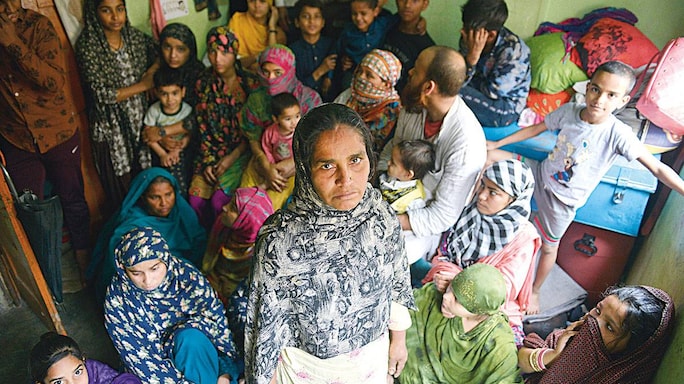
Mushtari Khatoon in her Chandu Nagar home among the families she saved (Photo: Yasir Iqbal)
When the phone rang early on the morning of 25 February—Mushtari Khatoon, her husband Mohammed Hakim and their three teenaged children were asleep in their home in north-east Delhi’s Chandu Nagar. As Hakim handed her the phone and Mushtari grabbed it, a chill ran through her spine. “They are going to kill us, Chachi! For God’s sake, save us!” howled her young nephew Muhammad Niyaj at the other end.
The petite Mushtari, 42, rushed out in a blind panic to Khajuri Khas, across the dusty, broken road, from where her family had called. Trouble had been brewing, but no one had imagined the cauldron of communal hatred would boil over with such vengeance in Delhi, which was hosting US President Donald Trump at the time. This madness took away 53 lives, both Muslims and Hindus, and left hundreds homeless and orphaned, in the north-eastern fringes of the capital.
Reaching the lanes of Khajuri Khas, Mushtari watched in disbelief as hundreds of armed men shouting “Jai Shri Ram” flooded the narrow lanes, dressed in riot-police gear. “Carrying petrol bombs, country-made pistols, lathis and tear-gas shells, they went on the rampage,” Fayaz Alam, Mushtari’s nephew, says.
“I trembled within, but knew I had to jump in, else my family would be killed,” recalls Mushtari. She ferried them, making five trips cross to her home in Chandu Nagar, a Muslim-majority area. On her last round, however, she got stuck along with a crowd, their lives hanging by a thin thread.
Khajuri Khas is a grubby urban settlement, where homes of Hindus and Muslims lie cheek-by-jowl with small businesses dotting the lanes. Skirted by open drains and the sludgy Chand Bagh nullah, it is home to migrant labourers who came here to build a better life. Mushtari and her large clan are among them.
Growing up in Bihar’s Khagaria district, Mushtari is a homemaker with only basic skills that would see her through in Delhi. However, that day she stood up to blind terror with the power of a matriarch.“The mob targeted Muslim households and forced them to leave their homes,” says Mohammad Munazir, who lost his small, windowless house, built with his life savings, in the mayhem.“I called the police at least 10 times, as did others, but nothing,” says Mushtari, a week later. The rioters busted doorways, broke open shutters and hounded out victims, while spitting communal taunts at them. Then they unleashed large-scale loot and arson. Targeted by the mob, some 150 terrified people took shelter on one Mehboob’s roof, escorted by paramilitary men. Meanwhile, the basement had been set ablaze. “We had no place to escape, and waited for a grisly end on that rooftop,” says 22-year-old student Mushahid.
Hysterical with fear, they explored their next move, when the paramilitary men ordered that the men must stay and the women and children should leave. “This is when I put my foot down. ‘Everyone will leave, else we will all die here’ I told them firmly,” says Mushtari. She then supervised the evacuation of 50 men, women and children, including a mother, who jumped across three rooftops carrying her six-day-old baby to reach safety.
These nine families were in her care, when we visited, in two tiny rooms, where they took turns to sleep. The couple opened up their home and hearts to create a safe house for these refugees of hatred.
As we walk back through the charred remains of destroyed homes, broken glass and the many dreams that died that day in Khajuri Khas, Mushtari clasps my hand, her eyes welling up in grief. This is the woman, who saved more lives than any policeman that day.
source: http://www.readersdigest.in / Reader’s Digest / Home> True Stories> Heroes / by Sanghamitra Chakraborty / April 27th, 2020
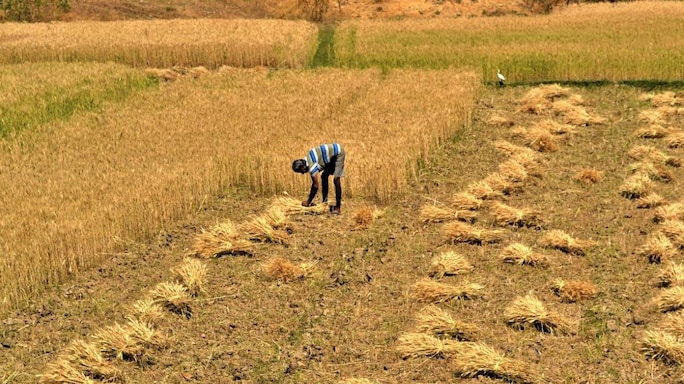
Riyaz Zaman and Mustafa Qamar Zaman decided to donate their entire standing crop to the state asking for the wheat to be distributed among the underprivileged.
Image used for representative purposes only (courtesy Pixabay).
Two brothers in Madhya Pradesh’s Guna district toiled away on their wheat field for months tending the crop with the hope of making a decent profit. But with the coronavirus pandemic striking terror and bringing the country to a standstill, they decided to donate the entire harvest to the state so that the poor and the needy can be fed.
The duo, Riyaz Zaman and Mustafa Qamar Zaman, approached the Guna district administration and expressed interest in donating their standing crop in an area of 25 bighas (around 6 acres) to the state.
The district administration swung into action immediately. Led by Guna district collector S. Vishwanathan, the local administration took possession of the land and started harvesting the crop.
“They are devout Muslims belonging to the Bohra community, and they wanted to do their bit for the state and the country. Hence, they dedicated the crop with the condition that this would be distributed among the poor,” says R. B. Sindoskar, the deputy collector of Guna, who is overseeing the harvest of the crop.
Talking to Reader’s Digest, Sindoskar said that the crop once cut would yield more than 100 quintals of wheat, which will be donated to the state granary.
The crop in the field located in the Bhullan Pura area of the Guna district, Sindoskar says, has almost been cut, and it is being transported to a granary in Guna. Sindoskar estimates that at today’s rates, the wheat would cost around ₹2 lakh.
The teachings of the Bohra Muslim community religious head Syedna Mufaddal Saifuddin—that helping those in need is the greatest service to humankind—was the inspiration behind the two brothers’ charitable effort.
“They have set an example for others,” says Sindoskar, also adding that the wheat will indeed be distributed for the cause the brothers intended.
source: http://www.readersdigest.in / Reader’s Digest / Home> True Stories> Heroes / by V Kumara Swamy / April 20th, 2020
While Mustafabad heals, Al Hind Hospital is now a sanctuary—over 50 people, left homeless by the politics of hate, are housed there.
24 February 2020 was a busy day at Al Hind Hospital at Delhi’s Old Mustafabad. This three-storied hospital, in a Muslim-dominated neighbourhood, found itself in the eye of a communal storm, and its founding doctor—40-year-old M. A. Anwar, a migrant from Bihar—thrust into the foreground.
“Patients started coming in from 2:30–3 a.m. The facility is small; we didn’t have the infrastructure, but became the only refuge for those who needed medical help,” Anwar says.
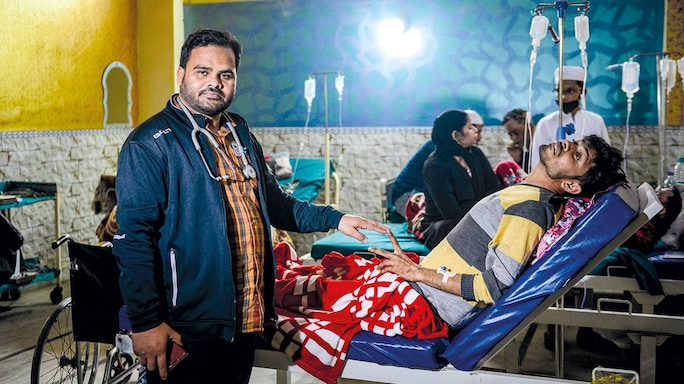
Through the next few days of communal fire, nearly 600 patients streamed in, turning the first floor into a makeshift emergency ward. Mattresses and sheets were requisitioned, ropes were strung across the room to hang drip feeds. Alarmingly, many of the injuries Anwar treated were from bullets and pellets; some were worse. “Every wound I witnessed wasn’t just trauma—it was plain savagery. They spread a man’s legs until his groin split in half.”
“There were attacks everywhere. All the entry points into Mustafabad were barricaded,” he continues. “We tried to call ambulances but the Centralized Accident Trauma Services, meant for this very purpose, flatly refused.” The police were no better. “We had wheeled out a patient with a severe head injury on a stretcher, and others with pellet injuries, about a quarter of a kilometre from here.” When an ambulance organized by some of Anwar’s doctor friends reached, the police refused entry. “They said, ‘Our constable was killed, so how does it matter if eight or 10 of yours also die’. Kids with pellet injuries were beaten up mercilessly by men in uniform.”
Handicapped by institutional failure, Anwar found himself doubting his ability to help. But, he found his resolve soon, “I decided, we will try our best. For the rest, kudrat [nature] will take its course.”
His faith paid off. Justice S. Muralidhar of the Delhi High Court was to hear a plea on 25 February on allowing safe passage to the wounded from Al Hind Hospital to Guru Teg Bahadur Hospital, which was better equipped to treat these severe injuries. Advocate Suroor Mander arranged for Anwar to testify on the desperate situation at the hospital. “The honourable judge—simply doing his duty, listening to those affected—saved us.”
Doing one’s duty—and doing it well—is exactly what sets Anwar apart too. Not abandoning his station, even when he had the opportunity to, speaks volumes of his commitment to his profession. “It is during times of trouble that a doctor is needed. I didn’t have the time to think it through, but had I fled that day with my family, I would have lived with the regret that I didn’t do my duty. I have just done my job.”
Witnessing this scale of violence could shake anyone’s faith inhumanity but Anwar disagrees: “We all have our conscience. It’s been suppressed to an extent in some; sometimes it feels like it has taken leave of others. But everyone has a sense of what is right. And everyone knows what happened was wrong,even if they don’t have the courage to speak up.”
While Mustafabad heals, Al Hind Hospital is now a sanctuary—over 50 people, left homeless by the politics of hate, are housed there. “We are trying to rehabilitate them. Give them rent and rations for a couple of months; most of them had low-income jobs, so we are also trying to find them work. Currently, we are building a database of those who want to help and those in need—to bring them together.”
Anwar moved to Delhi almost 18 years ago from Bihar’s Champaran district. After he decided to pursue a career in medicine, his mother would tell him, that once he became a doctor, he shouldn’t charge fees. “I think, now, I have kept her word,” he laughs.
source: http://www.readersdigest.in / Reader’s Digest / Home> True Stories> Heroes / by Naorem Anuja / April 29th, 2020
In the mid 1940s, as the Muslim League began to realise its vision of a separate nation state for the subcontinent’s Muslim population under Muhammad Ali Jinnah, it met with resistance not only from the Congress’ high command but also from the Jamiat Ulama-i-Hind (JUH), a political organisation that was founded in 1919. In this excerpt from Venkat Dhulipala’s Creating a New Medina, the leader of the JUH, Maulana Hussain Ahmad Madani, presents his reasons for his opposition to the Muslim League and the two-nation theory.
The JUH now formed a separate party, the Azad Muslim Parliamentary Board, to fight the elections and ward off the criticism that it was merely a handmaiden of the Congress. Its chief campaigner was Maulana Husain Ahmad Madani, the principal of the Darul Uloom, Deoband, and one of the foremost Islamic scholars in the country. Madani, as his name suggests, had an intimate connection with Medina as he had been a renowned teacher of Hadith in that holy city for nearly fifteen years. Madani remained steadfast in his advocacy of a composite undivided India and emerged as the most prominent alim opposed to the ML and its Pakistan demand. Reacting to the accusation that he had ‘joined the Hindus’, he wrote to a correspondent in Rawalpindi
You write that I have joined the Hindus and you are stunned by that. Why do you get affected by such propaganda? Muslims have been together with the Hindus since they moved to Hindustan. And I have been with them since I was born. I was born and raised here. If two people live together in the same country, same city, they will share lot of things with each other. Till the time there are Muslims in India, they will be together with the Hindus. In the bazaars, in homes, in railways, trams, in buses, lorries, in stations, colleges, post offices, jails, police stations, courts, councils, assemblies, hotels, etc. You tell me where and when we don’t meet them or are not together with them? You are a zamindar. Are not your tenants Hindus? You are a trader; don’t you buy and sell from Hindus? You are a lawyer don’t you have Hindu clients? You are in a district or municipal board; won’t you be dealing with Hindus? Who is not with the Hindus? All ten crore Muslims of India are guilty then of being with the Hindus.
Madani believed that the ‘fundamental institution of contemporary political life was the territorial nation-state’ and India was indeed such a State . The main problem facing India was British imperialism which could only be overthrown through a joint Hindu-Muslim struggle. This would have the effect of also freeing other parts of Islamic world from British yoke, since it was control over India that allowed them to hold on to their worldwide Empire. Madani opposed Pakistan since he saw it as a British ploy to divide and weaken the nationalist movement and extend British control over the subcontinent. He pointed to their dismemberment of the Ottoman Empire and reducing its component parts to colonial appendages. Madani therefore attacked ML and Pakistan in a number of different ways. To begin with, he accused Jinnah of deliberately not coming up with a concrete plan about Pakistan. Quoting a news report from the Haqiqat of Lucknow, he pointed out that when Jinnah was asked at a press conference in Karachi about what Pakistan meant, the Qaid asked for more time to provide clarifications on the matter. On being pressed further, Jinnah directed the inquisitive newsman to existing writings and his own statements on Pakistan. When a Muslim editor reportedly pointed out that he had read all the existing literature and concluded that Pakistan was suicidal for the Indian Muslims, Jinnah got upset and refused to take further questions. For Madani this meant that Mr. Jinnah till date had not fully thought through or worked out the implications of Pakistan.
By contrast, Madani claimed that he himself had thought deeply on the matter and proceeded to lay out Pakistan’s devastating consequences for the Indian Muslims. While earlier JUH commentators had highlighted its dangers for the ‘minority provinces’ Muslims, Madani added that even those belonging to the majority provinces would find themselves in the lurch. He made it clear that according to the principles of the Lahore Resolution itself, existing provincial boundaries would have to be altered. It would entail Muslims in eastern Punjab and western Bengal being excluded from Pakistan. After all numerical majority was the deemed principle for partition, and non-Muslim districts in the Muslim majority areas could not be forced to join Pakistan. Assam too would not be a part of Pakistan as Muslims were a small minority in the Brahmaputra Valley. Madani noted that Iqbal too had talked of severing the Ambala division from Punjab to make it more religiously homogenous. By echoing the official Congress stance on the issue of territorial division Madani squarely called into question Jinnah and Liaquat’s claims that Pakistan would include six provinces in their entirety.
Madani also ridiculed the idea that Pakistan would be an Islamic State based on principles of the Sharia. He noted that the Asr-i Jadid of Calcutta had quoted Jinnah as saying that Pakistan’s constitution would be created by a Constituent Assembly elected by its people. Madani also referred to the Shahbaz of Lahore that carried an Urdu translation of Jinnah’s interview to the News Chronicle of London, in which he likened Pakistan to a European style democracy. Jinnah had also made it clear that Pakistan’s basic industries would be state controlled thus making it more akin to a socialist State. Madani’s extensive and careful citation of various newspaper reports in his pamphlets against Pakistan attests to the importance of the popular press not only in terms of being a critical site for debating Pakistan but also as a vehicle for dissemination of information and ideas to a wide audience.
Madani was however selective in quoting Jinnah since he largely ignored his many public statements wherein the Qaid asserted that Pakistan’s government would be established according the principles of the Sharia. Even if Madani quoted one such speech where Jinnah asked the minority provinces Muslims to sacrifice themselves for the purpose of establishing such a State, he dismissed it as a charade (dhong). After all Jinnah was not a practicing Muslim and Islamic practices had no meaning for him. The JUH ulama would go on to call Jinnah Kafir-iAzam and Churchill’s showboy. Madani also pointed out that Jinnah did not particularly care for even the worldly needs of fellow Muslims. Jinnah had after all sacrificed Muslim legislative majorities in Punjab and Bengal in the 1916 Pact. Closer home, Madani noted that the staff of Jinnah’s newspaper the Dawn, included only three Muslims while it had six Hindus, two Christians, a Jew, and even a Qadiani such as Z.A Suleri.
The League’s anti-Islamic character, its close association with the imperialist government, its dangerous ploy of Pakistan and the devastating consequences it would have for Indian Muslims were themes that Maulana Husain Ahmad Madani reiterated in a number of pamphlets on the eve of the elections as he tried to wean Muslim voters away from the ML. These were pithily summarized in a widely circulated appeal to the Muslim voter that listed all the anti-Muslim activities of the ML over the past three decades.
1) The ML had betrayed Islam by undermining a comprehensive Shariat Bill in the Central Assembly by adding conditions that rendered it useless and dead.
2) The ML toed the government line by passing the Divorce (Khula) Bill which made it unnecessary for Muslim judges to adjudicate divorce in Muslim families. When the JUH ulama sought to redress this issue by introducing a Qazi Bill, the ML at the government’s behest opposed and killed this bill since it did not want the ulama to be invested with any authority.
3) The ML had co-operated with the government to enable the passage of the Army Bill even though 500 ulama signed a fatwa opposing it.
4) The ML had not objected to the transfer of the Shahidgunj court case from Punjab to Calcutta thus sinking the Muslim cause forever in the Bay of Bengal.
5) The ML supported amendments to the Civil Marriage Act allowing marriages between Muslims and non-Muslims even though it knew that such marriages were against the Quran.
6) The ML forced the Sarda bill upon Muslims with government help even though the ulama protested against such an imposition.
7) The ML signed the Lucknow Pact of 1916 reducing the Muslims to legislative minorities in the provinces of Punjab and Bengal.
8) During the 1930 Round Table Conference, the ML got together with Europeans, Indian Christians, and Anglo-Indians and again reduced Bengal and Punjab Muslims to a minority in their own province, making their demand for establishing Pakistan in these very areas rather ironic.
9) The ML repeated this despicable tactic again after the Communal Award of 1932.
10) The ML supported the government in imposing stiff conditions for obtaining drivers licenses making life more difficult for poor drivers.
11) The ML did not condemn the government for shooting dead 47 Muslims who were part of a public procession mourning the hanging of Abdul Qayyum by the Sind government.
12) The ML government in Bengal was responsible for the death of 35 lakh people during the Bengal famine, a majority of who were Muslims.
13) The government of Sir Nazimuddin was extremely corrupt and government contracts were mostly handed over to friends and relatives of the high and mighty including many Hindus.
14) The Central government dropped 700 bombs from the air upon the NWFP as part of its offensive against the rebellion killing a number of Muslims. When the Congress member from Madras, Mr. Satyamurthy introduced a motion to condemn these wanton acts of the government, the ML did not support him and instead kept silent.
15) While the ML raised a hue and cry over atrocities perpetrated upon Muslims in the minority provinces by the Congress governments, when Rajendra Prasad offered an enquiry to be headed by the Chief Justice of the Federal Court, the ML flatly declined and instead demanded a royal commission to probe the charges.
16) The ML did not raise even a murmur of protest when the government itself declined to set up a Royal Commission for this purpose.
17) The ML did nothing for the cause of the Palestinians or the Muslims of Zanzibar.
An excerpt from Venkat Dhulipala’s Creating a New Medina: State Power, Islam and the Quest for Pakistan in Late Colonial North India. Reproduced with the permission of Cambridge University Press.
VENKAT DHULIPALA :Venkat Dhulipala is Assistant Professor of History at the University of North Carolina Wilmington, and teaches courses on the history of modern South Asia, comparative colonial histories and introductory surveys in Global History.
source: http://www.caravanmagazine.in / The Caravan / Home> News> History / by Venkat Dhulipala / March 08th, 2015
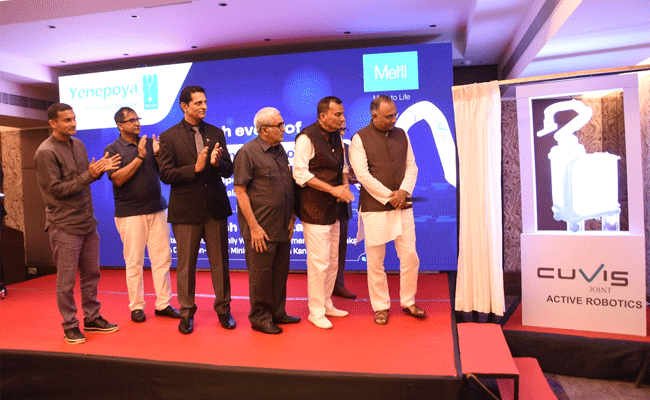
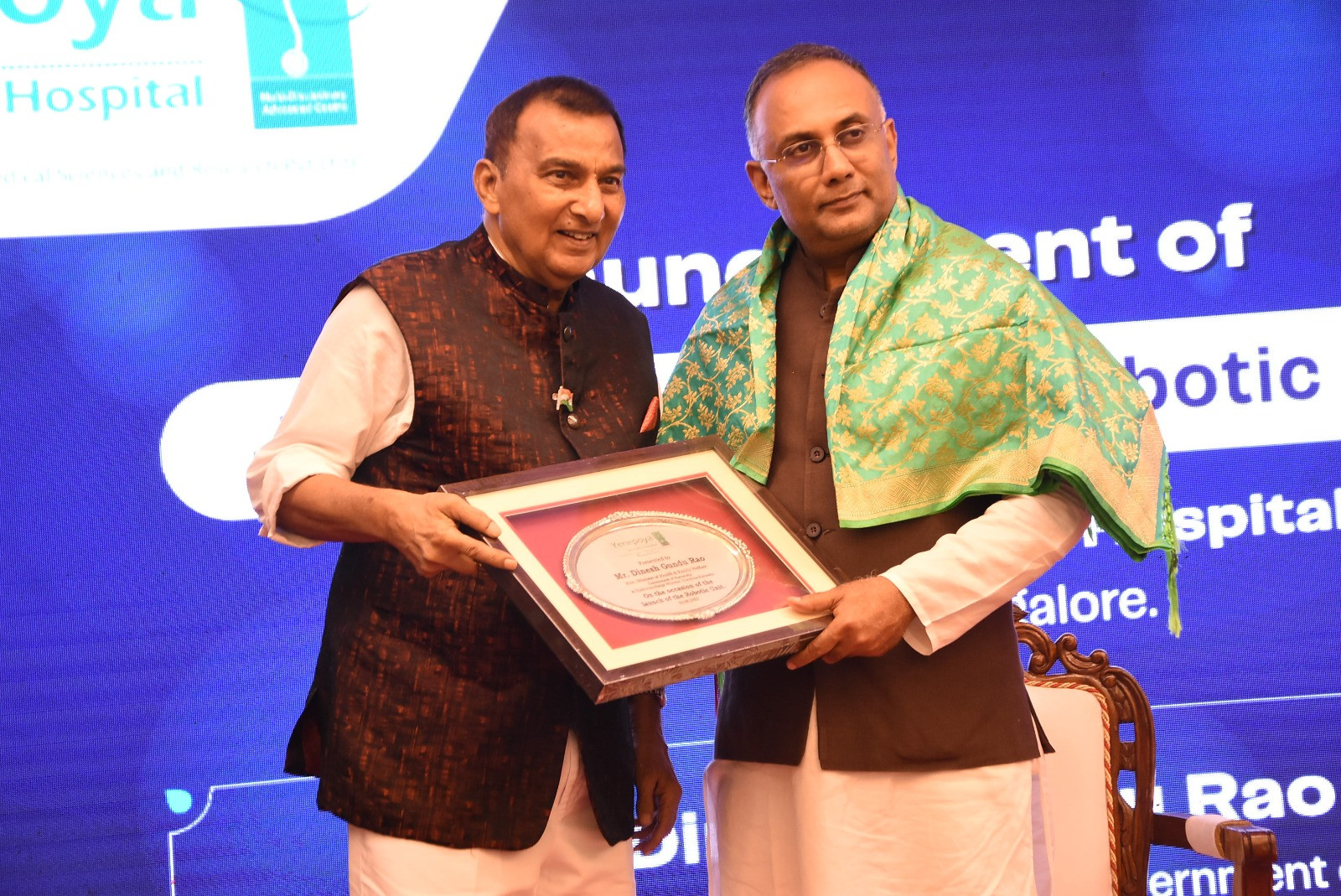
Yenepoya Specialty Hospital marked a significant milestone with the launch of its cutting-edge Joint Replacement Robotic Unit. The launch event took place at the Taj Vivanta Hotel in the city on Tuesday. Gracing the occasion, Karnataka Health Minister and Dakshina Kannada In-charge Minister Dinesh Gundurao inaugurated the revolutionary unit, which is a collaborative effort with Meril Life, a global med-tech company.
This pioneering initiative stands as the first-of-its-kind facility not only in Dakshina Kannada but also as the first outside Bengaluru in the state of Karnataka.
Dr. Muhammad Thahir, the Director – Medical at Yenepoya Hospital, extended a warm welcome to the esteemed guests and attendees, setting the tone for the event. Dr. Yenepoya Abdulla Kunhi, Chairman of Yenepoya Group, followed with introductory remarks that shed light on the transformative potential of the newly launched robotic unit in the realm of healthcare. Dr. Kunhi also emphasized the need for adapting to technological advancements for the betterment of humanity and acknowledged the district’s continuous commitment to healthcare excellence.
Suvdeep, representing Meril, provided an insightful overview of the Cuvis Joint Replacement Robotic Unit, now available at Yenepoya Specialty Hospital. Highlighting its uniqueness, Suvdeep explained that it’s the sole fully-automatic robotic joint replacement unit currently accessible. The technology empowers doctors to offer personalized alignments based on a generated 3D model from CT scans, underscoring the critical role of medical expertise in the process.
Dr. Deepak Rai, Consultant Orthopaedic Surgeon at Yenepoya Specialty Hospital, applauded Abdulla Kunhi and Mohammed Farhaad Yenepoya for their visionary efforts in elevating healthcare standards in Dakshina Kannada. Dr. Rai elucidated the profound impact this robotic joint replacement unit is anticipated to bring to the future of healthcare over the next decade.
Explaining the concept of Joint Replacement Robotic Surgery, the Cuvis system was described as a tool that employs accurate CT scans of the knee and meticulous measurements pre-surgery, delivering enhanced precision and benefits in the field of joint replacement.
Minister Dinesh Gundurao commended the new service and urged the public to utilize such advanced offerings in the region. He also stressed the importance of researching why arthritic issues are increasingly affecting the younger generation. Minister Gundurao applauded the healthcare contributions of Yenepoya Group and underscored their resolute commitment to elevating healthcare in the district.
The event concluded with Dhanush Shetty extending a vote of thanks, while Clinical Dietitian Haifa Ansari efficiently compered the proceedings.
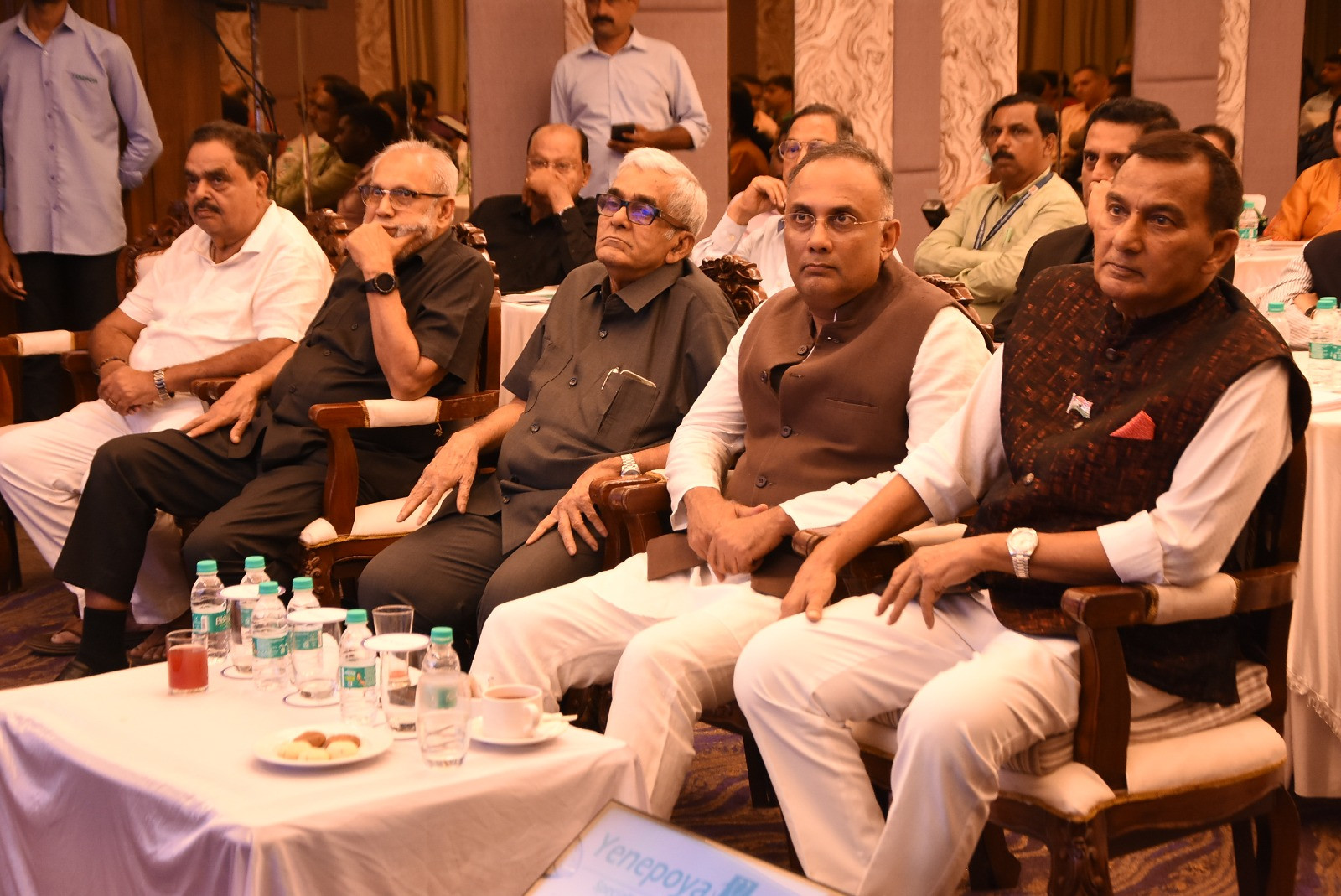
Managing Director of Yenepoya Group, Yenepoya Mohammed Kunhi, Director Operations Yenepoya Abdulla Javeed, Pro-Chancellor of Yenepoya Deemed to be University Yenepoya Mohammed Farhaad, Vice-Chancellor Dr. Vijay Kumar, Former Minister Ramanath Rai, Dr. Bhaskar Shetty, Dr. CP Habib Rehman, Dr. Savita Shetty, and others were present during the significant occasion
source: http://www.varthabharati.in / VarthaBharati.in / Home> Karavali / by Vartha Bharati / August 15th, 2023
Syed Akthar Ahmad, also known as Akthar Orenvi, was a Bihar-born Urdu writer who produced exceptional literary works, devoted his life to Urdu, and died in 1977 after suffering from a severe illness.
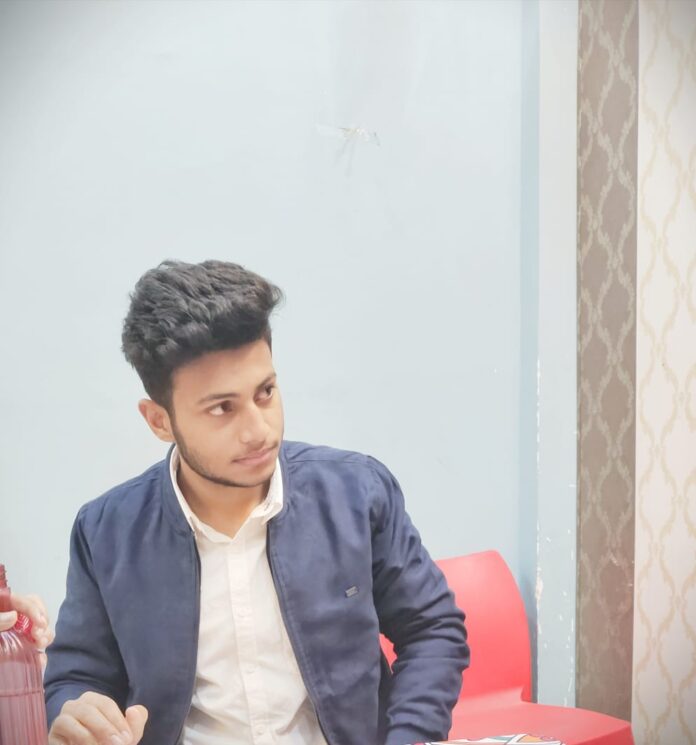
Now, almost 35 years after Orenvi’s death, Syed Amjad Hussain, an 18-year-old aspiring writer, is writing a book about him in Hindi, an extraordinary task for a student in his first year of college.
“Bihar has been home to many Urdu writers and poets, some of whom are still remembered, while others have been relegated to obscurity in an era when the language itself is on the verge of extinction,” said Hussain, who is currently pursuing BBA at the Maulana Abul Kalam Azad University of Technology in West Bengal, adding that he has chosen to write a book about Orenvi and “re-introduce him to the youth of today.”
Why Akthar Orenvi?
Hussain was introduced to Urdu writers in his house, where education has always been a priority, through the elders who spoke about prominent Urdu writers of Bihar and also narrated the stories written by them.
“ My great grandfather had married a girl from Oren. She was the daughter of Magistrate Syed Irshad Hussain. And my father, his cousins all spent their childhood in Oren. And whenever they visited our house there used to be a lot of discussions about the village and the prominent people of the village, one of whom was the poet Akthar Orenvi” said Hussain to Two circles.
This connection with the Oren village and all that he heard about Akthar sahab gave young Amjad Hussain the idea to write about him.
Hussain was also moved by the fact that Orenvi suffered from severe illnesses but kept on writing till his last breath.
“In the current era of reel, people have been cut off from real life. And in the process, they have forgotten the rich Indian culture of reading. Earlier there were book clubs despite the fact that not all people had access to them. Today when people have such easy access to books, they are no longer interested in reading,” Amjad said.
“Akthar Sahab suffered from typhoid thrice. And in those days medical treatment was not advanced, and we can imagine how much he suffered then. Even while sick he never stopped writing; such was his devotion to writing. And I felt such commitment and dedication needs recognition. But sadly, non-Urdu readers don’t know much about him. So, I decided to write his biography.”
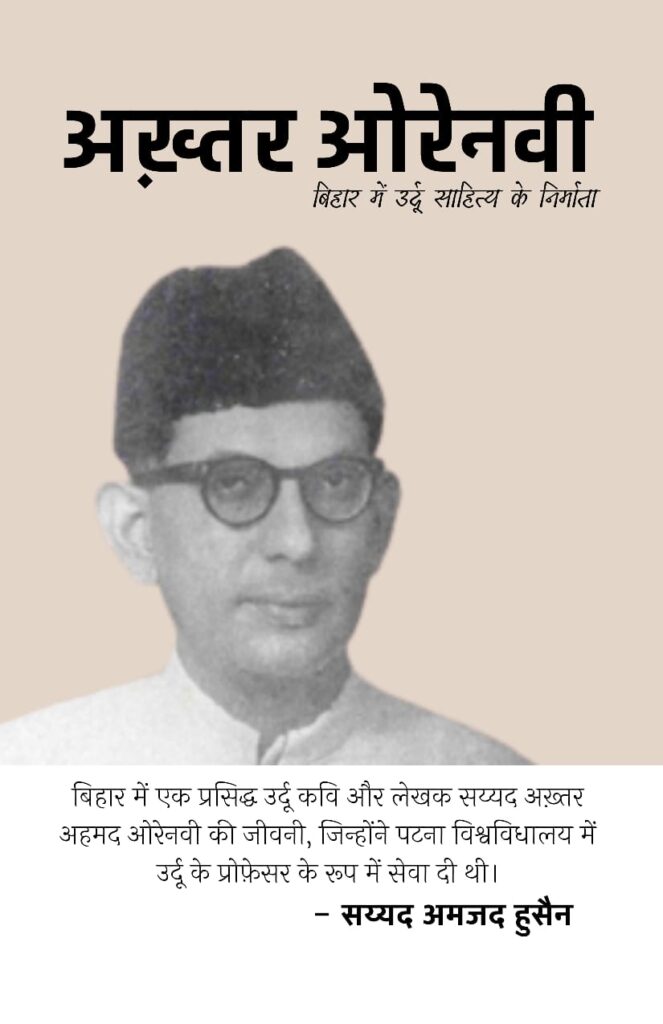
Cover page of the Hindi book authored by Syed Amjad Hussain
Amjad said his fascination about History and his own love for the Urdu language were also reasons why he chose to write the biography of Orenvi.
Amjad shared that there is one very popular book by Orenvi titled ‘Bihar mein Urdu Zaban -O-Adab ka Irtaqa’ which also played a role in prompting him to write about him.
And surprisingly his parents agreed to his project with no questions asked!
What the book contains
Syed Akthar Ahmed hailed from Urain or Oren, a village in Munger division of Bihar State. The book Amjad is writing is titled ‘ Akthar Orenvi: Bihar mein Urdu Sahitya ke Nirmata’ and has roughly around 70-80 pages containing a brief history about Orenvi – birth, education, marriage, achievements, his meeting with Pandit Jawaharlal Nehru, his sickness, his works and his death.
“Unfortunately, not much material is available about Akthar Orenvi”, said Amjad to Two circles, “I did extensive research, even visited Oren the place where Akthar sahab belonged to. His house in the village is intact. And I found some pictures which I shall include in my book,” he added.
Amjad spoke to the people of the village, especially the elders who had more to tell. He started his research in October 2022 and began writing the book in January 2023.
The people in the village told him that Akthar sahab shifted to Patna after his marriage so they did not hear much about him later. “His house in the village is intact and so are his memories in our hearts”, said one of them.
Akthar Orenvi’s brother Syed Fazal Ahmed retired as Inspector General. Akthar Orenvi did not have any children but has some popular descendants (nephews) who are well known TV and theatre personalities like Roshan Seth who played the role of Pandit Jawaharlal Nehru in the epic movie ‘Gandhi’ and Aftab Seth, retired Indian diplomat.
Akthar Orenvi’s works are included in the syllabus of many a Urdu University all across India. And his short stories are included in SSC Board exams. And Amjad’s favourite story by Orenvi is ‘Ek Darakht ka Qatal’.
Akthar Orenvi’s house in his village Oren
Future plans
Amjad feels this book, slated to release on the 14th of July will not only introduce the poet, writer AKthar Orenvi to the youth but also make them want to learn Urdu so they can read the original works of the author.
The first edition will have 300 copies only which will be sold online through Notion Press, Chennai.
Interestingly Amjad has worked on the book alone, reading, re-reading, spell check, proofreading etc.
Amjad, originally from Shaikhpura, Bihar now lives in Kolkata pursuing his studies while his parents and siblings continue to live in Bihar.
His father, Syed Ahmad Hussain founded ‘Madrasatul Banat Azizul Uloom’ in the 90s which is exclusively for girls. Syed also looks after their business along with his eldest son while his younger siblings are studying.
Amjad plans to write another book about Sufism in Bihar. He likes reading Urdu Shayari, especially the works of Juan Elia Sahab and Imam Ahmed Raza Khan.
He wants to work towards preserving the Urdu language because he feels that it is foolish to associate any language with one particular community and discriminate against it.
But overall, he is just like any other teenager, fun loving and hangs out with his friends.
source: http://www.twocircles.net / TwoCircles.net / Home> Indian Muslim> Lead Story> TCN Positive> Youth / by Nikhat Fatima, TwoCircles.net / July 05th, 2023
“Of men of this type who are known to have approached Mr. Gandhi with offers of assistance, the most prominent is Pir Muhammad.” W. H. Lewis, Sub Divisional Officer of Bettiah, wrote this in a report to the Commissioner of Muzaffarpur in 1917. The context was the famous Champaran Satyagraha which launched Mahatma Gandhi in Indian politics. The British officials believed that Pir Muhammad was the man who informed Gandhi about the plight of peasants in Champaran.
Who is Pir Muhammad?
I asked the question to a researcher when he told me about Pir Muhammad. I was heading a research team for planning a museum at Red Fort, Delhi. I had no idea about Pir Muhammad. After I got to know him and his contributions, we gave him a place in a gallery with Ganesh Shankar Vidyarthi, another nationalist journalist.
Lewis gives the answer to the above question in his report: “He is, I believe, a convert to Muhammadanism (Islam), and was a teacher in the Raj School. He was dismissed from his post for virulent attacks on local management published in or about 1915 in the press. He lives in Bettiah, and works as a press correspondent for the Partap, a paper which distinguished itself for its immoderate expressions on Champaran questions.”
Pir Muhammad, who used pen name Munis, was a regular contributor to the nationalist Hindi newspaper Pratap edited by great freedom fighter Ganesh Shankar Vidyarthi. Chamaparan had been a center of anti-colonial agitation since 1906 when Sheikh Gulab and Sital Ray organized peasants against the forced indigo plantations. Pir was a school teacher in Champaran with a flair for writing. In 1914, he started highlighting the atrocities of British officials on local peasants with his articles in the Pratap.
Pir’s articles popularised agitations in Champaran at a national level. Along with Raj Kumar Shukul, he played an instrumental role in bringing Gandhi to Champaran and starting a satyagraha. An intelligence report noted that Pir “is a man of no position, and no means, a dangerous man, is practically a Badmash”.
Lewis reports explains the important of Pir Munis. It says, “Pir Muhammad is the link between this Bettiah class of mostly educated and semi-educated men and the next class, i.e., the raiyats’ leaders.” In a society where raiyats (peasants) were mostly illiterate, their voices remained unheard by the educated class. Pir was an educated person but did not belong to the urban elite. His articles brought out the realities of village dwellers to the urban educated class. The urban educated, like Rajendra Prasad, further popularised the matter at a nationwide scale.
Pir before the visit of Gandhi, and after the visit as well, advised peasants who took up legal battle against the indigo planters. He used to sit at SDM and SDO’s courts to help any peasant who wanted to file a case against indigo planters. This is a reason why the Superintendent of Police called him “a very bitter man”.
Pir Munis played an important role in making Gandhi a national hero. After Champaran Satyagraha, he kept fighting for peasants’ rights, depressed classes, and promoting the Hindi language till his death in 1949.
source: http://www.awazthevoice.in / Awaz, The Voice / Home> Story / by Saquib Salim / August 18th, 2023
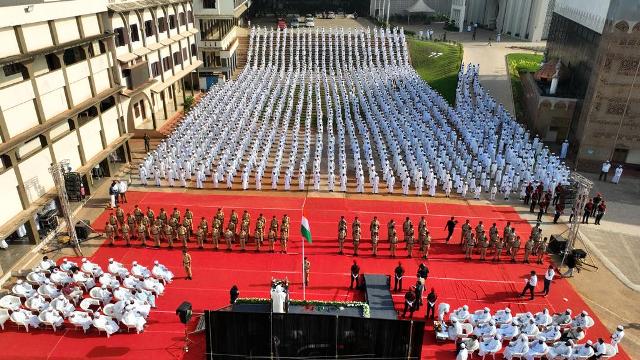
Students from 24 states celebrate the Independence Day at Markaze
Calicut:
Students from 24 states and six union territories came together in a grand ceremony at Markaz Karanthur to commemorate a significant event.
Sheikh Abubakr Ahmad, the founder Chancellor of Markaz and Grand Mufti of India, proudly raised the flag and delivered an inspiring address. He emphasized that every Indian deserves to relish the hard-earned freedom that has been secured through the united efforts of people from all walks of life, transcending barriers of caste, religion, and class.
Furthermore, Sheikh Abubakr Ahmad urged the nation to reflect upon the civil liberties and fundamental rights envisioned by the architects of our nation and enshrined in the constitution. After 76 years of independence, it is crucial for both citizens and leaders to assess the extent to which these principles are being upheld in the present day. He encouraged the students to pursue continuous learning and training, with the aim of elevating India’s reputation on the global stage.
Addressing the gathering, Markaz Director General C Muhammad Faizi conveyed an important message.
The students, under the guidance of Jamia Markaz Pro-Chancellor Dr Hussain Saquafi Chullikode, made a collective pledge to uphold these values.
The event featured a parade and captivating performances by various groups including the Markaz School Student Police Cadet, Scout, Junior Red Cross Society, NCC, and the Markaz School brigade team, adding to the festivities.
source: http://www.muslimmirror.com / Muslim Mirror / Home> Indian Muslims / by Muslim Mirror Desk / August 15th, 2023
The famous writer Kushwant Singh, once wrote: “Indian Freedom is written in Muslim blood, since their participation in the freedom struggle was much more, in proportion to their small percentage of the population.”
The story and history of India’s independence are written with the blood of Muslims. According to historical references, 65% of those who stood, fought and sacrificed against the British for India’s independence were Muslim freedom fighters, the hams live reported.
A large number of people from all religions and castes took part in the freedom struggle, undoubtedly. However, the struggles of many Muslim prominent personalities who also contributed to India’s freedom and even sacrificed everything including their lives are little known. Muslims have been at the forefront to oppose the British and stood shoulder to shoulder with people from other communities while fighting against them. Getting freedom was not easy, our ancestors had to go face a lot of struggles and difficulties to get us the freedom that we are enjoying now.
The First Call To Oppose British
In the 1750s, Nawab Siraj-ud-Daulah was the first awakened Indian ruler, who stood his ground against the British. He lost the Battle of Plassey in 1757 due to the betrayal of Mir Jafar (Commander of Nawab’s army). With this, Siraj-ud-Daulah’s reign marks the end of the last independent rule in India and the beginning of the East India company’s rule that was unabated for the next two hundred years.
First Freedom Struggle By Muslim Rulers
The first freedom struggle against the British was started by the rulers of Mysore Hyder Ali and his son, Tipu Sultan, during the 1780s and 90s. Both used the first iron-cased rockets and cannons effectively against the British invaders.
Tipu Sultan is considered to be one of India’s first freedom fighters for his fierce fight and brave against the East India Company. He resisted the conquest of the British in southern India and was reluctant to welcome them on his soil. He was the only Indian ruler who understood the dangers that the British posed to India, and fought four wars to oust them from the country.
The Unsung Heroines Of India’s Freedom Struggle
Begum Hazrat Mahal, the unsung heroin, played a very important role in India’s war of Independence. Being a woman, she led a rebellion against the British East India Company in 1857. She shot the British ruler, Sir Henry Lawrence and defeated the British army in a conclusive Battle at Chinhat in 1857.
In the great revolt of 1857, as many as 225 Muslim women sacrificed their lives in the uprising. These unsung Muslim women freedom fighters who have sloganeered, shed blood and given their lives for the country’s independence have now been forgotten to due biases.
A majority of freedom fighters did a nameless service to the nation and one such lesser-known name was Abadi Bano Begum (Bi Amma). Bi Amma was the first woman to address a political rally wearing an abaya. She took part in National freedom struggles, Khilafat Movement and propagated Hindu-Muslim unity. Following Mahatma Gandhi’s advice, Bi Amma played an. An important role in encouraging women to take part in the freedom movement. Further, she played a pivotal role in the Swadeshi movements.
In the book, Gandhi and the Ali Brothers: Biography of a Friendship by Rakhahari Chatterji, Maulana Mohammad Jouhar says, “Suffice it to say that, although she was practically illiterate, I have, in all experience, of men of all sorts of types, come across none that I could call wiser and certainly that was more truly godly and spiritual than our mother.”
Bi Amma was also the mother of Muhammad Ali Jauhar and Shaukat Ali popularly known as the Ali Brothers whom she raised on her own after her husband died when she was young.
Amjadi Begum, the wife of Muhammad Ali Jauhar and daughter-in-law of Bi Amma, is yet another Muslim women freedom fighter. Mahatma Gandhi also dedicated an article on her titled ‘A Brave Woman‘ where he admired her as a courageous wife of a courageous man.
At the age of 45, Asghari Begum, another forgotten Muslim woman, has also taken part in the 1857 revolt and challenged British rule in the present-day Uttar Pradesh. However, she was captured by the British in 1858 and burnt alive.
Habiba, a Muslim woman’s fought many battles against the British in Muzaffarnagar in 1857. However, she was captured and hanged along with 11 other female warriors at the age of 25.
The Great Revolt of 1857
During the Great Revolt of 1857, Hindus and Muslims under the leadership of the last Mughal emperor Bahadur Shah Zafar tried to oust the British from India. A majority of Hindu sepoys requested Zafar to lead them in the war of Independence. Although the Revolt failed due of several reasons, Muslims have always stood on the front line to oppose the British.
Former Prime Minister of India, Rajiv Gandhi during his visit to Bahadur Shah’s grave, wrote in the visitor’s book: “Although you (Bahadur Shah) do not have land in India, you have it here; your name is alive… I pay homage to the memory of the symbol and rallying point of India’s First War of Independence….”
Muslims came to India and ruled here for over 800 years but they did not steal anything from here as the British, the Dutch and the French did. By bringing plenty of knowledge in literature, architecture, judiciary, political structure, government body and management structure, which is still used in Indian management strategy, they helped India to progress into a unified and civilized nation.
Lighthouse of Rebellion
How many of us know that the organizer and leader of “First Indian freedom struggle” in 1857 was Moulavi Ahamadullah Shah. Known as the ‘Lighthouse of Rebellion’ in Awadh, he Faizabad free from British rule for almost one year, until his death at the hands of British agents on June 5, 1858.
“With being a practicing Muslim, he was also the epitome of religious unity and Ganga-Jamuna culture of Faizabad. In the revolt of 1857, royalties like Nana Sahib of Kanpur, Kunwar Singh of Arrah fought alongside Maulavi Ahmadullah Shah. Maulavi’s 22nd Infantry Regiment was commanded by Subedar Ghamandi Singh and Subedar Umrao Singh in the famous Battle of Chinhat,” according to researcher and historian Ram Shankar Tripathi.
The important role of Muslims in the uprising is the reason that the British government singled out the community for the worst revenge. From the Nawab, the King of Mysore, the last Mughal King, Princes, the landlords, the Ulemas, intellectuals, Urdu journalists, including common people, all members of the Muslim community have made great sacrifices for the freedom of India.
In the uprising of the 1857 revolt, thousands of ulema were slaughtered and the whole of Delhi was emptied of Muslims, according to excerpts from Syed Ubaidur Rahman’s book Biographical Encyclopedia of Indian Muslim Freedom Fighters. They were not even allowed to return to their homes and reclaim their properties.
First Journalist To Sacrifice His Life During The Great Revolt
Moulvi Muhammad Baqir, a scholar and activist of Indian independence activist was the first journalist to be executed following the rebellion in 1857. The editor of Urdu newspapers, Delhi Urdu Akhbar, was washed dead on 16th September 1857 for writing Nationalist articles, without even a trial.
Although India got independence on 15 August 1947, the foundation of the freedom struggle was laid before 1857. Since the time of the Revolt of 1857, which is considered to be the beginning of India’s freedom struggle, Muslim leadership has spearheaded the cause.
First Muslim To Be Hanged For Conspiring Against East India Company
At the age of 27 years, Shaheed Ashfaqulla Khan was the first Muslim to be hanged for conspiring against the British Raj. Khan was hanged to death on December 19, 1927. With this, he became a martyr and a legend among the people because of his love for the country and his unshakeable spirit.
Reshmi Rumal Tehreek (The Silk Movement)
Muslims not only took the lead in the uprising, but also stood in the front line in all other efforts to topple the British colonial regime in India.
After the revolt of 1857, the Muslim leaders changed their strategy of resistance by setting up educational institutions across the country. Reshmi Rumal Tehreek or The Silk Letter Movement (1913-1920) was an initiative by Deobandi Leaders Maulana Mahmud Hasan and Maulana Ubaidullah Sindhi to topple the British Empire.
However, when British intelligence learned about it, hundreds of sympathizers of the initiative were arrested and put in prison for years without any trial. The top leaders including Maulana Mahmud Hasan and half a dozen of his followers were banished to Malta after a faux trial where they faced the worst hardship.
Role of Muslims in Congress’ anti-colonial struggle
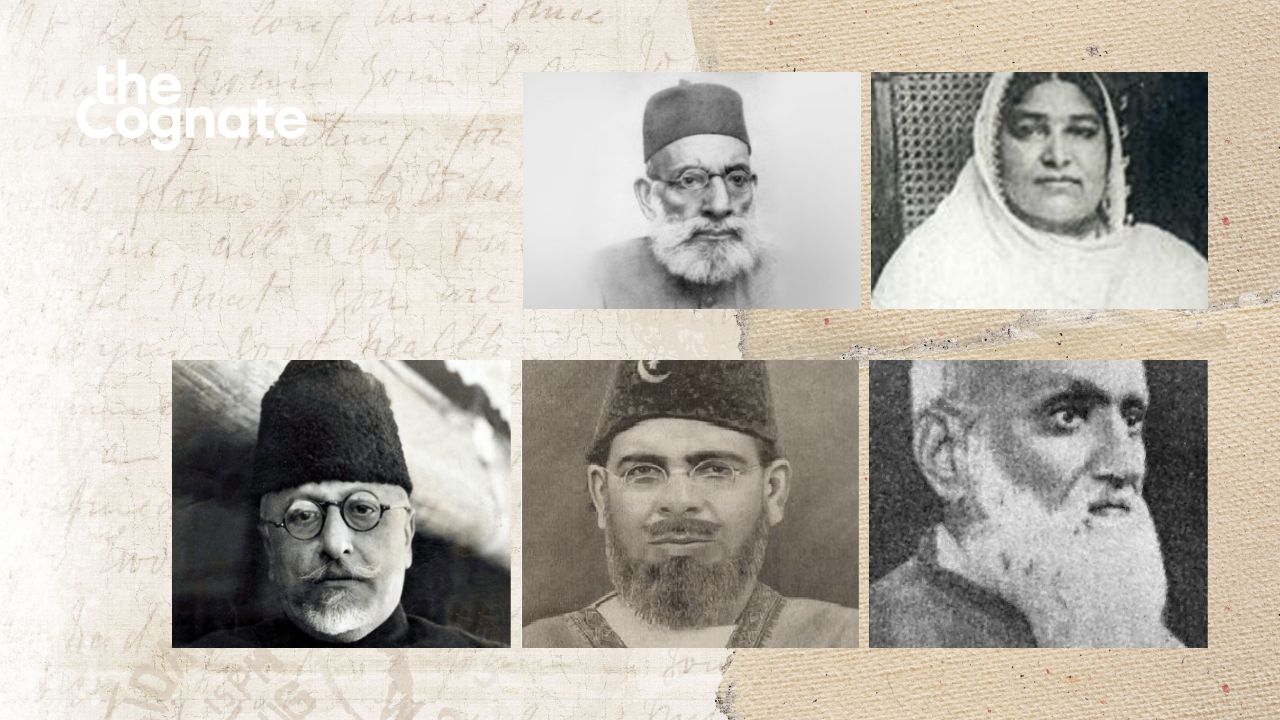
Justice Abbas Tyabji, an Indian freedom fighter from Gujarat and associate of Mahatma Gandhi, was the first Muslim president of the Indian National Congress party. Justice Tyabji is also known for leading Salt Satyagraha following Gandhi’s arrest in 1930.
Another Congress president during the colonialism was Maulana Abul Kalam Azad, who is one of the chief Muslim leaders of the anti-colonial nationalist movement. He became the youngest President of the Indian National Congress in 1923 at the age of 35. He faced multiple imprisonments by the colonial state.
From Justice Tayabji to Maulana Abul Kalam Azad, there have been eight Muslim leaders who were in the Indian National Congress’s freedom movement. The other prominent Muslim leaders include, Muhammad Ali Jauhar, Shaukat Ali, Maulana Azad, Dr Mukhtar Ansari, Hakim Ajmal Khan, Maulana Mahmud Hasan and many others. They made every possible sacrifice for the cause of the end the colonial rule.
Frontier Gandhi
Khan Abdul Ghaffar Khan was a Pashtun independence activist who campaigned to end the rule of the British Raj in India. He founded the Khudai Khidmatgar resistance movement against British colonial rule in India. He was also known as Frontier Gandhi for his principles of non-violence and friendship with Gandhi. Khan worked towards the formation of a united, independent, secular India.
Muslim Man Coins “Jai Hind”
The patriotic slogan “Jai Hind” was initially coined by Zain-ul Abideen Hasan, but it was adopted by Netaji Subhash Chandra Bose. It is now used as a way of salutation throughout India. It means “Victory to India” in English.
The Creation Of the National Flag
For a majority of us, the current national flag was designed by Pingali Venkayya. However, it was a Muslim Lady Surayya Tyabji, who created the flag’s final look today.
Although we have recounted several names of the Muslims who have contributed to India’s freedom struggle, there are several thousands of them who fought on the streets against the British Raj.
source: http://www.thecongnate.com / The Cognate / Home> History / by Rabia Shireen / August 15th, 2022
In the freedom struggle, Muslim freedom fighters played a predominant role.
In the Indian freedom struggle, though, Muslim freedom fighters played a predominant role, right-wing organisations are trying to erase their history. In view of it, it is essential to know the important Muslim freedom fighters who fought for Indian Independence.
Indian freedom fighter and former aide of Subhash Chandra Bose Abid Hasan Safrani. (Photo: Siasat)
Abid Hasan Safrani
Abid Hasan Safrani, an Indian National Army (INA) soldier from Hyderabad is one of the unsung heroes of Hyderabad. He not only played role in India’s independence but also coined the slogan ‘Jai Hind’ which was later declared the salutation of the Indian Army and government employees.
Safrani was constantly with the INA fighting from Burma to Imphal in India.
After India attained freedom, then Prime Minister Pandit Jawahar Lal Nehru inducted him into the Indian Foreign Service (IFS). He was posted to several countries including Egypt, China, Switzerland, Iraq, Syria, Senegal and Denmark.
After retirement, Safrani settled at a farm in Shaikpet, Tolichowki. He passed away in 1984.
Maulana Abul Kalam Azad
Maulana Azad, a distinguished Islamic scholar, author, academician and a prominent freedom fighter, was elected as the youngest President of Indian National Congress aged 35, and later led the historic Khilafat Movement.
After Independence, Maulana Azad served as India’s first Education Minister for over 10 years, during which he laid the foundations for the country’s massive academic network. Acknowledging his contributions, his birthday – November 11 – is celebrated as National Education Day.
Siraj-Siraj-ud-Doulah
Siraj-Siraj-ud-Doulah, the Nawab of Bengal was the first Indian king to foresee the threat posed to the future of the country by the English East India Company which entered India in the name of trade but transgressed its limits. He took bold initiatives to thwart the company’s evil designs.
Mir Khasim Ali Khan
Mir Khasim Ali Khan was a warrior Nawab who fought against the East India Company till his end with the conviction that he could ensure safety for his kingdom and liberty and prosperity for his people only by driving the British out of India.
Hyder Ali
Hyder Ali, who is famously known as ‘the Napoleon of South India’ for his relentless fighting against the conspiracies of the East India Company and its henchmen and for checkmating the British ambitions of expansion in South India
Tipu Sultan
Tipu Sultan, the ‘Tiger of Mysore’, was a great visionary who exposed the expansionist designs of the British imperial forces and gave a clarion call to his fellow countrymen and native rulers to unite and fight against the East India Company.
Syed Mir Nisar Ali
The Wahabi movement enjoyed a special status in the history of revolt against British rule in India, and Titu Mir, whose real name was Syed Mir Nisar Ali, added militancy to it. It became the source of inspiration for several movements in the Struggle for Independence of India.
Haji Shariatullah
Haji Shariatullah, who militantly led the Farazi Movement that stood as a source of inspiration for several revolutionaries in the Indian Freedom Struggle
Ghulam Rasool Khan
Ghulam Rasool Khan, the Nawab of Kurnool in Andhra Pradesh, created terror among the officials of the East India Company.
Moulana Peer Ali Khan
Moulana Peer Ali Khan fought against the British military force declaring that sacrificing oneself in the cause of liberation of one’s motherland is a proof of one’s love for his country.
Moulvi Ahmadullah Shah Fyzabadi
Moulvi Ahmadullah Shah Fyzabadi created panic among the British camps. In the First War of Indian Independence of 1857, he fought against the forces of East India Company and registered several victories over them.
Sheikh Bikhari Saheb
Sheikh Bikhari Saheb raged against General Dalhousee’s ‘Doctrine of Lapse’ whose sole objective was to expand the British empire. He stood in support of the freedom loving native rulers and fought against the foreign rulers.
Azimullah Khan
Azimullah Khan was renowned as a strategist in the First War of Independence, 1857.
He retreated to the forests of Nepal along with Nana Saheb, Hazarat Mahal and others, when the First War of Independence had faced the situation of near defeat. Azimullah Khan passed away in October 1859, while making efforts to secure financial and military support to fight back against the British.
Mohammad Bakht Khan
Mohammad Bakht Khan provided leadership to the heroes and heroines of The First War of Independence of India of 1857 against the forces of the East India Company, by taking up the responsibility of Commander-in-Chief.
He streamlined the troops after his appointment as the Commander-in-Chief by the Mughal Emperor, Bahadur Shah Zafar.
Khan Bahadur Khan
Khan Bahadur Khan, the ruler of Rohilkhand, fought against the British to liberate the motherland.
Declining a very high official post offered by the East India Company, Khan Bahadur Khan revolted against the British at the age of 70. He declared Independence at Bareilly, the capital of Rohilkhand on 31 May, 1857.
Bahadur Shah Zafar
Bahadur Shah Zafar, the last Moghul Emperor, led the First War of Independence, which was recognized in history as the symbol of anger among the people of India against the British.
He breathed his last in jail on 7 November 1862.
Mohammad Sher Ali
Mohammad Sher Ali, an embodiment of anti-British spirit , was born in 1842 at Peshawar, presently in Pakistan. He was inspired by the Wahabi movement that arose against the British in his younger age. His family migrated to Ambala from Peshawar in 1863. He was sentenced to death on 2 April, 1868.
Begum Hazrat Mahal
Begum Hazrat Mahal was a prominent woman of the 1857 rebellion. There was a fierce battle between the Company troops and the Begum troops. When defeat became inevitable, Begum Hazrat Mahal retreated to the Nepal forests along with the co-revolutionary leaders like Nana Sahib Peshwa and others.
Begum Hazarath Mahal struggled for the independence of her state till her last breath. She passed away at Kathmandu of Nepal on 7 April 1879.
Moulvi Syed Allavuddin
Moulvi Syed Allavuddin was a spiritual leader. He used to exhort people of Nizam State, one of the strongest princely states of South India, to rebel against the British hegemony. He stood in the forefront of the direct fight against the British Government.
He was a native of Hyderabad, the capital of erstwhile Nizam princely state. Allavuddin intensified his rebellious activities soon after the First war of Independence of India was started in 1857.
British forces arrested and sent Moulvi Allavuddin to the cellular jail in Andaman on 28 June 1859. After leading a miserable life of 25 years as a prisoner, Moulvi Syed Allavuddin passed away in 1884.
On the occasion of Independence Day, all Indians need to pay tribute to all the freedom fighters who took part in the Indian freedom struggle.
source: http://www.siasat.com / The Siasat Daily / Home> News> India / by Sameer Khan / August 15th, 2023