Dr A Remla Beevi, director of medical education who bade adieu to a tumultuous stint on Tuesday, terms her last seven years as the most challenging in her 34-year career.
Thiruvananthapuram :
Dr A Remla Beevi, director of medical education who bade adieu to a tumultuous stint on Tuesday, terms her last seven years as the most challenging in her 34-year career. She had an arduous task as the DME during the Nipah and then the pandemic outbreak in the state.
When the Nipah virus outbreak was reported in Kozhikode district in 2018, like any other health professional, Dr Remla was also at sea. Even today, Thiruvananthapuram native Dr Remla remembers that once the diagnosis was reached, health authorities took steps to set up isolation facilities in a jiffy.
However, she is still upset that the state lost Lini Puthussery, the nurse who died in the first outbreak. Dr Remla recalls that the diagnosis had not come when Lini fell ill. Dr Remla gives credit to the entire health department, including then health minister K K Shailaja and former health secretary Rajiv Sadanandan, for working unitedly to contain the Nipah virus spread within Kozhikode district. In 2020, when she was busy with her administrative work at the directorate of medical education in Thiruvananthapuram, the first Covid case was reported in the state. Later, the Covid spread was declared a pandemic.
“The biggest challenge was that apart from Covid patients, people affected with other illnesses as well as pregnant ladies were thronging the Thiruvananthapuram Medical College and SAT hospitals. We had to set up separate labour rooms, operation theatres, ICUs and separate wards and divide our staff into three pools – Covid, non-Covid and reserve,” Dr Remla told TNIE.
Many a time, she missed her family – comprising husband Dr E Abdul Khadar, former professor and head of the cardiology department of Kottayam Medical College, engineer son Mohammed Farooq Husain and daughter Dr A Sumayya residing in Kottayam – when she returned home after a long and tiring day.
Dr Remla became the DME in 2015 after serving as the principal in Thrissur, Alappuzha and Kottayam government medical colleges. She joined the government service in 1988 as a lecturer at the Government Medical College in Kottayam.
Dr Remla who has specialised in radiology, fondly remembers the team work rendered by former health minister Shailaja who went out of the way by reading medical books and journals about Nipah and Covid so that these would help her “health army” to combat the deadly viruses.
source: http://www.newindianexpress.com / The New Indian Express / Home> Good News / by Cynthia Chandran, Express News Service / June 02nd, 2022
Sadiq Wasim Nargal’s candidature was approved by the Supreme Court collegium in April 2018. Four years on, the Centre is set to clear the recommendation
pix: english.mediamangalam.com
The Centre is set to approve the Supreme Court collegium’s recommendation to appoint senior advocate Sadiq Wasim Nargal as judge of the Jammu and Kashmir (J&K) High Court.
It is the oldest pending recommendation by the SC and once cleared Nargal will become the first Muslim judge from Jammu in J&K High Court.
After a four-year delay, President Ram Nath Kovind is expected to okay the appointment and the official notification is expected to be out this week, according to a report in The Hindustan Times.
The long process
Nargal name was first recommended by the High Court collegium on 24 August 2017. The candidature was okayed by the top court collegium, comprising former Chief Justice of India Dipak Misra, Justice Jasti Chelameswar and Justice Ranjan Gogoi (who became CJI in October 2018), on 6 April 2018.
However, Nargal’s elevation was left out while the government issued warrants on 3 August 2018 for the appointments of the other two lawyers, Sindhu Sharma and Rashid Ali Dar, whose names were recommended along with him.
After a few months, the Centre returned Nargal’s name along with that of sessions judge Rashid Ali Dar to the SC collegium for “reconsideration”.
According to the Memorandum of Procedure, which oversees judicial appointments, the government can send back recommendations that it deems unsuitable. It is, however, bound to accept them in case the Supreme Court collegium reiterates the names, a report in ThePrint says.
The top court authorities had made inquiries at the Ministry of Law and Justice about the reason for not accepting the recommendation but did not receive any response. According to the report, there were complaints against Nargal but the Intelligence Bureau gave him a clean chit.
The SC collegium reiterated its decision on Nargal in January 2019 and March 2021.
Now finally, four years after the first recommendation, he will get a stamp of approval from the Centre.
Nargal’s experience
Nargal resigned from his post as senior additional advocate general of the former state of Jammu and Kashmir in June 2018.
As a government counsel, he has represented security forces, including the Indian Army, Border Security Force and Central Reserve Police Force before the High Court, reports The Indian Express.
He is currently a senior advocate in Jammu and the standing counsel for the University of Kashmir.
The impact of the delay
Eleven judges were appointed to the high court after Nargal was recommended. He was 49 when his name was suggested by the Supreme Court for elevation and would have had more than 12 years as a permanent High Court judge. By the convention of seniority, he would have been a potential Chief Justice of a High Court in the country. Now, he will have a tenure of over seven years, according to The Indian Express report.
The approved strength of the J&K High Court is 17 judges. It currently has 15 judges including Chief Justice Pankaj Mithal. He is originally from the Allahabad High Court.
Have other advocates had similar experiences?
Senior advocate Amitesh Banerjee was recommended twice as a judge of the Calcutta High Court. He is the son of former Supreme Court judge, Justice UC Banerjee.
Another name rejected by the Centre despite being recommended three times by the collegium is Shakya Sen. When he was first recommended in 2017, he had not yet turned 45, the minimum age for a high court judge, reports Scroll.in.
With inputs from agencies
source: http://www.firstpost.in / Firstpost. / Home> India> India News / by Gauri Ghadi / May 31st, 2022
Shamnad was not just an expert in intellectual property rights, but a relentless crusader who worked towards ensuring diversity and representation of marginalised communities in legal practice.
The untimely and tragic death of professor Shamnad Basheer was a bolt from the blue for many of us. As I scuttled to get more information on what initially seemed impossible to believe, I realised that apart from the loss of a friend, the country had also lost one of its finest legal minds. Globally renowned for his expertise in the field of intellectual property rights (IPR), Shamnad was found dead in his car near Bababundangiri in Chikkamagaluru of Karnataka.
As news of his death spread and tributes started pouring in all over my social media timeline, there remained no doubt that his sudden demise was a great loss to the legal fraternity and academia across the globe. Shamnad was a relentless crusader, working day in and out to ensure diversity and representation of marginalised communities in the field of law and legal practice. An alumni of the National Law University, Bangalore and Oxford University, Shamnad was a man on a mission as he championed many causes ranging from internet equality, fairness in IPR, public interest litigation, judicial accountability, to the rights of sexual minorities, visually impaired and physically disabled persons.
For me, Shamnad was more a social justice warrior than a globally-known IPR expert. He was not just the force behind Increasing Diversity by Increasing Access to Legal Education (IDIA), but also Access to Legal Education for Muslims in India (ALEM India).
I first heard of him in 2009, when he wrote a blog about remarks made by then Supreme Court judge Markandey Katju. In open court, Justice Katju equated a young Muslim sporting a beard with a Taliban militant. That year, Justice Katju had rejected an appeal of a Muslim student that he should be permitted to sport a beard in his convent school. Rejecting the plea the judge had remarked that, “We don’t want to have Talibans in the country. Tomorrow a girl student may come and say that she wants to wear a burqa. Can we allow it?”
According to Shamnad, “notwithstanding the merits of the case”, Justice Katju’s comments were “callous and insensitive” and he was “unfit to be an impartial judge”. Back then, Shamnad was the HRD ministry’s professor of intellectual property law at the National University of Juridical Sciences (NUJS), Kolkata. In the conclusion of his blog, he wrote:
“The Supreme Court bench may have been right in denying admission to Salim’s SLP. However, in view of Justice Katju’s statements made in open court that equated every bearded Muslim with a Taliban, the possibility of bias against a community cannot be ruled out. And the Chief Justice must not only censure such remarks, but take immediate steps to have this case reheard before another bench. For justice must not only be done, but also be seen to be done!”
Years passed by, and I kept reading his insightful articles and commentaries in various newspapers and websites. He was prolific, writing on a range of issues related to law, policy and public good. In 2015, a common friend (Tarunabh Khaitan) connected us, asking me if I would be interested in helping Shamnad’s team at IDIA to reach out to the Muslim community. Having admired Shamnad’s writings, the opportunity to work with him was like a dream come true. I readily agreed and eventually, we became good friends.
Shamnad Basheer at a panel discussion of intellectual property rights. Photo: Flickr/World Intellectual Property Organisation CC BY NC ND 2.0
Diversifying the legal field
More than anything, he was always on the lookout for ways and means to ensure that IDIA reaches the remotest parts of the country. To contextualise the need of diversity in national law schools, let me quote a study conducted by the students of NLS Bangalore in 2016. According to the study:
“While the students are somewhat evenly divided across sexes, the income, caste and religion statistics are telling of what constitutes ‘merit’ in this country. While 15% of the students reported their family’s annual income to be above Rs 36 lakh per annum, more than 50% reported an annual income of more than Rs. 12 lakh per annum. Eighty two percent were Hindus and the next largest religious group was the wealthy Jain community (5%), which constitute less than 0.5% of India’s population. On the other hand, Muslims, who constitute 14% of India’s population, make up only 0.5% of that of NLS. The NLS also has predominantly upper-caste students at 65%, with about 27% identifying as Brahmins.”
Similarly, another report found:
“In the last 15 years i.e., from 2000 onwards, only one Dalit advocate has been designated senior by the Supreme Court, and only two from the Muslim Community. The Advocates from backward States like Uttar Pradesh, Chhattisgarh, Jharkhand or Bihar have not been designated at all. The Advocates from rural background are totally ignored. Even with regard to a progressive State like Karnataka, only one Advocate has been designated after a gap of 25 years. It is relevant to mention that in the last round of designation, out of five advocates designated, four of them belonged to one caste.”
Despite being an extremely busy person, Shamnad believed in and practiced mentoring and coaching young minds, individually and personally. Few years ago, when I visited his flat in Bangalore, he was helping two students who were staying at his house to prepare for the CLAT exam. Both belonged to an unprivileged background, a common thread among the spectrum of students whom IDIA supported. A glance at IDIA scholars, like visually impaired Najrul Islam from Siliguri, West Bengal, who studies at the National Law University, Delhi (NLU) or Meraka Mani from Srikakulam district of Andhra Pradesh, currently studying at IFIM Law College, Bangalore, Aparna Amnekar from Nagpur, Maharashtra, a student of Government Law College, Mumbai, Sonia Sabu of Ernakulam district in Kerala, studying at NLIU, Bhopal and Vinatoli of Dimapur (Nagaland), studying at NUJS Kolkata shows an incredible initiative founded and run by him, with diversity and representation at its core.
Learning from IDIA’s experiment and under the guidance of Shamnad, ALEM India was started last year. The initiative tries to ensure access for socio-economically disadvantaged Muslims and improve their representation in Indian law schools.
Personally coaching legal professionals
His objective was not just to coach students for national law schools or produce batches of successful lawyers and legal professionals. He wanted to prepare young minds who are competent yet socially committed. It is hardly a surprise that IDIA produced graduates like Yogendra Yadav, better known as Yogi. The son of a manual labourer (working in Alang, Gujarat) and a resident of Pitij village in Chhatra district of Jharkhand, Yogi graduated from the National University for Study and Research in Law (NUSRL), Ranchi in 2017. He is currently a lawyer in the Ranchi high court. He worked as a newspaper hawker in and around his village from a very early age and it is while distributing newspapers that he got to know about IDIA and CLAT.
In the recently concluded Lok Sabha elections, he contested as an independent candidate. Explaining his rationale to contest the election, Yogi told Bar & Bench, “IDIA always encouraged me to take up community causes and help as best as I could, They were training me to become a CHAMP and this is all part of that.” I clearly remember Shamnad informing us of Yogi’s inspiring story with pride. “Yogendra Yadav, our IDIA Scholar makes his Political Debut!,” read the email he had sent to some of us.
Shamnad was also keen to highlight IDIA scholars to people working in different walks of life, not just those in the law and judiciary. In 2017, got in touch with me to invite the anti-manual scavenging activist and convener of the Safai Karmachari Andolan, Bezwada Wilson, to deliver the key note address at the IDIA conference on creativity and leadership.
Bezwada Wilson. Photo: PTI
“We share the same set of ideals in terms of empowering the marginalised and building a more inclusive India,” he had written to Bezwada, copying me in the email. Bezwada’s key note, according to Shamnad was “a provocative address”. A year later, he also wrote an article on Bandicoot, a robot to replace manual scavenging. He noted:
“Bandicoot is not just a clever idea; it is a game changer, and dare I say a life saver! Putting some teeth back into India’s constitutional promise of “equality” for Dalits and other marginalized sections who’ve had to clean our crap for years. Only a few days ago, the Delhi high court ruled on a case involving the death of two manual scavengers; making the government pay for its murderous negligence!”
His latest email to me was in July this year, a heart breaker titled: “Deeply Disappointing News: 7 IDIA Scholars Still Without Committed Donors!”. “I am deeply saddened to bring you this disheartening message. Unfortunately, of the 12 IDIA scholars that gained admission to leading law schools this year, we found donor support (covering all expenses) for only 5 of our scholars. Which means 7 of our kids are left behind and it will be a struggle to put them through law school without some promise of a committed donor (or donors),” read his email. Little did I know then that this was going to be his last email to me.
Now that Shamnad is gone and we cherish his memory, our duty is to ensure that we carry forward the work he initiated, in the same spirit that he always professed. And that, I believe, would be our real tribute to him.
source: http://www.thewire.in / The Wire / Home> Law> Rights / by Mahtab Alam / August 11th, 2019
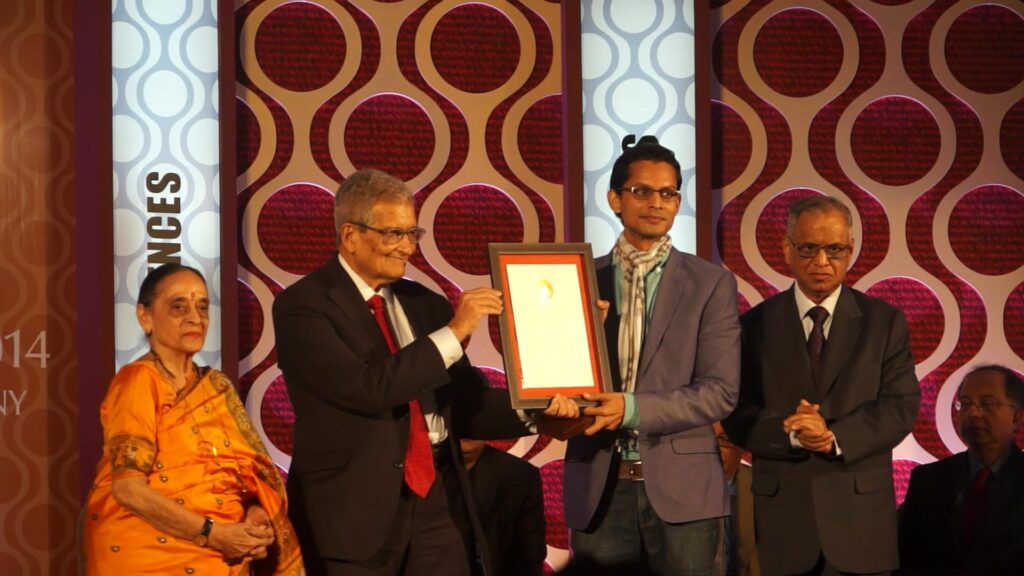
Photo of Shamnad receiving the Infosys Prize (Humanities) in 2014 from Mr. Amartya Sen / pix: shamnad.com
Bengaluru :
Indian Institute of Science (IISc) professor Jayant Haritsa and Intellectual Property (IP) academic and consultant professor Shamnad Basheer, both from Bengaluru, are among six winners of the Infosys Prize for this year.
Each prize, comprising a purse of Rs.55 lakh, a 22-carat gold medallion and a citation, is awarded by Infosys Science Foundation, a not-for-profit trust, set up by the global software major and funded by a corpus of Rs.100 crore ($16 million), contributed by the IT firm, its trustees and co-founders in 2009.
“Haritsa, computer science and automation department professor at IISc, has been awarded the prize under the Engineering and Computer Science category for his contribution to the design and optimisation of database engines,” the Foundation said in a statement here Thursday.
Haritsa also heads the supercomputer education and research centre at the institute.
Basheer, founder of SpicyIP, India, bagged the prize for his contribution to the analysis of a range of legal issues, including pharmaceutical patent injunctions and enforcement in the Humanities category.
As India’s premier blog on IP and innovation law and policy, SpicyIP does accurate reporting of IP developments across the country.
Basheer is also founder and managing trustee of Increasing Diversity by Increasing Access (IDIA) in Bengaluru.
Shubha Tole, associate professor at Mumbai-based Tata Institute of Fundamental Research (TIFR), got the prize under the Life Sciences category for her contribution to studying the hippocampus and amygdale centres of learning and memory in the brain.
“Tole’s work can lead to a better understanding of human behaviour, cognition and emotions,” the statement noted.
Tole is also a principal investigator at the TIFR’s biological sciences department.
Massachusetts Institute of Technology (MIT) adjunct professor Madhu Sudhan has been awarded the prize under the Mathematical Sciences category for his seminal contribution to probabilistically checkable proofs and error-correcting codes.
As a principal researcher at Microsoft Research in New England in the US, Sudan also heads the electrical engineering and computer sciences (EECS) department and computer science and artificial intelligence laboratory (CSASIL) at MIT in Boston.
Council of Scientific and Industrial Research (CSIR) senior scientist Srivari Chandrasekhar at the Hyderabad-based Indian Institute of Chemical Technology (IICT) has bagged the prize under the Physical Sciences category for his contribution to the synthetic organic chemistry with special focus on the synthesis of complex molecules from natural sources.
Abdul Latif Jameel Professor of Poverty Alleviation and Development Economics at MIT, Esther Duflo, got the prize under the Social Sciences category for her pioneering contribution to development economics, including the work related to India and Africa.
Duflo is also founder-director of Abdul Latif Jameel Poverty Action Lab in the US.
“The Foundation has been able to recognise some of the best researchers of our time through the prize. Their contributions are an inspiration to students and professionals and have the potential for real-time impact on individuals and society,” Infosys co-founder and Foundation president N.R. Narayana Murthy said on the occasion.
A panel of jurors, comprising renowned scientists and professors from the world over, evaluated the noted winners.
The Infosys Prize jury chairs are Pradeep Khosla, Nobel Laureate Amartya Sen, Inder Verma, Srinivasa S.R. Varadhan, Shrinivas Kulkarni and Kaushik Basu.
President Pranab Mukherjee will award the winners and felicitate them Jan 5 in Kolkata.–-IANS
www.shamnad.com
source: http://www.muslimmirror.com / Muslim Mirror / Home> Exclusive Reports> Indian Muslims> Youth / November 15th, 2014
Mohammed Shaukath Azeem, son of taxi driver, resident of Jarigudde near here has secured 545th rank scoring 914 marks in the UPSC examination that was held recently.
Shaukath got his primary education from SVT school of Karkala and completed his high school and degree studies in KMES college. He did the engineering graduation in Electronics and Communication from MITE at Mijar near Moodbidri. Later when he wanted to appear for UPSC, he was selected for UPSC training by the government of Karnataka and he was given stipend during training.
Shaukath started writing the UPSC examination for the first time in 2016. This was his seventh attempt and he came out with flying colours.
The Public Service Commission of 2021 has selected 685 candidates throughout the country and Shaukath is one of the few who are selected from Karnataka. Shaukath comes from a financially poor family. His father Sheikh Abdul drives a taxi for a living, while his mother Maimuna is a housewife.
An elated Mohammed Shaukath Azeem said, “My parents, who stressed on my education even during financial difficulties are my inspiration. I used to prepare everyday for five hours before the examination. Not only studying, but the social knowledge helped me a lot. I will most probably get selected for revenue or chartered accountancy. Selection process will be held within two months.”
source: http://www.daijiworld.com / DaijiWorld.com /(Headline edited) / Home> Top Stories / by Daijiworld Media Network – Karakala (MS) / June 01st, 2022
Rashida Be Khatri, a craftsperson of Bagh Print, has been selected for national merit certificate for 2018 by Union Ministry of Textiles.
Bhopal :
Rashida Be Khatri, a craftsperson of Bagh Print, has been selected for national merit certificate for 2018 by Union Ministry of Textiles.
She has been selected for Bagh handblock print bedcover. In the bed cover; she has done fine work using natural dyes. Rashida has been working in the field for more than 30 years in Bagh village in Dhar district of the state.
She is the only woman to have been received two state-level awards in 2012 and 2014. She is wife of late master craftsman Abdul Kader. Rashida did not lose hope after death of her husband on May 12, 2019. She took care of her sons Arif, Hamid and Ali as well as the craft. Her sons are also working under her guidance to promote the craft.
Her designs are inspired by ancient monuments of Dhar district including Mandu Nilkanth besides Taj Mahal, Red Fort, Agra Fort etc.
source: http://www.freepressjournal.in / The Free Press Journal / Home / by Staff Reporter / October 31st, 2021
After a near-death experience, Badrunissa Irfan, wife of Irfan Razack, CMD of Prestige Group, has put paintbrush to paper, expressing all that she’s been through.
Bengaluru :
11 years ago, Badrunissa Irfan was in a comatose state for almost a month. Doctors had lost hope but Irfan pulled along.
Today, over a decade after the incident, Irfan is sharing what she experienced for the first time, through her art works. Titled ‘Freedom of the Soul’, 35 paintings of Irfan will be on display at Sublime Galleria in UB City through the month of June.
Picking up her acrylic paints after a 20-year break, Irfan questions what a soul is through her paintings. “I had a near-death experience where I was in a state of coma for 23 days and was declared clinically dead twice. But I came back to life and what I witnessed during those days is what I have painted now. I want to convey the message I received from the Almighty through my art.”
While she took to art at a young age, her passion took a backseat when life and responsibilities took over. “It was my daughter Uzma [Uzma Irfan, director of Prestige Group], who encouraged me to pick up the brushes again. When I told her that my body cannot do what it used to before, she sent her daughter (my granddaughter) Alayna Zaid (who is also an artist) to sit with me while working,” she says, adding that she started work on her paintings in January this year.
Talking about her paintings, Irfan says, “You’ll find that most of my paintings are of open skies, mountains, gushing streams, animals and birds.”
Starting at `75,000 and going up to `1,40,000, all proceeds from this show will be donated to charity. She recalls how she couldn’t hear anyone except her daughter reading verses from the Quran every day.
“In my unconscious state, there was a scenario where I felt like I was looking at my own body from the outside,” she says. Every experience that she went through during that period comes to life in this series. “The colours that I use depend completely on my mood. I spend about two hours in the afternoon and another two in the evening and finish one painting within two days. It might take a little longer if it’s a bigger one,” Irfan adds.
Irfan believes she ‘came back to life’ to share what she has seen and witnessed. “I personally feel more connected with nature, animals, birds, flowers and fruits. I feel humans are hypocrites and so I use my art to share the beauty I believe in,” says Irfan, who is also the author of cookbook Duniya-e-Ziyafat.
(Freedom of the Soul will be showcased from June 1 to 30 at Sublime Galleria. All proceeds from this show will be donated to charity)
source: http://www.newindianexpress.com / The New Indian Express / Home> Cities> Bengaluru / by Anila Kurian , Express News Service / May 31st, 2022
Board chairman Moulana Sahfi Saadi said that the Wakf Board has decided to bring awareness among people of the Muslim community on the importance of getting education.
Image used for representational purposes (File | EPS)
Kalaburagi :
The Karnataka Waqf Board has decided to establish 10 degree colleges for women at 10 places across the state, including Kalaburagi, Yadgir and Raichur districts, said board chairman Moulana Sahfi Saadi on Sunday.
Addressing a press conference here, Saadi said that the Waqf Board has decided to bring awareness among people of the Muslim community on the importance of getting education.
To prepare youths from the Muslim community to face competitive examinations, including IAS and IPS, the Waqf Board is also constructing a well-equipped coaching centre for which it has acquired 30,000 sqft land near Lal Bagh in Bengaluru.
The foundation stone for the centre will be laid in June. Philanthropist Jiya Ulla Sharif has announced to donate Rs 15 crore for the centre.
“The government has sanctioned Rs 2.5 crore for the construction of a degree college and hostel in Tumakuru,” he said. To a question, he said the Waqf Board will conduct a survey of the new properties of under its purview shortly.
source: http://www.newindianexpress.com / The New Indian Express / Home> State> Karnataka / by Express News Service / May 30th, 2022
The couple decided to donate its 28-cent ancestral land to LIFE Mission, the Kerala government’s flagship housing scheme for the landless.
Haj (Photo | PTI)
Pathanamthitta :
Aranmula residents Jasmine and Haneefa were making arrangements for their long-cherished dream of going on haj and were prepared to sell their land to raise funds for the trip when they had second thoughts.
Instead, the couple, married for over three decades, decided to donate its 28-cent ancestral land to LIFE Mission, the State government’s flagship housing scheme for the landless.
The couple’s decision came after it saw the plight of a neighbour-family living on a rented premises and found it difficult to cremate the body of a family member who died recently.
“We were planning to sell our property and use the funds for haj pilgrimage. But, in the past couple of months, we saw some incidents in which certain families find it difficult to cremate their family members as they don’t own a property. Such incidents made us rethink our Haj plans,” Haneefa told PTI.
He said recently, a person passed away in his locality and a community leader donated his four cents of land to that family to conduct last rites and cremation.
“After that incident, we decided to make use of the land to help the needy instead of going for haj,” Haneefa said.
Local Self-Government Minister M V Govindan hailed the decision of the couple and said it was an inspiration to society.
Minister Govindan said the couple was an inspiration to the forward journey of society which needs to embrace every human being.
“People like Haneefa and Jasmine have set an example of humanity and are role models for society,” Govindan said.
Health Minister Veena George on Sunday visited the house of 57-year-old Haneefa and received the agreement to hand over the property for the Life Mission from the couple on behalf of the Aranmula Grama panchayat.
The land, owned by 48-year-old Jasmine, was received under the ‘manasodithiri mannu’ campaign of the Left government, Govindan said.
“Till now, the government has received 926.75 cents of land in 13 locations for the Life Mission scheme. Also in 30 locations, 830.8 cents of land have been assured for the Life Mission. The project has also received a sponsorship of Rs 25 crore to construct 1,000 houses,” the Minister said.
Govindan said he hopes more people would come forward to help the poor and draw inspiration from the couple.
The Left government has till now handed over 2,95,006 houses to beneficiaries under the Life Mission scheme, he said.
He also added that 34,374 houses are currently under construction.
There are 27 housing complexes that are also under construction, he said.
source: http://www.newindianexpress.com / The New Indian Express / Home> Good News / by PTI / May 29th, 2022
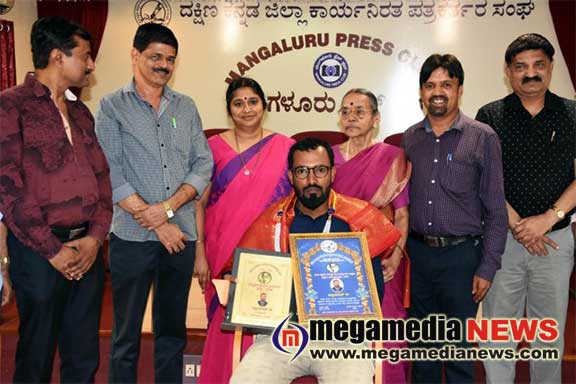
Pa Gopalakrishna Memorial Award 2018 for ‘Best Rural Reporting’ was presented to Journalist Imtiaz Shah Tumbe at Patrika Bhavan.
His article on Kodagu natural calamity, published in Vartha Bharati, was selected for the award.
Shah, a sub-editor in Vartha Bharati, said he had stepped into the field of journalism without any proper background. He said his parent organisation had honed his skills and provided him with an opportunity. “I feel privileged to receive the award.”
Dakshina Kannada District Information and Public Relations Senior Assistant Director K Rohini presented the award to Shah.
Speaking on the occasion, Rohini said the family members of veteran journalist late Pa Gopalakrishna, who had instituted the award, had set an example for others.
DK District Working Journalists’ Association Srinivas Indaje presided over the programme. Secretary Ibrahim Adkasthala, Mangaluru Press Club President Annu Mangaluru, Patrika Bhavan Trust President K Ananda Shetty, Pa Go’s spouse Savitri and senior journalist Manohar Prasad were present.
source: http://www.megamedianews.com / MegaMedia News / Home / March 02nd, 2019