Komatlagudem Village (Khammam District), TELANGANA :
Apart from being Telangana’s first Muslim woman IPS officer, Saleema is also the first woman from the erstwhile Khammam district to have been appointed to the IPS.
Rachakonda DCP Shaik Saleema (Photo| EPS)
Khammam :
A festive air has gripped Komatlagudem village of Chintakani mandal in Khammam district after Shaik Saleema, who was a non-cadre Superintendents of Police (SP), was appointed to the Indian Police Service (IPS) by the Central government. She is currently posted as a DCP in the Rachakonda commissionerate.
Apart from being Telangana’s first Muslim woman IPS officer, Saleema is also the first woman from erstwhile Khammam district to have been appointed to the IPS.
Hailing from a middle-class family, Saleema’s father Lal Bahadur also served in the Police Department and retired as Sub-Inspector (SI) a few years ago. Her mother Yakubbi was a stay-at-home parent. The couple has three other children – Zareena, Munni and Khasim – and all of them are in good positions now.
After completing her schooling and graduation in Khammam, Saleema joined the Kakatiya University in Warangal for pursuing a postgraduate degree in bio-technology. After cracking the group exams, she was selected as a DSP in 2007 and got her first posting at Kagaznagar in erstwhile Adilabad district.
Later, she worked as the vice-principal of Amberpet Police Training Centre in Hyderabad. She also served as Addl DCP (Admin) in Cyberabad police commissionerate. Saleema’s sister Zareena is currently awaiting her interview after clearing the Andhra Pradesh Group-1 exam.
While her another sister Munni currently works as a vehicle inspector in Khairatabad, Hyderabad, Saleema’s brother Khasim is a doctor at Care Hospital in Hyderabad. The cop’s husband works as a software engineer.
When The New Indian Express spoke to a couple of villagers, they all expressed their happiness over Saleema’s promotion. Speaking to The New Indian Express, Saleema shared her joy and said that she has always strived to be honest in her job throughout her career.
The officer says: “More and more women should join the force. For this, one has to step out of their comfort zone and come forward. Only then, you would be able to achieve the name and fame that you dream of. I also did the same. Thanks to my family members for supporting me throughout the journey.”
Mentioning that getting a government job had always been her dream, Saleema said after receiving one, she never looked back. “My family supported me the same way they would if I received any other job. They never let me face any difficulties alone. After I got married, my husband Baji Ahmed, who works as project manager, became my spot driver,” chuckles Saleema.
Ahmed looks after both their kids, studying in Classes IX and II, without any complaints. She says her younger child still wonders as to why her picture appears in newspapers once a while. When asked if there was any incident that gave her complete satisfaction, the cop shared one such instance with The New Indian Express.
“We were given complete freedom by CP Mahesh Bhagwat to put an end to two major threats the city was facing in 2018 — sex determination in Uppal and sex trafficking in Yadagirigutta. One of those nights, I received a call with a tipoff and we had to conduct, not a raid but, a decoy operation. I saw many grave things that night. But, after successfully detecting the case and sending the victims to shelter homes, I felt complete satisfaction. Memories of that day still give me immense pleasure,” she said.
source: http://www.newindianexpress.com / The New Indian Express / Home> States> Telangana / by B Satyanarayana Reddy and Priya Rathnam / by Express News Service / December 26th, 2021
Umran Malik, the young pace sensation from Jammu and Kashmir, has done it again.
The 22-year-old Sunrisers Hyderabad pacer on Tuesday set the internet on fire by sending a 150-kmph delivery in the first over of his team’s IPL 2022 match against Rajasthan Royals at the Maharashtra Cricket Association Stadium, here.
And this is not the first time that the express pacer has clocked the 150-kmph on the speed gun in the IPL.
In the second leg of the IPL played in United Arab Emirates (UAE), Malik sent down a 153-kmph thunderbolt, the fastest delivery in IPL history, and had both his skipper Kane Williamson and the then India captain Virat Kohli gushing over the new speed demon of Indian cricket.
After seeing his ability to bowl with lightning speed, SRH gambled and retained him as their third player ahead of the IPL 2022 mega auction.
On Tuesday, that gamble seems to have paid as Malik was their best bowler against Rajasthan Royals, taking two wickets in his four overs spell giving away 39 runs.
Every time he jumps on the popping crease, he outdoes his pace. With his express pace, Malik got the wickets of Jos Buttler and Devdutt Padikkal.
The instant stardom, that he achieved in UAE last year and enhanced on Tuesday, is just a byproduct of his confidence that made him believe that he could make it to the India team at a very young age.
When he was 18, he wrote in his bio on his social media handle, “India Soon”. The pacer, whose father Abdul Rashid is a fruit-seller in Shaheedi Chowk in Jammu, was confident enough to predict that one day he will make it to the national side. His dedication and perseverance paved the way into his state’s Under-19 squad.
A good performance in the Syed Mushtaq Ali Trophy T20 competition helped him make it to the Sunrisers Hyderabad team as a net bowler.
Malik was roped in as a short-term Covid-19 replacement for T Natarajan, who had tested positive for Covid virus ahead of Hyderabad’s encounter against Delhi Capitals on September 22, 2021. After that, Malik’s fortunes completely changed.
Malik, who was part of the Hyderabad contingent as a net bowler, has played eight T20 and one List A match for Jammu Kashmir and has picked a total of four wickets.
Hailing from a modest family in Jammu’s Gujjar Nagar, Malik began playing at a young age. His family has always supported his passion with his father, his mother and two older sisters always there for him.
In the game against Royal Challengers Bangalore in the 2021 IPL, Malik went a step further by bowling the second-fastest delivery of IPL — a 152.95kph thunderbolt that stunned everyone.
At the post-match presentation, RCB’s then skipper Virat Kohli spoke in support of the youngster, “Whenever you see talent like this, you are going to have your eyes on them and make sure you maximise their potential.” “I really felt proud on seeing such a big player talking about me,” Malik had said after the match.
His exploits resulted in him being asked to be part of the Indian senior team’s net bowlers for the T20 World Cup in the UAE last year.
By clocking 150-kmph again on Tuesday, Malik has proved that his exploits last year were not a flash in the pan. He has it in him to consistently hit the 150-mark on the speed gun.
Now he has to build on this brilliant start to fulfill his dream of making it to the Indian team.
–IANS
source: http://www.tribuneindia.com / The Tribune / Home> Sports / by IANS / Pune, March 29th, 2022
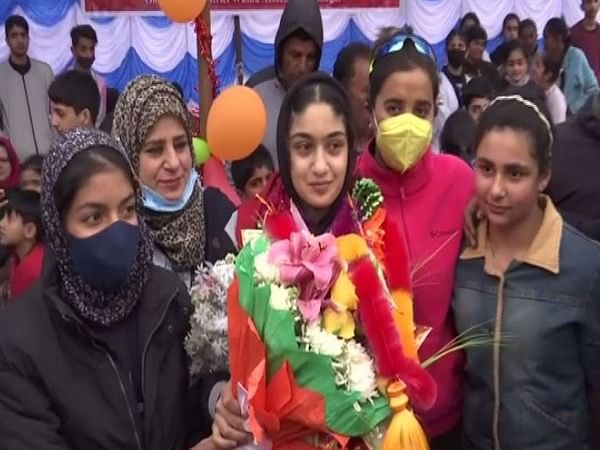
Sadia Tariq who won a gold Medal in the Moscow Wushu Stars Championship received a warm welcome from family and friends who reached Jammu and Kashmir’s Srinagar on Saturday.
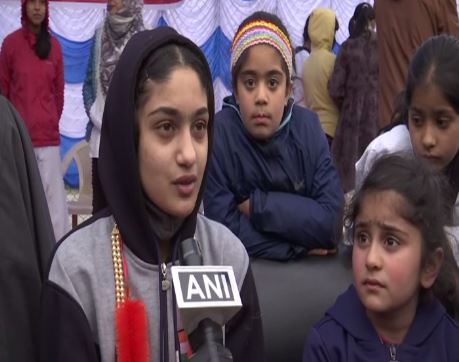
Speaking to ANI, Tariq shared her happiness and thanked her family and coach for supporting her.
“My eyes were in tears when I won the gold medal. If this happened today it is only because of my coach and family. I want to thank my coach who was there supporting me all the time,” she said.
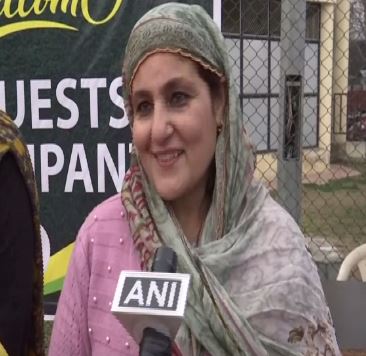
Maimoona Tariq, mother of Sadia said her daughter was passionate about this since she was in the third standard, today she made all of us proud.
“I am proud of my daughter, she made us proud. She was always engaged in this game since the third standard. I want other children to participate in the game also and made their parents proud,” she added.
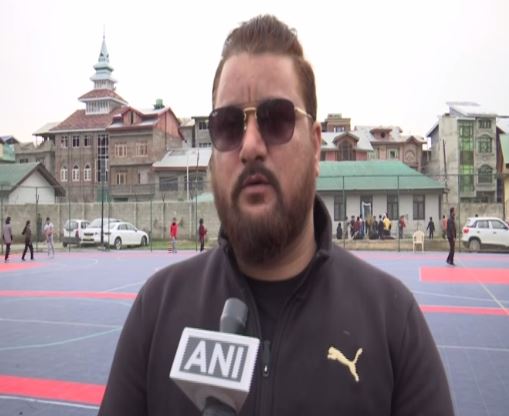
Masood Rather, Joint Secretary of Srinagar Wushu Association said “we all are very proud of Sadia. She performed very well in Wushu Stars Championship. Sadia already won two gold in national, it is her third gold medal.”
“As far as talking about Wushu, it is very popular in Jammu and Kashmir,” he further added.
Earlier in the last week of February, Prime Minister Narendra Modi congratulated Sadia Tariq on winning a gold medal in the Moscow Wushu Stars Championship, which is being held from February 22 to 28.
Sadia won the gold medal in Wushu Championship in Moscow by defeating a local player. Moscow Wushu Stars Championship is the approved event in the Annual Calendar Training and Competition of the Sports Authority of India. (ANI)
This report is auto-generated from ANI news service. ThePrint holds no responsibility for its content.
source: http://www.theprint.in / The Print / Home> India / by ANI / March 06th, 2022
Inayat Ali Mulki, one of the promising leaders of this generation, has been appointed as the general secretary of Karnataka Pradesh Congress Committee (KPCC) under the strong leadership of D K Shivakumar.pix
Inayat Ali started his political career as a grassroot level worker, taking up the responsibility as the NSUI president for the Mulki block of Dakshina Kannada district.
He then continued to serve the Congress party as National NSUI general secretary and as the Karnataka Pradesh Youth Congress Committee general secretary, working under the guidance of the late Oscar Fernandes, Mukul Wasnik, Ashok Gehlot and Rahul Gandhi.
Inayat Ali expressed his humble gratitude for this new role in the Congress party and promised to continue his noble work for the overall betterment and the upliftment of the society.
source: http://www.daijiworld.com / Daijiworld.com / Home> Karnataka / by Media Release / April 09th, 2022
He will help organise the 44th International Chess Olympiad from July 28 to August 10
The Tamil Nadu government on Saturday appointed Darez Ahamed, Special Secretary, Health and Family Welfare Department, as Officer on Special Duty for conducting the 44 th International Chess Olympiad from July 28 to August 10.
As per rules, sanction is granted for creation of a temporary post of Officer on Special Duty, Chess Olympiad, in the Office of Sports Development Authority of Tamil Nadu in the Super Time Scale of IAS for a period of six months, a Government Order issued by Chief Secretary V. Irai Anbu said.
Dr. Ahamed, Mission Director, National Health Mission, Special Secretary to Government, Health and Family Welfare Department, will be placed in full additional charge for the post of Officer on Special Duty.
He will assist the Committee for Organising Chennai Olympiad (COCO) Society with respect to the Olympiad and undertake necessary activities in coordination with the Principal Secretary, Youth Welfare and Sports Development, and Member Secretary, Sports Development Authority of Tamil Nadu.
Dr. Ahamed will also be ex-Officio member of the COCO Society and also Member Secretary of its Executive Sub Committee.
source: http://www.thehindu.com / The Hindu / Home> News> National> Tamil Nadu / by Special Correspondent / Chennai – April 09th, 2022
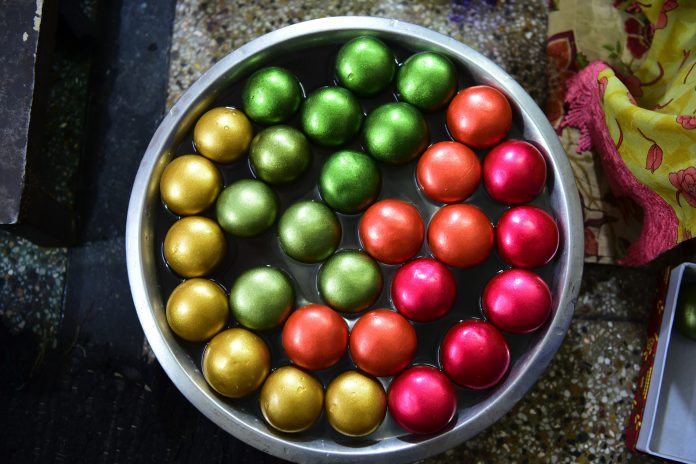
‘Gulal Gota’ is made with unique craftsmanship and compliments the festival of colours. | Picture by Tabeenah Anjum
Dozens of Muslim artisans in Jaipur have kept the 400-year-old traditional art form of Gulal Gota alive.
Jaipur :
The narrow lanes of Jaipur’s walled city are abuzz with festive fervour ahead of Holi, the festival of colours to be celebrated on March 17. Twenty-eight-year-old Amjad Khan, a seventh-generation lac bangle maker is busy selling Gulal Gotas (lac balls filled with colours) at his shop situated in the Maniharon-Ka-Raasta inside the Tripolia Bazar in the walled city of Jaipur.
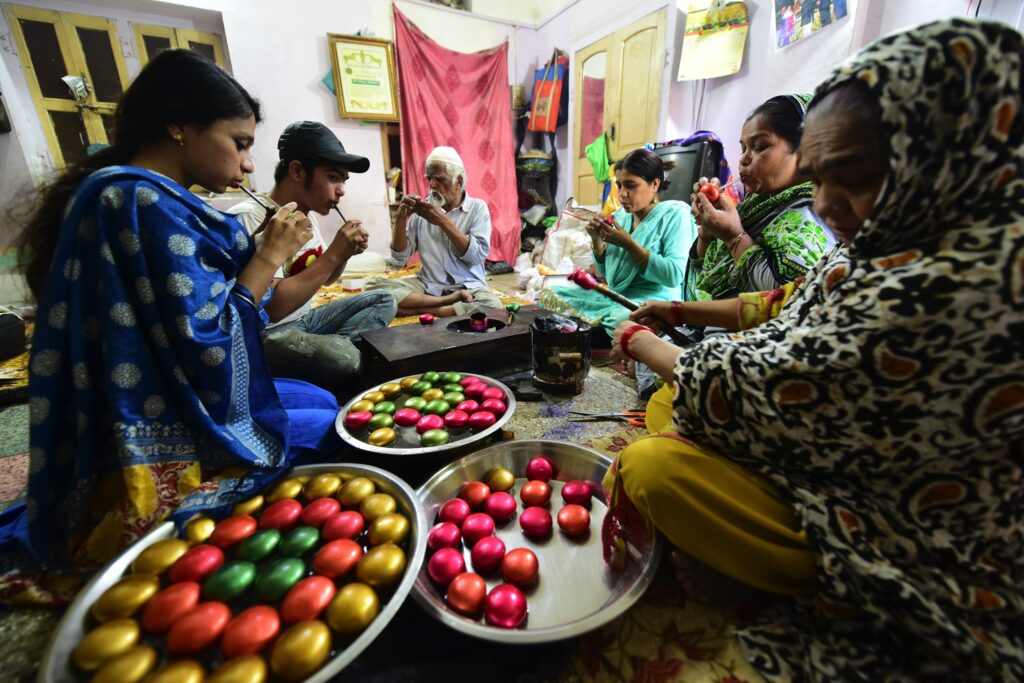
Every year, two months ahead of the Holi, Amjad along with his eight siblings starts making the lac balls and fills them with colours before packing them in boxes. Amjad is not alone. Dozens of artisans in Jaipur have kept this traditional art form alive, which is as old as 400 years.
Gulal Gota is made with unique craftsmanship and compliments the festival of colours. After completing his basic education, Amjad learnt this art from his father late Babbu Khan. The family does not earn much from the sale of Gulal Gota but they don’t want to give up on this traditional art form that they have inherited from their forefathers.
‘Gulal Gota’ is made with unique craftsmanship and compliments the festival of colours. | Picture by Tabeenah Anjum
“In the last two decades and especially from the last two years because of the pandemic, the demand for Gulal Gota has come down a bit but for the love of this art form, we want to keep it alive and pass this to our next generation irrespective of gender. My siblings, mother and late father used to participate. It brings families together,” Amjad shared.
“Every year for two months our entire family gets busy making Gulal Gotas. It is an art to add colours in the lac containers. It is again re-heated and then, with the help of a steel rod and the air is blown into the small balls. We fill it later with organic colours. We are not even earning 50 per cent of what we are spending to make these balls but we are only doing to make the Holi special,” Amjad said.
Each ball weighs from 10 to 20 grams and costs anywhere between Rs 100 to 150.
The Gulal Gotas are still popular with traditional families and are used at the famous Govind Dev Ji temple in Jaipur. According to the popular view of historians, Sawai Jai Singh II brought the artists from Amber to the walled city and developed the unique art of Gulal Gota. Even today during the annual Holi celebration at the city palace, revellers throw these balls at each other and get smeared with colours without hurting anyone.
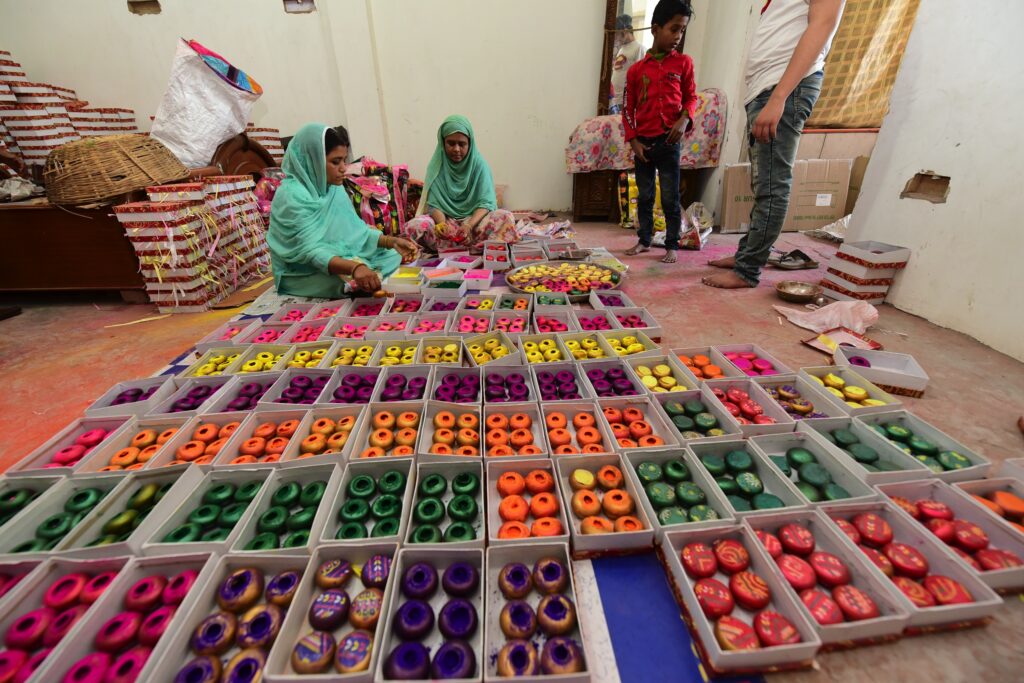
Boxes of Gulal Gotas being prepared for sale. | Picture by Tabeenah Anjum
Apart from states such as Madhya Pradesh, national capital New Delhi and Uttar Pradesh, it is shipped to other parts of the world including Canada, Britain, Australia, Spain, France and Nepal. However, packaging the balls needs careful handling to avoid the risk of the balls bursting in their wrapping. The balls are sold in packs of 6 or 8.
Those involved in the production of these balls belong to the Muslim community. Awaz Mohammed, a national award-winning artist who has been in this field for seven generations said, “This is a beautiful gesture and brings two communities together. The only sad part is that for an artist the sale from Gulal Gotas is not enough to sustain their livelihood.”
Awaz’s daughter Gulrukh Sultana who is a trained lac artist not only learnt the art from her father but is also sharing the skill at national institutes across India such as NIID, JJ School of Arts, Pearl Academy etc.
“Making lac artifacts is an intricate and unsafe job, but I want to share this art and skill with the future generation. It is the passing of tradition and heritage Jaipur is proud of. Lac is delicate and it needs proper handling. I have trained so many artists in different cities and also given demonstrations internationally,” said 35-year-old Sultana, a recipient of the state award in 2009 and a UNESCO award in 2013.
Looking at the market and interest of the younger generation, Sultana is apprehensive about whether this art could be saved. “Since there is not much earning, it is less attractive for youngsters to learn this skill but at the same time the government should come up with lucrative initiatives and ensure the art is kept alive”, she added.
Tabeenah Anjum is a journalist based in Rajasthan reporting on politics, gender, human rights, and issues impacting marginalized communities. She tweets at @TabeenahAnjum
source: http://www.twocircles.net / TwoCircles.net / Home> Lead Story / by Tabeenah Anjum, TwoCircles.net / March 16th, 2022
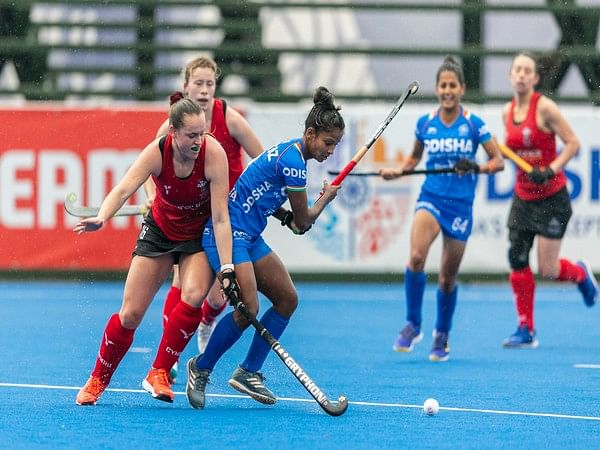
Mumtaz Khan of India Women’s team in action against Wales during Junior Hockey WC (Image: HI)
Lucknow (Uttar Pradesh) April 4 (ANI):
India stunned Germany in the Junior World Cup Hockey pool match after doughty Mumtaz Khan’s powerful drag-flick sent the ball crashing into the nets to send the girls in blue in frenzied celebrations while joys of her mother, Qaiser Jahan, who sells vegetables in Lucknow, knew no bounds.
Mumtaz Khan, 19, is now India’s new hockey sensation, taking her team to the top league while her dribble and powerplay with her stick awing the opponents.
Lucknow, the city of Nawabs and also hockey-lovers, is showering love and appreciation on Mumtaz’s family, which ekes out a livelihood as vegetable vendor.
With the hockey stick, Mumtaz Khan is not only shattering India’s powerful opponents, but also the age-old patriarchal taboos. Her mother is jubilant that Mumtaz Khan, one of her six daughters, has given a resounding slap to all those who taunted her in the past for having only daughters.
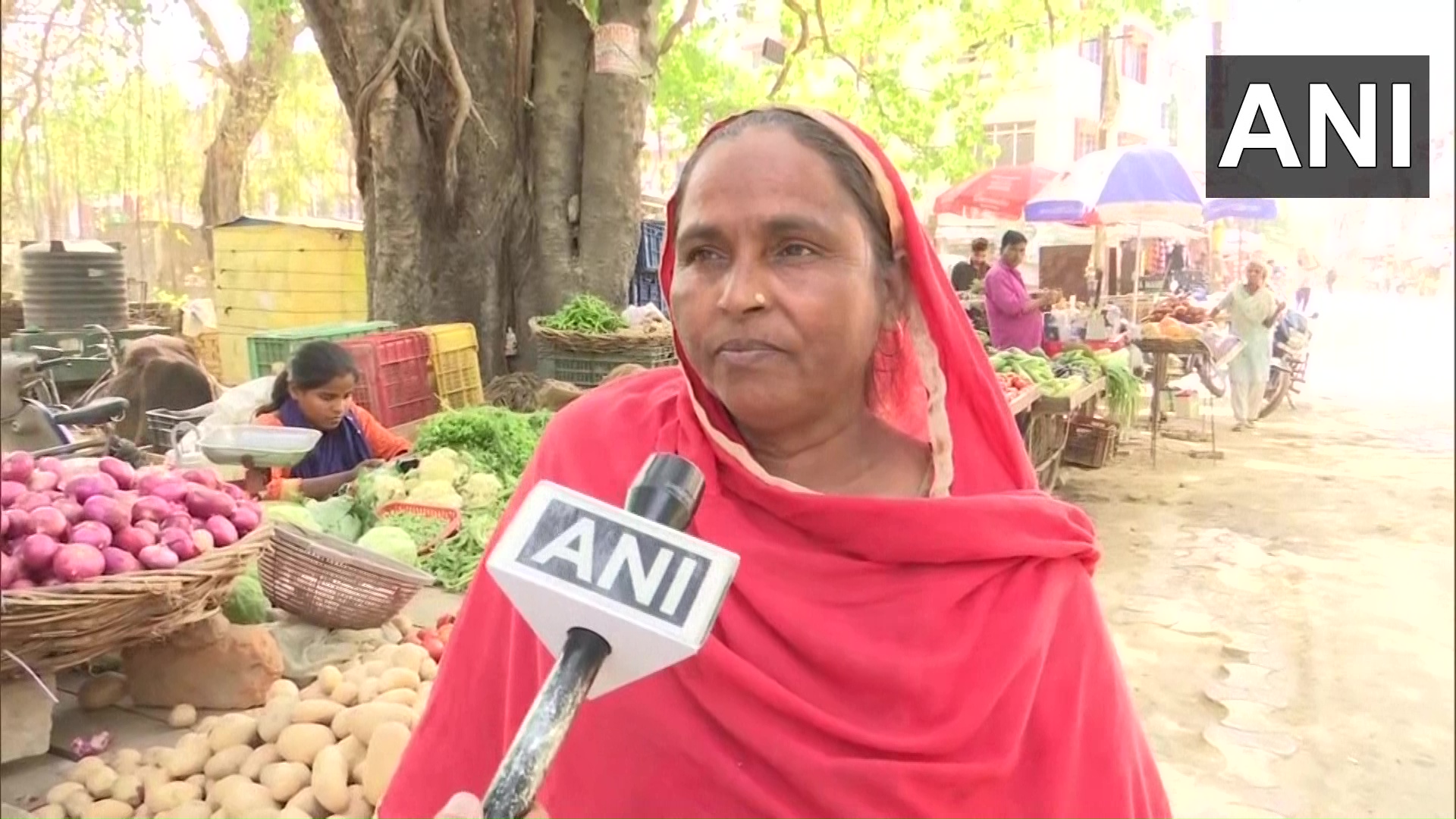
“People often made remarks that I only have daughters. Mumtaz has made us proud, and broke the social stigmas,” said Qaiser Jahan, while speaking to ANI at her vegetable shop in Lucknow.
My daughter is equal to 100 sons, said Qaiser Jahan.
While Qaiser Jahan managers to earn Rs 300 daily, she went beyond her means to support Mumtaz Khan pursue her dreams to wear the blue jersey and represent India on astroturf.
The financial strain proved insufficient for Mumtaz Khan to fly with the girls in blue to South Africa to play for the country.
Mumtaz Khan along with other under-19 Indian girls in blue is taking the team to newer heights, with a quarter-final berth sealed. Besides beating the formidable Germany by converting the penalty shoot, Mumtaz Khan had also taken India to an unassailable lead with a 3-1 scoreline with a brilliant field goal in the 41st minute against Wales in the FIH Women’s Junior World Cup at Potchefstroom in South Africa. India finally won the match 5-1.
Her father Hafiz Khan, a vegetable vendor, has all been supportive of Mumtaz Khan’s passion for hockey.
Mumtaz Khan’s journey as a hockey player began when she went to Agra to participate in a race and was spotted by Neelam Siddiqui who trained her at KD Singh Babu Stadium’s Sports Hostel.
“I feel very proud that my daughter is playing for the country. We are getting a lot of respect because of her,” said Mumtaz’s mother.
“I feel proud that my sister is an international hockey player. Despite poverty, our parents have raised us to make us capable to do something for ourselves,” said Farha Khan, Mumtaz’s sister. (ANI)
This report is auto-generated from ANI news service. ThePrint holds no responsibility for its content.
source: http://www.theprint.in / The Print / Home> India / by ANI / April 04th, 2022
Gulammohammed Sheikh: ‘What we need is an open climate within our institutions to allow artists to practise their art’
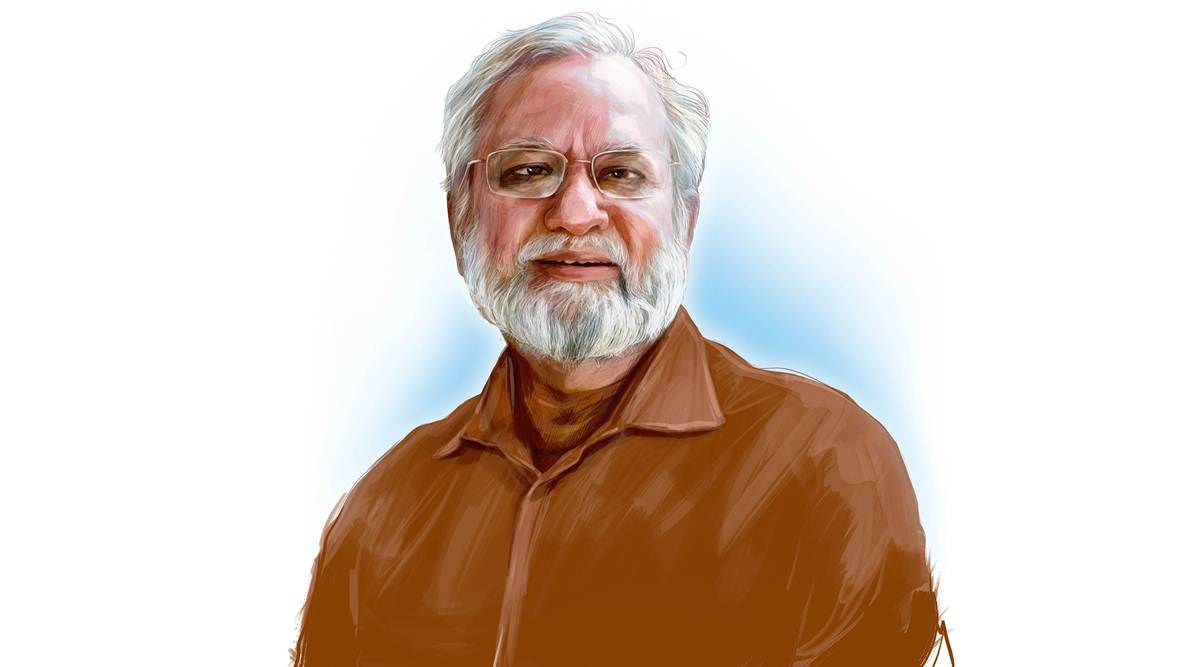
Gulammohammed Sheikh, artist (Illustration : Suvajit Dey)
Gulammohammed Sheikh speaks on the idea of multiplicity in life, art education in India, interference in institutions and how the world of art remains free of divides. This session was moderated by Vandana Kalra, Senior Assistant Editor, The Indian Express .
Vandana Kalra: In 1981, you had said that living in India means living simultaneously in several times and cultures. Do you think the relevance of your statement has only increased over time? Also, how do you look at the works that you made during that period, for example, City for Sale?
Among these works, the first one was About Waiting and Wandering, the other was Speaking Street, the third Revolving Routes and the fourth City for Sale. They relate to actual situations and are connected.
Speaking Street was a re-creation of the kind of street that I lived in during my childhood. Born in 1937, I spent about 18 years in Surendranagar, which was then a small town, before I came to Baroda to study. We lived in a little lane, which had a little mosque whose walls were painted green with enamel colours, but it didn’t have a dome. There would be people sitting on the street selling fish, or somebody pulling a little cart. In the lower half of the painting there are several events taking place simultaneously in different houses or rooms, as would happen with people living in chawls. Speaking Street also carries a personal portrait — a young boy looking out of a window. Thinking of the childhood spent in a street like that, I remember having learnt to recite the Quran in Arabic at a madarsa, while studying Sanskrit at school. It gave me the idea of multiplicity in life, connected by multiple belief systems.
This work connects with the much larger City for Sale, based in the city in which I continue to live; the city of Baroda, now Vadodara. I came to Baroda first in 1955 as a student, and after finishing my studies at the Faculty of Fine Arts, I taught there for three years. I was then in London on a scholarship for three years and returned home in 1966. When I first came to Baroda, it opened for me not just the world of art, but also the art of the world. But in 1969 this city produced another image. Some of the worst communal riots took place here between 1969 and 1970. People began to look at me with my name in mind. So, it gave me an identity which was different from the identity that I had acquired when I had reached Baroda, then — open, liberal, multifaceted. In 1969, suddenly the situation changed. These four paintings, in some ways, reflect upon the times that I had gone through. City for Sale is large and has multiple figures, so many characters. There are three men meeting on the pretext of lighting a matchstick. Would that provoke incendiary connotations? There is also a woman who has a big vegetable cart, which literally flows into the town. Then there is, in the centre, a film being shown called Silsila (1981). And on the top, the scene of a communal riot. It brought together multiple parts of a city, depicting how riots are raging in one part, but a film is being shown in another. In a way, it was confessional, it was also some kind of a release for me.
Yes, there are problems that beset our institutions. Government museums and academies are out of touch with what’s going on in the world of art, and directors are often appointed rather arbitrarily, often not from the art world at all
Vandana Kalra: In more recent years, you’ve taken this thought forward and you seem to have turned to Kabir and Mahatma Gandhi to call for peace, call for intermingling. If you could talk a bit about that.
Gandhi came to me right from the time I was in school. I read My Experiments with Truth (1927), in Gujarati it’s Satya Na Prayogo. It has remained with me ever since. During the years of 1969 and 1970, Gandhi kept coming to me, in different forms, different guises. But I didn’t know how to paint Gandhiji, I had never seen him in person. I saw lots of photographs. Then I devised something. The first painting that I made of him was of Gandhi in South Africa, in the image of a young lawyer. But the second one, which I have used twice or thrice since, was the image of Gandhi returning to India, quoted from a painting by Abanindranath Tagore.
Kabir came in a different way. I was familiar with his poetry from my school days but he began to become more and more relevant in the context of the conflicting situations that I saw around myself. I thought, perhaps, I should try to paint Kabir. But how to paint Kabir? My mentor KG Subramanyan’s mentor Benodebehari Mukherjee had painted a large mural in Santiniketan on the saint-poets of India, which included Kabir. Benode babu knew that Kabir was a weaver, so he went to the weavers’ colony to search for his image of a weaver and made his Kabir. I found a Kabir image in a late Mughal painting in the British Museum collection and devised a Kabir-like persona from that image. As Kabir began to recur in my mind, I began to read Kabir but it was difficult to find a visual equivalent. It was when I heard Kumar Gandharva singing Kabir that I thought, why can I not illustrate his poetry? Within histories of art, a great number of paintings illustrate poetry.
We have to think of a holistic way of devising a new art education system for our country. An art education system that is not standardised. It should leave room for each region, each culture in a diverse country like ours
Vandana Kalra: How do you look at the dialogue between your poetry and painting?
When I started writing poetry while I was in school, it was very traditional, using Sanskrit meters or in the form of songs. When I came to Baroda, I met a new mentor, Suresh Joshi, the writer who pioneered a modern idiom in Gujarati. He introduced us to Baudelaire, Rilke, Lorca, etc. After reading these great poets, I felt what I was writing was not worthwhile, so I threw away much of it, and began to write poetry without verse, without any meter. I felt I should use spoken language. I had to find my voice from within the spoken word. In some ways, I had to find something which was not only modern but also personal, which was mine. Similarly, in painting, I had to struggle hard. Every student feels that he is under the shadow of his teacher, so he wants to get out of that shadow. I started to look outside of Baroda. I looked at MF Husain and began using the image of a horse. But there was a difference between Husain’s horses and mine. Husain’s horses are to be regarded as timeless. Charged with energy, they were larger than life. My lonely creature came from my life experiences, perhaps it came from the tonga, the ghoda-gaadi that I knew from my childhood. This horse was harnessed and was trying to unshackle itself.
” The world of art in India is still free of divides… For us it was a mini India, a multiple India; it was not straitjacketed into the singular. Many of us found our life partners from within the Faculty we taught and studied at
Devyani Onial: What do you think about art education in India? Also, you started teaching when you were very young. Can you talk a bit about those days?
Art education should begin at school and children should be taken to art galleries and museums. I’ve seen not just in the West, but also in places like Indonesia, tiny tots are taken to museums, they have their little notebooks with them in which they write about the paintings that they see.
The Faculty of Fine Arts (MS University), set up around 1950, was the first institution in India where university education included fine arts. It offered not a diploma, but a degree.
What the pioneers visualised was an artist who was literate and educated, a new citizen of modern India, because it coincided with the independence of the country. It was a small institution, the teacher student ratio was one to 10, or one to 15. The studios were huge, they were like warehouses and were open throughout the day and night. For somebody like me, coming from a small town, it was a great experience to learn from your teachers who were working alongside you. We saw NS Bendre working, we saw our seniors like Jyoti Bhatt, Shanti Dave and GR Santosh working. Despite the fact that I had some financial difficulties, I managed to sail through those four years of under-graduation, and then even did my master’s. I got a job to teach while I was in my second-year master’s course and some of my classmates also became my students for a brief while. But art education, even to this day, is a neglected discipline. We have to think of a holistic way of devising a new art education system for our country. An art education system that is not standardised. It should leave room for each region, each culture in a diverse and multifarious country like ours.
Leena Misra: Vadodara was recently in the news because Chandra Mohan was not allowed to display his artwork. It was also in the news because they have booked the first case of interfaith marriage, which violates the freedom of religion. So what do you think went wrong in the city and why are people not speaking up? Has the space for expression, even for artists, shrunk?
It’s not that people were not speaking. Prof Shivaji Panikkar, the then in-charge Dean of the Faculty, stood firm defending the student against a controversy engineered by external elements. A spate of protests by students against the assault on the institution continued for almost a year. Several of us spoke. Ganesh Devy (literary critic) had also spoken up. But the issue that you’re talking about is larger. What we need is an open climate within our institutions of art and art education, to allow artists to practise their art. External issues have been brought to institutions, which then have been victims of unhealthy controversies and conflicts. I think artists should and would articulate their ideas through their art and there are artists who have done that. I will quote the German playwright and poet Bertolt Brecht: “Will there be singing in the dark times?” To which the answer is, “Yes, there will be singing about the dark times”.
External interferences are mostly politically motivated, we got to stand against them but while continuing to practise. If you stop practising, if you do not paint, that is more dangerous. Baroda had a liberal foundation and to an extent it still exists. The world of art and artists in India is still free of divides. Let me give you example of five of my teachers from the Faculty of Fine Arts. The first dean Markand Bhatt, a Gujarati, was married to Perin, a Parsi. NS Bendre, a Maharashtrian, married Mona, a Tamilian. Sankho Chaudhuri, a Bengali, married a Parsi fellow artist Ira, and K G Subramanyan married Sushila, a Punjabi, the last two couples had met in Santiniketan. For us it was a mini India, a multiple India; it was not straitjacketed into the singular. Many of us found our life partners from within the Faculty we taught and studied at. A Kashmiri Ratan Parimoo found Naina, a Gujarati; a Maharashtrian PD Dhumal, married Rini, who was a Bengali. So there was nothing unusual in a Gujarati like me marrying a Punjabi Nilima. That has been the culture of the Faculty of Fine Arts. We lived a life which was not just a life lived, but a life shared.
Shiny Varghese: What do you think are the values that we should support today that will determine what our future will be like tomorrow?
I would answer your question in a different way. Frankly, my own view is that contemporary Indian art is still very vibrant. We have three to four generations of artists working. We have 97-year-old Krishen Khanna, of the generation of Husain. You have my generation, and you have those that come after us, like Atul Dodiya, Sudarshan Shetty and several others. Then there is a still younger generation working. I’m not painting a rosy picture. What I am trying to say is that within art, among artists, there is still a dialogue, and they are working steadfastly. I’m also very happy that we have many women artists. We also have several couple-artists, doing different things in their own way. Like Manu and Madhvi Parekh, Arpita and Paramjit Singh, Reena and Jitish Kallat, Atul and Anju Dodiya, Bharti Kher and Subodh Gupta among others. I wonder if such a situation prevails in other countries. I am putting it in a somewhat simplistic manner but the values our artists seem to pursue are the values of a free and creative practice. Most of us are engaged in finding a visual language for contemporary issues, often referring to problematics of our times. Then, there are so many young artists. We have a young artist called BR Shailesh, who was trained in a gurukul, he speaks Sanskrit, he came to study painting, and he ventured into digital art, then into installation. He is using his gurukul background and devising a way where there is both critique as well as celebration.
Rinku Ghosh: On the one hand you say art is about hope, on the other you choose to stay away from rescuing institutions like the National Gallery of Modern Art and Lalit Kala Akademi from decay. How will young artists express themselves freely if greats like you don’t act?
It is not correct. Artists have always spoken out in one way or another. A long time back, in the 1960s, J Swaminathan published Contra (1966-67) to take on the Akademis, we (Bhupen Khakhar and I) brought out a journal called Vrishchik (1969-73) and through that, amongst other things, mounted a campaign to reform the Lalit Kala Akademi. We fought for three years, as a result of which the government appointed the Khosla Commission. Some of the reforms that we were fighting for were included. So, it’s not that artists have not driven change. Yes, there are problems that beset our institutions. Government museums and academies are out of touch with what’s going on in the wider world of art, and directors are often appointed rather arbitrarily, often not from the art world at all. Are we to become activists then? When KG Subramanyan was asked the question, he said tellingly that yes, he would, but as an artist activist, not as an activist artist. The younger generations of artists too have their own modes of articulating the need for change, their own activism.
Paromita Chakrabarti: Could you speak about the time when you met your wife? You mentioned how it was commonplace in the artistic community to find partners from other communities. In the larger city, for instance, was there the ghost of love jihad at that time, which has become so prominent now?
I have already made some remarks about the issues earlier. I have tried to answer these through the paintings that I have done, including City for Sale, which is about the city and which deals with the kind of conflicting situation you are talking about.
External interferences are mostly politically motivated, we got to stand against them but while continuing to practise. If you stop practising, if you do not paint, that is more dangerous. Baroda had a liberal foundation and to an extent it still exists. The world of art and artists in India is still free of divides. Let me give you example of five of my teachers from the Faculty of Fine Arts. The first dean Markand Bhatt, a Gujarati, was married to Perin, a Parsi. NS Bendre, a Maharashtrian, married Mona, a Tamilian. Sankho Chaudhuri, a Bengali, married a Parsi fellow artist Ira, and K G Subramanyan married Sushila, a Punjabi, the last two couples had met in Santiniketan. For us it was a mini India, a multiple India; it was not straitjacketed into the singular. Many of us found our life partners from within the Faculty we taught and studied at. A Kashmiri Ratan Parimoo found Naina, a Gujarati; a Maharashtrian PD Dhumal, married Rini, who was a Bengali. So there was nothing unusual in a Gujarati like me marrying a Punjabi Nilima. That has been the culture of the Faculty of Fine Arts. We lived a life which was not just a life lived, but a life shared.
Shiny Varghese: What do you think are the values that we should support today that will determine what our future will be like tomorrow?
I would answer your question in a different way. Frankly, my own view is that contemporary Indian art is still very vibrant. We have three to four generations of artists working. We have 97-year-old Krishen Khanna, of the generation of Husain. You have my generation, and you have those that come after us, like Atul Dodiya, Sudarshan Shetty and several others. Then there is a still younger generation working. I’m not painting a rosy picture. What I am trying to say is that within art, among artists, there is still a dialogue, and they are working steadfastly. I’m also very happy that we have many women artists. We also have several couple-artists, doing different things in their own way. Like Manu and Madhvi Parekh, Arpita and Paramjit Singh, Reena and Jitish Kallat, Atul and Anju Dodiya, Bharti Kher and Subodh Gupta among others. I wonder if such a situation prevails in other countries. I am putting it in a somewhat simplistic manner but the values our artists seem to pursue are the values of a free and creative practice. Most of us are engaged in finding a visual language for contemporary issues, often referring to problematics of our times. Then, there are so many young artists. We have a young artist called BR Shailesh, who was trained in a gurukul, he speaks Sanskrit, he came to study painting, and he ventured into digital art, then into installation. He is using his gurukul background and devising a way where there is both critique as well as celebration.
Rinku Ghosh: On the one hand you say art is about hope, on the other you choose to stay away from rescuing institutions like the National Gallery of Modern Art and Lalit Kala Akademi from decay. How will young artists express themselves freely if greats like you don’t act?
It is not correct. Artists have always spoken out in one way or another. A long time back, in the 1960s, J Swaminathan published Contra (1966-67) to take on the Akademis, we (Bhupen Khakhar and I) brought out a journal called Vrishchik (1969-73) and through that, amongst other things, mounted a campaign to reform the Lalit Kala Akademi. We fought for three years, as a result of which the government appointed the Khosla Commission. Some of the reforms that we were fighting for were included. So, it’s not that artists have not driven change. Yes, there are problems that beset our institutions. Government museums and academies are out of touch with what’s going on in the wider world of art, and directors are often appointed rather arbitrarily, often not from the art world at all. Are we to become activists then? When KG Subramanyan was asked the question, he said tellingly that yes, he would, but as an artist activist, not as an activist artist. The younger generations of artists too have their own modes of articulating the need for change, their own activism.
Paromita Chakrabarti: Could you speak about the time when you met your wife? You mentioned how it was commonplace in the artistic community to find partners from other communities. In the larger city, for instance, was there the ghost of love jihad at that time, which has become so prominent now?
I have already made some remarks about the issues earlier. I have tried to answer these through the paintings that I have done, including City for Sale, which is about the city and which deals with the kind of conflicting situation you are talking about.
It is difficult to tell you the personal story, but it was, and is not uncommon among artists to get acquainted with each other, and eventually to become not only friends but partners. The pursuit of our vocation brought us together. Several of my friends and students have married outside their communities. The kind of divide, that you belong to this belief system or you belong to that belief system, or that you come from Kerala or Bihar, is denounced in our community of artists. Art actually binds, art brings us together, art gives us a new world to live in. When I say that art spells hope, what I mean is that hope is the essence of the creative act. I still believe that a creative life also makes you a slightly better human being, because it allows you to keep the divide out, it allows you to share, it allows you to meet people, it allows you to connect with as many people as possible.
Suanshu Khurana: You mentioned Kumar Gandharva and the impact his Kabir bhajans had on your work. Are there any other musicians who’ve been a significant part of your consciousness while creating your art?
I listen to a lot of music. Even now, during the pandemic, we have a little bluetooth speaker and I listen to music every morning or while working. I listen to Mallikarjun Mansur, I love Bhimsen Joshi, I enjoy Kishori Amonkar’s singing. I have not known many musicians, but I had some connection with Kumar Gandharva because of the opportunities of meeting during the programmes at Bharat Bhavan in Bhopal during the 1980s, where I would listen to him. Among the series of Kabir paintings I made, two were companion pieces: a largish painting called Ek Achambha Dekha Re Bhai has the companion piece called Heerna. It is my tribute to Heerna sung by Kumar Gandharva.
source: http://www.indianexpress.com / The Indian Express / Home> Idea Exchange / by Premium, Express News Service / April 05th, 2022
He received the award from AIIMS Director Randeep Guleria
Kozhikode
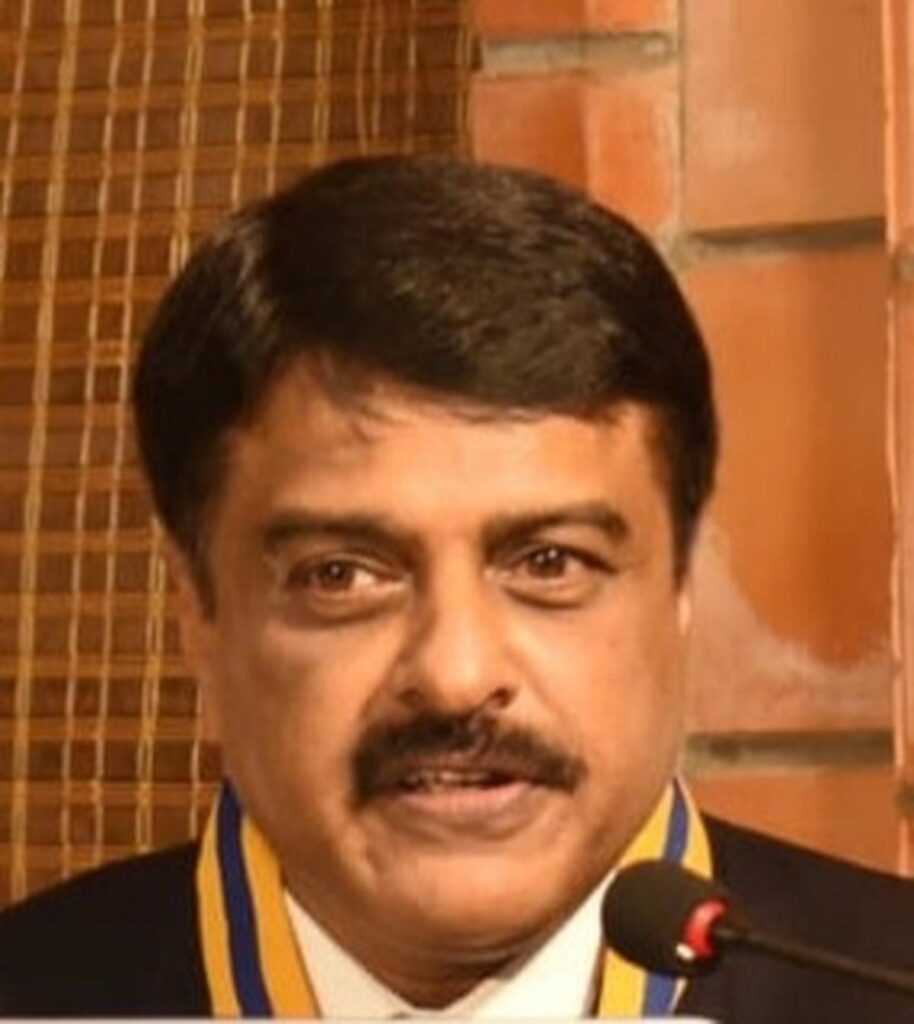
Thoracic surgeon Nasser Yusuf has bagged the prestigious A.S. Paintal-RC Jain Memorial Chest Oration Award instituted by the National College of Chest Physicians.
He received the honour from the All India Institute of Medical Sciences Director Randeep Guleria during the national conference on pulmonary diseases hosted between March 31 and April 3 in Varanasi.
source: http://www.thehindu.com / The Hindu / Home> News> National> Kerala / by Staff Reporter / April 06th, 2022
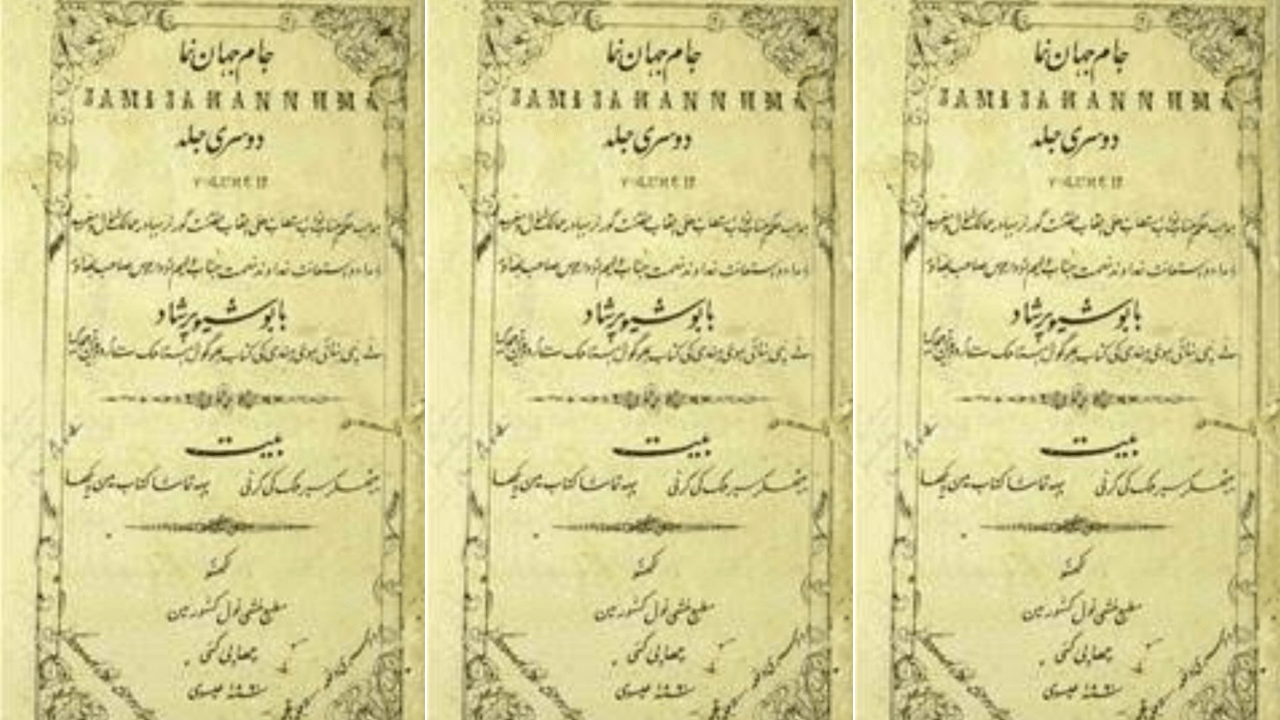
India’s first Urdu newspaper Jam-E-Jahan-Numa. Source: @indoislamicpage
Most people might be unaware, but 27th March is a historic day in the history of Urdu Journalism. On this date, the first-ever printed newspaper in the Urdu language was published exactly 200 years ago.
Urdu Journalism started in the Indian sub-continent from Calcutta with the launch of Jam-e-Jahan Numa on March 27, 2022.
In today’s India, Urdu is associated with Muslims and is considered the language of Muslims. In this context, when we look at the history of Urdu journalism, one may be surprised today to learn of its heritage and secular origins. Urdu, which has been on a decline in India over the years, and one which is much maligned by Hindutva groups, had a Hindu man who established the first journalistic publication.
Hari Hardat, a Bengali Brahmin Hindu, published the Jam-e-Jahan Numa from Calcutta on March 27, 1822. It was published under the editorship of Lala Sada Sukh Lal; a Punjabi. The printer was William Hopkins, a British national and an employee of the East India Company.
The composition of people under whom Urdu Journalism saw the light of day is really remarkable, as it truly reflects its secular characteristics. Non-Muslims had a huge contribution in the growth and development of Urdu journalism, as most of the editors in the 19th century were also not Muslims.
However, in post-independent India, Urdu language, which is widely spoken and read even today, came to be perceived as a Muslim language.
In 1822, with the publication of Jam-e-Jahan Numafrom Calcutta, the journey of Urdu journalism began. Soon it spread to other parts of the subcontinent covering what we study today as the history of the 19th and 20th centuries here. During its two hundred years, Urdu journalism has seen many ups and downs and has left a deep imprint on the history, politics, economics and sociology of the subcontinent.
The history of this entire subcontinent i.e, present-day India, Pakistan, Bangladesh, Burma and Afghanistan would be incomplete without Urdu journalism. The political, economic and cultural conditions of that time truly reflect on the pages of Urdu newspapers of that time.
Urdu journalism started even before Gujarati journalism took off. The latter’s first publication, the Bombay Samachar, appeared first on July 1, 1882. Similarly, Hindi Journalism had its first newspaper – Utand Martand – published on February 9, 1826. For Tamil Journalism, the Tamil Magazine, a journal, was published in 1831.
However, Bengali journalism had set in by that time and the first newspaper in the language was the ―Bengal Gazette appeared in 1816.
After Bengali newspapers, Jam-e-Jahan Numa was the second newspaper that came out in any Indian language from undivided India. At that time, two Bengali newspapers, the Sambad Kaumudi and the Samachar Chandrika were already in circulation. So it can rightly be said that Urdu journalism held the distinction of being the second vernacular which began journalism in India.
Technologically, Urdu journalism is also at par with other vernacular journalism. India has also witnessed the digitisation of Urdu newspapers in the 21st century. There are over three dozen Urdu newspapers that have launched their e-newspapers.
Urdu journalism in its 200-year-long chequered history has seen many ups and downs. It is the only language in the country that sadly also is facing step-motherly treatment in the birth of its place. Today, it is also treated with a suspicious eye in its own country. The integrity of its antecedent is doubted often too.
In spite of all this injustice, today Urdu journalism continues to shine. Its readers owe Harihar Dutt for his idea of starting an Urdu language newspaper.
It is worth mentioning here that when Harihar Dutt launched his newspaper, he had never imagined that he was going to sow the seed of Urdu journalism and that it would also galvanize others to do the same from across the nation.
Jam-E-Jahan-Numa: The Pioneer Urdu Weekly
Jam-e-Jahan Numa – the pioneer Urdu language newspaper was printed at Mission Press, 11, Circular Road, Calcutta and published from No. 2, Colootola – a commercial place of central Calcutta.
It was a 3-sheet (6 pages) weekly of quarter size and issued on every Chahar Stambah (Wednesday). Each page of the Jam-e-Jahan Numa was divided into two columns and there were normally 22 lines in each column. The size of the paper was 20×30/8 centimetre, and it was priced at Rs.2/ per month, and the word ―Chahar Shambah (Urdu word of Wednesday) was printed on each issue below the Masthead with the date.
Harihar Dutta brought out this pioneer Urdu weekly at such a time when the language was not popular in Bengal. Urdu was prevalent only for conversation and it had not been adopted in the field of Journalism. But it was the foresight of Harihar Dutta that he introduced Urdu language as a new field in the printed newspaper form.
But his experience could not succeed at once. Therefore, after 6 issues of Urdu edition of the Jam-e-Jahannuma, he converted it into a Persian weekly. The Jam-e-Jahan Numa which was launched as an Urdu paper ceased to exist in Urdu after its 6th issue and became a Persian newspaper on May 16, 1822.
The reason behind this change was that majority of the readership was illiterate and poor. And Persian was the official language of that period and the language of the elite too. Hence it made sense.
But it seems that this condition was confined only to Bengal. In other parts of the country, Urdu had become popular by that time. So, a few years later Urdu newspapers started publishing in north India. The popularity of Urdu increased rapidly and it compelled the then colonial government to change the official language from Persian to Urdu.
The interest of Harihar Dutta in Urdu did not subside. And after one year he introduced an Urdu supplement with the Persian edition of the Jam-e-Jahan Numa. This supplement was started on May 23, 1823. It consisted of 4 pages and the pages were divided into two columns.
All types of national and international news would publish in the Jam-e-Jahan Numa. Human interest stories and news of scientific inventions would get due coverage.
The Urdu Jam-e-Jahan Numa continued to be published for around four years and eight months; starting from 23rd May 1822 to 23rd January 1828. During this period, around 241 issues were published. Out of these 241 issues, almost 100 issues carried the historical events of Britain, Europe and the Mughal emperor Jahangir.
The Persian edition consisted of 8 pages and the Urdu supplement was of 4 pages. The government was extending some financial support to this newspaper then as well. But high postal charges were a burden on the proprietor of this newspaper.
To curtail the expenditure of the newspaper, Harihar Dutt stopped the Urdu edition once again in January 1828 and continued the Persian edition. The pages of the Urdu edition were also allotted to the Persian edition. However, it finally ceased to exist forever due to non-patronage of the government.
How long the Jam-e-Jahan Numa continued is not known but Abdus Sattar Siddique in his article entitled ―Hindustan Ke Purane Akhbar, wrote that the paper continued to publish till 1845.
Condition Of Urdu
When Harihar Dutt launched the first Urdu newspaper, Urdu was not the language of the elite and educated class. It was in its evolution phase. It was not developed as a reading and writing language among the educated class, and was only used as a means of communication among the people belonging to the lower strata of society.
The readers of Urdu were few. The educated class, be it Hindus, Muslims, Sikhs or others, was Persian reading. All official work was also carried out in Persian which was the official language of that time under the British.
In fact, reading and writing Urdu was considered demeaning during that period, and the educated class considered it an insult to use Urdu, as it was the language of the masses and ordinary people. All official communiqué was done in Persian only.
The nobility would consider the use of Urdu language as below the standard action. Moreover, newspaper reading habit was also not developed by that time. Even the elite did not have time to read newspapers or to know about society in general. Producing a newspaper in Urdu was also not an easy task at that time, hence.
Before the commencement of Jam-e-Jahan Numa, there were a few handwritten newspapers- not printed, which were basically written for the nobility and the rich. These handwritten newspapers were written by a band of writers who were called calligraphers. It was a tiresome and time-consuming act, so the number of copies of these papers that were sold was small.
Even the cost of producing these handwritten newspapers was very high, which was another reason which made it out of reach of the common people. These handwritten papers were the only source of information for the nobility and the rich class as well.
We have to keep this fact in mind while reading about Urdu journalism, when Harihar Dutt published the Jam-e-Jahan Numa, the concept of reading a newspaper had not turned into a habit. So, in a way, after Bengali, it was Urdu journalism that appeared on the horizon and changed things.
This article first appeared in The Siasat Daily. Published here with the author’s permission.
source: http://www.thecognate.com / The Cognate / Home> Culture / by Dr Md Zafar Iqbal / April 01st, 2022