Triben generally refers to the confluence of the three rivers Ganga, Yamuna and the illusive Saraswati near Allahabad.
But the Hooghly district of West Bengal also houses another Tribeni, where the Bhagarati or Hooghly River disintegrates into three branches. The three branches are Hooghly, Sarswati and Jamuna (Kanchrapara Khal).
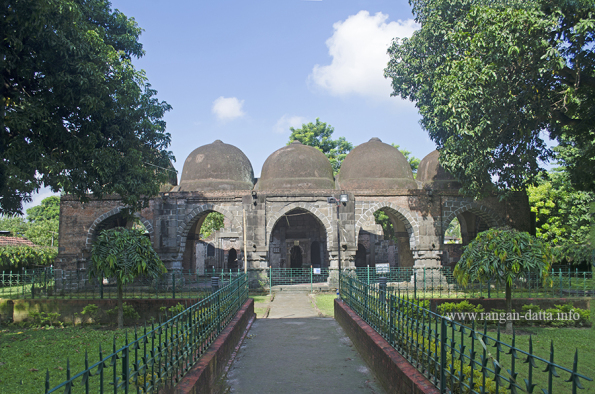
Zafar Khan Gazi Masjid, Tribeni, Hooghly
So like the Prayag near Allabahad, the Tribeni of Hooghly has also attracted pilgrims for centuries and is mentioned in ancient Bengali literature like the Mansamangal and Chandimangal .
Today Tribeni is located about 70 km north of Kolkata on the Bendel – Katwa rail line and is approachable both from Howrah and Sealdah by train.
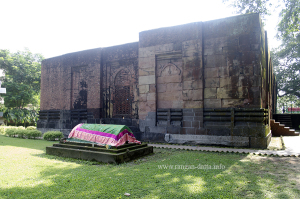
Dargah of Zafar Khan, with a grave outside it, Tribeni
Today the prime attraction of Tribeni is the Dargah of Zafar Khan Gazi. The dargah is located on a small mound over looking the Hooghly river.
It is housed inside a walled complex which also contains a mosque and several other scattered tomb. It remains an active religious site.
The mosque is not only the oldest Mosque in West Bengal but also happens to be the oldest Islamic structure in the whole of undivided Bengal.
Zafar Khan was a general of Delhi Sultan Feroze Shah, who invaded Hooghly in the late 13th century, he defeated the local Hindu king and established the Turkish rule in Bengal.
Zafar Khan settled in Tribeni as he was mesmerized by the beauty of the Hooghly River. The locals started considering him as a learned man and he came to be know as Zafar Khan Gazi. But soon after Zafar Khan was killed in a battle with another Hindu king of the region.
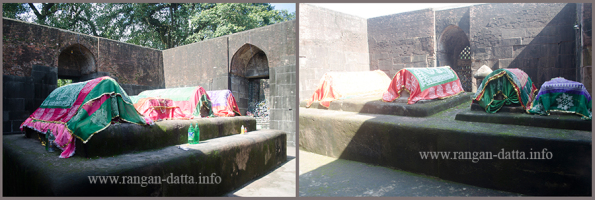
Inside the Zafar Khan Gazi Dargah. L: Eastern Chamber, R: Western Chamber with Zafar Khan’s grave at the extreme right
The Dargah was constructed in 1315 and is located on the eastern end of the walled complex. It has two chambers and the roof has long collapsed. The western chamber contains the grave of Zafar Khan along with the graves of his two sons Ain Khan Ghazi and Ghain Khan Ghazi. The fourth grave in the complex and the wife of Ughwan Khan, another son of Zafar Khan Gazi.
The eastern complex houses the grave of Zafar Khan’s third son Barkhan Ghazi. He is buried along with and his two sons Rahim Khan Ghazi and Karim Khan Ghazi. The identity of one tomb remains unknown but it shape suggests it belongs to a woman.
The Dargah is located on a high plinth and both the chambers are approached by flight of stairs. Both the chambers are provided with Jali screens allowing sunlight to filter into the chambers.
Both the mosque and the dargah are built with a combination of stone and bricks, some thing quiet unusual in the land famous for terracotta.
Both the most unique feature of the Dargah and the Mosque is the presence of several Hindu motifs and symbols in its walls.
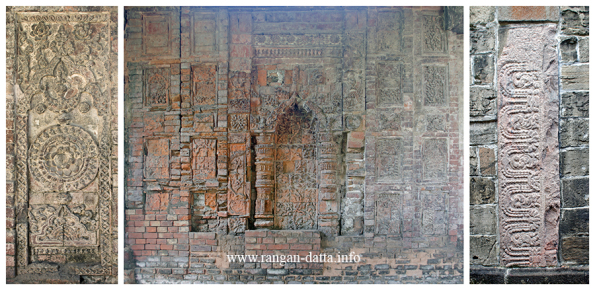
Hindu ornamentation from the outer walls of the Dargah of Zafar Khan Gazi, Tribeni, Hooghly
Both the structure contains stone panels of Hindu deities but most of them have been chiseled off leaving an faint imprint. It is quiet likely these motifs were removed from abandoned or demolished Hindu Temple and were used in the construction of the Mosque and Dargah.
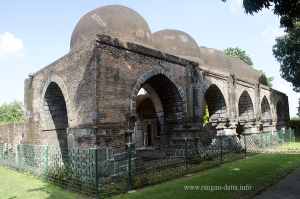
Mosque of Zafar Khan Gazi, Tribeni
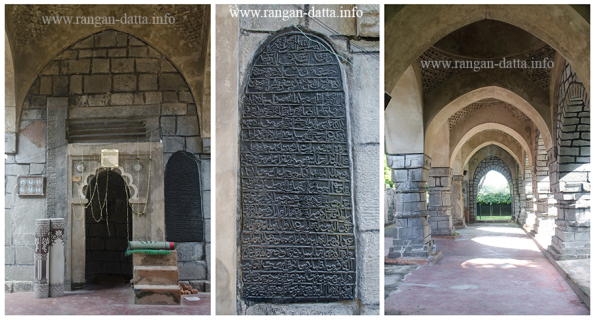
The rectangular Mosque measures 76 feet by 36 feet and dates back to 1292. It has five arched entrance in the front and two aisles create 10 squares, each of which is topped by a dome. Sadly only 6 of the 10 domes can be seen to this day.
The Zafar Khan Mosque, Tribeni. L: Central Mihrab, C: An Arabic Inscription and R: Arched aisle
There are five mihrabs on the western wall, out of which three are more or less intact. The central mihrab is ornamental and is made of stone. The two miharab flanking the central mihrab is made of bricks with beautiful terracotta ornamentation. Like the Dargah the Mosque also contains ornamentation from temples.
Ornamentation inside the Zafar Khan Gazi Mosque, Tribeni, Hooghly
A trip to Tribeni is never complete without the visit to nearby Bansberia Bansberia famous for its Haneswari Temple and Ananta Basudev Temple.
source: http://www.rangandatta.wordpress.com / Rangan Datta / Home> Bengal Archaeology, Bengal History, General / by Rangan Datta / photographs : www.rangan-datta.info / December 01st, 2016
Arbaz Ahmed is 9th rank holder in the KCET 2020 Merit List containing the names of 1,55,552 successful candidates.
Karnataka CET Result 2020:
Mohammad Arbaaz Ahmed is among the Top 10 of Karnataka CET 2020 result of which was declared by the Karnataka Examination Authority (KEA) Friday.
Accordingt to KCET 2020 result announced by KEA on Friday, Mohammad Arbaaz Ahmed secured the 9th position in the Merit List led by 10 toppers in Pharma course.
As many as 1,75,349 students out of the total 1,94,419 candidates who registered for KCET 2020 appeared for the test held on July 30 and 31, 2020. Of them, 1,53,470 students have qualified for Engineering admission.
The students qualified in other courses include – Agriculture (1,27,627), Veterinary Sciences (1,29,666), AYUSH (1,29,611) and Pharma (1,55,552).
A total of 80 students scored cent per cent marks – 60 out of 60 in Biology, 03 students scored 100% marks in Chemistry.
Rakshith M secured the 1st Rank, Shubhan R secured the 2nd spot, and M Shashank Balaji hold the 3rd position in Engineering.
In Pharma, Sai Vivek P has secured the 1st rank, Sandeepan Naskar hold the 2nd position and Pawan S Gowda bagged the 3rd rank. Arbaz Ahmed is 9th rank holder in the KCET 2020 Merit List containing the names of 1,55,552 successful candidates.
Karnataka Common Entrance Test Cell (CET) was established in the year 1994 for conducting entrance tests to determine the merit of the candidates for admission to professional courses such as Medical, Dental, Indian Systems of Medicine and Homoeopathy, Engineering / Technology and Architecture courses, Farm science, B-Pharm, Pharm-D courses.
source: http://www.ummid.com / Ummid.com / Home> Education & Careers / by ummid.com news network / August 22nd, 2020
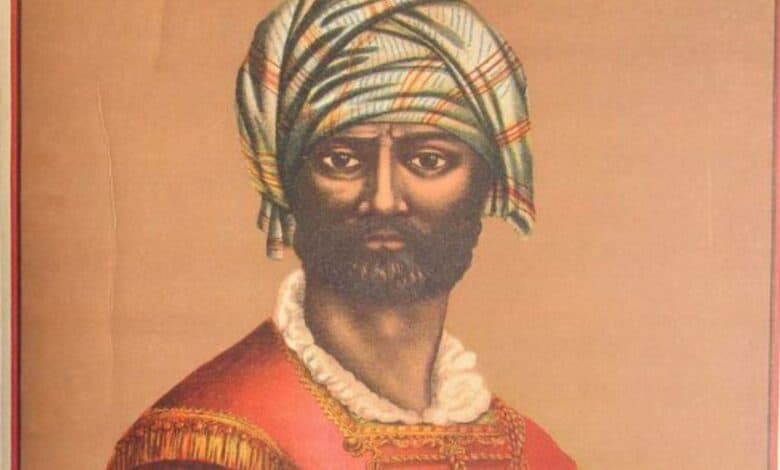
Hyder Ali, who is famously known as ‘the Nepoleon of South India’ for his relentless fighting against the conspiracies of the East India Company and its henchmen and for checkmating the British ambitions of expansion in South India, was born in 1722 at Devanahalli village, Karnataka state. His father was Fateh Mohammad Ali and mother Mujidan Begum.
Though he did not have any formal learning, he received training in martial arts. Hyder Ali was sharp in intellect, strong in will, capable of handling multiple tasks simultaneously and was brave at heart.
He had participated in Devanahalli war in 1749 as a young soldier of Mysore State. Recognizing his gallantry, Nanjaraj, the Minister of Mysore kingdom, honoured Hyder Ali with the title of ‘Khan’ and promoted him as the Chief of a battalion in the Mysore army.
They attacked Mysore several times with the help of the East India Company.
Though Hyder Ali suffered initial losses, he resisted them successfully and proved a virtual nightmare to East India Company. Even then, the British rulers provoked Hyder Ali again which led to the second Mysore war in July 1780. He went to the battlefield along with his son, Tipu Sultan.
While Hyder Ali captured the Arcot, his son Tipu defeated the East India Company troops and captured Kanjeevaram, which was about 50 miles from Madras. This sent shivers to Warren Hastings, the Governor General of East India Company.
He immediately sent additional troops from Culcutta, Madras with abundant funds under the control of his Commander General, Sir Eyre Coote. While fighting against the foreign enemy on one side, Hyder Ali and Tipu Sultan taught a befitting lesson to Malabar Nayars and chieftains, who revolted against him with the active support of Nizam of Hyderbad.
Hyder Ali, while leading his troops towards successive victories, fell ill and died in the battlefield on 7 December, 1782, near Narasingarayuni Peta village, which is now in Chitoor district of Andhra Pradesh.
source: http://www.siasat.com / The Siasat Daily / Home> Featured News / by Nihad Amani / August 22nd, 2020
Indian businessman honoured for his philanthropic work by UAE government
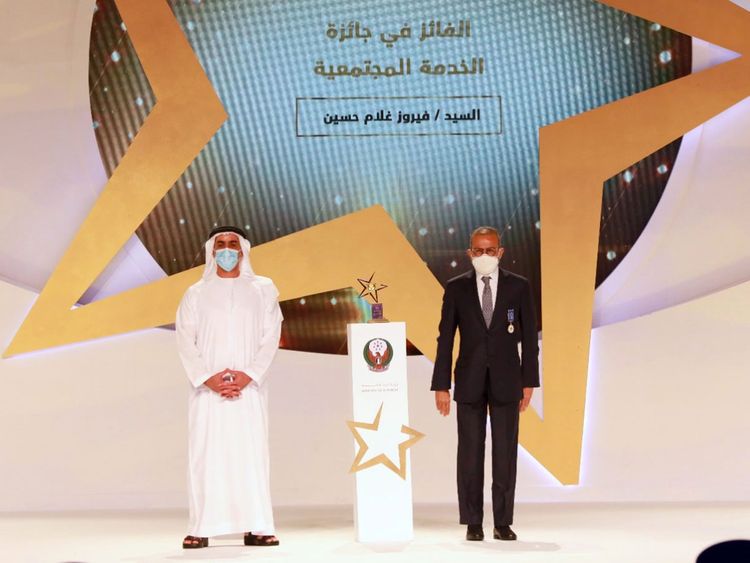
The excellence certificate and citation was handed over to Merchant by Shaikh Saif bin Zayed Al Nahyan, Deputy Prime Minister and Minister of Interior. Image Credit: Supplied
Dubai:
The UAE Ministry of Interior on August 19 honoured Indian businessman Firoz Goulam Merchant for his exemplary community services.
The excellence certificate and citation was handed over to Merchant by Shaikh Saif bin Zayed Al Nahyan, Deputy Prime Minister and Minister of Interior, in the presence of senior police officers and government officials.
Since 2008, Merchant, the proprietor of Pure Gold Jewellers, launched a philanthropic movement called the Forgotten Society. Spearheading this initiative, Merchant worked tirelessly with several correctional institutions in the country to identify debt-ridden prisoners and assisted them in repaying debts to the tune of millions, thereby securing their release and providing free air passage to their respective countries.
A deeply humbled Merchant told Gulf News: “It was a very proud moment for me to be acknowledged by the government of the land. I would like to express my gratitude to the UAE Government for this honourable recognition for my humble efforts to support the community.”
source: http://www.gulfnews.com / Gulf News / Home> UAE / by Staff Report / August 20th, 2020
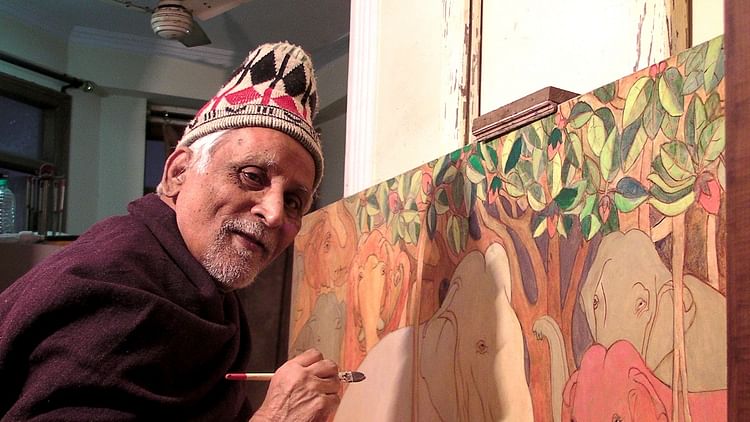
Mohammad Yasin passed away peacefully on August 19. He was a versatile artist calligrapher, print maker and pioneered the technique of Lithography in Department of Graphics, Jamia Millia Islamia.
Mohammad Yasin
“laa.ī hayāt aae qazā le chalī chale apnī ḳhushī na aae na apnī ḳhushī chale” (I came as life had brought me, as death takes me, I go. I came not of my own accord / nor of my own I go.) -Sheikh Ibrahim Zauq
This was one of the customary couplets that Yasinn Sahab loved to recite whenever I visited him. It seems that he was always ready for his heavenly abode and wanted to cheer his remaining life with enthusiasm.
Mohammad Yasin at the age of 92, passed away peacefully on August 19, 2020 at his residence in Shaheen Bagh, New Delhi. He was born on January 4th, 1928 at Mugalgidda village, Hyderabad (Andra Pradesh). Under the aegis of Aseem Asha Foundation, I understood him while making an hour-long documentary film on his work and life in association with Dagar Family i.e. Pictorial Calligrapher Qamar Dagar, Dhrupad Singer Ustad Wasifuddin Dagar etc. Later I consociated with him.
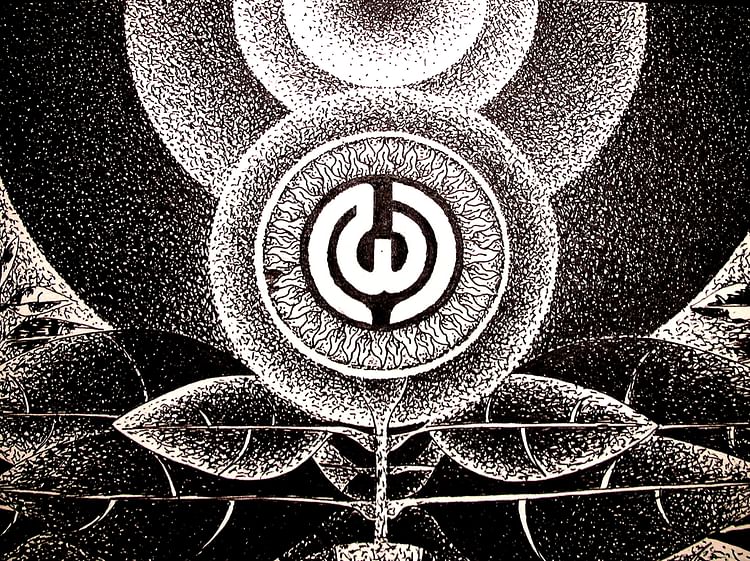
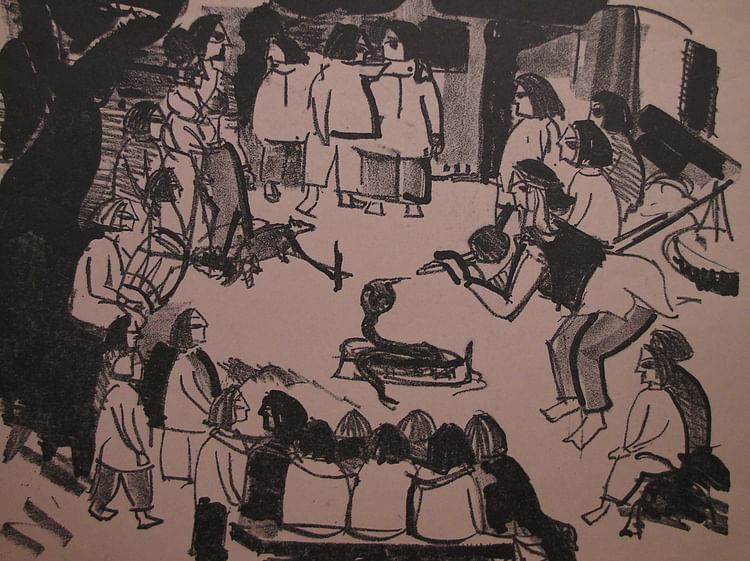
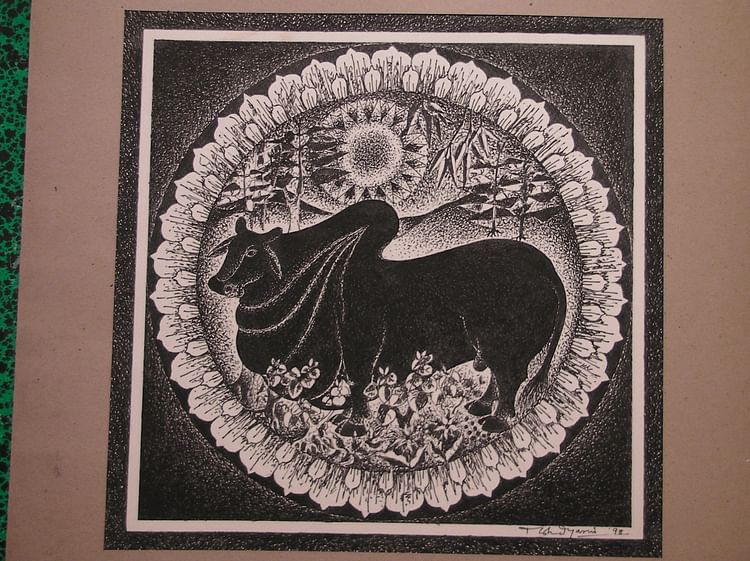
He was a versatile person, calligrapher, print maker and pioneered the technique of Lithography in Department of Graphics (Print Making), Jamia Millia Islamia, New Delhi. It was great endeavor in meeting with veteran artist Mohd. Yasin for the first time. This was the first full length documentary on Art & Artist by me which I enjoyed making a lot. I learned many new things on each and every step that enriched me to understand the variety, depth and details of his work.
I took Yasin ji’s interviews in many schedules. Every time I found a new and very interesting story from him. He himself was a great storyteller. His stories are detailed and very informative, a learning experience for everyone. I learned a sense of perfection, purity, innocence, humanity, selflessness and foremost devotion for the arts from him.
His film was appreciated and screened at various places such as The Attic, Delhi, India International Center (IIC), Delhi, Jawahar Kala Kendra, Jaipur etc.
He painted till his last breath. The integration of OM and Allah in his paintings were mesmerizing. Throughout his life, he conveyed the message of Peace and Harmony that are in line with the principles of Aseem Asha Foundation as well. He was a poetry enthusiast too, and used to recite Urdu couplets while sharing anecdotes with an amused face. In 2017 Aseem Asha Foundation was honored to confer a life time achievement award on him at IC’s hotel, Okhla.
He was also selected for several important scholarship and fellowship programs. During his scholarship at east-west center, Honolulu, Hawaii, he studied at the department of Art, University of Hawaii and at Pratts graphic Art center, New York.
Yasin had about 37 solo exhibitions including one in Paris in 1991, among others, one titled, “A decade in Retrospect 1974-84” was held at the Jamia Millia Islamia, Delhi in 1984, another one titled, “Retrospective of Paintings, Drawings and Graphics” spanning 1958-2005 was held at Castelo Branco, Portugal in 2005.
The remarkable work of Yasinn Sahab has inspired many students of Aseem Asha Foundation to take apprenticeship in arts and now they are doing extraordinary work in this field. To commemorate his work, we renamed our project as “M Yasin Community Visual Art Project”. He is not with us physically but spiritually his soul will always remain with us and pour the blessing on every work that we do.
He would invite me in each birthday since 2013 and I was the only outside person in his birthday celebrations. He was loquacious with me when I used to visit with my students, he used to give them blessing as well and hold the conversations very affectionately. He always advised us to make the Art as a part of the life in order to become good person. Art connoisseur Laurence Bastit who deceased recently played a very significant role in promoting him as a painter at national and international level.
I still remember an incident when he got the news from All India Fine Arts and Crafts Society (AIFACS), New Delhi about his life time achievement awards and honorarium of rupees 1 lac with a commemoratory lunch. He called and invited me first, I hurried to his home, we were in euphoria, and selected the attire for his awarding ceremony such as Sherwaani, Topi, Jootis etc. His face was as bright as an innocent child. Unfortunately, due to lockdown it could not be conferred upon him in his presence.
I feel, people like Mohd. Yasin don’t require any award or honor, in fact he awarded his life to us, to the young generation. He himself faced lot of physical, financial and mental challenges throughout his life. He was also affected with Tuberculosis and Paresis but never compromised with the quality of his work, he was never bothered about any acknowledgement though his work should get a great recognition from the government. Later in his life he taught at Delhi College of Art and Faculty of Fine Art, Jamia Millia Islamia. His works are in permanent collections of galleries, Art Institutions, museums and in private & individual collection in India & abroad.
I cannot forget the cherished moments with him specifically attending his birthdays, art exhibitions, award ceremonies and personal meetings. His legacy will be a great source of inspiration for the contemporary world and to the generations coming ahead.
source: http://www.nationalheraldindia.com / National Herald / Home> Obituary / by Aseem Asha Usman / August 20th, 2020
A total of 19 police personnel from the state have been conferred with the President’s Police Medal on the occasion of Independence Day.
Bengaluru :
A total of 19 police personnel from the state have been conferred with the President’s Police Medal on the occasion of Independence Day.
V L N Prasanna Kumar, ASI, Criminal Investigation Department, has been honoured with the medal for distinguished service.
The others are:
R Hemanth Kumar, DySP, Special Investigation Team, Lokayukta; Parameshwar Hegde, DySP, CID; R Manjunath, DySP, ACB, Mandya; H M Shailendra, DySP, Kodagu; Arun Nagegowda, DySP, Mandya; H M Satish, ACP; H B Ramesh Kumar, DySP, intelligence, Bengaluru; Umesh, DySP (Armed), Police Training School, Mysuru; C N Diwakar, Circle Police Inspector, Kodagu; G N Rudresh, Special Reserve Police Inspector, KSRP, Bengaluru; B A Lakshminarayan, SI, City Special Branch, Bengaluru; M H Chandekar, special reserve SI, KSRP, Bengaluru; K Jayapra- kash, PSI, Mangaluru; H Nanjundaiah ASI, Chikkaballapur; Atheeq Ur Rahman, ASI, Shivamogga; Ramanjanaiah, ASI, Tumakuru, R N Balikai, ASI, Haveri, and K Honnappa, head constable, Bengaluru Rural.
source: http://www.newindianexpress.com / The New Indian Express / Home> Cities> Bengaluru / by Express News Service / August 15th, 2020
Decades before the birth of the city of Calcutta, the area that is now Tollygunge was a dense forest land called Russapugla with an abundance of mangrove trees.
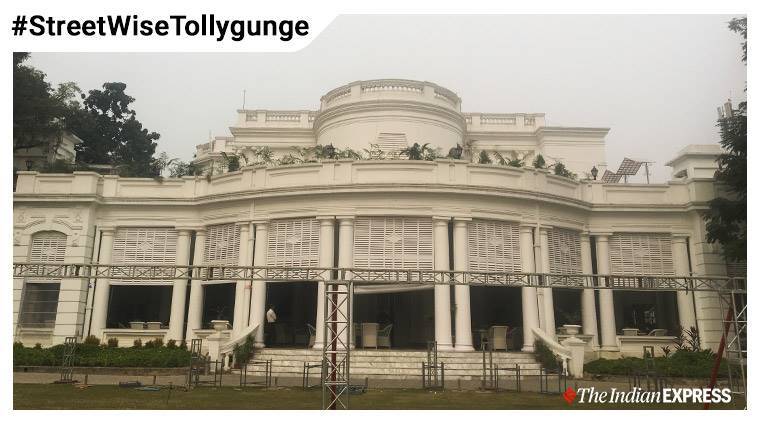
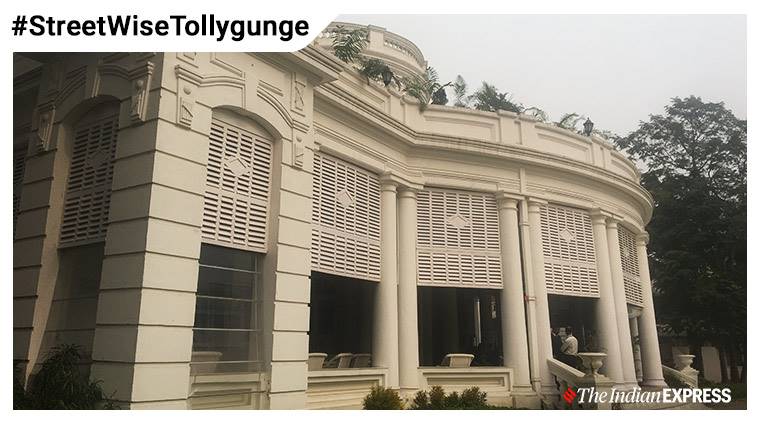
The clubhouse on the grounds of Tollygunge Club in Kolkata. The club is preparing for its New Year’s Eve party with stage equipment on its grounds. (Express photo: Neha Banka) ______________________
Most know Tollygunge as a neighbourhood in south Kolkata rather than the long stretch of road by the same name that cuts through a large swathe of the area.
Decades before the birth of the city of Calcutta, the area that is now Tollygunge was a dense forest land called Russapugla with an abundance of mangrove trees. Over the centuries, the land was cleared for settlement and urban planning but some traces of the forest can still be found in the expansive property belonging to Tollygunge Club and the Royal Calcutta Golf Club in the neighbourhood, some of the oldest social clubs in the city.
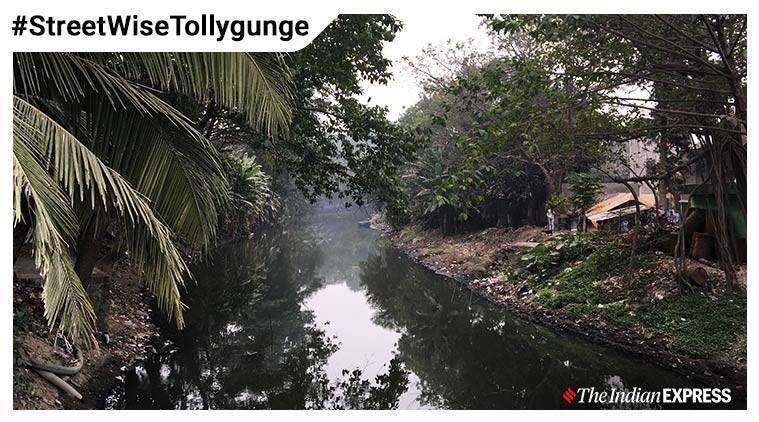
Tollygunge Club, established in 1895, derives its name from the neighbourhood of Tollygunge, that in turn got its name from William Tolly, a colonel in the British Army in 1767. Calcutta was a city of creeks, although many have been entirely or partially filled up. Today, few of those creeks remain, winding slowly across the city, trying to find their way into the Bay of Bengal, but one would have to search beneath cramped, illegal urban settlements and mounds of garbage to find them.
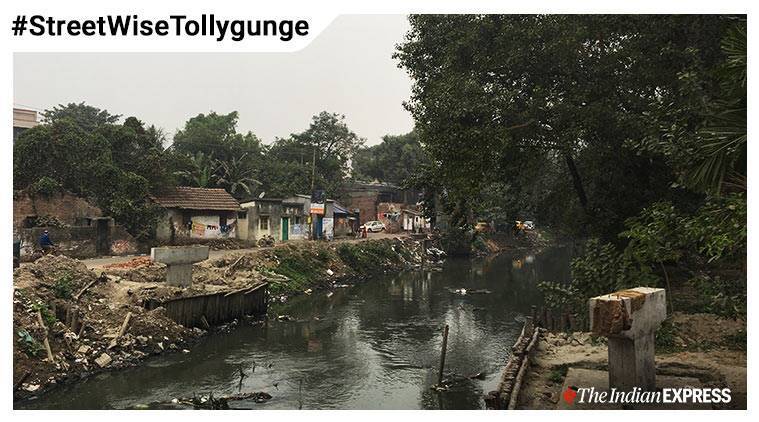
Tolly’s Nullah behind the grounds of Tollygunge Club in Kolkata. (Express photo: Neha Banka) ______________________
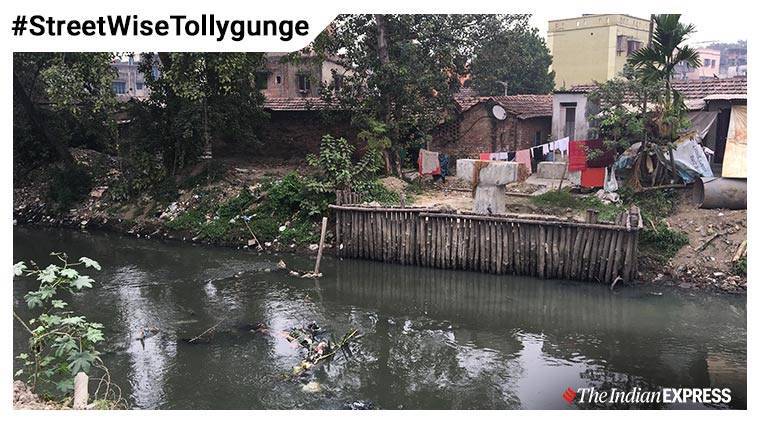
In the outer peripheries of the property that belongs to Tollygunge Club, a narrow creeks snakes past, as if conjoined to the boundaries of the club’s walls. On both banks of the creek, slums have developed over the years and garbage floats on the water, emanating a foul stench.
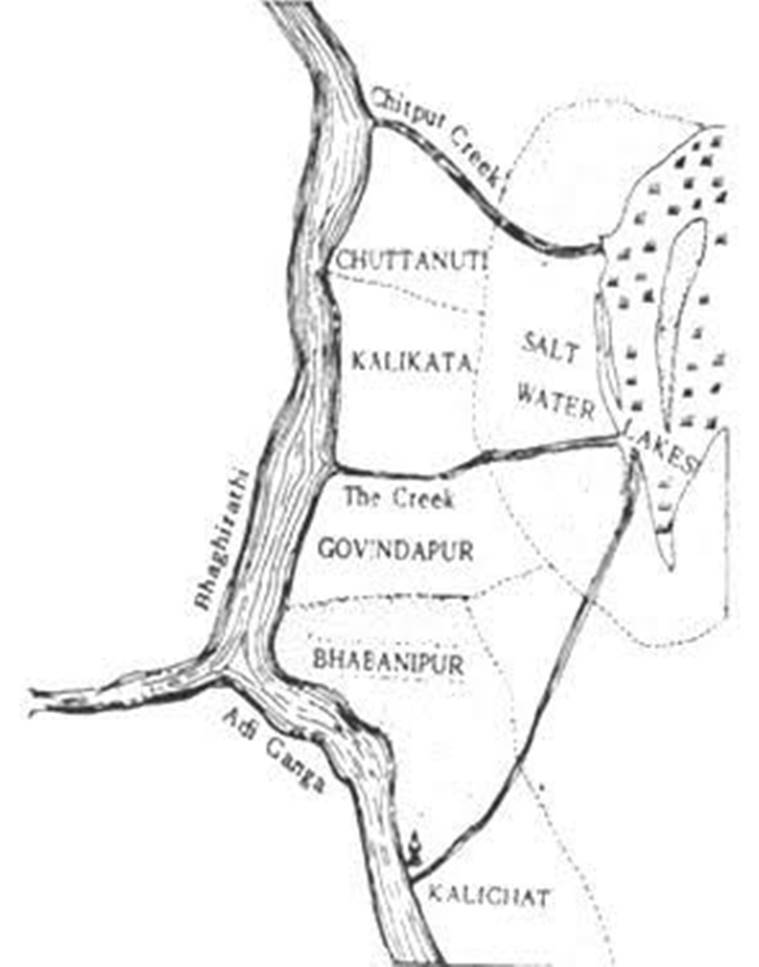
According to historian P Thankappan Nair, who has documented the city’s history extensively, this creek was originally called the Govindpur Creek. There is no historical documentation for why the creek was so named, but perhaps it acquired its name from that of the village of Govindapur, one of the three villages that went on to form the city of Calcutta. According to Nair, another name for this creek in Bengali was Adi Ganga or the original River Ganga that flows past the city.
This map is a conjecture map and shows the path of Adi Ganga. Tolly’s Canal is named ‘The Creek’ in this map and runs past Tollygunge when it was still the village of Govindapur. (Map credit: Chattopadhyay 1990/Jenia Mukherjee) ________________________
In 1775, Colonel Tolly wrote to Warren Hastings, the Governor-General of India, with a proposal of leading an excavation to connect the village of Balliaghat, now called the neighbourhood of Beliaghata, in the wetlands of the eastern fringes of the city, to the neighbourhood of Tollygunge through a waterway.
Slums have come up on both banks of Tolly’s Nullah. (Express photo: Neha Banka) ____________________
According to published letters in the Fort William-India House Correspondence Vol.7 (1773-1776), Tolly wrote to Hastings saying he can do the same on a contract with the East Indian Company or lend his services for Rs 80,000, along with a levy on tolls paid by boats passing through the creek for a period of 12 years. This plan was agreeable to the Company, and Tolly was directed to survey the land. This creek, 27 kilometres long, was then renamed Tolly’s Nullah after the colonel and opened for navigation in 1777.
After the opening of the Nullah, the neighbourhood became more developed and came to be known as Tollygunge. After Tolly’s death, his widow was unable to continue collecting the tolls and the maintenance of the waterways. The Company took over the management of the Nullah and auctioned its leasehold rights in March 1794 to an Englishman in the city, John Hooper Wilkinson. In 1804, the Bengal Government took control over the Nullah and the Collector of 24 Parganas was authorised to maintain it.
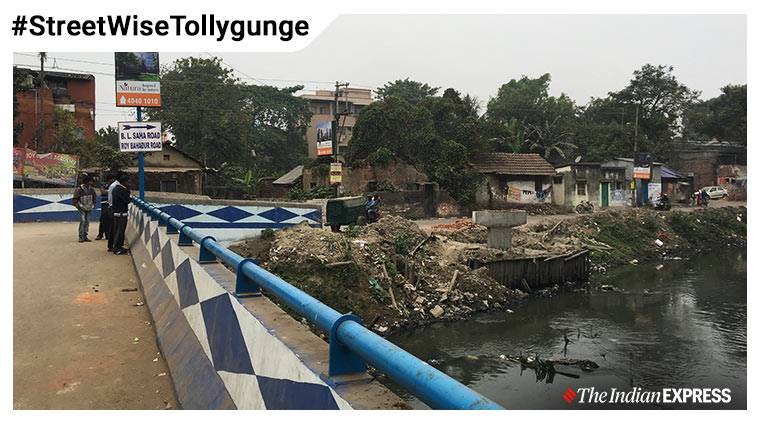
Passersby stand on a small bridge that connects the banks of Tolly’s Nullah. (Photo: Neha Banka) __________________________
There is no document to independently verify this fact, but according to the Tollygunge Club archives, the premises of the club was originally an indigo plantation home of Richard Johnson, a merchant in the East India Company, set up in 1781.
Around 1806, the British dispatched Tipu Sultan’s family to Calcutta and gave them a living allowance. Tipu Sultan’s son Ghulam Mohammed Shah purchased the plantation grounds from Johnson to be used as a residence and the family spent a considerable amount of time in the neighbourhood.
After the family’s fortunes changed, they sold some portions of the plantation and leased out other sections to William Dixon Cruickshank, a Scottish banker, who was looking to build a sports club for the British that would also allow residential facilities and provide space for the British to socialise.
After the fortunes of Tipu Sultan’s family changed, they sold some portions of the plantation and leased out other sections to William Dixon Cruickshank, who was looking to build a sports club for the British. (Express photo: Neha Banka) ___________________
Over time, Tipu Sultan’s family divested complete control of the estate and the lands came under the direct control of the Tollygunge Club, a name that the institution acquired because of the neighbourhood it was located in and because of the location of the creek that runs just behind its premises.
Over the decades, most of the open spaces in the club were converted into an 18-hole golf course and the forest land was cleared to make space for other structures and facilities inside the club premises.
Today, there are no signboards that indicate the location of the Tolly Nullah in the neighbourhood of Tollygunge. Haphazard modern construction has changed the facade of Tollygunge and to find the nullah, one would have to engage in a self-conducted walking tour using an old map of the city for guidance.
An offshoot of the main road in Tollygunge, a narrow lane, through which only one vehicle can pass at a time, is the only way to access the nullah these days. Slums occupy both banks of the waterway and an overwhelming sense of garbage permeates all around. Tollygunge Club itself has changed over the decades and its history can only be found in pockets.
Haphazard modern construction has changed the facade of Tollygunge and to find the nullah, one would have to engage in a self-conducted walking tour using an old map of the city for guidance. (Express photo: Neha Banka) ______________________
Although most of the dense forest has been cleared away over the years, jackals still roam its greens in the darkness of dusk and late into the night. On any given day, one can spot diverse species of birds on the club grounds, like kingfishers and cattle egret. Few city residents know of how the institution and its neighbourhood got its name and perhaps even fewer know of the existence of the waterway that lies beyond the high walls of the club.
source: http://www.indianexpress.com / The Indian Express / Home> Cities> Kolkata / by Neha Banka / Kolkata , December 27th, 2019
Veteran Bollywood actress Padmini Kolhapure with Shoor Veer Awardee Shams Alam at Dr Aneel Kahshi Murarka’s The Shoor Veer Awards 2018 in Mumbai (photo provided)
MUMBAI— Because we all have a hidden hero inside – that was the tag-line of the 4th edition of ShoorVeer awards from Dr. Aneel Kashi Murarka’s foundation AmpleMissiion. The ShoorVeer Awards is a unique initiative that honors common men and women from across the country who achieved uncommon goals.
It honors brave-heart individuals who have known no fear and have performed extraordinary acts of bravery. The event held at the Bombay Stock Exchange Aug.10 was attended by a bevy of celebrities from the corporate world, film and the television industry, and the social field.
Besides, hosts Dr. Aneel Kashi Murarka and Siddhant Murarka, Roop Kumar and Sunali Rathod, Padmini Kolhapure Sharma, Mickey Mehta, BJP members Ashish Shelar, Vinod Shelar and Shaina NC, designer Sangeeta Murarka, Vastu expert and numerologist Basannt R Rasiwasia, Sooraj Thapar, Akashdeep Saigal, audiologist-speech therapist Devangi Dalal, Gurpreet Kaur Chadha, Yogesh Lakhani, Ashok Lokhande, television’s Tenali Rama – Krishna Bharadwaj, comedian VIP and writer-director Anusha Srinivasan Iyer were among the guests or presenters.
The award ceremony was also marked by live performances by singers Meghna Mishra (of “Secret Superstar”) and Aaman Trikha among others. The awards also saw a ramp walk by transgender women, signifying gender equality.
ShoorVeer 2018 awardees
Anoop Khanna
‘Dadi ki Rasoi’ in Noida sector 29 has gained immense popularity over time. Begun by Khanna (social activist), it aims at providing quality food to poor and needy people at just Rs 5. It serves food to more than 500 people per day, and the group also collects old unwanted clothes, cleans and irons them and sells them in a special shop for a nominal price of Rs. 10.
Rekha Mishra:
Railway Protection Force Sub-Inspector Rekha Mishra (32)’s daring exploits to save children, often battling great odds, feature in the Maharashtra State Board’s Class X textbook. She is credited with rescuing hundreds of destitute, missing, kidnapped or runaway children from various railway stations in the past few years. Currently posted at the Chhatrapati Shivaji Terminus (CST), the cop has helped 953 children till date. This correspondent was given the honor of being one of her presenters.
Insia Dariwala
Insia Dariwala is an award-winning international filmmaker and one of the founder members of Sahiyo, an organization against Female Genital Mutilation. Dariwala, a survivor of childhood sexual abuse, creates awareness to help similar victims through her films and her organization. Her award-winning debut film “The Candy Man,” followed by another hard-hitting film, “Cock-Tale,” delved into topics like child sexual abuse, and sexual violence on women. Insia also started The Hands of Hope Foundation, which diligently focuses on sexual violence on women and children.
Aarefa Johari
Aarefa Johari is a journalist and an anti-FGM (Female Genital Mutilation) activist based in Mumbai. She began her career with a four-year stint as a reporter for the Hindustan Times. For the past three years, she has been working at Scroll.in, an online news publication. Johari is also a co-founder of Sahiyo along with Insia Dariwala, a non-profit organization working to end female genital mutilation among the Dawoodi Bohra and other South-Asian communities.
Saumya Chandra & Nagesh Ahir
While most children their age would panic in the face of an emergency, these two, aged 13 and nine respectively, remained calm. When their friend fell into a deep water-tank, they rushed to help him. Having learned disaster management, they caught onto his collar and saved his life.
Major D.P. Singh
Major D.P. Singh is India’s first Blade Runner, who was severely injured on the Kargil battlefield! The army surgeon declared him dead on arrival after being blown by a mortar bomb and sent his wrecked body to a makeshift mortuary. But he won over death and, today at 39, has run close to 20 marathons. He is also a motivational speaker, inspiring over 1700 amputees across India. He manages a support group called The Challenging Ones.
Aaman Trikha
For someone qualified in engineering, Aaman Trikha is the voice behind the popular BJP anthem “Acche Din Aane Wale Hain” in the run-up to the Lok Sabha Elections of 2014. He is a known playback singer.
Rajan Kumar
Rajan Kumar is an Indian actor, born and brought up in Munger in Bihar. He is the first Indian actor who has been portraying comedian Charlie Chaplin for as many as 12000 hours in 4000 shows in India and abroad. For this, he won many awards and accolades and entries into the Guinness and Limca Books.
Dr. Habib Z. Shaikh
Dr. Habib Z Shaikh has been serving the poor patients without charging them any fee since 20 yrs. The doors of his Kamili Clinic are always open to the sick and needy slum-dwellers of Hari Nagar in the western suburbs of Mumbai. He is a household name there, and his patients get the best treatment possible. He is an unsung hero who shies away from any media glare, leading by example and being true to his profession.
Salma Memon
Salma Memon’s journey motivated her to take up education of underprivileged children as a cause. Her passion and hard-work took roots two years ago when she launched her dream initiative, Project UMEED, which supports education of underprivileged and orphan children.
Annasaheb Jadhav
Annasaheb Jadhav is a young Deputy Superintendent of Police, who was posted a few years back in the Naxalite-prone area of Gadchiroli, Maharashtra. During his tenure, he set up a library for the poor and underprivileged students, a counseling center for educational guidance and various other activities to help their economic growth. This year, they have come together again to help 250 students of Gadchiroli with school stationary. He has also been selected for the President’s Medal this Independence Day.
Subarna Ghosh
Delivering a baby through a C-section without any medical need is a norm these days. Still, nobody raises any questions. Today we have a voice questioning this practice, reflecting the collective agony of so many women tricked into undergoing unnecessary surgery. This is the voice of Subarna Ghosh, who has filed a petition through change.org (which received 1.5 lakh signatures till date) to urge hospitals to declare the number of C-sections conducted. Women and Child Development Minister Maneka Gandhi has supported this petition, urging the health ministry to make necessary policy changes to curb C-sections in the country.
Dr. Satendra Singh
Dr. Satendra Singh is a doctor at the University College of Medical Sciences and Guru Tegh Bahadur Hospital, Delhi. A physiologist by profession, he contracted poliomyelitis at the age of 9 months but went on to complete MBBS and MD (post-graduation) in Physiology. He is the first Indian to win the prestigious Henry Viscardi Achievement Awards, given to extraordinary leaders in the global disability community. He is a noted disability activist, especially for his sustained efforts in making public places accessible for disabled persons.
Meghna Mishra
Singing sensation Meghna Mishra has achieved huge success at 16 and is a star already.
Shams Alam
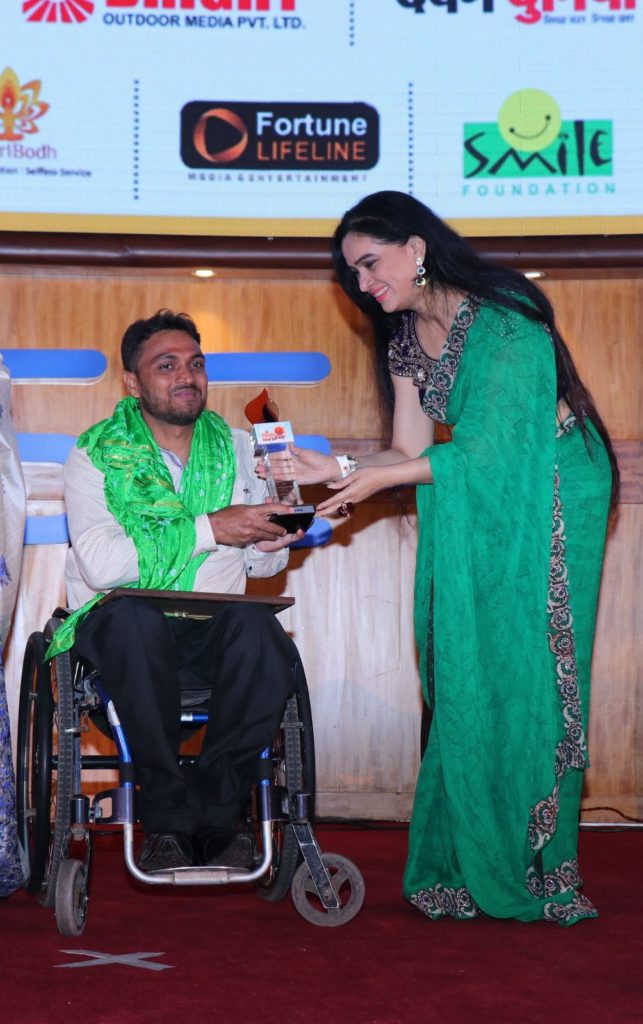
Mohammad Shams Alam Shaikh, a mechanical engineer by profession, was also a passionate Black Belt Karate player. But life had different plans for him. After getting diagnosed with spine tumor and undergoing multiple operations in 2010, Shaikh was left paraplegic. But he took to swimming and won the bronze in the 12th Para-Swimming Championship in Chennai. Shaikh won four gold medals at the championship that was held in Indore and was also awarded a trophy for best swimmer. He is the first Indian to have successfully finished 6 kilometers of open sea swimming organized by the Indian Navy.
Nagraj Gowda
Nagraj Gowda always dreamed of setting an example for others, and wondered how to do it. Since he had a passion for cycling, he hit upon the idea to go on a solo cycling expedition across India with a social message for people. There were many issues he strongly believed in, and he wanted to advocate to his countrymen. Gowda, a resident of Mumbai, started his all-India Cycle Yatra on Dec.3, 2017 to spread the messages of World Peace, Communal Harmony, National Integration, Save Water, et al. So far he had peddled over 6000 kilometers.
source: http://www.indiawest.com / India West / Home / by R.M. Vijaykar , Special to India West / August 18th, 2018
Dr. B. Ahmed Hajee Mohiudeen passed away on Sunday at a private hospital in Mangaluru after a brief period of illness
Dr B. Ahmed Hajee Mohiudeen, founder of the BA Group, Thumbay, was known for his philanthropic activities.
Dr B. Ahmed Hajee Mohiudeen, 86, entrepreneur, philanthropist, educationist and the founder chairman of BA Group, Thumbay, passed away on Sunday at a private hospital in Mangaluru after a brief period of illness.
According to former Karnataka minister U T Khader, the mortal remains of Dr. Ahmed Hajee will be kept at Thumbay PU College for the public to pay their tribute. Funeral will be held at Thumbay Masjid burial ground after 4pm on Sunday.
Ahmed Hajee, born in 1933 to B. Mohiudeen Hajee and Mariamma in a business family, graduated in commerce in 1954 and began his career soon after as a small scale industrialist in a village called Thumbay on the outskirts of Mangaluru.
He founded the BA Group, in 1957. From a fledgling company in the 1960s, the BA Group is now on the threshold of rapid expansion into areas such as urban housing, education, real estate, healthcare and exports and imports.
Ahmed Hajee, who was married to Bee Fathima Ahmed Hajee, is survived by three sons – Thumbay Moideen (founder president of Thumbay Group, headquartered at Ajman, UAE), B Abdul Salam (Managing Director & CEO – BA Group), B M Ashraf and his daughter Shabana Faizal (co-founder and Vice Chairperson of Kef Holdings).
Mohiudeen Educational Trust has been playing a vital role in the promotion of education by sponsoring a number of educational institutions such as BA Industrial Training and Technical Centre, a Kannada and English medium school, a pre-university college, a nursery school, and Darul Uloom Mohiudeen Arabic College.
Ahmed Hajee is also the founder president of a number of institutions and trusts in Mangalore and the surrounding areas. He is the president of the 80-year-old Badriya Educational Institutions at Mangaluru. He is also the president of Nav Bharat Night High School, which was established before India’s independence. He is one of the Trustees of Islamic Academy of Education, under Yenepoya Group.
source: http://www.khaleejtimes.com / Khaleej Times / Home> World> India / by Staff Report, Mangaluru / August 16th, 2020
Following up on The New York Times article on the imposters who called themselves the descendants of Wajid Ali Shah, we trace the last prince of Awadh and the story of a family that settled in Kolkata after decades on the move.
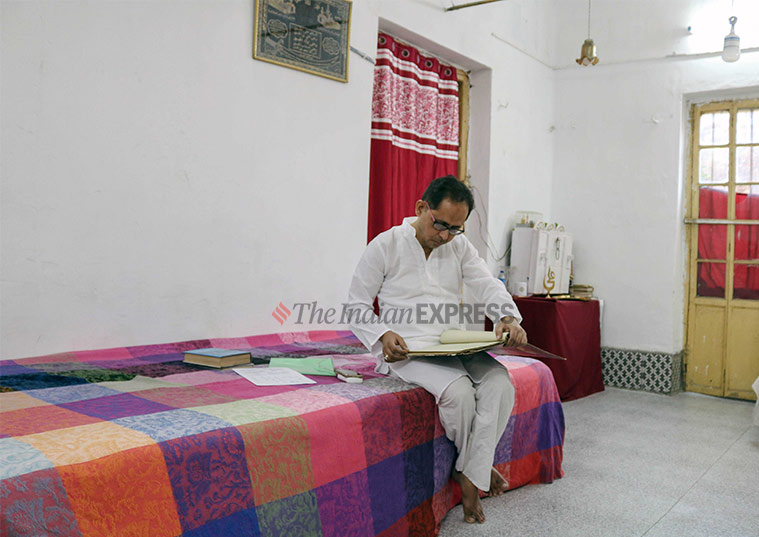
Dr Kaukab Quder Meerza, a direct descendant of Nawab Wajid Ali Shah, in his home in central Kolkata. (Express Photo: Shashi Ghosh) ________________________
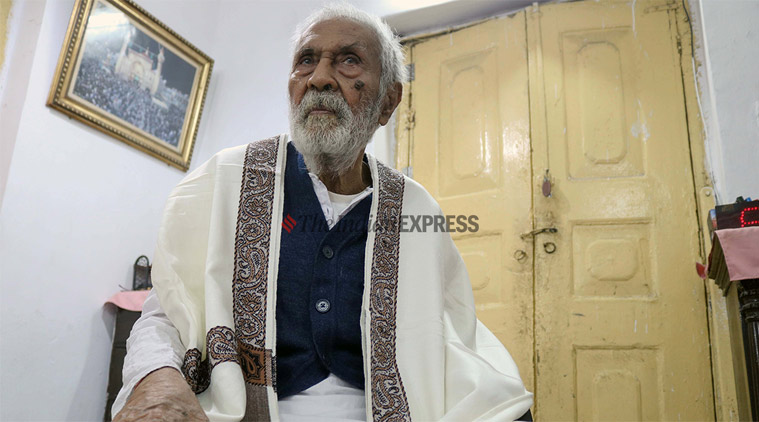
Dr Kaukab Quder Meerza, 86, doesn’t keep well these days. Long conversations are challenging for him and his children and grandchildren have to help him walk short distances inside the house. His home, deep inside a bylane in the heart of Kolkata, an old, unassuming, one-storey building, is easy to miss if one isn’t paying attention. The modest interiors of his residence give no indication of who Meerza is or his family’s legacy. They are the last remaining descendants from the ruling line of Nawab Wajid Ali Shah, the last ruler of the kingdom of Awadh in India.
In November, The New York Times article titled “The Jungle Prince of Delhi ‘,brought focus back on the descendants of the Nawab after the story revealed that a family living in the ruins of a 14th-century hunting lodge in New Delhi for decades, claiming to be the descendants of the Awadh rulers, were actually imposters.
An ‘absurd’ story
Meerza and his family in Kolkata are familiar with the story of Wilayat Mahal, as are most people who have been associated with the former princely state of Awadh in various capacities or have spent time researching on Nawab Wajid Ali Shah. Wilayat, the woman at the centre of the deception, along with her son Ali Raza, also known as Cyrus, and her daughter Sakina, entertained journalists, mostly those from overseas, with her claims of ancestry, and the journalists, in turn, dedicated hours of time and spools of newsprint in telling their dramatic story.
“It was absurd,” says Meerza, recalling his meeting with Wilayat Mahal in the 1970s-80s. When Wilayat made her first appearance at the New Delhi railway station, Meerza and his brothers Anjum Quder and Nayyer Quder agreed that it was necessary to meet her to learn more about the basis of her claims. The family decided that Meerza would travel to Delhi for that purpose, having studied the family history most extensively. He doesn’t remember his first meeting with her very well—some four decades have passed since—but the second visit is more vivid in his memory.
A photograph of a painting of Nawab Wajid Ali Shah found in the Imambara Sibtainabad. Unlike the commonly seen paintings of the Nawab, here he is fully covered and is not depicted with one exposed nipple (Photo credits: Sudipta Mitra) _________________________
Sometime after his first meeting with Wilayat, Meerza took another trip to Delhi and met her at the Maurya Hotel, now called ITC Maurya. “She said many things about herself,” recalls Meerza. “With great difficulty, she met me because the place (the room they met in) was reserved for VIPs. The lady talked about nothing in particular.” It isn’t immediately clear why it was a challenge to meet Wilayat because Meerza’s age and health have impacted his speech.
A few of Meerza’s children and grandchildren who still live in Kolkata are gathered around him and his younger daughter Manzilat Fatima, 52, and son Kamran Ali Meerza, 46, express surprise at the revelation. Although Wilayat’s story is familiar to the family, this is the first time they have heard about their father’s second meeting with her. As he begins his tale, his voice becomes louder, emphatically denouncing the stories Wilayat and her children had spun over the years.
______________________
“It was a dark place and the meeting was absurd,” Meerza continues. Wilayat wore a sharara, he recalls, just like women did centuries ago in Lucknow, in the royal courts, not a sari, perhaps to add more credence to the character she had been attempting to play. “She wasn’t wearing jewellery. It was absurd. She spoke to us in Urdu and sometimes in English.” During their conversation, not once did Wilayat disagree that Meerza’s family members were descendants of Wajid Ali Shah. “We were interested in knowing the background of the lady. Of course, we told her about us. She never denied that we were from Wajid Ali Shah’s family, but she presented herself as a representative of the family. I told her that she was not a representative and that she was talking (about) absurd things.”
Meerza remembers that Wilayat showed some newspaper cuttings, not legal documents, to lend credibility to her claims. “Whenever I said anything about the branch of Birjis Quder’s family, she never (responded). I said that whatever she was talking about the background of the family was absurd. That she was not talking correctly about the family.” In this meeting, Meerza says, there was no sign of Wilayat’s daughter Sakina. “Only her son was there. A little older than Kamran now,” says Meerza, gesturing towards his son. “I’m sorry that I met her.”
Kamran Ali Meerza browses through letters written by his family to the Indian government over the years, denouncing Wilayat Mahal’s claims of ancestry. (Photo: Shashi Ghosh) _________________________
After The New York Times story was published, Manzilat told her father that the world now knew what the family had been trying to tell people about Wilayat Mahal for decades. “What is there to say about that?” asks Meerza about the story. To Meerza and his family, and to many others who met Wilayat over the years, the revelation came as no surprise.
The Nawab’s 300 wives
“There is a saying that if you throw a stone in Lucknow, it will fall on a Nawab’s kothi (house). All fake. Most of them are fake,” says Manzilat. Nawab Wajid Ali Shah was a documented hedonist, who found joy and solace in music, women and extravagance and had some 300 wives, many of whom he divorced when the period of his decline started, presumably in an attempt to lessen his financial burden and responsibility. It is difficult to state the exact number of his descendants, but the figure would be somewhat in proportion to the number of Wajid Ali Shah’s consorts, in addition to his official spouses and the children he had with them.
The British officials who deposed and drove Wajid Ali Shah out of Awadh and imprisoned him in Calcutta in 1857, recorded the names of 185 officially recognised wives of the Nawab and his children. This list was published in the Awadh Pension Book of 1897 after the death of Wajid Ali Shah’s son and successor, Birjis Quder, the last official ruler of Awadh.
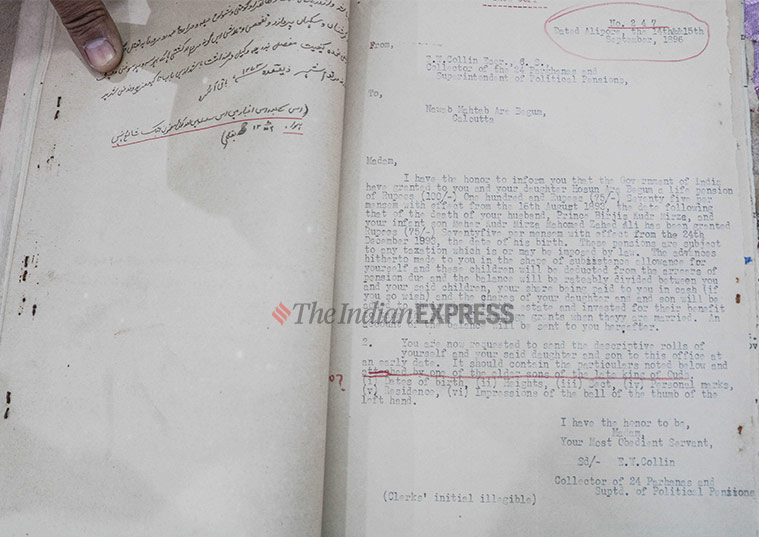
A type-written replica of a letter written in 1896 by EW Collins, Collector of 24 Perganas and Superintendent of Political Pensions to Nawab Mahtab Ara Begum informing her of the political pensions granted to her and her children by the British government. (Photo: Shashi Ghosh) ___________________________
The descendants mentioned in the Awadh Pension Book of 1897 were allotted political pensions, first given by the British government in India, a responsibility that later transferred to the government of independent India in 1947. The central government made no alterations to the names of the descendants mentioned in the Awadh Pension Book of 1897 and has continued paying the required monthly pension ever since. The Awadh Pension Book, however, hasn’t prevented pretenders in Lucknow and elsewhere from sprouting, claiming ancestry to the family, because few bother to check official documents to verify such claims.
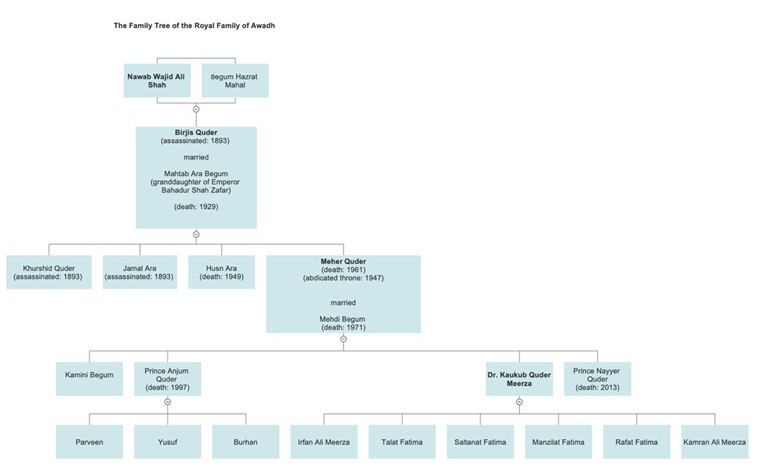
Meerza’s family are direct descendants of Birjis Quder, the son of Wajid Ali Shah and his wife Begum Hazrat Mahal, a courtesan who became the second official wife of the Nawab. But it would be doing Hazrat Mahal a disservice if she were to be dismissed as a mere court dancer whose fortunes changed when she captured the Nawab’s fascination and favour.
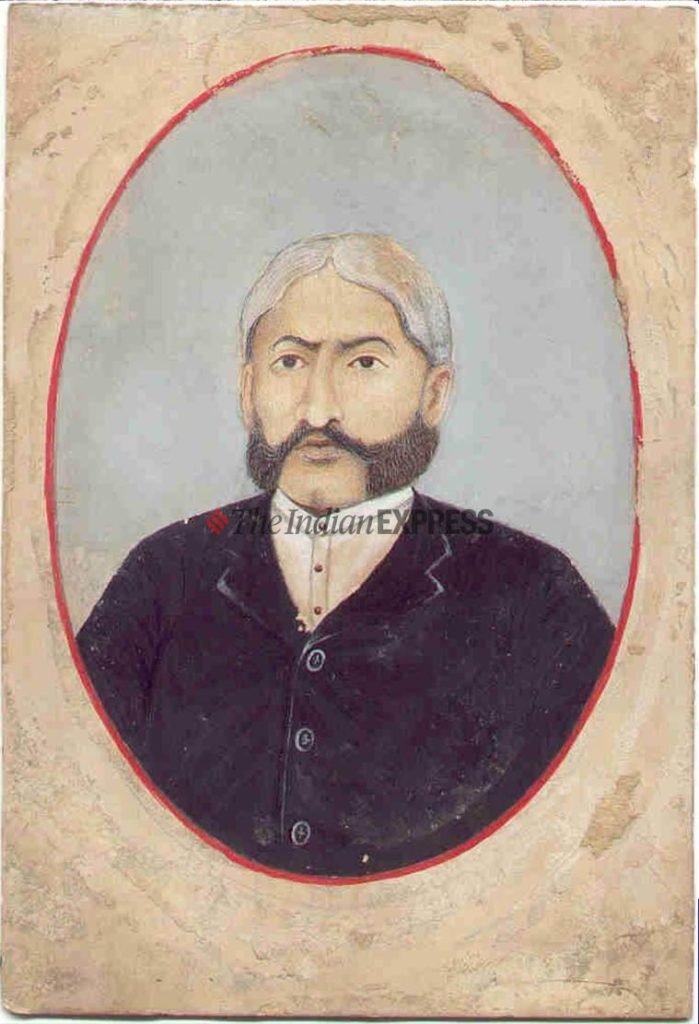
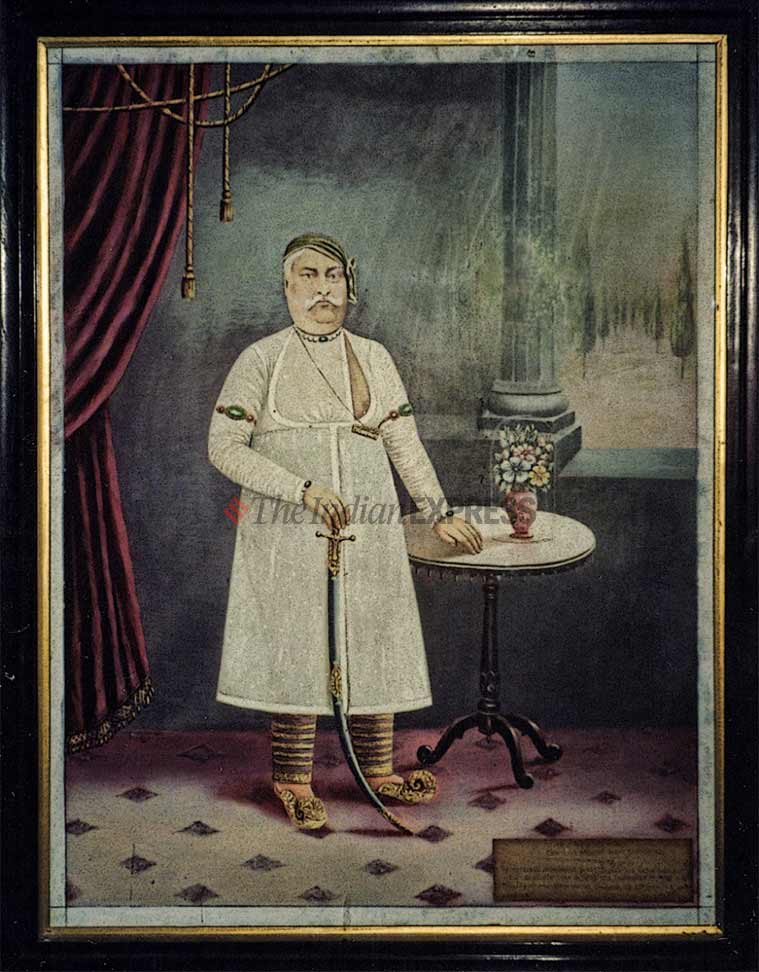
An undated hand-painted portrait of Birjis Quder. (Photo credit: Manzilat Fatima) ________________________
“She was a warrior and she was a purdah nasheen,” says Manzilat of her ancestor, who lived wearing a customary veil that she removed to launch into war with the British. When Wajid Ali Shah was dismissed and dispatched from Awadh, Begum Hazrat Mahal actively engaged in opposing the British during the Rebellion of 1857 on her own accord, without having been given any special political appointments by the deposed Nawab.
Her resistance against the British proved to be futile and she was compelled to flee Awadh. Taking her son Birjis Quder, she sought asylum in Nepal under the protection of King Jung Bahadur Kunwar Rana who demanded hefty financial compensation in return. The mother and son spent close to two decades in Nepal, but not much is known about their circumstances or where they found the finances to live in the country. Hazrat Mahal died away from her homeland, in a nameless grave in Kathmandu, forgotten till only recently.
The last Nawab of Awadh
Sometime in 1893, according to her father’s research, says Manzilat, Birjis Quder, now the ruler of Awadh in exile, was coaxed by the other wives and children of Wajid Ali Shah who had followed the Nawab to Calcutta, to join them in the city. “It was a conspiracy,” says Meerza, a statement he repeats several times during the interview with indianexpress.com. “It was a conspiracy among the other families of Wajid Ali Shah and the British because Birjis Quder was the last legal heir. The conspiracy was hatched and he was invited by deceit. They told him that he was the head of the family now and Birjis Quder was taken in by the sweet talk. So of all the places, he came to Calcutta. He could have also gone to Lucknow,” says Manzilat.
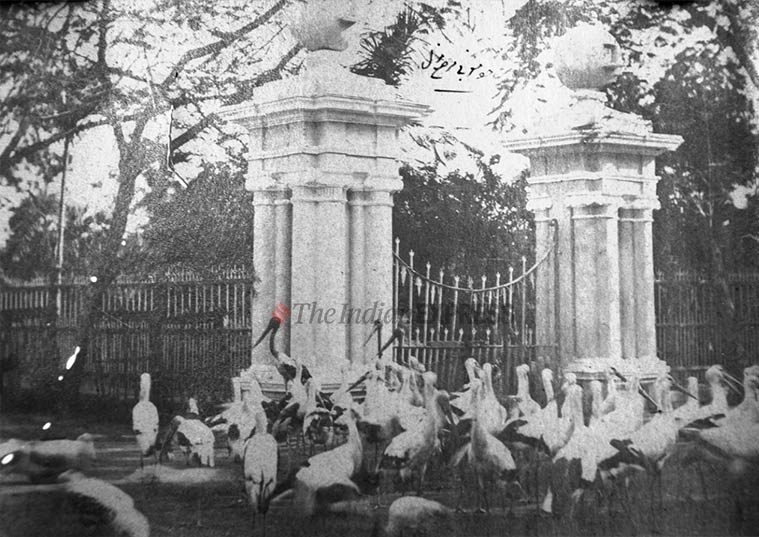
This rare photo depicts the main entrance of the family home of Birjis Quder and Mahtab Ara Begum in Metiabruz, Kolkata, now demolished. In the foreground, birds that appear to be storks are seen flocking near the entrance. (Photo credits: The private archives of Dr. Kaukab Quder Meerza and his family) ______________________
According to the story passed down in the family, Birjis Quder and his eldest sons Khurshid Quder and Jamal Ara were invited for dinner by the other families of Wajid Ali Shah on the night of August 14, 1893. All three died the next day, having been poisoned. When news reached of their murders, Birjis Quder’s wife, Mahtab Ara Begum, who was the granddaughter of Bahadur Shah Zafar, the last Mughal Emperor of India, fled Metiabruz, the neighbourhood in Calcutta where they had been staying, while she was pregnant with Mehr Quder, along with her remaining daughter, Husn Ara and reached central Calcutta in search of a safe house.
“When news of the death arrived, she ran from Metiabruz, along with her precious potli of jewels. These things I don’t know (much about), but my father will know,” says Manzilat. The house where the family now live in is not only unique because of its residents, but the building itself is of little-known historical importance.
“Perhaps she didn’t buy this house that very night itself. But she put up in another place somewhere close by in some small room, while she was trying to find some protection. From that time onwards, we are here and it’s my father’s wish that as long as he is around, we cannot construct anything here,” says Manzilat, looking around the living room of their home. Mahtab Ara Begum’s son Mehr Quder had three sons and one daughter, including Manzilat’s father Kaukab Quder Meerza.
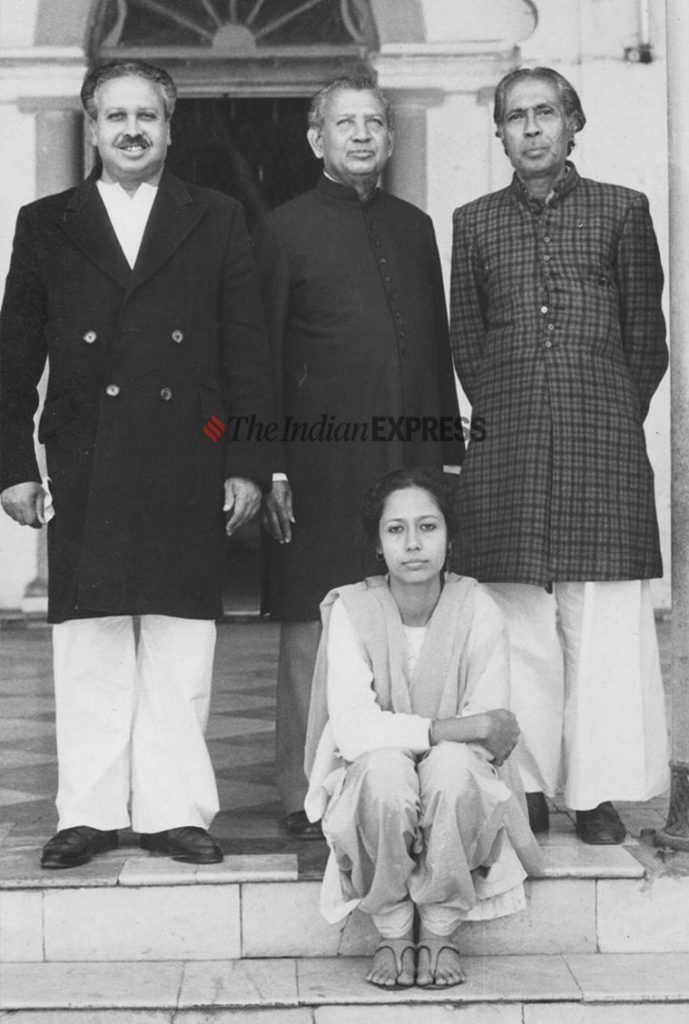
(From Left to Right) Prince Nayyar Quder, Prince Anjum Quder, Dr. Kaukab Quder Meerza pose for a photo with Meerza’s daughter Manzilat Fatima at Imambara Sibtainabad in Metiabruz, Kolkata, sometime during 1985-1986. (Photo credit: The private archives of Dr. Kaukab Quder Meerza and his family) ___________________
“The last pension holder is Dr. Kaukab Quder Meerza, the last living member of that generation,” says Sudipta Mitra, author of the book ‘Pearl by the River: Nawab Wajid Ali Shah’s Kingdom in Exile’, who has conducted research on the Nawab for more than a decade. The various provisions of this pension mean that Meerza is the last remaining recipient of this monthly pension that will not be transferred to Manzilat or her five siblings, Irfan Ali Meerza, Talat Fatima, Saltanat Fatima, Rafat Fatima and Kamran Ali Meerza. Prince Anjum Quder died in 1997, years after the death of his daughter Parveen. His two sons, Yusuf and Burhan live elsewhere in the country with their families and don’t spend much time in Kolkata these days. Prince Nayyer Quder never married. Unlike his brothers, Kaukab Quder Meerza never used the title of ‘Prince’ before his name, preferring to use the title of ‘Doctor’ to signify the Ph.D that he earned, explains Manzilat.
Mitra says this list and its provisions, left by the British, documenting the descendants of Wajid Ali Shah, not only provide a monthly pension to listed descendants, but it also serves to provide recognition to the descendants because it is the most authentic documentation available of the Awadh royal family tree. It also helps weed out pretenders like Wilayat Mahal and her children, who find no mention in either the Awadh Pension Book of 1897 or in other historical documentation and research on Awadh.
Asked about Wilayat Mahal, Mitra dismisses her entirely. “I did not find their names in the records and was hence not interested in them. They did it for publicity,” says Mitra.
Fake nawabs of Lucknow
The controversy surrounding claimants who say they are descendants of the Nawab or of the larger Awadh royal family is nothing new, but according to Mitra, there is very clear historical documentation that helps sift out fraudulent claims for those bothering to do the research. “When Wajid Ali Shah lived in Lucknow, there were many taluqdars who lived like kings themselves. So their descendants call themselves ‘royal’,” says Mitra of some such claimants. Mitra believes that although the Awadh Pension Book of 1897 is not the full and final record of all of the Nawab’s wives and children, it is the most authentic record available.
A photograph of a painting of Nawab Wajid Ali Shah, depicting the Nawab with white hair. (Photo: Sudipta Mitra) ______________________
So why then did the Uttar Pradesh government or the Indian government not do anything to weed out the imposters? “The belief is that the imposters are harmless. They aren’t taking anything. They aren’t asking for anything,” says Manzilat. She points to some individuals who live in Lucknow and have made the make-believe their business where they attempt to cash in by claiming to recreate the Awadh of the Nawabs and Awadhi cuisine, purportedly representing food as it was cooked in royal kitchens, especially for foreign tourists. “It is difficult to deny Dr. Kaukab Quder Meerza’s ancestry,” says Mitra. “The government has recognised the family and that is why they get the pension.”
There is little doubt that Wilayat Mahal and her family were a nuisance for the Indian government. She was attracting crowds and journalists and was occupying the VIP room at the railway station, filled with her children, fripperies, dogs and carpets. During their second meeting at the Maurya Hotel in Delhi, Meerza remembers that there were talks going on between the Indian government and Wilayat that were perhaps not heading in the direction in which she would have liked. Although the government eventually gave Wilayat consent to live with her children and dogs in Malcha Mahal, the dilapidated 14th century hunting lodge in the middle of Delhi, Meerza says in no way should it be considered official recognition of her claims.
“She did not get any recognition from the government. Forcibly living in the (railway) station was not the right thing (to do),” says Meerza. Two years ago, after the death of Wilayat’s son Cyrus, when he was able to speak more clearly, Meerza told his family that the Indian government gave Malcha Mahal to Wilayat not to give recognition to them, but because they were creating nuisance in public. “In order to keep them quiet, the government gave them ruins and she accepted it. No royal would accept something like this,” says Manzilat. “She was also offered some flats in Lucknow but she refused to accept it.”
Battling historical inaccuracy
The family continues to battle misinformation about their ancestors, particularly Wajid Ali Shah, especially concerning the time the Nawab spent in Calcutta. Government apathy towards correcting historically inaccurate information frustrates the family, but they say there is little they can do. Nobody has conducted as much research on Nawab Wajid Ali Shah and his wife Begum Hazrat Mahal, the line from which the Kolkata family descend, as Dr Kaukab Quder Meerza, but few are listening.
A few years ago, says Manzilat, heritage walking tours in the city held in conjunction with the city government began claiming that the Bengal Nagpur Railway (BNR) House in Kolkata, a large mansion in the Garden Reach neighbourhood of the city, was where Wajid Ali Shah once stayed in during his time in the city. A plaque was also installed in the premises of the mansion stating that this fact had been verified by her father. Local newspapers and blogs began repeating those claims and the myth took a life of its own, including a mention on Wikipedia. “My father’s name has been used to claim that the BNR property was a place where Wajid Ali Shah stayed. But my father is the sole authority (on the family history), and there is no evidence that (the BNR building) was associated with Wajid Ali Shah,” says Manzilat.
After graduating from St. Xavier’s College in Kolkata with a Bachelors in Economics, Meerza went on to do a double Masters in Political Science and Urdu from Aligarh Muslim University. When he started a Ph.D at Aligarh, his advisor told him to consider conducting research on his own family’s history, on Wajid Ali Shah. The family believes the thesis written in Urdu is the most comprehensive documentation of Wajid Ali Shah and his wife Begum Hazrat Mahal, and Manzilat’s elder sister Talat Fatima, 62, is in the process of translating it to English.
Helping Satyajit Ray write ‘Shatranj Ke Khilari’
In October 1976, when Satyajit Ray began writing his screenplay for the film ‘Shatranj Ke Khilari’, set in the backdrop of Awadh during the First War of Independence of 1857, the filmmaker made a trip to the Imambara Sibtainabad in Calcutta to learn more about the subject. Wajid Ali Shah’s descendants in Kolkata are trustees of the Imambara and Anjum Qudr directed Ray to his younger brother Meerza, who was at that time teaching Urdu as a lecturer at Aligarh Muslim University and simultaneously researching on Nawabi Lucknow and specifically, Wajid Ali Shah.
Pictured here are the interiors of the Imambara Sibtainabad in Metiabruz, Kolkata. The descendants from the ruling line of Wajid Ali Shah are the trustees of this property. (Photo credits: Sudipta Mitra) _____________________
That was how Satyajit Ray came to engage with Meerza in a long-term correspondence through letters, to better understand the character of Wajid Ali Shah for his screenplay. Over the course of weeks, Ray and Meerza discussed less well-known aspects of the Nawab’s life and Nawabi Lucknow, and conducted in-person meetings where the director made trips to Aligarh where Meerza had been occupied with his teaching and research.
“In my screenplay, I show (Wajid Ali Shah) as a tragic figure who realises that he should not have sat on the throne but should have pursued an artistic career. Do you agree with this viewpoint?” asks Ray in one of his first few letters to Meerza. The purpose of the correspondence, Ray says in his letter, was to fill in gaps of information that the filmmaker had found in his own research on Wajid Ali Shah.
Meerza doesn’t bring up his correspondence with Ray during the interview. His son Kamran shares this information, remembering at least one visit that the filmmaker made to their Kolkata home when Kamran was still a young boy, and opens up a folder containing letters exchanged between his father and the filmmaker. ‘Shatranj Ke Khilari’ would have probably still been made even if Ray had never corresponded with Meerza, but would it have been the masterpiece that it is without Meerza’s contributions? It is difficult to speculate but perhaps for this very reason, Ray invested time and funds pursuing Meerza’s insight and knowledge of his ancestor, and travelled around the country while Meerza was dividing his time between Kolkata and Aligarh.
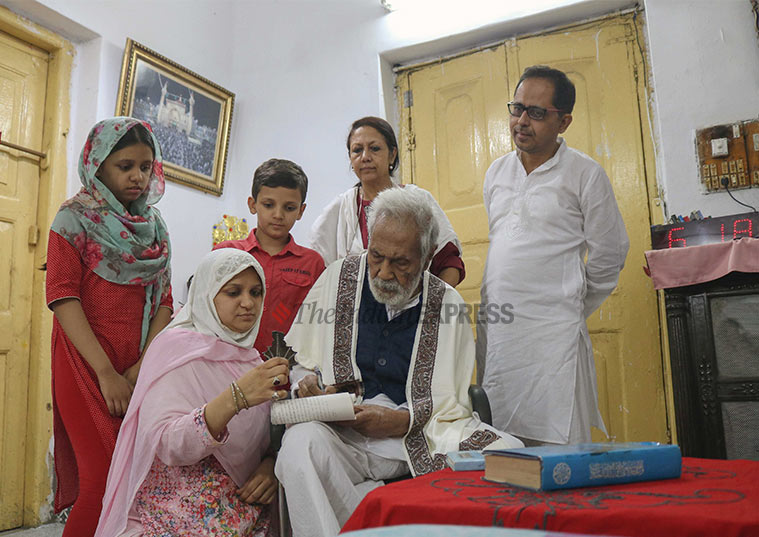
Two of Dr Kaukab Quder Meerza’s children (R-L) Kamran and Manzilat and Kamran’s children Mohammad Sulaiman Qudr Meerza (aged nine) and Zainab Fatema (aged 11), gather around to watch as Kamran’s wife, Nuzhat Zahra, helps her father-in-law translate the inscriptions written on the royal seals. (Photo: Shashi Ghosh) _____________________
Last remaining royal artefacts
The family doesn’t have many belongings of historical significance, in part due to the circumstances in which their ancestors fled for their lives. But two royal seals, carefully wrapped in a large square piece of red velvet fabric, are exceptions. One is a small rectangular metal seal with etchings of daggers and an inscription in Urdu that reads: ‘Nawab Hazrat Mahal Sahiba’. The etchings on Hazrat Mahal’s seal are unique because they feature daggers instead of floral motifs, signifying her role as a warrior queen who defended her kingdom against the foreign invasion of the British, explains Manzilat.
The second seal is slightly larger, featuring the royal coat of arms of Awadh, with elaborate etchings of floral motifs and an inscription in Arabic and Urdu. The calligraphy is elaborate and the family struggles to translate it; they’ve never done it before. Due to his age, Meerza finds it difficult to read the finely etched calligraphy of the seal. The family turns to Kamran’s wife Nuzhat Zahra, a 36-year-old lecturer in Urdu and a research scholar in the city, for help. Her Urdu language skills are better than those of her husband and his siblings.
Birjis Quder and Hazrat Mahal’s descendants in Kolkata only have two royal seals belonging to the last Nawab and his wife in their possession. The small rectangular metal seal (left) belonging to Begum Hazrat Mahal has etchings of daggers and an inscription in Urdu that reads: ‘Nawab Hazrat Mahal Sahiba’. The larger seal (right) features the royal coat of arms of the kingdom of Awadh, and belongs to Birjis Quder. Birjis Quder’s royal seal bears inscriptions in Arabic on the top, followed by his royal titles in Urdu below, saying, “NarsuminnAllah Fatun Qareeb” (Help from Allah and a near victory) and “Sikander Iqbal Shah, Khudullah Mulkohu Mirza Birjis Quder Ramzan Ali” (His Highness Keeper of Allah’s heaven-like nation. Mirza Birjis Quder Mohammad Ramzan Ali.) (Photo credit: Shashi Ghosh) ______________________
Not much is known about the circumstances that Birjis Quder found himself in, in a foreign land, far away from his home and inheritance, or even his thoughts at watching the British loot and strip his father of everything that he ever had. But perhaps the sentiments of the last Nawab of Awadh can be found in the elaborate calligraphy of the inscription denoting an Arabic phrase, followed by his royal titles, alqaab, on his seal:
“NarsuminnAllah Fatun Qareeb”; Help from Allah and a near victory.
“Sikander Iqbal Shah, Khudullah Mulkohu Mirza Birjis Quder Mohammad Ramzan Ali”; His Highness keeper of Allah’s heaven-like nation. Mirza Birjis Quder Mohammad Ramzan Ali.
source: http://www.indianexpress.com / Indian Express / Home> Research / by Neha Banka / Kolkata – January 04th, 2020