All posts by mpositiveone@gmail.com

Mumbaiwale: Four local Islamic landmarks to check out – each with its own colourful history

Mumbai, MAHARASHTRA :

An adult cinema turned mosque, a Muslim home turned film museum, a gorgeous blue masjid & a dargah cops love.

The one that now houses a film museum

National Museum of Indian Cinema, Pedder Road

On Pedder Road, one Muslim-owned mansion has been converted in a someday-to-be-opened museum for the movies. Gulshan Abad, the Victorian-Gothic villa, was built in the mid-1800s (a time when the main entrance itself offered a view of the Arabian sea) and was home to the Gujarati businessman Peerbhoy Khalakdina. The five-acre estate was eventually inherited by a relative Cassamally Jairazbhoy, whose third wife, Khurshid Rajabally, hosted cultural gatherings at the home in the 1920s.

Rajabally’s filming of a Haj pilgrimage makes her one of India’s earliest documentary filmmakers. Her son Nazir Ali made documentaries about Indian classical and folk music.

The home served as a hospital for WWII soldiers and in 1949 was briefly rented out to Jai Hind College before the institution found a permanent campus in Churchgate in 1952. But in 1950, the government confiscated the estate, declaring it an evacuee property after Partition.

The home, now restored, holds artefacts from India’s rich cinematic history. Alas, the launch has been tied up in bureaucratic red tape, and you can only get as far as the entrance.

The one that used to be an adult movie theatre

Deeniyat centre, Mumbai Central

The Deeniyat educational and charitable trust couldn’t be more wholesome. It aims to educate children, men and women in basic Islamic tenets and moral teachings related to the Koran and Sunnah. But the institution and mosque are housed in a building that once screened films of less salubrious taste.

In 1914, Ardeshir Irani and Abdulally Esoofally, both instrumental businessmen in early Indian cinema, bought a theatre near Nagpada junction on Bellasis Road. By 1918, they’d named it Alexandra Cinema and converted it into a movie hall, screening films from India and abroad. The single-screen movie hall screened films through the decades – silent films, new talkies, Technicolor hits, epics, Amitabh’s angry-young-man phase and blockbusters. But by the 80s, it was largely where you’d go to watch a B-grade or adult film.

In 2011, a developer bought the 15,000sqft property, turning it over to the non-profit. Deeniyat has spruced up the interiors, and even added a mosque inside. But the exterior – tiled roofs, wraparound verandahs – stays largely the same.

The one where the cops go to worship

Hazrat Makhdum Fakih Ali Mahimi dargah, Mahim

The scholar-saint who lived between 1372 and 1431, was the first commentator of the Koran in India. His books have focus on the philosophy of time and space. He was the Qazi or judge for the Muslims of Thana district.

But what makes him the patron saint of the Mumbai Police? Because he lived at a time when the Portuguese had possession of Salsette, the islands north of Mahim. A Portuguese sergeant would seek his advice and help on many cases. Many also believe that the site at which the Mahim police station stands is said to have been the saint’s home.

Until today, during the annual urs or fair held in his honour, it’s the policemen who lay the first ornamental sheet over his tomb at the dargah. On the urs days, devotees can also walk into the police station premises to pay their respects.

The blue one that catches the moonlight

Masjid-E-Iranian, Dongri

I first saw what is locally called the Mughal Masjid on a local-history tour of Bhendi Bazaar back in 2005 (Yes, I was a nerd before it was fashionable). I was lucky. It was a cool full-moon night and the blue tiles seemed to glow in the dark. For a minute, this tiny corner of Mumbai seemed like Morocco.

The mosque is 158 years old, built by a wealthy Iranian merchant, Haji Mohammad Hussain Shirazi, in 1860 and is maintained by a trust set up by his descendants. It has no dome, but two minarets, and a mosaic of blue tiles of every hue and pattern.

Inside, if you do get permission to enter is a lawn, a pond, a fountain, crystal chandeliers in the inner sanctum and Koran verses inscribed on the walls.

source: http://www.hindustantimes.com / Hindustan Times / Home> Mumbai / by Rachel Lopes, Hindustan Times / October 05th, 2018
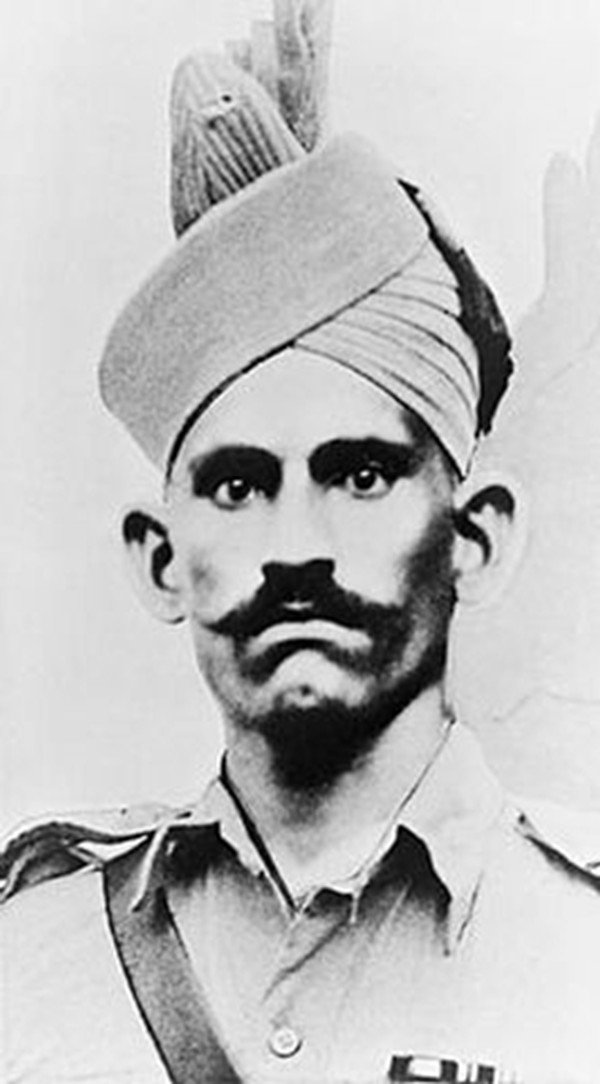
Jemadar Abdul Hafiz VC ( Victoria Cross)

Kalanaur (Gurudaspur District),  PUNJAB / (buried in Imphal, MANIPAL) :

Jemadar Abdul Hafiz VC

Abdul Hafiz was born in Kalanaur Village in Punjab, India. His father name was Nur Muhammad and mother was Hamidan. He was married to Jigri Begum.

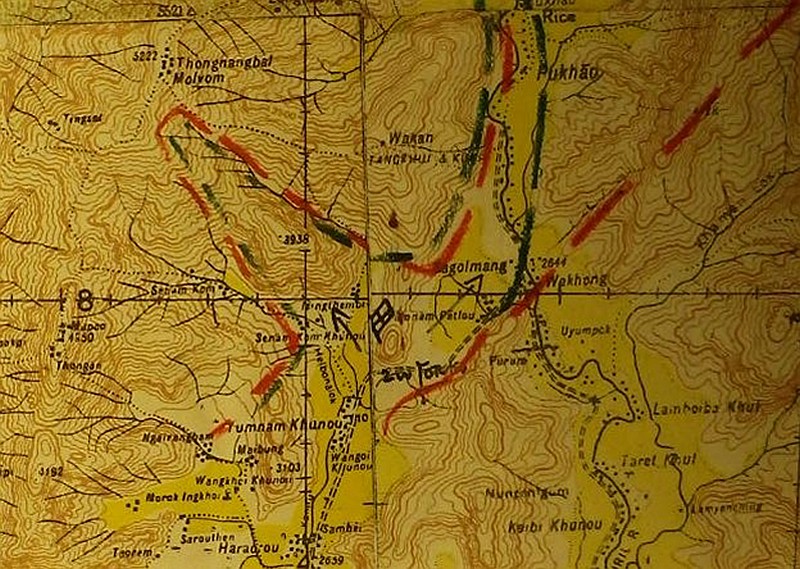
Jemadar Abdul Hafiz of 3/9 Jat won the Victoria Cross- the first Muslim soldier to do so in the Second World War ( Imphal, 1962). He won the VC in a feature named “Runaway Hill” which is located at the corner of the road leading to Isingthembi on the Pangei- Sagolmang Road (see map).

“He served with the 9th Jat Regiment with service number 11460. Jats are an ethnic group who follow a variety of religions. The Jat battalions were structured around two companies of Hindu Jats, one company of Punjabi Muslims and one company of Musulman Rajputs, a mix requiring not only good purely military leadership to ensure the respect of all but sensitivity for different cultures and beliefs”. (CWGC)

The 3rd Battalion, 9th Jat Regiment, was part of the 5th Indian Division during the Imphal campaign and at the time of this action were operating in the Nungshigum area to the north east of Imphal as part of a force advancing up the Litan road which was of strategic importance to both sides as it offered one of the few approaches to the Imphal plain. The attacks in and around Nungshigum Hill, of which Abdul Hafiz’s was one, continued until 13th April 1944 when the hill was finally captured.

Flag in the map showing the RUNAWAY HILL

According to War Diary dated 6th April 1944, 3rd battalion, 9th Jat Regiment,
” D Coys standing patrol the high ground at RK 420790 was driven offduring the night by thr enemy. At approx. 0930 hrs. D Coy counter attacked the enemy from the high ground killing at least 45-50 Japs and capturing a great deal of equipment. Our losses were 4 killed and 12 wounded including Major RITCHIE M.C. wounded. 1 Pl. B Coy supported by 1 tp of “HONEYS” did a sweep at approx 0900 hrs to the village ISINGTHEMBI RK 410800 where enemy had been reported- N.E.S.. 1 Pl. B Coy and the GR Pl at 1630 hrs ordered to NUNSHIGUM RK 4375 to take up a defensive posn”.

“It was by Runaway Hill that the Division’s third Victoria Cross was won. Before dawn on April 6, during this original encircling movement, at a time when we could not be sure when they would appear next, the Japanese attacked one of Colonel Gerty’s standing patrols. By driving the Jats off, they secured a hillock that overlooked the main company position. Jemadar Abdul. Hafiz was ordered to recapture the hill with two sections of his platoon.

After an artillery bombardment by Bastin’s 4th Field Regiment, Abdul Hafiz led his Jats in to the attack. They charged up the hillside that was bare of cover, shouting their war-cry as they neared the top. Then the waiting Japanese opened fire with machine-guns. On the approaching Jats they threw down grenades. Jemadar Abdul Hafiz was wounded at the outset. A bullet struck him in the leg. Yet he dashed forward and seized the enemy machine-gun by the barrel, while another Jat killed the Japanese gunner.

The Jemadar then took up a Bren gun dropped by one of his men who had fallen wounded, and notwithstanding the heavy fire from the enemy positions on this hill and on a feature to the flank, he shot a number of the Japanese soldiers. And so fiercely did he lead his men that the enemy ran away: hence the name Runaway Hill. But Jemadar Abdul Hafiz was mortally wounded in the chest, still grasping his Bren gun. To his men he shouted in his own language, “Reorganize! I will give you covering fire.” But he died,. without having been able to pull the trigger. He was awarded the Victoria Cross, posthumously, and was the first Muslim soldier to win this decoration in the Second World War” ( Ball of Fire – Antony Brett-James 1951) .

Geoffrey Evans and Antony Brett-James in their book “Imphal” give the account of how the feature got its name of Runaway Hill . ” Undaunted, Abdul Hafiz rushed forward as best he could and with supreme bravery seized the barrel of the machine gun while a second Jat Killed the gunner. That done, he saw a bren automatic which had been dropped by one of his wounded men, and picking it up without hesitation, he opened fire on the enemy to such effect that those whom he did not kill ran away as fast as they could. For this reason the hill became known as ‘Runaway Hill’, a name which it retained throughout the battle”.

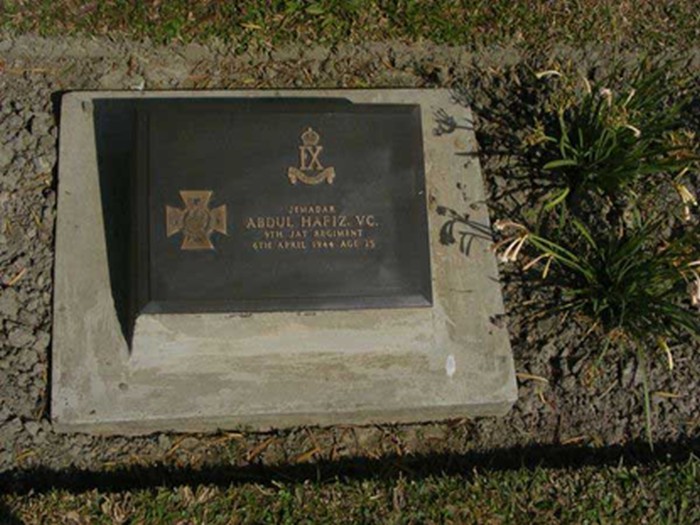
Grave of Jemadar Abdul Hafiz VC

His citation reads as follow:

The KING has been graciously pleased to approve the posthumous award of the VICTORIA CROSS to:–Jemadar Abdul Hafiz (11460), 9th. Jat Regiment, Indian Army.

In Burma, in the early hours of the 6th April, 1944, in the hills 10 miles North of Imphal, the enemy had attacked a standing patrol of 4 men and occupied a prominent feature overlooking a Company position. At first light a patrol was sent out and contacted the enemy, reporting that they thought approximately 40 enemy were in position. It was not known if they had dug in during the hours of darkness.

The Company Commander ordered Jemadar Abdul Hafiz to attack the enemy, with two sections from his platoon, at 0930 hours. An artillery concentration was put down on the feature and Jemadar Abdul Hafiz Khan led the attack. The attack was up a completely bare slope with no cover, and was very steep near the crest. Prior to the attack, Jemadar Abdul Hafiz assembled his sections and told them that they were invincible, and all the enemy on the hill would be killed or put to flight. He so inspired his men that from the start the attack proceeded with great dash.

When a few yards below the crest the enemy opened fire with machine-guns and threw grenades. Jemadar Abdul Hafiz sustained several casualties, but immediatetly ordered an assault, which he personally led, at the same time shouting the Mohammedan battle-cry. The assault went in without hesitation and with great dash up the last few yards of the hill, which was very steep. On reaching the crest Jemadar Abdul Hafiz was wounded in the leg, but seeing a machine-gun firing from a flank, which had already caused several casualties, he immediately went towards it and seizing the barrel pushed it upwards, whilst another man killed the gunner.

Jemadar Abdul Hafiz then took a Bren gun from a wounded man and advanced against the enemy, firing as he advanced, and killing several of the enemy. So fierce was the attack, and all his men so inspired by the determination of Jemadar Abdul Hafiz to kill all enemy in sight at whatever cost, that the enemy, who were still in considerable numbers on the position, ran away down the opposite slope of the hill. Regardless of machine-gun fire which was now being fired at him from another feature a few hundred yards away, he pursued the enemy, firing at them as they retired.

Jemadar Abdul Hafiz was badly wounded in the chest from this machine-gun fire and collapsed holding the Bren gun and attempting to fire at the retreating enemy, and shouting at the same time “Re-organise on the position and I will give covering fire.” He died shortly afterwards.

The inspiring leadership and great bravery displayed by Jemadar Abdul Hafiz in spite of having been twice wounded, once mortally, so encouraged his men that the position was captured, casualties inflicted on the enemy to an extent several times the size of his own party, and enemy arms recovered on the position which included 3 Lewis Machine-guns, 2 grenade dischargers and 2 officers’ swords. The complete disregard for his own safety and his determination to capture and hold the position at all costs was an example to all ranks, which it would be difficult to equal.—( London Gazette. Issue 36627, 25th July 1944 ).

The Victoria Cross and Campaign medals awarded to Jemadar Abdul Hafiz, 3rd Bn, 9th Jat Regiment, Indian Army, have been acquired by the Michael Ashcroft Trust, the holding institution for Lord Ashcroft’s VC Collection.

Abdul Hafiz is today laid buried at Imphal Indian War Cemetery at Hatta Minuthong, Imphal. His Grave number is 3. Q. 2. He was 25 years of age when he died on 6th April 1944

source: http://www.e-pao.net / E-Pao / Home> Manipur> History of Manipur> Historical War Manipur / by Rajeshwor Yumnam / May 18th, 2015

Death no leveller in Capital cemetery

NEW DELHI :

Proud to be Punjabi. That’s the well-heeled Punjabi community of the Capital, a community with established business interests, its own way of living, its own burial ground, says  VIVEK SHUKLA….

Book your place to avoid disappointment... but only if you are a Punjabi Muslim as this burial ground near Shiddipura is reserved for Punjabis. Photo: S. Subramanium.
Book your place to avoid disappointment… but only if you are a Punjabi Muslim as this burial ground near Shiddipura is reserved for Punjabis. Photo: S. Subramanium.

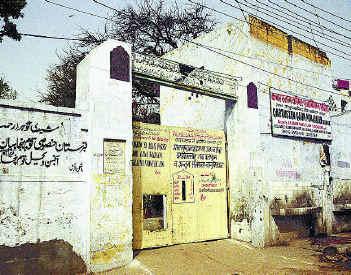
A MUSLIM family along with their friends and relatives recently went to a burial ground in Shiddipura near Idgah mosque known as Qabristan Qaum Punjabian for the last rites of a relative. They were, however, told by the guard of the burial ground that this place is only for Delhi’s Punjabi Muslim community.

Principal of Delhi University’s Zakir Hussain College, Prof. Riaz Umer, who is also the president of the Anjuman Vakile Qaum Punjabian of Delhi, the organisation looking after the institutions run by this community, informs that other than their own community members they only allow the burial of somebody who has made a significant contribution for their community.

This is a very unique community as Punjabi Muslims still vigorously preserve their own identity. The elders of Punjabi Muslim community came here for the first time in mid-17th Century from a place called Bhera in West Punjab, now in Pakistan. They were Khatri Hindus with surnames like Khanna, Channa, Sapra, Baluja, Saluja, Sehgal, Mehndiratta, Bahri and Sachdeva, etc., before embracing Islam.

Legend has is that a group of Punjabi Khatris from Bhera was going to Haridwar for a holy dip in Ganga. On the way, they met Sufi Shamsuddin Tabrez who asked where were they going. When he was told by the Khatris about their plan, the saint reportedly asked whether they would become Muslim if he brought the Ganga right there. The Hindu Khatris accepted his offer and the saint literally brought the Ganga there and then the awe-struck Hindus as promised converted to Islam.

S.M. Abdullah, a prominent member of Delhi’s Punjabi Muslim community, says that while it is true that their forefathers embraced Islam, nevertheless they vigorously guard their exclusive heritage. “Come, what may, Punjabi Muslims will not marry outside the community. We ensure that the bride or groom’s family is Punjabi Muslim, that too from Bhera,” says Abdullah, proudly adding that his surname is Mehndiratta.

It is said that 64 Punjabi Muslim families came to Delhi at the outset. They set up their base somewhere around the present-day Shalimar Bagh. The male members started going downtown to find work. “With the passage of time they started doing small jobs here but were rather shabbily treated by the locals as they were not sophisticated enough to communicate with the more refined and cultured Delhiwallahs,” says Nasser, another member of this dwindling community and a leading model.

According to Abdullah, the Punjabi Muslims’ big time came when the Moghul Emperor Bahadur Shah Zafar was looking for some rare herb called Bahadra. When only the Punjabi Muslims could provide the herb, the king and his courtiers were really surprised. He called important members of this community and asked them whether they wanted anything from him. The Punjabi Muslims, among other things, sought permission to do business in downtown Delhi and a separate piece of land for their burial ground. The demand for business was granted and land was allotted to them near the present-day Raj Niwas, the official bungalow of Delhi’s Lt. Governor for burials. Once the first ground was full, another burial ground was made near the historic Idgah mosque at Shiddipura. Known as Qabristan Qaum Punjabian, the burial ground can only be used by Punjabi Muslims. There is no place for any non-Punjabi here.

It is said that 75 per cent of the Walled City belongs to this community. Except for a handful of doctors, teachers, engineers and advocates, they are all into business. Once G.B. Road was almost totally owned members of Punjabi Muslims. After Partition, many of them left India and the authorities confiscated their properties.

The famous Marina Hotel is also partially owned by one Haroon Japanwala while the famous Dehalvi family of Shama Publications fame are also Punjabi Muslims.

The historic Hardinge Library is also said to be financed by one Buksh Elahi, a cigarette merchant. He also belonged to this community.

The Punjabi Muslims community also conducts its own census every 10 years. According to the latest census report, the total population of this community in Delhi is 5090. The literacy rate is over 50 per cent. It is more than the literacy rate of Muslims in the Capital.

source: http://www.thehindu.com / The Hindu / Home> Metro Plus Delhi – online edition / by Vivek Shukla / March 06th, 2003

The last of eight generations of Rogan art in Kutch

Kutch, GUJARAT :

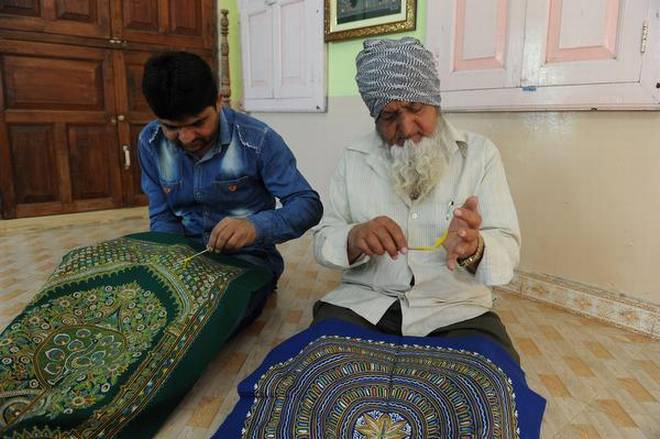
Abdul Gafur Khatri at work at his residence in Nirona village, Kutch | Photo Credit: Vijay Soneji

The Khatris have practised the art for eight generations now

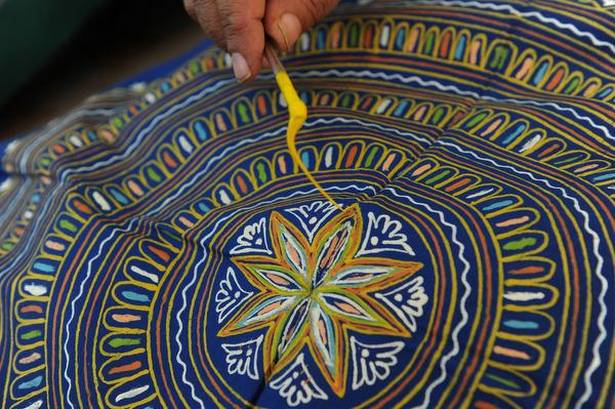
Sitting on the floor, Abdul Hamid carefully twists a thick spool of yellow paint around a metal pin. Stretched out before him is a piece of red cloth, pinned on either side to the legs of his trousers. He dabs the paint on the heel of his left palm — it’s a gummy mass and has to be worked into something more malleable. Hamid then brings the tip of the pin a few inches above the cloth, and as it hovers, an elastic strand of colour streams on to the surface. And the magic begins: an intricate pattern grows beneath the swirling pin that never touches the cloth. The floral design looks like needlework.

Hamid then folds the cloth and, just like that, a flawless mirror-image of the pattern appears and an exquisite piece of Rogan art is born.

“We have practised Rogan for eight generations now,” says Hamid. “The first six generations did not get their due for preserving the art, but now, finally it is widely recognised and we couldn’t be happier.”

‘Rogan’ in Persian means oil: the paint is made with castor oil. Rogan art is believed to have originated in Persia some 300 years ago and was traditionally used to embellish bridal trousseaus. As it crossed borders, it began fading from the collective memory of its creators. But nine members of the Khatri family in Nirona, a small village in Gujarat’s Kutch district, are the last surviving custodians of the art form.

The Khatri community once did Rogan work on the clothes of local animal herders and farming communities. But as machine-made textiles became a more affordable alternative and Khatri youth lost interest in learning the art, Rogan began to disappear. “But our family revived it in 1985,” says Hamid. In fact it is Hamid’s elder cousin, Abdul Gafur Khatri, a national award winner, who is credited with resurgence of Rogan art.

P.M.’s pick

The ‘Tree of Life’, an intricately patterned tree with hundreds of dots and dashes, is their signature painting and most in demand. A 14×17” painting can take 12 days to complete— Prime Minister Narendra Modi chose one to gift to the then U.S. President Barack Obama during his U.S. visit.

“Rogan art is 100% an artist’s imagination on a piece of cloth,” Gafur bhai, as he is better known, explains. “There is no tracing, no drawings to refer to.”

But preparing the base from castor oil is a laborious process and can take two days. The oil is heated and cooled in a (special) vessel and continuously stirred so it doesn’t burn. After two days, the residue left behind is mixed with cold water and it thickens into a sticky paste called rogan. Natural colour pigments are then added to the oil base. “Yellow, for instance, comes from a particular stone that is ground,” says Hamid. The pigments are added to the castor oil base and stored in earthen pots.

Wall pieces made by Abdul Gafur Khatri in Nirona village, Kutch | Photo Credit: Vijay Soneji

The nine artists have six national awards and six State awards between them. They proudly show me photographs of celebrities — politicians, film stars, sports stars — who have either bought their art work or felicitated them at awards functions.

Men last longer

It strikes me as odd that all nine members of the family working on the art form are men. This could perhaps do with the belief that women, once they get married, would pass on their knowledge to their husband’s families, threatening the art with dilution. But as Rogan faces extinction, Gafur bhai, has taken upon himself the task of teaching the technique to 200 girls from his village. And this has breathed fresh life into the dying art.

“We taught most of these girls for free. They can now create at least the basic designs,” Gafur bhai says, adding that 25 girls also help the family with their work. In another effort to popularise Rogan, the family conducts live demonstrations for every visitor at their doorstep. During the 30-minute demonstration, artists patiently answer questions and explain the techniques they use. On an average, the family gets 150 visitors a day. And between November and February, during the Rann Utsav — the Kutch desert festival — the numbers shoot up to 250 or 300.

No tough competition

Unlike other forms of textile art such as Ajrakh that face are under threat by factory-made products, Rogan faces no such competition, but meeting market demand has been a challenge.

“You will not find Rogan art the way you find other arts in the markets. It’s not because we don’t want it to go out to the people, it’s because we have limited resources,” says Gafur bhai. We go to five or six exhibitions around the country in a year, and rest of the time we are at home, working.”

It has been a long journey for the Khatri family: from reviving the art to creating public interest to recovering from the Bhuj earthquake setback. But today, they are only seeing a huge resurgence of interest.

The writer is an independent journalist based in Gujarat. When not researching her stories, she is busy spinning tales for her toddler.

source: http://www.thehindu.com / The Hindu / Home> Society / by Azera Parveen Rahman / January 20th, 2018

AMP Education Award 2018

Mumbai, MAHARASHTRA :

NatlAwardsAMP06oct2018

Association of Muslim Professionals announced its ‘AMP NATIONAL AWARD FOR EXCELLENCE IN EDUCATION 2018’ on the occasion of ‘Teachers Day’ on September 5th, 2018

The importance of teachers can be understood by the quote of Prophet Muhammad (SAW) where he said that “I have been sent only as a teacher to you“. The Prophet PBUH reached the hearts and minds of people through educational activities.

5th September is celebrated as Teachers’ Day in India. The contributions and successes of Teachers and Educationists are celebrated across India this day. The role of a teacher/educator in the society is both significant and valuable. They have a profound influence on the lives of the students – they build their competence and shape their characters, thereby laying the foundation of a strong and civilized society.

After the successful launch of the Education Excellence Awards last year, this year again AMP is has announced the names of 100+ Influential Educators across the country. AMP aims to felicitate and recognize teachers who are going beyond their duty and inspiring students to reach greater heights. AMP has initiated this prestigious award to highlight the contribution of teachers in Nation Building and helping make a better society through inspirational teaching.

We extend our warm greetings and felicitations to all the teachers, particularly those who have been selected and appreciated by AMP in recognition of their outstanding services in the field of Education and invaluable Contribution to the Society at large. In today’s modern world, it is all the more necessary that our children understand the human values of love, respect and tolerance, which are essential for a peaceful world. It is, therefore, vital that teachers emphasize the importance of these values. Students should be made to think in terms of the welfare of humankind and progress of the nation”.

Chapter Leaders and members of AMP from various cities across the country nominated Teachers, Principals and Sr. Academicians from different Institutions, who have served the Society and the Community with distinction. The team of Senior Professionals and Academicians along with AMP Board evaluated and selected 100+ such Professionals and they are declared the recipients of these Awards.


Sr. No Awardee Name Title Location
1 Mr. Furqan Qamar Secretary General, Association of Indian Universities (AIU) Delhi
2 Dr. Akhtarul Wasey President, Maulana Azad University Jodhpur
3 Prof. Tariq Mansoor Vice Chancellor, Aligarh Muslim University Aligarh
4 Prof. Talat Ahmad Vice Chancellor, Kashmir University Kashmir
5 Dr. Faizan Mustafa Vice Chancellor, NALSAR University of Law Hyderabad
6 Mr. Mohammad Aslam Parvaiz Vice Chancellor, Maulana Azad National Urdu University(MANUU) Hyderabad
7 Maulana Gulam Mohammad Ismail Vastanvi President, Jamia Islamia Ishatul Uloom, Akkalkuwa Akkalkuwa
8 Dr. Shahid Ashraf Pro-Vice Chancellor, Jamia Millia Islamia University Delhi
9 Prof. Abdul Shaban Pro-Vice Chancellor, Tata Institute of Social Sciences (TISS) Mumbai
10 Dr. Amitabh Kundu Former Dean, School of Social Sciences, JNU Delhi
11 Dr. Amir Ullah Khan President, Glocal University Hyderabad
12 Dr. Faruk Kazi Dean- Research, Development and Consultancy at Veermata Jijabai Technological Institute (VJTI) Mumbai
13 Dr. Manmohan Singh Chauhan Director, Central Institute for Research on Goats Mathura (U.P.)
14 Prof. Shahid Ahmed Professor, Jamia Millia Islamia University Delhi
15 Prof. Syed Noman Ahmad Professor, Aligarh Muslim University Aligarh
16 Prof. Apoorvanand Professor, University of Delhi Delhi
17 Dr. Mahrukh Mirza Vice Chancellor, Urdu Arabi – Farsi University Lucknow
18 Prof. Zubair Meenai Professor, Jamia Millia Islamia University Delhi
19 Dr. Gazala Habib Associate Professor, IIT Delhi Delhi
20 Mr. Makibur Rahman HOD, D.I.E.T. Guwahati
21 Prof. Anwar Khan Associate Professor, Public Administration Services Hyderabad
22 Dr. Farrukh Waris Retd. Principal, Burhani College of Arts and Commerce Mumbai
23 Dr. Abdul Azim Akhtar Asst Professor, Shree Guru Gobind Singh Tricentenary University Delhi
24 Prof. Adil Hakeem Khan Director, Nation College of Engineering & Technology Guna (M.P.)
25 Dr. Sayed Aleem Ashraf Jaisi Reader, Arabic Department, MANU Hyderabad
26 Dr. Kalim Khan Director, Rizvi Institute of Management Studies Mumbai
27 Mr. Anwar Khan Retd. Principal, Osmania University Hyderabad
28 Prof. Shaikh Rahmatullah Professor of Tourism, Dr. D Y Patil University Navi Mumbai
29 Dr. Afroz Alam HOD, Maulana Azad National Urdu University (MANUU) Hyderabad
30 Dr. Yasmeen Pervez HOD, Chhatrapati Shivaji Institute of Technology Raipur
31 Dr. Mumtaz Ahmed Khan Founder & Chairman, Al-Ameen Educational Society Bangalore
32 Mr. Abdul Rasheed Director, Al-Rizwan Group of Jr. College and Schools Nanded
33 Mr. Shaikh Masood Mohiuddin Professor, Dr. Zakir Hussain Jr. College of Arts, Commerce and Science Aurangabad
34 Mr. Mohammad Shameem Jawed Assistant Professor, IIM Visakhapatnam Vishakhapatnam
35 Dr. Mohd. Kaleem Khan Associate Professor, IIT Patna Patna
36 Dr. Azizuddin Khan Associate Professor, IIT Bombay Mumbai
37 Mr. Mohammed Lateef Khan Founder Trustee and Chairman, MS Education Academy Hyderabad
38 Dr. Razak Ustaad Associate Professor, SLN Engg College Raichur
39 Mrs. M. Sharmeela Head Mistress, Municipal Muslim Girls Middle School Vaniyambadi
40 Miss. Munawar Sultana .A. HOD, Islamiah Girls Higher Secondary School Vaniyambadi
41 Mr. Zafar Ahmed Khan Retd. Principal, Qidwai Jr. College of Arts, Commerce & Science Nagpur
42 Mr. Inamur Rehim Teacher, M. A. K. Azad Jr. College Nagpur
43 Prof. S. Raisuddin Professor, Jamia Hamdard University Delhi
44 Brig. Syed Ahmad Ali Director, Jahangirabad Institute of Technology Barabanki
45 Dr. Tanveer Jamal Principal, City Compostile PU College Gulbarga
46 Dr. Aslam Sayeed Professor, Al Badar Dental College Gulbarga
47 Mr. Md. Javeed Abdul Rehman Saheb Momin Assistant Teacher, Anjuman Urdu High School Hubli
48 Dr. Shariq Nisar Professor, Rizvi Institute of Management Studies and Research (RIMSR) Mumbai
49 Mrs. Sahana Zamal Teacher, Govt. Primary School Odisha
50 Mr. Kazi Mujiboddin Hamidoddin Research Scholar Ambajogai, Beed
51 Mr. Sayyed Zahid Ali Head In-Charge, TMC School No. 124, Mumbra Mumbra
52 Dr. Bilal Sheth Senior Lecturer, Govt. Dental College Himmatnagar
53 Mr. Hanif Tailor Principal, Pipardiwala English Medium School Surat
54 Mr. Syed Balig Ahmed Director, Ranthambhore Nursing College Sawai Madhopur, Rajsthan
55 Mr. Shaikh Aziz Shaikh Yaseen Assistant Teacher, Mother Ayesha High School and Junior College Malegaon
56 Mr. Shaikh Mehaboob Ali Kittur Ret. Asst. Teacher, St. Mary’s High School Hubli
57 Mr. Akhtar Hussain Principal, Government Senior Secondary School Bissau, Rajasthan
58 Mr. Siddiqui Saleem Shahzad Assistant Teacher, ATT High School and Junior College Malegaon
59 Mr. Mahmood Ali Md Yusuf Khan Assistant Teacher, ATT High School and Junior College Mumbai
60 Mr. Imran Khan Teacher, Varisth Upadhyay Sanskrit School Alwar, Rajasthan
61 Mr. Fayyaz Ahmed Ghulam Mustufa Momin Teacher, Samadiya High School and Jr. College Mumbai
62 Mrs. N. M. Shalika Banu Teacher, Fathima Central Senior Secondary School Chennai
63 Dr. Ateeque Malani Assistant Professor, IIT Bombay Mumbai
64 Mrs. Fatima Rashid HOD, Unviersal Education Mumbai
65 Dr. Mohammed Tahir Ansari Assistant Professor, University Kuala Lumpur Royal College of Medicine Perak Mumbai
66 Dr. Mehrunnisha .M. Sheriff Desai HOD, R. J. Tiberwala College of Commerce Dhandhuka, Ahmedabad
67 Miss. Qudsiya Shahana Vice Principal, Anwar UP Uloom Higher Secondary School Bhopal
68 Mr. Abdul Aziz U Rajput Historain and Freelancer Bijapur, Karnataka
69 Mr. Raja Hussain Assistant Professor, Islamiah Boys Higher Secondary School Vaniyambadi
70 Dr. Shahnaz Nabi Former HOD, Calcutta University Kolkata
71 Mr. Tafseer Ahmad Khan Assistant Block Resources Coordinator, BRC Kunda Kunda, Pratapgarh
72 Mr. Yunus Sahab General Secretary, Taha Group of Institutions Ballari
73 Mr. Siraj M Jamkhandi Headmaster, Secab Malik Sandal Urdu High School Bijapur
74 Mr. Mohammed Azheruddin Principal, Noble High School Bhainsa, Telangana
75 Mr. Mohamed Attaulla Khan Principal, K. K. Public School Bangalore
76 Mrs. Farhat Ali Syed Assistant Professor, Prestige Institute Of Management & Research Indore
77 Mr. Syed Maquasood Ali Principal, Innovative Public Higher Secondary School Dewas
78 Dr. Ahsan Bin Mohammed Al Hamoomi Director, Green Meadows Park School Hyderabad
79 Mrs. Fareeda Banu Md. Javeed Momin Assistant Teacher, Govt. U.H.P. School Hubli
80 Mr. Mohammed Sadiq Founder, Hyderabad Islamic School Hyderabad
81 Mr. Altaf Haider Momin Teacher, Zilha Prishad Urdu School Islampur
82 Dr. Mohd. Abdul Aleem Guest Faculty, Maulana Azad National Urdu University Hyderabad
83 Mr. Shamshoddin Zare Assistant Teacher, Govt School UHPS Jamkhandi, Karnataka
84 Prof. M. A. Mallick Professor, Integral University Lucknow
85 Mr. Mohammed Hamed Hussain Farooqui Director & Principal, Madina Islamic Mission High School Hyderabad
86 Prof. Alquama Shibli Fromer Guest Lecturer, Calcutta University Kolkata
87 Mr. Yusuf Lat Retd. Teacher, M.M.P. High School Surat
88 Mr. Suleman A Patel Retd. Teacher, M.M.P. High School Surat
89 Prof. M.N.Hoda Director, Bhartiya Vidyapeeth’s BVICAM Delhi
90 Mr. Abdul Razik Husain Head Teacher, Amravati Z. P Amravati
91 Mr. Shahid Ali Abidi Head Master, Upper Primary School Lucknow
92 Mr. Sayed Sajidulla Inamdar Assistant Teacher, Govt Urdu School Jamkhandi
93 Mr. Abdulrehmaan T Sindhi Retd. HOD, G. D. Modi College of Arts Palanpur
94 Mrs. Rehana Shaikh President, Iqra school Vijayapur
95 Mr. Mohammad Zuhair Vice Principal, P.R.Pote Patil College of Engineering Amravati
96 Mr. NoorulHuda Shabbir Qureshi Teacher, B. Z. Urdu High School and Jr. College Bhusawal
97 Mr. Syed Shah Ali Al Hussaini Pro Chancellor, KBN University Gulbarga
98 Dr. Bibi Raza Khatoon Asistant Professor, MANNU Hyderabad
99 Mrs. Mehjabeen .K. Kamangar Vice Principal, Anjuman Urdu High School Hubli
100 Dr. Rabiya Khanam Principal, Hameed Pyare College of Education Gulbarga
101 Miss. Syeda Abeedi Mohammadi Principal, Faraan High School Gulbarga
102 Prof. Muzaffar .H. Assadi Special Officer & Professor, Raichur University Raichur
103 Mrs. Ayesha Arif Shaikh Principal, Anglo Urdu Girls High School Pune
104 Mrs. Umme Salma Zia Haider Naqvi Principal, Anjuman I Islam’s Mustafa Fakih Urdu High School and Junior College Thane
105 Mr. Mohammed Rafeeq Rangrez Assistant Teacher, Govt Junior College & High School Yadgir
106 Dr. Mohammedshafi Abdulraheem Phaniband Professor, SDM College of Engineering and Technology Hubli
107 Mrs. Anisa Shaikh Principal, F. D. High School Ahmedabad
108 Mr. Abdulrashid Ahamadsaheb Sanadi Retd. Headmaster, Bharatesh High School Belagavi, Karnataka
109 Mr. M. Hussain Teacher, Kerala Urdu Teachers Association Kerala
110 Dr. Asna Urooj Professor, University of Mysore Mysore


source: http://www.ampindia.org / AMP- Association of Muslim Professionals / Home> AMP Education Awards / September 2018

Being ‘don dapper’

Chennai, TAMIL NADU :

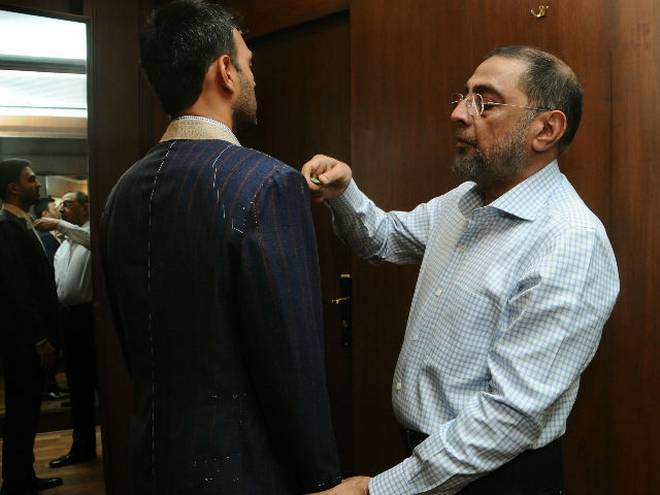
It takes at least two trial sessions before a bespoke suit is ready; a client at Syed Bawkher & Co / PHOTO: R. RAGU

Susanna Myrtle Lazarus visits establishments that offer a bespoke experience for men

You absolutely love that one shirt on display at the store; it’s even available in your size. Just to be safe, you try it on, and to your indescribable disappointment, find that it’s either too narrow at the shoulder or the collar is cutting off your airway or it doesn’t fit around your waist because it’s that dreaded slim cut. And that’s the reason why more and more men are opting to get their clothes tailored, and not just at the corner tailor store, but of the bespoke kind.

But what does bespoke mean exactly? While the dictionary definition is ‘made to order’, in the world of bespoke tailoring, it’s not as simple as that. Unaiz Ahmed of Syed Bawkher & Co in Nungambakkam, says, “It stems from the word ‘bespeak’, which means to be spoken for. It is expressly made to fit one particular man, right from the fabric and pattern to the cut. And it’s not to be confused with made-to-measure, which is derived from a standard block pattern and has superficial adjustments made to it. It won’t account for a peculiar drop of the shoulder or waist. It has limitations, while bespoke tailoring takes all this into account.”

This is one of the main reasons why men prefer to have their suits custom-made to their requirements. “Fit has become an important criteria. In the business world, it’s not very important to wear a suit now; those who do wear them want to have a unique one that showcases their personality and individuality. They also do their research and know what they’re looking for,” says Unaiz.

He knows what he’s talking about: his family has been in the bespoke business for four generations now. As he speaks about his education in London, and under the tutelage of his father, Unaiz deftly marks out a pattern on the material of a dark blue suit. “The person who measures and the person who marks and cuts the material should be the same. Two people can have the exact same measurements but completely different body types. That connection is needed to create the perfect garment,” he says.

Generally, the process of creating a bespoke suit, shirt or trousers can take two to three weeks, depending on the time of the year. First, there’s the consultation, where the client decides what he wants. Depending on the budget and occasion for which he will be wearing it, the tailors will recommend fabric, colour, style and cut. Based on this, extensive measurements are taken. About a week later, the client comes in for a trial fitting when adjustments are made as required. In another week’s time, when the garment is almost finished, there’s a second fitting. Once all the final tweaks are made, the finished product is delivered. All the garments are hand-stitched.

If it’s a wedding, a lot of men go in for tuxedos or bandhgalas. Dark, formal prints are best for lounge suits and business meetings, while lighter shades are preferred for luncheons and summer outdoor weddings. Bespoke pieces usually go by classic cuts and not by trends, and tend to focus more on what looks good for a person’s body type. For a slim and tall person, a sleek and athletic cut will work. Shorter men get a more relaxed cut, and if they are stout, pleated trousers are suggested to give a flattering look.

Prices range from Rs. 35,000 for a basic suit and can go up to Rs. 3 lakh, depending on the fabric used, with cashmeres, vicunas, super 200s and fine counts leaving your wallet considerably lighter than the 120 count fabric from Indian mills would. On an average, a suit can cost anywhere between Rs. 55,000 and Rs. 75,000 at this premium store. Behind Unaiz hangs a pale pink linen jacket. “That one is going to New York; our client wants to wear it for the summer,” he says, adding that men are more comfortable with experimenting with their clothing abroad than they are here in Chennai.

However, this is changing, feels Tushar Bansal of Mandira Bansal Studio. The label, which was founded in 2011, has recently launched its design studio in Alwarpet. He shows some examples of how customers are subtly taking their style quotient up a notch: a waistcoat with The Simpsons print lining, a Nehru jacket with a woven design on the collar and another with a translucent houndstooth fabric overlaid on a cream and pink print material. They have also created a monochrome Madras print on request from a client; it features an autorickshaw.

“We also do bespoke kurtas and sherwanis. Not only do clients want a better fit for their wedding wear, they’re not content with off-the-rack pieces. Men have become more conscious about their look; comfort and a personalised touch is what they look for. They pay attention to every minute detail, from the buttons used, to the colour of the thread and the cuffs,” says Tushar, whose clientele is largely from the North Indian community in the city.

Tushar finds that it’s not the younger crowd that does the experimenting. “The more travelled clients who are aware of fashion trends and have met people who push the envelope when it comes to personal style are the ones who are ready to play around with their ensembles,” he says.

Machine-stitched bespoke suits come in the range of Rs. 15,000 to Rs. 18,000, while the same when hand-stitched costs double — it’s labour-intensive and takes 12 days for a single suit to be finished. Sherwanis made of fine fabrics like georgette, net and pure brocade are hand-embroidered at the studio, and can cost upwards of Rs. 35,000.

At Bespoke by Lazaro on Khader Nawaz Khan Road, clients come in asking for very specific detailing on their shirts. “Those who have the confidence to carry off bold colours are the ones who go for it. Otherwise, it’s generally charcoal, greys and blues,” says Tamsil Ahmed, business partner of the firm. Shirts here cost between Rs. 1,500 and Rs. 2,500, while suits go from Rs. 11,500 to Rs. 45,000. Indian brand material on average cost Rs. 1,600 per metre, while Italian and other international brands, retail at Rs. 7,000 to Rs. 10,000 per metre,” explains Tamsil.

“There’s a noticeable difference between a tailored shirt and a bespoke one. Some of our clients are fitness freaks and they don’t get readymade shirts that fit very well. Here, we can give them a garment that shows off their physique,” he says. And when it comes to suits, Tamsil says that accessories like cufflinks, tie pins and pocket squares add an extra dimension to the look. For those particular about their footwear, this store also offers bespoke shoes, ranging from Rs. 7,000 to Rs. 12,000.

It’s not just for occasional wear that men are going in for bespoke clothing. S. Mohamed Sultan Shabeer, a 35-year-old industrialist, is a recent convert to the trend. “I used to get my shirts tailored online, but I wanted better options. A friend recommended I go in for bespoke, so I ordered a couple of shirts and a pair of trousers for trial. I could see and feel the difference immediately and a lot of people commented favourably on my appearance,” he says, adding that he immediately went in for a wardrobe overhaul, ordering 30 shirts at one go.

While Shabeer prefers Egyptian and Italian fabrics, Nawaz, director of a trading company, goes in for linens most of the time. “The fact that I have control over every step of how my clothes are made is what appeals to me. I can get exactly what I want and I don’t have to compromise on anything,” he says. “When I first tried bespoke clothes a few years ago, I did not have the patience. But now, I enjoy the interaction and the process that goes into it,” adds the 43-year-old.

“With more clients going in for bespoke, designers are also working towards giving the same personalised service at a lesser price,” says Tushar.

There’s no doubt about it; men are willing to spend some serious coin when it comes to looking dapper. Unaiz says it’s for the experience of getting something made exclusively for you, a one-of-a-kind piece that no one else in the world has.

source: http://www.thehindu.com / The Hindu / Home> Fashion / by Susanna Myrtle Lazarus / Chennai – April 24th, 2015

Remembering what was

Chennai, KARNATAKA / Bengaluru, KARNATAKA :

ShabbeerAhmedMPOs05oct2018

RJ and entrepreneur Shabbeer Ahmed turns back the pages to simpler times in a smaller city

I first moved Bengaluru in the year 1995. Back then, all the roads were lined with trees, which looked wonderful when they bloomed, and the traffic situation was not so bad. My favourite road in fact was Bannerghatta road, which in those days was considered the fringe of the city, where people came for a relaxing drive. I actually used to stay near the Meenakshi temple in Hulimavu, areas which were barren a few years back. There used to be a water theme park near Bannerghatta which is no more, and now the area is just like any other part of the city. We spent many days on motorcycle rides in this area, stopping to buy egg puffs from the lovely bakeries that dotted the route.

There are fewer migratory birds these days as well. Until a while back the areas surrounding Madiwala Lake had a lot of birds come around, which has lessened and now you see birds on terraces instead. We even saw water snakes on the banks of the lake, and we’d give them names, like Ka from Rudyard Kipling’s The Jungle Book.

Personally, since I’m a massive food lover, I like to go to Fanoos to grab a roll and then head to Makkah cafe in Johnson Market, where I can sit with a suleimani tea and chat with people. Being a nature lover, I also enjoy trips to Bannerghatta National Park when I can. And there’s nothing like a trip to South Bengaluru for some authentic idli, vada, and dosa.

It is true that Bengaluru has become very commercial and industrial, but that has also led to it gaining in infrastructure and opportunity. There are so many options for youngsters here.

As told to Sooraj Rajmohan

source: http://www.thehindu.com / The Hindu / Home> Life & Style – Insider / by Sooraj Rajmohan / October 03rd, 2018

Mosques in Dravidian-Islamic style: About the Islamic architecture in Tamil Nadu

TAMIL NADU :

The 17th Century Kilakarai Jumma Mosque

The kallupallis are reminders of the region’s cultural and architectural traditions

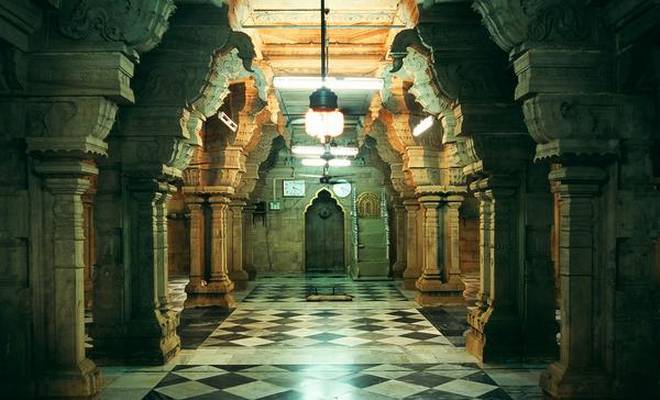
Among the many inscriptions at the Vaishnavite shrine of Adhi Jagannatha Swamy at Thirupullani, about 10 km from Ramanathapuram in southern Tamil Nadu, there is one about a grant for a mosque. This particular inscription of the late 13th Century by the Pandya King Thirubuvana Chakravarthy Koneri Mei Kondan, describes the grant made to the Muslim Sonagar, to build a mosque at Pavithramanikka Pattinam. While no one today has a clue as to the exact location of Pavithramanikka Pattinam, the region has many ancient mosques like the rest of Tamil Nadu. What is unique about these mosques is that they were all built of stone, in the Dravidian architectural style with Islamic sensibilities.

Unlike north India, Islam came to the south through maritime spice trade even as it was spreading across Arabia in the 7th Century. The Muslims who were traders enriched the country with precious foreign exchange, and hence were accorded a special place by the Tamil rulers of the day, and often received grants to build mosques, like the one at the Adhi Jagannatha Swamy temple.

As mosques are called Palli Vaasal in Tamil, and they were built of kal, the Tamil word for stone, they came to be locally known as kallupallis. These kallupalliswere essentially built more like mandapams, better suited to Islamic requirement for the congregation to assemble and stand together in prayer.

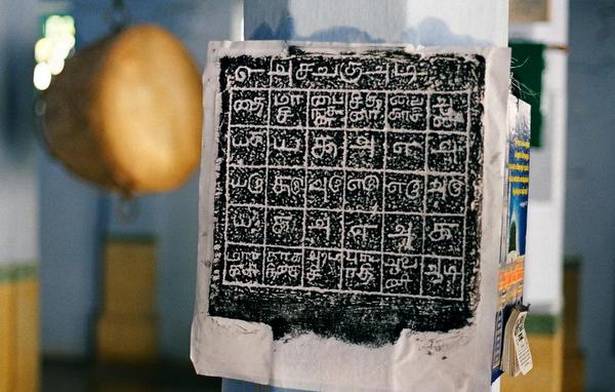
Engraving of Tamil calendar for prayer found inside the mosque

With guidelines for the construction of mosques being simple – such as prayer facing Mecca, no idol worship and clean surroundings, the masons who worked on these mosques under the supervision of religious heads restricted themselves to carving floral and geometrical motifs instead of human figures as in a temple. “While the raised ‘Adisthana’ of the Hindu temple was retained, there were no ‘Garbha Grahas’ and no figurines carved on any of the pillars” says Dr.Raja Mohammad, author of Islamic Architecture in Tamil Nadu.

For more than a millennium, hundreds of such mosques built in the Dravidian Islamic architectural style came up across Tamil Nadu, often with the help of grants from the rulers of the day, ranging from the Cheras, the Pandyas, the Venad kings and the Nayaks to the Sethupathis of Ramanathapuram. Across Tamil Nadu, wherever Tamil Muslims lived in large numbers, from Pulicat near Chennai to Kilakarai, Kayalpatnam, Kadayanallur, Kottar, Tiruvithancode, Madurai, etc., one finds these beautiful kallupallis.

Amongst these kallupallis, though not the oldest, the most beautiful mosque is to be found at Kilakarai, near Ramanathapuram. A medieval port town with a predominant Tamil Muslim population, Kilakarai has many mosques built during different eras spanning many centuries. The one built towards the end of 17th Century is the most beautiful of them all. It is believed to have been built by the great merchant and philanthropist Periathambi Marakkayar, also known as Seethakkathi, whom the Dutch records speak of as a great trader having considerable influence with the Sethupathis, the then rulers of Ramanathapuram.

The mosque built in the Dravidian architectural style of the late Vijayanagara period, has elements that are specific to native traditions. Like many other kallupallis, this mosque too has Podhigai, the floral bud detailing on the pillar corbels, which represent positivity and auspiciousness, an essential part of the cultural beliefs of the land. An interesting engraving found in this mosque is the Tamil calendar for prayer.

What is unusual about this calendar is that, timings for prayers in the various Tamil months are marked in Tamil numerals, a rarity, found in just a few other mosques in southern Tamil Nadu.

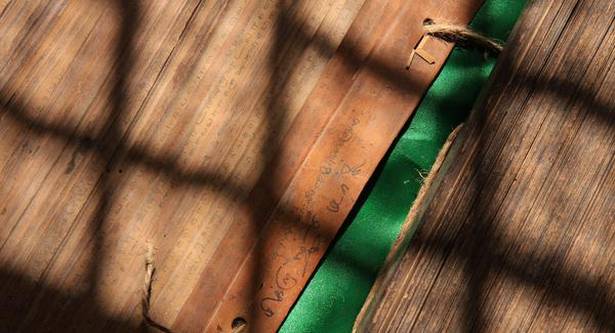
These mosques, deeply embedded in the Tamil culture, were also places where Tamil flowered. Further down south, at the Kottar mosque in Nagercoil, an early Tamil Islamic literary work, Mikuraasu Malai, was presented to the assembled congregation by Aali Pulavar in the late 16th Century.

Mikuraasu Malai, a palm leaf work

Mikuraasu is a Tamilised form of Mihraj, and narrates a significant event in the life of Prophet Muhammad (Pbuh), his ascension to the heaven. Even after 400 odd years, the tradition of singing Mikurasu Malai on the eve of Mihraj continues to this day at the Kottar mosque. Other literary works such as Seera Puranam, a Tamil epic on the history of the Prophet, are also recited across mosques in Tamil Nadu.

The Kallupallis in Tamil Nadu stand as proud reminders of not just an architectural tradition but also of cultural traditions, where Islam effortlessly adapted itself to the native customs.

source: http://www.thehindu.com / The Hindu / Home> Society> History & Culture – Anwar’s Trail / by Kombai S. Anwar / November 23rd, 2017

The walls have years

Kutch, GUJARAT :

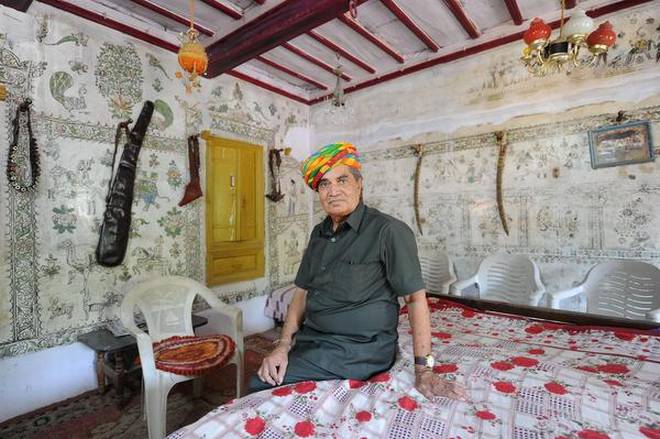
Kalubhai Vaghela in his ancestral house in Mundra. Photo: Vijay Soneji

In 18th century Kutch, walls were painted with stories. They survive today in only three places

On the fissured walls of the magnificent Tera fort in Gujarat’s Kutch district the story of the Ramayana springs to life in vivid colour: there is Sita on a pyre, Ram raining arrows on Ravana.

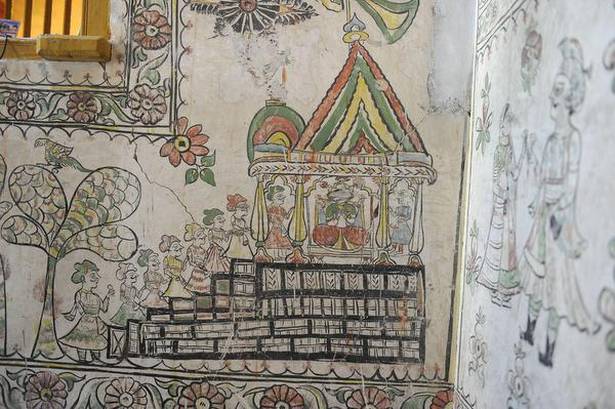
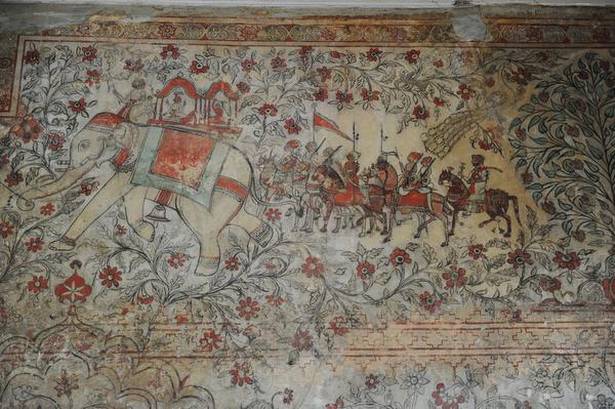
Kamangari bhint chitro or wall paintings was once a thriving art form in Kutch, used to embellish the palaces and homes of the affluent. The themes were as diverse as the patron’s tastes, but were predominantly mythological, with scenes from the Ramayana or Krishna Leela. Royal processions was another favourite. The landscape was another rich source of material, and date palms and peacocks and scenes from everyday life were common.

Kamanagiri01MPOs04oct2018

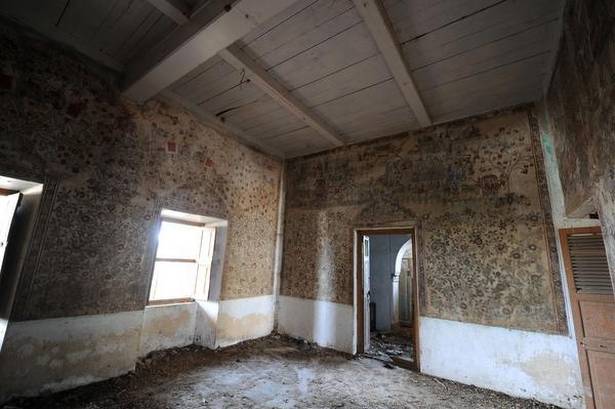
Today, only bits and pieces of this rich art are preserved in a few homes, temples, and on Tera fort. But if you were to string these together chronologically, history would come alive in a lyrical manner.

Back to its origin

Kamangari art originated in the 18th century. “It was a relatively peaceful time; there were no battles, and it was a conducive environment for travel and trade,” says Pradip Zaveri, a Vadodara-based businessman, known for documenting Kamangari. During this time, the Kamangars, a Muslim community from northern Kutch who traditionally made bows and arrows (kaman means bow) and painted shields, travelled to the rest of the region.

Soon the affluent Bhatia and Jain communities commissioned the Kamangars to paint their homes, giving birth to the art form. Such artistic embellishment on walls was traditionally seen as auspicious in Kutch.

A folk art

One of the finest examples of Kamangari art is in Aina Mahal, an 18th century palace in Bhuj. Here, the corridor is painted with a 47 feet scroll titled Nagpanchami Ashwari, by Kamangar artist Juma Ebrahim. The scroll begins with a royal procession with a mounted Arab cavalier, Arab soldiers, a cannon drawn by a pair of bullocks, a chariot of the family deity, and a group of camel riders. In the middle of the scroll is Maharao Shri Pragmalji II on a caparisoned elephant. The ethnicity of every individual is represented by their costume.

The paintbrushes were made from the bark of the local date palm, and the colours sourced from tree bark, flowers and stones. The artists would paint on wet plaster to ensure permanence.

For all its beauty, says Zaveri, Kamangari does not appear to have a consistent style. “If you look at two paintings, you will see the difference in the treatment and rendering. For example, the lines on wall paintings are thicker than those in the scrolls. In some places, flowers are used to fill gaps — like in a temple in Anjar — but in other places this is missing.”

Kamangari artwork at MacMurdo’s bungalow in Anjar. Photo: Vijay Soneji

Artists essentially followed their patron’s instructions. As the rich traders who commissioned this art travelled abroad, the art saw changes too. “The artists were given postcards from these places, and they would then draw characters inspired from the West but wearing a Kutchi pagdi, or the women would have long skirts,” Zaveri says.

In a Jain temple in the Abdasa taluka of Kutch, a man is shown wearing a hat but in a dhoti and long coat. Some later paintings depict British soldiers in uniform. Others have aeroplanes, rail engines, and even a game of cricket.

MacMurdo’s bungalow in Anjar. Photo: Vijay Soneji

At the bungalow of James MacMurdo in Anjar, the first political resident of the East Indian Company in Kutch, you can see Krishna and the Gopis dressed in the traditional attire of the Rabari community, complete with the nath (nose-ring). Much of the work also showed influences of the Mughal and Rajasthani styles.

The decline

According to Zaveri, Kamangari was popular until the early 20th century. Then, around the time of the Great Depression, its patrons began to migrate out of Kutch, and homes were locked up or abandoned. The murals degenerated and new occupants painted over them. The Kamangari artists turned to other livelihoods.

“The 2001 Kutch earthquake dealt another severe blow; many houses that had the last few paintings came down,” says Zaveri. Now there are only three places in Kutch with well-preserved Kamangari — the fort in Tera, MacMurdo’s bungalow in Anjar, and an ancestral home in Mundra, belonging to Kalubhai Vaghela.

There have been some feeble attempts by the government to revive the art, but more promising is a new project. Dalpat Danidharia, a librarian at Bhuj’s Prag Mahal, a 19th century palace, says: “Some of us who are passionate about saving Kamangari from disappearing from public memory are working on commissioning artists to create replicas.” The aim, he says, is to let everyone experience this vibrant Kutchi heritage before it’s lost forever.

When not researching new stories, the Gujarat-based freelance journalist likes spinning tales for her toddler.

source: http://www.thehindu.com / The Hindu / Home> Society> History & Culture / by Azera Parveen Rahman / September 29th, 2018

Revisiting Sheikh Salim Chisti’s tomb

Fatehpur Sikri (Agra District), UTTAR PRADESH :

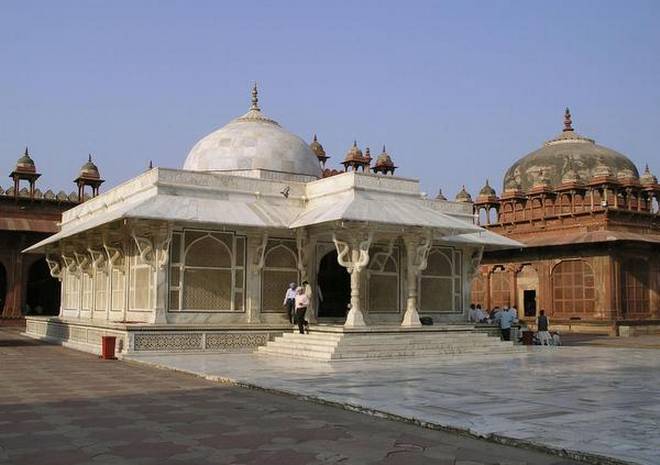
Soothing experience: Sheikh Salim Chisti’s tomb in Fatehpur Sikri | Photo Credit: V_V_Krishnan

Reminiscing a slow but stimulating journey to Akbar’s capital city

When Marion and Sally, two English teachers of St Thomas’ School, Mandir Marg, set out on a trip to Fatehpur Sikri in 1978, they boarded the last train from Delhi. “It sounds ominous, like the last plane from Da Nang, when South Vietnam was overrun by the Viet Minh,” remarked Sally, “Yes,” recalled Marion. “Many struggled to board the plane. Some were left behind but in the melee an enterprising Western reporter was not only able to capture the heart-wrenching scene, but also played the hero by helping a hysterical woman and her kid take his seat on the plane as he jumped down to shoot what later turned out to be award-winning pictures of the airport scramble.”

The last train from Old Delhi station did not cause any such frenzied commotion. Over 40 years ago it was the one that was supposed to leave just before midnight, but the departure was invariably delayed. From Delhi Main station it ran up to Agra Cantt, its destination, and took seven hours to do so, usually even more. The passenger train had a whole lot of policemen travelling in it. As a matter of fact, right from the ticket window they made their presence felt when they pulled suspicious-looking youths out of the queue and slapped and punched them before asking questions like, “Where are you going? Where did you get the money to buy the ticket? Are you drunk? Who else is travelling along with you? Where do you live?” before searching them with their shirts off and pants down,” the two teachers recalled.

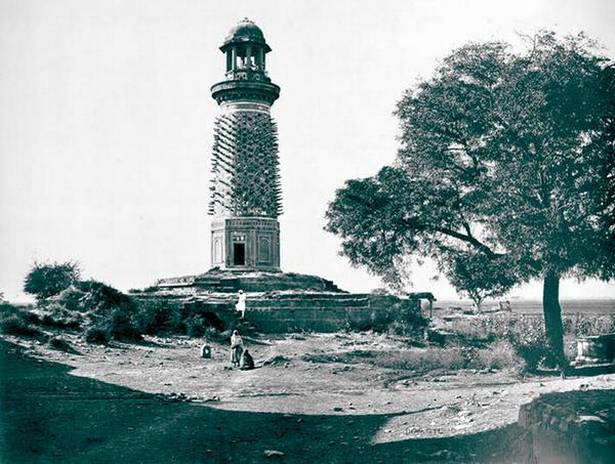
A view of Hiran Minar

When they caught the train they didn’t see those young men again. The train made three false starts, provoking someone to remark that the driver was shaking the compartments to fit in more passengers. Finally it started rolling, with several urchins rushing to catch it. By the time the train reached New Delhi station it was nearly 1 a.m. After that the Passenger stopped at every station big or small and as people got down, many were detained and searched by policemen on the platform. But the two girls reached Agra Cantt station safely. From there they were escorted by friends Sam, Lewis and this scribe by car to Sikri.

The shrine at Fatehpur Sikri is one of the most venerated places. Where wild animals once roamed a gem of a monument now greets the eye,” disclosed Sam. “It was here on a hill that Sheikh Salim Chisti dwelt and thither came Akbar the Great to seek his help for the birth of a son and heir apparent. He came on foot, leaving his camels, elephants and horses behind. The hermit sat with a rosary (tasbi) reciting the 99 names of Allah. The emperor’s prayers were heard and his Rajput queen bore a son, Salim, whom Akbar always called Sheikhu Baba, after the saint. Not only that, he built this magnificent city to commemorate the event and dwelt here with his Nine Jewels, like the Nine Worthies of the ancient world. “I have heard about the Nine Jewels,” said Marion, “but who were the Nine Worthies?” “Hector, Alexander the Great, Julius Caesar, Joshua, David, Judas Maccabaeus, King Arthur, Charlemagne and Godfrey of Bouillon,” replied Sam without batting an eyelid.

Akbar’s legacy

Sam related his tale standing by Sally’s side. She listened, her doe eyes thoughtful. As they approached the trellis of the shrine where people who seek favours tie a thread, she tied one too, making Sam wonder what she had sought. They next went to the Buland Darwaza and saw the town of Sikri spread out before them. Nearby is the water works set up by Akbar and from above the ramparts a man dived 80 feet into the baoli or step-well. They looked aghast. “Just you wait and see,” said Sam as Lewis nodded in approval. Soon a dare-devil emerged and salaam-ed them. They tipped him and he walked away to prepare for another demonstration. “These divers have been continuing the tradition for several centuries. VIPs and common people alike tip them. Perhaps, it will continue so long as there is water in the baoli. But it is a paradox that Akbar, who built a new capital here, had to desert it because of water scarcity.” Sam informed the party. They went down the steps of Buland Darwaza, Sam pointing out the Hiran Minar from where the shikar was shot in Mughal times, though some think that Akbar’s famous elephant was buried there and perhaps that’s why it is also called Elephant Tower.

At Sikri town they had the fabulous 24-layer Mughalia parantha. “Why is this parantha so thick?” enquired Marion. “It could feed one whole family.” “Quite right,” said Sam. “Ask Sally, when we were last here she had to take half the parantha to Delhi where we had it for breakfast the next day and the remainder for lunch.”

“Did Akbar really play with women as chess pieces? “enquired Sally.” Off course he did,” replied Sam. “Don’t talk rubbish. Listening to you one would imagine the great Akbar had nothing else to do but seduce maids of honour”, admonished Lewis. From there the party went to the Taj Mahal and then caught the Taj Express back to Delhi after a memorable day. Marion and Sally are now back in England and Sam works in Bangalore, where Lewis keeps reminding him of the visit whenever he rings up from Kolkata.

source: http://www.thehindu.com / The Hindu / Home> Society> History & Culture – Down Memory Lane / by R.V. Smith / October 01st, 2018