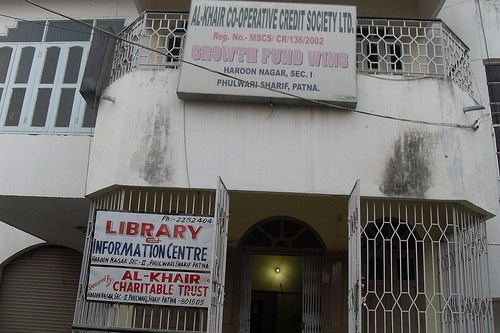
Kamla Devi, Pankaj Kumar, Geeta Devi and Sanjay Singh, all Hindus, share one thing in common. Their lives have been transformed through “interest-free” loans provided by a Muslim cooperative credit society in Bihar, yet another example how integrated Indian society has always been at the grassroot level.
They are four of nearly 9,000 Hindus — mostly vendors, small traders, roadside shopkeepers, marginal farmers and women — who got rid of exploitative moneylenders thanks to interest-free loans by the Al-Khair Cooperative Credit Society Ltd that is based here.
“I used to sell potatoes and onions in a small roadside shop. I was often exploited by moneylenders for a small amount of Rs 2,000 to Rs 5,000 that I needed for my business. But a few years ago, I was surprised when someone informed me of interest-free loans from Al-Khair Society,” Kamla, in her mid 40s, told IANS at her shop in Mirshikar Toli here.
She first took a Rs 10,000 loan to run her shop, followed by loans of Rs 20,000 to Rs 50, 000.
“It helped me expand my business from a vendor to a wholesale trader,” she said.
Now doing financially well, Kamla managed to fund the education of her two sons, with one getting admission in an engineering college and the other in a B.Ed. college.
Based on the Islamic principle of prohibiting interest, Al Khair Society has provided interest-free loans of more than Rs 50 crore to nearly 20,000 people, mostly those struggling for survival, in the last one decade of its existence.
About half of these beneficiaries are Hindus. Regardless of religion and any other considerations, Al Khair Society has opened new vistas for large sections of marginalised people, skilled and unskilled, from unorganised sectors.
Geeta Devi not only turned her small roadside vegetable shop into a big one; she has opened another vegetable shop for her son.
“Our life has changed after I came into contact with Al Khair Society. It helped us live a life of dignity. For poor people like us, interest-free loans are God’s gift and, unlike in regular banks, there are no uncertainties about getting the loan,” she said.
Manju Devi, another beneficiary, has been taking a loan of Rs 20,000 to pay the annual school fee of her children for the last five years. Her husband runs a roadside shop.
“I also deposit my daily earnings with Al-Khair Society and repay the loan amount without paying any interest,” Kamla said.
Sanjay Singh, another beneficiary of the interest-free loans, said banks have no time for vendors like him and they have no interest in giving out small loans.
“Banks charge interest and there is a lot of paper work involved that only discourages and frustrates the poor,” said Sanjay, who used to sell garments on a bicycle. He now owns a small garment shop run by his wife even as he continues to sell clothes on his bicycle.
What attracts people, many of whom are not literate, to Al Khair Society’s door is that it involves minimal paper work and a poor-friendly perspective.
“Interest-free loans may be a concept associated with Muslims as Islam prohibits interest as it terms it unjust, but it has a universal appeal and can benefit all, not just Muslims,” said Shamim Rizvi, a retired bank officer closely associated with Al Khair Society for nearly a decade.
Unable to get help from banks, these loans help people free themselves from the clutches of moneylenders who charge high interest rates.
Nayiar Fatmi, managing director of Al Khair Society, told IANS that interest-free loans are gaining popularity.
“Even a small amount of five to ten thousand is significant for people who don’t have access to banks. Nearly 50 percent of the beneficiaries of interest free loans are Hindus. Most of them use the money for earning livelihoods that empower them,” Fatmi said.
Al Khair Society has 13 branches spread across the states of Bihar, Jharkhand, Uttar Pradesh and Delhi.
“We are planning to open new branches in Kishanganj in Bihar and Ranchi in Jharkhand to reach out to more such people,” Fatmi said.
Al Khair Society is a successful example of interest-free microfinance that has brought smiles on faces of thousands of people. It started with merely a small fund and two employees at a small office in Patna. Today it has 100 employees.
The organisation charges a nominal service charge from those who take interest-free loans to pay salaries of its employees, rent of office and other expenditure.
Started by a group of educated Muslims in early 2000 as a small step to help ordinary people, the organisation has seen a tremendous response from all sections of society, irrespective of religion, caste or creed.
(The weekly feature series is part of a positive-journalism project of IANS and the Frank Islam Foundation. Imran Khan can be reached at imran.k@ians.in )
source: http://www.siasat.com / The Siasat Daily / Home> Breaking News> Featured News> News> Top Stories / by Imran Khan / April 18th, 2018
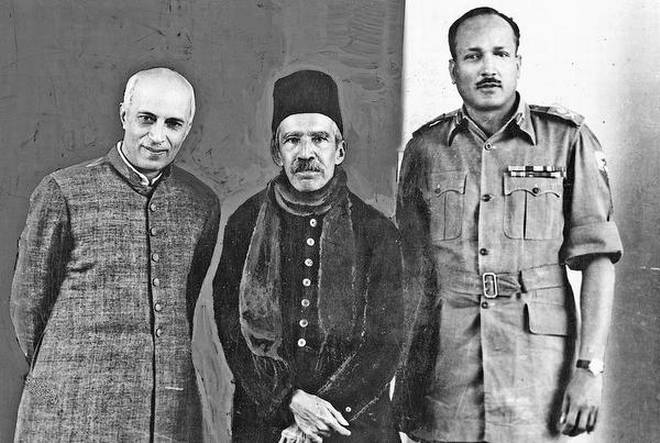
awaharlal Nehru with Nizam Mir Osman Ali Khan and Major General J. N. Chaudhuri after the police action | Photo Credit: THE HINDU
India’s diplomatic efforts succeeded in choking the supply of arms to Hyderabad, resulting in the September 17, 1948 surrender.
Seventy years ago, on September 17, 1948, at noon, Hyderabad ceased to exist as a princely state after a war that lasted all of 109 hours. It would have gone on for longer had India not been able to stymie the former kingdom’s attempts to procure weapons for a protracted conflict.
Hyderabad became part of India more than a year after the latter’s existence as an independent nation. Ruled by the hereditary ruler Nizam Mir Osman Ali Khan, the 212,000 sq km kingdom fancied its chance as an independent country.
Standstill Agreement
Unlike the Instrument of Accession with India signed by other princely states at the time of Independence, the Nizam nominated a three-member team to negotiate a Standstill Agreement. The Agreement signed on November 29, 1947 by Governor General Lord Mountbatten and Nizam Osman Ali Khan, specified that it would be valid for one year and that foreign affairs, defence and communications would be in India’s control while the Nizam had control over domestic affairs.
Declassified diplomatic cables between India War Office Staff, the Commonwealth Relations Office (CRO) and the UK Foreign Office, archived in the British Library, reveal that immediately after Independence, India played a high-stakes diplomatic game in London to staunch the flow of arms to Hyderabad in November 1947. This shortage of weapons ultimately forced the Hyderabad army to surrender within four days with limited Indian casualties.
The Nizam scouted for arms across the board — trying to buy them from France, tapping Pakistan for supplies and finally turning to gun runners — the role of Australia-born aviator Sidney Cotton’s role in the transport of weapons from Karachi to Hyderabad is the stuff of legends.
But the role of Indian diplomats in stalling the flow at the source is less known, carried out by hidden channels.
The British government played along with India by persuading France against selling German weapons to Pakistan, which in turn wanted to funnel them to Hyderabad.
The first of the series in the diplomatic cables sent to Donaldson at the CRO by R.H.S. Allen of the Foreign Office begins innocuously enough. “French Embassy informed Foreign Office on 1st November that Pakistan Trade Commissioner in London recently represented to French Authorities in Paris that his government urgently desired 600,000 rifles, same number of revolvers and 300,000 light and heavy machine guns from former German weapons in France. It added that, if France could not supply, his govt had other offers from Sweden, Belgium and the Netherlands,” says the cable marked Important/Top Secret by CRO.
These low bore, small arms on Pakistan’s shopping list were meant for Hyderabad. But India moved the diplomatic game a notch higher, with the persuasive but often abrasive V.K. Krishna Menon, Indian High Commissioner in London, swinging into action.
“As regards Hyderabad, it was decided that we should tell Mr. Krishna Menon, who has been bothering us (FO?) on the subject, that it is not our intention, as things stand at present, to supply arms on any abnormal scale to Hyderabad, but that Hyderabad is entitled to limited quantities of arms for the legitimate purposes of their state forces and police…” (says a cable sent again to Donaldson of CRO by FO on November 14, 1947)
An exchange of nine diplomatic cables in November 1947 and multiple jottings by officials on them, show how India managed to literally starve Hyderabad of weapons.
Another cable, sent to Gordon Walker, Under-Secretary of State (the initials are illegible) dated November 11, 1947 reads: “This shows that we must have a full and frank discussion with Mr. Krishna Menon and Rahimtoolah (Habib Imran Rahimtoolah, Pakistan’s High Commissioner) on the subject. Mr Menon constantly assumes that the UK should stop Pakistan from getting arms anywhere. ..But I confess that 600,000 rifles, 300,000 machines seems to be a lot…”
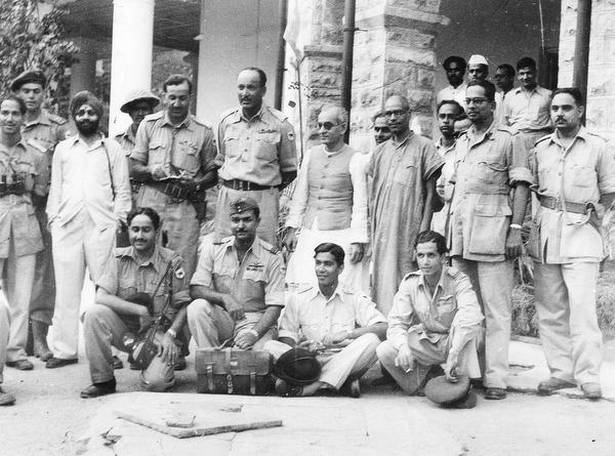
A group photograph of K. M. Munshi and Swami Ramand Tirth with Indian Union officers immediately after their arrival in Secunderabad on September 21, 1948. | Photo Credit: THE HINDU
Pakistan was not just shopping for arms — it was passing around the bowl. A rather large one at that. A cable from Washington to FO on November 26, 1947, reads: “Pakistan is now trying to get a loan of 2 billion dollars from the U.S.A. of which 200 million is for military supplies. This follows their attempt to get arms from France.” On the margin is the scribbled note: “USA have told us that they are cold-shouldering this.”
By the end of 1947 — the last cable in the series is dated December 4 — India had successfully closed the official arms pipeline for Hyderabad, hampering the Nizam’s efforts to stay independent for long.
Airborne supply
Then Sidney Cotton stepped in. He was the legendary flying ace who flew the last plane out of Berlin in 1939 and pioneered aerial reconnaissance by photographing German war efforts.
However, by the time, Cotton flew into the picture to help Hyderabad, it was too late. Hyderabad could not get any fresh weapons for 11 months from the time India and Pakistan came into existence. The armed forces of Hyderabad didn’t have arms nor ammunition for training.
Cotton flew to Hyderabad in the first quarter of 1948 to meet the Nizam and got a shopping list of weapons. He quoted an amount of £20 million in cash for running the weapons. Back in London, he hired a 24-member team and bought five used Avro Lancastrians for £5000 each. Cotton’s first run of arms began from Heathrow Airport on May 11, 1948, with the first Lancastrian that halted in Basle, Switzerland, to pick up an unspecified number of Oerlikon cannons. The first shipment of weapons landed on July 10, 1948 in Warangal.
In the course of the next two months, Hyderabad received about 25,000 mortars, 1,000 anti-tank mines, 1,200 sub-machine guns from Beretta, another 3,000 sub-machine guns, 10,000 rifles, one ack-ack and six low-calibre anti-tank guns and ammunition, delivered by Cotton.
Indian forces entered from the west in Sholapur and from the east near Suryapet. The war that began at 4 a.m. on September 13, 1948, lasted 109 hours and by September 17, 1948, Hyderabad surrendered. File | Photo Credit: P.V. SIVAKUMAR
The Nizam’s Commander-in-Chief at the time of Indian pincer movement on Hyderabad was Major General Syed Ahmed El-Edroos. He writes in his biography about the 20,000 .303 rifles and other small arms and ammunition brought in by Cotton and which had Rawalpindi Pakistan Arsenal markings on them.
But the Hyderabad army, which had a strength of 17,000 soldiers, 9,000 irregulars and 362 officers, didn’t get to train on the weapons or use them on the field. Indian forces entered from the west in Sholapur and from the east near Suryapet. The war that began at 4 a.m. on September 13, lasted 109 hours and by September 17, Hyderabad surrendered.
Cotton’s last flight out of Hyderabad’s Hakimpet airstrip was on September 16, at 3 a.m. — just hours before the surrender. This time the plane was loaded with cash of about £4 million in rupees.
Cotton was also supposed to have picked up the private militia leader Kasim Razvi. Razvi headed the Majlis-e-Ittehadul Muslimeen, and created the Razakars (volunteers) force to defend Hyderabad and the Nizam. This private militia created terror throughout the kingdom and triggered an exodus of Hindus from Hyderabad and other urban centres.
But Razvi’s escape ended in a theatrical fiasco due to a misunderstanding about the flight timing. As Cotton thundered away in his Lancastrian thinking Razvi had boarded, the militia leader desperately ran behind the plane, too late to flee. Razvi was placed under house arrest and tried for sedition. He was freed in 1957 and he emigrated to Pakistan where he died penniless in 1970.
The diplomatic heat was kept up even as Hyderabad surrendered. According to a report in The Hindu, R.K. Nehru, India’s diplomat in the U.S., in a radio broadcast on September 17 that was heard coast-to-coast said: “The British in similar circumstances would have marched in on the first outbreak of violence to restore order, put down the Razakars and bring the Nizam to his senses.” (This is significant because Pakistan and officials from Hyderabad were portraying India as an aggressor. And this Indian diplomat put things in perspective)
source: http://www.thehindu.com / The Hindu / Home> News> Cities> Hyderabad / by Serish Nanisetti / Hyderabad – September 15th, 2018
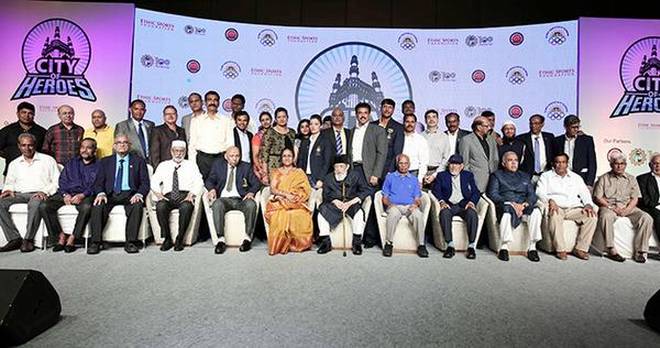
Sportspersons from the city being honoured at an event on Saturday.
Football legends and athletes felicitated by Ethic Sports Foundation
It was an evening when some of the football legends from the city went down memory lane while reflecting on the state of the sport.
On Saturday, Ethic Sports Foundation felicitated some of the finest sportspersons from the city, under the banner of ‘City of Heroes’, which also saw a sprinkling of outstanding women athletes like 2004 Athens Olympian J.J. Shobha, Arjuna Awardee and volleyballer Mulini Reddy and quite a few kabaddi players.
The objective of the event was to honour these stars of yesteryears and also remember the contribution of legendary football coach S.A. Rahim, who scripted India’s golden era in football.
Some of the speakers included sports historian and commentator Novy Kapadia, former sports scribe N. Ganesan, Olympians T. Balaram, M.S.S. Hameed, D.M.K. Afzal, S.S.Hakeem, son of late S.A. Rahim, renowned badminton coach and Dronacharya S.M. Arif, former SAI boxing coach Emani Chiranjeevi, hockey Olympians N. Mukesh Kumar and Edwards Alloysius, former India football captain Victor Amalraj, Mohd Habib, Shabbir Ali, rowing coach and Dronacharya Ismail Baig, Arjuna Awardee Mir Khasim Ali.
Jayesh Ranjan, Principal Secretary to Telangana Government, was the chief guest.
To inspire youth
Kailash Nath Yadav, MD of Ethic Sports Foundation, said they hosted the event to inspire youth by showcasing the diverse nature of sports in Hyderabad along with highlighting the efforts of the greats like S.A. Rahim.
source: http://www.thehindu.com / The Hindu / Home> News> Cities> Hyderabad / by Special Correspondent / Hyderabad – September 15th, 2018
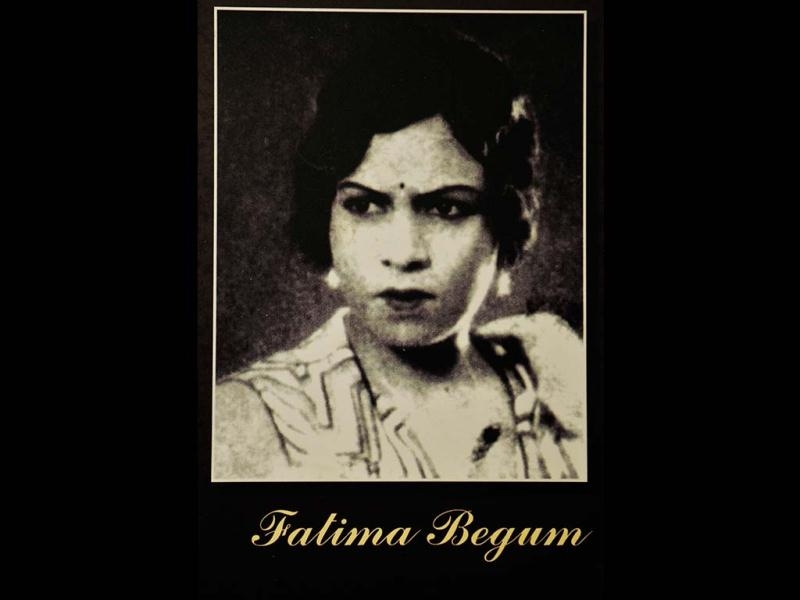
Most people are aware of the contemporary female directors that exist in the country as they have gotten recognition, acclaim and fame but few know about Fatma Begum – actress, scriptwriter and director – who created a path for many others in the film industry to follow at a time where male domination in every sphere was prevalent. Being arguably the first in the field she set opened the way for other women to venture into the film industry.
Fatma Begum, the first female director of Indian cinema, was born to a Muslim family in India in 1892.
She was also invested in acting, screen-writing, and production. She was trained in Theatre and initially used to stage Urdu plays, following which she began working in films in 1922. She started her journey as a director with the silent film Veer Abhimanyu (1922). In a short span of time she had directed the following films: Bulbul-ae-Paristan (1926), Goddess of Love (1927), Heer Ranjha (1928), Chandrawali (1928), Shakuntala (1929), Milan Dinar (1929), Kanaktara (1929) and Goddess of Luck (1929).
Bulbul-ae-Paristan was the most famous film directed by her. It was set in ‘Paristan‘ (Fairyland) had a big budget and included special effects using technology.
Fatma worked with filmmakers like Ardeshir Irani and Nanubhai Desai. After this, she created her own production company – Fatma Films, later changed to Victoria Fatma Films – and was the first Indian woman to do so.
When Fatma joined the film industry, only men were part of it. Even female roles were played by men. Thus, Fatma’s determination to break into this male-dominated sphere marked her as a trailblazer.
As an actor, she starred in many films including Veer Abhimanyu (1922), Sita Sardaba (1924), PrithviVallabh (1924), Kala Naag (1924), Gul-ae Bakawali (1924) and Mumbai ni Mohani (1925). She also contributed to writing scripts and wrote the script for Bulbul-ae-Paristan (1926). A few of her films featured her daughters, Sultana and Shehzadi. She used trick photography for special effects in films and included fantasy in her films.
Rumour has it that Fatma Begum was married to Nawab Sidi Ibrahim Muhammad Yakut Khan III, the last ruler of the Sachin State. However, no evidence exists to reaffirm this as the Nawab did not acknowledge Fatma Begum or their daughters. No undisputed images of her exist today.
Having a 16-year-long film career, her Last film was Duniya Kya Kahegi after which she retired voluntarily. Her daughters, Zubeida, Sultana and Shehzadi carried on her groundbreaking legacy as they too were actors in silent films. Zubeida went on to become the first Indian actress to star in the first talking film, Alam Ara (1931).
Fatma Begum died in 1983, at the ripe old age of ninety-one, leaving behind a pioneering approach to the film industry.
Sources:
IMDb: Fatma Begum Cinestaan: Fatma Begum, Jaddanbai: The earliest female filmmakers of Indian cinema TCRC: The story of Fatma Begum, India’s first woman director News18: 100 years of Indian cinema: The first women directors
source: http://www.feminisminindia.com / Feminism In India / Home> Culture> Cinema / by Maryam Mansoor / March 12th, 2017
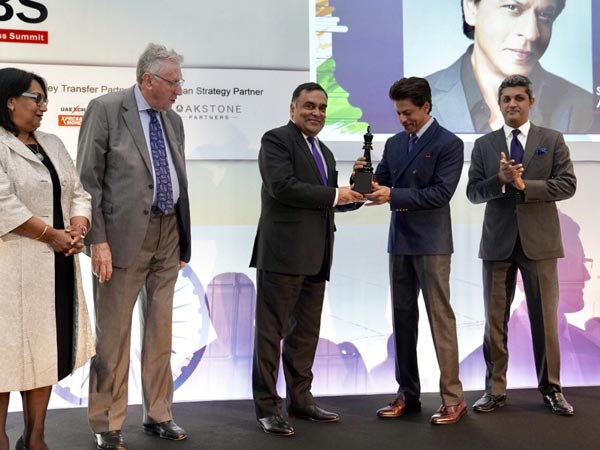
Here’s some good news for all Shahrukh Khan fans! The superstar was recently felicitated as a “Game Changer for his Unmatched Contribution to Globalizing Indian Cinema” at the business summit in London.
Time and again, King Khan has represented India at international events making the nation proud. The ET India – UK Strategic Conclave, a special business summit discussing the economic relations between India and UK was graced by the global icon in London.
Check out some of the pictures here-
SRK In Conversation
Representing the entertainment industry for a chat session on the ‘Growth of the business of entertainment across the globe and its impact on India”, Shah Rukh Khan said, “The growth for Indian films has been much smaller compared to the growth of television in India. The ratio of theatres to the audience area is still very small, we have very few theatres compared to the audience we can garner. In the Interiors of India, there are not many screens for people to go and I think there is a huge market here for entrepreneurs to get into making low-cost theatres.”
SRK Felicitated As The Game Changer
The actor, producer, activist was also felicitated with The Economic Times Game Changers of India” – Hall of Fame for “His Unmatched Contribution To Globalising Indian Cinema.”
The Superstar Also Unveiled A Coffee Table Book
A coffee table book titled ‘Game Changers of India’ was also unveiled at the summit which features Shahrukh Khan along with other accomplished leaders.
SRK’s Award Acceptance Speech
Accepting this honour, the superstar said, “I take this opportunity to thank a lot of people, actors, actress, and audiences, for allowing me to continue unencumbered with any idea that I had, they gave me the ability to just go ahead and give it a shot, try and go wrong if I may, and more often than not they allowed me to go wrong”.
He further added, “Business is become about millions, targets and projections, though I fully respect the managerial capacity of business, but I like to think of it as the people who work with me allowed me the imaginarily capacity, they allowed me to imagine and they managed that imagination. So, when you become a game changer you cannot take it upon yourself, there are loads of people involved and the audience as well around the world accepts you doing the stuff you do and think it’s entertaining”.
On the work front, Shahrukh Khan will be next seen in Aanand L.Rai’s Zero co-starring Anushka Sharma and Katrina Kaif.
Salman Khan host Shahrukh Khan on Dus Ka Dum – Dumdaar Weekend
source: http://www.filmibeat.com / FilmiBeat / Home> Bollywood> News / by Madhuri V / September 12th, 2018
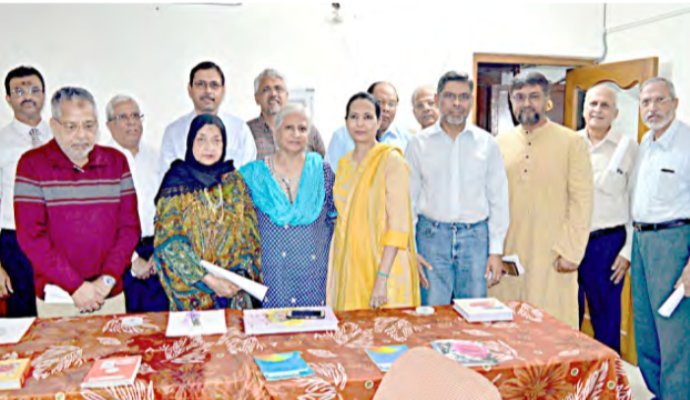
Mr. Amer Ali Khan, News Editor of Siasat Urdu Daily received a letter from six police stations including Bahadurpura and Langer Houz requesting him to arrange for the burials of nine destitute Muslim dead bodies.
In accordance with these requests, these dead bodies were procured from Osmania and Gandhi General Hospitals. They were buried in Tharthareshah Muslim graveyard, Secunderabad under the supervision of Mr. Syed Abdul Mannan, Mr. Samiullah Khan and Mr. Abdul Jaleel.
Mr. Syed Shah Inamul Haq, Imam of Jamia Masjid, Afzal Jung led the funeral prayer.
source: http://www.siasat.com / The Siasat Daily / Home / by Sameer / September 13th, 2018
According to the report furnished by Mr. Iftekhar Husain, Secretary of Faiz-e-Aam Trust, a sum of Rs. 2.99 crore was spent on various schemes of financial assistance to poor students and families.
In 2016-17, the trust spent Rs. 59.81 lakh for primary education, Rs. 21.21 lakh for technical education, Rs. 29.5 lakh for relief and Rs. 7.85 lakh for treatment of patients.
In this manner, from April 2017 to January 2018, Rs. 40.46 lakh, Rs. 21.21 lakh, Rs. 18.68 lakh and Rs. 3.58 lakh were spent on the above mentioned works.
So far, the trust has help 625 students of primary education, 731 of SSC, 1237 of Intermediate, Degree, PG, Engineering, MBA, MBBS and Paramedical Courses.
He further told that the trust was established in 1983 by his brother-in-law, Mr. Zulfekhar Husain. It enjoys full support from Mr. Zahed Ali Khan, Editor of Siasat Urdu Daily. The trust is now helping 1456 students ranging from primary school to Engineering and Medical courses. It is also extending financial help to 1256 patients. It rehabilitated 2280 persons.
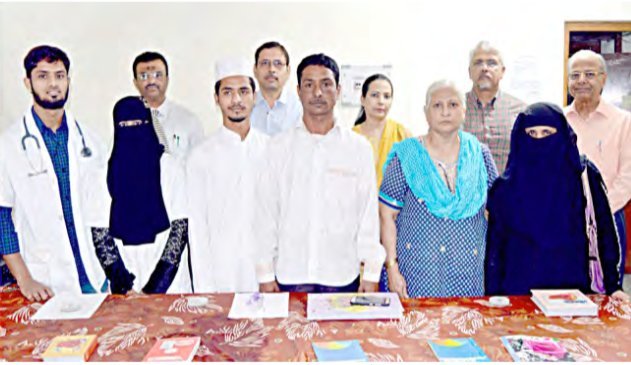
Faiz-e-Aam Trust helped Kareemunnisa whose husband, an autodriver had left her helpless. Her sons, Syed Hasan and Syed Yaseen and daughter, Saba Begum were adopted by the Trust for educating them. Syed Hasan completed MBBS whereas Saba Begum is doing the same course. Her eldest son, Syed Yaseen has completed Hifz-e-Quran.
Ms. Farukh Parveen Jamal, Chairperson of Trust, Aurangabad and Mr. Siraj Tahir, Trustee of Faiz-e-Aam Trust attended the meeting and listened to the details of the poor families.
In collaboration with Siasat Millat Fund (Clothes bank) it helped 1552 families. Destitute Muslims of Muzaffar Nagar received help through Siasat Millat Fund. It also helped Salwa Fatima and Sania Siddiqui for their ambitions to become pilots. For Old Age Home of Siasat, the trust gave a donation of Rs. 5 lakh.
The trust also helped Nuzhat Fatima, a student of MBBS, Shaik Nazeer Ahmed and Ayesha, students of MD.
During the past three years, the trust has spent Rs. 1.6 lakh for primary education, Rs. 43.33 lakh for technical education, Rs. 71.15 lakh for rehabilitation, Rs. 23.35 lakh for treatment of patients.
It may be mentioned that Syed Hasan had secured a free seat in MBBS. Mr. Ali Asghar played a key role in getting financial help for this family.
Hajera Begum is a second year MBBS student. Her father is a tailor and her mother manufactures beedis. She has two sisters. The expenses of her MBBS fees were paid by her parents by mortgaging ornaments. Dr. Makhdoom Mohiuddin’s wife, Dr. Shaista Mohammedi Husaini received a message on WhatsApp for helping Sabera Begum which she forwarded to Secretary of Faiz-e-Aam Trust who arranged Rs. 1.27 lakh for getting back the ornaments which were mortgaged.
Mr. Rizwan Haider, Trustee welcomed the guests. Ms. Amena Saher conducted the meeting.
These details were given in a special meeting held at Faiz-e-Aam Trust which was attended by Ms. Farhat Yasmeen and Mr. Siraj Tahir, Trustees.
The other persons who attended the meeting were Dr. Samiullah Khan (Director Shadan College and MESCO member), Dr. Saukat Ali Mirza (Chairman Helping Hand), Mr. Ali Abedi (Social worker, London), Mr. Mudasir Alam (US), Mr. Jameel Haider (US), Fakhri Saheb (US), Anees Iftekhar Ali (US), Ruqayya Begum (US), Syed Haider (member, Faiz-e-Aam Trust), Aijaz Husain (US), Jafar Ahmed (US), Syed Jafar Husain (Sada-e-Husaini), Hamid Ali, Prof. Shaukat Hayat and Mr. Ahmed Basheeruddin Farooqui (former Dy.DEO).
source: http://www.siasat.com / The Siasat Daily / Home / by Sameer, The Siasat News / January 18th, 2018
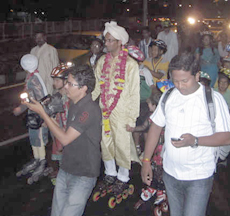
“Baaraat” of Sajid Khan, a national level skater and coach, skating its way to marriage venue in Bhopal on Sunday night.
Bhopal:
Bhopal, the capital of central Indian state of Madhya Pradesh, witnessed a unique wedding wherein “Baaraat” (the wedding procession of the bridegroom) on Sunday night skated its way to wedding venue on roller skates.
The “Baaraat”was that of Sajid Khan, a national level skater and roller skating coach in local Delhi Public School, who adopted this unique move to attract people’s attention towards skating and promote the game in the state and ensure recognition to it in international events.
The bridegroom and the “Baratis” all put on their skating shoes to roll on in the marriage procession from Gauhar Mahal to Bagh-o-Bahar, the wedding venue, as vehicular traffic on the VIP road nearly came to a screeching halt. Budding skaters, the disciples of groom Sajid, also danced to the beating of drums as the procession moved on with passersby halting down to have a clear glimpse of this unique “Baaraat”.
Sajid, who is also president of Speed Roller skating Association, Bhopal, skated to have a rendezvous with his bride Shaista Yasmeen, who also happens to be a skater and a roller skating coach. Several national and international junior skaters such as Huzaifa Zafar, Akshay Sharma, Syeda Masooma Fatima, Ahsas Shrivastava, Gautam Sharma, Shayali Kumbhare, Aamir, Nilesh, Sami Khan, Hrithik Khare and others also joined the “Baaraat” with their skates on.
Sajid revealed that it was their students who planned the one-of-its kind wedding and he was happy to accept the unique idea. The wedding shall be remembered for long, not for its grandeur, but for the mode of transport the groom and the members of the “Baaraat”chose to reach the marriage hall.
“It is a historic moment in my life as the people who witnessed the wedding procession shall be attracted towards the roller-skating sports. “We are advertising the skating game through the procession. I spend my whole time in skating and as such I and my students decided to take out wedding procession on skates which is something unique”, Sajid told media persons as he rolled on skates to meet his soul-mate and bring her home.
Meanwhile, Nikah was solemnized at the historical Taj-ul-Masajid, one of the biggest Masjid in Asia, between the Asr and Maghrib prayer timings on Sunday evening. Elite of the town along with large numbers of sportspersons attended the Nikah.
It may be pointed out here that a couple has also tied nuptial knot while rappelling at Kerwa Hills in the city in the past.
source: http://www.ummid.com / Ummid.com / Home> Life & Style / by Parvez Bari (pervezbari@eth.net) / September 19th, 2011
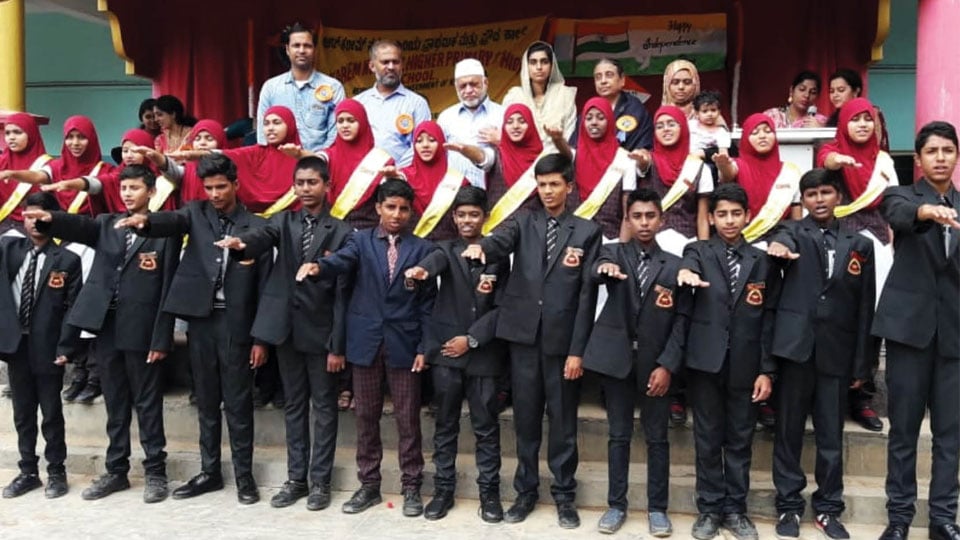
The Investiture Ceremony of Al-kareem School was held at the School premises recently.
All the School leaders were honoured and were made to take oath followed by recitation of the School pledge.
School Founder Alhaj Hussaini Baig, School Chairman advocate Kaleem Ulla Baig, School HM Yasmeen Sultana, teachers and students were present on the occasion.
The student leaders are M. Armaan, Syed Junaid, Mohammed Hassan, Junaid Ahmed, Junaid Khan, Mohammed Nabeel, Awaiz Shariff, Amith Kumar, Mohammed Zeeshan, Mohammed Anas, Mohammed Yousuf, Afsha Baig, Simran Banu, Sakeena Banu, Sadiya Taj, Umme Hani, Aiman, Suhana Kouser, Uzma Tehreem, Bibi Ayesha, Bibi Ameena and Farhana Firoze.
source: http://www.starofmysore.com / Star of Mysore / Home> News / September 09th, 2018