The story of Haji Baqir Ali Badayuni, the Halwa Paratha seller who was acknowledged by the Late Prime minister, Mrs. Indira Gandhi
Portraits of Haji Baqar Ali.
Each year during the month of Dhul Qadah, the annual congregation (Urs) of 19th-century Sufi saint widely popular as Shah Ji Mohammad Sher Miyan took place in the small city of Uttar Pradesh, Pilibhit. The main congregational prayers were held on 03rd to 05th Dhul Qadah. As common with all Urs and traditional fairs, one can find makeshift stalls of Halwa Paratha erected on road leading to the dargah.
Last year while passing down the crowded street near the dargah, it was two old portraits hanging on the stall of ” Badayuni Halwa Paratha” that caught my attention for exploration. The first one is the portrait captioned in Urdu and Hindi introducing him as Late Haji Baqar Ali Badayuni. In the first portrait, the late Baqar has nicely wrapped a traditional white turban with a vest jacket (Sadri). The pen clipped to the front pocket of the vest reflected an impressive dressing style more of a writer than a Halwa Paratha shop owner.
The second portrait was torn from the lower edge and almost faded. In this portrait, the Baqir was receiving an award from late Prime minister, Indira Gandhi.
I made a request to the man sitting on the cash counter to parcel one packet of his calories loaded large size Paratha, and Halwa made up of Suji (Semolina). During the conversation, he told that Haji Baqar Ali was his grandfather who started to sold Halwa Paratha during Colonial days. The Halwa Paratha stall was named after his birthplace, Badayun.
Badayun is the small city of Uttarpradesh located one hundred twenty-eight kilometers south-west of Pilibhit. It was once the mighty capital of Katehar Province during the reign of Mamluks and also the birthplace of the famous 13th-century Sufi of Central Asian origin, Hazrat Nizamuddin Awliya.
The torn and faded portrait of Haji Baqar Ali receiving the shield from late Prime minister Indira Gandhi with the live portrait of man frying large size parathas.
In the decade of the sixties and seventies, the Badayuni Halwa Paratha was a popular street food stall at Urs of Hazrat Nizamuddin and Hajj house near Turkman Gate at Delhi. In off times, he used to manage a hotel at Badayun named as Sultani Hotel. It was during this time, Haji Baqar Ali was also acknowledged by Late Prime minister, Indira Gandhi for serving his street food delicacy at syncretic Indian gatherings especially at Hazrat Nizamuddin Urs. For almost six decades, the man moved with his stall at the Urs (death anniversary) of Sufis like a wandering nomad. Haji Abdul Qadir passed away in mid-eighties at age of eighty-eight years. While recalling the old days, the grandson of Baqar Ali got melancholic.
Grandson of Baqar Ali with his chef.
In the present scenario, he is hardly able to manage expenses as the earnings are meager in comparison to the grandfather days. These two portraits and name of the stall “Badayun Halwa Parath” made his street food shop different from the several others. This seems to the prized possession of a grandson who is now taking care of Haji Baqar legacy.
source: http://www.rehanhist.com / RehanHist.com / Home / August 02nd, 2018
HRD Ministry’s survey finds dip in the case of other minority communities
While the enrolment of Muslims in institutes of higher education in Telangana rose by 22% over a period of five years, enrolment of other minorities such as Christians, Sikhs, Jains, Buddhists and Parsis dropped by around 17%.
These were the observations of the All India Survey on Higher Education released by the Ministry of Human Resources Development. While the enrolment of students from the Muslim community in 2012-13 stood at 89,524, it rose to 1,09,240 in 2017-18. On the other hand, the number of students enrolled from other minority communities was 11,920 in 2012-13; the number fell to 9,866 in 2017-18.
Analysing the data, former Head of Strategy and New Initiatives, Bill and Melinda Gates foundation, Prof. Amir Ullah Khan said that greater access to education, as compared to previous years, in the State had led to the increase in enrolments. He said that enrolment in institutes of higher education was linked to a larger number of schools – both government and private — being opened.
New schools
“The spurt in new schools, including residential schools for minorities and private schools, has led to an increase in enrolment. These schools are acting as feeders for institutes of higher education,” Prof. Khan said.
Touching upon the drop in enrolments of students belonging to other minority communities, Prof. Khan said that students reached nearly full enrolment in the last decade or so, sometimes crossing 100%, as they were enrolled in multiple institutions. “Hence the enrolment rate has now slowed down as there is a correction. The Muslim minority has now got access to schools in their neighbourhood and in their medium of instruction. This is the reason for the late catch-up,” he said.
The survey revealed that there have has been lesser enrolment of Muslim women as compared to men. While 3,44,173 men were enrolled from 2012-13 to 2017-18, the number of women enrolled stood at 2,77,202 in the same period. The report said that data was based on ‘voluntary uploading of data by institutions’.
source: http://www.thehindu.com / The Hindu / Home> News> Cities> Hyderabad / by Syed Mohammed / Hyderabad – August 02nd, 2018
IndusInd Foundation is a charitable organization established in the year 1995 with the main objective of supporting the education of the underprivileged children and supporting them in all kind of needs.
IndusInd Foundation provides educational scholarship every year at pan India level after HSC education until examinations to meritorious and economically challenged students who would like to pursue their college post-graduation.
Eligibility:
12th class with 85% marks
Admission in regular degree course in Science, Arts, Commerce, Engineering, Medical, Computer & Management etc. (All courses)
Apply Offline before 30th Sept. 2018
The application for grant of scholarship is to be made in the prescribed application form, which is obtainable our website:
Leader of Opposition in Rajya Sabha, Ghulam Nabi Azad receives Outstanding Parliamentarian Award for the year 2015 from President Ram Nath Kovind during Outstanding Parliamentarian Award ceremony at Central Hall of Parliament in New Delhi on Aug 1, 2018.
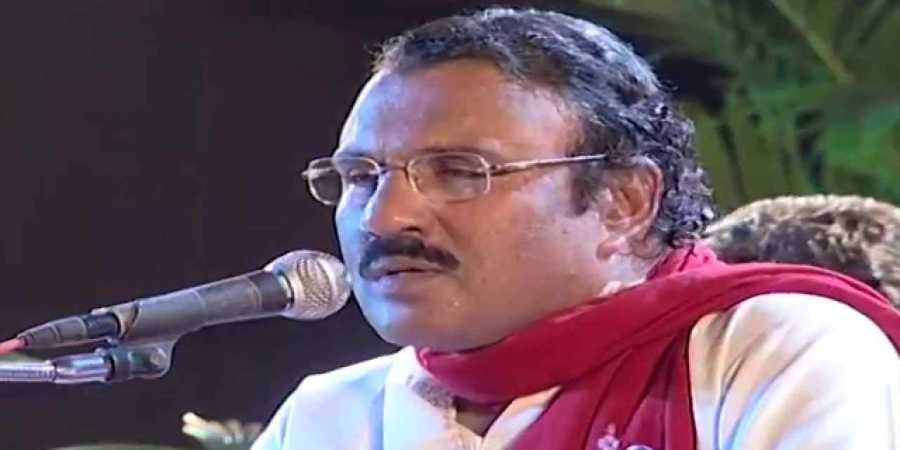
A talented singer, Umbai (original name is PA Ibrahim) is known for his beautiful Ghazal renditions of old Malayalam songs and his own Ghazals.
Malayalam ghazal singer Umbai. (Image: YouTube)
Kochi:
Prominent Malayalam Ghazal singer and composer Umbayee passed away on Wednesday evening at a hospital in Aluva. He was 68.
Umbayee was born in Mattanchery near Kochi. He is known for his soulful Ghazal renditions of old Malayalam songs. A talented singer, Umbayee (original name is PA Ibrahim) released his first album in 1988. He has released more than ten Ghazal albums and has associated with prominent music directors and lyricists in Kerala.
Umbayee has composed music for poems written by literary stalwarts like ONV Kurup and Satchidanandan. He has also sung Ghazals of legends like Mehdi Hassan, Jagjit Singh, etc.
source: http://www.newindianexpress.com / The New Indian Express / Home> States> Kerala / by Firos BF, Express News Service / August 01st, 2018
Dr. Shaik received business leadership icon award and was honored by Indian Business Professionals Council, Dubai – the award was given by His Excellency Dr. Thani Ahmed A l Zeyoudi, Minister of Climate Change & Environment and other Senior dignitaries from Indian Consulate.
For every hundred reasons, the world presented for women to sit behind without a dream, there came a thousand reasons as to why they must chase it. Dr. Nowhera Shaik, left no stones unturned whenever she got an opportunity to contribute her bit to the progress of civilization. However, what is commendable is that it was she who created these opportunities that acted as the stepping ladder to the top-shelf of empowerment, humanity and the ever-changing corporate world. Over time, she expanded her horizons and built herself a forte in several different paths of life. She is a businesswoman to look up to, founder and CEO of Heera Group, The National President of the All India Mahila Empowerment Party, an entrepreneur and most importantly a selfless philanthropist, who wakes up every day with the vision of progressing in the world of civilisation & learning to make a difference in the life of another individual.
Some of the awards and achievements of Dr. Nowhera Shaik:
1. Extraordinaire – Powerful Women Achiever by NexBrands – Brand Vision Summit 2017-2018
2. Stardust Achievers Award 2017
3. Gulfood Award – Best New Comer Brand 2016
4. Woman of Integrity and Purpose Award 2016
5. Fastest Growing Indian Company Excellence Award 2013
She also won the honorary award for ‘Best Transfer for Heera Gold Charted from UAE.’ Further, she grabbed the Antony Gold Bullion Company Limited U.K. award and the Tajir Gold Dust and Bar Ghana Limited award.
She was the proud receiver of several awards that were an evident reflection of her expertise in the world of business and her undying passion to help the people in need. With the kind of integration of knowledge and hard work, she put across, the growth of the firm was obvious.
Her selfless service to the society and her urge to ascend the ladders of corporate success and empowerment has led her to carve a path for several young women along with serving her own purpose.
About Dr. Nowhera Shaik
Ms. Shaik was born to Shaik Nanne Saheb and Shaik Bilkis in 1973. Ms. Shaikh has followed her father’s footstep from a very early age by supporting him in his business activities even during her school days. Mr. Shaikh Kolkar Madaar Saheb, grandfather of Ms. Shaikh was a successful businessman who started S.N.S. Transports in 1920 and found success in the wholesale business of vegetables, fruits, and textile products across the entire country. The high spiritual and religious cultural and business background was inherited by Ms. Nowhera Shaikh. In 1998, Ms. Shaik Nowhera started an Islamic School for girls at Tirupati Town in the name of ‘Madrasa Niswan’ (under a society registered with the Registration of Societies Act, AP, India, No: 386), with around 150 Students. Most of the students were very poor and could not even afford to buy books and uniform. She gave such poor children free education with lodging and boarding facilities.
An inspiration to many and the reason for several newfound smiles, Dr. Nowhera Shaik believes she’s only beginning her journey and that there is a long way to go before she sees the peak of it.
source: http://www.businesswireindia.com / Business Wire India / Home> New Detail / June 28th, 2018
Many Indian dishes can be traced back, indirectly, to a 16th-century, food-obsessed ruler named Babur.
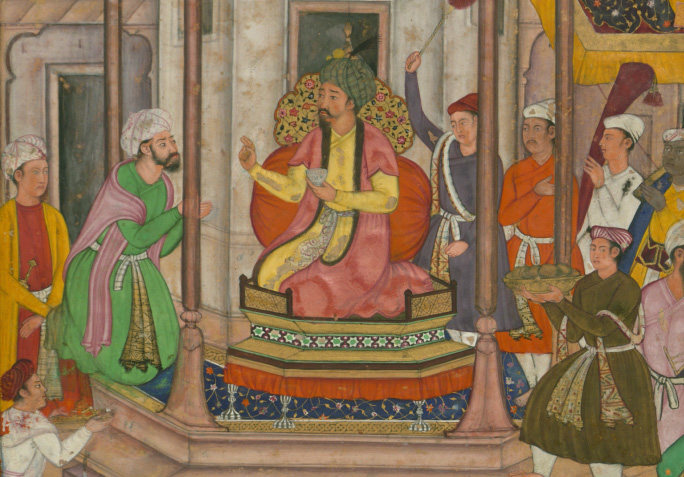
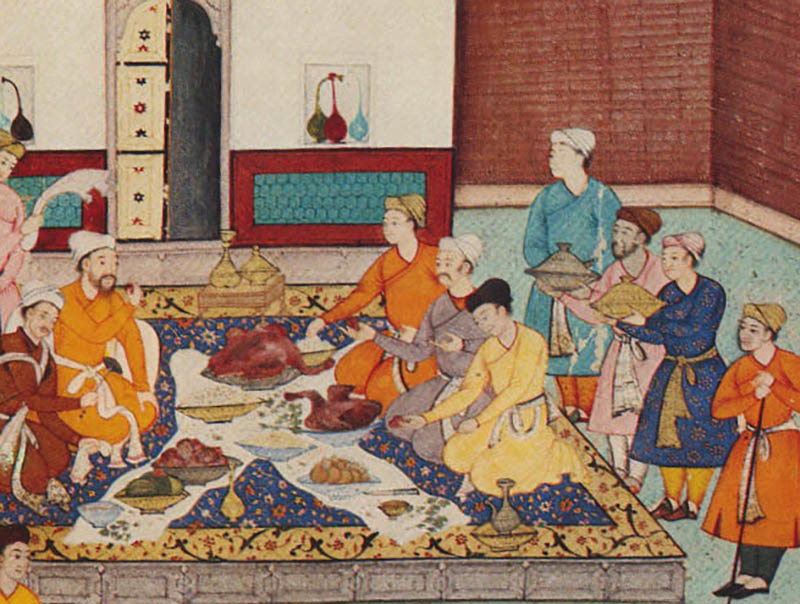
Babur Being Entertained in Ghazni, from the Baburnama, the memoirs of Ẓahīr al-din Muhammad. PUBLIC DOMAIN
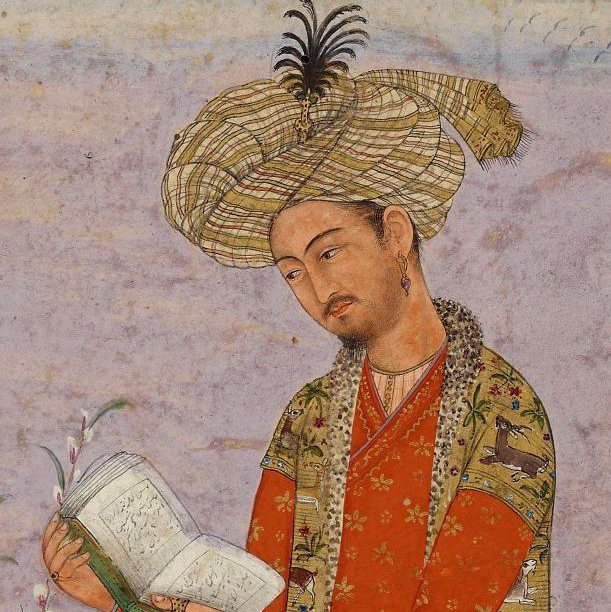
ZAHIR AL-DIN MUHAMMAD, THE 16TH century Central Asian prince better known as Babur, is renowned for his fierce pedigree and proclivities. Descended from both Timur and Genghis Khan, he used military genius to overcome strife and exile, conquer northern India, and found the Moghul dynasty, which endured for over 300 years. He was a warlord who built towers of his enemies’ skulls on at least four occasions. Yet he was also a cultured man who wrote tomes on law and Sufi philosophy, collections of poetry, and a shockingly honest memoir, the Baburnama, in which he appears to us as one of the most complex and human figures of the early modern era.
Through the Baburnama, we learn that Babur was versed in courtly Persian speech and custom, yet nonetheless a populist who built strong ties with nomads and championed the vernacular Chagatai Turkic tongue in the arts. He was a pious man, but was also given to libertine escapades, including massive, wine-fueled parties.
But the first—and arguably one of the most culturally consequential—personal details he reveals is that he was a food snob. Babur loved the foods of his homeland and hated those he found when he had to reestablish himself in India, which to him was mostly a way station on the bloody road back to the melon patches of his youth. He didn’t just whinge about missing foods from home, though. He imported and glorified them in his new kingdom, laying the groundwork for his descendants to warp Indian cuisine so profoundly that they redefined that culinary tradition, as many know it worldwide, to this day.
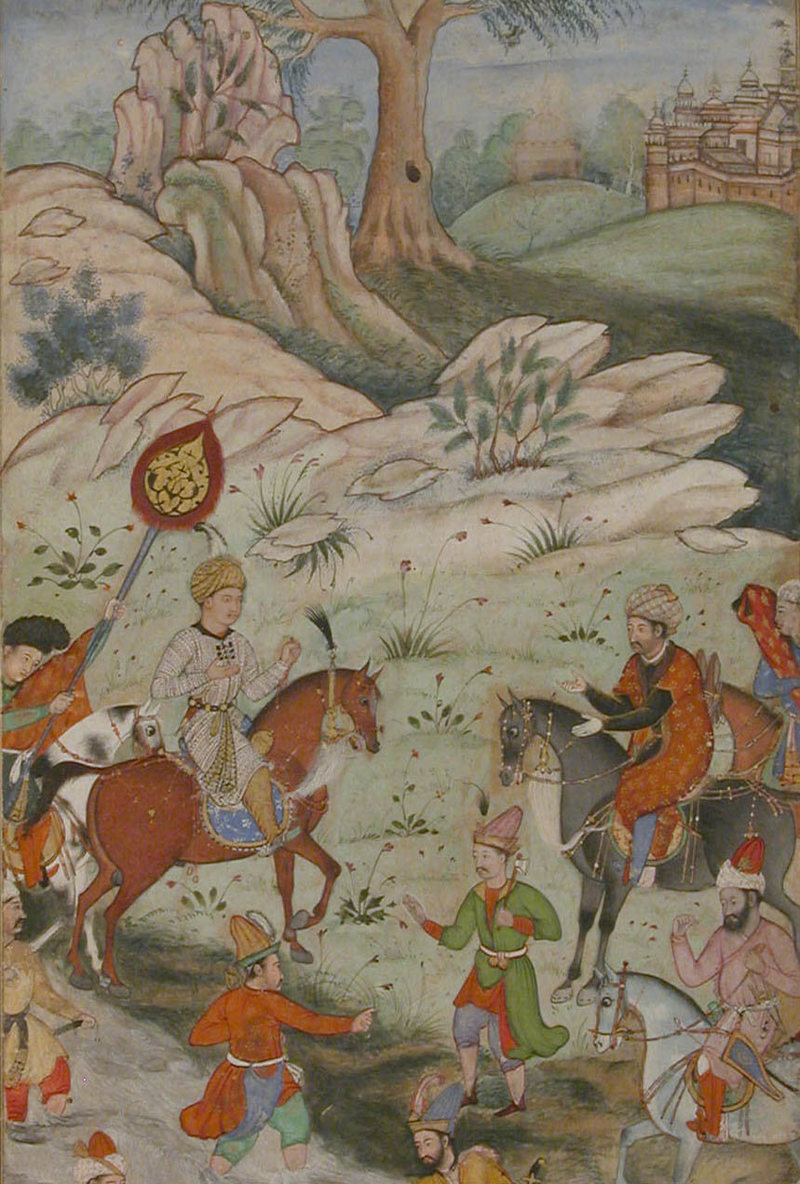
A depiction of Babur meeting Sultan ‘Ali Mirza near Samarqand, from the Baburnama. PUBLIC DOMAIN
The Baburnama opens with a description of Ferghana, a region now split between Kyrgyzstan, Tajikistan, and Uzbekistan, where Babur grew up. Known then and now as the breadbasket of Central Asia, it follows that Babur would touch on agriculture. But in introducing his hometown of Andijan, Babur opens with a note on the quality of its grapes and melons before turning his attention to its layout and fortifications. He then ducks back to praise its game meats, especially its pheasants, which “are so fat, that the report goes that four persons may dine on the broth of one of them and not be able to finish it.” Only then does he tell us of the people who live there.
Almost anytime he describes a place back home, he starts with vittles. Margilan is known for its dried apricots, pitted and stuffed with almonds. Khojand’s pomegranates are proverbially good, but they pale next to Margilan’s. And Kandbadam is tiny and insignificant, but it grows the best almonds in the region, so it’s worth mentioning.
“Early sections of his Baburnama,” writes Fabrizio Foschini, in a report on Afghanistani melons authored in 2011, “really sound like a consumer guide to the fruit markets of Central Asia.”
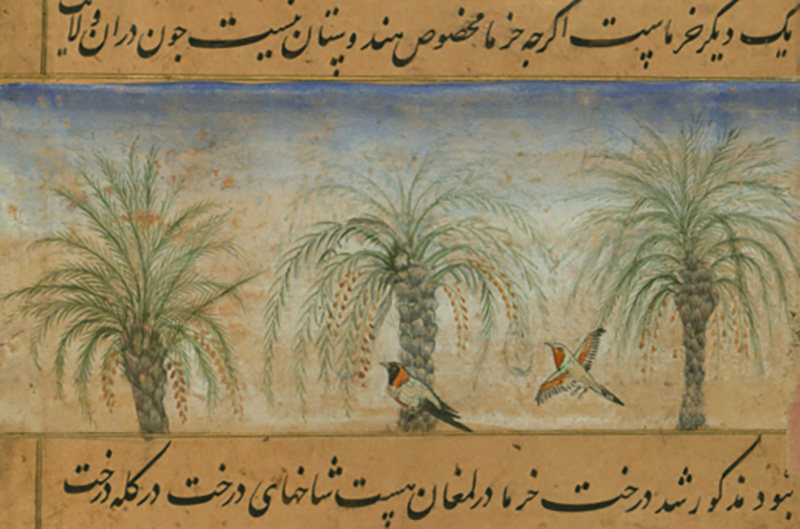
A detail of date trees illustrated in the Baburnama. PUBLIC DOMAIN
Babur doesn’t forget food once he gets into the meaty war stories, either. He breaks one narrative to note that the area around a castle he just besieged grew a unique melon with puckered yellow skin, apple-like seeds, and pulp as thick as four fingers.
The Baburnama is not solely concerned with food. The bulk of it is a painstaking record of families and feuds, and Babur dwells on other seemingly random details that tickled him, such as a courtier’s talent at leapfrog. Since we don’t have a similarly honest accounting from his peers, it’s hard to say whether Babur’s epicureanism was atypical.
Given the chaos he grew up in, though, it’s incredible that Babur could spare any thought for food. Thrust to power at age 11 (by the Gregorian calendar), in 1494, he had to navigate bloody infighting amongst his relatives. Known as the Timurid princes after their conqueror-ancestor Timur, they jockeyed against each other for regional control. Babur became an active participant in this Central Asian game of thrones—he seemed particularly obsessed with taking the regional cultural capital of Samarkand. While he seized it in 1497, he lost the city almost immediately, as well as Ferghana, and (a very long story short) spent the rest of his teenage years reclaiming or losing bits of territory, fleeing into exile with remote nomadic tribes, and trying to court new followers and surge back. Although he never stopped trying to reclaim Samarkand and his homeland, by 1504, at age 21, he’d effectively been forced out of the region for the rest of his life.
A portrait of Babur. PUBLIC DOMAIN
That year, he pulled off a fantastic feat of warlord jiujitsu, flipping a rival’s forces into his service and marching on Kabul, which was vulnerable after undergoing its own contentious power shift. Babur took the city, and, naturally, set to cultivating its produce scene. In and around the city, he built at least 10 grand gardens that included a fair number of fruiting plants.
While Babur’s writings suggest a personal obsession with food, it’s hard to disentangle this obsession from homesickness. There were also political reasons for him to pay so much attention to cuisine: Food snobbery was a standard way for a Timurid prince such as Babur to make his mark and prove his elite bona fides in a new land. “The Timurids, while ethnically Turkic, based their legitimacy to a large extent on their being champions of Persianate ‘high’ culture,” says Central Asian historian Richard Foltz, “which included taste in food.”
Kabul proved ill endowed to support a successful campaign back to Ferghana, though. So Babur turned his attention to neighboring India. He got a lucky break when a new king—an inept man who clearly had dissenters and rebels in his ranks—came to power in the northern Sultanate of Delhi. Babur struck at this weakness, invading the region through the early 1520s. Despite being outmanned by a ratio of perhaps five-to-one in his final standoff with the sultan, he usurped the throne in 1526.
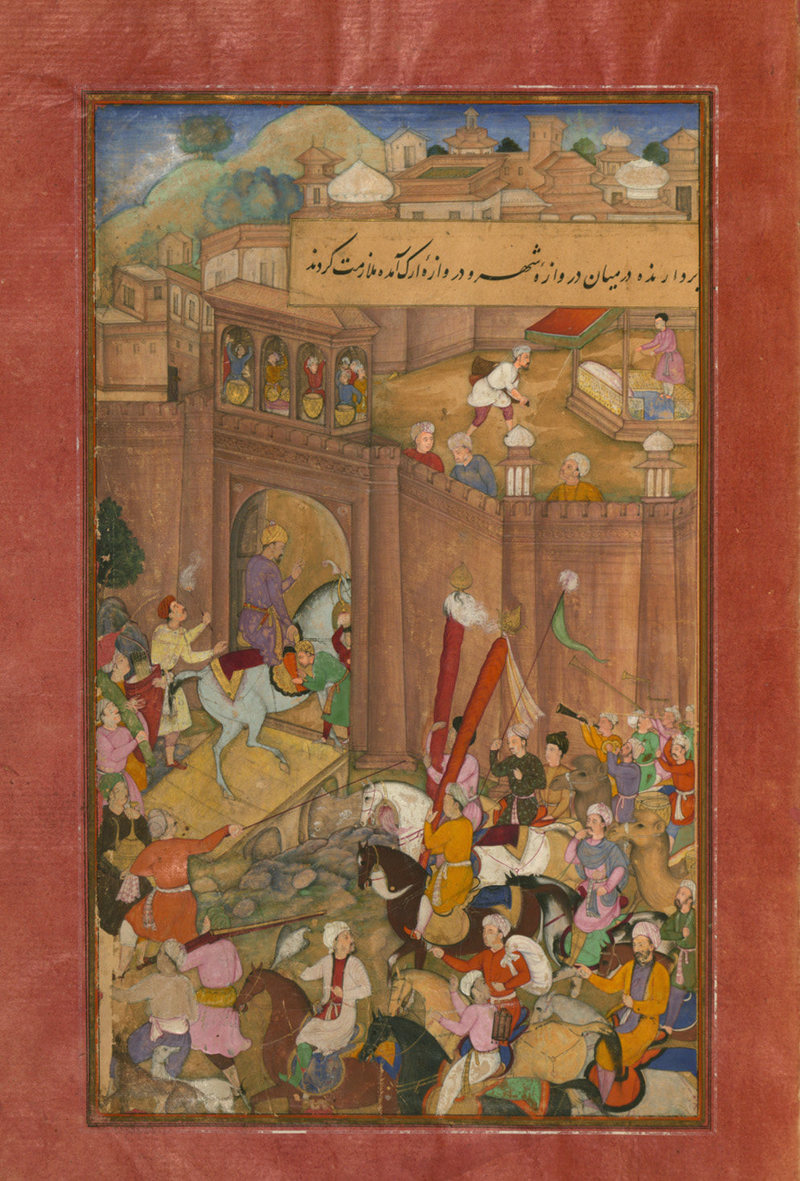
Babur entering Kabul. PUBLIC DOMAIN
According to Foltz, Central Asians mostly looked down on Indians, who were neither Muslims nor Persianate. Babur, his recent biographer Stephen Dale notes, was also still deeply homesick. These factors, and possibly personal tastes, led him to dismiss his new territory, and especially its food: “Hindustan is a country that has few pleasures to recommend it. … [There is] no good flesh, no grapes or muskmelons, no good fruits, no ice or cold water, no good bread or food in their bazaars.”
Babur shouldn’t have had time for food in India either. He spent the last four years of his life fighting local insurgencies and consolidating his power. In 1530, he died at the age of 48, in Agra, the north Indian city where his great-great grandson Shah Jahan (lived 1592–1666) would later build the Taj Mahal. But he wrote letters in those years expressing his desire to return home, or at least taste its grapes and melons. He describes receiving a melon from Kabul and weeping as he ate it. He planted Central Asian grapes and melons in India, which brought him some joy. He even asked local chefs to make Persianate food for him, although one of them tried to poison him.
By establishing supply chains that brought his native agriculture and cuisine to the region, Babur left a lasting legacy. “He probably played a role in bringing Central Asian influences into the elite, courtly Indian life,” says Elizabeth Collingham, a food historian who explored Babur’s life and influence in her history of curries .
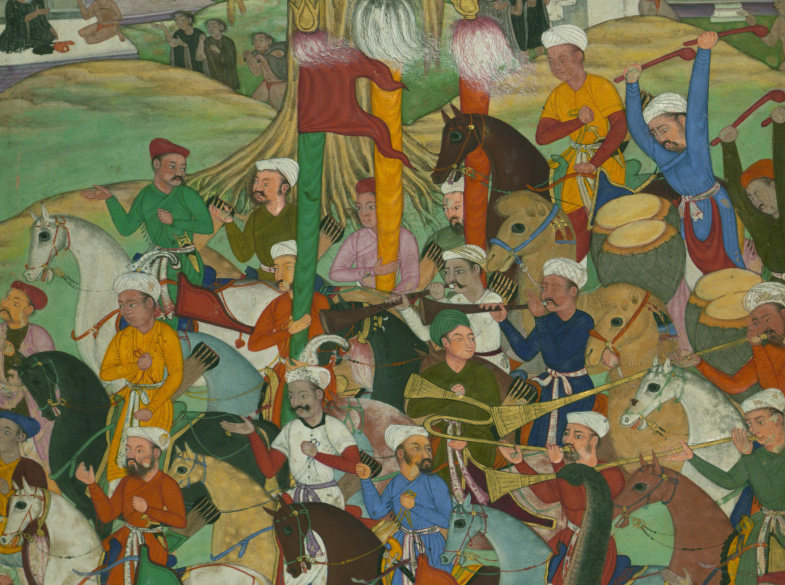
Babur, on the Way to Hindustan, Camping at Jam, from the Baburnama. PUBLIC DOMAIN
Granted, Babur was not the first Central Asian lord in what is now India. From 1206 to Babur’s day, five prior Central Asian dynasties ruled from Delhi. They too imported foods from home, cooked dishes they knew, and even did some fusion cooking. Trade and migration also meant there’d always been interplay between the regions, including culinary influence. Glimpses of this cultural mingling include the first mentions of samosas in the region’s written record—in accounts of those earlier medieval sultans’ feasts.
But according to Rukhsana Iftikhar, a historian of social life amongst the Mughals, the Persian word for “Mongols” by which Babur’s descendants came to be known, many of these dishes differed in style and flavor profile from the Persian-influenced Central Asian cuisine Babur preferred. They likely had not caught on with the general Indian population by the time Babur arrived, and few of them would sound familiar to fans of global Indian fare today.
Historians like Dale and Foltz chalk this up to the fact that previous dynasties—while they had some cultural influence—seemed to see India mostly as a piggy bank. They didn’t like to mix with local elites, and their culture was not grand or stable enough to invite mimicry and adaptation.
A banquet with roast goose. PUBLIC DOMAIN
Babur, by contrast, was more statesman than raider. His pedigree and strong connections to Iran also gave him and his descendants more cultural cachet, and those descendants mixed more readily with the local populace. And for over a century after his death, Mughal rulers continued to praise the same foods Babur praised and keep the caravans of his beloved Central Asian fruits and nuts flowing. Babur’s successor Humayun brought Persian cooks to Delhi, and Humayun’s son, Akbar, was notably cosmopolitan and curious in the kitchen. Later descendents were not as invested in Persianate culture and the foods of Ferghana as Babur. But either as a means of displaying their wealth or of brandishing the superiority of their heritage, they carried on the culinary trajectory Babur set up.
Babur’s descendants also spent lavishly on their kitchens, elevating food as a status symbol. But unlike Babur, they made it a point to round up chefs from around their Indian domains, a practice that invited fusion. The grandeur and duration of their courts, argues Collingham, led local elites to copy their Persianate and Central Asian motifs and augment their own kitchens, leading to parallel fusion work in places like Hyderabad, Kashmir, and Lucknow. Over the centuries, these innovations coalesced into Mughlai food, a stable cuisine common across, although not ubiquitous in, northern India by the early 20th century.
This cuisine was defined by, among other things, aromatic, creamy curries, often incorporating the nuts and dried fruits Babur adored. It includes many dishes familiar to Western diners today: Korma, a blend of Central Asian nuts and dairy with Persian and Indian spices. Rogan Josh, a slow-cooked, Persian-style meat spiced up in the kitchens of Kashmir. And tandoori grilling, facilitated by Mughal tweaks to said grills and to marinades and spicing styles.
These dishes became ubiquitous in the West, Collingham says, because haute Indian chefs have long viewed Mughlai cooking the same way Western cooks used to see Le Cordon Bleu. Indians who set up restaurants abroad made Mughlai food the template of Indian food in the U.S. and U.K.—to the chagrin of Indians who grew up eating many other cuisines that remain hard to find outside their homelands.
None of this was a conscious project for Babur. But by setting up shop in Agra and Delhi, he created a wave that shook the foundations of India, culinary and otherwise. His tastes indirectly fueled 300-plus years of kitchen innovation. It’s no Central Asian dynasty of skulls and melons. It’s something more widespread and enduring, if unexpected or unwanted.
Gastro Obscura covers the world’s most wondrous food and drink.
source: http://www.atlasobscura.com / Atlas Obscura / Home> Stories / by Mark Hay / November 15th, 2017
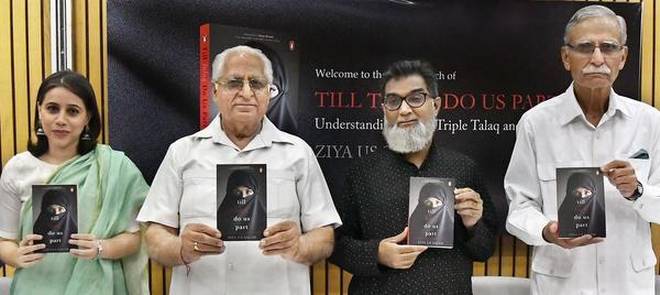
FOR A FAIR CONTRACT At the discussion that followed the book release, the panellists (from left) journalist Marya Shakil, lawyer J.C. Batra, author Ziya Us Salam and Lt. Gen. (Retd.) Zameeruddin Shah) discussed women’s rights in Islam
Ziya Us Salam’s “Till Talaq Do Us Part” defogs the miasma around the issue of instant triple talaq
Triple talaq is a phrase that the citizens of India became acutely aware of post the events of 2017, when seven women petitioners moved the Supreme Court against their instant divorce brought about through the uttering of the words ‘talaq, talaq, talaq.’ The apex Court had, on August 22, ruled that instant triple talaq was a practice not sanctioned in the Quran, yet a fog of confusion and obfuscation surrounds the general discourse and public understanding of what exactly constitutes an Islamic divorce. In this context, Till Talaq Do Us Part (Penguin Random House) by senior journalist Ziya Us Salam is a book that acquires much significance as it tries to brush the dust away and bring clarity to the issue by reverting to the most authentic source for Islamic knowledge — the Quran.
Released this past evening at the India International Centre by Lt. Gen. (Retd.) Zamiruddin Shah, the book defines nine types of divorce interpreted from Quranic verses.
Among them some of the most important ones are Khula, the inalienable right of the woman to instantly divorce her husband on the grounds of his inability to take care of her needs or even simply her dislike for him; Talaq e Ehsan where the man pronounces divorce once but the woman lives with him for the next three months, after which he can divorce her or they can reconcile; Talaq e Hasan where the man pronounces divorce three times in three months, but only in the interim periods of menstrual cycles; Mubarat which takes place through mutual consent, Faskh or judicial divorce; Talaq e Tafweez which is incorporated into the Nikahnama wherein the husband vests the rights of divorce in his wife.
Lack of information
“In the present scenario within the country, the right information on Islam was not reaching the masses,” says Salam. Which is why he decided to write this book that talks about numerous aspects of marriage including the model nikahnama that the AIMPLB spoke of circulating but never quite got down to the task. He also speaks of the importance of meher, the dower paid by the man to the woman at the time of marriage, and how it is entirely neglected among Muslims in India. The meher must be paid either in full to the woman at the time of nikah, or in part with the husband giving a written undertaking that he would pay the rest in future, he emphasises. “One of the most important things is to have one regular nikahnama for all Muslims — at the most two, one for Sunnis and the other for Shias — but ideally, just one.”
Understanding halala
The book also deals with the highly controversial issue of halala, which in truth has been contorted and disfigured heavily into an abhorrent act of female exploitation. Halala, explains Salam, actually gives a woman the right to choose.
If perchance a woman’s second husband either passes away or the second marriage too results in divorce, she has the right to go back and choose her first husband again. However, with the entirely invalid and un-Quranic practice of triple talaq, instant divorces are carried out in a fit of anger and when the man comes to his senses and wishes to reconcile with the woman, they are forced into a monstrous distortion of Halala. When triple talaq gets pushed out of the scene, the question of a one-night halala would not arise at all.
Several scholars state that triple talaq was made legal by Umar Ibn Khattab, the second Caliph in Islamic history. “The important fact which is overlooked, though, is that it was made legal upon the condition that the man giving triple talaq would be flogged,” he highlights. “So why do the maulanas forget to flog the men giving triple talaq?”
A very important point here is that instant triple talaq did not exist at the time of Prophet Mohammad at all, nor the time of the first Caliph. Equally pertinently, it was later made entirely invalid and illegal by Ali Ibn Abi Talib, the fourth Caliph of Islam.
Many Islamic countries have made the instant talaq illegal and it is non-existent among the Shia sect. In fact it is illegal in all other sects except the Hanafis, but as the author writes in his book, “there is no direct word from Imam Hanifa on triple talaq.”
But social structures are rigid and herd tendencies difficult to change, which is why the Supreme Court judgement against instant triple talaq cannot be enough, just as dowry and caste system still exist despite being grossly unconstitutional. In addition, the maulanas whom the masses look to for religious guidance are ill-equipped for the task, caught as they are between rote-recitation and following customs without an attempt at understanding. “Across the country, a vast number of Imams don’t even know (the meaning of) what they have read in namaz!” avers Salam. “They prevent women from coming to mosques but at the Kaaba in Mecca, women and men pray together, perform Hajj together. There is no restriction at all upon women praying in mosques.”
The important task, then, is for the community to be educated and made aware of their rights, for people to read translations of the Quran and develop a deeper understanding. One may pick any translation and exegesis among the many reputed ones, but the most important thing is to explore. In addition, the men must be made aware of the rights of women as much as the women themselves. As Salam says, “We have reduced the understanding of the Quran to the monopoly of some aalim. But the Quran came for all of humanity, not a select group of scholars.”
source: http://www.thehindu.com / The Hindu / Home> Books> Authors / by Zehra Naqvi / May 03rd, 2018
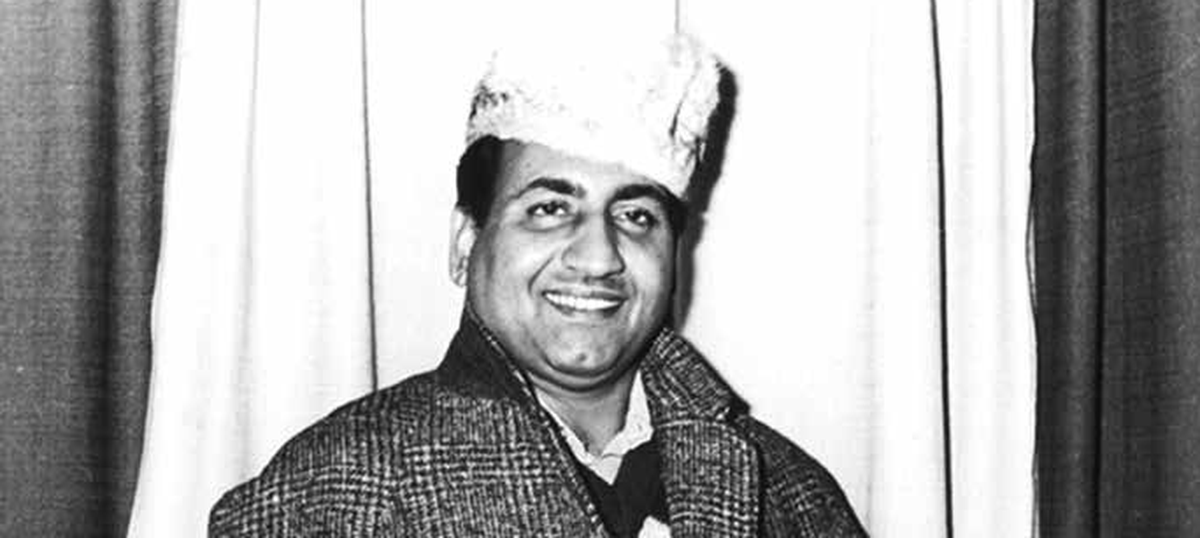
The legendary singer extended his vocal range to foreign languages whenever he got the opportunity.
Mohammed Rafi | Sujata Dev
Mohammed Rafi’s first break as a singer came in 1942, when he sang the duet Goriye ni Heeriye ni with Zeenat Begum for composer Shyam Sunder in the Punjabi film Gul Baloch (1944). Since then, he sang an estimated 4,500-5,000 songs in 14 Indian languages and four foreign languages until his death on July 31, 1980.
Not a bad feat at all for a singer who struggled with even English. In the biography Mohammed Rafi: Golden Voice of the Silver Screen, Sujata Dev writes about how the unlettered singer would politely turn down requests for autographs as his fame grew. “He began practising his signature diligently and when Ammi (mother) enquired why he was wasting reams of paper, he told her that he did not want to deprive his fans and so was learning to sign his name in English,” Rafi’s son, Shahid, told Dev. “Soon he began signing autographs in English and enjoyed doing so. It came as a great compliment for all his efforts when a journalist mentioned that he had the best signature in the industry.”
Rafi was born on December 24, 1924, in Kotla, a village near Amritsar. Singing in English became one of his greatest triumphs, especially since the language was a stumbling block throughout his life. When music composers Shankar-Jaikishen approached him to sing English numbers for a non-film music album in 1968, the singer was hesitant. Maverick actor-writer Harindranath Chattopadhyay , an ardent fan of the singer, wrote the lyrics. He convinced Rafi to take up the assignment, helping the singer perfect his diction for the recording. The two songs were Although we hail from different lands, based on the same composition as Baharon phool barsao (Suraj, 1966), and The she I love, based on the composition Hum kaale hain toh kya hua (Gumnaam, 1965).
Rafi’s English songs pale in comparison to the command he had over Hindi songs but never one to back down, he made a valiant effort to overcome his fears and grasp his limitations as a singer. It also gave him the courage to test his vocals in other foreign languages such as Dutch, Creole and Persian.
In this clip, Rafi sings in Creole, the local language of Mauritius, when he toured the country in the 1960s. He sings Mo le coeur toujours soif zot l’amour camarade (My heart will always be thirsty for your love, my friends), based on the tune of Ehsaan mere dil pe tumhara hai doston(Gaban, 1966).
‘Mo le coeur toujours soif zot l’amour camarade’.
This video clip shows Rafi performing at a concert in Dutch. He sings Ik zal jou nooit vergeten al zal ik in India zijn (I will never forget you, although I will be in India). The music is by Shankar-Jaikishen from the composition Baharon phool barsao, which remains immensely popular among Rafi fans.
https://www.youtube.com/watch?v=vz2piQTmraY
‘Ik zal jou nooit vergeten al zal ik in India zijn’.
For the Persian track Aye Taaza Gul (O fresh flower), Rafi collaborated with Afghani singer Zheela.
‘Aye Taaza Gul’.
In Mohammed Rafi: Golden Voice of the Silver Screen, Sujata Dev writes, “Kersi Lord, the multi-faceted musician had a long association with Rafi. He also happened to be the singer’s next door neighbour. ‘I remember once an Iranian couple had come to India and they wanted Rafi Sahab to sing an Iranian song. He called me home to play the synthesizer as he sang the song, with a fluency that made it seem as if it was his own mother tongue. The couple was left spellbound.”
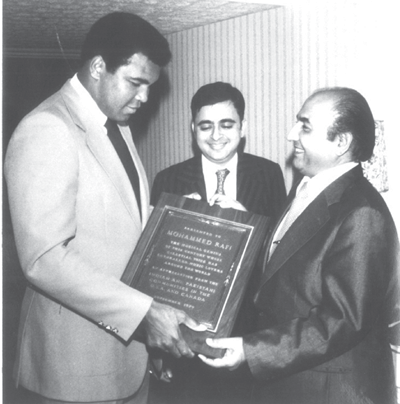
Boxer Muhammad Ali felicitates Rafi in Chicago during one of his tours. Courtesy Sujata Dev’s ‘Mohammed Rafi’.
source: http://www.scroll.in / The Scroll / Home> The Reel> Tribute / by Manish Gaekwad / July 31st, 2016
Over 1000 war rockets of Tipu era have just been found in a fort in Karanataka. Tipu Sultan was the first warrior in history to have used rockets in his warfare against the British.
Recall Tipu Jayanthi celebrated by the Karnataka Government under Siddaramaiah and the violent opposition it evoked from the BJP and Hindutva forces who overlooked Tipu Sultan’s fierce fight against British rule and only focused on his Islamic identity. An Union Minister publicly refused to participate in the Tipu Jayanti celebrations.
The fanatical opposition to Tipu Sultan by BJP and its top leadership has been so intense that it did not even accept the speech of President of India Ramnath Kovind who while addressing the Karnataka Assembly appreciated Tipu Sultan, among others, and flagged his pioneering role in employing the first ever rocket in the history of warfare against the British.
In their blind opposition to Tipu Sultan just because he was a Muslim, the BJP leaders of Karnataka did not hesitate even to diminish the dignity of the President of India by refusing to acknowledge his speech and dismissing it as as a draft prepared by the then Karnataka Government. Even Prime Minister Narendra Modi while campaigning for BJP candidates in the Karnataka elections sarcastically said that the Congress Government was celebrating the Jayanti of “Sultans”.
Let us be mindful of the fact that a sketch of Tipu Sultan finds a prominent and place in the calligraphed copy of the Constitution where the sketch of Lord Ram, Akbar and other outstanding figures of Indian mythology and history occupy a hallowed place.
It is not that President Kovind is the first President of our Republic who invoked Tipu Sultan’s glorious legacy. Earlier President K. R. Narayanan in his speech delivered at the banquet hosted by the President of the French Republic, Jacques Chirac, on April 17, 2000 in Paris referred to the correspondence exchanged between Tipu Sultan and Napoleon Bonaparte for the purpose of forming a grand alliance to defeat the British and throw them out of India.
In an appendix of the publication, The Sword of Tipu Sultan, authored by Bhagwan Gidwani, there is a text of letter written by Napoleon to Tipu Sultan bringing out the strategic affinity and understanding between India and France in the late 18th century.
Napoleon wrote in the letter to Tipu Sultan : “You have already been informed of my arrival on the borders of the Red Sea, with an innumerable and invincible Army, full of the desire of delivering you from the iron yoke of England.”
Before the letter could reach Tipu Sultan, the British intelligence succeeded in intercepting it. Then President Narayanan in his aforementioned banquet speech rsaid: “…Napoleon’s demarche perhaps underlined the strategic affinity that links India and France and the responsibility we hold in creating a more equal and democratic inter-national order in the multipolar world.”
It is all the more significant to note that the concept of ” creating a more equal and democratic inter-national order in the multipolar world ” was taken up by Narayanan by invoking Tipu Sultan along with Napoleon who is a national hero for the French. I recall that the leadership of France deeply appreciated this speech and thanked the then Indian President for contextualizing the strategic dialogue started between the two countries in the 21st Century by referring to the strategic understanding forged in the 17th Century.
Abdul Kalam in his writings published before he became President of India had outlined Tipu Sultans stellar contributions as the first warrior in history of warfare for having used rockets against the British who were completely on the defensive. The account given by President Kalam of the rockets used by Tipu Sultan in his war against Britishers makes a fascinating read and the younger generation should be educated about it. He also refers to the Royal Artillery Museum, London that has exhibited the rockets used by Tipu Sultan with the claim the he became the first warrior to do so.
It is rather fascinating to note that the French Revolution and its ideals deeply impacted Tipu Sultan and he celebrated the Revolution with great fervour. Possibly he was the first monarch in India who remained wedded to the enduring ideals of the Revolution- liberty, equality and fraternity- and planted a tree in Srirangapatnam to commemorate it. He enlisted himself as a member of the Jacobin Club which constituted one of the prominent political formations of the Revolution proclaiming egalitarianism and affirming a social order informed by liberty, equality and fraternity.
His strategic vision encompassed in its scope a modern navy which he founded in 1796 and set up two dockyards where ships could be used and equipped with necessary facilities for conducting warfare. It greatly supplemented his military capability based on his land based armoury and armed forces.
His critical understanding that a strong economy could sustain a strong military paved the way for him to take manifold measures to augment and expand trade and commerce and set up a chain of industries. His farsightedness in understanding the danger posed by the advancing British forces in the 18th century stood him out as an unparalleled leader with a firm grasp over military and strategic affairs. British historians have recorded his accomplishments with admiration. And recorded the fact that the conditions of the peasants of Mysore were far better than their status in the British provinces of that era.
Historians have recorded that Tipu Sultan liberally gave grants to numerous Hindu shrines and respected the faith of others. Such a legacy rooted in respecting all religions makes Tipu Sultan relevant for our contemporary period which is witnessing majoritarian tendencies.
He relentlessly fought against British occupation and aggression and eventually attained martyrdom. His heroism and bravery to fight against colonial subjugation constitutes an important portion of Indian history. It is important to celebrate that legacy and enrich it.
Jawaharlal Nehru in his Discovery Of India wrote “Haider Ali and Tipu Sultan .. inflicted a severe defeat on the British and came near to breaking the power of the East India Company.” Such a glorious phase of Tipu Sultan who almost broke the power of the East India Company and who remained wedded to ideals of French revolution inspires India of twenty first century. We need to immortalize it by affirming its enduring value which is far above party politics and ideological rivalry.
As the twenty first century India faces threat from Hindutva forces engaged in lynching people and polarizing them in the name of cow protection, love jihad and religion we need to reinvigorate the legacy based on liberty, equality and fraternity which remained at the heart of the French Revolution, guided Tipu Sultan and inspired our freedom fighters and the framers of our Constitution to shape the destiny of India based on progressive values.
(S.N.Sahu served as Officer on Special Duty to late President of India K.R.Narayanan and also as Director in Prime Minister’s Office under Manmohan Singh).
source: http://www.thecitizen.in / The Citizen / Home / by S.N. Sahu / July 30th, 2018