MLA pays homage at Tipu Tomb, releases Urus Shariff invitation
Mysore/Mysuru:
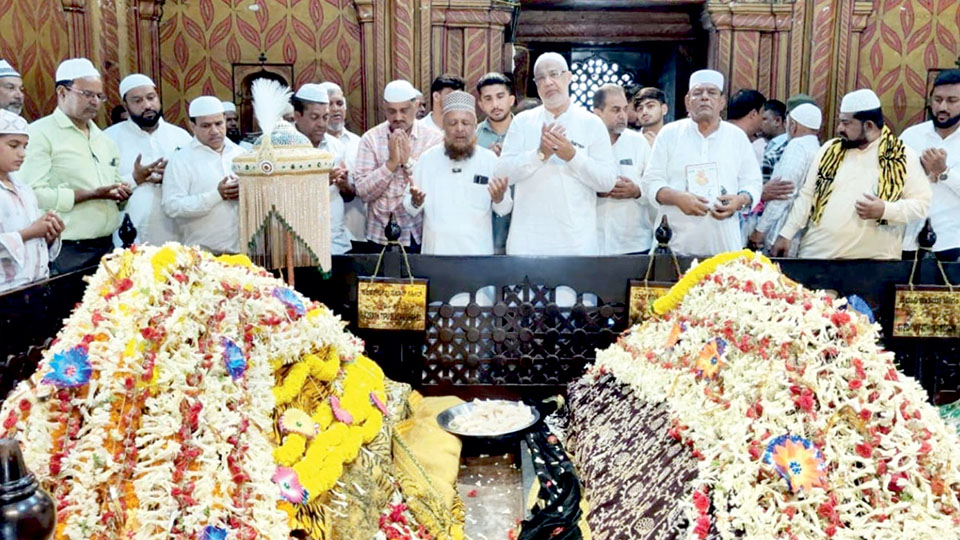
MLA Tanveer Sait, along with several others observed Tipu Sultan Martyr’s Day at a Fatha Khawni programme organised by Hazarath Tipu Sultan Shaheed Welfare and Urus Committee Secretary Afroz Pasha at Tipu Tomb (Gumbaz), Ganjam in Srirangapatna recently.
Hazarath Moulana Syed Inayathur Rehaman Razvi Saheb, Khateeb-o-Imam of Masjid Aqsa, Tipu Tomb, performed Fatha Khawni while Afroz Pasha and MLA Tanveer Sait spread the Flower Mat (Chadar) on the tombs of Tipu Sultan Shrine and his parents. Moulana Mohd. Inayath Ur Rehaman Razvi read Duwa supplications for the welfare of all.
Afroz Pasha distributed sweets (Tabruk) and felicitated the MLA by offering shawls.
Invitation, posters released
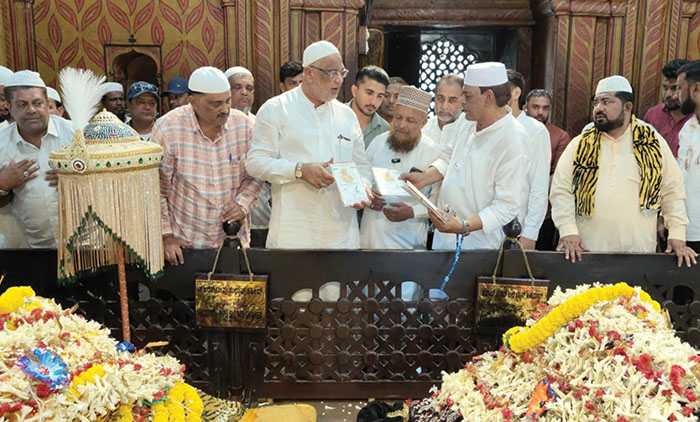
On the occasion, MLA Sait released the invitation and publicity posters of the 234th Annual Sandal Urus Shariff of Hazarath Tipu Sultan Shaheed.
The annual Sandal Urus Shariff will be celebrated on May 16 in city during which a public meeting will be held and a procession will be taken out.
Industrialist M.F. Jamsheed, Senior Congress leader Syed Iqbal, Waseem, Radiulla Khan, Member of the College Development Council of Government Girls’ Pre-University College Khwaja Mohammed Musheer Chishti, Syed Younus, Majeed Ahmed, Afroz Khan and a host of devotees were present.
source: http://www.starofmysore.com / Star of Mysore / Home>News / May 08th, 2026
The 234th Urs-e-Sharieff of Hazarath Tipu Sultan Shaheed, organised by Hazrath Tipu Sultan Shaheed Wakf Estate, Ganjam in Srirangapatna, will be held on May 16 and 17 at Gumbad-e-Shahi at Ganjam in Srirangapatna.
The Sandal procession will commence from Masjid-e-Ala in Srirangapatna at 3 pm on May 16 and will reach Gumbad-e-Shahi at 5 pm.
Special programmes will be held from 7 pm at Gumbad and will continue the whole night till next morning.
For details, contact Hazarath Tipu Sultan Shaheed Wakf Estate on Ph: 08236-252786 or Mob: 97390-58786, according to a press release.
source: http://www.starofmysore.com / Star of Mysore / Home>In Briefs / May 05th, 2026
The half-baked propaganda of communal forces against the Tiger of Mysore is trying to divide communities
THE Tiger of Mysore (Sher-e-Mysore) Tipu Sultan often finds space in sections of the media, especially in Karnataka. There have been occasions of State-sponsored celebrations of his birth anniversary and the Bharatiya Janata Party (BJP) regularly creates obstacles to these celebrations, resulting in unnecessary ruckus. This time around, Tipu Sultan is in the news from Malegaon in Maharashtra.
The newly elected deputy mayor of Malegaon Shan-e-Hind Nihal Ahmad, put up the portrait of Tipu Sultan in her office, upsetting the Shinde group’s Shiv Sainiks and the BJP. These forces got the portrait removed with the intervention of the authorities. Some protests were also held.
Maharashtra Pradesh Congress Committee President Harshvardhan Sapkal got incensed and defended Tipu Sultan, claiming that the contribution of Tipu Sultan to Mysore is equivalent to that of Chhatrapati Shivaji Maharaj in Maharashtra.
But, Chief Minister Devendra Fadnavis did not like the idea of comparing Tipu Sultan and Shivaji Maharaj, as it was an insult to the latter. Following this absurd comment, the Congress office was pelted with stones by BJP workers and nearly seven people were injured in the ensuing mayhem.
The objection of the BJP to the statement from the Congress leader is that Tipu was a “mass murderer of Hindus” and he tried to convert Hindus to Islam. There are many other charges put against Tipu by Hindutva elements. Most of these try to project Tipu as anti-Hindu and a cruel king. This is far from the truth.
Lots of these myths are part of the communal narrative, accentuated by the British narratives, which are harsher against Tipu in particular. This is because he was one of the few rulers who fought against the British. Tipu had asked Nizam and the Peshwas to oppose the armies of the East India Company. He foresaw the dangers of British power entrenching in India.
Tipu’s administration was a mixed one, with many top officers being Hindus. Purnaiah served him as the Mir Miran (head of a department) and was crucial to his administration. Krishna Rao was his treasurer. Shamaiya Iyengar held a high-ranking ministerial position and Narsimha Iyengar held a position in the postal department. Tipu Sultan reportedly provided grants to the Sringeri Shankaracharya, including for the rebuilding of the temple and the installation of the Hindu goddess Sharada. He granted land and endowments to various temples throughout his kingdom. During his reign, the 10-day Dussehra celebrations were an integral part of the social life of Mysore.
In 1791, Maratha forces led by Raghunath Rao Patwardhan attacked and plundered the historic Sringeri Sharada Peetham, causing the Shankaracharya to flee. Upon learning of this, Tipu Sultan expressed deep anger, stating that those who committed such acts would face consequences, and promptly sent funds, gifts, and letters to restore the temple and reconsecrate the idol. The raid was part of the Third Anglo-Mysore War, during which Maratha forces caused significant destruction to the temple complex, including killing or wounding people and looting property.
Tipu Sultan, who frequently interacted with the Sringeri Jagadguru and addressed him with high respect, immediately ordered the Mysore administration to assist in the restoration, demonstrating his patronage of certain Hindu institutions. Evidence of this restoration is found in several letters in Kannada, preserved in the Sringeri monastery records, where Tipu requested the Jagadguru to pray for the prosperity of his kingdom.
Tipu Sultan was a staunch opponent of the British. There is an accusation against him that he persecuted some Hindu and Christian communities. The reason for this persecution, however, was purely political, not religious. About these persecutions, historian Kate Brittlebank says that “This was not a religious policy but one of chastisement”. The communities targeted by him were seen as disloyal to the State.
The communities Tipu targeted did not belong only to the Hindu stream. He also acted against some Muslim communities, like the Mahdavis. The reason was that these communities were supporting the British and were employed as horsemen in the East India Company’s armies. Another historian, Susan Bayly, says that Tipu Sultan’s attack on Hindus and Christians outside his state is to be seen on political grounds, as at the same time he had developed close relations with these communities within Mysore.
Sarfaraz Shaikh, in his book Sultan-E-Khudad has reproduced the ‘Manifesto of Tipu Sultan’ in which he declares that he would not discriminate on religious grounds and would protect his empire until his last breath. He had a great interest in rocket technology. This finds appreciative mention in Dr APJ Abdul Kalam’s book, Wings of Fire.
It is interesting to note that in the Rashtriya Swayamsevak Sangh’s series for children on Indian history, they had published a book on Tipu in the 1970s. BJP’s Yeddyurappa had adorned Tipu’s headgear to solicit votes in the 2010 elections in Karnataka. Then President, Ramnath Kovind, sent a eulogising message on the occasion of Tipu Jayanti (2017). He has an RSS background. He praised Tipu by saying that “Tipu Sultan died a heroic death fighting the British. He was also a pioneer in the development and use of Mysore rockets in warfare.” Tipu – along with Rani Laxmi Bai – are also depicted as freedom fighters through drawings in Part XVI (page 144) of the original, hand-written and illustrated copy of the Indian Constitution.
Due to his policies, Tipu was popular among the people of Mysore. There are many folk songs, sung in villages, praising him. It is for this reason that one of our greatest playwrights, Girish Karnad, said that had Tipu been a Hindu, he would have the same status that Shivaji Maharaj has in Maharashtra. This is very close to what Sapkal stated, nothing extra.
This whole incident of opposing the portrait of Tipu in the Deputy Mayors’ office is one more instance of communal forces latching on to divisive politics. Kings should not be seen just by their religion; their policies towards people of different religions and people’s welfare should be the major criterion for evaluating them. Tipu stands very tall in this scale of religious tolerance. The half-baked propaganda of the communal forces is trying to divide communities.
A major tribute to Tipu was paid by Subhash Chandra Bose. He adopted Tipu’s ‘springing tiger’ as the insignia of Azad Hind Fauj, which fought against the British. The major contribution of Tipu was to forewarn the Indian rulers about the advancing threat of the East India Company, the British. It was for this that he bravely fought against the British and laid down his life in the fourth Anglo-Mysore War. The communal forces who are out to demonise Tipu belong to the ideology that did not even lift a little finger against the British rule.
source: http://www.clarionindia.net / Clarion India / Home> Opinion / by Prof Ram Punyani / February 18th, 2026
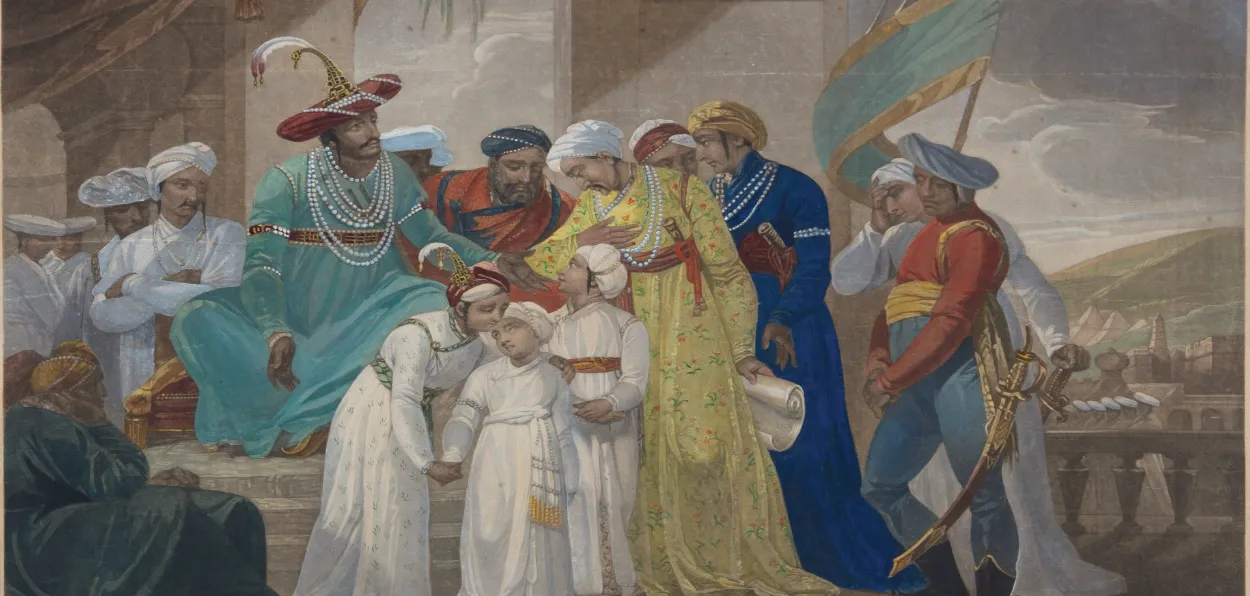
Tippoo Sultaun delivering to Gullum Alli Beg the Vakeel his sons who are taking leave of their brother previous to their departure from Seringapatam (1793) Painting by Henry Singleton
“The Christian drummers were seized, taken to the palace where Tippu’s sons were confined, and made to beat the “general” ; lights flashed in the palace, refreshments were brought out; a mob of sepoys called on the princes to place themselves at their head; Tippu’s own flag, green stripes on a red field, was nailed to the flagstaff. Prince Muizuddin (son of Tipu Sultan) ordered his horse to be saddled, and told off a party of sepoys to go and seize the principal hill fort; when that was captured and the dead body of Colonel Marriott, paymaster of stipends, brought before him, he promised he would mount his horse and ride through the native town proclaiming the restoration of the Mahommedan power.”
A Slice of History
This is the account by Colonel Alfred Keene of the night of 10 July 1806 at Vellore. The rising, popularly known as the Vellore mutiny, was a dress rehearsal of a sort of what would happen in May 1857 at Meerut.
Keene pointed out, “In the mutinies of Vellore and the greater one of 1857, two points of similarity stand out prominently. In each is the unreasoning fear of an attack on the institutions of religion and of caste; for the greased cartridges in the latter mutiny had as much to do with the outbreak as had the new head-dress in 1806, and the presence of the remnants of the Moghul Dynasty at Delhi acted in 1857 precisely as had the presence of Tippu’s family at Vellore in 1806.”
After the fall of Tipu Sultan in 1799, the English East India Company shifted his children to Vellore. In early 1806, the Commander-in-Chief ordered a new headgear and, the removal of beards, tilaks, earrings, or any mark of caste identity.
The Indian sepoys of the 2nd Battalion 4th regiment showed dissatisfaction in May 1806 and disobeyed the orders. These sepoys were tried in army court and 21 of them were found ‘guilty’. Of them, one Hindu leader and other Muslims were discharged from the duty and sentenced to receive 900 lashes each. The other 19 were not discharged but ordered 500 lashes each. The order was passed on 29 June and published to the army on 2 July 1806.
The wife of a serving English officer at Vellore, F. W. Blunt, wrote in a letter to her family in England, “Nine of the ringleaders, as they were called, were brought down to Madras and here passed publicly through the streets in irons, destined to receive the most dreadful military punishment…… The nine men in irons awaiting a most severe punishment was made use of by the sons of Tippoo, who have been kept prisoners in the Palace at Vellore since the taking of Seringapatam and served to ripen a design that had been long formed. A conspiracy was formed by the Sepoys to murder all the Europeans and take possession of that Fort.”
Tipu Sultan
On the night of 10 July 1806, Shaikh Kasim, a sepoy, led the English East India Company sepoys in starting a general massacre of the English troops.
Lt. Col. W. J. Wilson in ‘History of the Madras Army’ wrote, “The sepoys went away shortly afterward, and were heard to call out “Come out, Nawab, come out, Nawab, there is no fear.” This was supposed to be addressed to Futteh Hyder, the eldest of the four Mysore Princes.”
Of the 372 Englishmen present at Vellore, 128 were killed that night by the Indian sepoys. The English flag was replaced with the flag of Tipu Sultan, which was handed over by Moizuddin, the eldest son of Tipu. He was proclaimed the leader of the revolutionaries.
Though the immediate cause was the headgear and other orders, the revolt had been planned for a long time. Charles Macfarlane wrote, “The splendour which the sons of Tippoo were enabled, by the liberality of the Company, to keep up, attracted a continual influx of visitors, including all that came to Vellore from the countries which had once belonged to their father. Among these men were very many who had lost by the change which had taken place in Mysore, who hated the tranquillity which we had introduced into their country, and who longed for the old days of rapine and violence. It is believed that these desperadoes contributed to a regular conspiracy and facilitated the execution of the daring design.
It is said that the confederates intended that all who were brought to join in the insurrection should act upon a preconcerted plan, which had been digested and privately circulated by some of the turbulent Marawa chiefs; and that in connection with these desperadoes were some few Frenchmen, disguised as fakeers or dervishes, who went about the country inveighing everywhere against the English as robbers and tyrants. It is also stated that placards were fixed up within the mosques and Hindu temples, where Europeans never entered, to excite a general spirit of revolt among the whole native population of Madras.”
The English Government set up an enquiry commission headed by Major General Pater which submitted its report on 9 August 1806. The report said, “There are two principal causes which appear to us to have led to the mutiny. The late innovations in the dress and appearance of the sepoys, and the residence of the family of the late Tippoo Sultan at Vellore.”
Sir J. F. Cradock, the Commander-in-Chief, disagreed with these findings and argued in his submission that change in dress was a pretext and the real objective was to restore the rule of Tipu Sultan’s family.
The Court of Directors after the investigation declared that the “immediate cause of the discontent among the sepoys was the introduction of certain innovations in their dress, which were offensive, and, as they held, degrading to them; and that the captive sons of the late Tippoo Sultan, with their adherents and abettors, took occasion, from the dissatisfaction of the sepoys, to instigate them to insurrection and revolt, with the view of effecting their liberation, and the restoration of the Mahomedan power.”
The mutiny was suppressed by noon on 10 July. Colonel Gillispie stationed at Arcot came to rescue the Englishmen at Vellore before 7 am. His forces, which also included Indian sepoys, killed more than 500 Indians in the fort within a few hours.
At least 15 English officers including, Colonel Fancourt, H.M.’s 34th regiment, commanding the garrison, Lieutenant-Colonel McKerras, Captain Willison and Lieutenants Winchip and Jolly of the 23rd, Captain Miller, Lieutenants O’Reilly, Smart, and Tichbourne of the 1st, and Lieutenants Eley and Popham of the 69th, Mr. Mann Deputy Commissary of Stores, Mr. Gill Conductor of Ordnance, Mr. Smith the Military Paymaster and Major Armstrong of the 16th N.I. were killed.
Among the captured sepoys, six were blown away with cannon guns, five were shot by firing squads, eight were hanged, and several others were transported for life. Out of the retainers of Mysore Princes, one was sentenced to death, two to transportation for life, one to imprisonment for life, and one to imprisonment for ten years. The sons of Tipu Sultan were sent to Kolkata with stricter vigilance.
Lord William Bentinck, Governor, and Sir J. F. Cradock, C-in-C, were removed from their respective offices by the Court of Directors.
source: http://www.awazthevoice.in / Awaz, The Voice / Home> Stories / by Saquib Salim / July 10th, 2025
On November 10, the 274th (or 273rd) birthday of Tipu Sultan was celebrated peacefully in his erstwhile capital, Srirangapatna, amid heavy security.
The date of his birth is disputed – there is little agreement on whether it is November 10, November 20, or December 1, or whether that event happened in 1750 or 1751. (File photo)
This past Sunday, November 10, the 274th (or 273rd) birthday of Tipu Sultan was celebrated peacefully in his erstwhile capital, Srirangapatna, amid heavy security. The security was necessary because Tipu has become, in recent years, a polarizing and politicised figure, with successive state governments casting him alternately as monster and Messiah. Even the date of his birth is disputed – there is little agreement on whether it is November 10, November 20, or December 1, or whether that event happened in 1750 or 1751.
Be that as it may, one well-documented fact about Tipu is that he commissioned, around 1795, the famous Tipu’s Tiger, a mechanical automaton built by local craftsmen using local materials, possibly with inputs from French engineers. It featured a painted wooden tiger mauling a man who, judging from his costume, was decidedly European. The hollow toy housed various mechanisms that were worked by the turning of a crank handle. Each time it was turned, one of the man’s arms moved up, seemingly in a (futile) bid for self-defence, while the bellows inside pushed air out of the man’s throat and several openings in the tiger’s head, producing what sounded like a wail of distress from the man alongside a growl from the tiger. Symbolic of the self-styled Tiger of Mysore, the tiger was as large as life; the hapless European just a little smaller.
Tipu’s Tiger may well have been a product of Tipu’s fancy, meant to inspire him after his defeat in the Third Anglo-Mysore War in 1792, following which he not only lost half his kingdom but was obliged to give up two of his sons as hostages to Lord Cornwallis. But there is a popular theory that the visual of the tiger attacking the soldier was based on a real incident that happened later the same year.
On 21 December 1792, so the story goes, the goodly ship Shaw Ardaseer, bound for Madras, stopped to take on cargo at Sagar Island, situated at the mouth of the Hooghly in Calcutta, at the point where the Ganga meets the Bay of Bengal. On the ship was 17-year-old Hector Sutherland Munro, a ‘cadet for Madras’ who had only arrived in India on the 8th of November. Along with his fellow cadets, young Hector went ashore to try his luck at hunting deer, but was unsuccessful. The party had just sat down at the edge of the jungle to eat a meal when they heard, in the words of eyewitness Capt Henry Conran, ‘a roar like thunder,’ and saw ‘an immense royal tiger spring on the unfortunate Munro.’ In a moment, continues Conran, Munro’s head ‘was in the beast’s mouth,’ and it had raced into the jungle, carrying Munro with it. Conran and the others shot at the tiger and killed it, but Munro could not be saved.
Conran’s sensational prose, and the fact that young Munro was the son of the celebrated General Sir Hector Munro, the hero of the Battle of Buxar (1764) and the capture of Pondicherry (1778), and one of the main players in the Second Anglo-Mysore War (1780) against Tipu‘s father Hyder Ali, ensured that the story went viral in England, perhaps even inspiring William Blake’s famous 1793 poem ‘The Tyger.’ Given that his sons were being held in Calcutta at the time, the story almost certainly also reached Tipu. In the aftermath of the Fourth Anglo-Mysore War, in which Tipu was killed, Tipu’s Tiger, which had little intrinsic but much emblematic value, was carried back to England in triumph, and installed, in July 1808, in East India House on Leadenhall Street.
Today, Tipu’s Tiger sits behind glass at the Victoria & Albert Museum (V&A) in London, where it has long been, according to the museum’s website, ‘one of the V&A’s most popular exhibits.’
(Roopa Pai is a writer who has carried on a longtime love affair with her hometown Bengaluru)
source: http://www.hindustantimes.com / Hindustan Times / Home / by Roopa Pai / November 12th, 2024
Tipu Sultan was born on November 20, 1750 and died on May 4, 1799 fighting with the Colonial forces
New Delhi:
Twitter users on Wednesday paid rich tributes to Tipu Sultan on his birth anniversary, with many posting the quotes of the King of the erstwhile Kingdom of Mysore as also pictures of his prized possessions with hashtags #Tipusultan, #SherEHindTipuSultan, #TipuJayanti and #TigerOfMysore.
As many as 3,143 tweets were posted by Twitterati on Tipu Sultan.
Vanchit Bahujan Aghadi leader Prakash Ambedkar wrote: “Tipu Sultan, the king of Mysore, will always be known for his valour and his continuous resistance against the British rule”.
“A tribute to the first freedom fighter of India on his birth anniversary”, the grandson of Dr BR Ambedkar wrote.
Another Twitter user wrote: “Tipu Sultan was the only Indian ruler who understood the dangers the British posed to India, and fought four wars to oust them from India – in that sense he could be called the first freedom fighter in the subcontinent”.
One user posted a quote attributed to Tipu Sultan: “One day’s life of a lion is preferable to hundred years of a jackal”.
Many Twitter users also hailed his liking for advanced technology.
“Tipu Sultan was fascinated by science & technology, got gun-makers, engineers, clockmakers & other experts from France to Mysore, then set up a manufacturing of bronze cannons, ammunition & muskets to ‘Make in Mysore’. Basically the first who worked for MakeinIndia”, (sic) wrote one user.
Make in India is a type of Swadeshi movement covering 25 sectors of the Indian economy. It was launched by the Government of India on 25 September 2014 to encourage companies to manufacture their products in India and enthuse with dedicated investments into manufacturing.
Tipu Sultan was born on November 20, 1750 and died on May 4, 1799 fighting with the Colonial forces.
source: http://www.ummid.com / Ummid.com / Home> India / by Ummid.com with inputs from IANS / November 20th, 2019
Karnataka’s BJP govt has cancelled Tipu Jayanti, celebrating a ruler once hailed for his bravery and genius, but seen by the right wing as a bigot. We must reexamine Tipu Sultan.
The BJP government in Karnataka has done away with Tipu Sultan celebrations. But, as it is vital to remember Tipu Sultan, in this first-part series, I lead you into the life of Tipu Sultan, the ruler of Mysore.
The recent efforts of the Hindu right to project him as a Muslim bigot show that their political stakes in him have changed.
Any opinion on the rule of Tipu Sultan in Mysore will in fact be incomplete without mention of the political situation prevailing in and around Mysore towards the end of the 18th century. Mysore, which had emerged from the ruins of the Vijayanagar empire, was moulded into a small but dynamic Hindu state primarily during the rule of Chikka Devaraja Wodeyar in the early decades of the 18th century.
The Wodiyar kings, who had been ruling Mysore for over 300 years, were only nominal rulers by then — the actual power was wielded by their prime ministers or ‘dalavai’.
Tipu’s father, Haider Ali, began his career in Mysore around 1749, as a soldier under one of these powerful ministers.
He used his tact and bravery to stave off Maratha raids into Mysore, fought against the British and expanded Mysore’s territory down south to the coast of wealthy Calicut. He thus eased himself into the title of the ‘sarvadhikari’ or ‘regent of the kingdom’ in 1760.
After Haider’s death in 1782, Tipu took over his father’s position, keeping the Wodeyar king as a proxy but publicly continuing to put on a show of respect. Tipu’s appropriation of this position would not have been possible without the assistance of some of Haider’s closest friends and advisors as well as the acquiescence of the local populace, who had by then come to see a stronger and more prosperous Mysore under Haider and the young Tipu.
From Madras, the British were cautiously observing the rise of Mysore — and resented Haider’s and Tipu’s push into Malabar.
Tipu Sultan took over Mysore in 1782: He remains its most iconic ruler. (Still from The Sword of Tipu Sultan: Via Author)
A 17-year-old Tipu had given the British a fright by galloping with his army into the East India Company’s garden house near the beach in Madras.
He rattled them so much that the governor there fled offshore in a small boat. A series of four Anglo-Mysore Wars started in 1767. These propelled the hitherto unknown Kingdom of Mysore into the powder rooms of Europe and America.
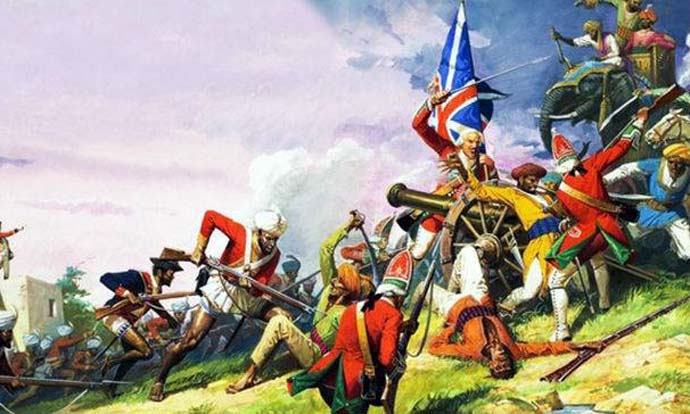
The first war saw Mysore dictating terms to England at the gates of Madras; the second war was Tipu’s brightest moment. At the battle of Pollilur (1780), the sun-and-tiger-stripes banner of Tipu’s Mysore oversaw the worst disaster that ever befell an English army in India — out of 3,000 men in the British army, only about 400 survived.
With these two victories, the mood in England began to change — and a vicious propaganda and diplomatic campaign against Mysore began.
By 1785, one in seven Englishmen in India was imprisoned by Tipu. By this time, the British had won in Plassey and Buxar; the whole of India except the Punjab and the Marathas had capitulated to them. Tipu’s Mysore stood as a bulwark against the British. What rankled the British even more was that here was a native ruler — or ‘despot’, as they branded all of them — who was different from the others.
He did not while away his time in pleasure orgies, nor leave the management of state to some palace coterie; and not once did he ask the British for help against his neighbours. He created an army which, in the words of his nemesis, Arthur Wellesley (later Duke of Wellington), was “the best fighting force in the whole of India”.
He took advantage of the enmities being played out in Europe, recruited the French as willing allies and drilled his army in modern European manoeuvres.
Giving It Back: Unlike several other princely states, Tipu Sultan took the British head-on in ferocious battles. (Picture: India Today)
Mysore was the first state to demonstrate the efficacy of rockets in war by modifying what was until then a mere firecracker into something that could carry a sword or wooden blade with it. Tipu even sent back French weapons with a letter stating they were substandard compared to the ones in his arsenal.
Working almost 18 hours a day, he kept meticulous records of revenue and personnel across his kingdom. He created a set of revenue regulations that rationalised land taxes — and even offered subsidies to farmers if they farmed more land. Landowners and temple trusts with excess landholding were asked to hand it over to landless or tenant farmers. He created a navy that sent ships with his diplomats to meet the Ottoman sultan in Constantinople and the French emperor in Paris. He built a powerful navy, consisting of 20 battleships of 72 cannons and 20 frigates of 62 cannons.
A separate board of admiralty was established in September 1786 and massive dockyards at Jamalabad, Wajidabad and Majidabad were constructed on the west coast to build 40 warships and a number of transport ships to strengthen the naval power. The 200-odd forts under Tipu’s reign were mostly named on Hindu script ions.
An elite group of Brahmin civil servants was nurtured during his early rule to make sure that revenue was properly collected. His forts were among the strongest in south India and his currency so beautifully minted that the Mughal emperor apparently felt slighted at receiving coins more beautiful than his own — he even minted coins with Hindu deities on them.
Deep in the midst of war, he wrote of receiving silkworms to create the silk factories of Mysore.
Sugar and paper factories were established for the first time under him. Sword blades and gunpowder were manufactured locally. He was also liberal with gifts to Hindu religious establishments in Mysore and Malabar after subduing it.
A Visionary Leader: Tipu Sultan was an extraordinary mix of courage, skill and heart. (Still from The Sword of Tipu Sultan: Via Author)
The third Anglo-Mysore war in 1792, with Cornwallis at the helm of the British army, did not go well for Tipu.
He was hard-pressed by the British-Maratha-Nizam allied powers to surrender half his kingdom, submit to a war indemnity of ₹3.3 crore — and deliver two of his sons as hostages to the British. Thanks to his financial prudence, he managed to pay the British their ransom and have his sons released a year earlier than the stipulated three years.
This period between 1792 and the fourth Mysore war in 1799 was one of great tribulation for Mysore — rebellions raged and finances were tight on account of the indemnity paid. However, it is to Tipu’s credit that not once during his rule, in the midst of almost incessant war, did his subjects suffer from famine or pestilence.
At the same time in British Bengal, millions of Indians perished in a famine…
(To be continued).
source: http://www.dailyo.in / DailyO / Home> Open To Opinion> Politics / by Sanjay Khan / August 03rd, 2019
Over 1000 war rockets of Tipu era have just been found in a fort in Karanataka. Tipu Sultan was the first warrior in history to have used rockets in his warfare against the British.
Recall Tipu Jayanthi celebrated by the Karnataka Government under Siddaramaiah and the violent opposition it evoked from the BJP and Hindutva forces who overlooked Tipu Sultan’s fierce fight against British rule and only focused on his Islamic identity. An Union Minister publicly refused to participate in the Tipu Jayanti celebrations.
The fanatical opposition to Tipu Sultan by BJP and its top leadership has been so intense that it did not even accept the speech of President of India Ramnath Kovind who while addressing the Karnataka Assembly appreciated Tipu Sultan, among others, and flagged his pioneering role in employing the first ever rocket in the history of warfare against the British.
In their blind opposition to Tipu Sultan just because he was a Muslim, the BJP leaders of Karnataka did not hesitate even to diminish the dignity of the President of India by refusing to acknowledge his speech and dismissing it as as a draft prepared by the then Karnataka Government. Even Prime Minister Narendra Modi while campaigning for BJP candidates in the Karnataka elections sarcastically said that the Congress Government was celebrating the Jayanti of “Sultans”.
Let us be mindful of the fact that a sketch of Tipu Sultan finds a prominent and place in the calligraphed copy of the Constitution where the sketch of Lord Ram, Akbar and other outstanding figures of Indian mythology and history occupy a hallowed place.
It is not that President Kovind is the first President of our Republic who invoked Tipu Sultan’s glorious legacy. Earlier President K. R. Narayanan in his speech delivered at the banquet hosted by the President of the French Republic, Jacques Chirac, on April 17, 2000 in Paris referred to the correspondence exchanged between Tipu Sultan and Napoleon Bonaparte for the purpose of forming a grand alliance to defeat the British and throw them out of India.
In an appendix of the publication, The Sword of Tipu Sultan, authored by Bhagwan Gidwani, there is a text of letter written by Napoleon to Tipu Sultan bringing out the strategic affinity and understanding between India and France in the late 18th century.
Napoleon wrote in the letter to Tipu Sultan : “You have already been informed of my arrival on the borders of the Red Sea, with an innumerable and invincible Army, full of the desire of delivering you from the iron yoke of England.”
Before the letter could reach Tipu Sultan, the British intelligence succeeded in intercepting it. Then President Narayanan in his aforementioned banquet speech rsaid: “…Napoleon’s demarche perhaps underlined the strategic affinity that links India and France and the responsibility we hold in creating a more equal and democratic inter-national order in the multipolar world.”
It is all the more significant to note that the concept of ” creating a more equal and democratic inter-national order in the multipolar world ” was taken up by Narayanan by invoking Tipu Sultan along with Napoleon who is a national hero for the French. I recall that the leadership of France deeply appreciated this speech and thanked the then Indian President for contextualizing the strategic dialogue started between the two countries in the 21st Century by referring to the strategic understanding forged in the 17th Century.
Abdul Kalam in his writings published before he became President of India had outlined Tipu Sultans stellar contributions as the first warrior in history of warfare for having used rockets against the British who were completely on the defensive. The account given by President Kalam of the rockets used by Tipu Sultan in his war against Britishers makes a fascinating read and the younger generation should be educated about it. He also refers to the Royal Artillery Museum, London that has exhibited the rockets used by Tipu Sultan with the claim the he became the first warrior to do so.
It is rather fascinating to note that the French Revolution and its ideals deeply impacted Tipu Sultan and he celebrated the Revolution with great fervour. Possibly he was the first monarch in India who remained wedded to the enduring ideals of the Revolution- liberty, equality and fraternity- and planted a tree in Srirangapatnam to commemorate it. He enlisted himself as a member of the Jacobin Club which constituted one of the prominent political formations of the Revolution proclaiming egalitarianism and affirming a social order informed by liberty, equality and fraternity.
His strategic vision encompassed in its scope a modern navy which he founded in 1796 and set up two dockyards where ships could be used and equipped with necessary facilities for conducting warfare. It greatly supplemented his military capability based on his land based armoury and armed forces.
His critical understanding that a strong economy could sustain a strong military paved the way for him to take manifold measures to augment and expand trade and commerce and set up a chain of industries. His farsightedness in understanding the danger posed by the advancing British forces in the 18th century stood him out as an unparalleled leader with a firm grasp over military and strategic affairs. British historians have recorded his accomplishments with admiration. And recorded the fact that the conditions of the peasants of Mysore were far better than their status in the British provinces of that era.
Historians have recorded that Tipu Sultan liberally gave grants to numerous Hindu shrines and respected the faith of others. Such a legacy rooted in respecting all religions makes Tipu Sultan relevant for our contemporary period which is witnessing majoritarian tendencies.
He relentlessly fought against British occupation and aggression and eventually attained martyrdom. His heroism and bravery to fight against colonial subjugation constitutes an important portion of Indian history. It is important to celebrate that legacy and enrich it.
Jawaharlal Nehru in his Discovery Of India wrote “Haider Ali and Tipu Sultan .. inflicted a severe defeat on the British and came near to breaking the power of the East India Company.” Such a glorious phase of Tipu Sultan who almost broke the power of the East India Company and who remained wedded to ideals of French revolution inspires India of twenty first century. We need to immortalize it by affirming its enduring value which is far above party politics and ideological rivalry.
As the twenty first century India faces threat from Hindutva forces engaged in lynching people and polarizing them in the name of cow protection, love jihad and religion we need to reinvigorate the legacy based on liberty, equality and fraternity which remained at the heart of the French Revolution, guided Tipu Sultan and inspired our freedom fighters and the framers of our Constitution to shape the destiny of India based on progressive values.
(S.N.Sahu served as Officer on Special Duty to late President of India K.R.Narayanan and also as Director in Prime Minister’s Office under Manmohan Singh).
source: http://www.thecitizen.in / The Citizen / Home / by S.N. Sahu / July 30th, 2018