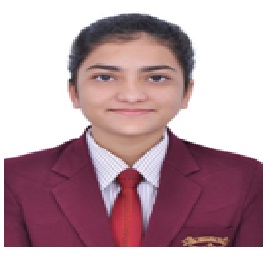
Where there is will there is a way, Sara Ansari proved the cliché with her exceptional qualities and abilities. Indian born Sara, who is a resident of Dubai now, has not only makes her parents proud over her success, India and Dubai too delighted over her achievements.
Born in Malegaon a small town in Maharashtra and brought up in Dubai Sara has secured 98% marks in CBSE 10th Examination which was held in March 2018 and result of which was declared on May 29th. Interestingly she got 100% in Mathematics as well as in Science.
She aims to pursue her career in Astro Physics which deals with space research. She believes that by pursuing this career she can participate in promotion of science education and eliminate the poverty and hunger from the world.
Sara is not only excellent academically but also proved her talent in many extracurricular activities.
She has been awarded by the prestigious Diana Award in recognition of her outstanding contribution to society. The Diana Award is bestowed upon inspiring courageous, Compassionate young people, positively transforming the lives of others in Diana, “Princess of Wales” memory and legacy.
She is a confident speaker and an outstanding Debater too.This Year at the occasion of Independence Day, she has been awarded by “The Best Speaker “ Award by the Consulate General of India in Dubai in recognition of her performance in Inter School Debate Competition.
She is a prefect of Model United Nation Club in her school. She has visited United Nation New York, U.S.A. in July 2014 as a part of her Global Young leader conference. and attended several MUN Conferences in Dubai and Globally and achieved the Best Delegate Awards. Model United Nation also known as MUN is an extra-curricular activity in which students typically role-play delegates to the United Nations and simulate UN Committees. This activity takes place at MUN Conferences which is usually organized by High school or Collage MUN Club. Her paintings too won her many awards and accolades.
“We are so proud of her that there is no word to explain” says her father Iqbal Ansari, adding that her achievements have been a direct result of self-discipline and dedication to performing the required research and practice necessary for success in such endeavors.
The student of The Millennium School, Dubai has also won the prestigious Sharjah Award for Educational Excellence for the academic year 2015-2016. This award is instituted by Ruler of Sharjah H.H. Dr. Shaikh Sultan Bin Mohammad Al Qasimi for recognizing outstanding achievers in academics and co-curricular activities, with special emphasis on social responsibilities.
The award was presented to her by Crown Prince and Deputy Ruler of Sharjah, HH Sheikh Sultan bin Mohammed bin Sultan Al Qasimi in a glittering ceremony held at University City hall, Sharjah on Thursday, 21st April 2016.
“It is a glorious moment for our country, family & school that Sara Ansari was awarded the prestigious Sharjah Award for educational excellence for the ‘Most Distinguished Student’, for the academic year 2015-2016”, says her father.
Sara was also the winner of prestigious Sheikh Hamdan Award for Distinguished Performance 2015, the award recognises the students from Gulf Countries who excel not only in Academics but social, religious, cultural, sports activities. The award was presented to her during 2015 by Deputy Ruler of Dubai HH Shaikh Hamdan Bin Rashid Al Maktoum.
Sara and her partner design a Drone under theme “Drone to Rescue” which would help mountaineers for rescue, the project won first award for deigns during Makers Day 2016 which was organised by GMS. The project was chosen top 10 finalist out of 700 projects presented by different UAE schools at GEMS Wellington School Dubai. The project was selected by Arab Innovation Centre for Educational Excellence for AICE accelerator Programme, as a part of this programme they got funding and mentoring from industry experts to expand the project scope and evaluate the commercial and technical feasibility.
Social Activities: Sara’s passion is Art & craft, she knows several Art & Craft techniques like Decoupage, paper quelling, embroidery, par cord. She has taught the skills to less fortunate people in Sri Lanka, India, UAE. She was recognised for her efforts and appreciated by community members and international NGO’s. Kindly visit her website www.facebook.com/sarastalent to know more about her activities.
Sara’s talent is drawing & painting, she has won many certificates and award from different bodies and international organisations. She has a special skill of Pyrography, the art or technique of decorating wood or leather by burning a design on the surface with a heated metallic point.
She is also very good swimmer and also interest in ice skating, roller skating and participated in marathons.
source: http://www.theindianawaaz.com / The Indian Awaaz / by The Correspondent , The Indian Awaaz / June 04th, 2018
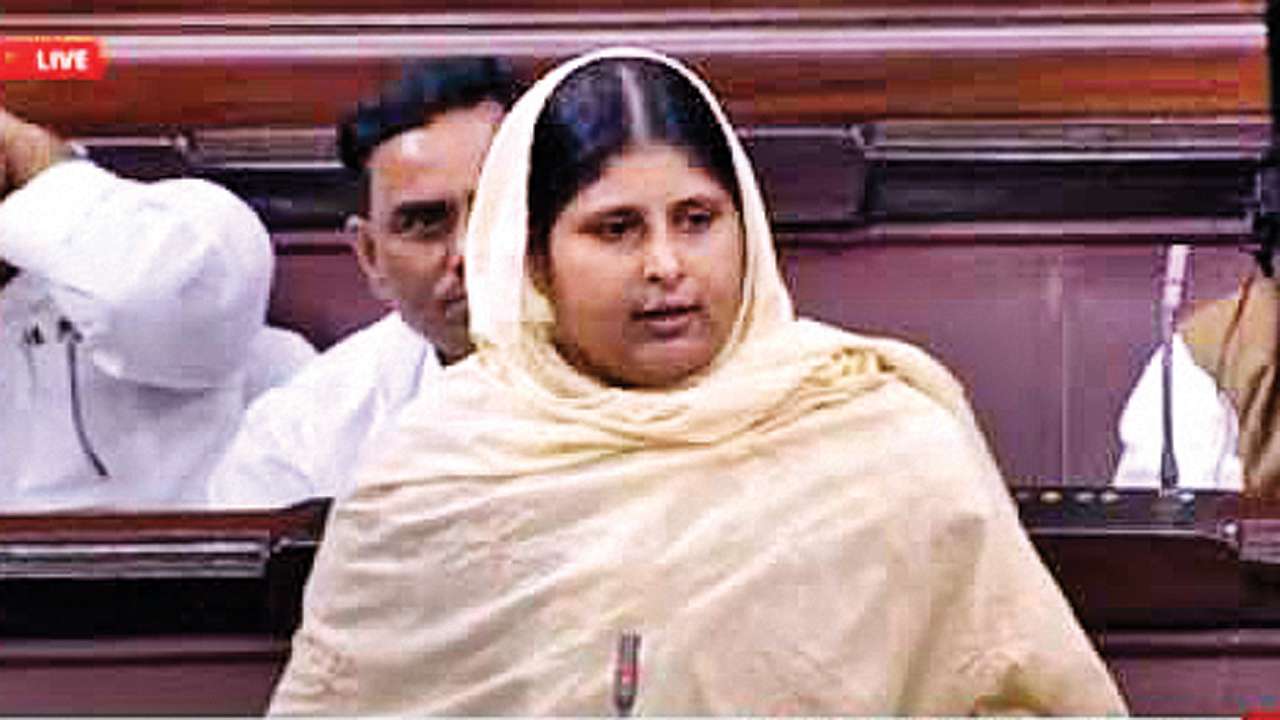
Kahkashan Parveen File photo of JD(U) member Kahkashan Parveen
In the Rajya Sabha the proceedings were disrupted as members of several parties stormed the well over various issues including India’s biggest bank scam and special package for Andhra Pradesh, as soon as the listed papers were laid.
Chairman M Venkaiah Naidu did not wait and adjourned the proceedings till 2:30 p.m. observing, “One week has gone waste. This is no good. This is sad.”
Before adjourning the house, Naidu announced the nomination of JD(U) memberKahkashan Parveen on the panel of presiding officers to conduct the proceedings of the House, making her the first woman to be included in the panel in the recent times.
The move came a day after the Women’s Day when several members demanded inclusion of a woman member in the panel, which was agreed to by the Chairman.
Parveen would replace Basawaraj Patil, whose term expires on April 2, Naidu said, adding that she has been a mayor and the chairperson of the Bihar Mahila Aayog.
When senior Congress member Viplove Thakur who had demanded the inclusion of a woman in the presiding officer’s panel, rose to thank him, Naidu, in a lighter vein, said he wanted to nominate Thakur, but she would have lost her voice in the panel.
“Viplove, in our language, means revolution,” he said.
When the Upper House reassembled to take up the Private Members’ Business, Pramod Tewari of Congress tried to raise a point of order on the issue of the banking scam.
However, Deputy Chairman P J Kurien disallowed him and instead asked him to persuade his protesting party colleagues to return to their seats from the well.
source: http://www.dnaindia.com / DNA / by DNA Correspondent / March 10th, 2018
Naira Village (Pulwama District), JAMMU & KASHMIR :
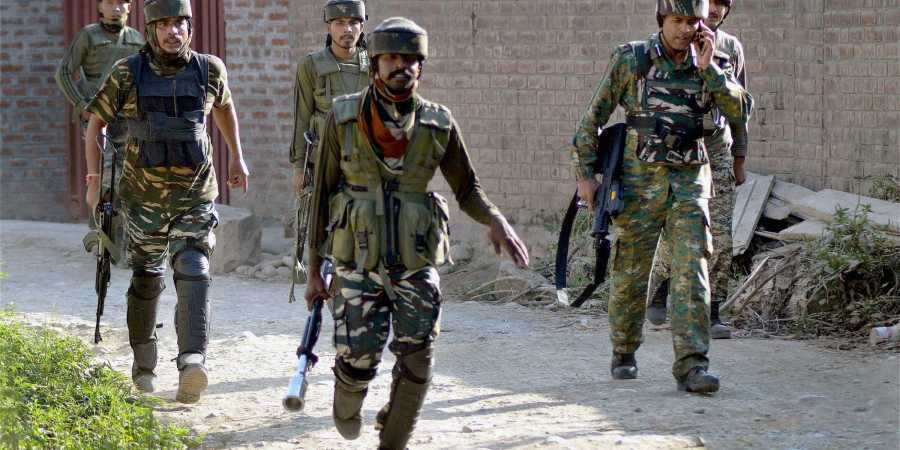
Militants late last evening barged into the house of a CRPF jawan Naseer Ahmad Rather at village Naira in south Kashmir’s Pulwama district and fired on him from close range.
For representational purpose (File | PTI)
Srinagar :
At least four security including two policemen, an army man and a paramilitary CRPF jawan, who were on leave, were killed by militants in the strife-torn Valley in over a month while another abducted policeman was spared after his family “apologised on his behalf” and appealed for his release.
Militants late last evening barged into the house of a CRPF jawan Naseer Ahmad Rather at village Naira in south Kashmir’s Pulwama district and fired on him from close range.
Naseer, who was posted in CRPF 183 bn at Police Control Room (PCR) Srinagar and was on leave at his home, sustained multiple bullet injuries in the militant firing. He died while being shifted to hospital. The slain cop is survived by parents, wife and three kids.
His wife is pregnant. Naseer was the 4th security men to be shot dead by militants while on leave at his residence. On July 21, militants had abducted and killed policeman Mohammad Mohammad Salim Shah in south Kashmir’s Kulgam district. Saleem had been promoted as constable from SPO and was undergoing training in Kathua.
He had come to home on leave some days before he was abducted and killed by militants. Earlier on July 5, militants had abducted police le Javed Ahmad Dar from his house at Vehil in Shopian district. His bullet ridden body was recovered by police few kilometres away from his house. Dar, who was a Personal Security Officer (PSO) of former SSP Shopian Shailendra Mishra, was also on leave at his home.
Earlier, on June 14, an army man Aurangzeb, who had availed leave and was on way to his home in Poonch to spend Eid with family, was abducted by militants in Shopian and later his bullet ridden body was recovered from neighbouring Pulwama district.
On July 28 evening, militants abducted another policeman Mudasir Ahmad Lone R/o Chankitar, Tral of Pulwama district from his home. Mudasir was the lone son of his family, which comprised his parents and three sisters. Immediately after his abduction, his mother in a video message “apologised” to militants on their son’s behalf and appealed them to set him free. She has said that her son would resign from police if released.
After the pleas of his family, the policeman was spared by militants and set free. The abduction and killing of security men is turning out to be a major cause of concern for the security agencies.
“By killing policeman at their homes, the militants want to terrorise and demoralise the entire police force. We are trying to deal with this new threat of militants by reviewing the security measures and Standard Operational Procedures (SOPs),” a senior police officer said.
Sources said police officials have directed the policemen hailing from volatile and militancy infested areas of south Kashmir to remain vigilant while being at their homes.
A security official said army and paramilitary jawans have been told to inform local units in case they go on leave to their homes in Valley, especially in south Kashmir.
source: http://www.newindianexpress.com / The New Indian Express / Home> Nation / by Fayaz Wani, Express News Service / July 30th, 2018
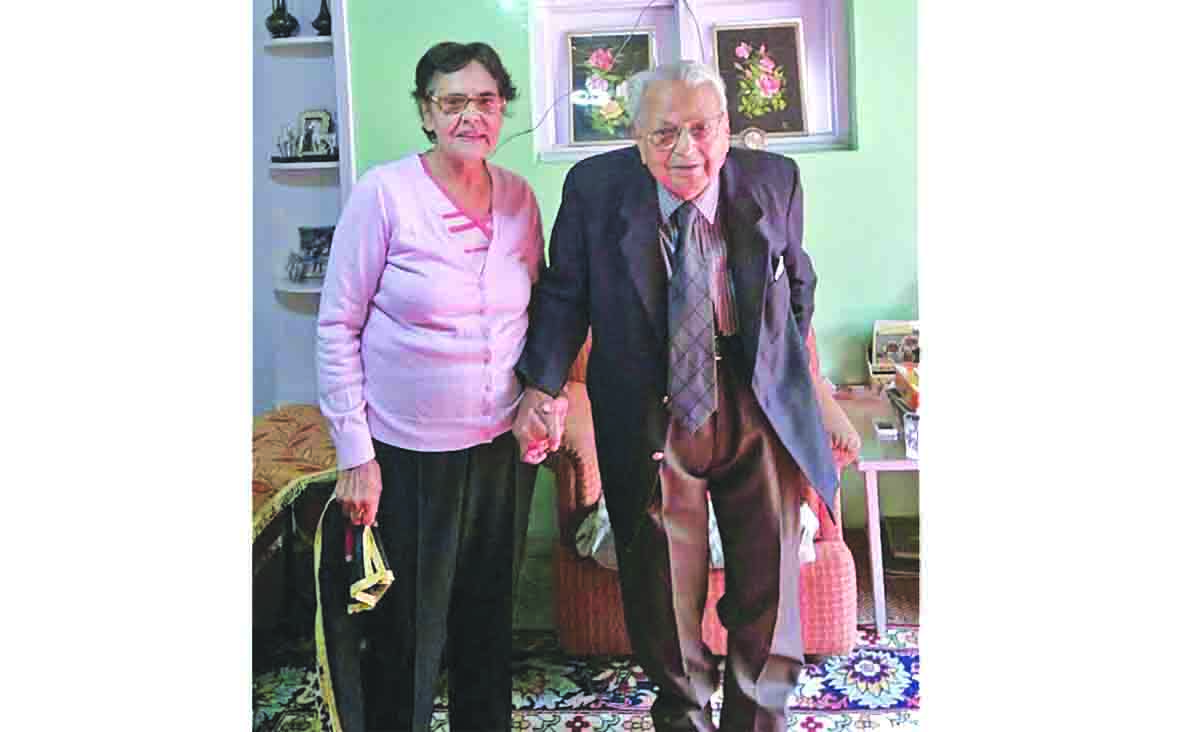
With the demise of Dr Naseer Ahmad Shah (January 5, 1929 – October 11, 2017), an era is over. A key decision maker in the health and medical education, he has many things to credit.Saima Bhatmeets some of his students, contemporaries, his widow Dr Girija Dhar, who died on July 13, and daughter to explain the phenomenon called Dr Naseer
Dr Naseer Ahmad Shah and Dr Girija Dhar
In the first week of October 2017, Noor Jahan, a lady in mid-60s was seen wandering in the corridors of Valley’s only women hospital, Lala Ded. Her only concern was to know about the well-being of her doctor, Dr Naseer. She was perturbed after hearing that “Dr Naseer is unwell.”
Not knowing Dr Naseer’s address, she knocked at the doors of all the senior doctors whom she thought could help her get exact information. She had a belief that only Dr Naseer knew “the treatment of her ailment.”
A week later, on October 11, 2017, the lady lost hope when the news broke about Dr Naseer’s demise. With the death of Dr Syed Naseer Ahmad Shah, at his at Kral Sangri, Nishat residence, an era ended.
As the relatives were preparing for his funerals, not able to comprehend the loss, Kashmir’s renowned gynaecologist, Dr Girija Dhar had a major heart attack. Dhar was Shah’s wife. As an ambulance drove her to the hospital, the coffin moved to the cemetery.
Dr Naseer was an icon, his students say. They termed his era in Government Medical College (GMC) as ‘golden era’ of medical education. Nobody before or after him, they insist, could match what he gave to GMC.
Born on January 5, 1929, in an official quarter in Booniyar (Baramulla), where his father, Ahmad Ali Shah was posted as Forest Range Officer, Dr Naseer’s family has roots in Teetwal village of Karnah. Then, it was part of the Muzaffarabad district in the erstwhile state of Jammu and Kashmir.
The family was well-educated and most of his siblings were serving in good positions, remembers Dr Muneer Masoodi. Syed Nazir Ahmad Shah retired as district and session judge, Syeed Ahmad Shah retired as DIG police, Zameer Ahmad Shah retired as Major in the army, Mehmooda Ali Shah retired as principal of Women’s college M A Road Srinagar. Rehana Jalaluddin Qureshi, remembers Dr Masoodi, also belonged to them.
Dr Masoodi joined GMC Srinagar the month Dr Naseer opted for his voluntary retirement.
The family, according to Dr Javid Khan, a student of Dr Naseer and also a Teetwal resident, has significantly contributed to raising the graph of education in the Valley. “We have a renowned shrine near our house that actually belongs to Dr Naseer’s grandfather,” Javed said. “But his father decided to move out of that place though all their relatives are still living there.”
Dr Naseer had an interesting history. Soon after he finished his MBBS at King Edward Medical College, Lahore, Naseer, according to Meera Khana’s book A State In Violent Peace was arrested in Pakistan for his alleged role in spying. The allegation was later proved to be baseless but only after spending nine months behind the bars.
The time in Jail as shared by Dr Naseer with Khana was spent imagining the long queues of patients. Once out, he was sent to Srinagar, primarily because of his sister Miss Mehmooda’s influence.
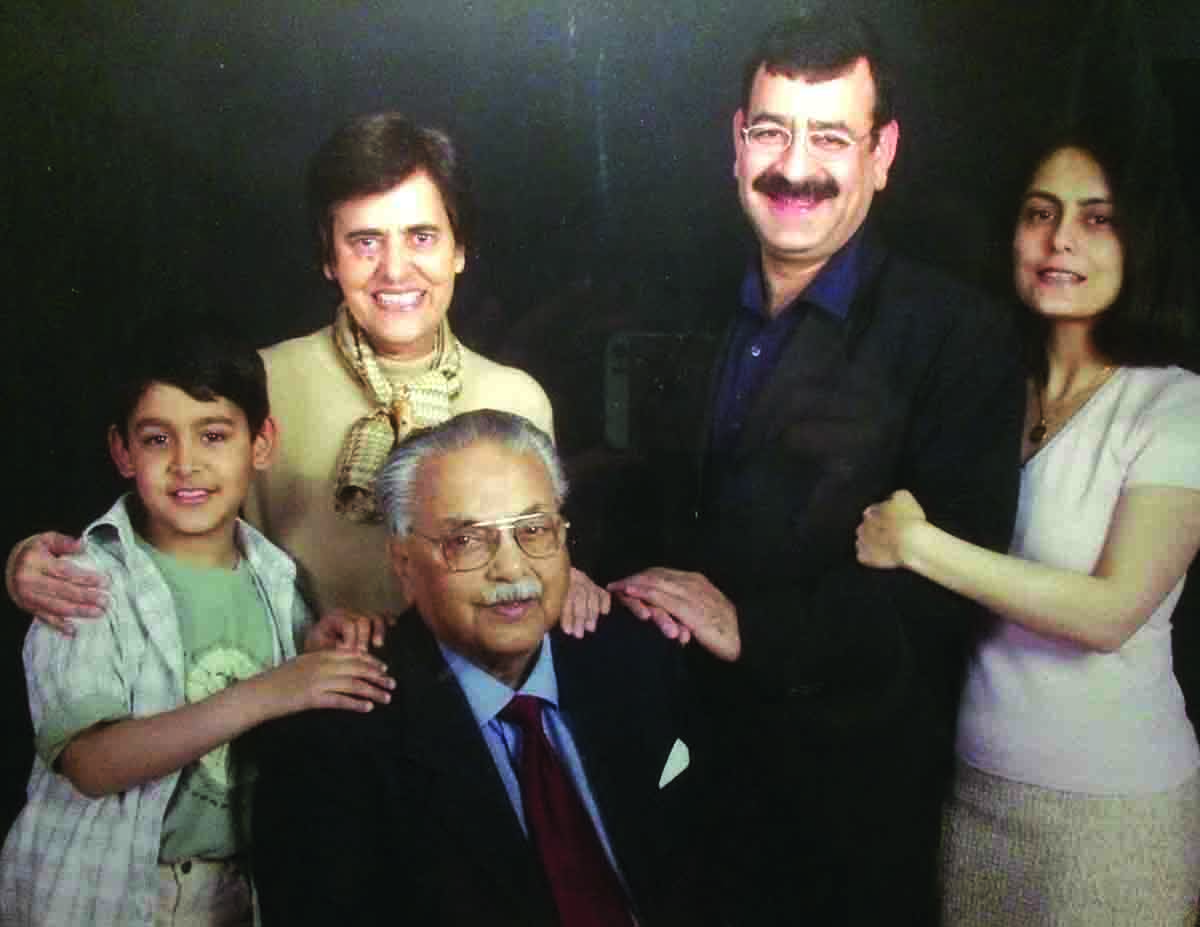
Dr Naseer Ahmad Shah and Dr Girija Dhar with their daughter, son-in-law and grandson.
Back home in the mid-1950s, Dr Naseer tried to look for a job. But Sheikh Muhammad Abdullah was the reason he could not get it, says one of his student on condition of anonymity. This was despite the fact that Sheikh had stayed with Shah in Pakistan, earlier.
“I vividly remember during the college days Sheikh Sahib used to stay with him in Pakistan but once in Srinagar, Sheikh never helped or supported him,” he said.
Literally heartbroken, Dr Naseer left for the United Kingdom to pursue higher education. Once there, he completed his MRCP and became the member of the Royal College of Physicians in London. With one more diploma, he became the first qualified specialist in tropical diseases in northern India.
Specialisations apart, it was his stay in England where he met the love of his life, a Pandit girl, who later became his wife. The couple took seven years to decide whether to marry or not. Finally, the marriage took place on February 05, 1965.
Recuperating from the loss of losing a partner of over five decades and a recent heart attack, Dr Girija Dhar remembers their stay in England and situation before the final call of the marriage.
“We knew each other before as our families knew each other. “Actually we had a lot of understanding and many of our ideas were very similar. He was not a very religious man nor was I, so we thought we won’t do any harm to any religion by marrying each other but still, it took us seven years to decide if we should really marry.” Dr Girija said with a giggle.
Aware of the societal compulsions, the couple before coming to Srinagar decided not to disclose about their marriage but “the news reached Srinagar before we landed.”
Back home, the couple, as per their plan, started living separately. Later, Dr Girija’s mother, a widow, invited Dr Naseer to her home and asked him to take his bride home.
As Dr Girija started to live with her in-laws, she recalls her mother-in-law as a generous lady. Understanding the dilemmas, she told the newly married couple to look for a separate accommodation. “She was of the opinion that if my family wanted to visit me they will hesitate in coming or having any food in our house,” Dr Girija said.
So they got a government accommodation in Tulsi Bagh and started living there. By the time, the couple had joined the newly opened GMC Srinagar, where Dr Naseer was given the post of Assistant professor.
Dr Girija too had a specialisation. When she went to London, women in Kashmir were suffering from a disease Vesicovaginal fistula (VVF), which was usually the outcome of improper care after their delivery. “Because of the high pressure on their bladder, they couldn’t control their urine, they had dribbling urine and as a result of which their families had abandoned them,” Dr Girija said. So in London, she had a special training so that back home she could take care of new mothers in Kashmir.
Dr Naseer rose through the ranks, quickly. Surpassing his two seniors, Dr Karnal Koul and Dr (Prof) Ali Jan, the government led by GM Sadiq appointed him as the Principal and Dean faculty of medicine, GMC Srinagar in 1969. Dr Koul was appointed as director health and Dr Ali Jan retired voluntarily. Naseer retained the position for 12 years, till he opted for premature retirement in November 1981 at the age of 52 years. The reasons were ‘personal’.
The era of Dr Naseer was “golden”, says people who have seen him working. During his tenure, the college received recognition by Medical Council of India (MCI). He started multiple academic activities in the Medical School including the first-ever national conference in Pharmacology. A postgraduate laboratory was established in the Medical School for advanced biochemical laboratory tests. He strongly supported post-graduation in various specialities and used his personal influence to get it started and recognized by the MCI.
An outreach programme, the Chitranjan Mobile Hospital was his significant contribution. This hospital extended high-quality healthcare to far-flung regions of the state including border regions like Karen, Kargil, Karnah and Gurez.
Making the medical graduation impactful, GMC Srinagar had reached No 4, in an all India ranking. “This made a big impact as the acceptability of medical students at national and international level became easier and smoother,” says a student.
In between, he was also awarded the prestigious fellowship of the Royal College of Physicians, for his performance as a medical profession both as a treating physician and as a medical academician.
Besides medical competence, Dr Naseer raised the bar of GMC in many ways. During those days, Dr Muneer says Prime Minister of J&K would never dare to call the principal of GMC to the secretariat. “But with due respect, they were invited for tea in their houses. And up to Dr Girija Dhar, no principal ever visited secretariat.”
Recalling his student days in GMC, Dr Muneer vividly remembers how Dr Naseer used to book cinema for all of his students and during cultural programme or sports week, Sheikh Abdullah used to join the students. This precedence continued till GM Sadiq’s tenure, Kashmir’s ‘armchair’ Chief Minister for managing the state from his office.
“He was a fatherly figure for all of us, including the international students who used to come to GMC Srinagar under an exchange programme. He even used to buy books for the students who couldn’t afford it,” Dr Muneer adds.
There are little disagreements that some of his students talk about. One is that he permitted his daughter to avail the backward certificate to get into GMC despite being a proud city resident.
A farsighted person, Dr Naseer, however, changed lives. During his tenure as the principal, he was known for his ‘recommendations’. “I once approached him for my post-graduation seat but instead he advised me to work hard. I felt very bad that time but in the long run, that advice helped me a lot to grow,” remembers one of his students.
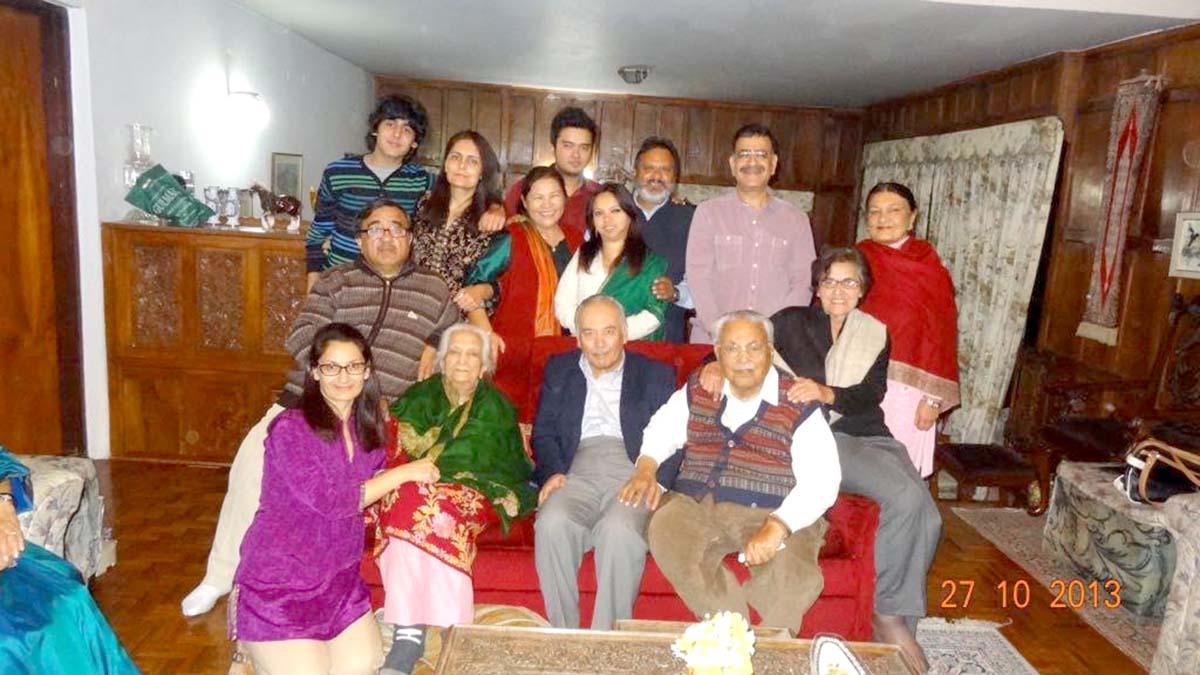
Family picture of Dr Naseer Ahmad Shah.
Dr Naseer helped students who were in extracurricular activities. Dr GM Malik, his student who later became a GMC faculty says he was one among the topmost students of his batch with Dr Jalal ud Din (medicine) and Dr Ashiq Hussain (surgery), “We were dropped from the MD list as he had started giving preferences to the students who were active in cultural programmes.” Malik said they had to fight with the government to cancel the list.
Malik once interviewed Naseer for his medical journal and asked him this uncomfortable question. “He accepted the fact that he used to help ‘needy’ people by going out of the way. And some people below the ladder ‘misused’ their position,” Malik said. “He was generous so he would help anybody but that was at the cost of meritorious students.”
Cited as “personal reasons” for opting voluntary retirement had actually many contributing things. The primary reason being, Dr Naseer was not “happy the way the government was treating him.”
“During Sadiq’s time he enjoyed absolute powers up to minister level and every decision was taken by him which include the selection of MBBS as well as PG candidates, even appointments in the health department used to be as per his choice, health secretary too was appointed by him,” says another student, wishing anonymity.
It changed when Abdul Gani Lone became a health and education minister. “Lone got PGI director Dr Santokh Singh as secretary cum advisor to the health department and all the selections were done as per PGI Chandigarh guidelines,” another of his students, who wish to remain anonymous, said. “When Sheikh Abdullah resumed power, DrAllaqbandh was given powers of all associated hospitals and it was parallel to the principal post and in Jammu, the responsibilities were given to Dr Zutshi.”
Dr Malik says, Dr Naseer was short tempered but at the same time he would forgive and forget things, which are the qualities of a great man. “He was a good administrator. He would not bother with smaller things. We as students could freely enter his room. He was never into corruption and he would hardly go to the secretariat. He would settle all student problems in college only,” Dr Malik said. “That was the reason why after so many decades of service, he just had only his home as the main property.”
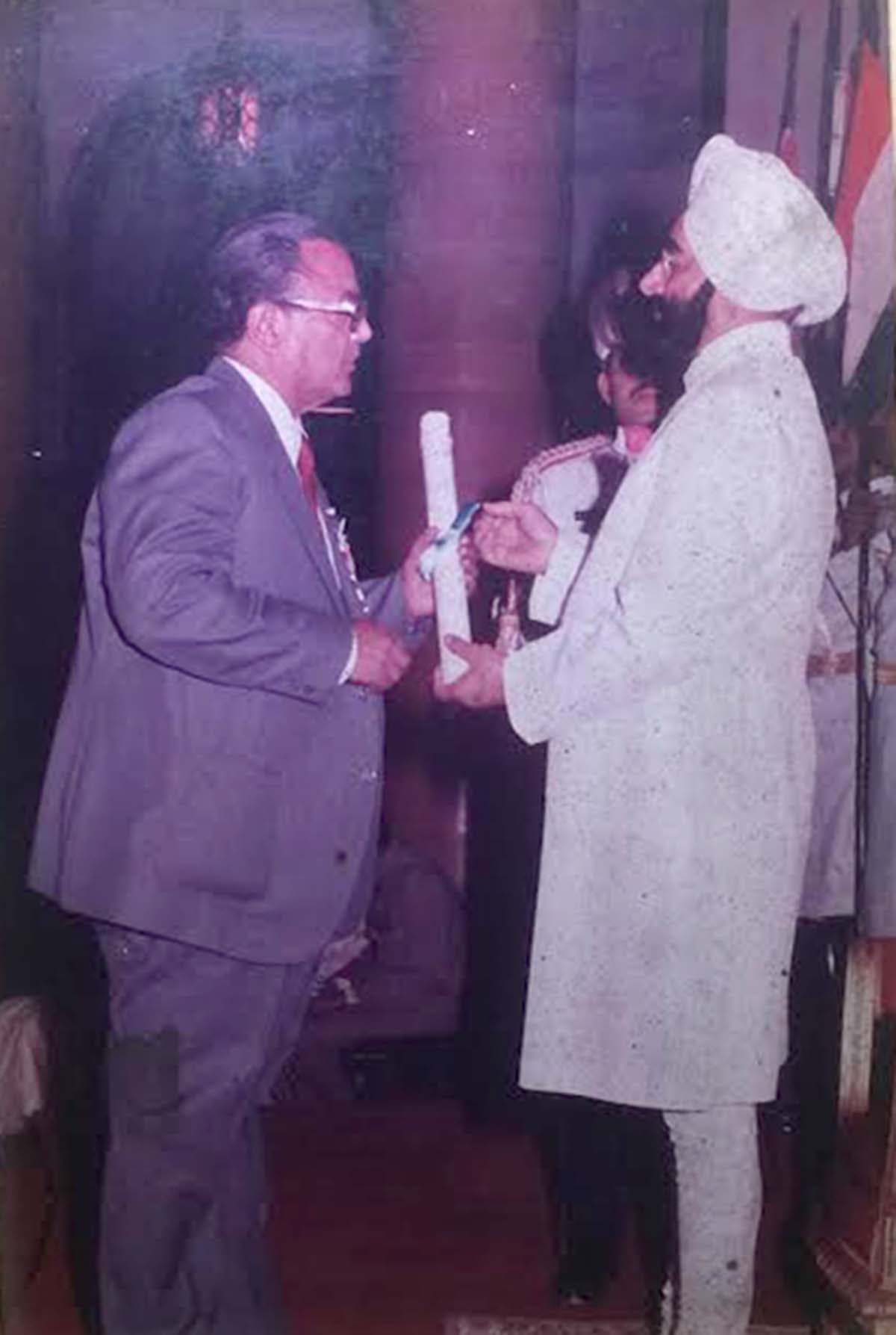
Doctors who served under him said that he was known to stand by his principles. After his retirement, he was appointed as a member of legislative council in 1996, and he held the position for six years, left it in 2002. He was also awarded Padma Shree in 1984.
Dr Naseer being facilitated by then president of India Gyani Zail Singh
Post-retirement, he continued his practice at his Dalgate clinic. On weekends he would visit Gulmarg along with his family where he used to treat the people of Gulmarg and Tangmarg for two decades (the 60s and 70s) free of cost. He even used to distribute medicines and sometimes he would buy medicines for the destitute patients. His contemporaries say his medical practice was highly ethical.
At home the doctor couple had a girl child, Tina Angila Shah, born in 1967. A doctor by profession, 50-year-old Tina is currently practising medicine in England, the place where her parents, met, married and studied. She is married to Anil Koul.
Remembering the day Tina was born, Dr Girija says by then both families had adjusted, reconciled fully and there were great celebrations.
Tina remembers her father as a friend of whom she was never scared off. “My childhood was happy like any other normal child but I was brought up in a very liberal atmosphere where I was encouraged to think. Nothing was enforced on me and I was able to make my own choices.”
By the time Tina was four years old, her family adopted a Ladakhi girl child, Deldun, then 7, who could give company to their daughter all the time.
Deldun, now a senior technician in SMHS, was an orphan and had a posthumous birth. She says those days education was not very common in Ladakh so she came to Kashmir and got a new family.
When Tina was studying in Presentation Convent School, Deldun started her education from Kothi Bagh Girls School, and after completing their 12th exams Tina got admission in GMC and Deldun got interested in Lab and joined Diploma in Medical Laboratory Technology (DMLT).
While in SMHS, Deldun says she is witness to her Dadu (Dr Naseer’s) generosity who helped a number of doctors financially. “He used to call class four employees before retiring and ask them if they have any source of income. In case of negative response, he managed employment for any of their family members,” Deldun said.
After Tina left for England, Deldun decided to stay with the couple till she got married in 1984. “We had a big shamiyana on my marriage and now for the second time it was on his death,” she said and broke down. Deldun’s marriage was a grand affair, she remembers. She said that Indira Gandhi also attended her wedding and she had all Kashmiri cuisine. “All of the father’s rights were paid by Dadu on my marriage. And after that, I used to frequently visit them.”
Deldun says he always used to wear good matching clothes and everything had to be in order, perfect and clean.
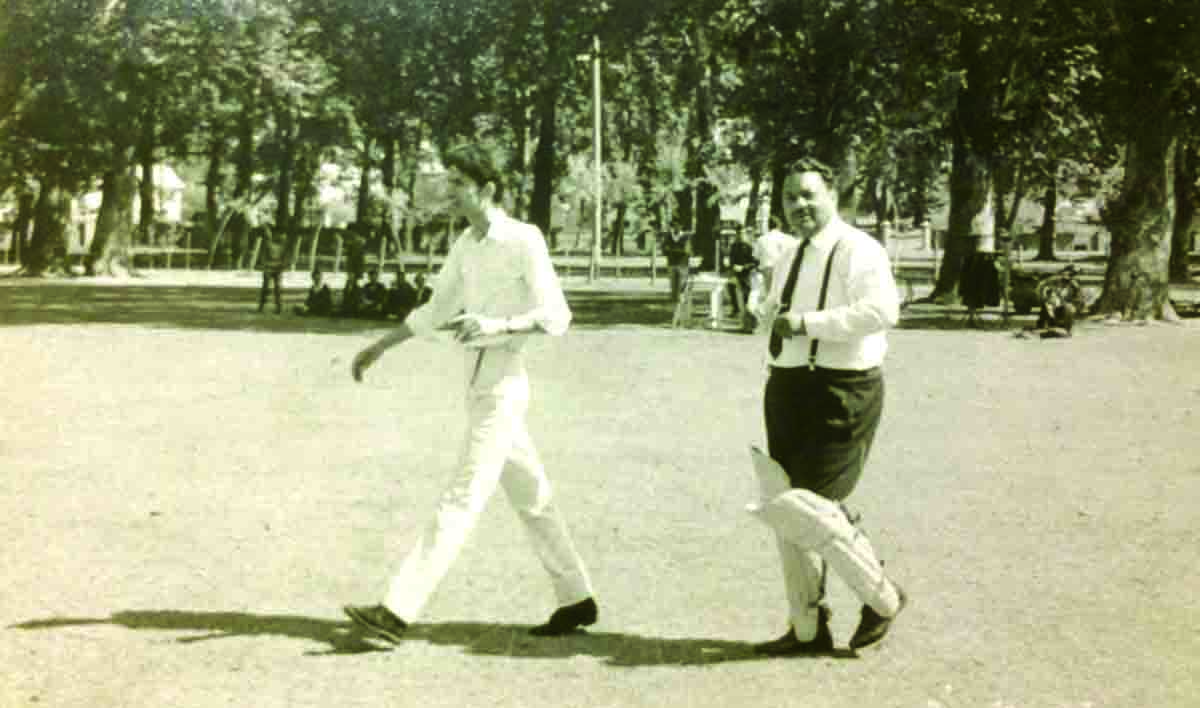
Dr Naseer’s address changed many times since 1952. It was Dalgate first, then they moved to Tulsi Bagh and later to 5 Transport Lane, behind SP College and finally to Kral Sangri in late 70’s, which they owned. Dr Naseer was fond of golf.
In March 2016, Dr Naseer had a fall in Jammu and fractured his right arm, which later became a cold shoulder. But Dr Girija says before that fall he had developed some spinal problem. For a complete year, he had no major illness but the problem was with his mobility only.
“He was a great storyteller and had a fantastic memory. If he would have been here, he could have told you each memory with dates,” shares Tina, who herself refused to talk much about her memories saying they are ‘personal’. “Generosity is the word to describe my father.”
But Dr Girija, who does not remember many things now, says that she has now realised what kind of a person he was. “We never boasted about our work but now when I am receiving patients from far-flung areas who come to pay their condolences, I am realising what kind of a person my husband was.”
After taking seven years to decide, the couple lived together for 52 years. The heart attack, moments after Dr Naseer was taken for final burial revealed the bond the two souls shared. As Dr Girija talked about Naseer, her eyes were moist.
source: http://www.kashmirlife.net / Kashmir Life / Home> Obituary / by Saima Bhat / July 21st, 2018
Asif Shaikh’s ornate art pieces are going on display at a design centre in New York.
Asif Shaikh
In his teens, Asif Shaikh had tried hard to draw the famous tree of life latticework screen in the Sidi Sayyed Mosque of Ahmedabad. He was stippling a lot those days, making images out of minute pencil dots in the manner of old halftone newspaper prints. Though many admired the drawing, Shaikh was unhappy. It was not as perfect as the original.
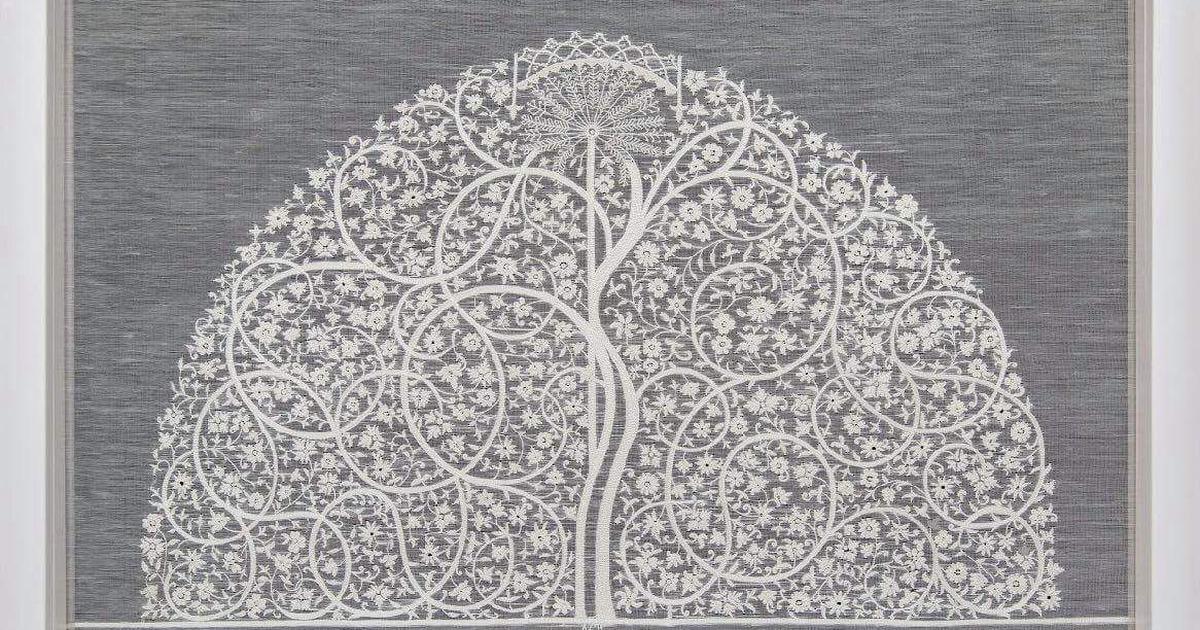
Some three decades later, by now a master designer and embroider, Shaikh attempted the tree of life again. This time with the aari (awl) needle and gossamer-thin Thai silk yarn on the finest handwoven silk-linen from West Bengal. As the minute chain stitches appeared, white on white, he rediscovered his fascination with the ancient stone carving. His long artistic experience allowed him to render it perfectly in his own medium.
The Sidi Saiyyed mosque built in 1572, the final years of the Gujarat Sultanate, has 10 latticework panels that represent the best geometric designs. “There is an easy symmetry in the looping branches of the tree, the leaves and flowers,” said Shaikh. “And in the centre, almost imperceptible, is the strong straight Cyprus. I find it spiritually comforting.”
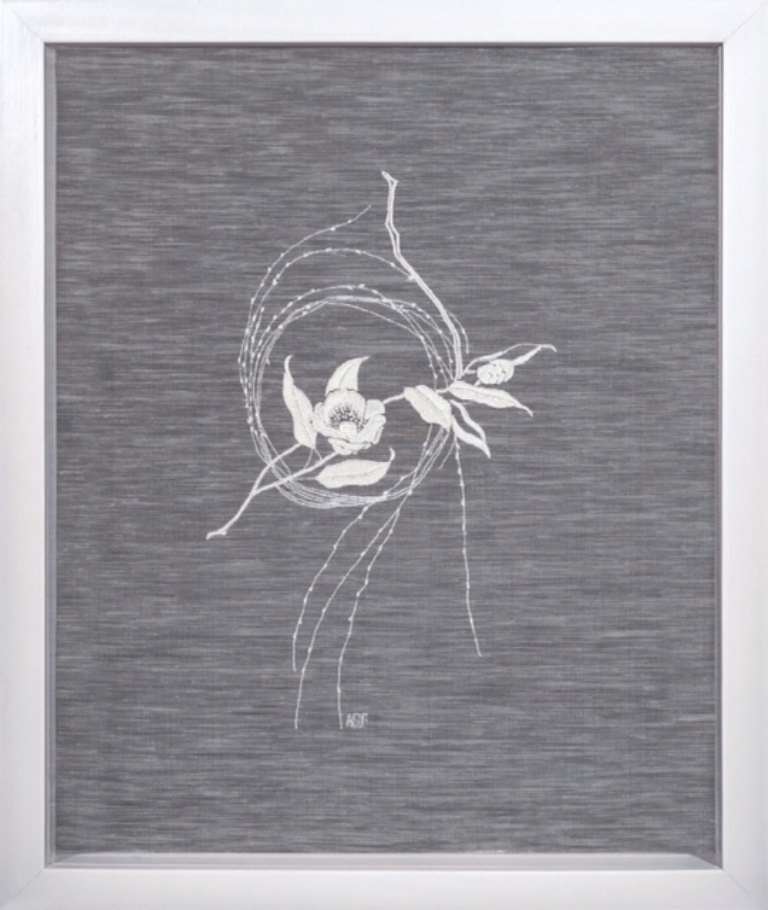
Shaikh’s show, Sacred Geometry, opens on August 2 at a New York design centre owned by the furniture designer Tucker Robbins, and will be on view for nearly two weeks. This, like his earlier exhibitions, will have exquisitely embroidered art pieces – high-end wall decor – which clients have already started to book. The essentially white-on-white collection is an ode to Ahmedabad: all the designs having been inspired by the stone and wood jaalis in historical monuments around the city.
Image courtesy: Asif Shaikh.
With the Historic City of Ahmedabad, founded by Sultan Ahmad Shah in the 15th century, receiving World Heritage Status in July 2017, Shaikh’s celebration has new relevance. As a child he lived in the city outskirts, but the fort, mosques, tombs, havelis and later-era Hindu and Jain temples captivated him. Apart from the Sidi Saiyyed, he was inspired by the Rani Sipri Mosque, Sarkhej Roza and theJama Masjid of Ahmedabad.
He howeverdoesn’t make exact copies. Rather, he approaches them as a modern painter would, with his own perceptions and interpretations. “I don’t like spelling it out to the viewer,” said Shaikh. “I want them to appreciate or reject the designs freely. They should suggest their own titles to the pieces.”
Image courtesy: Asif Shaikh.
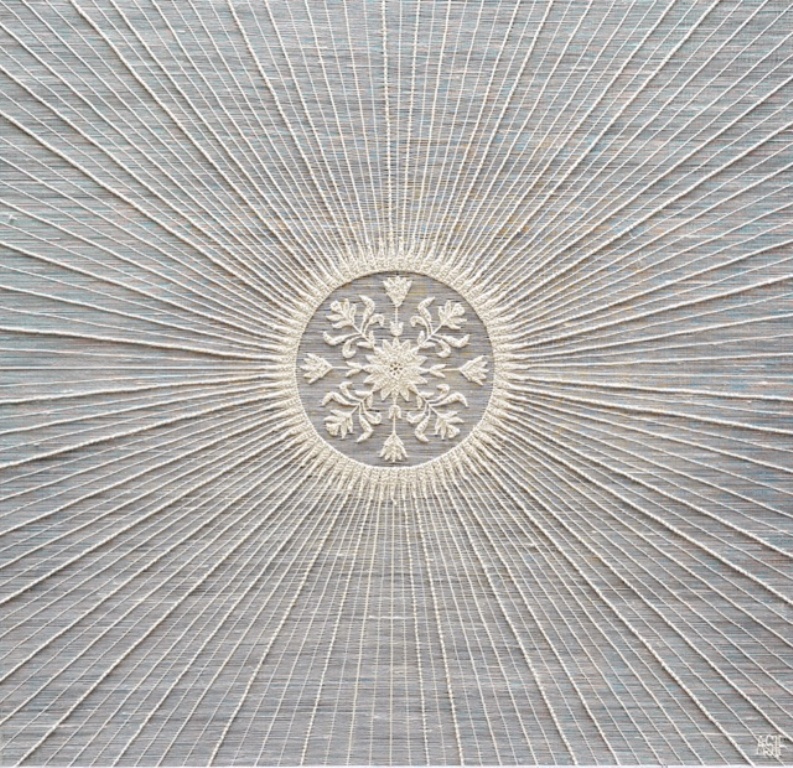
In one work Shaikh has usedparallel flowing lines. To some they may seem like rivulets but hewas thinking of roots. The roots of a tree are never seen, he explains, yet they are the strongest part of the tree, holding it upright and sustaining it through all kinds of weather. “I was also thinking of my own roots, the ancient artistic traditions which are beckoning to me now. But I can never fully comprehend all that is latent in my cultural origins, so I have left some threads hanging free beyond the border.” There are two other patterns – with a circle in the centre and straight lines – where he has tried to create an optical illusion with close parallel and concentric lines, once again trying to grasp that which is mostly invisible. “The Sun’s rays are visible only occasionally when there are clouds,” he says. “But to viewers these two frames might suggest other things.”
Shaikh is completely self-taught. He used to sit for days watching old embroiders at work and practiced at home. He signed up for formal training as interior decorator but gained fame for his embroidering skills, long before he graduated. Today he is happy spreading theword on Indian craft traditions and developing new techniques for the artisans who work with him at his studio in Ahmedabad. For his use,he redesigned the Mughal-era frame for needlework called the Karchoibe and came up with new stitches.
Image courtesy: Asif Shaikh.
For Sacred Geometry it was difficult to render the design on fabric, especially with thread that was one-fourth the width of normal embroidery thread. Shaikh is upset that he could not source silk embroidery thread from India and had to buy it from Thailand instead. “India was producing the twisted silk yarns needed for embroidery even a few years ago in Bangalore,” he said. “But now all you get is rayon. I cannot understand why silk yarn is not produced locally.”
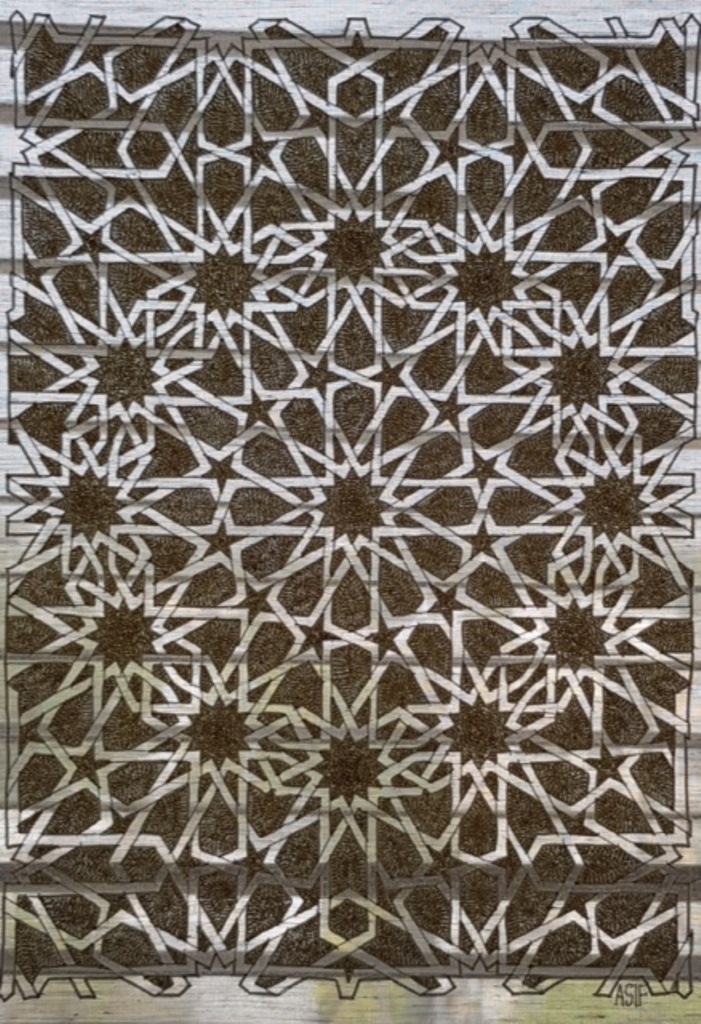
His studio team of embroiders had never done anything like this before and they had to be guided step by step. The ancient artisans, who worked on wood, marble and sandstone, often used both the surface and the perforations for effect. To achieve that on cloth was difficult. Scholars claim that textile patterns were chosen by the early followers of Islam to make their monument as distinct as possible. From the close association of artists, mathematicians and philosophers emerged a unique form of decorative art that abjured human and animal forms for pure geometry. The patterns often repeated over and over again, mirrored in reverse colours and at times seeming to extend infinitely beyond borders seem to carry a philosophic message.
But Shaikh does not lay too much stress on the religious aspect because of the “rather sad trend in India today of labelling everything by religion”. Shaikh was witness to the murderous 2002 Gujarat riots and has since seen ugly discriminations. He was one of the victims when his neighbourhood in Ahmedabad was attacked by a rampaging mob in February. He suffered head wounds and had to be hospitalised. For months he couldn’t work. “Ahmedabad is like the rest of India, he said. “Congested roads, filth…we have it all. But like the rest of India there is also unbelievable richness and beauty of art and craft. And people, who will appreciate and support you, no matter what. I am proud to hold up this tiny fragment of heritage to the world.”
source: http://www.scroll.in / Scroll.in / Home> Magazine > Thread The Needle / by Sebanti Sarkar / July 24th, 2018
Chana Mohallah Village (Budgam District ), JAMMU & KASHMIR :
Budgam:
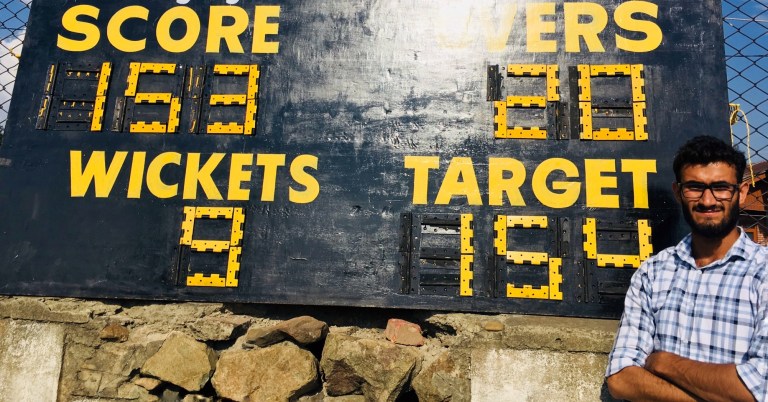
Nadeem Hussain Mir, 21, of district Budgam has designed a cricket scoreboard out of door hinges which has become a major attraction for the players and spectators at Budgam’s lone stadium in Paller village.
The manually operated scoreboard has been erected on the fencing of the playground.
Nadeem, a resident of Budgam’s Chana Mohallah village presented his scoreboard during the knock-out matches of a local tournament here in which Kashmir’s famous cricketer Manzoor Pandav is also participating.
His invention has stirred interest among the spectators here who remain updated about the score during cricket matches.
“In 2017, I noticed that cricket fans here were unable to keep a track of score and then an idea of designing a manually operating scoreboard struck my mind.”
Nadeem told ‘Kashmir Images’ that he wanted to make a scoreboard that would be different from a traditional number plate board. “Once I saw my father, who is a carpenter, fixing joints of a door with the hinges; then and there I began work on designing a score board out of door hinges.”
Nadeem, who is a student of final year, says that he had shared the idea with his friends, but received a negative response from them. “My friends told me that it was not feasible to make a scoreboard out of door hinges.”
“In 2018, I shared the idea again with my friends and I was told to give my idea a practical shape and was also given five thousand rupees by the organisers of the tournament,” he says.
He says that first of all he made a graph which took him many days to complete it. “I fixed 63 hinges on a blackboard. In order to make the scoreboard visible I painted the inside of each hinge with black color and colored those hinges yellow outside.”
When asked what people think of his invention, he says, “Everyone is lauding my effort.”
Nadeem says that a local player and one of the organisers of the tournament, Rameez Hassan, helped him to give his idea a practical shape. “Without the support of Rameez, it was impossible to even think of making a scoreboard.”
Nadeem is a famous chess player of his locality. He claims that no opponent has ever defeated him in a chess game.
source: http://www.thekashmirimages.com / Kashmir Images / Home> Budgam / by Abid Hussain / July 22nd, 2018
His earlier national mark is 45.31 seconds which he clocked while finishing fourth at the Gold Coast CWG.
File image | AFP
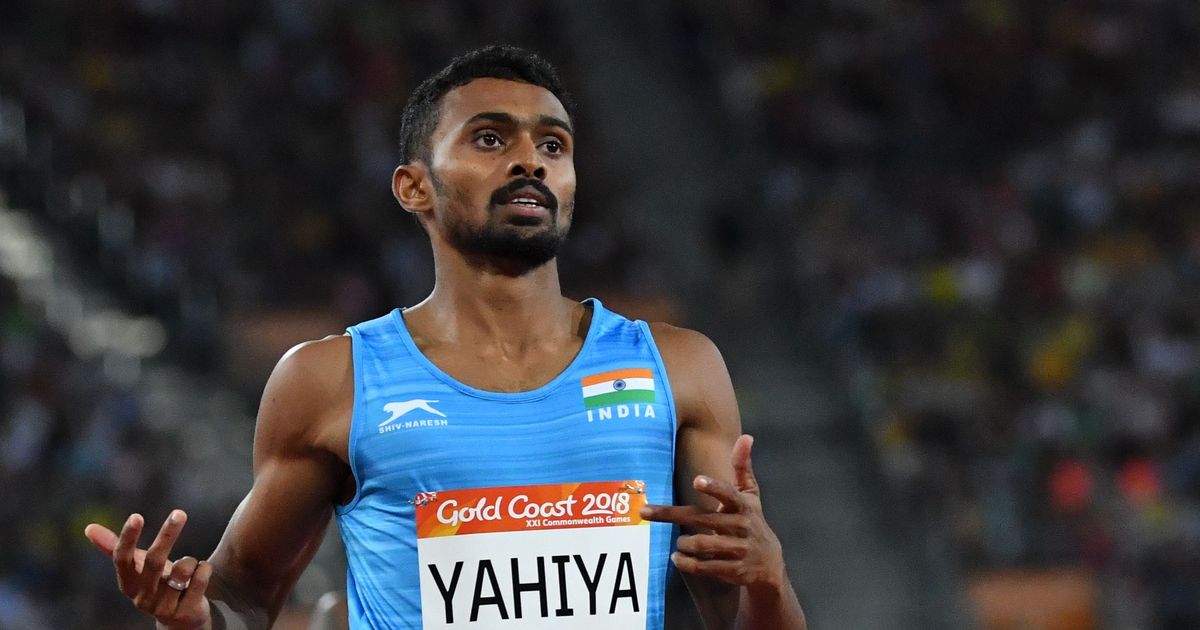
Muhammad Anas bettered his own 400m national record while winning gold with a time of 45.24 seconds in an event at Czech Republic on Saturday.
His earlier national mark is 45.31 seconds which he clocked while finishing fourth at the Gold Coast CWG.
Anas, who is training near Prague along with other quartermilers as part of preparation for the upcoming Asian Games, set the new mark at an event at Velka Cena Nove Mesto nad Metuji.
Anas now also holds the next 3 fastest times – 45.32 seconds, 45.35, and 45.40.
In the women’s event, MR Poovamma won gold with a timing of 53.01 seconds. There were only five women, who competed in the event.
Rahul PAWAR@rahuldpawar
Watch full race of record breaking run by Muhammad Anas of India who set new record with a timing of 45.24s in the VELKÁ CENA NOVÉHO MĚSTA NAD METUJÍ at Nové Město nad Metují (21. 7. 2018)@afiindia
A biopic is being made on Syed Abdul Rahim, the architect of modern Indian football
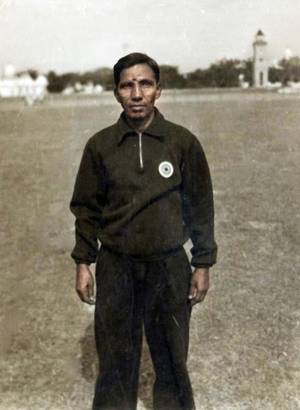
More than 62 years after an Indian football team came within a whisker of winning an Olympic medal, a Bollywood movie is being made on the Hyderabad coach who made it happen: Syed Abdul Rahim.
“About a year ago, Joy Sengupta, an ad filmmaker, approached me saying he wanted to make a movie about Rahim sahab. I shared all the information with him. They expected I would ask for money. I don’t want money, I want the younger generation to know about the glorious golden period of Indian football and my father’s contribution,” says Syed Shahid Hakim, son of S.A. Rahim and a Dhyan Chand awardee.
Reliving glory
The biopic is expected to bring alive S.A. Rahim’s life, who led a stunning rise of the Indian team in the 1950s. His biggest achievement? Getting a walkover in the 1956 Melbourne Olympics against defending champion Hungary even as its Magic Magyars withdrew due to Hungarian Revolution; beating Australia 4-2 before losing to Yugoslavia 1-4 in the semifinals. At the Asian Games inaugural, Rahim’s team won gold for India as the then Prime Minister, Jawaharlal Nehru, watched from the VIP stand. On Friday, Zee Studios tweeted about its project: “Elated and proud to announce a story never told as @ZeeStudios_ #BoneyKapoor & @freshlimefilms come together for a biopic on India’s legendary #Football coach, Syed Abdul Rahim, starring @ajaydevgn, directed by @CinemaPuraDesi.”
Mr. Shahid Hakim, who played under his father, later coached and was a referee as well before retiring from the National Institute of Sports, Patiala, has been bombarded with calls about his father since then.
The trigger was perhaps Novy Kapadia’s book Barefoot to Boots that’s partly instrumental in spotlighting the coach, who was almost forgotten except in the rarefied field of Hyderabad’s football circles. Rahim worked his magic on Indian football teams between 1948 and 1960 bagging Asian Games gold in 1951 and 1962. In the 1960 Rome Olympics, India was jinxed in the death group ‘D’ which had Hungary, France and Peru. India lost to Hungary 2-1 and drew 1-1 with France before losing 2-0 to Peru. It was here that Balaram and P.K. Banerjee scored a goal each. In that period, the Hyderabad police team brought home five Rovers Cup trophies.
Football prophet
Rahim was a school teacher who drifted into football coaching. Noticing that Indian footballers used to dribble needlessly, he came up with the concept of one-touch football. “The player had to get the ball and pass it. A dribble would be considered a foul and a free kick awarded,” says Hakim, as he reels out names of playgrounds in Hyderabad and tournaments that used to be played here.
“People bemoan our football skills. But where are the grounds for children to play? Football is the most democratic game. One ball and two goal posts can engage 22 players. But our government is interested in promoting individual sports. Money, land, academies are gifted to players. Team games get a short shrift,” rues Mr. Hakim, promising to share all the trials and tribulations of his father with the movie-makers. “He was a strict disciplinarian. I was treated as just one of the players. There were so many talented players that we used to hide injuries, lest someone else play and take our slot. He used the 4-2-4 combination before anyone used it,” says Mr. Hakim.
While football grounds have disappeared and the beautiful game is played only by a few expats in Hyderabad, the biopic is sure to make Indians remember a time when India was a name to reckon with in world soccer scene.
source: http://www.thehindu.com / The Hindu / Home> News> Cities> Hyderabad / by Serish Nanisetti / Hyderabad – July 14th, 2018
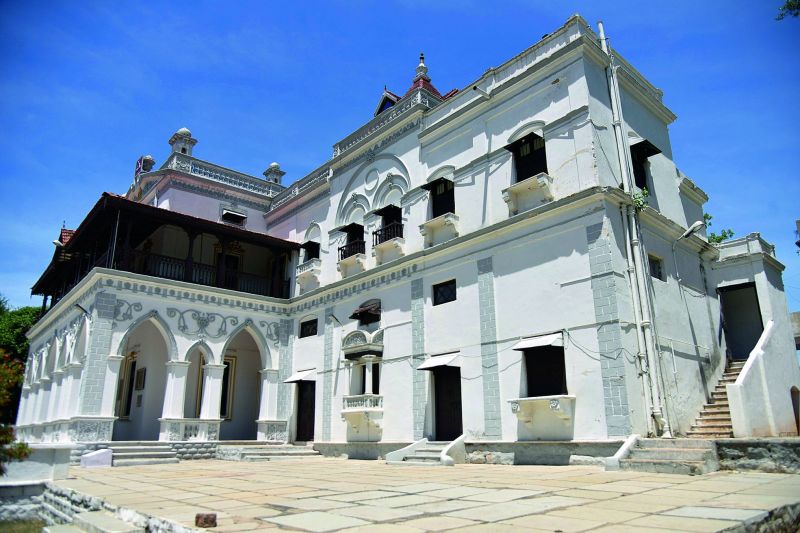
Maintained in pristine condition, it is used as Army mess.
Saif Gulshan was the residence of Sultan Saleh bin Ghalib al Quaiti, Nawab Saif Nawaz Jung, a prominent noble in the Nizam’s court.
Hyderabad:
The erstwhile Hyderabad state had the largest army in the country, and what is now the Sarojini Devi Eye Hospital was the first hospital for the Army here.
The First Lancers of the Hyderabad Army at Asafnagar is still being maintained in its original condition. All of this was originally part of the Golconda Fort and, not surprisingly, there are two Qutb Shahi-era tombs within this area. The Nizam had great respect for the army.
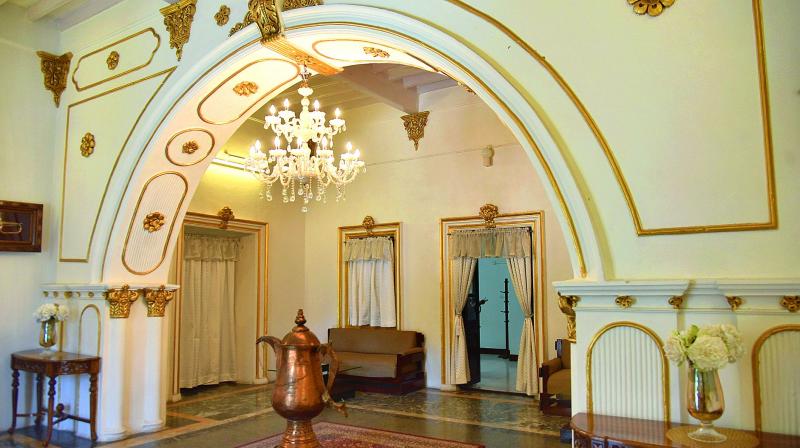
Saif Gulshan was the residence of Sultan Saleh bin Ghalib al Quaiti, Nawab Saif Nawaz Jung, a prominent noble in the Nizam’s court. Constructed in 1912 it has a mixture of European and Qutb Shahi styles. This residence is being maintained in pristine condition and is used as an Army mess.
The building has an elevated basement, which seemed to be in style those days. It has been built with great care, leaving a lot of open space, both in the front and at the sides. A well on one side of the house must have been the water source and it must have been an open and beautiful structure. There are many jharokas and the first floor has rooms. The terrace is covered by a low-tiled roof, which is supported on wooden posts.
The beautiful facade of the building has been well-maintained by the Army. A lot of wood, stained glass and stucco work has been used in the building, which has verandas on three sides, each one ending in a room. The windows look out to this narrow veranda, which has exquisite tiled flooring. The veranda has Gothic arches and since the entire building is on an elevation, it looks imposing. European influences and Indian elements blend wonderfully well in the building.
There is another impressive building about a 100 yards away. This too was connected to the army and officials must have lived here. Or it could have been a zanana. Smaller in size, that building is surrounded by wooden eaved projections with windows on all sides. There are four rooms with one in each corner and in those days the centre used to be a courtyard, open to the sky. It is now covered and is like a big hall. In 2012, the building bagged an Intach award. According to the citation, Awadh bin Abdullah, the founder of the al Quaiti clan, was the first to travel to India in the last quarter of the 18th century. During his brief stay in the country, Awadh is said to have served the Nizam during the Second Mysore War. His son Omar migrated to India in the early 19th century and after a brief stint with the Raja of Nagpur, ended up in Hyderabad as head of the Arab mercenaries who formed a bulk of the Nizam’s irregular troops.
The main structure of the building is flanked on either side by projecting blocks. “The structure is flanked on either side by projecting blocks crowned with tiled pyramids lending majesty to the structure. The central portion is surmounted by a highly decorated pediment which bears the monogram of Saif Nawab Jung in stucco,” says the Intach citation.
The interiors show that the building was well-planned, with huge arches and windows and doorways with stucco to highlight the structure.
A lot of wood has been used and there is a wooden staircase leading to the first floor. Elegance and form are the highlights of this building.
This building stands along with the other smaller building in the midst of a forest and a fountain, while a road nearby brings in the sound of traffic.
Well-kept and still maintained in its original form of limestone and brick, with a little bit of granite, the Army must be lauded for the care it has invested in maintaining this landmark building.
source: http://www.deccanchronicle.com / Deccan Chronicle / Home> Nation> Current Affairs / by Lalitha Iyer, Deccan Chronicle / July 15th, 2018