The coins till the police action were in the pattern of Moghal coinage before it was changed in 1858.
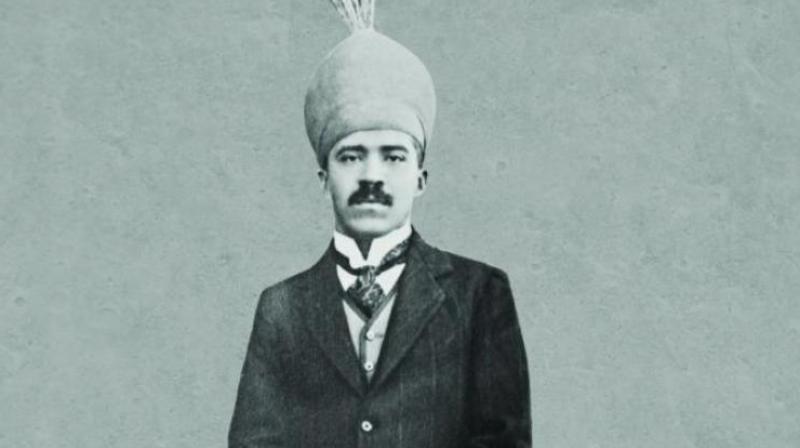
Nizam VII Mir Osman Ali Khan
Hyderabad:
The first series of paper currency introduced during the rule of Nizam VII Mir Osman Ali Khan were printed in London.
The currency notes of one five, 10, 100 and 1,000 rupee denominations were widely appreciated for their design and quality of paper, said Mr Amarbir Singh, an eminent numismatic. “The need for having paper currency was felt as there was a shortage of metal after World War I,” he said during a lecture here.
The notes had Islamic resemblance without any pictures of animals, plants or buildings and contained four languages — Urdu, English, Kannada and Telugu.
“The Nizam ensured that they were without any signature of the finance committee member. Only when they landed in the Hyderabad did they gain complete form,” Mr Singh said. The second series of notes, smaller in size, were introduced in the 1930s and printed at the Government Printing Press at Malakpet.
The regular coinage of Hyderabad in large circulation was the one rupee coin, the Osmania ‘Sicca’. The one rupee note was unpopular, and people were put off by its black colour.
The coins till the police action were in the pattern of Moghal coinage before it was changed in 1858.
Hyderabad had a mechanised mint at Saifabad where gold silver and copper coins were printed.
The highest coin for public circulation was silver one rupee.
source: http://www.deccanchronicle. com / Deccan Chronicle / Home> Nation> Current Affairs / by Asif Yar Khan, Deccan Chronicle / July 15th, 2018
An English sport is empowering girls in the Kashmir Valley to chase their love for sports. No, it’s not cricket, but rugby.
Until a few years ago, this Kashmiri girl didn’t know a thing about rugby and had never even seen a rugby ball. But today, she claims she is the youngest Rugby Development Officer (RDO) in Jammu and Kashmir , has coached hundreds of school and college kids, and has dreams of playing for India one day.
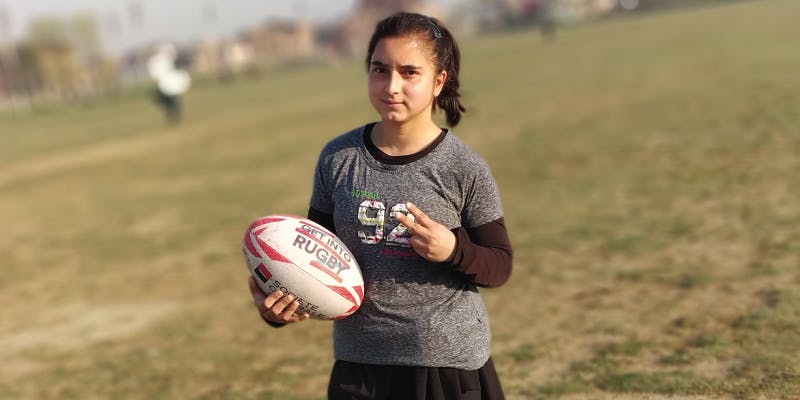
Irtiqa Ayoub
Irtiqa Ayoub (23) from Jammu and Kashmir , discovered rugby when she was 16-years-old, and since then there has been no looking back. For someone so young, she is fearless, passionate and determined. She is a shining example of how when young girls are empowered and given freedom of choice, they can surmount any challenge. Irtiqa has also leveraged the power of social media to ensure that her efforts and talent don’t go unnoticed.
Love for sports
As she speaks to me over the phone in Hindi from her home in Safakadal in Srinagar, Irtiqa confesses that she has always been into sports and loved playing football. But when rugby was first introduced in her school, she was hesitant to play. “I had no idea about the sport, the rules and how it’s played. I hadn’t even seen how the ball looked like. When the coach encouraged us, I decided to give it a try but was still hesitant,” she says. However, after a week of playing rugby, she realised that she was going to enjoy this rough contact sports.
Since then, there has been no looking back. Irtiqa has won seven gold medals at the state level, and seven at the district level. She won a silver medal for Rugby 7’s in 2016 and 2017, and a gold medal for snow Rugby in 2017.
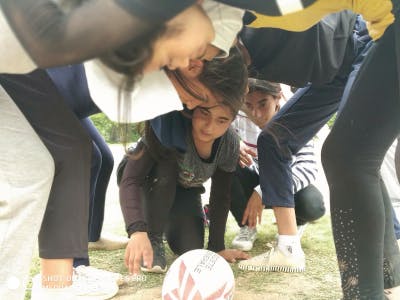
Girls in action
Becoming a coach
About a year-and-a-half ago, Irtiqa decided to take her love and passion for the sport to the next level and began coaching assignments in schools and colleges across the Valley. When she had started playing, there were very few girls in sports. But over the years, rugby’s popularity has grown not just among girls, but across the Valley. Sports has become a way to not just channel the spirit of the youth, but to build teams that can play for India. Given the Valley has so much snow, it provides an excellent opportunity for players to play snow rugby too.
The promotion of rugby has undoubtedly changed the lives of young girls like Irtiqa for the better. “I want to learn more. I believe there is a lot of scope and talent in Kashmir. I have been coaching for the past one and a half years and started to reach schools, colleges and tuitions for activities of Rugby sports. I believe we Kashmiris have good talent in all sports and activities, and we just need to believe in ourselves and work hard for better outcomes. I want all girls to feel free and join any sport they want to learn and earn,” she says.
The sheer confidence she displays is surprising, given that no one in her family has worn jeans, been on the field playing rough, and come back home with a broken nose. “My life changed after my father started seeing my pictures on magazines and television.”
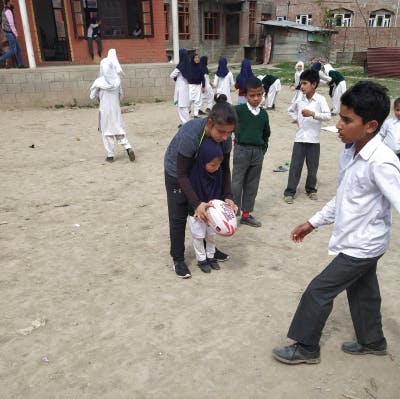
Irtiqa coaching young kids in a school
“Initially, he was hesitant and didn’t let me go for the Nationals, but once he came round, his support has been my strength. I come and go, wear jeans, go to the gym to train, and my grandfather, who is old school, asks me why I am not going out to practice or play when he sees me in the house.”
Quiet like the scene from the movie Dangal, Irtiqa and her family often get to hear unsavoury remarks, but her attitude to it is simple. “Ignore what people say. When people close to you say things, it does hurt, but I need to do what I need to do.” However, when some remarks and comments warrant a response, she doesn’t take it lying down.
When in one of the matches, the opponent’s knee hit her nose, she went on to play the match and win. “This game is my passion and nothing can keep me away from it.” She believes she is no less than the boys, and when it comes to competition she says, “I don’t look at anyone. I look at myself for I am my own competition.”
The ice, rain, snow, and the roughness of the game don’t deter her.
Social media empowering women
In summers, she wakes up at 5.30 am and goes for a two-hour walk, and after she is back, she has breakfast and heads for her coaching assignment. Then she heads to the gym, and in evenings she spends time on social media to connect with the world and share her experiences. Ever since she started coaching, she has leveraged various social media channels such as Twitter, Facebook, etc. to share her love for Rugby with the world. Now, Irtiqa is a well-recognised face in the state.
Irtiqa also has a club, a team of girls she is training and prepping alongside her, to make it to the nationals, and eventually play for India. It’s surprising how someone so young wants to not just play for herself but also empower others who can go on to make a name for themselves in this sport. She is proud that some of the girls she trained have gone on to play at the State and National level.
Support is crucial for success
For any sportsperson, and for sports to thrive, the access to resources is pertinent. Earlier, the rugby players didn’t have the ground, which meant they could not practice for more than a month before big games. But now, the Valley has the Rugby Home Polo in Srinagar. The Jammu Kashmir Sports Council and the Jammu Kashmir Rugby Association have not only helped by providing a ground and promoting the game, but they have been very supportive. “They support us every time,” says Irtiqa. Having an exclusive ground has made a huge difference, as all the rugby players now have a place to practice. “Now, we prep for three months before the nationals,” she says. The popularity and support for the game in Kashmir has definitely come in handy.
However, the mindsets need to change. Irtiqa has this message to share with especially parents and girls – “The girls who have talent and commitment, please pursue the game, but it is important for parents to support your girls for with your support they can go far.”
Success and failure is a part of the game
“I don’t believe in giving up. It’s not a part of my dictionary,” she emphasises passionately. However, as in any game, all days are not the same and sometimes you have to face failure. On those days, she doesn’t let defeat get to her. “I tell myself it was not my lucky day and I move on.”
Her primary goal right now is to play for the country and be a part of the Indian team. “I am going to the gym and training very hard for the upcoming camp. I hope to make it, as I want to play for my country,” says Irtiqa.
source: http://www.yourstory.com / Your Story / Home> Her Story / by Tanvi Dubey / June 09th, 2018
Hyderabad boy Muzammil Khan and son of retired IPS officer, AK Khan grabbed All India Rank (AIR) 22 in the Union Public Service Commission (UPSC) examination.
Hyderabad :
Hyderabad boy Muzammil Khan and son of retired IPS officer, AK Khan grabbed All India Rank (AIR) 22 in the Union Public Service Commission (UPSC) examination.
Results of civil services exam for 2016 were declared on Wednesday. Muzammil Khan told Express that he would be opting for Indian Administrative Service (IAS). Khan had attempted civil services exam four times earlier. He was even selected two years ago and recently finished his probationary period as an officer with Indian Railways. However, he had been aiming for IAS and gave the exam during his service with railways. Earlier he had worked as a Probationary Officer with the State Bank of India. Khan did his under engineering from BITS Pilani. For the UPSC Mains exam, he chose Anthropology.
AP students shine
A total of 1,099 candidates were selected in the exam. Kothamasu Dinesh Kumar from Vijayawada, secured rank 6. Gopalakrishna Ronanki from Srikakulam in AP bagged rank three.
Kothagudem boy secures rank 36
Kothagudem boy, Mikkilineni Manu Choudary bagged rank 36 on his first attempt. He said, “I knew I would be in the top 1,000 ranks but was not expecting to get 36. On a daily basis for one year I put in an average of nine hours in preparing for the examination.”
source: http://www.newindianexpress.com / The New Indian Express / Home> States> Telangana / by Express News Service / June 01st, 2017
Recalling ups and downs in his career as a police officer, 1981-batch IPS officer Abdul Khayyum Khan, (known as A K Khan) said that police service is the best job in serving people and only a police officer can directly help the public.
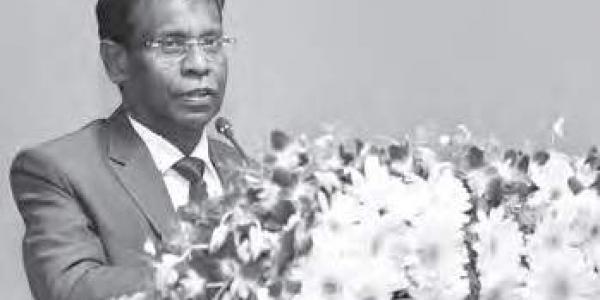
ACB director general AK Khan speaking during his retirement programme in Hyderabad on Saturday | Express photo
Hyderabad :
Recalling ups and downs in his career as a police officer, 1981-batch IPS officer Abdul Khayyum Khan, (known as A K Khan) said that police service is the best job in serving people and only a police officer can directly help the public. Khan retired as director general of the Anti Corruption Bureau (AC B), Telangana State on Saturday.
He is the first chief of AC B after formation of Telangana State. Khan is also the chairman and vice-president, Telangana Minorities Residential Educational Institutional Society. At the age of 25, Khan finished his training as IPS probationary off i cer and was pos ted i n Vijayawada. He further stated that when he took charge as the DG of AC B, the conviction rate was low.
“I took measures by providing proper training to public prosecutors and staff of the agency that helped in enhancing conviction rate to 70 per cent in the AC B. The AC B staff have been trained in various ways in detecting cases of illegal assets and trap the accused officials,’’ Khan said. Khan has worked in various important capacities as SP Nalgonda, SP Prakasham, SP East Godavari and DCP traffic, West Zone. On promotion, he worked as DIG , Guntur, DIG, CID and later as IGP.
He was also posted as Additional Commissioner of Police, L&O and Additional Commissioner of Police, Traffic in Hyderabad and later as Commissioner of Police in Visakhapatnam. On promotion as Additional DGP, he worked as DG Fire Services, Additional DGP (L&O) and Commissioner of Police, Hyderabad. He also worked as Vice Chairman and Managing Director of APSRTC.
source: http://www.newindianexpress.com / The New Indian Express / Home> States> Telangana / by Express News Service / January 01st, 2017
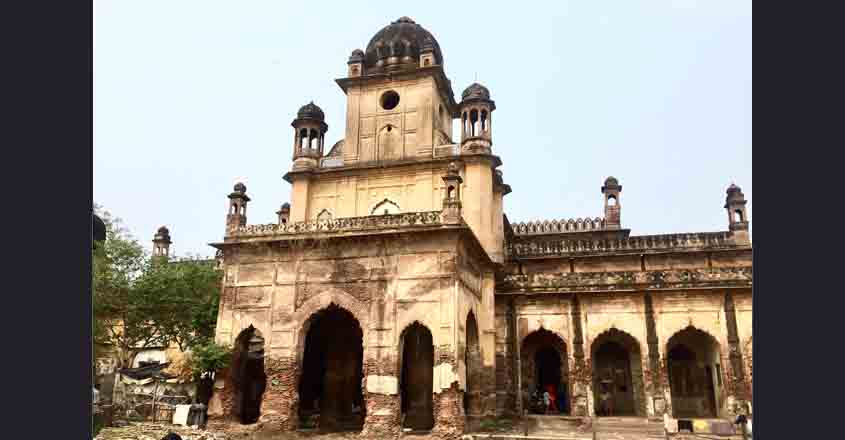
Rifa-e-aam was where literary events were held to provide Rifa (happiness) to people
During struggle for independence, this club became the centre of anti-British activity
Rifa-e-Aam, Lucknow
Lucknow:
The city of adab (etiquette) and tehzeeb (manners) was also an indispensable part of India’s freedom struggle. The Nawabs of Awadh or the rulers who governed the state of Awadh during 18th and 19th centuries conspicuously nurtured syncretism, which became an integral part of the culture in the Ganga-Jamuna belt.
Nawabs were the great connoisseurs of art, music, and architecture. Numerous monuments were built during their time. One among those was Rifa-e-Aam, where literary events were held to provide Rifa (happiness) to people. When the signboards outside several clubs and gymkhanas signalled ‘dogs and Indians’ to stay out, Rifa-e-Aam welcomed dissenting voices, credit for which goes to the liberal Raja of Mahmudabad. The historic Lucknow Pact of 1916, between the Congress and Muslim League was signed here.
During India’s struggle for independence, this club became the centre of anti-British intellectual activity. In 1936, Anjuman Tarraqi Pasand Mussanafin-e-Hind or Progressive Writers’ Movement was born in this building, under the leadership of Syed Sajjad Zahir and Ahmed Ali. Soon a number of eminent progressive litterateurs like Saadat Hasan Manto, Ismat Chughtai, Faiz Ahmad Faiz, Mulk Raj Anand, to name a few, joined the movement. To cap it, presidential address was delivered by Munshi Premchand.
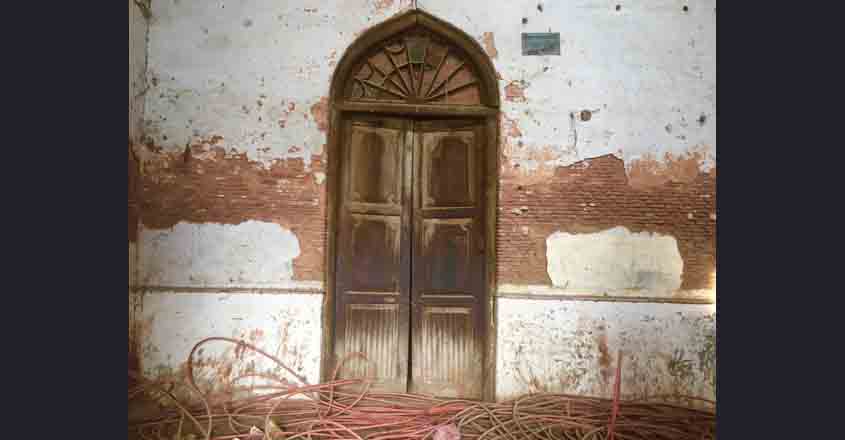
During my recent visit to Lucknow, I asked the person who ferried me around the city, to take me to this forgotten monument, tucked away in the crowded lanes of Qaiserbagh. When Google map ditched us due to poor network and left us amidst the labyrinth of congested by lanes, the human version of Google maps – paanwala (tobacco seller) helped us locate it. There stood the dilapidated structure which once upon a time heard the speeches of Mahatma Gandhi, Pandit Nehru, and many other visionaries.
The ground in the front of the monument is now a bus station. Lakshmi Narayan parked the car and since it had rained that morning, he asked me to get off from the other side to avoid a stagnated pool of water and filth. At present, one part of the decrepit structure is inhabited by a family of nonagenarian – C P Pandey, who was appointed as the caretaker of the club. The other portion is managed by the association and the only thing common between them is the illegal construction and encroachment, around which stands the cracking monument of Rifa, donning a lugubrious look.
I spent some time envisioning the past associated with it and wondering who is responsible for such sorry state of affairs today. Is it the people, ignorant of the past or the authority which has turned a blind eye to misdemeanour? Perhaps lack of pride in our glorious heritage.
I finally left with a heavy heart remembering Faiz and hoping one day Rifa would be restored.
source: http://www.travel.manoramaonline.com / OnManorama / Home> Travel> Reader’s Discovery / by Pragya Srivastava / July 17th, 2018
One of Kochi’s leading digital musicians, Salim Nair is busy getting his first digital record ready.
Digital musician Salim Nair (Photo |Albin Mathew/EPS)
At his soundproof studio in Kochi, digital musician Salim Nair stands in front of his LinnStrument as well his Ableton Push 2 midi controller. He is dressed casually in a white cotton shirt and grey trousers. The bespectacled musician then gently starts with a tap of one of the keys on the midi controller. The sound of a piano can be heard. This performance is seen live on Facebook.
And the name of the instrumental song is called ‘When love rains’. Soon, he uses the sax, sitar and the flute. After a while, the sound becomes mesmerising; there is a rise and fall in the tone. Salim gets so involved in the playing that he keeps swaying from side to side. In his other songs, the instruments he uses include the sitar, sarangi, sarod, violin, santoor, saxophone, brass, and the keyboard. “I also use synthesised sounds,” he says. On YouTube and Facebook, he has put up over 60 song/videos.
“I call it a digital art music show,” says Salim. “[The late American writer] Susan Sontag has said art music requires the listener to put in a little bit of effort into listening. My songs have a slow and nuanced development. You can get bored. So my target audience is anybody who can appreciate music as more than just being a background sound.”
Now Salim is busy working on bringing out his first digital art album, ‘Decohered’, a collection of tone poems, a few of which are based loosely on the works of the late Urdu writer Faiz Ahmed Faiz. Asked the charms of Faiz, Salim says, “His poems are very lyrical. It is very amenable to a song structure. I look for poems that can give me an emotional flow.”A trained Carnatic musician since his childhood, Salim felt disappointed by the limitation of the traditional sound. “I used to play the flute and it is monophonic,” says Salim. “It cannot produce more than one sound.”
The other problem was the structure of Indian classical music. “Until 25 years ago, there were very specific caste-based restrictions about what you can sing and perform,” says Salim. “Most temple sanctums are closed to everybody except the Brahmins. The music was specifically created to support this hierarchical structure.”
That is the structure that Salim wants to break. “I am using Carnatic idioms and making my own rules,” he says. “Think of this: you spend 12 hours a day perfecting a song sung by composer Thyagaraja (1767-1847). What is the point of that? Express what you feel not what some singer felt 170 years ago.”It was only when Salim, an electrical engineer by profession went to Philadephia, USA, in 1999 that he had a change of mind. While there, he realised that he could use the computer as a primary music instrument. “It has more capabilities than my single flute,” says Salim, who relocated to Kochi in 2014 and is working as a software programmer.
Asked the difference between digital and analog music, Salim says, “In analog music, we are physically using an instrument to create music. In digital, I am just changing data and this creates a different kind of sound. The production method is the biggest difference between analog and digital music.”As to the charge that there is less soul in digital music, Salim says, “Is the violin natural? There is so much engineering that goes behind the making of a violin. On the other hand, digital music is more malleable. I am transferring what I am thinking directly. I don’t have the constraints of a physical object.”
source: http://www.newindianexpress.com / The New Indian Express / Home> Magazine / July 07th, 2018
Yazin Nizar is elated to have made a place for himself as a playback singer
It was in 2002 that Yazin Nizar made his debut as a playback singer in the movie Punarjani, around the same time that he bagged the top prize of Gandharvasangeetham, a music show on Kairali TV. But that didn’t help him get more films. In fact, he had to wait for nearly 10 years to get his big break. Nevertheless, 2014 has given him reasons to be chirpy. “I sang some hit numbers in Malayalam and Tamil. Even though my career didn’t start off with a bang, I have made steady progress as a singer,” says Yazin.
These days, his song, ‘Kolusu Thenni Thenni’ from Cousins composed by M. Jayachandran [the “one crore song” that he sang with Tipu and Shreya Ghosal] is rocking the charts. Also, he is excited to have rendered the backing vocals for A. R. Rahman in Rajinikanth’s Lingaa, which is now in theatres, and the much-anticipated Vikram-starrer I. Meanwhile, his band comprising a group of friends has performed on many stages in India and abroad.
Now settled in Chennai, where he also has a flourishing career in the Tamil film industry, he was recently in the city to shoot for Music Mojo on Kappa TV and spend some time with his family in Pallimukku in Kollam district.
The 24-year-old says that he has had his share of struggles and disappointments. Post Gandharvasangeetham, though he was a member of the prize-winning team of the music show Sangeetha Mahayudham on Surya TV and title winner of a reality show on Jeevan TV, the journey has been no cake walk. “Although I recorded some songs with Sharreth sir and Shaan Rahman early in my career, they didn’t get noticed because the films didn’t do well. However, I got lucky by singing for Vidyasagar (‘Hayyo…’) in Spanish Masala. The songs in Thattathin Marayathu (‘Pranante naalangal’) and Ozhimuri (‘Vaakkinullile…’) came as a big bonus,” he says.
Later, he got a break in Tamil, thanks to his decision to move to Chennai to study for a management degree and pursue a career in music as well. His debut song, ‘Avatha Payya…’ from Paradesi, composed by G.V. Prakash Kumar, was a hit and he started getting more songs in Tamil. In the meantime, he got to sing in Telugu and Kannada as well.
“If there is a flood of singers in Malayalam, there are even more of them in Tamil. There must be some 25,000 registered singers in Chennai. What really makes me happy is that, be it in Malayalam or Tamil, I have worked with some of the best composers. The important fact is that my voice has never been stereotyped. I have sung songs of different genres and styles,” he says.
He credits his father, Nizar A., for his inclination to music. “More than my studies, my father took an interest in my singing career. He is a great music lover and a huge Mohammed Rafi fan. In fact, whenever we had power cuts, my father and I listen to Rafi songs on our battery-run tape recorder and sing along,” says Yazin, who has learnt Carnatic music.
With his good looks complementing his rich voice, he should be getting acting offers as well, right? “Oh…yes. I sang as well as acted in the Hindi song, ‘Zindagi…’ in Angry Babies in Love. But right now my focus is on singing. I want to sustain the good run and don’t want my career to fizzle out,” he signs off.
Short notes
Yazin has worked with composers Sharreth (Nalla Pattukare), Ouseppachan (Musafir), Deepak Dev (101 Weddings), Vidyasagar (Spanish Masala, Bhaiyya Bhaiyya), Bijibal ( Ozhimuri, Vikramadithyan, Angry Babies in Love), Shaan Rahman (Thattathin Marayathu, Praise the Lord), M. Jayachandran (Cousins), G. V. Prakash Kumar (Paradesi), Yuvan Sankar Raja (Poojai), Ghibran (Amarakavyam, Thirumanam Enum Nikah) and others.
source: http://www.thehindu.com / The Hindu / Home> Metroplus / by Athira M / Thiruvananthapuram – December 17th, 2014
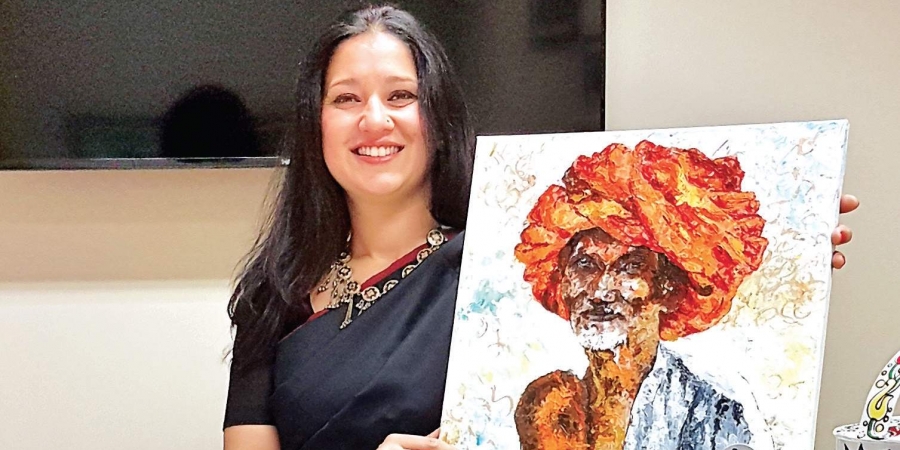
Lucknow-born Bushra Hasan, who has made her mark in Australia through her Indian-influenced art, now wants to use it as a therapy.
Bushra Hasan
If art enables us to find and lose ourselves at the same time, Lucknow-born graphic artist Bushra Hasan has used art to create an identity for herself Down Under, her new homeland. Hasan, who moved to Australia in 2013, has added beautiful hues to her varied creative portfolio.
In five years, her different strokes have left an indelible mark on the artistic landscape in Australia, and made Hasan a name to reckon with for her brushwork. Be it the painting of a life-size puppet elephant for Moomba Parade, or the Indian truck style art adorning the trams of Kolkata and Melbourne, or the recent community art workshop that she held for immigrants, the shades of her creative sensibilities have charmed one and all.
Armed with a mixed bag of experience in designing newspaper pages and magazine covers in India, Hasan moved to Australia’s cultural capital Melbourne after “falling in love with its vibrant, stylish and arty feel”. The City of Secrets embraced the artist and her India-influenced art with open arms, and she went on to join the Multicultural Arts Victoria (MAV) as Community Liaison Officer in 2018.
“I started looking for jobs after moving to Melbourne. In between, I also launched my art brand Indybindi and started putting its products in various makers’ market. People noticed my art and MAV expressed its keenness to hire me to conduct workshops. In January 2015, Moomba Parade organisers approached me to paint a life-size puppet elephant in Indian art style, and they have used it for all parades since then,” she says.
MAV introduced her to Roberto D’Andrea, a former tram conductor, and an activist who had been working on the unusual friendship between Melbourne Tramways and Kolkata Tramways for 21 years. “Kolkata Tramways had sent an SOS to all the tram-running cities requesting them to put pressure on the West Bengal government to rethink its decision to abolish trams in Kolkata. Only Roberto responded and went there with his team, collaborated with Indian activists and organised shows, etc., that worked and the state government postponed its decision,” she says, fondly recalling her artistic collaboration with Roberto. She used kitschy Indian truck art style to tell the story of 21 years that found its way to the trams of Kolkata to celebrate the iconic tram friendship between the two cities.
“Indian tribal art hugely inspires me, and I am proud to flaunt my Indian roots in my artwork,” she says. Hasan redesigned her artwork and turned it more colourful, and reflective of India’s diverse artistic culture and submitted her entry for the 5th edition of the annual Melbourne Art Trams project. She was one among the eight artists whose design made the cut, and Tramjatra, her artistic tribute, chugged along, happily for seven months from October 2017 to April 2018 on the trams in Melbourne.
She recently led a nine-day long art exhibition for people to share their ‘immigrant journey’ through art at the Emerge In The North festival. “The workshop was an effective step towards building relationships within the community,” she says.
Having used art to create an identity, she wants to use it to heal others. Talking about her next project, she says, “I want to do a lot more to keep myself creatively engaged. I am working on a module that will focus on helping children who are victims of sexual abuse to overcome their trauma through art therapy, heal themselves, and emerge stronger.”
Allapra (Kunnathunad Taluk – Ernakulam Distirct ), KERALA :
Mr Nizar has won the district-level best innovative farmer award in aquaponic farming.
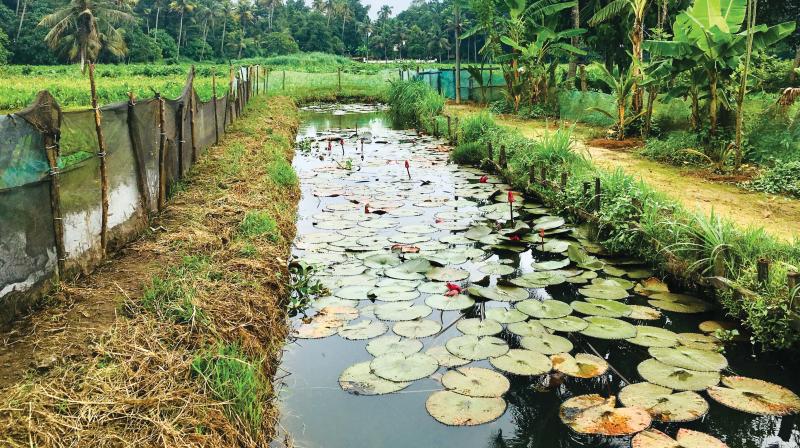
Scenes from the compound of Nizar’s plywood unit
Kochi :
At a time when green experts debate impacts of highly polluting plywood companies in Perumbavoor area, a plywood unit owner from there has bagged the state’s award for best innovative farming. Nizar M. M. from Allapra is a role model for entrepreneurs on how to convert a polluting industry environment-friendly and farming on its premises.
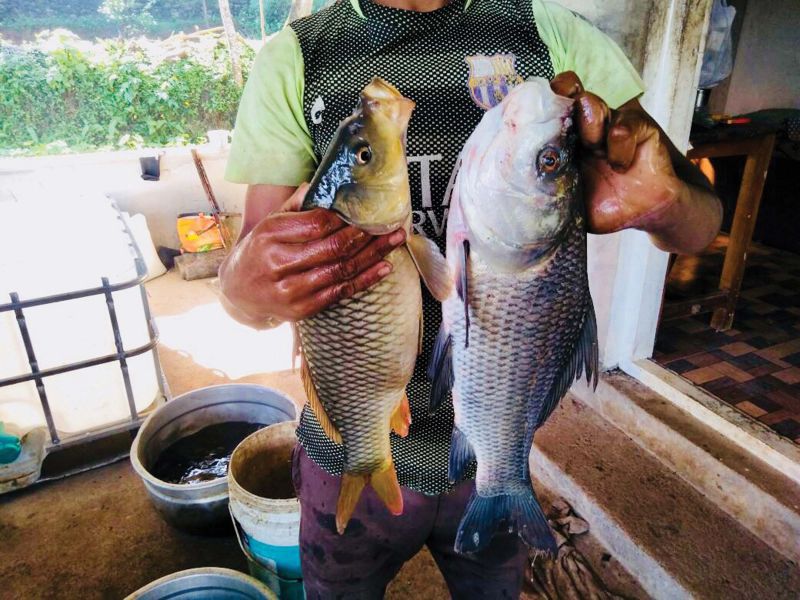
The more than four acres of land where the plywood unit is situated has been developed as an organic aquaponic fish, vegetable and dairy farm by spending Rs 50 lakh. Mr Nizar has won the district-level best innovative farmer award in aquaponic farming. “We’ve initially taken up farming at the plywood company compound to minimise damage to the environment. Later, it has been expanded, and now the four-acre organic farm produces vegetables, fish and milk,” he said.
“The aquaponic farm was set up on an experimental basis spending `1 lakh, six months ago. Now, fishes from the farm are being sold at markets in Perumbavoor and the 20-20 food security market at Kizhakkambalam. Milk of the six indigenous Vechur dwarf cows on the farm is a most sought after.”
Fishes are given only organic feeds and waste from the fish ponds is used as organic manure for corn, sugarcane and vegetable cultivation. There are plans to develop the aquaponic farm at an estimated cost of Rs 6 lakh with a government subsidy of Rs 2.5 lakh.
Mr Nizar also plans to set up an organic coconut oil manufacturing unit and a goat farm soon.
The more than 100 migrant workers of the plywood unit are staying in the company compound, and their food is being made of organic vegetables and fishes from the farm.
source: http://www.deccanchronicle.com / Deccan Chronicle / Home> Lifestyle> Pets and Environment / by Smitha N, Deccan Chronicle / July 13th, 2018
“Honesty is a very expensive gift. Don’t expect it from cheap people – Warren Buffett’.
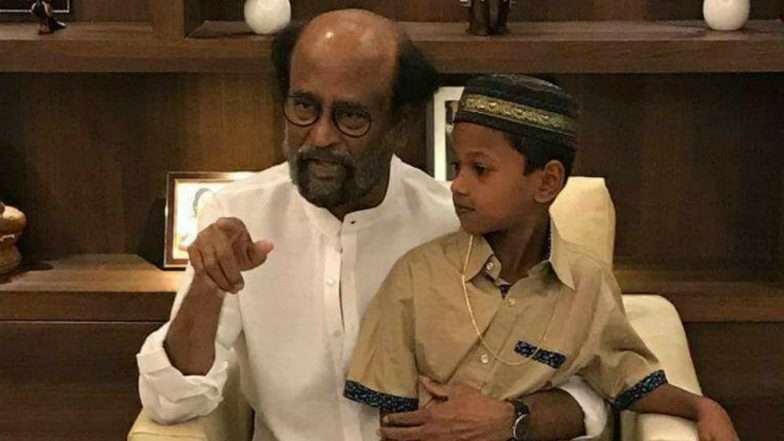
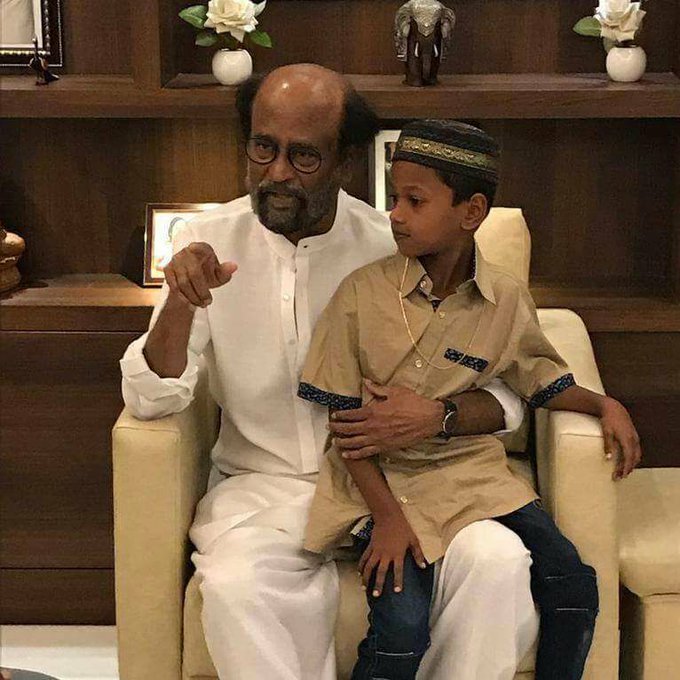
Rajinikanth with the kid (Photo Credits: @rameshlaus/Twitter)
Mohammed Yaseen appears as any regular kid, but he possesses something that not even the best of men does – the gift of honesty. The young boy from Erode, a municipality in Tamil Nadu depicted a rare act of virtue that left none other than superstar Rajinikanth.
Yaseen who had found a bag containing Rs 50,000 chose to return to its rightful owner. Mind you, he belonged to an economically backward family, but that didn’t deter him from doing what is right. Mohammed Yaseen’s honesty was not only acknowledged, but the actor-turned-politician Rajinikanth offered to help him with his educational expenses.
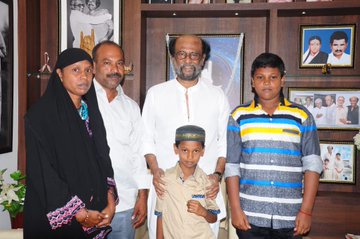
Ramesh Bala, an entertainment industry tracker, shared pictures of Rajinikanth meeting young Yaseen at a felicitation ceremony held in honour of the boy’s remarkable deed.
Bala captioned the image of the boy sitting on Rajinikanth’s lap by writing, “#Superstar @rajinikanth met the #Erode Kid #MohammedYaasin who handed over ₹ 50,000 he found near his school to Police Authorities.. #Superstar is very impressed with the kid’s honesty and assured financial help for his future studies.”
#Superstar@rajinikanth met the #Erode Kid #MohammedYaasin who handed over ₹ 50,000 he found near his school to Police Authorities..#Superstar is very impressed with the kid’s honesty and assured financial help for his future studies..
Mohammed Yaseen’s parents were also present at the event. The boy’s mother and father looked proud of their son’s deed as Rajinikanth also met them. It was so pleasing to see the South Superstar who is admired by millions across the globe be mighty impressed with the young kid.
Rajinikanth was quoted saying about Yaseen, “What honesty. Despite being from a poor family, he said, ‘this is not my money’ and handed over to the police.” The superstar further made a heart-warming statement, “I will take care of his entire educational expenses, whatever field he wants to pursue. I will consider him to be my son.”
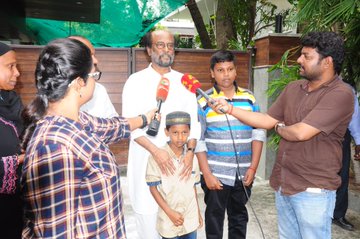
The Kaala actor was beaming with pride narrating to the reporters how Yaseen had told ‘This is not my money’ before handing it over to his school principal who took him to hand it over to the police.
Yaseen had found a bag containing cash near a bush close to his house in Erode. Without having a second thought of keeping it with himself, the boy rushed to take the matter to his school authorities. Just like Rajinikanth, we are also simply blown away by the little boy’s act of honesty.
source: http://www.latestly.com / Latest Ly / Home> Viral / by Rashmi Mishra / July 15th, 2018