While many people have expressed their dissatisfaction about Chief Minister H.D. Kumaraswamy (HDK) for not sanctioning any funds to Kodagu in his Budget, this little boy from Yemmemadu village near Napoklu takes the cake. In a video that has gone viral, the boy vents his anger at the CM and at the same time highlights how Kodagu is ravaged by rain and how man-animal conflict has made lives miserable in this tiny district.
In the video, the Class 8 student, Kallira Fateh, son of Kallira Ummar and Rukya, says the district which has given River Cauvery to Mysuru, Mandya, Bengaluru and Tamil Nadu has got nothing from Kumaraswamy.
Hailing from a farming and daily wager family, Fateh, holding an umbrella, is seen pleading with the CM to provide relief to the rain-affected Kodagu farmers. Taking a dig at the Chief Minister for ‘neglecting’ Kodagu district in the Budget, Fateh said, “Mysuru, Mandya and half of Tamil Nadu get water, if it rains in Kodagu district. But the unrelenting rain has destroyed coffee, pepper, areca and paddy crops in Kodagu.”
“The wild elephant menace is on the rise in Kutta, Birunani, Balele and Ponnampet because of which daily wagers and agriculture farmers fear to venture out of their houses. The rain-battered Kodagu-Kerala Road has become non-motorable. “Who should people approach to get their problems addressed? It is you (CM), who else,” he said.
He continued, “Kumaraswamy has meted out injustice to Kodagu by not sanctioning grants to Kodagu and added that the CM should treat all districts equally.”
The boy then addressed BJP State President B.S. Yeddyurappa to impress upon Prime Minister Narendra Modi to announce compensation for the distressed farmers.
“Modiji is Prime Minister for 130 crore people of the country. He should treat people of all religions and castes on equal footing. This holds good for the CM too,” Fateh said.
The video went viral and reached the CM too. Kumaraswamy told reporters in Bengaluru that since Independence, many rulers have come. “Why am I being targeted, that too after taking charge just two months ago? I know about the problems faced by people of Kodagu. I will visit Kodagu and stay there for two days and hear the grievances of people and solve their problems,” he said. Fateh’s father Umar said his son was pained by the destruction of standing crops on 3,500 acres of paddy fields in the village.
“Our paddy field has been waterlogged for the past 13 days. No official or people’s representative visited our area. In our village, we get electricity only for six months a year. All this upset him,” he said. “I’m happy that the State Government and the CM have responded to our demands,” he said.
source: http://www.starofmysore.com / Star of Mysore / Home> News / Madikeri – July 15th, 2018
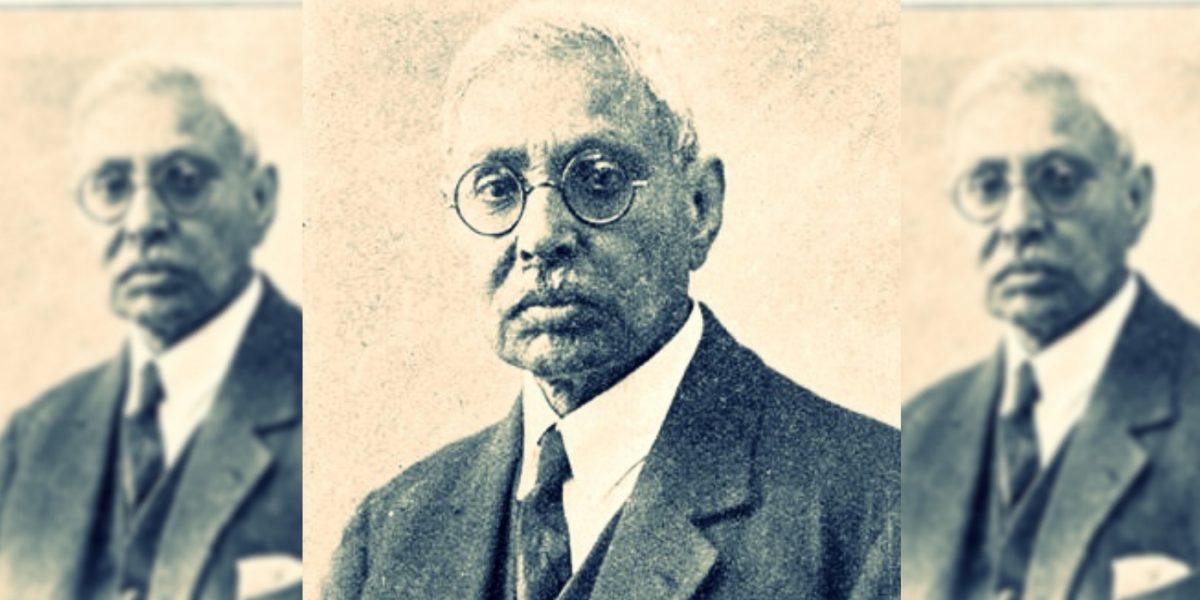
Maulvi Barkatullah Bhopali believed the spirit of Marx’s thought and divine religions was the same. “The objective of both is to provide a dignified and peaceful life to the oppressed.”
Maulvi Barkatullah Bhopali, who was born 164 years ago this month, was a glorious standard-bearer of the Indian independence movement. He toured Great Britain, Europe, Japan and America, in addition to the Soviet Union in connection with the struggle against British imperialism. He was among those few ulema who travelled to Moscow in May 1919, just a short period after the Bolshevik Revolution; he saw the conditions there with his own eyes, and met Lenin and other Bolshevik leaders. During his stay in Moscow, he said during an interview with the Izvestia newspaper:
“I am not a communist or a socialist, but right now my political program includes throwing the British out of Asia. I am a staunch enemy of European capitalism in Asia. Therefore, there is complete compromise between myself and the communists over these objectives and we are allies on this field. I do not know what shape the future events will take, but what I can definitely say is that the famous appeal of the Soviet government of Russia, in which the people of all nations have been requested to rise up and conduct jihad against capitalists, has greatly influenced us, and what we like more than that is that the Soviet Union has revealed all the secret agreements (between Russia and Great Britain) whose objective was to enslave other nations, especially the Eastern nations. Not only this, but the Soviet Union has unilaterally cancelled all such agreements. Russia accepts the principle of equality and evenness between all small and great nations. The ideas of the Bolsheviks, which we call socialism, are also making a place in the hearts of the common Indian people.”
In his book, Bolshevism and Islamic Nations, Maulvi Barkatullah writes, “The actual spirit of Marx’s thought and divine religions is the same. The objective of both is to provide a dignified and peaceful life to the oppressed, punished people of god by freeing them from cruelty and oppression.”
“The philosopher Plato has presented such a map of his ideal Republic in which ownership would be common and public. The provision of basic needs, sources of entertainment, opportunities for employment will be equal for all. Because of the progress of education, every individual of the nation will benefit from knowledge in a way that his every act will be reasonable and right. These are the basic principles on whose foundation Karl Marx presented the majestic structure, behind which was the knowledge and experience of many generations,” he continued.
Maulvi Barkatullah bemoans the fact that in his time, there is not even a single Muslim kingdom which can be called independent in a meaningful sense. He writes, “Today not even a single independent Muslim state remains because Muslim countries have been subdued at the hands of British imperialism and the dictatorial royal tsar, French or Italian colonialism in the 20th century. They are being fully exploited.”
But he is not hopeless with this situation. He says,
“There is no cause for hopelessness. After the dark night of the czar’s oppression and tyranny, the dawn of human freedom has arisen on the horizon of Russia in which Lenin is giving the good news of human prosperity, sprinkling the light of his ideas like the sun (sic). That grand scheme which was presented 2000 years before by the philosopher Plato, which was transferred as a great heritage from one generation to the other; today the principles and ideologies of this ideal republic are being given practical shape. Under the leadership of Lenin, this is being popularly accepted as a reality. Across the length and breadth of Russia and in Turkistan, the entire arrangement and administration has been given to workers, people employed in agriculture and ordinary soldiers. The equal rights of all classes and nations have been accepted, every individual has been guaranteed a better life.’
Maulvi Barkatullah not only completely supported the Bolshevik government of Russia, but appealed forcefully to the Russian people, especially the Muslims of the eastern region, to support the Soviet government wholeheartedly and array themselves against its enemies so that the successes of the revolution could be defended; and the intervention and conspiracies of the imperialists could be countered.
He says, “Now the time has come that the Muslims of the whole world and Asian nations obtain complete information about Russian socialism, understand those golden principles and accept them with full passion and sincerity. The noble and high objectives hidden in the foundation of this modern system demand that Muslims should completely support and defend it. They should unite with Bolshevik forces to make the aggression of British followers and other tyrant rulers unsuccessful; send their children to Russian schools without wasting time so that they can obtain modern science, high arts, practical physics, chemistry and mechanical technique.’
In her book, Haj to Utopia, Maia Ramnath writes that Barkatullah “single-handedly embodied the overlap between the Bolshevik and Pan-Islamist networks, utilising the connective tissue of the Ghadar infrastructure to do so. She cites a foreign office report of 1915 as saying: “It would appear that Barkatullah was a sort of connecting link between three different movements, namely, the Pan-Islamic, Asia for the Asiatics and the Indian Sedition”. A German diplomat wrote that he was “first in line a nationalist and then a Moslem”.
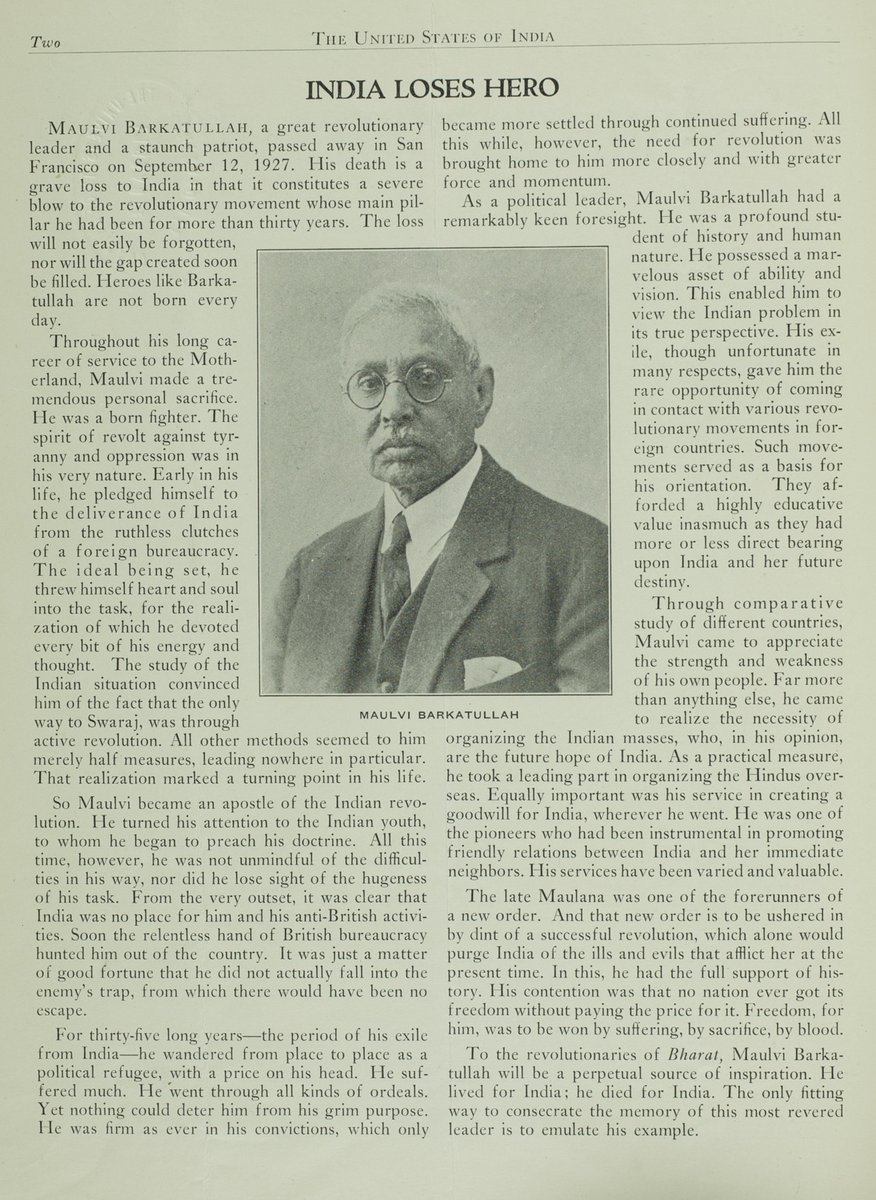
Maulvi Barkatullah’s was a warrior life. He passed away in San Francisco on September 20, 1927.
Tribute paid to Barkatullah in the United States of India, a publication of the Ghadar Party in the United States, in 1927. Credit: South Asian American Digital Archive
Barkatullah had been one of those who had backed the Ghadar uprising against the British during and after World War I. In a tribute to him after his death, published in the United States of India, a publication of the Ghadar Party in the US, the magazine wrote:
“To the revolutionaries of Bharat, Maulvi Barkatullah will be a perpetual source of inspiration. He lived for India; he died for India. The only fitting way to consecrate the memory of this most revered leader is to emulate his example.”
Raza Naeem is a Pakistani social scientist currently teaching in Lahore. He is also the president of the Progressive Writers Association in Lahore. His most recent work is an introduction to the reissued edition (HarperCollins India, 2016) of Abdullah Hussein’s classic novel The Weary Generations. He can be reached at: razanaeem@hotmail.com .
source: http://www.thewire.in / The Wire / Home> History / by Raza Naeem / July 15th, 2018
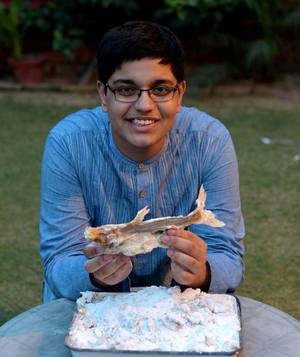
Early start: Arsh Ali shows off his mummified shark. | Photo Credit: Rajeev Bhatt
At 17, Arsh Ali is an archaeology prodigy, already participating in ASI digs and seminars
Three months ago, Arsh Ali lost a coveted member of his aquarium: his little pet shark. But instead of disposing of its body, Arsh buried it in a tray filled with natron. A complex salt known for its ability to dry things up, natron is naturally available in Egypt, but Arsh had to create it by mixing multiple chemical elements.
He has learnt the method from the ancient Egyptians, about whom he knows much. “There is no foul smell or any organisms growing in it, even after so many days,” says Arsh, smiling proudly and pointing to the tray with the dead shark in the lawn of his house in Allahabad. His goal is to mummify his pet shark just like the ancient Egyptians did.
Pharaoh bread
Arsh’s knowledge of Egyptian history, archaeology and mummification runs deep: he has researched coffins, funerary hieroglyphic inscriptions and even knows how to make bread like the ancient Egyptian did. “Every other day he cooks something for me,” laughs Fatima Ali, Arsh’s mother.
At 17, Arsh is already an archaeologist, although he doesn’t have a formal degree yet. Unlike most kids his age, Arsh spends much of his time researching ancient history, visiting digs, attending seminars, and delivering lectures on history and archaeology.
Acknowledging his talent, the Archaeological Survey of India (ASI) has been inviting Arsh since 2015 to their programmes, seminars, excavations and explorations, a privilege often restricted to post-graduate students of archaeology. Arsh has so far taken part in seven excavations and explorations. His first tryst was with the excavations at Binjor in Rajasthan in 2015-16 under the ASI, followed by those in Rakhigarhi, the largest known Harappan site in Harayana, conducted under the supervision of Deccan College in Pune.
“The Harappans were excellent craftsmen. Even 5,000 years ago, they produced a lot of things,” says Arsh as he describes each dig in detail. The cupboard of his room is crammed with specimens he has brought back from sites for further study: wheat grains, terracotta bangles, pot shards, shells, neolithic tools, starfish, and an octopus.
Arsh’s adventure with art and archaeology started early. His parents, Fatima and Faisal, were convinced from the start that their son was special — when he was six, for example, he sat at a restaurant in Kathmandu and sketched the Pashupati temple on a paper napkin in one shot, down to every dome and flag.
When he was in Class VIII, during a visit to Bara Imambara in Lucknow, the family met the site conservator of ASI who was impressed with Arsh’s knowledge. One thing led to another and soon Arsh was participating in ASI fieldwork.
Arsh knows 15 languages, including Hebrew, Arabic, Brahmi, Greek, Ugaritic, Nabatean and Phoenician, besides Kharosthi and Hieroglyphics. He credits his precocious knowledge to curiosity and reading. “I did nothing but read books, and purchased nothing but books every time I got an opportunity,” he says.
Smitten with Anubis
Ancient Egypt had him hooked early. “When I was five, I had an encyclopedia on Ancient Egypt. I didn’t knew how to read and write then, but that’s when I came across an image of Anubis, half-human, half-jackal.” He was smitten with the Egyptian god of mummification.
Arsh’s archaeological interest has culminated in a quest: he wants to establish the evidence of the existence of Buddhism in Egypt by tracing the route of the Buddhist emissaries of the Mauryan emperor Ashoka in Ptolemaic Egypt in particular, and the Hellenistic world in general.
He delivered a lecture on the subject at the National Museum in Delhi last month, and visited Egypt a few months ago.
Arsh was allowed access to the antiquities at the national museums in Cairo and Alexandria, where he came across plenty of evidence to substantiate his theory: a coin with details of King Ashoka, literary references, terracotta items, objects of Indian art, and Brahmi inscriptions on pots. When asked about future plans, Arsh says, “I want to gift something to the world, something that might be useful.”
omar.rashid@thehindu.co.in
source: http://www.thehindu.com / The Hindu / Home> Society> Profile / by Oman Rashid / July 14th, 2018
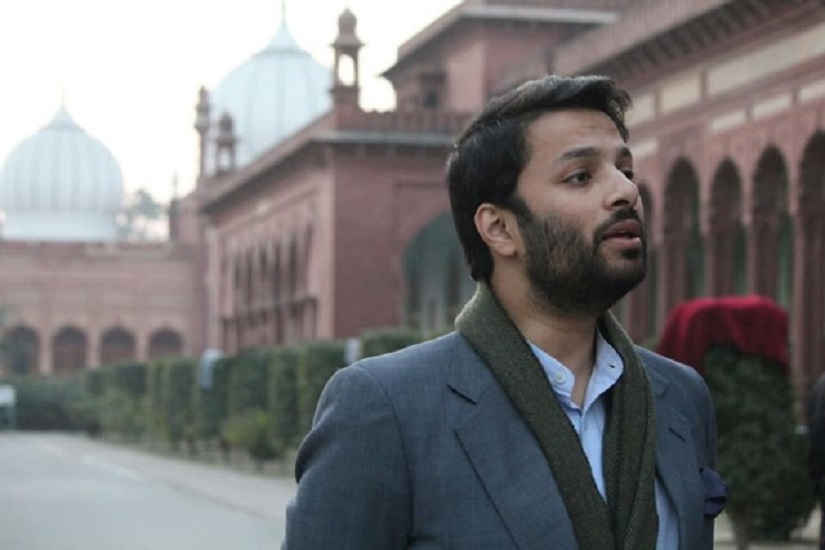
Dr Ali Khan Mahmudabad has come to be one of the world’s foremost voices on Muslim issues. His writing spans across publications and languages, from Huffington Post to The Indian Express, from Urdu to French. Outside of being a journalist, he teaches history and political science at Ashoka University and also advises think tanks on subjects such as politics, religion and security in South and West Asia.
In his new book The Making of North Indian Muslim Identity: Poetry, Politics, and Religion 1850–1950, he talks about the role of poetry in expressing identity, particularly what it meant to be both Muslim and Indian in a time of sociopolitical exigency. The book charts the rich history of the mushā‘irah (poetic symposium) and investigates changing notions of nationality and patriotism in that space. It offers new perspectives on how Muslim intellectuals, poets, political leaders, and journalists conceived of and expressed their relationship to India and to the trans-national Muslim community.
Mahmudabad spoke to Firstpost about the impact of literature and poetry on shaping political identity and the role of Muslim identity in Indian politics.
Why have you chosen to look at Muslim-Indian identity from the viewpoint of the mushā‘irah?
From its inception, Islam fostered a culture of ‘orality’. Poetry, of course, was and has been one of the most important ways in which Muslims have grappled with questions to do with religion, culture, politics, history not to forget love! This tradition of reciting poetry publicly and the prominence poets were accorded by society in general and elites in particular continued before and during the life of the Prophet and thus gradually poetry became interwoven and inextricably linked with many Islamic traditions beyond just the Arabic speaking world. The tradition of public poetry recitals was a prominent part of various other Muslim societies, notably Persian, though what sets the mushā‘irah apart is that it is, as is argued in the books, part of a distinctly Indo-Islamic heritage. In India, of course, there was already a long tradition of such gatherings such as the gosthi in Malyalam or the Kavigon in Bangla.
Ali Khan Mahmudabad’s new book is titled The Making of North Indian Muslim Identity: Poetry, Politics, and Religion 1850–1950
In India, political polarisation that began to crystallise in the 19th century largely revolved around religion and language. The so-called Urdu-Hindi language divide is perceived to have been one such intractable binary and there has been much academic work questioning this. The differences that did exist tended to focus on the script but with the mushā’irah, an oral space, the problem was script was of course absent. This combined with the fact that the main theme of ghazals was to do with absent beloveds meant that the mushā’irah was a cosmopolitan space that acted as a bridge between members of various communities. The importance of the mushā’irah was also underscored by the fact that the British also chose to patronise them and use them to try and catalyse new directions in Urdu poetry that dealt with the material and natural world. Despite this, of course, the power of the ghazal — the power of love — continued and to this day remains a unique feature of the mushā’irahs history. In the quest for locating and trying to understand what the ‘public sphere’ was composed of in the period before the creation of the Indian nation-state, the mushā’irah offers a window into how poets from a variety of backgrounds were grappling with rapidly changing social, political, cultural, economic, religious and even technological changes. Although not within the purview of this book, but part of my other research focuses on other spaces that have not been explored enough because our conception of what constitutes the public sphere derives mostly from European definitions. Thus spaces in and around shrines and temples, public religious processions and other institutions, both physical and more liminal, allow us to track the manner in which people were reacting to the tumultuous changes at the end of the 19th and beginning of the 20th century.
How do you think the Indian Muslim identity has evolved since 1950?
Rather than speaking of evolution, it is better to speak of changes. Of course in a country as large as India it is impossible to generalise. There are dozens of different schools of thought and sects beyond the lazy binary that people are prone to use of Shia and Sunni. However, it is safe to say that following the Constituent Assembly debates and in the decades following partition, questions to do with Muslims in the political sphere largely revolved around cultural, religious and linguistic rights and social (eg. caste), political and economic questions do not get as much attention.
Apart from this, the manner in which land reform was carried out, particularly in a place like Uttar Pradesh, meant that many institutions, like religious trusts, madrassas and charities amongst others looked elsewhere for patronage, often looking to the greater Middle East. More recently with market liberalisation, ease of travel and the rise of social media new questions have begun to arise about what it means to be authentically Muslim as Indians see how people in other parts of the Muslim world practice their religion. Indeed many of the identity problems that emerge in many parts of the world are precisely because the Mirpuri, Bengali or Bihari Muslim is forced to confront questions about his or her religious and cultural practice when they meet Arabs, North Africans, Turks, Iranians and others at the local mosque who do things a different way. A substantial number of Muslims from various parts of India have also now spent considerable time working in various parts of the Arabian Peninsula and this too has brought about interesting socio-cultural and religious changes although data is still hard to come by.
All these aspects have also had an impact on material culture. I think this has also sadly led to a number of misconceptions. For instance, a prominent columnist complained that she was seeing many more hijabs than she used. Of course, she saw this a sign of increasing religiosity but the truth is that a lot of these women who choose to wear the hijab are doing so and coming out to work rather than staying at home as might have been more common even a few decades ago. The hijab in a sense has been something that has facilitated this transition. This is just a small example but the point is that young Muslims are adapting to the times while also proudly being rooted in their religious identity.
Politically speaking, it was already clear pre-1947 that there is no such thing as a Muslim vote bank although this myth is still propagated by parties seeking to polarise or counter-polarise electorates and one thing that remains the same from, say, the 1937 election to now is that while voting Muslims take into account a huge range of local and regional factors and therefore do not vote solely on the basis of religious identity.
Do you think that literature and poetry still have the same effect in shaping sociopolitical identity?
Literature and poetry continue to have a very important role to play. Mushā’irahs are as important as ever and are held everywhere, from small towns in UP to Delhi and even Dallas and Dubai. Poets tend to be revered and although most literary critics and scholars would say that the quality and level of poetry has fallen drastically, the fact remains that poetry, in whatever form, still remains an important form of entertainment and even political resistance. The rise of literature festivals — like Rekhta — the popularity of Rana Safvi’s #shair and Javed Akhtar’s ‘Rediscover Poetry’ as a paid service for Tata Sky’s Television network are just some examples of how Urdu in particular remains curiously popular despite the number of official Urdu speakers in North India falling according to latest census figures.
Away from the internet and large metropolises, poets like Kumar Vishwas and Imran Pratapgarhi recite to audiences of thousands even in far removed and remote areas they are treated like rock stars. Some critics complain that the quality of this poetry leaves much to be desired but then again I think these poets are responding to changes taking place in society and are able to detect the pulse of the people which often means that it might not be high literature or refined poetry but nonetheless it reflects the tastes and mindsets of the audience. Literature in various Indian languages continues to be tremendously important and has a high readership across the country despite the fact that English is muscling out these languages because it has more utility in ‘aspirational’ India.
You explore the idea of hubb-e watanī in your book. In what ways did patriotism evolve under the purview of your book?
Well, it took a book to answer this question so you will have to read it! What I try and trace is how people’s sense of belonging and rootedness changed over a period of more than 100 years. So I start with the shahr ashob genre, literally the affliction or lament of the city, in Urdu as opposed to its Persian roots. Many poets following Nadir Shah and Ahmad Shah Abdali’s attacks on Delhi fled and articulated a sense of grief and longing for the loss of their homes. Of course, this was an elite response and was limited in its scope but what is interesting is that people used poetry to confront this trauma, as poets have for millennia. This displacement and loss continued into the 19th century and the trauma of 1857 was again grappled with through poetry.
Following the rise of the colonial government and its desire to ‘order’ society through census’, categorisation, knowledge creation etc and the influx of new ideas of what constituted the natural world, of nationhood and citizenship, people had to yet again grapple with an entirely new vocabulary. I would go so far as to say a new moral vocabulary was created to cope with these changes and this even affected something like poetry because the British tried to ‘reason’ that poets should give up their more ‘hedonistic’ symbols and concentrate on writing natural poetry. The nazm as a form of poetry really fully came about in this period of the last quarter of the 19th century. The importance of the local and regional remained but it is safe to say that there was something of a shift from imagining India in more metaphysical terms to articulating a more material conception. In a sense, I think this is where the problem began because it is much easier to differ about material identifiers than metaphysical ideas. People from various communities obviously had different ideas of the material markers that defined India. In addition to this, an understanding of ‘their’ history, which at the time was particularly influenced by what the British and others came to define as history, became more exclusionist and the categories through which people defined themselves more rigid.
At the same time the telegraph, ease of travel and print technology opened up new vistas for people and so news from Ottoman Turkey or Libya could travel to India relatively quickly. Imperialism and colonialism’s global net of oppression also opened up people to the suffering of others and thus you begin to see the umma or community of Muslims emerge as a political category. Of course, the umma is not something new to this period and has its roots in the Quran but the manner in which it was seen towards the end of the 19th century is somewhat new. Interestingly, the spectre of ‘pan-Islamism’ or some kind of global Muslim threat that is often talked about today can already be seen in colonial archives where movements for freedom and independence were immediately dismissed as the result of the violent machinations of Muslims.
Today the question of Qaum vs Umma or nation vs community is something that is brought up again and again all over the world but I hope that my work shows is that these two categories need not be contradictory and indeed how poets, in particular, were able to negotiate both while also being anchored in the local or regional. I think the tragedy is that identity as it exists in the modern age privileges binary and fixity or even rigidity while we see that even in the period before the creation of the Indian nation-state, people had managed to come up with novel ways of resolving perceived tensions which demonstrated how fluid and malleable identities were.
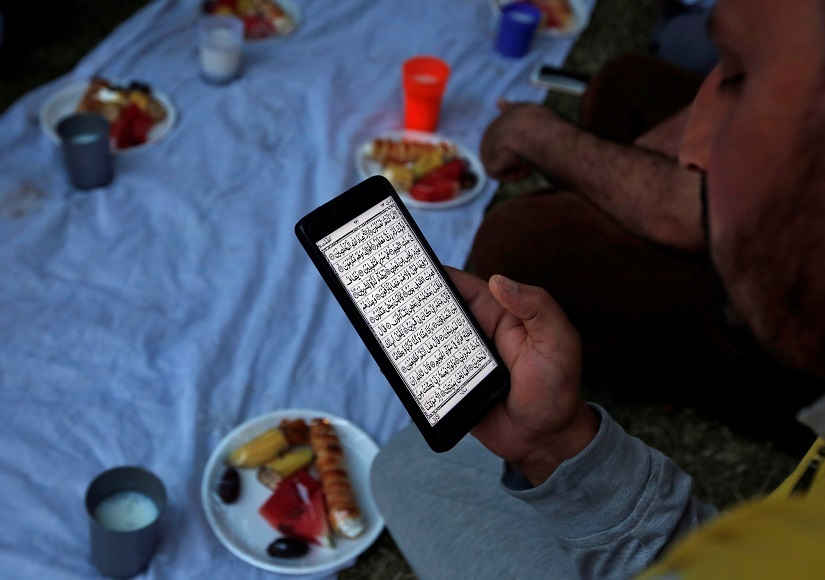
A man reads the Quran on his cellphone. REUTERS
How have your students influenced the way you look at your work?
Most of this work was carried out before I began teaching, but I have used some of it in my class called ‘Political Thought in the Age of Nationalism.’ My students come from highly diverse backgrounds from all over India and even from other parts of the world and so it is useful to see how deep differences go within a small group of 10-12 people let alone an entire country. Many of the students have pushed me to think more about Partition and its aftermath, particularly because many of them, indeed many of us, inherit history which we might not always have the tools to deconstruct and understand. On the first day of classes, I ask students to write an essay on what nationalism means to them and I allow them to write in any style they wish. These essays have been eye-opening for me in terms of trying to understand how from a very young age people are exposed to narratives and stories that that on the face of it are harmless but put in a larger perspective show just how divisive they can be. What was refreshing to see was how the students were already critically aware of this and indeed it was interesting for me to see and try and understand the mechanisms through which these young people have tried to resolve or reconfigure pressing questions to do with their identity. Sometimes, there has been a student who points out a new way of reading or understanding a poem based on a perspective that had eluded me. While this might be articulated through asking a question, the question in itself allows me to learn and this is truly one of the pleasures of teaching.
You have seen the Muslim identity expressed in many different ways across the globe. How similar or different is the Muslim identity in the Middle East from that of India?
Nowadays it has become very fashionable to talk of Indian Islam, particularly in counter-terrorism and countering violent extremism circles (CVE). I am afraid this kind of talk is rather reductionist and frankly is more telling of the political exigencies faced by political and security establishments rather than anything deeper. Of course, because of historic differences and more importantly because of language and culture, there are differences in the manner in which Islam became embedded in different geographic areas but this does not mean that its essence is different in India from say Iran or Egypt. In fact, I would caution you in using the binary of the Middle East and India because both these terms also gloss over the fact that there is huge diversity in them internally.
During Hajj, for instance, people are largely divided according to nationality but traditionally and even now there is an awareness, even a recognition I would say, amongst the Muslims who go on the pilgrimage of a shared spiritual bond with people from vastly different ethnic, racial and cultural backgrounds. Now the fact remains that the rituals, customs and manner in which Islam is practiced in India is inevitably affected by the fact that these came about over the course of centuries in a particular context. Thus, in terms of even something as abstract as beauty or aesthetics, there will be a difference between how an Algerian Muslim defines what is beautiful and how a North Indian Muslim might define it. Both will be circumscribed by parameters that are laid out according to Islamic principles, and these might be very broad, but within these, they might be radically different.
You see, religion cannot exist in isolation from culture, language and I would even say geography and technology — and so the differences that we see between various parts of the Muslim world are not simply religious differences but also differences that arise from these other factors. Of course with the rise of the internet and social media, people are grappling with the mind-boggling diversity amongst Muslims across the world, particularly as debates rage about what is and what is not authentically Islamic. In some instances, there is probably an insecurity that develops when people in South Asia or South East Asia see how Muslims practice their religion in the Arab world but these are such large changes that I don’t think much can be done about them. The rise of a more puritanical and literalist Islam across the world is as much the result of the modern world than anything else because it needs the least amount of cultural mediation and seeks to create a more uniform globalised Muslim identity. Of course, these are issues that will play out over the next decades and it is too early to begin to make any kind of substantial claims.
What role do you think religion plays in India’s politics today? How do you think the Muslim identity is represented in Indian politics today, if at all?
Religion is ubiquitous in Indian politics. Our Constitution, which I think is a remarkable document, is something that is anchored in values and principles that took more than 300 years to organically emerge from within Europe’s public sphere: universities, newspapers, town squares, cafes, salons, associations and clubs, etc. They were an organic part of the tumultuous history of the reformation and enlightenment. However, they came to our part of the world through imperial and colonial networks and thus did not emerge from a bottom-up social churn within our own societies. This is not to say that the principles themselves are not relevant but the larger argument is that they were not embedded in our society and our languages. A new political and indeed moral vocabulary was constructed but I would argue this did not necessarily translate well — or was not translated — into terms that made sense for people whose entire identity and worldview stemmed from and revolved around their religious identity. The point is that it was assumed that people would transcend their religious identity and thus the country would gradually imbibe the values of the constitution but as we can see this is at best a fraught project. Until and unless we can seriously locate the values of the constitution and endow them with a moral legitimacy in the eyes of those who are religious, we will continue to see a fractured political landscape. For example, for some Dalit movements across India the constitution is almost a scared document because it has morally empowered them but sadly this is not the case for many others. For many people, whether Hindu, Muslim, Sikh or Christian, their ideas of right and wrong stem from their religious beliefs and the attendant vocabulary and the constitution merely serves as a legal list of do’s and don’ts to put it crudely. How many people will honestly admit that they see the constitution as a ‘moral authority.’
As for how I think Muslim identity is represented in Indian politics today, well unfortunately I think that Muslim identity is only spoken of in terms of platitudes and generalisations. This is partly because the community’s leadership has been in the hands of people who have had a vested interest in promoting insecurity and emphasising issues that, although important, detract from the very real political, social and economic needs of the Muslims. As I said earlier, Muslims have almost never voted en bloc, yet talk of Muslim vote banks is prevalent. Together with this Muslims are nearly always labelled as backward and needing ‘upliftment’ but very few people are ready to admit the systemic and institutional factors that have brought Muslims to such a pass. Today to speak of discrimination is to allegedly play victim politics, to draw attention to the Sachar report is to beg for sops, to ask for rights and security is to seek appeasement. It seems that Muslims are now political untouchables. This is dangerous because exclusion nearly always breeds discontent and eventually can catalyse extreme reactions.
Muslims are caught in a vicious circle between the machinations of so-called Muslim leaders whose politics thrives on catalysing fear and insecurity and the systematic manner in which the politicians evoke the spectre of the ‘muslim threat’ or indeed of the Muslim vote bloc in elections. The political marginalisation of the Muslims is, of course, something that needs to also be seen in the light of the global pressure of the so-called war on terror. From my experience in the field, Muslims want the same things as everyone else, autonomy, dignity, security, justice and the access to the facilities and institutions of the state.
Who are the writers and poets who inspire your own style of writing?
I must admit that much of who inspires me depends on the context I find myself in, but on the whole, I can say that in Urdu Mir Taqi Mir, Majaz Lucknawi and Faiz are always sources of comfort. In Pharsi Fakhruddin Iraqi and Bedil and amongst the modern poets Fareedoon Moshiri. In English, my own supervisor, the late Professor CA Bayly’s style of writing. The poetry of Auden and Yeats. I really like Chimamanda Adichie’s writing style. I think the person whose ‘voice’ I really admire is that of my mother, who from a young age read her stories and work to us and inspired us to read often and widely.
Whom and what are you reading right now?
In Praise of Shadows by Junichiro Tanizaki, Religion as Critique: Islamic Critical Thinking from Mecca to the Marketplace by Irfan Ahmad, Debt by David Graebar, Idrak-e Zawal-e Ummat (Understanding the Fall of the [Muslim] Community) (Vol. 1) by Rashid Shaz, Mahzalah al-‘Aql al-Bashari (Mockery of the Human Mind) by Iraqi intellectual Ali al-Wardi and Vimal Kumar’s poetry collection Hatya se Atmhatya Tak.
source: http://www.firstpost.com / FirstPost. / Home> Latest News> Living News / by Payal Shah / July 15th, 2018
Ustad Farook Ali Chand inducting a student by tying a symbolic knot around her wrist, on Sunday.
Farook Ali Chand teaches ‘pure music’ at Padapparamba
Listening to riyaaz (practice) of Hindustani ragas in faraway Kerala may sound like a cultural medley, but a music academy launched four years ago in a village ambience at Padapparamba, near here, is doing just that. And it follows the world famous Bhendi Bazaar Gharana.
Ustad Farook Ali Chand, renowned Hindustani classical music trainer of Bhendi Bazaar Gharana known for his meticulous and systematic teaching style has taken up the responsibility of imparting classical music lessons in the original form.
“I want Keralites to learn Indian classical music in all its purity. Although many people in Kerala have been showing a great love for Hindustani music, most do not understand it,” said Ustad Chand here on Sunday.
Religion of music
As part of the plan, the Ustad launched his fortnightly class at Shaikh Ba Kaja Mueenuddin Music Academy, an institution set up by a philanthropist to spread humanistic values through Hindustani music, at Padapparamba on Sunday.
Students from different parts of the State are attending his classes. “It doesn’t matter which religion you follow. There is only one religion in music,” the Ustad told his students comprising children and adults alike.
“Classical music is vast. Ghazal is only a part of it where you enjoy imaginative freedom,” he said humming a well-known song of Ghulam Ali, who was a disciple of the Gharana.
“You have great singers like Lata Mangeshkar and Manna De from this gharana,” the Ustad said. He said Keralites showed an inclination towards Hindustani owing to its imaginative freedom.
source: http://www.thehindu.com / The Hindu / Home> News> States> Kerala / by Abdul Latheef Naha / July 16th, 2018
A look at the processes of social exclusion which have led to the economic, educational and political decline of Muslims
The urgency with which a batch of homologous petitions have been filed against halala and polygyny this year, and the media attention that instant talaq received last year, would make anyone think that these are big, and the only issues facing Indian Muslims.
The reality, however, is different. Instant talaq despite its atrociousness was never a major problem and its setting aside by the apex court had rendered halala too redundant. There is also no statistical evidence to show that polygyny is widely prevalent among Muslims.
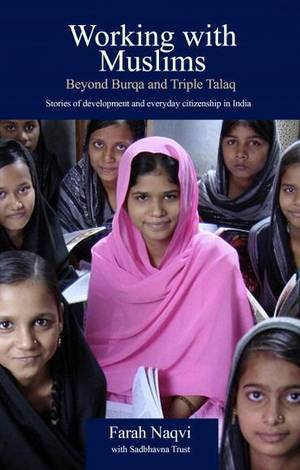
Thankfully, Farah Naqvi’s latest book Working with Muslims: Beyond Burqa and Triple Talaq written in collaboration with the Sadhbhavna Trust makes a spirited attempt to pierce the veil of nescience shrouding real Muslim issues. It looks at the complex historical processes of social exclusion which contributed to the economic, educational and political decline of India’s single largest minority.
Comprehensive study
The book catalogues the findings of a seminal study conducted between 2011 and 2013 of 359 NGOs working with deprived Muslims in eight states and Mewat, a region that straddles Haryana and Rajasthan. Naqvi’s reasons for profiling these NGOs are perceptive. She points out that while Dalits and tribals were constitutionally defined as “development subjects” to overcome the historical discrimination that had affected their progress, Muslims were imagined as “cultural subjects” and constitutional commitments to them were restricted to protection of their religious freedom and personal law.
This allowed the state to absolve itself of responsibility towards Muslims and instead locate the blame in the “religious-community space” where the community is faulted for its own backwardness. It is no wonder that even years after the formation of the Ministry of Minority Affairs and release of the path-breaking Sachar Committee Report, government attitude hasn’t changed.
To prove her point, Naqvi cites Amitabh Kundu’s Post-Sachar Evaluation Committeereport of 2014 which inter alia warned that government interventions were not big enough to address the huge deprivation of the Muslims and that implementation structures had not been designed to directly and effectively benefit the minorities.
Hence, says Naqvi, there was never a greater need for the NGO sector in India to take forward a long overdue engagement with the Muslim community especially its women who are invariably seen through the typical tropes of shariah and hijab and never as persons deserving education, health, employment and public representation.
In this context, her study explains the difficulty of addressing Muslim deprivation in terms of their religious identity. Naqvi writes that although NGOs do not discriminate against any community on the basis of religion they were very reluctant to talk about their work with the Muslims. Their fear was that they may come under the CBI scanner or their funds may get frozen.
Climate of fear
Some NGOs openly suspected the stated objectives of Naqvi’s study. They thought her research team was spying for the state and wanted to hide the fact that they were working with deprived Muslims. In other words, the NGOs were able to “walk the walk” but did not have the courage to talk.
Yet Naqvi and Sadbhavna Trust were able to locate 76 NGOs who primarily work with Muslims out of the 359 they mapped. The rest worked with other groups including Dalits, tribals and Muslims. Working with Muslims also contains 30 fascinating stories from across India of the great work done by dedicated NGOs for the Muslims in areas such as women’s rights, rehabilitation of sex workers, education, urban and rural development, child and disability rights, health, access to credit, and democratic participation.
Nonetheless, Naqvi decries the climate of fear under which the NGOs seem to be working for Muslims. She feels the prevalence of such fear amounts to denying that Muslims face a development deficit which polarises and isolates them selectively. Therefore, if a minority community is subjected to such treatment on the basis of its religious identity then that identity calls for secular recognition.
Naqvi’s earnest appeal deserves to be taken seriously because secularism cannot be used as a pretext to ignore discrimination on grounds only of religion or caste which is prohibited under Article 15 of our Constitution, or to violate the spirit of this Article by neglecting to make special provisions for the advancement of any socially and educationally backward classes of citizens. Canadian political philosopher Will Kymlicka in his book Multicultural Citizenship states that “a comprehensive theory of justice in a multicultural state will include both universal rights, assigned to individuals regardless of group membership, and certain group-differentiated rights or ‘special status’ for minority cultures.”
In this regard, Working with Muslims is a trailblazing contribution to the study of Muslim marginalisation in India. It not just encourages the Indian state to not let religion hinder affirmative action programmes for Muslims but serves as an invaluable source of information for those genuinely interested in knowing if Muslims have issues beyond polygyny, triple talaq and halala.
Working with Muslims: Beyond Burqa and Triple Talaq; Farah Naqvi, with Sadbhavna Trust, Three Essays Collective, ₹450.
source: http://www.thehindu.com / The Hindu / Home> Books> Review / by A. Faizur Rahman / July 14th, 2018
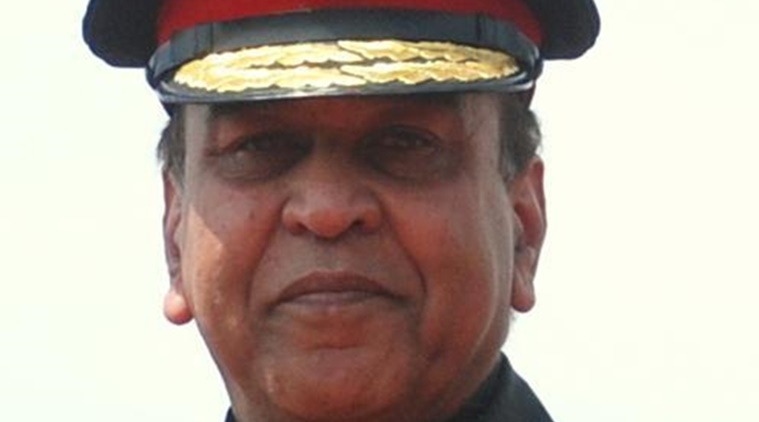
Hasnain (65) has served in Kashmir in many capacities during his career in the Army. The last post he held was that of Corps Commander of the Srinagar-based Chinar Corps. He retired as military secretary in June 2013
Hasnain (65) has served in Kashmir in many capacities during his career in the Army
Former military secretary Lt General Syed Ata Hasnain has been appointed as the chancellor of the Central University of Kashmir, according to a notification issued here Friday. “The President of India in his capacity as the Visitor of the Central University of Kashmir is pleased to appoint Lt Gen Syed Ata Hasnain, former Military Secretary, Indian Army, as the chancellor of the university, for a term of five years,” it stated. The notification was issued by the registrar of the university.
Hasnain (65) has served in Kashmir in many capacities during his career in the Army.
The last post he held was that of Corps Commander of the Srinagar-based Chinar Corps.
He retired as military secretary in June 2013.
source: http://www.indianexpress.com / The Indian Express / Home> Education / PTI / Srinagar – July 13th, 2018
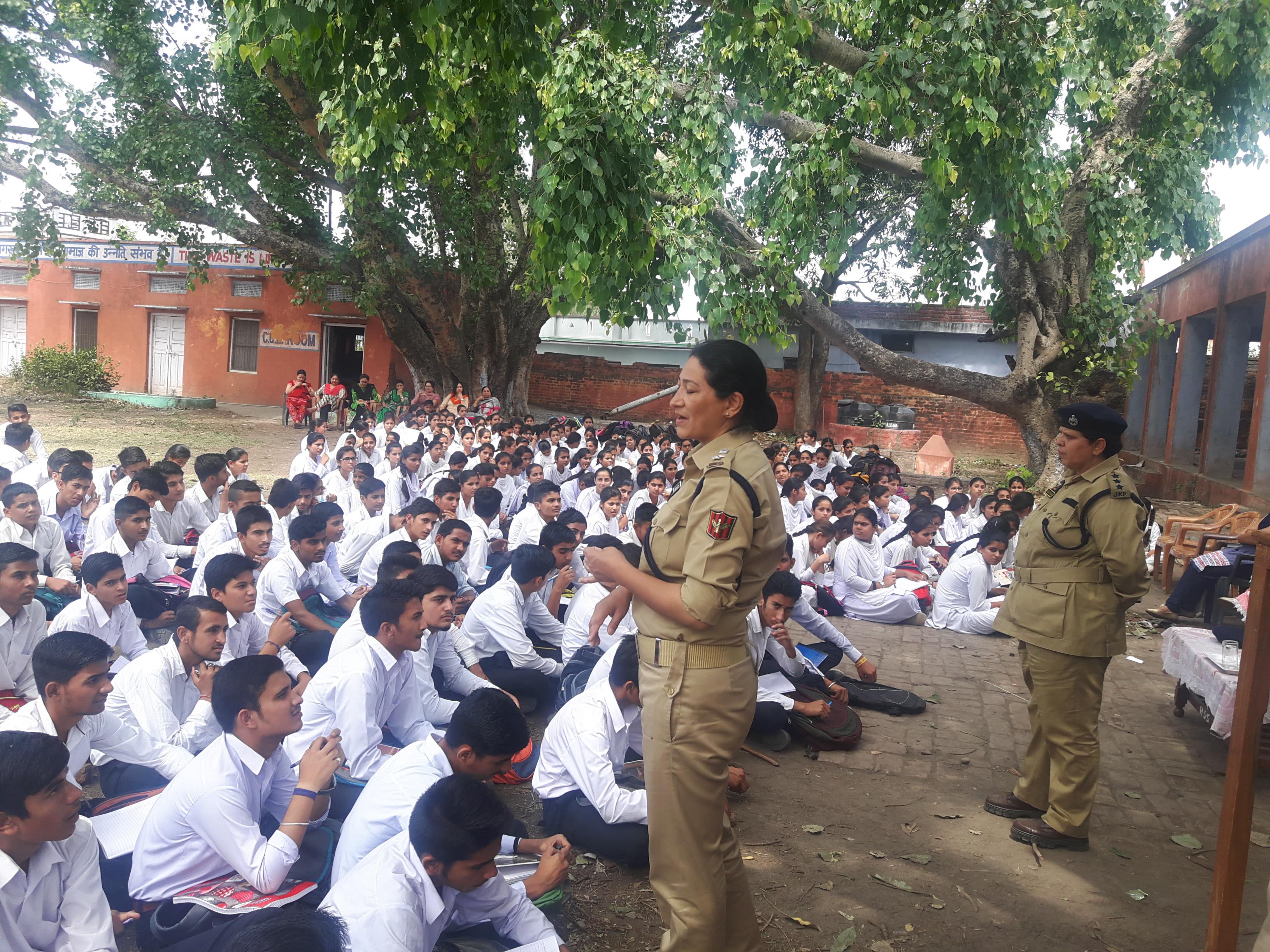
Few decades ago, a few women were out and about. With increase in number of enrollment in schools and level of education, we have witnessed increase in number of women working and earning their livelihood. And not just that, they hold powerful and influential designation and are in no way any lesser than their counterpart gender. To bring forth such exuberant women in uniform, whose aura will definitely leave you in awe, ‘We The Women’ brings for you a section ‘Woman In Khaki’.
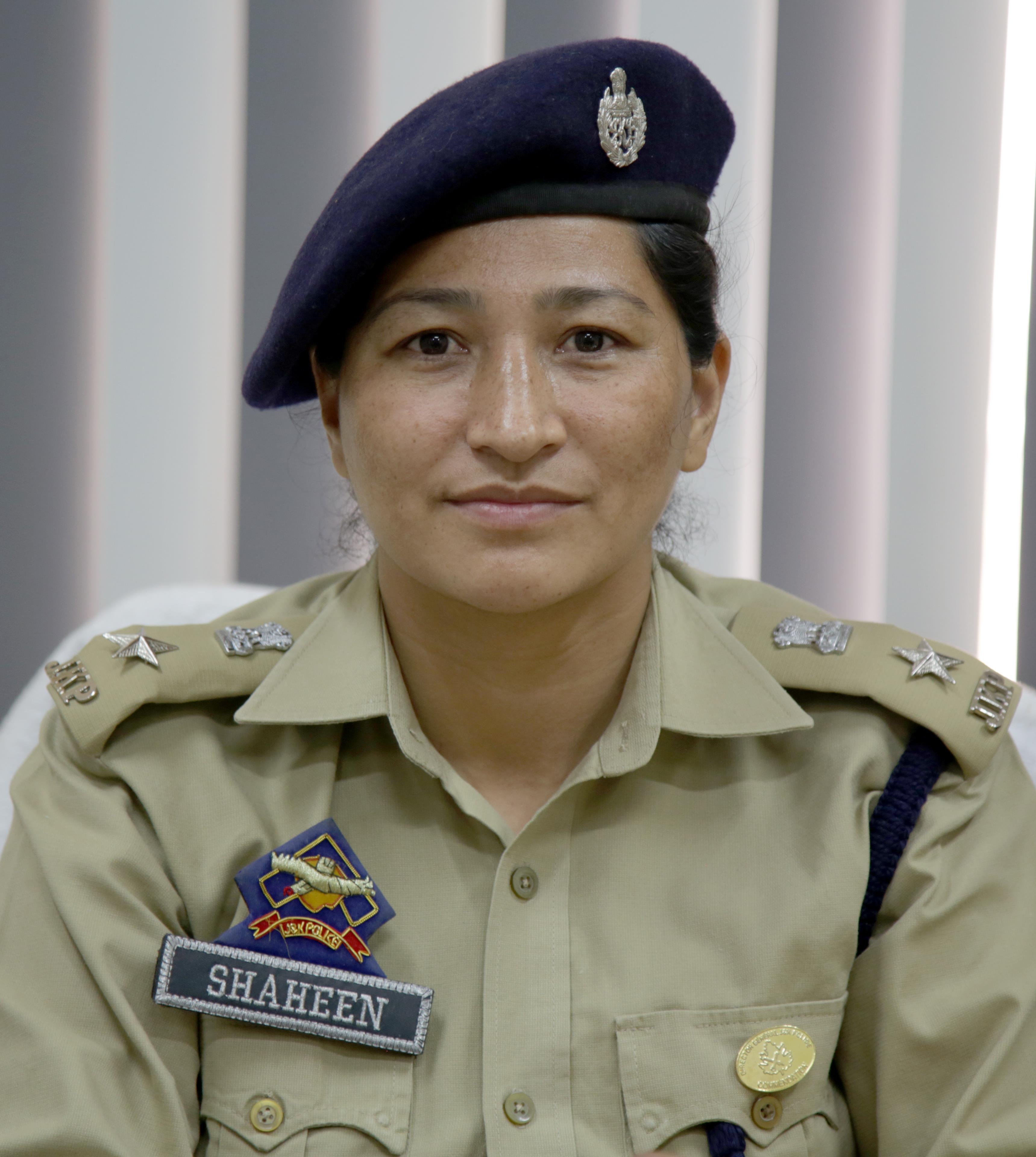
Have you ever come across a woman in uniform? What feelings and thoughts did it induce in you? Well, whatever that may be, I was flooded with feeling of admiration and respect. So, to know more about life of women in uniform we met Shaheen Wahid, SP Traffic Jammu Rural. And the conversation only amplified the pre-existing feelings.
Shaheen was born and brought up in tough terrain of Ladhakh, in a tribal area, where ‘work culture’ prevails and is practiced in every family, whether rich or poor. Which means unlike the excessively comfy environment kids these days are brought up in, children then, were involved in household chores. Shaheen reminisces that despite being first child in her maternal and paternal family she was loved and pampered a lot. But that does not mean that you were allowed to get spoilt. Along with studies, she used to help her mother, break coal for ‘Bukhadi’ (heater), bring home water to drink, go to the streams to wash clothes; but life was adventurous and peaceful. Shaheen shared’ “My parents gave me best of education, they possibly could; the school I was in till 10th was one of the best, where we were encouraged to indulge in mountaineering, trekking and other sports”. After class 10th Shaheen went to Chandigarh for higher education, where she completed her 12th, graduation as well as master’s degree.
On being asked, if being in Police was planned she told, “It was by chance not by choice”. She explained that she was more inclined towards Civil Services, but when her friend applied for Police, she thought of giving it a chance as well. She adds, although was by chance, but she is content that she made it into this field, because of how much it synced with her individuality. “I used to enjoy the physical activities which others used to find exhausting, because I was already used to leading such tough life” says Shaheen. And so, she encourages others as well, to explore Policing as career option as well.
Shaheen got into the chair of SP Traffic Rural Jammu in February from State Crime Record Bureau, which is completely different. Earlier she used to collect data and conduct surveys regarding Crime rate and so on and submit it to NCRP, NHA and like departments. Today, she has four districts, Rajouri, Poonch, Samba and Kathua under her jurisdiction. Her work includes touring, inspection, surveys, law enforcement and so on. Along with this, since the scenario of work policy in police is transitioning from being brute force to community police, which aims to built a repo among society and work along with it. She mentioned, “Traffic is very big challenge. Although crime rate is very high, think for an instance, number of people you know who have committed any crime and then think of people who are on road for one reason or another, every single day. The more people there are on road, the higher their chances of disobeying the law and order. You cannot bring a change just by mere enforcement of law or by ‘chalanning’; people need to be made aware about the rules and regulations as well as the need to follow them. No doubt that nobody is spared if we come to impose ‘chalan’ but we take a different strategy when it comes to interacting with public”.
Being in such position might appear luxurious and comfortable but is it so? “Uniform gives you a sense of authority but it is also a reminder that we are servant to the society and hence we should not let that sense of power into our head” Says Shaheen. At times Shaheen has to start around 4 in the morning, reach to extreme of her jurisdiction, spend day doing whatever is needed, say inspection, survey or enforcement and then reach back around mid-night. And even when she is in office the work load of such large area can be well estimated. And let’s not assume that she has no personal responsibilities. She is mother of three, elder one aged around six and youngest one around one. Her family also includes her parents-in-law and her husband. Despite having such schedule, Shaheen believes that it is essential to balance between both family and work. Here she emphasis on importance of having a support system to help her through. She thanks her mother-in-law for taking care of her children when she is out and about.
Talking about women in general, according to Shaheen Women is epitome of sacrifice and patience. “In our society, people get sad when a girl is born to them. Even when they provide her with same facilities as they provide their boy, there is difference in their attitude as well as their expectations from both of them. Girls are expected to take care of everyone’s need in family and be dedicated towards their responsibilities. I have no objection with that as I believe everyone should be self reliant. If a girl can be asked for a glass of water when anyone comes home, a boy should be expected to do the same. We need to have parity among both the genders even in our behavior and expectations; only then we can inculcate same set of qualities in males as well. After all, a little patience and sense of putting someone else’s interest can resolve so many issues that are prevailing and hence help us grow as a nation.
On being asked who empowered woman is, Shaheen replied that she believes, every woman is empowered if she exercises her duties as well as rights; every woman who is aware about her strength and the value of her contribution in her family as well as society is ‘Empowered’. She added, “If being at such designation, I am not confident enough that I can execute my responsibilities well, I am not empowered at all, despite that.” To women out there, she says that they should take up every challenge and strongly get through them; never letting the fact that they are women, become an excuse.
source: http://www.thenewsnow.co.in / The News Now / Home / by Akriti Jamwal / July 06th, 2017
It was a moment of great pride for Deputy Inspector General of Police (Jammu-Kathua Range) Ashkoor Wani as his daughter was the only woman in the passing-out parade of the 11th batch of Deputy Superintendent of Police here today.
Dr Sunniya Wani was the only woman among the 17 officers in the passing-out parade at the Sher-i-Kashmir Police Academy.
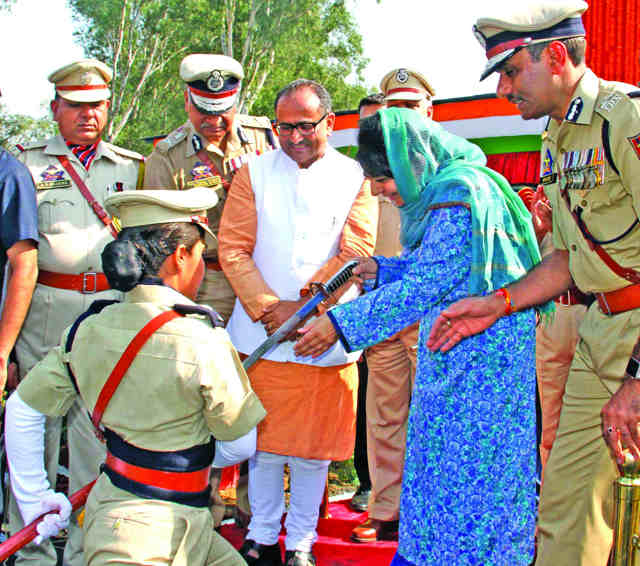
Wani also became the first woman Kashmir Police Service (KPS) officer to get the best all-round award for her performance during her over-a-year-long training. She was awarded the trophy and citation by Jammu and Kashmir Chief Minister Mehbooba Mufti, who is also the first woman to hold the post in the state.
Lauding Wani, the chief minister said she was proud of her achievement.
“I am proud of your achievement and I wish more and more girls follow your footsteps.
I am also happy to see girls competing in every field and in many fields outnumbering boys,” she said. Ashkoor Wani said: “I am really proud of my daughter for her achievements. It is really a matter of pride and honour for me and my family that my daughter became the first female KPS officer to get the all-round award that too from the hands of Chief Minister Mehbooba Mufti.”
He said that his daughter always enjoyed the freedom to follow her dream and that he always encouraged her for that. “She is a medical doctor by profession and then she decided to wear the uniform. From childhood, she always wanted to contribute to the society and I hope and pray that she will become a good and dedicated police officer and would serve the nation, state and the community,” Wani said.
Sunniya Wani said that her father has always been an inspiration for her and she would follow the footsteps of her father to become a dedicated police officer.
“My father has always been an inspiration for me. I grew up watching him in uniform and I always wanted to follow his footsteps and wear the same uniform. I am happy that I made my father proud today,” she said.
Dr Wani said the sky was the limit for today’s women. “I want to tell girls to follow their dreams as nothing is impossible and the sky is the limit for them,” she said. (PTI)
source: http://www.news.statetimes.in / State Times / Home> News> Jammu & Kashmir > Jammu / by Tejinder Singh Sodhi / October 29th, 2016
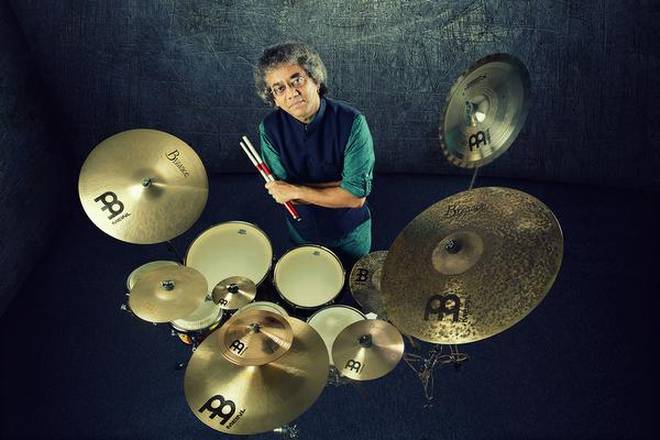
Beat master: Taufiq Qureshi invited a score of other musicians to guest on his debut album Rhydhun.
Taufiq Qureshi revisits the music of his debut album that set the benchmark for world music
It’s been 18 years since percussionist Taufiq Qureshi released his debut album Rhydhun –An Odyssey of Rhythm under the FreeSpirit Entertainment label. Firsts are always of course, special especially since it pushed the boundaries of drumming patterns. The album featured a galaxy of guest musicians like Qureshi’s father Ustad Allarakha, brothers Zakir Hussain and Fazal Qureshi, wife Geetika Varde, vocalist Shankar Mahadevan, violinist L. Shankar and percussionist Nitin Shankar.
The magic of Rhydhun will be recaptured when Qureshi, Varde and their son Shikhar Naad Qureshi perform this evening. They will be joined by Sridhar Parthasarathy on mridangam, Vijay Prakash and Sandeep Patil on vocals, Aditya Paudwal on keyboards, and Nitin Shankar and Dipesh Verma on percussion. “We have been thinking of doing this for some time,” says Qureshi referring to this evening’s show that revisits the album that began it all. “We will adapt some of the pieces to give them a more contemporary feel, but the flavour of the original compositions will be retained.”
Born in a family of tabla greats, Qureshi was basically trained in that instrument and then in Carnatic rhythm styles. Later, his interest in world music inspired him to take up the Western drum kit, bongos and batajon, and eventually the African djembe. That gave him the idea of adapting the African djembe using patterns of the Punjab gharana of tabla playing. “I was fascinated by the djembe, and got the idea [of adapting patterns] while recording Rhydhun,” says tabla maestro Qureshi. “It took me three or four years to get the thought process in action. The tabla is a double drum and the djembe is a single unit. So I had to work hard on the adaptation.”
Naturally, Qureshi’s son Shikhar Naad took to percussion at an early age. Now at 21, he plays the djembe and drums, and regularly accompanies sitar exponents Niladri Kumar, Ravi Chary and Purbayan Chatterjee. “Rhythm flows in the family, and my parents and uncles have encouraged me a lot,” says Shikhar Naad.
With a long career in music, Qureshi points out his father has always been his biggest inspiration. “He encouraged people to do things differently,” says the musicians. “After all, rhythm is universal. This is something I encourage [students] at my Sion institute to do too though they have to master the basics first.” He tells all his ‘bandhus’, as he addresses his students, to keep an open mind and never copy anybody. According to Qureshi, there has been a huge interest among the young to learn the djembe in the last few years.
The audience this evening can expect favourites off Rhydhun such as ‘The Tree Of’, ‘The Other Rhythm’, ‘Nand’, ‘Ear To There’, ‘The Rhy In You’, ‘1/2 to 16’ and the Maharastrian lezim-flavoured ‘Jiji Rhy’.
Taufiq Qureshi & Shikhar Naad and others will perform at The Quarter this evening at 9 p.m., see insider.in for details.
source: http://www.thehindu.com / The Hindu / Home> Entertainment> Music / by Narendra Kumar / July 12th, 2018