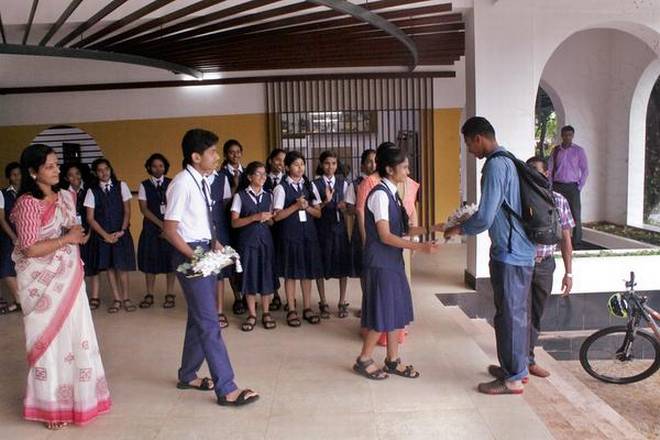
Students welcome Al Ameen at Rajagiri Public School.
Al Ameen is on a Kashmir-to-Kanyakumari bicycle campaign against child abuse
Kochi :
Heavy rain accompanied by strong wind was what received 19-year-old Al Ameen in the city on Monday long before he could pedal his way to Rajagiri Public School for his formal reception.
The two receptions, the other being at Al-Ameen Public School, were among the five stopovers in the city over two days for the second-year sociology student from the Jamia Millia Central University, who is on a Kashmir-to-Kanyakumari bicycle campaign against child abuse.
Having popped antibiotics after getting beset with stomach upset and vomiting, the lashing rain further took its toll on the weakened body of the youngster who is originally from Kazhakkoottam in Thiruvananthapuram.
In fact, he was admitted at a hospital in Karnataka for a day before entering Kerala.
However, that didn’t douse the spirit of Al Ameen who mounted the cycle from Srinagar on June 2 with the noble intention of creating awareness among students about the need to stand up against abuse of varied hues against them.
“I also wanted to encourage students to actively participate in finding solutions to the problems faced by the community around them,” said Al Ameen who had been clocking around 80 kilometres a day.
He was briefly joined by his college mate Shigraf Zahbi in the Delhi-Rajasthan stretch before giving it up owing to hostile climatic conditions.
Asked why he opted for cycling to propagate his cause, the youngster said that the nobility of the cause alone would not win the attention it deserves unless combined with some extraordinary act. “For me, cycle is just the tool to attract attention to my larger goal,” he said.
Before his stopovers at five schools in the city, he had been accorded receptions at schools in Thiruvananthapuram, Kollam and Alappuzha.
The receptions were organised by district child protection officers of the Women and Child Development Department.
He will now meet students of more schools in Malappuram, Kozhikode, Vadakara, Kasaragod and Manjeshwaram before wrapping up his campaign in Kanyakumari on July 23. by which time he would have covered around 4,250 kilometres.
source: http://www.thehindu.com / The Hindu / Home> News> Cities> Kochi / by M.P. Praveen / Kochi – July 10th, 2018
Making a comeback, Lapataganj-fame actor Abbas Khan will next be seen in not one but three films. The Lucknowite has already shot for Partho Ghosh’s ‘Dosti Zindabad’, Rahul Shukla’s ‘Is She Raju’ and has completed the first schedule for ‘The Legend of Peacock in Varanasi’.
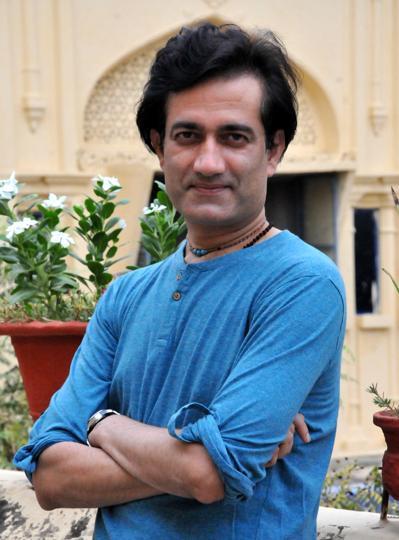
Actor Abbas Khan in Lucknow.(Dheeraj Dhawan/HT Photo)
Making a comeback, Lapataganj-fame actor Abbas Khan will next be seen in not one but three films. The Lucknowite has already shot for Partho Ghosh’s ‘Dosti Zindabad’, Rahul Shukla’s ‘Is She Raju’ and has completed the first schedule for ‘The Legend of Peacock in Varanasi’.
“While Lapataganj was about to conclude in 2014, I suffered major back injury which kept me out of action for 2 years. I did ‘Super Cops v/s Super Villian’ on TV for six months and shot for 100 Days fame director Partho’s comeback film in Lucknow; it has been nearly two years but the film is yet to release. Now, I am banking on these three films,” he says on his short visit to his hometown.
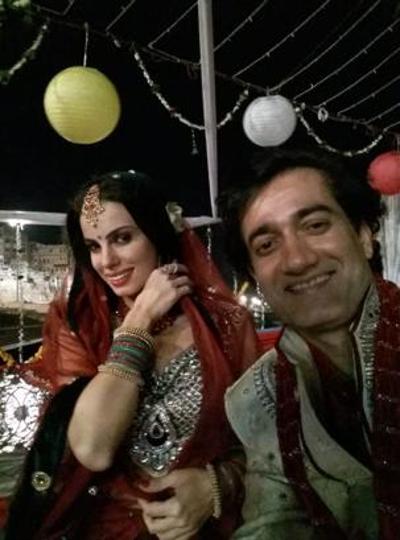
Abbas Khan during the recent shoot of The Legend of Peacock in Varanasi.
He plays a naughty writer in Is She Raju while in The Legend of Peacock he plays a ‘dilphek aashiq’ (lover boy). “Legend… is an international project which will go to film festivals first and then will be released in cinemas. It’s about a foreigner girl who has travelled around the world and is in India for self-realization. I play a hotel owner who falls in love with her and is madly after her. It’s loosely a comic version of an obsessed lover played by Shah Rukh Khan in Darr,” he says.
After playing the iconic role of Biji Pandey, in extremely popular show Lapataganj, he is looking for a good role on TV. “The roles I want to play are not coming my way. After you play a character which is a big hit, one gets typecast and similar roles come your way. I don’t want to do same thing again and again. I am not still able to break that mould. I wish to do a negative role but people are not coming out of my screen image,” he says.
He is in talk for a Star Plus show. “Since it has not been finalized, I can’t talk much about it. But, it’s a ‘kamal ka character’ of Noor Miyan. Let’s see how it shapes up,” he says.
Abbas was scheduled to shoot a film in Lucknow with Lapataganj co-actor Sucheta Khanna. “We wished to make a film and also opened a production company for that but the financers backed out. Things have not worked for me but this is a phase and I hope to come out strong from it. With these films in kitty and two more films in pipeline, I hope things will change. Rest, I have left all on Allah!” he says.
The actor says one of his next films is scheduled to be shot in Delhi and the other in Kanpur. “UP has become the destination for film industry. One of our makers wants to shoot in Kanpur. The subsidy incentive is working very well and the state has become very film friendly. It’s a very happy scenario for people in UP,” he says on a signing off note.
source: http://www.hindustantimes.com / Hindustan Times / Home> Cities> Lucknow / by Deep Saxena,Hindustan Times,Lucknow / July 05th, 2018
The series will capture the dark side of the story of the Mughal empire and had emperors like Akbar, Jehangir, Shah Jahan and Aurangzeb.
Mumbai :
“Taj – A Monument of Blood”, a period drama series on the rise and fall of the the Mughal empire, is set to be produced by Applause Entertainment in partnership with Contiloe Pictures, who are confident of presenting a story with a mix of blood, betrayal, power, beauty, deceit and heartbreak.
The series will capture the dark side of the story of the Mughal empire, which ruled India for just over 3 centuries and had emperors like Akbar, Jehangir, Shah Jahan and Aurangzeb. Writing is currently underway.
The tale will be told over 5 seasons of twelve episodes each, using the birth and death of Shah Jahan as bookends. It will delve deep into the Mongol origins, bloodlines mixing with Persian and Rajput royalty, the court and palace intrigues, the repeated purging of aspirants to the throne, and the arrival of the British and Portuguese.
Sameer Nair of Applause Entertainment calls himself a big fan of revisionist narratives of history.
“Our history books have been written by victors and often paint very two-dimensional pictures about past empires. When Abhimanyu Singh (Contiloe Pictures) and I first discussed this idea, we immediately moved away from a typical historical to a darker and edgier version of the Mughal empire, a version in which symbolically the Taj is more a monument of blood, than a monument of love,” Mr Nair said in a statement.
Mr Singh, who has produced a slew of historicals for the small screen, says the new series will show viewers the historic journey through a fresh lens.
“It will take viewers on a historic journey showing them an unseen perspective of this illustrious dynasty which lead to their rise as the greatest empire in medieval times and the quest for power, within it, that finally lead to its downfall.”
source: http://www.ndtv.com / NDTV / Home> All India / by Indo-Asian News Service / July 12th, 2018
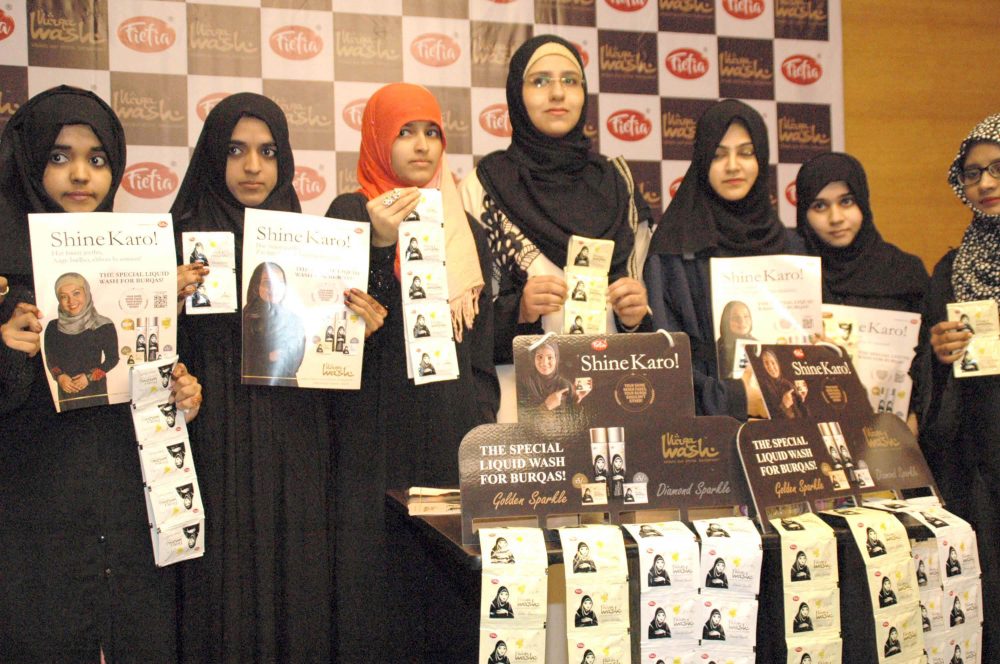
Hyderabadi girl Mahanoor Khatoon (C), launching her unique invention ‘Vurqa Wash’ a special liquid wash for Burqas, in Hyderabad on Wednesday. UNI PHOTO
source: http://www.siasat.com / The Siasat Daily / Home> Hyderabad> Photo News / July 12th, 2018
A still from the documentary Sarah, Thaha, Thoufeek
Documentary Sarah, Thaha, Thoufeek shows a moving relationship
A few years ago, a researcher from Belgium, who was scouring the Jewish sites in Kochi to learn more about the vintage Belgian glasses and ceramic material used in the city’s ancient synagogues, was surprised by a local’s understanding about them.
“Are you Jewish?” she asked him.
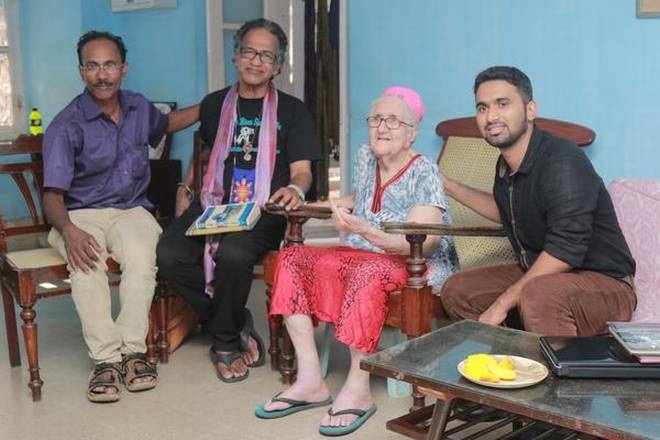
Thaha Ibrahim, a Muslim from Fort Kochi, smiled, shaking his head. Thaha and his friend Thoufeek Zakriya, a professional chef in Dubai and a master in Hebrew calligraphy, have a deeper connect with Jewish life in Mattancherry, courtesy their bonding with the senior most Kochi Jew, Sarah Cohen, in her late 90s.
The moving relation is portrayed in Sarah, Thaha, Thoufeek canned by Sarath Koottikkal, who followed the trio for a few years. The teaser of the hour-long documentary was released by Kochi Biennale Foundation secretary Riyas Komu at an event at Mocha Art Café, Mattancherry, on Tuesday.
“It’s an emotional work for me as well and nothing in this has been staged. It has candid shots capturing the touching relationship, which cannot be described in words or etched in a film in its entirety,” says Sarath.
He had known Thaha for sometime when one day Thaha causally told him about taking Sarah ‘aunty’, then 93 years and with no kin around, to a swanky new mall at the far end of the city. Ms. Cohen, who runs an embroidery shop in Mattancherry’s Jew Town, found news about the mall fascinating. On cue, Thaha, who has been close to the Cohen household for nearly two decades and taking care of the nonagenarian after her husband Jacob Cohen died, made a trip to the mall with ‘aunty’ and his family.
“The gesture moved me. We live in an age when aged parents are treated like an appendage, but this chap had the heart to heed to a wish by someone who’s 90-plus and not even a relative,” says Sarath, adding that the relation is thicker than blood.
“Thaha is like a son to Sarah aunty,” says Thoufeek, whose Hebrew calligraphic skills and knowledge of the religion, brought him close to Ms. Cohen in 2009. “She’s like my grandma, showering me with love and care. She happily relates things to me and reserves special dishes for me,” says Thoufeek.
Thaha’s cheerfulness and ability to inspire happiness and care won him a close pal in Thoufeek, someone less than half his age. “He’s like my brother and stays in close touch wherever I’m. We pursue our research on the Jews and Muslims of Kochi in right earnest,” maintains Thoufeek.
‘References coincidental’
As Sarath reveals, the film’s sharp focus is on bond binds the trio and not their religions. “If at all there are references to it, it’s all been coincidental.”
Candid shots, some of which were canned by Thaha himself — who took to photography inspired by Ellen Goldberg, co-author of The Last Jews of Cochin – form a remarkable feature of the film.
More than technical brilliance, accidental meetings, serendipitous moments and spontaneous conversations characterise the film, says Sarath. A point underscored by Thaha, who got to film Ms. Goldberg and her husband Nathan Katz, 30 years after he first met them at the Cohen household, and several such visitors and remarkable occurrences.
In the final stages of production, the film is set to be ready in the first week of August.
source: http://www.thehindu.com / The Hindu / Home> News> Cities> Kochi / by S. Anandan / Kochi – July 10th, 2018
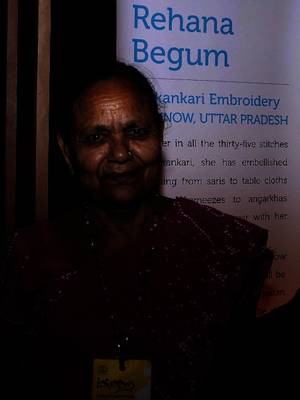
Rehana Begum, a master of Chikankari work. Photo: R. Shivaji Rao | Photo Credit: R. Shivaji Rao
A pantheon of craftsmen and their art are on display at Kaivalam, under way in Chennai. Rashmi R.D. introduces us to some Living Legends of Indian crafts. Meet Rehana Begum
“I learned from my father Shree Hasan Mirza, who received a national award in 1969 for his craftsmanship,” says fifty eight year old Rehana Begum.
Hailing from a long line of chikankari exponents, Rehana Begum began her work with this form of embroidery at the age of thirteen.
Chikankari dates back two centuries. The word chikan is thought to be derived from a Persian word; one theory is that the form travelled to India when its artisans migrated from Persia in search of better patronage. I t is believed that these artisans found a patroness in Mughal Empress Noor Jahan, wife of Emperor Jehangir, and that she did a lot to promote and popularize this craft form.
Rehana Begum works from her home in Thakur Ganj, Napier Road, Lucknow. “We are Lucknowi, born and bred.” Her whole family is involved with making Chikankari embroidery. They work as a group in one room which has become the embroidery room of the house.
“When I was younger we embroidered kurtas, topis, angarkhas jaise nawab log pehn te te (just like the nawabs used to wear). Now we do saris, suits (salwar kameez), ladies tops, whatever the new styles of dressing are in fashion now we embroider.”
Chikankari, she says, was traditionally done only on pure, un-dyed white shazaada cotton or Dhaka ki mulmul, both sourced from Dhaka, Bangladesh. The katcha daagha, the thread used for the embroidery, was also white and procured from Calcutta or Dhaka. Rehana Begum defines Chinkankari in her terms as ‘white on white’ embroidery.
“The first thing I made all by myself was a table cover. It took me one and half years to complete.”
And how long does it take to embroider a sari? “About two years. We usually work six to eight hours a day. My eyes aren’t what they used to be, so now I only do about two hours of embroidery work a day. I spend the rest of the time supervising the work of my apprentices and teaching them the various stitches.”
Rehana Begum takes her inspiration for her embroidery motifs from Mughal architecture. The delicate marble jaali (trellis) pattern of Mughal-style windows and parapet walls is transposed onto the fabric as a fine gossamer trellis of thread work. She also replicates the inlay patterns from Mughal monuments on the fabric she embroiders.
Chikankari has six basic stitches and over thirty-five other traditional stitches used in various combinations based on what the pattern to be embroidered requires. The names of some of these stitches are phanda, chana patti, ghaas patti, bijli, jaali, tepchi, bakhiya, hool, zanzeera, rahet, banaarsi, kharau, keel kangan, bubul and hath kadi. Depending on the type of garment and the pattern to be embroidered the entire process happens in a series of stages over a period of months or even years. Also, the embroidery itself is divided among the artisans, with pairs or groups of three or more specializing in one particular stitch. When one group completes their particular stitch for a garment, it is passed on to the next group to add their specialty stitch. One group may also have mastery of two or more stitches.
The pattern to be embroidered is stamped onto the fabric by hand with a wooden pattern block that has been coated with neel (indigo). The fabric now has the outlines of the designs that will be embroidered into the delicate ‘shadow’ embroidery motifs that are the defining feature of Chikankari.
“I would like to open a shop of my own someday,” Rehana Begum says hopefully. “What we kaarigars (artisans) get at the end of the day, after the shops and agents have taken their percentage—it isn’t much. I’d like to be able to meet directly with people who want to buy our work. Maybe we should have something like a kaarigar market…”
She and her family do travel extensively to participate in national textile fairs and handicraft exhibitions, but though sales are good, the travel costs add up. The price of raw materials has increased too, with good quality cotton and thread getting steadily more expensive.
“I love what I do,” she says emphatically. “There’s no way I could have done this for so long if I didn’t. I get a lot of satisfaction when I finish a piece. I have a large sample swatch that I take with me to exhibitions or when I get called to travel abroad. It took me three years to embroider. When I show it to people they are always amazed by the work. I feel very happy when I see their reactions.”
Rehana Begum has been invited to show case her work in Hamburg (Germany), Ireland, Cuba, Dubai and Muscat (Oman).
In 1976, she was given a State Award from the Uttar Pradesh government, and her work has been on display in the Crafts Museum of Uttar Pradesh. In 2003 she received the Shilp Guru award for her contribution to Chikankari.
“I am excited about coming to Chennai in October. I haven’t been to that city in a long time. I see it as an opportunity to show the international artisans who will be attending this event that Hindustan has great craft talent. They will be able to see what a wealth of kaarigars we have. Jo bhi kaarigar waha maujood honge, hum sab milkar hamare desh ka naam roshan karenge. (All of the artisans who gather for this event, together we will make the name of our country shine).”
source: http://www.thehindu.com / The Hindu / Home> Indian Crafts> Crafts / by Rashmi M.D. / Chennai – October 10th, 2012
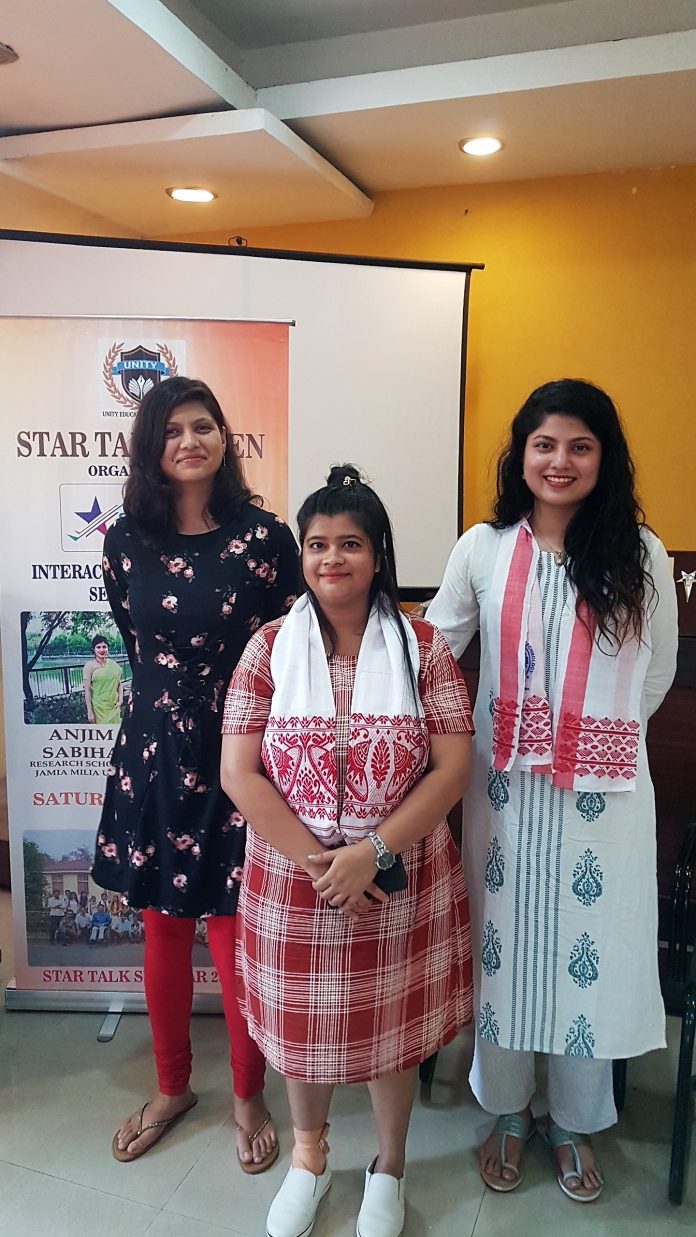
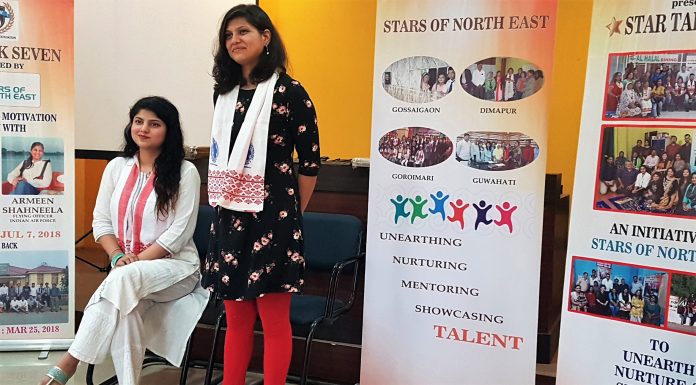
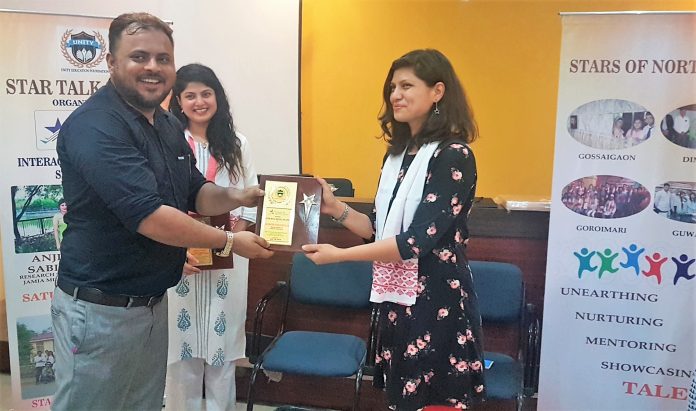
Armeen Shahneela, Flying Officer, Indian Air Force; Salma Hussain, human rights worker; and Anjim Sabiha, research scholar, Jamia Millia Islamia University Delhi at the “Star Talk Seven” event held at Burnihat on Saturday
Guwahati:
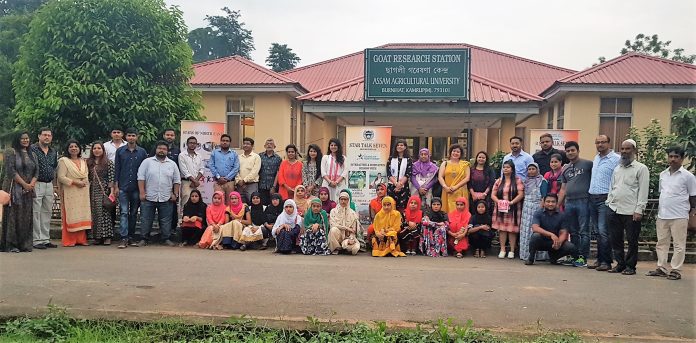
Three young achievers -all girls and path breakers were felicitated at the “Star Talk Seven” event organised at the Goat Research Station Auditorium at Burnihat on Saturday. Anjim and Armeen received the “Star Role Model Award” given by the Unity Education Foundation, Guwahati. They were also presented gifts by the University of Science & Technology Meghalaya (USTM). Fauzia Khan, MD of Ascentials, presented diamond jewellery to the achievers.
Along with the girls their proud parents were also facilitated.
Anjim Sabiha and Armeen Shahneela sisters from Puronigudam Assam are both top achievers in their respective fields.
Anjim Sabiha, research scholar, Jamia Millia Islamia University Delhi and Armeen Shahneela, Flying Officer, Indian Air Force, who received “Star Role Model Award” at a function held at Burnihat on Saturday are seen together
Anjim Sabiha is pursuing her PhD from Jamia Millia Islamia University New Delhi and has been selected for presentation of a research paper titled “Women Empowerment through Microfinance in Assam” at the forthcoming International Conference on “Empowering Women: Fostering Entrepreneurship, Innovation and Sustainability” to be held in Delhi on 16-17 July.
Her sister Armeen Shahneela, an alumnus of Jorhat Engineering College Assam, was commissioned as a Flying Officer of Indian Air Force at the Investiture programme at Hyderabad Air Force Academy where she was commissioned by Admiral Sunil Lanba, PVSM, AVSM, ADC, Chief of the Naval Staff on Dec 6, 2017. On Sunday, Armeen is reporting for duty at one of the Indian Air Force bases in the North East.
Armeen Shahneela, Flying Officer, Indian Air Force receiving the “Star Role Model Award” from Abu Zakaria, IT & software entrepreneur, at the “Star Talk Seven” event held at Burnihat on Saturday.
And the third star Salma Hussain, a youngster from Sontoli Village in Kamrup Rural District of Assam, has been selected for the Andi Leadership Institute Programme 2018 for Young Women Peace Builders. One among only eight young women selected from all over the world and only one from India, Salma will undergo training from August 5 to18, 2018 in Washington, D.C.
Salma plans to visit a few other places and meet important human rights workers to gather ideas for implementing her dream project of adopting a village in Assam and make it a model abode of peace.
Members of Stars of North East, guests and students from Shaheen Academy Guwahati are seen together with Anjim Sabiha, research scholar, Jamia Millia Islamia University Delhi and Armeen Shahneela, Flying Officer, Indian Air Force at an event held at Burnihat on Saturday.
source: http://www.twocircles.net / TwoCircles.net / Home> Education> Event> Indian Muslim / Guwahati – July 08th, 2018
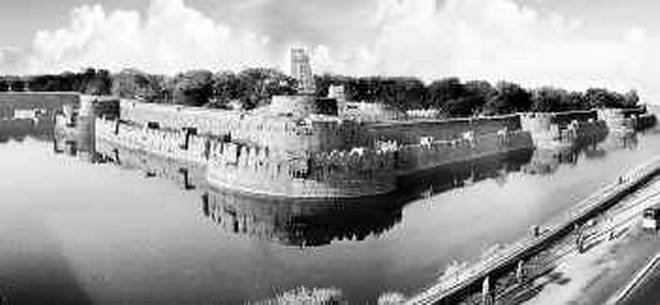
Site of awakening: The Vellore fort today. Photo: Curator, Government Museum, Vellore
Though it preceded the First War of Independence by almost 50 years, not much is known of this brief act of valour by the sepoys of the Vellore fort.
In the late-18th Century, the fakeers played a key role in spreading the message of unity amongst Indians and the need to throw out the British.
AT three, in the stealth of the dawn, on July 10, 1806, when it was still very quiet and the calm enveloped the Vellore fort, the doors of the native barracks suddenly flung open. Five hundred brave Indian sepoys were on the threshold of a mutiny they had so carefully plotted. Armed with muskets, they tiptoed out, dragging in their midst two heavily muffled six-pounder guns. They reached the European barracks, briefly halted, lifted the muskets to their shoulders and waited expectantly. The signal they anticipated was issued presently. It was at once fire works that shattered the still and the quiet. Windows and glass crashed while the English inmates woke up to their peril. Either they were killed in their beds whilst in deep slumber or were put down while running out in night robes trying to make sense of the pandemonium that had broken out so suddenly.
Losing direction
The Vellore War of Independence against the East India Company occupation was now well on its bloody course with all the trappings of romance associated with mutinies manifesting itself on that fateful morning. Underdogs defying authority, secretive planning, courage against intimidating authority, bravery and fearlessness towards death – all moved by a deep sense of right being on their side. By the time the smoke cleared and the guns became quiet by 5 a.m., about 15 British officers and about 100 English soldiers had been killed.
Col. Fancourt, the Commander of the Fort and Garrison was the first to be shot. Jamaidar Shaik Cossim, one of the principal leaders of the rebellion, had arranged to hoist Tipu’s Mysore flag over the fort signalling that the fort had been taken over. As the flag was fluttering proudly, the course of the mutiny floundered and lost its sense of direction and purpose.
Some of the sepoys started looting the houses of the Europeans, whilst others were busy abusing sepoys who did not take part in the mutiny. Yet others were conducting inconclusive discussions with Tipu’s sons, who were held captive within the fort, to come out openly and lead. Tipu’s princes hesitated and vacillated.
Though this rebellion preceded the First War of Independence (Sepoy Mutiny of 1857) by over 50 years, it has not been given the importance and significance it deserves as a determined early attempt to throw out imperialism and alien rule from Indian soil. We will take a brief pause from the fast-paced events of that fiery morning and analyse the causes for and significance of this rebellion before coming back to July 10, 1806 once again to complete our story.
Key influence
At the time of the Mutiny, the Vellore fort was station to the following Infantry Military units.
Battalions of the 69th Regiment and 23rd Regiment with 1,500 native troops and about 370 white officers and men present inside.
And great dissatisfaction was brewing amongst the Indian troops on various counts. And this had a good deal to do with the Fakeer Movement of the late 18th Century.
These fakeers were mystic mendicants (at times doubling up as mercenaries!) commanding the respect and affection of both Hindus and Muslims. In large numbers, they went from town to town conducting discourses, prayers and even puppet shows. They played a key role in spreading the message of unity amongst Indians and the need to throw out the British. They often got in touch with sepoys and native officers and instigated them to rebel. Their methods were secretive and the appeal powerful. These fakeers fanned all over the South and hence one can see that in the early 19th Century, there were several rebellions in the South.
The Chittoor polygors fighting the British between 1804 and 1805, the Travancore Mutiny in the same period and the Madurai outbreak of 1804 are examples to cite.
The famous valiant Wayanad hero, Pazhassi Raja gave the English anxious times till his capture and death in 1805. There was a ground swell of nationalism and a strong undercurrent of hope. And the fakeers sure had a significant role to play. Cantonments from Wallajahbad to Palayamkottai had been caught up in this freedom fervour.
The fakeers had a simple and enduring message: “we are many and they are few”.Like the gunpowder in the cartridge that needs a spark to ignite, the spark for the Vellore uprising came in the form of new uniform regulation announced by John Cradock in March 1806.
Cradock was the Commander-in-Chief the Madras Army. A new cap was prescribed in place of the turban and caste markings on the face were prohibited. The beard was to go. The hair over the upper lip was to be regulated and the wearing of earrings abolished. The troops saw this as the first step to Europeanisation and conversion to Christianity. Hindu and Muslim soldiers resented the regulations. Muslim soldiers expressed solidarity with Hindu sepoys who despised the use of cow leather in the new cap prescribed in the revised uniform regulation issued by the office of Cradock. Hindus and Muslims together rose as one in the name of religion and liberty.
Yet another factor that helped shape events in Vellore was the presence of Tipu’s family in the fort. They were confined and housed in the palaces and mahals formerly of the Nawabs of Arcot which lay within the precincts of the fort. After his heroic death on May 4, 1799, Tipu’s 12 sons and six of his eight daughters were brought to Vellore along with a retinue of servants and the party totalled 1,378.
In Vellore town itself a number of people had settled down following Tipu’s heirs. A certain Lt. Col. Marriott (pay master of Stipends) and his brother Capt. Marriott (the assistant paymaster) were in charge of the privileged prisoners.
Ironic twist
The presence of Tipu’s princes undoubtedly inspired the sepoys. Ironically, the princes perhaps did not provide decisive and inspiring leadership to the uprising.
Prince Moiz-ud-Deen is reported to have conducted some parleys with the leader of the uprising and Prince Fettah Hyder offered support in the early phase of the planning, albeit not too openly. Prince Moiz is said to have met key leaders like Subedar Noor Mohamed, Subedar Shaik Hossain and Jamaidar Shaik Cossim prior to July 10.
After assuming control of the fort, when Sheik Cossim and the others asked the princes to come out and openly lead them, the princes were insisting that they see the body of Lt. Col. Marriott first. This response did not help the course of the uprising which was already beginning to lack organisation.At that point and at about 9.30 am on July 10, 1806, Col. Gillespie of the 19th Dragoons, commanding the Cavalry Cantonment 16 miles away at Arcot, reached Vellore to put down the Mutiny. One Major Coates of the 23rd Regiment had earlier dispatched a letter through an officer at around 6 a.m. to the Arcot Cavalry unit seeking help. Gillespie arrived with an advance force. Lt. Col. Kennedy from the same cavalry reached a little later with heavy guns.
Swift end
The dislocated mutineers did not regroup in proper defence. The gates were blasted open by the 19th Dragoons and they stormed in. The rebelling native sepoys were mercilessly hounded and killed. It is reported that around 800 of them were found dead at the fort alone. More lives were evidently lost. By 2 p.m. in the afternoon the rebellion had not only been completely silenced but had come to be a brief pale memory of heroism – a flicker that was sadly extinguished.
As was expected, the British ordered a Court of inquiry into the events. It was also considered risky to keep the Tipu’s family in Vellore, so close to the seat of their former glory. They were taken and resettled in faraway Calcutta. The news of the Vellore War of Independence had sent shockwaves in England. The Governor, William Bentinck and Commander-in-Chief of the Madras Army, Sir John Cradock both were recalled on this count.
Historians should do more to research this not so well documented act of heroism, to inquire into questions like the impact of this event on the 1857 great rebellion.
Commemorating this unique rebellion, the State Government on the Bicentennial Anniversary held a function on July 10, 2006 with the Chief Minister participating and releasing a special volume on the Vellore uprising.
Voluntary groups and students are planning cycle rallies to Vellore to take home to the people of India the message of sacrifice behind these sepoys who dared to rebel so that we may live in a free country.
source: http://www.thehindu.com / The Hindu / Home> Features> Sunday Magazine / by A. Rangarajan / August 06th, 2006
Former Karnataka Higher Education Minister B.A. Moideen passed away in a hospital in Bengaluru on Tuesday. He was 81.
Born to Abdul Khader and Haleema at Pejawar in Bajpe village in May 1938, Moideen, joined Congress in 1969 and held various positions in the party before getting elected to Karnataka Legislative Assembly in 1978 from Bantwal assembly constituency in Dakshina Kannada district. However, he was denied party ticket to contest subsequent elections following which he joined Janata Dal in the later days.
Moideen was a member of the Legislative Council for two terms, from 1990 to 2002. He was the Minister for Higher Education in the J.H. Patel government between 1995 and 1999, when he earned the name of a honest administrator. He rejoined the Congress later. Moideen, a staunch follower of D. Devaraj Urs, was conferred with the Devaraj Urs Award instituted by the State Government in 2016.
Moideen’s autobiography, Nannolagina Naanu (Me within Me) was to be released shortly. Though he was reluctant to pen down his life, two writers, Muhammed Kulai and B.A. Muhammad Ali, coaxed him to do so and wrote the book.
Moideen, recalling his early political days, was learnt to have blamed three senior Congress leaders, M. Veerappa Moily, B. Poojary Poojary and Oscar Fernandes for his political debacle after 1983. “I didn’t do any harm to them and in fact had helped them when needed. Yet I can’t understand why they did hold grudge against me,” he had said.
source: http://www.thehindu.com / The Hindu / Home> News> States> Karnataka / by Special Correspondent / Mangaluru – July 10th, 2018
The world saw its worst refugee crisis between 1988 and 1994, coinciding with the end of the so-called Cold War, increasing globalisation and civil wars along ethnic lines.
After two decades of relative ease, 2015 and 2016 again witnessed an upsurge in refugee population, starting with the Syrian crisis and the latest, the Rohingya exodus from Myanmar.India is home to nearly 2 million refugees, with a large percentage coming from China (including a large number of Tibetan refugees) and Sri Lanka (which was torn by civil war from 2006-09).
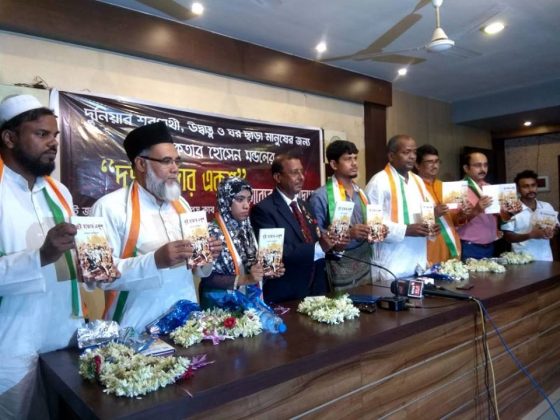
A book called “Dui Hazar Ekush”for the Refugees worlwide is published today at Kolktata Press Club. Renown Poet & Journalist Mokter Hossain Mondal has written this book for the Refugees people in Mynanmar and Syria. He dedicated this book to the refugees people across the globe.
The cover of this book has been unveiled by Ayesha Noor, three time gold winner in karate championship who dwelt in a slum area in Kolkata.
The life story of the footpath dwellers and the life story of the Refugees of Syria, Somalia & Rohingya people were narrated in this book. Here the poet tried to make the way to solve their problems.
This book has been published by Disha Prakashani.
source: http://www.financialsamachar.com / F Samachar / Home> Metrolife / July 05th, 2018