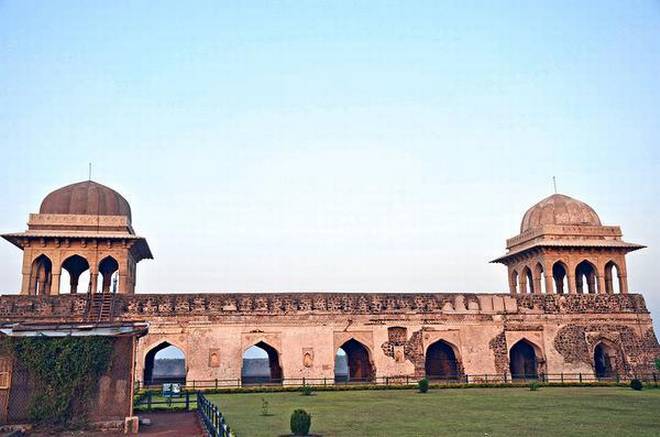
A section of Rani Roopmati Pavilion | Photo Credit: mail
Roopmati Pavilion is perched regally on the edge of a 365m precipice overlooking the Nimar Valley and to the south of the Baz Bahadur Palace in Mandu, Madhya Pradesh. A look by Chitra Ramaswamy
Among the plethora of monuments that dot the landscape of the historical city of Mandu in Madhya Pradesh, is the Roopmati Pavilion, an ode to love. The sandstone structure is perched regally on the edge of a 365m precipice overlooking the Nimar Valley and to the south of the Baz Bahadur Palace. It stands as testimony to the legendary tragic love story of Baz Bahadur, the mid-16th century Sultan of Mandu, a great musician, and his queen, Rani Roopmati, a singer of repute.
We traverse a broad, winding pathway to come upon a flight of stairs that brings us to the 16th century monument. The 72m high fort, Roopmati Pavilion, the southern-most monument in the city, is a magnificent expression of Afghan architecture in sandstone. It is evident that the monument underwent construction in phases during different time periods. The original design, sans pavilions, was built as an observation post for the royal army as a low, large hall with a pair of rooms on each side and a heavy sloping base. A symbol of their undying love, it was later transformed into the abode of Roopmati with a western side extension along the plinth. It was extended so as to enable the queen, who fervently worshipped the Narmada, to see the river and perform religious rites without stepping out of the fort.
The basement of the pavilion is characterised by corridors that have several arched openings along their width. The western ledge has a large reservoir from which rainwater collected during the monsoons would be channelled from the roof of the structure to a tank below by means of conduits.
However, it is the pavilions on the terrace of the original block that we access via spiral stairs, a later addition, which lends the structure its distinctive allure. The square-based pavilions are crowned with hemispherical domes that are fluted on the interior and exterior. We are treated to a visual delight as we climb a flight of steps to reach the pavilion top. Nature’s enchantment leaves us mesmerised as lush forests, plateaus, valleys and vast stretches of far away hills stretch before us.
Twin-storeyed palace
The Baz Bahadur Palace, closeby, lies on the hill-slope to the east of Rewa Kund and is set in the midst of picturesque verdure. Tall, sleek arches welcome us at the entrance to the twin-storeyed palace which is accessed by well laid, broad steps with landings at intervals. In its days of glory, an aqueduct ran on top of the arches, transporting water from Rewa Kund, the adjoining tank, to the pool in the palace courtyard. The water would be drawn upwards by Persian wheels that were powered by animals.
An inscription in Persian on the arch states that the palace was built in 1508 by Nasir-ud-Din. Incidentally, Nasir-ud-Din Shah Khilji, the Sultan of Malwa, is credited with designing this aesthetic structure which underwent repairs and renovations during the period of Baz Bahadur. Big courtyards and high terraces are distinct aspects of the palace that is an aesthetic blend of Mughal and Rajput architectural styles.
Halls and rooms with arched gates skirt the huge courtyard which is adorned by a stunning cistern with crystal clear water in the centre. The palace terrace is further adorned with a couple of chhatris or elevated domed pavilions. One of the big rooms, that even today has astounding natural acoustics, served as the music and dance hall of the palace.
source: http://www.thehindu.com / The Hindu / Home> Life & Style> Homes & Gardens / May 11th, 2018
Special occasion: Authorities of the Hubballi mosque organised the programme on Sunday in association with Sadbhavana Vedike Karnataka. | Photo Credit: Special Arrangement
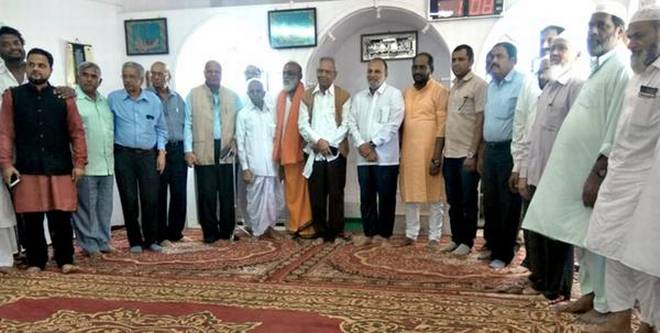
Masjid-e-Usman Ghani throws open its doors for Hindus for Id party
Masjid-e-Usman Ghani, located at Vijayanagar here, witnessed a special Id party on Sunday as authorities of the mosque had invited members of the Hindu community for the occasion.
The organisers said it was for the first time that an Id party was being held by inviting Hindu members on the mosque premises.
Mosque authorities, in association with Sadbhavana Vedike Karnataka , took this initiative to promote religious harmony and brotherhood in society.
Vedike secretary Akbar Ali Udupi said he was elated to see the Muslim community members opening the doors of a mosque for their brethren from the Hindu community. “It should have happened long back, but I am happy that it has happened no less than 70 years after Independence,” he said, and asserted that other mosques too should hold similar programmes.
He said the core essence of all religions was the same but they were presented in different ways. The prime reason for violence over religious issues was lack of proper knowledge about religions among their followers. Even those who resort to violence in the name of Islam do so because their knowledge of Islam was limited, he said. There were several examples in the life of Prophet Muhammed where he respected other religions and asked his followers to follow suit, Mr. Udupi said. Truthful knowledge of religion helps achieve peace and harmony, whereas unfair information of religion leads to disturbances in society. Therefore, every human being should strive to gain truthful knowledge of their respective religion in the larger interest of society, Mr. Udupi said.
Venkatesh Savadatti and Subhas Hosmani and others who were present on the occasion appreciated the move. They said division on religious lines was the creation of power-hungry politicians and common people should not fall prey to their devices.
source: http://www.thehindu.com / The Hindu / Home> News> States> Karnataka / by Staff Reporter / Hubballi – July 02nd, 2018
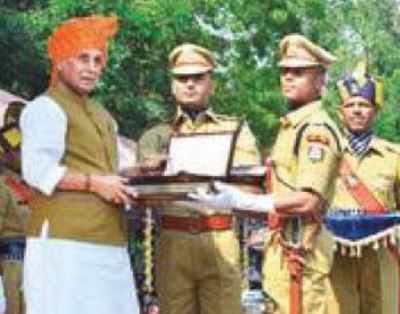
Sameer Shaikh receives the home ministry’s revolver & PM’s baton from Rajnath Singh on Monday
Mumbai :
In what he described as a dream come true, 25-year-old Mira Road resident Sameer Aslam Shaikh led the ‘Dikshant’ or passing-out parade of 136 Indian Police Service officers in Hyderabad on Monday.
Shaikh was given the honour as he emerged the winner of the Prime Minister’s baton and the home ministry’s revolver for being this year’s overall champion and the best cadet among IPS probationers .
Shaikh said he was inspired by former Mumbai police chief Julio Ribeiro to become a police officer and serve the nation. The son of a civil engineer, Shaikh studied at St Xavier’s School, Mira Road, and did his Class XI-XII at Sathaye College in Vile Parle. He did his bachelor of engineering in electronics from BITS Pilani. “I worked hard on my studies to work for the nation,” he told TOI from Hyderabad.
”I am happy at this moment,” Shaikh told TOI over the phone from Hyderabad where he led the passing-out parade at the Sardar Vallabhbhai Patel National Police Academy. Union home minister Rajnath Singh was the chief guest at the ceremony. The Shanti Park resident’s younger brother, Aman, too is studying engineering, while their mother is a homemaker.
It was while doing his internship at a think tank on public policies that Shaikh first decided to appear for the UPSC exam in 2015. He failed in his first attempt, though. But not feeling disheartened, a driven Shaikh spoke to several civil servants and got detailed, “first-hand” information on how to prepare for the exam. He said it was during his discussions with them that he understood the impact a civil servant has on society.
Thereafter, he meticulously planned his studies and focused on time management. He even moved to New Delhi to get a better understanding of the exam and studies there. Shaikh’s hard work paid off. In his second attempt in 2016, he cracked UPSC and was allotted IPS’s Maharashtra cadre. After a 45-week training in theory and physical fitness followed by an exam, Shaikh was declared the topper. “My parents have come here (to Hyderabad) and we all are together,” he said.
Shaikh recounted stories of senior cops who inspired him to join the force. “I studied to learn more and work for the country, not to just win the top position,” said the academy topper.
Shaikh led the parade of 136 IPS probationers, including 14 foreigners from the Royal Bhutan Police, Nepal Police and Maldives Police. During their training, the probationers learned to deal with various situations at the police academy and visited several places across the country to understand how the force functions. They also interacted with senior officials from various other departments.
source: http://www.timesofindia.indiatimes.com / The Times of India / Home> News> City News> Mumbai News / by Mateen Hafeez / TNN / October 31st, 2017
A DCP from Delhi has been helping to keep a family of five in Jammu going after their sole breadwinner was murdered in Delhi.
Delhi DCP (Northwest) Aslam Khan has been sending half of her salary every month to the family residing in RS Pura’s Flora village in Jammu and Kashmir. She also speaks to the family every day to make sure they are safe and doing okay.
I somehow got in contact with them and realised that they are very poor. So since February onwards, I started sending them a part of my salary. I’ve also been approached by people who want to help them.
Aslam Khan, Delhi DCP (Northwest) told ANI
The family’s breadwinner was a truck driver who was murdered in Delhi’s Jahagirpuri on 9 January 2018. Sardar Maan Singh was killed by a group of robbers, leaving his family helpless. During this time, Aslam Khan contacted the family and decided to help them, reports ANI.
“We were scared, but Ma’am started helping us and we are thankful to her”, the family told ANI.
The 42-year-old truck driver is survived by his wife, two daughters, and a son, who are being taken care of by DCP Khan.
source: http://www.thequint.com / The Quint / Home> India / July 02nd, 2018
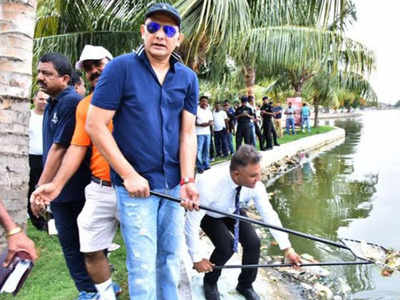
A human chain with more than 6,000 students was formed around the Hussain Sagar in the city on Sunday as part of the “Save Lake Campaign ” organized by the Military College of Electronics and Mechanical Engineering (MCEME) Secunderabad.
Former Indian cricket captain Mohd Azharuddin and Seema Singh , chairperson, Family Welfare Organisation, MCEME flagged off and participated in the 3.5 km Green Brigade Walk.
The programme was organized in connection with the annual Hyderabad Sailing Week. With the theme “Fit Hyderabad Swachh Hyderabad”, the green brigade walk was organized. Students from Army Public Schools, NCC cadets, army personnel, youth and general public participated in the walk from Sailing Club to Sanjeevaiah Park to promote fitness and health awareness amongst the citizens of the twin-cities.
As part of the Swachh Bharat Campaign, participants undertook a cleanliness drive promoting ecological awareness.
IT minister K T Rama Rao will inaugurate the “Hyderabad Sailing Week” on July 3, 2018. During the Hyderabad Sailing Week, a national seminar on “Race Management” will be organized.
Major General TSA Narayanan, cice commodore, EME Sailing Association said Hyderabad was a popular destination for the sailing in the country. The wind conditions in June – July are most favorable in the Hussain Sagar Lake to hone the skills in boat handling and understanding wind shifts, he said.
This is a landmark year for the EME Sailing Association as this year the event has been accredited as the Yachting Association of India (YAI) National Ranking event where in the performance of the sailors will be ranked, which will give them points for selection into National Team. The eco friendly sports are getting popular day by day and 200 sailors from all over the country are expected to participate in this year’s event, he said.
Major Alok Kumar, honorary secretary, EME Sailing Association informed that the event will see the biggest congregation of sailors in the country. “Sailing is an eco friendly sport which requires immense technical skills to negotiate wind conditions and water. The concepts of sails and boat handling have undergone huge advancement, however the sport still retains the old world charm of explorers and discoverers who used their wind propelled boats to discover the world,” he said.
source: http://www.timesofindia.indiatimes.com / The Times of India / Home> News> City News> Hyderabad News / Ch. Sushil Rao / TNN / July 01st, 2018
From missing White Steams to a recently found Duesenberg, a new coffee-table book — Automobiles of the Nizams — looks at the Hyderabad royal house’s expansive car collection
Once upon a time, Duesenbergs, Napiers, Rolls-Royces, White Steams and Hispano-Suizas were the playthings of the Nizams, the ruling family of Hyderabad. Then they disappeared. “There were 400 of them; I’ve been able to trace around 50. The others remain missing, scrapped, hidden or in private collections,” says Muhammad Luqman, a Hyderabad-born, Dubai-based banker and vintage car collector who has chronicled the royal wheels in his book, Automobiles of the Nizams. Containing never-before-seen photos, the tome tracks significant cars from production lines to palatial palaces. It is set to be released at the Pebble Beach Concours D’Elegance in California in August.
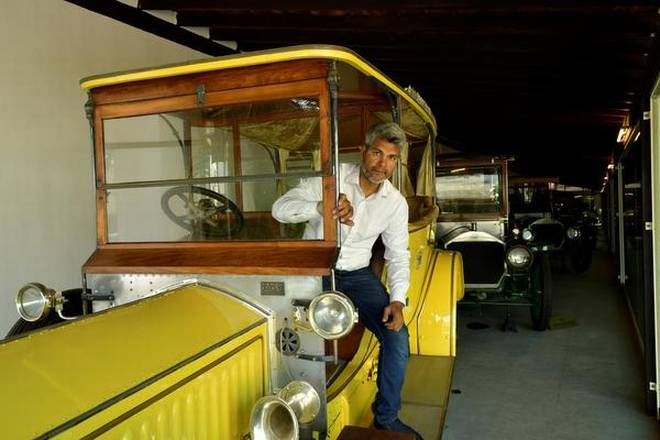
As we walk around the Chowmahalla Palace over the weekend — where some of these cars ferried the sixth Nizam, Mir Mahbub Ali Khan (1869-1911), and later his son, Mir Osman Ali Khan (1911-1948) — Luqman spins a fascinating yarn about the wealthy monarchs’ love affair with automobiles. The first to catch the motoring craze, he says, was Mahbub Ali. The story goes that to acquire one of the first Rolls-Royce Silver Ghosts, he roped in the services of the British Resident (an appointee of the British government), shelled out ₹25,000, and then got it modified to his taste. Painted yellow, as a sign of royalty, he ordered a crest shaped like the dastaar (traditional headgear) and metal work with a delicate lily pattern for the roof fringe. However, by the time the customisation on the Throne Car was completed, he passed away.
The Ghost chronicles
Last year, at Cartier’s Concours d’Elegance at Falaknuma Palace, his great-grandson, Prince Azmet Jah, sat in the Silver Ghost and reminisced about being driven around in Hyderabad. “This was a ceremonial car used on special occasions. The prince recalled how, to celebrate the golden jubilee of Osman Ali’s ascension in 1936, the courtiers wanted him to get a new car. But the Nizam, known for being frugal, asked the Railways (he had his own railway network) to spiff it up instead. They did so by adding horrible fenders,” says the author, who relied on the archival material at Chowmahalla Palace’s royal library for much of his research. “After being left to the elements, it was restored by Rana Manvendra Singh (one of the country’s foremost authorities on vintage vehicles) in 2012, with Cartier picking up the tab.” As we talk, I also spot a massive, newly-restored Wolesley beside the shiny Silver Ghost.
While the sixth Nizam bought cars in pairs and preferred the ultra-luxe versions, his son picked the simpler Humbers and Fords. Today, one of the 1933 Dodges used by Osman Ali is taken out for a spin every Sunday by Captain Kerman Pestonjee, a Hyderabad-based collector, who acquired it with a unique number plate: King Koti Hyd A. So does Luqman’s book overlap with Singh’s 2003 compendium, The Automobiles of the Maharajas, a sweeping history of Indian royalty and their tryst with cars? No, he replies, because his work is a micro history, with details about the vehicles and anecdotes about how the Nizams acquired them. “It has been my obsession for the past 30 years; this book is a culmination of the love story,” says Luqman, who houses his collection of 12 vintage cars, including a small 8 HP post-war Wolseley, in Hyderabad.
Disappearing act
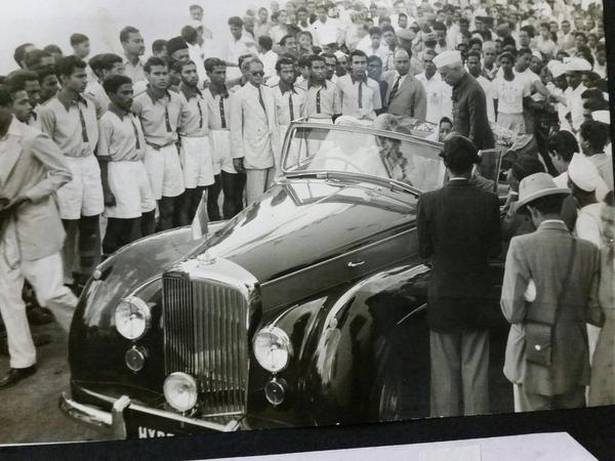
One of the cars he has been able to trace is a Bentley. When Prime Minister Jawaharlal Nehru visited in the ’50s, he was photographed in the vehicle with the Hyderabad number plate intact. Nizam Mukarram Jah had also used it extensively and once, in the ’60s, crashed it near Visakhapatnam — into a cart carrying coconuts. “The glass was smashed, the radiator twisted out of shape, but the Nizam continued with his programme and went to Calcutta. When he relocated to Perth, he took the Bentley with him. I traced it to a collector there,” says the writer, who also traced a Duesenberg to General William Lyon’s collection in the US.
But the mystery of the missing 350 cars remains. How do large automobiles just disappear? Luqman explains that after the 1948 merger with India, Hyderabad’s royal family simply lost interest in the vehicles — till Nizam Mukarram Jah Bahadur, an outdoorsman who loved tinkering with engines, took charge. His biographer, John Zubrzycki, talks about Jah’s fascination with everything with wheels, including earth movers and heavy machinery. “One of the Jeeps he had, had mounted guns,” he says. An interesting story that could explain a few of the disappearances, involves an electrician. “About 10 years back, the family wanted to install an AC at their Chiran Palace. Once done, a grateful Nizam asked the technician for the fee. ‘I want that Jeep,’ he replied, and the generous prince obliged. Now the Jeep, with the 8386 number, has passed on to another Hyderabadi family,” concludes Luqman, who hopes that more stories about the Nizams and their cars will come out once his book hits the market.
Automobiles of the Nizams, planned as the first of amulti-volumeseries,is published by Oxford Printing Press.
source: http://www.thehindu.com / The Hindu / Home> Life & Style> Luxury / by Serish Nanisetti / June 29th, 2018
The precious mango, so delicate that each piece has to be carefully plucked by hand and swathed in cotton, was developed in the late 18th century by the last nawab of Bengal.
New Delhi :
The West Bengal government is pushing for a GI tag for the Kohitur mango, arguably the most prized variety among the king of fruits that was ‘created’ during the reign of nawab Siraj-ud-Daulah strictly for royals only and now sells for up to Rs. 1,500 a piece.
The precious mango, so delicate that each piece has to be carefully plucked by hand and swathed in cotton, was developed in the late 18th century by the last nawab of Bengal. The mango was out of bounds for commoners with only royal orchards permitted to grow it, and only royals allowed to relish it.
Still out of reach for most, except for modern-day royals who have the means to spend, the the West Bengal government is trying to save and popularise the Murshidabad nawab’s favourite fruit all over the world and get a geographical indication (GI) tag.
“Kohitur is an exclusive variety from West Bengal. It can be only found in Murshidabad. At one time, there were 148 varieties in this district but now only 42 varieties are left. We are trying to save this variety. We have now applied for GI tag for Kohitur. Hopefully we will get it,” Gautam Roy, Deputy Director of Horticulture, Murshidabad told PTI.
The GI tag ensures that only those registered as authorised users are allowed to use the product name.
The rare and costly mango is presently on display and sold as a precious item from the state at the ongoing ‘Mango Festival” by the West Bengal government in the capital’s Janpath area.
“Legend has that, Siraj ud-Daulah, a connoisseur of mangoes, had gathered saplings of the best mangoes from all over the country for his garden in Murshidabad. He had even appointed few of his favourite mango breeders who were treated like Akbar’s Navratnas to do research and cross breed between various mangoes to create new varieties. Kohitur was created at that time and it was his favourite,” Roy stated.
The Kohitur is believed to have been created by a royal mango breeder called Hakim Ada Mohammadi, by cross breeding between a mango called Kalopahar and another variety, Roy said.
Though the Kalopahar, which got its name from its blackish green skin, is now extinct, the Kohitur continues to grow.
But the numbers are dwindling.
According to Kohitur growers, there are only 10 to 15 growers and only 25 to 30 Kohitur trees left in Murshidabad district despite the state government’s efforts to save the mango species.
“The district has more than 200 mango orchards but this variety is found only in a few. Some of these trees are over 150 years old. One tree does not bear more than 40 fruits in a season and the trees don’t bear fruit every year, making Kohitur one of the most sought after mangoes,” said Ashabul Mondol, a mango grower.
“It is an extremely delicate mango. It is not a very commercially viable mango,” he added.
But since each mango is priced at more than Rs. 500, growers tend to earn well.
“Last season we sold each mango at Rs. 1,500 per piece in Kolkata,” Mondol said.
The fruit is so delicate that fully ripe mangoes have to be plucked by hand. They start rotting if they fall from trees or get damaged in handling.
“It is so delicate that these mangoes need to be packed or kept separately wrapped in cotton. Legend has it that the nawabs kept the mangoes dipped in honey to preserve it and increase its shelf-life,” said Roy.
To relish the royal favourite, if you can afford it, eat them the way the royals did.
According to legend, Kohitur was not sliced by metal knives but bamboo knives to get the real flavour and taste. The nawabs would then use golden toothpicks to dig in delicately.
The Union Commerce Ministry has earlier given the GI tag for the Ratnagiri and Devgad Alphonso mangoes.
source: http://www.ndtv.com / NDTV / Home> Sections> All India / Press Trust of India / June 24th, 2018
Ordinary people continue to talk about the work of Moudgil, Gupta,Jaffer, Tewari, Singh, and Ghosh even today
Bidar district is fortunate to get good officers known for their out-of-the-box thinking. Munish Moudgil, Harsh Gupta, P.C. Jaffer, Anurag Tewari, Naveen Raj Singh and Ujjwal Kumar Ghosh, to name a few, were not only good administrators leading the bureaucratic apparatus but also people-friendly officers who ordinary folk continue to talk about even many years after they have been transferred.
That many of their unique experiments in the district have grabbed the attention of the political class in Bengaluru who, in turn, adopted them for the entire State considering their effectiveness in improving governance is testimony for their outstanding performance.
When Naveen Raj Singh was Bidar Zilla Panchayat Chief Executive Officer (CEO) between 2003 and 2005, the district witnessed a successful experiment of watershed development through arch-check-dams. A civil engineering graduate, Mr. Singh studied the pressure enduring logic behind Idukki Dam, a double curvature arch dam constructed across the Periyar in a narrow gorge between two granite hills in Kerala, and built the first-ever inclined-buttress check-dam, as it was called, in Bidar applying the same logic.
Considering the reduction of construction costs by half as compared to conventional check-dams and increased life expectancy to around 100 years, the arch-check-dams proved to be a successful model in watershed development at affordable costs. The experiment impressed the State government which issued standing directions to all district to adopt the Bidar model for building smaller check-dams.
Munish Moudgil, who served as Deputy Commissioner in the district between 2005 and 2007, was the man who not only forced the mighty to respect and adhere to the law of the land but also significantly contributed to improving the administration. An M.Tech graduate from IIT Bombay, Moudgil was the one who first conceived the idea of time-bound public grievance redressal system.
He began to hold Jana Spandana, a people-meeting programme, on Tuesdays to address public grievances and put a mechanism in place to see that every grievance is addressed within a stipulated time.
Then, all the other department heads also followed him. Impressed by the initiative, the government adopted it for the entire State under a new name, Sakala.
Then came Harsh Gupta. During his tenure as Deputy Commissioner between 2007 and 2010, Bidar saw multi-front development. He put men on task to identify and protect 96 little-known monuments of historical importance. It was during his tenure that around 1,100 acres of public land encroached upon by private parties returned to government’s possession. His groundwork is undeniable in the famous Bidriware getting geographical indication (GI) tag as he was the one who roped in Cauvery Handicrafts Emporium to train Bidri artisans and get their work globally recognised.
Education was P.C. Jaffer’s cup of tea. During his tenure as Deputy Commissioner between 2012 and 2015, he introduced a series of programmes for improving the education scenario in the district. He selected one efficient teacher from each one of the 1,350 government primary schools and get them trained in English teaching training. Experts from English and Foreign Languages University (EFLU), Hyderabad, with whom he entered into an agreement, trained teachers in two sessions with multimedia teaching tools.
Mr. Jaffer conducted a series of career counselling programmes for spreading awareness on UPSC examinations in the backward district. In one of his important initiatives, he conducted a preliminary test for those aspiring for civil services and selected 12 students — eight males and four females, whom he sent to Delhi for higher-level coaching. Two of them cracked the UPSC exams. His efforts to improve the district’s performance in SSLC and PUC examinations were unlimited.
Anurag Tewari, who succeeded Jaffer as Deputy Commissioner and worked between 2015 and 2017, was Bidar’s waterman. In collaboration with Team YUVA, a civil society group of professionals, he identified hundreds of public tanks and wells that were crying for dredging. The collective efforts paved way for the dredging of 100 tanks and 300 open-wells resulting in increased water storage and groundwater table recharge. In 2016, the then Chief Minister Siddaramaiah, who visited a lake in Aurad, locally known as Deshmukh Kere, which was freshly dredged, was so impressed that he extended the initiative to the entire State under the name of Kere Sanjeevini.
Ujjwal Kumar Ghosh, during his tenure as the CEO of Bidar Zilla Panchayat, put a system in place for ensuring punctuality of teachers in government schools. The system inspired the Education Department to further develop it into an SMS-Based School Attendance Monitoring System and extend it to the entire State.
Anirudh Sravan P. is another promising officer that Bidar could expect the furtherance of the legacy from. Transferred as Deputy Commissioner of the district by Election Commission during the recent Assembly polls, he got recognised as people’s officer within a short period. It is his repeated visits to the district hospital that made it a patient-friendly hospital. Known for his style of working more from the field than from office, he is still talked about in the rural areas of Kalaburagi where he had meaningfully implemented MGNREGA as the CEO of Kalaburagi Zilla Panchayat.
source: http://www.thehindu.com / The Hindu / Home> National> Karnataka / by Kumar Buradikatti / Kalaburagi – June 19th, 2018
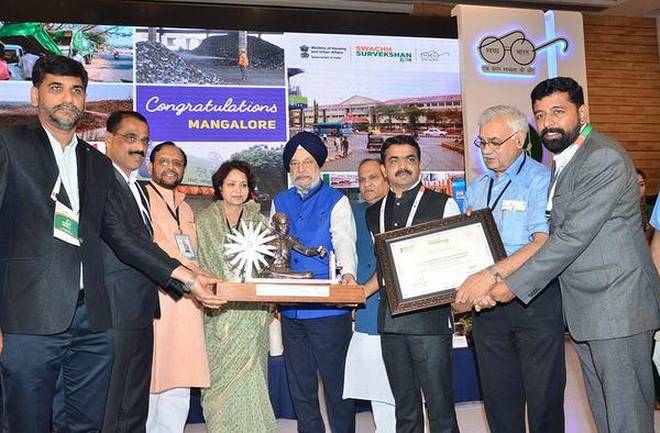
Mangaluru officials receiving the award from Union Minister for Housing and Urban Affairs Hardeep Puri in Indore, Madhya Pradesh, on Saturday. | Photo Credit: Supplied
The Mangaluru City Corporation received ‘India’s best city in solid waste management’ award under the categories of cities having a population between three lakh and 10 lakh under Swachh Survekshan 2018 at Indore, Madhya Pradesh on Saturday.
Union Minister for Housing and Urban Affairs Hardeep Puri presented the award at a function.
Bhaskar K., Mayor, Mohammed Nazir, commissioner of the city corporation, Naveen R. D’Souza, chairman, Standing Committee on Health and Education, and Madhu S. Manohar, Environment Engineer at the corporation, received the award. Mangaluru was among the 23 cities selected in the country for the national award under different categories.
The survey by the Union Ministry of Housing and Urban Affairs assessed 4,203 urban local bodies under the aegis of the Swachh Bharat Mission (Urban) between January 4, 2018 and March 10, 2018. The survey team was in Mangaluru for four days in February, 2018.
The on-field survey for Swach Survekshan had been conducted by an independent agency and the data for ranking the cities were collected through direct observation, citizen feedback and service-level progress..
source: http://www.thehindu.com / The Hindu / Home> News> Cities> Mangaluru / by Special Correspondent / Mangaluru – June 23rd, 2018
Today, Jawad is the managing director of TNM Online Solutions, a multi-crore IT establishment that deals with e-commerce, web designing and app development, and has a large clientele base from across the world.
It was a computer gifted to TNM Jawad which overturned his fortune and changed his life for the better. The 21-year-old from Kannur, Kerala, is a millionaire today and owns a company that rakes in an annual income of ₹2 crore. He also owns a house and a BMW car—and all this is thanks to Google!
This is the inspiring story of an enterprising youngster who entered uncharted territory at a very young age and emerged a winner through sheer hard work and trust in his abilities.
Today, Jawad is the managing director of TNM Online Solutions, a multi-crore IT establishment that deals with e-commerce, web designing and app development, and has a large clientele base from across the world.
But let’s go back to where it all began.
All of 10, a young Jawad made every possible use of the computer his father had gifted him along with an internet connection. Interestingly, Jawad’s original name is Mohammad Jawad TN, and it was his father who created his Gmail ID.
The 21-year-old genius.
“At that point, the user ID with my name wasn’t available, and instead Google came up with the suggestion ‘TNM Jawad’, and the name stuck! When I look back, that instance was the beginning of everything good in my life,” says the 21-year-old to The Better India.
Back then, Orkut and similar social networking sites were the rage, and this always intrigued Jawad. “I was keen to learn about everything—like how websites were created and how they worked and spent most of my after-school hours in the same pursuit. You could say that I was addicted to the computer but in a good way,” he recalls.
He soon learnt the basics of blogging and web design through free website building applications and even made a few blogs on his own. By the time he was a Class 10 student, he had launched a website along with his classmate, Srirag, named jasri.tk.
“Both of us were equally passionate about everything web related, and this was our first outing. However, we couldn’t afford a dot-com domain since we didn’t have any pocket money, so we created the site through a free domain,” Jawad adds.
Even as this went on, Jawad made sure that his studies never suffered. After scoring an ‘A1’ grade in all subjects in his exams, he had a lot of time on his hands and decided to explore the field further. He spent his vacation time understanding how great performing websites were different and what made them better.
By then, Jawad’s interest started becoming more pronounced. Realizing that there was a looming scope for website development, he decided to take the plunge by registering his first domain name—TNM Online Solutions—and running it as a virtual company. He started out by announcing on Facebook about designing a website at prices starting from ₹1,000.
Soon enough, enquiries started pouring in, but he admits to being technically ill-equipped to handle almost 99 percent of the queries that came his way.
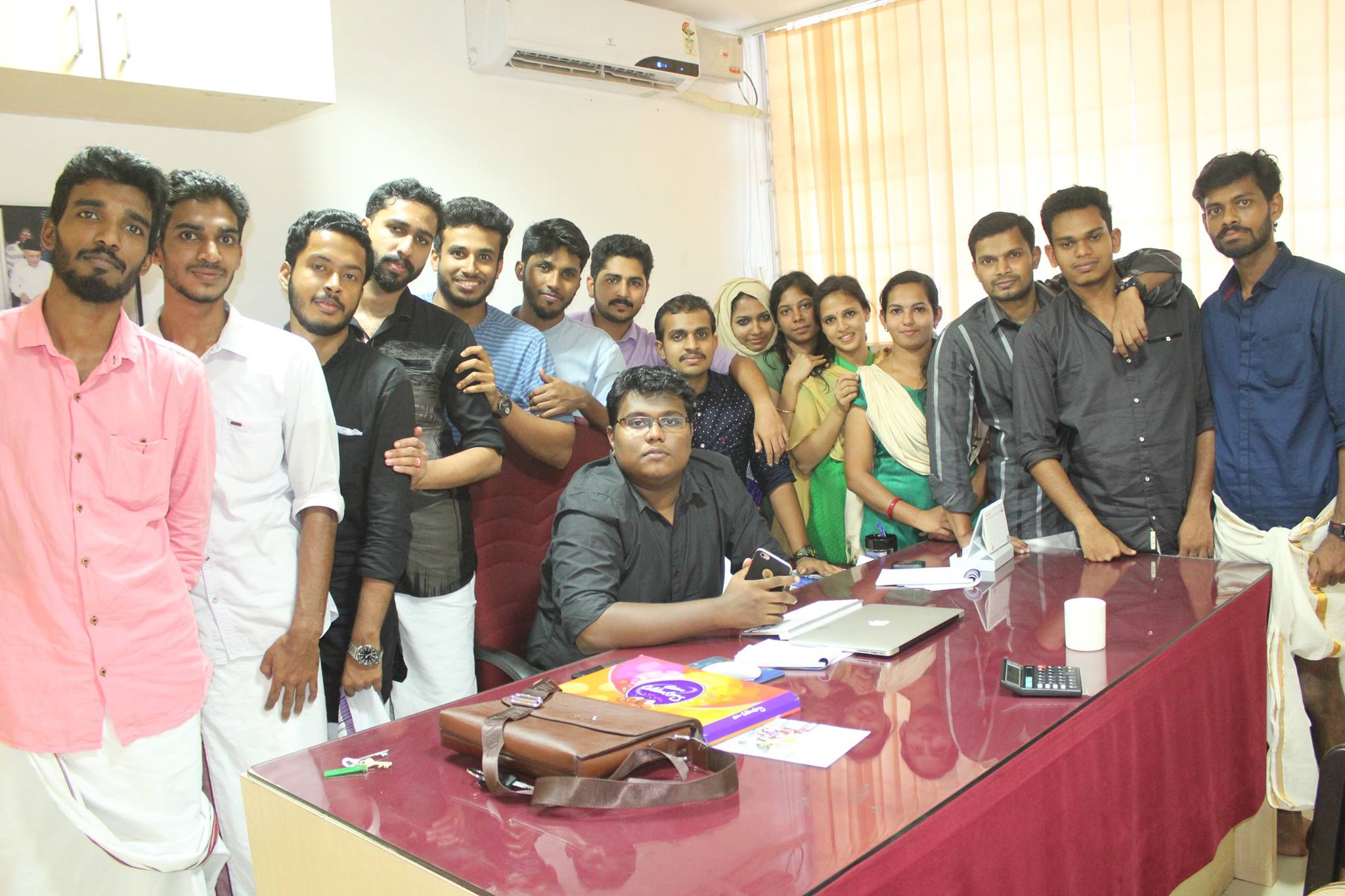
Jawad and his workforce.
“That is when I realised that I lacked strong tech-based skills that are important for website development, and to learn more, I even visited a couple of website design companies in Kannur and saw how they worked,” says Jawad.
When nothing seemed to be working for Jawad, the silver lining came in the form of a teacher from his school (where he was pursuing his higher secondary education) who had seen his Facebook post about website building. “Her brother had been an interior designer and was in need of a website. She came looking for me and requested if I could help, and guaranteed that she would pay the full amount I had quoted,” he recalls.
That was the first website formally developed under TNM Online solutions. “My teacher paid me the first ever remuneration I’d ever received in my life. Until then my folks at home had no clue about the company, so naturally, my mother, Fareeda, was shocked when I handed over an amount of ₹2,500 to her, and I had to explain what had happened,” laughs Jawad.
Somewhere around this time, Jawad’s family started grappling with a severe financial crunch after his father, who had been working in the banking sector in Dubai had to leave his job and return to India.
“Things started going from bad to worse, and I knew there was no time to brood over what had happened. Instead, I raised the subject of starting my own company to my parents and requested my father to somehow source ₹1 lakh for the venture. Knowing my penchant for computers and proclivity for web-based work, they wholeheartedly supported my ambition,” Jawad says.
In the meantime, he had signed up with an IT academy in Kannur, where he spent about a month professionally learning about website building and designing. This became yet another landmark turn in his life, as Jibin and Dinil, two of his teachers at the academy, agreed to work for him as salaried employees.
And thus on 23 June 2013, 17-year-old Jawad flagged off TNM Online Solutions at a small office in South Bazaar. Ably juggling school and work, Jawad would rush from school to office and work till 9:00 p.m., following which he would discuss business with clients till 2:00 a.m.
Jawad’s mother, whom he calls his backbone, was a constant pillar of support throughout his days of struggle.
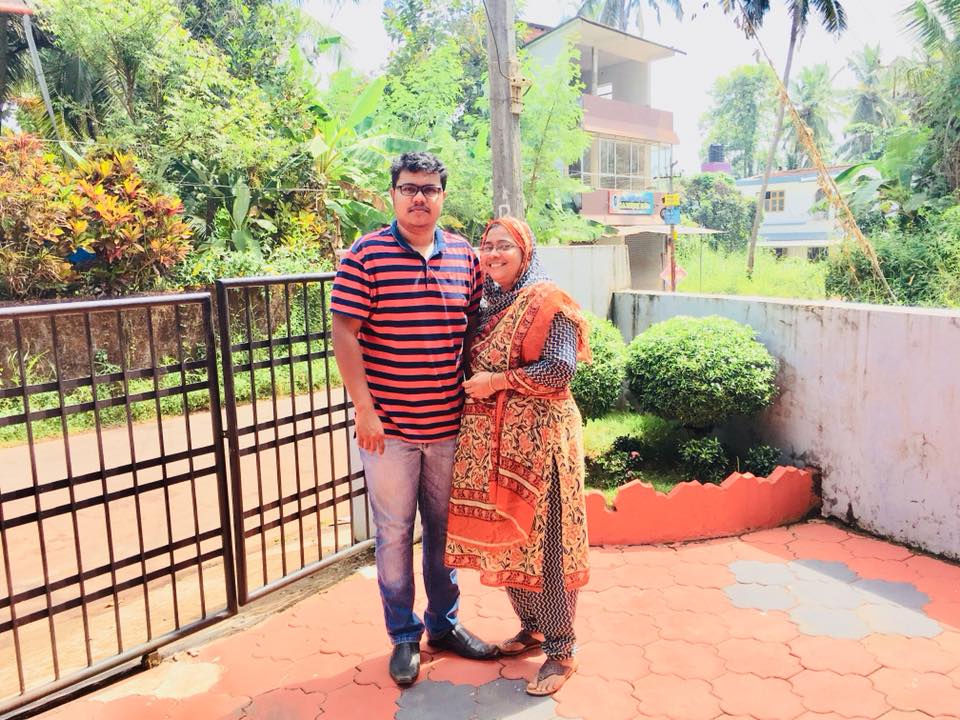
Jawad with his umma, Fareeda.
What makes his commitment even more worthy of appreciation is that he managed to score 85 percent in his higher secondary exams.
However, nothing in life comes devoid of obstacles.
Jawad had been offering designing services at a paltry sum, and this provision wasn’t enough to cover the company expenses that included office rent and employee salaries. Also, business was slow, and the team was only getting 1-2 projects per month. That is when his mother stepped in and offered to pledge her golden bangles for money, as she was against the idea of not paying the employees on time.
After two years of testing times and learning curves, TNM Online solutions had worked with over 100 small-scale clients within Kerala itself. “In this time, I learnt that more than revenue generation, it is one’s portfolio that matters,” he adds.
Jawad cites his participation in the YES Kerala Summit for young entrepreneurs that gave him and his venture the visibility it needed and brought in many new projects, as a landmark achievement in his career.
The young man was always keen on living in his own home because, despite the fact that his father had a well-paid job while he was abroad, his family had always lived in rented houses. At the age of 19, he fulfilled this dream by building a home of his own in Varam.
Today, the 21-year-old works with clients from over 18 countries and has opened an office in Dubai, which has a clientele base of over 900.
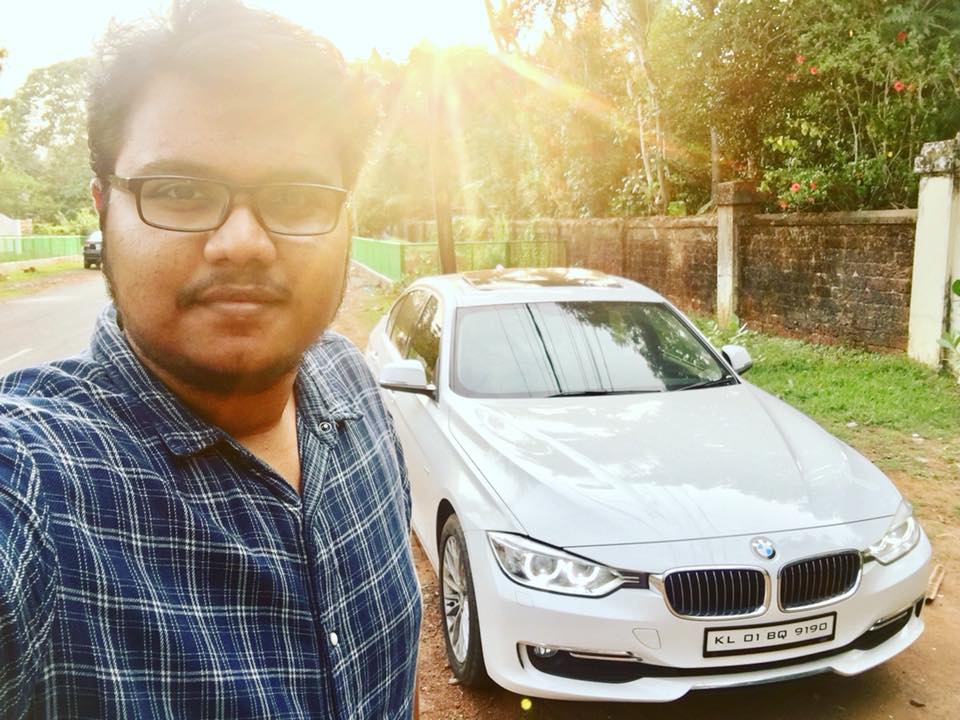
The young man with his prized possession.
Another significant trajectory for TNM Online Solutions started when Jawad started incorporating Search Engine Optimisation (SEO) for the websites he created, making it much easier for websites to be found during a search.
For his incredible achievements at such a young age, Jawad was recently felicitated in the UAE and bestowed with an award by Dr Ram Buxani.
At present, Jawad is busy with a new initiative. He has started the TNM academy that provides professional training in areas like web designing and digital marketing to youngsters. The academy was recently inaugurated in Kannur and is open for anyone, irrespective of age.
Jawad’s resilience and determination deserve to be admired and recognised, and his story will surely motivate everyone. We wish him great success in life and hope that all his future endeavours are fruitful.