Maihar, MADHYA PRADESH / Kolkata, WEST BENGAL / San Alselmo – California, USA :
Kolkata :
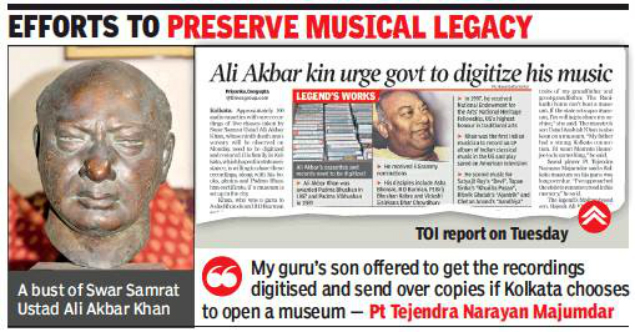
A day after Ustad Ali Akbar Khan’s family in Kolkata urged the government to digitise his 100-odd audio cassettes, offers to restore his works started pouring in. On Khan’s ninth death anniversary, TOI had reported about how the rare recordings of the Swar Samrat faced the risk of being lost forever.
On Monday, Raki Sree Eleperuma showed TOI the collection of her grandfather’s recordings of bandishes as well as orchestra pieces. The audio cassettes are currently with Raki’s mother. “They urgently need digitisation. It’s not possible for an individual to professionally treat these tapes with the latest technology to ensure long-time preservation. I hope, the state government offers professional expertise to preserve them properly,” she told TOI.
Immediately after the article was shared on social media by Khan’s disciple Pt Tejendra Narayan Majumdar, the legend’s California-based son responded. “I was so happy to see my guru’s son — Alam Khan – react immediately. He offered to get the recordings digitised at the Ali Akbar Khan library and send over copies if Kolkata chooses to open a museum. He also wanted to discuss this with Raki. Kishore Merchant — an art connoisseur in Mumbai — has also offered to help,” said Majumdar.
National Award-winning producer Sani Ghosh Ray was equally keen to chip in and help in the digitisation process. “These are part of our heritage. I don’t have any idea about the amount of money that is required to digitise them. But I’m ready to do my bit to get the funding for preserving this priceless collection. We just can’t let the recording get destroyed. If required, one can try to get crowdfunding,” he said from Mumbai.
Raki is happy that music connoisseurs are showing this interest in preserving a legacy. “I’m glad. I hope the government comes forward to digitise this collection,” she said.
source: http://www.timesofindia.indiatimes.com / The Times of India / Home> News> City News> Kolkata News / by Priyanka Dasgupta / TNN / June 20th, 2018
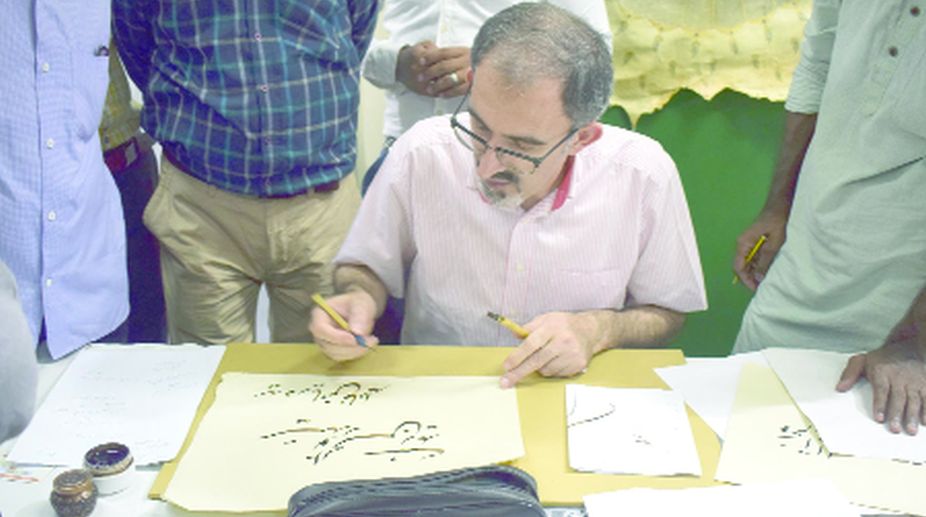
An Exhibition on Holy Quran was inaugurated at the Dr Zakir Husain Library in Jamia Millia Islamia (JMI) on 11 June. The exhibition, organised in collaboration with the Iran Cultural House, was launched by Prof Talat Ahmad in the presence of Masood Rezvanian, Ambassador of the Islamic Republic of Iran.
The exhibition includes a rare collection of manuscripts of the Holy Quran dating back to the 15th century. The manuscripts, written in Arabic, are in different calligraphic styles like Naskh, Thuluth, Muhaqqaq, Nashtalique and Shibasta. Beside this, the exhibition also displays rarely published translations of the Holy Quran in several Indian languages, including Hindi, Urdu, Kannada, Tamil and Malayalam, and in foreign languages, including English, Japanese, French, German, Burmese, Turkish and Persian.
Calligraphy as an art form came to India during the Mughal period between 16th century and 19th century. The Mughal Empire had close ties with the Iranian Empire, which led to the cultural exchange of the art forms. This led to the spread of Iranian influence in art, architecture and calligraphy.
Among the exhibits are the smallest and the largest Quran. Other exhibits include rare Quranic manuscripts and Quran written on different materials like ivory, metal, animal skin, wood and handmade paper.
source: http://www.thestatesman.com / The Statesman / Home> Features / by Majid Alam / New Delhi / June 24th, 2018
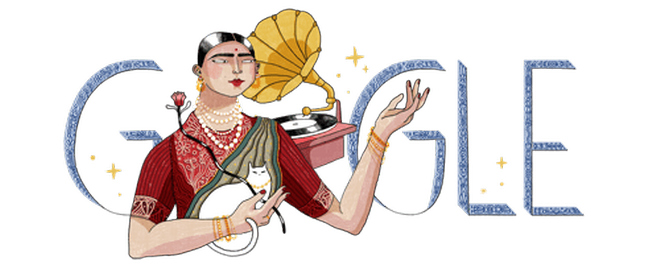
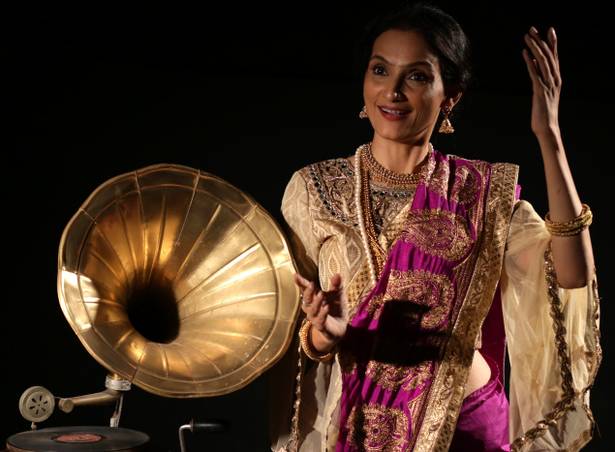
Today’s Google doodle features legendary musician and dancer Gauhar Jaan, the first Indian to record music on a 78 rpm record, thus opening up a new avenue for Indian classical music. Gauhar Jaan was born on this day in 1873.
The illustration is by Aditi Damle, showing Gauhar Jaan with her cat, and the gramaphone in the background.
Gauhar Jan
Gauhar Jaan was born Angelina Yeoward to an Armenian Christian father and an Indian Jewish mother. Angelina converted to Islam along with her mother in the 1880s and became Gauhar Jaan. Her mother, ‘Badi’ Malka Jaan, was an accomplished Kathak dancer and singer and was a courtesan in Benaras. Gauhar learned classical music and dance from her mother. The duo moved to Kolkata later, where Gauhar learned more classical forms such as the Patiala gharana, Dhrupad, Thumri, and the Bengali keertan. She started singing songs penned by Rabindranath Tagore much before it came to be known as ‘Rabindra Sangeet.’
Her maiden music concert was when she was as young as 17 years. Gauhar began giving dance performances too after a few years. She went on to perform in many parts of India, including Mysuru, Chennai, Dharbanga, and Allahabad. Gauhar used her travels as an opportunity to learn regional art forms. She could sing in as many as 20 languages.
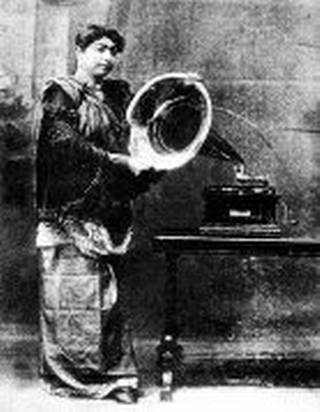
When Frederick William Gaisberg, the iconic recording engineer from the Gramophone Company, visited India to record Indian music, Gauhar Jaan was the first musician to accept his offer. This was at a time when her male counterparts were reluctant to accept a new technology, which they feared would spoil their voice. On the day of the trial recording, she is believed to have said “My name is Gauhar Jan,” according to Suresh Chandvankar of the Society of Indian Record Collectors.. This eventually became the label of the first Indian album. Gauhar has over 200 records to her credit. In 1994, the Gramophone Company re-released 18 of her songs as a collection.
Rajeshwari Sachdev as Gauhar.
“Gauhar Jaan was exceptional in more ways than one… she created a template to showcase something as expansive as Hindustani music in just three minutes!” said Vikram Sampath, who wrote her biography ‘My Name Is Gauhar Jaan! The Life and Times of A Musician.’ . Earlier gramaphone records would last only for three minutes and artists had to scream into horns as the acoustic technology was in its nascent stage. Gauhar’s method of recording was adopted by many women singers, which eventually led to more women taking up recording.
In the book, Mr. Sampath has chronicled the life and times of Gauhar, including her lavish lifestyle, her ill-fated relationships, and dwindling health during later years. There is an interesting story about the cat that is featured along with Gauhar in Tuesday’s Doodle. It is said that Gauhar spent ₹20,000 in the early 1900s and threw a party when her cat delivered a litter of kittens, according to historian V. Muthiah. However, she spent her last days as a court musician in the Mysore Maharaja’s palace for a sum of ₹500 per month, before she passed away on January 17, 1930.
Director Ashutosh Gowarikar has bought the movie rights for Mr. Sampath’s book, hoping to bring Gauhar’s life to the silver screen. Gauhar’s life had been enacted as a play directed by Lillete Dubey. Singer Rajeshwari Sachdev played the title role, while Zila Khan played the older Gauhar.
source: http://www.thehindu.com / The Hindu / Home> Sci-Tech> Internet / by K. Deepalakshmi / June 26th, 2018
Nada Village, Belthangandy Taluk (Dakshina Kannada District) , KARNATAKA :
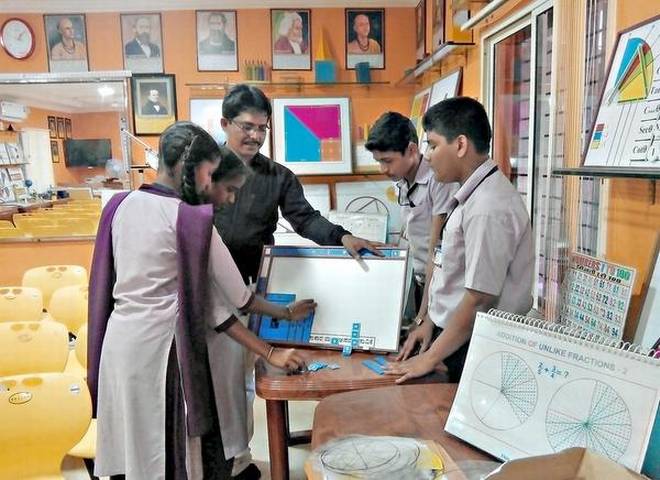
Yakub Koyyur, assistant teacher in mathematics, at the lab opened by him at Government Kannada Medium High School in Belthangady taluk of Dakshina Kannada district.
All SSLC students pass the maths paper; their success is being attributed to a laboratory in the school
A government school teacher setting up a laboratory to help students overcome their fear of mathematics four years ago appears to have borne fruit in a Dakshina Kannada village school as all the 43 students who appeared for the mathematics paper in the recently held class 10 exam have passed.
The Government Kannada Medium High School at Nada village in Belthangady taluk had previously recorded cent per cent results in mathematics way back in 2002.
It was Yakub Koyyur, an assistant teacher in mathematics, who opened the laboratory in the school in February 2014. But it was effectively put to use one year later, from the 2015–16 academic year.
It was the first such laboratory opened in a government school in the State. The objective was to make students having less-than-average learning ability score well and at least pass the mathematics paper.
When the first batch of class 10 students who used the laboratory wrote the exam in March 2015, the pass percentage in mathematics went up to 77.35 from 69.38 in 2014. It further rose to 95% in 2016 and witnessed a slight decrease — 94.59% — in 2017. The dream of the teacher to see all class 10 students pass in the subject was achieved this year.
Mr. Koyyur said many students end their education in class 10 for having failed in mathematics as they feel it is tough nut to crack. He, however, wanted to make the students first shed the fear about the necessary evil and pass the SSLC exam.
Before setting up the laboratory, the pass percentage in mathematics in class 10 in the school varied between 62.6 and 86.76 during 2008–13.
All those students who passed in mathematics in class 10 this year had made use of the laboratory since they joined the school for class 8 in 2015–16. “The laboratory inspired the students to shed the fear and also provided a base to understand the concepts of mathematics. Three years of continuous exposure of students to the laboratory could be one of the reasons for all having passed this year,” Mr. Koyyur said. But the pass percentage also depended on the questions asked and the learning ability of students, he added.
In his bright and colourful ‘Maths World’ laboratory, all students from class 8 onwards get hands-on experience through models, audio-visual tools, and charts. The laboratory was opened with a partial government funding of ₹2.5 lakh and ₹13 lakh contributed by the school alumni.
source: http://www.thehindu.com / The Hindu / Home> News> States> Karnataka / by Ravi Prasad Kamila / Mangaluru – June 18th, 2018
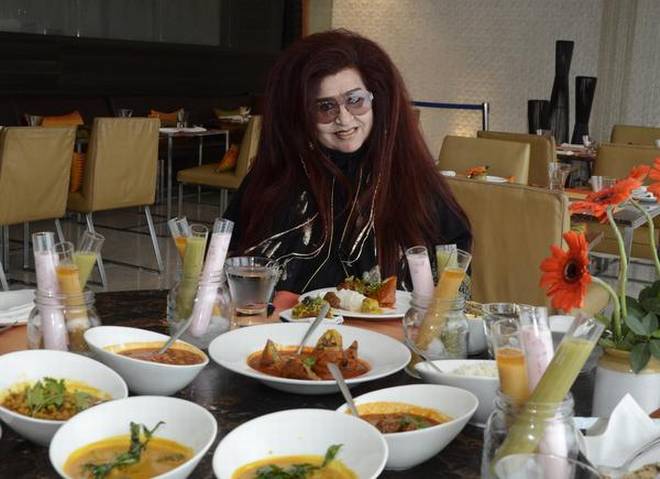
Appetite for knowledge Shahnaz Husain at The Park’s Fire restaurant in New Delhi | Photo Credit: Sushil Kumar Verma
Shahnaz Husain says quality of food plays a vital role in making a person look attractive.
It is usual to find film stars, sport personalities and politicians surrounded by fans and followers. One did not expect such response for Shahnaz Husain, one of the pioneers of herbal beauty care movement in the country. From the moment she steps into Fire, the multi-cuisine restaurant of The Park for a luncheon interaction, men and women of all age groups douse my cynical mind with their requests for selfies and autographs with the doyenne of cosmetic industry.
Perceiving my surprise, Shahnaz says, “This is the goodwill that I have earned thanks to my profession. For me, money was never primary. It was to help people look good without adverse effects. I’m always keen to help people including strangers whenever I observe a skin or hair problem. I try to suggest what is good for them. Recently, I noticed the girl doing my cardiogram at the doctor’s clinic had a bad case of skin pigmentation. I advised what was best for her.”
Chef Abhishek Basu has specially curated organic seasonal menu for the guest. Shahnaz remarks, “Being conscious about my diet, I am glad about this menu.”
Carving her own niche
Considering that Shahnaz comes from a family of legal luminaries — her grandfather Samiullah Beg served as the Chief Justice of Hyderabad High Court, father Nasirullah Beg was the CJ of Allahabad High Court and uncle Mirza Hameedullah Beg was the CJI — many find it surprising that she decided on cosmetic business as a career. “My father wished me become the Chief Justice of the International Court of Justice in Hague while I teased him that my limited schooling was not enough for that. Having been married at 15 and becoming a mother at 16, I wondered what to do with my life. Not keen on interior decoration or fashion, I decided to opt for cosmetic therapy and cosmetology.”
What she decided, she did with style, studying in eight countries and getting trained in globally reputed institutions like Helena Rubinstein, Swarzkopf, Christine Valmy, Lancome and Lean. “Having dropped out of school, I was hungry for knowledge , till they said, there is nothing else to teach,” she quips. Remarkably, Shahnaz paid the fees for these institutions on her own by writing articles on beauty for magazines and weeklies.
Shahnaz took a major decision when after learning Western techniques and methods she decided to create herbal products based on Ayurveda. She says it happened because of a chance incident. “At Rubinstein, my classmate Catherine used to come with a very beautiful woman whom she made wait outside. Unable to control my curiosity, I found out that the lady was her mother. A well known model, she had gone blind by using a famous eye make-up while advertising for the product. I was completely stunned and wondered that if a cosmetic product led to loss of sight, there is something wrong with the beauty business. Pondering over it, I decided to tap India’s more than 3000-year-old Ayurvedic heritage to find alternatives for the chemicals used in beauty products.” After returning to India, she employed several ayurveda practitioners for the job. “You would be surprised to know that for each formulation we discovered 20 alternatives. Such is the richness of this ancient science.”
Meanwhile, the chef fills the table with healthy options. There is sol kadhi, bael pathar ka sharbat and bhutte ka kees taco. Each finds favour with Shahnaz. “This is the strength of natural ingredients. It not only lends taste and flavour but also provides required nutrients.” As we finish the main course of Thanjavur manga curry, mangodi ki subzi and munsiari rajma masala is served. Shahnaz remarks, “The sheer colour, aroma and presentation makes the dishes so tempting. I will try a little of each.”
As we enjoy the delicacies, Shahnaz observes that while most people think that creams, lotions and treatment makes one look good, it is essentially our food intake that plays a major part. “If possible, people should go vegan, otherwise they must eat lots of fresh fruits and vegetables; go high on protein and less on carbohydrates; eat dal and rice after removing the water. These are the mantras for healthy skin and hair.” One couldn’t help observe the hotel staff, listening in rapt attention as did other guests around us.
Strict diet
On being asked if she herself practices what she preaches, Shahnaz says. “I follow my diet rigorously. Breakfast is oats, papaya and green tea. Lunch is usually fruit juice, brown bread, cheese and vegetables while dinner is one roti with subzi.” It must be tough to resist the temptation. “Yes it is,” she admits candidly. “I do have cheat days when I eat Hyderabadi biryani, korma, roast potatoes, kakori kababs, sheer mal and kheer.” Her favourite cuisine is of course South Indian. “Being light and healthy, I prefer idli and dosa with sambar. I learnt this from Vyjayanthimala, who told me that a doctor had advised her to eat these when she wanted to be fit for a particular film.” Likewise, she prefers Chinese cuisine, particularly chicken chowmein, Peking duck and sweet corn soup. “Bahut light hota hai!”
Amazingly dealing with chemicals and their formulations, Shahnaz does not lead from the front in kitchen. “I never had a chance to learn since we always had a cook at home. Once venturing to make rice, I was so confused about the quantity of water and the time required to boil it, that I ended up adding milk and sugar to make kheer,” she quips.
As the doyenne emphasises the need for proper diet for healthy body and mind, one wonders what beauty means to her. “Beauty is what a woman exudes from inside. There are essentially two aspects to it. A woman needs to be intelligent besides being attractive. One without the other never works. Secondly, neither the skin nor hair colour is important, it is the quality that counts.” Then what about this fanatic longing about fairness? “That is really unfortunate. I know several women having underwent chemically induced treatment to look fair. That never helps as the side effects are terrible. We too are entreated by parents to make their daughters fair to help them get a suitable match. All this pains me.” The cosmetic industry too fuels this fascination as evident from ads. “Instead of changing public perception, they are promoting it. Skin colour does not decide the character or nature of a person or how he or she will be as a life partner,” remarks Shahnaz.
Instead of this obsession for fairness, Shahnaz suggests one should take care of oneself. “Looking good is feeling good. People in general and women in particular must take out ‘me time’ to take care of themselves. This need not necessarily mean visiting salons or parlours.” Stating that beauty consciousness is no longer confined to the upper crust of the society, she narrates some interesting anecdotes. “I once met a woman selling Rajasthani cushions in Connaught Place. She recognised me and eagerly shared that she uses one of my products which she picks up in bulk during her visits to Delhi. Likewise, a guard once asked me what cream to buy for his wife. Beauty is everyone’s concern,” she sums up.
source: http://www.thehindu.com / The Hindu / Home> Life & Style> Food / by S. Ravi / June 20th, 2018
A three-day international seminar on Indo-Iranian Persian Literature organised by the Department of Persian began at the University of Kashmir in the auditorium of Ibn e Khuldun Alama Iqbal library on Thursday.
The theme of the seminar is “emergence of moral and ethical values in Indo-Iranian Persian literature and its relevance in modern times”.
The scholars and professors from different countries of the world have taken part in the 3-day seminar to present their research papers and to share their experiences with the students, various scholars and professors from the different states and different universities including Delhi, Lucknow has also participated.
The seminar was started with the recitation of Holy Quran by Dr Shanawazz shah followed by the naat by Syeda Mysooma.
Vice Chancellor Prof Khurshid Iqbal Andrabi presided over the seminar, addressed the guests and welcomed them with his warm speech.
In his presidential address, Prof Andrabi said that morals are the basic requirement of an individual, and is very fascinated by the beautiful culture, language of Iran.
Dr Jehangir Iqbal, Coordinator, Department of Persian, underlined the aims and objectives of the seminar and also highlighted the achievements of the department over the years.
Prof Shaief Hussain Qasmi delivered the keynote address.
Dr Ali Raza Ghazvey, Director literary Innovative center Academy of Art Tehran, Iran said: “it seems that we have entered a little Iran with the same culture that we are sharing with each other and the effect of Awraadi Fatah by Mir Syed Ali Hamadani ( rah) has kept the lost glory intact.”
Another guest and professor from the University of Kabul Afghanistan while presenting his research paper and sharing his experience with the students present there said: “we must look to the Persian language, not as an option but we must take it as the objective.”
Meanwhile, Arif Ayoubi who is a chairman Fakhhur Din Ali Ahmad committee said that the best students and scholars will be awarded the gold medals and some cash where they also would be helped and guided in future.
Now the next 2 days of the international seminar will be dedicated to the students and scholars from various faculties and universities to present their papers during these 2 days.
source: http://www.kashmirlife.net / Kashmir Life / Home> Kashmir Latest News / by KL News Network / June 21st, 2018
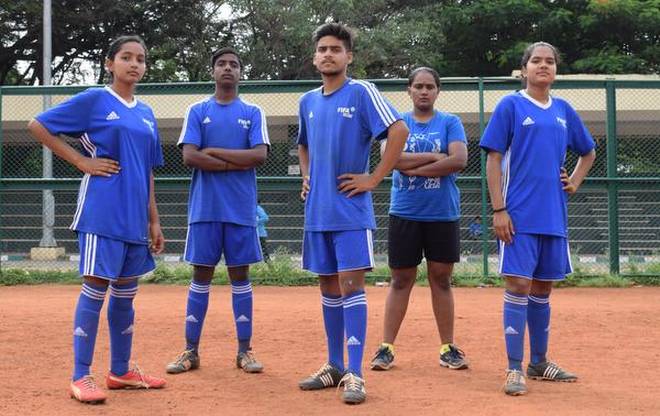
Amreen Taj, Vishnu R., Sandeep Akash P., Anitha Raju (trainer) and Manasa Yadav K. will be taking part in the Football for Hope Festival 2018 in Russia.
Four children from underprivileged communities have been selected to participate in the FIFA Football Fest
When 16-year-old Sandeep Akash, a resident of Byatarayanapura, told his mother that he had been selected to travel to Russia to play football and watch the FIFA World Cup, his mother dismissed it as a tall tale. She asked him not waste her time with silly jokes. It was only after his trainer called and assured his parents that their son had been selected to play football in Russia were they convinced.
Sandeep will be travelling to Russia along with three other teenagers — Amreen Taj, Manasa Yadav K. and Vishnu R. — to take part in the ‘Football For Hope Festival 2018’, an official event of the 2018 FIFA World Cup.
He is the first person in his family to be travelling abroad. His father, a painter by profession, encouraged him to pursue his interest in sports, but never thought that his son’s hobby would turn out to be this eventful.
The festival brings together children from various communities across the world, with a focus on social development. Around 48 teams will be participating in the programme from June 25 to July 5. Children will get to play football with their peers from various countries and will also attend leadership programmes. They will also get to watch one of the ongoing World Cup matches.
Sandeep and his friends, who were part of the NGO Dream A Dream’s after-school life skills programme, were chosen as delegates. They are the first in their families to get the opportunity to travel abroad. While Amreen and Vishnu’s fathers work as mechanics, Manasa’s father works as a driver.
The NGO is one of the two organisations selected from India by FIFA to take part in the event.
“We selected children with great potential who lacked avenues to exhibit their capabilities. We have been helping them work on their nutrition and fitness after the selection was done. For the last four months, the children have been practising for at least three hours every day, making time for football in their school schedule,” said Anitha Raju, trainer for the children and employee of Dream A Dream. These four children were shortlisted from 2,200 candidates across 28 schools in the city.
To play football was a big step for Amreen. “Usually, girls are not encouraged to take up a sport like football. Initially, everyone was sceptical. But after watching me, my brother and sister are very proud of me. I want to help more girls in my community take up this sport,” she said.
According to Sucheta Bhat, CEO of Dream A Dream, the football match that the children will be playing will have a set of unconventional rules (which the children themselves will come up with), with the primary aim of building leadership and cooperation. “This is the second consecutive time that our organisation has been selected,” she said.
All the four children said they want to pursue football training as a career and help more children from local communities realise their potential.
“It’s not only about the game. I have benefited by improving my communication skills and overall discipline,” said Vishnu.
Manasa said that she has gained focus in life. “Earlier, I used to be lazy. I see a huge transformation in myself. I want to pass on the benefit to more youngsters,” she said.
source: http://www.thehindu.com / The Hindu / Home> News> Cities> Bengaluru / June 20th, 2018
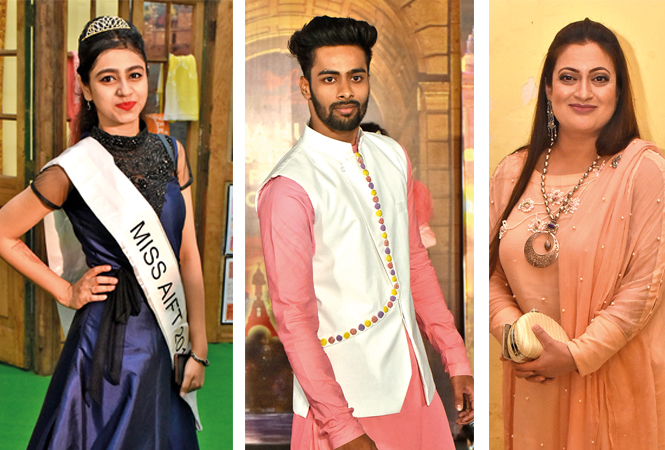
A fashion show was recently organized by a private institut of fashion designing at Paryatan Bhavan.
Organized by the second year students of the institute, the show had Yamaha Fascino Miss Diva 2016 Miss Universe India Roshmitha Harimurthy, and actor and Lucknowite Mohit Kesarwani as showstoppers for the evening.
SP Singh, vice-chancellor of Lucknow University and Anis Ansari were the chief guests of the event which had Madrid as its theme.
However, the highlight of the event was the fbb Campus Princess 2018 auditions in which Chitrapriya Singh was adjudged the winner. Being gratified as the finalist of the fbb Campus Princess pageant, Chitrapriya will get an opportunity to get groomed and participate in the Miss India organisation’s national beauty pageants.
source: http://www.timesofindia.indiatimes.com / The Times of India / Home> News> City News> Lucknow News / TNN / June 20th, 2018
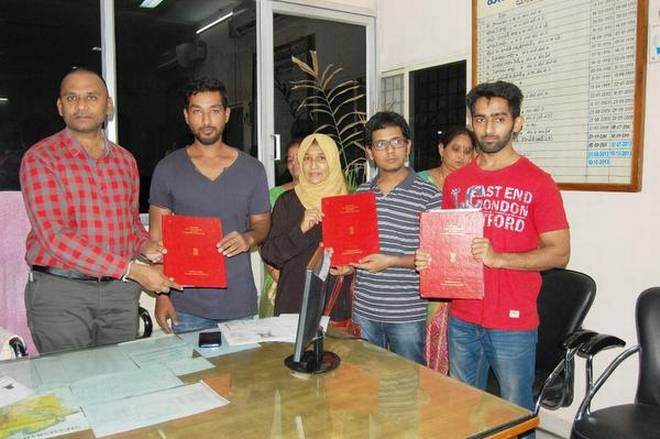
Revenue Divisional Officer T. Vinod Kumar handing over Indian citizenship documents to Sanan, Ruman and Saif at his office in Nizamabad on Tuesday.
The brothers, born to Indian mother and Pakistani father, applied for citizenship eight years back
Three Pakistani nationals – Mohammed Sanan, 29, his younger brothers Ruman, 27, and Saif, 25, were granted Indian citizenship by the Government of India. Revenue Divisional Officer T. Vinod Kumar handed over the citizenship copies to them in the presence of their mother Faiz Unnisa here on Tuesday.
After the perusal of their applications for citizenship, the Ministry of Home Affairs issued orders.
The orders were issued under Section 5(1)f of Citizenship Act-1955 on April 24 approving their appeal. The citizenship document copies No:243; 244; and 245 subsequently were sent to the district authorities.
They had applied for citizenship some eight years ago.
Ms. Faiz, daughter of late Hafeez Abdul Rehman and Samdani Begum, married Mohammed Abdul Nadeem Javed of Bahawalpur in Punjab province of Pakistan in 1988. After marriage, she moved to Pakistan, but did not give up her Indian citizenship. All her three sons were born there. After divorcing her Pakistani husband in 2004, she moved to Nizamabad along with her three sons and they have been staying here on a long term visa (LTV).
Refusing to reveal the details, Ms. Faiz and her children immediately left the RDO chambers after receiving the citizenship documents.
According to sources, she, along with her children and her siblings, has been running a private school in the old city for several years now. Meanwhile, Bharatiya Janata Party (BJP) activists arrived at the RDO office to stage a protest against giving citizenship to the trio. Realising that they had already left, they called off the protest.
When contacted, District Collector M. Ram Mohan Rao said the Government of India granted the citizenship to the three Pakistani nationals only after being convinced that there will not be any law and order problem with them. “I hope there will not be any problem from them, and or to them from anyone. Anyway, I will take the issue to the notice of the Commissioner of Police as regards their protection,” he told The Hindu.
source: http://www.thehindu.com / The Hindu / Home> News> Cities> Hyderabad / by Special Correspondent / Nizamabad , June 19th, 2018
Zurriyat Hussain Kazmi, 116, one of the oldest citizens of the country, died on Sunday night.
After his condition deteriorated, Kazmi was rushed to a private hospital in Rampur Garden locality. He was, however, declared dead upon arrival by doctors.
Kazmi, maternal grandfather of Union minister Mukhtar Abbas Naqvi, was fond of Samajwadi Party patron Mulayam Singh Yadav.
Born on January 1, 1902, Kazmi would say the secret of his long life was 10 kilometres of daily walk.
“He was not suffering from any illness. He died due to his long age,” said Azadar Hussain Kazmi, his youngest son and caretaker.
“My grandfather was a zamindar and had 2,000 bighas at Kulbhara village in Moradabad .
After my father joined British police in 1922, it disappointed my grandfather that his son was doing a job for Rs 10. Working under someone was not considered good then. My father later worked for Indian police. He met Mahatma Gandhi at Chowki Chauraha when the latter visited Bareilly during the struggle for independence,” said Azadar.
“Despite his long age, my father would cast his vote in every election. He believed that voting is an important right. He was fond of Mulayam and later became a fan of Prime Minister Narendra Modi ,” said Azadar.
source: http://www.timesofindia.indiatimes.com / The Times of India / Home> News> City News> Bareilly News / TNN / June 19th, 2018