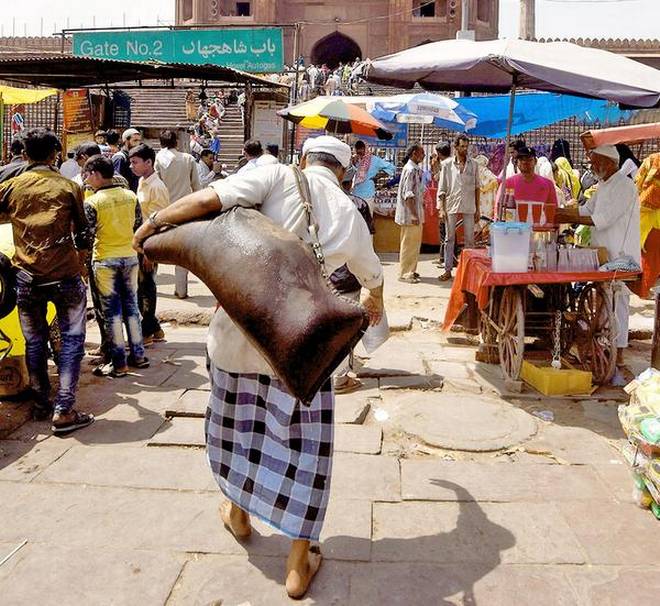
Keeping on: Shakeel Ahmad carries a goat hide flagon filled with water in Delhi / AFP
Bhishtis have been supplying water from their swollen canteens since the Mughal era
Shakeel Ahmad wanders the cramped alleyways of Old Delhi offering water from a goat hide canteen slung over his shoulder, a centuries-old service welcomed by thirsty vendors toiling under the baking sun.
Mr. Ahmad is one of last Bhishtis, a community of water carriers fading into history after generations of quenching thirsts in Delhi’s old quarter.
Bhishtis have been supplying businesses, pilgrims and passersby with swigs from their swollen canteens since the Mughals ruled India, an era before piped water sounded the death knell for their trade.
“I spent my childhood doing this. My ancestors too spent theirs,” Mr. Ahmad said, at the footsteps of Jama Masjid, a towering mosque built at the height of the Mughal empire.
Sense of an ending
“Now I am the last. I’m not sure if my children, if the next generation, will do this or not.”
For centuries, Bhishtis have sourced water from an underground basin deep beneath the warrens and Mughal-era monuments of Old Delhi — a bustling quarter hidden away from the modern Indian capital that grew up around it.
Inside a small Sufi shrine, Mr. Ahmad — like countless Bhishtis before him — draws water from a deep well, filling his large goat skin canteen known as a mashaq to the very brim.
“The water in this well hasn’t stopped since it was dug,” said Mr. Ahmad, gesturing to the murky depths of the pit below.
“It dried up just once when construction began on the Delhi metro… But then it just came back on its own.”
It is back-breaking work hauling a full mashaq around the crowded, cobbled streets in the blistering Indian summer, where daytime temperatures regularly exceed 40 degree Celsius.
A full canteen carries roughly 30 litres — enough to earn a Bhishti a mere ₹30, a pittance for the hard labour involved. “My children will find it difficult to do this job. I am the last (of my family),” he said.
Cheaper alternatives
The advent of piped water, and cheap bottled options, has decimated their business, but there’s still a handful calling out for Mr. Ahmad as he treads the lanes with his dripping flagon.
Old shopkeepers, parched in the midday sun, cup their hands for a mouthful of water, while street vendors have him fill cooling units and drink buckets to ward off the worst of the heat.
Problems with the piped water supply — not an unusual occurrence in the creaky old neighbourhood — is a godsend for Mr. Ahmad, even if a nuisance for everyone else.
“When they have their regular supply, no one bothers to call,” Mr. Ahmad said.
Of the bygone era
Business may not be booming but tourists and pilgrims still do double take when they see the elderly Bhishti in his white Muslim tunic and prayer cap carting his water skin, a flashback to a bygone era.
“Many people are amazed to see that this profession still exists… that something from the time of the kings still exists. They are surprised and happy to see us,” he said.
source: http://www.thehindu.com / The Hindu / Home> Sci-Tech> Environment / by Agence-France Presse / New Delhi – May 11th, 2017
Yaskhagana, the popular Hindu dance form from Karnataka’s Dakshina Kannada district, has been used as a backdrop in many Kannada films. But Ismail Mudashedde’s upcoming film, Banna Bannanda Badukku, will not only revolve around the dance-form, but also have a Muslim protagonist.
The film is the director’s take on the recent onslaught on Muslim artistes performing traditionally Hindu artforms in certain parts of the district.
The film stars actor Raviraj Shetty who will essay the role of a Muslim Yakshagana dancer.
“Banna Bannada Baduku is based on the real-life story of a Muslim artiste who was hounded by fundamentalists for performing the art. I was very impressed with the script when Ismail narrated it to me. I am happy to be part of the project,” Shetty told Bangalore Mirror.
Yakshagana enjoys huge popularity in the coastal belt of Karnataka and people of all communities are known to watch it even though the stories performed are mostly from Hindu epics.
Ismail, who has also written the screenplay and dialogues for the film, says it was challenging as the story was very intriguing. “This movie will remind people of the communal violence in Mangaluru and make people question if artistes should be harassed and victimised simply for performing an artform. I hope the film gives the audience a new perspective and they enjoy it,” Ismail said.
Besides Shetty, actors Anitha, Sagar, Riya Meghana, Ramesh Bhat, Satyajith and Honnavalli Krishna have pivotal roles in the film.
Real-life Yakshagana stars like Balipa Narayan and Patla Satish Shetty will be seen in guest roles.
Former Mangaluru mayor Sashidhar Hegde will also be part of the film.
source: http://www.bangaloremirror.indiatimes.com / Bangalore Mirror / Home> Entertainment> South Masala / by Nischith N , Bangalore Mirror Bureau / May 12th, 2017
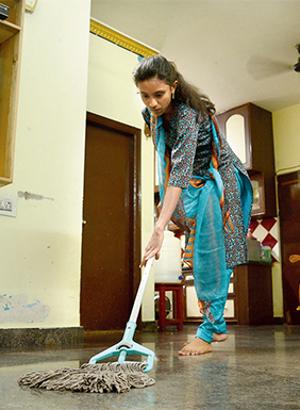
MAKING A CLEAN SWEEP: Elu Afshan working at one of her employers’ homes
by Sana Khan
Washing, cooking, cleaning, feeding, teaching, studying… the days are packed for this PU student who has managed to shine despite working in 10 households, a bed-ridden father and a mother who was frequently falling sick during her exams. We salute you, Afshan
On Thursday Elu Afshan, a PU student, managed to fulfil a part of her mother’s dream. Her mother works as a domestic help and wants that her child never has to do the work she does. With a First Class in Commerce, Afshan has a shot at taking a path different from her mother.
This student of Government PU College goes to some of the houses for domestic work, and takes care of her father, who was bed-ridden, and two younger siblings.
“My mother is the sole bread-winner of our family. Some days she gets tired or needs help, so I join her,” Afshan said. As her mother works in about 10 houses, hardly any day goes by without Afshan having to help.
After college, she used to head to the homes her mother works at and help her. “I washed vessels, clothes and cleaned the house. Everyone at the houses too was supportive and never complained about my mother’s work. Some of the persons used to send me back as they knew my exams were nearing,” Afshan said.
But being the eldest child in her family, Afshan felt the need to take on part of the responsibilities. Her brother has just finished 10th and sister is in the 8th standard.
Another chunk of the 17-year-old’s time would go in nursing her father, who has been bed-ridden since a fall.
“My father was working as a painter, but after a fall, his knee broke and he was bed-ridden for many months. That was a distressing time for us,” Afshan said.
She worked in all the houses her mother used to work. “All of employers took care of me like their kid,” she said.
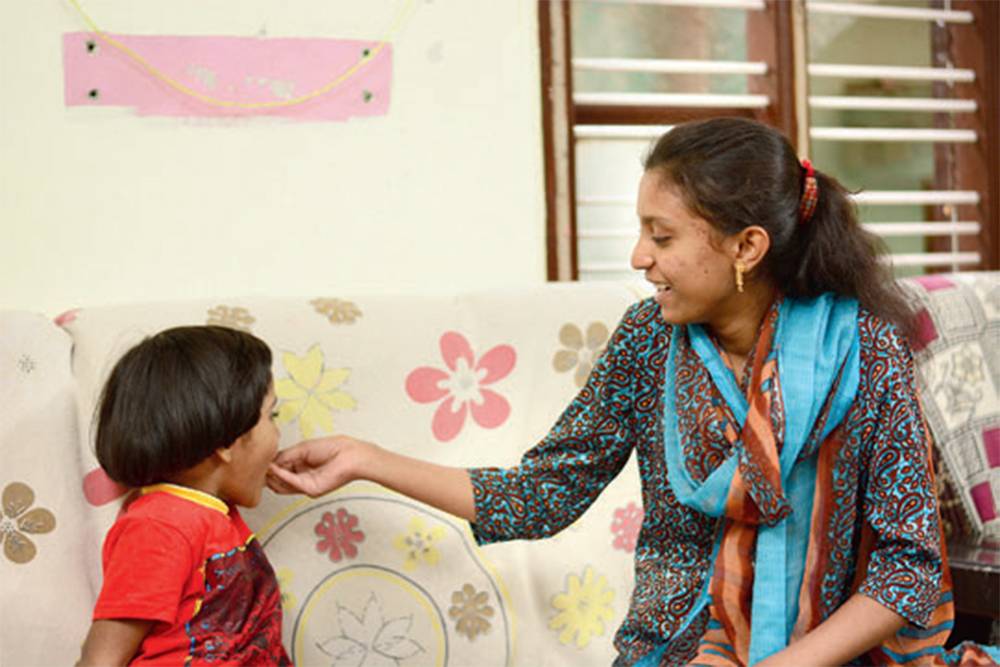
Feeding the child of the household is a delight for her too
During the exams, Afshan had a tough time as mother too started falling sick often. “It was difficult, with my father in this condition and my brother and sister also studying for their exams. I could barely study for two hours a day. There were days when I had to stay back in college to study before coming home,” she told Bangalore Mirror.
All the housework used to take the toll on Afshan on some days. There were times when she felt she should just study and not do any of the other work, but she had to help the family out.
After all this, Afshan is happy with the results.
Her mother Zaheeriunssa told BM, “I want my daughter to study well and take care of her life. She is an asset to the family. We want to give her more time to study, but sometimes it does not happen.”
Afshan said her mother treats her like a queen. On her future plans, she said, “I want to study, but my family’s condition is such that I do not know what I can do next. My mother says I must get job at an office,” she said.
source: http://www.bangaloremirror.indiatimes.com / Bangalore Mirror / Home> Bangalore> Cover Story / by Sana Khan, Bangalore Mirror Bureau / May 11th, 2017
Naseem Mirza Changezi, who is thriving at the ripe age of 106, has claimed to have met revolutionary freedom fighter Bhagat Singh in 1929, while the latter was living in Delhi’s Jama Masjid area and cautioned him against the power of the British.
Changezi, who was himself a freedom fighter, was given the task of ensuing regular supply of food to the young Bhagat Singh while he lived in disguise planning the bombing in the central legislative assembly.
“Shaheed Bhagat Singh wanted to see a free India. He wanted to show the British that in spite of such strengthened security, he came inside the Parliament. I tried to dissuade him, but he would not listen to me. I cautioned him about the British, told him either you will be hanged to death or you will be given life imprisonment,” Changezi told ANI.
Bhagat Singh was hanged in 1931 in Lahore jail, while Changezi is still alive.
“If the government knew about me giving shelter to Bhagat Singh, then even I would have been hanged,” he added.
Expressing disappointment, Changezi said India may have got independence, but it failed to achieve Bhagat Singh’s vision of freedom that sought a society where all communities and religions would live in complete harmony and peace.
“During the British rule, the Indians used to live in peace and brotherhood.this was not the scenario what it is now. This is not the outcome of the dream which we dreamt. We wanted unity, but what is happening? If the freedom fighters come and see this condition, then they would rather go back,” he added.
A freedom fighter himself, Changezi revealed how revolutionary leader Rashbehari Bose formed the roots of the Indian National Congress (INC) in Delhi and taught the youth to make bombs.
“He went to Punjab and taught the youth to make bombs. Then he moved to Japan. Subhash Chandra Bose went there and formed the roots of the Indian National Congress. He was going to Germany for some work where his ship capsized and he died. I was also a freedom fighter, but I didn’t want to die and I wanted to see India’s freedom,” he added.
Bragging that no doctor could uncover his secret to a long life, the 106-year-old said when people ask him remedies for increasing life span, it was simply to eat less, talk less and sleep less.
Going down the memory lane, Changezi shared his fascination of playing Hockey with legendary player Dhyan Chand during his youth.
“I used to practice Hockey in the evening. I was a Hockey champion. Dhyan Chand used to play with me,” he added.
Changezi was felicitated by the Delhi Legislative Assembly on March 23, after Chief Minister Arvind Kejriwal unveiled the busts of martyrs Bhagat Singh, Rajguru and Sukhdev in the assembly premises on the occasion of ‘Shaheedi Diwas (Martyrs’ Day)’. (ANI)
(This story has not been edited by timesofindia.com and is auto–generated from a syndicated feed we subscribe to.)
source: http://www.timesofindia.indiatimes.com / The Times of India / Home> News Home> City> New Delhi / ANI / May 31st, 2017
The senior Congress leader talks Pakistan, triple talaq, Indian Muslims, and his party’s need for a new vocabulary
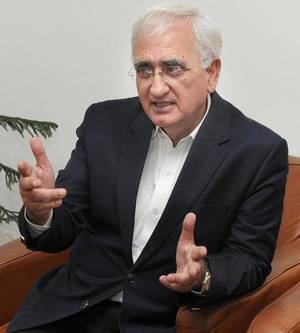
Congress leader, former Foreign Minister and lawyer Salman Khurshid is a man of many parts. From tomorrow, he will be appearing in the Supreme Court as amicus curiae in the controversial triple talaq case. In a wide-ranging conversation, he talks about the triple talaq issue, what it means to be a Muslim in Narendra Modi’s India, the need in the Congress party for a new narrative, and the problem with the government’s Pakistan policy. Excerpts from the interview:
Why have you offered your services to the Supreme Court on triple talaq?
Why not? It may have a political context, but it’s not necessary to look at it in a political context. It can be seen in pure humanistic terms, and towards (developing) a pure understanding of the sociology of Islam. Instead of a partisan approach, we can have an objective discussion that will be helpful for both parties, the court and society. I have done some research, I offered it to the court and am very encouraged that the court accepted it.
But for the BJP (Bharatiya Janata Party), it is a political issue.
In politics, [you can] pose something for the benefit of a segment of society; or you can propose something [because] it gives you political advantage. If the BJP is genuinely concerned about the welfare of Muslim women, then it is understandable. If they are doing it to excite aversion to Muslims, it’s very sad. My view is that they may be taking a simplistic political stand. Therefore I hope an objective understanding of triple talaq will be an appropriate response.
The Muslim ulema see it as an interference in personal laws.
That’s their point of view. There are many other points of view. If ulema from elsewhere in the world and ulema from India have different positions then there needs to be a dialogue between the two sets of ulema rather than for Indian Muslims to say we will only listen to the Indian ulema.
Do you think the BJP is gradually moving towards enacting a Uniform Civil Code?
Maybe, but anyone in the BJP who thinks framing a Uniform Civil Code is about removing elements of Islam from the law in this country is barking up the wrong tree because there are many more complicated issues that arise. Let me give you an example: what is the position of the BJP on same-sex marriages? If you have a Uniform Civil Code, you can’t stop at traditional attitudes towards human relations.
Isn’t there a court ruling already on triple talaq?
There are High Court rulings and one specifically from Delhi of Justice Badar Ahmed which is very explicit: the ruling doesn’t say we will overrule triple talaq, it says there is no such thing as triple talaq. The world over, the majority view of Muslim thinkers is that there is no such thing as triple talaq. Even if you say talaq three times, it amounts to talaq being said only once. So we have to look at the texts more closely and then come to a conclusion.
Is triple talaq really a big issue for Muslim women?
It is not an issue at all, but anyone who feels the threat of adversity would like to stand up against it. But for the BJP to assume that Muslim women think only it can save them from this adversity is completely wrong. There are systems within Islam, and an understanding within the Muslim community that does not favour triple talaq. In fact, triple talaq is largely a propagation and promotion of Hindi movies.
You have written at least two books in which you have dwelt at length on what it means to be a Muslim in India. What does it mean to be a Muslim in Narendra Modi’s India?
Those books are already dated. What it means today is to understand what it means to be irrelevant. And you cannot blame Mr. Modi or [Uttar Pradesh Chief Minister] Yogi Adityanath for making Muslims irrelevant. The BJP is a political party and it has to win elections, and they have won elections by making Muslims irrelevant. But Muslims have played a major role in making themselves irrelevant.
Muslims have been wrongly described as a political group that is captive of the Congress and other liberal parties. They were participants in the Congress movement because it was the only movement that vigorously fought against Partition, refuted the idea of a divided India. So Muslims of India are those who rejected the idea of Pakistan. Where would they go? There have been disappointments with the Congress. Periodically, they return to the Congress. That’s how 10 years of UPA rule was possible. But Muslims have been constantly attacked for being Congress lackeys and the Congress has been attacked for appeasement of Muslims.
However, the fact remains that Muslims are not the only ones who have made themselves irrelevant. The liberals have made themselves completely irrelevant. The liberal voices are in complete isolation. It is liberal India that stood up for the minorities and women.
On the subject of appeasement of Muslims by the Congress, the A.K. Antony Report after the 2014 elections hinted that that might have been part of the problem.
I have not seen the report but I don’t accept the report has this because I have spoken to Mr. Antony. He said he was saying this is in the context of political structures in Kerala, it was not a general proposition.
That is not how it is read in your party.
My party has all kinds of characters but I don’t think they have a right to claim they speak for the party. I can say with enormous confidence that either in private conversations or in public we haven’t heard such a direction from our top leadership.
You mean Sonia and Rahul Gandhi.
Yes, yes. But there is ideology, principle and perception. If a perception is being created against the Congress, then we have to learn the idiom and the manner of presentation so that we don’t become susceptible to perception. And that’s where some of our colleagues are lacking.
We are not an NGO, we are a political party. And therefore, what needs to be said has to be said in a manner that will unite, not divide people. We were under a lot of pressure from the NGOs to use a language that is unfortunately divisive. The Congress has a very inclusive and nationalistic idiom that it has used in the protection of minorities and of vulnerable sections of our society. If we lose that idiom, we will be hurt, and that’s what the BJP has done. It doesn’t mean that we have second thoughts on our ideology.
Doesn’t the party need a new narrative?
Of course, we need a new narrative, a redrafting of strategies, a change in vocabulary. I would say fight for liberal India, you don’t have to fight for secular India. If people are unwilling to understand what secularism means, we should take the larger picture and talk of liberalism.
Define it as freedom, the right to express yourself, do things that you want to do in a way that does not impinge on the other person, community. That’s how all liberal societies define themselves and that’s how India should define itself till such time as we can get the balance back to speak more freely and more openly about the rights of minorities.
It’s been three years since 2014 but there is no talk of a new narrative in the Congress.
In our party we tend to concentrate more on organisation. There’s always a lot of good people available all the time but the larger winning strategy — of course the changes you make in the organisation are absolutely indispensable, the fresh flavour, the fresh passion, fresh vigour to work, reorganise yourself — will come from new thought processes. Perhaps we have not done enough of that. We did this when we had conclaves in the past in the years before we came to office in 2004, we built up a narrative that brought us to power for 10 years. I think a similar exercise is called for.
What will you say about the BJP’s Pakistan policy?
Disastrous. They have not understood Pakistan. Mr. Modi thought it was all about hugs and kisses, and the amazing charm that won him elections in India would win him Pakistan. He has realised that is not the case. Pakistan is a hard nut, very complicated case. Not only are they convinced that their existence is hugely dependent on the continuing disharmony with India but also that their internal structures are very finely balanced on hostility towards India.
In all my references to Pakistan, I have said we must stand by the government. It is our duty and obligation that the nation remains united and speaks in one voice. But frankly, how long can we keep our eyes shut and not cry out in pain about what is going on — the repeated casualties and no explanations? What happened to all those promises of we will fix them, show them what India is… There are no easy answers, but you can’t show you are weak as far as your military preparedness is concerned.
What about dialogue?
Let them say that dialogue will never be resumed. You start it, one day you stop it. Nowhere in the world does conflict end without dialogue. To hold out a promise that there won’t be a dialogue is silly.
There will be dialogue at an appropriate time and under appropriate conditions after we have no reason to feel a sense of weakness. Casualties must stop, that is the first priority and it won’t stop by begging Pakistan to stop it. We must have the strength to stop it.
source: http://www.thehindu.com / The Hindu / Home> Opinion> The Wednesday Interview – Interview / by Smita Gupta / May 10th, 2017
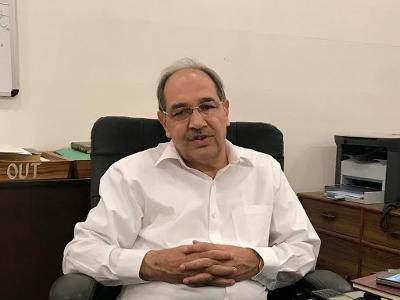
Prof Tariq Mansoor, newly appointed vice chancellor of Aligarh Muslim University.
Aligarh :
The newly appointed vice chancellor of Aligarh Muslim University (AMU), Prof Tariq Mansoor, has said that his priority would be to maintain discipline in the university and get rid of all the criminal elements who are giving a bad name to the institution.
Talking to TOI, soon after the notification of his appointment, Mansoor said the responsibility to head the institute is “huge” and he would ensure that students get a secure environment for their studies. Maintaining that there are only a handful of students who create problems on the campus, Mansoor, who would take charge after the end of the term of the present VC, Lt Gen (retd) Zameer Uddin Shah, on May 17 said his priority would be to get rid of such elements.
Responding to a question on the impeding audit of the AMU regarding academic, research, financial, and infrastructural ordered by the UGC, the newly appointed VC said he would ensure that all help is extended to the probe team and everything is done in a transparent manner. Mansoor said such audit can prove beneficial to the university also.
“Whatever deficiencies the audit points out would be taken care of”, he said. In response to a question on resistance by students organization against allowing leaders of right wing Hindu organizations for organizing debates in the university, Mansoor said, “Ideologies can differ but exchange of ideas should be welcomed in any academic institution”.
Maintaining that he was as it looking after 1/3 of the university in his present capacity as the principal of Jawaharlal Nehru Medical College, he said he would ensure total transparency in AMUs working.
Incidentally Mansoor is the first “local” vice chancellor of the university in the past five decades. Mansoor secured the highest number of votes (94) in AMU court. Out of three candidates, Prof Mansoor was the only candidate who was a professor in the university and having academic and administrative experience in a university system.
Rahat Abrar, director of Urdu Academy and former public relation officer of AMU said that the last local VC, Prof Abdul Aleem, was appointed 49 years back in 1968.
Three candidates including Mansoor were in the fray for the post of VC of the AMU. The other two candidates were: Abusaleh Shariff, executive director and chief scholar, US-India Policy Institute, Washington and Shahid Jameel, CEO, Welcome Trust and DBT India Alliance. The three names were sent to the Union human resource development ministry two months ago by the AMU Court.
Mansoor, born on September 20, 1956, completed his MBBS from the JN Medical College in 1978 and MS (Surgery) in 1982. In 1994, Mansoor completed FICS from the International College of Surgeons. Mansoor became the principal and chief medical officer of AMU’s JN Medical College in September 2013. He had first started working at the college’s department of general surgery as a clinical registrar in 1983 and taught MBBS classes.
Mansoor’s father late Prof Hafeezul Rahman was founder dean, Faculty of Law at AMU and his elder brother late Prof Rasheeduz Zafar was professor of Civil Engineering at IIT, Delhi, and professor and head of the department of Civil Engineering in AMU and vice-chancellor of Jamia Hamdard University, New Delhi from 1992-1994. He has published 90 research papers and works in national and international journals.
source: http://www.timesofindia.indiatimes.com / The Times of India / News> City News> Agra News / by Anuja Jaiswal / TNN / May 04th, 2017
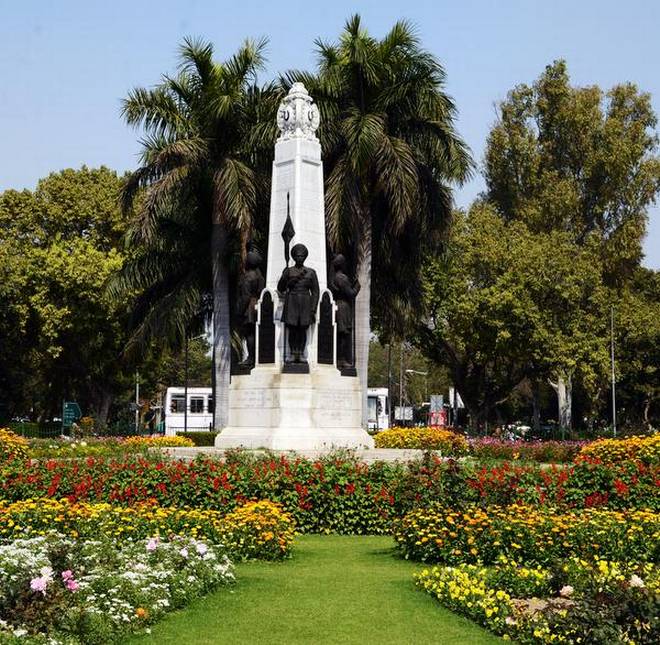
Lastng legacyTeen Murti memorial in New Delhi, The Second Lancers WW-I memorial in the cityVV Krishnan, KVS GiriV_V_Krishnan
A relook at the legacy of the Teen Murti Memorial in Delhi which has a Hyderabad connect
The Teen Murti Memorial in New Delhi is set to be renamed again. What was Imperial Cavalry Brigade Memorial and became Teen Murti Memorial after Independence, is to be renamed Teen Murti Haifa Chowk timed with the first ever visit of an Indian Prime Minister to Israel. The tinkering with the name of a war memorial will not change the glorious memory and the gallantry of Indian soldiers.
Hyderabad House is a well known landmark in New Delhi and is a venue for the reception of foreign dignitaries. The Teen Murti memorial’s link to Hyderabad is less well known. But as the roundabout with three lancers wearing pugrees and khaki shorts grabs the nation’s attention due to yet another renaming row, it is time to remember the legacy of the memorial and its Hyderabad connect.
Just outside the Jamali Kunta darwaza of Golconda in Hyderabad is the area known as Second Lancers. Dotted with low squat houses painted white — some with extensions and some in the same state they were constructed — it has a few houses that still bear the names of the original allotees. While most of the men with Jamadar, Dafadar honorofics are no longer alive, the houses currently occupied by their children and grandchildren still carry their nameplates. These were some of the soldiers who saw action in France and later in Egypt and what was Palestine. The lancers from Hyderabad were the first to sail and were part of the 15th Imperial Service Cavalry Brigade along with lancers drawn from Jodhpur and Mysore princely states. The Teen Murti celebrates the bravery of soldiers from these three princely states.
To call them brave would be an understatement. The great war’s first mechanised weapon was the machine gun that shot out hundreds of bullets in an arc. The lancers from Hyderabad and the other princely states armed with just lances and light weapons were no match for the rat-rat-rat of the machine gun that mowed down anything that moved. But these men stood up, fought and won. One of the most impressive victory was at Haifa on September 23, 1918 and for this the residents of the city still celebrate Haifa Day organised by Indian embassy.
It was not easy to rouse Hyderabad soldiers to fight someone else’s war after crossing the sea. Before the war, the Nizam Osman Ali Khan had to issue a firman informing his soldiers that it is okay for them to fight against fellow Muslims of the Ottoman empire. The port city of Haifa was the key entrepot for the Allied war machine. Years later, the British withdrew from the city leaving the Jews and Arabs to fight it out. The Jews, using a three-pronged attack, captured the city on April 24 in 1948 as the Arabs left their ancient homeland.
Interestingly, while the Teen Murti memorial is in the news, the actual war memorial built for the soldiers who fought for the British in the first World War remains neglected and unseen amidst bushes and brambles in the cantonment area near Second Lancers area in Hyderabad.
Memorable designs
Teen Murti House in New Delhi was designed by Edwin Lutyens, while the Teen Murti Memorial was designed by Leonard Jennings. The one accessible war memorial in Hyderabad, the EME War Memorial in Secunderabad,was designed by Eric Marrett.
source: http://www.thehindu.com / The Hindu / Home> Features> Metroplus / by Serish Nanisetti / May 08th, 2017
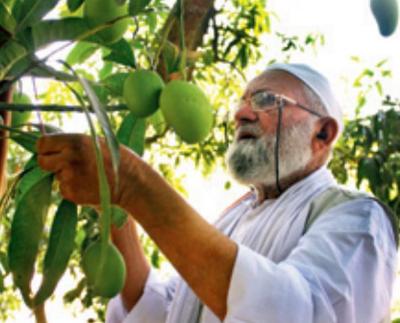
Yogi mango is latest product from the laboratory of UP’s Mango Man. Three years after Haji Kalimullah christened a mango after PM Narendra Modi he has now named another after UP chief minister Yogi Adityanath. The 74-year old Padmashri recipient, Haji Kalimullah is excited about the new variety in his orchard in Malihabad, about 30kms from Lucknow.
It’s the first time the variety named by him has not been developed by the man himself, rather, has grown naturally in his orchard. In all likelihood, it appears to be a cross of another naturally developed variety, ‘Karela’ and Dussehri.
“The Yogi mango is slender, elongated and beautiful and you won’t stop marvelling when you see it,” said Kalimullah. But the hybrid’s parent is not know even to him. “Some people visited my orchard recently and while they were looking around they asked about these four five different-looking mangoes on a tree. I said the variety might have developed naturally and they suggested to name it after Yogiji and I did,” he said.
This time, however, Kalimullah has named the variety a little earlier than usual. On all other occasions on which he developed a new variety, he waited for the fruit to ripen to know its taste and smell.
“I am still not sure how this mango is going to taste as it is green and the same can be said about how it would smell. But I hope it will taste good as it is a hybrid of Dussehri,” he said, adding that it will take about a month for the fruit to ripen.
Meanwhile, the tree bearing Modi mango has some fruits on it this year too. “Modi mango is exceptional in taste and very nice to look at,” said Kalimullah. It’s a hybrid of Kolkata’s Husn-e-Aara and Lucknow’s Dussehri. No wonder, the fruit has acquired distinct streaks of crimson like Husn-e-ara and elongation of Dussehri.
Kalimullah’s technique is different when it comes to developing a new variety. “I cross flowers, develop a fruit and then sow its seeds because every seed is different and that is how the best variety develops,” he said.
It’s anything but easy. About 99% experiments have gone waste. The few that survived brought the man recognition. He has named the hybrid of Khasul Khaas and Chausa weighing up to 1 kg after Sachin Tendulkar. He has also named one variety named after Aishwarya.
source: http://www.timesofindia.indiatimes.com / The Times of India / News> City News> Lucknow News / TNN / May 07th, 2017
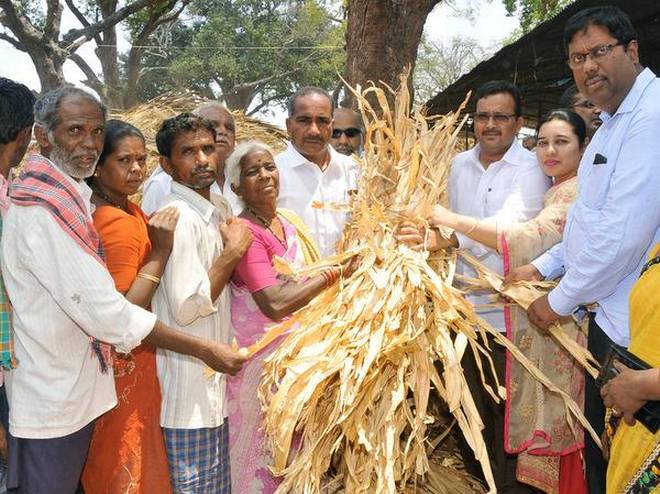
n solidarityCongress MLA for Tumakuru City Rafiq Ahmed distributing fodder to farmers at a goshala at Thovinakere in Tumakuru districton Friday.
‘I wanted to do my bit to mitigate the woes of cattle and farmers’
In the midst of reports of right-wing cow vigilante groups attacking minorities in different parts of the State and the country, Rafiq Ahmed, Congress MLA for Tumakuru City, chose to celebrate his 50th birthday in a goshala by feeding cattle.
While his birthday celebration could be seen as a symbolic repartee to right-wing groups stereotyping minority community leaders, the thrust of his effort, he said, was to show solidarity with farmers struggling to cope with drought.
“I wanted to celebrate my birthday in a simple way. The region is reeling under the worst drought in 45 years, and I wanted to do my bit to mitigate the woes of cattle and farmers,” said Dr. Ahmed.
He was joined by his wife, Aisha Sultana, and workers from his party as he donated 12 tonnes of fodder, which will be used to feed the cattle in the goshala at Thovinakere. He also distributed fodder to farmers who had brought their cattle to the shelter.
Shankrappa, a farmer from Soorenahalli in Koratagere taluk, said, “We are happy that he has travelled here from the city and chose to spend his birthday with us … The crisis has resulted in a shortage of fodder and food.” Mr. Shankrappa was forced to bring four buffaloes to the shelter as his three acres of land has gone barren.
“This shelter has saved us and our cattle. Otherwise, more than half the farmers in nearby villages would be forced to sell their cattle to slaughterhouses,” he said.
Dr. Ahmed announced financial assistance for the family of farmer Kaavalappa who had allegedly committed suicide because of mounting loans.
The goshala on Friday saw more than 2,000 cows and buffaloes brought by around 1,500 farmers who have been struggling to feed the animals because of their financial situation.
source: http://www.thehindu.com / The Hindu / Home> National> Karnataka / by S. Bhuvaneshwari / Tumakuru – May 06th, 2017
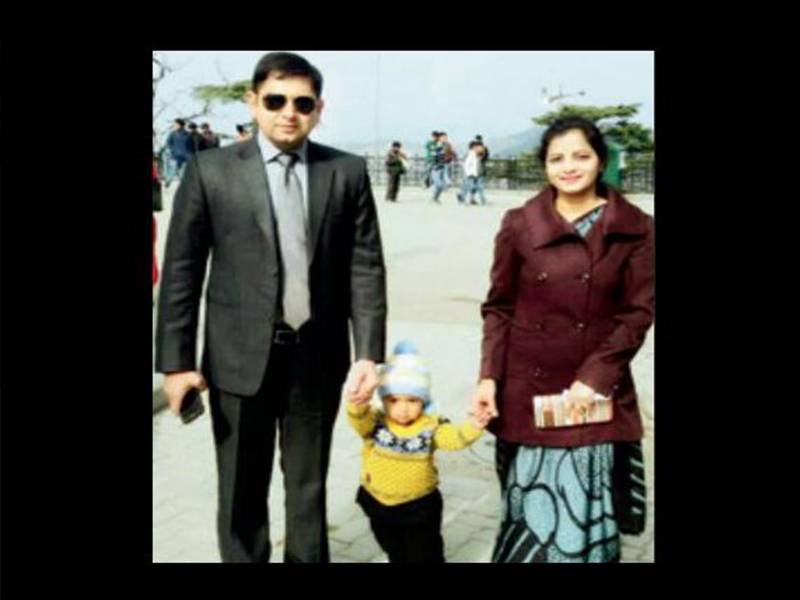
A Himachal-based couple has decided to ‘adopt’ the 12-year-old daughter of an Army jawan, who was beheaded by Pakistan in the Poonch district of Jammu and Kashmir on May 1. They have offered to bear the child’s expenses from school till marriage, to ensure a good future for her.
As a tribute to Naib Subedar Paramjit Singh ‘s sacrifice, Kullu deputy commissioner Yunus Khan and his wife Anjum Ara, an IPS officer, have decided to take care of his daughter, Khushdeep Kaur. “Khushdeep will continue to stay with her family. We will be paying for all her expenses and meeting her from time to time to know about her problems and solve them. If she wants to become an IAS or IPS officer or choose some other career, we are there to help,” said Ara, SP of Solan district.
Yunus said it is difficult to assuage the pain of the martyr’s family, but they are trying to share their grief. “By ensuring good education to his daughter, we are doing our duty as responsible citizens,” he said. Yunus said that it is up to Khushdeep whether she wants to continue studying at her village school or join some other school. “We would be there for her throughout her life to help her in making decisions,” he added.
source: http://www.timesofindia.indiatimes.com / The Times of India / News> City News> Shimla News / TNN / May 05th, 2017