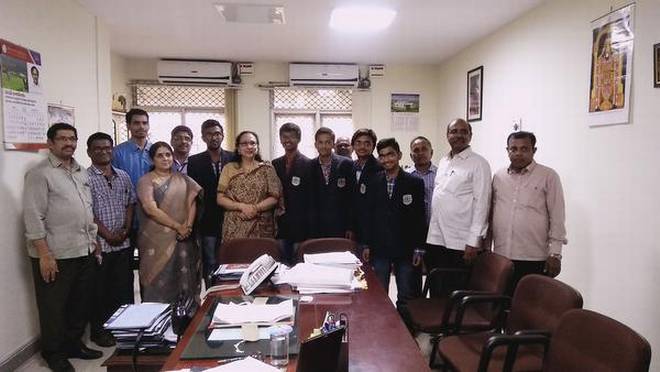
Principal Secretary, Higher Education, Ranjeev Acharya, TSREI Secretary Seshe Kumari with the state toppers of Intermediate hailing from residential schools
TSRJC students figure in the top 10
They come from financially and socially poor backgrounds, but their faith in the government residential school system paid rich dividends. And it was no mean achievement figuring in the top 10 ranks in the Intermediate examinations this year, studying in a remote village far away from the hustle and bustle of town life.
Five students from the Telangana State Residential Junior College, Sarvail in Yadadri district, figured in the top 10 in the Intermediate examinations this year, an achievement that went unnoticed in the publicity blitzkrieg of private colleges. However, the government recognised their performance and felicitated them with laptops worth ₹ 45,000 each.
The laptops were presented by Deputy Chief Minister Kadiyam Srihari at the Secretariat and he said it showcased the power of government institutions and the potential they have in throwing up State rankers. The awardees included Ch. Saicharan, State 2nd ranker in MPC; D. Ahmed Waseem, who got 9th rank, P. Vasantha Reddy and J. Bharathu Kumar, who secured 10th rank and D. Nipun Rai, who was at 4th place in the BiPC stream.
The students met the Prinicpal Secretary, Higher Education, Ranjeev Acharya, who said it was a commendable achievement and lauded the efforts of the teachers who made it possible.
The TSREI Secretary, Seshu Kumari, explained the effort that went into identifying good teachers and providing them with the right atmosphere to excel. “We want to take TSRJC, Sarvail, on par with the erstwhile APRJC, Nagarjunsagar, which was the first option of all State SSC toppers.
The achievers were elated that they were getting recognised on a par with private college students, who generally hog the limelight during the results period. “Commitment from teachers and their focussed guidance coupled with our hardwork is the reason for the success,” they said in unison.
TSRJC Sarvail Principal Surender Reddy said that all these students also secured good marks and ranks in the JEE Main. They would surely clear the JEE Advanced to get into the top IITs, he added. Mr. Reddy said that 14 students from the TSRJC Sarvail, 7 from TSRJC, Hasanparthy and one each from TSRJC L.B. Nagar and Nagaram qualified for the JEE Advanced.
source: http://www.thehindu.com / The Hindu / Home> News> Cities> Hyderabad / by P. Ravikanth Reddy / Hyderabad – May 04th, 2017
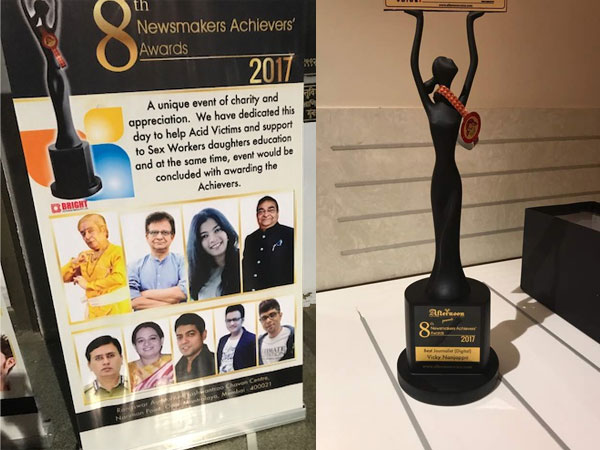
It was a proud moment for OneIndia as our special correspondent Vicky Nanjappa bagged the award of ‘best journalist (digital)’ at the Eighth Edition of Newsmakers Achievers’ Awards. The event was held in Mumbai on May 1. Unlike any, the event this year was dedicated to the acid attack victims. Vicky Nanjappa was recognised for his contribution to the field of journalism in the last 18 years. Achievers from various fields like education, art, science, politics etc were also recognised and awarded on World Labour Day.
While celebrating achievers from various fields, the Newsmakers Achievers’ Awards did its little for those in need. The highlight of the event was the financial assistance provided to children of sex workers apart from contributions to acid attack survivors. “I have undergone eight surgeries and two more will follow. I hope the accused should be awarded stringent punishment. Life is full of obstacles but one should struggle hard to overcome all obstacles,” said Aarti Thakur, a 27-year-old acid attack survivor.
Daultabi Khan, a 34-year-old victim of acid attack said, “I have to undergo huge hardships after the acid attack. I have lost vision in my one eye both my ears are deformed. I will utilise this money for treatment purpose.” Achievers of 2017 During the event, several persons from the media, academic and political sector were honoured including OneIndia’s Vicky Nanjappa for journalism. Pandit Birju Maharaj and Pradeep Welankar were honoured with the Lifetime Achievement Award while Diwakar Raote received the Best Politician Award.
Aasha Warriar was honoured with the Best Spiritual Leader award while Dr Mukesh Batra bagged the best doctor award. Dr Deepak Bhosale received the best Educationist award. Roxy Arora was honoured with the best Author award. Virag Gupta received the best lawyer award. Namrata Thakker was honoured with the Best Social Entrepreneur award.
Deep Haider received the Best Journalist (Editor) award. Rashid Hashmi was felicitated with the Best News Anchor award.
Varun Singh received the Best Journalist (Print) award. Anil Nagpal received the Best Photographer award. Nandita Venkatesan was felicitated with Best Writer/Reporter award.
Asha Mamedi bagged the Best Social Worker jury award. Sushant Divgikar was felicitated with Best VJ award. Siddharth Nigan received the Best Child Artist award. Meghna Malik was felicitated with the Best Actress award. Darshan Kumaar received the Best Actor award. Lubna Adams bagged the Best Fashion Choreographer award and Ssumier S. Pasricha received the Best Comedian award. Dolly Parekh was felicitated with Best Fashion Designer award.
Samidha Guru was honoured with the Best Marathi Actress award while Kishor Kadam bagged the Best Marathi Actor award.
“This year award function is special for us as we have tried to make a small difference in the lives of acid attack victims and sex workers daughters’ lives. By lending a helping hand to them we will rebuild their lives,” said Vaidehi Taman, Group Editor of NBC. OneIndia News
source: http://www.oneindia.com / OneIndia / Home> News> India / by Anusha Ravi / Wednesday – May 03rd, 2017
When was the last time you blew a balloon? Probably, when you were a child?
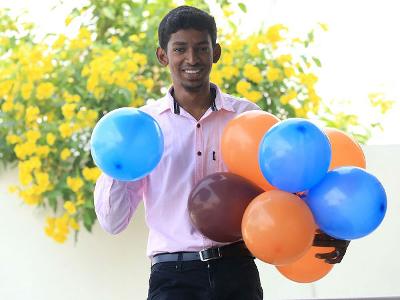
But, for 22-year-old N Sadham Hussain, son of a flower seller from Podanur, inflating balloons is the route to fame.
This engineering graduate has been in the news ever since he blew 500 balloons in a matter of 68 minutes at an event held in the city.
Hussain attempted a record in three categories- most balloons blown in a minute, most balloons blown in three minutes and the fastest time to blow 500 balloons. At the recent event, he managed to inflate 11 balloons in a minute, 29 balloons in 3 minutes and 500 balloons in 68 minutes.
“It all started in 2011 when I started doing a part-time job in balloon decorations. I was in charge of blowing balloons for birthday parties and private events. Later, I came forward to blow balloons at a symposium held at my college. (Dr NGP Institute of Technology) The pace at which I was blowing the balloons impressed a friend of mine, who later suggested that I could put the skill to good use.
That’s when I decided to give the records a shot.
Since then there has been no looking back. I blew 486 balloons in an hour at an event and that was considered a record. It’s been two years I completed my studies but I continue my passion for blowing balloons.”
Sadham now accompanies his brother in installing smart boards in schools. He already has his name etched in the Limca Book of World Records for blowing 486 balloons in one hour and 1,000 balloons in 147 minutes.
So, does he practice blowing balloons on a regular basis? “Not really! Since, I continue my job in balloon decorations and I get the opportunity to practice regularly. The only ritual I have been following from day one is to keep a glass of water and glucose next to me. You lose a lot of moisture when blowing a balloon and it’s imperative that you don’t feel tired while at it. You need a lot of stamina as well.”
However, he adds that blowing balloons is not a cakewalk while attempting a record. “The balloons diameter should be 20 cm after blowing it; you have to tie it up. Many a time I have burst a number of balloons during the process. I get extremely nervous then and lose out on time.
But, I carry on with the attempt as I have to finish inflating the maximum number of balloons at a particular time.”
The electrical engineering graduate aspires to set a world record in blowing balloons. “I want to set a world record and I am working hard towards it,” says Sadham, who is still hunting for a job that will help fulfill his dream.
source: http://www.timesofindia.indiatimes.com / The Times of India / News> City News> Coimbatore News / by P. Sangeetha / TNN / April 30th, 2017
That was a question I was recently asked in connection with a reference I had made to Umda Bagh and its links with education in the city for nearly 125 years. Good question, and off I went ahunting for information.
Into the Umda Bagh campus moved c.1895 the Madrasa-I-Azam, the chief Muslim school in the South and which was established in 1849. This developed partially into a Government Muhammadan College with its own buildings in 1934.
In 1948, the College was reconstituted as the Government Arts College for Men. The College moved to Nandanam in 1972 and a women’s college opened in its stead in 1974. This was named the Quaid-E-Millat Government College for Women, leaving many a student puzzling over the prefixed name, which I’m told means ‘Leader of the Nation’.
A Tirunelveli Rowther, Mohammed Ismail went into business in the 1920s and became a leader in the worlds of leather and Madras commerce. That leadership led him into politics, in which he had shown interest from when, as a 13-year-old, he started in 1909 the Young Muslim Society in Tirunelveli.
Nine years later, he founded the Council of Islamic Scholars and joined the Indian Muslim League. In 1946, he led the League’s Madras unit in the Assembly elections and became Leader of the Opposition. He was also elected to the first Lok Sabha, which simultaneously served as the Indian Constituent Assembly. And, an intriguing election that year was as the founding President of the Madras State Mutton Dealers’ Association, which he remained till his death 26 years later.
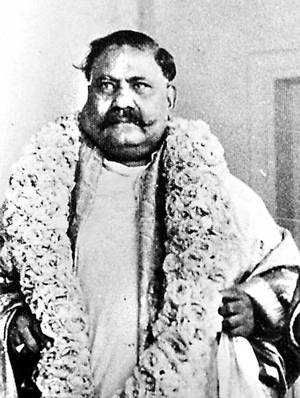
When Pakistan was born in 1947, the Muslim League divided and an Indian Union Muslim League came into being. Mohammed Ismail was elected its first President. After serving in the Rajya Sabha from 1952 to 1958, he moved into Kerala politics with States’ Reorganisation in 1956. Leading the IUML, he won Lok Sabha seats in 1962, 1967 and 1971. He died a year after his last election, revered in both Tamil Nadu and Kerala as the Quaid-E-Millat, a leader who ensured communal harmony. Interestingly, his education had been in Hindu, Catholic and Protestant schools and colleges!
Perhaps the greatest tribute paid to him was by Congress Chief Minister M Bhaktavatsalam who, describing his dignified and conciliatory behaviour in the Legislature, said he was “a model for all Opposition leaders”.
The chronicler of Madras that is Chennai tells stories of people, places and events from the years gone by and, sometimes, from today
source: http://www.thehindu.com / The Hindu / Home> Society> History & Culture / Madras Miscellany / by S. Muthiah / May 01st, 2017
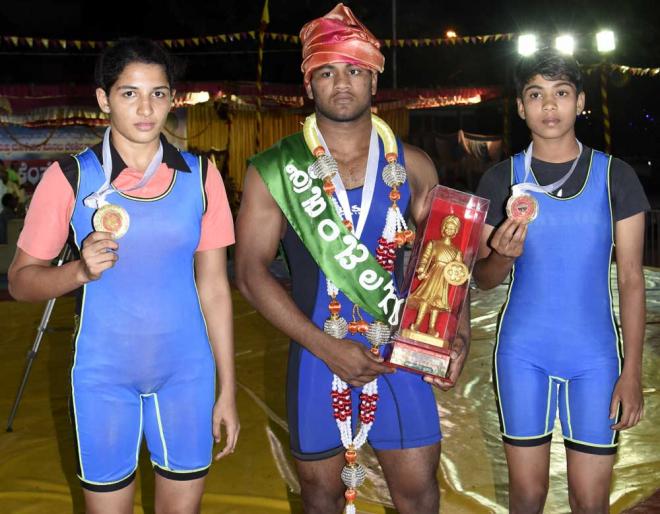
Winners: Kempegowda prize winners Srinivas (centre) flanked by Atma Shri (left) and Sahida Begum. DH PHOTO
Srinivas of Davanagere claimed the Kempegowda award for the best wrestler in the State-level competition organised by the Kannada Kala Jyoti Sangha on Sunday.
Srinivas emerged champion in the below-74kg category, defeating Maesa P of Bangalore University.
In the women’s section, Atma Shri of Alvas and Sahida Begum of Gadag were joint winners of the Kempegowda prize.
India had won seven medals in the first leg on April 24 and six (1 gold, 4 silver, 1 bronze) in the second leg.
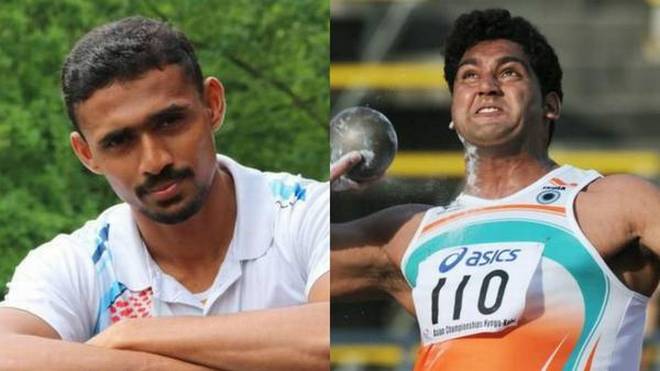
Muhammed Anas got over the disappointment of missing out on the first two legs of the Asian Grand Prix and won the 400m gold in the third leg here on Sunday with an impressive 45.69s, just 0.19s off the World Championships qualifying time.
This was the national record holder’s first race of the season after he and M.R. Poovamma were denied visas by China for the Asian GP’s two earlier legs in Jinhua and Jiaxing.
“I missed the qualification time narrowly but it will come soon,” the 22-year-old, whose national record of 45.40s in Poland last year earned him a Rio Olympics slot, told The Hindu over phone.
Om Prakash Karhana, also a National record holder, won the shot put gold with a 19.58m.
Jinson Johnson and Asian champion Tintu Luka were both beaten at the tape and had to settle for silver in the men’s and women’s 800m.
Dutee Chand in the 100m and National record holder in shot-put Manpreet Kaur were the others to win silver medals. Dutee’s 11.52s was her season’s best.
Neeraj Chopra, the under-20 World champion who qualified for the World Championships with an 82.32m at the second leg in Jiaxing three days ago, took the men’s javelin bronze while Asian Games bronze medallist Poovamma picked up the women’s 400m bronze in 53.11s.
“I have come straight from a good stint in Hosur and was feeling good,” Riyaz said “I was confident of a good outing and right from the start of the race, I knew that I was on a roll,” he added
Hyderabad’s Mohammed Riyaz and Bengaluru’s Joel Joseph did the star turn in the JKTyre Vroom Quarter- Mile Rush, winning the Super Bikes and Super Cars categories with elan here today.
Riyaz, a runner-up in the National Drag Racing Championship, was supreme in the Unrestricted Open Class, completing the 400 metre dash in just 9.869 seconds.
Racing on his favourite Yamaha RD 7, his reaction time was an amazing 0.507 seconds at the start that give him an unbeatable edge over all the competitors.
“I have come straight from a good stint in Hosur and was feeling good,” Riyaz said. “I was confident of a good outing and right from the start of the race, I knew that I was on a roll,” he added.
“I know my bike very well and I had full faith in myself. I really enjoyed myself,” Riyaz said, when asked about his victory.
In the four-wheeler Unrestricted Class, local boy Joel was a picture of confidence in his Honda City Turbo Dragster. He won the race handsomely as excited fans cheered him on, needing just 12.763 seconds with a great reaction time to clinch the title and all the bragging rights.
Joel reigned supreme in the Indian Open as well to make it a grand double. He clocked a total time of 12.673 seconds which was beyond all the others’ reach.
“I am very satisfied with both my runs today. Coming to the event as a defending champion gave me that confidence and I always knew I had a great chance,” Joel said.
Earlier, Riyaz looked good for the championship mantle in the speedy 851 to 1051cc Class as well, after having clocked 9.912 seconds. But seasoned Rizwan Khan pulled off a sensational run, recording the quickest time of the day: 9.677 seconds.
“It was an amazing performance by Rizwan,” the Hyderabadi said, graciously acknowledging his friend-cum-rival’s victory. In the super sport Indian Open, KaleemPasha of Bengaluru proved to be the king, taking the title in flat 11.778 seconds.
Nidha Adeni of Bangalore, the only lady racer on the second day of the JK Tyre Vroom event, finished a commendable fifth in the Indian Cars’ 1101-1400 cc category.
source: http://www.outlookindia.com / Outlook / Bengaluru – April 30th, 2017
When Fareeda Bibi heard that her son Sher Mohammad — a CRPF constable+ who was part of the battalion that was ambushed in Sukma — had been taken to a Raipur hospital with five bullet wounds, her heart sank.
It was much later that someone in her village of Aasifabad Chanpura in Bulandshahr, UP, told her that her son had taken down at least three Maoists even as he collapsed in unbearable agony. That’s when she smiled a bit. “I am proud that my son fought like a lion for his country,” the 65-year-old said. “He is keeping alive a tradition that our family is known for.”
Sher’s father Noor Mohammad served in the Indian Army and retired with honour. His uncle Abdul Salam was also in the Army and retired 10 years ago.
“When Sher’s son Sohail, 2, grows up, I will ensure he, too, devotes his life to protect this country,” she said.
Though TOI could not independently verify details about Sher’s encounter with Maoists, the jawan told a TV channel from his hospital bed in Raipur that the 74th Battalion of the CRPF was overseeing construction of a road when about 300 Naxals ambushed them with AK-47 rifles+ .
“The 99 CRPF soldiers fought hard. We retaliated, gave them a fitting response. We were able to gun down at least 11 to 12 Naxals. I myself shot down two-three,” Sher has been quoted as saying. He was caught by machine gun fire in the waist and knee.
Sitting on a charpoy in her modest house, Fareeda said the whole village is praying for her son’s recovery.
“We know what it means to join the Army or CRPF,” she said. “There is risk, of course. But patriotism flows in our veins.”
Waris Ali, Sher’s eldest brother, was the first one to receive news of the attack through an acquaintance who saw the report on TV.
Waris told TOI: “As soon as we heard about the incident, we called up CRPF authorities in Raipur. They said Sher was being cared for, so there was no need to rush (to Raipur). I drove down this morning from Delhi, where I work, to be with my mother.”
A large number of villagers have gathered around Fareeda and Waris, consoling them and praying with them. One of them, Aqleem Ali said, “We are a big family. A large number of our relatives are in the armed forces. Sher has done something every fauji would do under such circumstances. He will come back.”
source: http://www.timesofindia.indiatimes.com / The Times of India / Home> News> City News> Meerut News / by Sandeep Rai / TNN / April 26th, 2017
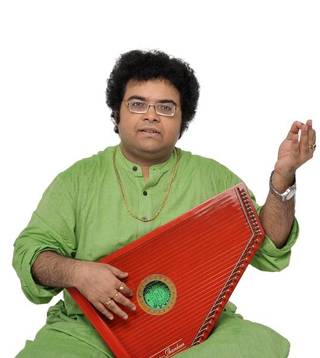
SHARING SIMILAR SENSIBITIES Ustad Bade Ghulam Ali Khan
Seasoned musicians paid melodic tributes to Ustad Bade Ghulam Ali Khan on his 115th birth anniversary in Kolkata.
The Calcutta School of Music, in association with Saambhavi, offered homage to Ustad Bade Ghulam Ali Khan on his 115th birth anniversary (2nd April) at the century-old School’s Sandré Hall. The evening touched the nostalgic chord when Pandit Buddhadev Dasgupta who, despite his ailment, came to share his treasured memories related to Khansaheb with the audience, sobbed like a child while listening to ‘Hari Om Tatsat’, soulfully sung by Nabhodeep Chakraborty, a young torchbearer of Kasur Patiala Gharana who religiously pays melodic tributes to Khansaheb on this day every year and who conceptualised this event.
According to Dasgupta, the erudite sarod maestro who is an ardent admirer and delightful analyst of Khansaheb’s charismatic music, “Among those legendary musicians who spent part of their lives in the city of joy are Ustad Amir Khan and Ustad Bade Ghulam Ali Khan. The styles of both the ustads had the biggest impact on local vocalists and quite a few Bengali musicians, without any direct taaleem have tried to blend their styles with results which often are little short of disastrous.”
Fortunately, Chakraborty, having been trained by Ustads Raza Ali Khan, Mazhar Ali Khan and Jawad Ali Khan, grandson and grand-nephews of Khansaheb, has acquired enviable gharana treasures.
Extraordinary rehearsal
He insists on the ‘Kasur’ prefix. This has a valid reason. ‘Khansaheb hailed from Kasur, a small town 30 kilometers away from Lahore; and the people still remember the superhumanly riyaaz of ‘Kasuri Bade Ghulam’, says Chakraborty. “It was Khansaheb, who modified the original Patiala style which basically thrived on taans. (Khansaheb’s son) Ustad Munawwar Ali Khan went on record while describing the olden, somewhat rough, gayaki, ‘Aisa lagta tha jaise billiyan jhagad rahi hain (it sounded as if cats were fighting)’.”
The evening was based on some select compositions of Ustad Bade Ghulam Ali Khan under the pseudonym ‘Sabrang’. A clutch of Chakrborty’s disciples presented these khayal bandish-s with sincere reverence. Each one focused on a special aspect of their gharana’s salient features. They were ably supported by Timir Baran Chakraborty on tabla.
Among them Sagnik Sen, a child prodigy who possesses ‘Classical Voice of India 2013’ title, stood out for his short but amazingly matured and melodious presentation of two compositions in ragas Bhimpalasi and Multani. The anecdotal history of every gem, displayed during the course of this edifying evening, revealed that Khansaheb believed in ‘Sab din nahi hot ek samaan’ (Multani); that he sang in praise of ‘Dev Maheshwara’ (Bhupali); that he penned a composition in Megh but sans the description of Monsoon and often sang it in Madhmad Sarang.
In the latter part of the evening, Nabhodeep Chakraborty, accompanied by Amit Chatterjee (tabla) and Keshab Banerjee (harmonium) presented a bandish in Koheri Kalyan, one of the most heard ragas invented by Khansaheb; the others being Andoli ka Sarang, Malini Basant, Hariruddh (named after a river in Afghanistan, this raga blends Dhani and Malkauns).
His selection also included a Malkauns tarana, set to Asul-e-Fakhta tala of five beats that interprets the rhythm of the fluttering wings of a bird (Fakhta). A rare Maand from the unpublished records of Khansaheb was Chakraborty’s last piece but encores led him to ‘Hari Om Tatsat’- one of the unforgettable compositions, immortalised by Khansaheb. The screening of a documentary film on the life and music of Ustad Bade Ghulam Ali Khan topped it all.
source: http://www.thehindu.com / The Hindu / Home> Entertainment> Music / by Meena Banerjee / April 27th, 2017
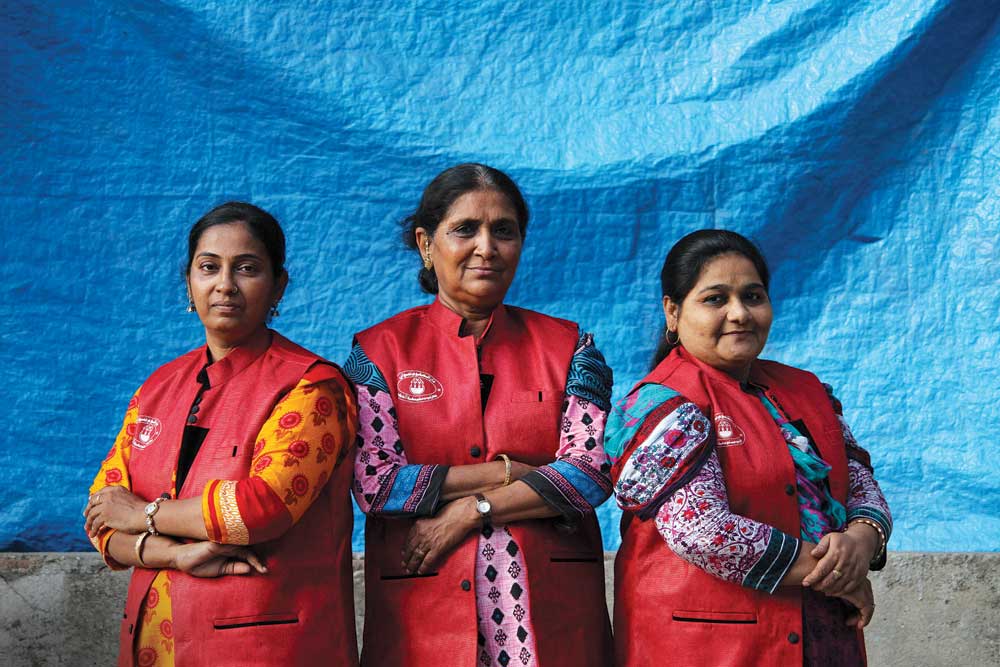
(L-R) Suraiya Shaikh, Khatoon Shaikh and Heena Siddiqui, newly appointed qazis in Mumbai (Photo: Anushree Fadnavis)
India’s pioneering female qazis are pushing for a gender-neutral interpretation of Muslim law
IN THE LAST two years that Suraiya Shaikh was preparing herself to become one of India’s first female qazis, she grew close to a young woman in a Muslim neighbourhood in Mumbai’s Khar suburb. Shaikh is a member of the Bharatiya Muslim Mahila Andolan (BMMA), an advocacy group that campaigns for female rights within the community. She came to know the woman—let’s call her Haseena, a teenager then and now 20 years old—through an outreach programme of the group.
Haseena was going through a particularly bad time. She was only just beginning to heal from a severe bout of tuberculosis, which had forced her to discontinue her school education. She spent all her time indoors, her body was getting frailer by the day, and the strong medicines she consumed had left her deaf in one ear. According to Shaikh, who used to visit Haseena at home, the young girl was also in depression.
During these visits, Haseena would convey her anxieties and fears. And Shaikh, in return, would tell Haseena about her life, and her ambition of becoming a qazi, an Islamic judge. The two Muslim women, separated by exactly 25 years in age, were to become close friends.
Several days went by last year without the two getting a chance to meet. But when Haseena suddenly appeared in front of Shaikh next, she had undergone a striking transformation. She looked healthy and had put on some weight. When she would comb her hair, Suraiya says, she would take almost two hours to do just that. But the most remarkable thing about her, Shaikh recalls, was Haseena’s new-found ebullience.
“It was love,” Shaikh now says. “She was in love.”
Haseena had fallen in love, gotten engaged, and was planning to get married by end of 2017. But this marriage, as Shaikh now laughs while recounting the story, is not going to be like any old love marriage. It is neither a simple love marriage, she says, nor an arranged one. “It will be a wrong-number love marriage.”
A young Muslim man in Malad had mis-dialled a phone number and found himself accidentally speaking with Haseena. Drawn by the quality of each other’s voice, the frequency of these ‘wrong number’ calls increased over the next few months until the two were sure they were in love and decided to get engaged.
Haseena has now put a condition to her suitor. When the two get married in December, their wedding will have to be conducted not by a qazi chosen by his family, as has come to be the tradition, but by a female one, Suraiya Shaikh.
“The boy’s family has so far not agreed to the idea of a female qazi. I believe they are saying this is not possible. But the boy has promised he will convince them,” Shaikh says. “And maybe this will be my first nikaah.”
Some days ago, when Haseena learnt that Shaikh had completed her training, she wanted to know when the qazi would need to be intimated for a December wedding. “I told her, ‘Usually you have to register a month in advance, but you had better register by October’,” Shaikh recounts. “These wrong number marriages, I don’t know… Kuchh tehkeekat karna padega (We will have to carry out some investigations).”
The BMMA, which was formed in 2007, although its members have been campaigning for Muslim women’s rights for much longer, pursues its cause in different ways. It files petitions in court, like the one that resulted in women being allowed to enter the sanctum sanctorum of Mumbai’s Haji Ali dargah. It also runs a legal aid centre in Mumbai, Shariah Adalat, for aggrieved Muslim women, which often pits them against qazis and maulanas who interpret Muslim laws unfavourably towards women.
“It’s really atrocious how these qazis go about their job,” says Khatoon Shaikh, the BMMA’s Maharashtra convenor. “Often, they don’t even have proper training. They just grow long beards and open their shops,” adds Heena Siddiqui, a BMMA member. As the women describe it, Islamic judges have several duties to perform, like ensuring that there is no underage marriage, that a wedding has the consent of both the bride and groom, and later, if the husband wants to divorce his wife, the procedure is spaced out over a proper period of time (with a reconciliation attempt), and not done by the man saying one word thrice at a single go. “But the problem with these qazis,… is that a husband will say ‘talaq’ thrice and a male qazi will just listen to the husband’s version of things and finalise a talaqnama, without once listening to the woman or asking witnesses,” Khatoon Shaikh says.
WHEN BMMA MEMBERS learn of such cases, they not only meet both parties and try to reconcile the matter, but also catch hold of the offending qazis. They send notices to them and, if needed, file police complaints. Sometimes the qazis apologise and promise to rectify issues. Sometimes they switch off their phones and refuse to meet them. In one such case some years ago, they began receiving complaints about a Bandra judge known as Musa Qazi who had solemnised marriages where the bride was a minor and finalised divorces without once meeting the wife. “We just went to his office, all of us, and really scared him,” says Siddiqui, “Now he doesn’t do anything like that. In fact, when we need a qazi, we send our people to him now.”
In most cases, however, such relatively easy resolutions aren’t available, and Muslim women languish under unfair rulings as a result. Two years ago, the BMMA released the findings of a two-year-long survey it had conducted among 5,000 Muslim women in 10 Indian states. A majority of the women turned out to be housewives who had been married before the age of 18 and who suffered from domestic abuse. Many of them were divorcees. The survey revealed that most of them wanted the Triple Talaq process of divorce to be abolished, arbitration before a divorce to be made compulsory, and any qazi who gave legitimacy to such a divorce without consulting the woman or stipulating the need for arbitration to be punished.
About three years ago, as the results of the survey began to come in and several cases presented themselves at their Sharia Adalat, members of the BMMA began to wonder: why should they only deploy their methods for fire-fighting? Why couldn’t they attempt to prevent these fires in advance? Noorjehan Safia Niaz, one of the co-founders of the group, was more specific. Why didn’t the group train women to be qazis?
The group set up a centre for Islamic learning and theology, Darul Uloom Niswaan, and prepared a syllabus covering various subjects ranging from the Indian Constitution and jurisprudence to Muslim prayers and laws, as also the history, principles and values of Islam. A total of 30 Muslim women across India were selected to join the training programme. Two years later, 15 of them have qualified as Islamic judges. There have never been women holding these positions in India before, barring a few exceptions like Shabana Ara Begum, whose father, a qazi in West Bengal, helped her become one several years ago. Niaz says she hasn’t come across any such cases elsewhere either in the larger Islamic world. Several of them have been taunted by traditionalists who claim that females cannot be judges. But the BMMA points out that the Qur’an does not bar women from the role. “The problem is not that the Qur’an is unfair towards women. It is the misinterpretation done by qazis and clerics,” Siddiqui says. “A female qazi, we think, will bring a more gender-neutral perspective when she interprets Islamic laws. She will think about the woman before deciding any matter.”
Siddiqui recounts a case she encountered a few years ago, where a husband divorced his newly-wed wife by uttering talaq thrice upon discovering that she wore glasses. “When the family had come to see her before marriage, she hadn’t been wearing the spectacles. But after the marriage, when they found that her eyesight was weak, they claimed they had been cheated,” Siddiqui says. “And can you believe it? The qazi confirmed this talaq without once meeting the girl.”
Safia Akhtar, a 65-year-old former college professor in Bhopal who has also qualified as a qazi, narrates a problem-case she is currently helping resolve. A woman wants to divorce her husband because he has taken another wife. But whichever qazi she has approached so far has forbidden her from divorcing her husband. “We are now fighting the case in court,” says Akhtar.
Among other things, women judges will ensure that for weddings, the address and identity documents of grooms as well as brides are submitted for scrutiny; that sources of income are ascertained; and that both are marrying of their own free will. “These are small basic things, but often no one does them,” Siddiqui says.
As a qazi, Khatoon Shaikh (second from left) often handles cases where women have been divorced and abandoned without any consultation (Photo: Anushree Fadnavis)
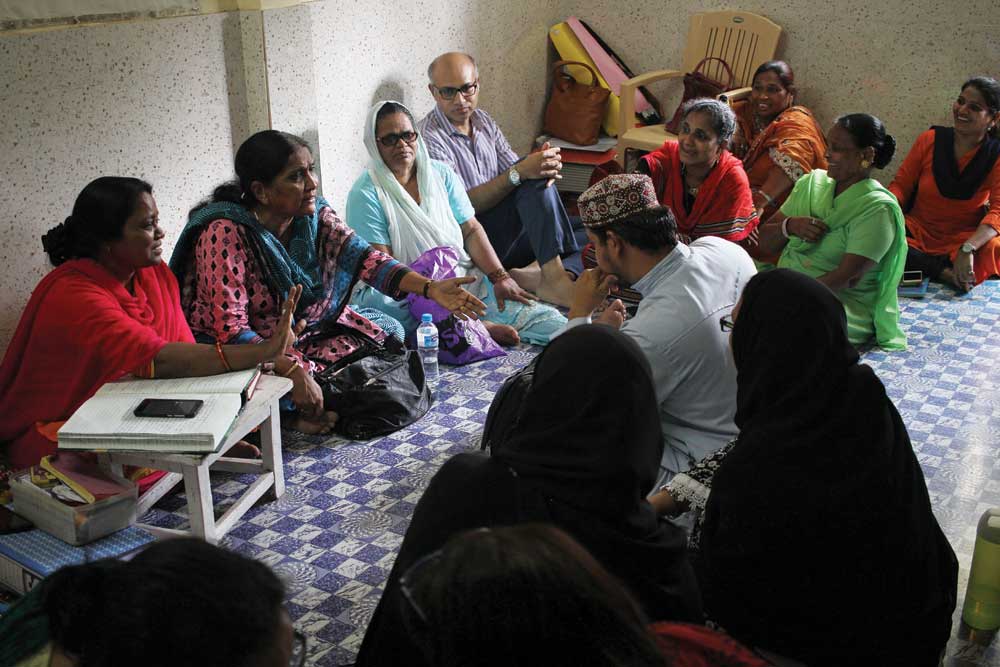
We sit on the floor in a tiny two room office in Bandra’s Kherwadi area. There is little here other than wooden stools upon which rest large registers detailing the cases of several women. The walls are covered with colourful posters of messages. ‘Jahaan insaaf nahin, wahan Islam nahin’ says one; where there is no justice, there is no Islam. Another has details of cases dealt with last year: a total of 229, of which a majority concerned Triple Talaq (31) and polygamy (35); the BMMA has managed to resolve 61 of them, a success rate of 38 per cent.
Below these charts, Nirmala, a Hindu woman who volunteers at the organisation, sits with a large register. “Fifty-four new cases already this year, can you believe it?” she asks and raises her arms.
Beside her, seated on the floor are three women. One of them, draped in a burkha, draws open her facial veil to reveal a face not older than 25, perhaps even younger. “She is almost four months pregnant,” says one of her two companions. “But her husband refuses to cooperate.” The woman’s face has no expression and her eyes seem vaguely focused on the thickness of the register.
The young woman, it turns out, was married six months ago to a Muslim man in a Jogeshwari household in the city. But she had to return home just a few months later after she was verbally and physically abused by her in-laws. She wants a divorce, but her husband has refused to grant one. Her doctors have now found that her foetus has an abnormality, a danger to her as well as the foetus if she goes ahead with the pregnancy, but the husband refuses to sign any document permitting an abortion. He was supposed to visit the office today to discuss the issue, but almost an hour later, he has not shown up.
Suraiya Shaikh’s face tightens with rage when the husband says over phone that he can’t come. She threatens to lodge a non- cognisable offence against him if he doesn’t show up in two days. The young woman gazes at the register throughout the conversation. The doctors want to abort the foetus by next week; an abortion after 20 weeks of pregnancy would be illegal. The three thank Shaikh and promise to return a few days later.
All of Saturday passes like this. A few people come with new cases or to inquire after old ones. The weekdays are much busier, where the entire room is crowded with people and their grievances. Khatoon Shaikh is away today, at a police station in Bhiwandi, where a Muslim man has kept both his children but thrown his wife out of his house on the suspicion that she is having an affair with someone. And when there is no one around, Suraiya Shaikh, Siddiqui and Nirmala joke amongst themselves.
The biggest challenge for them, they admit, will be to be accepted as qazis. “We have done all this,” Niaz says. “Now I think the community should come forward and respond.” But the qazis themselves don’t plan on waiting. Several of them have begun to contact their family members and friends to see if there is anyone of marriageable age whose weddings they can formalise.
SURAIYA SHAIKH HAD JOINED the BMMA after the group helped resolve a marital discord between her sister and her husband. Over the years, she has encountered so many cases, from Facebook Triple Talaq posts to divorce notices sent by email and SMS, that she is no longer surprised by them. She has also learnt to keep her temper in check.
But occasionally, anger gets the better of her. Some days ago, while walking out of Bandra Railway Station with her daughter- in-law, she caught sight of a man hitting his wife. She intervened to help the woman hit her husband back. Her daughter-in-law, who is quite conservative and has been suspicious of her mother- in-law’s activism, was shocked. “How could you do that?” she asked Suraiya Shaikh. “You are a qazi now.”
source: http://www.openthemagazine.com / OPEN / Home> Society / by Chendup G. Bhutia / April 28th, 2017