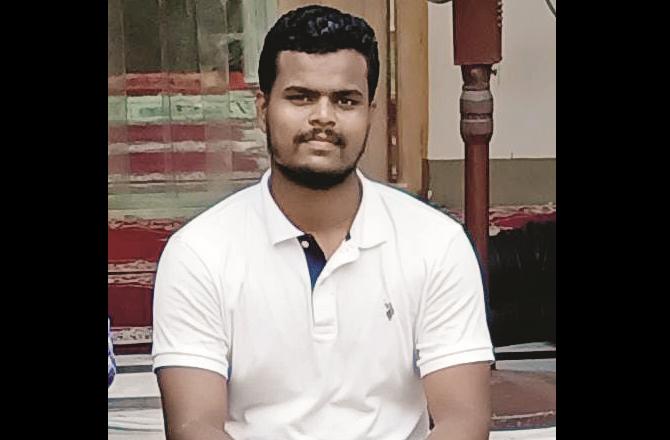
Mohammad Kasim (as his name is spelled in UP Judicial Services Exam Result Sheet) secured the 135th rank in the coveted exam result of which was declared on August 30, 2023.
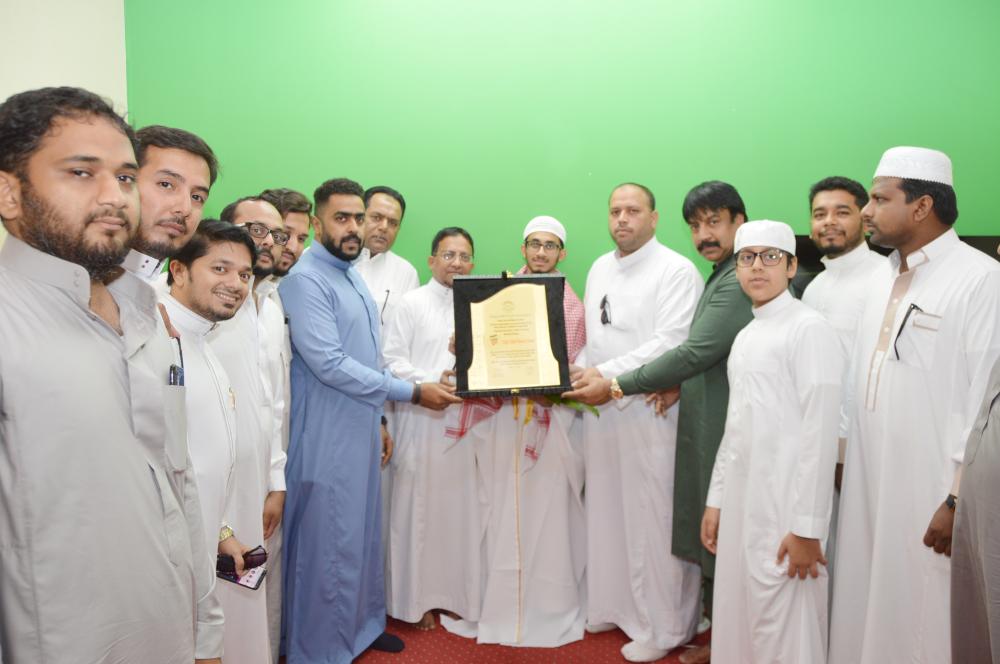
Justice Mohammad Qasim (sitting in the middle with specs and in white t-shirt )(Photo shared by Adv S G Rabbani Alig (@sgrabbani_ias) who described Mohammed Qasim as his mentor and friend)
Sambhal (Uttar Pradesh):
Nobody can fail you if you are determined and committed to what you have planned to achieve, Mohammad Qasim, 29-year-old Judge from the Muslim dominated but neglected district of Sambhal in Uttar Pradesh said.
Mohammad Qasim is one of the six students from the prestigious Aligarh Muslim University (AMU) to crack the Uttar Pradesh Judicial Service Civil Judge (Junior Division) Examination 2022, conducted by the Uttar Pradesh Public Service Commission (UPPSC).
Mohammad Kasim (as his name is spelled in UP Judicial Services Exam Result Sheet) secured the 135th rank in the coveted exam result of which was declared on August 30, 2023.
Earlier, Mohammad Qasim had bagged the All India Rank 1 in the LLM Entrance Exam in 2019. He later also qualified for the UGC NET in 2021.
The story of Mohammad Qasim’s impressive success run however is full of struggle and challenges.
Mohammad Qasim’s Journey to Success
Qasim was born in a very poor family of Ruknuddin Sarai in Sambhal district of Uttar Pradesh. His father used to sell Haleem (a type of Biryani) on a handcart on roadside. In his early days, Qasim used to wash plates to help his father. As he grew older and learnt the art of making Haleem and Biryani from his father, he set up own stall. During this journey however, Qasim did not stop his education.
“My mother is the motivational force behind me and never permitted me to drop out of the school”, he recalled.
“If you are not son of a celebrity or do not belong to a political family then the only option for you to become big is education. It is only through education that you can become a hero. And, today the way I am being felicitated and being welcomed is the testimony of this fact”, a beaming Qasim said while talking to a local YouTube Channel.
Qasim completed his early education from a government school in Uttar Pradesh and passed Inter from Warsi Junior High School of Ruknuddin Sarai. He later joined Aligarh Muslim University (AMU) and graduated in BA LLB and then passed LLM from Delhi University (DU).
“At AMU, I saw a number of students in Law department who after completing LLB go to DU and pursue LLM and then join the judiciary. Law always fascinated me, and the immediate thought that came to my mind is if I wish to fulfil my dreams I too will have to follow the same route”, he recalled.
After BA LLB from AMU, Mohammed Qasim started practicing as a lawyer and simultaneously joined Delhi University to complete LLM. He then appeared for the Uttar Pradesh Judicial Services exams in 2022.
“The most interesting part of my judicial service exam was personal interview. There was a panel headed by a High Court judge. They were all too impressed by my “direct approach” of engaging with the people”, Mohammed Qasim recalled explaining about the art that he perhaps had mastered when he was a roadside food vendor.
Besides his mother who motivated him, Mohammed Qasim gives credit for his success to his teachers in his own home town and at Aligarh Muslim University (AMU).
“I was quite weak in few subjects, especially English and Mathematics. Coming from a small village it was unbelievable for me watching AMU students read English language newspapers. I used to become nervous. But teachers there helped me which is why I could become successful”, he said.
(With inputs from Hukoomat Express YouTube Channel)
source: http://www.ummid.com / Ummid.com / Home> Education & Career / by Aneequa Sabaha, ummid.co / September 06th, 2023
Rashid belongs to a small town of Chapra, Bihar. Both his parents, Noor Alam Khan and Noor Aisha, are teachers by profession.
New Delhi:
Jamia Millia Islamia (JMI) alumnus Rashid Khan who is currently working as Scientist SD in Indian Space Research Organisation (ISRO) Propulsion Complex, Tamil Nadu played an important role in ISRO’s first Solar Mission Aditya-L1 launch.
Rashid Khan was actively involved in the acceptance test of PS2 and PS4 stage used for Rocket PSLV-C57.
India launched its first Solar Mission on September 02, 2023. The Mission, Aditya L1, is designed for providing remote observations of the solar corona and in situ observations of solar wind.
The spacecraft, named after the Hindu Sun deity Aditya, is set to traverse a vast distance of 1.5 million kilometres (930,000 miles) to reach its destination.
Nigar Shaji, daughter of a Muslim farmer from Tamil Nadu was the Project Head of India’s Solar Mission.
Rashid’s Role in Chandrayan-3 Mission
Jamia alumnus Rashid also played an important role in ISRO’s Moon mission Chandrayan-3 launched on August 23, 2023. For Chandrayan-3 Mission, Rashid’s responsibility was to conduct Acceptance tests of L110 stage (Liquid Propulsion System) and C25 stage (Cryogenic Propulsion System) propellant tanks for LVM3- M4 rocket used for Chandryaan-3 mission launch on 14th July 2023.
Rashid’s future responsibilities are design qualification for different stages of rockets for ISRO’s future missions like Human space programme (Gaganyaan Mission) etc.
Rashid belongs to a small town of Chapra, Bihar. Both his parents, Noor Alam Khan and Noor Aisha, are teachers by profession. It was their dream to see Rashid working as Scientist in ISRO which he successfully fulfilled.
Rashid completed his B.Tech in Mechanical Engineering from Jamia Millia Islamia (JMI) in the year 2017. He secured AIR-11th rank and was selected by ISRO to work as Scientist in 2017 itself. He has been working with the space organisation since March, 2018.
India’s unmanned Moon mission Chandrayan-3 has been designed to stay “alive” for 1 Lunar Day which is equivalent to 14 days on our Earth. After a stay of more than a week on Moon , the Vikram lander and Pragyan Rover both have been put in “sleep mode”.
“The Rover completed its assignments. It is now safely parked and set into Sleep mode. APXS and LIBS payloads are turned off. Data from these payloads is transmitted to the Earth via the Lander,” ISRO said in a post on social media platform X, formerly Twitter.
source: http://www.ummid.com / Ummid.com / Home> Science & Technology / by ummid.com News Network / September 06th, 2023
Global NRI Official presenting a memento to Hafiz Abdullah Abdul Mateen Usmani, presented by Azmat Ali Emran and Syed Abdul Hadi / SG Photo by Abdul Rahman M Baig
Jeddah:
Hafiz Abdullah Abdul Mateen Usmani, winner of the annual Qur’an memorization contest organized by Jamiat Khairokum Li Tahfizul Qur’an Kareem (Khairokum Qur’an Memorization Society) for Makkah region, was recently felicitated by the Global NRIs Youth Club here.
Abdullah Usmani won the first prize from among 1,000 participants out of which 13 candidates were bracketed in the category of those securing between 95 and 99 marks. In the ensuing round involving the 13 finalists of the competition, he was declared the winner.
Abdullah Usmani was presented a car by Jeddah Governor Prince Mishaal Bin Majed.
Jamia Al Khairiya Li Tahfiz-ul-Qur’an Kareem is a semi government institution and center established for the students to memorize and recite the Holy Qur’an. It holds the competition every year to encourage students and other participants.
Hafiz Abdullah Usmani is an Indian and belongs to the city of Hyderabad in Telangana state.
Syed Abdul Hadi, vice president of Global NRIs Youth Club, presented a Mishla’h (an adornment cloak wore by men) to Hafiz Abdullah Usmani as a token of appreciation. It was followed by a memento presented by Azmat Ali Emran, president of the club. Bouquets were presented to the contest winner by Fysal Ali, Farhan Baig and Syed Khaja Viqaruddin.
Speaking to Saudi Gazette, Hafiz Abdullah Usmani said: “It took me four years to memorize the Holy Qur’an. I was 11 years old when I started the memorization.”
He is also the alumnus of IISJ from the batch of 2017. Initially he was admitted to Muaz Bin Jabal School where he memorized about one/sixth of the Qur’an. Later he got enrolled in Dar Ul Furqan School from where he completed his memorization of the Holy Qur’an while learning Tajweed. He completed the memorization of the Qur’an four years back. It was last year when the Masjid Al-Aziziyah officials advised him to appear for the Qur’an memorization contest.
Hafiz Abdullah Usmani took the opportunity and appeared from Masjid Al-Aziziyah under the supervision of Sheikh Hamza Rayyan, imam and khateeb of the mosque.
Abdullah Usmani continued with his worldly pursuits along with his Qur’an memorization and took an open school examination from 6th to 8th standard from IISJ. He became a regular student of IISJ from 9th standard after completing his Qur’an memorization.
Initially, he started memorizing of Holy Qur’an on the instructions of his mother. Later after getting admitted in Muaz Bin Jabal School he gained interest in memorizing and was very much motivated by seeing his peers doing so.
While memorizing the Qur’an, he got a chance to meet Sheikh Ayman Rushdi Suwaid, and learned Tajweed from him. He is known to be the Sheikh Ul Tajweed in Jeddah. In his early days of memorizing Qur’an, he used to listen to the Qirat of Sheikh Abdurrehman Al-Sudais and learned the ayats (verses) of the Qur’an that made him memorize the Qur’an faster.
Talking about his future plans, Abdullah Usmani said he would like to learn more Arabic, Islamic history and Qur’an. He said he was interested in pursuing advance accounting courses and build his career. He also has plans to lead Taraweeh prayers during Ramadan in any of the mosques of Jeddah.
Listening to the recitation of Sheikh Meshary Alafasy, Sheikh Mohammed Ayub and Sheikh Al-Sudais helped him learn the correct pronunciation and also helped him in the memorization process.
Speaking to Saudi Gazette, the award winner’s father, Abdul Mateen Usmani, said: “I would first thank and express my gratitude to Almighty Allah for the honor bestowed on my son.”
In this context, he said, efforts of Jamia Tahfiz-ul-Quran was exceptional. “This prize is more than a hundred billion dollar for me. I have not even dreamt that my son Abdullah will be winning the first prize.”
He said all his children initially received their early education having British curriculum. “Me and my wife decided that we will invest money on good education for our children. All my children were enrolled in Al-Waha International School for their primary education. It was my wife’s plan that we will encourage Abdullah to be a Hafiz. So after completing 5th standard, we removed Abdullah from the school and admitted him in the institute for Qur’an memorization. I was a little reluctant but my wife played a major role in making my son Hafiz.
“I advise all unmarried as well as married people not to waste or kill their time by watching movies and TV serials and spoil their future but instead focus on their education both for the deen (religion) and duniya (world). Even the Prophet (peace be upon him) said that one should give priority to the Seerah of anbiya (prophets).”
He said his wife started attending religious classes with other women in our neighborhood soon after she landed in Jeddah. She sacrificed her sleeping hours during daytime to attend these classes.
“It’s the parents responsibility to mold their children as they want. One can lay the right foundation from the word go,” he said.
Speaking to Saudi Gazette, Azmat Ali Emran, president of Global NRIs Youth Club said: “It’s an honor for our club to be the first to felicitate Hafiz Abdullah Abdul Mateen Usmani.”
Syed Abdul Hadi, vice president, said: “Abdullah made the Indians and specially the people of Hyderabad very proud by winning this award. I would like to thank Allah the Almighty and also congratulate his parents on behalf of Global NRIs Youth Club.”
source: http://www.saudigazette.com.sa / Saudi Gazette / Home / by Abdul Rahiman M Baig, Saudi Gazette / Headline edited / September 18th, 2018
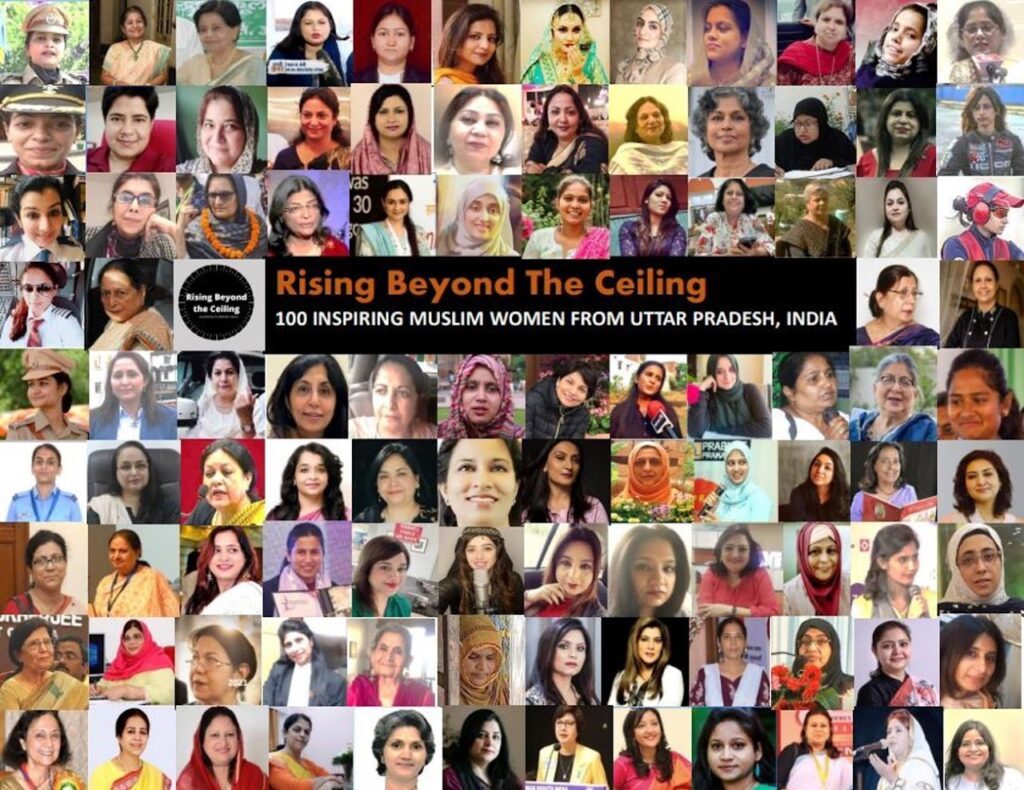
Muslim women are not a monolith, says Dr Farah Usmani, the founder and honorary editor of the “Rising Beyond The Ceiling” (RBTC), an initiative born out of frustration with the stereotypical narrative surrounding Muslim women in India. RBTC is preparing a directory of Muslim women who have excelled in different fields.
However, millions of Indian women, who identify themselves as Muslim, reach across spectra of ethnicities and languages, states and union territories, do not look the same or sound the same and contribute towards nation building in a variety of ways, says Dr Usmani adding that the compendium is under finalisation.
Member, UP Sunni Central Waqf Board, Sabiha Ahmad, who is busy preparing the list of prominent Muslim women in Uttar Pradesh, said, “The organisation is in the process of preparing a directory of such Muslim women who hold certain positions in social, corporate and professional workspace.”
She says the women spotlighted here from Uttar Pradesh do many things—they fly planes, serve in police and armed forces, they are skeet shooters and bike riders, write books and poetry, create art, play snooker and tennis, administer and govern, espouse social issues, serve as lawyers, scientists and doctors, are entrepreneurs and corporate professionals and are substantive contributors to the progress of the country.
Recently an online international meeting was organised in which the issue was discussed at length.
Veteran politician Mohsina Kidwai; vice chancellor, Era University, Lucknow, prof Farzana Mahdi; writer Sabeeha Anwar; artist Dr Farzana Shahabuddin and Samreen Ahmad were prominent among those who attended the virtual event.
Ahmad further says there is a myth surrounding Muslim women in India that they are highly conservative, prefer to stay home, not at par in education with women of other communities.
“Rising Beyond the Ceiling (RBTC), a non-profit organisation focused on supporting and promoting Indian Muslim women and their leadership and contributions in their respective fields, is working to bust this myth,” says Ahmad, who is also incharge, RBTC UP 100 .
RBTC UP 100 is a congregation of 100 women representing 22 million (2.2 crore) Muslim women from UP.
It is working under the leadership of Dr Farah Usmani, the founder and honorary editor of RBTC initiative who is also serving at United Nations Population Fund (UNFPA) headquarters in New York as director-1 level.
“The stories of these Indian Muslim women are for all women and girls to draw inspiration, role model them and thus become mentors in their own districts and neighbourhoods thereby become inspirations themselves for future generations,” Ahmad adds.
source: http://www.hindustantimes.com / Hindustan Times / Home / by HT Correspondent, Lucknow / September 22nd, 2021
The 1860s and 70s were a difficult time for the old and noble families of Delhi. The changes ushered in after the rising of 1857 had precipitated the decline of the city that had begun with the invasion of Nadir Shah over a century ago. The grandeur of the old Mughal capital was gone and with it disappeared the wealth and commerce. This was the era of Mirza Asadullah Khan Ghalib and his poetry of decrepitude and nostalgic longing. Old merchant families were particularly badly hit.
The Ellahies were just such an old family of Delhi merchants. By the 1870s it was being run by Hajee Karam Ellahie. The writing was however, on the wall and the family realized that opportunities in Delhi were dwindling. Karam’s much younger brother, Bukhsh, an ambitious young man therefore decided that he would not sit around waiting for the decline to be complete. Rather he would take on the challenges of the new era head on.
If Delhi was in decline, the new capital of the British, Calcutta, had been growing rapidly over the same period. By the second half of the nineteenth century it was a city bursting with opportunities, ideas and wealth. Young Bukhsh decided the best way to approach the new age was to move to Calcutta. In 1878 he joined an old Muslim firm in Calcutta as a young apprentice hoping to pick up enough skills to survive in the new order.
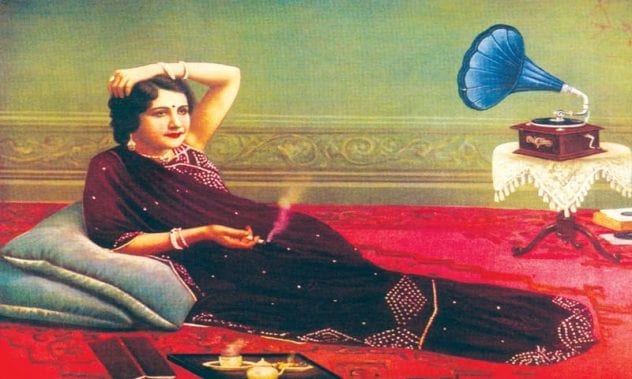
Gauhar Jaan in a Cigarette Advertisement
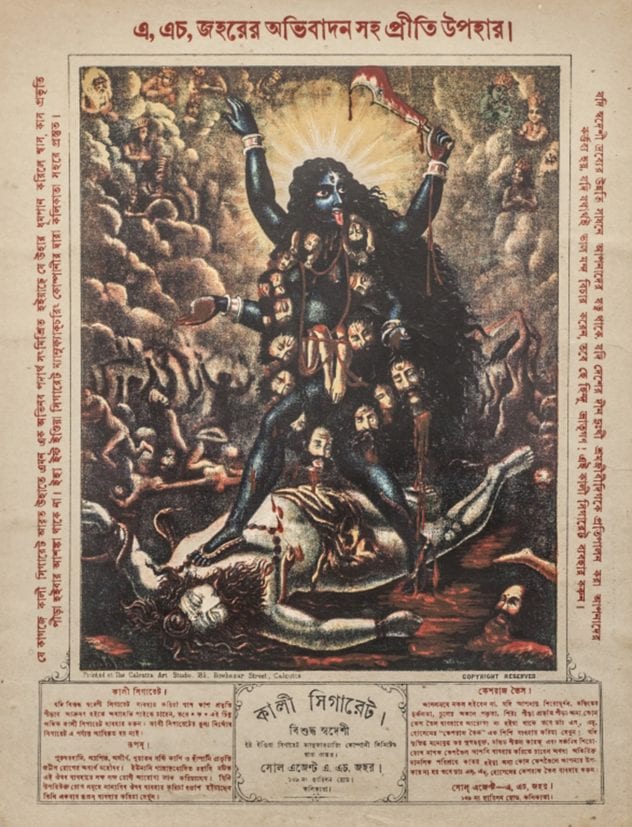
During his time in the city, Ellahie also keenly observed his fellow denizens closely. Amongst the new fashions that caught his eye was the habit of smoking cigarettes. The British army had picked up the habit during the Crimean War in the mid-1850s from their Turkish rivals. Unbeknownst to Ellahie precisely around the 1880s, when he was apprenticing in Calcutta, a new cigarette-rolling machine was making it faster and cheaper to produce cigarettes commercially.
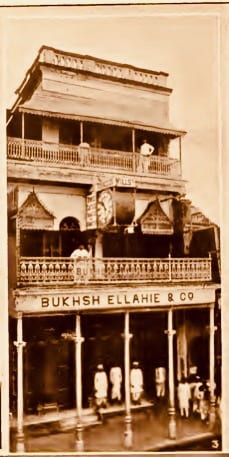
A shrewd businessman, Bukhsh soon asked his older brother to lend him some capital to start a business importing tobacco to make cigarettes. In 1885, with his brother’s loan, Bukhsh set up Bukhsh Ellahie & Co. Apart from new production techniques he also adopted new advertising techniques to popularize the new trend in the city. Cashing in on the growing celebrity of the Hindustani classical singer, Gauhar Jaan, Bukhsh Ellahie launched a brand of local cigarettes called the ‘Gauhar be Baha’. he also distributed free cigarettes to the army as a precocious new promotional tool.
The brand and the business were an enormous success. Before the century ended, Bukhsh was one of the richest men in the city. So complete was Bukhsh Ellahie’s domination of the local market that when foreign firms such as Wills and ATC first came to India, they had to enter into partnerships with Ellahie and depend upon the latter’s distribution networks.
Bukhsh Ellahie & Co Offices
Until 1901 the firm of Bukhsh Ellahie therefore remained the sole agents for the major foreign tobacco companies. It was only in 1901 that E.J. Parrish, the manager of ATC’s Indian operations eliminated Ellahie’s sole agency and instead set up its own distribution depot at 95, Clive Street, Calcutta, with its own devoted staff. While the partnership flourished however, Ellahie innovated once more and advertised the partnership using yet another then still fairly new commodity, i.e. matchboxes.
Matchbox label issued by Bukhsh Ellahie & Co. advertising their partnership with British American Tobacco.
Bukhsh Ellahie & Co. were, as they themselves would later advertise, unquestionably the “Pioneer of the Tobacco Trade in India”. Yet, their mercantile portfolio were not limited to tobacco, or indeed matches. Ellahie was a general merchant and dealt in a wide variety of goods. He was also an official supplier for the Indian Army, thereby acquiring a large and lucrative captive market. Above all, they were one of the first local firms to recognize the importance of foreign trade and worked hard to develop international trading partnerships.
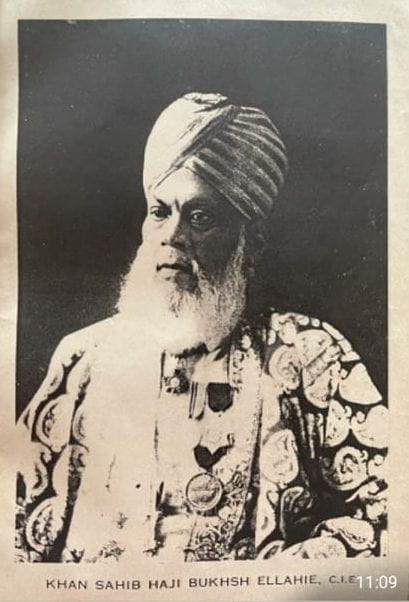
In time, Hajee Bukhsh Ellahie became members of both the Bengal and Punjab Chambers of Commerce and was honored by the British government, first with the title of Khan Bahadur and later, with the Companion of the Indian Empire (C.I.E.). He also became a well-known philanthropist and built or sustained several charitable institutions in his adopted city, Calcutta. On Chitpur Road he built a Musafirkhana or a Traveler’s Lodge. He also founded an orphanage and an association for the burial of indigent Muslims.
Khan Bahadur Haji Bukhsh Ellahie
Notwithstanding recent awareness of the unhealthfulness of smoking, Calcuttans continue to smoke in large numbers today. A recent survey found the city is the highest consumer of cigarettes in all of India. Few of these modern smokers however, have ever heard of Bukhsh Ellahie. His once legendary fame and wealth have, alas, disappeared from public memory like the smoke from his Gauhar cigarettes.
In the heart of Bangalore, where diversity thrives and stories of perseverance resonate, two remarkable individuals, Lubna Afza and Azeem Azeez, are rewriting the narrative of education and hope through their initiative, “Our English School.”
This inspiring journey began with two distinct backgrounds converging in a shared mission to make a difference. Lubna Afza, an advocate, and Azeem Azeez, a social activist, embarked on a remarkable endeavor to provide education to madrasa students and differently-abled children.
In 2015, Lubna Afza endured a heart-wrenching series of tragedies that would break anyone’s spirit. She lost her father, mother, niece, and brother-in-law in a tragic road accident in Saudi Arabia. The same day, her husband divorced her, leaving her in a state of emotional despair. Struggling with the loss of her family and her marriage, Lubna spiraled into severe depression. Her sole source of strength was her 8-year-old son, who sometimes had to step into the role of caregiver during her darkest moments.
Azeem Azeez, a seasoned community activist, had spent years volunteering at government schools and organizing scholarship camps for disadvantaged children. It was during the COVID-19 pandemic that fate brought Azeem and Lubna together as they volunteered at an NGO. This serendipitous encounter led to a shared dream of making a positive impact on society.
Their journey took a significant turn when Azeem introduced Lubna to the world of madrasas. Together, they embarked on a mission to provide quality education to madrasa students, starting with their work at a madrasa in Varthur. The bond they formed with these students ignited a fire within them to do more.
Their vision took a leap forward when they stumbled upon “Our English School,” a historic institution in Jayanagar established in 1965. The school had fallen on hard times due to the pandemic, and its owners were considering selling it. Azeem and Lubna made a bold decision to purchase the school’s license, envisioning a brighter future for it.
However, challenges remained. The pandemic forced them to adapt, and “Our English School” became a mobile school, reaching students across three madrasas in Bangalore. Under Lubna and Azeem’s leadership, the school began offering English, Hindi, Kannada, Maths, and Science courses to students pursuing Hifz or Aalim programs, impacting the lives of over 200 madrasa students.
For Lubna, this endeavor became her lifeline, giving her a renewed sense of purpose after enduring immense personal hardships. However, a crucial hurdle looms ahead. To maintain their school license, they must establish a physical school, a financial burden they are unable to bear alone.
Lubna, Azeem, and the dedicated teachers they have assembled are passionate about their transformative work but need support to secure a permanent space. They have exhausted their life savings and are now reaching out to the community for assistance, appealing for funds or space to establish a proper school.
The need for their services is evident as this year, over a thousand students are eagerly waiting to enroll in “Our English School.” These aspiring students are a testament to the impact Lubna and Azeem’s initiative has had on the community.
“Our English School” has become a beacon of hope for many madrasa students seeking a well-rounded education. It symbolizes the resilience of individuals like Lubna and Azeem, who are determined to make a difference despite facing adversity.
To contribute to their mission or learn more about “Our English School,” please visit www.ourenglishschool.org.
source: http://www.thecognate.com / The Cognate / Home> Education / by Shaik Zakeer Hussain / September 04th, 2023
Syed Mohammad Hussain said Failing in four attempts disappointed me, but it did not let me break down. I worked hard and cracked the UPSC exam.
Hussain, a resident of Sholapur Lane, Wadi Bandar, Mumbai, has secured the 570th rank in the UPSC Exam 2022.
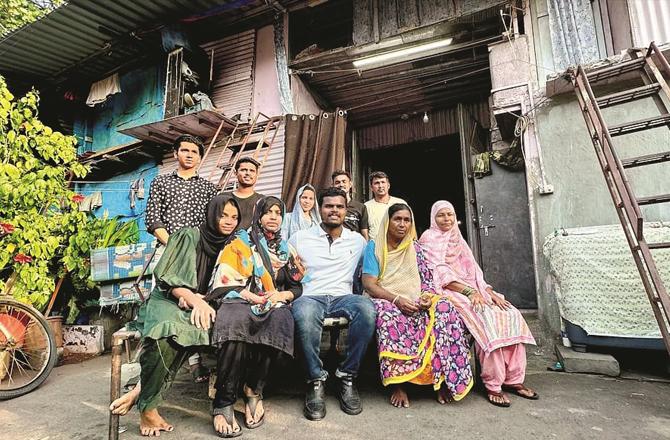
Success for Hussain was full of struggles and hard work. Hussain lives in a small shanty on the roadside adjacent to the Wadi Bandar Majgaon Dock area. It is the hub of godowns; loading and unloading heavy vehicles is routine here. When I reached Wadi Bandar, Hussain met me enthusiastically and immediately reminded me by saying, Sir, I promised that this time I would definitely give you an interview opportunity.” Now that it has been fulfilled, I remembered that meeting in my flashback. After a while, Hussain got busy between some TV channels and YouTubers and then said, “Sir, we sit at a place nearby; the house is small; people will keep coming to meet me; we will not be focused.” We reached the nearby Jafar Sulaiman Hostel. Hussain said, Sir, the complete preparation of my 5th attempt has been done at this place.
On a question about the journey from primary to graduation, Hussain replied that he studied from 1st to 5th standard at Khwaja Shia Asana Ashri School, then joined St. Joseph High School Dongri in 6th standard, from where he passed the 10th exam in 2012 with 61% marks. Later, I passed 12th Commerce in 2014 from Anjuman Islam Alana Junior College in Vermont with 72%, joined Elphinstone College for graduation, and completed my B.Com. in 2017 with 86%.
Hussain reveals the story of how the idea of doing UPSC came to his mind. My father is illiterate; his childhood was spent in an area that was once considered a hotbed of crime. My father had dreamed of making us government officers by giving higher education to my siblings. He was a member of the Mohalla committee, so he used to participate in the programmes organised by the police station. When I was a school-going boy, I had the opportunity to visit government offices. Then I got inspired by the officers, and the idea of becoming an officer came into my mind at an early age. After graduation, I decided to pursue a career in competitive exams. My father wished that if the situation in the area were to change, I would have to prove myself.
Not having much career awareness, I moved from Mumbai to Pune based on whatever I had learned by myself. There I took admitted to Unique Academy and started regular civil service studies. Alhamdulillah I qualified for the preliminary exam on my first attempt in 2018 after only eight months of preparation, but failed the main exam due to my lack of experience in studying.
Meanwhile, I came to know about Jamia Residential Coaching Academy. I cleared its entrance and went to Delhi, where I learned a lot from seniors. Appeared for the 2019 prelims but didn’t qualify. The reason was that I focused all my attention on the main study. As I had no experience studying, it was a big lesson for me.
Unfortunately, due to the Corona lockdown, I returned to Mumbai. Here, then, CEO Maqsood Khan Sahib gave me an opportunity to prepare in Haj House. With all the facilities near my home, I worked hard and qualified for the 2020 and 2021 prelims, respectively, but failed again in the mains. Due to some unavoidable circumstances, senior students left the Hajj House. It was a sign of great sorrow for me.
At the same time, with the efforts of Maqsood Khan sb., a centre for the preparation of the civil service examination was started at the Jafar Sulaiman Musafir Khana hostel. I was very happy that Allah provided us with the means. It was impossible to study with uniformity among all the members of the house. After joining Jafar Sulaiman Hostel along with my own studies, I started coaching other students as well. Alhamdulillah, ever since this centre was established, students have been achieving success in one or another examination. The full credit goes to Maqsood Khan Sahib and his teammate, who laid the foundation of this centre in times of need. Despite very limited resources and a lack of facilities, doing my studies here has been quite fruitful for me. Having qualified in three out of the four attempts in the prelims, I was very disappointed with the continuous failure in the mains but did not let myself break down.
One day, I sat in the courtyard of the mosque in Jafar Suleman Musafirkhana and wept before Allah. I did introspection on myself and found out my weaknesses, strengths, and the reasons behind my failure. In the end, I stood up with determination by committing myself, “Now the next journey will be for success.” Then I qualified for the May 2022 preliminary exams. This encouraged me. The main exam took place in September 2022. Alhamdulillah, I had success in that too. In preparation for the interview, I went to Jamia RCA Delhi, where I got training and guidance from seniors. Through hard work and continuous mock interviews, I gained confidence and appeared for the interview in February 2023. Alhamdulillah, I succeeded with a 570 rank on my 5th attempt. Due to the support of my parents, relatives, friends, Haj House, Jamia RCA, Jafar Sulaiman Musafir Khana Civil Service Centre, and especially Maqsood Ahmad Khan Sb.
Mohammad Hussain said in a message to the students: The civil service exam takes time. It’s a test of patience and requires hard work with comprehensive planning, concentration, a positive attitude, and consistency. Sometimes you have to go through a lot of stress and pressure. I would like to tell the students that success is not within their realm and takes time.” It’s a test of patience and requires hard work with comprehensive planning, concentration, a positive attitude, and consistency. Sometimes you have to go through a lot of stress and pressure. I would like to tell the students that success is not within their realm.” It’s a test of patience and requires hard work with comprehensive planning, concentration, a positive attitude, and consistency. Sometimes you have to go through a lot of stress and pressure. I would like to tell the students that success is not within their realm. Everyone has a share in it. Meet the professionals with whom you want to make your career, get full knowledge of the field, and work hard.
Interviewer Akhlaque Sk (career counsellor) can be reached at sakhlaque@ymail.com.
source: http://www.thehindustangazette.com / The Hindustan Gazette / Home> News> Education / by Shaikh Akhlaque / May 28th, 2023
Ace entrepreneur Haji Bukhsh Ellahie launched India’s first brand of local cigarettes which became a huge success.
Making History: (Left) Promotion board; (Right Portrait of Haji Bukhsh Ellahie Photo: Bukhsh Ellahie Archive
In 1906, Jellicoe and Page, representing British American Tobacco, were unsuccessful in finding an agent in Mumbai to sell their W.D & H.O Wills cigarette brands. In Calcutta, they had no choice other than to tie up with Indian entrepreneur Haji Bukhsh Ellahie. He had made a fortune with his indigenous cigarette brand named after Gauhar Jaan, an upcoming Hindustani music singer who would go on to become the first to be recorded for the gramophone.
Bukhsh Ellahie had moved to Calcutta from Delhi in 1878 in the hope of making his fortune in the then capital of India. His brother, Karam Ellahie, stayed back to mind the family business. Enrolling himself as an intern with a business house, Bukhsh Ellahie soon learnt the tricks of the trade and was all set to take off on his own.
In the Crimean War (1853-1856), French and English officers acquired the habit of cigarette smoking from their Turkish allies. This addiction soon spread all over Europe. There was a great demand from the armies of the Western world for cigarettes. Bukhsh Ellahie saw the potential and realised it would replace pipes and the Indian hookah. When he came across a new and fast model of a cigarette-rolling machine, an innovative business idea germinated.
In 1887, he registered a company under the style of Bukhsh Ellahie & Co., Calcutta. Borrowing capital from his brother to import tobacco, he launched India’s first cigarette branded ‘Gauhar de Baha’, named after the legendary Gauhar Jaan. Bukhsh Ellahie did not just have the vision for business but also an uncanny knack for marketing. What he created then are now standard principles in marketing and promotion. He named his product after a popular singer to cash in on her popularity. He launched a campaign in which the visual showed her relaxing on a couch, listening to the gramophone almost in supine listlessness, holding a cigarette with smoke gently curling from it. The outrageous visual broke all traditions and advertising stereotypes. The campaign grabbed the attention of the audience. Bukhsh Ellahie then launched her face on matchboxes. These were printed in Austria. This was another first in India’s marketing scene.
To promote the product, he also sent free boxes of cigarettes to the Indian Army thereby building a demand which could be best termed as creating ‘brand addiction’. The shift to cigarettes was rapid, as Bukhsh Ellahie had envisioned, and he became one of the richest men in Calcutta by the 1900s. The trend of sending free cigarettes continued for two decades as letters sent to the Army prove. Joined by his son, Abdur Raheem, Bukhsh Ellahie grew the business and soon their portfolio included various types of goods and they took up imports, partnering with several international firms. When Jellicoe and Page came to India, they appointed Bukhsh Ellahie & Co as the first agent of Wills. This was, in a way, the birth of ITC, the multi-business conglomerate of today.
The father and son also contributed to the Army War Fund and towards building hospitals and relief work for natural disasters. Abdur Raheem held several positions including that of Commissioner of Calcutta Corporation from 1913-1923. They also built a traveller’s lodge, founded an orphanage and formed an association for the burial of indigent Muslims. Bukhsh Ellahie was bestowed the title of Khan Bahadur and later, the Companion of the Indian Empire (CIE) was awarded to Abdur Raheem.
The business is tracked till the 1930s and it is assumed that organised cigarette manufacture, including competition from new cigarette companies such as Vazir Sultan Tobacco Company and imports by others dented it. Abdur Raheem had no sons but his daughters were married off into eminent families in Delhi. The next generation took up legal practice. Bukhsh Ellahie’s great grandson was the managing director of Kalinga Airways and his sons went into trade and started their now flourishing tea and export business that spans continents.
(Views expressed are personal)
Rajiv Soni is a brand engineer and mentor
source: http://www.outlookindia.com / Outlook / Home> Profile / by Rajiv Soni / September 03rd, 2023
Nida Anjum Chelat, a 21-year-old rider from Kerala’s Malappuram, became the first Indian to complete the gruelling Equestrian World Endurance Championship for juniors and young riders in Castelsagrat, France on Saturday.
Nida, riding atop Epsilonn Salou, accomplished four laps totaling 120 kilometers within a span of seven hours and 29 minutes.
The goal of the championship is to cover the track without any harm coming to the horse.
Nida demonstrated remarkable skill by successfully finishing all four stages, securing the 23rd position in the initial stage (28.6 kilometers), 26th in the second stage (29.2 kilometers), 24th in the third stage (33.8 kilometers), and an impressive 21st place in the final stage (28.6 kilometers). Throughout the competition, Nida maintained a commendable average speed of 16.7 kilometers per hour.
In this championship, 70 competitors representing 25 different countries participated, with 33 of them unable to finish the race.
The UAE claimed both the individual gold and silver medals, while Bahrain and France emerged as the victorious teams in their respective categories.
“To qualify for the World Endurance Championship, a rider and their horse must complete a 120km distance at least twice within a two-year period. Nida has surpassed this requirement by completing the 120 km distance four times with two different combinations,” said a statement on Sunday.
“Nida has achieved the three-star rider status, becoming the first Indian woman to do so by successfully completing the 120km distance ride more than once,” the statement added.
“I am proud to be the first Indian to have achieved the feat and would try to bring more laurels for the country,” said Nida.
Nida whose parents hail from Kerala’s northern Malappuram district and reside in Dubai, gained entry into World Championships by winning the Gold Sword at the Abu Dhabi Endurance Championship. She is being coached by renowned horse trainer and rider Ali Al Muhairi.
source: http://www.maktoobmedia.com / Maktoob / Home> India> Latest> South India> Sports / by Maktoob Staff / September 04th, 2023
Abdul Nasir Maudany and his son Salahudeen Ayyoobi
Salahudeen Ayyoobi was 10 months old when his father and Peoples Democratic Party chairman Abdul Nasir Maudany got arrested and sent to Coimbatore central jail in 1998. Unlike other kids, Salahudeen grew up visiting his father in jail.
Salahudeen rarely spent time with his father during his childhood. His limited memory was those periodical visits to the jail, amidst tight security, and looking at his beloved father standing behind the bars at the visiting space and graciously looking at his skull cap and a magnificent beard.
His father’s oratory skills, analytical and intelligent skills, empathy, and caring nature, Salahudeen learned through the admirers across Kerala, was a forbidden treasure for him to enjoy. Every day in his life, he lived the injustice unleashed by the Indian judiciary system and coped through the vacuum created by his father’s absence.
“Father’s absence left a void in my life which cannot be filled by anything. There are no ways to cover it up. I crave for his presence during Eid days and to guide me through my academics,” said Salahudeen, while sitting in the guest area of his two-storey house in Ernakulam district’s Kaloor.
However, at least two decades later, an example of poetic justice can be seen in the enrollment of Salahudeen at the Kerala High Court. He graduated from Bharat Mata College with a degree in Legal studies in January 2023 and has now enrolled today, March 19, 2023.
According to Salahudeen, the degree of injustice his father and family faced throughout his life and the prolonged legal fight in the Indian courts are the major driving force behind his decision to study law and his father inspired him to pursue law.
Salahudheen’s father Abdul Nasir Maudany, an assertive Muslim politician who founded Islamic Sevak Sangh and People’s Democratic Party, was arrested in connection with the Coimbatore bomb blast on 31 March 1998. After spending around 9 years in jail, he got acquitted of all charges in August 2007.
However, in August 2010, he was arrested and taken to Parappana Agrahara central prison in Bangalore in connection with the 2008 Bangalore blast case. In July 2014, Maudany got bail on medical grounds by the Supreme Court on the condition that he will not leave Bangalore and the government is at liberty to take all steps, including putting him under surveillance, to ensure he does not get in touch with witnesses in the case.
Similarly, his wife Sufiya Madani was arrested from her residence in December 2009 in connection with the burning of a Tamil Nadu bus in Kerala’s Kalamassery in September 2005. She got bail in 2009 from rom the NIA court under the condition not to leave Ernakulam district without permission. The court later relaxed her bail in July 2014 after she approached the court to grant her permission to visit her husband in Bangalore who was battling with many health issues, including diabetes and urinary issues.
Maudany lost his right leg in August 1992 following a bomb attack from an RSS cadre near Anwarssery in Kerala’s Kollam district. In April 2021, the Muslim leader moved the Supreme Court seeking permission to leave Bangalore for his hometown in Kerala, citing health issues. However, the then chief justice of the apex court denied him permission and called Maudany a “dangerous man.”
Salahudeen spent most of his childhood thinking that it’s normal for a grown-up person to end up in jail and similar to him most of the kids’ fathers are in jail.
Salahudeen Ayyoobi. Photo: Thoufeeq K
“I thought the only time they were allowed to meet is during festivals or another day of special occasions,” he said.
Although Abdul Nasir Maudany will not be able to attend his son’s enrolment due to safety reasons and bureaucratic red tape, he is so satisfied and happy with his son’s achievement.
An elixir of happiness amidst the dark days and nights of grave injustice,” his father took to Facebook to share Salahudeen’s achievement.
“I want to meet him in person and need to watch that excitement in his eyes,” Salahudeen said with proudness in his eyes.
Maudany is currently struggling with a lot of illness and was advised to take rest by his doctors. They also advised him not to talk over the phone for a long time.
“I missed my parents’ presence almost all important stages of my life. The prolonging tale of injustice is the sole reason behind those missing,” Salahudeen said.
Salahudeen made up his mind to pursue law while he was studying in the ninth standard.
“It’s the need of the hour for the marginalised community including Dalits, Muslims, and Adivasis to study law, represent them in court, and fight for justice. They must be part of the judiciary and law-making institutions,” he added, stating the importance of representation in the legal sector.
According to him, a judge from a marginalised community or with lived experiences of injustice might be able to ensure righteous judgments. “They will be able to understand and empathise with the pain, injustice, and problems faced by the common man and its impacts on their daily life. Instead of merely seeing it as a profession,” he said.
However, due to his father’s prolonged imprisonment under draconian laws, Salahudeen missed the privilege of having a smooth school education. He spent the lion’s share of his academic life, almost 13 years, in boarding school as his family don’t want his study to get affected by the case. There were days in which Salahudeen cried the whole night in hostel beds due to the injustice faced by his family.
“We have experience in the management of an educational institution expressing their concern over continuing my studies due to case-related issues. We respected their concern, discontinued the course, and enrolled in other institutes,” he said.
“Although we faced many hardships in life, there were many people who supported us, considered us as their family members, and showered us with love and care. Those love and affections healed us and empowered us to survive,” he said while showing a black-coloured Mont Blanc pen gifted by renowned writer Kamala Surayya’s son Nalappad in his childhood wishing him successful academics. “I am planning to carry this pen with me on my enrolment day,” he said.
Although many college-mates empathised Salahudeen’s cause and offered solidarity, a few of them were of the notion that his family is of terrorists. “As they started interacting with me closely, hanging out with me, understanding my ideals and principles, they started to rethink about the manipulated portrayal of my family and became so close in the next 5 years,” he said.
Salahudeen points out the media trial as the main reason behind the vilification of his family. “Those innocent people portrayed as criminals and terrorists by the media, have to carry the scar of accusation even after they got acquitted. There are many lives in the country destroyed by the media. Those lives include our family too. For the general public, their reference materials are those distorted facts and constructed lies peddled by the media. Common conscience was formulated from those biases,” he said.
During our one-hour-long conversation, he highlighted that the prolonged jailing of undertrial prisoners is a grave injustice not only for them but to their close ones including children, parents, spouses, and comrades.
“This crisis must be addressed with seriousness by civil society. Such prolonged incarcerations might halt the creative intervention by those individuals aimed at societal change and would affect the progress and welfare of the society as a whole,” he said.
The system ensures prolonged incarceration mainly by delaying the filing of the chargesheet and presenting fabricated evidence and witnesses in court. Salahudeen alleged many witnesses presented by the investigation agencies on his father’s case later confessed to the court that they were forced by the investigation agencies to give false testimonies and a few of them were not even interrogated but their testimonies were included.
“Under the present circumstances, it’s easy for an investigating officer or an agency to persuade an individual or force him/her to give false witness testimony in court. There must be a responsible system to effectively monitor the investigation process and ensure transparency,” he said.
Although many people were offering solidarity and empathising with political prisoners, most of them were unable to stay with the cause for long term. In most cases, family and closer ones of the prisoners were left to fight the battle alone, he said, questioning the silence of the Kerala society over his father’s arrest.
“Be it the public or responsible individuals, most of them were silent on the injustice faced by my father. My father has been battling with various issues including legal and health. He is fighting every day for his existence. But the concerned authorities and rights advocates were relatively silent,” he added.
Being the elder son of a man who propagated the politics of the unity of the oppressed in Kerala at least three decades ago, Salahudeen is well aware of the hope and aspirations many people have in him. “There are many unfinished social justice missions and movements kickstarted by my Vaapachi (father). I am planning my future in a way to be part of it and play my role in it,” he said.
source: http://www.maktoobmedia.com / Maktoob / Home> Features> India> South India / by Ashfaque EJ / March 19th, 2023