Category Archives: Amazing Feats

Students overcome several odds to secure ranks, gold medals

Davengere, KARNATAKA :
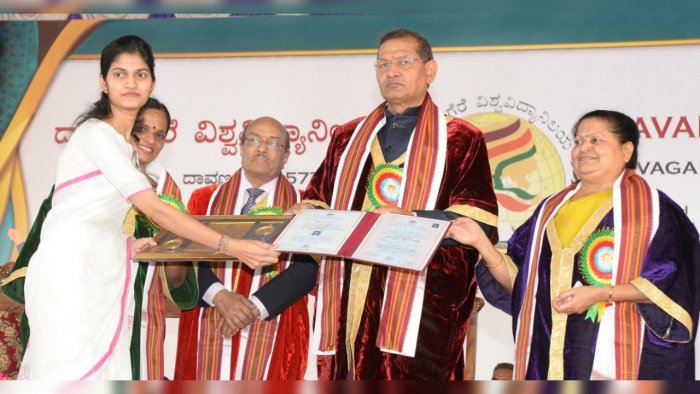
Davangere University Vice-chancellor Sharanappa V Halase presents gold medals and certificate to Nisarga K P, who secured the first rank in MA (English) even when she had epilepsy during examinations last year, at the 8th convocation in Davangere on Thursday. University Registrar (Evaluation) H S Anitha, Academy for Creative Teaching Chairman Gururaj Karajagi, and Registrar Gayathri Devaraj are seen. Credit: DH Photo

Every rank holder in academics will have a story to tell. Likewise, Megha S N, who emerged as the golden girl with four gold medals in MSc in Mathematics at Davangere University’s 8th annual convocation held at Shivagangotri Campus here on Wednesday, wants to become a mathematics teacher with the sole intention of eradicating from the minds of students that it is a hard nut to crack.

She is the daughter of Nagaraj, a school teacher in Davangere and Sudha, a homemaker.

Speaking to DH, she said, many students find mathematics a tough subject due to wrong teaching methods adopted by teachers. If it is taught in the right way at the school level, all students would love it. “Being a daughter of the Mathematics teacher, I was taught it in the right method.”

On her future plan, she said she is preparing for NET/KSET to become a teacher in a degree college. She also has a plan to do a PhD.

Student suffering from epilepsy gets first rank

Nisarga K P, the first rank holder in MA in English, was suffering from epilepsy during the examinations last year. She was bedridden. But her perseverance fetched her two gold medals. She is still undergoing treatment. She was hospitalised in Manasa nursing home in Shivamogga in April last year.

She studied the subject on the phone and laptop on the bed as examinations were held in September due to lockdown. “I am alive today due to treatment by doctors Avinash and Vamana Pai. Parents and my brother Kotresh, BBM student, gave much-needed moral support.”

She told that many children from rural areas still find English as a hard nut to crack. “I want to set up a private school in the rural area and teach English to rural children effectively so that they not only overcome inferiority complex when they come to a city for higher education but also able to compete with their counterparts in urban areas.” 

She is the daughter of Panchakshari, a civil contractor and Basamma, a homemaker, the residents of Vidyanagar in Davangere.

BA rank holder aims for IAS

Jyothi Gupta V, a student of AVK college in Davangere, and who secured the first rank in BA, wants to become an IAS officer. Currently, she is doing MA in English at Davangere University. She is the daughter of Vinod Kumar Gupta, a businessman, and Reena Gupta. English, Sociology and Political Science were her optional subjects in BA.

Street vendor’s daughter bags first rank

Irshad Jabeen a native of Chitradurga, and the first rank holder in MSc in computer science, said, though her father Syed Islam is a street vendor. who sells sofa sets, he always encouraged her to do well in in her studies. In order to realise her dream of becoming an IAS officer, she quit the job in Bengaluru and she is now preparing for UPSC exams. Currently, she is working as a lecturer in SRS PU College in Chitradurga. She travelled from Chitradurga to the campus every day and became the topper. 

Hyder Ali, son of Mehboob Sab, a bangle seller at Bhanuvalli in Harihar taluk, bagged the first rank in MA in Political Science. “ My parents have five children and all are graduates. I am preparing for UPSC examinations,” he said.

Chaitanya C M, daughter of Chennakeshava, Principal of the government the First-grade college in Chitradurga and Manjula B K, a homemaker, bagged the first rank in BCom. She is a student of SJM Degree college, Chitradurga. She also has a plan to become an IAS officer. Currently, she is doing MCom at the University of Mysore.

Sindhu P K, the first rank holder in MSc (Physics), proved that poverty can never become an impediment to achieving success. Her father Karibasappa P T works in a grocery store in Davangere. She also wants to become an IAS officer, she said.  

source: http://www.deccanherald.com / Deccan Herald / Home> State> Karnataka Districts / by Nrupathunga SK, DHNS / April 09th, 2021
Maulana Wali Rahmani: India’s torchbearer Muslim scholar who made promotion of education his mission

Patna, BIHAR :

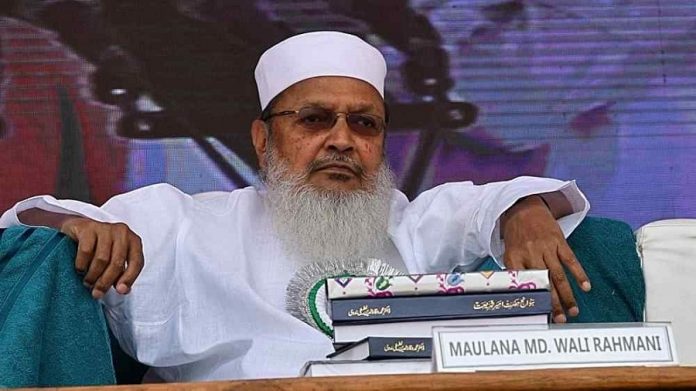
Maulana Wali Rahmani | Photo Courtesy: Clarion India

What set Maulana Wali Rahmani, an Indian Sunni Islamic Scholar, academician and founder of Rahmani30, apart was his efforts towards the promotion of education among Muslim youth. Although Rahmani was a multi-lingual man, he had evident love for the Urdu language. In February this year, he launched a campaign for education among the Muslim community and promotion of the Urdu language. 

The well-known torchbearer of India’s Muslim community, who strove to work for the promotion of education, Maulana Mohammad Wali Rahmani would have turned 78-years-old on June 5 this year. On April 3, Maulana Wali Rahmani breathed his last at a Patna hospital after a brief illness and other complications.

Such was his repute and respect among the community that he had 8.5 lakh followers who took the oath of allegiance to him as “Sajjada Nashin” of Khanqah Rahmani in Munger in the Indian state of Bihar. Rahmani became “Sajjada Nashin” of Khanqah Rahmani, Munger in 1991 after the death of his father Sayyid Minatullah Rahmani. At present, Rahmani was the Secretary-General of All India Muslim Personal Law Board (AIMPLB). He was Ameer-e-Shariat, or the head, of the renowned religious organization Imarat-e-Shariah of Bihar, Jharkhand and Odisha. However, what set him apart was his endeavour in the field of education. His organization, Rahmani30, founded in 2008, was his gift to the Muslim community of Bihar, and the country.

Had there been no Rahmani30, hundreds of students might not have heard about him and many poor Muslim students could not have realized the dream of making it to India’s top engineering institutes; the IITs or the Indian Institute of Technology.

The Rahmani30 has since then expanded to NEET or the National Eligibility cum Entrance Test for medical education. Top accountancy and Law entrance tests have also been included now.

Rahmani30 is modelled on Super30 founded by famous mathematics teacher Anand Kumar of Bihar who started selecting 30 poor students and grooms them for IITs. Super30 was a big success. So is Rahmani30. Since its inception, Rahmani30 had the services of Bihar senior police officer Abhayanand, who retired as DGP Bihar. Every year test exams are held for the selection of Rahmani30 and the selected candidates are provided with free residential coaching with food.

Maulana Wali Rahmani was a political personality. His proximity with political leaders got him brickbats too. He was elected to the Bihar Legislative Council on April 7, 1974, and continued till 1996. In 1984 and 1990 he was elected as deputy chairman of Bihar Legislative Council. He was criticized after his (in)famous Deen Bachao Desh Bachao (Save Islam, Save Country) rally at Patna in 2018. Just after the rally, one of its organizers were declared as the candidate from Nitish Kumar’s party for the Bihar Legislative Council. Maulana Rahmani was accused of compromising with Nitish for ‘a seat in Bihar council.’

He, however, was also praised for his bold statements before the top political leaders when the issues related to the Muslim community were discussed.

His birthplace Khanqah Rahmani is a well-known religious place that was founded in 1909 by his grandfather Maulana Mohammad Ali Mungeri, who was a co-founder of Nadwatul Ulema, Lucknow. Maulana Wali Rahmani’s father Maulana Minatullah Rahmani was also a renowned religious scholar who also held the post of General Secretary in All India Muslim Personal Law Board.

Maulana Rahmani got his initial education at Rahmania Urdu School, Jamia Rahmani in Munger, Bihar and then proceeded to Nadwatul Ulema and Darul Uloom Deoband. He also studied at Bhagalpur University which is now known as Tilka Manjhi Bhagalpur University in Bihar.

At the age of 22, Maulana Rahmani joined ‘Naqeeb’, a weekly published by Imarat-e-Shariah. He also served at Jamia Rahmani.

In 1991, following the demise of his father, he was made Sajjada Nashin of Khanqah Rahmani.

He was made Ameer-e-Shariat at Imarat-e-Shariah in November 2015 and held the post till his last breath. Here too, Maulana Rahmani’s focus was on education. He also worked for the better medical facility at Sajjad Memorial Hospital being run by Imarat-e-Shariah.

Although Maulana Rahmani was a multi-lingual man, he had evident love for the Urdu language. In February this year, he launched a campaign for education among the Muslim community and promotion of the Urdu language.

He also campaigned for the upliftment of the Madrasas.

His biography Hayat-e-Wali penned by Shah Imran Hasan states, “Maulana’s untiring efforts and timely steps to save the country’s Madrasas are worth mentioning. He met several dignitaries, including the then Prime Minister Atal Behari Vajpayee and presented before him the case of Madrasas in the context of their roles in the country’s freedom struggle and nation-building.”

Maulana Rahmani was a man who loved to make friends in other Muslim organizations too. He kept Maulana Rizwan Ahmad Islahi, the young Ameer-e-Halqa (Bihar chief) very close to him. Maulana Rizwan recalls that when representatives of Muslim organizations went to meet Bihar Chief Minister Nitish Kumar, everybody wanted Maulana Rahmani to talk to him but he proposed his name (Maulana Rizwan’s). “Such was his generosity,” he said.

Maulana Rahmani will be missed at many places, including at AIMPLB and Imarat-e-Shariah. However, his absence would be felt most at Rahmani30. The passing away of Rahmani poses a challenge for both Imarat-e-Shariah and Rahmani30 to take his dream further.

source: http://www.twocircles.net / TwoCircles.net / Home> Lead Story / by Sami Ahmad, TwoCircles.net / April 05th, 2021

After Wali Rahmani, Anees Chisti also left for heavenly abode

Pune, MAHARASHTRA :

Pune:

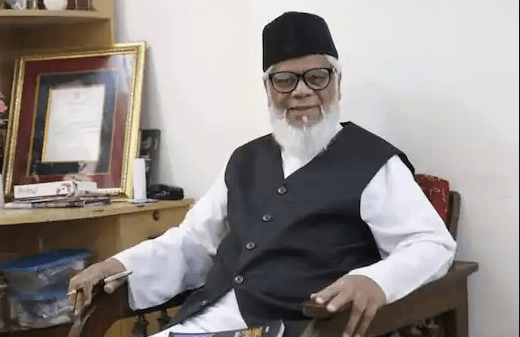
Well known educationist, intellectual, thinker and author of several books, Professor Anees Chishti has passed away in Pune at the age of 79.  He was unsung hero of the community who made tremendous contributions in the progress of the community in the country.   He will be also remembered for his dawha works as he translated Islamic literature into local Marathi language. He was a close confidant of late Maulana Abul al Hasan Nadvi who launched All India Tahreek e payam e insaaniyat with an aim to dispel misunderstandings about Islam.   Chisty was one the pillars of this movement.

According to Anees Chishti’s family, he first suffered a heart attack and then later normal infected by COVID-19. During his treatment at Azam campus Unani hospital Pune He took his last breath and was buried on Monday, April 5, after Isha prayers at Muhammad Jamia Hussaini Masjid in the city.

As news of his demise spread, condolence messages flooded on social media. Many important personalities expressed their grief and sorrow who acknowledged the scholarly and social services of Anees Chishti.

Chisti was born on February 6, 1943 in Pune. His father Shakeel Ahmad was a freedom fighter. He was educated in Pune and Sholapur. Pune is considered the brain of Brahminical forces.

Expressing condolences on the demise of Anish Chishti, PA Inamdar administrator of Azam Campus Pune, said his demise is a great  loss to the nation. He said that Anees Chishti was recognized as an authority in Islamic studies and science and literature.

Munawar Pir Bhai from Pune termed the demise of Anis Chishti as a great loss of the society and said that he was a very capable and intelligent person. Traveled to many countries, he had a keen eye on Islam and Allama iqbal. And he described the death of Anis Chishti as his personal loss.

Talha, nephew of Anees Chishti, said that after the death of Maulana Wali Rahmani, he had gone to Lucknow to meet Maulana Rabi Hasni Nadvi.

After returning from the trip, his health deteriorated and on April 5, at around 5.30 pm, he passed away. The personality of Anees Chishti was a person with various attributes.  He was a member of the Majlis-e-Shura of Darul Uloom Nadwa tul Ulema, Lucknow and member of the, All India Muslim Personal Law Board.

He was very close to Maulana Syed Abul Hassan Ali Nadvi, a thinker of Islam, and he was the General Secretary of the All India Tahreek e payam e insaaniyat. The movement was launched in the backdrop of Babri masjid dispute which had been used by the communal forces to spread lies about Muslims and Islam in the country.

He was the author of many Urdu, Marathi and English books. His books have been translated into various languages. He was a connoisseur of calligraphy, a teacher of calligraphy, an Islamic scholar, and an educator. Apart from Urdu, many of his books have been published in Marathi.

Mirza Abdul Qayyum Nadvi, a bookseller and activist from Aurangabad, said that he had spoken to Anis Chishti two days before his death. More than 53 of his books have been published. Anis Chishti was fluent in many languages. These included Urdu, Marathi, Hindi, English, Arabic, Persian and other languages. He was a very good man, a man of knowledge, a good teacher, a good writer, a credible writer, an eloquent speaker, a guest lecturer on the panel of high-ranking training institutes. He has received numerous accolades for his books on education, and books on Muslim freedom fighters .and other books. In many countries, his Urdu and English language books are included in the Syllabus.

He trained soldiers at the Indian Institute of Education, College of Military Engineering Pune. He has delivered sermons and lectures on Islamic and scientific and literary topics in different parts of the country. He is survived by a daughter and four brothers.  Arguably, his demise made the community further poorer as it was in the shocked after Muslim Personal Law Board General Secretary Maulana Mohammad Wali Rahmani in Patna just two days before.

source: http://www.muslimmirror.com / Muslim Mirror / Home> Indian Muslim / by Abdul Bari Masoud / April 07th, 2021

Meet Azharuddin, a mechanical engineer from Meerut who made an electric cart from junk, earning laurels

Muradnagar, (near Meerut), UTTAR PRADESH :

Twenty-year-old Azharuddin from Meerut in the north Indian state of Uttar Pradesh is good with his hands. He created an electric cart from junk and he is now receiving online orders from abroad. Apart from this, the 21-year-old has also made an electric bicycle that can cover a distance of 100 km on a single charge.

Uttar Pradesh:

His father laboured all his life and his mother never went to school, yet the twenty-year-old Azharuddin from Muradnagar near Meerut in the north Indian state of Uttar Pradesh battled all odds and went on to become a mechanical engineer. His is a story of fighting poverty with talent and hard work and emerging victorious.

Azharuddin studied at a government school and today he is a second-year B.Tech. student at Subharti University, Meerut. The university management does not take fees from him. Instead, they provide all the facilities.

Azharuddin is good with his hands. He has created an electric cart from junk and is now receiving online orders from abroad. The twenty-year-old has also made an electric bicycle that can cover a distance of 100 kilometer on a single charge.

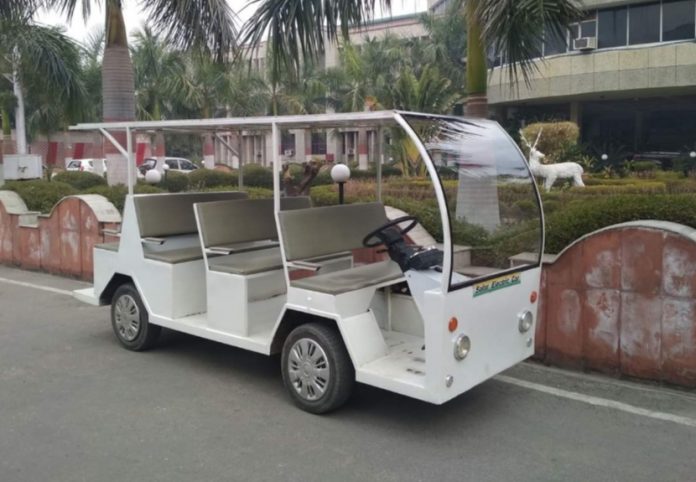
In addition to the electric cart, Azharuddin has also made a solar cart, which does not need to be charged. His feat is remarkable as he has accomplished it all by himself.

Presently, the boy from Muradnagar is working to get his e-cart verified by the government.

Electric cart made by Azharuddin

“The e-cart is basically solar powered, but it can also be charged. It will benefit the environment immensely. It is cheaper and more robust. It can be used as an auto. Currently, its demand is coming from societies of large size, where these non-polluting carts are of great importance. Apart from this, they have great importance in places like Zoos, Taj Mahal etc. Till now such carts were running on battery. We have a cheaper alternative to solar and electricity,” Azharuddin told TwoCircles.net.

Azharuddin’s accomplishments have not been in vain. He has received an offer of 6 solar carts from a society in Hyderabad.

For his first electric cart, it cost him INR 1.5 lakh. He has improved its cost of making and his e-cart now has space for more people to sit. An e-cart made by him has been sent to Dubai.

Azhar says that if the government cooperates with him, they can build something that can contribute to pollution reduction in the country and improve the environment.

Azharuddin says that he has made his electric bicycle in the same manner. It can charge up to 100 kilometres at a time, while the company’s cycle runs 30-40 kilometre. It can run-up to the speed of 25-30 kilometre per hour and is pollution-free. He has started getting orders for his e-cycle.

He says his e-cart was used at the Taj Mahal in Agra for six months. “I had built a one-seater helicopter in 11th grade, which was greatly appreciated at the exhibition in Ghaziabad,” he said.

His e-cart is now being used in Haryana’s Hisar Cantt. and Engineering College. His e-carts are also today used at his college Subharti Meerut.

Azharuddin’s father Amirudin Kassar told TwoCircles.net that “Azhar has brought him only joy and pride.”

“People in the village know me because of my son. I respect him more,” he says.

Talking enthusiastically about his e-cart, Azharuddin explains that in the event of solar energy being interrupted, its work will be done by charging and this cart will keep running. “Two batteries of 12 volts and five batteries of 140-ampere lead-acid have been used in the solar panel. This is the biggest feature of this e-cart that it operates from both solar and electricity as well and is cheap,” he says.

At Subharti University, Azharuddin’s work is discussed with excitement.

A staffer at the University Sanjay Kumar points out that Azhar’s talent is natural. “The natural talent inside him is going to take him to places. He has earned a name for himself through his work. His difficult time has passed. We wish him a bright future,” he said.

The story of Azharuddin exemplifies that passion and hard work pays, no matter how humble your beginnings.

source: http://www.twocircles.net / TwoCircles.net / Home> Lead Story> TCN Positive / by Aas Mohammad Kaif, TwoCirlcles.net / March 30th, 2021

Paralysed by bullet, Kashmir man overcomes disablity to teach differently-abled children

JAMMU & KASHMIR :

Though Javed Ahmad Tak was confined to the bed for years after getting injured in a militant attack, he is now teaching hundreds of disabled kids to tackle life’s challenges.

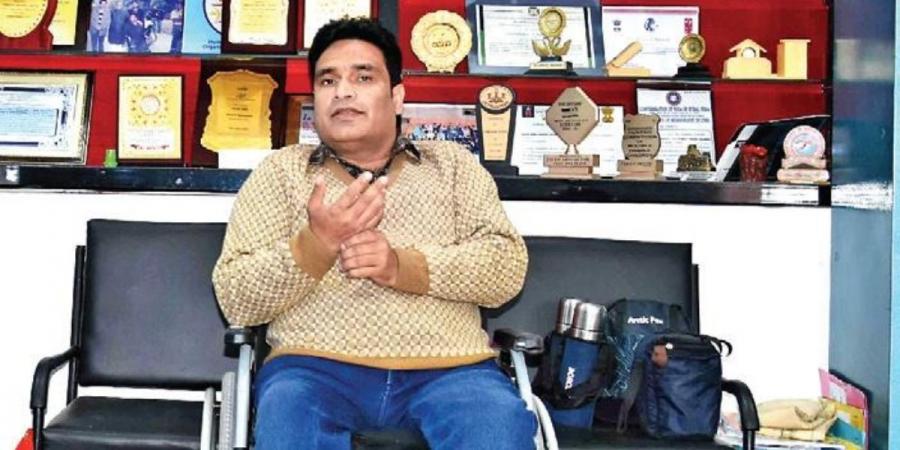
Javed Ahmad Tak’s school is currently teaching 120 differently-abled students. (Photo| EPS)

Jammu & Kashmir :

Javed Ahmad Tak’s life took a dramatic turn in 1997. Hit by a bullet during a militant attack, he was confined to the bed for years first and now to a wheelchair. But Tak, now (45), has taken his disability head-on and has created opportunities for others like him. Today, he is a role model for many differently- abled people.

On the night of March 21-22, 1997, 21-year-old Tak was injured in firing at his uncle’s house at Bijbehara in Anantnag. “The gunmen had come to attack my cousin who was the block president of the National Conference. I tried to save his life and suffered a bullet injury,” recalls Tak. The bullet caused severe damage to his spinal cord, kidney,  pancre a s and intestines.

Tak, a BSc final year student  at that time, remained hospitalised for about an year. After being discharged in February 1998, he remained bedridden for the next three years. “While being confined to bed, I would hear noises of young boys playing outside my home. In June 2000, I told my mother that I don’t want to sit idle and want to teach these young boys for free,” Tak said.

“I taught 80-90 boys for the next four years. After free coaching, I also started a book bank at my home to help boys and girls from poor families,” says Tak. He also started a uniform and school bag bank for those who could not afford them.

Wheelchair-bound, Tak was not content and wanted to do something for the specially- abled children. He asked his friends and relatives to find out disabled children in his locality and adjoining areas. In 2006, Tak started the Zeba Apa Institute for Specially-abled children.

He also continued his studies and completed his Masters in Social Work from the University of Kashmir in 2007. “Some of the children had mental disorders and their plight was miserable. A few of them were blind and some were hearing-disabled,” Tak said. The government had sanctioned Rs 75,000 ex-gratia to him in 1999 even though he had spent lakhs on his treatment.

“I took the money which helped me to start the school in rented accommodation. I hired a few trained teachers to teach disabled children,” Tak said.

The school was meant for primary students but later it extended up to 8th standard. About 120 differently-abled students currently study in the school which has 25 staff members, including 10 trained teachers.

The teachers use a variety of methods to teach different types of disabled students. Tak also has a teacher from Kerala, who is a special educator and speech therapist. “He helps us frame syllabus for different kinds of disabled children. He also trains the teachers,” he said.

The school does not have any fixed fee system and it is for parents to decide how much they can afford. “Some parents pay normal charges, some meagre and some don’t pay at all,” Tak says. With no help from the government, the school runs on donations from the public, NGOs and civil society groups. The school now has its building. “We constructed the building with the financial support of locals and NGOs,” Tak said.

The school has a good academic record. One of the visually impaired girl students, Zakiya Manzoor, is doing her BA from Delhi University. Another visually impaired Saima Hussain is a junior artist at J&K Cultural Academy. The students have also excelled in sports. They are also being trained in extra-curricular activities. Some have participated in national- level sports competitions and won medals.

Tak says if he had a better transport facility, the school would have over 200 students. The school has purchased two buses on loan for ferrying students, but that’s not enough. There are cases where parents of children have hired accommodation near the school.

Tak hopes to expand the school to the higher secondary level so that it can cater to all disabled children of the four districts in south Kashmir. “I also plan to set up a hostel for students so that those living in far-off places can live here and avail of education facilities.”

source: http://www.newindianexpress.com / The New Indian Express / Home> The Sunday Standard / by Fayaz Wani / March 28th, 2021

Mechanic Khaleel’s Way Of Aatmanirbhar Bharat: German Car’s Switch Unit Runs With Mixer’s Speed Knob!

Mysuru, KARNATAKA :

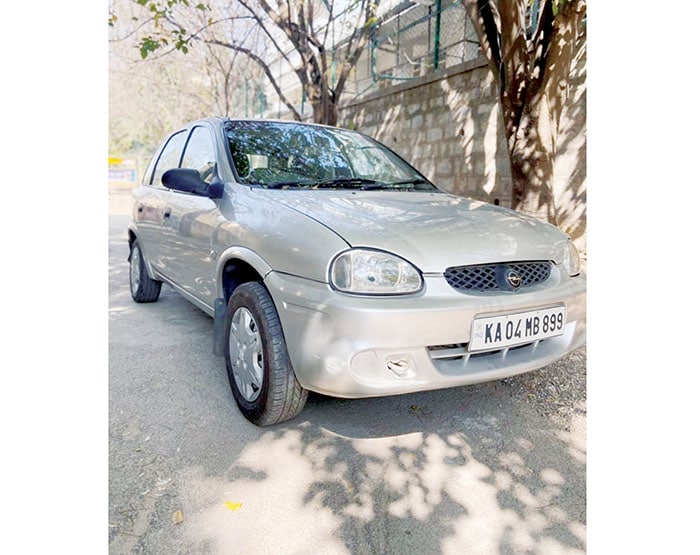
Owning a car was a distant dream till 50 years of my age. Finally, I could buy a petite beauty — a German company car Opel Corsa Sail. It was a “pre-owned” one (decent word for second hand). The running around I made to purchase this would itself make an interesting story as I was a greenhorn then. The pre-owner used all his expertise in explaining its features and convinced me to buy it. He also postured as if he was deeply pained to part with the car.

Well, like any other kid with a new toy, I developed a bond with this beauty. Once, it was a dream to buy a car but soon I used to drive this car even in my dreams. My   obsession for spic and span maintenance of my new love, made her silver-coloured curvatures (I believe Chassis is a very harsh word) shine brighter.

A veteran from Indian Air Force that I am, the lessons on cleanliness has been imbibed by me. I never cared for myself even when I got sunburned in the cleaning process. I thought I had to compensate the time lost in my earlier 50 years without a car and spent more time in adoration of this new car !

This car had an exquisite spacious accommodation and upkeep of the interiors of her beauty was also given equal prominence. Dust was my chief enemy. The sight of dust would horrify me. So cleaning was meticulous. Even the remote and hard-to-access portions were carefully polished.

Well, my wife was obviously unhappy that in the course of car cleaning, my household responsibilities were weaning. Her frequency of nagging had increased. (Friends used to say their wives are also same and that sounded like music to my ears). One fine day (can I call it so?), in spite of my wife’s admonitions, I ventured into cleaning my car.

Matter of just a switch

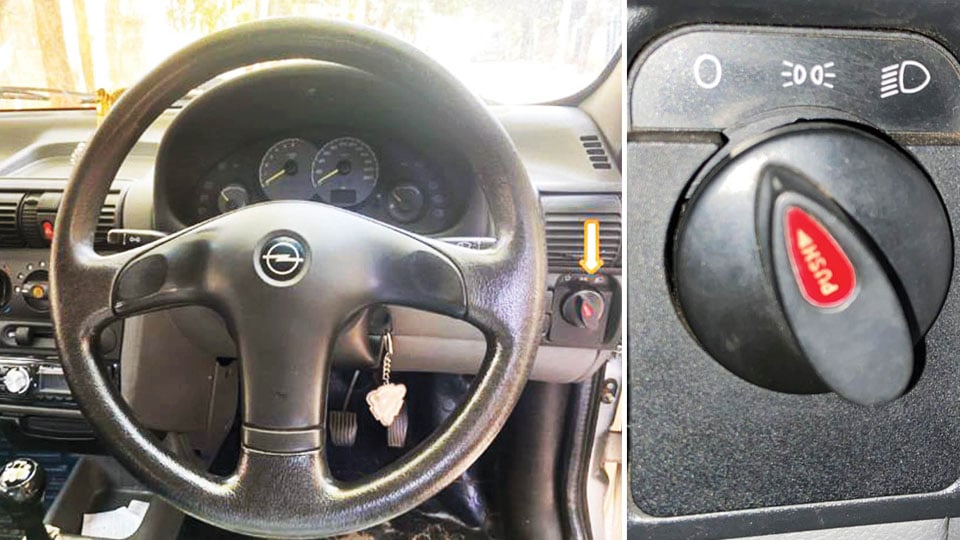
I do not dare to blame my wife for her warnings, because of which I got a little distressed. But the resultant bad mood had an evil effect as I cleaned the interiors. There was this headlight control switch that became the casualty of my distraught. Unlike the modern-day cars, which have control switch attached to steering wheel itself, in my car, it was a little remotely fixed at right-hand corner below the dashboard. Because of my unusual harsh handling that day, the switch got damaged and so was my sleep that night.

The next day I went to the company-authorised service centre. The service engineer inspected it and gave a verdict that it cannot be repaired and the entire switch control unit needs to be replaced, with an original imported one. He said that it has to be obtained from the manufacturer and may take 15 days and the estimated cost was about Rs. 7,000.

Deft hands

I got worried and decided to have a second opinion. One of my friends advised me to go to a local mechanic, Khaleel, who was an expert in his own way in repairing high-end cars. I thought of giving it a try and went to his garage which was next to a Gujari (dump yard). I was amazed to see several high-end imported cars parked there for different levels of repairs.

I was very anxious about the snag in my car, may be very minor, but was paramount for me. But after inspecting the car for only a few seconds, he showed no expressions whatsoever. He asked me to leave the car and come after an hour. His face was so serious that I did not dare to ask any more questions. The next one hour was the toughest in my life. My restless mind was preparing for the worst. 

Complex problem, simple solution

I went back to the garage, posing with a fictional courage. Cool as a cucumber, Khaleel said the snag is rectified and demonstrated that it worked properly.  He asked me to pay Rs. 100. I was astonished and could not believe. I peeped into the dashboard and I could see a new control knob, which looked pretty familiar as well as bizarre to me. It was totally different from the original one. I wondered how he could get such a part which was supposed to cost a bomb and was not readily available locally in such a short time and that too for a paltry hundred rupees.  

When I expressed my bewilderment and disbelief (though happy within), he nonchalantly said, “Saar, it is very simple technology like a mixer in your house.  I just bought a mixer speed control knob for just ten rupees and replaced the broken switch” and handed over the broken switch to me. I was astounded. I thought to myself, hell with the frightening company-authorised service centre, my job was done so effortlessly and the worry vanished.  

Above all, I thought, it was a classic  example of “vocal for local” and “Aatmanirbhar Bharat” much before our Prime Minister Modi promulgated the scheme nationally. Wonder how many such sophisticated spare parts Khaleel would have  replaced in those imported cars lying in his garage with their bonnets open to the sky. And how many such Khaleels  would be in the trade!

source: http://www.starofmysore.com / Star of Mysore / Home> Feature Articles / by S. Vasudevan, Retired Superintendent of Customs & GST / March 26th, 2021

Muslim composers who enriched classical music

TAMIL NADU :

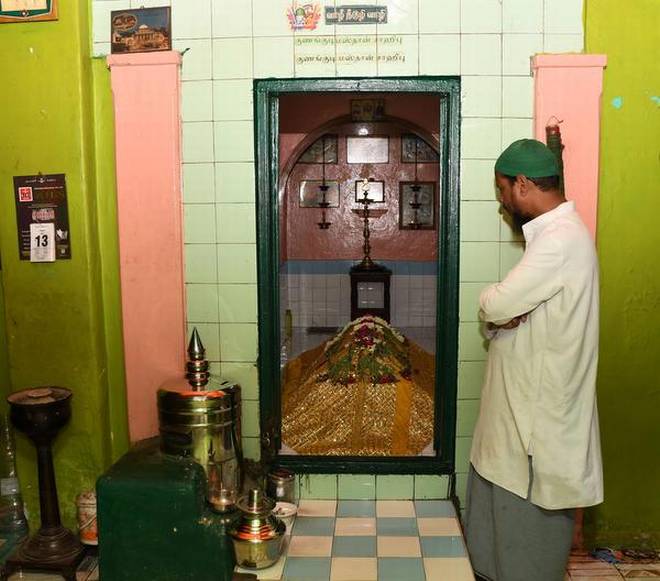
The Hazarath Gunangudi Masthan Sahib Dargah (Kunangudi Mastan Sahib Dargah) at Royapuram in Chennai   | Photo Credit: B. Jothi Ramalingam

Written with a knowledge of grammar and aesthetics, their songs are immortal

If you think of the Muslim link to Carnatic classical music, Sheikh Chinna Moula and his descendants and disciples are the first that come to mind. In the 1970s, T.M. Abdul Azeez was a violin accompanist on the Carnatic platform. He is now settled in Kerala, where he teaches music. Abraham Pandithar’s Karunamirtha Sagaram (1917) lists a few Mohammedan names as performing artistes though it is difficult to fathom now if they were performing in the Hindustani or Carnatic styles.

Gulab Mantil is one — he claimed to be a descendant of Mian Tansen of Akbar’s Court and was under the patronage of the Sivaganga rulers. He was adept at various instruments. On Chottu Mian there is no information other than the fact that he was a good singer of Hindustani Music. Nannu Mian and Mirali are listed as brothers, who were noted for their skill on the dholak. Closer home, at Tondiarpet we have the dargah of Kunangudi Mastan Sahib who is propitiated with music of the Sufi variety.

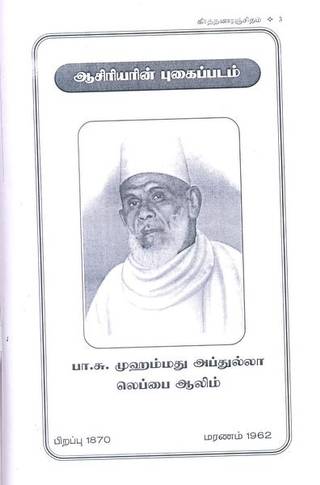
Given this background, it was a revelation when PAK Mohammad Sulaiman walked in with PS Ilyas of Kayalpattinam into the Music Academy a month or so ago. The latter had with him a precious possession — a fragile copy of a book published in 1909. Titled Kirtanaranjitham, it was a compilation of songs composed by his grandfather and Mohammad Sulaiman’s great grandfather, PS Muhammad Abdullah Labbai. It was printed at the Kalarathnakara Press, Madras.

Famous jeweller

A preface to the book gives details of the composer’s antecedents. His grandfather, Sheikh Sadakatullah was a Kazi (judge) at Kayalpattinam and had the privilege of moving about in a palanquin. That made him Pallakku Labbai to the locals. His son, Muhammad Suleiman Labbai got into the precious stone trade and his three sons, of whom the composer was the second, followed him into the business. The first and third sons set up offices in Colombo while Muhammad Abdullah Labbai (1870-1962), the composer, moved to Bombay. He made such a name for himself in the business that jewellers referred to him as Abdullah Jauhari. But his attachment to the dargah where the family prayed, the Shahibu Appa Thaikka at Kayalpattinam, was such that he eventually moved back to take care of it. He is also buried there.

Muhammad Abdullah Labbai has composed around 90 songs as per this book. It is also stated in the preface that the composer presented all of these at the dargah. What is interesting is that some of the songs are still being sung there, though the tunes have changed over time. The book sadly lacks notation (it must be remembered that notation in print was not common practice in the early 1900s). But ragas and talas are provided for every song. The popular ragas are all there, with preponderance for usage of Khamas, Mohanam and Kalyani. There are certain ragas that are not easy to identify. Names such as Desikam, Karnataka Desikam, Mohana Thodi and Nilakambodi are puzzling.

The composer was clearly well aware of the laws of composition and follows the requisites of prosody and alliteration. The language used is Manipravalam — a mix of Sanskrit, Tamil and Urdu/Persian. The bulk of the songs are in the usual kriti structure of pallavi, anupallavi and charanam. The last named are usually three and in some songs, four in number. The mudra of Abdullah appears in all the pieces.

Perusing the songs, you see all the familiar themes of Tamizh Padams — the lovelorn maiden yearning for union with the Supreme, the sending of messages to the divine via swans and companions, berating the Beloved for His heartlessness, and songs of surrender. Besides these, there are songs in the Thevaram format and some structured as Kannis. Certain songs are on specific locations where holy personages are buried, in the manner of kshetra kritis. These include Kayalpattinam, Manjakollai, Kizhakkarai, Saragam/Ervadi in Thirunelveli District, Cannanore in Kerala and Kandy in Sri Lanka.

The book follows the format for music publications of its time. There are benedictory verses in form of kappu, kanni and viruttam. Besides, like the ratha bandams that Tamil scholars of yore indulged in when patterns like chariots could emerge from the way they wrote verses, Muhammad Abdullah Labbai has worked on calligraphy by way of a Chithirakkavi Kattalai Kalithurai. His scholarship came in for praise from several Muslim men of letters, all of whom wrote verses in his praise, which were included in the first edition.

The 1909 publication was reprinted in 1963. This was done with the support of the family business in Colombo. Hussain Bhagavatar of the Panchalingapuram Jam’ath kept the songs in circulation for much of the 20th century. The descendants of the composer are now in the process of bringing out a new edition.

source: http://www.thehindu.com / The Hindu / Home> Society> Faith / by V. Sriram / June 14th, 2018

America’s Producer’s Guild honours Irrfan Khan but misspells his name

RAJASTHAN / Mumbai, MAHARASHTRA :

Khan was among the 21 cine personalities who were remembered during the ceremony’s ‘In Memoriam’ segment.

Late Bollywood actor Irrfan Khan (Photo | PTI)

Los Angeles : 

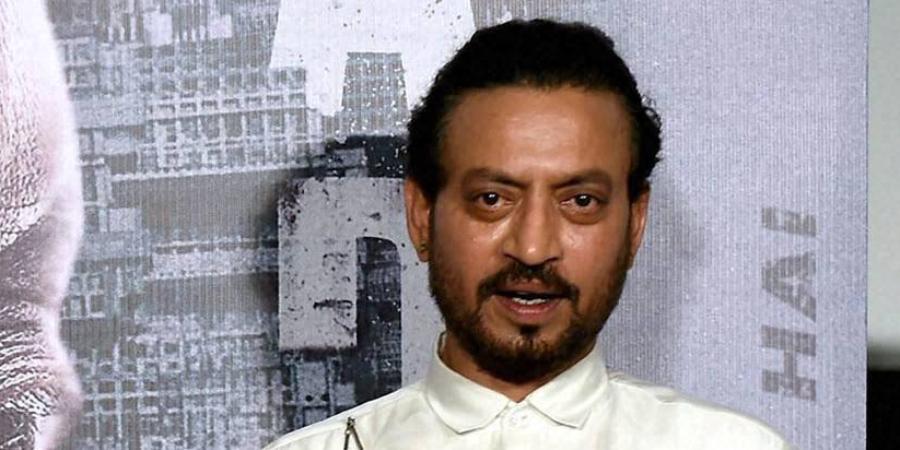
The 2021 edition of the Producer’s Guild of America (PGA) Awards honoured the late Indian star Irrfan Khan during its “In Memoriam” segment but got his name wrong.

The awards, considered as an Oscar bellwether, were held virtually on Wednesday.

Khan was among the 21 cine personalities who were remembered during the ceremony’s “In Memoriam” segment.

However, the pre-taped production of the awards committed a gaffe with the actor’s name as it read ‘Irrif Kahn’ instead of Irrfan Khan, reported Variety.

Another typo was spotted when the name of “Minari” star Steven Yeun, who was one of the presenters at the event, was misspelled as ‘Steven Yuen’.

Khan, who straddled both Indian and international cinema with equal elan, died in April 2020 at the age of 54 following a two year-long battle with a rare form of cancer.

In Hollywood, he featured in blockbusters such as “Inferno”, “A Mighty Heart”, “Life of Pi”, “Amazing Spider-Man” and “Jurassic World”.

The “In Memoriam” segment of PGA Awards also paid to tributes to Hollywood great Kirk Douglas, who died at the age of 103 in February 2020, and “Black Panther” star Chadwick Boseman, who passed away in August at 43 after a private four-year-long battle with cancer.

Other prominent names in the segment included Harry Bring, Sue Bruce-Smith, Allan Burns, Kevin Burns, Stuart Cornfeld, Charles Gordon, Buck Henry, Thomas L Miller, Tom Pollock, Rebecca Ramsey, Carl Reiner, Gene Reynolds, Pamela Ross, Ronald Schwary, Lynn Shelton, Fred Silverman and Jamie Tarses.

source: http://www.newindianexpress.com / The New Indian Express / Home> Entertainment> English / by PTI / March 25th, 2021

Mohanlal dedicates Marakkar Arabikadalinte Simham’s National Award win to Indian Navy

KERALA :

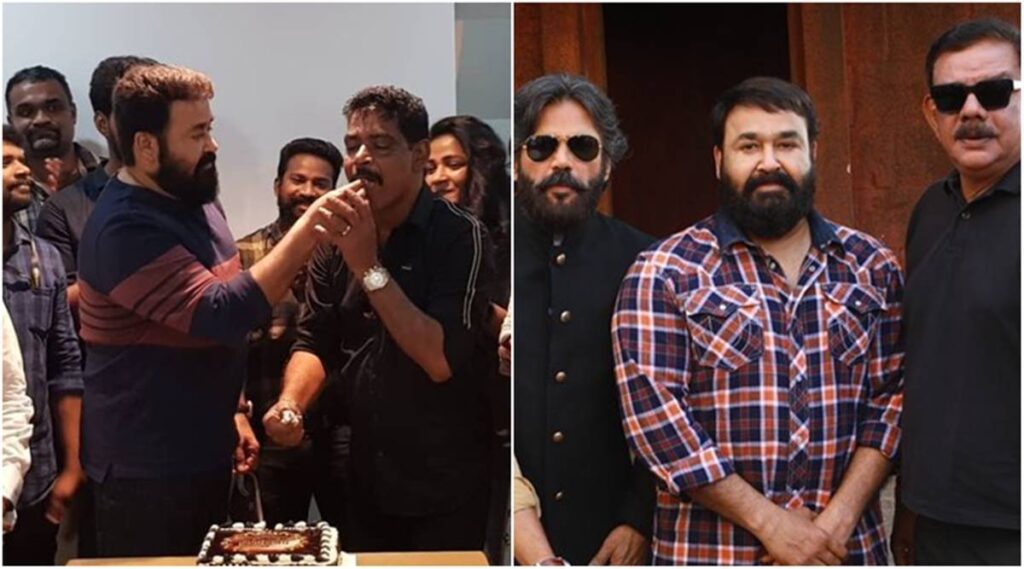
Marakkar Arabikadalinte Simham director Priyadarshan is a proud father as his son Siddharth Priyadarshan bagged a National Award for Best Special Effects in Mohanlal-starrer.

Marakkar Arabikadalinte Simham is directed by Priyadarshan. (Photo: Mohanlal/Instagram)

The team of Marakkar Arabikadalinte Simham is in a celebratory mode as the Mohanlal-starrer won Best Feature Film award, Best Special Effects award and Best Costume award at the 67th National Film Awards ceremony, which took place in Delhi on Monday.

The actor dedicated the National Award “to the glory of the Indian Navy.” The Malayalam superstar celebrated the win with his team and shared the pictures on his Instagram account.

Expressing his emotions, the 60-year-old said, “Hearty congratulations to all the National Award winners. Happy and elated to hear the fantastic news…. Marakkar- Arabikadalinte Simham (Marakkar – Lion of the Arabian Sea) has bagged the National Award for best feature film.

My Congratulations to Team Marakkar and the Captain of the ship priyadarshan for this honour. My sincere thanks also to all who supported us on this labour of love. I join Aashirvad Cinemas in celebrating this award and dedicate it to the glory of the Indian Navy.

___________

priyadarshan@priyadarshandir·

Dedicating this overwhelming moment to all such fathers out there in the world aspiring to see their children being succesful and happy. Thanks @Mohanlal, @antonypbvr, Team Marakkar and to all those who supported me . 2/2

#MarakkarLionoftheArabianSea

____________

For the filmmaker Priyadarshan, the win was also a moment of pride as a father as his son Siddharth Priyadarshan won an award for Best Special Effects. Overwhelmed with the win, Priyadarshan dedicated the awards to all fathers who aspire to see their children achieving success.

“It is an affectionately proud moment for any father to see his children getting recognised for excellence in their chosen field of activity. Dedicating this overwhelming moment to all such fathers out there in the world aspiring to see their children being succesful and happy. Thanks @Mohanlal, @antonypbvr, Team Marakkar and to all those who supported me,” the director tweeted.

Suniel Shetty, who played a pivotal role in the film, said that he is “super proud to be a part of this National award winning film.” Celebrating his very first “National Award-winning film,” Suniel thanked Priyadarshan, Mohanlal and the entire team of Marakkar- Arabikadalinte Simham.

“Big big congratulations to my baby, Chandu, Sidharth Priyadarshan for winning the award for the Best VFX. Once again congratulations Team @MarakkarMovie,” he concluded.

Marakkar Lion Of The Arabian Sea stars Mohanlal as a decorated commander in Zamorin’s naval force. The film also stars Pranav Mohanlal, who plays the younger version of the superstar.

The film, made at an estimated cost of Rs 100 crore, also stars Prabhu, Manju Warrier, Keerthy Suresh and Kalyani Priyadarshan among others.

source: http://www.indianexpress.com / The Indian Express / Home> Entertainment> Malayalam / by A. Kameshwari, New Delhi / March 24th, 2021

YSRC’s Shaik Fayaz Basha: From vegetable seller to Rayachoti municipality chief

Rayachoti (Kadapa District) , ANDHRA PRADESH :

Basha took part in the party campaign in the previous elections to the Rayachoti municipality and played an important role in the victory of the YSRC candidate.

File photo of Shaik Fayaz Basha selling vegetables at Rayachoti I Express

Kadapa : 

It took just a few weeks for Shaik Fayaz Basha to become the chairperson of Rayachoti municipality from a vegetable vendor. Basha, a degree holder, has been selling vegetables at the local market for a livelihood after he failed to get a decent job. Simultaneously, he used to take an active part in the YSRC activities whenever he gets free time.

Basha took part in the party campaign in the previous elections to the Rayachoti municipality and played an important role in the victory of the YSRC candidate. This time, the party fielded Basha as its candidate in the municipal elections and he won with a good majority. Much to the surprise of Basha, the party fielded him for the chairperson election, which was a cakewalk as the numbers were very much in favour of the ruling party.

Overwhelmed by the opportunity given to him by Chief Minister YS Jagan Mohan Reddy, Basha said, “I thank Jagan Mohan Reddy for giving someone like me the opportunity to be the chairperson of the Rayachoti Municipality. Despite being a degree holder, due to unemployment, I had to sell vegetables in my village to survive. I had no direction in life. It was then that the YSRCP gave me the opportunity to contest. Now, I was the Chairperson of the municipality. It is an unbelievable journey’’

“This once again proves that the YSRC is a party of the common man,” he said, once again thanking Jagan for giving him the opportunity. Earlier, the party had nominated a Muslim woman, Mayana Jakiya Khanum from Rayachoti, to the Member of Legislative Council (MLC).

source: http://www.newindianexpress.com / The New Indian Express / Home> States> Andhra Pradesh / by Express News Service / March 19th, 2021