Abdul Jabbar’s family members are very happy about him getting this honour.
Abdul Jabbar, who died on November 14 last year left behind a wife and 3 children
Abdul Jabbar of Bhopal, who fought a long battle for the victims of the Bhopal gas tragedy in 1984, has been awarded the Padma Shri. Abdul Jabbar is receiving this honour posthumously.
Abdul Jabbar’s family members are very happy about him getting this honour.
When India Today reached Abdul Jabbar’s house in the Chandbad area on the outskirts of Bhopal, we found that the condition of his house is very bad.
Abdul Jabbar, who died on November 14 last year left behind a wife and 3 children.
Abdul Jabbar’s wife Saira Banu said, “I am happy that the government is giving this honor to us but I am sad that my husband Abdul Jabbar is not with me in this moment of pride and happiness.”
Wife Saira Banu says that if Abdul Jabbar were alive, the joy of getting Padma Shri would have been doubled.
Jabbar’s wife said, Abdul Jabbar never thought about his own family. He made the gas victims his family. Abdul Jabbar’s wife expressed anguish that when her husband was ill, no one took care of him initially. At the last moment, the government approached the family but it was too late.
“He always kept thinking about the gas victims, and at the last moment he had told me not to let the gas victims fight end here but to take this fight further”, added Jabbar’s wife Saira Banu.
Speaking to India Today, Abdul Shamim, brother of Abdul Jabbar said, “When Abdul Jabbar was ill, no one from the government and gas-affected organisations took care of him. His treatment was also not taken seriously.”
Jabbar’s brother demanded a government job for Jabbar’s wife. ‘Financial condition of Jabbar’s family is very bad and sometimes children eat only once a day’, said Jabbar’s brother Shamim. According to Abdul Shamim, if his sister-in-law gets a job, she will be able to take care of her kids and her children will get a good education too’.
Abdul Jabbar’s eldest son Sahil said that he had learned to serve the poor from his father. Sahil said that ‘his father used to stay at home very rarely, he used to go out in the morning to help the gas victims and sometimes when there was no money in his pocket, he would borrow and help the gas victims. ‘I learned the same from my father’.
source: http://www.indiatoday.in / India Today / Home> News> India / by Ravish Pal Singh, Bhopal / January 26th, 2020
Mohammed Sharif from Faizabad lost his son 27 years ago. But he got to know about it only a month later. Ever since then Sharif has taken it on himself to cremate unclaimed bodies.
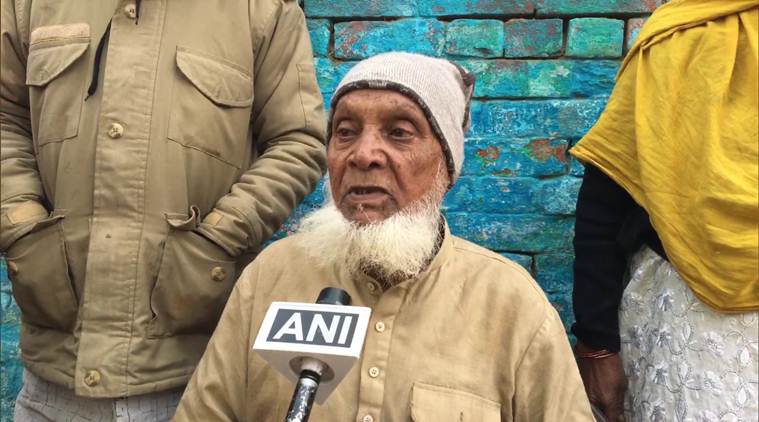
Mohammed Sharif has been named in the Padma Shri awardee list. (Source: ANI/Twitter)
A man who cremated over 25,000 unclaimed bodies is among those set to receive Padma Shri from President Ram Nath Kovind, according to news agency PTI. Mohammed Sharif from Faizabad lost his son 27 years ago. But he got to know about it only a month later. Ever since then Sharif has taken it on himself to cremate unclaimed bodies.
On Saturday, President Ram Nath Kovind approved the conferment of 141 Padma awards . The list comprises seven Padma Vibhushan, 16 Padma Bhushan and 118 Padma Shri awards. These awards are conferred by the President at ceremonial functions which are held at Rashtrapati Bhawan usually around March/April every year.
Earlier today, Vice President M Venkaiah Naidu had said that honouring unsung heroes with Padma awards is in a way “discovery of India”.
“I appreciate the Government for recognizing the unrecognized irrespective of their visibility. One way, this is a discovery of India,” Naidu wrote on Twitter while congratulating the awardees.
Other relatively unknown names on the list include Jagdish Lal Ahuja, who serves free food to patients and attendants outside PGI hospital in Chandigarh and Javed Ahmad Tak, a specially-abled social worker from Jammu and Kashmir.
(with agency inputs)
source: http://www.indianexpress.com / The Indian Express / Home> India / by Express Web Desk / New Delhi – January 26th, 2020
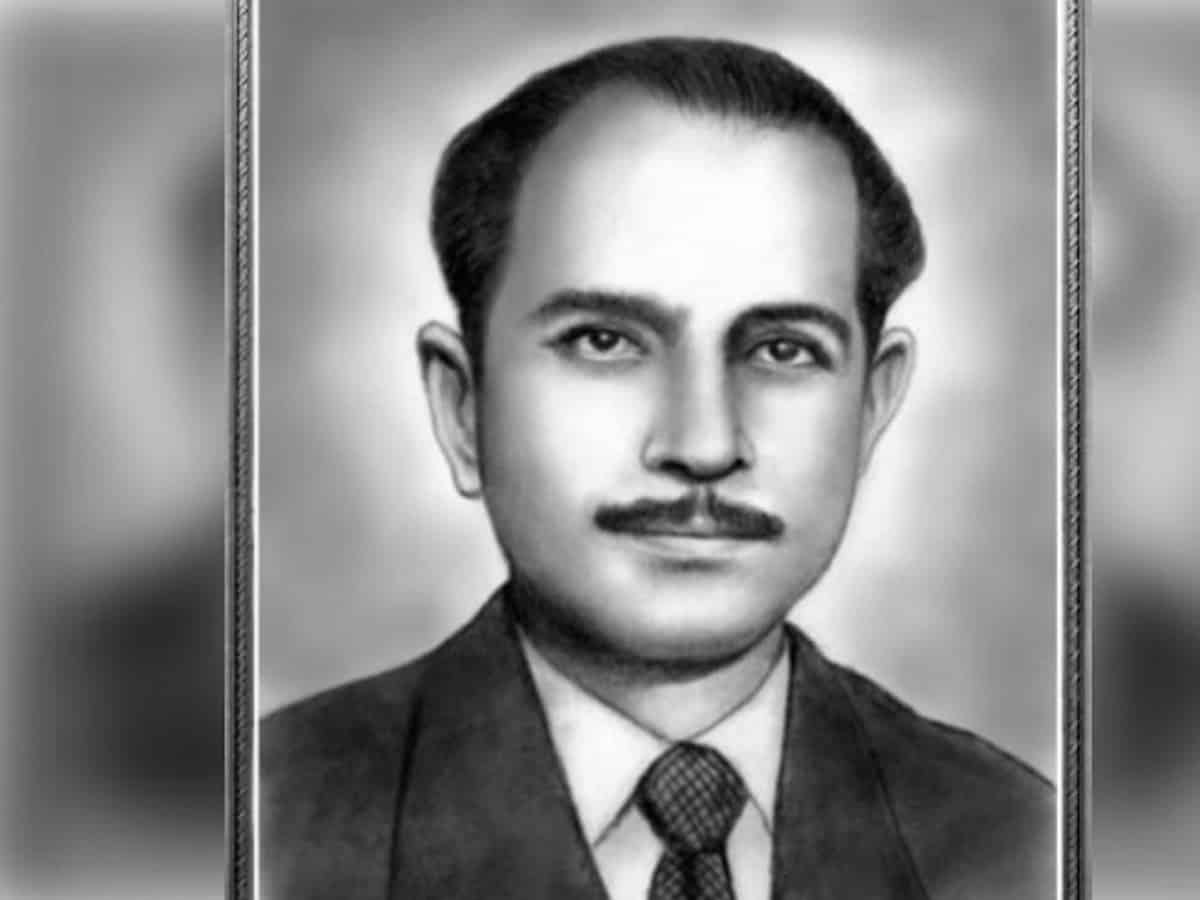
Abid Hassan, born in Hyderabad in 1912, hailed from a patriotic family.
Abid Hasan Safrani/COURTESY INDIANMUSLIMLEGENDS.BLOGSPOT.IN
Hyderabad :
This is the story of Abid Hassan Safrani who, not many may know, was not just the trusted lieutenant of Netaji Subhash Chandra Bose, but the Hyderabadi who had coined the magical slogan JAI HIND.
I have had the privilege of translating into English the Telugu book on the life of Netaji Bose by the late Ch. Acharya at the behest of the Freedom Fighters Association.
The following are excerpts from the book. Kindly read on:
“JAI HIND ”. No slogan had ever cast a greater spell on the nation than this. It had welded the people of this country of diverse languages, cultures, and faiths during the freedom struggle and filled them with a strong sense of patriotism. It continues to do so even now.
The man who coined this stirring slogan was Major Abid Hassan Safrani of Hyderabad, a close aide of Netaji Subhash Chandra Bose.
It was adopted as the national slogan at Free India Centre’s first meeting in Berlin in November 1941. Then, it became a popular form of address and greeting.
Safrani was with Bose when he undertook the death-defying undersea journey from Germany to the Far East. Safrani recalled how calm and composed was Bose when enemy ships rained bombs on the submarine. Unmindful, he dictated notes to Safrani on the future course of his action.
Sisir Kumar, the nephew of Bose, gave more details of the adventure in his book, ‘INA in India Today’.
Abid Hassan, born in Hyderabad in 1912, hailed from a patriotic family. After graduating in engineering with distinction, he went to Berlin for higher studies.
Attracted by Bose’s freedom movement, he joined the Indian National Army. Recognising his leadership qualities, Bose gave Safrani ample scope to grow to his full potential.
Safrani could fluently speak several languages like English, German, French, Arabic, Persian, Sanskrit, Hindi, Urdu, Telugu, and Punjabi. This enabled him to build excellent rapport with officers and men of the INA. Major Safrani headed the Gandhi Brigade in the INA. It consisted of men of exceptional courage and valour.
When they eventually surrendered to the British army at Imphal in North East India, top British officers could not help marvel at the bravery of Safrani and his men. He was imprisoned and put in solitary confinement with not even a window to allow light.
He mentioned this in a letter to his mother, Hassans had firm roots in nationalism. Abid’s father, Jaffer Hassan, was dean in Osmania University , and mother, Begum Amir Hassan, a staunch Gandhian. They inculcated patriotic feelings in their sons, Badrul Hassan and Abid Hassan, at a tender age.
All of them were very close to Mahatma Gandhi and used to visit his Sabarmati ashram. Fanatics threatened to kill them and throw their bodies into the Musi. Gandhi would send his secretary, Pyarelal, to railway station whenever the Hassans visited him. Badrul Hassan edited Gandhi’s “Young India” in 1925.
He remained a true Gandhian until his death in 1973. He wore khadi and led a spartan life in a small room.
Abid Hassan Safrani also imbibed these traits.
Begum Safrani was a unique personality who lived a full life(1870-1970). She gave away everything for the freedom of the country, including her paternal property. She was a close friend of Sarojini Naidu and was affectionately called ‘amma Jaan’ by Gandhi, Nehru, Netaji and Abul Kalam Azad.
“Abid Manzil”, their residence in Troop Bazaar, stands as mute testimony to the burning of foreign cloth in 1920 at the behest of Gandhi. In his book, Sisir Kumar Bose gave a graphic account of the escapades of Subhash Chandra Bose and Abid Hassan Safrani such as the submarine journey from Germany to Asia and the INA’s triumphal march through the forests of Imphal.
After the Second World War, Safrani was jailed for six years. Begum Amir Hassan, who did not expect anything in return for the services of the family, was much worried that her son might be sentenced to death in the Red Fort trial. Several INA men were shot dead for participating in the liberation movement. She met Gandhi, Nehru and Sarojini Naidu to plead for her son’s life.
Safrani got a last-minute reprieve after Prime Minister Nehru and Governor-General, Lord Mountbatten, intervened. Nehru had earlier visited a prison in Singapore where INA members were lodged. He spotted a man sitting aloof and asked if he was Safrani from Hyderabad . The man greeted him with “Jai Hind” and nodded ‘yes’.
After his release, an ailing Safrani returned to his “Dhoop Chaon” residence in Banjara Hills, Hyderabad and recuperated under the care of his loving mother and friends like Bankat Chandra, Elizabeth, and C.S. Vasu. He took up radio sales for a living, but with little success. He wrote a civil services examination and qualified for foreign service. He was personally interviewed by Jawaharlal Nehru .
He had served in Indian missions in a number of countries like Egypt, Iraq, Turkey, Senegal, Zambia, Ivory Coast. Safrani was Indian Ambassador to Iraq when Jordan King Hashmath-e-Faizal, was killed in an army coup in 1957. The government drew heavy flak in Parliament for his absence in Baghdad at the crucial movement. Nehru defended Safrani. Safrani loved agriculture and raised a horticultural farm in Golconda . It was his practice to visit Netaji’s hometown, Calcutta, in January every year carrying fruit grown on his farm.
That was his way of remembering his mentor, Netaji Subhash Chandra Bose. He used to recall with moist eyes those memorable years with Bose. He died in 1984 but immortalized himself with the soul-stirring slogan he coined: Jai Hind. It would keep the Hindus, Muslims, Sikhs and others together for centuries and strengthen national integration. He was an ideal Shia and a noble Sufi saint.
Safrani memorial school in Golconda, run by his wife, Suraya, seeks to instill in the minds of young pupils the lofty ideals, values and principles dear to her husband.
Dasu Kesava Rao is a senior journalist who worked for The Hindu, among other newspapers
source: http://www.siasat.com / The Siasat Daily / Home> Featured News / by Safoora / January 26th, 2020
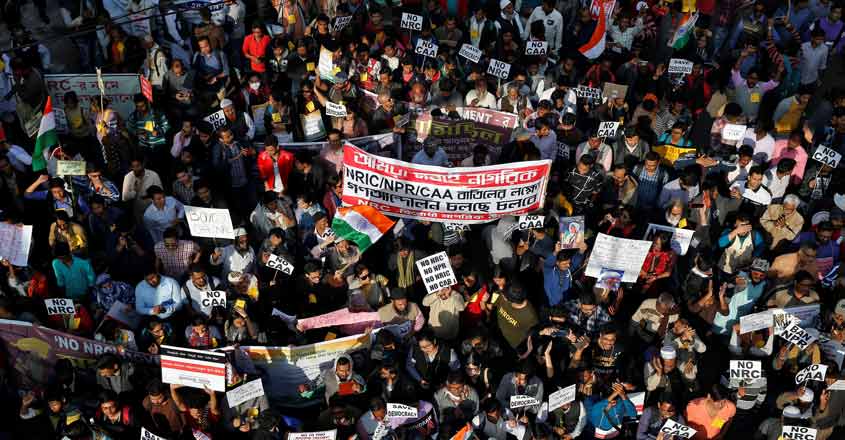
It was a 35-year-old housewife who triggered off the anti-Citizenship Amendment Act (CAA) protests at the Clock Tower in Lucknow.
Qausar Imran, 35, was watching the Shaheen Bagh protests on the TV on Thursday night and while discussing the issue with her husband over dinner, her husband told her that the women in Shaheen Bagh were very much like her.
“I thought that I should also do something like this and my husband supported me. That night, my three children, aged six, eight and 13, and my niece who is 24 sat up with me all night making posters,” said Qausar, who has received formal schooling only till class 5.
A resident of Turiaganj, Qausar had never attended a protest or a meeting even with other women in the locality.
On Friday morning, the 35-year-old housewife and her children went from door-to-door, asking women to initiate a protest on the lines of Shaheen Bagh.
“We had made posters which read ‘we reject CAA, no NRC’ and ‘we are Indians’ and we came here after Friday prayers, around 2:30pm. We decided to start the protest even though barely 15 women including children had turned up. We hid the posters under our burqa and the moment we took the posters out, the cops came running,” said Safia, the 24-year-old niece of Qausar.
“I told them that they can tape my mouth and or beat me up but I will not move from the spot. When they told me that I had no permission to protest, I said that I was not creating any ruckus. The electricity supply was snapped in the area that night, but even my youngest child did not cry or ask to go home. We sat there undeterred. Now, I feel overwhelmed by sheer number of women sitting with us,” said Qausar.
Since Friday night, the numbers started swelling and there are now hundreds of women and children at the Clock Tower.
“There are now men and women from non-Muslim families who have joined us. People are coming to serve tea and snacks and some are even bringing food for us. The police are trying to move us, but the women seem stronger than men this time,” she said on Monday morning.
College-going boys and girls are bringing more posters that are being displayed at the protest site and media coverage is also increasing by the day.
source: http://www.english.manoramaonline.com / OnManorama / Home> Women> She News / by IANS / January 21st, 2020
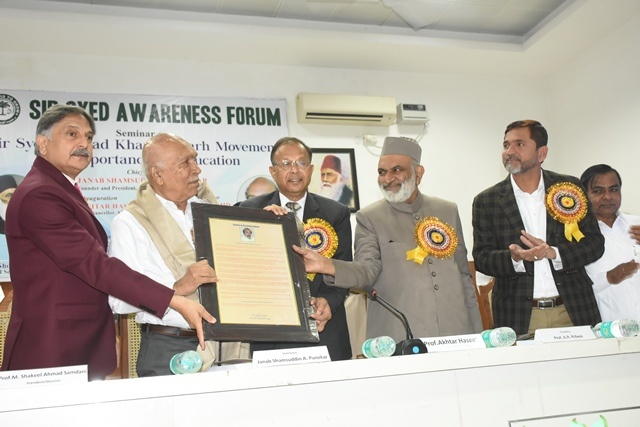
Mohsin E Millat Award being presented to Mr. Shamsuddin Punekar by Prof. Shakeel Samdani, Prof. Akhtar Hasbeeb and Prof. A.R.Kidwai
Aligarh:
“Those who are getting education from the great institution established by Sir Syed Ahmad Khan are having the blessings of Almighty on them. Had the Aligarh Muslim University (AMU) not existed, then the Indians would have remained educationally backward for a long period of time. I really admire Sir Syed Ahmad Khan that he started an educational movement and that movement gave me inspiration to do social and educational work” said edupreneur Shamsuddin Abdullah Punekar while addressing a seminar organized by Sir Syed Awareness Forum (SAF) on “Sir Syed, Aligarh Movement and Importance of Education” at Auditorium, University Polytechnic, Aligarh Muslim University, Aligarh.
Mr. Punekar was also conferred “Mohsin E Millat Award” for his services in the field of education. He is the man who established 24 educational institutions in Karnataka and running them successfully.
The award was conferred by Prof. Akhtar Haseeb, Pro Vice Chancellor, AMU and Prof. Shakeel Samdani, President of Sir Syed Awareness Forum, Aligarh..
Mr. Punekar further said that it is the duty of the old boys of this university to take inspiration from the life of Sir Syed and spare some time and money for social and educational work. He told the audience in detail about his life and struggle in establishing 24 educational institutions in Karnataka. He exhorted the audience to save our youth by guiding them on the right path. At last, he congratulated Prof. Shakeel Samdani for organizing such a wonderful seminar.
While inaugurating the seminar, Prof. Akhtar Haseeb, Pro-Vice Chancellor, AMU said that the seed of scientific education planted by Sir Syed has grown up into a tree in the form of Aligarh Muslim University and its three centres. Sir Syed always preached the ideals of tolerance, secularism and brotherhood. He, while congratulating Prof. Shakeel Samdani for successfully organizing the seminar, said that there is no substitute of hard work and those who keep on working hard will see its benefits sooner or later. In the last he advised the audience that whatever has been transpired in the seminar should be transformed into action.
Prof. Shakeel Samdani, Director of the seminar and Dean, Faculty of Law, AMU while highlighting the objectives of the SAF, said that this forum was established 15 years ago with the mission to enlighten the ideals of Sir Syed to the students and the forum has been successful in doing so. The purpose of this forum is to make the students aware about the mission and vision of Sir Syed including constitutional ideals of secularism, tolerance, peace and harmony. Prof. Samdani furhter said that in comparison to North India, South Indian Muslims adopted Aligarh Movement and established hundreds of high qualtiy institutions. The same movement should be restarted in north India by the Muslims.
U.P. Ratan Awardee, Dr. Lokesh Sharma said that no one can repay the debt of Sir Syed Ahmad Khan. Sir Syed lost everything for the upliftment of the community. Without caring about his opposition and criticism Sir Syed continued to work for scientific education and he successfully achieved his goal.
Prof. A.R. Kidwai, Director, UGC Academic Staff Collge, AMU while delivering his presidential remarks said that, Sir Syed worked a lot for scientific education and he became a defender of scientific education. He also discussed the tour of Sir Syed to England, where he saw the lifestyle, education system, syllabus, buildings of them and tried to replicate them in AMU.
Dr. Swati Rao while addressing the gathering said that education is incomplete without proper upbringing. She further said that Urdu language is an Indian language and it can be called as the language of communal harmony. She wondered by Urdu language is not getting justice in the country.
Prof. Mohibul Haque said that Sir Syed was one who influenced the time. Sir Syed and Raja Ram Mohan Roy were the first who started socio-religious movement in India. Sir Syed launched educational movement for regeneration of Muslim community and he was the pioneer of interfaith understanding.
The notable feature of the seminar was that it was attended by 32 delegates from Karnataka, Maharashtra and Andhra Pradesh. 2 delegates came from Turkey and gave an international touch to the seminar. A large number of academicians, faculty members and students of AMU were present in this seminar.
The seminar was moderated by Ayesha Samdani, MBBS student, at AMU. The seminar was started by the recitation of verses from the Holy Quran by Dr. Obaid Iqbal Asim, Abdullah Samdani welcomed the guests and vote of thanks was proposed by Khansa.
The seminar was made successful with the tireless efforts of Adv. Shoeb Ali, General Secretary, SAF, Dr. Haider Ali, Inchage, Mrs. Anjum Tasneem, Mohd. Nasir, Hunain Khalid, Kashif Sultan, Chitranshu, Manasvee, Samreen, Anas, Shubham, Zakia Khan, Samra Hashim, Pawan Varshney, Yusuf Iqbal, Md. Sabeeh, Sachin Varshney, Rahul Singh, Shelja, Talat Anjum, Razia Chauhan, Shreya Singh, Salman, Moiz, Adnan, Chirag and others.
source: http://www.muslimmirror.com / Muslim Mirror / Home> Education> Indian Muslim> Positive Story / by Abdullah Samdani / November 17th, 2019
We have acknowledged a lot of legendary stories of underprivileged children who knocked out every difficulties on their way to achieve a great successful life ahead. One bright example is Dr. APJ Abdul Kalam, who, out of poverty, used to sell newspapers in his early childhood to earn for his livelihood and studies. Dr. Bhim Rao Ambedkar couldn’t study in a small room due to the presence of his other fourteen siblings, so he used to sleep early and get up in the midnight to study when all others were fast asleep. Dr. Rajendra Prasad studied under the street lights, etc.
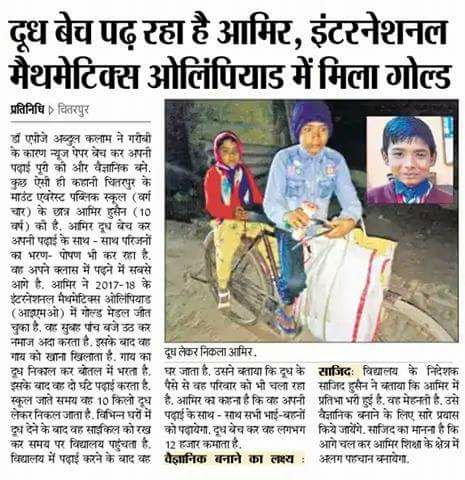
Here is a similar story of a child named Aamir Ahmad of fourth class. Aamir has won gold medal in the International Mathematics Olympiad (IMO) in 2017-2018.
It was a cold night. It was the wedding reception party of a friend. We had our fine dinner by 9 pm. Now it was time for the talks for the gathering of friends. We set a bonfire in front of the friend’s house. And the laughter began. We indulged in the entertainment of anecdotes and jokes around married life. Then a bicycle bell rings. We were blocking the road with our gathering. A little boy on a cycle with his younger littler sister on the back carriage of the bicycle. He wanted us to move so that he could go on his way.
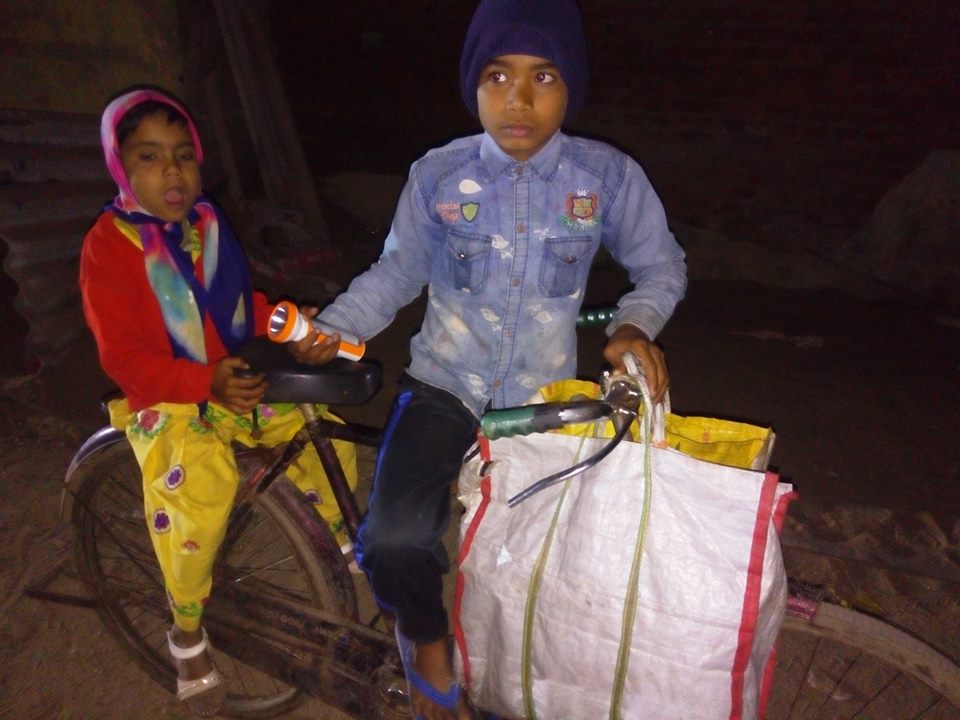
Aamir with his sister. Picture taken from Author’s FB page
My eyes fell on the boy. With a woolen cap on his head and a shirt with all buttons buttoned up till neck for it was cold out there, maybe he didn’t have a sweater. I recognized the boy. He was Aamir from my school. I called him out, “Aamir”. He replied, “yes, sir”. I approached him. His bicycle’s handle was laden with 10-12 one and two-litre bottles and a 3 year old sister on the back. Some 20-25 kilogram load. I asked him “where are you going in this cold night?” He replied, “I am out to sell milk, house to house.” I said “day after tomorrow you have level-2 exam of International Mathematics Olympiad”. He replied immediately, “Yes, sir. I have finished revising 7 chapters of the 14 from IMO practice book before leaving home and will finish the remaining 7 chapters after going back home before I sleep.”
I was stunned. I knew he was from an economically poor family but I didn’t know that he used to sell milk every morning and evening. I didn’t have any words to say. I stood there looking at him with a gasp. He kept looking at me if I had to tell something. I could say anything but okay bye. He wished ‘salaam’ and left to go about his work.
I was shaken from inside. I kept thinking how many such kids are struggling day in day out to make their dreams come true with all their sweat and blood, with no proper clothes to wear according to the weather, with no food to fill their stomachs two times a day but with courage to dream of reaching the stars.
Aamir is the eldest of his siblings. He tops in his class exams. Has already earned a gold medal in International Mathematics Olympiad. Tomorrow (11th Feb, 2017) he is going to Bishop Cotton School, Ranchi, to attempt level-2 of the IMO.
I only pray that this 10 year old Aamir becomes exemplary for kids of his age sucked up in Android culture and becomes a new Kalam for the country.
(Note: The original write-up(Hindi) is translated into English by Kashish Azeem and Adeel Ahmed)
source: http://www.thecompanion.in / The Companion / Home> Education / by Sajid Hussain / February 14th, 2018
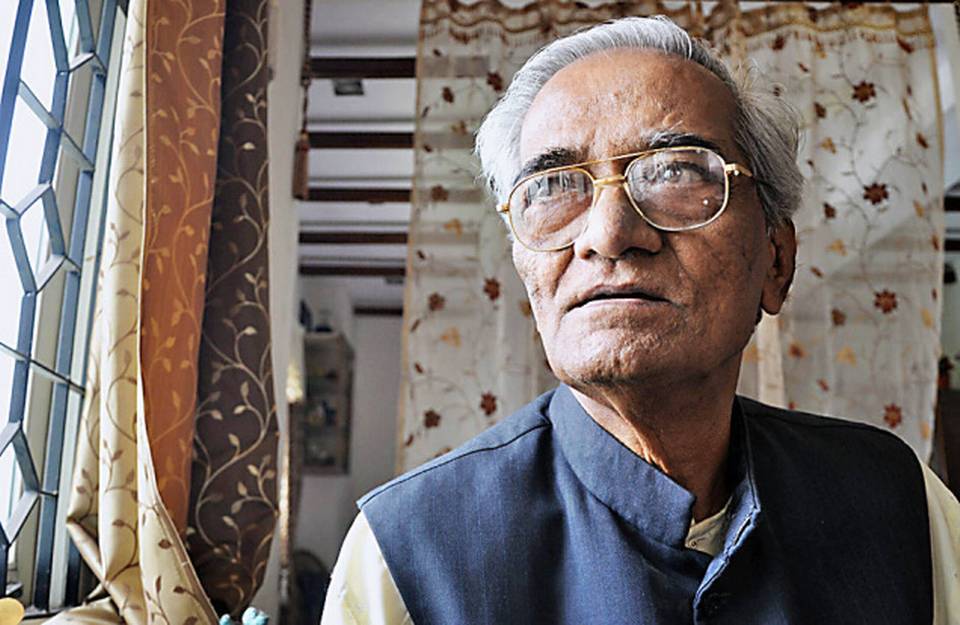
Padma Shri Mujtaba Hussain who completed 50 years of humour writing in Urdu. Photo: G. Ramakrishna | Photo Credit: G_RAMAKRISHNA
Many people have learned Urdu just to read his articles
Laughter is the shortest distance between two people. But in this case, it spans the entire Indian sub-continent. Whatever he writes, creates ripples of laughter across the Urdu world.
No prizes for guessing who the writer is. If it is Urdu and humour ,it ought to be Mujtaba Hussain.
For the past half a century, this Padma Shri recipient has been dishing out what is in great short supply today – humour.
Mr. Hussain’s writings open up the lips and the heart and at the same time show the pearls and the soul.
At 77, he is anything but tired.
This Hyderabadi humorist doesn’t believe in resting on laurels. Week after week, he churns out sharp and witty write-ups that are lapped up by his growing fans club.
Two books recently published by the Educational Publishing House, Delhi, bring out some of the finest writes-ups about Mr. Hussain penned by critics and writers of no mean repute.
The book “Mujtaba Hussain Jaisa Dekha Jaisa Paya” is all about his personality while “Mujtaba Hussain Aayeinon ke Beech” deals with his art and style.
At a time when the Urdu language has few takers, Mr. Hussain has revived interest in it through his satirical writings.
Many people have learnt Urdu just to read his articles.
Today a number of people have done research on him and many waiting to do Ph.D on his art.
The enduring appeal of his writings is a tribute to his uncanny sense of humour and the Urdu language itself.
Well known writer-journalist, Khushwant Singh, is an unabashed admirer of Mr. Hussain and feels he is rare among Indian writers of humour.
Pakistan writer, Syed Arif Hussaini, calls Mr. Hussain a purveyor of wit and humour.
“He excels in his field due to simplicity of his language, racy style and absence of overlapping themes,” he says.
Sure, Mr. Hussain’s brand of humour is wholesome and straightforward.
He creates humour without offending anyone. Borrowed brilliance is not his forte, says Mohd Ali Siddique, Pakistan’s well known critic.
No compromises
In a bid to tickle the funny bone, Mr. Hussain doesn’t compromise on the language either.
The simple but literary touch in his works comes as a breath of fresh air.
“His humour is laced with a bitter truth which only a honest person can perceive,” says his daughter, Rashida Samdani. Those who have read his “Apni Yad Mein” composition will know. It is a masterpiece of self obituary wherein the author highlights his own follies while taking pot-shots at life.
The two publications unveil interesting facets of Mr. Hussain’s personality. Several real life incidents are cited to show his ready repartee, subtle intellect and scintillating humour even during trying times.
Man knows how to cry from birth, but laughter takes some learning. But with Mr. Hussain’s ready wit, the job sure becomes easier.
source: http://www.thehindu.com / The Hindu / Home> News> Cities> Hyderabad / by J.S. Ifthekhar / Hyderabad – April 01st, 2013
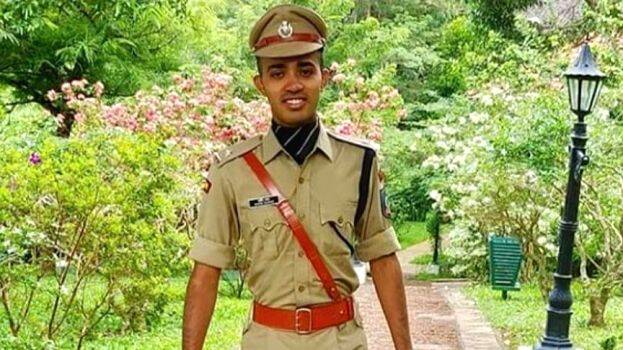
Hasan Safin, a 22-year-old boy from Gujarat, is all set to create history on December 23 by taking charge as the youngest IPS officer in the country. Safin, who comes from a humble background, hails from Kanodar village of Palanpur.
Safin had secured an all India rank of 570 in his very first UPSC attempt. When quizzed about his achievement, Sajin said, “I actually wanted to join IAS but I could not clear the exam. Hence I decided to pursue my career as an IPS officer and will use this opportunity to serve my country.” Safin is the son of Mustafa Hasan and Naseembanu, both labourers in a diamond mining unit.
According to Safin, his journey to success wasn’t easy as his parents found it difficult to pay his fees due to their low incomes. He added that his mother even prepared chappatis for nearby restaurants to find extra money to fund his education.
source: http://www.keralakaumadi.com / Kaumadi Online / Home> India> General / December 16th, 2019
We must thank Sher Shah Suri, the founder of the Suri Empire, for creating this amazing road connecting the major cities of India
New Delhi:
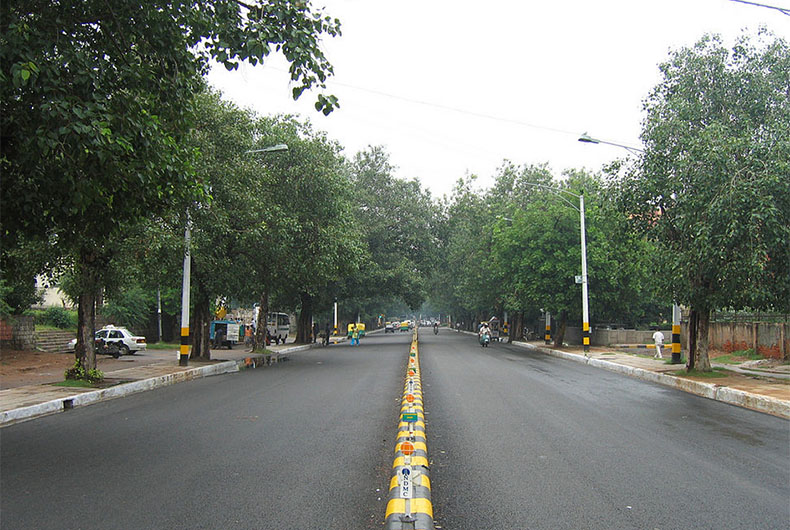
For travellers in India, moving from North to South or East to West, would have been almost impossible if the magnificent Grand Trunk Road did not exist. We must thank Sher Shah Suri, the founder of the Suri Empire for creating this amazing road connecting the major cities of India. Whenever there are discussions about this splendid road, Sher Shah Suri’s name is always mentioned with awe. But the Grand Trunk Road is just one of his major creations. Few know what an extraordinary personality he was and how much we owe him. In his seven-year rule he added a vast number of improvements that we continue to see today.
Born Farid Khan Lodhi in 1486 at Sasaram in modern day Bihar, he was the grandson of an ethnic Afghan, a noble of the Pashtun Sur tribe named Ibrahim Khan Suri. Farid Khan became known as ‘Sher’ when as a young man he saved the King of Bihar, from a tiger that had suddenly leapt upon him. He was later re-named Sher Shah and rose to become the founder of the Suri Empire in the northern part of the Indian subcontinent.
A landowner (Jagirdar) and a representative of the Delhi rulers of that time, he was an adventurer with royal connections and was recruited by Sultan Bahlul Lodi of Delhi during his long confrontation with the Jaunpur Sultanate. He was one of the eight sons of Mian Hassan Khan Suri – a prominent figure in the government in the Narnaul district. His grandfather Ibrahim Khan’s ‘Mazar’, still stands as a monument in Narnaul.
Sher Shah rose from being a private to the status of a commander in the Mughal army under Babur to the level of being the governor of Bihar. In 1538, when Babur’s son Humayun was away at war, Sher Shah took over the state of Bengal and established the Suri dynasty – naming it after the ‘Sur’ tribe to which he belonged. A gifted administrator and strategist during his rule from 1538 to 1545, he introduced a number of important changes, which continue to benefit us till today.
As a brilliant general Sher Shah laid foundations for later Mughal emperors – among them Akbar son of Humayun, was probably the one who benefited the most from this. Among Sher Shah’s more important strategies in his administration, was the setting up of new civic and military rules. Under him, the first ‘Rupiya’ was issued in place of ‘Taka’ – and still continues to remain. Another important improvement was the reorganisation of the postal system of the Indian Subcontinent. To ensure that he would be remembered, Sher Shah renamed the name of Humayun’s city, changing it from ‘Dina-panah’ to ‘Shergarh’ and simultaneously he also revived the historical city ‘Pataliputra’, which had been steadily declining since the 7th century. The feather on his cap is however the Grand Trunk Road, for which he is justly famous.
It is said that Sher Shah and his father were constantly fighting with each other. His father, Hassan Khan Suri, then a jagirdar of Sasaram, had several wives with whom Sher Shah did not get along and so, he decided to run away from home. When his father discovered that Sher Shah had requested Jamal Khan, the governor of Jaunpur to give him shelter, he wrote a letter that stated, “my son being annoyed with me, has gone to you without sufficient cause. I trust in your kindness to appease him, and send him back; but if refusing to listen to you, he will not return, I trust you will keep him with you, for I wish him to be instructed in religious and polite learning.”
But Sher Shah refused and replied in a letter, “If my father wants me back to instruct me in learning, there are in this city many learned men: I will study here.”
Sher Shah started his service under Bahar Khan Lohani, the Mughal Governor of Bihar. Because of his valour, Bahar Khan rewarded him with the title ‘Sher Khan’ After the death of Bahar Khan, he became the regent ruler of the minor Sultan, Jalal Khan. Jalal soon realised that Sher Khan’s power in Bihar would make things difficult and sought the assistance of Ghiyasuddin Mahmud Shah – the independent Sultan of Bengal. Ghiyasuddin sent an army under General Ibrahim Khan but Sher Khan defeated the force at the battle of Surajgarh in 1534 after forming an alliance with local chiefs – and achieved complete control of Bihar.
In 1538, Sher Khan attacked Bengal and defeated Ghiyasuddin Mahmud Shah. But could not capture the kingdom, because of the sudden appearance of Emperor Humayun and his army. On 26 June 1539, Sher Khan faced Humayun in the Battle of Chausa and defeated him. Assuming the title ‘Farid al-din Sher Shah’, he defeated Humayun once again at Kannauj in May 1540 and forced him out of India.
Thereafter Sher Shah turned his attention towards the Rajput Forts. He attacked Malwa and Jodhpur, but was killed during the siege of the Rajput Fort of Kalinjar. Sher Shah had ordered the walls of the fort to be blown up with gunpowder, but he was himself seriously wounded, by the explosion. He died on May 22, 1545 and was buried in Sasaram. His son Jalal Khan succeeded him, taking the title of ‘Islam Shah Suri.’
The founder of the Suri Dynasty lies under the splendid Sher Shah Tomb that is 122 ft high and stands majestically in the middle of an artificial lake in Sasaram – located on the road that he is famous for – India’s magnificent Grand Trunk Road.
(Shona Adhikari is a lifestyle and travel columnist.)
source: http://www.ummid.com / Ummid.com / Home> Life & Style / by Shona Adhikari – IANS / December 11th, 2019