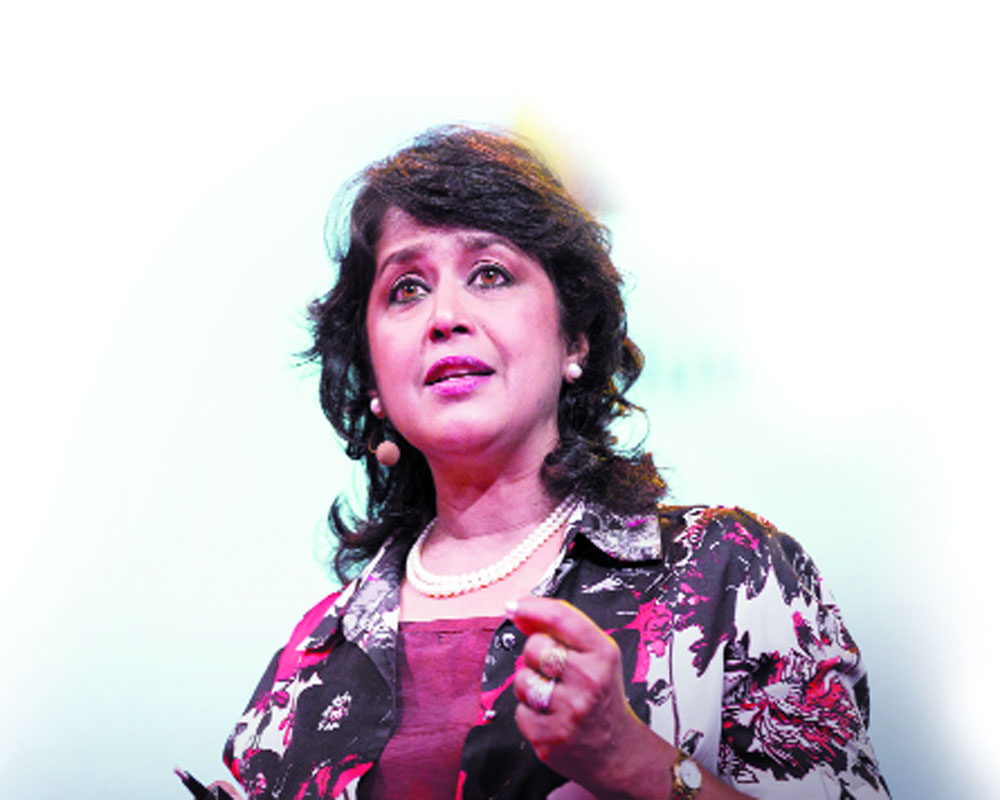
Former President of Mauritius Ameenah Gurib-Fakim tells Asmita Sarkar that there are no two ways forward than making women and minorities part of the progress
She holds many mantles — politician, the first woman President of Mauritius and a biodiversity scientist. Not only that, she is also a proponent of cultural diversity and creating entrepreneurial opportunities for women in Africa. Social media- savvy and with a clear voice, she pushes for saving the planet and its biodiversity.
What is the way forward in Asia and Africa to empower women and other minority sections?
No team can win a football match by leaving 52 per cent of the team on the bench. Women, minorities must all come together with their talents and change their way of doing things. Our diversity is our strength. When it comes to minorities, I am reminded of the words of a great statesman Pierre Trudeau. He stated and I quote, “A just society will be one in which the rights of minorities will be safe from the whims of intolerant majorities”. Countries that have valued immigrants, like the United States, are a classic example. Most of the big brands in the US have emerged from the contribution of immigrants.
As a scientist and politician, how did you envision your expertise in changing the world around you?
Countries need to be technically-driven and this is where scientists have a key role to play in shaping the destiny of their respective countries provided the leadership takes heed. Again those countries that have recognised this technical vision have emerged strong.
Countries need strong institutions and strong leadership to emerge and science and technology are powerful tools. For the first time in 2015, even institutions like the United Nations (UN) have recognised this in the crafting of the UN Sustainable Development Goal’s.
Can you tell us about your link to India?
I am a fourth generation Indian from the diaspora. My forebears came from Ghazipur area in Uttar Pradesh. They left in 1862 to come to Mauritius to work the land and never returned.
Going forward, do you think that conversations around biodiversity have become confined to conservation alone?
May be the conversation has been skewed towards conservation but it is an equally laudable exercise, and one that we cannot shy away from.
What personal struggles did you face while growing up which you wish girls in your country don’t have to anymore?
When I was growing up, I had a set of challenges like girls were forever being denied education. That is no longer the case in my country although I am aware that this still happens in many other countries.
Girls in science were a rarity but is now becoming more common. So hopefully with more role models, it will ease the way for many more to join the efforts for encouraging girls and women in both leadership and power.
What is the way forward for Asia to transition from emerging economies to developed ones without damaging the environment?
Asia is fast emerging but the leadership will have to acknowledge that development must rhyme with sustainability. It is in their interest for their survival, for the prosperity of its people and long term future of their countries.
(The leader will be at the 10th edition of TEDxGateway on December 2 at the DOME @ NSCI Mumbai)
source: http://www.dailypioneer.com / The Pioneer / Home> Vivacity / by Asmita Sarkar / November 27th, 2018
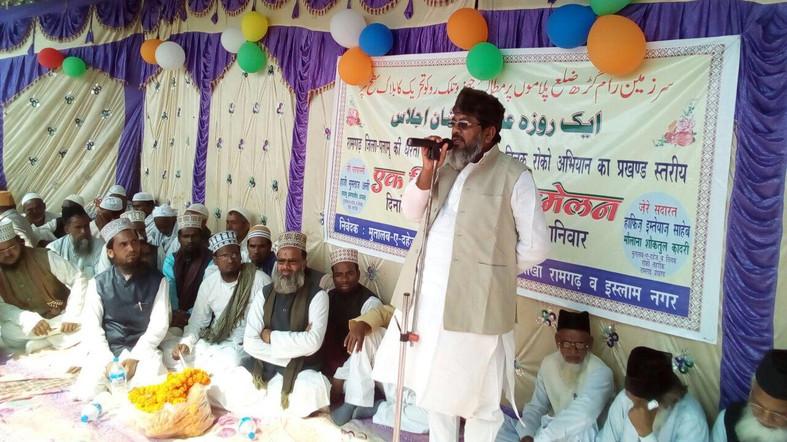
Haji Mumtaz Ali addressing anti-dowry campaign in India’s Jharkhand state. (Supplied)
A man in India has launched a massive campaign against dowry, one of the biggest social evils claiming hundreds of lives every year in the country. Such is the impact of the campaign that close to 1,000 Muslim families have now returned dowry to the bride families, expressing regret over their conduct in public and vowing not to repeat it in future.
The credit to this unique campaign straightway goes to Haji Mumtaz Ali who has launched the campaign in the eastern Indian state of Jharkhand. The success of the campaign is underlined from the fact that villages after villages are joining it every day, openly taking an oath not to accept dowry in future.
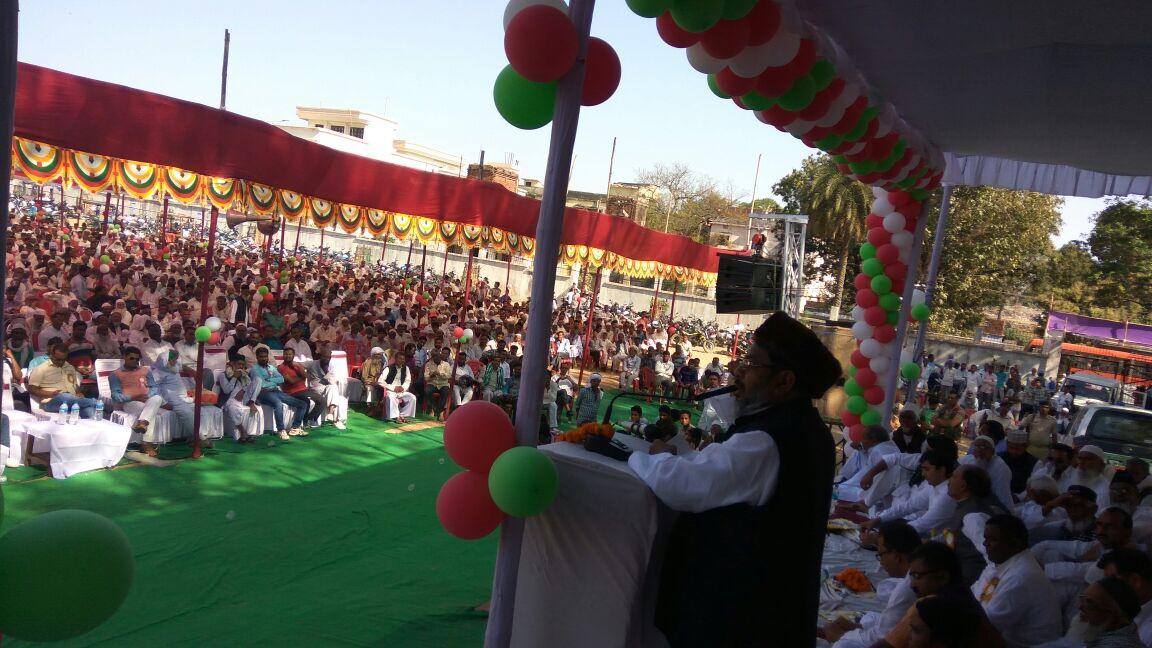
Initially, the campaign was started in Palamu district but now it has gone beyond its boundary and spread to several others districts as well. But what’s further fascinating about it is that the campaign is not limited to any particular community only as the Hindus too have lent a wholehearted support to this campaign, joining the anti-dowry rallies in large numbers.
“I am happy to inform you that what started as a silent campaign against this social evil two years back has now turned out to be the mass movement. Now it’s not limited to any particular area or the community only but Hindus too are joining us in large numbers,” said Ali who happens to be the brainchild of the campaign.
The peak of the campaign was when the Muslim villagers began returning dowries years after they had taken them at the time of their son’s wedding. (Supplied)
Rs 60 million returned
The peak of the campaign was when the Muslim villagers began returning dowries years after they had taken them at the time of their son’s wedding. According to Ali, close to 1,000 Muslim families have returned dowries worth Rs 60 million to the brides’ families so far, impressed by his appeals to give up dowry.
One of them was Nizamuddin Ansari who returned Rs 40,000 to the bride families. “I regret about taking dowry from my daughter-in-law’s families but feel proud to return it now,” Ansari told an anti-dowry meeting held in Palamu recently.
However, the campaign didn’t reach at this level all of a sudden. Ali had to work hard, day and nights for months during which he held more than 100 such meetings and rallies in entire Palamu division to convince his community members not to take dowry, braving sweltering heat and chilling winter.
But what compelled him to launch the campaign? “I saw many families getting destroyed under the impact of dowry although it was not initially prevalent in Muslim families. I came across many poor families selling their ancestral properties or taking loans on high interest to arrange money to solemnize wedding of their daughters”.
“What was terrible this money was being wasted on arranging decoration, DJ, orchestra and various types of dishes; it was not being used for important works! So I decided to launch a campaign in the society, sooner the better,” Ali said, in a telephonic interview on Thursday.
“I was aware of the economic status of my co-villagers. I knew their financial background just wouldn’t permit them for lavish wedding. They were doing so just because they had taken dowry from the brides’ families. So it was necessary to alert them,” he said.
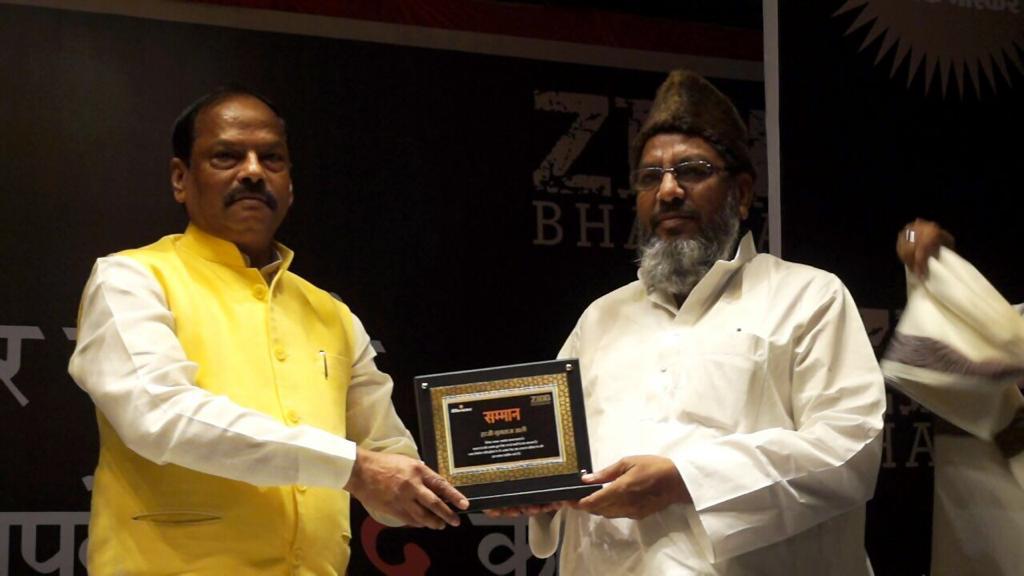
Haji Mumtaz Ali being honoured by Jharkahnd Chief Minister Raghubar Das. (Supplied)
Crowds of villagers
Eventually, Ali launched the campaign in April 2016 but got encouraged to focus on it after seeing huge crowds of villagers attending his each rally and meeting.
“I told the Muslim villagers to fear from the almighty and swear in the name of Allah not to take dowry in future and this ultimately clicked,” Ali revealed, describing his campaign as a “huge success”. Recently, Ali was honored by Jharkhand chief minister Raghubar Das for his campaign against dowry.
Ali is happy to tell that villagers are now opting for “dowry-less” marriages. “Now, the general masses have taken over my campaign. This indicates the success of my campaign, Ali remarked, with his voice exhibiting satisfaction and delight.
Dowry has been claimed hundreds of lives every year in India. As per an official report, a total of 24,771 dowry deaths were reported in India in between 2012 and 2014 with Uttar Pradesh taking the lead with a maximum of 7,048 deaths. This information was given to the Lok Sabha in a written reply by federal minister for Women and Child Development Ministry Maneka Gandhi in April 2016.
The minister further told the House that India recorded 348,000 cases of cruelty by husband or his relatives during this period with the West Bengal topping the chart with 61,259 such cases, followed by Rajasthan (44,3111) and Andhra Pradesh (34,835), as per the National Crime Records Bureau data.
source: http://www.english.alarabiya.net / Al Arabiya – English / Home> Features / by Manoj Chaurasian / Special To Al Arabiya English / November 08th, 2018
Working in tandem with Savitribai Phule, Fatima had to not only take on high caste Hindus but also faced fierce opposition from orthodox Muslims who opposed the idea of equal education for all.
Are you in favour of education for girls? To even ask this question in today’s socio-political milieu seems ridiculous, considering that this is not only enshrined in our Constitution but supported by mainstream public discourse.
There are numerous government programmes and schemes dedicated to the education of the girl child, irrespective of class, caste or religion. Admittedly, there are parts of this country where this idea and subsequent socio-economic progress is actively discouraged. However, more than 150 years ago, it wasn’t even a part of the mainstream socio-political discourse, and in fact, those pushing for it were met with intense hostility and social boycott.
Those with even a cursory knowledge of the history behind education in India will have heard of Savitribai Phule, who valiantly fought against the oppressive hierarchies of caste and gender to challenge untouchability and educate girls, among other critical social interventions.
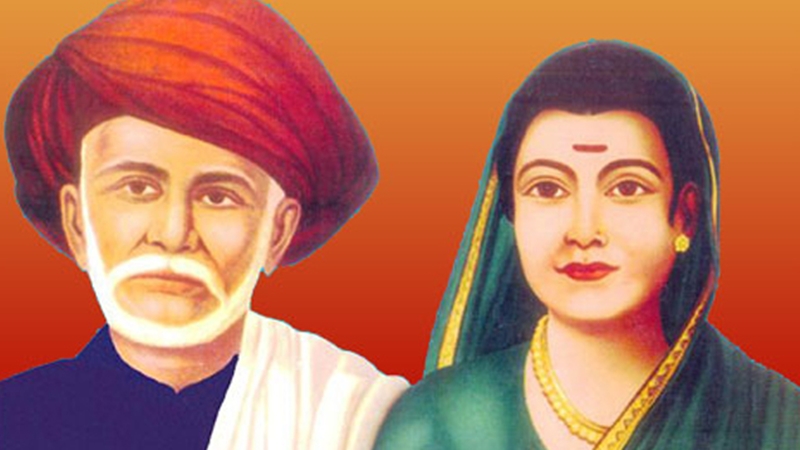
Along with her husband Jyotirao Phule, they fought against caste discrimination, the scourge of untouchability and worked towards the emancipation of women and reform of Hindu family life in present-day Maharashtra during the 19th century. They were among India’s first major social reformers.
Jyotiba and Savitribai Phule (Source: Free Press Journal)
But how many people know about the Muslim woman who made Savitribai’s bid for girl education possible? Not many, one would argue, and that isn’t their fault considering little is known about her life history.
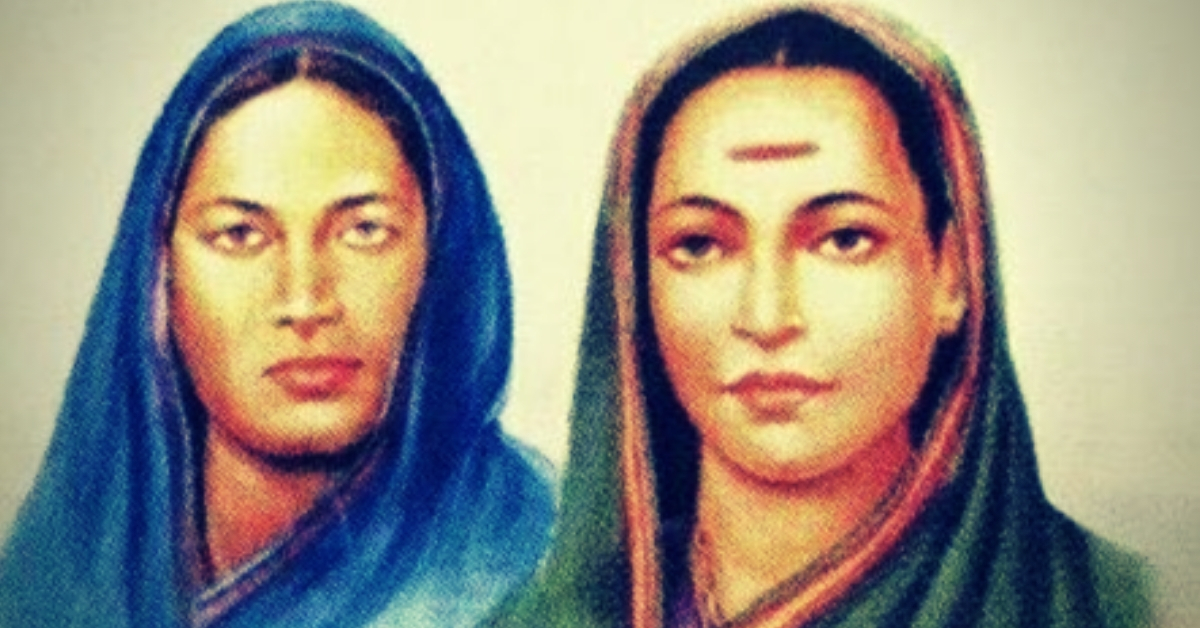
What we do know is her name was Fatima Sheikh, and she is widely recognised as the first woman Muslim teacher in India, who also worked with Savitribai to establish the first school for girls at her own house, alongside her brother Usman Sheikh in 1848.
The story begins with the Phule couple attempting to educate members of the lower caste communities, particularly their women, at their home in Pune.
Considering that education at the time was the preserve of only upper caste men, the very thought of educating women and lower castes was anathema, and the Phule couple were given the choice of either stopping work or leaving their home. They chose the latter but were offered refuge by Fatima and Usman at their home in the Ganj Peth area of Pune (then referred to as Poona).
At a time when everyone including their own kin abandoned these social reformers, Fatima and Usman not only gave them an opportunity to rekindle their ambition to uplift those on the margins but also sheltered them. At the Sheikh household, Fatima helped Savitribai to set up the first school for girls in Pune called the ‘Indigenous Library.’
According to archives from the era, it was Usman (inspired by the Phules) who encouraged his sister to not just educate herself but also spread its gospel to all members of society.
Fatima Sheikh (left) and Savitribai Phule. (Source: Twitter/Tanvir Salim)
Not only was Fatima risking the wrath of caste Hindus, but also orthodox Muslims, as both groups at the time were deeply opposed to the idea of equal access to education. Nonetheless, this didn’t deter Fatima, who not only undertook training alongside Savitribai but also soon after began teaching others.
“Defying all norms, Fatima and Savitribai set up the school and even went to a training institute, to become professional teachers,” says this account from Feminism in India. They were soon joined by social reformer Saguna Bai, who helped Savitribai open another school and would subsequently go onto chart her own education movement for the marginalised.
Through her time with Savitribai, Fatima had taught in all the five schools that the social reformer couple had opened, and continued to do so until 1856 when Savitribai was afflicted by illness and was compelled to move back to her mother’s house. We don’t know much about her life post-1856.
“When Fatima and Savitribai started going to schools which were established by Jyotiba, people from upper caste community used to harass and abuse them. They were stone pelted and sometimes cow dung was thrown at them as it was unimaginable for the upper-caste community to see lower castes of the society getting educated. Fatima Sheikh and Savitribai didn’t pay attention to these hindrances and continued their work,” writes Siddhant Mohan, editor of Two Circles. Aside from such hostility, there are even reports that some had attempted to take their lives.
Despite the challenges before Fatima, she maintained her pursuit of approaching every household in her neighbourhood and community, asking families and encouraging them to give their girls a shot at a decent education, irrespective of faith.
Having said that, there isn’t too much historical or archival material to ascertain what happened to Fatima after 1856, and even the question of when she was born remains up for debate although her birth anniversary is celebrated across social media forums on January 9. With no real male figure in Fatima’s life aside from her brother, there are indications that she went against the norm of marriage and subsequent patriarchy and orthodoxy she would have to endure. Nonetheless, her work with Savitribai isn’t disputed, and one can only imagine the kind of resistance she faced.
Last April, members of the depressed classes celebrated Dalit History month, and on that occasion an internet archive Dalit History said:
“The friendship between Fatima and Savitri was one of respect, compassion and synergy. Throughout their time together, Savitri would often mention her in her letters to Jyotirao with affection and concern. Their friendship lives today in the form of the work they have done in creating both foundation will and actual structures for the upliftment of the marginalised.”
Today, every educated Indian woman owes a debt of gratitude to Savitribai Phule and Fatima Sheikh.
Fortunately, there have been attempts to recognise her work and contribution. Aside from her association with the Phules, the Maharashtra State Bureau of Textbook Production and Curriculum Research took cognisance of her contribution in their textbooks in 2014.
Fatima Sheikh played a crucial role in ensuring that children, irrespective of gender, caste or religion, had access to education, and the results are there for everyone to see.
(Edited by Gayatri Mishra)
source: http://www.thebetterindia.com / The Better India / Home> Education> History> Women / by Rinchen Norbuwangchuk / September 19th, 2018
Medicine for vitiligo awaiting US FDA clearance, says doctor who was selected for Padma Shri
Hyderabad :
Dr.Mohammed Abdul Waheed, a Unani doctor well known for his research work and 35 years of experience in clinical management of vitiligo, is an elated man after being selected for the Padma Shri award.
“This will bring recognition to Unani medicine. I am really thankful to Government of India. God is great,” he said. Sharing his happiness, the Padma Shri awardee in the field of medicine told The Hindu that importantly it would help in bringing global recognition to Unani medicine.
Dr. Waheed, who graduated in Unani medicine and Surgery from Osmania University in 1978, was the former head of Central Research Institute of Unani Medicine under the Department of Ayush, Government of India. With expertise in phase II and phase III clinical trials, he had treated over two lakh vitiligo patients. “We are working for globalisation of Unani medicine. A drug dossier for vitiligo has been submitted to USFDA by the Central Council for Research in Unani Medicine. If approved the medicine could be globally utilised to treat and manage vitiligo,” he said. Recipient of several prestigious awards for his research including the AIIMS’s Best Scientist Award, he Dr.Waheed developed 17 Unani formulations for the effective management of vitiligo. and also coordinated multi-centric clinical trials of Unani medicines on Diabetes, Hypertension and Hepatitis.
Finding treatment for vitiligo mainly caused by autoimmune disorder — that affects one % of world and three to four % of Indian population — was close to his heart as the condition caused social discomfort and depression to patients, he said.
source: http://www.thehindu.com / The Hindu / Home> News> Cities> Hyderabad / by M.L. Melly Maitreyi / January 26th, 2017
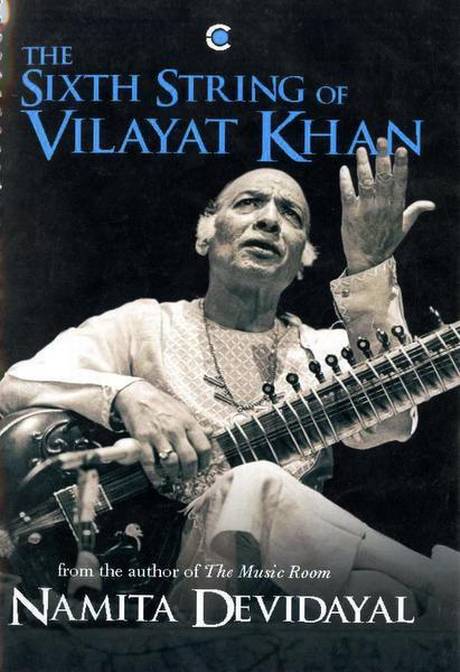
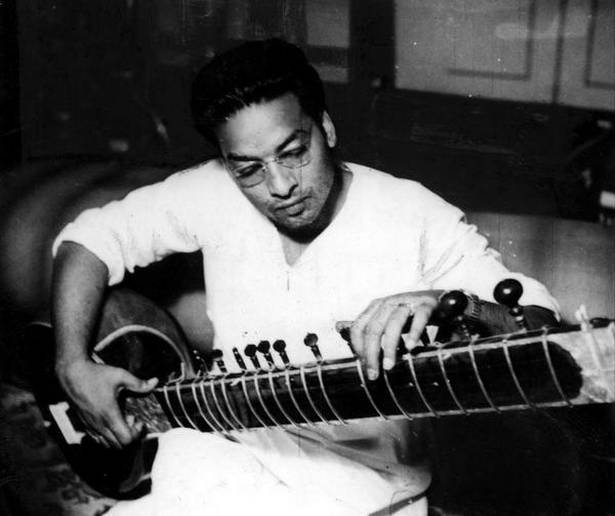
Namita Devidayal’s book on Ustad Vilayat Khan is an interesting account of his life and musical journey
Writing the life sketch of a legendary musician such as Ustad Vilayat Khan is no easy task. Going by his lineage, stature, proficiency and lasting influence, summing up his music and personality in 252 pages is like exploring a raga in five minutes. Yet, such an attempt is important to enable young musicians to imbibe from his distinctive style and virtuosity.
The book, The Sixth String of Vilayat Khan, has been authored by Namita Devidayal, who had earlier penned the bestseller, The Music Room: A Memoir. Namita says she has tried to create an impressionistic fluid portrait — of a magnificent artiste and a fragmented human being. “I have tried to imagine him and tell a story anchored in fact but narrated with poetic license, like improvising on a jazz standard. It would be a mistake to regard this strictly as a biography.”
The book is an outcome of Namita’s long discussions with people who were close to the Ustad and his family and through interviews, archival records and photographs.
Vilayat Khan was 10 when his illustrious father Enayat Khan passed away, but not before inducting his son into the legacy of the greatest sitar gharana (his grandfather was Imdad Khan, who undertook the tough 40-day chilla ritual, when the musician does not step out of the house and only practises).
As a young lad, living in Calcutta, in a house named ‘Riyaz,’ Vilayat had only the sitar for a friend. He was eight when he performed at the All-India Bengal Music conference and earned immense praise. The Megaphone Recording Company even came up with a 78 rpm featuring the father on one side and the prodigious son, on the other. But his father’s untimely death left Vilayat shattered, both monetarily and musically.
The book gives a detailed account of how Vilayat fought hardships to become one of India’s foremost musicians. One night, he left home with his sitar, swearing to return only as an accomplished musician. He boarded a train to Delhi and reached his destination thanks to kind-hearted ticket collectors.
He went straight to All India Radio; the station director recognised him as Enayat Khan’s son and gave him refuge in the station’s garage. He used to have food from the canteen and clean instruments in the studio. He was delighted to see eminent artistes walking AIR’s corridors and listen to the recordings of musical greats.
Packed with interesting anecdotes and providing insights into the artistic ambience of the time, the author takes the readers through Vilayat’s training under his maternal grandfather (Bande Hasan Khan) and uncle (Zinda Hasan Khan), who were vocalists and would come to Delhi to teach him. Sometimes, Vilayat visited their house in Saharanpur. Bande Hasan Khan was also a wrestler and took his grandson to the akhada to build his stamina.
Vilayat’s mother Basheeran Begum was happy that her family had undertaken the responsibility of his training, but her son’s growing fondness for singing worried her. She warned him about breaking the family tradition. A distraught Vilayat approached his uncle, who advised him to make his sitar sing instead. So he began to consciously nurture the gayaki ang in his instrument. The Ustad, who was also an accomplished surbahar player, once said, “When I sit down on stage to play, everything comes to me in the form of a vocal performance. It just happens.”
An entire chapter is devoted to the 1944 Vikramaditya Music Conference in Bombay, where a sitar maestro called Vilayat Khan was born. Soon he became a regular at prestigious festivals and private concerts. At the same time, another sitar exponent, Ravi Shankar was making a mark too. Though stories of their rivalry were spoken about in music circles, both had tremendous respect for each other.
Vilayat’s tryst with fame, money and the film industry (among his close friends were Naushad and Madan Mohan) began when he moved to Bombay. It was also where he met his disciple Arvind Parikh, who came from a Gujarati business family. A devoted shagird, Arvindbhai also became his close confidante. By 1950, Vilayat Khan began touring the world.
His preparation for concerts included planning his attire. The book talks about how he would often have a dress rehearsal in which the entire family would be forced to participate. Even his silver and carefully-designed paan box had to be set the night before a performance. He loved the good life, traditional when it came to his art, while preferring to be up-to-date in his appearance. From Bombay, he moved to Shimla, to enjoy the quietude of the hills, and then to the U.S.
While drawing the portrait of an older Vilayat Khan, Namita touches upon his uneasy relationship with his son Shujaat Khan, a well-known sitar player and his younger son Hidayat Khan’s struggle to live up to his father’s expectations.
In 2004, after traversing the highs and lows of life like the notes of his strings, the Ustad died of lung cancer. In his hands, the sitar gained a beautiful voice.
source: http://www.thehindu.com / The Hindu / Home> Entertainment> Music / by Chitra Swaminathan / November 08th, 2018
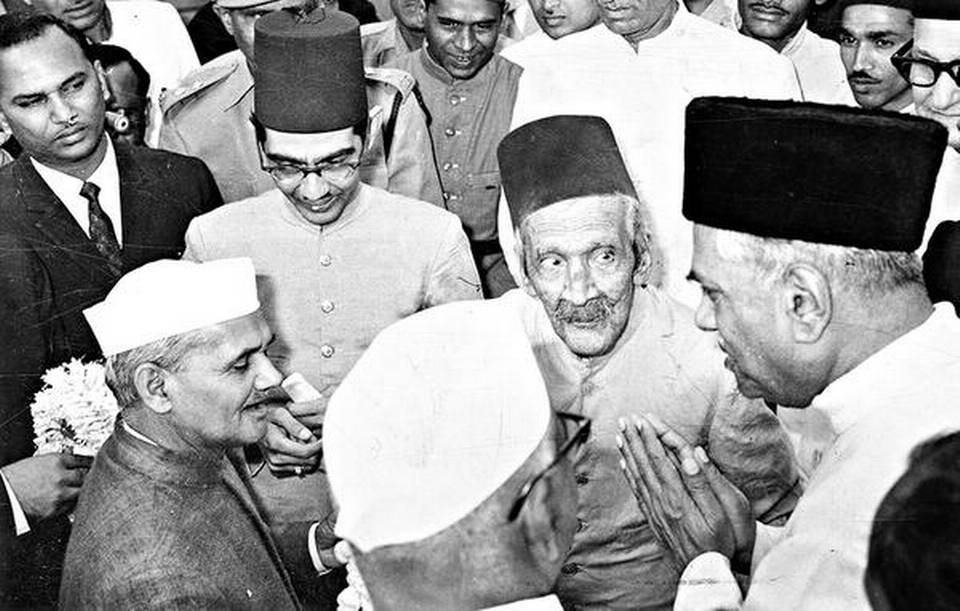
Key deposit: Nizam Mir Osman Ali Khan, centre, with Lal Bahadur Shastri and others in Hyderabad. | Photo Credit: The Hindu Archives
RTI queries bust myth of 5,000 kg gift for national defence
A series of Right To Information applications have busted an urban legend that Nizam Mir Osman Ali Khan of Hyderabad donated 5,000 kg of gold to the National Defence Fund in the aftermath of the 1965 war with Pakistan.
The Prime Minister’s Office, under which the National Defence Fund functions, responded to this reporter’s RTI query that it has no information of any such donation.
According to popular lore, Nizam Mir Osman Ali Khan is said to have given 5,000 kg of gold to Prime Minister Lal Bahadur Shastri during his visit to Hyderabad in 1965. The Prime Minister was touring the country to raise funds to steady the post-war economy. The story goes that after donating the gold, the Nizam asked only that the boxes containing the precious metal be returned.
In fact, the Nizam invested 4.25 lakh grams (425 kg) of gold in the National Defence Gold Scheme, floated in October 1965 with a generous 6.5% interest, to tide over the economic crisis.
The Hindu report
A report in The Hindu of December 11, 1965, from Hyderabad, corroborates the less glamorous version of the Nizam and his gold. As The Hindu reports:
The Prime Minister, Mr. Lal Bahadur Shastri and the Nizam of Hyderabad exchanged a few words to-day at the airport when the ageing ex-ruler came to greet India’s Prime Minister…
Addressing a public meeting later in the evening, Mr. Shastri congratulated the Nizam on his investing 4.25 lakhs grams of gold in gold bonds which was valued at about Rs. 50 lakhs. The investment contained old gold mohors (coins) whose value was more depending on their antiquity. “We do not want to melt these gold mohors but send them to foreign countries to obtain a higher value. We may get a crore of rupees,” he said.
The report also mentions a donation of 1.25 lakh grams of gold from the Tirumala Tirupati Devasthanams and a purse of ₹8 lakh in cash from Telegu film stars to the government.
The October 1965 National Defence Gold Bonds had the additional benefit of being an amnesty scheme. “The provisions of the gold control or customs regulations will not apply with respect to gold in any form tendered as a subscription to the gold bonds and no proceedings will be instituted… Further, where such gold has been acquired out of income which has not been disclosed under the Income-Tax Act … such income, or the wealth represented by the corresponding assets, will not be liable to tax under these enactments in assessments,” said the press note from the government.
Secret beneficiary?
While the Nizam’s investment was a smart move, mystery shrouds the beneficiary of the investment. The RBI rejected an RTI query on the investment as well as the final beneficiary, citing Section 8(1)(j) of the RTI Act: “unwarranted invasion of the privacy.”
Najaf Ali Khan, one of the grandsons of Nizam Osman Ali Khan, said he was unaware of the payout. “This is news to me. I don’t know who has claimed it. The Nizam had created 52 trusts but I am not aware of any trust receiving this money,” he said.
source: http://www.thehindu.com / The Hindu / Home> News> Cities> Hyderabad > Sunday Special / by Serish Nanisetti / Hyderabad – November 11th, 2018
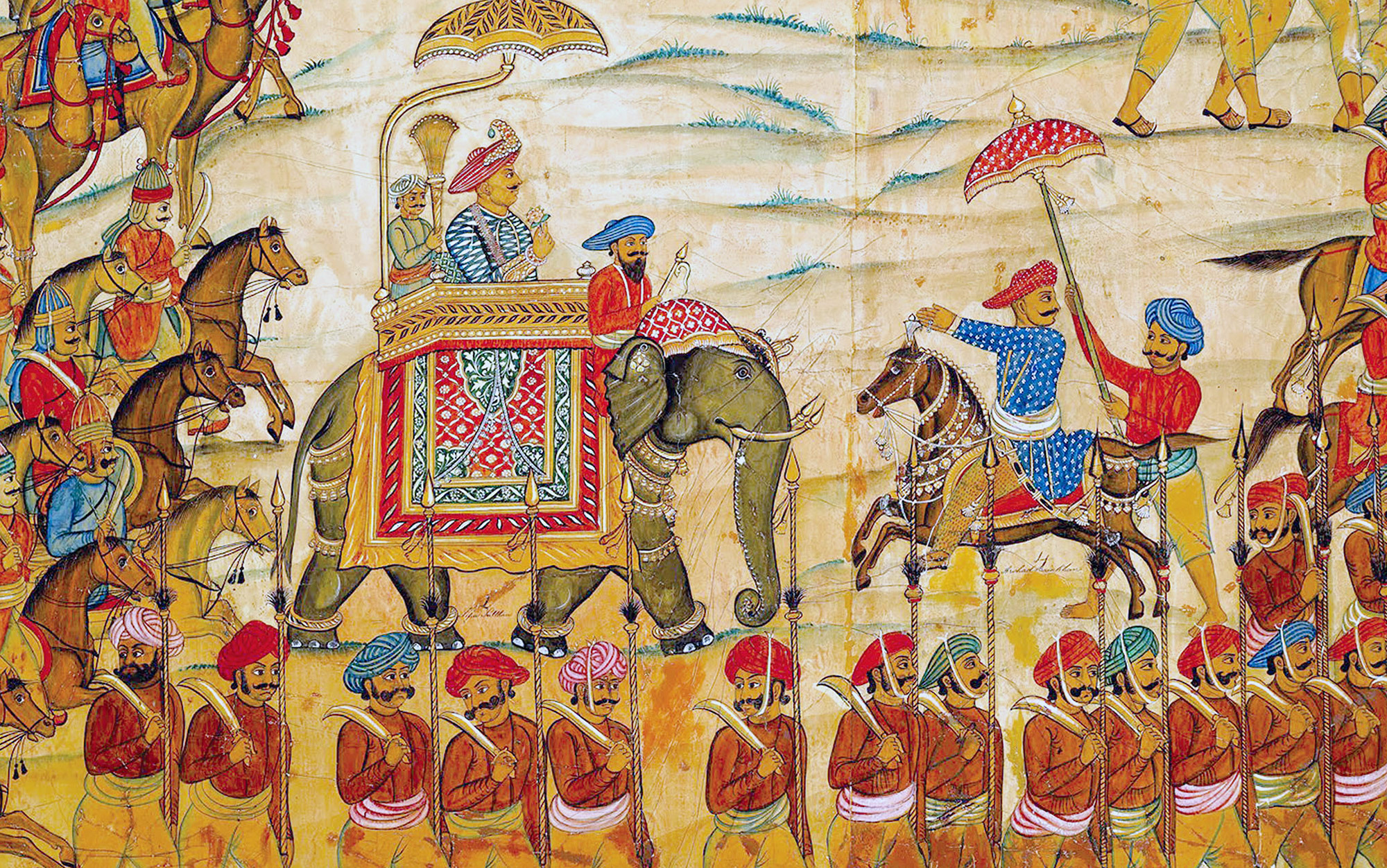
Tipu Sultan, son of Haider Ali, on an elephant in a detail from ‘The Battle of Pollilur’, 1780, a mural at Daria Daulat Palace, Seringapatam. Photo by Bridgeman Iages
If the sultan of Mysore had had a bit more luck, George Washington might be known as the Haider Ali of North America
If the sultan of Mysore had had a bit more luck, George Washington might be known as the Haider Ali of North America. As the ruler of Mysore, a kingdom in what is now southwestern India, Haider fought a series of wars with Great Britain in the latter half of the 18th century, at the onset of the Age of Revolution. While Haider was fighting his last battles against the British, Washington was leading the forces of the nascent United States from the harsh winter at Valley Forge to the final victory at Yorktown.
The circumstances of Haider’s childhood did not seem to mark the young man out for greatness. Born around 1720, Haider soon lost his father, a mercenary officer who died on campaign. Haider followed his father’s path, becoming an officer for the Wodeyar dynasty that ruled Mysore. After many years of service, he grew indispensable to the ruling family, sidelining it entirely by the 1760s. It was a dangerous time to come to power in South Asia. The British East India Company was expanding its power throughout the Subcontinent, at the expense of rulers from Bengal in the east to Haider’s neighbours in the south. Allied with France, however, Haider held off the British advance for another two decades, dying in 1782, just a year before the US triumphed in its own rebellion against Britain.
Haider and Washington never communicated directly with one another, but they fought against a common enemy, and shared a common ally. Like the Mysoreans, the American rebels were members of a global coalition funded by the French government, which saw both uprisings as a chance to humble Britain. In the Seven Years’ War (1756-1763), Britain had ended nearly a century of conflict with its imperial rival in North America by seizing France’s vast territories in Canada and the Mississippi River Valley. Some French observers tried to minimise the extent of the defeat. Voltaire dismissed loss of North America as ‘a few acres of snow’. Yet French policymakers were well aware that Britain had greatly increased its power. Too weak to confront it again on its own, the French government wove a network of alliances, playing on resentments against Britain’s growing control of global trade and rapidly expanding empire. Beginning in the mid-1770s, it sent money and military advisors to both Mysore and the US, aiming to avenge its defeat by stoking colonial rebellions against Britain.
The alliance with France proved critical to the survival of the fledgling US. The memory of French aid, and particularly of the dashing Marquis de Lafayette’s assistance to Washington, has for more than two centuries served as a symbolic origins story of close Franco-American relations. During the Revolutionary War, however, Americans saw themselves not just as allies of France, but as part of a coalition that included Mysore.
Even after the US made peace with Britain in 1783, the American fascination with Haider and his son and successor, Tipu Sultan (1750-1799) lived on. Mysore’s rulers became familiar references in American newspapers, poems and everyday conversation. Yet, within a generation, Americans lost their sense of solidarity with the Indian Subcontinent. Mysore remained under British control, written out of the story of the American Revolution. The US turned its attention to the interior of North America, and to becoming an imperial power in its own right.
Even before the Revolutionary War, American interest in South Asia was lively. In fact, Americans’ rebellion against Britain in part grew out of the connections between America and the Subcontinent. Before the 1770s, Americans were cheerleaders, rather than critics, of British imperialism. The Philadelphia-born poet Nathaniel Evans (1742-1767) commemorated the victory of the East India Company at the Battle of Plassey in 1757, in which Robert Clive had seized control of Bengal:
The world to British valour yields
How has bold Clive, with martial toil
O’er India born his conqu’ring lance?
Sharing in Britain’s glory in this way seemed natural to Americans, who were proud to be part of the British Empire. The East India Company’s growing influence in Bengal enabled it to export large quantities of South Asian goods, particularly textiles, to American ports such as Boston and Charleston. Colonial elites displayed them in their homes with pride, signs that they were part of a global British empire growing rich from the spoils of the Subcontinent.
While Americans were free to purchase these imperial commodities, they were not free to join British merchants in South Asia. Britain’s colonies served to provide the motherland with raw materials. They were not supposed to have direct economic relations with each other, but rather to send their exports to the great trading centre of London. New England merchants in particular resented being pushed to the side of the mercantile system. Following military victories by the East India Company in South Asia, the company’s economic power within the British Empire, including North America, grew even greater, and so too did New England merchants’ resentment.
In 1773, the British government issued the Tea Act, a bill in effect subsidising the East India Company so it could sell tea to North America more cheaply than any other company. The Tea Act was meant to save the Company’s struggling finances, which were sinking under the cost of its expensive wars. By allowing the Company to sell its tea without paying the heavy taxes normally due on tea exports to the colonies, British officials thought they could help the Company while also keeping Americans happy. Because of the taxes levied on it, tea was expensive in the colonies, and tea-loving New Englanders often resorted to buying theirs on the black market. If the Company no longer had to pay these taxes, it could pass the savings on to thirsty American consumers.
Seeing themselves as victims of Britain’s imperial oppression, Americans sympathised with the empire’s other victims: South Asians
The colonists, however, did not respond as the British expected. By granting the East India Company an exemption from the tax, Parliament had confirmed that the tax on tea, passed without Americans’ consent, was there to stay for all other merchants. And the smugglers that the British government hoped to cut out of the tea business were influential members of New England society. On 16 December 1773, economic self-interest combined with principled opposition to taxation inspired a group of protestors to attack a Company shipment of tea, dumping its contents into the ocean.
The Boston Tea Party marked Americans’ growing opposition to British rule, and the beginning of a new perspective on South Asia. The British government retaliated by stripping Massachusetts of its right to self-government. Outraged colonists met in 1774 to form the First Continental Congress. The following year, armed conflict between colonial militias and British soldiers broke out at Lexington and Concord, and the American Revolution was underway. Americans started to see themselves as victims of Britain’s imperial oppression. They were soon sympathising with the empire’s other victims, particularly South Asians.
The American revolt against Britain quickly took on international dimensions. In 1776, the Continental Congress declared independence, transforming the former British colonies into the United States of America. American agents were soon busy seeking international recognition and goodwill from countries including Morocco, the Netherlands and, most importantly, France, Britain’s imperial rival. Within a year, the French government began sending aid to the fledgling US. A year later, in 1778, France and the US officially became allies.
The Continental Congress recognised that it was not France’s only partner against Britain, and looked for ways to cooperate with Mysore, France’s South Asian ally. In 1777, on the advice of Thomas Conway, an Irish-born French military advisor, the American patriots contemplated sending troops to join the French military expedition to the Subcontinent. The provisional American government lacked the resources for such a scheme, so instead it encouraged American privateers to attack the East India Company’s shipping to weaken Britain’s economic grasp on South Asia.
Different state governments also made friendly gestures toward Mysore. In 1781, the Pennsylvania legislature commissioned a warship named theHyder-Ally, an eccentrically spelled tribute to the Sultan of Mysore. This ship sailed the North Atlantic only, far from the Indian Ocean. Its existence, however, demonstrated the affinity American elites felt for Mysore’s cause. Philip Freneau, an ally of Thomas Jefferson and one of the country’s leading poets, wrote a poem in honour of the Hyder-Ally and its namesake, the sultan of Mysore:
From an Eastern prince she takes her name,
Who, smit with freedom’s sacred flame
Usurping Britons brought to shame,
His country’s wrongs avenging.
Clearly, nothing prevented these 18th-century Americans from seeing faraway Asian peoples as exemplars of liberty.
Despite Freneau’s optimistic vision, freedom’s sacred flame did not save South Asia. By the early 1780s, it was becoming clear that Britain would lose the war. Many Americans happily imagined a post-war world in which the East India Company would no longer be a significant force. Britain, however, managed to hold on to its territory in the Subcontinent, resisting the combined forces of Mysore and France.
France’s military support for Mysore and the US helped drive it into crippling debt and push French society toward its own, more radical revolution. Meanwhile, Britain’s finances survived the conflict intact, allowing it to continue an aggressive policy in the Subcontinent after 1783. The cash-strapped French, however, could maintain only a token military presence in the region. The situation left Mysore’s new ruler, Tipu Sultan, to his own devices. He resisted mounting pressure from the British for nearly two decades, succumbing only in 1799. He died beneath the walls of his citadel as he fought a last-ditch battle against the East India Company.
The American government adjusted to the new realities of South Asian politics. New England merchants eagerly sought to trade directly with the Subcontinent. In the first years after the end of the Revolutionary War, they relied on the French colony of Pondicherry on the southeastern coast of the Subcontinent as a port. They soon realised however that they could not enter the region’s most lucrative markets without the permission of the British East India Company. They lobbied for the establishment of American consulates to foster goodwill for American interests. Responding to their pressure, the US government created its first consulate in South Asia in 1792, in Calcutta. Two years later, in Madras, they added another. American consuls in the region were responsible only for relations with the Company. They had no contacts with independent South Asian states such as Mysore, which the American government, like the French, left to fend for itself.
Only recently an enemy of the British empire, America had won independence and become Britain’s junior partner in empire
On a state level, American interest in Mysore disappeared. But many Americans remained fascinated by Haider Ali and Tipu Sultan. When Tipu sent a team of ambassadors to Paris in 1788, in an unsuccessful attempt to restore the Franco-Mysorean alliance, Jefferson, then the American minister to France, reported on the event with keen interest. Like Jefferson, a wide range of Americans were eager to learn more about Mysore. American newspapers of the 1780s and ’90s reported on the country’s desperate struggle with Britain. American textbooks, including Jedidiah Morse’s influential The American Universal Geography (1793), included sections on Mysore. Haider and Tipu seem to have approached the status of household names. In Williams vs Cabarrus (1793), a lawsuit brought before a circuit court in North Carolina, the two parties disputed a wager made on a horse race. One of the horses was named ‘Hyder Ali’ in tribute to Mysore’s former ruler.
Even in the wake of Tipu’s final defeat, in 1799, his struggle for an independent Mysore continued to echo in the imagination of Americans. In his sermon on 4 July 1800, John Russell, a Baptist minister in Providence, warned his audience about the dangers of British imperialism. While many Americans, such as Alexander Hamilton, advocated for closer ties to Britain, Russell insisted that Britain could not be trusted. The ultimate example of British injustice, he argued, was its conquest of Mysore. Deeply moved by what he saw as Tipu’s heroic resistance, Russell told his congregation of Tipu’s death at the hands of British soldiers: ‘here the full heart must have vent… [Tipu Sultan] defended his power with a spirit which showed he deserved it. His death was worthy of a king.’
For Russell, Tipu’s end ought to warn America about the mortal dangers of empire. By the early 19th century, however, America had embarked on its own imperial project. American missionaries fanned out across North America, travelled to the Levant, and poured into South Asia, writing glowing reports back home on the work that the British were doing to ‘civilise’ the world, including the Subcontinent. Only recently an enemy of the British empire, America had won independence and become Britain’s junior partner in empire.
American diplomats, merchants and missionaries in South Asia accepted Britain’s empire in South Asia, working alongside it to profit from local trade or proselytise to potential converts. Over the following decades, foreign policy officials, commercial interests and religious groups pushed for the US to acquire a colonial empire of its own. Just like the British empire Americans had once rebelled against, the US became an imperial power, with colonies stretching from Puerto Rico and Guantánamo in the Caribbean to the Philippines in the Pacific.
Today, with military bases in more than 70 countries across the globe, the US remains an empire. Yet, the generation of Americans who fought for independence from Britain and laid the foundations of America’s identity saw the US as an anti-imperial cause and nation. The founding generation and the children of the founders were fascinated with Mysore and its leaders because they thought Haider Ali and Tipu Sultan embodied American values of resistance to empire and aspiration to freedom. If later generations of Americans had continued to see Haider and Tipu as heroes, had continued to identify with underdogs and anti-imperial causes, then the US, and indeed the world, might look quite different today.
source: http://www.aeon.com / Aeon / Home> Essays / by Blake Smith / Edited by Sam Haselby / December 07th, 2016
___________
Blake Smith is a postdoctoral fellow at the European University Institute in Florence, Italy. His research, focusing on the French East India Company, has appeared in scholarly journals such as French Cultural Studies and the Journal of the Economic and Social History of the Orient, as well as popular media such as The Wire and The Appendix.
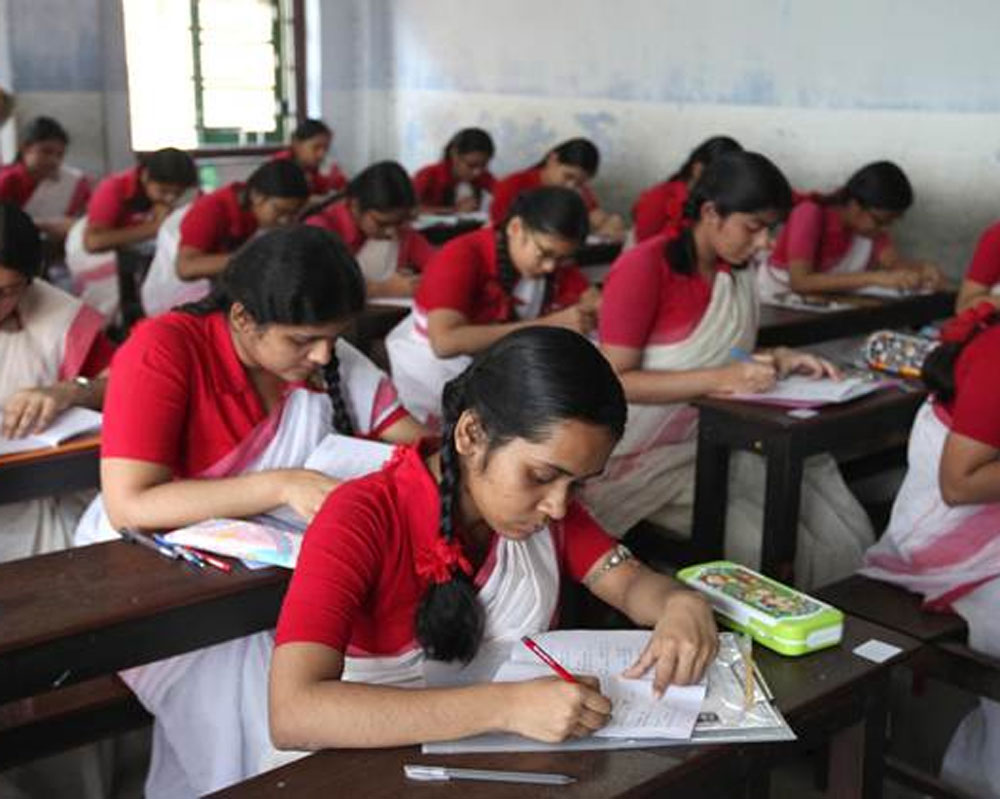
The West Bengal Board of Secondary Education (WBBSE) has allowed a 12-year-old girl — who never enrolled in school, and instead, studied at home — to sit for the Madhyamik Examination 2019 as an external candidate.
WBBSE president Kalyanmoy Ganguly said Saifa Khatun qualified the eligibility test conducted by the WBBSE for external candidates in August, and her case was “unprecedented” in the history of Madhyamik Examination (Class 10 board examination) in the past two decades.
The minimum age to appear in the examination is 14, Ganguly said.
Khatun, who hails from Howrah district, secured 52 per cent marks in the eligibility test, results of which were announced on October 11.
Another board official said the girl’s father Mohammed Ainul had moved the WBBSE to allow her to sit for the Madhyamik Examination 2019.
The last such instance of an external candidate appearing in the board examination before the minimum age was in the early 90s, the official said.
source: http://www.dailypioneer.com / The Pioneer / Home> Trending News / PTI / Kolkata, October 27th, 2018
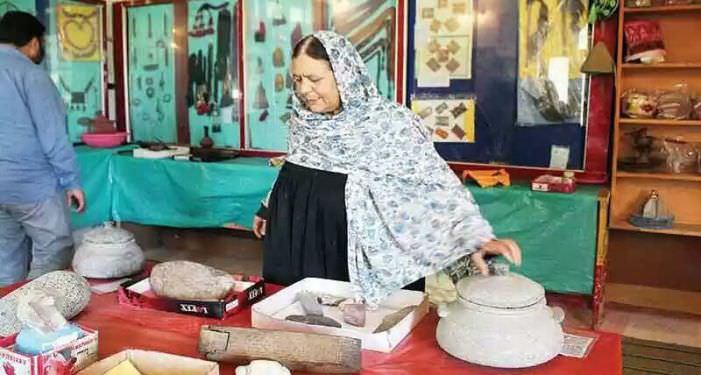
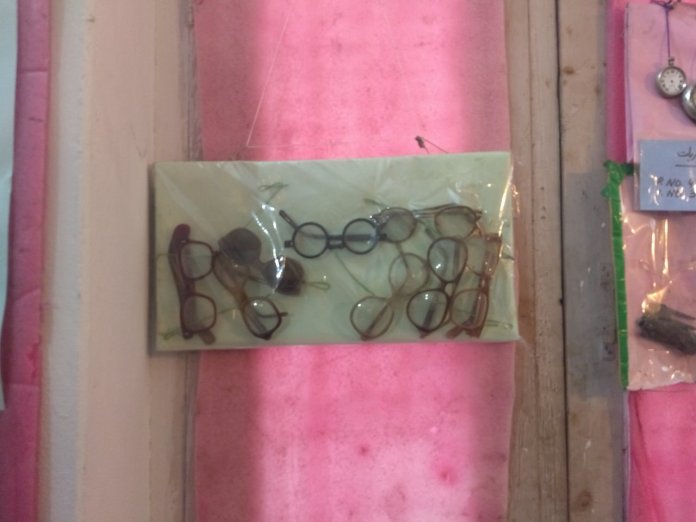
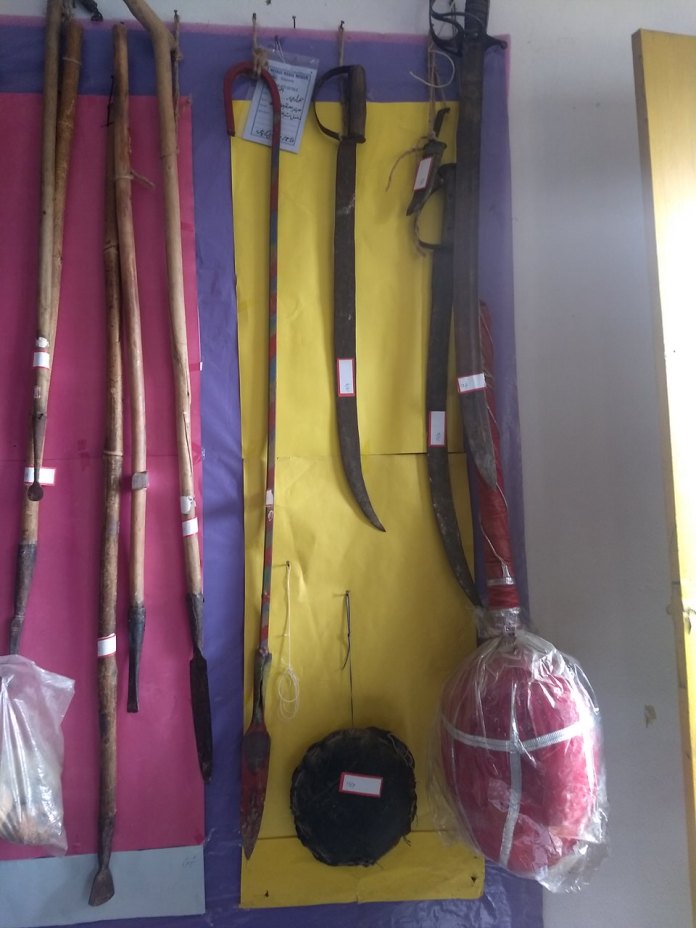
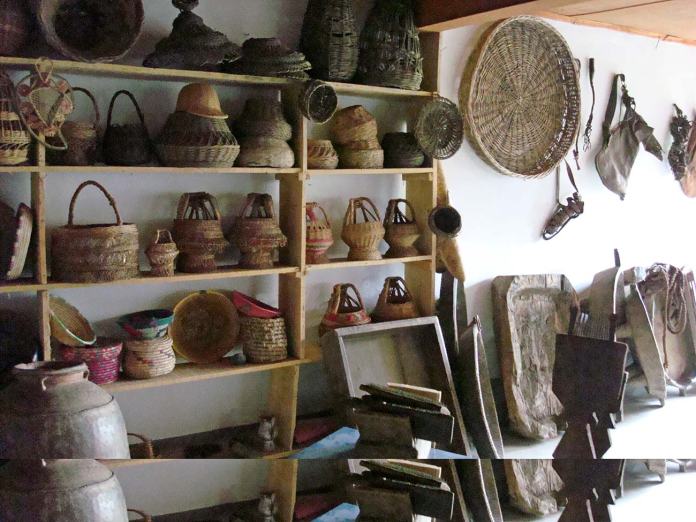
In the summer of 2014, as I walked past colourful stalls at Srinagar’s exhibition ground, the quiet and less colourful one in a corner caught my attention. Its tables were decorated with vintage Kashmiri crafts, coins, and manuscripts. The stall belonged to Meeras Mahal, a privately run museum.
Image Credit: Meeras Mahal Blog
As I and a fellow acquaintance went closer, we were warmly welcomed by an elderly woman. She made us sit and introduced herself humbly. “Ateeqa Bano, founder of Meeras Mahal,” she said. She walked us through the collection and told us stories about her journeys to get each of these artefacts.
Ateeqa’s narration clearly revealed her love for her collection. She also learnt that my friend had preserved a handwritten Quran at his place. She took his contact and invited us to her museum at Sopore, nearly 52 km from Srinagar.
Weeks later, she appeared at his doorstep with a hope to acquire the handwritten Quran. She was unable to strike a deal here but she never gave up on her other pursuits. Her failure here demonstrates how difficult the curation of items was.
The journey of forming a museum took a shape after Ateeqa’s retirement from government services in 1998. 2001 onwards when the museum was set up, it meant everything. It was initially set up in a small room in BEd college at Noorbagh in Sopore and later shifted in 2008 it to present building, all run and maintained by her expenses.
She would convince people to donate things to them and when the days weren’t all sunny, she would offer something in return. The goods would then be indexed and preserved.
Ateeqa’s looks resembled that of an ordinary Kashmiri woman but her hard-work and foresight went way beyond. I was never lucky enough to hear her story from her but even months after her death, the museum and the collection are reminiscent of her.
A corner in photo gallery contains collage pictures of famous women from Kashmir or who are in some ways associated with Kashmir. The wall, very diligently, compels one to think about the women from Kashmir who always remain unrecognized and unacknowledged and teaches us something that most other museums or schools don’t.
Her compassion for women’s rights was also revealed to me through the caretaker of the museum who said that Ateeqa had given her space to live close to the museum along with her children after she had been ousted by her in-laws. She recalls her days with Ateeqa Bano as a golden phase that she would never forget.
Ateeqa Bano chose an unorthodox way of life. After her father’s death, she decided to live forever with her mother and never marry. The decision to not marry is still a rebellious one in Kashmiri society and for her to make this choice decades back must have invited criticism from all. Apparently, she never budged and continued doing what she loved doing the most – her work.
From Sopore in the North to Shopian in the South to every district in Kashmir, Ateeqa travelled to collect things that represented Kashmir in many ways. She would travel for days and nights to obtain seemingly mundane goods and preserve them as a way to preserve the past for forthcoming generations.
The travels were not always easy. “At times, she would walk for miles altogether and ride a horse too when roads were not motorable,” says Maryam Masoodi, wife of her nephew. At times, she would be dissuaded by family, considering the effort it required. Maryam remembers how she would tiptoe inside the house in evenings when she got back home late from her work, fearing reproval from the family members.
On one occasion when Maryam accompanied her to her house in Kupwara, she went to rooftops to look for collectables. Maryam and others at the museum were fascinated and realized that no one else could have done it.
Image Credit: Kashmir Life
Today, at the museum, the caretakers refer to visitors as guests and regale them with stories of Ateeqa Bano. Before her death, she would spend days here. She had also built a blueprint to develop the museum on modern lines. However, because of her illness, she couldn’t accomplish this task. Her nephews are very keen to make her dream come true while she rests in her grave in the lawns of the museum.
source: http://www.feminisminindia.com / Feminism In India – FII / Home> History / by Arshie Qureshi / December 27th, 2018
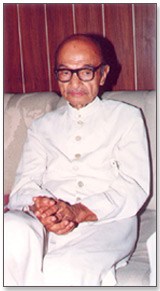
Birth anniversary of noted Hakeem Padma Bhushan Hakeem Abdul Hameed was celebrated on September 14, 2018. Former Rajya Sabha MP and noted journalist Shahid Siddiqui delivered the lecture on ‘Hakeem Abdul Hamed, a great thinker, philosopher and his role in the construction of the nation’ as Chief Guest. The programme was presided over by Prof Syed Ihtesham Hasnain Vice Chancellor Jamia Hamdard. Prof Ihtesham Hasnain said late Hakeem Abdul Hameed was ‘Hamdard’ in the real sense.
Pro Vice-Chancellor Prof Ahmed Kamal, registrar Saud Akhtar, relatives of Hakeem Abdul Hameed from India and Pakistan, a large number of teachers, officers and students were present on the occasion.
Late Hakeem Abdul Hameed, a renowned physician, was the Founder-Chancellor of Jamia Hamdard, which he established with his own resources. A great philanthropist, thinker and visionary, he set up several institutions with the funds of Hamdard Wakf Laboratories. Some of the esteemed institutions established by him include Hamdard National Foundation, Hamdard Education Society, Hamdard Study Circle, Hamdard Public School, Hamdard Institute of Historical Research, Ghalib Academy, Centre for South Asian Studies and Business & Employment Bureau.
Hakeem Abdul Hameed was honoured by several national and international awards including the Avicenna Award presented by the erstwhile USSR in 1983. He was conferred with Padma Shri and Padma Bhushan by the Government of India. He was also an honorary member of the Academy of Medical Science of the Islamic Republic of Iran and Chancellor of Aligarh Muslim University, Aligarh. In October 2000, the Research Centre for Islamic History, Art and Culture (IRCICA) Istanbul, Turkey, presented IRCICA Award for Patronage in Preservation of Cultural Heritage & Promotion of Scholarship to Hakeem Saheb posthumously.
source: http://www.siasat.com / The Siasat Daily / Home> India> News / by Rasia / September 15th, 2018