Taj Mahal of India is widely recognized as “the jewel of art in India and one of the universally admired masterpieces of the world’s heritage”. It’s a unique monument built by Mughal emperor Shah Jahan in memory of his wife Mumtaz Mahal. Taj Mahal is one of the Seven Wonders of the World and one of the best examples of Islamic architecture.
Millions visit India to get glimpses of this unique architectural beauty and this includes a large number from Middle East. How about seeing the beauty of Taj Mahal here itself in Kuwait?
Inspired by the architecture of Taj Mahal, Kuwait has designed a mosque exactly like Taj Mahal, a replica. The mosque is a bigger version of India’s Taj Mahal. It’s 3 times bigger.
Sadeeqa Fatimatul Zahra Mosque, a prayer place for the Kuwaitis, looks similar to India’s Taj Mahal from the outside. Located at Block 6, Abdullah Al-Mubarak area, West of Jleeb Al-Shuyoukh, the mosque is already gaining a reputation as one of Kuwait’s most distinctive buildings and is called the “Taj Mahal of Kuwait”.
It’s learned that Hassan Johar, a Member of Parliament, who was behind this unique project here, received the blessing of the Indian embassy before building the mosque.
Internal design of the mosque differs from the original. It consists of carvings of verses from the Quran. The four minarets and central dome of the mosque are adorned with brass crescents. The main prayer area is at the ground floor with library and utilities. It has a separate prayer hall for the women in the first floor. The Mosque was officially opened for the public in 2011.
The beauty of the mosque in middle of the desert is mesmerizing. It’s a proud feeling for all Indians here in Kuwait to witness a replica of the Taj Mahal in Kuwait. Those who have not seen the Taj Mahal in India, they can now see it in Kuwait.
source: http://www.timesofindia.indiatimes.com / The Times of India / Home> NRI> Contributions> Contributors / by Deepika Nambiar, TOI Contributor / April 30th, 2014
The birth centenary year of Noor Inayat Khan, the famous Indian-origin World War II spy, was observed in the UK this week.
Popular English novelist and political commentator Frederick Forsyth was among the key guests at a special memorial event in London to celebrate the life of Noor, the great-great-great-grand-daughter of Tipu Sultan, who became the first female radio operator to be sent from Britain into occupied France.
“What is so remarkable about Noor Inayat Khan is that she owed us nothing; she didn’t have to go,” said Forsyth, the well-known thriller writer behind books such as ‘The Day of the Jackal’ and ‘The Odessa File’ who compared her to the 18th century ruler, Tipu Sultan, known as the ‘Tiger of Mysore’.
“When it came to being recruited for the SOE (Special Operations Executive), she could have said ‘thank you but no’…but she volunteered. There must be something of the old tiger in her genes. It is recorded that she fought like a tigress…Noor absolutely did not die for nothing.
“She is an amazement, a remarkable and extraordinarily brave woman who did what she did for a country to which she owed nothing,” Forsyth said.
The memorial event was organised by the Noor Inayat Khan Memorial Trust set up by Shrabani Basu – author of the World War II heroine’s biography ‘Spy Princess’.
It coincided with the dates of June 16-17, 1943, when Noor – under her codename Madeleine – was flown to the landing ground in Northern France.
“She combined the rational side of her personality with her hatred of injustice and became one of our greatest heroines. My hope is that she would have gone back to that inner life that sustained her,” said Christine Crawley, a Labour party politician who has campaigned for the contribution of women agents in the war to be commemorated.
The SOE was an underground force established in Britain in 1940 by war-time Prime Minister Winston Churchill to “set Europe ablaze”.
It recruited men and women to launch a guerilla war against Hitler’s forces.
Noor, born in September 1914 to an Indian Muslim father and an American mother, grew up in Britain and France.
Despite her pacifist views, she decided to join the war effort to defeat the Nazis and was eventually captured.
In spite of being repeatedly tortured and interrogated, she revealed nothing and was executed by an SS officer on September 13, 1944, at Dachau concentration camp at the age of 30.
She was later awarded the George Cross, the highest civilian decoration in the UK, in recognition of her bravery.
A bust in Noor’s memory now stands at Gordon Square in central London, a stone’s throw from the home she briefly lived in.
source: http://www.ndtv.com / NDTV / Home> Diaspora / Press Trust of India / June 19th, 2014
People pose with mangoes weighing over 2kg grown at an orchard in Shinor village in Vadodara.
Vadodara :
Mangoes weighing over two kilograms apiece have caught the fancy of farmers and scientists alike in central Gujarat. These mangoes are not a miracle of genetic engineering or hybridization but the humble ‘desi’ variety that grows across the countryside.
The exceptionally large mangoes grow on a tree in the farm of Iqbal Khokhar in Shinor village on the banks of Narmada in Vadodara district. The fruit from this tree was recently displayed at the Krishi Mahotsava in Chhota Udepur.
A native of Shinor and deputy director in the animal husbandry department, Dr Snehal Patel, is among the people who have been highlighting this unique fruit. A mango orchard owned by Patel’s family existed at the location and was sold later. But only two trees have survived now – one of them being the one that bears the jumbo-size mangoes.
Horticulture expert from Anand Agriculture University, Hemant Patel, said, “This is four to five times the size of even the Rajapuri mango. This phenomenon needs to be researched.”
source: http://www.timesofindia.indiatimes.com / The Times of India / Home> India / by Sachin Sharma, TNN / June 06th, 2014
by Farrukh I. Younus , Freelance Writer – United Kingdom
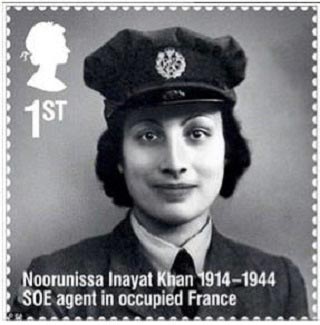
In line with commemorating the centenary year for the start of World War I, the UK’s Royal Mail has announced the release of ten stamps, each of which recognizes the accomplishments of seven men and three women born in 1914.
The ‘Remarkable Lives’ stamp series includes Dylan Thomas, the famous Welsh poet, Roy Plomley, the BBC radio broadcaster who created Desert Island Discs, and Barbara Ward, an economist who urged governments to share their wealth with the poor.
An Obscure Muslim Heroine
Also in this new set of stamps is a lesser-known personality: Noor Inayat Khan. Khan is the only Muslim included in the list. She was born in Moscow to an American mother and an Indian father.
A descendant of Indian royalty, her family fist moved to England and then to Paris. They returned to London when the city was occupied in 1940. Here she joined the Women’s Auxiliary Air Force and was then recruited in 1942 to the Special Operations Executive (SOE), an elite spy squad.
Initially known as Nora Baker Khan, Noor was given the code name Madeleine and in 1943, she was the first female radio operator to be flown secretly into Nazi-occupied Paris; this despite an SOE report stating she was “unsuited to work in her field.”From Paris, she transmitted numerous messages back to London saving many lives. For a period of time, she was the only link between the UK and the French Resistance.
Aged just 30, Khan managed to evade capture for three months but was eventually betrayed by French collaborators and arrested. She tried to escape twice while in Paris and, being considered too difficult, was eventually moved to Germany.
Despite being tortured, Khan revealed nothing of her mission or even of her real name. She was eventually executed in 1944 by the German Gestapo in the Dachau concentration camp. Before her execution by a shot in the back of her head, her last word was, “Liberté!”Britain awarded Khan the George Cross and France awarded her the Croix de Guerre.
Commemorating Noor Inayat Khan
Author Shrabani Basu wrote a book about Khan entitled, “Spy Princess: The Life of Noor Inayat Khan”. Basu campaigned for a memorial in honor of Khan’s efforts, unveiled by Princess Anne in London’s Gordon Square Gardens in November 2012.
It is said that Khan’s decision to be involved in the war efforts was not specifically due to a love of Britain (though this was a part of it). Her involvement was largely on account of the values of religious tolerance and non-violence that she was taught as a child by her father who was a musician and a Sufi teacher. As her biographer Basu said, she “couldn’t bear to see an occupied country.”
The National Archives reveal that Khan had studied both medicine and music. She was also an accomplished writer with a collection of traditional Indian children’s stories published in the French newspaper, Le Figaro.
Unity Productions Foundation has produced a documentary on the life of Khan. The world premiere of the documentary, “Enemy of the Reich”, was held on February 15, 2014 at the prestigious Warner Theater in Washington DC. It was attended by a full house of more than 1400 people.
Khan’s example demonstrates how an individual, particularly an empowered Muslim woman, can support her country. At a time when Muslim women in general suffer the image of being weak and uninvolved in society, Khan demonstrates that a person can be at ease with their faith, gender, heritage and culture without questioning their identity.
I recently returned from a World War I and II memorial tour in Belgium where I visited the resting places of soldiers. The one that stood out most to me was the Ploeg steert Memorial to the Missing. We owe a great debt of gratitude to the men and women who fought for the freedoms that we enjoy today.
Each of the ten people featured in the Royal Mail ‘Remarkable Lives’ stamp set contributed in their own way to the benefit of society. As a British-born Muslim of Pakistani heritage, I am encouraged to find a British-Indian Muslim woman recognized in our stamps and to know that all who contribute to our betterment will be recognized, irrespective of faith or gender.
source: http://www.onislam.net / On Islam / Home> Culture / Sunday – March 30th, 2014
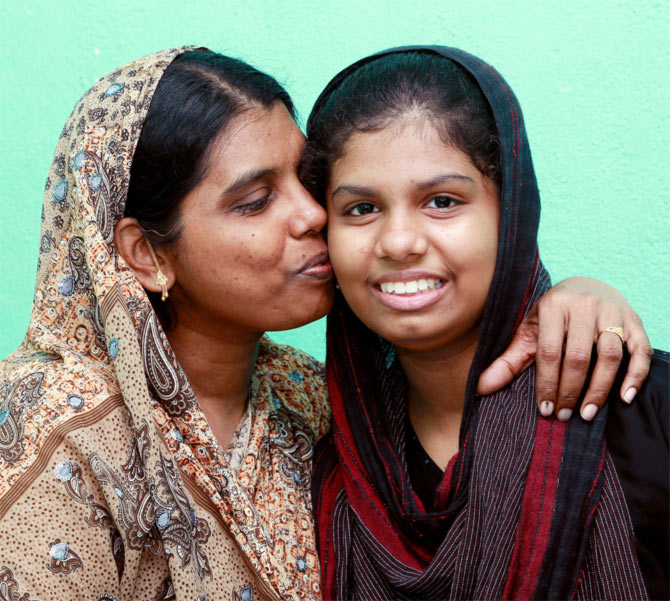
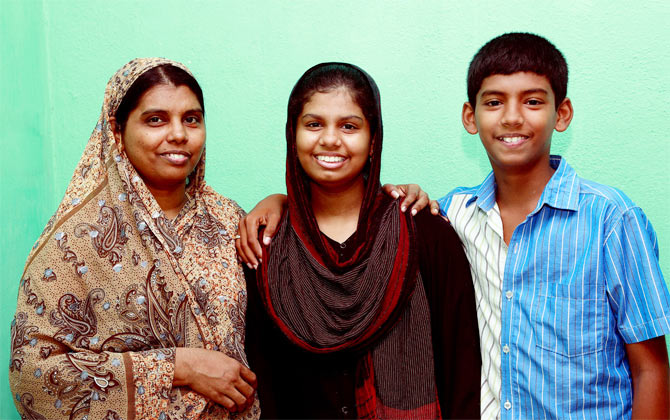
Image: Fathima Shabana with her mother Bahira Begum Photographs: Sreeram Selvaraj
Shobha Warrier/Rediff.com
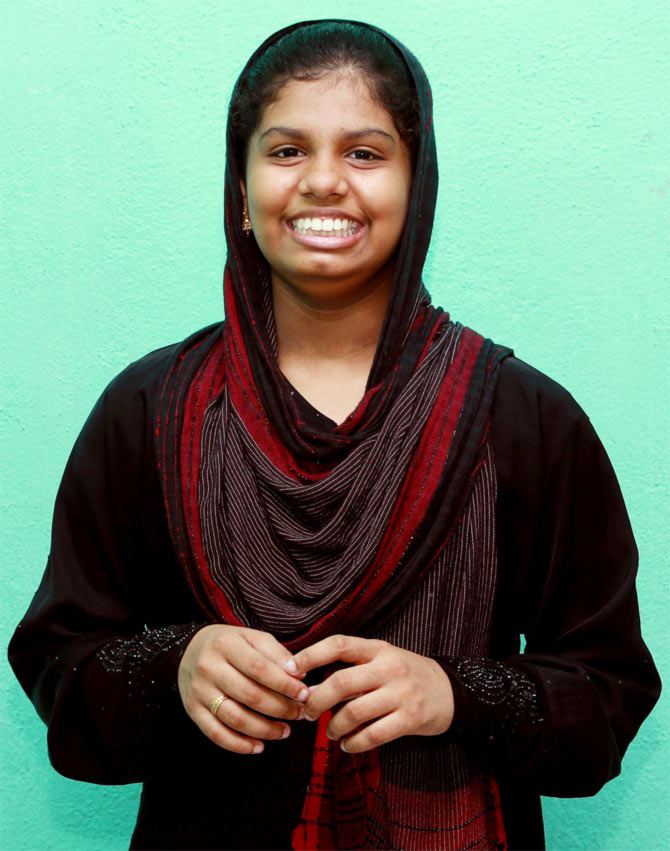
Meet Fathima Shabana who’s cleared her JEE (Main) and wants to study computer science from an IIT.
It has been a week since the Joint Entrance Examination (JEE) results were released, and yet, the smile on 17-year-old Fathima Shabana’s face has still not diminished. After all, she has been working hard for the last four years; and she has just cleared the JEE (Main). This means that she has already made the grade to go to an Indian Institute of Information Technology (IIIT) or National Institute of Technology (NIT) or state engineering institutions that will offer seats on the basis of JEE (Main) merit list like the Anna University in Tamil Nadu.
If she manages to make it through to the JEE (Advanced) examination on the May 25, she might well make it into an IIT!
Fathima’s is no mean achievement, especially when you look at her background. Her father, Shahul Hameed, dropped out after Class VIII and her mother didn’t continue past primary school.
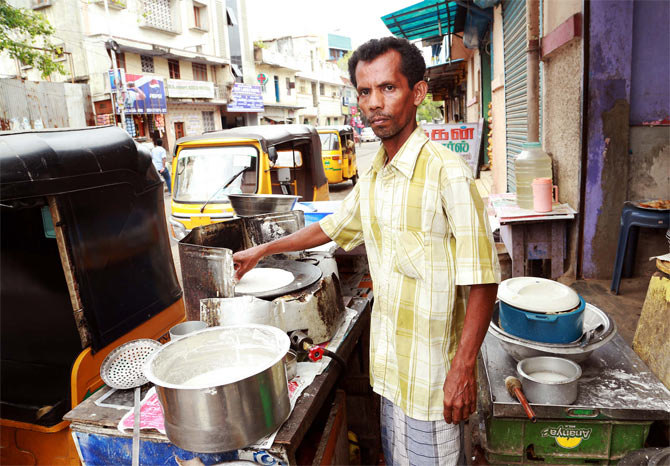
Ever since he made his way to Chennai from Siruthondanalloor village in Thoothukudi district in search of a job almost two decades ago, Shahul Hameed has been washing dishes and serving food at a pushcart eatery.
His day starts very early in the morning, before the city wakes up, and ends only by 10 at night. For all of this, he takes home Rs 300 a day.
Ever since he was told of his daughter’s phenomenal achievement, he has been a happy and proud man. “My daughter has made me very proud. She was always an extremely hard working child, and I always knew that she would pass all of her exams with flying colours. I could not afford to send her to a private school. So, I sent her and my son to a corporation school so that we didn’t have to pay for their fees and textbooks.”
“It has always been her dream to be an engineer. But I earn only Rs 300 a day; I do not have the wherewithal to send her to an engineering college. I grow distressed just thinking of shattering my daughter’s dreams. But I am sure some good soul will come forward to help her pursue her dreams,” he says, while making dosas for a customer.
Image: Fathima Shabana’s father Shahul Hameed sells dosas and earns Rs 300 a day. Photographs: Sreeram Selvaraj
Her equally proud mother, Bahira Begum, said, “Neither me nor my husband could study much. But we made sure that our children studied, and studied well at that. We thought we should give them an education even if we had to borrow money to do so. We first sent Fathima to a private school, but we soon found that we could not afford to educate our children in a private school. We had to then move both of them to a corporation school. But in spite of that, not once did I have to tell Fathima to sit down and study. She was always happier among her books than she was playing with other girls of her age. She would sit at home and write something all the time.
In fact, I would tell her to take a break and go out and play. But she never would.”
Bahira remembers that her daughter never asked her for a new dress, or expressed her desire to go watch a movie. “She was not interested in anything but her studies. Even if we called her to go out, she would not come. Even as a small child, she was obsessed with her education and always wanted to come first in class.”
“God has been kind to me. It was because of God’s gift that I was able to focus on my education. I love Mathematics and can solve mathematical problems for hours together without feeling bored,” Fathima said.
When she was in Class IX, a private IIT-JEE coaching institute came to her school to select good students and offer them free coaching. She was among the nine students selected after a screening test.
When she told her mother that she wanted to attend JEE coaching classes, she told her that they could not afford to send her to a tuition class. But her school head master was insistent.
“He came home and convinced us that Fathima would never get such an opportunity in her life, and that we should not deny it to her. We had to agree to send her to coaching classes.”
As the institute was far away from her home, it was past 9 in the evening by the time she got back home. “So, I would study until midnight and get up by 6 in the morning to do all the home work.”
So focussed was she on her studies that from first standard onwards, she was either first or second in school.
After scoring 83 per cent in her Class X Board exams, she went back to the same school and continued her preparation for the JEE. “I was happy after I finished the JEE (Main) exam. I knew I did well, especially my Mathematics paper. Yes, I was expecting a good result, but when I finally saw online that I had cleared the Main exam, I couldn’t believe it. I called my father and conveyed the good news to him. He was overjoyed, as was my mother.”
Image: Fathima Shabana with her mother Bahira Begum and brother Arshad Saliq Photographs: Sreeram Selvaraj
Bahira also was confident of her daughter getting in. “I know nothing about colleges. I only knew that she would get admission in to a very good college somewhere in India because of how hard she worked. However, in our community, we do not send our girls to far-off places. So, I hope she gets admitted to an engineering college in Chennai.”
Whenever Fathima expressed her desire to become an engineer, her mother would tell her not to dream so high because of the financial constraints they faced in the family.
Now that she is going to write the JEE (Advanced) exam on May 25, her dream is to get selected to study Computer Science at an IIT. “I love computer science. I do not have a computer at home, but we have one in our school that we get to operate. I enjoy working on the computer.”
Fathima’s brother, Arshad Saliq, who studies in Class IX, has someone to look up to now. “I also top my class, but now, I want to emulate my sister. I want to study in an IIT.”
Fathima’s dream is “to get a good job so that my father will not have to struggle as hard to make ends meet.”
The family strongly believes that it was all because of the blessings of God that Fathima could achieve something that her parents could never even dream of.
“When we thank God, we also pray that He would show us a way to give Fathima what she wants. When we let her study, not even in our wildest dreams did we think that she would make both of us, practically illiterate as we are, so proud,” said Bahira on a parting note.
source: http://www.rediff.com / rediff.com / Home> Get Ahead / May 14th, 2014
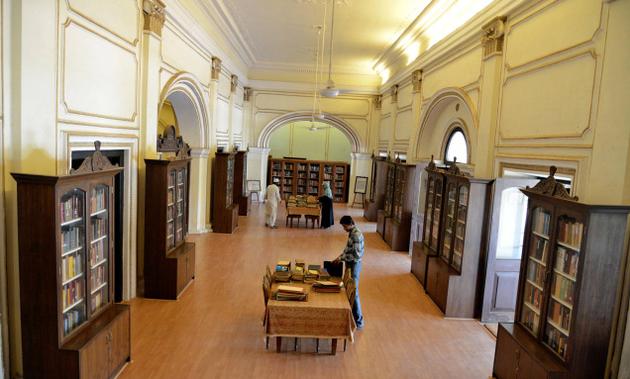
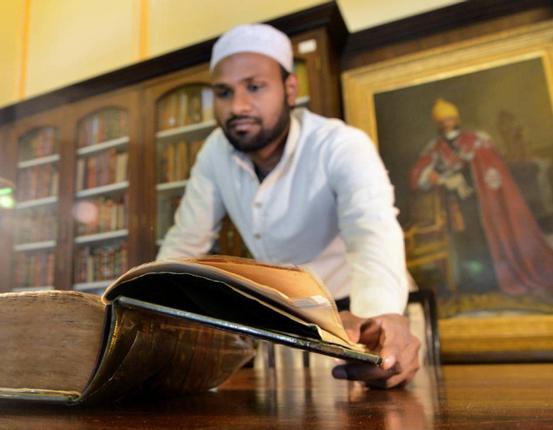
Books restored from different Asaf Jahi dynasties are in the Chowmahallah Palace library./ Photos: Nagara Gopal / The Hindu
The Mehtab Mahal library at Chowmahalla Palace throws open a treasure trove from the Nizam’s era
The Nizams, it turns out, had an eye for everything exquisite. From the jewellery they wore to the silks that adorned their wardrobe, the cars they rode in, and the cuisine they partook, everything simply spelt royalty. While these indicate their lavish lifestyle, their interest in books and literature is less known.
Throwing light on their urge to discover and relate to the world around is the Royal Library in Chowmahalla Palace; its collection of books includes The Life of Samuel Johnson, History of Don Quixote, John F Kennedy – Portrait of a President, Glimpses of India,The Princes of India and an array of Encyclopaedias and much more .
Situated in the Mehtab Mahal of the Chowmahalla, the Royal Library houses more than 10,000 books and “is a haven for researchers and book lovers.”
The library that was thrown open to book lovers last year has been digitized recently, not only to help book lovers but also ensure safety of the royal treasure.
The idea of the library is to protect and preserve the valuable collection of the Asaf Jahi kings. The collection mostly belonged to the Mir Mahboob Ali Khan (VI Nizam), Mir Osman Ali Khan (VII Nizam) and Nizam Mukarram Jah. The books have been sourced from different Asaf Jahi palaces like the Nazri Bagh, Chiran Palace and Chowmahalla to be housed in the Royal Library here.
The books thus collected were sorted and segregated into various categories.
Books restored from different Asaf Jahi dynasties are in the Chowmahallah Palace library./ The Hindu
“A lot of work went into making them ready to be put in the cases for readers to read them in the library. Various professionals worked to clean, bind and make the books fit for reading. We have applied all preservation techniques, including fumigation, to protect the books,” informs G. Kishan Rao. He adds, “The collection of books range from history, literature, poetry, philosophy, geography, culture and religion. This library also houses the exclusive collection of Qurans by the Nizams which was inaugurated recently.” A few books also hint at the Nizam’s passion to learn languages. The number of English books is close to 3000, followed by Urdu, Persian and Arabic.
“There is also a good number of Persian manuscripts containing the firmans issued by the Asaf Jahis as well as several volumes of Mir Osman Ali Khan’s poetry,” informs the librarian. Qurans of different sizes are in the process of being restored and will find place in the library after that.
source: http://www.thehindu.com / The Hindu / Home> Features> MetroPlus / by Prabalika M. Borah / Hyderabad – April 25th, 2014
She broke the glass ceiling many a times, from being the first woman to enter any Class-I civil service to becoming the first IRS officer to be appointed a UPSC member and to being the only woman to have worked in the Central Narcotics Department.
After donning multiple hats during her long career, it was another proud moment for Parveen Talha, when she was conferred the Padma Shri award on Saturday for her contribution to the Civil Services.
But the road to success wasn’t that easy for Talha and the biggest hurdle was to overcome the anti-women mindset of her bosses at the initial stages of her career.
“It is indeed a proud moment for me but I am grateful to my bosses too. Though I had to initially deal with their anti-women mindset when I joined services 45 years ago, after a few years I was able to prove that I could handle the tricky jobs as efficiently as my male colleagues,” Talha told PTI.
70-year-old Talha joined Indian Revenue Service (Customs and Central Excise) in 1969 where she worked for 35 years and was then picked up as a member of the Union Public Service Commission (UPSC) in 2004.
“Once my bosses began to trust in my capabilities, I started getting challenging assignments including posting as Deputy Narcotics Commissioner in Uttar Pradesh,” she said.
“There was a large-scale leakage of opium going on in UP then. While I tried my best to play a stringent officer dealing with certain illegal channels, poppy cultivators were surprised too because they had never seen a woman at that level,” she added.
By halting for days in the cultivation areas and delving deep into all processes of poppy cultivation from sowing to lancing and harvesting, she gathered foolproof intelligence which was put to good use by her hand-picked preventive parties.
During her posting in UP and Bihar in 1990s, she attached illegally acquired property worth millions of rupees belonging to smugglers and drug traffickers at the risk of her life.
While she was posted as Director General Training in 2002, Talha provided strategic vision to the Department of Customs and Central Excise in evolving comprehensive packages of programmers for technical capacity building of all cadres and service providers.
Talha, who was honoured with the President Award for “Specially distinguished record of service” in 2000, also has a penchant for writing.
She has written ‘Fida-e-Lucknow’, a collection of 22 short stories, besides writing the dialogues for the serial ‘Husn-e-Jana’ directed by Muzaffar Ali.
“I find there are stories in every nook and corner that are waiting to be told. So I will pursue my passion for writing now that I am a retired person,” she said.
source: http://www.newindianexpress.com / The New Indian Express / Home> Nation / by PTI – New Delhi / April 27th, 2014
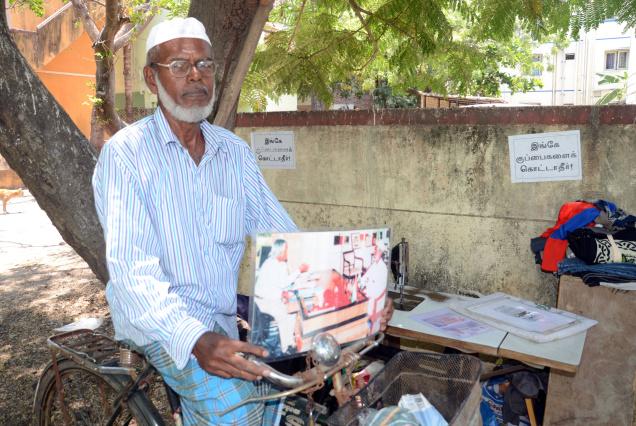
Mission on wheels: While cycling to Delhi from Chennai, S. Nagoor Meeran made many friends./ Photo: M. Karunakaran / The Hindu
Nagoor Meeran, a tailor, cycled to Delhi to meet Abdul Kalam. Vipasha Sinha on his feat
Neither the merciless weather nor the bumpy roads could stop S. Nagoor Meeran from meeting the APJ Abdul Kalam in 2003. At that time, Kalam was the President of India.
Nagoor started his journey to the capital by cycle from Tenkasi. In 35 days, he rode through Chennai, Hyderabad, Nagpur, Bhopal, Agra. It was commendable for a 57-year old to perform such a feat.
Ten years later, Nagoor shares the story of that journey and talks of his love for cycling.
“The Lion’s Club was planning to do an event to promote world peace. They had different ideas in mind but I suggested that I could cycle all the way to Delhi and meet the president,” says Nagoor, who is a tailor by the day and watchman by the night.
It was an Imam from his town who suggested to him the idea long ago and this seemed like a perfect opportunity. He had also met Kalam’s brother in Rameshwaram and expressed his interest in meeting the head of the country.
“However, when I reached Delhi I was told I could not meet the President. Yet I was hopeful. I wrote about my journey and the purpose of the meeting and left the request in a glass box kept for people who wish to meet the President. Reading it, he agreed to meet me. I quickly changed my clothes ahead of the meeting. Mr. Kalam was kind enough to have lunch with me. We spoke about three things – the need to promote peace and communal harmony, development in his native town of Tenkasi, and my desire to visit Mecca. I also presented a letter appreciating him,” says Nagoor.
He also got a chance meet other ministers and personalities. All that he carried for the journey on a basic Hercules cycle was a small bag and a bottle of water. He says there were many people who helped him complete his quest along the way.
“I would start in the morning and by six in the evening, I would look for a temple or a police station or a forest department office where I could spend the night. Some people would offer food and water. Between Agra and Delhi come these humungous soft drink outlets, I went there and they gave me two big bottles of cool drinks for the journey. Since water was a major problem, I would befriend the truck and lorry drivers on the highway, and they would erect tents where they could rest. I would use their water tanks to clean my clothes and take a bath. There were times when I would go without a bath for days. I also maintained a diary with the signature and names of all the people who helped me during the journey,” says Nagoor, who has to spend around Rs. 10,000 for this trip, which was partially sponsored by Lions Club and Sun Tv.
Completing his mission, he took a train back to Chennai. Now, he carries in his small bag a photo taken with Kalam and few newspaper clippings lauding his feat. Ask him why he took that journey, he says: “It was just for the love of cycling.”
source: http://www.thehindu.com / The Hindu / Home> Features> Down Town / by Vipasha Sinha / Chennai – March 29th, 2014
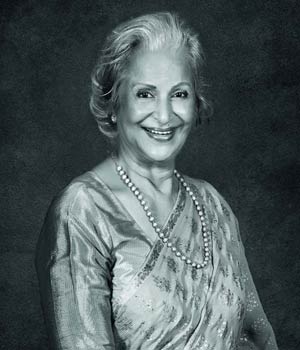
Sharla Bazliel reviews conversation with Waheeda Rehman by Nasreen Munni Kabir.
Her name means “the unique one” and few actors have had a career, and life, quite like Waheeda Rehman. From being discovered by Guru Dutt by sheer accident at the age of 17 to becoming a successful star in Bollywood, to giving it all up one day and moving-toddlers in tow-to a derelict farm on the outskirts of Bangalore with husband, sometime actor Shashi Rekhi, Rehman has done it all. In Conversations With Waheeda Rehman, the actor tells the entire story in her own words, with insightful prompts by filmmaker and writer Nasreen Munni Kabir that prevent the book from turning into a rambling mess.
Conversation with Waheeda Rehman by Nasreen Munni Kabir
Rehman speaks with honesty and humour and Conversations is filled with interesting anecdotes about her experience of working with artistes such as Satyajit Ray (who first brought up the subject of wanting to make Guide), Raj Kapoor, Dev Anand (who was perpetually late), her friendship with stars such as Nargis, Sunil Dutt and Nanda and her adventures living off the land. Bollywood buffs and collectors of film trivia can look forward to her insights into the craft of filmmaking and an entertaining behind-the-scenes look at the making of some of the key films in Indian cinema.
Although her personal story is fascinating, the heart of the book lies in a few pages about Guru Dutt. With her natural talent and haunting beauty, Rehman brought to life some of Indian cinema’s most iconic characters-Gulaabo, Shanti and Rosie-but no story about the actor is considered complete without reference to the doomed director who committed suicide in 1964. Although Rehman acknowledges this curiosity, her answers sixty years later remain shrouded in layers.
Excerpts
Waheeda Rehman. / Pic by Rohit Chawla
Guruduttji was sitting in a distributor’s office (in Hyderabad) when they heard a commotion outside. Guruduttji asked him if there was some trouble on the street and he was told the stars of a popular Telugu film were passing by and excited fans were making the commotion. The distributor then added: ‘A new girl has performed a song in the film. It has caused a sensation. When the stars go on to the stage, the audience demands to see this young girl. Her name is Waheeda Rehman.’ Guruduttji was surprised: ‘Waheeda Rehman? That’s a Muslim name. Does she speak Urdu?’ ‘I hear she also speaks Telugu and Tamil.’… That’s when Guruduttji told the distributor he would like to meet me because he was looking for new actors to cast in his next production. The distributor then called Mr Prasad to set up a meeting. Mr Prasad had not heard of Guruduttji. Very few people in the south had heard of him in the mid-fifties. I think there weren’t many film magazines at the time and in any case no one in my family read them, so we were unaware of his name. The distributor explained to Mr Prasad that his friend was a well-known Bombay director and had made a number of successful films. Then Mr Prasad called my mother and told us that Guruduttji wanted to meet me. My mother and I made our way to the distributor’s office the next day. I think the meeting lasted about half an hour. Guruduttji hardly spoke. He asked us a few questions in Hindi: Such as where we were from. That was it.
We went back to the hotel where we were staying. When Mr Prasad asked about the meeting, my mother commented that Guruduttji said very little. Mr Prasad said some people were just made like that. We returned home to Madras a few days later.
He hadn’t seen the film. He had no idea what I looked like on camera. He heard my name and asked to meet me without having seen me at all. There was no reason why the distributor had to mention me in the first place. So how could I not believe it was destiny?
After our first meeting in Hyderabad, three months went by and then someone came to see us at our home in Madras. He said he was from Bombay. I think he was a film distributor. He said he had come on behalf of the director whom we had met in Hyderabad. Of course, by that time, we had even forgotten Guruduttji’s name, to which our visitor said: ‘Well, Guru Dutt has asked me to take you to Bombay. He wants to sign you.’ My mother was most surprised and decided to discuss the idea with her friends. They advised her to say Bismillah and go. She was very reluctant. Bombay was like a foreign country to us. As usual she asked Mr Prasad for his advice and he said: ‘Go, Mrs Rehman. There’s no harm if she works in Bombay, but remember she is not a slave. Don’t agree to all their demands. If you don’t agree to something, say it. If you don’t like living there, come back. Just don’t get intimidated.’ So the three of us-my mother, a family friend who was called Mr Lingam and I-landed in Bombay at the end of 1955. We stayed at the Ritz Hotel in Churchgate.
*************
It was finally agreed at the next meeting that I could keep my own name. They asked my mother to go ahead and sign the contract… as I was under eighteen. Just before she could put pen to paper, I said: ‘I’d like to add something to the contract.’ (Director) Raj Khosla was surprised: ‘Newcomers don’t usually make demands. Just sign.’ Guruduttji kept silent. Then I told them if I did not like any costumes, I would not wear them. Guruduttji sat up. Then he said in his quiet voice: ‘I don’t make films of that kind. Have you seen any of my films?’
‘No.’
‘All right. Mr & Mrs ’55 is running in town. Go and see it. We’ll talk about the costumes later.’
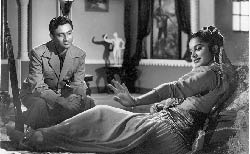
A shot from Waheeda Rehman’s first hindi film C.I.D., with Dev Anand
We were given cinema tickets and we went to see Mr & Mrs ’55. The following day we returned to the office. We said there was nothing wrong with the costumes…But I said I still wanted the clause about costumes added. Raj Khosla looked at Guruduttji and said: ‘This is amazing, Guru. You’re listening to this girl and not saying anything. The choice of costumes depends on the scene and not on the actress.’ I can’t believe I was so outspoken, but I insisted: ‘When I am older, I might decide to wear a swimsuit. I won’t now because I am very shy.’ Raj Khosla retorted: ‘If you’re so shy, why do you want to work in films?’ I said calmly: ‘I haven’t come here of my own accord. You called us.’ No decision was made. We were driven back to the Ritz Hotel. The next day we went back to the office. The clause about my costumes was added and my mother signed my three-year contract with Guru Dutt Films.
*****************
Everyone makes films that don’t work. His sister Lalli [the artist Lalitha Lajmi] told me once that Guruduttji suffered from depression. In the last years of his life he was very confused. We could all see that. He was unhappy. But no one realised just how depressed he was. He started a film called Raaz in which I starred opposite Sunil Dutt… I shot many good scenes, but Guruduttji shelved the film. When we asked why, he said: ‘Nahin jam raha hai.’ [It isnt working.] Then he started Gauri with Geeta (his wife) who wanted to act. He shelved that too.
My husband suffered from depression as well and we didn’t realise it. He started losing interest in everything. He didn’t want to meet people and basically didnt feel like doing anything. In the same way, no one knew how Guruduttji was really feeling.
Waheeda Rehman with Guru Dutt in Pyaasa
His death was a mystery-no one knew for sure whether it was a suicide or an accident-there was much curiosity. His death was such a shock to us all. He was only thirty-nine. He was young. The question everyone asked was: ‘Why did he have to die like that?’ None of my film colleagues have ever asked me personal question about our relationship. It was always other people and the press who were curious, and still are, almost sixty years later. I know we are public figures, but I strongly believe my private life should remain private. What ultimately matters and concerns the world is the work we leave behind.
Humayuns Tomb made news in 2010 when US President Barack Obama and wife Michelle were photographed here,staring at the monuments majestic elegance. On Thursday,the World Heritage Day,the Humayuns Tomb complex will return to make news again to announce the unveiling of its most attractive structure,Isa Khans Tomb,after a two-year-long restoration.
Isa Khans Tomb,part of UNESCO World Heritage Site of Humayuns Tomb,has a dome that resembles a plump inverted flower. But time and state negligence had robbed this flower of its beauty and fragrance. A 27-month-long conservation drive has attempted to infuse that lost beauty back into the tomb.
The restoration drive was jointly funded and undertaken by the Aga Khan Trust for Culture and the World Monuments Foundation,with help from the Archeological Survey of India. The project is part of a larger urban renewal project in Delhi that includes 50 monuments.
On Thursday,Union Minister for Culture Chandresh Kumari Katoch will open Isa Khans Tomb to the public. Almost 2,000 school children will be taken there for a heritage walk and design workshops.
Isa Khan was a noble in the court of Sher Shah Suri in the 16th Century. Suri ruled Delhi between the reigns of Humayun and Akbar.
Isa Khans Tomb is a resplendent example of the concept of a garden tomb,which pervaded that era. It combines the garden and the grave,symbolic of life and death.
This tomb is the only historical monument in India which has been restored by a non-government body. A key official of the restoration project said other than returning the mausoleum its lost glory,the project has also successfully achieved its objective of imparting knowledge of traditional architecture and design to the craftsmen who worked on it.
We got them trained in making tiles in the Central Asian style,where the Mughal and Suri dynasties originated, he said.
Today,the Mughals are primarily associated with their taste for rich architecture the Indo-Persian school of architecture. But their love for fruity and floral plantations was legendary. Mughal monuments were designed in the centre of gardens primarily consisting citrus plantations. That same refreshing,tangy citrus scent will burst into the precincts of Isa Khans garden tomb again now with the generous re-plantation of this genus.
When restoration was underway in 2011 at this garden tomb,serendipity visited the project team. The monument suddenly had Indias oldest sunken garden. The official said,The idea was to align the tree top-level with the eye level,so that when one stands on the courtyard of the main structure,one sees a carpet of green,giving a sinking effect to the encircling vegetation.
For a monument to achieve the prestigious UNESCO World Heritage Site status,its features must contain an outstanding universal value. The Humayuns Tomb complex made the cut because it is not just the mausoleum of the second Mughal emperor,but an ensemble of 16th Century garden tombs like Bu Halima,Batashewala,Neela Gumbad and others,besides Isa Khans tomb.
The restoration projects staff boasts of an inclusive approach undertaken while giving the garden tomb complex a makeover.
For us,the craftsmen were the projects centerpiece. We focused on the quality of work and not the traditional dihaari (daily wages) system. We also employed latest technology,like laser scanning and GPRS pointing,to fine tune things. Laser scanning helped to make an error-free structural assessment of the monument and GPRS pointing helped to locate underground archeology,if any,before we started work, the source said.
Revival of the Garden tomb
On World Heritage Day,Union Minister for Culture Chandresh Kumari Katoch will open the Isa Khan Tomb to visitors,after a 2-year restoration drive
Isa Khan was a noble in the court of Sher Shah Suri in the 16th Century
His mausoleum is an example of the concept of garden tomb,which pervades that era. It combines the garden and the grave,symbolic of life and death
Dome resembling an inverted plump flower had weathered owing to time and negligence
Restoration jointly funded,and undertaken by Aga Khan trust for Culture and World Monuments Foundation,with help from ASI
It is the only historical monument in India restored by a non-government body
The project is part of a larger urban renewal project in Delhi which includes 50 monuments
For the project,craftsmen were trained in making tiles in the Central Asian style,where the Mughal and the Suri dynasties originated
Along with a crafts-based approach,latest technology,like laser scanning and GPRS pointing,was used to fine tune the work.
source: http://www.indianexpress.com / The Indian Express / Home> Cities> Delhi / by Ruchika Talwar / New Delhi / April 18th, 2013