Category Archives: Amazing Feats

Ali: Nizams built city, not Naidu

Mohd Ali ShabbirMPos25jan2014

Hyderabad: 

The Nizams’ rule found place in the record books of both the Legislative Assembly and Council on Friday.

Congress MLC Mohd Ali Shabbir actually submitted a detailed note to Council chairman A. Chakrapani, stating that the Nizams, especially Nizam VII, had developed Hyderabad city and not Telugu Desam president N. Chandrababu Naidu.

Shabbir listed over 100 buildings, monuments, infrastructure projects, government departments, hospitals and others, including the present Assembly building, Jubilee Hall, Hussainsagar Lake, Railway network, Road Transport Corporation, Begumpet Airport, Osmania University, Osmania General Hospital etc. that had been constructed by the Nizams or during their reign.

“Pre-1956 Hyderabad was the largest and most prosperous of all princely states in India. It had its own army, airline, telecommunication system, railway network, postal system, currency and radio broadcasting,” he explained in the note which was part of the debate on the AP Reorganisation Bill.

“Hyderabad, the first planned city of India, was already a developed city centuries before it became part of Andhra Pradesh. The world’s first drinking water reservoir, Hussainsagar, was built in 1562,” he said.

Several MLAs and MLCs like Akbaruddin Owaisi, Mohd Shabbir Ali, Etela Rajender and others gave credit to the Nizams for the development of Hyderabad, while some Seemandhra MLAs like D. Narendra and others criticised their rule, which they said, had led to the Telangana armed rebellion and the notorious Razakaar movement.

“I wanted to put the record straight. The Nizams developed Hyderabad city and others contributed later. The claim of Leader of Opposition in Assembly, Nara Chandrababu Naidu, is ridiculous that he got Hyderabad on the global map. The fact is, Naidu went on the global map and got recognition by reciting the name of Hyderabad repeatedly,” Shabbir Ali said in the note to the Legislative Council Chairman.

He challenged Seemandhra leaders for an open debate on Hyderabad. “In fact, Naidu tried to damage the culture and identity of Hyderabad. The historic Hussain Sagar Lake was shrunk during Naidu’s period and he tried to change the name of the city from Hyderabad to Cyberabad. Even NTR’s samadhi is built on encroached land which was originally Hussain Sagar,” he alleged.

source: http://www.deccanchronicle.com / Deccan Chronicle / Home> News> Politics / DC / January 25th, 2014

Shah Rukh Khan tops Forbes Celebrity List for the second time

ShahrukhMPos04jan2014

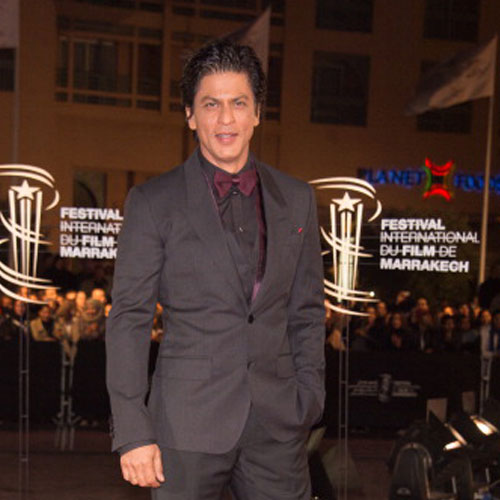
Bollywood star Shah Rukh Khan has been named the most powerful celebrity of 2013 by Forbes India for the second time in a row.

The 48-year-old actor has conquered the Top 100 celebrity list with the help of his popularity and earnings from his mega hit film ‘Chennai Express’ this year.

Indian cricket captain Mahendra Singh Dhoni moved up from the third spot last year and has come in at the number two spot with his immense popularity and endorsement deals.

Bollywood star Salman Khan slipped from his second position last year and earned the third spot in the list. They are followed by Sachin Tendulkar at number 4, and megastar Amitabh Bachchan, who retained his position, completing the top five on the list.

Bachchan is followed by Bollywood action star Akshay Kumar, who has come in at number 6.

There have been two exits from the top 10 this time. Actress Kareena Kapoor and swashbuckling cricketer Virendra Sehwag have made way for actors Ranbir Kapoor at number 8 and Hrithik Roshan at number 10.

Cricketer Virat Kohli is the youngest celebrity to make it to the top 10 this year.

Katrina Kaif is the only woman who has made it to the Top 10.

Nearly a fourth of the list in 2013 comprises newcomers. The notable ones include Ravindra Jadeja (28), Shikhar Dhawan (39), Shankar-Ehsaan-Loy (52), Ranveer Singh (66), Prakash Jha (67).

Superstar Kamal Haasan didn’t make it to list the last year, but the controversy and success of his film ‘Vishwaroopam’ ensured he was in at number 47. Sridevi has also made it to the list at 73rd spot.

source: http://www.dnaindia.com / DNA / Home> Entertainment> Report / Agency: PTI / Friday – December 13th,  2013

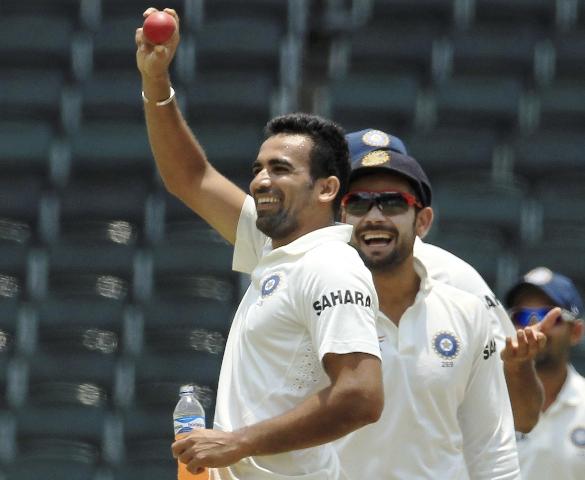
Zaheer takes 300th test wicket in comeback

Zaheer Khan (left) waves to the dressing room after taking his 300th Test wicket as Virat Kohli (right) watches during the fifth and final day of their cricket test match against South Africa at Wanderers stadium in Johannesburg, South Africa, on Sunday. / AP

Zaheer Khan became the fourth Indian to take 300 test wickets by removing Jacques Kallis on the final day of the first test against South Africa on Sunday.

Khan’s milestone arrived on his comeback test after a year-long absence from the long format of the game. His last five-day game before the series-opener in South Africa was in December 2012, but the wily left-arm seamer returned with 4-88 in the first innings at the Wanderers before taking Kallis’ wicket in the second.

Khan joins leg spinner Anil Kumble, all-rounder Kapil Dev and off spinner Harbhajan Singh in India’s 300 club. He reached his 300 in his 89th test. Kumble leads India’s wicket-takers with 619 in 132 tests and is third on the all-time list behind Sri Lanka’s Muttiah Muralitharan (800) and Australia’s Shane Warne (708).

www.thehindu.com / The Hindu / Home> Sport> Cricket / AP / Johannesburg – December 22nd, 2013

Smart vendor carts & homeless shelters that turn into shops

Eleven student teams from across the country have conceptualised innovative, implementable ideas that can make a huge impact and a difference to one’s daily life. The products, a result of those ideas, range from a one-stop smart card that can be used for 14 different kinds of public transport, to a clock that alerts a mother on the days her newborn is due to get vaccinations.

These ideas were showcased at the National Student Challenge (NCS), a competition held by the Indian Institute of Human Settlements (IIHS). Students had prepared for the challenge for more than six months. The competition was spread across various fields such as urban culture, basic services, urban poor, human development, safety and violence, livelihood, transport and mobility, affordable housing, etc.

The third edition of NCS saw the participation of over 1,100 teams from across the country, of which 25 were selected for the semi-finals that were held on Wednesday. Nina Nair, chief people officer and head, NCS said, “The concept of NCS is aimed at challenging the youth to stop wringing their hands and to do something about the things that irk them. This year, however, we made it mandatory that they come up with concepts that can be implemented. Thinking up ideas is easy; implementing it is the real hurdle. The 25 teams have done extensive research on the workability of their ideas.”

Here’s a look at some of the innovative ideas.

Innokart
In the wake of the Food Safety and Standards Authority of India recently issuing notices to street food vendors on maintaining cleanliness and hygiene, this innovation by a team of four from Jamia Millia Islamia, Delhi comes as a blessing in disguise for vendors.

Their idea: an improved food cart. Targeted at meal vendors, the cart comes complete with segregated dustbins, folding flaps where customers can stand and eat and storage and advertising space. “We studied vendors outside Nizammuddin railway station and in Saraikale Khan, Chandni Chowk, Sarojini Nagar and Karol Bagh. We found that most of the carts were huge and space-occupying. Vendors also dirtied the area around them. We will team up with National Association of Street Vendors in India to educate vendors on the importance of the carts,” said Huma Parvez and Nida Haque, who along with their team members Faiza Jamal and Ahmed Faraz Khan conceptualised Innokart.

Transpact
Two students from Jadavpur University, Kolkata have developed a concept that facilitates cashless transactions on any mode of public transport. Their idea: a one-stop smart card to integrate ticketing across 14 modes of transport. If their idea is implemented, a commuter needs only carry just one currency-loaded smart card which can be used use as a ticket on buses, Metros, taxis and autos. Since the origin of their idea is in Kolkata, the team has included travel on tram and ferry too. “It erradicates the change problem,” said Avishek Das. “We have also seen a lot of illegal tokens flood the existing system as well as paper wastage. To eliminate all that and to centralise the transport system, we came up with this concept.”

His teammate, Arunima Sen, added, “With this system we can also record patterns on commuter traffic and bring accountability to those running the system.”

Infilight
On a 20-day education yatra, Saif Khan and Imbesat Ahmed from IIT, Kharagpur stumbled on the poor electricity situation in villages of Bihar. Even though there were schools and teachers, the students could not pursue their studies, revise for exams and do their homework after coming back home due to long power cuts. But almost every child above Std VIII possessed a bicycle, thanks to the Bihar government’s Cycle Yojna scheme. It triggered the idea of a cost-effective lighting solution powered by bicycles. “Our innovation comes with a rechargeable battery that can be fitted to a dynamo which in turn is fixed to a bicycle. Using the energy generated from cycling, the dynamo recharges the batteries which can be used to power LED lamps that we will provide in the kit,” said Saif. The easy-to-fit device will be dust, shock and water resistant.

DRP
To address the problem of over seven lakh homeless people in India, a group of three from Piloo Mody College of Architecture, Cuttack has invented night shelters for homeless people. Their idea: prototype kiosks that can accommodate up to three people at night and can be used as small shops for grocery and other knick knacks. “Most of the people who are homeless in the cities are either beggars or daily wage labourers. These 7.35 sq mtr kiosks made of scrap block boards can be assembled anywhere and cost only Rs 1,200 to produce,” said Debadyuti Nandy, who along with teammates Rajarshi Das and Sraman Ghosh designed the kiosk.

Padawans
Have an elderly relative at home and are worried about his/her safety while you are away at work? No problem, says this group of friends who are from Vydehi Institute of Medical Sciences, University College London and Amity, Noida. Their idea: a portable, wireless emergency alert device in the form of a bracelet or pendant that automatically sends out an alert when the person wearing it is debilitated or incapacitated. “The aged usually suffer from various kinds of diseases and it is not possible to keep an eye on them all the time. Our device, which can be triggered by the press of a button, will send a message via a bay station to the hospital the patient is registered with, and to a close relative. Each device will have a medical ID that paramedics using our app can check to get access to critical health information,” says Shankhanil Chowdhury, who along with his brother Saurav Chowdhury and friend Prasenjit Lahiri developed the concept.

Badlaav
Two students have conceptualised a device that can serve as a timely reminder for mothers to get newborns vaccinated. Their idea: a wall clock that has an automated display issuing notification at regular intervals in visual and audio format from six weeks to 18 months of the child’s birth. The reminders are as per specified by doctors. Asmita Misra who worked on the concept designed by her teammate Sahil Goyal, learnt during one of her field researches that parents had no idea when to get their child vaccinated. “We found that they were given a card but did not know how to read it. An in-house alert system was the need of the hour. For illiterate mothers, we have installed a small audio reminder that will start reminding the family three weeks prior to the date of vaccination – once every week,” she said.

Kaizen
Railway terminals are often a garbage dump with travellers and commuters throwing away used mineral water bottles and other plastic items. This not-so-pleasant sight caught the attention of a group of friends studying at Vellore Institute of Technology who have come up with an idea to improve the recycling process. Their idea: development and deployment of plastic collection machines in cities to deposit plastic bottles in exchange for a nominal amount of cash. “Ragpickers usually sort out plastic bottles at source. We plan to have them bring the collected mass to our kiosks at railway stations. And like systems in the West, they will get paid for feeding the bottles into the machines which will then compress it, thus enabling the transportation of more bottles at one go. These machines will also have sensors to detect pet bottles from ordinary plastic and separate them. The amount ragpickers bring in will be weighed and they will be paid a fee that is at least Rs 2 higher than what they get per kilo now,” said Yashanshu Jain, a of the team members who has worked on the concept. The other members of the team are Sarang Surve, Piyush Pangarkar and Rohit Kumar Tiwari.

source: http://www.bangaloremirror.com / Bangalore Mirror / Home> Bangalore> Others / by Tapasya Mitra Mazumder, Bangalore Mirror Bureau / December 17th, 2013

Mines officer from Bellary goes missing in Odisha

IbrahimShariffMPos02dec2013

Sandur (Bellary dist):

Ibrahim Sharief, a resident of Yeshwantnagar in the taluk, who works as an assistant controller of mines with the Indian Bureau of Mines in Odisha, reportedly went missing on November 25.

Except his two-wheeler found near a private hospital, there have been no clue about his whereabouts, said the worried family members of Sharief. The 36-year-old officer, known for his uprightness, had left home for work in Bhubaneshwar, around 10 am.

When he didn’t return home for lunch, his wife Salma Begum called him on his cellphone which was switched off. Panicked, she enquired at the office where she was told that he had not come to work.

She informed her family members in Yeshwantnagar immediately and registered a complaint with the police.

During the investigation, the police found his two-wheeler abandoned in front of a hospital near his office.

His brother Subhan told Deccan Herald that even after a week since Ibrahim went ‘missing’, the family has received no information either about him or about the progress in the investigation.

He urged the Odisha government to direct the police to probe the matter at the earliest.

Ibrahim’s father Giddu Sab, with tears in his eyes, said that the last time he saw his son was when he had come home for Bakrid. He prayed for Ibrahim’s safety.

Sandur legislator E Tukaram said that he had discussed the issue with the Home minister and the DG&IGP of Karnataka, who are in touch with their counterparts in Odisha. The matter was raised in the ongoing winter session in Belgaum, he said.

source: http://www.daijiworld.com / DaijiWorld.com / Home> Karnataka / Sandur (Bellary District) DHNS / Monday – December 02nd, 2013

Officer missing case: “Will send team to Odisha if needed”

Karnataka  government was in touch with its Odisha  about an official of Indian Bureau of Mines hailing from the state who is reported missing for the last one week, Home Minister K J George said today.

“Government will send a team there (Odisha) if need arises,” George told reporters here, when asked about Assistant Controller of Mines 34-year old Ibrahim Sharif, who is reported missing since November 25 from Bhubaneshwar.

Hailing from Karnataka, Sharif has been staying with his family at Nigam Vihar in Phase-II of Kanan Vihar under Infocity police station area in Bhubaneshwar.

Sharif’s wife Salma Begum in her FIR had said he remained untraceable since he left for office in his scooter at 10 AM on November 25. His mobile was activated only for two seconds on November 26 and located a Allahabad at that time.

Suspecting abduction of her husband, Salma Begum appealed for his safe return.

Sharif, whose nature of work made him visit mines and undertake inspection for enforcement of rules of mineral conservation and development, reportedly last visited some mines in Barbil area of Keonjhar district in Odisha in September.

source: http://www.business-standard.com / Business Standard / Home> PTI Stories > National> News / by Press Trust of India / Belgaum – December 02nd, 2013

Unani regimen offers hope to mishap victim

Imran Khan, a resident of Tumkur, had been bedridden for the best part of 12 years after nearly 200 kg of steel fell on his back when he was visiting a construction site.

The 28-year-old lost all hope of walking again till he found out about Ilaj bit Tadbeer (regimental therapy), a little-known system of unani medicine involving massage, cupping and leeching using herbs. Imran underwent 14 months of continuous treatment at the National Institute of Unani Medicine (NIUM), which falls under the Ministry of Health and Family Welfare. Now, he has started walking with support.

The story of Tousif Ahmed from BTM Layout is similar to Imran’s. Tousif injured his spine in an accident in Andhra Pradesh in January 2012 in which his uncle died.

“I was told by a private hospital that I would not walk again and would be bedridden for the rest of my life. But with intervention from NIUM, I am moving in a wheelchair and also walking with crutches,” he said.

Tousif has been receiving treatment at the Institute for the past four months. He is currently shooting videos of recovering patients at NIUM in order to make a short film.

“I had wanted to set up a call-centre after getting my BCA, but the accident crippled my dream. But as I can move again, I have set a target of five months to walk out of this hospital,” he said.

Dr D A Muzzaffar Bhat, resident medical officer of NIUM, said the centre was focusing on neuro-rehabilitation. This included attending to patients who suffered from stroke, myopathy, epilepsy, motor-neuron disease, Parkinson’s disease, hemiplegia and paraplegia. He said NIUM takes up cases referred from other hospitals like NIMHANS.

He referred to the successful treatment of Mohammed Farooq, who was admitted to Victoria Hospital after meeting with an accident. He was bedridden for eight months with no sensation in his lower-back. Farooq started treatment at NIUM in January and is now walking with the help of crutches.

“No surgeries are done here and our approach is to develop cells and strengthen nerves and muscles,” Dr Bhat said .

Options for Cerebral Palsy Aditya Kholi greets you with a smile and offers a chair to those who approach him and only when he tries to walk, do people notice a problem.

Aditya is a child who was born with cerebral palsy and could hardly move his legs. His father Mahesh Kohli, an IT professional, had quit his job in Dubai to research treatment options for Aditya, when a friend told him about Ilaj bit Tadbeer.

After five months of treatment, Aditya can now sit comfortably and also fold his legs and walk.

source: http://www.newindianexpress.com / The New Indian Express / Home> Cities> Bangalore / by Mohammed Yacoob – Bangalore / November 18th, 2013

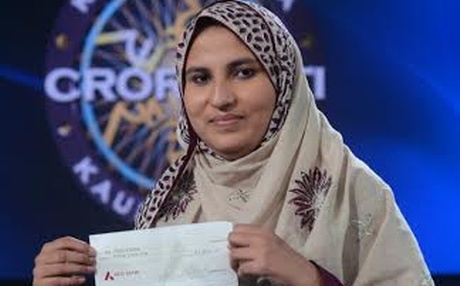
Firoz Fatma Becomes First Woman ‘Crorepati’ of KBC7

Firoz Fatma - the first female crorepati of KBC 2013.
Firoz Fatma – the first female crorepati of KBC 2013.

Firoz Fatma from Saharanpur has emerged the first female crorepati of the 2013 edition of popular reality TV game show “Kaun Banega Crorepati” (KBC).

She took home a jackpot of Rs.1 crore from the show, hosted by Bollywood megastar Amitabh Bachchan. Her victory will be showcased on the season’s last episode Sunday.

A Bachelor of Science student from Uttar Pradesh, Fatma participated in the game show to win a certain amount to pay off her deceased father’s loan.

Fatma had lost hope to make it to the hot seat this season, but she finally found her lucky moment.

“I was very nervous when I wasn’t able to make it to the hot seat in the second last episode and felt I have to go home empty handed. But then I aced the fastest finger first round and made my way to the hot seat,” Fatma said in a press statement issued post her Rs.1 crore victory.

“Also, I didn’t feel as the one-crore winner until the audience clapped and Bachchanji hugged me. It is a great feeling,” she added.

Fatma credits her pool of general knowledge to newspapers and news channels.

Now the young lady wants to help her family get rid of her father’s loan, and invest some money in studying further for a brighter future. She also wants her mother to live a tension-free life.

KBC is the Indian adaptation of international format “Who Wants To Be A Millionaire”. KBC first went on air in 2000.

Except the third season, which was hosted by Shah Rukh Khan, Big B has been in the anchor’s seat for all KBC seasons.

source: http://www.newindianexpress.com / The New Indian Express / Home> Entertainment> Television / by IANS / November 28th, 2013

‘The Great Akbar’ of Independence struggle

Azad’s greatest gift was to postulate an equation between Islam and Indian nationalism on the one hand, and between Islam and the universal principles, on the other

Height about 5’ 5’’; exceptionally thin; noticeably fair; age about 33 years; has practically no hair on his face though he does not shave; long sharp face with prominent nose. This is the “official” description of Maulana Abul Kalam Azad, the golden boy of the Independence struggle. With his confidence, charm and sincerity, Azad impressed people of his age group with his sharp and swift mind. Later in years, he especially cultivated a look of venerable age to give a suitable background to his learning. His genius and method were too individual to found a school, but his writings and lectures exerted a profound influence owing to the breadth of view and patient learning. Rajaji described him as ‘The Great Akbar of Today’.

Unease with conformity

The study of Azad’s early life is, however, hampered by a deficiency of data. But there is ample evidence to indicate his discomfort with the traditional order of things. This was enough to rouse his scorn. So is his unease with taqlid or conformity. Is Islamic doctrine so rigid and dogmatic that it leaves no room for intellectual creativity? With this bent of mind, he broke off the shackles of fossilised theology, and critiqued all those elements in theology that inhibited the progress of empirical science and the unlimited process of their utilisation. His views on the spread of a materialistic way of life and the stagnation and retardation of religious life became well-known, but this phase in his life — when he “saw in religion only ignorance” — proved to be momentary. Once he regained his faith, he worked out a synthesis between the reformist and orthodox philosophies. He did not go too far in this journey, but went far enough to disturb thestatus quo.

The awakening at Aligarh’s M.A.O. College fostered ideas on reforms, interpretation, and innovation among the Muslim intelligentsia. Syed Ahmad Khan moulded young Azad’s thinking. He did his very best to read his writings and admired them. He also admired Shibli Nomani, founder of the Nadwat al-ulama in Lucknow. And when the Nadwa alim turned pan-Islamist after the European intervention in the Balkan States, Azad too stressed that the bonding with the Turks was unique insofar as they were a part of the Islamic community as well as its last political centre.

One has only to cast a glance at some of Azad’s early writings to realise that he entered the valley of doubts and uncertainties to demolish the suppositions that had guided theologians. He opposed the ‘scripturalists’ or the ‘literalists,’ because they advocated rigid adherence to the fundamentals of Islam, as literally interpreted from the Koran and the Sunna. His interest in the externals of religion, too, diminished. At the same time, he was consistent in his authentic inward piety. Just as he was ready to comprehend the whole Koran within the verses of the first Surah, so he conceived and pursued the politics of Islam within the Koran’s dimension of piety.

The Muslim communities were divided by geographical situation, by differences of dialect and custom and, in some cases, by the deeper chasm of sectarianism, but pan-Islamism inflamed their passions, a feeling that, although they had been ground down under the wheels of history, they thought of themselves as a mighty society spread worldwide. Azad, for one, was attached to the common inheritance of Islamic culture and explored the treasures of thought and emotion which belonged to the umma. He proceeded naturally from the conviction that education, liberalism and faith in progress were requisites for Muslim empowerment.

Setting a great example of moral leadership during World War I, Azad became the soul of the Congress party. He opposed Partition heart and soul, while a great body of his compatriots clamoured for a Muslim nation. He could not conceal the contempt that he felt for them, and at no stage in his public career did he stoop to compromise. The spectacle of Indians working out a new way of life and boldly defying the accumulated prejudices and animus of the past was one which aroused his interest and curiosity. Without looking around to find a mirror that might reflect radical faces, he identified pluralism to be the weapon of the strong and the weak against the British. He preferred the conviction of Dara Shikoh, the eldest Mughal prince and a victim of Aurangzeb’s conspiracy, that in the search for the ultimate Truth, mosques as well as temples validly mediate the one candle’s light.

Harmonious and creative Islam

Azad’s greatest gift was to postulate an equation between Islam and Indian nationalism on the one hand, and between Islam and the universal principles, on the other. He did so to enlarge our conception of what is possible, enrich our intellectual imagination, and diminish dogmatism which closes the mind to ijtehad. With his belief in an integrated, harmonious and creative Islam, he adumbrated the outlook of a religious humanist, very much in the line of the humanism embodied in the classical Persian Sufi poetical tradition. He envisaged an Islam not of sectarian belligerence but of confident partnership in a cultural and spiritual diversity where a strident divisiveness would be its betrayal.

Maulana Abul Kalam Azad, Minister of Education in free India and sponsor of an ‘official’ history of the 1857 Rebellion, referred to the two communities standing ‘shoulder to shoulder’ to liberate themselves from the British yoke. Why did Azad and others think that it was worth their while to make this point? Probably, to record the regret that “the British swept away and rooted out the late Mughals’ pluralistic and philosophically composite nationalism,” and to bemoan that they ensured that common action by Hindus and Muslims would in future not be accomplished easily.

Shakespeare’s view of life in one of his plays is that, “round the lonely great ones of this earth there is inevitably a conspiracy of envy and hatred, hatched by the base and common sort.” On December 30, 1941, the gates of Naini prison outside Allahabad opened for Azad; on August 9, 1942, the new gate of the old Ahmednagar Fort prison closed behind him.

Earlier, its mention would invariably bring to his mind several forgotten footprints of time and presented, page after page, six centuries of history. And yet, “in this world of thousand caprices and moods, so many doors are opened to be closed and so many are closed to be later thrown open.” Hence, between July 15 and August 5, 1942, he went around the country for consultation with the Congress leaders.

Azad spent a total of 10 years in jail. Thrown into a new world whose geography did not extend beyond a hundred yards and where the population was no more than 15 faces, he was overwhelmed by the morning sunlight and the evening darkness. Like Antonio Gramsci, Azad conceived of writing something that might absorb him and give a focus to his inner life. For this, he read a great deal. He drew the guidance and motivation from the reading of Scriptures. It is important to realise — and important particularly for the full knowledge and comprehension of times past — that internment kindled Azad’s Islam into warmth and fervour. Like Aurobindo Ghose who found God as a result of the wrath of the government, he felt comforted and serene. And like the future sage of Pondicherry, he found it impossible to explain the love of motherland or sacrifice to the thick-skinned Britons in India.

Independence came with Nehru’s ‘tryst with destiny’ speech, but Partition plunged Azad’s spirits into depression. “There is no more certain test of statesmanship,” wrote H.A.L. Fisher in his History of Europe, “than the capacity to resist the political intoxication of victory.” Though hurt and wounded by a colossal tragedy, the otherwise distraught Azad carried his tribulations with a stoical dignity and pursued his active role through stresses of inner disquiet. Ultimately, he suffered for the sake of truth. He had noted in one of his many elegant passages that, “the flowering trees whose offspring once represented beauty and grace were now lying in a heap in a corner, like burnt out bushes and trampled up grass.” The story which opened with the bright colours of the Al-Hilal and Al-Balagh closed in deep shadow.

Like the Urdu poet, Mir Taqi Mir, Azad could only voice affirmation of the historical process or protest against the iniquities of time and the suffering it caused to the sensitive mind and soul. He had indeed no small talk, and no time for it, or for little human foibles, but in his famous speech after independence at the Red Fort in Delhi, he lambasted those Muslims who threw themselves more and more deeply into the communal vortex. At the same time it must be said to his credit that, in the turmoil raging around the Muslim communities, Azad secured them the comfort of peace and security. Lesser men found conflict in the rich variety of life, but Azad was big enough not only to see the essential unity behind all that diversity but also to realise that only in this unity can there be hope for India as a whole and for those great and varied currents of national life.

(Mushirul Hasan is a historian of modern India. He has edited a book Azad’s Legacies: Islam Pluralism and Nationhood (forthcoming)

source: http://www.thehindu.com / The Hindu / Home> Opinion> Lead / by Mushirul Hasan / November 08th, 2013
Braving adversity : A tale of courage

Here’s a story of exemplary courage and determination. A story of how a young boy, who lost his hands and a leg in a mishap, braved adversities to literally guide the 

City out of chaos.

Like any other restless child, 11-year-old Salman was flying a kite atop his house when he suddenly saw the kite descending. In a bid to get hold of the kite, he ran towards the parapet wall on the terrace. He then slipped over the wall and fell straight on to a live wire. Salman lost both his arms and a leg in the process.

Today, 21 years after the incident, unable to find a job to feed his family, Salman stands at a busy junction near Miller’s Road directing traffic. He is there from 11 am to 8 pm. He has been at this spot for the last 18 years.

Salman was employed at a few places before he decided to do this. His previous employees sacked him citing silly reasons. One said he didn’t know English and couldn’t communicate well, the other said they wanted people who could run around.

“After I lost my hands and one of my limbs, I couldn’t go to school. I don’t know how to read and write and after being humiliated at several places, I thought I could help people by easing the traffic at this busy junction where there is no traffic police at any time of the day,” says Salman.

Salman is a familiar face to those living in the vicinity and this stretch where he stands, connects Miller’s Road to Benson Town.

It is a one-way but violations are aplenty and although there is a steep turning, people drive at high speed unmindful of the traffic ahead. Salman gets tipped anything between Rs 5 and Rs 20 a day.

“I don’t ask for alms but people generously give me some money and together I manage to make about Rs 200 a day. This just about covers my transport and food expenses for a day. It is better than working in a stifling environment where you are looked down upon,” he beams.

The residents say Salman’s presence has made a significant difference in easing the congestion.

Mujib, a businessman who lives across the street, says he never fails to tip Salman.
“People wait for Salman to come and motorists actually listen to him and follow his
directions. He’s doing a service that even the traffic cops don’t do with as much dedication.”

Nasir, who works with a logistic firm and lives in Benson Town, says he has been seeing Salman for the last couple of years.

“It’s a great service that he’s doing. If not for him, this narrow road would have been chaotic. We miss him on days when he’s not around,” Nasir sums up.

source: http://www.deccanherald.com / Deccan Herald / Home> Supplements> Metrolife / by Nina C. George / DHNS, November 25th, 2013