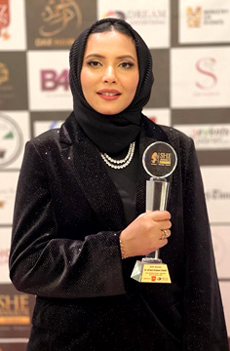
Dr. Afreen Mubeen Sheikh, a native of Mangaluru has made her hometown proud when she recently won the SHE Award in Dubai for her dedicated service to her profession and for contributing to the cause of women empowerment in UAE.
Dr Afreen is an alumnus of K S Hegde Medical Academy where she pursued her MBBS. She later did her Diploma in Obstetrics and Gynaecology from the Royal College of Physicians of Ireland.
Dr Afreen is a mentor and coach for foreign medical graduates seeking medical licensure in the UAE. She is a women’s health consultant in Mamahood, Dubai. Her expertise and guidance have empowered countless mothers to make informed decisions about their health and well-being. She has also successfully founded a women’s modest fashion brand by name ’Hayaa by Afreen’ in Dubai and also has a popular blog page by name ’The Whitecoat Mama’ on Instagram.
She uses the platform to raise awareness about women’s health and Gulf medical exams. She’s not only a respected medical professional and social media influencer but also a brand ambassador for several renowned brands in the UAE. Dr Afreen’s inspiring journey and her achievements were featured in a popular Dubai magazine ’Xpatzhub’ in October.
Dr Afreen is married to Dr Mohammad Mubeen who is a Paediatric Intensivist.
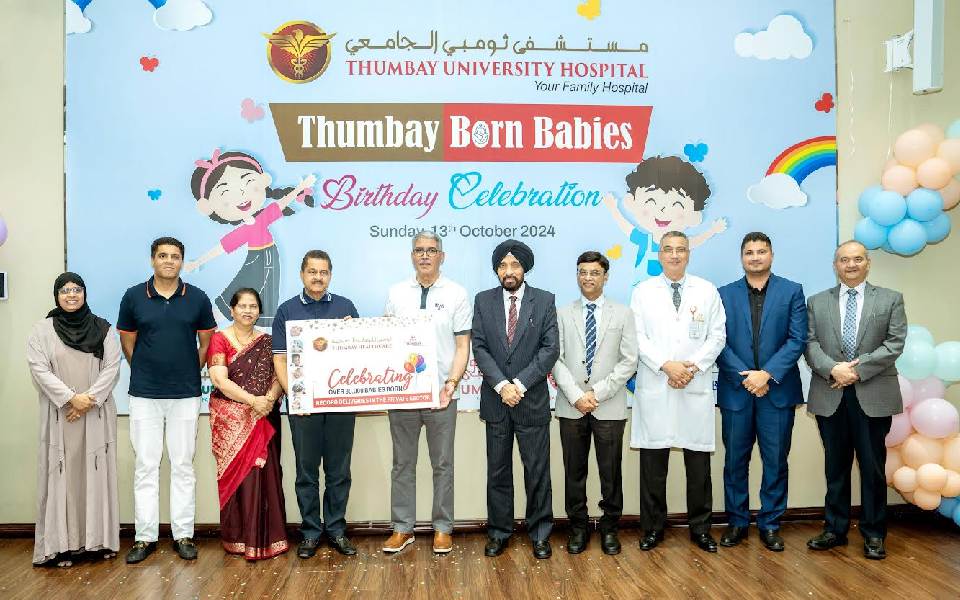
In honor of its achievement of over 90,000 deliveries, Thumbay University Hospital, UAE’s largest private academic hospital owned and managed by Thumbay Group, hosted a special event.
The festive occasion took place at the Thumbay Medicity (Al Jurf, Ajman), offering an evening filled with joy, laughter, and memorable experiences for the attendees present.
Since the first delivery in January 2003, Thumbay Healthcare has successfully conducted over 90,000 deliveries, significantly contributing to its growth and establishing itself as the UAE’s most sought-after family hospital for maternity care. The Obstetrics and Gynecology (OBG) department serves approximately 35,000 patients annually and is equipped with 10 state-of-theart labor and delivery rooms, a dedicated OBG emergency unit, and specialized operating theatres. Additionally, there is a postnatal ward with private rooms for new mothers, ensuring a comfortable and supportive environment during their recovery.
The event was graced by the presence of Chief Guest Dr. Thumbay Moideen, Founder President of Thumbay Group, along with Akbar Moideen Thumbay, Vice President of Thumbay Healthcare.
The celebration featured various activities designed to engage both children and adults. Highlights included balloon twisting, magic shows, face painting, and a best-dressed babies’ contest, with three winners announced. The event culminated in a cake-cutting ceremony that signified the growth and joy shared by infants and their families over the years.
Attendees also had the chance to participate in a raffle draw, with five winners receiving surprise gifts aimed at enhancing their parenting experience. A dedicated photo booth was available for families to create personalized keepsakes. Additionally, parents received vouchers for a health check-up valued at AED 3,499, available for AED 399, as well as a free dental consultation.
“As we commemorate the remarkable achievement of 90,000 deliveries within our hospital family, we recognize the profound honor of being part of these significant milestones in the lives of so many. It is a privilege to support the early development of each child, who represents the hope for a healthier and brighter future. Together with their families, we take pride in witnessing the growth, milestones, and vast potential that these new lives will contribute to our community. This milestone reaffirms our commitment to providing exceptional care and nurturing the next generation, ensuring that every child has the opportunity to thrive,” said Akbar Moideen Thumbay, Vice President of Thumbay Healthcare.
The hospital also offers an affordable maternity package, further enhancing its commitment to accessible and quality care for families. Maternity package at Thumbay University Hospital includes consultations with specialist gynecologists, free delivery booking, and antenatal classes. Priced at AED 5,499 for normal deliveries and AED 8,999 for C-section deliveries, the package is designed to diagnose, monitor, and prevent health issues, promoting healthier lifestyles for expectant mothers.
source: http://www.english.varthabharati.in / Vartha Bharati / Home> Gulf / by Vartha Bharati / October 16th, 2024
Unpacking the politics behind the Indian fashion industry’s biggest—but unsung— shareholders
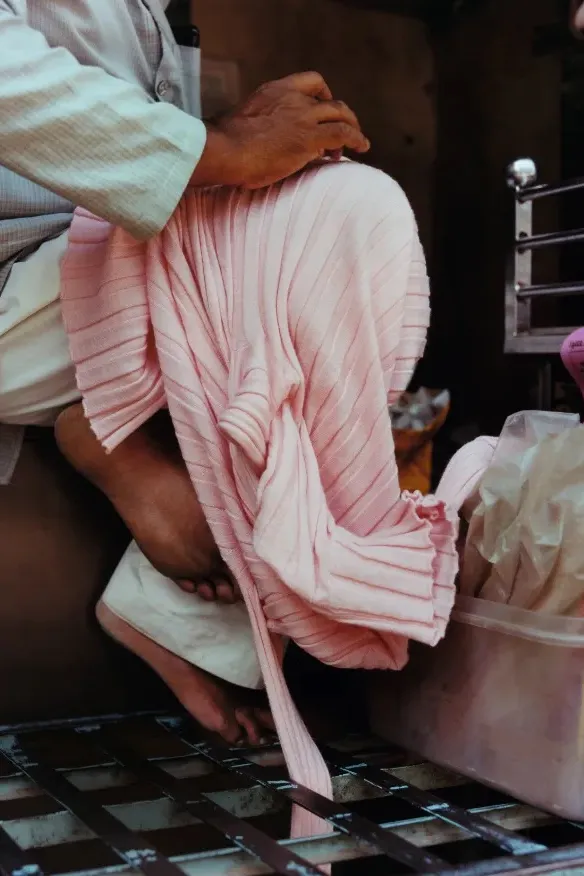
Photo: Bikramjit Bose
At first glance, Indian jewellery brand Olio’s Instagram feed looks like any other of its kind: a visually resounding moodboard of sorts, chock full of Bollywood references, 90s nostalgia, and whimsical photos of its maximal, statement jewellery that is unforgettably cool.
But dig just a little deeper and you’ll find that beyond the beautiful aesthetics and jewellery accents, Olio isn’t afraid to make a cultural, social, or political statement. Case in point, when user ‘Shreya’ left a review for Olio’s website accusing them of ‘misinformation’ for attributing the origins of the haath phool to the Mughals “who brought it to the country by way of Persia,” as per Olio. But ‘Shreya’ claimed that the haath phool “is a Hindu jewellery that has nothing to do with Mughals”. So, Olio dedicated a post as ‘a history lesson for Shreya’ on how the Mughals played a pivotal role in shaping the art of jewellery-making in India. More on that later in the story.
In a country with over 5,000 years of history, the rise and fall of countless civilisations, the reign of rulers from all over the world, and 200-year-long colonisation, to deem something purely from one cultural corner is an abject erasure of aspects of the history of one the world’s oldest civilisations. “It’s just so crazy that people just want to rewrite history. We are so multicultural, and it comes from our history; there’s beauty in this diversity,” exclaimed Aashna Singh, one-half of Olio’s founding duo.
This might seem like any other incident of someone confusing their facts about history, but the erasure of the part of history that Singh is referring to is specifically that of Mughal and Islamic influence on India.
As represented by ‘Shreya’, there seems to be an increasingly divisive and communally charged sentiment amongst people bent on homogenizing what is a polychromatic amalgamation of cultural influences on our clothes, jewellery, art, culture, culinary history, among others, and in effect, risking the oblivion of its colourful tapestry of heritage, something Singh witnessed first hand with her brand. “That was the first time we took a strong stance about something, and it was very interesting to see the reaction to that. I mean, you also get a lot of love, and people who appreciate it appreciate it a lot. But then there have been customers who wrote to us saying they’re not going to shop with us again because they were just so upset by it, which is scary.”
But what does jewellery, and its design history, have to do with the country’s current inflamed state of religion-based viewpoints? According to Umair Shah, co-founder of a creative studio that works with lifestyle brands, and an amateur historian, a lot. “We need to understand that most of the ancient craft we cannot simply call ‘ours’ because everything has a nuanced historical aspect.
If you talk of silk that is used to adorn idols in the temples, it came through the Silk Route from China.
If we talk of carpet weaving in Kashmir, it came with Shah Hamdan, a Persian saint, scholar, and religious leader of the 14th century AD.
Zardozi came with the Safavid empire in Iran; what Suzani is in Central Asia just became Sozani in India.
All of these arts and crafts that are now celebrated in India have a cross-cultural, cross-boundary relation or derivation. And you will find that often the people who are carrying forward these traditional skills today in India may have ties that originated from those regions.”
“It serves as an element of forming your identity. One of the biggest reasons behind that was the absence of a caste system that could be related to any profession, whereas a majority of the population in medieval times were working as per their caste. But with a lot of Muslims, they were doing any kind of job that was fitting for them. Incidentally, one of the most important industries for India happened to be textile.” Shah further added that when we erase the association of religious identity, its ensuing history and heritage, with the karigars, we risk losing the identity and the history of the craft itself.
Make no mistake, India appreciates, celebrates, and continues to buy what is commonly known as ‘Mughal’ art and design, but Shah pointed out that’s only the case until something starts looking “too Muslim”. “A lot of crafts that we see in the market are popular because we have a tendency of fetishising anything that’s ‘Mughal’, so to speak. But the fetishisation is for the craft only, and not for the karigar. You don’t want to be associated with their religious identity.”
Last year in October, an Indianwear brand was forced to remove its ad after online outrage poured in over using an Urdu phrase, ‘Jashn-e-Riwaaz’, meaning ‘celebration of customs’ for their Diwali campaign. “Deepavali is not Jash[n]-e-Riwaaz. This deliberate attempt at abrahamisation of Hindu festivals, depicting models without traditional Hindu attires, must change. And brands should face economic costs for such deliberate misadventures,” tweeted a political leader. A year prior to that, in October 2020, a prominent jewellery brand’s ad faced similar outrage, this time for supposedly promoting “Love Jihad” in an ad that showed a pregnant Hindu woman escorted by her Muslim mother-in-law for her baby shower ceremony. The jewellery giant eventually took the ad down from all its digital platforms.
Kallol Datta, a Kolkata-based clothes-maker and finalist of the Jameel prize, is of the opinion that the root of the problem doesn’t lie in the lack of awareness of Persian and Mughal design influences. The problem is in a different ballpark and, as Datta predicts, is set to snowball into something of a different scale in the future. “Right now, you have fascists posting instructions on social media on how to do away with Urdu words in your vocabulary and substitute them with Hindi words. This could soon also include instructions on design language.”
Amidst Indic and Mughal influences, and the black and white of what’s ‘our’ history, and what’s not lies a line that is extremely blurred. The line being of who influenced what, and at exactly what point in time, or if a ruler’s reign affected change in the architecture or design of the era. When an idea is inspired by somewhere else it is often transformed into something new.
That’s why Pramod Kumar KG, who is the managing director of Eka Archiving Services, founder director of the Anokhi Museum of Hand Printing, and the first director of the Jaipur Literature Festival, emphasizes the importance of looking at the history of design, in all its forms, from a much more nuanced lens. “We look at something and we assume that this is Mughal design. We don’t realize that this is an assimilation of different things over the centuries which has come down to us in a certain form. We have brilliant portraits of, say, Jahangir wearing a bandhani patka waistcloth, bandhani being a technique that is more indigenous to the country or to the subcontinent. So this constant moving back and forth existed. Sometimes it’s convenient for us to look at something and say, ‘That’s Mughal, this is Rajput, this is Hindu, this is Muslim’. But the fact of the matter is that all of them are incredibly layered – designs, motifs, and even garments. It’s not a blanket answer and I really wish people would look at it that way and realize that we are far more than just one or the other.”
When I asked Sarthak Kasliwal, the youngest partner at Jaipur’s iconic jewellery institution, The Gem Palace, what he makes of such ‘influence’, he replied with a much more simplified version: “Artists always get inspired from different places. There’s no originality in anything in the sense that the first was also created by getting influenced by something else. So no one can actually own it. You date back in history, you say it because you know that part. You can trace it back. But to what date? And what about before that?”
Beyond debates and discussions of history, heritage, and lineage of craft forms, something much more tangible lies at stake – the livelihoods of generational Muslim karigars if their art is disassociated from their identity. But why should the fashion industry care? As per Datta, “The pattern cutters, sewing machinists, hand embroiderers, weavers, dyers and printers – a majority of people engaged in fashion production are Muslims. Fashion gets to profit off of culture and craft. But you cannot profit off the labour of an entire community and stay quiet when the same community is subject to intimidation, diminished access to education and livelihood.”
But as Kumar pointed out, “Everybody’s just too scared to speak up at all, to say anything contrary that’s also important. Be it celebrities or designers, nobody wants to toe that line. But by being silent, you’re equally a party to the problem.” That is why Shah thinks that designers and design houses hiring Muslim karigars need to step up. Beyond fair pay and regular work, Shah insists that they need to be given assurance that they work in an unprejudiced environment. “Beyond getting their work done by the karigars, designers need to be aware of the situation in the country and the realities of the lives of the people who are working for them. All these people don’t have a voice today. If they are getting humiliated or threatened, they will likely not know what to do about it. They need reassurance that the brands they’re working with will at least be their voice if something untoward happens.”
The way ahead is, undoubtedly, a more inclusive and diverse design and cultural sentiment wherein every influence is celebrated as part of the country’s fabric, agreed Kasliwal who envisions the same as a young businessperson and the heir of a prestigious design institution.
Singh and her partner Sneha Saksena, too, shared that they intend to use their privilege and Olio’s platform “to do the right thing”, even if it costs the brand a few angry customers or negative reviews. “ Fashion can be very frivolous sometimes. It’s just jewellery at the end of the day. Like, what am I doing? I’m just trying to sell jewellery. But if we can have an impact by using our privilege and our platforms to protect the most vulnerable, then why not? Because otherwise, what’s the point of it all?”
source: http://www.vogue.in / Vogue India / Home> Fashion / by Shubhangana Das / September 23rd, 2023
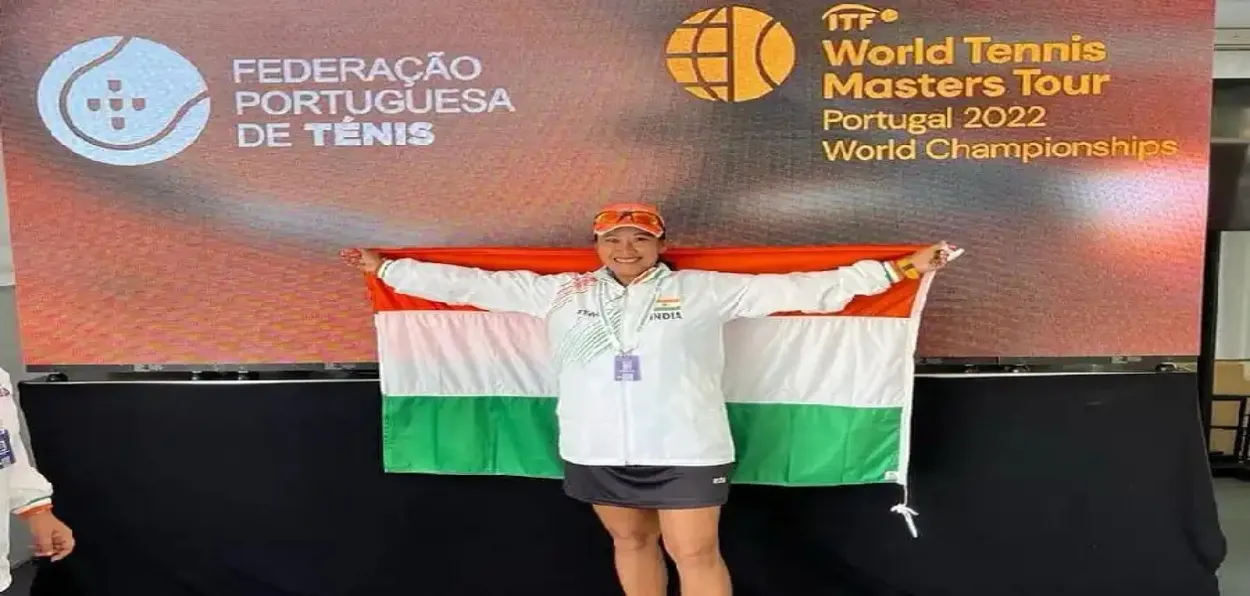
Nanzeen Rahman Zaffar at the World tennis Masters’ Tour in Portugal
A woman in her 40s; a homemaker, a doting mother, and an ideal daughter-in-law – Nazneen Rahman Zaffar of Guwahati is all this yet has a distinct identity. She is an international tennis player.
Nazneen proves that age is no bar to success She is a mother of two children manages her family well and is yet able to find the time and energy to excel in sports.
“I played sports in school but never got into sports professionally. In college, I was focused on studying. I started playing late in life after I got married.’ After 10 years of playing tennis, she took a break to care for her children and family.
“I started playing tennis in 2011 and the next year, I participated in the state-level tournaments. Tasting success, I was even more interested in playing, and later on, I trained well and played at the national level,” Zaffar told Awaz-The Voice.
Nazneen Zaffar playing tennis
Later Nazneen Zaffar finished among the top 10 at the ITF Masters.
She says her daughter encouraged and inspired her to play tennis. Her daughter is currently pursuing her higher studies at the A&M University in Texas.
“When I took my daughter Raina Zaffar to the stadium for tennis training, I too wanted to play. Some of my friends always told me that I played good tennis and I should continue. They told me that they wanted to see me at the international level in Indian colours. I thought; why not give it a try? I participated in the international games held by the All India Tennis Association in Haryana where I won my first trophy in the doubles event.”
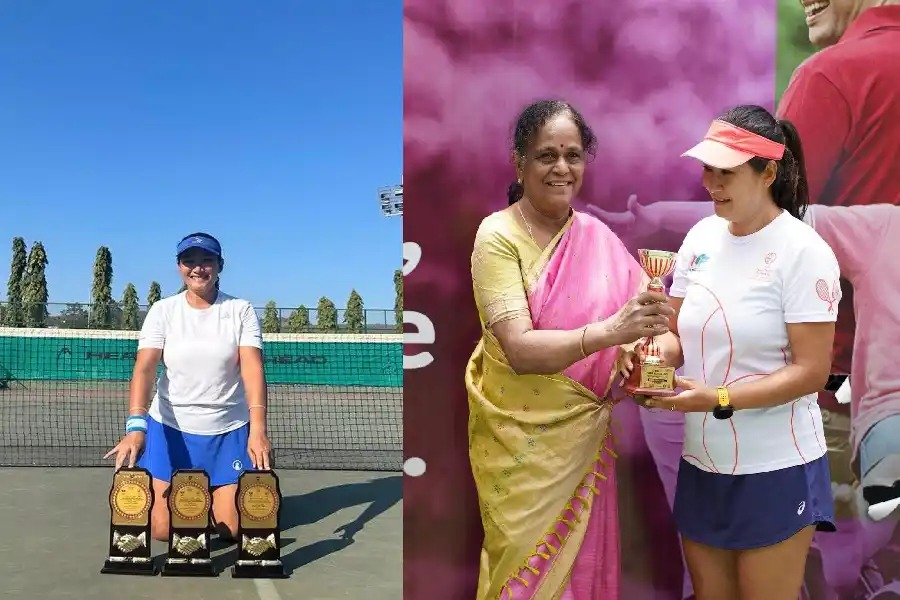
Nazneer Zaffar with her trophis and receiving a trophy
Nazneen Zaffar won the All Assam CTC Mixed Doubles titles in 2023 and 2024, finished runner-up in World Masters Tournament 200 in Dubai in 2023, won titles in Masters Tournament 200 in Guwahati and in Darjeeling in 2023 and a Masters Tournament 100 in Gurugram in 2023.
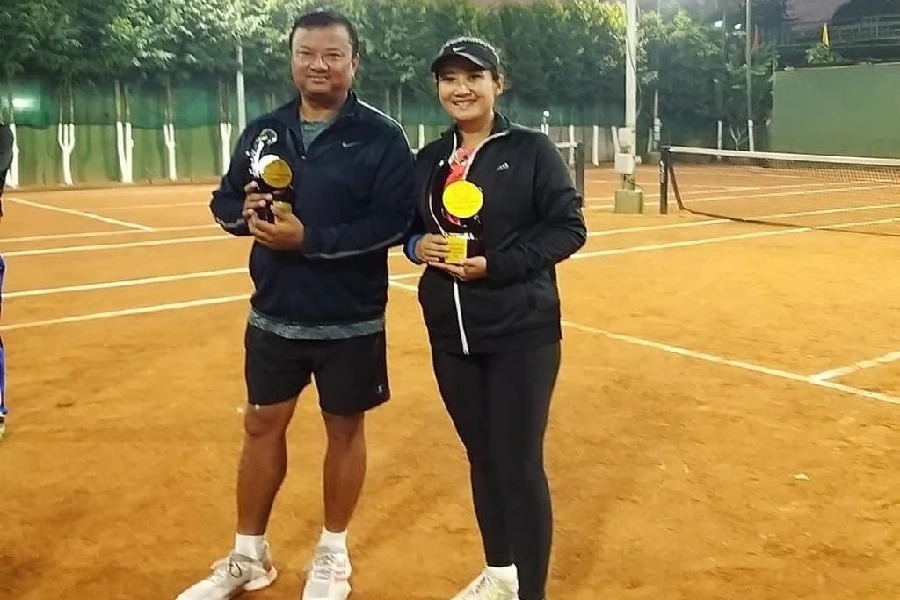
She also won the doubles title in a Masters 400 in Thailand.
“I gradually started participating in more tournaments and my ranking improved. Then when India sent a women’s team for the World Championships, I was appointed its Captain.”
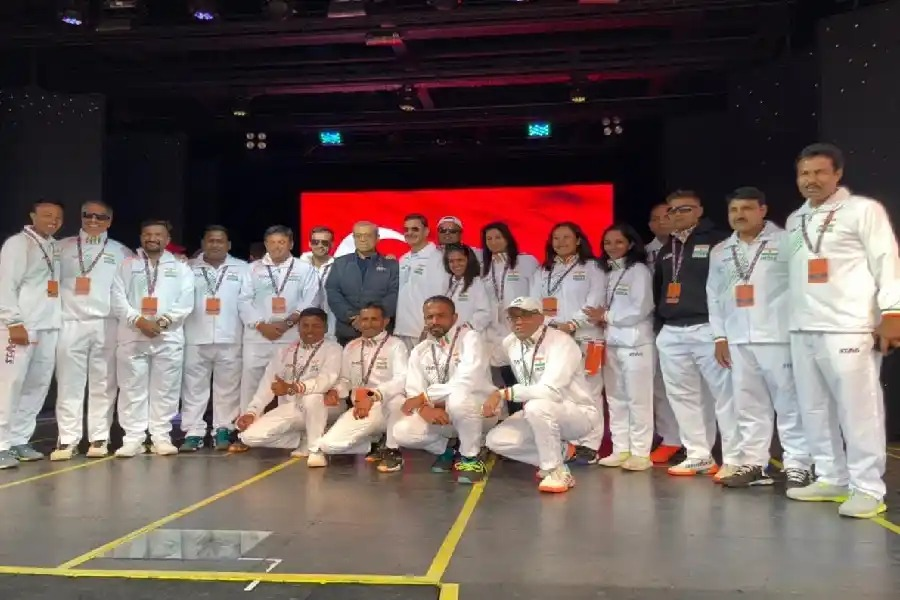
She took the first women’s tennis team to Portugal. “Most importantly, every player in our team was a mother. It’s nice to think that we have made a distinct identity after having children.”
Nazneen Zaffar with her husband Shahnawaz Zaffar.
Nazneen has broken the myth that it is difficult for women to maintain physical fitness after becoming mothers. Nazneen is an athlete and an active fitness influencer on social media as well.
“I think sports and physical education are always complementary. When I had to take my daughter to different places for sports, I had to take care of her body and fitness. Since it becomes too expensive to take a fitness coach with us every time, I studied how we can keep ourselves fit; and how a tennis player can take care of her fitness.”
“It becomes quite difficult for women of my age to keep fit after bearing children. Many women give up self-care. However, I believe that every woman should take care of herself, not just because she has to play sports, but for her physical and mental health. They must walk and do yoga. Muscle formation slows down in a woman after the age of 30. On the other hand, when the time of menopause comes at the age of 40, many hormonal imbalances occur.
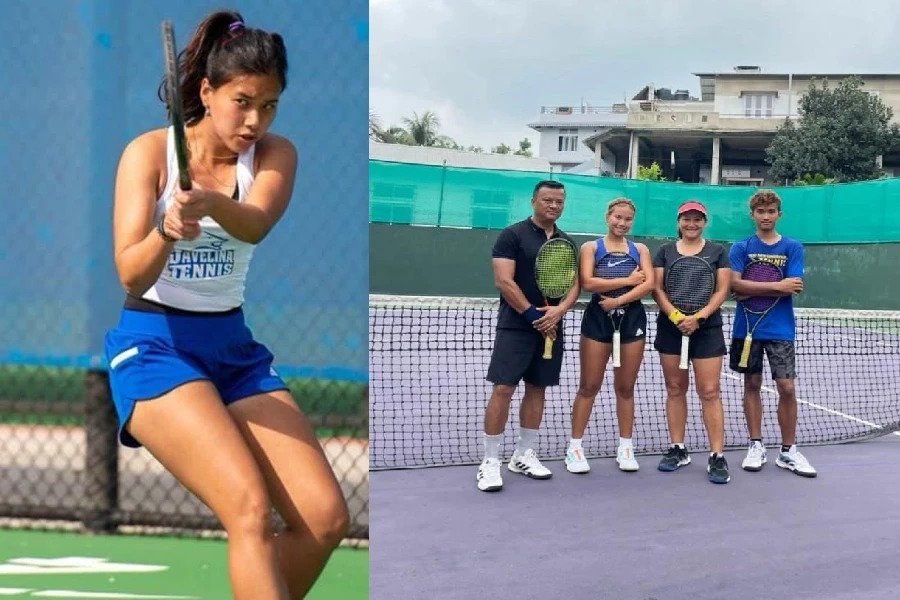
Raina Zaffar in the tennis court (Left) Nazneen and his family in Tennis court
“We have to keep ourselves fit to deal with all these problems. There are so many women who after a certain age would say we can’t do this… we can’t do that. But I think there is no age to stop learning. Even a woman in her 80s and 90s can learn or do many things if she has the confidence and desire. When I started playing, there were very few women in Assam, but now many women have come out,” Nazneen said.
“I have been imparting free yoga training at the Khanapara ground. I believe apart from physical fitness, we must also focus on mental health. When we are mentally fit, we live happily and can also keep others happy; and deal with all the problems. When members of a family see this change in the woman, they too want to change,” the fitness influencer emphasized.
In many cases, a woman, especially a Muslim woman, finds going out a hassle. As a Muslim woman, Nazneen Zaffar has never encountered someone questioning or blocking her; rather she receives support from her family.
Nazneen Zaffar with the Indian team
“I get a lot of support from my family. My father supported me when I was young and later it was my husband Shahnawaz Zaffar. He is an NIS-accredited tennis coach. He guides me on many aspects of the game. Many women, especially Muslims, are reluctant to go out. I am very fortunate that my family supports me financially and mentally.”
Nazneen also links sports with religion and spiritualism. “I pray and fast regularly except sometimes when I am playing for competitions. When I have to go out for sports, I stay in a single room so that I can carry on with my religious activities smoothly. Religion helps us keep our bodies healthy. We fast for a month which is a very positive practice and this rule of fasting has many scientific implications for an athlete,” she said.
Since a player faces various situations during sports how can the player maintain mental stability to cope with good and bad situations are some difficult aspects of sports. Nazneen Zaffar, an athlete and fitness influencer, has done a course in sports psychology. Through this, she has been advising many players on how to keep their mental state stable.
“I did a course in sports psychology. Tennis is a very difficult game. There are many good and bad experiences. Since my daughter and son play along with me, I’ve done this course,” she said.
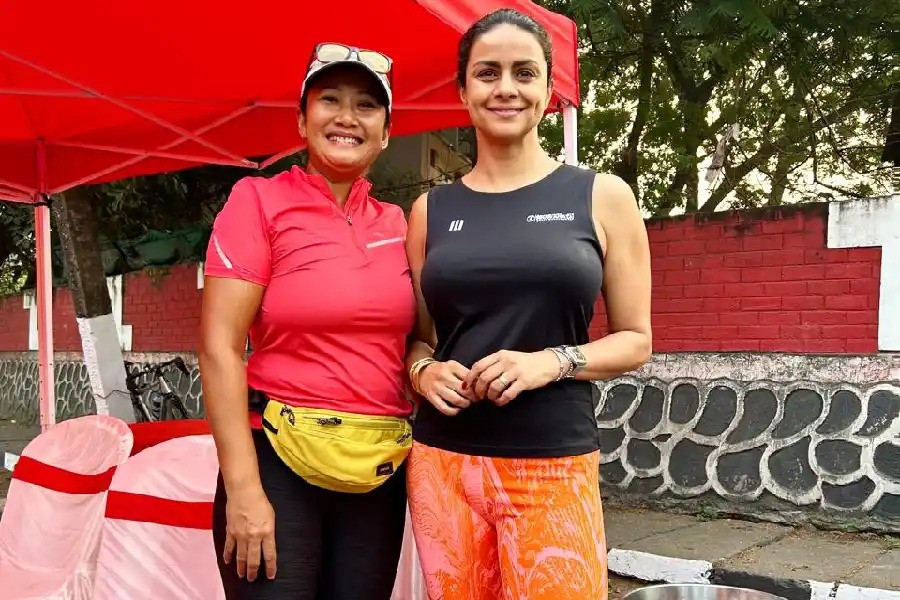
Nazneen with Bollywood actor Gul Panag
“I have been able to help my children stay mentally stable. I also advise many other players to stay strong. The course teaches how to deal with situations after losing a game or how to be determined. For instance, I have to decide the moment I enter the court that I have to win this game anyway, no matter who the competitor is. It helps me to keep up with the expectations of the audience,” she explained.
Of late Nazneen has been promoting a relatively new sport in Assam – pickleball.
“Pickleball is a fast-spreading sport in Assam. It is spreading rapidly in the US as well as in Asian countries. It is spreading in India as well. This game is simple and convenient. It has no hard and fast rules. It is a mixture of tennis, table tennis, badminton, etc, and can be played by people of all ages. It is a game where a polymer ball is played with a small paddle made of fiber, micro-fiber, and wood. We have brought this game to Assam. We recently demonstrated pickleball in several schools and IAS Colony and got a very good response.”
Pickleball has been launched in 23 states of India. In NCR, Delhi NCR, and Western India, new coaches are coming up and about 10,000 players have registered. An institute named Pickleball World Ranking was launched recently in Dubai.
source: http://www.awazthevoice.in / Awaz, The Voice / Home> Story / by Munni Begum, Guwahati / August 06th, 2024
Professor Mazhar Asif of Jawaharlal Nehru University (JNU) has been appointed the new vice-chancellor of Jamia Millia Islamia, an official statement said Thursday
New Delhi:
Professor Mazhar Asif of JNU has been appointed the new vice-chancellor of Jamia Millia Islamia, an official statement said Thursday.
Professor Mazhar Asif, School of Languages JNU, will serve on the post for five years.
“The President of India in her capacity as the Visitor of the university has appointed Professor Mazhar Asif, School of Languages, JNU New Delhi as the vice-chancellor of Jamia Millia Islamia for a period of five years,” the statement said.
The appointment of Dr Mazhar Asif, came after Prof. Najma Akhtar demitted Jamia VC office in 2023. Prof Najma was the first and so far only woman VC of Jamia Millia Islamia.
About Prof Mazhar Asif
Born on January 02, 1971, Dr Mazhar Asif is currently serving at Centre for Persian & Central Asian Studies, School of Language Literature & Culture Studies, Jawaharlal Nehru University, New Delhi.
Prof Mazhar is specialised in Indian Knowledge System, Sufism and Mysticism and has more than 27 years of teaching experience, including over 10 years as Professor.
As per his bio, he is fluent in Assamese, Bhojpuri, English, Hindi, Persian, Urdu and Vajjika.
He is Trustee, Dara Shikoh Research Foundation, Member, North East India History Association, Member, All India Persian Teachers Association and also holds a number of other posts and positions.
A very interesting mention in his bio is that during his time as a student at JNU, Prof Mazhar Asif was a member of the Akhil Bharatiya Vidyarthi Parishad (ABVP). ABVP is the students wing of the BJP and is affiliated with the right wing RSS.
source: http://www.ummid.com / Ummid.com / Home> Education & Career / by ummid.com news network (headline edited) / October 24th, 2024
“If we only remember Sir Syed over a plate of biryani once a year, we miss the essence of his mission. AMU was created to serve the community, and it’s our duty as graduates to stay true to that vision.”
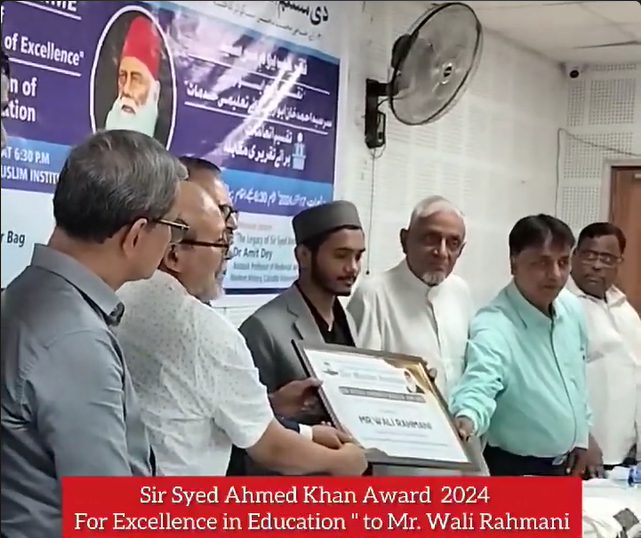
The Aligarh Muslim University (AMU) recently celebrated the 207th birth anniversary of its founder, Sir Syed Ahmad Khan, a visionary leader known for his contributions to education and social reform. On this occasion, Wali Rahmani, a prominent speaker and recipient of Sir Syed Ahmad Khan Award 2024 for Excellence in Education, delivered a compelling message urging the audience to deeply understand the compatibility between science and faith.
During his address, Rahmani challenged the common notion that science and religion are separate, emphasising that the Quran encompasses scientific principles. “To say that one hand holds science and the other the Quran implies that the Quran lacks scientific understanding, which is a misconception,” he stated.
“The Quran isn’t void of science; it contains scientific wisdom. When we speak of education, we must start in the name of Allah. Education divorced from His name isn’t complete.”
Reflecting on Sir Syed Ahmad Khan’s legacy, Rahmani highlighted how Sir Syed dedicated his life to the cause of education, building AMU to serve the community. He noted that Sir Syed’s vision extended beyond the establishment of a university; it was about empowering the community through knowledge and service.
“It is essential to remember why leaders like Sir Syed did the work they did,” he remarked, adding, “If we merely commemorate his work without continuing it, we aren’t doing justice to his legacy.”
Rahmani emphasised the need to go beyond token celebrations, stating, “If we only remember Sir Syed over a plate of biryani once a year, we miss the essence of his mission. AMU was created to serve the community, and it’s our duty as graduates to stay true to that vision.”
Expressing his gratitude, Rahmani acknowledged the honour of receiving an award in Sir Syed’s name, though he humbly expressed his doubts about deserving it.
“It’s an honour for my work to be recognised, but I also feel a sense of responsibility,” he shared. “While I cannot force anyone to become like Sir Syed, I can call them towards the truth, towards what is right.”
Rahmani’s words resonated with the audience, reinforcing the values and mission that Sir Syed Ahmad Khan championed – education, community service, and a harmonious integration of science and faith.
source: http://www.radiancenews.com / Radiance News / Home> Pride of the Nation> Awards> Education> Focus / by Radiance News Bureau / October 26th, 2024
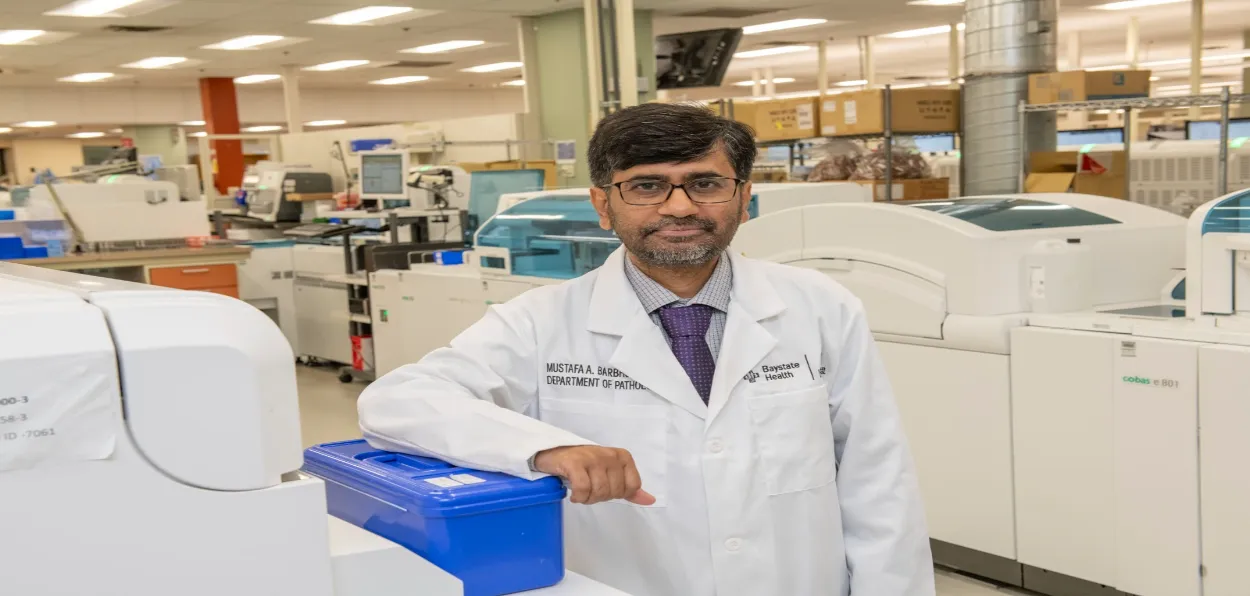
Dr. Mustafa A. Barbhuiya at his workplace in the US
Hailing from a remote village in southern Assam’s Hailakandi district, Dr. Mustafa A. Barbhuiya has been selected among top 100 most influential people in Pathology, specifically, as one of the Top 20 Heroes of Pathology in US for this year.
Featured in ‘The Pathologist Power List’ 2024, Dr Mustafa has demonstrated innovation, leadership, and achievement in the field of Pathology. But the journey of Dr Mustafa to achieve this coveted position was not so easy.
Dr Barbhuiya completed his elementary schooling (HSLC/10th) in Sanuhar Ali Memorial High School, Bahadurpur, a remote village in Hailakandi district of southern Assam. During those days in the early nineties, his village neither had electricity nor had motorable road communication.
Dr Barbhuiya Mustafa with his family
“I used to cycle from my village on muddy roads to attend Advanced Mathematics and Science classes in Hailakandi town. I went to Gurucharan College, Silchar, Assam for 12th and Bachelor of Science with a major in Zoology and pass course in Botany, Chemistry and other science and language electives,” Dr Barbhuiya told Awaz – The Voice.
He studied further in Jiwaji University, Gwalior for Masters and PhD in Biochemistry which paved his way to become a Clinical Biochemist and a Molecular Biologist.
“I will remain ever grateful to two of my teachers who helped me to become what I am today. One is Prof. Baby Singha (Retired) of Department of Zoology, Gurucharan College, Silchar with whom I have specialized in the subject of Parasitology and I have never looked back. The other teacher who actually got me into Clinical Biochemistry was Late Prof. Meenu Rai, former Head of Biochemistry, College of Life Sciences, Cancer Hospital and Research Institute, Gwalior, Madhya Pradesh.
“My PhD guide Prof. Pramod K. Tiwari shaped me as the future molecular biologist with whom I have not only learnt about science of medicine, study of diseases but several life lessons that I continue to carry as of today,” Dr Barbhuiya said.
Dr Barbhuiya with his collegaues
Dr Barbhuiya completed his PhD in Biochemistry Jiwaji University, Gwalior, Madhya Pradesh in July, 2013. He went to Johns Hopkins School of Medicine, Baltimore, Maryland, USA in July 2013 to pursue advanced postdoctoral training.
“The ultimate goal was to return to India and set up my own laboratory around clinical biochemistry and molecular diagnostics in my home state Assam. But the circumstances after completion of my postdoctoral training in Johns Hopkins and lack of securing a suitable job back in India compelled me to pursue things in the United States. I further completed my clinical chemistry fellowship in Penn State College of Medicine, Hershey, Pennsylvania, USA and have become a practicing clinical biochemist and clinical laboratory director,” he said.
Dr Barbhuiya currently holds the position of section medical director overseeing the Clinical Chemistry and Point of Care Testing operations of Baystate Health Pathology services across Western Massachusetts, USA. He provides clinical consultation to physicians and other healthcare providers regarding the laboratory test interpretations in the subspecialty area as systems consultant.
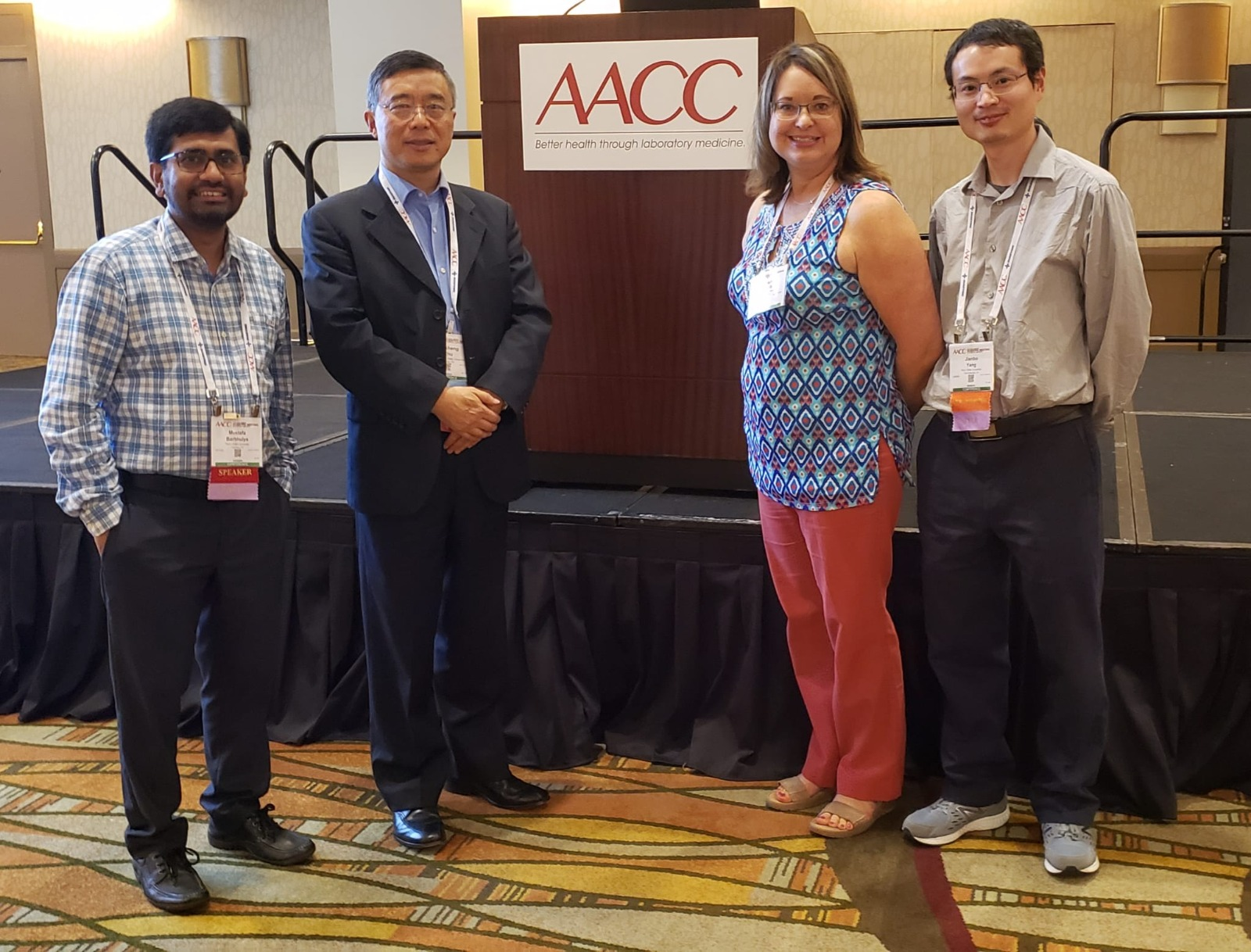
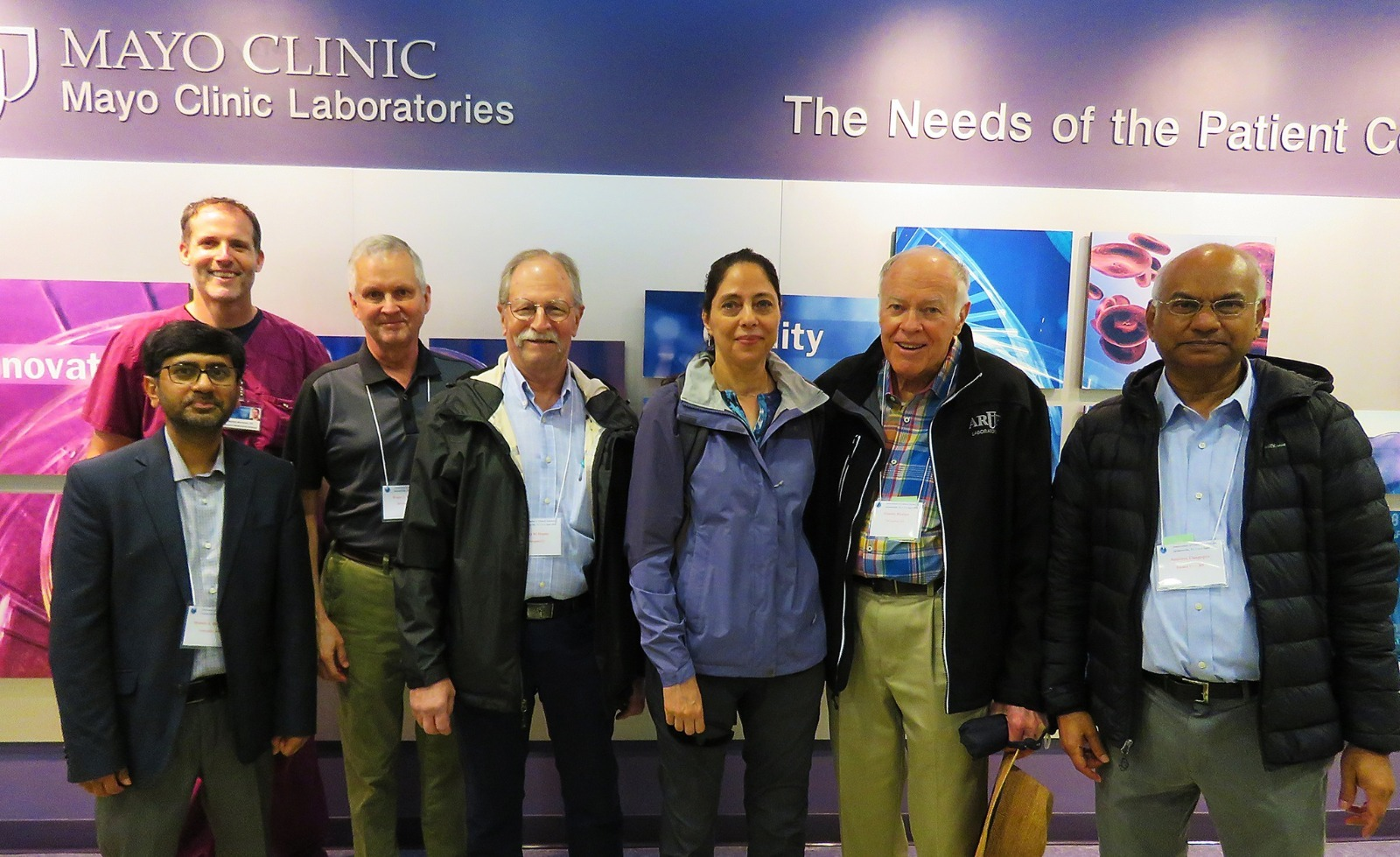
Dr Barbhuiya with other renowned pathologists
He ensures that the clinical laboratory meets several US federal and local state regulations delivering timely and accurate diagnosis for patients. He is accountable for the effective management and administrations of clinical operations of the Clinical Chemistry and Point of Care Testing service within the Baystate Health Pathology operations. He also serves as Assistant Professor of Pathology; Healthcare Delivery and Population Sciences, UMass Chan Medical School- Baystate Regional Campus.
Dr Barbhuiya has set up a global non-profit organization, Foundation for Advancement of Essential Diagnostics, both in the USA and India. “My next goal is to take my non-profit foundation activities to low and middle-income countries around the world and locally serve in underserved areas of the United States,” he added.
Academically, Dr Barbhuiya is making efforts to continue his research areas of interest. His primary areas of research are studying biliary tract (liver and gallbladder) cancer mechanisms, discover biomarkers of diagnostic and therapeutic values.
source: http://www.awazthevoice.in / Awaz, The Voice / Home> Story / by Daulat Rahman, Guwahati / October 27th, 2024
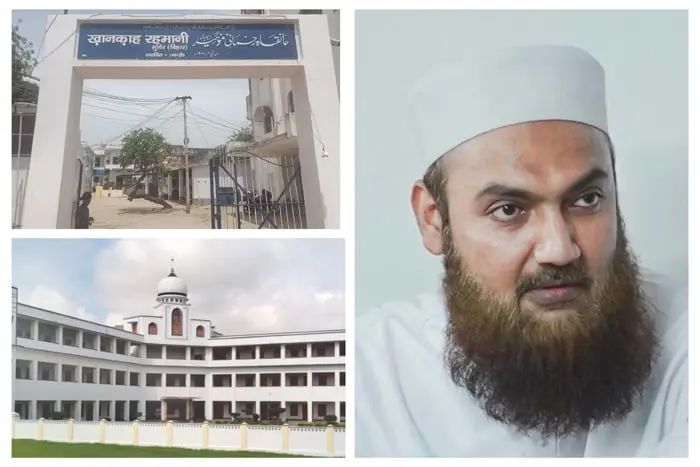
The long history of social change at Khanqah Rahmani. Where freedom fighters and future leaders meet. Rahmani30 has sent 513 students to different IITs and 838 students to the National Institutes of Technology (NITs)
Munger:
When you reach Khanqah Rahmani during the last asra (phase) of Ramadan, you will find hundreds of people doing itikaf – a ritual, in which faithful reside inside the mosque from the night of the 21st Ramzan till the sighting of the Eid Moon. They pray and fast and reside there only. Mohammed Salauddin, is a regular for itikaf for three decades.
The 64-year-old man remained associated with Khanqah for the last 32 years.
And the obvious question arises, what does he get by giving so many years of his life in the Khanqah?
“Everything,” the tall man gives a single-word answer. And adds, “I am an angutha chap (an illiterate person). For employment, I got a driving license in 1982, and since then I started working for the Rahmani Saheb family. And did other jobs as well but remained attached to the Khanqah.
“Later Salauddin got married and became the father of two sons. Both of his children studied in Jamia Rahmani.
“I became hafiz from Jamia and then did an initial study of Alimiat from here. And went to Deoband for the completion of Alimiat. And took a graduation degree from Munger, MA from CCU Meerat, BEd from Haryana, Mass communication from Jamia Millia Islamia. I cleared state and centre level teacher’s eligibility tests. Then sat in the examination of Bihar Public Service Commission’s TRE2 and became a teacher in February this year,” informs Mohammed Najmuddin, Salauddin’s son. Najmuddin is also pursuing a PhD from Munger University.
Najmuddin is not alone. Along with him, Mohammed Mudassar Usmani (MA, MEd), Akbar (MA, BEd) and Mohammed Hassan (BA, BEd) all are huffaz of Khanqah Rahmani who cleared the BPSC TRE 1 and 2 and have become teachers in 2023 and 2024.
Najmuddin’s elder brother Shahabuddin also a hafiz from Jamia is now an officer in the National Council For Promotion Of Urdu Language, has done a BA from Jamia Millia Islamia, MA from Maulana Azad Hyderabad, qualified NET and done an MPhil from Delhi University before joining NCPUL, Delhi.
“All these were possible for a person like me because of Khanqah Rahmani and its educational centres,” claimed Salauddin, the father.
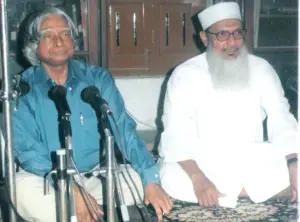
APJ Kalam and Mohammed Wali Rahmani in Khanqah Rahmani in 2003 | Arranged
The history of Khanqah Rahmani
It was established in 1901 by Maulana Mohammed Ali Mungeri. Since then the Khanqah not only remained as a center for societal reform and purification of souls but also helped freedom fighters during the freedom struggle. Freedom fighters like Mahatma Gandhi, Jawahar Lal Nehru, Abul Kalam Azad and Dr Rajendra Prasad among others stayed at this centre. Former Prime Minister Rajiv Gandhi also visited the Khanqah.
After Ali Mungeri, Maulana Syed Shah Lutfullah Rahmani, his nephew ran the centre. And thereafter Minnatullah Rahmani and then his son Mohammed Wali Rahmani and now his son Ahmad Wali Faisal Rahmani is taking care of it. His brother Fahad Rahmani is the CEO of Rahmani Programmes of Excellence under which Rahmani30 functions.
Khanqah was also been instrumental in establishing the All India Muslim Personal Law Board, which safeguards Muslims in protecting their personal laws and identities.
Who is Ahmad Wali Faisal Rahmani, the present head?
The chief of Imarat-e-sharia and the secretary of All India Muslim Personal Law Board, Ahmad Wali Faisal Rahmani, is also head of the Khanqah. He has studied Information Technology from the University of California and worked as a teacher there. His professional career also includes working for Adobe and British Petroleum. However, Faisal Rahmani got his early education in Khanqah Rahmani as he got his elementary education in Arabic, Quran, Deeniyat and Mathematics in the Khanqah. He started looking after the activities of the Khanqah after the demise of his father Mohammed Wali Rahmani.
Whenever he gets time from the activities of Imarat Shariah and AIMPLB, he spends time in the Khanqah. He does not let anyone chide even a screaming child. There are a large number of women who come to listen to him. He prefers to eat along with the students and members as well as the faculty of the centre.
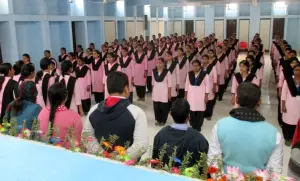
Students of Rahmani BEd College | Arranged
Jamia students hold the Quran on one hand and tablets on other
Jamia Rahmani, which came into existence in 1927 is one of the several centres run by the Rahmani Foundation , a charity body of Khanqah Rahmani. Jamia’s students not just memorize the Qur’an, but also understand it by learning Arabic.
Here, every student also learns science, English and Mathematics as well and gets tablets for their study. They have smart classes too.
But this is just the beginning for the students. The Khanqah has Rahmani30, to prepare for JEE Advanced (IIT), JEE Mains. It has branches in several cities across India. There is also a centre for Medical (NEET) entrance and for the preparations for Chartered Accountant and Company Secretary entrances. It has a BEd College, which has a large number of female students. Jamia Rahmani has added several new courses after 2011.
“When Ahmad Wali Faisal Rahmani became head here, the first thing he did was, start a one-year Diploma in Mass Communication in journalism course in Jamia. Later started two years of Master in Islamic Jurisprudence Study and last year, a two-year course, Diploma in English Language in Professional Skills also began,” said Fazle Rahma Rahmani, head of the Department of Journalism and Mass Communication.
The Khanqah also provides residential facilities to the families of its faculties as well as the cooks. It provides meals to almost 1200 people three times a day. Most of the beneficiaries are the Jamia students and people associated with the Khanqah.
Then there is the Rahmani School of Excellence (where students can get enrolled in a Nursery and study up to standard twelve). In the School Management Committee, Muslims as well as non-Muslims teachers are present, it has females too. And it has a diverse background of students.
“While Jamia Rahmani and Rahmani30’s study is completely free, BEd, school education and other studies have some fee structure. But where there are fees, Khanqah authorities give scholarships to needy students and have a liberal approach to such cases where parents approach the centre. Money never became a hurdle in getting an education from the educational centres related to Khanqah,” points out Fazle Rahma.
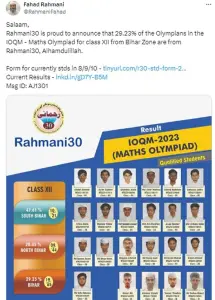
Since the inception of Rahmani30, 513 students have been admitted to different IITs in the country. While 838 students reached JEE Advanced to get admission to the National Institute of Technologies (NIT) during the same period.
“Several students of School of Excellence have become IITians so far,” claims Fazle Rahma.
Whereas, many students of different centers of Rahmani30 also take part in the Olympiad, every year.
The Jamia Rahmani’s Taleemgah building was inaugurated by Former President of India APJ Abdul Kalam. Kalam, who wanted to be known as a Professor rather than a former President, in 2003 itself, says a lot about Khanqan’s educational work.
From the stage of Khanqah, the scientist claimed that he was also a student of the Madrasa Board.
However, neither before the visit of the President of India nor after it, did Khanqah Rahmani’s educational works got the attention that it should have got the mainstream media.
source: http://www.enewsroom.in / eNewsRoom India / Home> Education / by Shahnawaz Akhtar / April 09th, 2024
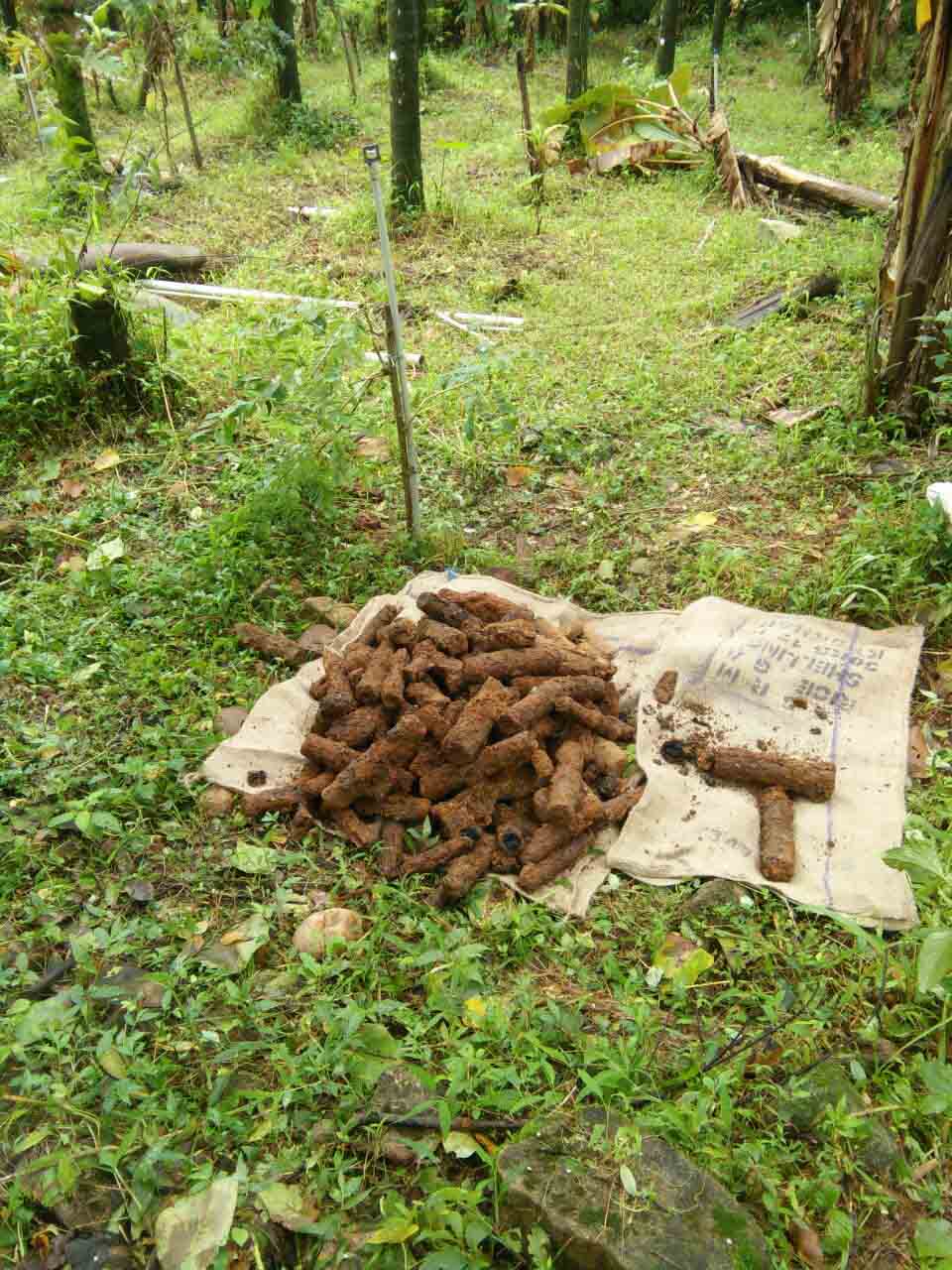
Rockets, Nagara Fort, India(Courtesy Karnataka Department of Archaeology, Museums, and Heritage (DAMH))
More than 1,000 unexploded rockets have been recovered from an abandoned well in the state of Karnataka in southern India.
The excavators believe the corroded shells date to the eighteenth century when the Muslim warrior King Tipu Sultan ruled the region.
The cache was uncovered when the well, located at Nagara Fort in the Shivamogga District, was being repaired. “The rockets, which are of several sizes, are metallic cylinders filled with some powder, possibly saltpeter or some form of explosive propellant,” says R. Shejeshwara Nayaka, assistant director of the Karnataka Department of Archaeology, Museums, and Heritage (DAMH), who led the excavation in 2018. “They have circular end caps on oneside, while on the other side there is an opening which lights like a fuse. We have also found some equipment that might have been used for assembling or making them.”
G. Venkatesh, commissioner of DAMH, adds, “Records say that Tipu Sultan’s father, Hyder Ali, was the first to use metal-cased rockets. He also had an armory and factory at Nagara Fort, a strategically very important city. There is a strong possibility that this site was used as a storage point or a factory for the rockets.”
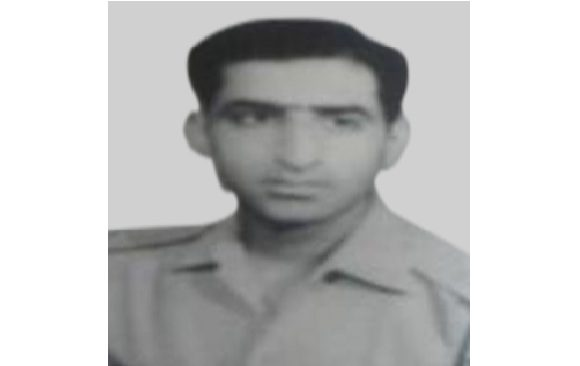
Major Mahmood Hasan Khan hailed from Dhanuri village in Jhunjhunu district of Rajasthan and was born on 02 March 1941. Son of Risaldar Nawab Mohd Hasan Khan, he was born into a military family but lost his father at an early age. He was brought up by his uncle Major Akbar Ali Khan who was serving with the then Nizam of Hyderabad. He completed his school education in Hyderabad and later went to Aligarh Muslim University for higher studies. He joined the Indian Army in the year 1962 as a Sepoy and subsequently got commissioned as a commissioned officer. He was commissioned into 14 Grenadiers of the Grenadiers Regiment, an infantry Regiment known for its brave soldiers with a rich history of various battle honours. In 1971, Maj MH Khan got involved in the thick of operations as his unit got deployed on the western border when the war with
Atian Supply Point Raid (Naushera Sector): 06 Dec 1971
During the Indo-Pak 1971 War, Maj MH Khan’s unit 14 Grenadiers was deployed on the western front. In December 1971, India had to go to war with Pakistan as the genocide perpetrated by the Pakistani army in their erstwhile eastern part of the country had resulted in an unprecedented influx of millions of refugees into India. Though the war was concentrated on the eastern front, Pakistan launched operations on the western front too. When the war was declared on 03 Dec 1971, 14 Grenadiers under the command of Lt Col Inderjit Singh was functioning under the operational control of 25 Div and was spread all over the Div AOR (Area of Responsibility) from Naushera to Poonch. On 06 Dec, 14 Grenadiers along with the elements of 8 Mahar battalion were tasked to raid the enemy’s Atian Supply Point to cause maximum damage to it. Maj MH Khan as ‘Raid Commander’ was tasked to carry out the assault along with two more officers, Capt Roy Chowdhary and 2nd Lt Prakash, and 49 OR (Other Ranks).
The raid involved going through a heavily guarded area and destruction of the objective of platoon strength. The team led by Maj MH Khan and divided into three groups planned a multi-directional attack on the enemy to achieve an element of surprise and cause maximum possible damage. The attack commenced at around 1800 hrs on 06 Dec and Major Khan led his men to the objective by shrewd manoeuvres, destroying post after post. The raid was thus successfully carried out after twelve hours of constant action. Maj MH Khan and his soldiers fightly valiantly, destroyed the enemy’s 12 storehouses, and 6 timber stocks, besides eliminating several mules and personnel. Maj MH Khan was given the gallantry award, “Vir Chakra” for his act of conspicuous gallantry, unyielding fighting spirit, and leadership. By the second week of Dec 1971, India had almost achieved victory on the eastern front but the border skirmishes were still going on, on the western front. Maj MH Khan’s unit 14 Grenadiers was involved in operations in the “Battle of Daruchhian” during that period.
“Battle of Daruchhian” (Indo-Pak War): 13/14 Dec 1971
After the failure of the Pakistani divisional attack on Poonch, the Indian Army decided to carry out local and limited actions all along the ceasefire line to improve its defensive posture. One such attack was launched by an infantry battalion in the area opposite Madarpur on the night of 10/11 December, and having captured Nangi Tekri, Jungle Tekri, Bump and other features denied the use of the Kotli-Madarpur-Hajira road to the enemy. As a follow-up to these operations, it was decided to secure Daruchhian, a feature blocking the Balnoi neck of the Kotli-Balnoi road between the Poonch River and the ceasefire line. Daruchhian was a conical feature, narrow and rugged at the top and with steep projections. It was forested on all sides except the southwest spur and was reportedly held by less than one Pakistani company of regular troops and some Mujahids as part of the main picquet line. 14 Grenadiers battalion under the command of Lt Col Inderjit Singh was tasked to launch an attack on Daruchhian and it was allotted an additional company and artillery support of four to six fire units. Maj MH Khan was functioning as a Company Commander of “D” Company at that time.
The capture of Daruchhian was planned to be carried out by 0800 hrs on 14 Dec in three phases. It was a multi-pronged attack involving primarily B, C, and D companies of 14 Grenadiers and elements of other outside resources. As per the plan, in Phase-I ‘B’ Company was to capture OP (Observation Post); in Phase-II ‘C’ Company was to capture West Spur and in Phase-III ‘D’ Company was to capture South West Spur. Besides the commanding officer Lt Col Inderjit Singh, Maj MH Khan, Maj HS Chahal(‘B’ Company Commander), and Capt Hamir Singh(‘C’ Company Commander) as company commanders were involved in planning and executing the operational plan. ‘A’ Company under the command of Maj SR Dogra was responsible for marking the FUP(Forming up Point) for Pase-I and then acting as a reserve for Phase II. The attack was launched on the night of 13/14 Dec 1971 in three phases with three assault groups attacking from different directions.
In Phase-III of the battle, Maj MH Khan’s ‘D’ Company was given orders to attack SW Spur at about 0400 hrs on 14 Dec. Maj MH Khan moved swiftly and ordered his platoons to give him fire support when he with one platoon moved towards the objective. Despite heavy enemy firing, Maj MH Khan and his men kept moving and reached the flat ground west of the OP position. While moving forward, Maj MH Khan noticed one of the enemy MGs that was impeding the advance and causing casualties. Maj MH Khan along with a few men in a daring move charged towards the bunker with grenades. However while doing so, Maj MH Khan was shot and got injured. But despite the injury, he moved forward and lobbed the grenade in the enemy bunker, before falling to another burst of fire on his head. The enemy gave a very stiff resistance and the battle for Daruchhian continued for over 12 hours. Maj MH Khan as the Company Commander of ‘D’ Company fought valiantly and led his men to give a befitting reply to the enemy firepower. In the fierce exchange of fire, during the battle, a total of eight officers, seven JCOs, and one hundred and forty-five other ranks were martyred, wounded, or missing in action. Besides Major MH Khan, the other martyred brave hearts included five officers (Maj HS Chahal, Maj SR Dogra, Capt OP Dalal, Capt Bakshish Singh, and 2nd Lt GP Bahukhandi), 4 JCOs ( Sub Jai Singh, Sub Taj Mohd Khan, Nb Sub Hasam Khan and Nb Sub Ram Sarup Singh) and 44 ORs.
Major MH Khan displayed commendable gallantry and devotion to duty during the operation and laid down his life in the service of the nation. Though he was given the gallantry award, “Vir Chakra” for his act of gallantry on 06 Dec 1971, he did not live long enough thereafter and made the supreme sacrifice on 14 Dec 1971 during the heroic ” Battle of Daruchhian”.
____________________________
2 Comments
Shaheen KhanReplyLate Major MH khan is my grandfather. We obviously have a lot of relevant information about him. Pease contact us so we can give as much info for the page of this great man.
Honourpoint is an online memorial to honour, appreciate and remember the spirited and valiant sons and daughters of India who had the distinction of serving the country in “military uniform”, and are no longer with us. It is an endeavour to ensure that supreme sacrifices of our soldiers and their families do not fade away and are given their rightful place in our nation’s collective consciousness. Read more…