Category Archives: Arts, Culture & Entertainment

How Sherin Mohamed tickles the funny bone with her Instagram page

Thiruvananthapuram, KERALA :

Sherin Mohamed | Photo Credit: Special Arrangement

The 29-year-old’s Instagram comic strips and illustrations look at the sunny side of life through the eyes of a hijab-wearing woman

If you log on to Sherin Mohamed’s Instagram page, a hijab-wearing, chirpy-faced young woman pops up a wide smile. Her rather large wonder-struck eyes bear two red heart shapes. The jolly user avatar in self-referential humour perhaps best captures Sherin’s spirit. Even her Instagram handle, ‘ticklesh’, is meant to instantly evoke a ticklish sensation!

With her simple but mirthful comic strips on droll vignettes from everyday life as seen through the eyes of a hijab-wearing woman, Sherin has been tickling many a funny bone. A bunch of amusing illustrations and a few caricatures on some sheroes, like the one on Ilhan Omar, the hijab-wearing Somali-American Democrat elected to the US Congress, come as a bonus for her page visitors. “It (Instagram page) started off with some light-hearted moments occurring in my life. Such moments need not be overtly eventful as simple slices of life, like a conversation with my hubby or observing my kids playing sometimes become fodder for imagination,” says the 29-year-old.

An Ernakulam native, Sherin grew up in Dubai. The former accountant later settled in the capital city after her marriage. And it was as a sheer pastime that she decided to try her hand at doodling and sketching after she had quit work during her first pregnancy. “I started doing comics in 2016 with just paper and pen. They used to be simple drawings with members of my family becoming my characters. I began digitalising my works the next year when I opened ticklesh,” says Sherin.

Her modus operandi involves doing an elementary sketchwork on paper with pen and using the app SketchBook to lend life to her drawings. “I think my drawing style is rather simple and I don’t even do shading. I don’t paint either, though I would love to learn that. I like to make the embellishments I can do while on the go on my phone for the sake of spontaneity and convenience.”

Sherin says she originally intended to open an Instagram page by the handle “tickle bone or a catchy phrase on similar lines” but most of the ideas were already taken up. She then struck upon ‘ticklesh’ — a portmanteau of the word ‘tickle’ and the first two letters of her first name. “I’m glad the name stuck. I feel changing it now would be like changing the name of one’s child,” she says with a laugh.

While some of the witty dialogues in her comic strips are in English, she sometimes resorts to Malayalam transliterated into English so as not to lose the pun and the fun in translation. But Sherin says she doesn’t want to restrict her characters by giving them any names. “Essentially, they can be anyone, from any part of the world. Also, what works for me is often spur-of-the-moment ideas,” says the mother of two. “For instance, when her brother, Zayed, was born, my five-year-old daughter, Ayesha, said she was quite happy. But in her own cute way, she added as an afterthought that she would have preferred a minion instead (laughs). Such real-life banter often finds its way to my works,” Sherin explains.

Simplicity is the soul of her wit and humour is her cup of tea. Sherin says, for now, she would rather steer clear of “serious or tricky subjects”. “I don’t think what I seek to express is cathartic or anything eye-opening. I just want to make people laugh through what I love to do. I like to watch comedies and I read a lot of comics too, mostly online. When I was in Dubai, I used to avidly read a children’s magazine that featured a lot of nice comics,” says Sherin about her tastes.

With encouragement pouring in, Sherin now tries to put up at least a post a week. Between keeping her kids engaged and taking care of the domestic stuff, any time of the day is conducive for her to keep her “passion” going. “That’s the best of such a hobby. There’s no deadline and there are no work hours to be met.” So, does she consider herself a born artist? “That’s a paradox. I never drew as a child. In fact, I used to entirely skip art classes in school. Sometimes, I would seek my vaapa (dad) to do my art projects,” says Sherin with a chuckle.

Sherin, who “loves talking in Malayalam movie dialogues,” says she plans to come up with comic strips with characters who interact using  iconic dialogues, especially from the 90s. A big fan of the Disney movies, she also intends to “draw people she knows as Disney characters.”

Sherin’s ever game to deliver the punchline!

source: http://www.thehindu.com / The Hindu / Home> Entertainment> Art / by Harikumar J.S.  / Thiruvananthapuram – May 03rd, 2019
Mint’s Ashwaq Masoodi only Indian in Nieman fellowship list for 2020

JAMMU & KASHMIR :

  • The fellows participate in Nieman seminars, workshops, master classes and conduct research with Harvard scholars, among others
  • The prestigious Nieman fellowship entails attending two semesters at Harvard University, starting September 2019

_______________________________

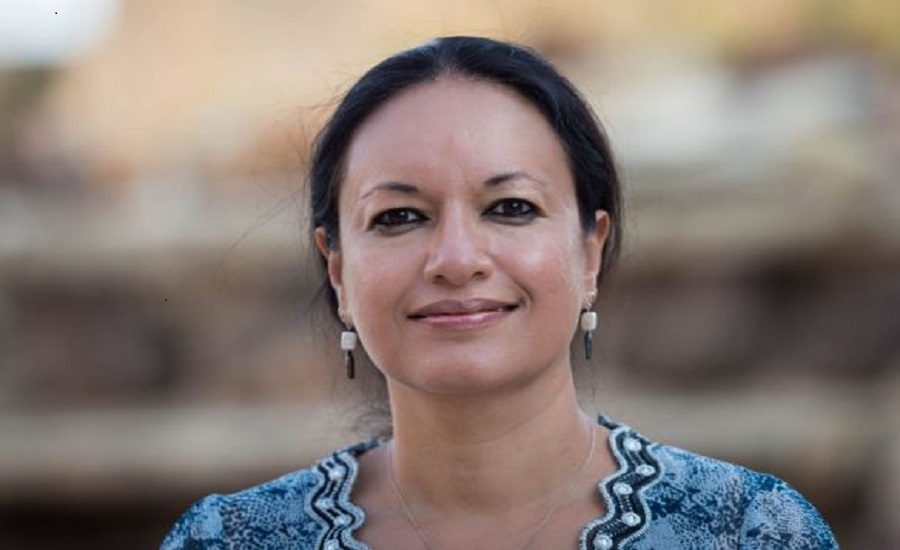
Ashwaq Masoodi, national writer at Mint, has been awarded the Nieman Fellowship at Harvard University. In a press release issued on 3 May, the Nieman Foundation for Journalism announced that Ashwaq will join 26 other Nieman Fellows for the class of 2020. Ashwaq is the only Indian in this list

The prestigious Nieman fellowship entails attending two semesters at Harvard University, starting September 2019.

  • The fellows participate in Nieman seminars, workshops, master classes and conduct research with Harvard scholars, among others.The release also said that, at Harvard, Ashwaq would explore ways to battle stereotypes and improve media reporting on Muslims, the largest religious minority in India
  • The Nieman Foundation for Journalism has educated more than 1,600 accomplished journalists from 98 countries since 1938. The selected journalists are from a dozen countries, including Australia, Lebanon, Niger, Turkey, China, Russia, Zimbabwe, Hungary, besides from nine different US states and Washington D.C.
  • Ashwaq has been working in Mint since August 2013 and specializes in long stories on the lives of the marginalized communities, gender and society.

Read her stories in Mint here

source: http://www.livemint.com / Live Mint / Home> Explore / by Staff Writer / May 04th, 2019

Oklahoma Commission on Status of Women Gets Kashmiri-American Muslim Commissioner

JAMMU & KASHMIR / NEW DELHI / Oklahoma , U.S.A. :

Dr. Nyla Ali Khan
Dr. Nyla Ali Khan

Oklahoma City :

Dr. Nyla Ali Khan has been appointed as a Commissioner on the Oklahoma Commission on the Status of Women. She has been appointed for a five-year term by Senator Greg Treat, who is President Pro Tempora of the Oklahoma Senate.

“The Oklahoma Legislature created the Oklahoma Commission on the Status of Women in 1994 to act as an advisory entity on equity issues relating to gender bias; monitor legislation to determine whether it is discriminatory toward one gender or the other; act as a resource and a clearinghouse for research on issues related to women and gender bias; report annually to the governor, president pro tempore of the Senate, and speaker of the House of Representatives regarding its activities and make recommendations concerning needed legislation or regulatory changes relating to equity and gender bias.”

Dr. Nyla Ali Khan is the first South Asian Muslim member of the Oklahoma Commission on the Status of Women. She said that as a member of the Oklahoma Commission on the Status of Women, she acts as a resource and provides expertise to the Commission. She provides research and information on societal violence and structural inequities that result from deep-rooted prejudices against women. Dr. Nyla Khan said, “The questions to which I seek to provide well-substantiated answers are as follows: How can we, as women, develop the ability to organize and mobilize for social change, which requires the creation of awareness not just at the individual level but at the collective level as well? How can we develop self-esteem for which some form of financial autonomy is a basis? How can we make strategic life choices that are critical for people to lead the sort of lives they want to lead? We require a quality education for these mammoth tasks.”

c.reddirtreport.com

source: http://www.caravandaily.com / Caravan Daily / Home> Indian Muslim / March 12th, 2019

Neglected and lying in ruins, ‘world’s smallest mosque’ cries for attention

Hyderabad, TELANGANA :

Once the land on which the Jino-ki-Masjid and the Dargah was build was to the tune of 600 acre.

JinoKiMasjidMPOs24apr2019

Hyderabad :

Located a stone’s throw away from the Dargah Hazrath Syed Shah Imaad Uddin Mahmood Al Hussaini, a nondescript structure stands out in front of the scenic hilltop on the banks of Mir Alam tank. This Qutub Shahi structure, popularly known as the Jino-ki-Masjid, may well be the ‘smallest mosque’ in the world.

Less than 10 sq m in area, this structure has the traditional elements of Qutub Shahi architecture including turrets and a big arch, under which there is a small space for devotees to pray. However, although it is located within the complex of the Dargah, the small structure stands dilapidated. The lime plaster has given away at various places, revealing the skeletal brickwork underneath.

The turrets are also broken at places, and so arch. The way to the mosque is also rocky, with no clear path. The mosque’s state could very well pose as a risk for visitors. The mosque gains importance as the Dargah complex was home to Syed Shah Imamuddin Husaini alias Mir Mahmood Nimatullahi, one of the oldest sufis of Hyderabad. In ‘Landmarks of the Deccan’, its author Syed Ali Asgar Bilgrami wrote, “He first came to Hyderabad from Najaf (Mesopotamia) during the reign of Sultan Abdullah Qutub Shah and stayed on this hillock.”

Mahmood had laid several buildings erected on this hill. “The mason who worked here were paid over and above the wages and the pregnant women-labourers were paid double the wages,” Landmarks of the Deccan said, adding that since no one knew his source of income, “it was a general belief that the Saint had some supernatural means of income”.

Once the land on which the Jino-ki-Masjid and the Dargah was build was to the tune of 600 acre. However, now, with time, most of it is occupied with houses built on one side of the hillock. The place comes alive during Urs, usually held on the 13th Shaban of the Islamic Calender, which was on April 19. During that time, many visit the Dargah, and hence it becomes important to conserve and repair the ‘smallest mosque’.

source: http://www.newindianexpress.com / The New Indian Express / Home> States> Telangana / by Express News Service / April 23rd, 2019

After two years, century-old Ma Hajiani Dargah restored to glory

Worli – Mumbai, MAHARASHTRA :

MaHajianiDargah01MPOs23apr2019

Conservation architect Vikas Dilawari’s work on Worli shrine is a significant chapter in the city’s built heritage

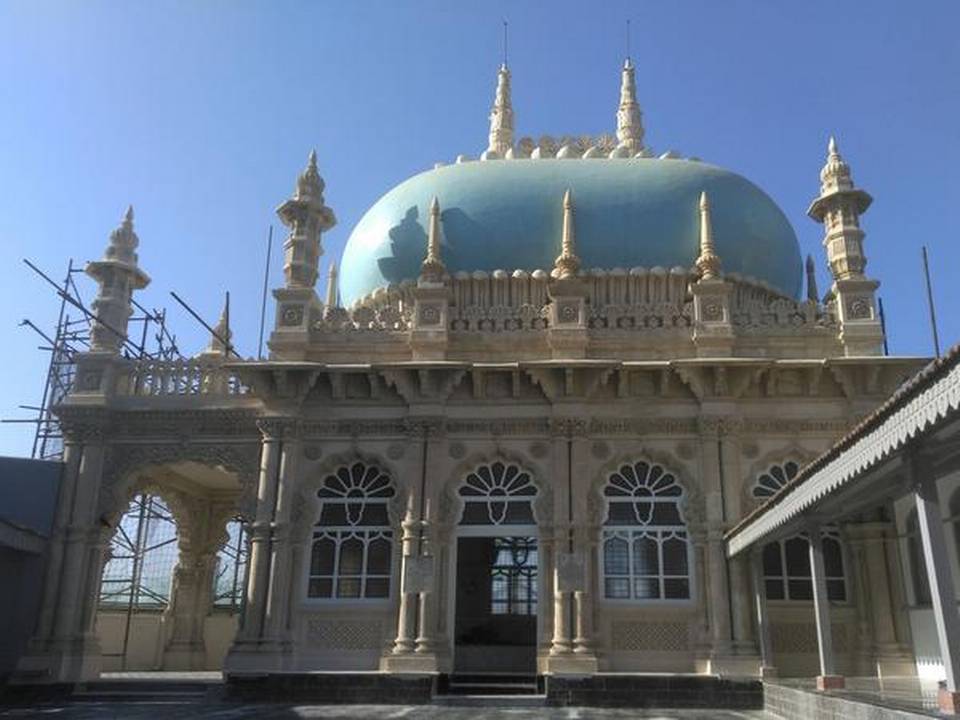
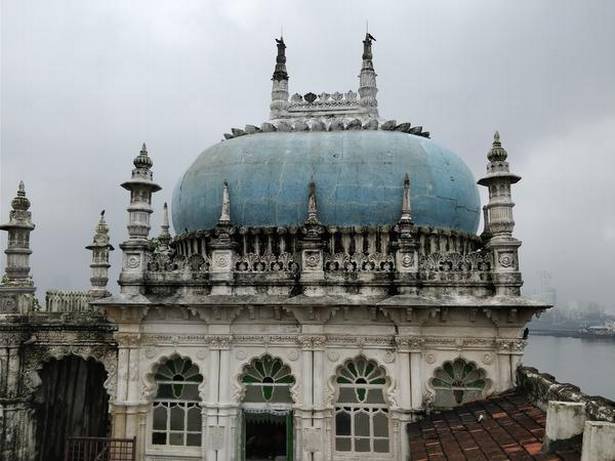
Cocooned in the shielding hold of the bay, just off the arterial, traffic-clogged road that hugs the coastline, is the 111-year-old Ma Hajiani Dargah, restored to its former glory. The restoration of the building began in November 2017 and was completed by conservation architect Vikas Dilawari on April 19, which also marked the eve of Shab-e-Baraat.

The dargah is one of the lesser-known spots of quiet in the city, often interchanged with the more popular Haji Ali Dargah, a stone’s throw away. Built in 1908 when Sir George Sydenham was the Governor of Bombay — primarily in Porbandar stone and basalt ashlar plinth — it is an ideal example of Indo-Saracenic architecture. Subtle influences of the colonial style of construction are evident, particularly in the ornamental work. “This is a very unique building. It is a magical place, of tranquillity, at the tip of the land on a natural rocky outcrop, elevated so gracefully,” Mr. Dilawari said.

MaHajianiDargah02MPOs23apr2019

Over the years, the dargah’s neighbouring plots of land were sold to private developers. The towering Samudra Mahal — a piece of prime real estate — was where the residence of the Scindias of Gwalior once stood, before being demolished in 1960. “Until a few decades ago, the Mahalakshmi temple, the Haji Ali Dargah, and the Ma Hajiani Dargah would have been the beacons along the coast of Bombay. The proliferation of high-rises without appropriate urban design is certainly impacting the pristine setting, and this might change further with the introduction of the impending coastal road,” Mr. Dilawari said.

A nautical past

The dargah is the site of three graves: Ma Hajiani, Haji Ismail Hasham Yusuf, and his son, Sir Mohamed Yusuf, draped in red and green brocaded chaddars and rose petals. The Yusuf family has been eminent in shipping trade and philanthropy in the city. Haji Ismail Hasham Yusuf founded the Bombay Steam Navigation Company in the late 19th century, and established the erstwhile Marine College at Rashid Mansion in Worli as a charitable institute, later moved to the island of Nhava and still functional as Training Ship Rahaman.

The mausoleum is built in honour of Ma Hajiani, a saint believed to be the sister of Saint Pir Haji Ali Shah Bukhari. The Haji Ali Dargah, houses the tomb of the latter. According to legend, they died at sea and their bodies were washed ashore, a few metres from each other. They were then buried at the respective spots they were found. Subsequently, two tombs were built — Haji Ali for the brother and Ma Hajiani for the sister. At the Ma Hajiani Dargah, women have always been allowed to access the maqbara. Women frequent in large numbers, making offerings of red or green glass bangles: red indicating one’s wish for marriage, and green for offspring.

source: http://www.thehindu.com / The Hindu / Home> Society> History & Culture / by Khorshed Deboo / Mumbai – April 23rd, 2019

Lyricist Shakeel Badayuni’s Death Anniversary

Badayun, UTTAR PRADESH / Mumbai, MAHARASHTRA :

Today is Lyricist Shakeel Badayuni’s death anniversary. Though he did not have poetry background like the other poets, Shakeel Sahab’s inspiration was his distant relative Zia-ul-Qasiri Badayuni, a religious poet. Honored by the Indian government as Geetkar-e-Azam (great lyricist), he penned several beautiful songs for about 89 Bollywood movies.

Bollywood and Lyricist Shakeel Badayuni’s Death Anniversary:

Some of my favorite Bollywood songs he penned in the 1940s and 1950s are:

Afsana likh rahi hoon… Dard (1947)

Suhani raat dhal chuki… Dulari (1949)

Milte hi ankhen dil hua deewana kisika… Babul (1950)

Akeli mat jaiyo Radhe Jamuna ke teer… Baiju Bawra (1952)

Door koi gaye dhun yeh sunaye… Baiju Bawra (1952)

Bachpan ki mohobbat ko… Baiju Bawra (1952)

Man tarapat Hari darshan ko aaj… Baiju Bawra (1952)

O duniya ke Rakhwale… Baiju Bawra (1952)

Zindagi denewale sun… Dil-e-Nadaan (1953)

Insaaf ka mandir hai yeh Bhagwan ka ghar hai… Amar (1954)

O door ke musafir humko bhi saath lele… Uran Khatola (1955)

source: http://www.lemonwire.com / Lemon Wire / Home> Bollywood / by Gayatri Rao / April 19th, 2019

How chikankari crossed the road

Mumbai, MAHARASHTRA / NEW YORK, U.S.A :

Hues of an art Farha Ansari and her designs / Murali KUmar K

From Hillary Clinton to Alia Bhatt, Ahilaya’s designs have invaded the wardrobes of celebrities

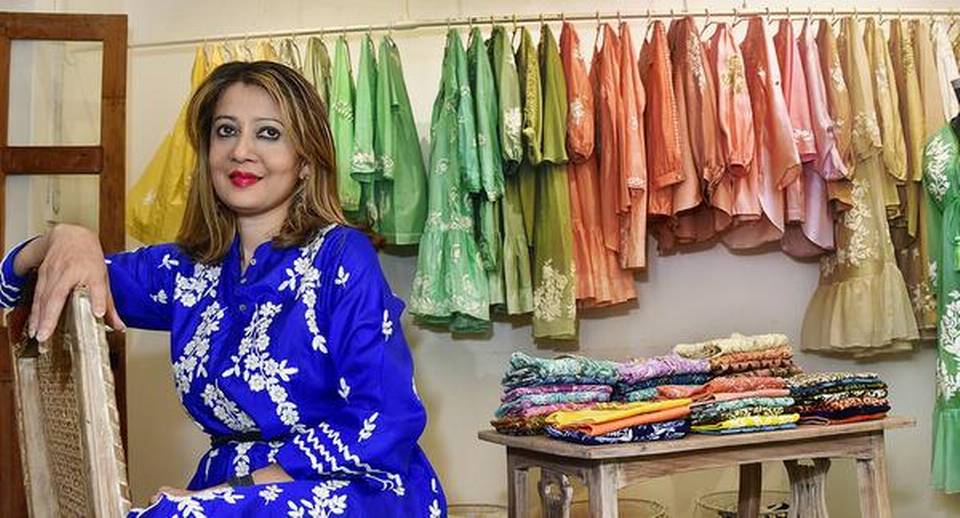
In the Bombay of the 1970s, when his daughters were young, Anwar Ansari started a hand-printed chikankari textile business called First Lucknowi, because he believed he was the first to start such a venture. Chikankari is a traditional embroidery style that originated in Lucknow. Anwar and his partners hired local artisans in Bombay and Lucknow to handcraft these designs on cotton, silk, chiffon and other fabric.

Almost half a century later, First Lucknowi is different yet, essentially, the same. Today, it goes by the name Ahilaya, named after the queen of the 18th Century Malwa kingdom, Rajmata Ahilyadevi Holkar.

Managed by Anwar’s daughters, Farha, Nagma and Sana, the number of employees has grown from 40 to 200 and its customer base has also increased. Many celebrities — Hillary Clinton, Ivanka Trump, Drew Barrymore, Anushka Sharma, Alia Bhatt among others — are among Ahilaya’s customers.

According to Farha, the chief reason for the brand’s longevity and success is, “We do everything and do not outsource anything.” “The materials have to be pure; there should not be any synthetic. We are stringent about that.”

The designs and raw material are couriered to the artisans in Lucknow and Mumbai, who in turn handcraft the clothes, she adds.

Farha, now lives in New York and oversees ‘Leaves of Grass’, an international offshoot of the family-run business. Though her sisters, Nagma and Sana, take care of the Indian affairs, Farha visits the Bengaluru store at least once a year. This visit is ritually followed by a meeting with craftsmen too.

“They feel happy when they learn that the clothes they make are worn by models and celebrities. We sometimes call them for photo shoots, order biryani and have a good time.”

The price range starts at Rs. 4,000. Farha says, exclusively handcrafted wear often costs more. Comparing synthetic and machine-made wear to handmade garments, according to her, “is like differentiating microwaved dinner from gourmet food. We also pay fair wages to our workers. If we reduce the price, we might not be able to do that.”

source: http://www.thehindu.com / The Hindu / Home> Features> MetroPlus / by Praveen Sudevan / April 16th, 2019

Welcome to the graveyard of rare books, also known as the Saulat Public Library, Rampur

Rampur, UTTAR PRADESH   :

Priceless editions of Urdu, Persian and English lie in neglect as no one cares to maintain a library that should have been a national treasure.

Daniel Jacobius Morgan

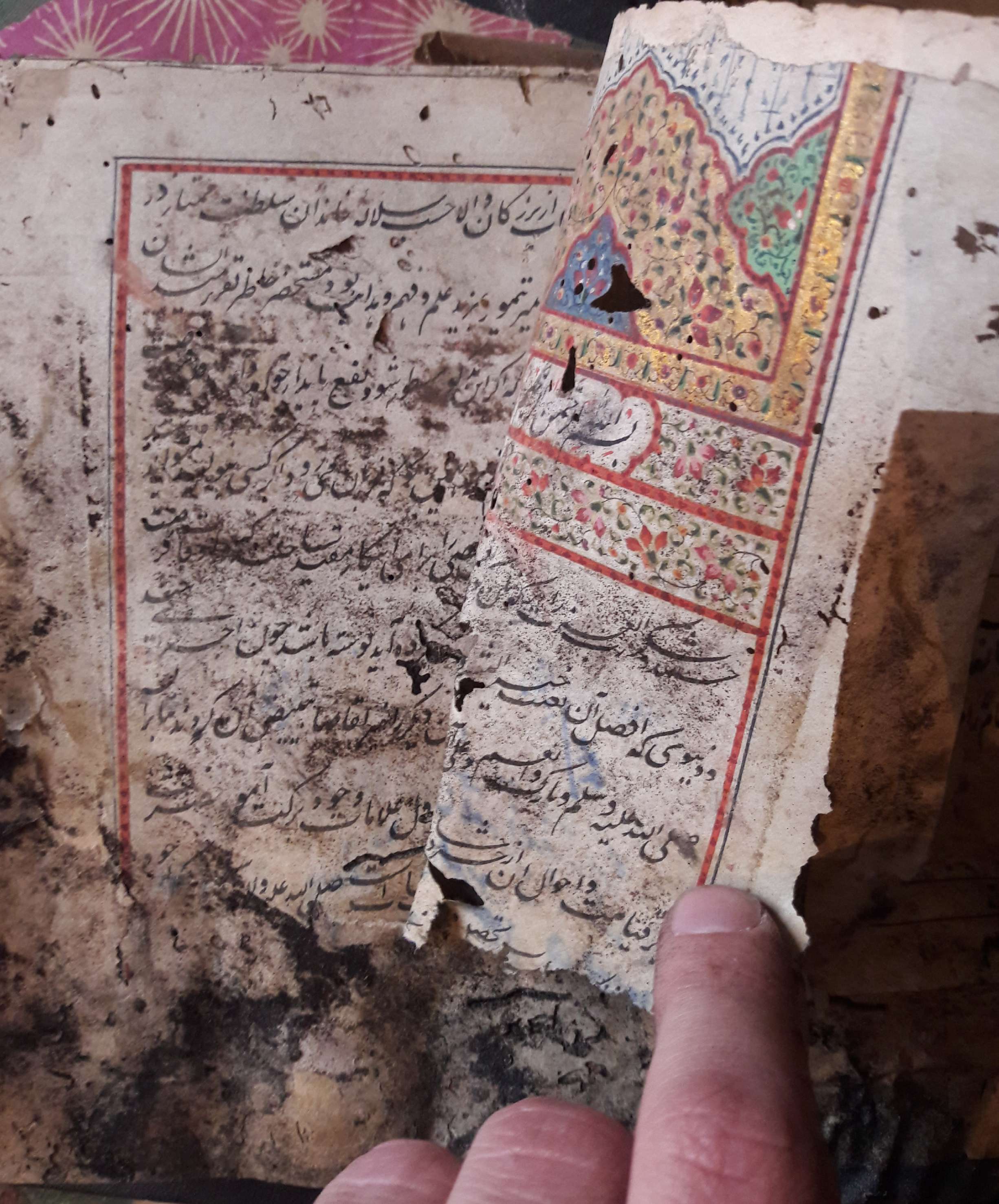
I have spent much of the past week digging through piles of books at the Saulat Public Library in the city of Rampur in Uttar Pradesh. I am looking for a single manuscript: Muhammad Sanaʾullah Panipati’s Khawass-i Hizb al-Bahr, an 18th century Persian commentary, written in Delhi, on the occult properties of a famous prayer formulae compiled by Abu al-Hasan al-Shadhili, the Maghribi mystic of the 13th century. It is, very likely, the only copy of the commentary in the world.

I know it is somewhere in the library because it appears in Abid Reza Bedar’s 1966 catalogue, but despite my excavations and those of Mazhar Muin Khan, the endlessly patient librarian, the manuscript remains hidden.

I am sure that Muhammad Sanaʾullah Panipati would have understood my search: just as words have occult sympathies with the material world, so too does this hidden manuscript exercise its power, drawing me to the library day after day although it remains unseen, buried beneath thick layers of dust, cobwebs and mouldering pages. As I dig through the stacks, I can’t help but call to mind the hadith qudsi: “I was a hidden treasure that loved to be known.”The disappearance of a single manuscript, though serious in itself, is part of a far larger problem at Saulat Library: one of India’s richest archives of Urdu, Persian and Arabic works, it has fallen into a state of absolute desuetude.

Reader's ticket
Reader’s ticket

Founded in 1934, the library was once an important centre of political and social life for North Indian Muslims. In its heyday, famous visitors included Khalid Sheldrake (the British pickle manufacturer turned king of Chinese “Islamistan”), Sayyid Hashimi Faridabadi (author of a famous Urdu history of Greece), Khwaja Hasan Nizami (the great Chishti Sufi of Delhi), and the Agha Khan.

Besides 25,000 Urdu printed books – including the only known first edition of Ghalib’s 1841 Urdu diwan – the library holds hundreds of irreplaceable manuscripts: eighteenth-century Afghan chronicles, works on occult science, personal diaries of Rampuri notables, volumes of Persian poetry, and richly-illuminated Qurʾāns. It also holds a complete run of Raja Ram Mohan Roy’s Persian newspaper Jam-i Jahan Numa, Muhammad ʿAli Jauhar’s Urdu-language Hamdard and English-language Comrade, as well as Sayyid Ahmad Khan’s Tahzib al-Akhlaq.

Since the partition, when many of its leading lights moved to Pakistan, it has undergone a process of steady decline. A further blow came with the abolition of the privy purse of the Rampuri royal family, the library’s major patrons.

The reading room with pictures of Hakim Ajmal Khan, Sayyid Ahmad Khan, Muhammad Ali and the first Nawab of Rampur

These days, residents of Rampur have barely heard its name. As I searched for it in the city’s narrow lanes, I kept being directed to its well-funded and illustrious sister library, the Raza Library, housed in the old Nawabi palace. Like its manuscripts, Saulat is hidden. To get there you have to walk through the winding streets that lead to the heart of the Chaku (knife) Bazaar to a small courtyard behind the city’s Jama Masjid (the congregational mosque). The library is up an unlit staircase behind a tailor’s shop. You really have to know where it is to get there.

The main reading room only has three walls now: the fourth collapsed in March 2013, and there is no money to replace it. All the books have now been moved into a single room where the electricity is intermittent at best and daylight comes in through a few holes in the ceiling. The library was already in poor condition when the wall fell. Since then the cataloguing system has broken down entirely.
External view with missing wall
The library’s one regular patron, a retired engineer who studied at Aligarh Muslim University, comes each morning to read the newspaper. He described the library as a “graveyard for books” (kitabon ka qabaristan). It is hard to disagree: the books are piled high on shelves, some strewn on the floor, torn and covered in dust so thick it looks like the set of a low-grade horror film.The sad irony is that the collection survived almost certain destruction once before. In the violence that accompanied partition in 1947, the managing committee of the library faced an enraged crowd who were marching through the city torching government buildings. Because the library is located in a former tehsil office, it was targeted for destruction. Forming a human chain, they passed thousands of books, manuscripts and newspapers from hand to hand across the courtyard that separates the library from the Jama Masjid (congregational mosque) some eighty metres away. But where fire and violence failed, ants and neglect are winning the day.I have come to Rampur to gather materials for my PhD dissertation on the history of eighteenth-century North Indian intellectual culture. For my task, the most precious manuscripts are often those that were never printed because they reveal much about fields of knowledge that were neglected with the coming of colonial rule. To see these irreplaceable texts crumbling before my eyes is heartbreaking.

A water-damaged Persian manuscript

Given the working conditions, Mazhar Muin’s daily enthusiasm for our thus far thankless search is remarkable. But without some urgent action to preserve or at least digitise the collection, the loss to India’s intellectual history will be immense. In the words of Ghalib:

“nāla-yi dil ne diye aurāq-i laḳht-i dil ba bād
yādgār-i nāla ek dīwān-i be-shīrāza thā”

“The heart’s lament threw the pages of the heart’s fragments to the wind
The memorial to the lament was a single unbound book.”

Neglected stacks
Neglected stacks

Alkazi: Saudi-Indian theater icon star attraction at Dammam fest

NEW DELHI :

AlKaziMPOs12apr2019

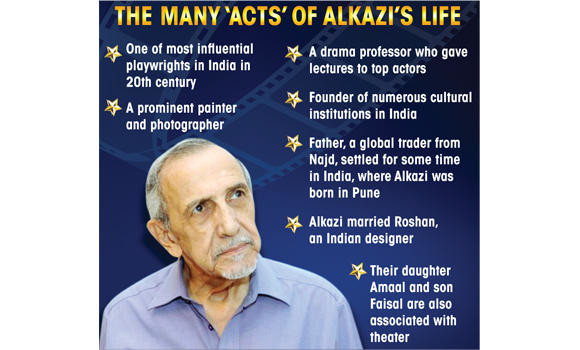
It is a classic case of believe it or not. Ebrahim Alkazi, the celebrated Indian theater director, has his roots in Unaiza in Qassim.
Alkazi’s businessman father, Hamad, came from Saudi Arabia and did business in India in the 1960s and 1970s. That was before the oil boom changed the face of Saudi Arabia.
Alkazi, now 90, went to St. Vincent’s High School in Pune and St. Xavier’s College, Mumbai. He went to London for training at the Royal Academy of Dramatic Art.
On Feb. 20, when Alkazi will be honored at the 2nd Saudi Film Festival in Dammam, it will be like a homecoming for the prodigal son.
“We want to honor pioneers in the field of theater,” said Ahmed Al-Mulla, director general of the festival. “And Alkazi is top on that list.”
Alkazi has played the role of a bridge between Indian and Arab cultures. “We consider him as a treasure and a maker of history. We want to present him as a role model to our Saudi youth,” said Al-Mulla.
He said a documentary on Alkazi will be screened during the opening ceremony, and a book is also being published illustrating his remarkable life and achievements.
Early on in his career, Alkazi got associated with the Bombay Progressive Artists Group, which included M.F. Husain, F.N. Souza, S.H. Raza, Akbar Padamsee, Tyeb Mehta, artists who were later to paint from his plays and design his sets.
As the director of the prestigious National School of Drama, Alkazi revolutionized Indian theater by the magnificence of his vision, and the meticulousness of his technical discipline. He trained many well-known film and theater actors and directors, including Om Puri, Naseeruddin Shah and Rohini Hattangadi. He also founded Art Heritage Gallery in Delhi.
Alkazi’s father spent his life trading between Pakistan, India, Turkey, Kuwait and Lebanon. He settled for some time in India, when his son Ebrahim was born in 1925 in Pune.
His daughter Amaal and son Faisal are also associated with theater.
Alkazi speaks highly about his father and takes immense pride in his Saudi roots and considers his early days in Pune as “the richest moments in my life.”

source: http://www.arabnews.com / Arab News / Home / Jeddah – February 18th, 2015

A life dedicated to singing qawwalis

Hyderabad, TELANGANA :

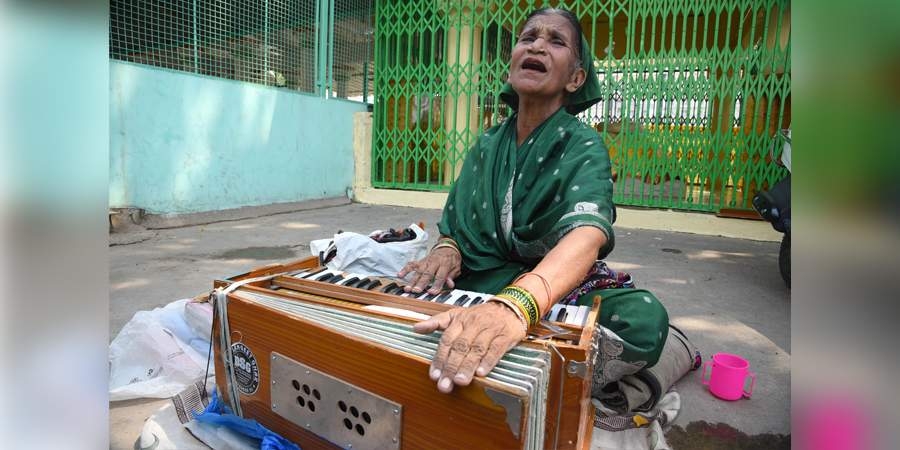
when Shahnaz Khanum sits outside the Hussain Shah Ali Dargah in Shaikpet with her harmonium, she is bound to touch a chord with her soulful singing.

Shahnaz Khanum (Photo | R Satish Babu, EPS)

Hyderabad  :

Women are not allowed to sing inside dargahs, and that is why, Shahnaz Khanum sits outside the Hussain Shah Ali Dargah in Shaikpet with her harmonium. Since she finds keeping the pallu of her sari fixed on her head a bit irksome, she ties a green cloth around her head. She sings outside the dargah on Thursdays, Fridays and Sundays. She is always dressed in green when she performs.

It is unusual to see a woman who sings qawwalis. The mutawalli of the dargah informs that she was once allowed to sing inside the dargah, but had to be relocated when devotees raised objections.Now 65, Shahnaz speaks in a low, husky voice about the days she used to perform inside the dargah with her husband. It has been 23 years since her husband passed away and the family, which is full of accomplished singers, now lives hand to mouth.

“I was married at 11, and had my first child at 12. My husband and I belong to a family of singers. I never went to school, but started singing in Telugu, Urdu, Hindi, Marathi and even Tamil from a young age. My mother was my teacher and she used to teach me ghazals. She was a big fan of Begum Akhtar. My husband used to play many musical instruments including the tabla and harmonium. My association with this dargah goes back 40 years. In those days, we used to live beside the dargah so that we could perform here.”
When asked to sing her favourite qawwali, she deftly runs her bony fingers on the harmonium and breaks into the famous, ‘Mere Dil Mein Hain Yaad-e-Mohammed.’ Her voice has pathos and she is a tad out of breath. But again, she has been sitting outside in the summer sun for the last three hours.

Shahnaz continues reminiscing about the good old days and says, “Earlier, there used to be many qawwali competitions in which both men and women used to take part. I used to travel to various parts of South India to take part in these soirees. But now, these gatherings are not held often. Also, I had to stop performing after my husband’s death. I earn anything between `200– 600 per day. I need to do this for my grandchildren. One of them has haemophilia and she needs an injection that costs `6,000 every month.”

Her son, Qadir Ayaazi, sings qawwalis, ghazals and bhajans. He performs with his two brothers in various dargahs, and has also sung bhajans for Satyanarayana puja. He laments that getting work in the age of YouTube channels has become a Herculean task. “We do not know how to record and upload our performances. For recording, we need a studio and equipment which are costly. That is why, we do not have much visibility. Also, the competition is intense. There are plenty of other parties who agree to perform taking half the amount we charge. At the end of the day, we earn a pittance.”

Picking the thread of words from her son, Shahnaz says, “This vidya is of no use if there is no backing or platform. My dream is to educate all my grandchildren so that they can come out of this cycle of penury.”
If you want to help/contact Shahnaz for any programme, you can reach her at 9849365164.
kakoli_mukherjee@newindianexpress.com @KakoliMukherje2

source: http://www.newindianexpress.com / The New Indian Express / Home> Cities> Hyderabad / by Kakoli Mukherjee / April 04th, 2019