Most people know of this hierarchy but how much do we know of the women behind this great dynasty?
Mughal empire
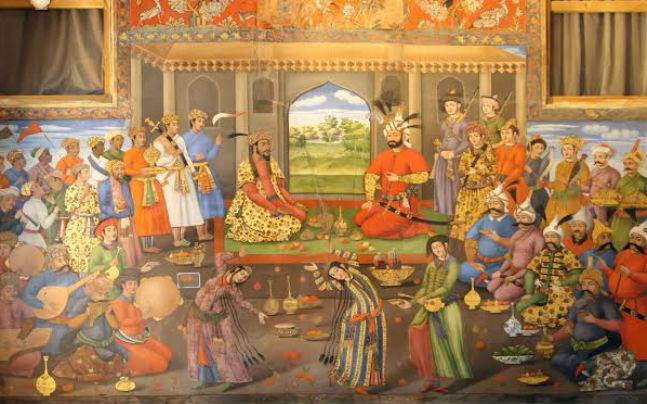
The Mughal Empire (1526-1707) was established by Babur defeating Ibrahim Lodi in the First Battle of Panipat. His reign went on for four years (1526-1530). His successor was his son, Humayun. Then arrived Akbar, followed by his son Jahangir, followed by Shah Jahan, and the, the last great Mughal ruler– Aurangzeb.
Most people know of this hierarchy but how much do we know of the women behind this great dynasty?
Here’s a list to educate you about the same!
source: http://www.indiatoday.in / India Today / Home> News> Education Today> GK & Current Affairs> History / by India Today Web / New Delhi – May 06th, 2016
The 56-year-old walks seven kilometres, reminding residents to get up for the meal before the roza.
Photo Aakash Karkare
It’s 3 am in Mumbai. Much of the city that claims never to sleep is silent and resting, save for one corner in the south. Under the massive JJ Flyover, in an area called Mohammad Ali Road, the streets are humming and throbbing. All kinds of meats and sweets are being made at roadside stalls. Not a single restaurant is shuttered. Teenagers, sometimes four to a bike, whiz around. Little children play cricket in the traffic-free narrow lanes.
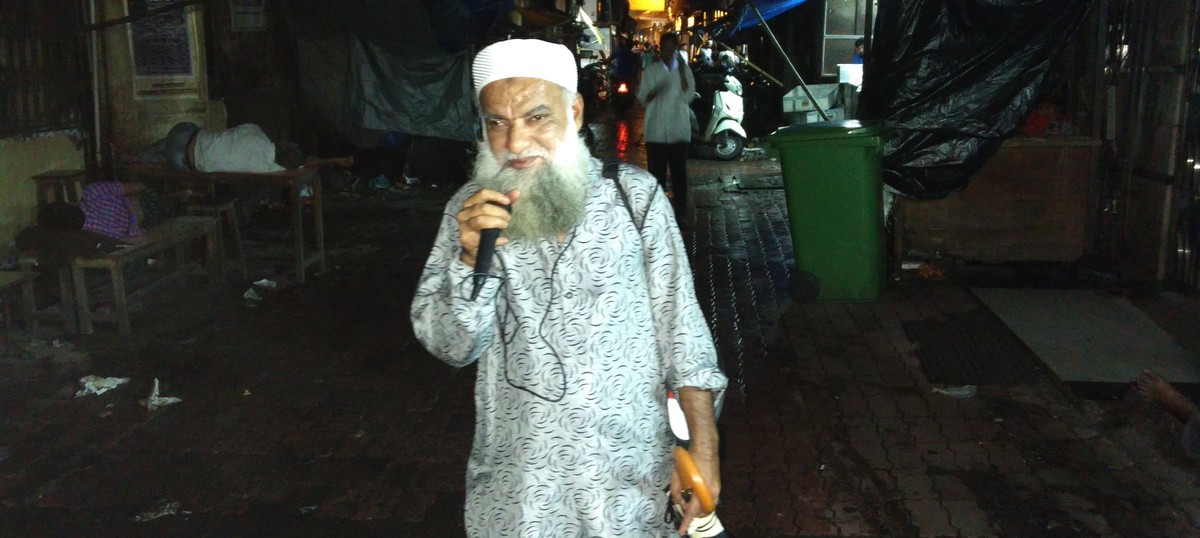
In this chaos resounds the call of Mohammed Farooq Qureshi Sheikh. “Neend se jaago, sehari ka waqt ho gaya. Zindagi ka kya bharosa? Ramzan mile ya na mile.” Wake up, it’s time for sehar. Who knows what life will bring? If we are able to get Ramzan, or not?
Credit: Aakash Karkare
For the last 18 years, during every Ramzan, Sheikh has made the same seven-kilometre trek from Shafai Masjid in Dongri to Dawoodbhoy Fazalbhoy High School in Chinch Bunder. The distance isn’t much, but Sheikh walks through every lane and by-lane, reminding the residents with his call to awaken for sehar (the meal eaten before the fasting for the day begins).
Along the way, passersby who know him, and call him Taj Bhai, stop to greet him. A few of them give him donations for his work. Children holler “Taj Bhai, chalu ho jao.” Taj Bhai, do your thing.
The 56-year-old finishes his walk by quarter past four, about 15 minutes before sunrise, so he can have his meal before the fasting begins. He chooses to avoid the area’s famed Ramzan delicacies, opting for a simple meal of milk and chapati. “At my age I can’t eat things like malpua,” he said.
A dying tradition
Sheikh is a practitioner of a Ramzan tradition that dates back ages, to a time before people had ready access to clocks and needed someone to tell them time. In Egypt, the practice is called Musaharaty and those who sustain it El Musaharaty. In Kashmir, they are given the name Sehar Khans.
Everywhere, alas, the custom is slowly dying out. The Sehar Khan, or the El Musaharaty, is becoming increasingly obsolete as people have begun relying on their mobile phones or alarm clocks to tell them time.
Sheikh calls himself a “sehariwalla” and while he says he hasn’t heard of the Sehar Khans of Kashmir, he does remember an “old man with a walking stick” who would come to his neighborhood when he was growing up. “Even then, the tradition of the sehariwallas was almost non-existent.”
Sheikh began his twilight Ramzan walks when he was in his mid-30s. His wife passed away when he was 22 and their son passed away soon after he was born. “In the beginning, I would walk up to the last floor in each building and call out to people. Now, I am too old to do that so I have this megaphone.”
He stays up all night, and at 3 am, he sets off from the office of the travel agency where he has worked for the past 15 years and where he lives in a corner. Sheikh says he got his first job when he was 16 at a printing press, after which he got by with odd jobs. Many of the employees at the travel agency have grown up seeing Taj Bhai do his nightly rounds.
Even in his old age, Sheikh keeps a brisk pace as he makes way through Mohammad Ali Road, chanting, “Neend se jaago, sehari ka waqt ho gaya…”
Saif Sathi, who has grown up in the area, feels Sheikh is still important. “There are so many people who don’t have anyone to wake them up,” said the 17-year-old. “People who sleep on the streets, for one thing. Even the local mosque has no one to wake them up. My family, too, relies on his call to awaken.”
But giving wake-up calls is not all Sheikh does. Last year, when the monsoon was late in arriving, he began going to the Kasaiwada area in Kurla to ask people to pray for rain. Even this year, because the rains didn’t come on time, he reminded people to pray for them. On occasion, when asked by local municipal councillors, he even announces government schemes. “A few years ago, they were distributing spectacles, so I announced that in the neighbourhood. More recently, I announced the government’s plan to conduct heart operations for free.”
According to Sheikh, there are still sehariwallas in the “poorer areas of the city who go around with daflis (tambourines)”. In Mumbai’s suburbs, in slums in Kurla or Nala Sopara, this tradition might still exist because not everyone there might have a phone, he believes.
But in the main city, he claims he “might be the only one still practising the profession”, although he adds a disclaimer. “I don’t keep up with what others are doing. All I can say for sure is that I am doing it.”
He plans to continue being a sehriwalla as long as he is “hale and hearty”, and is not very optimistic that future generations will continue in his footsteps. “Is there anyone in your generation who will stand and sing for an hour and a half?” he asked and laughed heartily.
source: http://www.scroll.in / Scroll.in / Home> Magazine> Traditional Touches / by Aakash Karkare / July 03rd, 2016
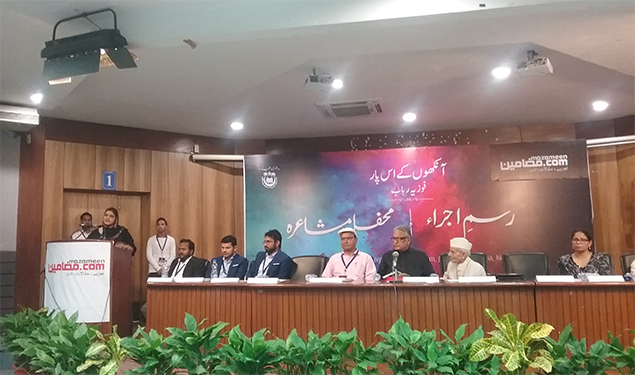
Mazameen.com, one of the largest websites of Urdu after Rekhta.org, in collaboration with Department of Urdu, Jamia Millia Islamia (JMI) organized a programme to launch Foziya Rabab’s first collection of poems “Aankhon Ke Us Paar” at the auditorium of the University’s Engineering Department here on Friday, 3 November, 2017.
Speaking on this occasion former Chairman of National Commission for Minority Educational Institutions Justice Suhail Ejaz Siddiqui likened the young poet from Ahmedabad with the famous poet Parveen Shakir (1952-1994) and extended his good wishes for her poetry to flourish in years to come. Renowned Urdu litterateur Gulzar Dehlvi maintained that Rabab was aware of the style of expression. “There is possibility of great creativity in her poetry,” said the nonagenarian poet.
Former Head of the Department of Urdu, JMI, Professor Khalid Mahmood appreciated the title Aankhon Ke Us Paar (Beyond the Horizons) in a philosophical note stating that the metaphor stood for wisdom and farsightedness.
He described the poem Mujhko to kuchh aur dikha hai aankhon ke us paar/Ek tilsam-e-hoshruba hai aankhon ke us paar as one of the finest poems of the collection.
Mahmood, who has also served as Vice Chairman of Delhi Urdu Academy, commended the feminine expression of emotions in her poetry stating that at times the changing mood in her narration took one by great surprise.
Urdu essayist and critic Kausar Mazhari said, “Foziya has tried to unfold women’s poetry which usually remains closed, but in so doing she has opened it a little more than required”. He called her a beautiful poet of romanticism with an amazing blend of simplicity and sincerity.
Head of the Department of Urdu, JMI, Prof Shehpar Rasool said, “The poet [Foziya] in Aankhon Ke Us Paar knows well what to say, when to say and how much to say”.
There is no feminism in Foziya’s poetry, rather it has an oriental household woman’s love for her man in which romanticism prevails because of the power of expression, remarked Dr Baran Farooqi.
About her own poetic journey Rabab said that her achievement was the result of the blessing of Allah and love of friends and well-wishers. “Playing around words is my profession; words which keep changing and which then take the shape of poetry.”
Words are the signs and symbols of life and carriers of truth and honesty, she added. She also read out some of her poems. Dr Adil Hayat presented a paper in which he termed Rabab’s poetry as the “poetry of love and separation”.
The book launch and discussion was followed by a mushaira in which over a dozen poets participated. These among others included Shehpar Rasool, Shakil Jamali, Tarannum Riyaz, Alok Shrivastav, Salim Saleem, Alina Itrat, Abdul Wahab Sukhan, Khalid Mubashshir, Kunwar Ranjit Singh, Poonam Yadav, Rehman Musawwir, Saurabh Shekhar, Tabish Mehdi, Urmila Madhav. Irfan Waheed and Khalid Saifullah Asari of mazameen.com also shared their views.
Moin Shadab beautifully compèred the mushaira whereas Dr Khalid Mubashshir moderated the book launch session.
A good number of literary persons including teachers and students from JMI and other institutions attended both the book release programme and the mushaira.
(A Delhi-based freelance journalist Manzar Imam can be contacted at manzarkhalil@gmail.com)
source: http://www.ummid.com / Ummid.com / Home> Life & Style / by Manzar Imam , ummid.com / November 13th, 2017
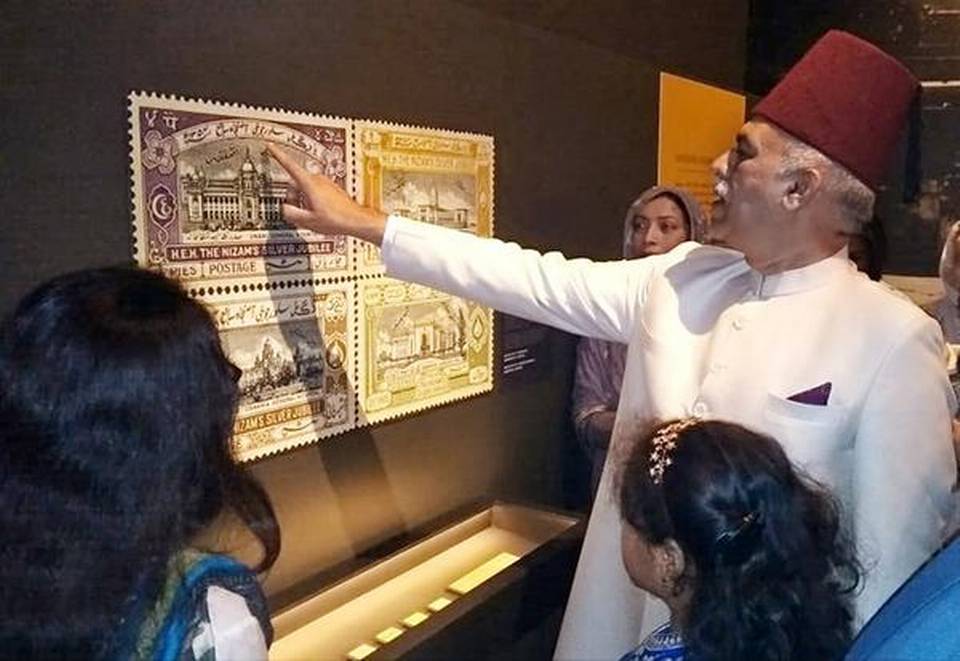
Nawab Najaf Ali Khan, a grandson of the seventh Nizam, at the exhibition in New Delhi recently.
Rare Nizam-era stamps from Ewari family’s philately collection exhibited in Delhi
An exhibition of postal stamps, envelopes, documents and photographs of the Nizam era held at New Delhi recently was a journey into the past not only for history lovers and inquisitive minds ready to peep into the bygone era at any given opportunity but also for descendants of the last and seventh Nizam, Mir Osman Ali Khan.
The exhibition with the theme of ‘Property of a Gentleman – Stamps from the Nizam of Hyderabad’s Dominions’ was organised jointly by The Gujral Foundation and Guli Art Foundation at Bikaner House from March 9 to 24 with the collection from the Ewari family. The kin of the seventh Nizam, including one of his grandsons Nawab Najaf Ali Khan, who visited the exhibition along with other family members, were all praise for the Ewari family for their prized collection.
Mr. Najaf Ali Khan said the collection comprised a selection of stamps originating from the erstwhile Hyderabad State during the Nizam’s rule. “The philately and other collection has a deep personal connect with Hyderabad,” he said, adding that the genesis of the expansive collection was the legacy of Nawab Iqbal Hussain Khan, the Post Master General in the Government of Nawab Mir Osman Ali Khan Bahadur Nizam VII.
First adhesive stamp
In all, the Ewari collection includes three million stamps from across the world, including the rare Penny Black, the first adhesive postage stamp in the world. It also featured every single stamp in the chronology of the senior most princely state of colonial India, Hyderabad. “The Asaf Jahi rule with Hyderabad as its headquarters issued its own stamps for almost 80 years from 1869 to 1949 till it joined the Indian Union,” Mr. Najaf Ali Khan explained. Against the present day advanced technology in communication, postage stamps were the indispensable remnants of the bygone era. The seemingly insignificant pieces of paper played an essential role as payment to help transfer messages, to facilitate revenue collection, taxation and other fiscal purposes, he noted.
Historic value
“Thanks to the organisers, who created such an ambience that immediately drew us in and we felt transported to the era of such royalty, it was a mesmerising experience. The dimly-lit huge landscapes of structural marvels of Hyderabad and custom-made lead boxes housing the stamps added to the beauty of the collection. We thank the Ewari family for preserving these priceless and alluring exhibits of historic value,” Mr. Najaf Ali Khan said.
source: http://www.thehindu.com / The Hindu / Home> News> Cities> Hyderabad / by B. Chandrasekhar / Hyderabad – April 01st, 2019
When Sania Mirza burst upon the global scene, the London-based New Statesman saw this “slender 18-year-old Muslim tennis player from India” as one of the 10 people who could change the world.
Jason Cowley, who wrote the article, believed that she had the “potential to change the world” for the following reasons: 1. She was the first Indian female tennis player to be ranked among the world’s Top 40. 2. She had made a breakthrough in sport despite coming from a country that usually discouraged women in sport. 3. She had discipline, tenacity, flamboyance. And all of this amounted to 4. She was going to “inspire a whole new generation of Indian girls”. Cowley’s article was written in October 2005, soon after a fatwa stipulated that Mirza should be prevented from playing tennis in skirts and T-shirts. Mirza instantly became a symbol of defiance, a “slender 18-year-old” girl who could stand up to Muslim hardliners. At around the same time, Time magazine hailed her as one of Asia’s heroes. AndThe New York Times said the weight of the country’s expectations rested on her.
I am at a loss to explain how or why the Sania phenomenon fizzled out in mainstream media. To be sure, she remains a remarkable player who will continue to inspire a whole generation of young women. But Mirza is no longer feted and hailed for her potentially transformative powers. I thought of Muslim role models once again when I saw the modest, self-effacing Allah Rakha Rahman accept his twin Oscars in Los Angeles.
There he was, up on stage in his very Indian designer sherwani singing Jai Ho, the song from Slumdog Millionaire. Or there he was on the red carpet with his wife, her head covered as she shyly posed for photographs. On stage, he was thanking God (“all glory and fame to God”) and his mother, talking of the path of love rather than hate that he had opted to follow. There was quiet dignity about him rather than the usual over-the-top Oscar exuberance. I suspected he would have had the same quiet smile had he lost.
Rahman is not known to be a man of many words. So, it was the subtext of what he said (or didn’t), that struck me as significant. Here was a Muslim who was confident in his identity as an Indian Muslim (in fact, with Maa Tujhe Salaam, he has done more to popularize Vande Mataram than the entire Sangh parivaar put together). Like the majority of Muslims everywhere, he believes in his God, in family values, in love and brotherhood. He was not out of place on the world stage performing with artistes drawn from all over the globe.
Rahman does not conform to any of the Muslim stereotypes. But he is undeniably an adherent of Islam, converting to the faith at the age of 21 along with his family. His views on politics are not widely known. But as a believing Muslim, he is reported to earmark one-third of his earnings to charity. Significantly, one of his first acts on returning home to India was to visit the Ameen Peer dargah at Kadappa in Andhra Pradesh to offer special prayers.
India’s Muslims have been singled out for their many unique qualities.
Thomas Friedman recently hailed the community’s decision to refuse burial in Mumbai to the Pakistani terrorists killed in the 26/11 attack. By denying terrorists the status of martyrs, the world’s second largest Muslim community was doing a “great service to Islam”, he said. Yet, one of the laments among Muslims is the lack of credible role models.
Bollywood within its secular framework has been able to throw up some figures—Javed Akhtar and Shabana Azmi most notably speak up for a pluralistic, democratic framework, but they’re not necessarily seen as strong adherents of Islam. Aamir Khan is the sensitive voice for the marginalized, not really a strong Muslim figure. Azim Premji is probably the richest Muslim in India but, once again, his success is defined in business, not religious terms.
In cricket, you could certainly look at the Pathan brothers who straddle both worlds—cricket and Islam. The sons of a poor muezzin who couldn’t afford even a pair of shoes, they now symbolize a can-do spirit. In a TV ad, they refer to their father as “abba”. It’s as if they’re saying, like Omar Abdullah, “We are Indians and Muslims and see no contradiction between the two.”
With his stunning Oscar win, Rahman reaffirms the same message to emerge as a new role model for young Indian Muslims. In equal parts a proud Muslim, proud Indian and proud professional, he stands as a counter to both the fanatic and the stereotype of the fanatic that many believe represent the average Muslim.
For this reason alone, I’m singing the new anthem: Jai Ho.
Namita Bhandare writes every other Tuesday on social trends. Respond to this column at lookingglass@livemint.com
source: http://www.livemint.com / Live Mint / Home> Explore> Looking Glass / by Namita Bhandare / March 02nd, 2009
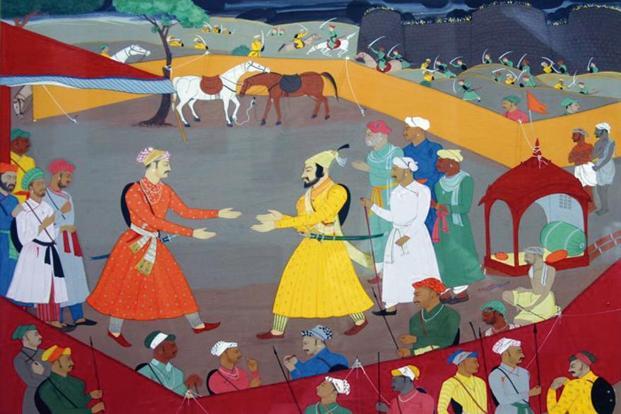
In 1674, Shivaji crowned himself king, with classical ritual in full display. Photo: Wikimedia Commons
By accepting the concept of the Thulukka Nachiyar, within the temple, was a space created to locate the newcomer Muslim within the world of the orthodox Hindu?
India is a mosaic of many curious tales. But very often, seemingly incongruous elements that reside in the realm of fable and myth end up lending an ironic congruence to the concrete world of men. Throughout Indian history, whenever politics has found itself at an awkward crossroads, a generous fabrication of mythology has helped ease the process. One prominent example is Shivaji’s—the Maratha warrior had emerged as a powerful force in the late 17th century, with armies, treasure, and swathes of territory at his command. But rivals painted him merely as an over-strong rebel, so that in addition to power, what he needed was legitimacy too.
The answer to Shivaji’s woes came in 1674, when he decided to crown himself king, with classical ritual in full and extravagant display. A genealogy was invented connecting him to an ancient royal line, and retrospective rituals permitted him to take his place as a “pure” Kshatriya, when so far Brahmins had deemed him inferior in caste. It was a masterstroke: Shivaji now towered over other Maratha clans in status, while simultaneously alerting his Mughal enemies that he was no longer a “mountain rat”—he was an anointed, lawful monarch.
As a society too, India has been capable of negotiating disruptive changes through the invention of tradition. Reading scholar Richard H. Davis’ work recently reminded me of the bizarre, clever and typically Indian ways in which this was achieved. When Muslim might arrived in India in the form of invaders, a new chapter was inaugurated in the story of our subcontinent. The old order fell, and a different structure was fashioned. One way in which the elites on both sides tried to rationalize, in their respective world views, these painful changes is through what historian Aziz Ahmad called epics of conquest and resistance. Thus, for instance, we have Muslim accounts that exaggerated the “destruction of infidels”, when, in reality, even the terrifying Muhammad of Ghor’s coins prominently featured the “infidel” goddess Lakshmi, countered by Hindus with their own stories, the case of Padmavati preferring fire to the embrace of a Muslim being one such. Rhetoric was amplified on both sides, legends and tales competing for narrative dominance to come to grips with changes under way on the ground.
One such fascinating story from the 14th century features a Muslim woman recalled to this day by Hindus as Thulukka Nachiyar (literally, “Tughluq Princess”), who is said to have fallen in love with a Hindu god. The outline of the story is as follows: When Muslim troops from Delhi plundered temples in southern India, on their list was the great Vaishnava shrine at Srirangam in Tamil Nadu. Temple chronicles show that indeed idols were seized, and, in this story, the processional image of the deity is taken to Delhi. The reigning sultan consigns the idol to a storeroom, while a local Tamil woman, who had followed the troops, returns to Srirangam and informs the temple authorities of the precise whereabouts of their deity. Dozens of priests now make their way to court, where, after entertaining the sultan with a series of performances, they request the return of their lost idol. The cheerful Tughluq king is happy to grant them this, commanding his men to go to the storeroom and fetch Srirangam’s deity. Everyone is, at this point, rather pleased with the turn of events, and we have every hope of a happy ending.
This is where the twist occurs. It so happens that the sultan’s daughter had long before gone into the storeroom and collected the idol, taking it to her apartments and there playing with the deity as a doll. The implication, however, is that by dressing “him”, feeding him and garlanding him, as is done to deities in Hindu rituals, the princess was essentially worshipping the image, winning divine affection. When the appeal from the Srirangam party is heard, the deity puts her to sleep and agrees to return south, only for the Tughluq princess to wake up distraught—she hastens to catch up with the Brahmins, who meanwhile have split, one group hiding the idol in Tirupati. Arriving in Srirangam but not finding the deity even there, the princess perishes in the pangs of viraha (separation).
Her sacrifice is not for nothing, though. When eventually the deity comes home, He commands the priests to recognize his Muslim consort, commemorated ever since in a painting within the temple. On his processional tour of the premises, to this day, the deity is offered north Indian food at this spot (including chapatis).
The story is a remarkable one, with an exact parallel in the Melkote Thirunarayanapuram temple in Karnataka, where, in fact, she has been enshrined as a veiled idol. Though it seems unlikely that a Tughluq princess actually came to the south head over heels in love with a deity, could it have been that there was a Muslim woman instrumental in having idols released from Delhi? Or is it, as Davis suggests, a “counter-epic” where the roles are reversed: Instead of a Muslim king chasing after Hindu princesses, we have a Muslim princess besotted with the Hindu divine. By accepting the concept of the Thulukka Nachiyar, within the temple, was a space created to locate the newcomer Muslim within the world of the orthodox Hindu? The truth might lie in a combination of these possibilities, but we can be sure that it is a colourful, revealing narrative with a splendid cast, telling us once again that while there were moments of crisis between India’s faiths, legend and myth allowed them to see eye to eye and move on to fresh ground—a lesson we would be wise to remember in our own contentious times.
Medium Rare is a column on society, politics and history. Manu S. Pillai is the author of The Ivory Throne: Chronicles Of The House Of Travancore.
He tweets @UnamPIllai
source: http://www.livemint.com / LiveMint / Home> Explore / by Manu S. Pillai / March 30th, 2018
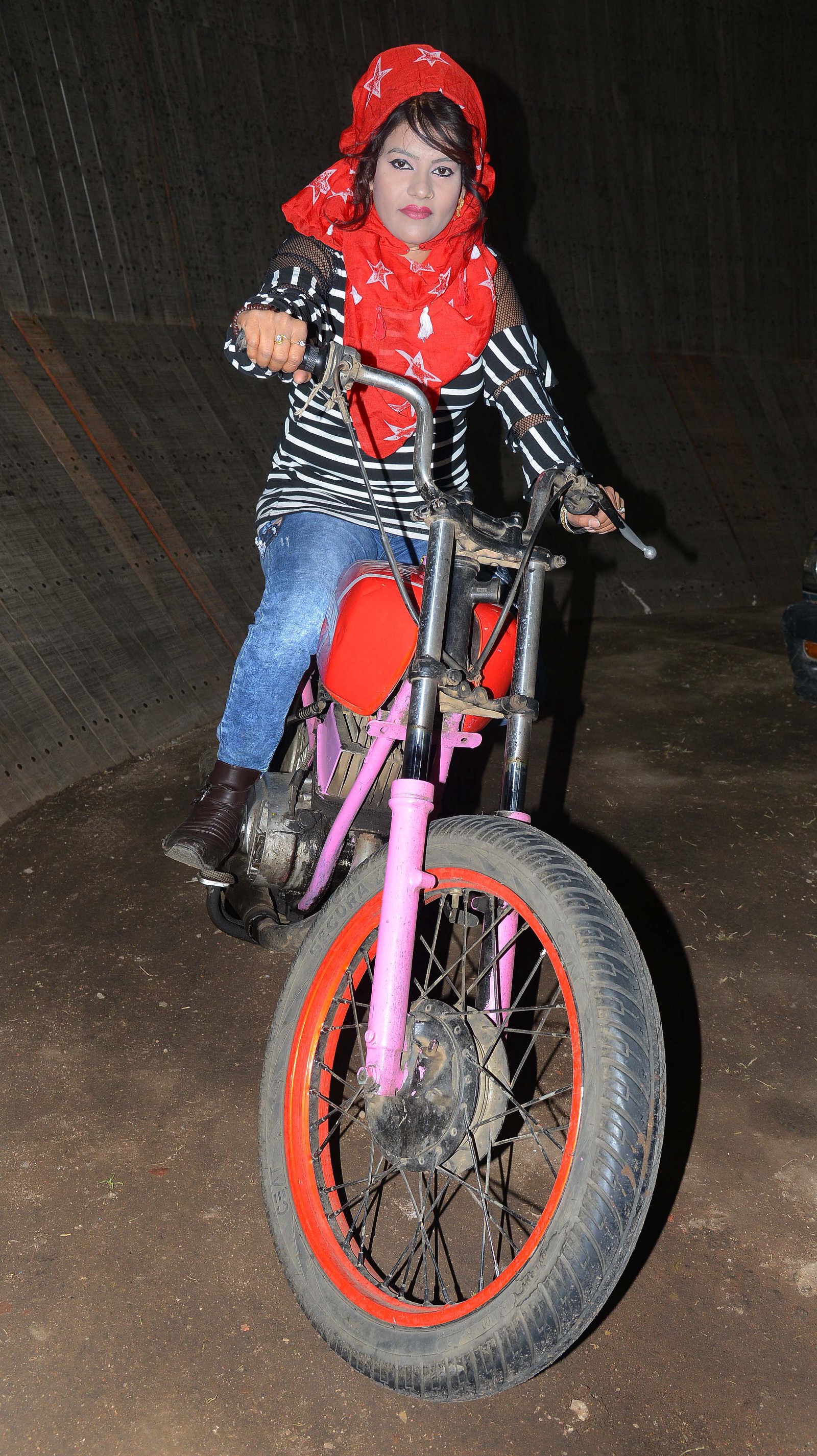
Rehana Khan, perhaps the first female stunt-woman to entertain the guests at Maut ka Kuan in Numaish, Hyderabad
28-year-old Rehana Khan
Numaish has been an integral part of every Hyderabadi, where year after year one doesn’t miss to take a stroll around the many stalls and rides. Not just the stalls but also the well of death — or maut ka kuan as it is popularly known — has always been a crowd-puller. Kids and adults alike would be excited to watch men get onto their bikes and cars as they take a round of the near-vertical pit with walls lined by wooden planks, at a high speed, often giving the audience a high five as they ride up!
However, this year the crowd hooted and cheered, as a stuntwoman made her entry and joined the team for the first time. 28-year-old Rehana Khan, who hails from Uttar Pradesh, has been performing stunts for the last six years and has been invited to be a part of Numaish for the first time.
Calling it her passion, Rehana says, “I would watch men do stunts on their bike and think to myself that if they can, then I can do it too. That is when I took it up as a challenge and started practising. It feels good that being a girl from a small town, I am doing something different, and not treading on the usual path.”
It’s been a little over two weeks and Hyderabad has welcomed the daredevil with open arms. “The audience here is very happy to watch my performance. They meet me after the show and I love the respect I have been getting. As girls have a bad (and clichéd) reputation for not riding properly on the road, when people see one attempt such deadly stunts, it leaves them in awe. Women feel happy and tell me that girls are not behind boys anymore,” she adds further.
Rehana stuns the audience at Numaish, Hyderabad
Stunts take Rehana to different parts of the country — Ranchi, places in Bihar and Chhattisgarh and Assam among others — but it is the respect she is getting in Hyderabad that she will “cherish forever”.
Rehana started practising right after college and it took her about six months to perfect the stunts. “If someone wants to pursue a career in it, they would require proper training. You have to make sure that you have no dizziness during or after riding on the ground. It would take a while for it to go, but once you get rid of it, the path ahead would seem easy,” she says adding, “Girls should try to create their own identity and not bow down to the stereotypes of the society. In today’s time, they are not behind men and can work as hard as them or even more.”
Her husband is always by her side, encouraging and proudly watching Rehana perform the stunts. “My family sees it as a dangerous profession but at the same time supports it since it is my passion,” she says adding that the money a stunt-woman earns is decent but it is the respect that she gets that makes it all worth.
Rehana stuns the audience at Numaish, Hyderabad
She entertains the audience from 5 to 11 pm every day with minimal breaks, but Rehana has no complaints and says with pride that she took the right path. “I wanted to be known for what I do, for the society to recognise me, to meet new people and to travel to different parts of the country showcasing my talent. Money is decent but what gives me happiness is to be among people, and be known for my talent. They respect you for taking up an unusual career. I must add that Hyderabad’s reaction has been very encouraging. I like it here,” concludes the daredevil, as she rushes to get ready for another show.
source: http://www.medium.com / Medium / Home / by Neha Jha / January 20th, 2019
A night’s stay in the hotel, which is set to open later this year, might cost up to Rs 8 lakh.
A view of the Great Scotland Yard (Photo | http://www.twenty14holdings.com)
Kochi :
Malayalee billionaire Yusuff Ali, who bought the Great Scotland Yard, which served as headquarters for the Metropolitan police in London, has converted it into a luxurious 5-star hotel. The renovation that cost Rs 685 cr. (£75 Million) was done in 3 years.
The business tycoon, who is chairman of Abu Dhabi-based retail giant LuLu Group had earlier bough the iconic building in 2015 for Rs 1000 crore (£110 Million). The renovated hotel is all set to open later this year and will be managed by the Hyatt Group.
When asked about the property, Yusuff Ali said: “This is a very prestigious project for us as this is one of the most well-known property not just in the UK but around the world. We have not left any stones unturned to make this the most sought-after hotel while retaining the essence of the original building, so that each of our guests get a truly memorable experience”.
Great Scotland Yard has special relevance in UK history as it was chosen by the then Prime Minister Sir Robert Peel as the headquarters for the Met police in 1829. Even after the renovation, the essence of the original building has been preserved.
The hotel will have 153 rooms and the tariff per night is expected to go up to Rs 7,79,842 (10,000 euro). These suites offer guests picturesque views of Nelson’s Column, Westminster Abbey and Buckingham Palace, making it one of the most unique locations in London.
The luxury hotel that is steeped in British political history will include references to the famous criminals of the time gone by. In a secret whisky bar, a decadent chandelier made of glass shards will be a nod to the Forty Elephants, the 19th-century gang of women known for smashing shop windows to steal jewellery. There will also be artwork by prisoners and old military uniforms.
Adeeb Ahamed, Son-in-law of Yusuff Ali and the Managing Director of Twenty14 Holdings, the hospitality arm of Lulu Group said, “Renovating the Great Scotland Yard building and unveiling the UK’s first Unbound Collection hotel will bring a truly individual and world-class hotel to London.
“The Great Scotland Yard is really an important part of the fabric of London and it is a great opportunity for us to be a part of the culture and legacy of this great city and help in its development. The Great Scotland Yard will be an enriching landmark in Westminster as a high-end luxury boutique hotel that recaptures the history, culture and essence of the London of yore.”
source: http://www.newindianexpress.com / The New Indian Express / Home> States> Kerala / by Express News Service / March 26th, 2019
Oscar-winning composer A.R. Rahman has created India’s Marvel anthem for the release of “Avengers: Endgame”
Oscar-winning composer A.R. Rahman has created India’s Marvel anthem for the release of “Avengers: Endgame”.
Oscar-winning composer A.R. Rahman has created India’s Marvel anthem for the release of “Avengers: Endgame”. It will come out in Hindi, Tamil and Telugu.
Marvel India has teamed up with Rahman for the track, which will be released on April 1, according to a statement.
“Being surrounded by Marvel fans in my own family, there was too much pressure to come with something really satisfying and apt for ‘Avengers: Endgame’. I hope Marvel aficionados and music lovers enjoy the track,” said Rahman.
There is much anticipation for “Avengers: Endgame”, especially after the success of “Avengers: Infinity War”
“‘Avengers: Endgame’ is not just a movie, it’s an emotional journey for fans everywhere in India. An original composition by Oscar winner A.R. Rahman was the perfect way to celebrate the love for Marvel among fans in the country.
“This is our small way of thanking the fans here for their extraordinary support”, said Bikram Duggal, Head – Studios, Marvel India.
Kevin Feige has produced the movie, directed by Anthony and Joe Russo. The movie will release in India on April 26 in English, Hindi, Tamil and Telugu.
source: http://www.news18.c0m / News 18 / Home> News18> Movies / by IANS / March 25th, 2019
The urs of Mughal emperor Shahjahan will be observed at the historic Taj Mahal for three days from April 2 next. Entry into Taj Mahal will be free for visitors after noon on April 2 and 3 while it will be free for the entire day on April 4.
Lakhs of devotees will throng the 17th century monument during the three-day event and will pay homage at the graves of Shahjahan and his wife Mumtaz, in whose memory the Taj Mahal was built.
On the last day, a ‘saptrangi chadar’ (multi-coloured bedsheet ) will be offered at the graves as part of a ritual. Sandalwood powder will be sprinkled on the grave too.
The urs of the Mughal king Shahjahan is celebrated on the 25, 26 and 27th day of Rajab, which falls of April 2, 3 and 4.
The Shahjahan urs committee will meet here on March 8 to decide on the arrangement and preparation to be made for the urs.
Officials said that a notification was issued by the ASI on the urs of Shahjahan. The administration will prepare a fool proof strategy to ensure full security to devotees attending the urs.
source: http://www.dailypioneer.com / The Pioneer / Home> State Editions> Lucknow / by PNS, Lucknow / March 06th, 2019