Prince Mishaal Bin Majed, governor of Jeddah, presents Abdullah Abdul Mateen Usmani the key of the car he won as first prize in the Quran memorization project
Jeddah :
Abdullah Abdul Mateen Usmani, an Indian expatriate, has recently been declared winner of the annual Qur’an memorization contest organized by Jamia Tahfiz-ul-Quran Makkah region.
One thousand huffaz (memorizers of the Holy Qur’an) participated in the event with 13 of them scoring marks between 95 and 99. In the second competition that ensued Abdullah Abdul Mateen Usmani was declared the winner.
Prince Mishaal Bin Majed, governor of Jeddah, was the chief guest at the gala event with hundreds of senior officials, philanthropists and parents of the participants in attendance.
Prince Mishaal distributed prizes among the winners with first prize going to Hafiz Abdullah Abdul Mateen who was given a car.
Jamia Tahfiz-ul-Quran is an institution and center established for the students to memorize and recite Holy Qur’an.
The Jamia holds the competition every year to encourage students and other participants.
Hafiz Abdullah Abdul Mateen Usmani belongs to the southern Indian city of Hyderabad.
The award winner’s father, Mateen Usmani, thanked Almighty Allah for the honor bestowed on his son and lauded the efforts of Jamia Tahfiz-ul-Quran in memorization and recitation of the Holy Qur’an.
source: http://www.saudigazette.com.sa / Saudi Gazette / Home / by Syed Mussarat Khalil / September 08th, 2018
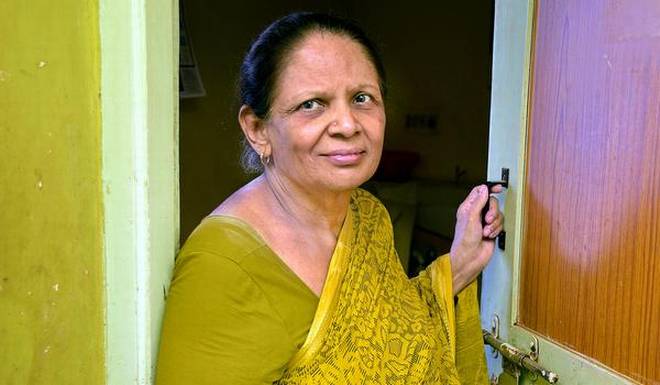
Remembering the past S Rahima, daughter of A M Shahul Hameed. | Photo Credit: M MOORTHY
A film industry stalwart’s daughter recalls the glory days of Central Talkies in Tiruchi
The glossy reprints on S Rahima’s bed are all that remain of a golden era that once defined her life as the daughter of film producer and theatre owner AM Shahul Hameed. The black-and-white pictures, taken in shooting spots and actors’ homes, hark back to a time when the sheen of show business was cemented by real relationships.
For movie buffs in Tiruchi, Central Talkies on Eda Street, Gandhi Market, once used to be the theatre to catch big banner productions of the day.
Started by Shahul Hameed in 1947, the 22,000 square foot complex opened for business with Payithiyakaran, the Tamil film produced by and starring N S Krishnan, the actor’s first assignment after his acquittal in the Lakshmikanthan murder case.
“My father was already constructing the theatre when he was running his rice business in the 1940s,” says Rahima. “Everything, from equipment to seating, was imported from England.”
Shahul Hameed also marketed films through his company called Central Talkies Distributors.
“He was the sole distributor of the 1958 Hindi film Madhumati in Tamil Nadu (starring Dilip Kumar and Vyjayanthimala Bali). He screened it at a special matinee show for the family in Central Talkies. Madhumati ran for over 100 days in the State, without dubbing,” says Ms Rahima.
Philanthropists
Shahul Hameed was the son of A Mohamed Hussain, a freedom fighter and prominent syrup merchant in Gandhi Market. Interestingly, though partially obscured by encroachments, it is still possible to see a plaque with Hussain named as the benefactor who gifted the Gandhi Market arch to the city of Tiruchi in 1928.
A.M. Shahul Hamid, movie producer and theatre owner, in an official portrait after receiving the Khan Bahadur title from Lord Mountbatten in 1945. | Photo Credit: SPECIAL ARRANGEMENT
Son Shahul Hameed made his name as a rice merchant, with his Hameedia Rice Mill based in Ariyamangalam. “Like my grandfather, my father was a philanthropist who would readily donate to any worthy public cause,” says Rahima, who is one of seven children born to Shahul Hameed’s second wife.
“He was honoured for his services to the British Government during the Second World War with the title of Khan Bahadur and a gold medal by [the last Viceroy of India] Lord Mountbatten in 1945.”
After Independence, then-Prime Minister Jawaharalal Nehru lauded Shahul Hameed’s generous donation of several truckloads of rice to the Indian troops fighting the Indo-Chinese war in 1962.
Central Talkies also brought the merchant into contact with prominent Indian film personalities.
“Quite early on, my father had gained a reputation as a saviour of films that were stuck in production due to financial problems,” says Rahima. “He helped TR Ramanna to successfully complete the production of Koondukili (1954), and Chinnappa Thevar’s Thaikkupin Tharam (1956), but only as a friendly gesture. Father never indulged in moneylending, because it is against our religious beliefs,” she says.
Becoming a producer
In 1962, Shahul Hameed helped actor-director AP Nagarajan with money to complete the shooting of his directorial debut Vadivukku Valaikappu, starring Sivaji Ganesan, Savitri, VK Ramasamy, MN Rajam and others.
After much persuasion, Shahul Hameed eventually agreed to Nagarajan’s request to produce the film Navarathri in 1964.
“All the stars were signed on for a salary of ₹3 lakhs each,” remembers Rahima. “In those days, you could buy a bungalow for ₹1 lakh in Thillai Nagar.”
A landmark 100th film for Sivaji Ganesan, the movie earned positive reviews for the nine distinct roles essayed by the thespian. It was subsequently remade in Telugu in 1966 with the same title and Akkineni Nageswara Rao in the lead, and in Hindi in 1974 as Naya Din Nayi Raat with Sanjeev Kumar.
Tragedy strikes
The success of Navarathri led to Nagarajan proposing his next film, a mythological, to be produced by Shahul Hameed, in 1965. Originally advertised as Siva-Leela, this was to be later renamed as Thiruvilaiyadal.
“These days, people would probably object to a Muslim producing a Hindu mythological film, but my father never let class or creed affect his friendships,” says Rahima. “He took a personal interest in the film’s production.”
Inspired by the Thiruvilaiyadal Puranam, a collection of 64 Saivite devotional stories written in the 16th century, the film was a critical and commercial success, running for over 25 weeks in theatres.
But it also had a thread of tragedy attached to it, for this was to be Shahul Hameed’s last production.
“A few days after the completion of filming, my father fell sick due to a heart ailment, and passed away on May 20, 1965, at the age of 58. It was as if the light went out of our life immediately,” says Rahima.
Finale
While Thiruvilaiyadal did well, winning awards and setting new standards for Tamil epic films, the lives of Shahul Hameed’s family members were thrown into turmoil.
“My husband Mohamed Kasim had been running the Central Talkies on lease on behalf of my father. Though we initially had a good run, with major films releasing here, my husband was unable to sustain the business due to rising rents,” says Rahima.
Mounting debts forced Shahul Hameed’s heirs to close down Central Talkies in 1983. The complex was sold in 1993.
“The trauma of losing Central Talkies affected my husband’s mental health badly, and he was confined to bed for 18 years,” says Rahima, who nursed him until his death on August 29, 2002.
Living in dire straits in rented accommodation near the Airport, Rahima, now a 70-year-old who suffers from age-related ailments, is supporting an adult son with neurological problems. Protracted property disputes have estranged her from her relatives, says Rahima.
The days of glittering movie premieres are a distant memory. Finding money to pay the bills is a daily challenge for this senior citizen.
source: http://www.thehindu.com / The Hindu / Home> Entertainment> Movies / by Nahla Nainar / August 31st, 2018
Explore a little-known facet of Goan history with our Quick Guide to the Safa Masjid
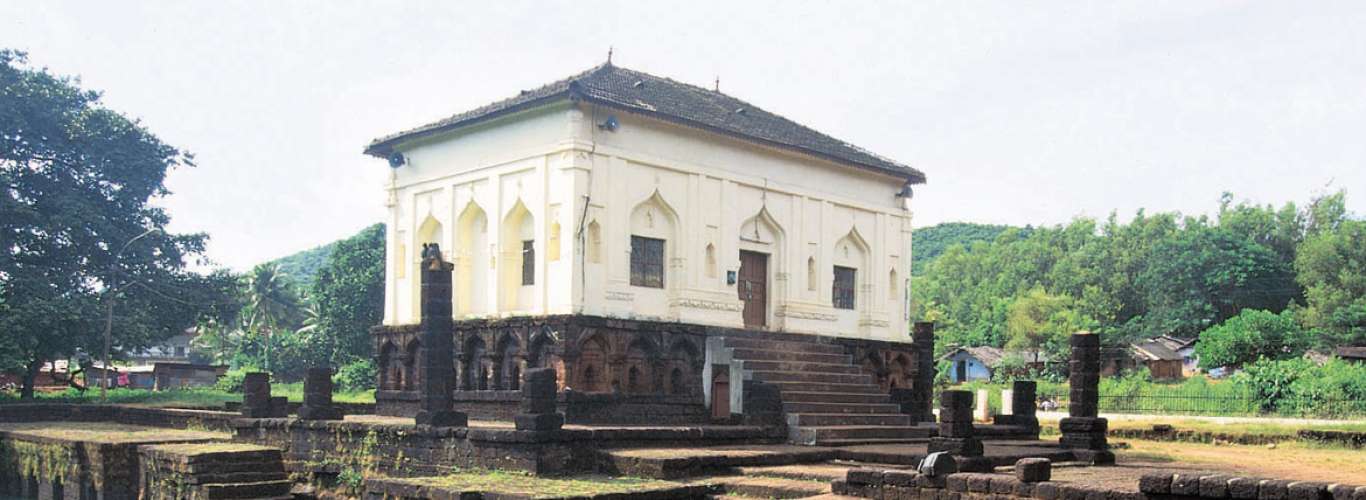
Set on the edge of a large tank just outside Ponda town, the Safa Masjid, built in 1560, is the only surviving mosque of the 27 shrines that Ibrahim Adil Shah of Bijapur constructed. Broken columns surround the mosque, which once graced a garden with laterite walkways. It’s among the few ancient Muslim monuments left in a state that has a long association with Islam and its solitude is evidence of the energy with which the Portuguese battled Muslim rulers.
Muslims – who now form just over five per cent of the state’s population – have lived in Goa since at least the 10th century CE, when the Kadamba rulers urged merchants from East Africa and Arabia to settle in the state.
But the kingdom’s affluence soon brought it to the attention of raiders. The raids, which started in the 10thcentury, reached a crescendo with strikes by Allauddin Khilji in 1294 and Muhammad Tughlaq in 1325. After briefly being held by the Vijayanagara Kingdom, Goa in 1358 came under the sway of Alla-ud-din Hasan Shah of the Bahmani family. When the Bijapur sultans took over from the Bahmanis in 1490, Yusuf Adil Shah started a construction campaign, building a mosque and a palace.
Ismail Adil Shah’s defeat in 1510, at the hands of the Portuguese Commander Alfonso de Albuquerque, had disastrous consequences for Goa’s Muslims. Angered that Muslims had helped Adil Shah’s defence, Albuquerque’s soldiers hunted them down viciously.
source: http://www.outlookindia.com / Outlook Traveller / Home> Explore> Story
This sleepy and now maligned town on the Karnataka coast boasts of a unique cuisine embracing Konkan and Middle-Eastern influences
Bhatkali biryani is topped with fried onions, curry or mint leaves.
Bhatkal is a small port town on the Arabian Sea, near Mangaluru. Between the 8th and 15th centuries, it was one of the chief ports on the western coast, specializing in the trade of rice, sugar, spices and horses. Yemeni horses would be brought from the port of Hormuz in Iran to Bhatkal, and traded across the country. Over the centuries, traders from Iraq, Iran and Yemen settled in Bhatkal and formed the Navayath (newcomers) community. Some of them intermarried with the locals, many of whom belonged to the Jain community, and were influenced by their customs, languages and culture. This, in turn, led to a unique and multicultural food practice.
In recent times, however, whenever Bhatkal shows up in the news, it is with reference to radical Islamist elements and polarization between religious communities. As a result, the spotlight is rarely turned on this unique cuisine. Other than the Bhatkali biryani, little else is known and even less represented in mainstream restaurants, even in its home state of Karnataka.
The Alibaba Cafe and Restaurant on Bengaluru’s busy MM Road in Fraser Town is one of the few places that is changing this trend. The décor seems straight out of an Arabian Nights tale. Coloured glass lanterns hang from the ceiling and the mud-plastered walls are reminiscent of a Yemeni village home. There are Indian references too. The restaurant’s heavy wooden door has a lotus motif and large copper cooking pots in the corner look curiously Mangalurean. Shaad Hassan Damudi, the owner, greets visitors while taking orders on the phone in rapid-fire Konkani.
Damudi is from the Navayath community and his restaurant’s menu reflects his heritage. “What you see on the menu here is centuries of cultural amalgamation between the various communities, resulting in a very unique cuisine,” Damudi explains. The meat-heaviness is also reflected in the star dish on the menu—the Shaiyyo biryani, made from vermicelli (shaiyyo) instead of rice. The vermicelli adds a uniquely Konkani touch to the distinctly Middle-Eastern flavours of the dish, featuring layers of delicately spiced meat and a generous helping of browned onions. Shaiyyo is sun-dried in vast quantities in early summer, so it can be prepared and enjoyed throughout the long west-coast monsoon. “Navayath cuisine tends to have milder flavours than traditional south Indian coastal cuisine,” says Damudi. “We use local Byadagi red chillies, known for their bright red colour and slightly sweeter taste.”
Any conversation about Bhatkali food always turns to Bhatkali biryani, made with basmati rice flavoured with saffron and whole garam masala. Tender pieces of mutton, chicken, fish or prawns are cooked separately with spices. Some even describe it as a korma and rice dish which is assembled in layers and finally topped with fried onions, curry or mint leaves.
Seafood is a staple of Bhatkali cuisine. Fish, prawns, mussels, clams, oysters and squid, available in plenty along the Konkan coast, are combined with local spices to create preparations like the laun miriya mhaure, where sliced fish (typically seer) are cooked in a traditional salt and red chilli paste, or shinonya nevri, steamed mussels stuffed with a spicy rice and coconut mixture.
Aftab Husain Kola, a Bhatkal native and a food and travel writer, says that although modern influences have crept into traditional Navayath cuisine, many of the old traditions of seasonal food have been preserved. He also throws light on some of the other Navayath home specialities like haldi pana nevri, rice pancakes steamed in turmeric leaves, and mudkuley, tiny steamed rice-flour balls in a delicately spiced curry. The community also gets together during weddings and festivals, for dawats or feasts which celebrate Navayath fare.
The wide range of Bhatkali desserts reflects the cultural intermingling of communities. Shaufa pana (dill leaves) feature in a variety of desserts, from poli (bread) to appo (pancakes), even puddings. Saat padra navariyo, a baked, layered dessert, reminiscent of Goa’s bebinca, and tariye khawras, a semolina, coconut and cashew pudding, are unique to the region. Some of the desserts have interestingly Middle-Eastern hybrid names too. Al basra poliand aflatoon poli are two such delicious concoctions—baked pancakes made with combinations of milk, coconut, egg and sugar. The Bhatkal version of kheer is godan—it has various manifestations, but the base always comprises coconut milk and jaggery.
The culinary diversity of this little coastal town is quite mind-boggling and more conversations about this and other aspects of Bhatkal’s rich culture could present an alternative narrative to those of terror and violence.
Aflatoon poli
Serves 4
Ingredients
2 tbsp refined flour
2 cups milk
4 eggs, beaten
1-2 tbsp sugar
1 tbsp broken cashews
1 cup coconut milk
K cup condensed milk
2 tbsp ‘ghee’
Method
Add the refined flour to the milk and stir over a low flame until it thickens. Leave aside to cool. Add in eggs, sugar, nuts, coconut milk and condensed milk, and mix thoroughly.
Grease a baking tin with ‘ghee’ and pour the mixture into it. Bake at 160 degrees Celsius for about 20 minutes. Check if it is done by inserting a toothpick into the pancake; it should come out clean. Remove from the baking tin and serve warm.
source: http://www.livemint.com / LiveMint / Home> Leisure / by Sriram Aravamudan / September 02nd, 2018
The pages of this Sanskrit trestise eschew a story of timeless love, passion and the strife it accompanies
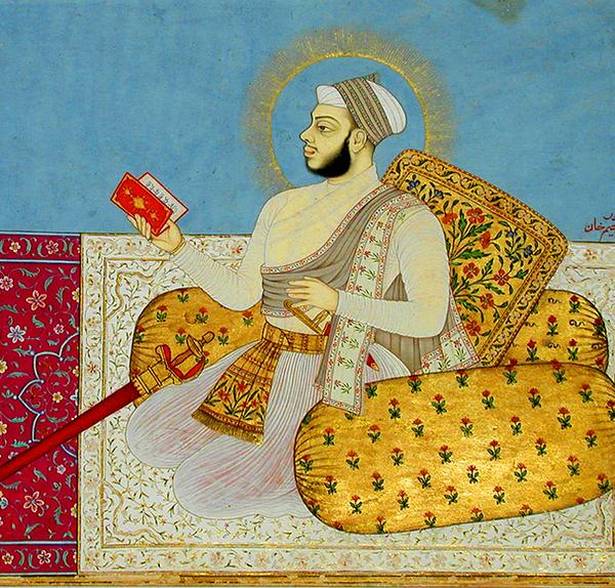
Misrigunj is one of the old city areas of Hyderabad where it is easy to get lost as the lanes and bylanes double back and are in no particular order. Even a compass will be of little use, forget about online maps. In one of the lanes that lead on from one of the biggest domes in the city is the grave of Syed Kalimullah Hussaini or, as he was known in his lifetime, Akbar Shah. Walking in the lanes and standing near his grave in Misrigunj, it is difficult to imagine that the young man wrote a Sanskrit treatise on love, heroines and their moods called Sringaramanjari. The treatise on the many moods of love begins with a Guru stuti.
Guru Ganapati Durga Vatukam Shivamachutam
Brahmanam Girijam Lakshmim Vanim Vande Vibhoteye
If Akbar Shah wrote the Sringaramanjari, credit has to be given to Sanskrit scholar Venkataraman Raghavan for resurrecting the book based on two manuscripts and giving insights into the life of Akbar Shah or Bada Akbar. Raghavan became curious in 1943 when he saw a Sanskrit manuscript in Government Oriental Library, Mysore. Using other material from Tanjore Library, Raghavan published a book with an exhaustive introduction leading to the adaptation of the work for Bharatanatyam and Carnatic music.
To understand how a book on love written in Sanskrit by a Muslim scholar living in a Sufi khankah came to be written about in the latter half of seventeenth-century Hyderabad would be a challenge. Akbar Shah was the son of Shah Raju Qattal who traced his lineage back to Gesu Daraz credited with bringing Sufism to Deccan. Akbar Shah grew up in his father’s khankah along with another young boy: Abul Hasan, or as Shah Raju called him Tana Shah(young king).
Painting of Akbar Shah
The lines of religion and language in Deccan were like lines drawn in the sand. It was in Deccan that a king moved his capital from Gulbarga down south to Bidar where the linguistic boundaries of Kannada, Telugu and Marathi met. The language and court practices were a blend of the Persian world and those from the native kingdoms. The taj worn by kings became the colourful pugree in course of time.
It is in this flexible world that a Muslim scholar could sit inside a Sufi khankahat the feet of his father and write a work that dwelt at length about the fickleness of love, heroines, beauty and attraction. If the love of your life is angry, Sringaramanjari has a recipe to solve the problem. It suggests a time and a place with a romantic mood like spring and moonlight. It also gives six ways to win over the love: pleading, gift, winning over her friends, indifference, falling at her feet or changing the circumstances.
One of the topics that Akbar Shah ponders is whether a courtesan is capable of real love and after much deliberation concludes that she has love for one person but feigns love with many so that she can carry on her life.
Unfortunately, Akbar Shah died young. Raghavan uses evidence in the book as well as a firman issued by Aurangzeb to prove that he died before 1675. Much before his playmate, Abul Hasan could rise to the pinnacle of giving one final burst of cultural efflorescence.
The mazar (grave) of Akbar Shah is in a much better shape now than it was in 1949.“People still come here and spread flowers,” says the mutawalli of the dargah of Shah Raju Qattal.
source: http://www.thehindu.com / The Hindu / Home> Society> History & Culture / by Serish Nanisetti / September 03rd, 2018
To clean and manage the 13th-century shrine, a Swachh Iconic Place, ₹5.68 crore to be spent
The historical dargah of Sufi mystic Khwaja Moinuddin Chishti in Ajmer is all set to get a facelift as a memorandum of understanding has been signed by the Dargah Committee, the Ajmer Municipal Corporation and Hindustan Zinc for spending ₹5.68 crore to clean and manage the shrine.
The 13th-century dargah has been included among the Swachh Iconic Places, a clean-up initiative focused on iconic heritage, spiritual and cultural places through a multi-stakeholder approach model. The campaign was initiated under the Swachh Bharat Abhiyan in 2016.
Select 100 SIPs across the country will be cleaned and developed at a higher level of sanitation and facility management in collaboration with corporates and leading public sector units as part of the initiative.
In Ajmer, the Collector will act as the project’s nodal agency with the Dargah Committee and ‘khadims’ (workers) being the primary stakeholders. An amount of ₹5.68 crore will be invested in the project’s first phase for establishment of two flower compost making machines, cleaning and basic repair of the Jhalra pond, re-flooring in select areas, procurement of machines for cleaning the floors, risk management system plan, conservation of Shahjahani Gate and initial plans for Nizam Gate.
More amenities
The MoU was signed in Ajmer on Saturday in the presence of Union Minister for Minority Affairs Mukhtar Abbas Naqvi. Mr. Naqvi said the project would help in the dargah’s upkeep and provide more facilities to the pilgrims coming during the Urs and in other seasons.
Two flower compost machines have already been installed in Kayad at a cost of ₹27 lakh for churning out about 25 kg of compost from 100 kg of flowers offered at the dargah. A vision document for the shrine has been prepared by a team of architects and building plan and design consultants.
source: http://www.thehindu.com / The Hindu / Home> News> States> Other States / by Special Correspondent / Jaipur – September 04th, 2018
When Imam Azhar al Qassimi stopped barely 20 minutes into his Friday sermon, many among the faithful were surprised.
Surprise turned to astonishment when they saw a man in a Christian priest’s robes walking into the jummah congregation.
It was Fr Sanu Puthussery, vicar of St Antony’s Church in Vechoor, Kottayam. The priest from the Syro-Malabar Church walked up to the podium, which the imam quickly vacated, and for the next eight minutes, addressed the 250-odd Muslims.
“It was an unbelievably holy experience,” Fr Puthussery told The Telegraph on Sunday about an event being portrayed as a milestone in communal amity and just the inspiration a flood-battered Kerala needs as it inches towards normality.
“I had gone to meet the imam at the Juma Masjid next to our church to thank him and the Muslim community who helped me feed and take care of the 580 flood-hit families who had taken refuge at our church.”
The imam asked him to wait through the Friday prayers, kept his sermon short and left the floor to the Christian priest.
Faced with a food shortage for the 2,000-odd people sheltering at the church, Fr Puthussery had approached the imam on August 17. He “mobilised food, medicines and volunteers” till the families left nine days later.
In a video clip of his thanksgiving address at the mosque, Fr Puthussery is heard saying: “This mosque came as God’s own hands to help those who took refuge at my church.”
He told this newspaper: “I had never even entered a mosque until then…. I spoke about brotherhood…. I could see tears roll down the cheeks of some elderly people.”
The imam said: “Humanity doesn’t have man-made boundaries. If we can continue to live by the same level of love and brotherhood, we can convert this planet into heaven.”
After the floods, Muslims youths have cleaned up temples. A church and a temple were thrown open for Muslims to offer Bakrid prayers as their mosques were under water.
Yassar Arafat, who had led a group of Muslim volunteers in rescue and relief and helped at the church, said the vicar’s address was “a moment everyone at the mosque would cherish through their lives”.
The man who shared the story on Facebook, Niyaz Nasar, said he had just happened to be at the Vechoor mosque although he usually goes to another mosque.
“Perhaps I was destined to be the messenger to reach this story to the world,” an emotional Nasar said.
source: http://www.telegraphindia.com / The Telegraph,Calcutta,India / Home> India / by K.M. Rakesh / September 03rd, 2018
For the fourth year in a row, Shia and Sunni Muslims on Wednesday offered joint namaz on Eid-ul-Azha at Shahnajaf Imambara in Uttar Pradesh’s capital Lucknow
For the fourth year in a row, Shia and Sunni Muslims on Wednesday offered joint namaz on Eid-ul-Azha at Shahnajaf Imambara in Uttar Pradesh’s capital Lucknow.
The namaz was followed by an Eid Milan programme organised and managed by a team of non-Muslim volunteers.
Several known faces, including former DGP Javeed Ahmad, participated in the joint namaz.
The organisers had made special arrangements this year for women to offer prayers. Participants from Saudi Arabia, the UAE and Qatar, who were visiting Lucknow for the festival, participated in the programme organised to promote communal harmony.
The namaz was led by Maulana Mustafa Nadvi.
Like previous years, citizens from other religious communities were present to witness the event and lend support to the cause during the Eid Milan programme organised by Shoulder to Shoulder Foundation, a non-profit organisation.
In view of the devastation caused by floods in Kerala, the volunteers had kept donation boxes at the venue for people to contribute to help rebuild the southern state.
These were particularly useful for those not adept at net banking and other such means.
The amount collected will be transferred to the Kerala Chief Minister’s Relief Fund.
source: http://www.hindustantimes.com / Hindustan Times / Home> Cities> Lucknow / by Press Trust of India / Lucknow – August 22nd, 2018
In the two volumes of ‘Asar-us-Sanadid’, Sir Sayyid combined anecdotes with rigorous measurements and descriptions.
IntroducingAsar-us-Sanadid
by Rana Safvi
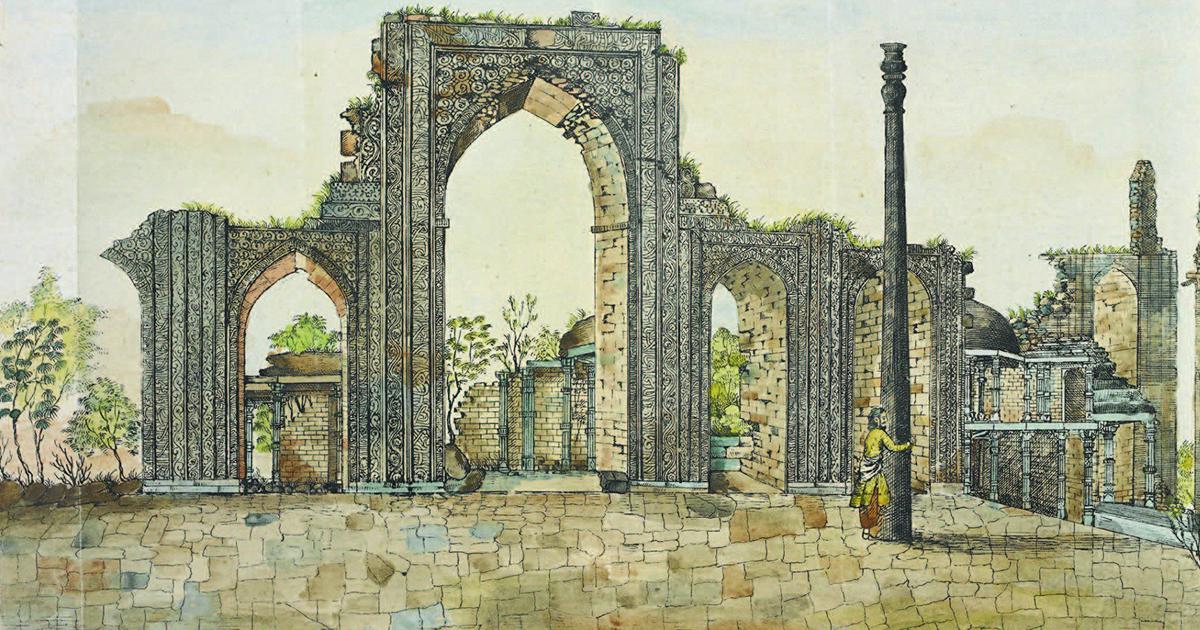
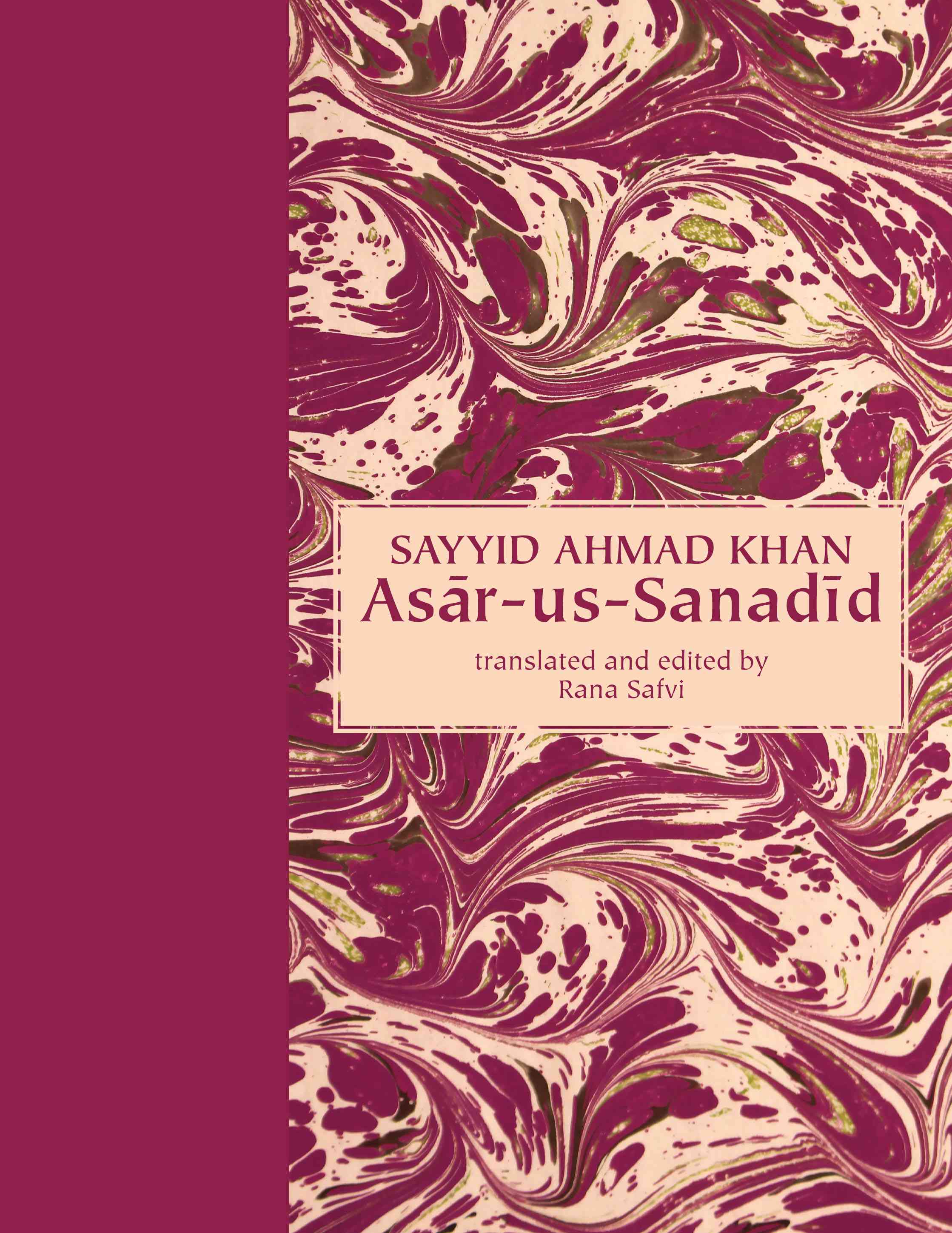
Asar-us-Sanadid by Sir Sayyid Ahmad Khan is an important book for many reasons. It was the first time that a book on this scale describing Delhi’s monuments had been written. The first volume was published in 1847 and a second volume in 1854. Though both had the same name and were about Delhi, they were very differently written. The first was an anecdotal description of the buildings, while the second took a more scientific approach with historical references, and the dimensions of the monuments.
It was also the first time in India, that a book had lithographically produced illustrations. As many as 130 illustrations of Delhi’s monuments were drawn by Faiz Ali Khan and Mirza Shahrukh Beg. The drawings were probably based on rough sketches provided by Sayyid Ahmad Khan himself. He made many sketches – a fact he mentions in the book – and also copied the inscriptions on each of the monuments, often at great risk to life and limb, as in the case of the Qutub Minar, where he hung down from the top of the minaret in a basket held by ropes. It was the first time that inscriptions on the buildings were noted down.
Asar-us-Sanadid is an invaluable work. Both editions – Asar-1 and Asar-2 (published in 1847 and 1854, respectively) – were written before the Uprising of 1857. As is well known, much of Shahjahanabad changed during and in the aftermath of the events of 1857. The British broke down many structures to make governance easier and there was massive restructuring, in particular, of the Red Fort.
Later, when Lutyens’ Delhi was being built, many more changes were brought about, not to mention the changes that are still taking place today. Thus, in his descriptions of the buildings and monuments of Delhi prior to 1857, Sayyid Ahmad Khan gives us a glimpse of lost glory. For students of history and heritage this is where its greatest importance lies.
The partition and transfer of population in 1947 meant that the landscape of medieval Delhi was changed further. Today urban development has resulted in encroachment and destruction or alteration of many more monuments.
Mehrauli is the first documented city of Delhi and it was from here that the Tomaras, Chauhan and early Delhi Sultans ruled. As it was a hilly and wooded area it become a favourite of the Mughals too, with the last two emperors shifting here during the monsoons. The last Mughal building is the Zafar Mahal, situated in Mehrauli, which was the royal residence during those months.
A unique festival called Phool Waalon ki Sair was also celebrated in the monsoons under the last two Mughal emperors.
The excerpt below describes some of the buildings in Mehrauli.
The Bagh e Nazir is now Ashoka Mission. According to some monks I spoke to there, the family of Nazir Roz Afsun fared very badly in the riots which took place during the partition of India in 1947, and the lone survivor, a young boy, migrated to Pakistan.
In 1948 Prime Minister Jawaharlal Nehru gave the land as a gift to the famous Cambodian monk Dharmvara Mahathera on behalf of the Indian state for the purpose of opening a Buddhist institute. It was he who founded the Ashoka mission there. It is now the Official Buddhist Mission in Delhi, known as Ashoka Mission.
The Hauz e Shamsi is a poor reflection of what it was, and though the pavilions of the Jharna still stand forlorn, they are desolate. The water is a dirty and stagnant pool and gone are the diving competitions or sliding stones. The mango orchard has disappeared and there are only residences in the area. One can only thank Sir Sayyed for a glimpse into that era when emperors and their consort picnicked here.
Bagh-E-Nazir
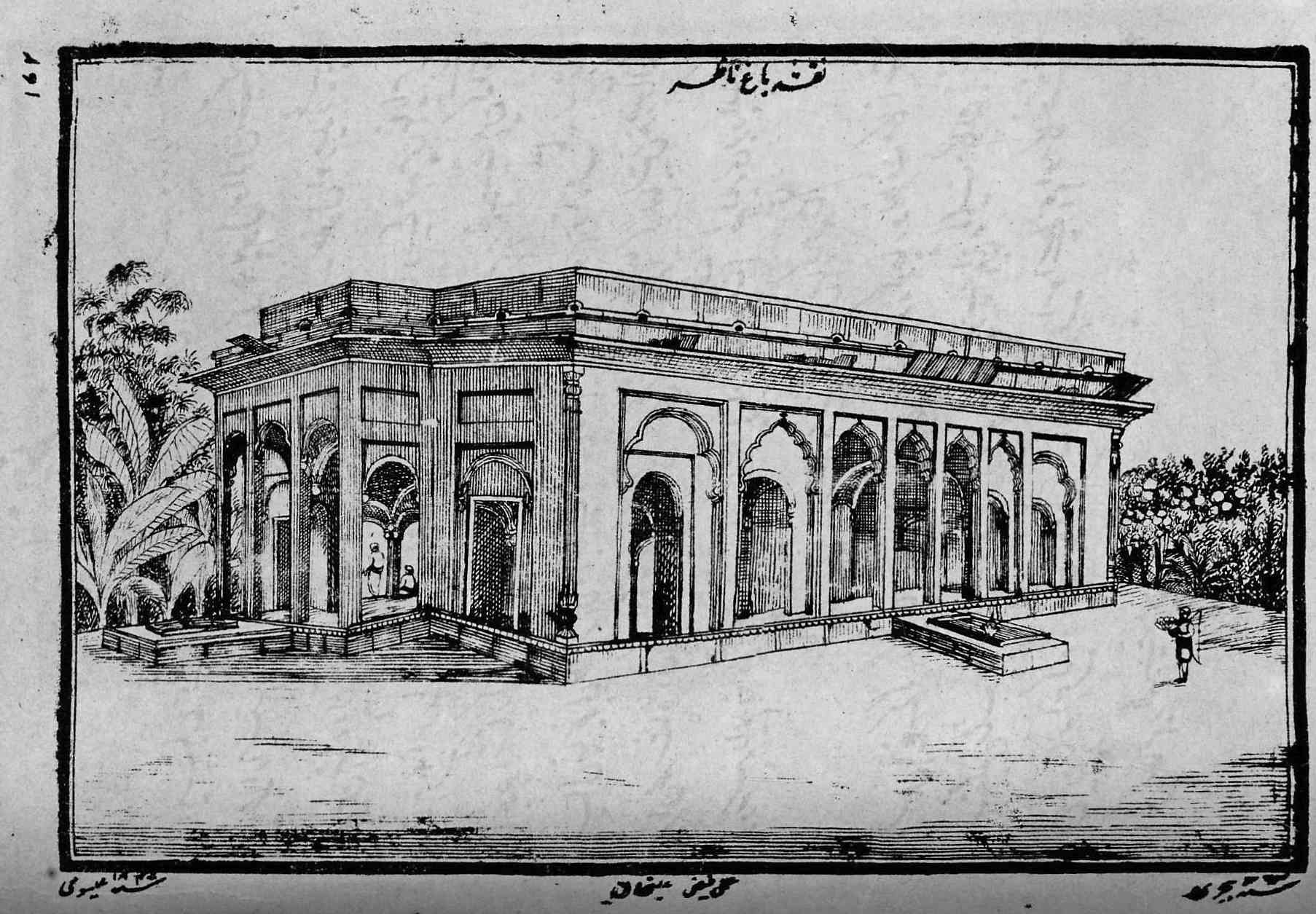
This is a beautiful, attractive, verdant and luxuriant garden near the waterfall of Qutub Sahib [in the Mehrauli area]. It is still very well maintained, with blooming flowers and green trees. The buildings around it are still intact and thousands of people come here during the Phool Walo’n ki Sair procession, to enjoy its beauty. The spectacle is as entertaining as though one were at a fair. This garden was built by Nazir Roz Afzun during the reign of Muhammad Shah Badshah. I will write down the verses inscribed on the entrance as they give the date of the construction and name of the builder:
By the orders of Muhammad Shah Adil,
Whose head bears the sacred crown.
He founded this garden near [the shrine and tomb of] Qutub Sahib,
And has adorned it with the flowers of paradise.
It should remain green till the Day of Judgment,
By the Grace of the Holy Quran.
The year of its construction,
Was found to be the blessed date,
AH 1116 in the thirty-first regnal year of Muhammad Shah.
Bagh-e-Nazir | Courtesy: National Archives of India, New Delhi
A wall surrounds the garden and there are red sandstone buildings of great attraction built all around, within the wall. There is one building in the middle of the garden that is the biggest and best of all the buildings there. Thus I am attaching its sketch here.
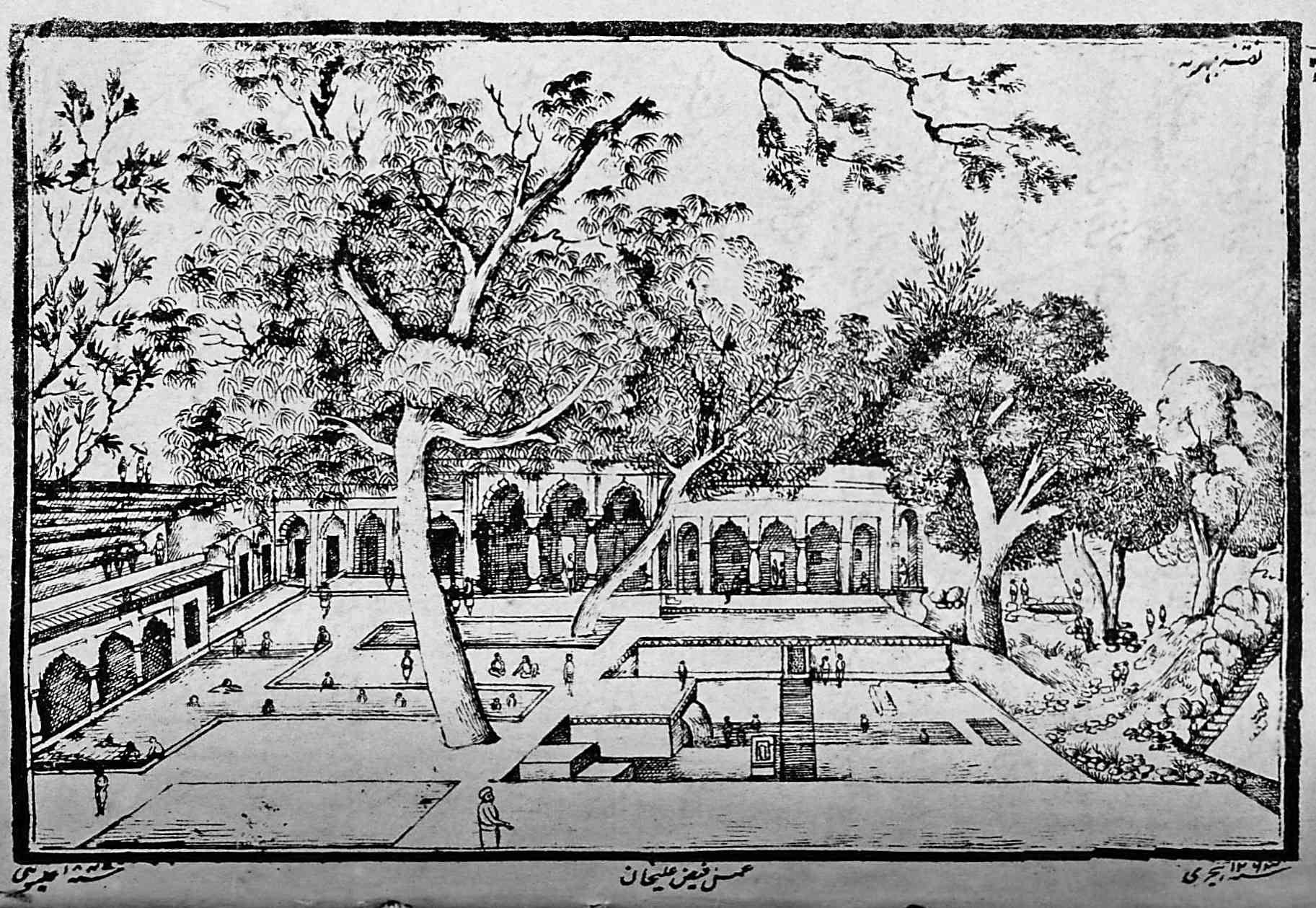
Jharna This is a place for recreation and pleasure; it is exotic and unearthly, elegant and refined, interesting and delightful, happiness-bestowing and heart-pleasing. Qutub Sahib’s waterfall [jharna] is famous for its verdant green trees and reminds one of heaven. Initially, Sultan Firoz Shah had constructed a dam here and the wall of the waterfall is that dam. It is still intact.
He had diverted the excess water of Hauz-e-Shamsi reservoir into Naulakh canal [nala] towards the moats of Tughlaqabad Fort. After some years however, the fort was abandoned and water stopped going to that area. The excess water from the Hauz-e-Shamsi then started flowing into the jungles from this dam and was wasted. Nawab Ghazi-ud-Din Khan Firoz Jung built a tank, water channels, and chutes for the water to flow through. The waterfall is an awesome spectacle and pleases the heart, causing the spectator to involuntarily exclaim in delight. There are various buildings around this waterfall which I will describe here.
Jharna | Courtesy National Archives of India, New Delhi
Pavilion on the western side On the western side, adjoining the wall of the dam stands a pavilion at an elevation of 11 feet and 5 inches. It has three arches, and the waterfall cascades down on it. There is an attractive tank in front of it, into which people jump from the roof of this building. During the Phool Walo’n ki Sair festivities people diving into this tank and swimming in it, make for a huge spectacle. They use various diving styles including somersaulting into the water, they also make a pyramid by climbing onto the shoulders of men standing below until the man at the top of the pyramid reaches tree-branch height. Then those at the bottom dive into the tank and all those on their shoulders plunge into the tank. This is called a “tree dive” [darakht kakudna] or a “wild growth dive” [jhad-jhankar ka kudna].
There are thirteen small water pipes under the roof of this building and water from the waterfall flows down through these, via the pavilion, and into the tank. There is a 3.2-feet wide water chute inside the pavilion which falls from a height of 4.3 feet into the tank. There are niches built under the chute in the pavilion wall, and water flows over lighted lamps that are placed within the niches.
This 25-feet square tank has an opening of 1.7 feet for water to flow into it and is 7.6 feet deep. There is a 22 feet long, 6 feet wide and 3.6 feet deep water-channel, which flows out of this tank in a 5.6 feet cascade and is joined by two smaller cascades from the north and south. There are beautifully carved stone chutes [salami pathar] measuring 3 feet 7 inches, to receive the cascade. The water winds its way down the carvings on the chute creating a mesmerising effect.
The water channel in front of this pavilion is 26 feet long, 6 feet wide and 2 feet deep, while the water channel in front of the smaller cascades is 15.3 feet wide, 2.9 feet wide and 8 feet deep. All the water collects at this point and flows into the jungle. The waterfall passes over all these pavilions and the water channel, and in reality it is a truly spellbinding sight. The sound of the flowing water mingles with the singing of the nightingale, the chirping of doves, peacocks dancing and the sounds of merriment of finely attired men and women. It is a mesmerizing scene, which could put Raja Indra’s assembly in the shade.
Pavilion on the northern side There is a very attractive double pavilion on this side. Muin-ud-Din Muhammad Akbar Shah Badshah built the double pavilion in his reign, around three years ago. These are the most attractive buildings in the place.
Pavilion on the southern side There is a three-arched pavilion in this area, with two smaller pavilions on its sides which gives it the impression of being five arched. In addition to this there are two doors next to it, thus making it seven arched. This pavilion was built around 50 years ago in the reign of Shah Alam by Shahji’s brother, whose name was Sayyid Muhammad.
Pavilion on the eastern side There are only mountains on this side and no buildings, but Muhammad Shah Badshah built a stone slide [phisalna pathar] 18 feet 3 inches long and 7 feet 7 inches wide.
The mango orchard There are many mango trees in this area. People tie swings to the branches and have fun swinging on them. Numerous dancing and singing girls gather here to enjoy themselves. In short, this place is magical and the mind boggles at its attractions. There is also a grave here with the following verse inscribed on it:
Abid who was wise, learned, pious and man of intellect,
Was martyred by a dishonest robber.
The invisible crier told me the chronogram of his death,
The soul of Abid, the martyr entered paradise [in] AH 1209.
Hauz-E-Shamsi This reservoir [hauz] was one of a kind. Sultan Shams-ud-Din Altamash built it during his reign and that is why it is famous as Hauz-e-Shamsi. Once upon a time this reservoir was made of red sandstone but now all the stone has been torn off and it is just a simple reservoir and that’s why people call it Qutub Sahib’s reservoir, while some still call it Hauz-e-Shamsi. The water from here feeds the waterfall and also fed the moats of Tughlaqabad in olden days.
It is difficult to imagine there is a reservoir of this size on the face of earth. It is spread across 276 bighas [a land measurement] and its water reaches eight provinces [subahs]! The pavilion has been built around the mark of a hoof which people call the hoofprint of the Prophet’s celestial steed Buraq, but to me it seems a made-up story. God alone knows the truth.
Auliya Masjid On the eastern side of the Hauz-e-Shamsi is a platform and on it another smaller platform about a gaz or so with a small wall. According to legend, Hazrat Khwaja Qutb-ud-Din Bakhtiyar Kaki and other Sufi saints undertook their spiritual retreat/penance [chillah] on it. They built the mosque with their own hands, bringing baskets [of mud from the reservoir] and that’s why it is called Auliya [The Saint’s] Mosque. Now people have plastered it with mortar and lime.
Excerpted with permission from Asar-us-Sanadid, Sayyid Ahmad Khan, translated and edited by Rana Safvi, Tulika Books.
source: http://www.scroll.in / Scroll.in / Home> Book Excerpt / by Sayyid Ahmed Khan & Rana Safvi / August 31st, 2018
Barbaria (Narsingpur District) MADHYA PRADESH / NEW DELHI :
S.H. Raza: Traversing Terrains which opened at the Piramal Museum of Art, Mumbai, will be on view till 16 December 2018. Through the paintings, photographs, diary extracts, and written correspondence between the artist and his contemporaries of the renowned Indian painter, the exhibition presents the story of Raza’s life from the early 1940s to the late 1990s.
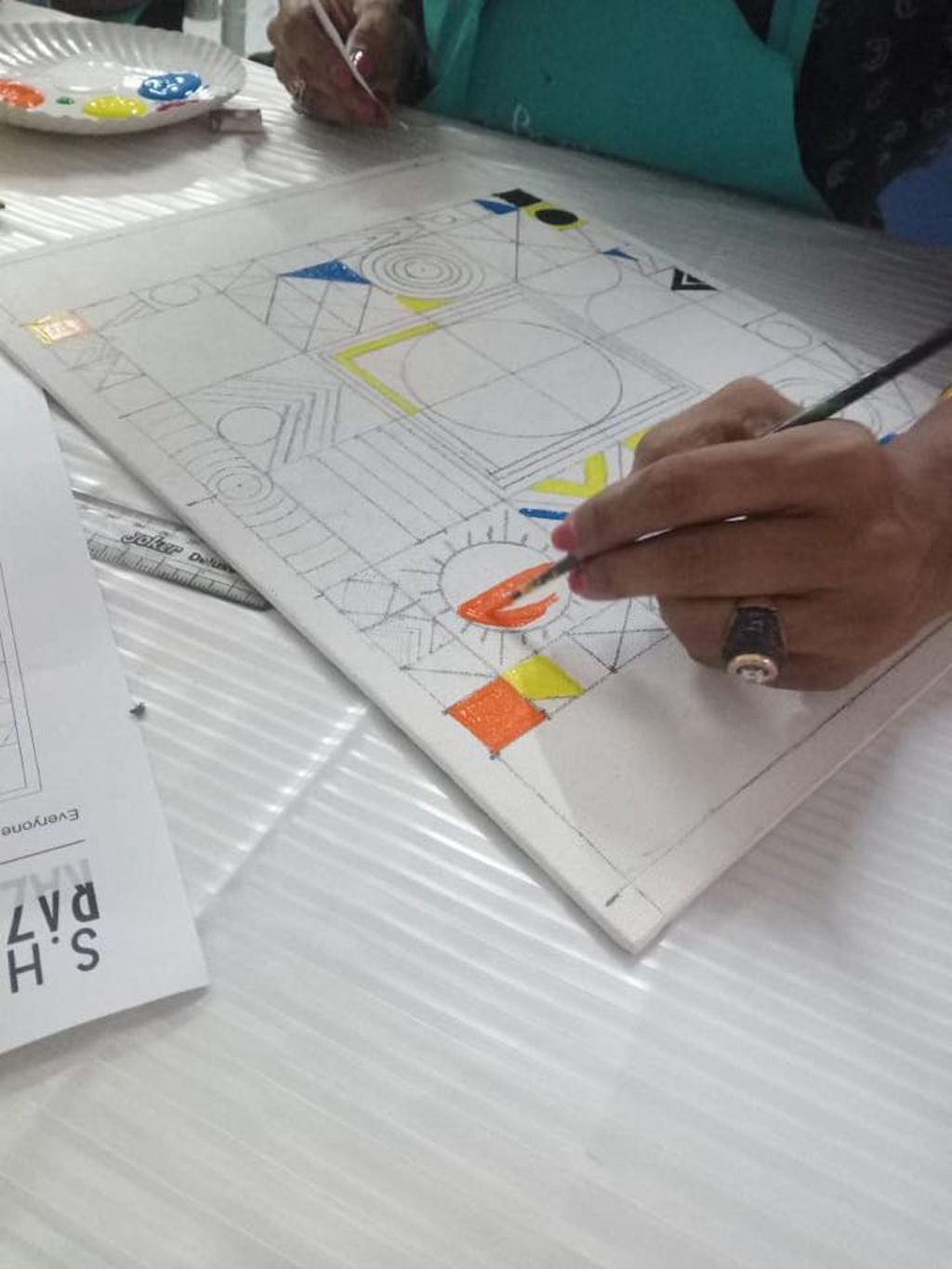
A painting workshop that individuals can choose to participate in.
An extensive outreach programme has been put together that draws upon key themes in Raza’s work and the narrative focus of the exhibition to make it accessible and engaging. A host of events including talks, film screenings, workshops and walkthroughs designed to increase the accessibility of Raza’s work for a wide range of audiences are also scheduled.
Programmes like Cycle 16 which will allow visitors to engage with the artists in residence and their on-going projects and a children’s workshop called Raza’s Bindu, which introduces children to the world of art using the most recognizable symbol from Raza’s work, the bindu, are to be held.
A second edition of Art Night Friday, part of the newly established Mumbai Midtown Arts Collective, will take place in late-September. Piramal Museum of Art will hold guided tours in English and Marathi till 10 pm. Towards the end of the month, Connect the Dots 2 is scheduled to be hosted. In this adventurous programme, participants will trace the footsteps of Raza by visiting locations around Mumbai that he frequented.
The registration for a few events is free or starts at INR 650. While most programmes will be held at Piramal Museum of Art in Lower Parel itself, ‘Connect the Dots’ will begin at Jehangir Art Gallery.