Category Archives: Arts, Culture & Entertainment

The Paigah’s necropolis

Hyderabad, TELANGANA :
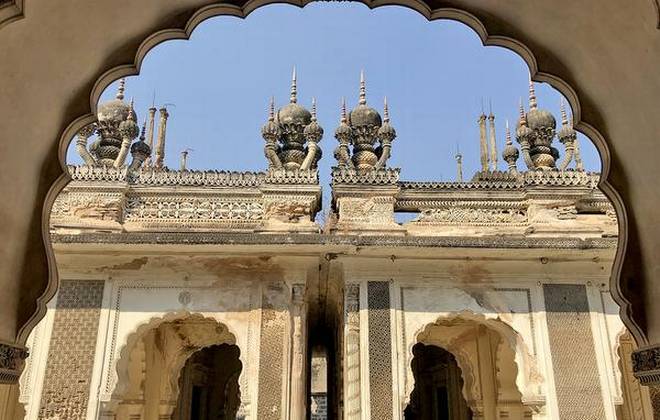
PaigahTombsMPOs20sept2018

A visit to what some call the Taj Mahal of the south

What comes to your mind when you think of Hyderabad? Sumptuous haleem and biryani, perhaps? Or the beautiful icon of the city, Charminar? Or maybe the unique khada dupatta and its accompanying necklaces, if you love clothes and handicrafts. All of these are understandable connections. Few would relate Hyderabad to an exquisite necropolis that is hidden away in the heart of the city, which I discovered recently thanks to a friend.

Dilapidated graves

At the entrance of the Pisal Banda suburb in Santosh Nagar, I stopped at a small café and asked for directions to this necropolis. No one seemed to have a clue. As I was following the GPS, I decided to trust it and ventured deeper into the crowded alley. Soon I saw a modern grave enclosure with the words ‘Paigah Tombs’ written on it there. I felt a little cheated, but then to my delight, just behind the grave enclosure was a white gateway which I entered.

On my right lay many dilapidated graves inside a rectangular enclosure. Some were as new as 2009, while some others were at least a century old and reminded me of verses on the dismaying finality of death and the futility of gathering wealth.

With my loud sighing at this state of disrepair, I managed to attract the attention of a caretaker of the Archaeological Survey of India (ASI), Rahmat, who then gave me a conducted tour.

In the courtyard were intricate work on the walls and small cupolas with Grecian horns on the roof, which were not only breathtaking but also striking in their originality. I had never seen work like this before. There were limestone trellises, ornamented pillars and roundels on the façade of the tombs. “You won’t find such work anywhere in the south or north,” Rahmat said proudly.

And how can it be that we speak of a tomb and someone hasn’t already compared it to the Taj Mahal? This is called the Taj of the south, Rahmat said, which I frankly think is gross injustice. There is no similarity in the architectural styles of the two tombs and this one is beautiful in its own right.

Origin of the name

The Maqbara Shams-ul-Umara, now better known as the Paigah Tombs, belongs to a family which was ranked only second to the Nizam of Hyderabad and to whom it was allied through matrimony. The family members were fierce loyalists of the Nizam and maintained an army to fight for the Nizam.

The word Paigah, which means pomp and rank in Persian, was a title given by the second Asaf Jahi Nizam of Hyderabad to the estate of Nawab Abul Fateh Taig Jung Bahadur in appreciation of the royal services rendered by him. The nawab was also conferred with the title of Shams-ul-Umra, which gives the tombs their name.

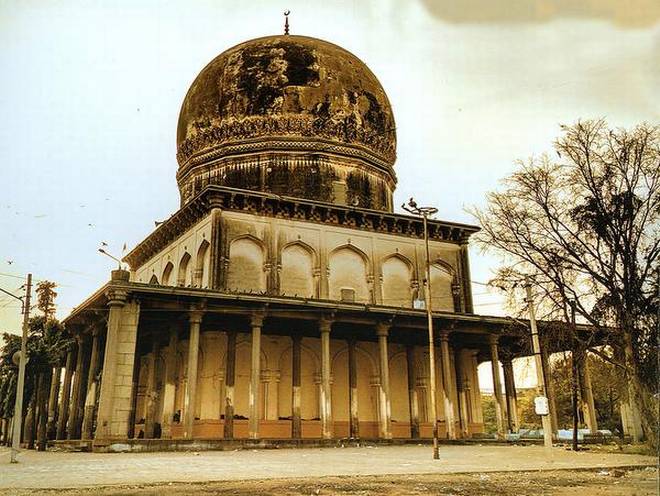
The first tomb, built in the 18th century and of Makrana marble, is that of Shams-ul-Umra, or the Sun of the Nobles, himself. It is delicate, with limestone and stuccowork on its enclosures. Twenty-seven members of the Paigah family, including the famous Nawab Sir Vicar-ul-Umra, are buried here.

The tombs all lie in a row under a foliated arched gallery with ornamented pillars and spectacular limestone jaalis on the façade of the buildings.

There are a number of open double storey enclosures that mostly hold several tombs inside. Each enclosure has limestone jaalis on the walls and exquisite carved teak doors as entrances. Each jaali is unique — some have motifs of fruits and flowers; others have drums, serpents, and vases.

The crypts are made of marble with intricately designed qalams (pen made of dried reed) or takhtis (slate) and headstones. A qalam or small raised mound on the cenotaph denotes that the grave belongs to a man, and a flat design of a slate denotes that a woman is buried here.

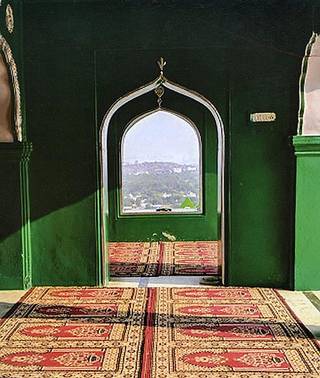
The architectural style inside the tombs and galleries is a mix of Rajasthani, Deccani and Persian, while the design on the roof is Moorish. The 30-acre compound also includes a mosque. Prayers are still held here. The sounds of the azaan and namaz waft over the graves. The Paigah family has handed over this architectural marvel to the ASI as part of our national heritage for safekeeping.

source: http://www.thehindu.com / The Hindu / Home> Opinion> Columns> Where Stones Speak / by Rana Safvi / January 21st, 2018
Hidden Mughal-era artwork to be latest Red Fort attraction

NEW DELHI :

This Mughal-era artwork — geometric and floral motifs in an 80-metre-long vaulted arcade called Chhatta bazaar — was hidden under multiple coats of whitewashing applied casually over the years as part of Red Fort’s maintenance and structural conservation work.

New Delhi

An almost a year-long exercise by the Archaeological Survey of India (ASI) to restore a mural serendipitously discovered while cleaning the ceiling of a historic marketplace in Delhi’s Red Fort is on the verge of being completed and will be ready for visitors to see from next month, according to three senior officials familiar with the restoration work.

This Mughal-era artwork — geometric and floral motifs in an 80-metre-long vaulted arcade called Chhatta bazaar — was hidden under multiple coats of whitewashing applied casually over the years as part of citadel’s maintenance and structural conservation work. The ASI had forgotten about the mural’s existence, and discovered it last October when it began restoring the corridor that is lined by souvenir shops on both sides.

In addition to the mural, visitors to the Red Fort will be also have access to buildings constructed by the British during its 90-year-long occupation of the monument between 1857 and 1947. Four British-built barracks, which were under the control of the Indian Army since Independence and were inaccessible to visitors,are being converted into themed museums, said one of the officials cited above.

“The conservation of the painting on the roof of Chhatta bazaar may take another month. People coming to the fort after that will see Mughal-era art that was lying concealed for decades,” said the official, who asked not to be named because he is not authorised to speak to the media. “We will hand over all four barracks by end of this month,” he added.

The four museums proposed to be set up at the barracks will be dedicated to the first war of independence in 1857, the Indian National Army led by Subhas Chandra Bose, India’s soldiers who participated in World War I, and the Jallianwala Bagh massacre of 1919.

NK Pathak, ASI’s superintending archaeologist, Delhi circle, said that nearly 70% of mural has been restored and the remaining work will be completed in a few weeks. “Lime coats are being manually scraped of with precision, which is a time-consuming process. This is to ensure that the original design is not damaged. Once entire artwork is exposed, we will take measures to protect it. Hopefully, by mid-October, we will be able to finish the work,” Pathak said.

A third official said that around 30-35 experts from ASI’s science branch have been working tirelessly to restore the designs. “Chhatta bazaar’s passageway has bitumen, which is being replaced with red stone. We are also asking shopkeepers to remove encroachment and metal shutters. The shops will now have sliding glass doors. We will not allow any extensions. All efforts are being made to restore the market’s original look,” said the ASI official on condition of anonymity.

There are 32-arched two-storeyed bays on either side of the arcade. The shops, dating back to when the Red Fort was completed by emperor Shah Jahan in 1648, were meant for common people coming to the Mughal Durbar and the setting is a replica of a bazaar in Peshawar, according to historian Swapna Liddle.

The author of Chandni Chowk: The Mughal City of Old Delhi, Liddle said that the market once had shops selling clothers and jewellery. It still draws buyers visiting the fort, but the shops now sell handicraft items, wooden articles, and other souvenirs.

source: http://www.hindustantimes.com / Hindustan Times / Home / by Parvez Sultan, Hindustan Times,New Delhi / September 19th, 2018

Fatma Begum: India’s First Female Director | #IndianWomenInHistory

Mumbai, MAHARASHTRA :

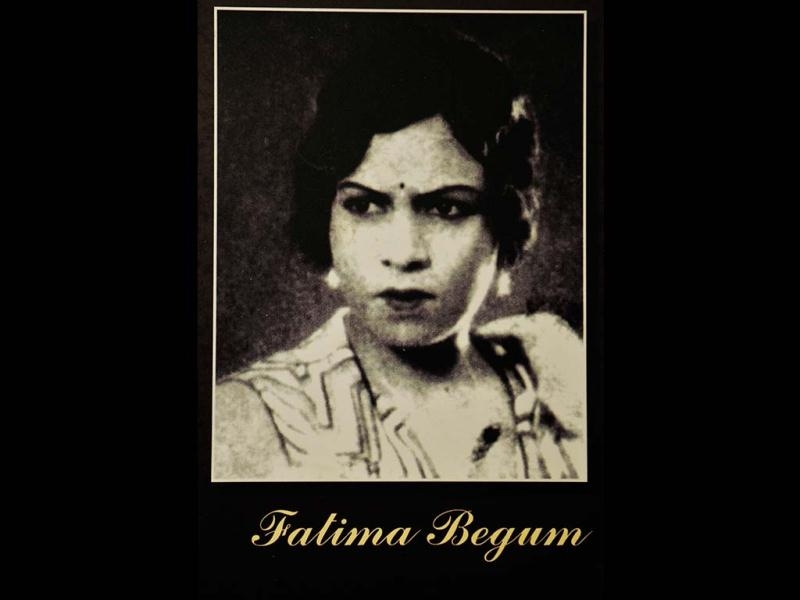
Fatma02MPOs15sept2018

Most people are aware of the contemporary female directors that exist in the country as they have gotten recognition, acclaim and fame but few know about Fatma Begum – actress, scriptwriter and director – who created a path for many others in the film industry to follow at a time where male domination in every sphere was prevalent. Being arguably the first in the field she set opened the way for other women to venture into the film industry.

Fatma Begum, the first female director of Indian cinema, was born to a Muslim family in India in 1892.

She was also invested in acting, screen-writing, and production. She was trained in Theatre and initially used to stage Urdu plays, following which she began working in films in 1922. She started her journey as a director with the silent film Veer Abhimanyu (1922). In a short span of time she had directed the following films: Bulbul-ae-Paristan (1926), Goddess of Love (1927), Heer Ranjha (1928), Chandrawali (1928), Shakuntala (1929), Milan Dinar (1929), Kanaktara (1929) and Goddess of Luck (1929).

Bulbul-ae-Paristan was the most famous film directed by her. It was set in ‘Paristan‘ (Fairyland) had a big budget and included special effects using technology.

Fatma worked with filmmakers like Ardeshir Irani and Nanubhai Desai. After this, she created her own production company – Fatma Films, later changed to Victoria Fatma Films – and was the first Indian woman to do so.

When Fatma joined the film industry, only men were part of it. Even female roles were played by men. Thus, Fatma’s determination to break into this male-dominated sphere marked her as a trailblazer.

As an actor, she starred in many films including Veer Abhimanyu (1922), Sita Sardaba (1924), Prithvi Vallabh (1924), Kala Naag (1924), Gul-ae Bakawali (1924) and Mumbai ni Mohani (1925). She also contributed to writing scripts and wrote the script for Bulbul-ae-Paristan (1926). A few of her films featured her daughters, Sultana and Shehzadi. She used trick photography for special effects in films and included fantasy in her films.

Rumour has it that Fatma Begum was married to Nawab Sidi Ibrahim Muhammad Yakut Khan III, the last ruler of the Sachin State. However, no evidence exists to reaffirm this as the Nawab did not acknowledge Fatma Begum or their daughters. No undisputed images of her exist today.

Having a 16-year-long film career, her Last film was Duniya Kya Kahegi after which she retired voluntarily. Her daughters, Zubeida, Sultana and Shehzadi carried on her groundbreaking legacy as they too were actors in silent films. Zubeida went on to become the first Indian actress to star in the first talking film, Alam Ara (1931).

Fatma Begum died in 1983, at the ripe old age of ninety-one, leaving behind a pioneering approach to the film industry.

Sources:

IMDbFatma Begum
CinestaanFatma Begum, Jaddanbai: The earliest female filmmakers of Indian cinema
TCRCThe story of Fatma Begum, India’s first woman director
News18100 years of Indian cinema: The first women directors

source: http://www.feminisminindia.com / Feminism In India / Home> Culture> Cinema / by Maryam Mansoor / March 12th, 2017

Shahrukh Khan Felicitated As The ‘Game Changer’ At India-UK Business Summit In London

NEW DELHI / Mumbai, MAHARASHTRA :

London :

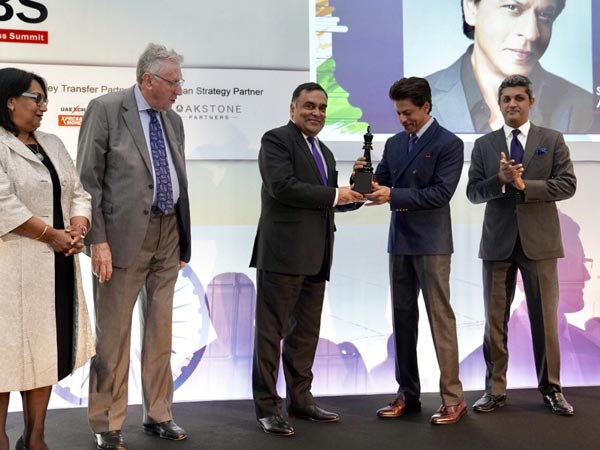
Here’s some good news for all Shahrukh Khan fans! The superstar was recently felicitated as a “Game Changer for his Unmatched Contribution to Globalizing Indian Cinema” at the business summit in London.

Time and again, King Khan has represented India at international events making the nation proud. The ET India – UK Strategic Conclave, a special business summit discussing the economic relations between India and UK was graced by the global icon in London.

Check out some of the pictures here-

SRK In Conversation

Representing the entertainment industry for a chat session on the ‘Growth of the business of entertainment across the globe and its impact on India”, Shah Rukh Khan said, “The growth for Indian films has been much smaller compared to the growth of television in India. The ratio of theatres to the audience area is still very small, we have very few theatres compared to the audience we can garner. In the Interiors of India, there are not many screens for people to go and I think there is a huge market here for entrepreneurs to get into making low-cost theatres.”

SRK Felicitated As The Game Changer

The actor, producer, activist was also felicitated with The Economic Times Game Changers of India” – Hall of Fame for “His Unmatched Contribution To Globalising Indian Cinema.”

ShahrukhKhanMPOs14sept2018

The Superstar Also Unveiled A Coffee Table Book

A coffee table book titled ‘Game Changers of India’ was also unveiled at the summit which features Shahrukh Khan along with other accomplished leaders.

SRK’s Award Acceptance Speech

Accepting this honour, the superstar said, “I take this opportunity to thank a lot of people, actors, actress, and audiences, for allowing me to continue unencumbered with any idea that I had, they gave me the ability to just go ahead and give it a shot, try and go wrong if I may, and more often than not they allowed me to go wrong”.

He further added, “Business is become about millions, targets and projections, though I fully respect the managerial capacity of business, but I like to think of it as the people who work with me allowed me the imaginarily capacity, they allowed me to imagine and they managed that imagination. So, when you become a game changer you cannot take it upon yourself, there are loads of people involved and the audience as well around the world accepts you doing the stuff you do and think it’s entertaining”.

On the work front, Shahrukh Khan will be next seen in Aanand L.Rai’s Zero co-starring Anushka Sharma and Katrina Kaif.

Salman Khan host Shahrukh Khan on Dus Ka Dum – Dumdaar Weekend

source: http://www.filmibeat.com / FilmiBeat / Home> Bollywood> News / by Madhuri V / September 12th, 2018

Siasat’s Millat Fund arranges burial of destitute Muslim dead bodies

Hyderabad, TELANGANA :

Hyderabad:

Mr. Amer Ali Khan, News Editor of Siasat Urdu Daily received a letter from six police stations including Bahadurpura and Langer Houz requesting him to arrange for the burials of nine destitute Muslim dead bodies.

In accordance with these requests, these dead bodies were procured from Osmania and Gandhi General Hospitals. They were buried in Tharthareshah Muslim graveyard, Secunderabad under the supervision of Mr. Syed Abdul Mannan, Mr. Samiullah Khan and Mr. Abdul Jaleel.

Mr. Syed Shah Inamul Haq, Imam of Jamia Masjid, Afzal Jung led the funeral prayer.

source: http://www.siasat.com / The Siasat Daily / Home / by Sameer / September 13th, 2018

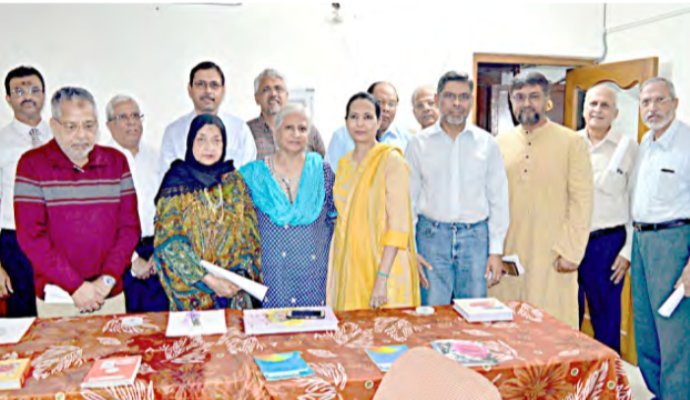
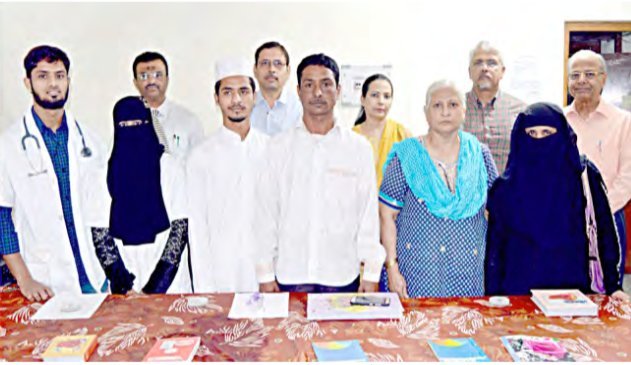
Faiz-e-Aam Trust extends help of Rs. 2.99 cr to poor students, families – Siasat’s role applauded

Hyderabad, TELANGANA :

FaizeAzamTrustMPOs13sept2018

Hyderabad:

According to the report furnished by Mr. Iftekhar Husain, Secretary of Faiz-e-Aam Trust, a sum of Rs. 2.99 crore was spent on various schemes of financial assistance to poor students and families.

In 2016-17, the trust spent Rs. 59.81 lakh for primary education, Rs. 21.21 lakh for technical education, Rs. 29.5 lakh for relief and Rs. 7.85 lakh for treatment of patients.

In this manner, from April 2017 to January 2018, Rs. 40.46 lakh, Rs. 21.21 lakh, Rs. 18.68 lakh and Rs. 3.58 lakh were spent on the above mentioned works.

So far, the trust has help 625 students of primary education, 731 of SSC, 1237 of Intermediate, Degree, PG, Engineering, MBA, MBBS and Paramedical Courses.

He further told that the trust was established in 1983 by his brother-in-law, Mr. Zulfekhar Husain. It enjoys full support from Mr. Zahed Ali Khan, Editor of Siasat Urdu Daily. The trust is now helping 1456 students ranging from primary school to Engineering and Medical courses. It is also extending financial help to 1256 patients. It rehabilitated 2280 persons.

Faiz-e-Aam Trust helped Kareemunnisa whose husband, an autodriver had left her helpless. Her sons, Syed Hasan and Syed Yaseen and daughter, Saba Begum were adopted by the Trust for educating them. Syed Hasan completed MBBS whereas Saba Begum is doing the same course. Her eldest son, Syed Yaseen has completed Hifz-e-Quran.

Ms. Farukh Parveen Jamal, Chairperson of Trust, Aurangabad and Mr. Siraj Tahir, Trustee of Faiz-e-Aam Trust attended the meeting and listened to the details of the poor families.

FaizeAzamTrust02MPOs13sept2018

In collaboration with Siasat Millat Fund (Clothes bank) it helped 1552 families. Destitute Muslims of Muzaffar Nagar received help through Siasat Millat Fund. It also helped Salwa Fatima and Sania Siddiqui for their ambitions to become pilots. For Old Age Home of Siasat, the trust gave a donation of Rs. 5 lakh.

The trust also helped Nuzhat Fatima, a student of MBBS, Shaik Nazeer Ahmed and Ayesha, students of MD.

During the past three years, the trust has spent Rs. 1.6 lakh for primary education, Rs. 43.33 lakh for technical education, Rs. 71.15 lakh for rehabilitation, Rs. 23.35 lakh for treatment of patients.

It may be mentioned that Syed Hasan had secured a free seat in MBBS. Mr. Ali Asghar played a key role in getting financial help for this family.

Hajera Begum is a second year MBBS student. Her father is a tailor and her mother manufactures beedis. She has two sisters. The expenses of her MBBS fees were paid by her parents by mortgaging ornaments. Dr. Makhdoom Mohiuddin’s wife, Dr. Shaista Mohammedi Husaini received a message on WhatsApp for helping Sabera Begum which she forwarded to Secretary of Faiz-e-Aam Trust who arranged Rs. 1.27 lakh for getting back the ornaments which were mortgaged.

Mr. Rizwan Haider, Trustee welcomed the guests. Ms. Amena Saher conducted the meeting.

These details were given in a special meeting held at Faiz-e-Aam Trust which was attended by Ms. Farhat Yasmeen and Mr. Siraj Tahir, Trustees.

The other persons who attended the meeting were Dr. Samiullah Khan (Director Shadan College and MESCO member), Dr. Saukat Ali Mirza (Chairman Helping Hand), Mr. Ali Abedi (Social worker, London), Mr. Mudasir Alam (US), Mr. Jameel Haider (US), Fakhri Saheb (US), Anees Iftekhar Ali (US), Ruqayya Begum (US), Syed Haider (member, Faiz-e-Aam Trust), Aijaz Husain (US), Jafar Ahmed (US), Syed Jafar Husain (Sada-e-Husaini), Hamid Ali, Prof. Shaukat Hayat and Mr. Ahmed Basheeruddin Farooqui (former Dy.DEO).

source: http://www.siasat.com / The Siasat Daily / Home / by  Sameer, The Siasat News / January 18th, 2018

A unique wedding – Groom of Bhopal moves on rolling-skates with Baraatis

Bhopal, MADHYA PRADESH :

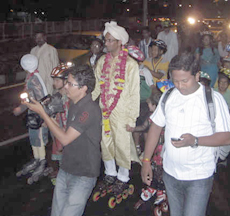
“Baaraat” of Sajid Khan, a national level skater and coach, skating its way to marriage venue in Bhopal on Sunday night.

Bhopal:

 Bhopal, the capital of central Indian state of Madhya Pradesh, witnessed a unique wedding wherein “Baaraat” (the wedding procession of the bridegroom) on Sunday night skated its way to wedding venue on roller skates.

The “Baaraat”was that of Sajid Khan, a national level skater and roller skating coach in local Delhi Public School, who adopted this unique move to attract people’s attention towards skating and promote the game in the state and ensure recognition to it in international events.

The bridegroom and the “Baratis” all put on their skating shoes to roll on in the marriage procession from Gauhar Mahal to Bagh-o-Bahar, the wedding venue, as vehicular traffic on the VIP road nearly came to a screeching halt. Budding skaters, the disciples of groom Sajid, also danced to the beating of drums as the procession moved on with passersby halting down to have a clear glimpse of this unique “Baaraat”.

Sajid, who is also president of Speed Roller skating Association, Bhopal, skated to have a rendezvous with his bride Shaista Yasmeen, who also happens to be a skater and a roller skating coach. Several national and international junior skaters such as Huzaifa Zafar, Akshay Sharma, Syeda Masooma Fatima, Ahsas Shrivastava, Gautam Sharma, Shayali Kumbhare, Aamir, Nilesh, Sami Khan, Hrithik Khare and others also joined the “Baaraat” with their skates on.

Sajid revealed that it was their students who planned the one-of-its kind wedding and he was happy to accept the unique idea. The wedding shall be remembered for long, not for its grandeur, but for the mode of transport the groom and the members of the “Baaraat”chose to reach the marriage hall.

“It is a historic moment in my life as the people who witnessed the wedding procession shall be attracted towards the roller-skating sports. “We are advertising the skating game through the procession. I spend my whole time in skating and as such I and my students decided to take out wedding procession on skates which is something unique”, Sajid told media persons as he rolled on skates to meet his soul-mate and bring her home.

Meanwhile, Nikah was solemnized at the historical Taj-ul-Masajid, one of the biggest Masjid in Asia, between the Asr and Maghrib prayer timings on Sunday evening. Elite of the town along with large numbers of sportspersons attended the Nikah.

It may be pointed out here that a couple has also tied nuptial knot while rappelling at Kerwa Hills in the city in the past.

source: http://www.ummid.com / Ummid.com / Home> Life & Style / by Parvez Bari (pervezbari@eth.net) / September 19th, 2011

Lucknow: Tazia makers give finishing touches to their work as Moharram approaches

Lucknow, UTTAR PRADESH :

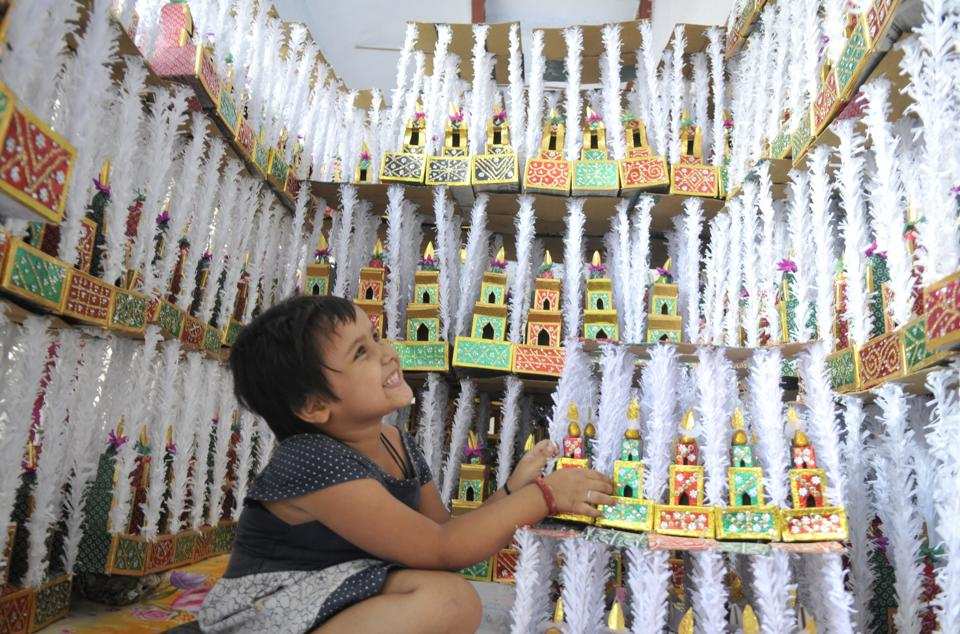
A fusion of solemnity, dedication and exquisite craftsmanship is on display as tazia-makers race against time to complete their work at Rauza-e-Kazmain in old Lucknow on Monday, two days before the Islamic month of Moharram beginning on September 12.

A fusion of solemnity, dedication and exquisite craftsmanship is on display as tazia-makers race against time to complete their work at Rauza-e-Kazmain in old Lucknow on Monday, two days before the Islamic month of Moharram beginning on September 12.

The grand, double-storey gateway that leads to the Nawabi era structure in the densely populated Saadatganj area is packed with makeshift shops displaying colourful ‘tazias’, a replica of Imam Hussain’s mausoleum in Iraq.

Inside, several people are busy erecting makeshift shops for the convenience of those who will arrive to buy the tazias, the prices of which range from Rs 500 to Rs 10,000 each.

Munni Begum, a traditional tazia maker and her family is at work at the rear of the 19th century structure, which is said to be a replica of the tomb of Imam Musa Kazim and his grandson, the ninth Imam Mohammad Taqui of Khorasan in Iran.

“We are running late this time. There are three more tazias left to be completed,” says Munni Begum, who is in her late forties, while placing glitter carefully on a semi-finished tazia made of bamboo shavings and cardboard.

She says making tazias is her ancestral trade and hers is perhaps the third generation carrying forward the family legacy.

“I still remember my mother and grandmother making tazias. In fact, I learnt the art from them. But its preparation is not as easy as it seems. Each one of these (tazias) is an outcome of relentless efforts by all my family members,” says Begum, pointing to around 70 finished tazias, their height ranging from 10 inches to 8 metres.

The preparations began months ahead of Muharram.

“All members in a family have a different role to play. The men make the frame using bamboo shavings,” says Mohammed Saeed, a family member of Munni Begum.

“Only a trained and knowledgeable craftsman can prepare a tazia as it has to look like the mausoleum of Imam Hussain. One has to be careful,” Saeed adds.

Once the frame, either of bamboo, cardboard or empty cigarette boxes, is ready, the other family members take up the remaining work.

“The women ensure the framework is well covered with rough paper, followed by a coating of colourful papers. Children make sure they use the glitter to decorate the tazia,” he says.

Taazia02MPOs11sept2018

Tazia-making this year got delayed due to a delay in procuring a loan from a local money lender, he says.

“We solely depend upon the income from selling tazias. We have to take loans from local money lenders to carry out the work every year. This year, the money lender delayed the funds. With the prices of raw material sky rocketing, it’s really becoming difficult for us to do our work,” he adds.

Like Saeed, there are around 150 families involved in tazia making in the state capital. “We believe it’s a dying art and the government is a mute spectator,” says Mohammed Shahansha, another traditional tazia maker from Kazmain.

“Until two decades back, many families in Faizabad, Kanpur, Agra, Moradabad and other districts were involved in tazia-making. But over the years, their income reduced and the prices of raw material increased drastically, forcing many to give up the ancestral craft,” Saeed says.

Meer Jafar Abdullah, member of a royal family of Awadh, says during Muharram, Shias keep tazias at their respective imambaras in their houses. The tazias have to brought a day before Muharram begins.

“Those who do not have enough space, often use a small portion of the house to keep tazias, commemorating the martyrdom of Imam Hussain in the battle of Karbala,” says Abdullah.

Exquisite craftsmanship is on display at Rauza -e-Kazmain in old Lucknow. (HT Photo)

“Mostly, the tazias are buried on the 10th day of Muharram. Some families bury them on Chehellum, the 40th day of the martyrdom of Imam Hussein. Some bury it on the last day of Muharram,” Abdullah says.

In Lucknow, Shias bury the tazias in Tal Katora Karbala, in Purana Najaf and Kala Imambada (opposite Ghantaghar in old Lucknow). The Sunnis bury tazias at Phool Katora in the Mahanagar area of Lucknow.

source: http://www.hindustantimes.com / Hindustan Times / Home> Lucknow / by Oliver Fredrick, Hindustan Times,Lucknow / September 11th, 2018

Kodagu floods: Pouring out a cupful of compassion

Sakleshpur Taluk, Hassan District , KARNATAKA :

Shaik Ahmed, a roadside tea seller, plans to contribute his earnings on Saturday for rain relief works in Kodagu. | Photo Credit: Special Arrangement

A tea seller at Channarayapatna has contributed his day’s earnings towards the relief works in flood-affected Kodagu. Shaik Ahmed, 60, opened his shop on Bagur Road at 5 a.m. on Saturday with a board stating that whatever he got on the day would go to the flood relief funds.

Till 6 p.m., he had collected a little over ₹7,000. “My aim is to collect at least ₹10,000 for the relief work. I will keep the shop open till 9 p.m. and will hopefully reach the target,” he said.

Mr. Ahmed, a native of Sakleshpur taluk, has been living in Channarayapatna for the past three decades. For years he worked in hotels, but about six months ago he decided to open a tea stall of his own.

Mr. Ahmed, a father of three, was moved by the plight of the victims on news media. “I felt bad for the people affected. My wife and children also supported my decision. We have decided to make Bakrid a simple affair this year,” he said. He added that the business on the day was better than most days. On a normal day, he requires 25 litres of milk, but on Saturday he needed 40 litres.

“I did not give tea or coffee to any customer on credit today.My customers obliged. Many of my friends came to my shop just to give me some business,” he said. He plans to hand over the money to the authorities on Sunday.

Many organisations, including the Hassan unit of Red Cross, have collected donations from people for relief works in Kodagu and Kerala. Members of Prakruti Seva Samudaya, which works for the welfare of transgenders, have also raised funds for flood victims.

source: http://www.thehindu.com / The Hindu / Home> News> States> Karnataka / by Special Correspondent / Hassan – August 18th, 2018

Detailing dargahs of Deccan in ‘Culture of Amity’

Hyderabad, TELANGANA :

Dargah01MPOs11sept2018

The booklet edited by Department of Culture chronicles the dargahs of Hyderabad and sets right some of the preconceived notions about them

How many Dargahs does Hyderabad  have? It is easy to remember. There is the Yousufain Dargah, Jehangeer Peer Dargah, Shah Khamoush Dargah, Husain Shah Wali Dargah, Shah Raju Qattal Dargah… And there ends the list for an average citizen of Hyderabad. The list, in fact, is quite substantial.

In an age where religious lines are hardening, the dargahs in India remain comparatively open spaces where the faith of the person is not questioned while entering. The people who come to find solace range from men sitting in corners in a forlorn way to women who come with their families and friends and sit outside, and then there are couples who pray for the intercession of the saints buried in the dargahs. Said dargahs also keep the social and spiritual life thrumming as they become epicentres for local festivals dictated by the lunar calendar. Urssamachiragaansandal are few of the events inside dargahs that people living in the area wait for.

Dargah02MPOs11sept2018

“Telangana is a confluence of different cultures, religions and beliefs. From the very rustic and rural Bonalu to the newer faiths like Christianity, people in the region have accepted and adopted all streams of beliefs. This book is a tribute to that,” says Mamidi Harikrishna, head of the Department of Culture who has edited the booklet called Culture of Amity being distributed free. The booklet lists 51 dargahs scattered across the city. “The list is exhaustive and we have discovered more. We will be listing 81 dargahs in the next edition of the book,” says Vasanta Sobha Turaga, an architect, who has edited the book along with Harikrishna.

Dargah03MPOs11sept2018

Between the pages

Without delving into each specific religious space the booklet has information about the dargahs and what goes on in them and how they shape beliefs. “The earliest and the oldest are from the 13th to 14th centuries: the Pahadi Shareef (1266) and Jehangir Peer Baba (1318). And the latest is less than 15 years-old.” The booklet also tracks the progression and change in architectural style. “We have looked at the architectural style of the buildings. But we have also tried to look at the rituals and traditions. There is a lot of intermingling of practices and colourful rituals,” says Turaga who has plans to expand the work into something more substantial.

The booklet also sets right some of the beliefs which people have about the various dargahs. It calls out the belief that the structure atop Moula Ali hillock is a dargah while in reality, it is an ashoorkhana with a few practices of a dargah like the urs that is celebrated in the Islamic month of Rajab.

sources: http://www.thehindu.com / The Hindu / Home> Society> History & Culture / by Serish Nanisetti / September 10th, 2018