Category Archives: Arts, Culture & Entertainment

Renovating Rahim’s tomb: The original monument of love

NEW DELHI :

Rahim01MPOs22mar2018

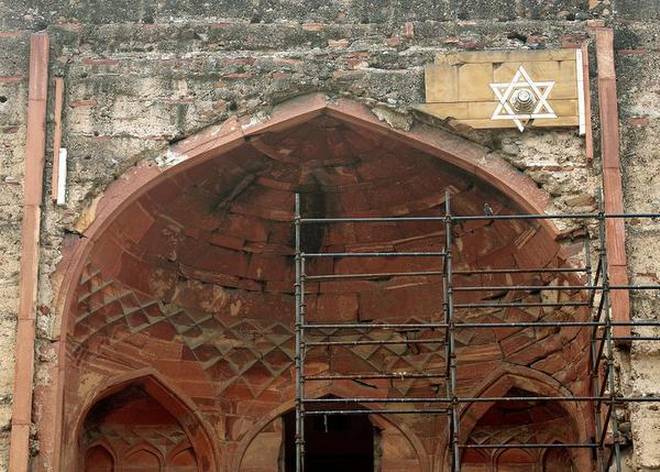
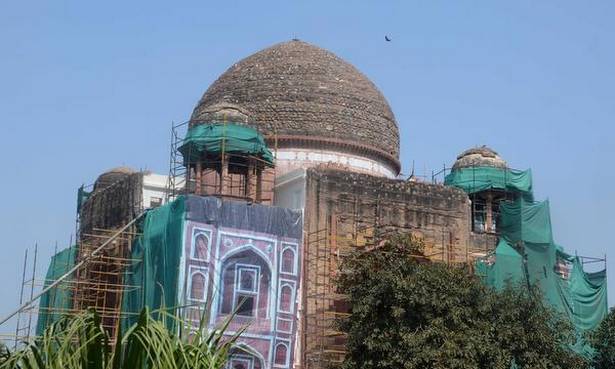
Rahim’s tomb, inspiration behind the Taj Mahal, was about to collapse when it was rescued by a conservation project
Rahim02MPOs22mar2018

Some 50 years before that magnificent monument of love, Taj Mahal, was built, Abdur Rahim Khan-e-Khanan, a poet and diwan in Emperor Akbar’s court, built a tomb in the memory of his wife Mah Banu. It was the first Mughal tomb built for a woman.

Constructed in 1598, the tomb stands a few hundred meters south of the Humayun’s Tomb, a world heritage site, in Delhi. This location was chosen for its proximity to Hazrat Nizamuddin Auliya’s Dargah — it was considered auspicious to be buried near the grave of a saint. Rahim too was eventually buried here in 1627.

Located near one of Delhi’s busiest roads, Mathura Road, Rahim’s tomb remained largely ignored for several years.

Then in 2014 the Ministry of Culture requested the Aga Khan Trust for Culture (AKTC) to restore Rahim’s tomb.

The tomb’s condition was precarious, to say the least, when the project began. “I usually don’t say this, but this building could have collapsed,” says Ratish Nanda, AKTC’s Chief Executive. It was “a very complex” project, he says. The restoration began in association with the Archaeological Survey of India and funding from InterGlobe, an Indian conglomerate.

There were deep cracks in the crypt, the first floor and the dome – “some so wide that you could put your arm through them.”

This needed immediate attention, and he realised it would take up to a year to fix them. Vandalism had added to the structure’s deterioration. Stones were missing, the white marble on the dome had been stripped off, water was seeping through. A flood a few years ago had also created cracks in the crypt’s vault.

Kilos of concrete

The restoration that had been attempted previously was woefully inappropriate and used modern plaster and cement, and had compounded the problem.

AKTC had faced a similar challenge during their restoration of Humayun’s Tomb, where they had to remove over a million kilos of concrete. The tomb wasn’t particularly structurally sound to begin with either, much like Humayun’s Tomb.

The team began with architectural documentation. This involved 3-D laser scanning (a technique first developed to find leaks in nuclear plants), photo archival research, historical research. Every stone was drawn up.

In 1968, the renowned British historian Percy Brown identified Humayun’s and Rahim’s tombs as structures that inspired the Taj Mahal. “But what is most significant about Rahim’s tomb,” Nanda says “is Rahim.” Rahim was just four when his father, Bairam Khan, an important military commander in the Mughal army, was assassinated. He grew up under the foster care of Emperor Akbar. He would later become one of Akbar’s nine most important ministers, the Navaratnas, and prove his own capability as a commander.

Most of us, however, know Rahim better as a poet. Apart from his famous dohas, he also wrote verses in Arabic, Sanskrit and Turkish, and translated Emperor Babur’s autobiography, Baburnama, from Turkish to Persian.

“I like the idea of this multidimensional personality. [He is] almost a renaissance figure,” says former diplomat T.C.A. Raghavan, whose curiosity about Rahim eventually led him to write a book about the man and his father, Attendant Lords (2017).

Secular symbol

Ujwala Menon, a conservation architect with AKTC, says that he was a secular figure and a patron of architecture. “The water supply system that he built in Burhanpur, with underground pipelines to every part, we can’t replicate that even today.”

Menon says that an attempt will also be made to restore the grand garden with plants that the Mughals favoured, such as citrus orchards.

A project of this scale requires several layers of work — preservation to keep the building in the state that it is found, restoration to bring the structure as close to its original condition as possible and reconstruction, which also involves a technique called ‘anastylosis’, where a ruined building or a broken object is restored using its original material. The vaults and parapet here were reconstructed using new pieces of Delhi quartzite and red sandstone respectively. Paint and lime-wash layers had to be painstakingly removed to reveal the incised geometric and floral patterns.

It will be another 16 to 20 months before the restoration of the tomb is complete, as there is major structural work to be done on the dome and facade.

But views on conservation can be subjective. There are those who criticise the work being carried out, saying that such techniques take away the narrative of age from the structure. Some believe that preservation is the only correct conservation technique.

But critics often focus on the aesthetics, not taking into account the structural integrity of the building. Nanda illustrates this with the analogy of skin. “You cannot say, ‘oh my skin is falling off, but I won’t repair it.’ Skin, besides making you look like who you are, is also fulfilling a lot of other functions.”

It is to counter such ‘mad arguments’ that Nanda says AKTC got the project extensively peer reviewed by over 50 different individuals — from architects, archaeologists and engineers, to historians, journalists and bureaucrats. These included Jaya Jaitly, Narayani Gupta, Saleem Beg, William Dalrymple, Gillian Wright and Lynn Meskell.

Nanda says that AKTC doesn’t take up a project unless the work can benefit local people. The Nizamuddin Basti Urban Renewal Initiative, of which the Rahim tomb renovation is a part, has also generated over five lakh man days of work for master craftsmen.

Earlier this year, a book, Celebrating Rahim, was published about Rahim’s life and and his artistic, political and intellectual work. AKTC and InterGlobe hope to bring out a compilation of Rahim’s written verses as well.

Nanda is appreciative about the private sector involvement in the project. “Unless there is a huge public interest in conservation, the future of heritage conservation is bleak.”

When he’s not chasing stories, the writer can be found playing Ultimate Frisbee or endless rounds of Catan.

source: http://www.thehindu.com / The Hindu / Home> Society> History & Culture / by Shashank Bhargava / March 17th, 2018

Lone warrior strives for making the Valley greener

Srinagar , JAMMU & KASHMIR :

Businessman Bhat has spent Rs 30 lakh from his pocket to plant 1,45,000 trees; he aims to plant 20,000 trees every year.

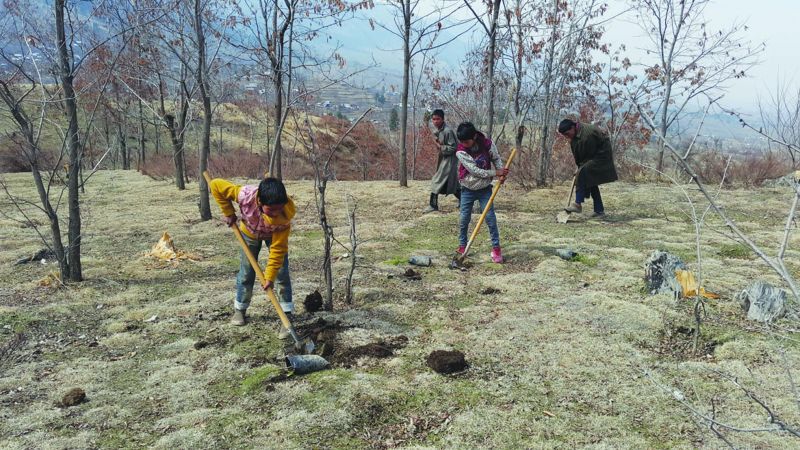
Abdul Hameed Bhat digging pits and planting conifer saplings.

Srinagar:

About nine years ago, he single-handedly began planting trees on barren hillocks which, till a couple of decades ago, used to be full of beautiful clusters of deodar or Himalayan cedar and conifer trees.

Abdul Hameed Bhat, 51, a businessman, has himself planted or helped volunteers in planting as many as 1,45,000 trees, mostly pine, in different parts of the Kashmir valley spending Rs 30 lakh from his own pocket.

“I don’t get any financial help from government or any other source nor do I run any NGO. It is an effort made at personal level,” he said, calling it a “heart mission” rooted in his love for environment.

Mr Bhat’s passion began in 2009 when he started taking care of dozens of pine trees planted by the social forestry department on the pavements outside his office in Srinagar’s Barzulla area but were left unattended.

As a  promotion activity in his auto business, he started gifting saplings to clients in place of calendars, diaries and other stationery items.

Last Sunday, Mr Bhat, a school dropout who has made it big in business, was joined by a large group of volunteers, including journalists and members of a football club,  to plant over 1,000 pine trees on a knoll at Sutaharan in central district of Budgam. Sitting in the lap of Pirpanjal Range, Sutaharan like many other Valley areas has witnessed large-scale deforestation mainly during the three-decade old armed conflict in Kashmir.

“There are many things we can do to preserve and protect our environment if we want to preserve and protect life on Earth and leave behind something good for our coming generations,” he told this correspondent after digging about 100 holes and planting saplings in them.

Mr Bhat said that it pains him to see deforestation across Kashmir and he took a “conscious decision” to do his bit to rectify the wrong.

“I know the damage done to our woods over the years is huge and no single effort is likely to have a great impact of reparation. But I thought whatever I can, I must do,” he said.

Relentlessly dedicated to restoring nature, Mr Bhat who is now known to many people in Kashmir as “Green Warrior” has not only won appreciation from all but is also enthusiastically joined by volunteers from almost every walk of life in planting trees.

Rahim Greens, a subsidiary of Rahim Motors owned by Mr Bhat, in collaboration with various organisations and the state’s forest department sometime ago launched a plantation drive in Srinagar city and Rajouri district in the Jammu region and involved educational institutions. An initiative named as “The Tree of Life” was organised by it jointly with Help Voluntary Trust earlier.

“No doubt, Hameed Sahib took the initiative and continues to be at the forefront of the campaign but it now appears to be a story of Mein akela hi chala tha janib-e-manzil magar; loag saath aatey gaye aur karvan banta gaya (I set out alone for the destination but people kept joining me and it turned into a caravan),” said a volunteer.

One of the prominent faces which have ardently joined the crusade is Rifat Abdullah, a TV journalist. Apart from distributing saplings in schools and colleges, he has adopted a barren hill in Rathsun area of Budgam and taken a pledge to convert it into what he calls “First Oxygen Zone” of Jammu and Kashmir.

“Thousands of deodar trees have been planted voluntarily on the hill, so far, under ‘Mission One Crore Plants’ launched by ‘Save Environment, Save Kashmir’, a public movement,” he wrote on Facebook.

Volunteers in Sutaharan area of the Valley.

The Kashmir valley bounded on the southwest by the Pir Panjal Range and on the northeast by the main Himalayas range is blessed with exotic natural beauty of landscape and water bodies. But over the years, its water bodies, mountains and particularly forests have been vandalised and the ecological assets are fast disappearing. As per official statistics, more than 14,000 hectares of forestland, including 9,496 hectares in the Jammu region and 4,877 hectares in Kashmir, has been encroached upon by people.

The state has a total forest area of 20,230 square km, largely distributed in the Valley (8,128 sq.km) and the Jammu region (12,066 sq. km). The twin district of Leh and Kargil in Ladakh are mostly devoid of forest vegetation with only 36 sq. km forest area together.

Forest minister Choudhary Lal Singh claimed that the government retrieved from encroachers around 135,000 kanals (16,875 acres) of forestland in 2016-17 for restoration.

“I have asked divisional forest officers to gear up their men and machinery for demarcation of retrieved forests land to avoid further encroachment,” he said.

Officials claim that a slew of measures have been initiated to regenerate the degraded forests. These include planting over two crore saplings across the state — 250,000 of these along the highways.

Mr Singh, while speaking in the state Assembly recently, admitted that out of 20,230 sq km forest area, about 9,000 sq km area is degraded due to “unabated human intervention”.

He also said that 382,000 kanals (47,750 arces) of forest area was under encroachment as on April 1, 2016. “I need around Rs 10,000 crore for treating 9,00,000 hectares of degraded forest area of the state and at the rate of present funding, it will take more than 350 years to rehabilitate the degraded forest area,” he said.

As per the forest policy of the country, 33 per cent of the total area of every region in plains and 60 per cent in the Himalayan region must be under forest cover but the ground reality is that India does not have more than 22 per cent total forest area.

In Jammu and Kashmir, despite it falling in the Himalayan region, the total forest area is about 20 per cent of the total area. The Valley has been experiencing erratic snowfall and hotter summers for the last decade or so and environmentalists say that the main reason for it has been the large-scale deforestation.

Ecologists and other experts insist that restoring the state’s green cover needs the involvement of people and more importantly the spirit shown by  Mr Bhat and his partners.

Mr Bhat is hopeful of a greener future. “Our younger generation is aware of the consequences (of deforestation). I have found young boys and girls more than willing to work with me and others in our humble effort to see our  surroundings turn green again.

source: http://www.asianage.com / The Asian Age / Home> India> All India / by Yusuf Jameel , The Asian Age / March 17th, 2018

Girls looking at girls

NEW DELHI :

A new photo exhibition in Chandigarh is a boost to women on both sides of the camera

Work from Delhi-based photographer Uzma Mohsin’s series ‘Love & Other Hurts’.

Men look at women. Women watch themselves being looked at—this John Berger aphorism sums up a majority of the writings by the brilliant English art critic, who based his observations on visual history ranging from Renaissance paintings to contemporary advertisements.

The politics of representation of women in art and photography has been fraught with all manner of problems long before #FearlessGirl and #MeToo became global hashtags. I’ve been a big fan of The Guerrilla Girls, a group of anonymous feminist activist artists who show up wearing gorilla masks in public and use data, humour and outrageous imagery to expose gender bias in politics, art and pop culture. One of their posters about female representation at the MET asks, “Do women have to be naked to get into the Met. Museum?” Illustrated with a visual of the classic 19th century nude La Grande Odalisque (with a gorilla head, of course), it states: Less than 5% of the artists in the Modern Art section are women, but 85% of the nudes are female.

Certain industries—advertising, pornography, fashion—bear a greater burden of guilt than others. Which is why it is interesting that a new exhibition celebrating the female gaze is curated by a former Vogue and Maxim photo editor, Iona Fergusson, who has spent close to a decade commissioning portraits, fashion and beauty editorials.

Opening this weekend at the Punjab Lalit Kala Akademi in Chandigarh, before it travels to Delhi and London, Girl Gaze: Journeys Through The Punjab & The Black Country, UK is categorically a project “about women by women”, says Fergusson. It is a photographic exploration drawing parallels between women from Punjab and the UK’s “Black Country” area, which has one of the largest Punjabi diasporas.

A striking work from Delhi-based photographer Uzma Mohsin’s series Love & Other Hurts is a portrait of a second-generation immigrant—a tattooed woman sporting an edgy hairdo with mermaid-blue hair swept to one side, with the other half dyed in a leopard pattern. “Birmingham, where she’s from, has a thriving metal scene,” says Mohsin over the phone from Chandigarh. The woman’s personal style is a canny metaphor for acquired taste marrying an inherited aesthetic. Mohsin plans to exhibit her 60 photographs with interwoven threads symbolizing the Phulkari embroidery work synonymous with Punjabi women. Another photographer, the UK’s Jennifer Pattison, is interested in magical worlds that find expression in the traditions of the Punjabi folk festival Lohri. Her fine art photographs, titled Rice Pudding Moon & The River Of Dreams, are inspired by songs that tell of a mother’s love and a land of dreams.

“We were interested in exploring the impact that immigration had on the women…the restrictions on freedom, agency and their own bodies,” says Fergusson.

She admires the work of South African photographer Zanele Muholi, for daring to increase the visibility of the black LGBTQ+ community in a country where women are killed for their homosexuality.

While it was on Fergusson’s agenda to commission women photographers who would explore diverse themes regarding gender, identity, patriarchy, tradition, culture and memory, she was also keen to highlight relatively lesser-known names. Her curatorial mission was to present photographs in which the subjects had agency and participated actively in image production. “It was important to prevent the phenomenon of Other-ing,” she says.

Mohsin’s series does this very literally: A bulk of her photographs are multiple exposure works. She first handed over film cameras to her subjects in the UK (mostly older Punjabi immigrant women) and asked them to photograph objects and scenes that represented them. Simultaneously, she recorded their oral narratives and memories of the places they had left behind. Then, following their stories, she made her own photographs in Punjab, using the same film rolls. “With multiple exposure on film, it’s always a bit of serendipity. Some worked and some didn’t… but it was great to have the subjects so intimately involved with the process,” she says.

Rather than pretty pictures and domestic scenes, the exhibits in Girl Gazecreate layered images that go beyond the purely personal to comment on the impact of migration and cultural cross-pollination. It is a reminder that when girls look at girls, they paint big pictures.

Girl Gaze: Journeys Through The Punjab & The Black Country, UK will premiere in Chandigarh (10-18 March), then travel to Jalandhar (23-27 March), and, later in the year, to Delhi, London and Wolverhampton.

The writer tweets at @aninditaghose

source: http://www.livemint.com / Live Mint / Home> Leisure> Ed-line / by Anindita Ghose / March 10th, 2018

The life of a weave

Mubarakpur (Azamgarh District) , UTTAR PRADESH :

One of Abdullah’s designs

Abdullah, a recepient of the Sutrakar Samman Award, on how self help groups are giving weavers a new lease of life

“If you weave good pieces, you will get good returns, this is what I feel,” says Abdullah, whose words belie his 37 years. He is the recepient of the Sutrakar Samman Award 2017, which is presented annually by the Delhi Craft Council to a weaver for his innovation and skill

Abdullah is from Mubarakpur, a small town about 13 km from Azamgarh in Uttar Pradesh. Mubarakpur has been the bastion of Benares sari weaving. Over the years, it seemed to be losing its significance, but timely interventions have led to renewed interest among the weavers and consumers.

Passion for the loom

Abdullah has been weaving for over 25 years. What marks him out is his unceasing love for the loom and the willingness to learn. “Thankfully there have never been any complaints about my work. I have had long stints with master weavers who used to love my creations, I have worked independently and now I work with a SHG. I believe in my work.” His specialty is the khadua or weaving the brocaded borders and motifs for which Benarasis are known. “Khadna or khadai on the loom which is done using small attachments or tillis give that brocaded look. We have to see if the threads are uniformly drawn; they should not criss cross.”

Abdullah started weaving when he was 11; he learnt the technique from his father. His sisters would work on the brocaded pieces and he learnt from them. In a year or so, he was proficient enough to weave a sari on his own. When he was 20, he installed two hand looms in his house. “I used to buy the yarn and do my own designs. My saris had many takers.” However, when market conditions deteriorated it hit the weavers hard. Master weavers make saris for traders from Benares. Their earnings depend on what the buyer fixes. Wages for weavers are not high. “Gradually I learnt what works and what doesn’t in the market. I also mastered the technique with the help of the master weavers with whom I worked. Today I can make any pattern, if you show me the design I can replicate it,” says Abdullah, who takes immense pride in his work.

In a world, where handloom products are on the wane, meeting a weaver like Abdullah fills you with hope. Abdullah adds, “Nearly 80 per cent of the people living in Mubarakpur are dependent on weaving. So there are more weavers than there is work.”

His association with Mubarakpur Weavers, a self help group of young weavers, gave a new lease of life to his work. The group procures orders and gives it to its members. There is a system of fair wages, the group knows at what price the final product is sold. There is no arbitrary profiteering by middle men. They participate in exhibitions and directly supply to stores also. This interaction with buyers also helps them understand design trends and prices. Abdullah’s brother and his other family members also assist him in the weaving.

I ask the inevitable question, will his sons also take up this profession? He smiles, “my experience with the SHG has been good. So if this continues, there will be no regret if my sons also take it up.” As a parting shot he adds, “it is not the money that I make which is important. The buyer who wears my creation should be happy. That is my reward.”

source: http://www.thehindu.com / The Hindu / Home> Society> History & Culture / by Chitra Balasubramanian / March 08th, 2018

An evening out at a Mumbra Masjid

Mumbai, MAHARASHTRA :

Mosque launches an outreach programme to fight misconceptions

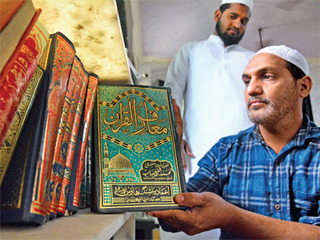
Imam of Al Furqan masjid, Maulana Saud (in white), looks on as Jamaat member Risal Baig displays the Koran. Photo by Sachin Deshmane

A ‘masjid parichay’ is enabling Hindus to visit the Al Furqan mosque and gain a better understanding of Islam.

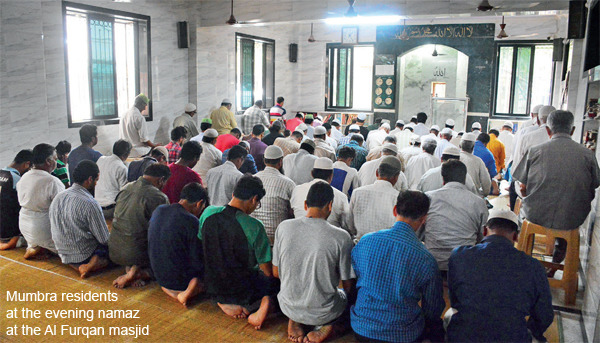
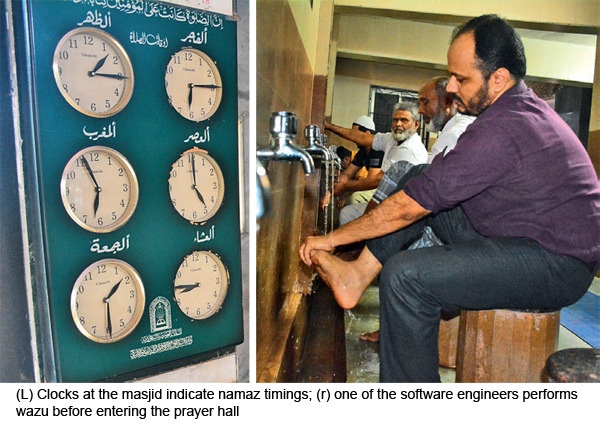
Spending four hours in a mosque is not most people’s idea of a Sunday evening outing. But for two Sundays in the last few weeks, 10 Hindus have travelled long distances to spend the entire evening at the Al Furqan Masjid, located in a bylane of Mumbra, a suburb of Mumbai. Starting off with doing wazu, or the obligatory washing of oneself before namaz, they ended their evening relishing biryani in the hall above the mosque.

None of these Hindus had ever stepped inside a masjid before.

“Going to a masjid in Mumbra? Are you out of your mind?” was the common reaction these Hindus encountered from friends — the shock stemming as much from the mention of a ‘masjid’ as from ‘Mumbra’, a place that was allegedly “internationally notorious for violent fanaticism”. A place where “no non-Muslim could go after sunset.’’

Vikhroli salesman D Gupta’s family didn’t even take him seriously when he told them about his plan. So when he returned home after his Mumbra visit, and casually mentioned where he’d been, his upset mother sent him off to “purify” himself with gau-mutra (cow urine) from the neighbourhood tabela before entering the house again.

Gupta remembers, as a 13-year-old, seeing students from a madarsa in his neighbourhood being beaten up by their teacher. An older friend said it was because the students had probably forgotten to curse Hindus enough, and warned Gupta to stay away from Muslims. The fear that had set in when he was a teenager vanished only after his recent visit to the mosque. Other friends had told him, at the time, that Muslims worshipped the Shiva lingam in masjids by pouring water over it, hence the mandatory tap at the entrance. And also that the Kaaba in Mecca, too, had a Shiva lingam inside it.

MumbaiMasjid02MPOs19mar2018

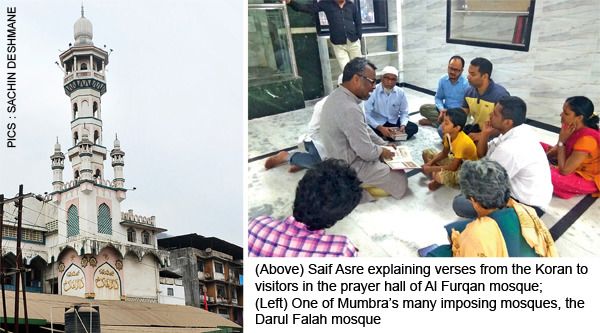
Jamaat-e-Islami member Saif Asre heard another perception about his place of worship while he was manning a bookstall distributing Islamic literature. “Commending me on trying to spread knowledge about Islam, a Hindu man said that he had heard masjids were storehouses for swords, and that one room was reserved only for the bodies of those killed with them. Driven by curiosity, the man had ventured into a mosque — but only after posting a friend to stand guard outside and inform his family if anything happened to the man,” says Asre. “This shocked me. We had no idea these were the ideas Hindus had about masjids.” This encounter was the trigger for the ‘masjid parichay’ programme that has been successfully carried out, so far, by the Jamaat in Nanded and Mumbra.

The first batch of Hindus who visited the Mumbra mosque were all members of the Indian Social Movement, a Vikhroli-based NGO that believes — according to its leaders Dr Deepak Gaekwad and Anand Howal — in being “Indians first and last”. They even use the phrase ‘Jai Bharat’ as a greeting. The group conducts awareness workshops on the Constitution, and had done so for the Jamaat, too. At least three of them had grown up with Muslim neighbours, and pointed to 1985 as the year relations between the two communities started changing. That was the year the Ayodhya movement began.

The second batch did not know anyone from the Jamaat. Their curiosity was aroused after reading a Facebook post about “masjid parichay’’.

While not all these Hindus had farfetched and bizarre ideas about masjids, some of them assumed non-Muslims weren’t allowed inside. Their knowledge of mosques was limited to the azaan, the call they heard on loudspeakers five times a day. “Allah ho Akbar” was the only phrase they could make out in the azaan. Most thought it referred to Mughal emperor Akbar (it means ‘God is great’).

MumbaiMasjid03MPOs19mar2018

The meaning of the azaan and other mysteries — the taps at the entrance to the masjid; the posture assumed for namaz, why it’s performed five times a day and the large turnout on Friday afternoons — were demystified for them by Asre. Helping him in demonstrating how namaz is performed, and how the azaan is called were four other Jamaat members, including a retired teacher and two software engineers. The latter revealed that when their work left them with no time to go to the nearest masjid for namaz, they prayed at their seat. Elevated parking lots in new office buildings made for ideal namaz spaces, where all the Muslims working on the premises could pray together, they said.

When Asre asked if there were any questions, nine-year-old Advait, who was there with his parents, Tarun Bharat journalist Bhatu Sawant and wife Kranti, put up his hand. What did the Arabic inscription on the wall mean? he asked. Later, he watched in wonder as the empty space where he had been running around a short while ago, filled up with men performing the evening namaz.

Asre revealed that thanks to the Facebook post, the Jamaat had received requests from many other Hindus, including a group of college girls. The visitors were taken to a hall in a building adjoining the mosque, where women pray on Fridays.

The Shia-Sunni divide, the burqa, the “intolerance” of Muslims who believed theirs was the only true faith — several questions were raised on these matters. But some questions remained unasked too, the participants admitted later. For instance, a question about the recurring campaigns organised by Indian Muslims in solidarity with Syria and the Rohingyas remained unarticulated.

“Those who attend such programmes will surely intervene when riots break out to explain that we are brothers,” hopes Howal, of the who felt the Quran expounds the same ideals of justice, equality and fraternity as the Indian Constitution. “If a boss reaches the masjid after his employee, he has to stand behind his employee, and during namaz, his head will be at the latter’s feet,” he pointed out, referring to the democratic nature of the Friday afternoon prayer, which must be held in congregation.

What about a reciprocal programme, where groups of Muslims can visit a temple? Asre felt Muslims were much more familiar with the Hindu religion than the other way around because even those who live in ghettos, encounter Hindus everywhere. While that is a debatable statement, the question also arises: Who would conduct such a programme? Would temple managements allow it, wondered Lokmat journalist Omkar Karambekar, as he returned from Mumbra. And, would Muslims who come to the temples, accept our ‘prasad’, was the question that bothered Gupta.

MumbaiMasjid04MPOs19mar2018

source: http://www.mumbaimirror.indiatimes.com / Mumbai Mirror / Home> Mumbai> Cover Story / by Jyoti Punwani, Mumbai Mirror / March 18th, 2018

Inter student Padmaja bags prize for essay on Prophet Muhammad

Hyderabad, TELANGANA :

An Intermediate second year student B. Padmaja bagged second place with cash prize of ₹25,000 on Sunday for her Telugu essay on the life of Prophet Muhammad.

The competition titled ‘Inspired by Prophet Muhammad’ was an initiative of the Jamaat-e-Islami Hind (JIH) affiliate Student’s Islamic Organisation.

Ms. Padmaja arrived in the city from Jagtiyal specifically to participate in the competition.

Speaking to The Hindu about what inspired to pen the essay, she said, “I read about the virtues of Prophet Muhammad and decided to enter the competition. He saw everybody as equal and took measures to protect women’s rights.” It did not take long for Ms. Padmaja to prepare for the competition. “The JIH gave me a book. I read it for about an hour a day before the competition. Then I spoke to my friends who are Muslims. After this, I wrote the essay,” she said.

And how does she intend to use the prize money? “I will use it to pay for my education,” she said.

With a keen interest on participating in similar competitions centred around different themes, Ms. Padmaja said, “It’s important that people look for good things in different faiths. Only this can help all of us co-exist.”

While Ms. Padmaja was awarded the second prize, the first place went to Syeda Haajer, also an Intermediate second year student. She was awarded a cash prize of ₹50,000. A graduation student, Mariya Gouher, bagged the third place and was awarded ₹15,000.

Around 20,000 students in different parts of the State wrote the essay in Telugu, Urdu and English. The winners were awarded prizes at Khaja Mansion where JIH Telangana and Odisha president Hamed Mohammed Khan spoke of the importance of pluralism and building bridges between different communities.

source: http://www.thehindu.com / The Hindu / Home> News> Cities> Hyderabad / by Syed Mohammed / Hyderabad – December 17th, 2017

Bababudangiri: Shah Khadri is administrator

Chikkamagaluru , KARNATAKA :

Rituals a mix of Hindu-Muslim traditions, says committee

The experts’ committee, constituted by the State government to look at the nature of rituals and worship at the controversial Bababudangiri shrine in Chikkamagaluru, has made it clear that Shah Khadri is the administrator of ‘Sree Dattatreya Bababudan Swamy Dargah’ and also the performer of the rituals.

The committee, headed by Justice Nagamohan Das, said the issue of management of the shrine was part of the “concluded findings” from the historical records.

Shah Khadri is Sajjada Nasheen (hereditary administrator) of the shrine. Syed Ghouse Mohiyuddin Shah Khadri holds the post at present.

The three-member committee submitted its report to the State government and the same has been accepted by the State Cabinet. The government has said that the report would be submitted to the Supreme Court, as the hearing of contempt petition against the government is coming up on April 6. Shah Khadri had moved the SC alleging that the government had been delaying to settle the issue, despite clear instructions from the court.

Ritual status

The committee, after verifying historical records and previous legal proceedings held since 1837, listed seven findings on the dispute. They include the name of the place (which is Sri Guru Dattatreya Bababudan Swamy Dargah) and location of the shrine on the hills. Both Hindus and Muslims are the devotees of the institution, it says. Regarding the rituals at the institute, the report states that the practice of reading Fateha, offering food items, placing flowers on the tomb and paduka, applying sandalwood paste, burning of incense, lighting of Nandadeepa, raising flags, beating of nagara (drums) and offering holy water to the devotees are performed by Shah Khadri. The institution is declared not a wakf property, but one under the jurisdiction of the Muzrai Department.

With regard to allegations against the administrator, the committee states that whenever Sajjada Nasheen committed acts of mismanagement, misappropriation etc., the Muzrai Department had taken action in accordance with the law.

Based on these findings, the committee rejected the Endowment Commissioner’s recommendations filed before the Supreme Court on March 10, 2010. The commissioner had recommended the appointment of a Hindu priest to offer prayers in accordance with Agama. Citing the Places of Worship (Special Provisions) Act, 1991, the committee opined that the Endowment Commissioner’s report was liable to be rejected. The Act prohibits a change in the religious character of any such place after August 15, 1947.

The Endowment Commissioner’s report had cited historian Suryanath Kamath’s article titled ‘Karnataka Dattatreya Aradhane’ to recommend the appointment of a Hindu priest. The experts’ committee stated that Mr. Kamath’s article was “not based on any authentic evidence.”

source: http://www.thehindu.com / The Hindu / Home> News> States> Karnataka / by Sathish G.T. / Chikkamagaluru, March 15th, 2018

Find out what made Aamir Khan the World’s Biggest Superstar

UTTAR PRADESH / Mumbai, MAHARASHTRA :

AamirKhanMPOs14mar2018

Aamir Khan’s appeal in World’s 2 major countries not only makes him the World’s Biggest Superstar, but also the most recognized face globally. The recent past has been a testimony of the mass hysteria Aamir Khan and his work generates not just in India but the world over too.
The actor is not just a Superstar in India but also China. With the population of 1.4 billion and 1.35 billion in China and India respectively, Aamir Khan is undoubtedly the biggest Superstar in the world. The record-shattering earnings of his last 3 outings make for his films PK (2014), Dangal (2016) and Secret Superstar (2017), topping the list of Top 5 all-time worldwide grossing Indian Films.
While Dangal earned a whopping 1908 crores in China while Secret Superstar raked in 874 crores at the Chinese box office, his first release in the neighbouring country opened to a thunderous response of 831 cr.
Aamir Khan emerged as the most watched non-Chinese actor in China, hence proving his stardom in the neighbouring nation. Such is the unprecedented appeal of Aamir Khan that has his work garner a huge showcase across theatres of the World along with global audience base thronging to witness his magic on celluloid.
Speaking about the tremendous love he is garnered with from the adjacent nation, Aamir Khan said, “My popularity in China happened by accident. Not many people know that it all started with 3 Idiots (2009), which reached Chinese homes through piracy. I guess they really related with the subject of the education system. Then they followed my work, including PK, and even the TV show Satyamev Jayate. When Dangal released in China, they already knew me and my work. Also, the reason why the films did such business in China is the sheer number of screens. In India, we have around 5,000 theatres, while in China there are 45,000. Even though there isn’t as much difference in the population of the two countries (approx 1.35 billion in India and 1.4 billion in China). I play a cameo in Secret Superstar, even then the film was released by the exhibitors in 11,000 theatres in China. Just imagine the scale”. Through his work Aamir Khan has brought India and China together, binding them with a common thread formed by Entertainment.
Over the years, Aamir Khan has been the only actor to have received the tremendous love and appreciation for his films in China. The actor has made it possible to resonate the mindset of the two nations, which is a rare phenomenon. With the love, acclaim and adulation from two of the most populated countries of the world, Aamir Khan enjoys a massive fandom which accounts for nearly half of the World’s population, thus making him a Global favourite!
source: http://www.freepressjournal.in / The Free Press Journal / Home> Entertainment / by FPJ Bureau / March 13th, 2018

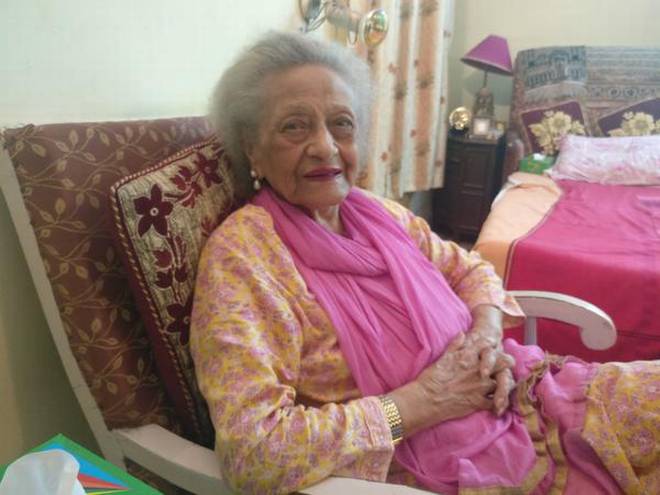
Former RS member Begum Hamida dies at 101

UTTAR  PRADESH :

Begum Hamida Habibullah | Photo Credit: Omar Rashid

She was the founder of SEWA (Self Employed Women’s Association), which promoted self employment for women and the art of Lucknow’s famous chikankari.

Begum Hamida Habibullah, a former Rajya Sabha member and a pioneer in women empowerment, died here on Tuesday.

She was the daughter of Nawab Nazir Yar Jung Bahadur, Chief Justice Of Hyderabad High Court and wife of Major General Enaith Habibullah, who went on to become the first Commandant of the National Defence Academy.

Her grandson Saif Habibullah announced the news of her demise through his Facebook account.

Born on November 20, 1916, Hamida was 30 when India achieved independence and was a witness to modern India’s political history, stretching from the British rule to the bloody partition. She witnessed the building of new nation, glory days of the Congress Party and its subsequent decline to the present domination by the BJP.

Her son, Wajahat Habibullah, was India’s first Chief Information Commissioner of India and former Chairman, National Minority Commission.

Ms. Habibullah was known for working on women issues. She was the founder of SEWA (Self Employed Women’s Association), which promoted self employment for women and the art of Lucknow’s famous chikankari ( thread embroidery).

She joined politics with the Congress after her husband returned from the army in 1965 and went on to become an MLA from UP’s Haidergarh seat in Barabanki from 1969 to 1974. From 1971 to 1973, she was a Minister of State in the U.P. government and a Rajya Sabha member from 1976 to 1982.

She held the Social and Harijan Welfare, National Integration & Civil Defence, and Tourism ministries.

Hamida passed senior Cambridge with Distinction in 5-Subjects before going on to get a gold medal in B.A. from Osmania University.

source: http://www.thehindu.com / The Hindu / Home> News> States> Other States / by Omar Rashid / Lucknow – March 13th, 2018

Bhatkal boy secures top position at All India Qirat and Hifz Competition

Bhatkal (Uttara Kannada District) , KARNATAKA :

JaferMPOs13mar2018

Mumbai :

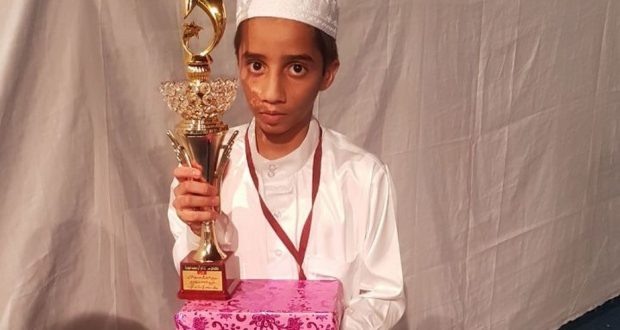
With his mesmerizing voice a little boy from Bhatkal has emerged the overall winner of at ‘All India Qirat and Hifz Competition’ organized by Idara-e-Dawatul Sunnah held in Mumbai on Sunday, March 11.

Jafer s/o Moulana Abdul Azeem Kazia(Vice Qazi, Jamatul Muslimeen Bhatkal) and a student of Maktab Jamia Islamia(Kargedde) has bagged first position in ‘All India Qirat and Hifz Competition’ while competing against 41 participants from across the country including 7 from his own hometown Bhatkal.

Jafer is also awarded an Umrah package for him and his parents by the organizers as a part of the winning prize.

The competition commenced on the morning of Sunday and continued till evening.

As soon as the news reached Bhatkal, social media platforms were full of congratulatory messages for the kid, as he turned a local social media sensation in no time.

Moulana Maqbool kobatte, President Jamia Islamia Bhatkal and other local institutions and their management congratulated the boy on his success.

Bhatkallys.com also takes this as an opportunity and congratulate Jafer, his family and his mentors and management of Jamia Islamia, and also prays to Almighty Allah to protect the kid from all the evil eyes and grant him more success in years to come so as to turn him into an asset for the community and to Islam.

source: http://www.bhatkallys.com / Bhatkallys.com / Home> Latest News / by Bhatkallys News Bureau / Mumbai – March 12th, 2018