Category Archives: Arts, Culture & Entertainment

A fight to preserve history

Kozhikode , KERALA :

Aysha Mahmood, alumnus of St Joseph’s HSS, is campaigning for safe keep of 150-year old building.
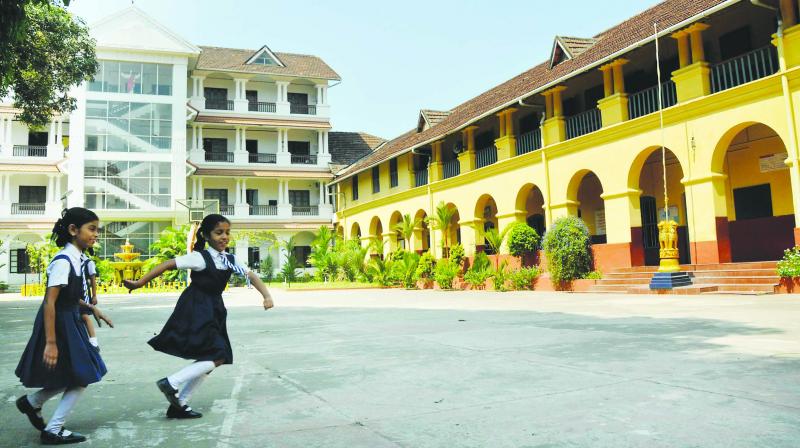
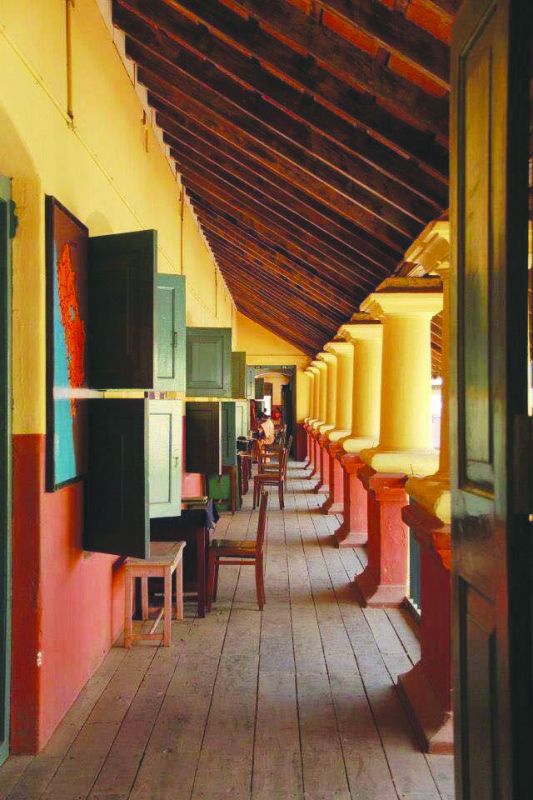
Children at St Joseph’s Anglo Indian Girl’s Higher Secondar School, the first school for girls in Malabar, built in 1862.(Photo: Venugopal)
Children at St Joseph’s Anglo Indian Girl’s Higher Secondar School, the first school for girls in Malabar, built in 1862. (Photo: Venugopal)

Thiruvananthapuram:

It was a chance meeting. Aysha Mahmood had come to her hometown, Kozhikode, to take part in the Offir Food Fest. She has been settled in Taiwan for a while, but couldn’t stop reacting to stories from home that shocked her.

Two years ago, she heard her beloved alma mater – St. Joseph’s Anglo Indian Girls’ Higher Secondary School – will have its oldest building demolished. A few of the alumni had then got together, spoke to the school and the idea had slowly died down. Now, after a chance meeting with someone she knew, Aysha heard the plan was back on.

Frantically, she gathered together some of the old girls who studied there, tried talking to the school, and finally had to start a petition online to save the old, old school – 155 years old.

“Some time back they celebrated the 155th anniversary of the building, now they are planning to pull it down, and in its place, build a glass and steel structure,” she says, remembering another old building that is no longer there. It was the boarding house where Aysha had spent many happy days. The building had a library in the centre which had a lot of really old Reader’s Digest magazines.

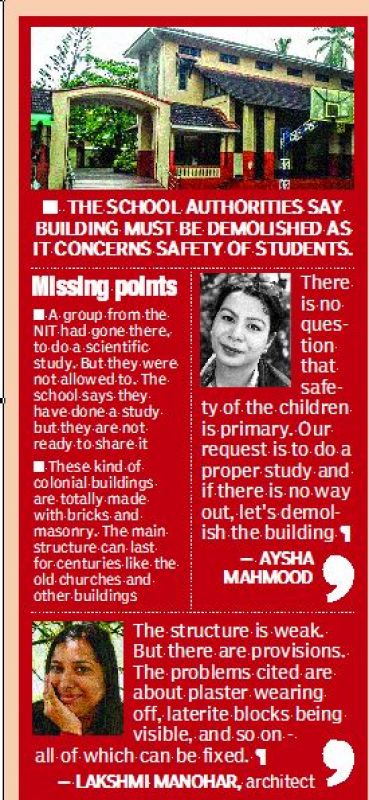
It was not accessible to the girls. But like in Enid Blyton novels, the girls found an old door from their dressing area that led to the library. Aysha’d sneak in, after opening the rusty hinge, and stay there with her torch or a candle, reading those old, old Reader’s Digest magazines.But that building and the library had got pulled down. Now there is only the original convent and this building they are planning to demolish, left of the first school for girls in Malabar, built in 1862. “We have very few 100 plus year old buildings left in Kozhikode. One reason they give for demolishing the building is space constraints. That they cannot have smart classrooms there. But there are architects interested in conserving it, who say, it can be done. We could add modern amenities, restore the building. A group from the NIT had gone there, to do a scientific study. But they were not allowed to. The school says they have done a study but they are not ready to share the report.”
StJosephs02MPOs28feb2018

The school has been giving the reason that it concerns the safety of the students. “But we feel that is an excuse,” says Abdul Hameed, an electrical engineer who runs an architectural consultancy. He got involved only because of his love for his hometown.

“We suggest we can get the best structural engineers from NIT, to ascertain the safety of the building. And then do a programme to restore it. The funding – can be thought out later. These kind of colonial buildings – were before concrete, so it is totally made with bricks and masonry. The main structure can last for centuries like the old churches and other buildings across the world. But maintenance should be done.”Abdul, with the collector, the new building’s architect, and a few others are planning to meet the headmistress on Monday. “Lots of people are calling. Venu IAS, former tourism secretary, K.K. Muhammed, former ASI director, have all shown their interest,” Aysha says.

Her petition has collected 2574 signatures as this is written. But she adds, “There is no question that the safety of the children is primary. Our request is to do a proper study and if there is no way out, let’s demolish the building.”There might be a way out. Architect and another alumnus of the school Lakshmi Manohar has just come back from a visit to the school on Saturday evening.
StJosephs03MPOs28feb2018

“We just wanted to meet the old teachers and find out what the issue is. According to us, the structure is weak. But there are provisions. They showed us the old classrooms. There are more students now, so the space is less, to take class. It is all congested. Their requirements need one or two floors more to the building. The question is whether the structure has the strength to withstand the extra floors. That’s what we should evaluate. The problems they cite are about the plaster wearing off, the laterite blocks becoming visible, foundation troubles, and so on – all of which can be fixed. But I am not a conservation architect. We should bring a technical expert to study the condition and tell what the situation is,” she says.

‘A collective memory which shaped Kozhikode society’
The St. Joseph’s building, since 1862, has played an undeniable role in making education attainable and accessible to girl children from all walks of life- par caste and creed. It contains the collective memory of thousands of women and girls, panning almost six generations. It has played alma mater to a large section of Calicut society- ensuring quality education. Keeping that heritage alive is of high importance.

Those interested in the demolishing of the building may be of the opinion that it affects the modern outlook of the management or that it is a threat to the safety. Both concerns can be addressed if the right people are involved.

There is a large Architects Guild active in Calicut that specialises in the restoration and strengthening of historical and heritage buildings. We must be prepared to give them a chance to present their expert opinion and help in this matter. The professors of NIT Architecture Department have made known their availability and deep interest in studying the building and presenting their proposal for the same.

While it does need some work, respected architects who have assessed it generally opine that the building is structurally sound. They feel that it could be refurbished at a cost lesser than that required for demolishing and rebuilding.The restoration will only add to the historical value and character of the school. A building that is  150 years old must be considered an asset to the city. In a world where characterless and soulless skyscrapers and steel-glass embodiments are dime a dozen, buildings like these serve as a place of solace for the soul and soothing to the sight. They embody our past and our culture. Caretakers of our colonial architecture and history must know that the St. Joseph’s School and its many buildings are rich and heavy with these values.To conclude, I think preserving buildings like these is essential because of the collective memories, Calicut and its people attach to it.

Generations are emotionally attached to this school building in which they have spend a big part of their childhood. It has had a formative and a positive role to play in all our lives and it will be the saddest day in our lives to see it being pulled down.
(Excerpts from the online petition of Aysha Mahmood)

source: http://www.asianage.com / The Asian Age / Home> India> All India / CRIS / February 23rd, 2018
MCD Elections 2017: Congress candidate Yasmin Kidwai wins Darya Ganj ward after recounting

UTTAR PRADESH / NEW DELHI :

New Delhi :

In a setback to Bharatiya Janta Party, Congress candidate Yasmeen Kidwai has won Darya Ganj seat after recounting of votes.

Delhi State Election Commission has earlier declared the Bharatiya Janta Party candidate Meeta Bhambri declared victorious after the first round of counting. Darya Ganj has been a stronghold of Congress for many years.

Former cabinet minister Harun Yusuf also hails from old Delhi. However, the territory of Muslim areas have been snatched by the saffron party. The party has fared well in the neighbouring of Chawri Bazar and Kashmiri Gate. The party is leading on 179 seats in MCD.

In an earlier development, Delhi Congress President Ajay Maken resigned from the post.

Former Cheif Minister Sheila Dikshit had accused him of leading the party in an irresponsible manner. Former Congress Delhi women Chief had accused him of not listening to party workers. She later joined the Bhartiya Janta Party after Arvinder Singh Lovely and Amit Malik embraced the saffron party.

source: http://www.india.com / India.com / Home> News> India / by Ravi Kaushal / April 26th, 2017

Bhapang player Yusuf Khan from Mungaska reaches out to music world with a click

Mungaska (Kaman Taluka), Alwar,  RAJASTHAN :

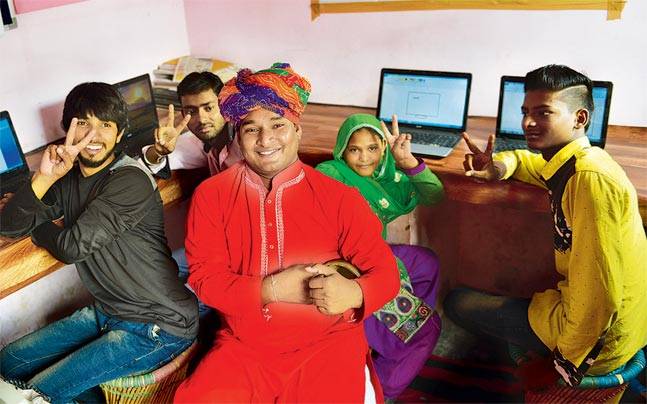
22-year-old Yusuf Khan (wearing a turban) is a Bhapang player and is using the Internet to digitalise his father & grandfather’s music

MUNGASKA-based 22-yearold folk musician has brought digital revolution among locals and other folk artists after the area received a high-speed Internet connection in 2014.

Yusuf Khan, a Bhapang player, is on a mission to digitalise dying folk music of Mewat area in Alwar. “I am an engineer but didn’t know how to operate a computer. I went to a computer institute where I realised that Internet can break geographical boundaries. In the last one year, I have opened an account on a social networking site and have also posted my music on YouTube. This has helped me get opportunities to perform in foreign countries,” said Khan, who is also a coordinator at six computer training centres.

Khan sacrificed his professional career to make the ancient musical instrument Bhapang popular. It is an instrument inspired by Shiva’s damroo.

DIGITISE MUSIC

“My grandfather and father are both renowned artists but the art is dying. I wanted to revive it. The first thing I did was digitalise all of their recordings. In order to promote the music we need to improvise. So I started following international and national artists through the Internet and have started doing fusion with Bhapang,” Khan explained.

Khan said that over 100 local and folk artists visit his computer centre to book tickets online, contact international music organisations along with creating their websites and digitalising their music.

COMPUTER LITERACY
His computer centre is famous among the locals as almost every house now has a computer literate.

Digital literacy has brought a significant change in the area as even women of the locality have email ids and social media accounts. Locals, mostly uneducated, have applied for PAN cards, passports and availed other government schemes through this centre.

source: http://www.indiatoday.in / India Today – Mail Today / Home> News> Mail Today / May 30th, 2016

Be the change you want

Hyderabad, TELANGANA :

Break Free: Jameela believes it is every woman's right to create her own identity. Photo: Nagara Gopal
Break Free: Jameela believes it is every woman’s right to create her own identity. Photo: Nagara Gopal

The journey was anything but smooth for Jameela Nishat, now a ray of hope for victims of domestic abuse.

It’s not easy giving up a secure job to work for women’s rights in an area where domestic violence and discrimination is the accepted norm. But if you dream about change and a world of equality, like poet and activist Jameela Nishat did, the transition is not hard at all.

Originally a teacher at a school for special children with a regular pay package, Jameela decided to give it all up to live for her conviction. What followed was a tumultuous journey filled with hostility, social boycott and accusations. But one thing remained constant – Jameela’s patience and perseverance. Today, not only is she well respected, she is also the person most women in Old City turn to for help.

Over the years Jameela has managed to help several women who have been victims of domestic violence, sexual abuse, incest, polygamy and forced marriages to much older men through her organisation Shaheen.

The journey was never smooth though. When she first began her journey as a women’s rights activist, Jameela was met with stiff opposition by not just the men in the locality but even the women.

“Domestic violence was a way of life for these women. I was met with statements like Woh mard hi kya jo aurat ko na maare (what kind of a man doesn’t beat women). When I set up Shaheen in this locality of Sultan Shahi not too many people were open to change. It is only over time that women have begun to realise that they too have a choice,” says Jameela, who is also an executive member of Asmita Resource Centre for Women. On several occasions Jameela and her team have busted fake marriage attempts by Arab men with young city girls.

It took tremendous tact and patience on her part to get her point across. “When I first began coming to this place, I approached the girls saying I could help them with English. Being summer vacations more than 50 girls came forward to learn the language. Gradually a month later I broached the topic of sexuality. Instantly 50 girls stopped coming and I was left with just five who were willing to work with me to create awareness. That is how Shaheen began,” she explains.

Needless to say, there was a lot of resistance. “I remember one particular incident when I was surrounded by more than 25 men, who did not agree with my work. This happened after the 2003 riots in Old City. I decided to hold a workshop for the Muslim, Dalit and BC boys on communal harmony. When our staffers and other girls sat alongside them for the workshop, the boys were livid. They were worried the girls would elope with Dalit boys,” she says.

But the transformation did come about. Slowly women began approaching Jameela for help and numerous cases of domestic violence and incest came to light. “There have been cases of women seeking a divorce after tolerating violence for 25 years. They are slowly beginning to realise that abuse is not a way of life. Most heartrending are the cases of incest. We once had a seven-year-old girl tell us that her 12-year-old sister was covered in cigarette burns by their step-father. When we met the girl we learnt that the man had been sexually abusing her. In another case a mentally unstable girl had been violated for several years by a maulvi under the pretext of treating her. We intervene and try to rehabilitate these girls. But resistance still persists in some people,” says Jameela, recalling an incident where a young woman was tied to the cot and set ablaze by her husband. Yet nobody from the girl’s family wanted to press charges. The girl herself told the police that it was just an accident.

For Jameela these are not mere cases. “I live these cases myself. Victims don’t need our sympathy, they need empathy. And that is what I do,” she says. Quiz her on how her family reacts to her work and she says, “I come from a very cosmopolitan family. My father was a painter and I’m a poet. My husband is an atheist and does not believe in these practices. We are like friends living under one roof. My sons also understand and appreciate what I do. As such I do not discuss my work with my family. My siblings know about what I do through newspaper articles.”

Her true dream though was to become an artist. “However, my father was sceptical about me going to art school since we would have to paint nude models. However, writing was encouraged in Muslim households, so I took to poetry,” she says, adding that she spent her childhood watching M.F. Husain paint on their living room floor. “He was my father’s close friend. He would roll out a canvas on our living room floor, sit on it and create a masterpiece in no time. Sometimes he would just use his hands to spread the colour. I would watch him and paint some pieces myself and pass it off as my brother’s work,” she laughs.

Through all of this, Jameela’s poetry is her constant solace. “I begin my mornings by writing a couplet. I write about the incidents I come across. It helps to channel my feelings through words,” she says, sharing a couplet she recently penned, which she says aptly describes her life.

Iss zindagi ki raah mein

Aese nikal padi

Meri talab sab ko hai,

Mera hisab kucch nahi

source: http://www.thehindu.com / The Hindu / Home> Society / by Ranjani Rajendra / Hyderabad – September 26th, 2013

Naeem Khan Designs Feathered Dress for Houston Gala Chair

UTTAR PRADESH / Mumbai, MAHARASHTRA  / New York, USA :

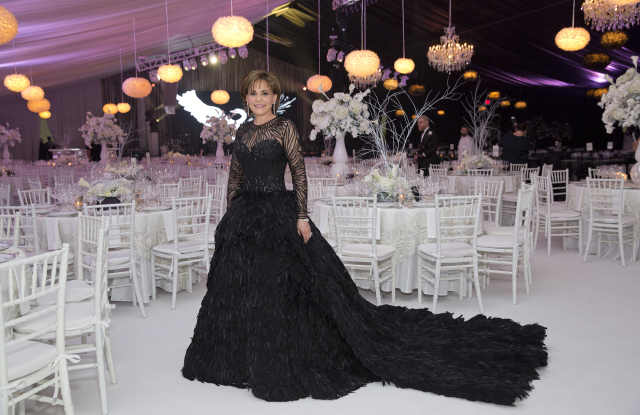
Khan designed the dress for Houston Ballet Ball chair Hallie Vanderhider.

Hallie Vanderhider / Photo by Jenny Antill
Hallie Vanderhider /
Photo by Jenny Antill

Black Swan :

Guests at The Houston Ballet Ball were encouraged to don black, white or a mix of both as an ode to Tchaikovsky’s ballet “Swan Lake,” but Houston Ballet Ball chair Hallie Vanderhider took the concept further — much further, enlisting the design prowess of Naeem Khan to create her feather-laden gown.

Vanderhider and Tootsies creative director Fady Armanious flew to New York and met with Khan to discuss a gown that would capture the elegance and dark beauty that Vanderhider had envisioned for the ball. Within a few sketches, the trio had landed upon an all-black gown covered in 3,500 natural black coque feathers, weighing in at 7.25 pounds.

“It was a magical moment. Naeem totally captured the essence of Swan Lake,” Vanderhider said. “He is such an amazing talent and has a great sense of humor.

Khan encouraged Vanderhider to embrace the mysterious elements of the dress, reminding her, “This isn’t a mother-of-the-bride gown.” The gown’s sheer long sleeves and bodice were finished with intricate beading.

source: http://www.wwd.com / WWD / Home> Fashion> Fashion Scoops / by Heather Staible / February 22nd, 2018

How Begum Rokeya — India’s first Bengali Muslim feminist — dared women to dream

BENGAL :

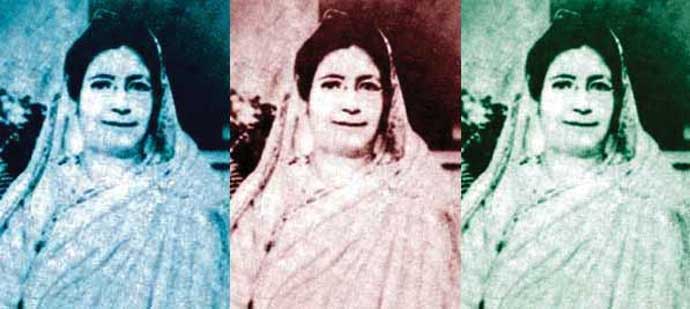
Rokeya Begum was an educationist, writer, social activist and effectively, India's first Bengali Islamist-feminist.
Rokeya Begum was an educationist, writer, social activist and effectively, India’s first Bengali Islamist-feminist.

As a Muslim reformist, her activism was neither half-baked nor exclusionist, yet little is known of her meaningful contributions to society.

Sometimes when wars are long and without any imminent hope of triumph or an end, it’s best to count on the smaller victories. Such as the taking down of Omprakash Mishra’s misogynist cringe-pop video or Uber apologising for their presumptuous and sexist offer on “Wife Appreciation Day” or Hulu’s The Handmaid’s Tale bagging the Emmy for “Best Drama Series” leaving behind popular shows like Westworldand Stranger Things.

The Handmaid’s Tale is to feminists what the BJP manifesto is to Arnab Goswami. Though Margaret Atwood’s evergreen dystopian thriller published in 1985 was one of its kind, it wasn’t the first. Eighty years before that, Begum Rokeya Sakhawat Hossain published her feminist utopian fantasy Sultana’s Dream, a novella investigating the ironies of a technologically advanced, gender-reversed India (one where men were confined to the “zenana” — the part of a house for the seclusion of women, or as Rokeya terms it, the “mardana” — imagined in the dreams of a woman named Sultana.

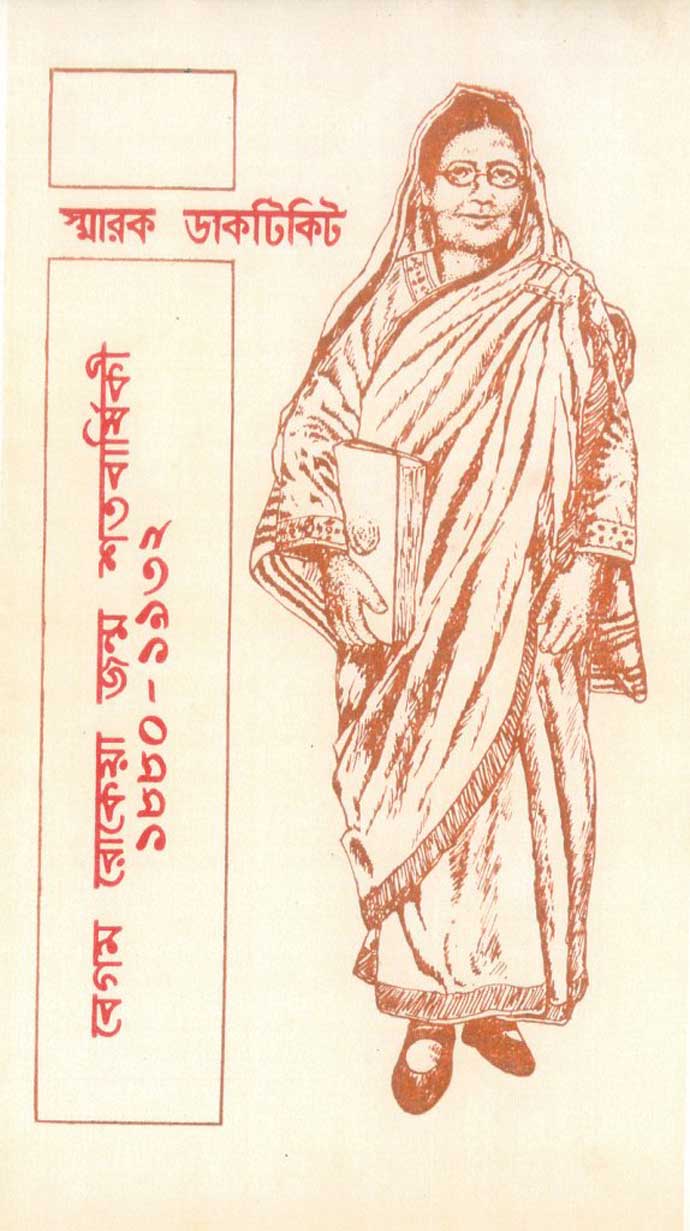
Born in 1880 to a wealthy Zamindar family in Pairabondh (present Bangladesh), Rokeya Begum was an educationist, writer, social activist and effectively, India’s first Bengali Islamist-feminist. While Savitri Phule and Pandita Rama Bai re-emerged through the obliterating clouds of India’s redacted history-telling, the narrative on Rokeya’s work remains shrouded, at least, in India.

Her father, an orthodox Muslim, persisted that the women maintained purdah and allowed them to be educated in Arabic (only) to enable them to read the Quran. Rokeya and her sister Karimunnesa, learned Bengali and English at the behest of their supportive brothers, who educated them on the sly. Perhaps this phase of her own life contributed amply to her tenacious belief that the lives of Muslim women could not be ameliorated without proper education. Added to that was her own sister who remained a key inspiration for Rokeya’s writings and her social work.

Karimunnesa, a seasoned poet, had been married off before the age of 15, putting what might have been a lucrative future to an abrupt end. This had further consolidated Rokeya’s faith in educational and individual rights for women — chiefly Muslim women, who, in that era, lived like showpieces in a glass casket but with an iron curtain.

With this line of thought and the support of her husband (Sakhawat Hossain, whom she was married to at the age of 16 and who died in 1909) and the money he had set aside, Rokeya went on to establish Sakhawat Girls Memorial High School, five months after his demise.

She started the school in Bhagalpur (a majority-Urdu speaking area in erstwhile East Bengal) with merely five students and was forced to shift the school to Kolkata in 1911 due to property feuds with her husband’s family. It remains one of the city’s most popular schools for girls and is now run by the state government of West Bengal.

Today, Rokeya's memory is as fleeting — even for her benefactors — as Sultana's dream. Photo: http://nationalwomansparty.org
Today, Rokeya’s memory is as fleeting — even for her benefactors — as Sultana’s dream. Photo: http://nationalwomansparty.org

In 1916, she founded the Anjuman-e-Khawateen-e-Islam (Islamic Women’s Association), which was her other organisational contribution to Bengali Muslim women. Through this organisation she offered financial and educational support to downtrodden Muslim women, over and above raising public opinion regarding the issue of Muslim women’s rights. That Rokeya was way ahead of her times finds semblance in the curricula of the school she established, which included physical and vocational training in an attempt to arm women with financial independence. She coined the term “manoshik dashhotto” or mental slavery, referring to the absence of individuality that pervaded the entire gamut of Muslim women and attributed it as the root cause for their subjugation. This rings true even today.

A century ago, Rokeya approached her adversaries with a wit and logic that is hard to find in today’s generation (which appears to be self-deprecatingly volatile). Insightfully, Rokeya tapped into the quintessential Muslim male ego and inversed it to men’s disadvantage, instead of directly antagonising them with liberal arguments.

She writes, “The Muslim society is paying a greater price for the lack of any system of education for their women. I have been informed by a reliable source that some educated Muslim youths of well-to-do families are setting conditions that if they can’t find educated Muslim women, they will not marry. They even threaten to become Christians and marry someone from that community if they fail to find educated Muslim women.”

Critics might question the ethic behind this approach, but the truth is, even now, “the threat to minority identity” continues to be the most veritable impediment to the realisation of Muslim women’s rights.

Keeping this in mind and the socio-politico environment of that era, perhaps by playing on their fears was not only ingenious but also the only way out.

In 1926, when she was invited to chair the Bengal Women’s Educational Conference, she said, “Although I am grateful to you for the respect that you have expressed towards me by inviting me to preside over the conference, I am forced to say that you have not made the right choice. I have been locked up in the socially oppressive iron casket of ‘porda’ for all my life. I have not been able to mix very well with people – as a matter of fact, I do not even know what is expected of a chairperson. I do not know if one is supposed to laugh, or to cry.”

Having lost her husband early and her two children who died at infancy, Begum Rokeya was not just subjected to scathing criticisms for her views but also faced unforgiving social exclusion. Despite the variegated hindrances she faced, in lieu of her gender, her community and the very fabric of the milieu that she had set out to change, she worked tirelessly and fearlessly to carve a way out for many Bengali Muslim women like myself.

Begum Rokeya died on December 9, 1932, and up until 11pm on December 8, 1932, she was working on an unfinished article titled, “Narir Odhikar“, which translates to women’s rights. The over-arching principle that governed her literary and social work was feminism and through it she heralded the discourse into Bengal. As a Muslim reformist from that era, Rokeya’s activism was neither half-baked nor exclusionist as the classist and sexist Aligarh movement led by Syed Ahmed Khan, yet little is known of her meaningful contributions to society. Today, Rokeya’s memory is as fleeting — even for her benefactors — as Sultana’s dream.

source: http://www.dailyo.in / Daily O / Home> Variety / by Suman Quazi / September 21st, 2017

The minimalist creations of product designer Saif Faisal

Bengaluru, KARNATAKA :

From designing cars to designing products for your home—Bengaluru-based Saif Faisal is fast becoming a name to reckon with

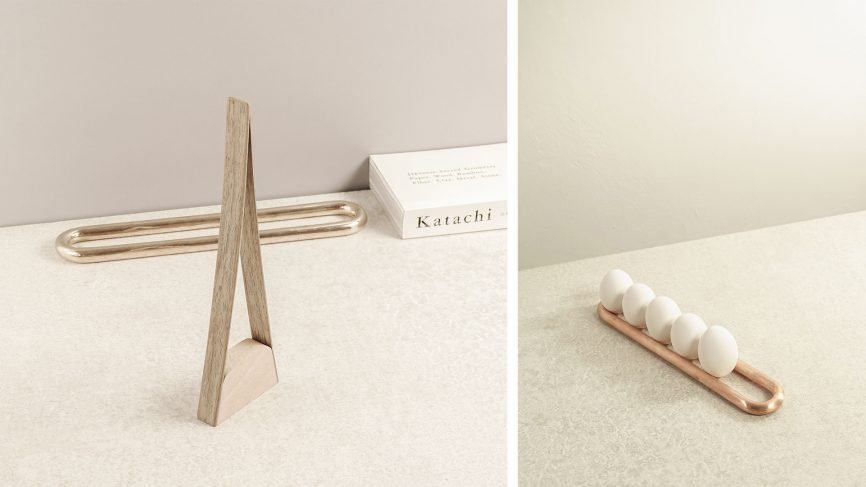
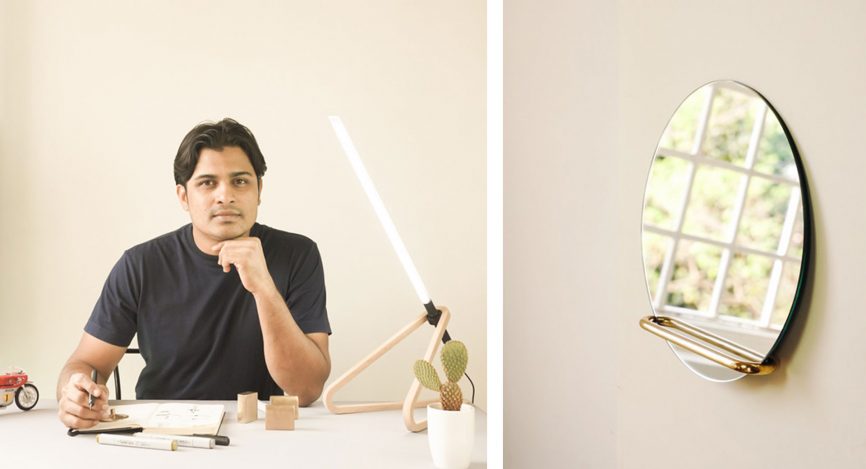
Foster Memo Clip (Left). Brackett Trays (Right).

Product designer Saif Faisal who started his career designing cars has very successfully ventured into designing products for your home. Trained as an architect at Bengaluru’s RV College of Architecture, Faisal previously represented his college at Formula SAE, a student design competition, where he worked on driver safety and ergonomics. Now, Faisal’s eponymous studio has created a collection of home accessories with a markedly minimalist design. AD sat down with the designer to get a more intimate understanding of his design instincts and inspirations.

Architect and product designer Saif Faisal (Left). Loop Mirror (Right).

Architectural Digest (AD): Where did you learn wood working?
Saif Faisal (SF): It was more like collaborative learning with a couple of people in the trade to understand the craft. This helped a lot in the design and product development. With my earlier design and engineering work in Formula Student racing, this brought the two extremes of craft and high-tech together. For instance, our design, the Counterpoise lamp uses the dynamics of gravity but is made in a humble natural material: wood.

AD: Did you start the brand with the intention of specializing in table-top office accessories (like lamps, trays, clips, coasters, etc)?
SF: Actually it’s the contrary; initially we were more focussed on furniture. We have worked on a lot of furniture, the String Series for Godrej Design Lab, a book case, and a series of Roto-molded seating for indoor/outdoor use. The development process of larger projects take quite a while so we started doing smaller objects in between, which can be self-produced and completed quickly as well—again something which we didn’t favour much earlier. I have to admit it’s quite enjoyable doing smaller stuff.

AD: Will we see any other products—like kitchen or tableware for instance—from your brand?
SF: Maybe…in 2015 we ventured into jewelry and craft that was a surprise for us. Every new thing we do is an exploration and adventure.

Counterpoise Lamp. Principle: Function and flexibity with ease.

AD: In its minimalism and simplicity, your products remind one of Scandinavian design. What/who is your design inspiration?
SF: You are right; they are reminiscent of Scandinavian design, and I suppose, of Japanese design too. I would say its Essentialism and not merely Minimalism, as we try to be more honest to the design essence with no frivolous decorative elements. If you see our Qaiser series in Bidriware, it has the Zillij pattern on it—that’s not minimal but essential. On that note, Essential Design can help the world become a better place, and it’s not just with the products…my observation is cultures with a better sense and appreciation of design have holistic politics and interactions.

AD: You mention ‘poetry’ and ‘harmony’ in design (in the notes on the products) several times. Why is this so important to you?
SF: It’s quite important that a design be poetic, to express to a user the object needs to communicate on a poetic level.

source: http://www.architecturaldigest.in / Architectural Digest – AD / Home> Perspective> Profile / by Leena Desai / February 24th, 2017

Meet the Men Behind the Red Banarasi Saree Anushka Sharma Wore

Varanasi (earlier Benares), UTTAR PRADESH :

Here’s a look at the craftsmen who worked on the gorgeous Banarasi saree that Anushka Sharma wore for her wedding reception in Delhi on 21 December. (Photo Courtesy: Vikrant Dubey (L), Yogen Shah (R))

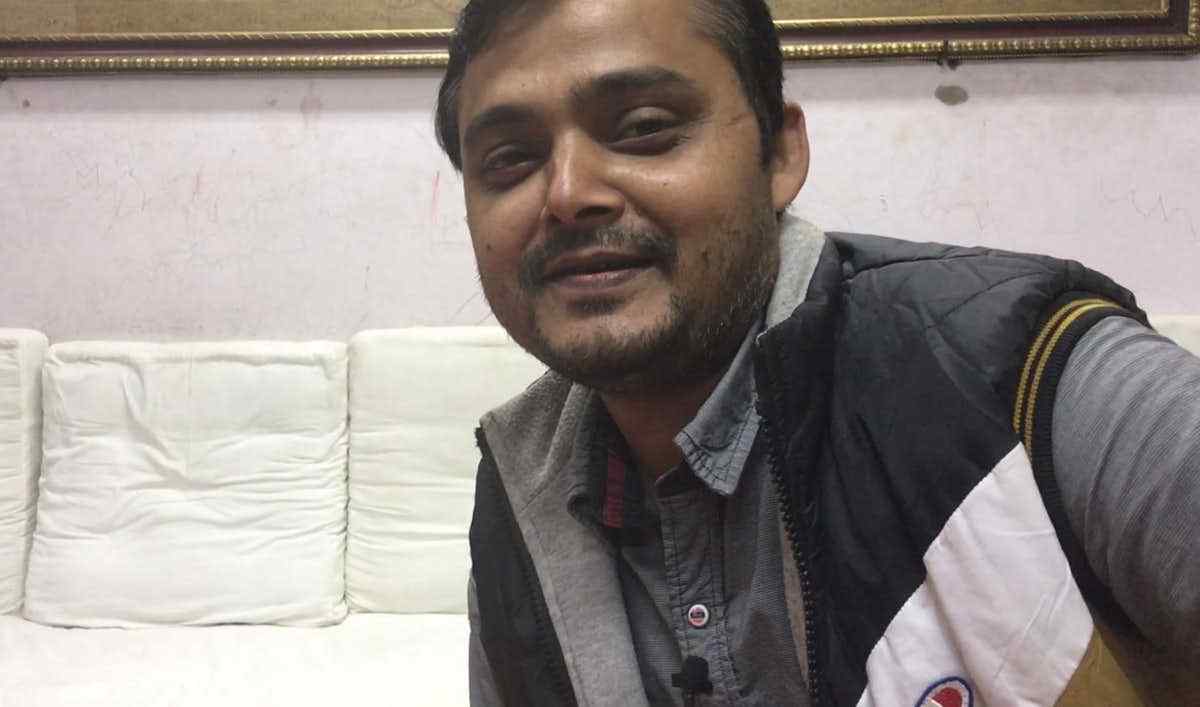
Muazzam Ansari of Benares was among several thousands who were glued to the television screen for news of the glitzy Virat Kohli and Anushka Sharma wedding. But unlike several others, Ansari was watching the ‘Indian wedding of the decade’ closely for a very special reason – the gorgeous Banarasi red saree that Anushka wore for her reception in Delhi.

Anushka02jan20th2018

Ansari was among a team of three craftsmen who toiled day and night for two months to create the exquisite saree. And the saree maker says having the world fawn over it was a moment of great pride.

Muazzam Ansari, the man behind the red Banarasi saree that Anushka Sharma wore for her wedding reception in New Delhi. (Photo Courtesy: Vikrant Dubey)
Muazzam Ansari, the man behind the red Banarasi saree that Anushka Sharma wore for her wedding reception in New Delhi.
(Photo Courtesy: Vikrant Dubey)

As the Virat-Anushka reception photos went viral, Ansari was quick to post photos of the saree on his Facebook page – a move that would quickly bag him the nickname, ‘Anushka Sharma’s Saree Man’.

Anushka’s saree called for extensive planning. After the designers decided on a Banarasi saree came the tough part – selecting a craftsman from the thousands of skilled workers in this trade in Benaras.

Maqbool Hassan Gets the Job

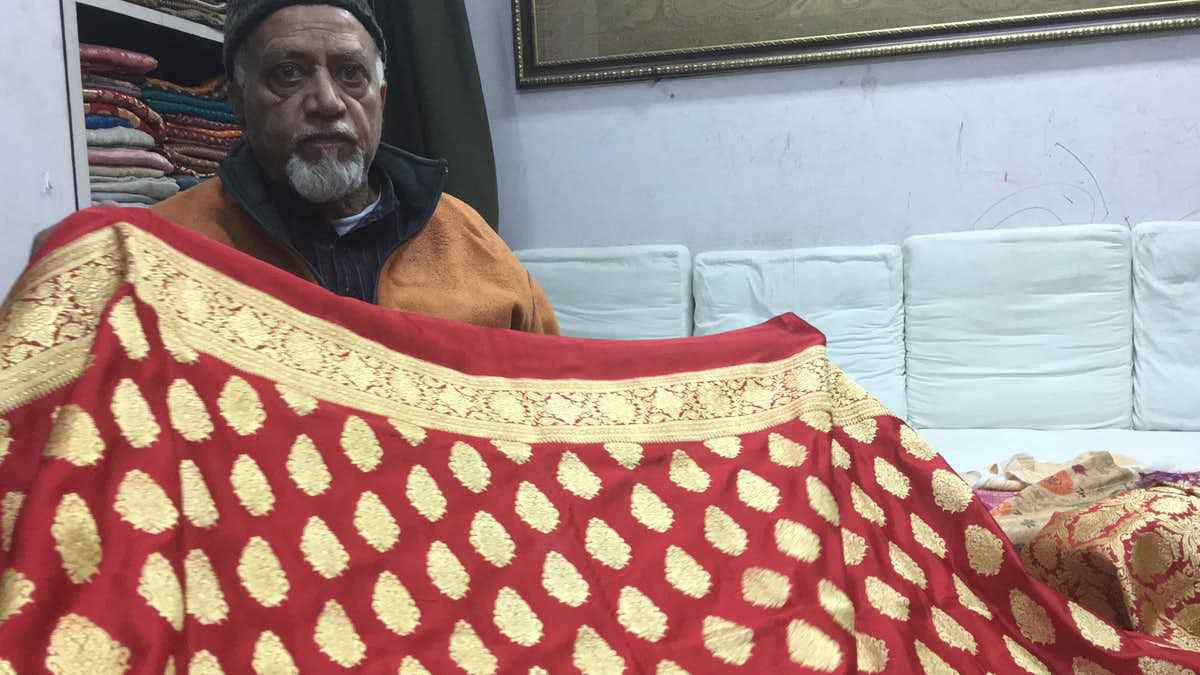
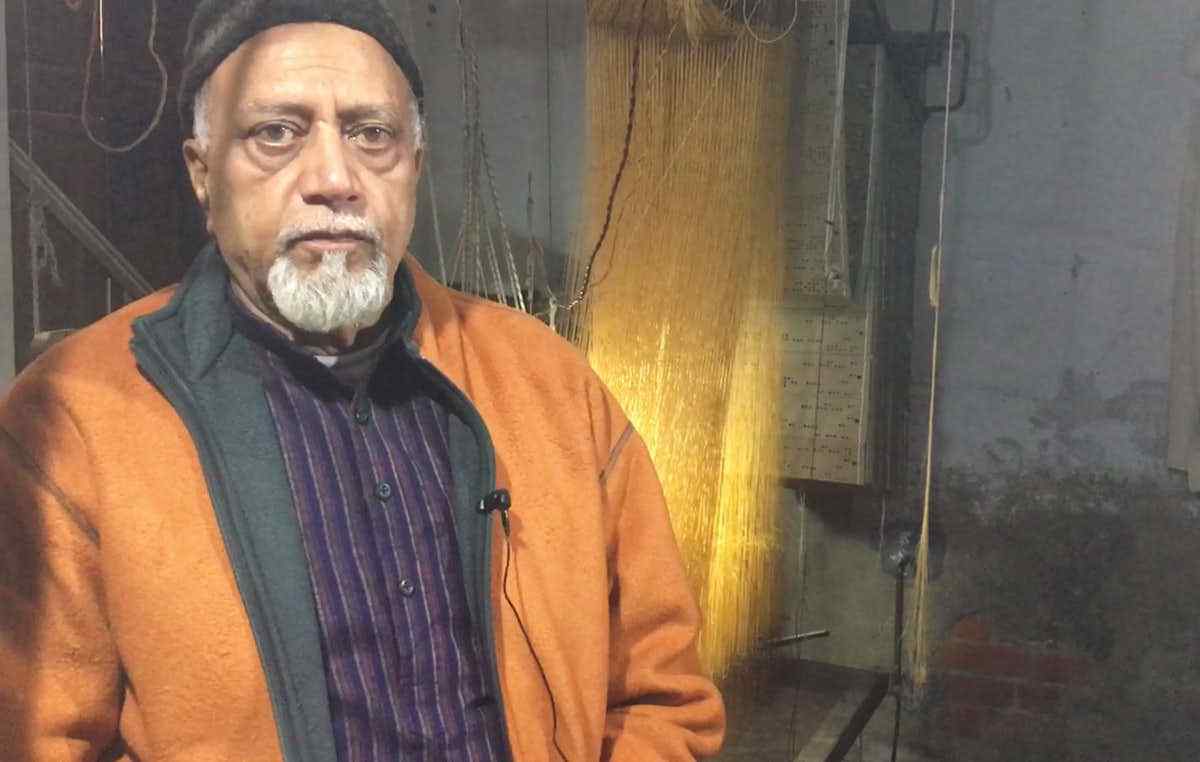
Craftsman of Anushka’s Banarasi saree, Maqbool Hassan. (Photo Courtesy: Vikrant Dubey)
Craftsman of Anushka’s Banarasi saree, Maqbool Hassan.
(Photo Courtesy: Vikrant Dubey)

The important task was given to Maqbool Hassan from Peeli Kothi in Benaras, who has been in the business since 1966. Hassan, whose family has been engaged in the business for over two centuries, is also credited with having created a saree for Aishwarya Rai and a sherwani for Abhishek Bachchan.

Maqbool Hassan of Peeli Kothi in Benaras has been in the business since 1966. (Photo Courtesy: Vikrant Dubey)
Maqbool Hassan of Peeli Kothi in Benaras has been in the business since 1966.
(Photo Courtesy: Vikrant Dubey)

After the Cottage Emporium in Delhi reached out to Maqbool Hassan with the order to create the sari, he set about creating a team of three of his most skilled craftsmen. Among his top three were Muazzam Ansari, whose work is already popular in Benaras, despite the fact that he only joined the industry five years ago. What’s more, fans of Ansari’s work reportedly compare his work with craftsmen with over 20 years of experience.

Months of Secret Planning & Weaving

From planning to making the saree it took almost six months. (Photo Courtesy: Vikrant Dubey)
From planning to making the saree it took almost six months.
(Photo Courtesy: Vikrant Dubey)

As soon as the dates for Virat and Anushka’s wedding were decided, the designers zeroed in on the Banarasi saree for their Delhi reception.

Then began the hunt for the saree design. After much debate and decision, the creators decided on a bright red colour with traditional golden work. The entire process of selecting a colour, finalising a design, and finishing the design took six months. All of it was done in absolute secrecy.

It took total of 60 days for Anushka’s saree to be made. (Photo Courtesy: Vikrant Dubey)
It took total of 60 days for Anushka’s saree to be made.
(Photo Courtesy: Vikrant Dubey)

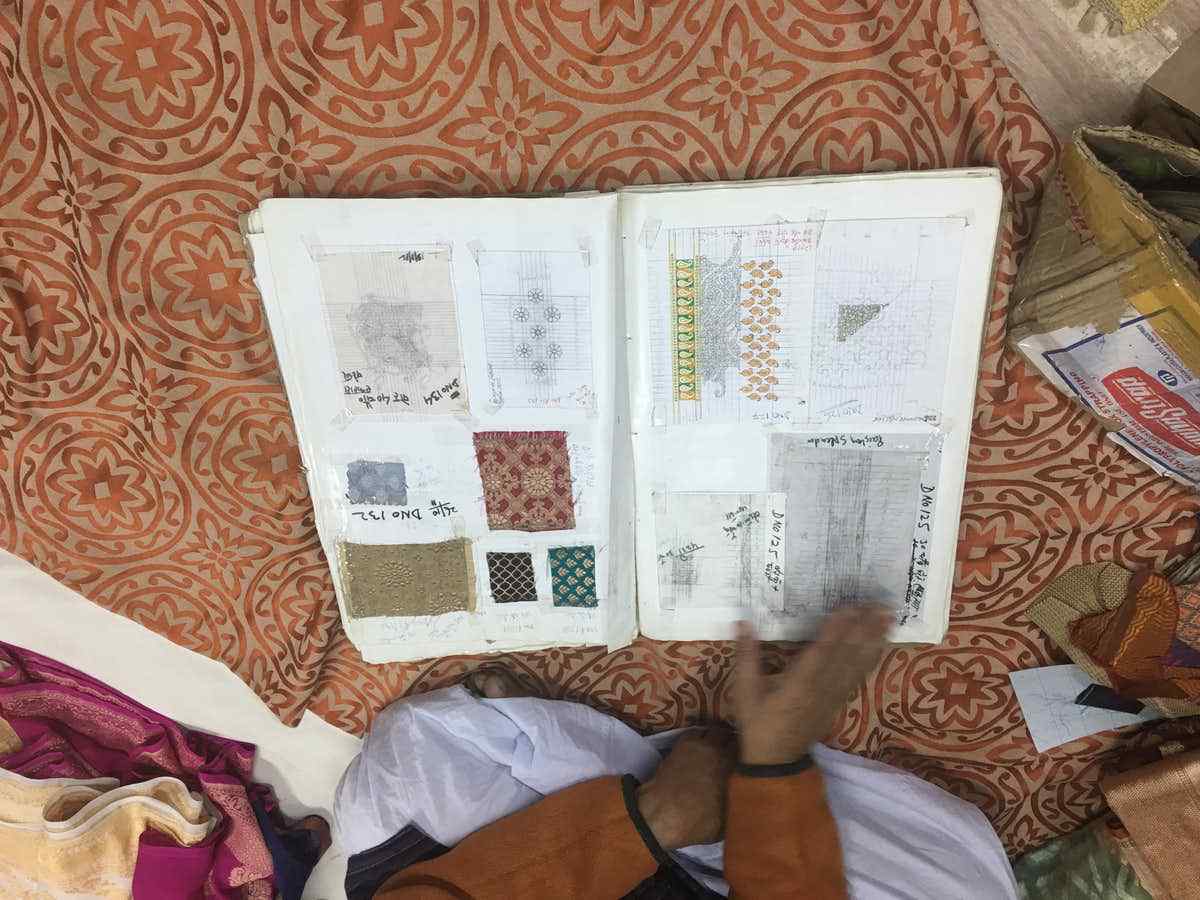
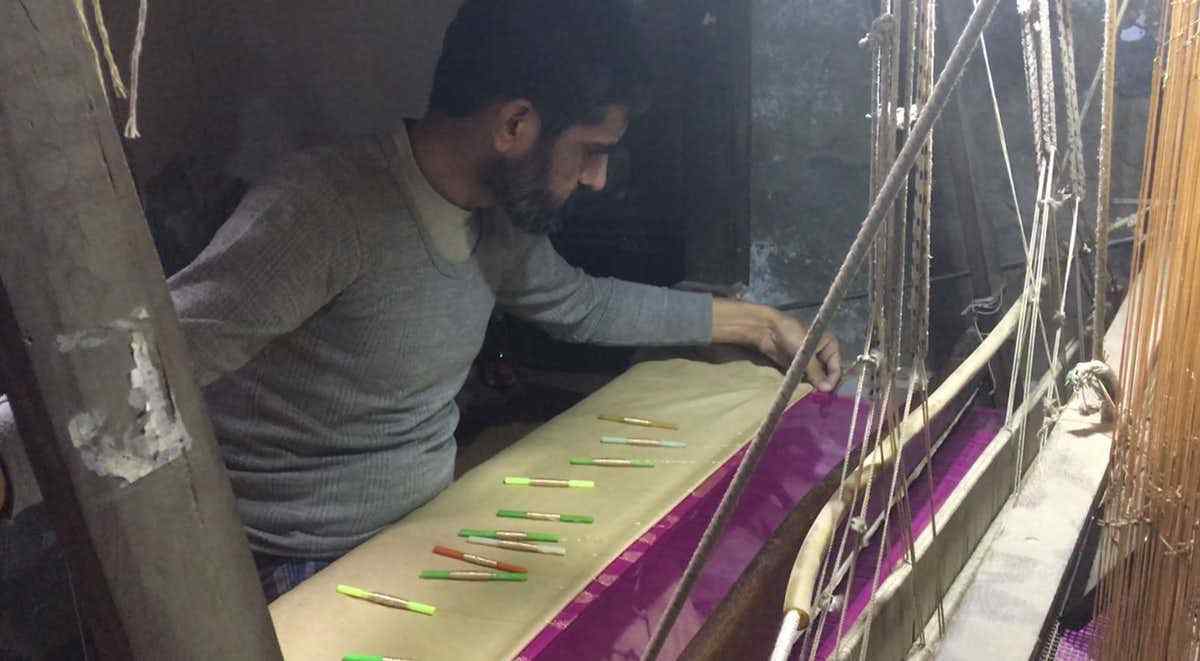
Once the design, colour, and fabric was finalised, it was time for the actual weaving. Banarasi sarees are made on handlooms – each thread and the colour for every bit of the design is put in place by hand.

The saree called for three weavers to work day and night for 45 days. It took another 15 days to add the finishing touches, taking it to a total of 60 days.

Painstaking Effort

Anushka Sharma’s saree took 60 days to make. (Photo Courtesy: Instagram)
Anushka Sharma’s saree took 60 days to make.
(Photo Courtesy: Instagram)

A mixture of silk and chiffon was used to make the saree in order to create an outfit that was both soft and light, despite all the embroidery and the seemingly-heavy work on it. The craftsmen also ensured that the saree did not have a glittery shine, even with real gold being used for the zari – with each motiff being worked on separately.

The three craftsmen tasked with making the saree had to work simultaneously on the weaving, and the absence of even a single craftsman made weaving impossible. With all the work that has gone into the saree, it is small wonder why Banarasi sarees are known for their timeless allure.

(This article was first published on QuintHindi.)

source: http://www.thequint.com / The Quint / Home> Entertainment / by Vikrant Dubey / December 27th, 2017

PBD 2018 celebrated in Riyadh with fervor

SAUDI ARABIA :

IndiainSaudiMPOs17jan2018

Riyadh :

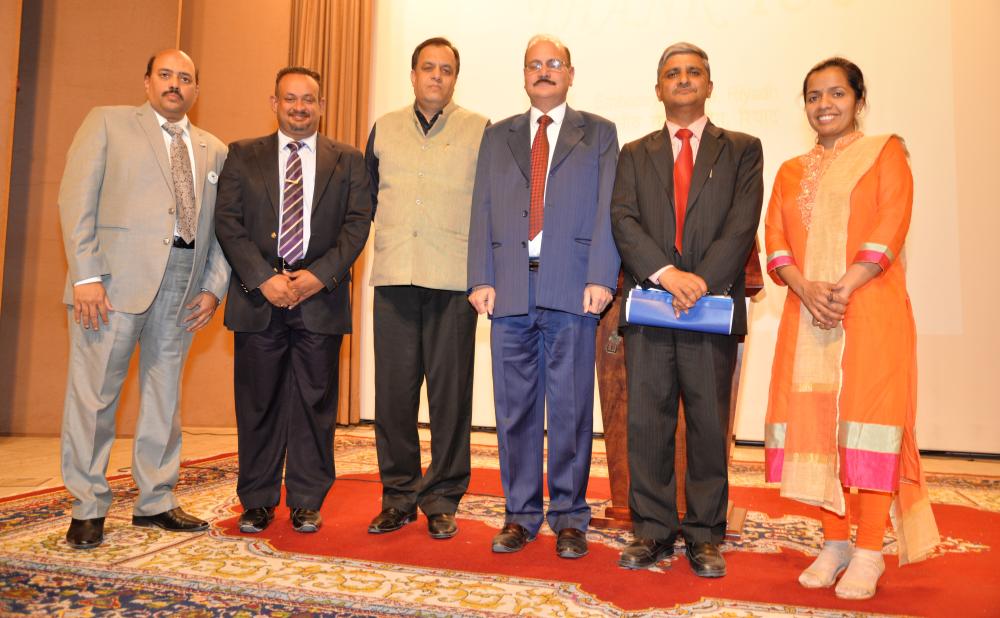
Indian Charge d’Affaires Dr. Suhel Ajaz Khan, during the recent Pravasi Bhartiya Divas (PBD) 2018 celebrations held at Indian Embassy auditorium here, advised Indian nationals to help each other and participate in assisting the community when needed.

Dr. Suhel, in his opening remarks while welcoming the gathering, said that the number of Indians living illegally in the Kingdom is very minute compared to its population after the completion of the recent Amnesty period. The Saudi officials, rounding up illegal residents, have revealed that so far among 250,000-300,000 rounded up in their sweep, that just 1,000 were Indians.

Even though this number is very small when compared to the overall figure and the number of Indians working here, Indian Embassy officials are regularly visiting deportation centers to see if there are any Indian still there needing their help, or is there any fresh Indians detained.

Dr. Suhel also said that during the amnesty period around 75,000 Indians were deported while adding, “It is a matter of satisfaction for us that Indians are very few among illegals.”

Highlighting the community outreach program of the Embassy, the DCM said that the Indian Ambassador traveled length and breadth of the Kingdom to meet the Indian nationals.

Embassy of India has actively implemented the flagship program of Indian government Madad and Emigrate.

He also said that the Indian Embassy would be merciless towards unscrupulous agents who send people to Saudi Arabia through illegal ways.

DCM disclosed that upon the request of Indian Prime Minister Narendera Modi, the Saudi government had issued royal pardon to 291 Indians during last year, the highest for several years.

The DCM also had a message to aspiring job seekers in India to come to Saudi Arabia through legal means and work here with honesty and dedication.

The event started with the playing of recorded speech of Indian Prime Minister Narendera Modi. Dr. Suhel briefed community members on the highlights of the speech.

This is a historic occasion as on this day the greatest Pravasi (traveler) of all time Mahatma Gandhi, the father of the nation, returned to India and this day commemorated as PBD,

Every year, Jan. 9 is celebrated as Pravasi Bhartiya Divas (PBD), an annual celebrations that marks the contribution of overseas persons with Indian Origin towards the homeland.

This year PBD is held at Singapore and the theme is Ancient Route, New Journey — Diaspora in the Dynamic ASEAN India Partnership

The Embassy of India selected four prominent members from the community to speak on the various flagship programs of the Indian government. The speakers included Salman Khaled, Yogacharya Soumya, Magesh Prabhakara, and Taqiuddin Mir Fazal.

The speakers stressed on various topics specially the flagship programs of the government like Digital India — Power to Empower, Yoga, Deen Dayal Upadhyaya, Gram Jyothi Yogna and Beti Bacho-Beti Padhaao.

The speakers were widely applauded for their depth and understanding of the government initiatives and its implications on Indian expatriates abroad, particularly from the Gulf region.

Anil Nautiyal, counselor, Embassy of India, conducted the proceedings and proposed the vote of thanks. Embassy staff actively participated in this event.

First Secretaries Venkateswaran Narayan, Dr. Hifzur Rahman Azmi, community members Architect Abdul Rahman Saleem, 2017 PBD recipients Zeenat Jafri, Shihab Kottukad, Ahmad Imthias, Deepak, Suhail Ahamad, Kundan Lal Gothwal, senior AGM Air India, principals of all Indian schools, managing committee members of various and large number of Indians and their families attended.

Students of Indian International Public School, Riyadh presented colorful cultural program depicting the unity and diversity of India.

source: http://www.saudigazette.com / Saudi Gazette / Home> Saudi Arabia / by Mir Mohsin Ali / January 16th, 2018

Meet Naeem Khan, Michelle Obama’s Fashion Designer

UTTAR PRADESH / Mumbai, MAHARASHTRA  / New York, USA :

Designer for power women had his life changed when outgoing First Lady wore his gown for a state dinner in 2009.

NaeemKhan01MPOs16jan2018

When he was an adolescent growing up in Mumbai, fashion designer Naeem Khan had just one dream.

“When I was 14 years old, I said to my then-girlfriend in India that one day I am going to design for the First Lady of America,” says Khan, who remembers being enchanted by images of former First Lady Jacqueline Kennedy in the now defunct Life Magazine.

Almost four decades later, the designer, now 57, has fulfilled his dream many times over. As one of Michelle Obama’s favourite couturiers, he has dressed her for various state dinners, as well as for more casual occasions, such as during a visit to Brazil.

________________________________________________________

“[Michelle] likes elegant glamour and loves her arms, so you have to make sure you enhance that.”

________________________________________________________

Since he launched his eponymous label in 2003, his uniquely glamorous aesthetic featuring figure-flattering silhouettes and lavish textiles have made him a firm red carpet favourite of some of the world’s most famous women, ranging from celebrities such as singer Beyoncé and actress Penelope Cruz to prominent public figures including Queen Noor of Jordan and Catherine, Duchess of Cambridge.

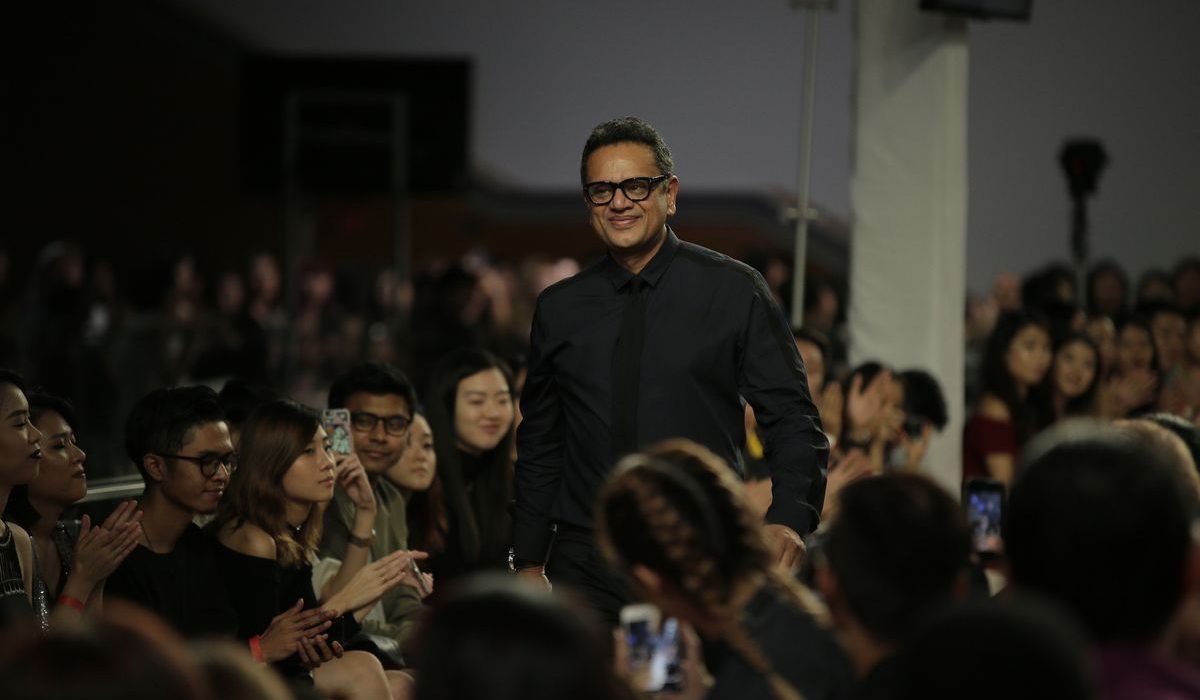
In Singapore to present his Spring/Summer 2017 collection at Singapore Fashion Week, Khan says without hesitation that the moment Michelle Obama stepped out in his strapless, embroidered gown to host their first State Dinner for India in 2009, he knew his life had changed. He was propelled to global fame in that singular moment.

Khan was hosted at the U.S. Embassy by HE Kirk Wagar during his trip – here are the photos.

Mr Naaem Khan, Ms Crystal Meredith Wagar, HE Kirk W.B. Wagar (U.S.A)

“I have always believed that if you are true to your dream and consistent in pursuing it, it will happen,” he says.

NaeemKhan03MPOs16jan2018

He grew up with a lifelong interest in fashion and honed his sartorial instincts by “osmosis”, thanks to his grandfather and father who both designed luxurious textiles and clothing for Indian royal families. At the age of 20, he moved to New York City to do an apprenticeship with legendary designer Roy Halston Frowick of the label Halston where he rubbed shoulders with Halston’s social circle, which included luminaries like the artist Andy Warhol, actress-singer Liza Minnelli and dancer Martha Graham.

His time with his guru Halston – who coincidentally shot to fame when he designed Jackie Kennedy’s pink pillbox hat which she wore to her husband’s presidential inauguration – laid the foundations for his own label.

He says: “My style is to use textures and luxurious fabrics in a form which is classic, yet relevant to the times. It works perfectly for powerful women because the garments send a very strong message – I am powerful, confident and fashionable. Look at me.”

NaeemKhan04MPOs16jan2018

The business of fashion is of course notoriously challenging, but Khan says he grew his to its current size by sticking to a simple principle. Besides his ready-to-wear business, he also launched Naeem Khan Bridal in 2013, and both lines are sold at over 100 retail outlets around the world.

“I don’t have investors and I’ve grown my business organically by watching the bottom line to make sure we are making money. It is not about having the largest business which is running at a loss,” he says. “Instead, my business philosophy is about having a good life, being profitable and enjoying what I do.”

One of his greatest rewards is having the privilege to develop relationships with movers and shakers of society, like the outgoing First Lady. “She gives full liberty to design for her. We have her form and we’ve create mannequins to drape on so it’s become a simpler process,” he says. “She likes elegant glamour and loves her arms, so you have to make sure you enhance that.”

Certainly, a designer couldn’t ask for a better muse. He adds: “She’s tall and has a great body for clothing so she is the perfect person to design for as she knows how to carry it off.

“She has said to me how much she loves my work. I love that she is so open with her compliments and has such respect for my art, which makes me want to do more for her.”

source: http://www.thepeakmagazine.com.sg / The Peak, SPH Magazines  / Home> Fashion & Watches / by Karen Tee / November 02nd, 2016