Category Archives: Arts, Culture & Entertainment

Awarding PIOs in recognition of their services

BRUNEI / LIBYA  / SAUDI ARABIA  :

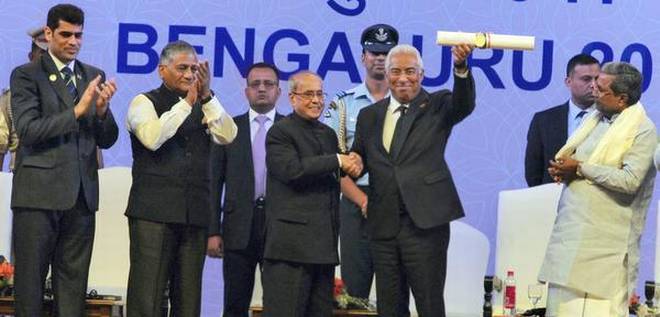
President Pranab Mukherjee honours Dr. Antonio Costa, Portugal Prime Minister, who received the Pravasi Bharatiya Samman, as Suriname Vice-President Michael Ashwin Adhin and Union Minister V.K. Singh look on, in Bengaluru on Monday. | Photo Credit: G R N SOMASHEKAR;G R N SOMASHEKAR -
President Pranab Mukherjee honours Dr. Antonio Costa, Portugal Prime Minister, who received the Pravasi Bharatiya Samman, as Suriname Vice-President Michael Ashwin Adhin and Union Minister V.K. Singh look on, in Bengaluru on Monday. | Photo Credit: G R N SOMASHEKAR;G R N SOMASHEKAR –

Winners of Pravasi Samman Awards include Portugal Prime Minister Dr. Antonio Costa

Her son was three years old when she realised that there was no school she could send him to. British and American schools were too expensive and she didn’t want to send him to a local school.

That prompted Zeenat Jafri to start the second Indian school in Saudi ArabiaInternational Indian School — in 1982 with her husband. She was among the 30 people feted for her achievement on Monday during the Pravasi Bharatiya Divas, when the Pravasi Samman Awards were given away by President Pranab Mukherjee.

The 64-year-old MBA graduate from Bhopal, who was given the award for her contribution to the field of education, said she started the school from her house, gradually scaling it up   to now educate 12,000 people.

Another person of Indian origin who was recognised with the award was Ariful Islam, coordinator and nodal point in the Embassy of India in Libya.

The electrical engineer relocated from India to Libya in 1980 following a pact between the two nations. He has seen his adopted country go through the worst of times, but continues to live there alone, though his family has moved back to Aligarh. “I have spent half my life there. We have successfully rescued many Indians,” he said.

The rescuer

The most recent episode he was involved was in the rescue of three abducted Indians from the IS in a dramatic operation in 2016 from the deep Libyan deserts.

Among the organisations that were awarded were the Singapore Indian Association in the category of community service.

The event saw double the number of awardees as it was being held after an interval of two years.

Among the other prominent winners of the award were Portugal Prime Minister Antonio Luis Santos da Costa, Labour Member of the European Parliament representing the West Midlands Neena Gill, British politician Priti Patel and Mauritius Minister of Finance and Economic Development Pravind Kumar Jugnauth.

Nisha Desai Biswal, Assistant Secretary of State for South and Central Asian Affairs in the United States Department of State, who was also among the 30 awardees, said persons of Indian origin, who were building bridges and connecting in an “increasingly divided world,” retained strong ties with India, she said.

source: http://www.thehindu.com / The Hindu / Home> News> National / by K.C. Deepika / Bengaluru – January 10th, 2017

Ayazuddin Patel only artist from Karnataka to participate in international art camp in Europe

KARNATAKA :

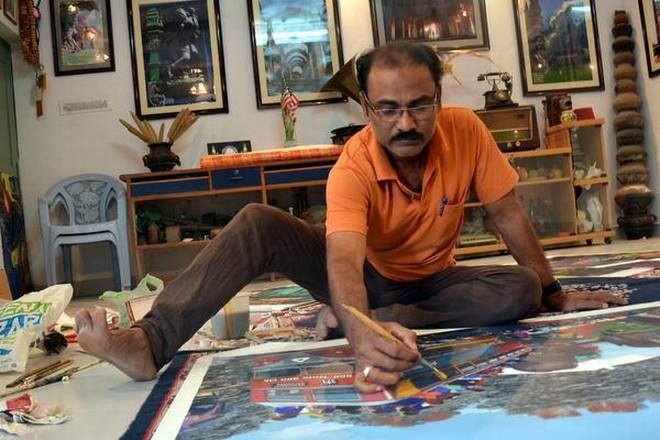
Lalit Kala Akademi Awardee Mohammad Ayazuddin Patel will be participating in the 5 th International Cultural-Artistic event from July 8. | Photo Credit: ARUN KULKARNI

National Lalit Kala Akademi Awardee and noted artist Mohammed Ayazuddin Patel will be participating in the 5th International Cultural-Artistic Event, a fortnight exhibition of painting and workshop-cum-art camp in Greece-Kosova-Balkan in Europe from July 8.

Mr. Patel is the only artist from Karnataka to attend the event which attracted 30 artists across the world. The event, which is jointly organised by Municipality of Suva-Reka and Department of Culture, Kosovo and Greece, provides a common platform for artists to exhibit their talent and get international exposure.

Speaking to The Hindu, Mr. Patel said that five of his digital art works were submitted online for the selection to the event. The 46-year-old artist has bagged 20 prestigious awards including 55 th National Lalit Kala Akademi Award, National Award for Photography and National Award for Digital Painting recognised by the Ministry of Culture.

Mr. Patel has also participated in international group exhibition in six countries and displayed his digital art works painting and photography during exhibitions at 34 different places and organised 20 solo exhibitions across the country.

Mr. Patel is known for digital painting and mixed media and his works adorn several walls in important State buildings.

As per the event schedule, the selected artists would be visiting famous museums, art galleries, historical monuments and old places in nine European cities including Istanbul in Turkey, Thessaloniki in Greece, Suva Reka in Kosovo, Budva in Montenegro, Mostar in Bosnia, Sarajevo in Herzegovina, Dubrovnik in southern Croatia, Tirana in Albania, Ohrid in Macedonia and Kavala in Greece during the 15 days camp.

source: http://www.thehindu.com / The Hindu / Home> News> States> Karnataka / by  Correspondent / Kalaburagi – June 27th, 2017

Mandi and the Arabian connection

Hyderabad, TELANGANA :

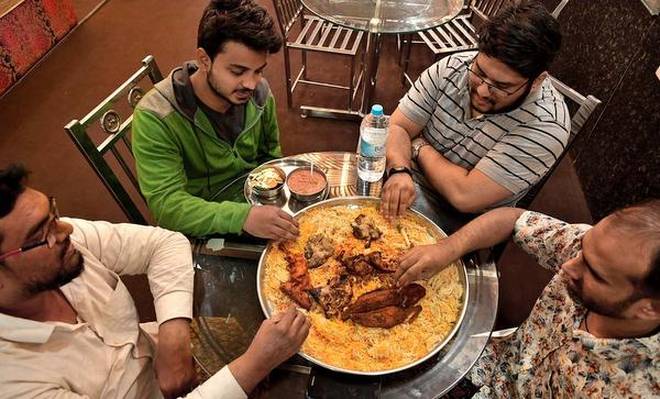
A must-try: Foodies having a Mandi, a combination of large chunks of mutton and rice garnished with dry fruits, at Mataram Al Arabi at Errakunta on Saturday.

Restaurateurs in Barkas and Yerrakunta suburbs arrived here from Hadhramaut in Yemen over two centuries ago

A 20-minute drive south of Charminar is all it takes to wonder whether one has teleported oneself to a west Asian country. For, once in Barkas and Yerrakunta suburbs, one is greeted by exotic signage in Arabic on restaurants like Mataam al Arabi, Al Saud Bait al Mandi and Al Khaleej serving the Arabian delicacy Mandi. And the business is booming.

The connection is clear. The two neighbourhoods are home to those who arrived here from Hadhramaut in Yemen over two centuries ago. Several of these restaurateurs continue to bear Arabian tribal affiliations. While one eatery is owned by those from the Bin Ziyad tribe, another belongs to the Nahdis. There are dozens of tribes as are the restaurants run by them.

Abdul Raheem Yamani, proprietor of Real Arabian Dhaba, pegs the number of Mandi restaurants along the six-km stretch that connects Barkas to Shaheen Nagar along the Srisailam highway at approximately 35. “This is the reason why the highway has a new moniker – Mandi Road,” he says.

The restaurateurs say that the spurt in the number of Mandi restaurants began in 2011 when the Arab community realised that it was a profitable business. Restaurants started mushrooming not just along the margins of the main thoroughfares, but in the by-lanes of Barkas.

With diners converging from across the city, observers say that while traditional Hyderabadi biryani continues to be famous, Mandi is giving it a run for money.

One of the first Mandi restaurants in the area is Mataam al Arabi. Its proprietor Abdullah Bashaadi says the dish is a combination of large chunks of mutton and rice garnished with dry fruits.

The 38 year old recounts that he began the business in 2010 soon after returning from the Haj. “We were served Mandi during the pilgrimage. All ate from the same large thaala sitting on the floor. That is when I struck upon the idea to start a Mandi restaurant,” Mr. Bashaadi says.

The traditional Arabian method of dining—sitting on the floor and eating from the same large dish—has been retained in all the Mandi restaurants.

Like most who trace their ancestry to the Arabian Peninsula, Mr. Bashaadi’s great grandfather Ahmad bin Awad Bashaadi arrived in the city from Hadhramut, Yemen. In fact, noted scholar Omar Khalidi writes in Muslims in the Deccan: A Historical Survey that Hadramis were a part of Afwaj-e-Beqaidah(Irregular Army) of Asaf Jahs. Their numbers swelled so much so that the Diwan, Salar Jung, constituted a separate court, the Qazaat-e-Uroob, for them. Further, two Hadramis served as Commissioners of Police of Hyderabad State.

Taha Quadri, a professional caterer specialising in Arabian cuisine, explains the Mandi variants. The rule of thumb is three parts of mutton to one part of rice. The rice is cooked in the same water that is used to boil the meat. “Mutton can be replaced with fish, chicken and even quail,” he says.

But while diners converge at the Old City from all across Hyderabad, the dish is a hit with the IT crowd of Hitec City. The uptown area of Jubilee Hills has one.

“There was a great demand for the dish in this part of the city which is why we started the restaurant around nine months ago. A majority of our customers are those working in Hitec City,” says Syed Waaris Ali, proprietor of Mandi @ 36.

source: http://www.thehindu.com / The Hindu / Home> News> Cities> Hyderabad / by Syed Mohammed  / Hyderabad – January 13th, 2018

Driven by devotion, seven embark on journey on foot to Karbala

Hyderabad, TELANGANA :

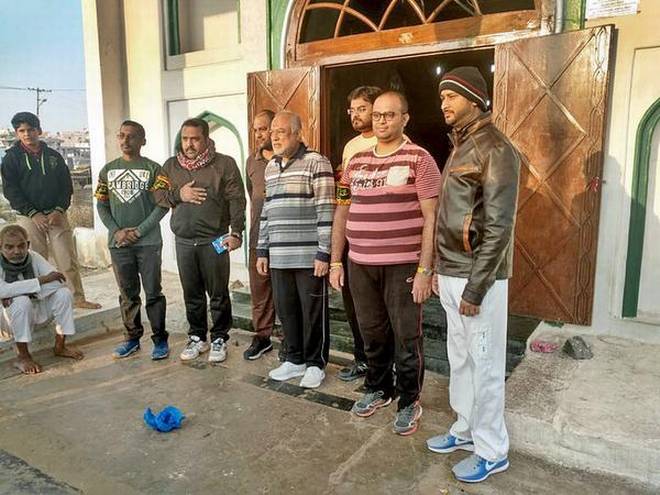
The group of seven led by Syed Abdul Ali beginning their journey from Daira Mir Momin in the city on Saturday.

To take at least six months to reach the shrine of Hazrat Imam Hussain

Faith and devotion make people do remarkable feats. It can make them test their limits and transcend spatial and political boundaries. Even if they have to walk hundreds of miles across three countries in their quest for spirituality. Seven men from the city have embarked on this very journey to reach the shrine of Hazrat Imam Hussain in Karbala, Iraq.

A revered and loved figure for both the Shi’ites and Sunnis, Hazrat Imam Hussain was the grandson of Prophet Muhammad. Each year, dozens of Shi’ites embark on what they call ziyarat or pilgrimage, from the city to Karbala.

The group of seven led by Syed Abdul Ali, a 66 year old from Purani Haveli in the Old City, left for New Delhi from the Daira Mir Momin early on Saturday morning. The others making the journey on foot are Syed Sharif-ul-Hasan Razvi (28), Mir Asim Ali Moosvi (33), Syed Ali Razvi (31), Syed Saqib Zia Naqvi (33), Ali Asghar (31) and Syed Ali Ahmed (37).

“The journey to Karbala will take at least six months. Our intention is to walk between 35 and 40 km every day along the National Highway 44. In other words, eight hours of walk every day. That way, we will reach New Delhi by the end of February or the first week of March,” the leader and sexagenarian said.

Out of the seven, two have made the pilgrimage on foot twice.

To avoid crossing into Pakistan on foot, they will take a flight from the national capital to Tehran in Iran. From there, they intend to go to Yazd and then cross into Iraq where they will proceed to Karbala.

A vehicle carrying supplies such as food and bedding will trudge alongside till New Delhi.

The six wayfarers began to prepare for the journey more than two months ago. “We practised walking every day without fail. It’s not possible to go without preparing yourself for something like that,” they said.

Explaining what the journey means to him, Mr. Ali Asghar, a businessman, said, “I got a job in Dubai, but I gave it up since I wanted to go to Karbala. Going there on foot is a great act of piety. What more could I want?”

source: http://www.thehindu.com / The Hindu / Home> News> Cities> Hyderabad / by Syed Mohammed / Hyderabad – January 06th, 2018

Umaru Pulavar memorial inaugurated

Ettiyapuram (Tuticorin District),  TAMIL NADU :

His 1,000 literary works will be added to library

Tuticorin :

Speaker R. Avudiappan inaugurated the memorial constructed for Umaru Pulavar, great Islamic poet, at Ettayapuram near here on Monday.

Official sources said that it was built by the Public Works Department on an outlay of Rs.22.5 lakh.

The monument would be maintained by the Department of Information and Public Relations.

The memorial, a two-storied edifice, has a tomb and prayer hall in the ground floor with a library on the top floor.

A collection of 1,000 literary works of Umaru Pulavar would be added into the library in a phased manner. The works would include poems like ‘Seerapuranam’, ‘Muthu Mozhil Malai’ and ‘Sethakathi wedding poems’, among others.

The access to the library would be free.

Sources said that the memorial was a tribute to the poet, whose ancestors had chosen Ettayapuram in Tuticorin district as their ‘home away from home’ since they descended from Arabia.

The forefathers of the poet came here to sell perfumes and settled in Nagalapuram, before moving to Ettayapuram where the poet was born in 1642.

Umaru Pulavar’s literary talents flourished under Kadikai Muthu Pulavar, court poet of the Ettayapuram Zamin. At the age of 16, Umaru Pulavar stole the national limelight by winning a literary debate with Vallai Varundhi, a renowned poet from North India. Umaru Pulavar was then made the court poet of the Ettayapuram Zamin.

“Seerapuranam,’ considered to be one of the best works by him, depicts the history related to Prophet Mohammed Nabi, and it contains 5,027 poems in three ‘Kandams’ (parts), which are Vilathathu Kandam, Noobuvathu Kandam and Hijurathu Kandam.

“Each of the ‘Kandams’ narrates various stages of the life of Nabi,” sources said.

Ministers Geetha Jeevan, Parithi Ellamvazhuthi and T.P.M. Moideen Khan, Collector R. Palaniyandi, District Public Relations Officer S.R. Sarathy and senior revenue officials were present.

source: http://www.thehindu.com / The Hindu / Home> National> Tamil Nadu / by Staff Reporter / October 30th, 2007

Of Muslim scholars and a glorious literary tradition

TAMIL NADU :

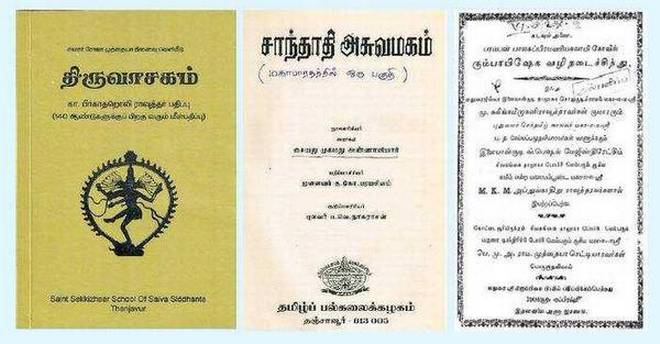
TamilBookCoversMPOs15jan2018

Umarupulavar, Kunangudi Masthan Sahib, Seiku Thampi Pavalar are popular names in the field of classical Tamil literature

Uraiyur Pitchai Ibrahim Rauther was an intriguing combination of a dry fish merchant and Tamil scholar.

His expertise is illustrated by the fact that towards the end of the 19th century, the management of Bishop Heber College in Tiruchi appointed him an honorary professor and among his students was the legendary Navalar Mu. Venkatasamy Naatar.

Writer and cultural historian Po. Velsamy, who posted some details about Ibrahim Rauther on Facebook, said he was an authority on the Tholkappiyam and great scholars such as Venkatasamy Naatar and Ra. Ragava Iyengar learned from him because till 1930, there was no one with expertise on the Porulathikaram of Tholkappiyam.

“Since the smell of dry fish on Rauther was overpowering, his students had to hold their noses even as they received lessons on the Tholkappiyam. But we have not been able get more details about Rauther, who died in 1908,” said Mr. Velsamy, who added that Rauther was a student Uraiyur Muthuveera Ubathiyayar and author of the Muthuveeriyam, a work based on the Tholkappiyam.

The Muslim community has had a glorious association with the Tamil language since the 12th century. Umarupulavar, the author of Seerapuranam, and Kunangudi Masthan Sahib are among the names to reckon with in the field of classical Tamil literature.

Sadhavathani Seiku Thampi Pavalar of Edalakudi in Kanniyakumari district is another well-known name in the Tamil literary world in modern times.

It was K. Peerkaderoli Rauther who published the Thiruvachagam in 1868. “The Sivapuranam in the Thiruvachagam is normally described as an agaval, but Rauther cited the Tholkappiyam to prove that it was a kalivenba,” said Mr. Velsamy.

Muslim scholars also worked extensively on Hindu epics and Athirampattinam Syed Mohamed Annaviyar rendered into Tamil the 14th chapter of the Mahabharata as Santhathi Asuvamagam.

Republished by the Thanjavur Tamil University, the book, comprising 4,104 verses, narrates the story of the Aswametha yagna performed by Dharma as per the advice of Vyasa after the war. “Santham means peace and asuvam refers to a horse. Magam means yagna,” explained Mr. Velsamy.

18 puranas

Annaviyar also rendered as ammanai (a type of verse) all the 18 puranas of the Hindus.

“Annaviyar and his descendants were scholars and even ran a publishing house. They wrote and published the Mahabharatha ammanai, Subramaniar Prasanna Pathigam, Aswametha Yagam, Ali Nama and Nooru Nama. Islamic scholars were experts in the sindhus, a genre in Tamil, and as many as 63 sindhus were published in the early 20th century,” said cultural historian Kombai S. Anwar.

When M.V. Ramanujachariyar, a colleague of U. Ve. Saminatha Iyer at the Kumbakonam Government Arts College, translated Vyasa’s Mahabharatha into Tamil, financial assistance came from many quarters, including two Muslims in Aduthurai, one of whom was a goat skin merchant. These contributions have been mentioned by Ramanujachariyar in the preface.

An interesting sindhu penned by M.K.M. Abdukathiru Rauther was performed when a kumbabhisekam was conducted at the Thiruvanmiyur Pamban Subramaniaswamy Temple. The title of the work is Pamban Balasubramaniaswamy Kovil Kumbabhiseka Vazhinadi Sindhu.

source: http://www.thehindu.com / The Hindu / Home> News> States> Tamil Nadu / by B. Kolappan / Chennai – January 01st, 2018

Muslim men take care of the synagogues

Kolkata, WEST BENGAL :

62194730

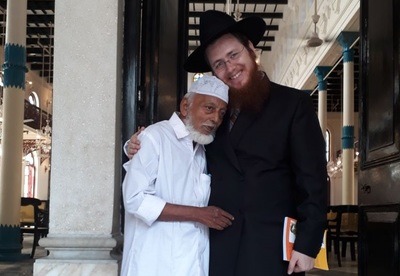
Mohammed Khaleel Khan, an old Muslim man clad in a pristine white skull cap, shirt and lungi, has been working as the caretaker of Beth El Synagogue for 58 years.

His father, Muharram Khan, who came from Odisha, also served as the caretaker and now, Khaleel’s sons, Shiraz and Anwar, work in the same profession. “We are serving in a religious place and we are very happy about it. While I work in Beth El, my brother, Anwar, is in Maghen David,” said Shiraz.

Besides these three-generation-long caretakers, there is Sheikh Wasim, another caretaker, whose father, Sheikh Naseer, also served at the Beth El Synagogue for 60 years.

“Some people questioned why we should be working in a synagogue. My answer is simple. I am working in a religious place. Name him Allah or Vishnu — there is no discrimination in God’s land. The work I do here is far better than working in a pub where they serve alcohol,” said Wasim.

Talking about the Muslim caretakers, Ian Zachariah asked, “What’s so surprising? We’ve never had any problems. They don’t have any problems either. This is how it should be everywhere.”

source: http://www.timesofindia.indiatimes.com / The  Times of India / News> City News> Kolkata News / by Shamayita Chakraborty / December 22nd, 2017

Umrao Jaan gets a tomb in Varanasi

Faizabad / Varanasi , UTTAR PRADESH :

Rekha as Umrao Jaan
Rekha as Umrao Jaan

Lucknow:

Umrao Jaan, the courtesan and poetess immortalised by Rekha in a 1981 classic, has got an address 80 years after her death.

A local club of sportspersons and social activists who had found Umrao Jaan’s nondescript grave in Varanasi in 2004 have built a tomb and decorated it for public viewing.

The tomb at the Fatman graveyard in Sigra was thrown open for public viewing on Tuesday (December 26, believed to be her death anniversary) and over 2,000 people have paid tribute to her since then.

Although there is no authentic research available on her, the general belief is that Umrao Jaan, on whose turbulent life at least a dozen films have been made in India and Pakistan and who inspired Mirza Hadi Ruswa’s novel Umrao Jaan Ada, left Awadh at the turn of the 19th century and lived in many places since, slipping into oblivion.

Shakil Ahmad, the president of the Derbyshire Club, a group of sportspersons and While trying to gather more information about her, “I was working on the grave of (shehnai exponent) Ustad Bismillah Khan one-and-a-half years ago when someone told me Umrao Jaan’s resting place was near his.”Some local people and I discussed and decided to renovate her grave. . The grave has been kept open at the centre in keeping with Islamic tradition, which says a grave shouldn’t be completely covered

None of the films made on Umrao Jaan, including the 2006 movie in which Aishwarya Rai Bachchan played the courtesan, mentions that she spent her final years in Varanasi.

source:  http://www.telegraphindia.com / The Telegraph, Calcutta, India / Home> India / by  Piyush Shrivastava / December 28th, 2017

The abiding fame of Faizabad

Faizabad, UTTTAR  PRADESH :

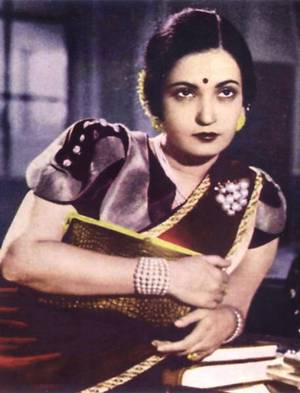
EPITOMISING SYNCRETIC CULTURE Begum Akhtar

“Shaharnama Faizabad” offers detailed information about the social and cultural life of the historic town

Although Faizabad had acquired prominence during the reign of the early Nawabs of Awadh, it lost some of its lustre when, soon after taking over the reins of the kingdom in 1775, Nawab Asif-ud-Daula shifted the capital from Faizabad to Lucknow.

Yet, it continued to enjoy a lot of influence until the last Nawab Wajid Ali Shah was deposed and banished to Matia Burz near Calcutta (now Kolkata). It was so because of its famed Begums who wielded considerable political and financial clout. However, in the last century, a Begum of a different kind brought the town national recognition when, at the end of every gramophone recording, she would proudly announce: “Mera naam Akhtari Bai Faizabad”. For most of her performing career, Begum Akhtar was known as Akhtari Bai Faizabadi and she truly represented the refined composite culture of Faizabad that abuts the Hindu holy town of Ayodhya.

Last year, Vani Prakashan had brought out an excellent book on Lucknow that offered scholarly research along with useful touristic information. Titled ‘The Other Lucknow: An Ethnographic Portrait of a City of Undying Memories and Nostalgia’, it was edited by Nadeem Hasnain and was based on a research project sponsored and funded by the Ayodhya Shodh Sansthan (Ayodhya Research Institute), an autonomous organisation of the Uttar Pradesh government’s Department of Culture.
FaizabadBookMPOs13jan2018

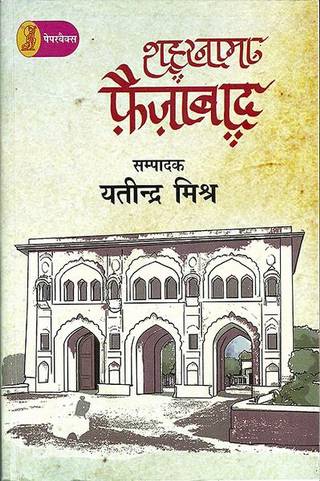
It’s a matter of rejoicing that this year, Vani Prakashan has published a companion volume on Faizabad with the help of the same Ayodhya Shodh Sansthan. The fact that this volume is in Hindi and it offers very detailed information about the historic town, its social and cultural life, and places of religious and cultural significance would warm the cockles of everybody’s heart. Hindi writer Yatindra Mishra, who recently won the President’s Golden Lotus award for his biography of Lata Mangeshkar, has edited this 640-page tome titled “Shaharnama Faizabad” (A Chronicle of Faizabad). A scion of the erstwhile ruling family of Ayodhya, Mishra’s love for Faizabad is evident in the care and fastidiousness with which he has performed this daunting task with the help of many experts including historians Salim Kidwai, Madhu Trivedi and Yogesh Pravin, Islamic culture scholar Mirza Shahab Shah and Kosala Museum’s Deshraj Upadhyaya, to name only a few. Mishra has not only edited the book but has also contributed a large number of detailed comments on the Faizabad region’s history and culture, making use of painstakingly done research into archival material and other sources.

The book is divided into five sections and opens with the history of Faizabad and the way its architecture and culture took shape under the Nawabs. After Nawab Saadat Khan ‘Burhan-ul-Mulk’ was awarded the Suba of Awadh by the Mughal Emperor, he built a temporary fort called Qila Mubarak near Lakshman Ghat in Ayodhya. After some time, he built a cantonment at a distance of five kms from Qila Mubarak and it was known as Bangla. During the reign of Nawab Mansur Ali Khan ‘Safdarjung’, Bangla acquired the name of Faizabad. This section also tells us a very interesting fact about the royal emblem of the Nawabs as it depicted fish (considered to be auspicious) along with the bow and arrow of Ram, the presiding deity of the adjoining Ayodhya. Detailed information about the arts, architecture, music, jewellery and ornaments, and prominent Nawabs and Begums and their Hindu and Muslim courtiers has been provided in this opening section.

The second section is one of the most interesting and valuable parts of this book as it deals with the events and heroes of the great revolt of 1857, often described as the First War of Indian independence.

Ripple effect

As is well known, the deposition of Nawab Wajid Ali Shah had also played an important role in spreading anger and anguish among the sepoys who hailed from the Awadh region in considerably large numbers. Mangal Pandey belonged to village Dugvan-Rahimpur of Tehsil Sadar in Faizabad district. We also come to know about Maulavi Ahmad Ullah Shah alias Danka Shah who, as early as in February 1857, had started condemning foreign rule in his public speeches. He was imprisoned and sentenced to death. Faizabad remained independent till January 6, 1858 and was defeated by the Nepalese army that attacked its forces and subdued them.

While the third section gives detailed descriptions of important religious places belonging to all the religions present in the region, the fourth section offers invaluable historical information about the writers, poets, courtesans, high-brow as well as folk musicians, folk art, village fairs as well as local festivals, bazaars and traditional haats, instruments and their makers, journalists, newspapers, magazines and printing presses of the region. It’s a fairly long list and offers a glimpse into the cultural richness of Faizabad.

The fifth and final section deals with prominent social workers, sportspersons, educational institutions and public libraries, thus completing a full circle. It’s not possible to discuss such a voluminous book in any detail here. Suffice it to say that those who are interested in knowing the history and culture of Awadh cannot afford to ignore this work.

source: http://www.thehindu.com / The Hindu / Home> Books / by Kuldeep Kumar / June 16th, 2017
200th Christmas for Faizabad church

Arcot, MADRAS (now TAMIL NADU ) /  Faizabad, UTTAR PRADESH :

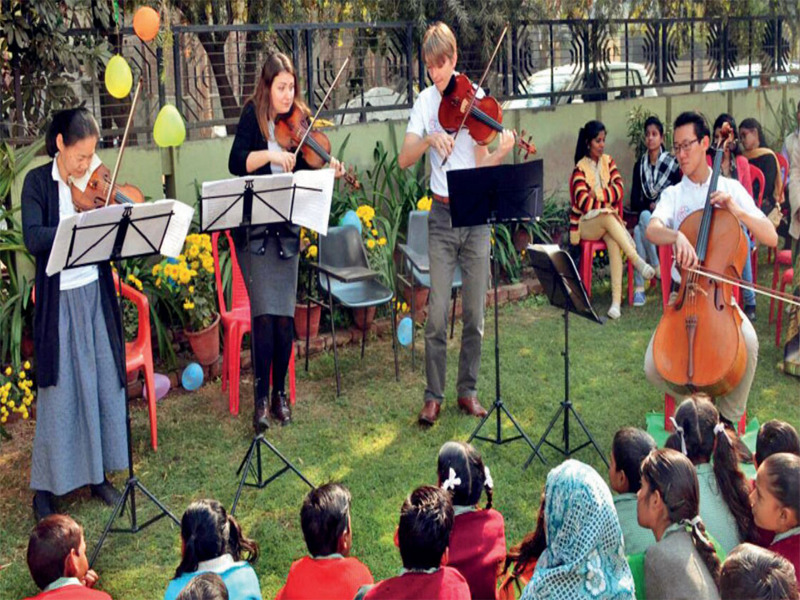
A German music band celebrates Christmas with children

Faizabad

Built 200 years ago, Wesleyan Chapel, a fine specimen of British Architecture, for the British soldiers posted in Faizabad Cantonment, Church of North India is all decked up to celebrate Christmas.

Wesleyan Chapel, built in 1816, merged with Diocese of Lucknow in 1970 and then came to be known as Church of North India.

Talking to TOI, Rev Kaushalendra Solomon, pastor of the church said that special prayer service would be held at midnight on Christmas and then in the morning. Different religious activities will continue in the church till December 31and a special watch night service would be held on New Year eve.

The church committee led by secretary Chitij Charles has ensured special decoration with flowers and lighting as the Church has completed 200 years. Rev Solomon said that they get special cakes baked for Christmas celebrations at a local bakery.

“Ghulam Mohammad, a local scholar, said that Maulvi Ahmad Ullah Shah, who was leading the 1857 mutiny against Britishers from Faizabad, had instructed his soldiers not to damage the Wesleyan Chapel because it was a place of worship.”

source: http://www.timesofindia.indiatimes.com / The Times of India / Home> Neww> City News> Lucknow News / by Arshad Afzal Khan / TNN / December 25th, 2017