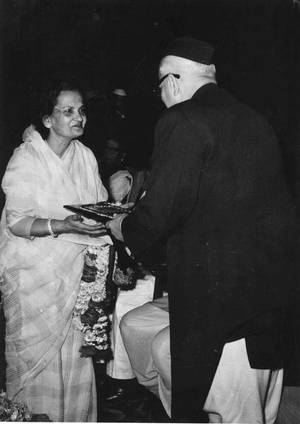
Tribute to the voice: Vice-President G.S. Pathak presenting the Sangeet Natak Akademi Award for Hindustani vocal music to Begum Akhtar
It’s been an annual ritual for over 25 years. The first and last week of October have always had legendary ghazal and thumri singer Begum Akhtar spinning on my system. The doyenne was born on October 7, 1914, in Faizabad, Uttar Pradesh and passed away on October 30, 1974, in Ahmedabad. So a few days before the dates, I have this Begum Aapa trip.
If there’s a voice that defined pathos, dard, deepness, gehraai, technique, taiyyari, she was definitely somewhere on top, globally. Check out her rendition of Shakeel Badayuni’s ‘Mere Humnafas Mere Humnava’ and the picture is absolutely clear.
Begum Akhtar fans are totally devoted to her singing, and I am no exception. Strangely enough, I hated her the first time I heard her. She didn’t let me sleep in peace. This was back in Jaipur, where I was a young rookie journalist. I was more into rock bands like Jethro Tull, Pink Floyd and Moody Blues, but my senior colleague and room-mate Abhay Kant hated my taste and insisted on playing Begum Akhtar late at night. It was torture, initially. But in a few weeks, I just got hooked on to Mir Taqi Mir’s ‘Ulti Ho Gayi Sab Tadbeerein’ and Momin Khan Momin’s ‘Woh Jo Hum Mein Tum Mein Qaraar Tha’. Honestly, I discovered the names of these poets much later.
Equations changed. Tull and Floyd were put on hold and I would listen to Akhtar even after Kant slept. By the time he left the following year for another job, I think he was sick of my listening to her. Yet, he took all his cassettes with him, leaving me bereft. For the next five years, her songs would only appear as earworms in the recesses of my mind. One day, at Rhythm House, Mumbai, I picked up a double compilation. The surprise was that many compositions were credited to the great Khayyam.
Some old favourites like Badayuni’s ‘Ae Mohabbat Tere Anjaam Pe Rona Aaya’ and Mirza Ghalib’s ‘Dil Hi Toh Hai Na Sang-o-Khisht’. But the real discovery was her rendition of Sudarshan Faakir on ‘Kuch Toh Duniya Ki Inaayaat Ne Dil Tod Diya’, ‘Ishq Mein Ghairat-e-Jazbaat Ne Rone Na Diya’ and ‘Apunon Ke Sitam Hamse Bataaye Nahin Jaate’.
And there was Faiz Ahmed Faiz on ‘Aaye Kucch Abr Kuchh Sharaab Aaye’ and ‘Donon Jahaan Teri Mohabbat Mein Haarke’. Besides ghazals, there was light classical repertoire like ‘Deewana Banaana Hai Toh’ and ‘Hamari Atariya. What timbre, texture, throw, tonality, totality.
Akhtar has always been special. She physically left us 43 years ago, but her music still rings in our ears and resounds in our hearts. Interestingly, there is another musician I get back to this month. The great music director S.D. Burman was born on Oct 1, 1906, and passed away on October 31, 1975. Next week’s column is dedicated to him.
PS: Thank you Abhay Kant for the Begum Akhtar introduction. Sorry about blasting the rock music.
source: http://www.thehindu.com / The Hindu / Home> Entertainment> Music / by Narendra Kusnur / October 25th, 2017
Short-story writer, novelist and playwright Bolwar Mahammad Kunhi has been announced the winner of this year’s ‘Literary Achievement Award in Kannada’ presented by Atta Galatta and Bangalore Literature Festival.
The awardees have been announced ahead of the sixth edition of the literature festival on October 28 and 29.
This year, in the fiction category, Anees Salim has won the prize for his book ‘The SmallTown Sea’. In the non-fiction category, Ruskin Bond’s autobiography ‘Lone Fox Dancing’ has been selected for the prize. In the newly introduced category of ‘Popular Choice’, the prize has gone to Twinkle Khanna’s book ‘The Legend of Lakshmi Prasad’.
The prizes will be given away at an award ceremony during the festival which will be held at hotel Lalit Ashok on Kumara Krupa Road.
source: http://www.deccanherald.com / Deccan Herald / Home> City / DH News Service / Bengaluru – October 22nd, 2017
The master’s style became so well established that it has come to stay.
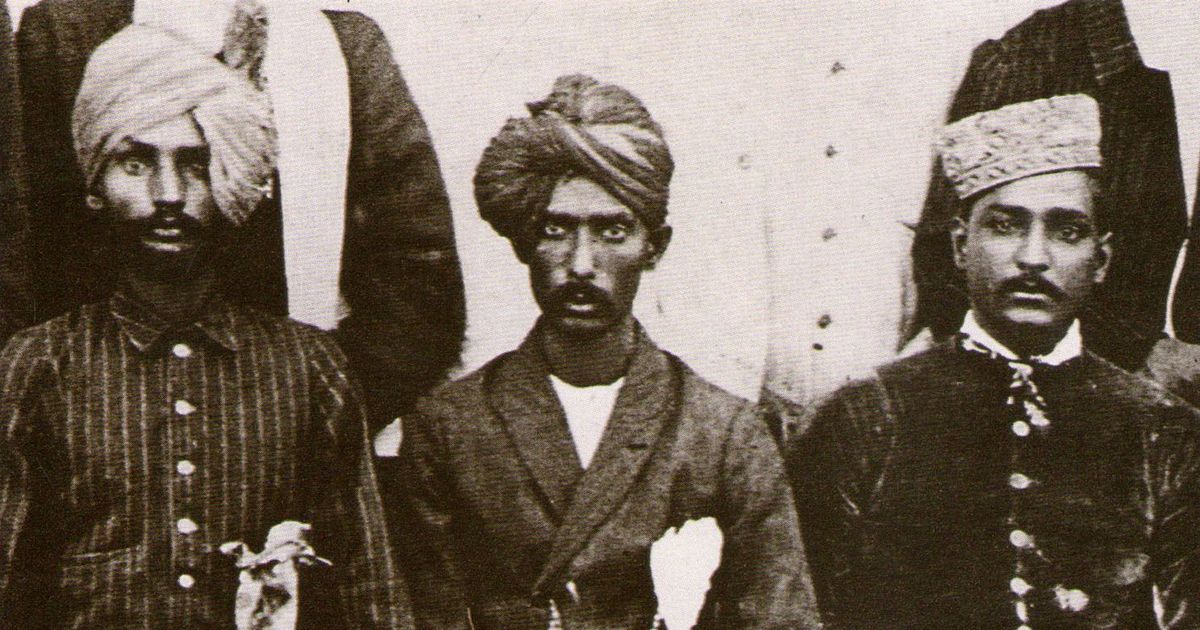
Abdul Karim Khan (centre)
Abdul Karim Khan was born on November 11, 1872, at Kirana, a village near Panipat. His father, Kale Khan, was also a musician and Abdul Karim and his two other brothers, Abdul-Majid and Abdulhug, imbibed their earliest lessons in music from him. It is said that Abdul Karim and one of his brothers left Kirana when they were still in their teens and came to Baroda where Abdul Karim soon earned a name for himself as a young poet and talented musician.
He then left Baroda and travelled to Poona and Bombay. He imparted his knowledge of music to a few earnest students and soon established himself as an outstanding musician of the Kirana gharana. He finally left Bombay and settled in Miraj, which was then a princely state. Among the well-known musicians of his time, he was the first who studied the complex problems of shruti. He was the principal and perhaps the only demonstrator of the shruti scale of the chromatic scale of Hindustani music. He demonstrated that the subdivision of the seven notes of the usual gamut into 22 parts was a fact to be reckoned with and not just a fantasy in the minds of ancient musicologists.
Abdul Karim was a man of simple and frugal habits, non-ostentatious and kindhearted. He did not bully or ill-treat his pupils and those who lived with him enjoyed parental care and attention. At Miraj, he developed an interest in the tanpura and brought his own musical knowledge to bear in the construction. He was on his way to Pondicherry when he experienced a severe pain in the chest at Chingalpeth. On October 27, 1937, he died peacefully on the platform at Singapuram Koilam, reciting Kalma in the raga Darbari.
We find it a little difficult to understand how it is that geophysical regionalism has become synonymous with the history of gharanas rather than the names of those maestros who have devoted their lives propagating and teaching the mode of music perfected by them in their own way and after their own heart. Is it the typical oriental philosophy of the impermanence of man that is responsible for the transference of credit and merit from man to place?
Geography of music
Tansen’s disciples made his music the music of the Gwalior gharana; Alladiya Khan’s complex music came to be linked with Jaipur or Atrauli; Fayyaz Khan and Vilayat Khan belonged to the Agra gharana; Bade Ghulam Ali was associated with the Patiala gharana; and Abdul Karim’s cultivated pattern of music came to be known as the Kirana gharana. Our inquiry into this aspect may not lead us on to any definite results. But it is important to explore how a gharana is born.
Let us consider the Kirana gharana and its distinguishing points. First, not much is known about Abdul Karim’s teacher, his father, Kale Khan. Abdul Wahid Khan, another exponent of the Kirana gharana, learnt his music from his father Hyder Khan. Not much is known about him either. Bande Ali Khan, the been maestro, is said to have belonged to this gharana and except for his celestial music and the romance which culminated in his marriage to his disciple, Chunna, there are few mentions of the Kirana gayaki. Most accounts of musicians, both living and dead, are anecdotal. They do not give us even a glimmer of the manner in which these great masters imbibed their music, the methods, the routine they followed and the influences which worked on them. It is not possible to convey accurately the idea of a gharana through words because our musical aesthetic or critical vocabulary have yet to arrive at a stage of absolute precision. It is still in a state of evolution. A listener feels the stamp of a gharana and there it rests; the musician, guided by his fancy and immersed in his own interpretation, has already left familiar ground and is in his own world where the gharana is as far removed from him as an airman from terra firma.
A common observation about the Kirana school is that the musician develops his song or cheeja merely on the strength of the alapi or elongated notes, so dovetailed that in his exposition of the melody, his only aim is to fix and cajole or caress a note, the only limitation being that of tala (the time measure), which beckons him to the point of return. The sweetness of melody is primarily due to the tonal quality, which imbibes a gradual, subtle use of semi-tones in the main note, whose placement in the scheme of the melodic weave is the main objective. For him the cheeja are only a help in articulation.
The Kirana musician seems to have all the time in the world once he has started and closed his eyes to mundane things like the audience. He weaves his net of alapi around a note and ascends the melodic structure as delicately as a gossamer spread over a leaf. He is in love with his swara he has captured that very moment. He plays with it, is engrossed in its nodal and sub-nodal musicality. This has provoked derisive and wholly unjustified remarks from listeners. They say if one Kirana gharana musician takes half an hour to reach gandhar, another musician of the same gharana will take one hour to do so.
The form matters
Some musicologists are of the opinion that this gayaki lacks form. The existence of so many gharanas is proof that what is termed form is an elastic, accommodative arrangement and not a principle of scientific rigidity. In our music, the artiste sets out and sings a cheeja perhaps once; he enunciates it properly and then begins to establish the melody in a multi-pronged manner. The chosen melody is set to a particular tala, and his beginning in slow tempo necessitates a slow and leisurely progress. Each school of music has decided over a long period of deliberation and practice its own mode of such measured progress. If we compare two music lovers’ assessments of a gharana, both of them may agree on the overall effect of the music but often disagree on individual movements or methods of elaboration. In our music there is really nothing inherent which dictates to us that only one arrangement is possible. Witness, for example, the different ways of enunciating the world kaku in Sanskrit musical treatises. Witness, also, the musician’s improvisations in changing the stress for the sama. One can pile up a whole list of such individual gimmicks employed by a musician.
In our music, the basic material is the melody or abstract series of sounds related in an artificial manner. These sounds are subject to some arrangements: for example, five-note ragas, six-note ragas and so on. It is easy to understand that once this arrangement is stretched over a composition, that is, on the musical theme, the musician is permitted a great amount of freedom in his handling of it. When we think of form in our music, we have to think of the sound content and not of a rigid structure superimposed on a cheeja and its movement. Hindustani music, is not written and, therefore, the duration of a performance differs from musician to musician. If a musician compresses all his art in a short period of time and another stretches his recital over a longer span, we do not consider it amiss. The total impression is what we finally have in mind.
When a Kirana musician creates an agreeable atmosphere of a melody by a succession of notes woven carefully and gradually, and when he expounds the cheeja with finesse and keeps you rooted to your seat, you cannot merely dismiss his art, and his effort as charming yet formless. We will have to grant then that the Kirana musician has evolved his own form and this is no mean achievement.
Focus on swara
A distinctive feature of this school of music can be briefly summarised thus: a Kirana musician places greater stress on the presentation of melody by employing alap or lengthened flights of swara continuation, running through the full time-measure. He does not play within the inherent rhythm or laya in the manner of a musician of the Agra gharana. In fact, his obsession with the swara overshadows every other facet of the presentation of music. He does not unfold the melody through playful hide-and-seek either with the time-measure or with intricate and complex variations of the rhythmic pace. His main concentration is on the note or swara, and with this as his base, he creates an atmosphere of deep reverence. A listener who concentrates on the performance notices that the Kirana musician does not deal with scattered or separate musical ideas, individual movements within the time-circle but builds up his melody, note by note, like a weaver.
Another distinctive feature of the Kirana musician is his voice culture. His gestures seem to indicate that he is really at great pains to produce a sound, and that he has some difficulty in sustaining it; but actually the artiste is not greatly constricted in his articulation. The Kirana musician’s sense of control of the subtle inflexions in voice production is remarkable and he has had to strive hard to attain it. He seeks to achieve the desired tunefulness. But his mannerisms appear somewhat odd; even so, they are natural to him. In his taans, there is more facial or jaw-bone control. The Kirana musician elaborates the sargam or notation of phrases deftly and in an ingratiating manner. In fact, this has become one of the notable and accepted ingredients of this gharana. His vocal line has a wide range – wider than that of most of the musicians of other schools of music.
One significant aspect of the Kirana musician is his presentation of the thumri in his own cultivated way. The Kirana musician’s voice culture is suited to singing the thumri because there is equal stress on both the composition and its meaningful presentation. The Kirana musician’s delineation of a thumri is again swara-dominated and tends towards a khayal pattern.
A genius arrives
Abdul Karim evolved and perfected the style entirely on the basis of his own genius. There is a gramophone disc of Abdul Karim, rare, yet still available in the possession of connoisseurs. It reveals an entirely different kind of musician. One can hardly place the musician as Abdul Karim even after ten guesses.
It is clear that Abdul Karim pondered over the problems of musical expression. He was gifted with a sweet and extremely pliant voice, which he cultivated in his own rigorous manner and it is on record that he enjoined his disciples to conform to the voice culture he taught them and to perfect it through persistent practice. Abdul Karim could reproduce all the 22 shrutis of our chromatic scale. Apparently, what we call form came to the musicians through the dhrupad style which was rigid in its structural presentation. Our musical progress, however, is traceable to rebels who boldly deviated from the uncompromising elements in the attitude of the dhrupadiyas. Abdul Karim ought to be applauded for the leadership he took in this battle.
Abdul Karim’s style is now so well established that it has come to stay. He who creates, lives. He has established his own norms, his own code of conduct. He lived at a time when great, very great and even outstanding musicians lived and performed in their own ways. If he rejected some of the ideas of other music styles, he must be applauded rather than accused of departing from them. New and upcoming musicians (like Kumar Gandharva or Vasantrao Deshpande) have also boldly created, established and consolidated their own styles and our music is the richer for their contributions.
Abdul Karim’s performances delighted his listeners. In addition to khayalgayaki, he raised thumri presentation to a new and beautiful state. During his performances, the listener experienced a mental repose. He sang khayal, thumris, Marathi stage songs, Marathi pads. He was not a purist or a dogmatic upholder of a particular tradition. He remained in his own sound of swara-dominated trance the whole day, and those who were close to him say he would pick up a tanpura and tune it to the basic note of a tanpura tuned the previous day, without striking the note of the harmonium for support. This meant that he was in constant harmony with that note both during his sleep and during his waking moments.
This article first appeared in ON Stage, the official monthly magazine of the National Centre for the Performing Arts, Mumbai.
“Tulla Dozing The Bull”, a documentary shot by Kashmiri filmmaker Jalal Ud Din Baba at Zojila has won the 3rd best film award at India International Science Film Festival (IISFF 2017).
Zojila is a high mountain pass in Jammu and Kashmir, located on the National Highway 1D between Srinagar and Leh in the western section of the Himalayan mountain range.
The documentary film narrates the life of Anayatullah Khan, 45 nicknamed Tulla who was born as a special kid to a shepherd family at Sonamarg. Tulla is unable to hear and speak. But Tulla is well prepared for such eventualities. He was born and brought up under the circumstances where life and its necessities teach a harder lesson in practice, sweat and blood.
Tulla is bulldozer driver and works at the Zojila pass to clear boulders, fifty feet high snow avalanches, cutting mountain patches, under the shooting stones so as to open the Srinagar-Leh National Highway after the six months of winter. He is a frontman earthmover operator.
“Tulla has never been to school for basics, brought up as a deprived and unprivileged boy without two natural inevitable abilities of a normal human being. Having restricted communicational ability and understanding, without which human skill, capability, capacity, aptitude, knack, proficiency, power, talent and aptitude becomes contemptible, unfit and unsavoury but Tulla is altogether diverse, special and praiseworthy, miles ahead of normally privileged human beings. His story is that of unmatched strength, brilliance and courage,” Jalal Ud Din Baba told TCN.
The documentary has won 3rd Best Film Award Competitive Film Category (A) for its green activism, film mastery, the remarkable art of storytelling, treatment and rare maturity of the filmmaker in his ability to trail the daily activity of his specially-abled protagonist Anaytullah Khan at Zojila.
The function at Delta Auditorium and Rosette Convention Centre National Centre for Sustainable Coastal Management (NCSCM) Campus, Anna University, Chennai on Sunday October 15.
source: http://www.twocirlces.net / Two Circles / Home> Indian Muslims / by TwoCircles.net , Staff Reporter / October 18th, 2017
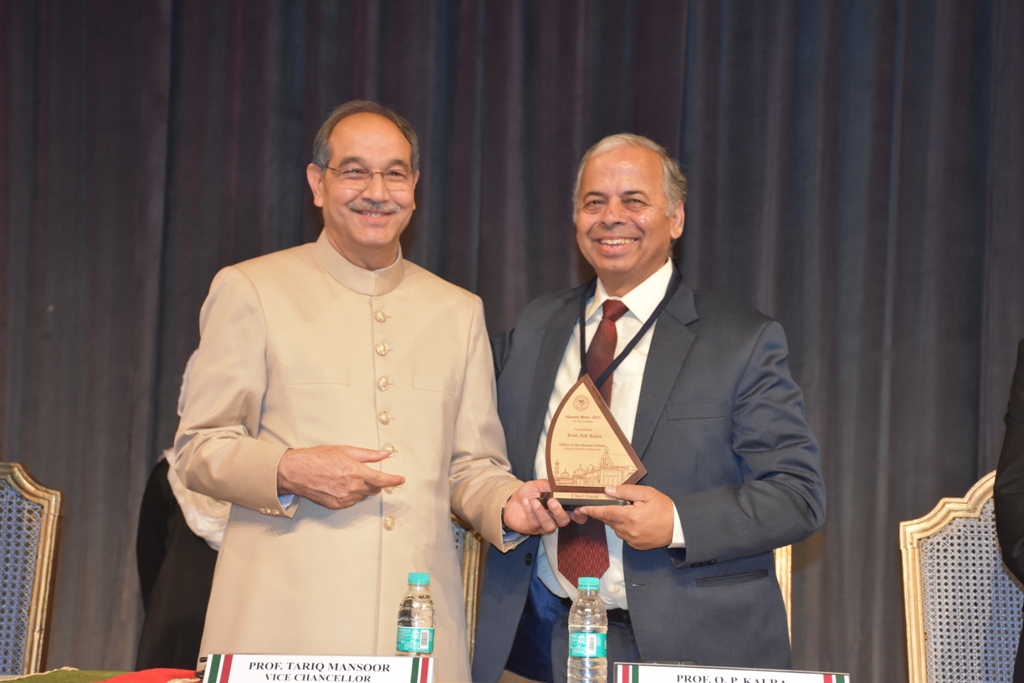
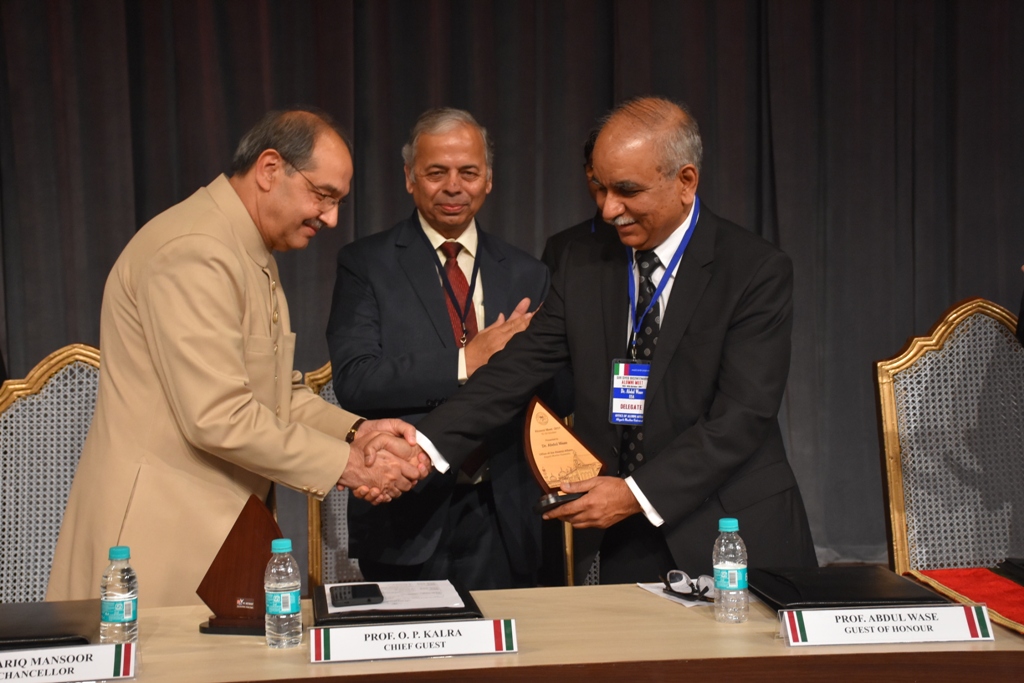
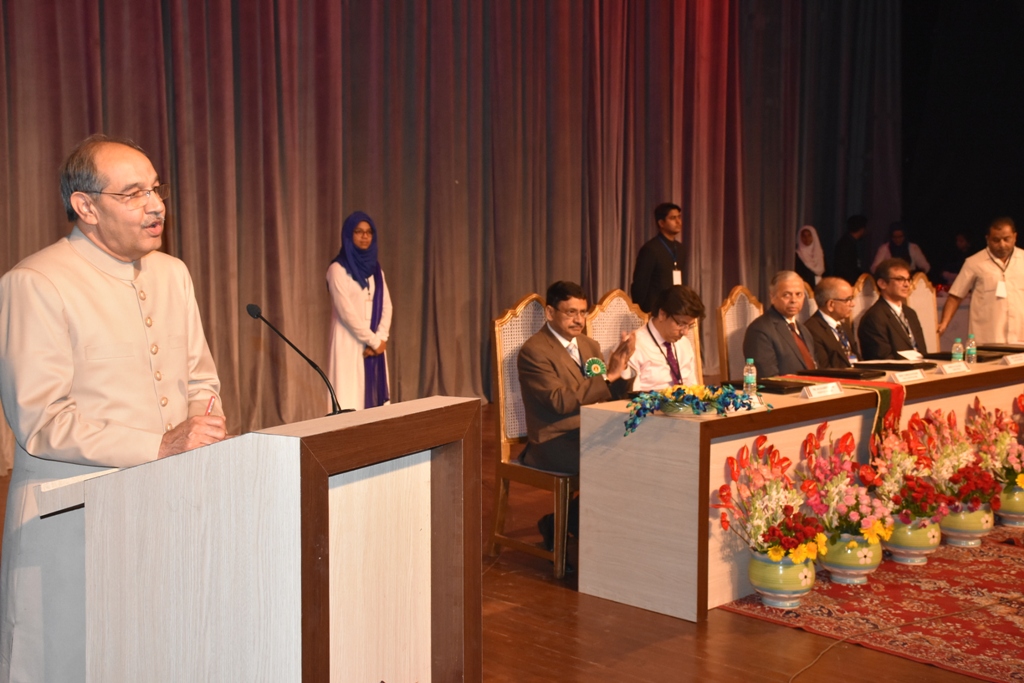
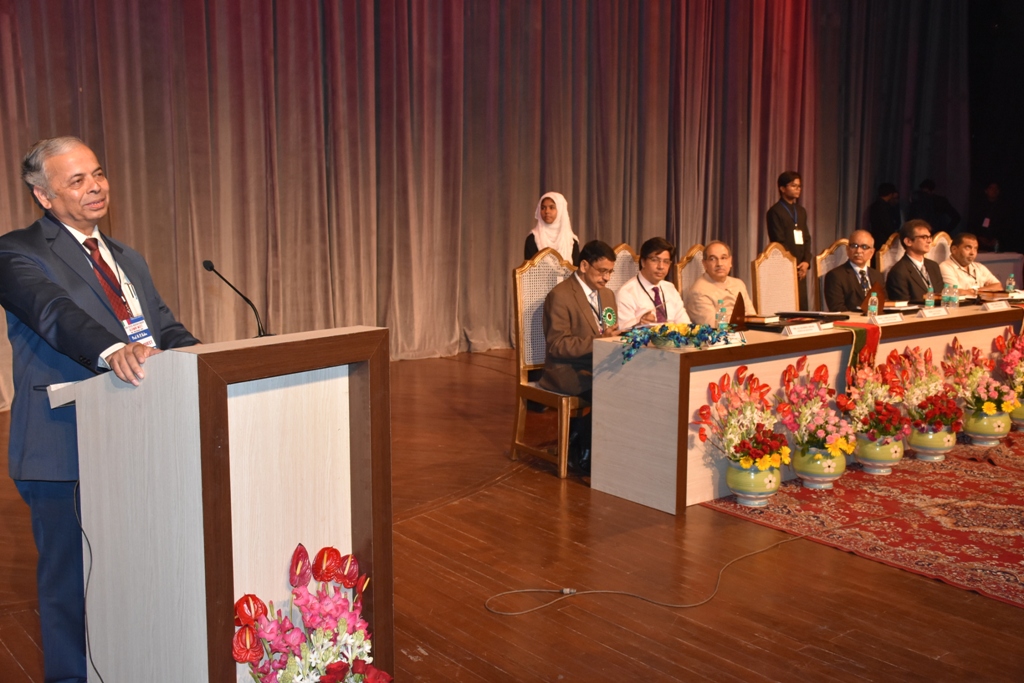
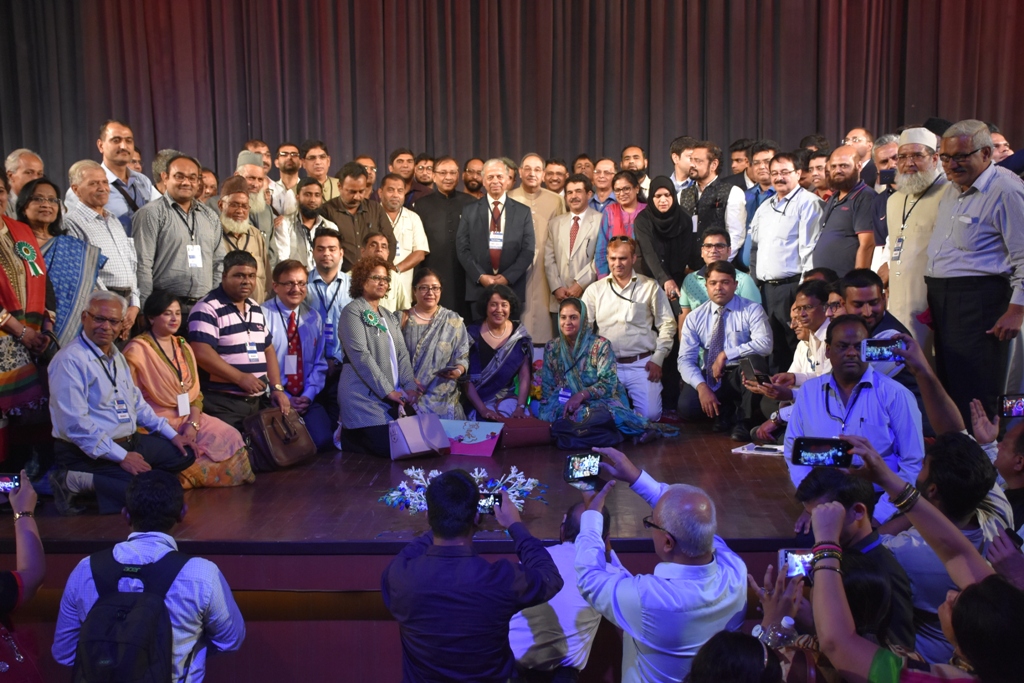
Hundreds of Aligarh Muslim University (AMU) alumni from across the world who attended the Sir Syed Bicentenary AMU Alumni Meet 2017 at the university’s Kennedy Hall Auditorium were caught up in nostalgia as the meet concluded with a valedictory function. AMU Vice Chancellor, Professor Tariq Mansoor after thanking the alumni for their visit said that the university will soon have ‘Distinguished Alumni Awards’ in national and international categories.
He pointed out that there is a plan to introduce alumni meets for all the faculties separately, which will be organised under the aegis of a central body of university’s Alumni Affairs Committee. “However, the idea is subject to change and discussions and has yet to be finalised,” said Prof Mansoor.
The Vice Chancellor further said that AMU is also planning to connect children of Alumni with the university through internships and other programmes. “Children of many alumni living in different parts of India and abroad are attending universities in various parts of world, we would like them to connect with the alma mater of their parents through special programmes,” said Prof Mansoor adding that many universities have been doing this and it can be done in AMU too.
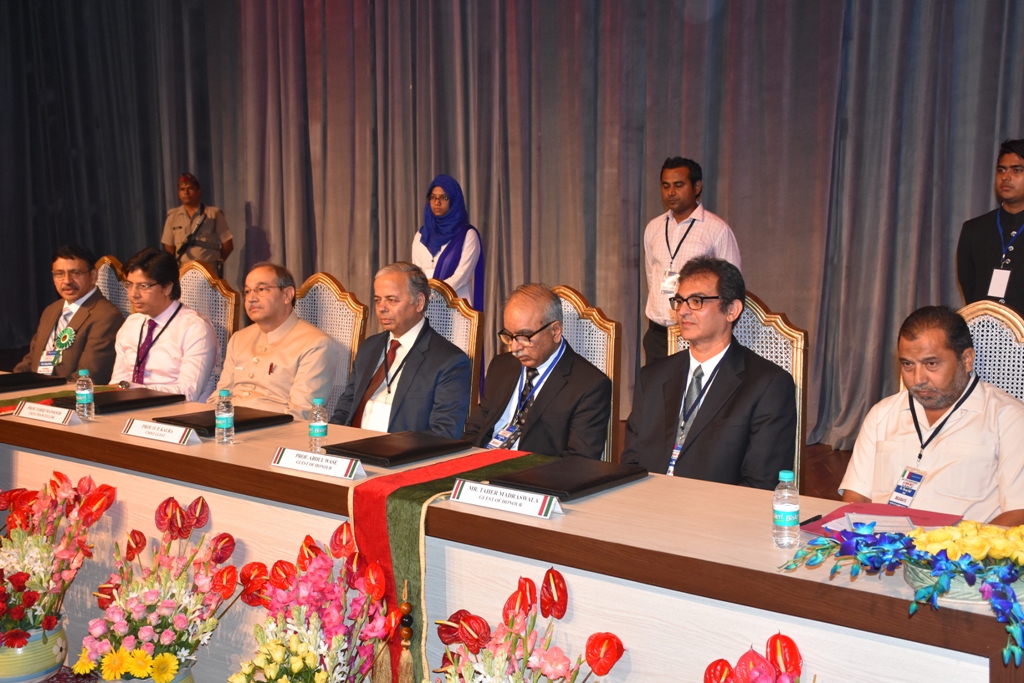
Prof O P Kalra (Vice Chancellor, Pt H L Sharma University of Health Sciences), who attended the function as the chief guest said that he came to Aligarh to appear in the MBBS entrance exam with hardly any money and a place to stay. “I stayed in a Gurudwara and was selected in the waiting list for admission in MBBS,” said Prof Kalra adding that my candidature for admission was selected in AMU’s Jawaharlal Nehru Medical College and Banaras Hindu University’s Medical College at the same time.
“My father advised me to attend AMU and taught me Urdu,” recalled Mr Kalra pointing out that a few years ago he visited his hostel room and found a research scholar of Sanskrit from a Muslim background residing in his room. “This is exactly what Sir Syed’s vision was,” he said adding that a student from a Hindu background like him learnt Urdu in AMU, while a Muslim boy becomes a researcher scholar of Sanskrit in the same University.
USA based Dr Abdul Wasey (senior cardiologist) pointed out that the revelation of the Holy Quran began with the word Iqra, urging humanity to read in the name of Lord who has created them. He added that the religious scriptures invite people towards knowledge and wisdom and Sir Syed with his efforts led people to the light of knowledge from the darkness of ignorance.
He urged students to not get distracted and to keep focussing on their goals. “If you keep your focus and work hard with determination, success will sure come,” said Dr Wasey.
USA based entrepreneur, Taher Madraswala said that he reached New York with just $90 in his pocket and worked hard to put a 100 million dollars company. “My success has been because I was groomed by my teachers in the Zakir Hussain College of Engineering and Technology and I was loved by my seniors and juniors,” he said.
Madraswala urged students to gain knowledge in the 20s, apply that knowledge in the 30s, chase money in their 40s, enjoy the hard earned money in their 50’s and do charity when they retire.
Ali Harris Shere (Vice President, Britannia) said that his education in AMU shaped his value system and taught him to respect people. Recollecting a meeting with Bollywood superstar, Salman Khan; he said that the actor soon recognised his AMU background after meeting him. “Salman Khan told me that the ethos of AMU were reflecting in my conversations,” said Shere.
He urged students to keep their hunger for knowledge, have proper mentorship, be visible with their achievements, understand the importance of networking and to have fresh perspectives to succeed in life.
On the occasion, a newsletter and a book, ‘Sir Syed – Bharat ke Anmol Ratan’ authored by Ikhlas Ahmad Sherwani was released by the Vice Chancellor.
A special attraction of the meet was a session of AMU’s women achievers in which Prof Yasmin Saikia (Arizona State University), Arifa Khanam (Senior journalist), Sabiha Said (Vice President, KPMG), Tasneem Rasol Boaz (Indian Railway Traffic Services), Nuzhat Parveen Khan (Dean, Faculty of Law, Jamia Milia Islamia), Ghazala Kohkan Shamsi (New York, USA) and Taab Siddiqui (Owner, Harvest Gold Food India) were the panellists.
Meanwhile a session on Aligarh Open University, a platform through which AMU alumni spread all over the world share knowledge and experiences with current university students was also organised. Earlier, in the day students associated with the University Drama Club performed a play on Sir Syed.
A troupe of ‘Ahmadi School for Visually Challenged’ sang the Tarana and the National Anthem. Dr Shariq Aqeel conducted the programme, while Prof Suhail Sabir proposed the vote of thanks.
source: http://www.twocirlces.net / Two Circles / Home> Indian Muslim / October 17th, 2017
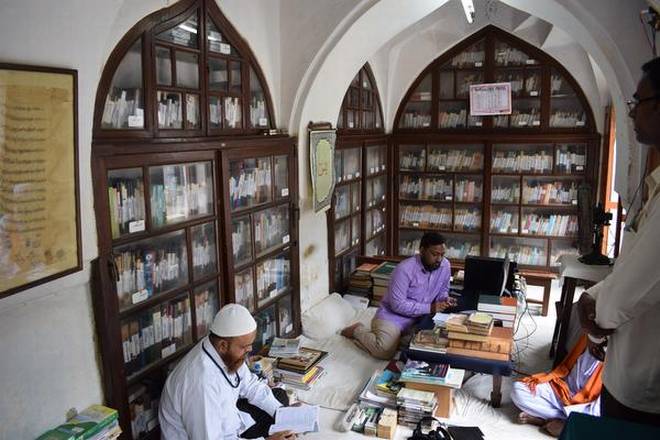
The library at the Khaja Bandanawaz Dargah in Gulbarga.
The library of Khaja Bandanawaz Dargah takes you back to the time of the emperors
The city of Gulbarga in Karnataka received much attention when the government decided to rename it as Kalaburagi a few years ago. Tucked away in the corner of freshly-minted Kalaburagi is a library that is seldom mentioned anywhere. Yet, this library, of the Dargah of Khaja Bandanawaz in Gulbarga, is a repository of some of the rarest of books on Tasawwuf (Sufism), Tafsir (Koranic commentary), Fiqh (Islamic jurisprudence), Ilm-e-Kalam (science of discourse), history, linguistics, and biographies of the Sufis of yore.
Operating out of a remote corner in the mausoleum complex, the library is not known to many people, except scholars researching Islam or Sufism. But that is going to change soon, thanks to the current sajjada nashin (custodian) of the Dargah, Syed Shah Khusro Hussaini.
The library is going to be moved to new premises with state-of-the art facilities, which will enable access to its carefully archived resources.
Lac seal
A part of the All India Syed Muhammad Gisudaraz Research Academy, the library has a collection of over 4,000 books and nearly 500 manuscripts. The collection includes about 25 biographies of Khaja Bandanawaz.
Perhaps the most prized item in the collection are three bound volumes of letters titled Khutoot Shahan e Salf (Letters from the Emperors) dating back to 1755. These are 23 letters, each on a page made of cardboard, with a lac seal embedded in a corner. This was the practice followed at that time to authenticate the origin of firmans (decrees) and letters from the imperial court. Some of the letters are from Aurangzeb’s court.
Khaja Bandanawaz Gisudaraz (1321 to 1422 AD), who carried the Chishti order of saints to South India, was a disciple of Hazrat Nasiruddin Chiragh Dehalvi. He moved first to Daulatabad, the capital of India during the Tughlaq era, and then came to Gulbarga in 1400 AD under the reign of Firuzshah Bahamani. Bandanawaz himself wrote a commentary of the Koran titled Tafsir e Multaqit, which ran to two volumes.
One of the volumes was preserved in Kutubkhana-i-Nasiriya, Lucknow. The other ended up in the British Library. An old patron of Gulbarga Library who had migrated to Karachi during Partition noticed it in London and sent a photocopy to the sajjada nashin a few years back. The Dairatul Maarifil Osmania (Institute of Oriental Studies in Hyderabad’s Osmania University) recently published Tafsir e Multaqit.
Sword-patterned decree
The library also preserves the original volume of Awariful Maarif, the famous Persian treatise on Sufism by Shahabuddin Suharwardy, written in the 12th century.
Khaja Bandanawaz wrote its key in Persian and titled it Maariful Awarif. Tafseer e Azeezi, written on silk pages, is yet another marvellous book treasured by the library.
It is a translation of and commentary on the Koran by the 18th-century Delhi scholar, Shah Abdul Aziz. The calligraphy was done about 200 years ago but the text retains the original brightness and beauty. While the Urdu translation runs underneath every line of the original Arabic text, the commentary is on the margins.
An imperial firman that hangs in a glass panel is written in Khat-e-Shikasta (calligraphy mimicking various objects) dating back to the 986th year of the Hijri calendar (corresponding to 1578 AD). Here, the lines of the firman run in the pattern of a sword.
The library is now headed by Dr. Mohamad Qamaruddun, an Arabic and Persian scholar from Bihar. Qamaruddin says the library receives scholars from the Oriental Studies department of universities in the U.S. and the U.K. The library plans to soon prepare a catalogue of the books and microfilms of all manuscripts. It will also digitise some of the more important works.
M.A. Siraj is a Bengaluru-based journalist.
source: http://www.thehindu.com / The Hindu / Home> Books / by M.A. Siraj / October 14th, 2017
The opening night of Amazon India Fashion Week SS 18 was celebrated by the collaboration of designer Nida Mahmood and Milind Soman’s active lifestyle brand. The collection was inspired by the rich culture, colours, textiles in their four distinct lines.
The ageless art of Ikat was also an inspiration for designer Nida. From indigo dyeing, printing techniques and Mughal patterns, the collection was a visual treat on the Day 1 of AIFW.
The silhouettes were inspired by women of India, keeping their comfort in mind for various forms of workout. Be it a dance class or running out in a gym, the outfits will cater to all. This genius collab with the fitness enthusiast Milind Soman brought together body positive image and inclusivity through the collection.
One of the main highlights of the collection was the first ever running sari, suitable for all Indian women of different shapes and sizes. Who would have that of that?
“With the launch of our running sari we now empower more women to get fit with their choice of silhouette”, said Milind Soman in a statement.
The clothes were made keeping in mind every person’s body requirement, empowering women to be fit with their choice of clothes. Made with 100% recycled plastic bottles, the collection is a treat for all fitness buffs.
source: http://www.timesofindia.indiatimes.com / The Times of India / News> Lifestyle> Fashion> Fashion Shows / TNN / October 13th, 2017
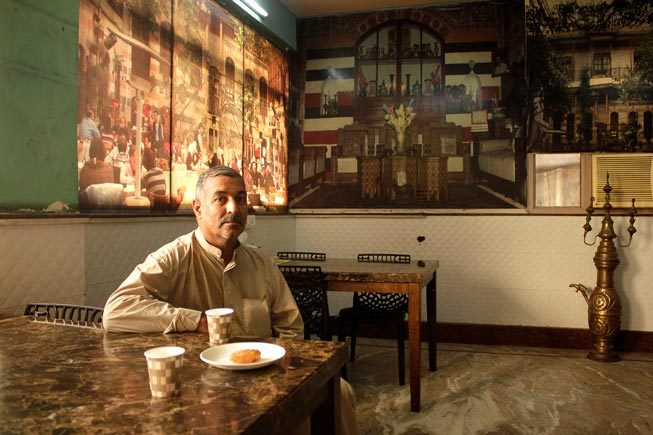
The wallpaper of Asharq al-Awsat bears images of Beit Jabri, a large, famous restaurant in Damascus. / Photo: Vamika Jain
When I walked into Asharq al-Awsat on a morning in early July, a man named Anas was praising Abdullah, the restaurant’s head chef, for helping him feel like he was back in his native Syria. Anas’s praise was prompted by Abdullah’s kibbeh labaniyeh—a yoghurt-based meat dish that is a staple of Arab cooking.
Like many of the guests who frequent Asharq al-Awsat, Anas was receiving treatment at a medical centre nearby. Over the past several years, Sarita Vihar has become a hub for medical tourists from all over the world, especially West Asia, who come to receive affordable medical treatment at private hospitals in the neighbourhood. While here, many patients from West Asia yearn for a taste of home, particularly because the food they are accustomed to is much less spicy than Indian food. Responding to this need, Asharq al-Awsat—which translates to “the Middle East” in Arabic—serves up Arab food in a setting that almost makes you forget that you are in India.
Asharq al-Awsat is on the fourth floor of Om Palace, a guest house in an area of Sarita Vihar dotted with lodging for medical tourists. The restaurant’s wallpaper bears images of Beit Jabri—a large, iconic restaurant in Damascus. An Arabic news channel plays on a small television. The restaurant’s patrons are typically Arabs wearing off-white thawbs and joking loudly in Arabic. But these jolly surroundings belie the difficulties faced by many of the restaurant’s patrons and staff.
Abdullah used to work as a chef in Damascus, but he and his family fled the ongoing Syrian civil war in 2011, leaving for Delhi. “Other than the war, there’s no other reason I would ever leave Syria,” he said. He lost two brothers in the war.
Two years after leaving Syria, Abdullah began work at Asharq al-Awsat. The restaurant was founded by Sohaib Kamal, an Indian man from Rajasthan, who studied Arabic and Farsi in a madrasa in old Delhi. He was inspired to open the restaurant in 2013, he told me, after he visited Om Palace—which, at the time, had an Indian restaurant on the fourth floor. Kamal spoke to many West Asian medical tourists staying at the hotel who were struggling to stomach the restaurant’s spicy food. “When I met a few Iraqis here once, they complained, ‘Coming to India was such a mistake—there’s nothing to eat here! I can’t even drink tea here, because I’m afraid it could be spicy,’” Kamal recounted, when I met him at Asharq al-Awsat. “They were so distressed and hungry all the time, and would end up eating biscuits and curd for meals.” Kamal spoke to the owners of the Indian restaurant and asked if he could start a restaurant there that served Arab cuisine. The owners agreed to rent out their kitchen, and Kamal opened his restaurant.
One day, about a month after Kamal rented out the fourth-floor space, Abdullah, who was at Om Palace to meet someone, stormed into the restaurant’s kitchen. “Who made this? This is not how you make kabsa!” Kamal remembered him saying. Abdullah then proceeded to show the cook—an Indian, and a personal friend of Kamal—how to make chicken kabsa, a popular Arab dish. Abdullah then, Kamal said, offered to help the restaurant in any way he could. “I was excited, because no other restaurant in Delhi has an Arab chef,” Kamal said. Before Abdullah came along, Kamal added, “We had been learning the cuisine off the internet and through other ad-hoc methods.” The chef at whom Abdullah had snapped on that fateful day became his assistant, and, “to date, he continues to learn from Abdullah,” Kamal said. Even the restaurant’s name bears Abdullah’s stamp—Kamal had not settled on a name for the place until the Syrian cook came along. They eventually decided on “Asharq al-Awsat” because it was the name of the restaurant where Abdullah worked as a chef in Damascus.
For the past few months, however, business has been bad at Asharq al-Awsat. “Sometimes this happens,” Kamal said. “We are mostly dependent on foreign medical patients—not many Indians come here, because we don’t serve any Indian food.” Faced with this downturn, the team decided to open another restaurant, in the more centralised location of New Friends Colony, opposite the Fortis Escort Heart Institute. Called MEC Syrian Food (the MEC stands for “Middle Eastern Cuisine”), this restaurant has been doing much better than Asharq al-Awsat, as it is frequented by Indian students from nearby universities.
I visited MEC Syrian Food a few days after it had opened, in late June. There, I met Abu Tarikh—the restaurant’s manager, who has also been Asharq’s manager for over a year. The walls had just been decorated with tiles inscribed with Arabic lettering. Some tables were draped with Persian rugs.
Tarikh, like Abdullah, is a Syrian refugee. He fled Damascus with his family in 2015, after both his home and the mobile-accessories shop he owned were destroyed in the war. He and his family initially moved to Mumbai, but they only stayed there for 20 days before Tarikh realised it “was not for him.” They moved to Delhi after that, he told me, and he is much happier here; he “understands things” in this city, and thinks that the “people here are good.”
It has not all been smooth sailing for Tarikh, though. He speaks some English but no Hindi at all, except for the few functional words which help him communicate with autorickshaw drivers and customers. This means, he said, that “one day’s work sometimes takes ten days. Nobody here understands me as they do back home.” But “I like India in general,” he added. “I have many Indian friends.”
Abdullah has had more trouble adjusting to life in Delhi. He finds the language barrier even more difficult to deal with than Tarikh does, since he barely knows any English or Hindi. “I left my home in Damascus because the entire country was in dire straits; but even here, I don’t know anybody, and I’m facing just as many troubles,” he said. “I don’t like it here at all. But I’m helpless, what can I do?”
In Abdullah’s ideal world, he would migrate to the United States. In India, he said, “there are no facilities. Even if you work for 24 hours a day, you can’t earn enough to take care of your children—everything is so expensive.” Also, he said, “Indians don’t like my food, because they eat such spicy food. I can make at least 80 types of Arabic food, but unfortunately, I have to limit myself to four, five types of dishes. It’s very frustrating.” He told me he has applied for a US visa, but has not heard back.
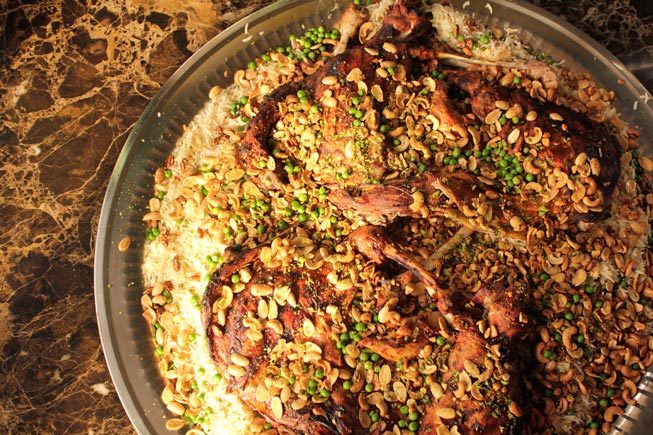
Every day, the Palestinian embassy places an order with Asharq al-Awsat for mansaf, an elaborate lamb-based dish
When I first met Abdullah, it was rush hour at Asharq al-Awsat. Each day, the Palestinian embassy places an order with the restaurant for mansaf—an elaborate dish of lamb cooked on top of a layer of flatbread and rice in a yoghurt-based sauce, decorated with pine nuts and almonds. His enthusiasm was palpable as he spun around the kitchen, grilling meat, assigning tasks to employees, bringing various dishes to boil.
But, shortly after that, during a smoke break outside the restaurant, he confessed, “Honestly, here, I am just going about my days, not even living. I am barely existing, with no end in sight.”
Anisha Sircar is an intern at The Caravan.
source: http://www.caravanmagazine.in / The Caravan / Home> Reporting & Essays> The Lede / by Anisha Sircar / September 01st, 2017
For connoisseurs of Indian music, Google’s October 7 doodle is special. Today, Google is celebrating the 103rd birth anniversary of Mallika-e-Ghazal Begum Akhtar with a commemorative doodle. Manuja Singh Waldia – a young Indian illustrator and graphic designer who studied in Delhi before she moved to the US – was commissioned to do the doodle art.
Google describes Begum Akhtar — born Aktharibai Faizabadi — as one of India’s most iconic singers. “In spite of early personal tragedies, Begum Akhtar’s mother recognized her daughter’s gift at a young age. With the help of family members, she sent her daughter for vocal training with some of the Ustads (masters) of the time. Though her soulful and melancholic voice was featured in many movies, Begum Akhtar ultimately returned to classical music, where she composed many of her own melodies and steeped herself in the rhythm of ghazals. After marrying, Begum Akhtar gave up singing. However in 1949, deteriorating health drew her back to her calling. Weeping tears of jubilation, she finally returned to a Lucknow studio to record and continued to share her gift with the world until her death in 1974. Her rich voice was comforting, particularly during the years India underwent upheaval caused by partition. With nearly 400 songs to her credit, Begum Akhtar’s legacy shines on in the musical traditions she loved over her lifetime,” Google’s description of the iconic singer states.
The doodle on Begum Akhtar is Waldia’s first for Google. When Penguin Classics decided to publish new editions of Shakespeare’s plays to enliven his work offstage, Waldia was commissioned to do the covers that would give the centuries old texts a contemporary update. “Erich Nagler, art director at Google, San Francisco, had commissioned me to work on it. He had traced contacted me through email,” said Waldia from Oregon. Nagler’s Twitter profile states that he is the art director for the Google doodles team in San Francisco. “The brief was to create on commemorating Begum on her birthday, and celebrate her status as one of the most popular ghazal singers, and one of the first female public ghazal performers,” she added.
The project was wrapped up a few weeks ago. For many in India, it was a pleasant surprise to find Google commemorating the birth anniversary of the legendary singer. “She deserves all the attention in the world. She is a pioneer and early feminist! She is pretty amazing. She overcame a lot of prejudice against female singers, survived sexual abuse as a young girl, escaped a bad marriage, was independent during times where women were either wives or mothers. It is so inspiring! I was reading articles on her today which mentioned her smoking habit, and insinuated that as a character flaw. That’s the kind of sexism that still exists today. So, she probably faced worse during her time,” the doodler said.
Having studied Communication Design at NIFT Delhi, Waldia also insists that she draws a lot of creative inspiration from Kolkata – a city where Begum Akhtar spent many years of her professional life. In 1934, the ‘Koyelia’ singer had the first stage performance in this city. It was here that she acted in films and theatres as well. Her first album – ‘Deewana Banana Hai Toh Deewana Bana De’ – was recorded here as well. She had sung for the megaphone company. The record was such a huge hit that the company had to make a special unit in Dumdum to meet buyers’ demand! “I’ve been to Kolkata thrice in my life, and had some of the happiest times there. The city’s creative energy had a major influence on me while growing up, and when I was contemplating if I should be an artist,” she said.
source: http://www.gadgetsnow.com / Gadgets Now / Home> News> Tech News / by Priyanka Dasgupta / TNN / October 07th, 2017
Lalitpur (Jhansi) & Agra (UTTAR PRADESH) / London, GREAT BRITAIN with Empress of India
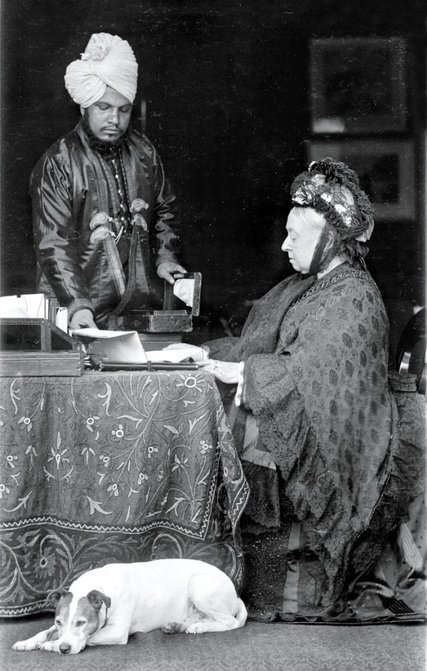
Queen Victoria at her desk, assisted by her servant Abdul Karim, the munshi.
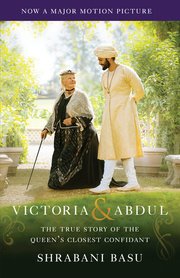
VICTORIA & ABDUL
The True Story of the Queen’s Closest Confidant
By Shrabani Basu
Illustrated. 334 pp. Vintage Books. Paper, $16.
I really do wonder if I am qualified to review this remarkable work. I am a nonagenarian, Anglo-Welsh, republican, agnostic liberal, an only half-redeemed British imperialist, sexually complex and incorrigibly romantic. “Victoria & Abdul” is about an aging British queen, her eccentric obsession with an engaging Muslim servant from India and the half-farcical opposition of the British establishment to their relationship. I had never heard of the story until the book reached me for my critique, and I had no idea it was about to be the subject of a much-publicized movie. Am I qualified to respond to it for The New York Timer? Reader, judge for yourself.
When it first reached me I began, as a republican, by scoffing. The very status of Alexandrina Victoria, Queen of England, at the time of her first encounter with that Indian servant struck me as perfectly ridiculous. She was a woman in her late 60s who was treated with almost religious reverence and responded accordingly. The whole preposterous charade of royalty was performed perpetually in her presence. It was wildly exaggerated, too, because she happened to be the titular head not simply of a small island nation but of the most enormous empire in the history of empires, claiming sovereignty over nearly a quarter of the earth’s surface. Perhaps the least logical of these bizarre circumstances was the fact that among her far-flung territories was one of the proudest and most ancient of all human entities, India. Since 1877, Victoria had been called Queen Empress, and India was the reason.
I scoffed, but then that Indian charmer entered the book, and I was beguiled.
So was Victoria. Abdul Karim was 24 when he arrived in England in 1887, engaged as an orderly for the queen during her Golden Jubilee celebrations and presently also charged with teaching Her Imperial Majesty Hindustani (as the British habitually referred to both Hindi and Urdu). Although of relatively humble stock, he was a born winner, educated, good-looking, clever and ambitious. I soon fell for him myself.
In no time at all, it seems, he became far more than an orderly, but rather an Indian gentleman of the court, more or less self-promoted out of the servants’ quarters and dubbed, by Her Majesty’s command, a “munshi” — which meant, I gather, a sort of more-than-teacher. This in turn seems to have morphed into a vaguely aristocratic honorific, and before long the delightful young orderly had become the Munshi. For the rest of his life he flaunted the title, and “Bravo,” say I!
I find myself genuinely touched by the bond between the empress and the munshi. He was an opportunist, but he was kind, which for my money redeems many faults, and old Victoria had been having a rotten time of it. First she lost her adored husband, Albert, and never got over it, and then John Brown, her beloved Scots gillie, died on her. Victoria’s nine children were scattered across Britain and Europe, and they were a mixed bag anyway. It must have been a lonely time for the old lady, but then along came Abdul Karim, in his virile youth, and he was very soon treating her not only as an empress but as a woman.
There was obviously nothing carnal about the relationship. Heaven forbid! The munshi seems to have regarded Victoria as an affectionate and generous surrogate mother. (She gave Abdul Karim and his wife three cottages, each near one of her own palaces, plus some land in India, and when he traveled on the royal train he had a whole carriage to himself.) In return he gave her his sympathy and understanding, and in particular they both seem to have enjoyed her daily (and very successful) lessons in Hindustani.
The affair, if we can call it that, spilled over into the style of the British court, which became more and more Indianified. Indian colors were everywhere, Indian sounds and even Indian smells (for curries were often served). When the court indulged itself or its visitors with one of its elaborate tableaux vivants, Indian faces were prominent on the stage, and indeed in the tableau of the king of Egypt, pictured in this book, the Pharaonic ruler himself was played by none other than — the munshi!
The generally snobbish and often racist British establishment of the day came to detest the munshi with an almost comical fervor, and, led by Victoria’s son and heir, Bertie, who later reigned as Edward VII, persecuted even Abdul Karim’s memory when he and his love were both long gone. I suspect that the munshi was a sort of dual reincarnation of Victoria’s beloved Albert and her dear, dear John Brown. And if there was something rather excessive — even, to my mind, schoolgirlish — about her attachment to her young servant, it was perhaps only a late and pathetic extension of the maternal instinct.
I grew fond of them both as I read this generous and meticulous book, and I write this review now with a sentimental tear in my eye. So what think you, Reader? Am I qualified for the job?