Category Archives: Arts, Culture & Entertainment

Empowering The Underprivileged Through Crocheting: Zehra Picturewalla’s Story

GUJARAT / Mumbai, MAHARASHTRA :

They say it only takes a vision and the will to act on that vision to make a difference in this world. And this is precisely what Zehra Picturewala, a young determined girl from a conservative Muslim family of Mumbai, aims to do.

Zehra, who originally hails from Gujarat, graduated from Nirmala Niketan with a degree in Textiles and Fashion Technology. Although Zehra had always dreamed of being a doctor, she knew that she had the heart of a designer. For her family, the next step for a 22 year old graduate girl was to get married and start a family. However, Zehra put her foot down and informed them of her passion and desire to do something more. It took a lot for young Zehra to convince her father that launching a business with a social undertone is what she truly wanted. Her efforts worked, he’s been her support ever since.

CrochetMPOs26aug2017

Zehra Picturewala runs a company called ‘ZnSkills’, which teaches underprivileged women and children the skill of crocheting and creating products. The company then sells these products and collects the revenue, which they then pay to the women and children who made them. So in a sense, her company is promoting indigenous handicrafts in a modern market and thus empowering the women and children from the underprivileged classes thereby bettering their position in society.

The idea for ‘ZnSkills’ came to her on a summer break during her graduation. Two of Zehra’s classmates started classes which offered livelihood skills, and these classes soon became a rampant success. The students who came down to attend these classes picked up these skills effortlessly and soon more started pooling in. The success of these classes led Zehra to believe that a professional initiative should be drawn around this theme which would help these students build their capabilities.

As soon as she completed her finals, she tried her hands at setting up several skills, out of which crocheting worked the best. Her cousin ordered a set of crocheted products for her, and Zehra began experimenting with the set. Her amateur hands soon turned professional, and people started clamouring to buy her work. She was thus compelled to search for artisans to herald in production on a large scale. An acquaintance gave her the idea of teaching these skills to the differently-disabled, and told her about an institute for the visual and hearing impaired children.

Zehra thus decided to teach these children, most of whom were girls, the necessary skills which they picked up even faster because of their enthusiasm. These students have now carried forth to produce the best pieces.

After this initial success, Zehra then turned her attention to the women living in unfavourable conditions in the remote areas of the city and brought them into her employ. Zehra attributes the success of ‘ZnSkills’ to these women.

Zehra confesses that her journey to becoming a successful entrepreneur wasn’t an easy one. Like many startup founders before her, she had a challenging time searching for investors, and she had the added challenge of doing this alone. “Training people, sourcing out products, designing as per demand, maintaining accounts, meeting potential investors, maintaining relations and struggling for buyers is hard, but it’s all worth my dream,” recalls Zehra.

To place focus on the company’s social angle, Zehra soon decided to tie up with some NGOs around the state – a good decision as it turned out, because in this way, she was able to meet people who were in need and who would be willing to work for a living. These people are provided with free training using free material, and once they worked for her company, the sales flew up and paved the way for the advent of a very successful business.

“The main problem that the women in the rural areas of our country face is the fact that they aren’t allowed to leave home to receive a proper education or employment.  So, I decided to make the production happen from individual houses.” On how this plan works, she says, “we collect ID proofs of the people we train and then decide a venue where every week, everyone accumulates to collect the material and make the products.”

Currently, over seventy artisans are working and contributing to the company. Zehra’s focus is on the growth of the company, mostly targeting new mothers.

On being asked what the idea behind her company is, she says, “When we patronize handmade products, we empower the weakest section of our society, a journey to let people know that women can move mountains if they wish.”

When asked her opinion on entrepreneurship in India she says, “Today’s entrepreneurs may be more into marketing and less in manufacturing, but I would advise them to import less and export more.”

source: http://www.yourstory.com / YourStory.com / Home> StartUp / by Sanjana Ray / September 11th, 2016
Had it not been for Muslims, we would have died: Saints injured in Utkal Express derailment

UTTAR PRADESH :

UtkalExpressMPOs26aug2017

Meerut :

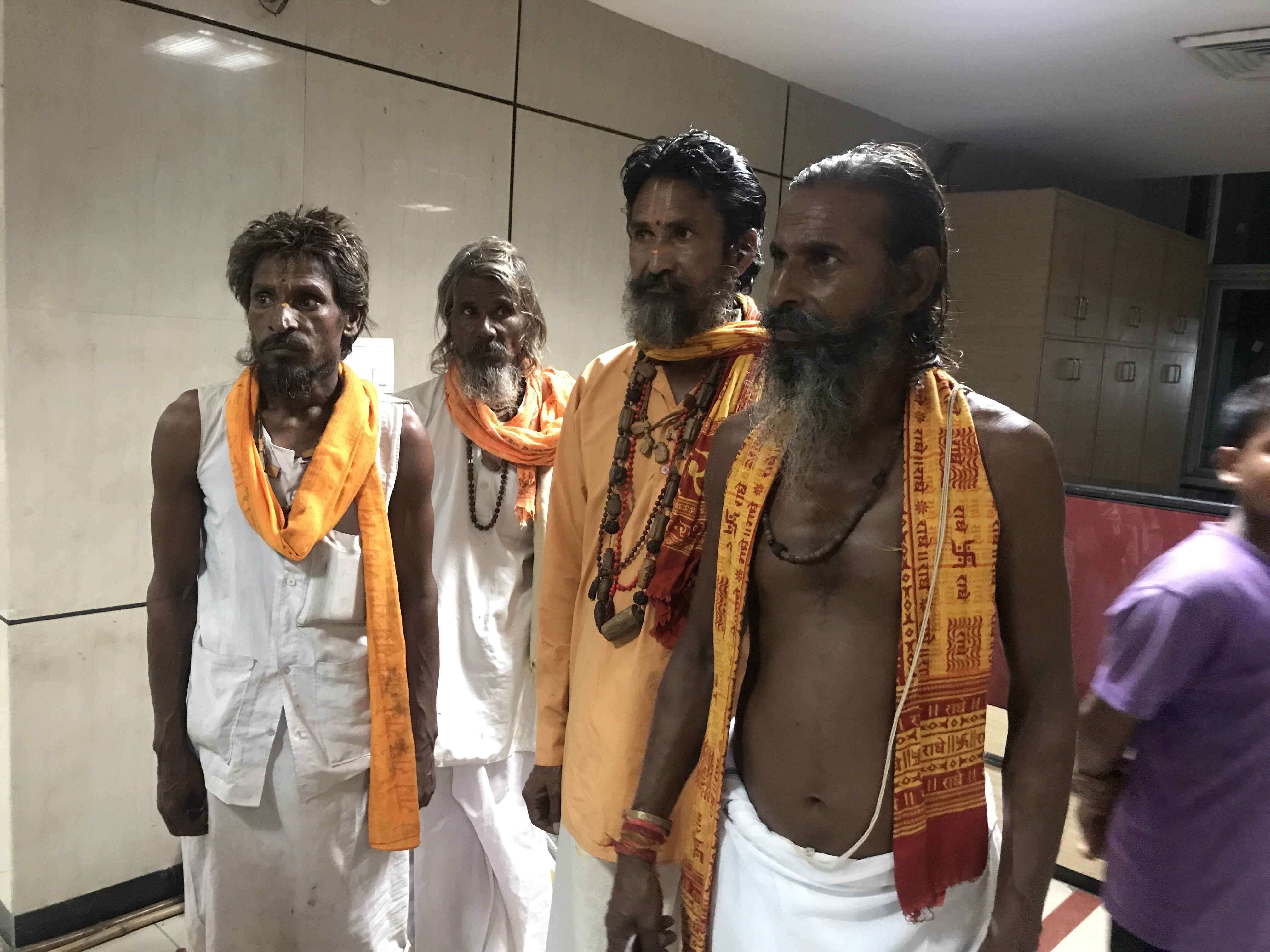
“I remember my head bumping into the seat in front of me, throwing me at least two feet forward. I was in pain and could her screams from all directions. Honestly, if it hadn’t been for Muslims in the area who rushed to the spot and pulled us out of the train’s coach, we might not have survived,” said Bhagwan Das Maharaj, a saint with a saffron cloth tied around his neck. He was travelling with six other ascetics who had boarded the Utkal Express from Morana in Madhya Pradesh and were going to Haridwar to take a holy dip in Ganga.

“They brought us water, khaats and arranged for a private doctor for us. We will never forget this gesture,” he added. Three saints from the group were injured and were rushed to Lala Lajpat Rai Memorial (LLRM) Medical College in Meerut for treatment.

“We believe in God and we saw his power soon after the accident. There are times when people politicize Hindu-Muslim ties, but there has always been love between the two communities,” said Morni Das, another saint.

Soon after 14 coaches of Haridwar-bound Kalinga Utkal Express derailed near Khatauli in Muzaffarnagar, government and private hospitals in Meerut were put on alert and emergency wards were set up for the accident victims. “There were many women and children in our coach. All of us were chit-chatting and suddenly our coach overturned. Initially, we didn’t realize what had happened,” said another saint Hakim Das.

Dr Raj Kumar Chaudhary, Meerut’s chief medical officer, said, “As many as 23 people have been taken to different hospitals in Meerut and are being given treatment. Also, 26 government ambulances and 26 private ambulances were rushed to the accident site to take the victims to hospitals.”

Till the time this report was filed, 23 people were admitted to different hospitals and many more were coming in. PL Sharma district hospital and LLRM Medical College also launched their helpline numbers: +919410609434 and 0121-2604977 respectively.

source: http://www.timesofindia.indiatimes.com / The Times of India / News> City News> Meerut News / by Ishita Bhatia, TNN / August 19th, 2017

The magic of Suraiya

PUNJAB / Mumbai (MAHARASHTRA) :

When Nawab F K Sherwani’s daughter got married, his friend the Chawalwala Nawab invited Suraiya to sing, and despite fever, one could make it to the wedding of Farhana Begum, holding on to mother’s hand. That was in the 1940s, when one was fortunate to hear the legendary singer in her prime and also see the courtesans dance the night away. That function is a fading memory now but not the screening of Anmol Ghadi, held two years later in Jaipur in a predominantly Muslim locality by Danyal Sahib. He put up the screen against the City mohalla wall, and it being a summer evening, people spread their cots to hear and see Suraiya, along with Noor Jahan, the senior of the two reigning screen beauties.

Suraiya had become a magical name by then and everybody was talking about her golden voice that could sway not only the music-loving rajas and nawabs but also the hoi polloi. “Iski zaban mein mithas hai (There’s sweetness in her voice),” commented 80-year-old Keti Baba, the ex-gardener of a nawab’s compound. Jajja Bua agreed with him as she munched her favourite bida ofpaanunder the neem tree, where she sat on a stringed cot, near the beautiful dulhan, Bilqis, while Khaleda Behn spoke or a fanciful musical duet between Saighal and Munawar Sultana. Each scene of the film drew remarks galore, and sometimes when the scenes got hetic.

Master Sahib tried to interpret them to those who kept getting puzzled by the sequence of events. Munni Bua found it difficult to control her son Karim who, like any mischievous schoolboy, kept fidgeting with his mother’s sari or tried to pull his sister’s hair. He, however, began to concentrate on the film when the fighting scene commenced. In those days films did not have “dhishum-dhishum” stuff. Here was a fight with a knife until the Pehalwan sprang up and wrested it from the villain’s hand. When the film ended people picked up their cots and went home, but they kept talking about Suraiya and Noor Jahan for a week after that, with comments on Suraiya’s dominating Nani.

More than 50 years later one had a chance to see the legendary actress again, when she came to receive the Sahitya Akademi award in 1998. That was a glimpse of a much mellowed Suraiya. But she still looked pretty though approaching 70. The wrinkles were hidden under a lavishly rouged face, the hair had been dyed, except for a straying grey one here and there, but the almond eyes were still sparkling and full of life. She conversed in a low voice and declined to sing, saying she had left “mosiqui years ago”.

Someone mentioned Dev Anand but she ignored the comment, and preferred to change the topic by remarking that it was getting late and she had to go back, the reference probably being to her Marine Drive residence, where she led the life of a recluse. What an evening of old memories it was!

Nawab Faiyaz Khan was long dead, so also his eldest daughter and her husband, S K Sherwani. The Chawalwala Nawab did not die a natural death: he had shot his begum in a fit of anger in the 1950s and was hanged on the clinching evidence of his only son.

Suraiya did not speak much about Noor Jahan (nor of Lata Mangeshkar) but from the little she said it was evident that she held her in high esteem. They were both from undivided Punjab ~ Noor Jahan from Kasur (which was to become such an issue during the Indo-Pak war of 1972) and Suraiyu from Lahore, where her uncle Zahoor, the ace villain or the silver screen in the 1930s and 40s was able to win her parents’ approval to become a child actor.

Although Suraiya did not speak about Dev Anand that December day, one still remembers the Latka (limerick): “Chhayi bahar hai / Jiya beqarar hai / Aaja mere Dev Anand,Suraiya bemar hai”. And when one reminisces of Suraiya can Noor Jahan be forgotten? When she came to India in 1980s, 35 years after leaving for Pakistan along with her husband Shauqat Hussain, one had a chance to see her at close quarters. Her name was later linked with cricketer Nazar Mohammad and then General Yahya Khan in a big scandal.

The glamour-girl of yesteryear, despite her many engagements in Delhi, found the time to visit the dargah of Hazrat Qutubuddin Bakhtiar Kaki and the shrine of Hazrat Nizamuddin Aulia. Tradition has it that one should visit Hazrat Qutubuddin’s mazar first and other shrines afterwards. Even Khwaja Moinuddin Chishti had ordained that the devotee must first pay respects to Qutub Sahib and then come to his dargah.

So Noor Jahan, accompanied by her pretty daughter, Hina and her husband, Haroon Butt, went to this mazar first. At Nizamuddin’s Dargah Noor Jahan offered a chadar and stood praying with palms open for blessings amid the aroma of joss-sticks. Perhaps the Malika-e-Tarannum prayed that her voice remain ever redolent. Or she sought the saint’s benediction on Hina and her husband ~ health, wealth and happiness. As per tradition, the actress left for Ajmer on a Friday to seek the blessings of the greatest Muslim saint of the East, without a visit to whose shrine no trip to India is complete for the true devotee.

Noor Jahan’s golden voice still resounds in the mind “in jocund or in pensive mood” ~ “Awaaj de kahan hai”, interspersed with Suraiya’s “Nuqta chin hain ghame-e-dil”, which brought out the very soul of Ghalib on her honeyed tongue. Suraiya’s last visit to Jaipur was at the initiative of music composer Naushad, who belonged to this city before making it big in Bombay. At his behest, she was the guest of the niece of the novelist lsmat Chughtai and spent a whole day at her house.

Among those who attended an evening of songs by her was Khalil Mian of Bagh Chaurniwala, a great lover of music and a friend of Nawab Faiyaz Khan. As the trees swayed in the breeze blowing from the hills surrounding the city, Suraiya too swayed in rhythm ~ and the audience with her. When she departed by the night train many of her admirers wondered whether they would hear the legend sing again in a live performance. Her death years later naturally left Jaipur sadder. That Dev Anand couldn’t marry Suraiya because of opposition by her Nani is one of tragedies of filmdom, which finds a parallel in the case or Dilip Kumar and Madhubala, whose father was opposed to their wedding proposal.

Nevertheless, Dev continued to have a soft corner for his old flame and when her favourite actor Gregory Peck made a brief stopover in Bombay, he took him to her house. It was near midnight and Suraiya was fast asleep. He woke her up to give her probably the biggest surprise of her life. Dev had eventually married Kalpana Kartik and Dilip for Sara Banu as the next best thing in their lives. But the way their marriages lasted shows that the same would have been the case had Suraiya and Madhubala become their respective wives.

Even after Suraiya passed away, a red rose was always found on her grave in the Mumbai kabristan. It was a tribute by the lover of her youthful days. All this comes to mind when one relaxes before the TV in the evening for a sundowner while one of Ghalib’s ghazals is being sung. It reminds one of Suraiya’s faultless rendition of the poet’s master-piece, “Nukta chin hain,gham-e-dil/Baath bane na bane”.

In the life of the actress the “Baath” that did not materialize was the affair with her heart throb Dev Anand of the romantic Gregory Peck type hairpuff! So that long past evening with Suraiya still extends up to now.

source: http://www.thestatesman.com / The Statesman / Home> Features / by RV Smith / New Delhi / August 25th, 2017

When Ustad Rashid Khan mesmerised Hyderabad

KOLKATA, WEST BENGAL :

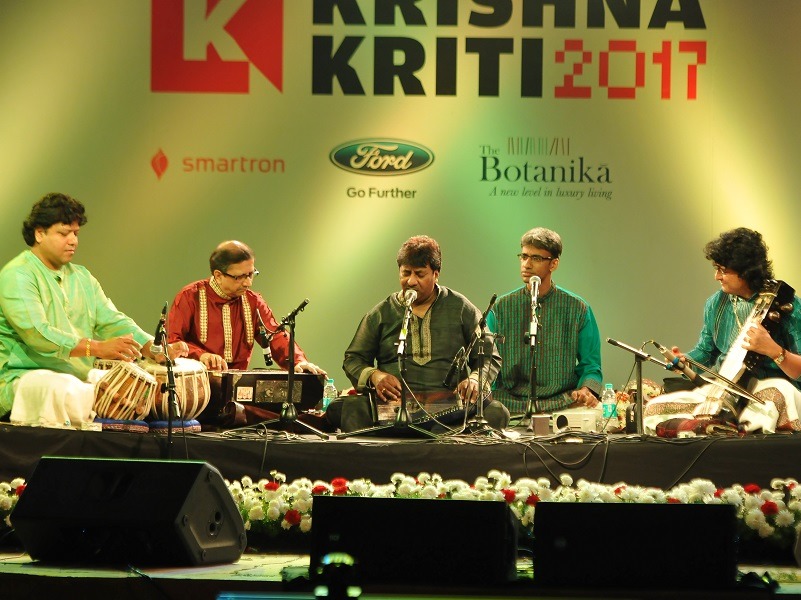
UstadRashidKhanMPOs26aug2017

The moment the scion of the Rampur-Seheswan gharana Ustad Rashid Khan stepped on stage, it felt like magic was infused at Rock Heights on Saturday evening.

The maestro of Hindustani classical music began the performance with the aalap of raag Yaman. Exploring every note of the intricate ragas, his sonorous rich timbre, lulled the audience into a musical bliss. The slow elaboration of vilambit khayal, the relaxed vistaars, passionate flourishes, and masterful taankaris defined the prowess of the Ustad. The second rendition, a composition in the beautiful ratrikalin raag Desh, enthralled the audience with meends rom madhyam to rishabh via gandhar that defines the raag.

Rashid then swung into the poignant Yaad Piya Ki Aaye, the famous thumri by Ustad Bade Ghulam Ali Khan piece much to the delight of the rasikas present there.

“Will he sing Aayoge Jab Tum Saajna? I will be so heart-broken if he does not sing the song,” whispered a member of the audience. So when he concluded his concert with his famous Bollywood number, the crowd broke into a thundering applause.

When we caught up with the singer backstage to ask him if he had deliberately saved the song for the last, he said, “It’s good that people like it. The song is actually a thumri. Achhi baat hai ki usmein maine kuch aalag kiya hai. There are many thumris as good as Aaoge Jab Tum Sajna, if they are incorporated in films, they will become as popular as this score.”

The exponent of the Rampur-Sahaswan gharana, who is a father to Suha, Shaona and Armaan is proud about the fact that his daughters will carry forward his legacy .

“Girls in our family never sang in public. But when they decided to become singers and pursue a career in singing, I gave them my whole-hearted support. Zamana change ho raha hai. I believe in their happiness more than tradition. I wanted them to live their dreams,” he says, signing off.

source: http://www.timesofindia.indiatimes.com / The Times of India / News> City News> Hyderabad News / by Papri Paul / January 11th, 2017

Sahitya Academy Award winner Ameer writes on Urdu poetry

NEW DELHI :

Urdu poetry has always been very special, writes Ameer Imaam.

Though all the poetries of world are special in a way for poetry is the mother of the fine arts, but despite that Urdu poetry has some features that make it unique among the world literature.

We find a glittering galaxy of literary personalities in Persian and English literature too and the names like Wordsworth Keats, Hafiz and Urfi are the never ending traditions and stand as the ever lasting impressions on the world literature but I couldn’t come across the any name of these languages, make me correct if I am wrong, that can be mentioned as the poet of present age. By this day, to the best of my knowledge, English poetry is synonymous with the literary stalwarts like Wordsworth Keats etc. Same is true with Persian poetry but this is not the case with Urdu. There was a time when Urdu poetry was meant to be Ghalib, Zauq, Anees etc. There is a time when Urdu poetry is meant to be Iftiqar Arif, Saqi Fatuqi, Jon Alia, Itfan Siddiqui and Farhat Ehsas. The urdu poetry is growing and has not been exhausted by it’s literary immortals, but these legends seem paving the way for the upcoming generations .

This walk of literature has another unique feature that is Mushira, a gathering where poets are supposed to recite their poetries for the audience. In these gathering, the poetry gets connected with every soul, who is present there in a different way. But this very speciality of mushaira gives birth to a problem. Some poets start coming with some extra efforts to maintain this connection. Most of the time these extra efforts appear a desperate attempt to camouflage the week ness of the works that turn mushaira into a sort of political rally and hooliganism.

Mushaira had not been like it since ever. All the big guns of literature of classical era shot to fame through mushairas and in those days it was the only bridge between a poet and the masses. There was a time when the reader was a listener first. So what we’re the circumstances that drove mushaira to this slogan raising, face making and,,,”the raised up hands should be there to the last row if you really appreciate it” sort of begging. To answer this question is not easy but it is not tough as well. This question too is standing in the que of the questions that have been demanding their answers since partition. The Exodus that was not of the people but was of the culture as well. The feudalism breathed it’s last and gave way to the industrialization.

Despite various demerits, feudalism was not the demerits only and was with some shiny patches like the dark ones of industrialization. Feudalism was stagnation, old fashioned, obsolete but a system of values and it could be anything but business. Industrialization was a flow, modernity, need of the hour but a business and it could be everything but a system of values and commitment.

JavedAkhtarMPOs01aug2017

The industrialization established the new monies of society and it changed not only the political but cultural scenario as well. He who pays the piper calls the tunes and with the new class of payers came a new class of pipers. The mushaira became a business and business is about making quick money only. Mushaira took a turn in that direction and the pipers were about not only making quick money but quick fame too. The post independent era was dotted with a series of communal riots and mushaira of that time exploited the situation quickly and became a wailing wall for a particular community. Though it kept masquerading so but it was no more an intellectual venture. It turned to be sensational and poetry, if it was poetry, based upon double meaning jokes, got a way to the podium. This melee left the pure literary poets like Mohd Alvi, Zeb Ghori and Musawwir Sabzwari far behind and they all we’re shrunk and cocoon to some journals and the collections of their poetry. They braved the boastful declaration of Bashiir Badr with silence when the later announced

Kaaghaz me dab ke mar gaye keedey kitab ke
Dewana bin parhey likhey mashhuur ho gaya

The book worms met a bookish, crushed between the paper death,
While a careless wanderer shot to fame without exploring the books.

Partition divided the Indian Urdu poetry into two sections. The one was for the audience and the other was for the readers.

But like every thing this mushaira too reached it’s saturation point and a new mushaira started itself stretching up to it’s height. A mushira that was different from the mushaira of last thirty to forty years.

Rekhta came as a whiff of fresh air. But there were some individual attempts too. The mushaira that has annually been organized by Tariq Faizi under the banner of Urdu Press Club falls into this category. It provides a platform to the poets who are known enough and the poets who are ascending the ladder of fame step by step. In this mushaira both the sections are supposed to come with quality poetry and they do. Javed Akhtar can compose Dard e disco for Shahrukh Khan but here he appears as the true grandson of legendary Muztar Khairabadi with his couplet

Woh shakl pighli to har shai me ghul gayi jaise
Ajeeb baat hui hai use bhulaney me.

Having melted down that face has mingled with everything here,,
Strange is the process of forgetting him.

Shariq Kaifi belongs to the city where once an ear ring was lost. He is a critically acclaimed poet and his collection of poetry, apney tamashey ka ticket, should be taken as an addition to the Urdu nazm but both the mushaira and the discussed poet had long been alluding to each other for in traditional mushairas there was no space for him or he couldn’t see any scope for his poetry there. Such a pleasant surprise it was to find him on the podium of Dubai Mushaira after his appearance in Jashn e rekhta. Two other invites were Kashif Husain Ghaiir and Zulfiqar Adil from Pakistan whom I happened to meet first in the Mushaira of Pakistan Arts Council Karachi. Kashif bhai, quite an introvert person, gave me his collection of poetry and what a fine poetry it was. The same was true with Zulfiqar Adil, another accomplished poet from the same land. Besides being an exceptional poet kashif bhai proved himself exception in another way for he appeared one of the few poets who could listen the poetry of others without reciting a single couplet of him. One of his couplet goes on like,,

Ham aise log zyada jia nahi kartey
Hamarey baad hamara zamana aata hai.

The people like us are bound to early death,
Our age dawns after our departures.

The couplet shows the agony of these cornered poets. We should be happy that he ,with his contemporaries, is witnessing his age dawning through his own eyes.

Once someone asked me about the challenges of young generation. I replied that being young in the literature is the biggest challenge before the young generation. The vultures hover upon the dead bodies, and if you are alive, you have to be a toothless, grey haired, or bald headed poet to win some recognition here. But the air is blowing in a changed direction and I am happy that it is going to prove me wrong soon. Vipul Kumar got a chance to be on the stage with the great stalwarts like Sahar Ansari. The young Turks like Abhishek Shukla and Muiid Rashidi too were introduced to the literary world on the same podium before.

The pure literary poets like Azhar Faragh, Anwar Shauur, Liaqat Ali Asim .Irfan Izhar .Ambreen Haseeb Amber and Farhat Ehsas have not only been invited here time to time but have been applauded as well.

Yes we are living in a changing world. Congratulations Tariq!

(The writer is Sahitya Academy Award winner)

source: http://www.okhlatimes.com / Okhla Times / Home> Local / by Okhla Times / August 01st, 2017

Mangaluru : While on this bus , learn how to file IT returns

Mangaluru, KARNATAKA :

Ibrahim Thabreez, 23, has equipped his bus with WiFi and offers free tax consultation

Owner of a private bus in Mangaluru encourages people to file IT returns by offering information and free consultation

After offering free Wi-Fi services on a private city bus, a Golden Line bus that runs between Mangaluru city (State Bank of India Bus Stand) and Hoo Hakuvakallu near Konaje will offer free consultancy services on several issues such as GST, linking PAN with Aadhaar, filing IT returns and how to go about it.

Ibrahim Thabreez, a 23-year-old MBA graduate working as an export executive at Sharief Marine Product Private Limited decided to spread awareness on the subject. Thabreez‘s family is into transport business and they own about three city buses.

Speaking to Bangalore Mirror, Thabreez said, “People panic when they hear the word tax. Now, with GST, the panic has only increased. I am campaigning so that people come forward and file their returns. I explain to them the benefits of filing returns and how to go about it. For this, I have pasted posters inside the bus. I thought this is the right time to spread awareness as there are few days left to file returns for the last financial year. I addition, I am helping people with getting a PAN card, as well as linking it to their Aadhaar cards and bank accounts,” he said.

The non-salaried class often try to avoid filing returns. “I have provided my mobile number on the posters on the bus. While I guide them for free, in case they want me to take it further and get them a PAN card, I will do so only by charging a fee prescribed by the government. Regarding IT returns, I can guide them on the taxable amount and how to go about filing e-returns. In case they insist that I file it for them, I can provide the services at my office at a reasonable fee,” he said.

When JIOFi was launched earlier this year, Thabreez saw to it that a device was placed inside the bus so that people could use WiFi for free. Though the free offer has ended, they use upto 5 GB data in the bus every day.

source: http://www.bangaloremirror.indiatimes.com / Bangalore Mirror / Home> News> State / by Deepthi Sanjiv, Bangalore Mirror Bureau / July 27th, 2017

Remembering the life and works of Akhtarul Iman

Quila, Dist. Garhwal, UTTARAKHAND (formerly Uttar Pradesh)  / Mumbai (MAHARASHTRA) :

Janab Khaleel Mamoon and Gopchand Narang at the inauguration of All India Seminar on Life and Works of Eminent Urdu Poet Akhtarul Iman in Bangalore, on 22, January, 2012. Photo:V Sreenivasa Murthy

On Sunday, Urdu aficionados across the city came together to remember, discuss and delve into the nuances of the life and works of noted Urdu poet and award-winning screenwriter in Hindi cinema Akhtarul Iman.

Though Iman was recognised as among the important faces of modern Urdu poetry after he was awarded the Sahitya Akademi Award in 1962, there has been little discourse, or few seminars held on him, said academic Gopichand Narang at a daylong seminar organised by the All-India Urdu Manch and Sahitya Akademi.

Dr. Narang, professor emeritus at the Hyderabad Central University, spoke about several facets of the Iman’s life and his poetry, alluding them to a “jigsaw puzzle”. Having been recognised by the Urdu community only after he was conferred the Sahitya Akademi award for Yaadein, Dr. Narang said that Iman’s works needed to be revisited.

“It was only after the award that everyone started reading him, and his name was taken with the likes of Meeraji and N.M. Rashid,” he said. He was fiercely independent, and though he was writing for Bollywood for his “source of livelihood”, he was always “an outsider” to Hindi cinema. He said Iman neither compromised on his ‘shayari’ nor ‘films’.

Screenplays

Iman wrote several award-winning screenplays, including for classics such as WaqtDharmputraKanoonPatthar Ke Sanam and Gumrah. However, he did not write lyrics for film songs unlike many of his Urdu poet contemporaries, Dr. Narang pointed out.

‘Jigsaw puzzle’

On the “jigsaw puzzle” that he compares the poet’s persona to, Dr. Narang said Iman’s writing was multifaceted. While, on the one hand, his poetry reflected a sense of longing for human values, relationships and innocence that a migrant would feel in a metropolis like Mumbai (Iman himself migrated to Bombay from Uttar Pradesh), it also dealt with weighty socio-political issues such as corruption, poverty and injustice, he said.

“A facet of his writing can be compared to R.K. Laxman’s ‘common man’ who observes all that is wrong around him, all that is commercialised, and the erosion of human values,” Dr. Narang explained. While Iman did refer to and appreciate revolutionary poet Faiz Ahmed Faiz, he was not among the activists, he added. “Some are activists, and then there are others who simply use the power of their pen.”

No ghazals

Several papers discussing the works of Iman were presented at the seminar. Khaleel Mamoon, former chairman of the Karnataka Urdu Academy, said Iman would be remembered for his strong individualism. “He never wrote ghazals as he felt that the form does not permit expression of original ideas and concept. He also believed that ghazals as a form had already reached its zenith by the time of Mirza Ghalib… so kept himself away from the tradition of ghazals.”

source: http://www.thehindu.com / The Hindu / Home> News> States> Karnataka / by Staff Reporter / Bangalore – January 23rd, 2012

Adaa Khan cherishes being compared to Sridevi for her role in Naagin

Mumbai, MAHARASHTRA :

Actor Adaa Khan says that along with getting good reviews for her role of Shesha in Naagin, she has also been complimented by people comparing her look with that of Sridevi in the film Nagina.

Actor Adaa Khan played the role of Sesha in the TV show Naagin and its sequel, Naagin 2.

For actor Adaa Khan, the TV show Naagin and its sequel hold a special place in her heart. The reason is not just that the shows were a hit, but also because her look in the serials was compared to that of Sridevi in the 1986 movie Nagina.

“The response to Naagin and Naagin 2 was encouraging for all of us,” says Adaa. “That the audience loved my portrayal of Shesha added to my happiness. I enjoyed playing the character, as it had several layers to it. I feel that doing the show has been a turning point in my career.”

The Amrit Manthan actor also got several compliments for the way she looked in the serials. Many have compared her look in Naagin to that of actor Sridevi in Nagina. “I have been praised for the way I looked on the show. But the best [compliment] was when people said that I looked like Sridevi. I am a huge Sridevi fan, so getting such compliments made me feel really special,” says Adaa.

Naagin 2 recently ended and Adaa says that she will miss her co-stars from the show — working together for so long, they really became close to each other. “Working with Mouni (Roy) and Sudha Chandran was, in a word, wonderful. We all used to have so much fun on the sets and now I am missing that already. I feel Naagin was one show where everyone had put in a lot of hard work and that helped in making the show such a success,” says Adaa.

source: http://www.hindustantimes.com / Hindustan Times / Home> Entertainment> TV / by Shreya Mukherjee , Hindustan Times / July 16th, 2017

OBITUARY – The Sardar of Urdu literature : Ali Sardar Jafri, 1913-2000.

Balrampur {District Gonda ),  UTTAR PRADESH / Mumbai , MAHARASHTRA  :

Photo: Vivek Bendre
Photo: Vivek Bendre

IT was perhaps in the early 1970s that I first heard Ali Sardar Jafri at a mushaira (poetic soiree) in Delhi. I do not have a very vivid recollection of all he chose to recite on that evening because the dais had a galaxy of eminent Urdu poets. Yet I still cherish the memory since he had made a great impression on me and other young men on account of his fiery poetry. What struck me most was the freshness of imagery, the transparent commitment to the man-on-the-street, and the intensely felt love for this country and its composite culture.

When the Sardar recited “har aashiq hai Sardar yahan, har maashooqa Sultana hai” (Here, every lover is Sardar and every beloved is Sultana), I was struck by the boldness of expression. I knew that romantic poetry was all about self-expression, but this was something absolutely new. Normally, lovers fashion themselves after Majnu and their beloveds after Laila, but here was a poet who identified himself and his beloved Sultana, who later became his wife, with every lover and beloved. Majnu and Laila were no longer the measure, the yardstick. It was the poet himself and his love that became the new symbols of lovers. This was a startling example of transmutation of literary symbolism. Here, one was faced with a totally new aesthetics.

So much has been written about Ali Sardar Jafri’s contribution to the progressive writers’ movement. He was one of its leaders, and insofar as Urdu poetry is concerned, its tallest leader in India. He belonged to a generation that began with participatio n in the freedom struggle and gradually moved from nationalism to Marxism. This was no fashionable Marxism embraced for its intellectual attraction. This was a Marxism that dislocated them from their comfortable aristocratic or upper middle class existen ce and compelled them to live the hard life. The many possibilities of fundamental social and economic change opened up before this generation, which remained unsatisfied with the attainment of political freedom alone. This was a generation that produced the likes of Shambhu Mitra, Bijon Bhattacharya, Mrinal Sen, Utpal Dutt, Balraj Sahni, Sahir Ludhianvi, Kaifi Azmi, Rajinder Singh Bedi, Shailendra, Salil Chaudhury, Majrooh Sultanpuri, Ramvilas Sharma, Kedarnath Agrawal, Nagarjun, Shamsher, Makhdoom Moh iuddin, Faiz Ahmad Faiz, Ismat Chugtai, Krishen Chander and a host of other equally eminent creative talents.

It was not without reason that the legendary Premchand had presided over the first ever conference of the Progressive Writers’ Association held in Lucknow in 1936. The clarion call he issued then, to “change the measure” of beauty, remains to this day a landmark event in the evolution of Indian literature.

Ali Sardar Jafri never forgot Premchand’s call. In fact, he uses this as an epigram to begin his celebrated poem Samandar ki Beti (Daughter of the Ocean) with. Unlike many other writers and poets, Jafri did not go to Bombay (now Mumbai) to write for Hindi films. He went there to work as a full-time activist of the undivided Communist Party of India (CPI). His involvement with writing film lyrics came much later and he was to set a standard of lyrical beauty that has remained unique. His composi tion for the film Footpath, “Shaam-e-gham ki kasam, aaj ghamgeen hain ham“, rendered in Talat Mahmood’s silken voice, remains memorable even today. Jafri even produced a film Gyarah Hazar Ladkiyan (Eleven Thousand Girls) in 1960 for friend Khwaja Ahmad Abbas. Incidentally, it was Abbas to whose film Anhonee Jafri lent his pen for the first time in 1952.

BORN in an aristocratic Muslim family of Balrampur, Uttar Pradesh in 1913, Ali Sardar Jafri plunged into politics early and joined the national movement. He went to jail several times on account of his political activities. He left for Bombay in 1942 and spent most of his life in this metropolis. A friend of revolutionary Turkish poet Nazim Hikmat and Nobel Prize winner Chilean poet Pablo Neruda, Jafri remained the leader of progressive Urdu writers till the end. He began his literary career with a collection of short stories Manzil (Destination) in 1938 and made a mark as a poet with Parvaz (Strength to Fly) in 1943. His Nai Duniya ko Salam (Salute to the New World) and Asia Jaag Utha (Asia has awakened) were translated int o many Indian as well as foreign languages.

Jafri also came to be respected as an editor of critical editions of the works of Mir Taqi ‘Mir’ and Ghalib, the two poets who influenced the course of Urdu poetry the most. He also edited the works of Kabir and Meera. Jafri wrote erudite introductions t o all these books, establishing himself as an extraordinarily perceptive critic. As a poet, his unique contribution was to get the free verse its rightful place in the Urdu literary world. Josh Malihabadi, his senior by many years, had effected a sort of shift from the dominant form of ghazal to nazm, which was not bound by the rules of rhyme. Yet, even Josh’s nazm followed conventions of literary metres and was not exactly “free”. It was Ali Sardar Jafri who, like Suryakant Tripathi ‘Nira la’ in Hindi, freed the nazm from its metrical shackles. If Josh was hailed as Shair-e-Inqilab (The Poet of Revolution), Jafri came to be known as Shair-e-Awam (The Poet of the People).

While Marxism permeated his whole being and writing, it never became an ideological cage for him. Jafri encompassed the great humanistic traditions and compassion of the Sufi and Bhakti movements, the love of nature found in the works of Kalidas, and an assimilative vision of India’s composite culture. In no other Urdu poet – perhaps with the sole exception of Nazir Akbarabadi who lived in the 18th century – would one find quite the same kind of effusive celebration of Krishna with his Gokul, Gautam Bud dha with his disciple Anand and Chandalika, glory of the Vedas, the Radha of Vidyapati’s poetry, and so on. True to his commitment, he penned beautiful poems on Karl Marx and Paul Robeson too.

Several honours came to Jafri during his long literary career. These included the Padmashri, the Pakistan government’s Iqbal Award, the Uttar Pradesh Urdu Academy Award, the Kumaran Asan Award and the Toronto Urdu Literary Academy Award. The irony of it was that in 1986, the same Aligarh Muslim University that had expelled him on account of his participation in the freedom struggle, honoured him (or rather itself), by conferring the D.Litt. on him. In 1998, he won the Jnanpith award.

Such was the force of his personality and the power of his pen that even Prime Minister Atal Behari Vajpayee, a life-long member of the Rashtriya Swayamsevak Sangh (RSS), had to concede in his speech while giving away the Jnanpith award that one could di ffer with Jafri’s views but not with his vision. When Vajpayee made his bus trip to Lahore last year, Jafri went along as a special invitee, chosen since he best symbolised the essential unity of mankind. Among the Indian Prime Minister’s main gifts to his Pakistan counterpart was a collection of Jafri’s poems entitled Sarhad (Border).

Ali Sardar Jafri was steeped in the best traditions of secularism. He fought against imperialism all through his life while remaining aware that imperialism had a great capacity to take on newer forms. His Marxist convictions gave him a strong sense of s ocial justice and equality between classes, castes, religions, languages, and sexes. With his demise at the age of 86, Urdu literature has lost a man who broadened its horizons and deepened its perceptions. Truly he was the Sardar of Urdu literature.

Such was the force of his personality and the power of his pen that even Prime Minister Atal Behari Vajpayee, a life-long member of the Rashtriya Swayamsevak Sangh (RSS), had to concede in his speech while giving away the Jnanpith award that one could di ffer with Jafri’s views but not with his vision. When Vajpayee made his bus trip to Lahore last year, Jafri went along as a special invitee, chosen since he best symbolised the essential unity of mankind. Among the Indian Prime Minister’s main gifts to h is Pakistan counterpart was a collection of Jafri’s poems entitled Sarhad (Border).

Ali Sardar Jafri was steeped in the best traditions of secularism. He fought against imperialism all through his life while remaining aware that imperialism had a great capacity to take on newer forms. His Marxist convictions gave him a strong sense of s ocial justice and equality between classes, castes, religions, languages, and sexes. With his demise at the age of 86, Urdu literature has lost a man who broadened its horizons and deepened its perceptions. Truly he was the Sardar of Urdu literature.

source: http://www.frontline.in / Frontline / Home> Obituary / by Kuldeep Kumar / Volume 17, Issue 17, August 19 – September 01, 2000

Srinagar girl plays Aamir’s daughter in ‘Dangal’

Srinagar, JAMMU & KASHMIR :

Zaira Wasim seems intelligent beyond years. The 15-year-old student of a missionary school in Srinagar owes her new-found confidence to her recent acting stint in Bollywood. She plays the wrestler daughter of actor Aamir Khan in his upcoming movie ‘Dangal’.

Zaira is back in Srinagar after six months in Mumbai, playing the childhood of Geeta Phogat, the Commonwealth gold medallist wrestler.(HT Photo)


Zaira Wasim seems intelligent beyond years. The 15-year-old student of a missionary school in Srinagar owes her new-found confidence to her recent acting stint in Bollywood. She plays the wrestler daughter of actor Aamir Khan in his upcoming movie ‘Dangal’.

Zaira is back in Srinagar after six months in Mumbai, playing the childhood of Geeta Phogat, the Commonwealth gold medallist wrestler. Phogat is the first woman wrestler from India to have won the gold in the 55 kg freestyle category at the 2010 Commonwealth Games. Aamir plays wrestler Mahavir Singh Phogat, who trained his two daughters in the sport.

“The experience has been life-changing,” Zaira says. “I was a normal teenager with a lot of anxiety but have been able to overcome that in the past six months,” she tells Hindustan Times.

Daughter of a banker father and a teacher mother, she was selected from among hundreds of girls who auditioned for the role. Zaira was spotted by the casting crew as she had featured in an advertisement for a cell phone. “I got a call for the role in April. It was a big decision for the family as Bollywood is not really looked up to in our society,” she says.

After initial resistance from her family, it was her aunt who supported her decision. “She asked my parents to give me a chance to realise my dreams,” she adds. “Like other Kashmiri parents, mine were concerned about what people would say. But my aunt handled the situation well.”

The decision did have its fallout, though. “A lot was said about me in the social media. But Aamir Khan and the rest of the crew supported me,” she says. “Eventually, I learnt not to pay attention to negativity,” she adds. “I realised you are as good as your thoughts and there was nothing I was ashamed of. I want to tell people that it’s a beautiful role about dignity and empowerment of women,” she adds.

The role required hours of rigorous training in wrestling, body-building and swimming. “I suffered injuries and the one in my shoulder was nasty. But I learnt to bear the pain,” she says. The only thing she regrets is cutting her long hair for the role.

Zaira is all praise for her co-star. “The first day of shooting wasn’t difficult as I had met Khan before. The day I met him first, he never had the air of a star and made me comfortable.”

Having resumed her studies now, the class 10 student says, “I take life as it comes. If another film offer comes my way and doesn’t affect my studies I will take it up.”

source: http://www.hindustantimes.com / Hindustan Times / Home> Entertainment> Bollywood / by Toufiq Rashid, Hindustant Times / December 08th, 2015