Category Archives: Arts, Culture & Entertainment

Major Mohammed Ali Shah’s diversity to the fore

UTTAR PRADESH / NEW DELHI :

Mohammed Ali Shah
Mohammed Ali Shah

Theatre actor Major Mohammed Ali Shah turned a motivational speaker for a session ‘Disruppt’ held in Hyderabad

If diverse experiences are what people seek from life, Major Mohammed Ali Shah has had plenty of those. The son of Lt. Gen. Zameer Uddin Shah (vice-chancellor of the Aligarh Muslim University and brother of actor Naseruddin Shah) wanted to be an actor since childhood, dabbled with a lot of career options before he chose the stage.

After a stint with a call centre when the IT boom was on, he was selected for a Short Service Commission posting — he was a young lieutenant deployed at Jammu and Kashmir,LOC — and then he did an executive programme in Marketing at IIM-Calcutta and switched over to a corporate career.

Yet Shah left it all to pursue a career in theatre and films. Now, in his latest avatar, he has turned a motivational speaker, addressing in a session in the city for a platform Disruppt, that seeks to help people overcome issues in their personal and professional lives.

“Surprisingly, Hyderabad was a place where I had tried for acting opportunities several years ago but things didn’t work out. Destiny brings me back to the same place now. The Disruppt session here even had a few people writing handwritten letters to me. That, in times where people don’t take time to send Whatsapp messages. I had suffered a lot of setbacks in life, so if I can contribute to people’s wellbeing by narrating my personal experiences, why not,” says Shah asks.

Amid all the professional churn, there haven’t been any regrets. “In my corporate life, I was paid well, there was no risk or adventure and I was even growing, getting promoted each year. When I looked back at satisfaction, things weren’t falling in place. I quit it one day to pursue my ambitions in the city of dreams, Mumbai. There was initial regret, but I gathered courage soon enough, my parents and my wife stood by me,” Shah states.

This phase also made him a nuanced actor. His army stint was crucial in landing him roles in Haider, Bajrangi Bhaijaan and the Malayalam film titled The Ruffian. Post two unsuccessful attempts to get into NSD (which was once his long-time goal), life came full circle when he worked with Tom Alter and Saif Haider Hasan.

Hasan even went on to produce his theatre series ‘The Major Actor’s Assorted Monologues’ that had shows at Kuwait, UK, Mumbai and Delhi. “Besides, my army stint had me equipped at everything from polo to rock climbing to martial arts and paragliding, mostly the Short Service Commission stint taught me to be a thorough gentleman. If I’m happy about one thing in life, it’s about taking no help from my family, be it from my sister (a social activist), father or uncle,” he says.

He’ll be next seen in Tigmanshu Dhulia’s Yaara (also stars Vidyut Jamwal and Shruti Haasan) and an untitled film where he plays a Punjabi.

source: http://www.thehindu.com / The Hindu / Home> Entertainment> Theatre / by Srivathsan Nadadhur / April 29th, 2017
SAUDI ARABIA – Community bids farewell to Indian diplomat

Jeddah , SAUDI ARABIA :

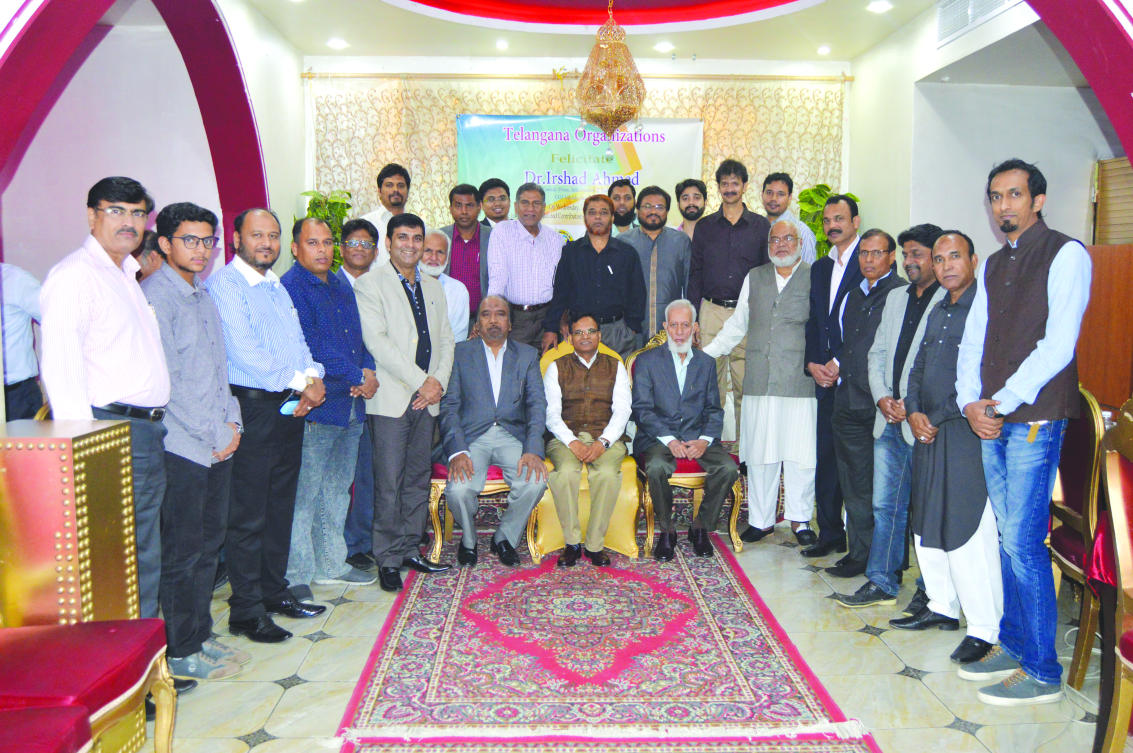
Dr.Irshad Ahmed (seated centre) with leading members of the Indian community in Jeddah at the farewell event
 JEDDAH:
An evening to bid farewell to Dr. Irshad Ahmed, consul for press, information and culture, on completing his four-year term at the Consulate General of India in Jeddah was held recently.
 It was organized by Jeddah-based community welfare organizations from Telangana, including Khak-e-Taiba Trust, Urdu Academy, Deccan NRIs, Noor Education Society, Pain & Palliative Care Trust and Telangana Welfare Foundation.
 Ahmed thanked the Telangana organizations for holding the event in his honor. He spoke about his memorable experiences in the Kingdom and applauded the hospitality of the Hyderabadi community residing in Jeddah.
 “People living in this holy land are very blessed and very proactive when it comes to community welfare,” he said, adding he will miss the Indian community.
Ahmed said he enjoyed his stay in Jeddah and felt very fortunate to be able to help the expats residing here.
The evening commenced with the recitation of the Holy Qur’an by Hafiz Noor, followed by a heart touching naat by Khalid Hussain.
Mirza Qudrath Nawaz Baig, along with senior community members, welcomed Chief Guest Ahmed and lauded the brotherly hand he had extended toward overseas Indians.
The presidents and vice presidents of the Telangana organizations praised Ahmed for his dedication to the Indian community and in organizing various events; specifically pointing out the large-scale mushaira held at the Consulate of India and promotion of the Urdu language in a foreign land.
Ahmed was presented with a plaque of appreciation. Members of the Telangana organizations said they would not say goodbye to Ahmed but would rather say “see you soon.” They said they are looking forward to seeing Ahmed soon in Jeddah on a new assignment.
One of the key hosts of the event, Imran Kausar, gave the audience an overview of the consul and his achievements.
He started his career as an Arabic lecturer in Jamia Millia Islamia in 1995; he later joined the Ministry of External Affairs, Government of India in 2001. His first foreign posting was at the Embassy of Riyadh as third secretary (Information and Culture from 2003 to 2005; then he was transferred to Consulate General of India, Jeddah as consul (Education and Culture) from 2005 to 2008.
He then worked as undersecretary (Gulf) from 2008 to 2012 and was then posted to the Consulate General of India, Jeddah again where he continued his posting as consul (Press, Information & Culture) from 2012.
He will continue his new assignment at the Ministry of External Affairs (headquarters) in New Delhi, India.
Leading members of the community at the event included Shameem Kausar, Siadat Ali Khan, Hasan Bayazeed, Jamal Qadri, Abdul Razzak, Abdul Wahab, Asimuddin Ansari, Aslam Afghani, Asif Daudi, Tahir Ali, Noorul Amin, Majid Saleem, Munawar Khan, Mazharullah Jibran, Sheikh Ibrahim, Rashid Razzak, Saleem Farooqui, Mahmood Misri, Ghazanfar Zaki, Mir Arif Ali, Abdul Rafay and Liaqat Ali Khan.
source: http://www.arabnews.com / Arab News / Home> Saudi Arabia / Wednesday – April 26th, 2017

India’s rabab maestro strikes a chord in Afghanistan

Bugrasi (Bulandshahr), UTTAR PRADESH :

In Afghanistan, he teaches locals the rudiments of playing the lute-shaped musical instrument which is quite akin to the sarod.

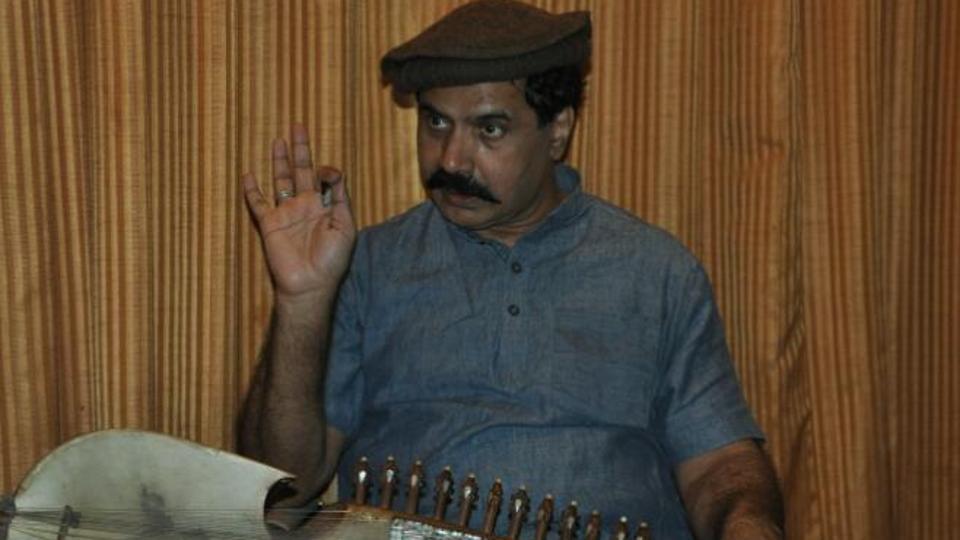
Ustad Gulfam Ahmad Khan with Afghan Rabab. (Rajesh Kumar/ HT Photo)

Music transcends borders and captivates hearts. Going by this maxim, India’s noted rabab exponent Gulfam Ahmad Khan, 61, is a winner all the way, from India to Afghanistan.

Khan, who played the Afghan rabab at Sankatmochan Sangeet Samaroh here late Saturday night and left the audience spellbound, has become India’s ambassador of goodwill of sorts in Afghanistan.

In Afghanistan, he teaches locals the rudiments of playing the lute-shaped musical instrument which is quite akin to the sarod.

Khan, who divides his time between New Delhi and Kabul, has taught 250 Afghan nationals and 50 more are under his tutelage. His skill has earned him enormous respect in Afghanistan where people call him Ustad.

In particular, he wants to popularise the Dhrupadi rabab (Narad veena), an Indian variety of the instrument, across Afghanistan and in other parts of the world.

Khan wishes for Prime Minister Narendra Modi to take the initiative to popularise the Indian rabab.

“Dhrupadi rabab is a completely classical instrument. It produces spiritual tunes. The Afghan rabab is for fast tunes. The Indian rabab needs promotion and preservation. If the centre makes a little effort, it may become a highly popular instrument in Afghanistan,” Khan told HT.

Khan , who is in Varanasi on a four-day tour, will leave for New Delhi on Monday.

Born in Bugrasi, a town in Bulandshahar, he started playing the rabab with his father Ishtiyaque Khan who had mastery over both rabab and sarod. He gave his first performance at the age of nine in Gurudaspur.

After putting in hours of riyaaz (practice), he honed his skills.

A few years later, he performed in Ahmedabad and did not have to look back thereafter.

He took a break for a few years in the late 198os when there were no connoisseurs of the great art. During this period, he played the sarod, only to return to the rabab in the 1990s.

Starting a fresh innings, he gave a few public performances and wrote the popular number ‘Gata jaaye mast kalandar, Allah teri shan, Maula teri shan’, composing the music on the rabab.

The song made him popular across Punjab.

When he visited his daughter and son-in-law in Afghanistan, he played the rabab and impressed the locals there. Many of them insisted on learning to play the rabab from him. He did not refuse.

As his renown reached the Indian embassy in Afghanistan, senior officials invited him to hold classes on the rabab to the Afghan people. Shedding his initial reluctance, he eventually accepted the offer.

He remained in Afghanistan between 2009 and 2014, training many locals. He also learned some local songs.

“Over 250 Afghans learned to play the rabab in my classes. Some of them are professional rabab players. Around 50 Afghans still take tips from me,” he said.

“Performing at the Sankatmochan Hanuman Temple is a spiritual experience. The audience enjoyed my performance. I will keep coming here. Banaras is a great city and its culture is really fabulous,” he told HT.

After putting in hours of riyaaz (practice), he honed his skills.

A few years later, he performed in Ahmedabad and did not have to look back thereafter.

He took a break for a few years in the late 198os when there were no connoisseurs of the great art. During this period, he played the sarod, only to return to the rabab in the 1990s.

Starting a fresh innings, he gave a few public performances and wrote the popular number ‘Gata jaaye mast kalandar, Allah teri shan, Maula teri shan’, composing the music on the rabab.

The song made him popular across Punjab.

When he visited his daughter and son-in-law in Afghanistan, he played the rabab and impressed the locals there. Many of them insisted on learning to play the rabab from him. He did not refuse.

As his renown reached the Indian embassy in Afghanistan, senior officials invited him to hold classes on the rabab to the Afghan people. Shedding his initial reluctance, he eventually accepted the offer.

He remained in Afghanistan between 2009 and 2014, training many locals. He also learned some local songs.

“Over 250 Afghans learned to play the rabab in my classes. Some of them are professional rabab players. Around 50 Afghans still take tips from me,” he said.

“Performing at the Sankatmochan Hanuman Temple is a spiritual experience. The audience enjoyed my performance. I will keep coming here. Banaras is a great city and its culture is really fabulous,” he told HT.

source:  http://www.hindustantimes.com / Hindustan Times / Home> Cities> Lucknow / by Sudhir Kumar, Varanasi, Hindustan Times / April 17th, 2017

Hina Khan seeks blessings at Ajmer Sharif Dargah

Srinagar, JAMMU & KASHMIR / Mumbai, MAHARASHTRA :

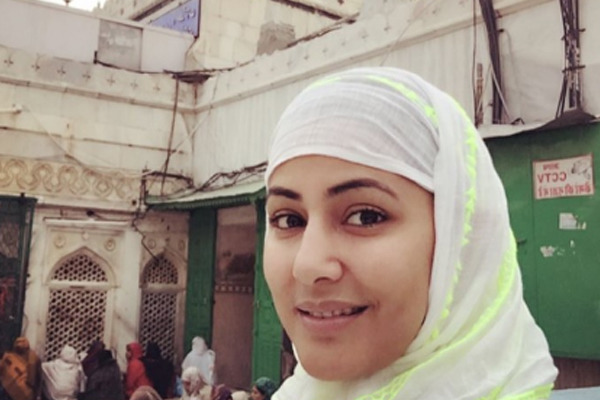
HinaKhanMPOs25apr2017

Actress Hina Khan, who is known for her iconic performance of Akshara on the show Yeh Rishta Kya Kehlata Hai, recently visited the Ajmer Sharif Dargah.

She played the character of Akshara, a lady who was very homely and sanskari. Hina was praised for her performance multiple times. She had become the face of Yeh Rishta Kya Kehlata Hai and made the show popular. For more that 8 years, the actress entertained the audience and got immense love in return.

She recently quit the show and is currently on a break. The actress is spending her time with her close friends and is visiting a number of places. She offered prayers at the Ajmer Sharif Dargah and shared the following post on her social media handle.

Hina has also been in the news as there are rumors about her taking up Nach Baliye with rumored beau Rocky Jaiswal.

source: http://www.timesofindia.indiatimes.com / The Times of India / Home> News> TV> News> Hindi / TNN / February 20th, 2017

Aslam Parvez brings to life the time and poetry of Bahadur Shah Zafar in new book

NEW DELHI :

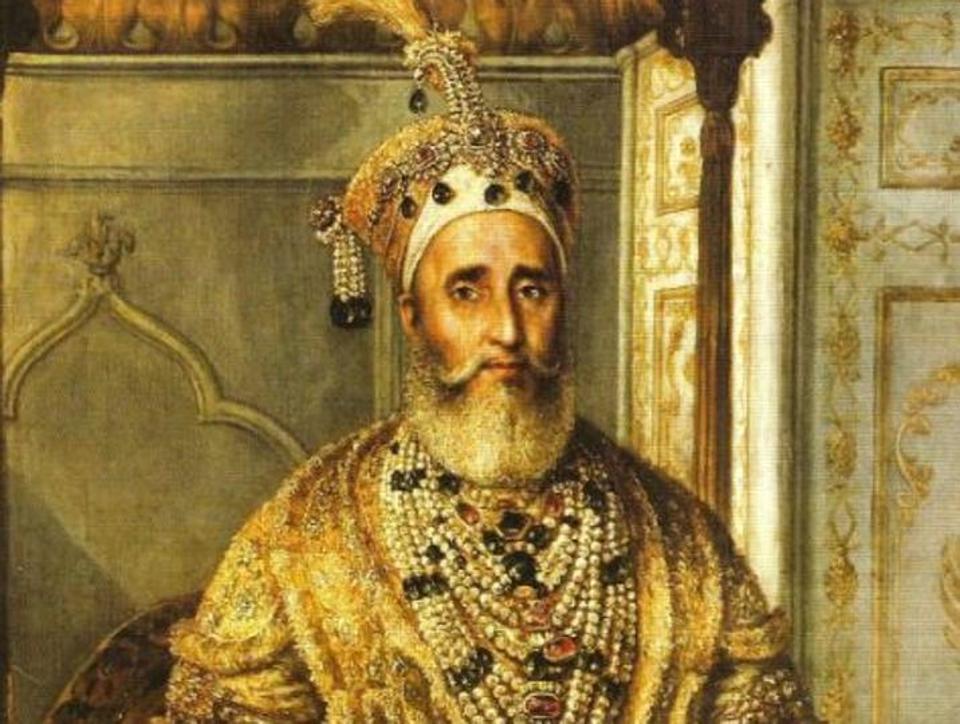
First published in Urdu in 1986, the book highlights the life and poetry of Zafar (1775 to 1862), whose reign marked a crucial period in the Indian history.

Bahadur Shah Zafar’s oil portrait, painted in 1854 by Austrian artist August Schoefft, now in the fort of Lahore.(photo_kraft/Instagram)

A new book brings alive the life and poetry of the last Mughal Emperor Bahadur Shah Zafar as author Aslam Parvez weaves together the strands of the political, the personal, the cultural and the literary aspects of a bygone era.

Publisher Hay House describes The Life and Poetry of Bahadur Shah Zafar as an absorbing, authentic and exemplary chronicle — studded with rare nuggets of information and enthralling anecdotes — of one of the most tragic figures of history who was witness to the end of a glorious dynasty.

First published in Urdu in 1986, this book brings alive the life and poetry of Zafar (1775 to 1862), who presided over a crucial period in Indian history when the country was subjugated and became a colony of the fast-expanding British Empire.

This work is as much about the 1857 Rebellion as it is about Zafar, the reluctant leader of the rebels. The pages also evoke the captivating ambience of a period when formidable poets such as Mirza Ghalib, Sheikh Muhammad Ibrahim Zauq and Momin Khan Momin, apart from Zafar himself, came up with one creative gem after another.

The author also provides a vivid picture of Delhi during the last days of its cultural and literary splendour as the Mughal capital and as a custodian of Urdu literature and poetry.

Finally, he recounts, in a touching manner, how Zafar spent his last days in Rangoon (where he had been exiled by the British) — a lonely and forgotten individual — far away from his beloved Delhi and from the trappings of empire.

source: http://www.hindustantimes.com / Hindustan Times / Home> Books / PTI, New Delhi / April 25th, 2017

Only Hebrew teacher in Indian university is a Muslim

Gopalganj, BIHAR / NEW DELHI :

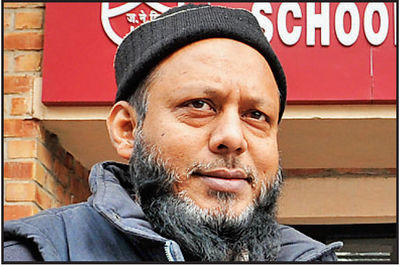
JNU professor Khurshid Imam.

New Delhi :

He has prayed in synagogues and observed the Sabbath, Judaism’s day of rest, and enjoyed crispy falafel on the streets of Jerusalem. A map of Israel hangs in his study where Yasser Arafat shares space with David Ben-Gurion. And he doesn’t mind if his 10-year-old daughter greets him with ‘Shalom’ instead of ‘Assalam Alaikum’. Meet Dr Khurshid Imam, a devout Muslim and the only teacher of Hebrew at a university in India, Jawaharlal Nehru University.

The bearded, skull cap-donning Imam hopes for a new dawn in India-Israel ties, which received a boost with foreign minister Sushma Swaraj’s West Asia visit last week. Unlike most Muslims who look upon Jews with suspicion – just as most Jews don’t trust Muslims – this assistant professor of Hebrew at the Centre of Arabic and African Studies doesn’t harbour any animosity. And he wants to use Hebrew, the ancient language in which the sacred Torah was revealed, to bring Jews and Muslims closer.

The cause of animosities between Muslims and Jews is political. Religion is a pawn in the hands of politicians who don’t want adherents of the two Abrahamic religions cementing ties,” said Khurshid Imam, 46, whose unique distinction “baffles” many of his co-religionists brought up on a heavy dose of hatred for Jews.

“Many call me ‘Mossad agent’ among Indian Muslims, a Zionist promoter and some even jokingly call me ‘nek Yahudi’ (benevolent Jew) because of my passion for Hebrew,” laughs Imam, third among six siblings who grew up in Gopalganj, Bihar, and went to Hebrew University of Jerusalem in 1998. He stayed there till 2000 post-M Phil at JNU.

“Government of Israel scholarship and Golda Meir scholarship funded my courses in Hebrew and study of the Modern Middle East,” he said. “I wanted to learn Hebrew to understand Judaism and find commonalities between Islam and Judaism.”

He also wanted to conform to a hadith (tradition) of Prophet Muhammad, who is believed to have asked some of his companions to learn Hebrew. “If the Prophet encouraged Muslims to learn Hebrew, who are clerics and community leaders to issue fatwa against those who visit Israel?” he asked.

Despite apprehensions of friends and family, Imam chose to stay amid Jewish students who he discovered were not as “rabidly anti-Muslim” as many paint them to be.

“Many Jews first thought I was a non-Arab Muslim jihadist plotting to bomb their establishments. Similarly, Arab Muslims in Israel and Palestine mistook me for a Zionist disguised as a practising Muslim. Once, some kids even threw stones at me, shouting, “Yahud, Yahud” (Jew, Jew). I was moved when several Jewish friends wept when I left Jerusalem,” recalled Imam.

He is, however, disappointed by the “cold” response from several Indian universities to his proposal for teaching Hebrew. “Khurshid’s efforts are laudable and I believe Indian universities should open their doors to Hebrew because languages help build bridges between people,” said S A Rahman, retired professor of Arabic who mentored Imam at JNU.

source: http://www.timesofindia.indiatimes.com / The Times of India / News Home> India / by Mohammed Wajihuddin / TNN / January 24th, 2016

Aamir Khan gifted Maulana Azad’s speech to sister

Pune, MAHARASHTRA :

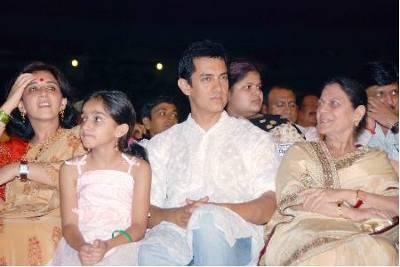
Aamir Khan's family
Aamir Khan’s family

For her elder sister Nikhat’s 50th birthday, Aamir Khan gifted her five speeches of  Moulana Abul Kalam Azad.

Aamir Khan’s sister, Nikhat celebrated her 50th birthday on Saturday and the entire Khan-daan was in Pune celebrating her birthday with lot of fanfare.

Aamir Khan had been thinking since a really long time of a special birthday gift for his sister. The entire family had been pitching in ideas for gifts to give to Nikhat. Everyone in the family had given him several options.

However, our perfectionist Khan wanted to look for the most perfect birthday gift for his sister. He especially wanted the gift to be extremely special, as it was Nikhat’s 50th birthday.

After a long brainstorming session Aamir Khan did the unbelievable. “He sourced and got the copy of five speeches of Maulana Abul Kalam Azad, the great Indian freedom fighter and Aamir Khan’s great grand uncle”, says a source. “At the get-together in Pune, everyone in the family heard all the speeches together and was teary eyed at the end of the session”.

“As it was much before their time and way back in history, no one from the family had ever heard Maulana Abul Kalam Azad’s voice ever before including Aamir, his sisters, bothers and cousins”, adds the source.

Aamir Khan and Kiran’s son Azad Rao Khan has been named after Maulana Abul Kalam Azad.

2012 has been Aamir Khan’s busiest year ever. Aamir is known for doing one project at a time. This is the first time in his career that he has been juggling between his magnanimous TV show Satyamev Jayate, Talaash and Dhoom 3 all in the same breath. Hence Aamir Khan hasn’t been able to spend quality time with his family.

source: http://www.http://www.timesofindia.indiatimes.com / The Times of India / News> Entertainment> Hindi> Bollywood> News / TNN / August 07th, 2012

The Queen of Roses

MADHYA PRADESH / NEW DELHI :

I enjoy food and do not like to eat like a glutton, but relish each morsel and am ready to experiment with the food which has a touch of Indian roots.

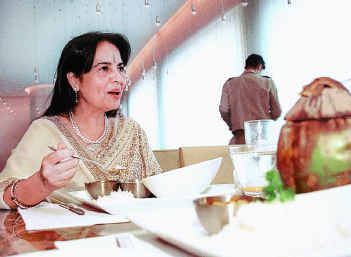
Salma Sultan reveals her fine taste over food at The Park's Fire restaurant in New Delhi.
Salma Sultan reveals her fine taste over food at The Park’s Fire restaurant in New Delhi.

REMEMBER THE newsreader on Doordarshan with a big, red rose in her hair? And then you would wonder, whether it was a season of the rose or not, but she would always have one tucked in her neatly done hair? Yes, one is talking about Salma Sultan. The famous face on the small screen, who also initiated a trend: of draping the border of her sari around her neck in a modern yet traditional way. It was later picked up by almost all the female newsreaders. She now discloses the reason; “I did not have so many blouses to match with each sari so I created a style to hide them.”

You saw her till 1997 then wondered where she vanished after that. Well, she started doing something more worthy of her time. That is, making serials on social topics for Doordarshan under her production house Lensview Private Limited. Serials like “Suno Kahani”, “Panchtantra” and “Swar Mere Tumhare” were among the offerings.

She is averse to those family soaps in which women are scheming and have an extra marital affair at the drop of a hat. But she is definitely not averse to food. “I enjoy food and do not like to eat like a glutton, but relish each morsel,” says Salma, now a grandmother of two, though looking at her well-maintained stature one would not find it hard to believe her on this count. The grace personified Salma is at New Delhi’s Fire restaurant in The Park Hotel. She is ready to experiment with “the food, which has a touch of Indian roots”. This 60-seat restaurant leaves one spellbound for two reasons: one, the space, limestone colour floors, walls and furniture drapes, and seats arranged at considerable distances making the restaurant a comfortable gourmet experience and second, a radiant orange, glass wall on which glittering green, red, orange lights keep interchanging their positions, providing a visual delight. Her starter of sweet corn, ginger and coriander soup has arrived. She warns the photographers, “Please don’t take my picture while I am eating, you would repent seeing those horrifying mouth angles in the frame later.”

You might have wondered why Salma would economise on her smile on DD but a meeting with her ensures a belly laugh for she tells you ample hilarious incidents. She recalls one such occurrence, “Once while reading news, I realised that two words got jumbled with each other. The line read like this, `Purane zamane main aurton ko bandar kaha jata tha’ while it should have been `Purane zamane main auraton ko band rakha jata tha’. The moral of the story is “the alertness of the mind is very important while reading news”.

Her entry into news reading too had been quite a hilarious experience. After doing her post graduation from English Literature from I. P. College, Delhi, she started working with Doordarshan as an announcer and presenter. “Those days (1967-68), they would not take young people for news reading but mature ones. Pratima Puri and Gopal Kaul were regular faces then. But Kaul never wanted to read news so once, when it was time to read news, he came entered the office with a completely-shaven head! Panic-stricken producer started looking for someone to replace him and their choice zeroed on me. I was asked to give a quick audition.” Always ready to take up challenges, Salma followed, “When I came back to the control room after audition, I witnessed a pin-drop silence and everyone sitting stunned. With a chocking voice I asked what happened, and was told that I read the 15-minutes news so quickly that they could not even start the roll!” Such was her nervousness that made DD realise that they should train people for news reading too!

Here she changes the subject to food. She prefers a spicy main course: broccoli, zucchini, asparagus, baby corn and bell peppers with kadai spices.

There is another facet of her personality that is strongly reflected in her serial titled “Jalta Sawal” on women issues currently showing on DD News on Sundays at 11 a.m. The face of a very sensitive and concerned woman and a responsible citizen. In this “very well-received programme” as she gauges from the responses, she has shown insightful and touchy episodes on prostitution, rape, dowry, infertility and foeticide. The next episode on working women can be seen this coming Sunday.

It’s time for some dessert here and Salma is offered a special seasonal fresh-fruit platter with kulfi. “That’s wonderful,” she compliments.

And she too!

RANA SIDDIQUI

source: http://www.thehindu.com / The Hindu / Home> MetroPlus – Online edition / by Rana Siddique / Thursday – Mar 24th, 2004

Nusrat Jahan: Calcutta Times Most Desirable Woman 2015

Kolkata, WEST BENGAL :

NusratMPOs25apr2017

Standing tall at 5’7”, Nusrat Jahan’s beauty is right there -staring at you. And no, you can’t look away because she’s absolutely gorgeous in her simplicity. Nusrat, who has been voted as Calcutta Times Most Desirable Woman of 2015, is on cloud nine! The overwhelming number of votes received online on http:www.itimes.compolls, along with our vote, has helped us decide the winners. When we reached out to Nusrat, who has topped the list, the twinkle in her eye got brighter.Excerpts:

How does it feel to be voted as the Most Desirable Woman of 2015? I am at a loss of words to express my feelings at this moment. I feel on top of the world. Still pinching myself to believe this is true. Times Most Desirable Woman is a prestigious honour given by The Times of India and I sincerely thank all those who thought I deserve this title.

What, according to you, makes a woman desirable? I believe beauty comes from within. A woman’s inner strength and her personality make her desirable. It has nothing to do with her looks. Her behaviour also matters.

How many times a day do you check yourself out in the mirror? Rarely. I believe I look good all the time (laughs), so I don’t need to keep looking in the mirror. On a serious note, I am too lazy . I am miles away from the mirror unless I am shooting or going out.

Who do you think is the most desirable man? Bradley Cooper -suave and oh-so-hot! You can find me drooling over him.

What do you find attractive in a man? Honesty and chivalry . I also like men with a good sense of humour, someone who can engage me in a conversation for hours.

Are you aware that men find you desirable? Well, yes! Name one woman who will not enjoy getting attention from men.

Who, according to you, is more desirable than you? Nicole Kidman -she is elegance and beauty personified.

What is that X-factor in you that makes men go weak in the knees? My eyes and smile!

Tell us about the milestones you want to achieve in life. I am a happy-go-lucky person, who lives in the present. I don’t waste time fretting about the future I can’t control. I work hard and leave the rest to the Almighty , who has already chalked out the course of my life .

source: http://www.timesofindia.indiatimes.com / The  Times of India / News> Entertainment> Bengali> Movies / TNN / January 12th, 2017

The Begum and the Mutiny

Kotwara, UTTAR PRADESH / FRANCE :

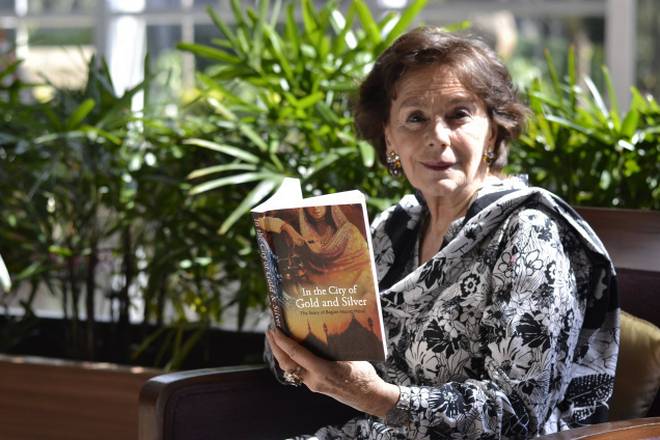
Kenize Mourad, author of ‘In the city of gold and silver – the story of Begum Hazrat Mahal’. Photo: Sangeetha Devi Dundoo

Hyderabad :

In the story of Begum Hazrat Mahal, Kenize Mourad found a story that belied misplaced notions of Muslim women of yore

Kenize Mourad, while researching for her book ‘In the City of Gold and Silver’, came across references to Begum Hazrat Mahal in documents written by the British. They referred to her as the ‘soul of the 1857 War of Independence’. “It is unfortunate and unfair that she has been forgotten in India,” says Kenize Mourad, in Hyderabad to launch her book ‘In The City of Gold and Silver – The Story of Begum Hazrat Mahal’ (Full Circle publications; Rs. 350).

Speaking to us in an interview, the author says, “Rani of Jhansi, Lakshmi Bai, is remembered because she died on the battlefield. She fought for about four or five months. Begum Hazrat Mahal fought the British for two years. It took the British nine months to gain control over Lucknow. The Begum continued her fight for a year after this.”

Kenize Mourad is of Turkish and Indian descent, Awadh to be precise. “I first visited Lucknow when I was 21 and heard about Begum Hazrat Mahal and her valour from my father (Raja Syed Sajid Husain Ali of Kotwara). Years later, I remembered the story and felt the Begum’s story had to be told,” says Kenize.

The author pored over documents and books in libraries of London, New Delhi and Lucknow. “It took me three years to find enough information. In Lucknow, I spoke to families whose ancestors had fought in the battle along with the Begum. Quite a bit of history in India follows an oral tradition,” explains Kenize.

She scouted libraries in London and came across six volumes of ‘Mutiny Papers’ documented by the British. An 1858 edition of The Times had stated ‘The Begum of Awadh shows greater strategic sense and courage than all her generals put together’. Kenize wanted to write about the Begum and dispel notions about Muslim women of yore. “The book is relevant in this time when Islam is misrepresented. The majority of Muslims, 95 to 98 per cent, is also being put in the same bracket as extremists, which is unfair. And these normal people are the first ones to suffer due to extremists,” says Kenize. “I wanted to show how a Muslim woman was strong enough to lead an army. The Begum was an intelligent woman who enforced justice and waived taxes on food for the poor,” says Kenize.

Kenize takes pride in raising her voice for underdogs all through her career as a journalist in France. “I’ve felt like a fighter for justice all my life. In my books, I have often written about the misrepresentation of the Quran,” says Kenize. History, she says, has intriguing accounts of women Muslim rulers. “There are instances of Turkish women holding important positions on their own right, not because they are mothers, sisters of wives of important men.”

Though Kenize was keen to present accurate historical facts in ‘In The City of Gold and Silver’, she took the liberty of weaving in a love story between the Begum and a dashing Hindu Raja. “I felt people will absorb an interesting historical novel than a dry book full of facts. Keeping the sociology of people in that era, I tried to recreate Awadh of those times,” says the author.

Kenize wrote the book in French. “In France, the book sold more than 70,000 copies. The pocket-friendly (abridged) version sold even more copies,” she says. The book has been translated in English by Anne Mathai and Marie-Louise Naville.

Talking about her roots in Lucknow, Kenize says, “During my first visit to Lucknow as a student, I was amused and spent six months there. Had it been a bigger city like Delhi or Mumbai, I might have stayed on. Opportunities for work were limited. And I wasn’t willing to sit at home and get ready to be married off,” she says. The topic of marriage reminds her of Hyderabad. “I was almost married off to a well-known Hyderabadi,” she says. “Through my cousin, Princess Niloufer, I happened to meet a gentleman from the Nizam’s family. He told Niloufer that he hoped for my hand in marriage. I found it odd that he hadn’t asked me directly. I was given to understand that I would be a ‘bird in a golden cage’. I turned down the proposal.”

This is Kenize’s first visit to Hyderabad. “I never visited this city thinking I may not be welcome here since I turned down the marriage proposal,” she laughs.

Next, Kenize wants to write about present-day Pakistan. “The country, as it exists today, is a tragedy. I want to write about Pakistan through fiction. It will take at least three to four years to work on the book,” she signs off.

source: http://www.thehindu.com / The Hindu / Home> Books / by Sangeetha Devi Dundoo / Hyderabad – January 17th, 2013