Category Archives: Arts, Culture & Entertainment

Alive, but dead on papers

Patna, BIHAR / NEW DELHI :
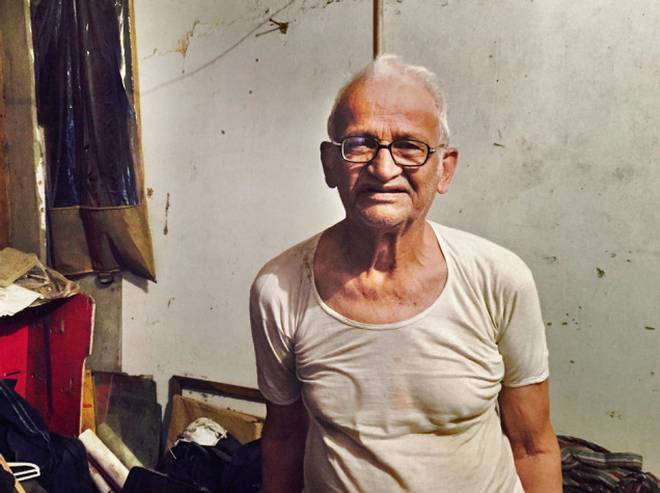
Poet Asrar Jamai, 75, says, “I am alive, but no official knows of it.”Photo: Maria Abhraham

Asrar Jamai, a 78-year-old poet, is fighting a bizarre battle for survival. For the past one-and-a-half years he has been making the rounds of the Social Welfare Department office to prove to the officials that he is alive, but no one seems to believe him.

According to Mr. Jamai, the department has declared him “dead” because of some confusion and has stopped his old age pension. He says he has submitted all relevant documents — PAN card, Aadhaar card — but they do not seem to be enough to change his “dead” status.

“I told the officials that I am standing in front of you, what else can be the biggest proof?” he says. “The official replied that he knows I am alive, but not other official knows of it.”

Mr. Jamai survives on the money he earns from his recitals at Mushairas. He lives in a small, rented room in the ever-crowded Batla House locality in Okhla. He has penned three books in Urdu and many of the unsold copies are stacked neatly in one corner of the room next to his cot where a collection of black fur caps are lying next to the pillow. A black Sherwani hangs on the electric wire that lights the only bulb in the room. He says he pays a little over Rs.1,000 as monthly rent for the room.

The pension he received was Rs.1,500 every month. “It may seem little for others but at least I could pay my rent with it,” he says, adding, “But now it’s not about money, it’s about my existence.”

Narrating his ordeal, he says that it took him more than five years to get registered with the department and start getting the pension. His passbook shows he starting receiving the pension from March 5, 2011 and the last time it was credited to his account was on April 22, 2013. “Since then I am fighting to prove that I am alive.”

According to officials, the department conducts a survey every year to ensure that the pensioner is alive and stays in the city. Moreover, the pensioner has to fill a form every year. “It seems either Mr. Jamai did not fill the form or there is an error from the department’s side. We will get it checked and if there is an error from our side, we will get it rectified,” said an official.

The area MLA, Amanatullah Khan, said he will take up the matter with the department.

source: http://www.thehindu.com / The Hindu / Home> National> New Delhi / by Maria Akram / New Delhi – September 28th, 2015
On the Kutch food trail

London / Kochi, KERALA :

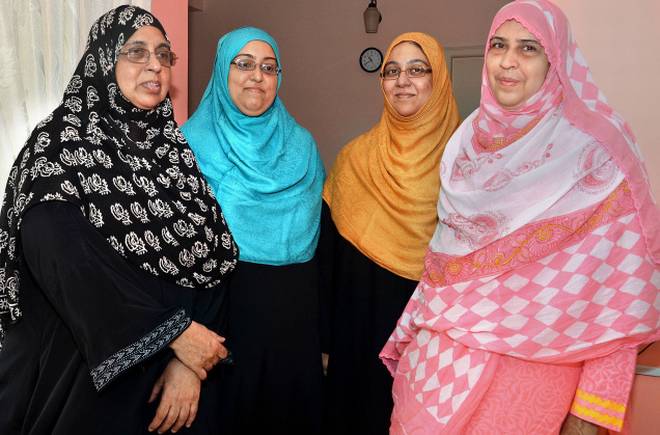
Together for food : From left, Sajida Aslam, Ruqia Suhaib, Nazia Tamir and Munira Munir from ‘Cutchi Kitchen’. Photo :Thulasi Kakkat

‘Cutchi Kitchen’ documents Kutchi cuisine through memories and recipes.

Almost 200 years ago, Sajida Aslam’s grandfather moved to Alappuzha from the Kutch region of Gujarat. Seventy-five years ago, her father moved to Kochi, where she was born among the growing community of Kutchi Memons in the city. Today, Sajida’s daughter, Shazia Wahid, is the founder of ‘Cutchi Kitchen’ — an initiative that documents through history and memories, the rich cuisine of the migrant community.

‘Cutchi Kitchen’ runs a website and a catering service primarily of Kutchi delicacies, with world cuisine as well. While Shazia runs the website from her present home in London, her mother Sajida, aunt Munira Munir Sait, sister Nazia Tamir and cousins Ruqia Suhaib and Sabiha Munir man the local orders from their homes in Ravipuram and Kaloor. “Shazia was inspired to begin ‘Cutchi Kitchen’ after she left the country,” says Ruqia, “She gave us all the first big push and we’ve completed almost a year now.”

‘Cutchi Kitchen’ opens with Shazia’s tribute to her ummima’s (maternal grandmother) special Kutchi chicken biryani. It is a detailed affair with three layers of rice sandwiching chicken in between, and served with raita. This recipe has been a favourite in our family for three generations for its minimal standing-by-the-stove time, writes Shazia. While two generations of Sajida’s family are involved in the daily workings of ‘Cutchi Kitchen’, Ruqia and Nazia say their children have taken a keen interest too, often chipping in with the preparations and tasting.

‘Cutchi Kitchen’ now has an active Facebook presence with over 3,000 fans and several followers on Twitter too. “We try and post at least once a day — either tips, or full recipes,” says Nazia. Thus far, they’ve had two online competitions too — the more elaborate one after they completed 100 recipes.

Their popularity rose most during the Ramzan fast, when they put together nine special Iftar menus, each with six dishes from starter, drink and main course to dessert. One of the highlights of these menus was their falooda recipes. While Sajida created an unusual falooda pudding made from China grass and cut into diamonds once set, Munira prepared the falooda drink, served cold and with jelly or ice cream. The menus were then released as an e-book.

The fasting season also brought with it almost daily orders for homemade frozen chicken fillets, samosas and rolls that only have to be fried before consumption. Their most ordered dish was also ‘Cutchi Kitchen’s’ most prized recipe — the goond jo laddoo, a powdery, sugary dessert served for auspicious occasions, given to brides before weddings and to mothers after deliveries. Explains Sajida, “The goond (acacia gum) has medicinal properties, and though the recipe for the laddoo is simple, it takes years of practice to get the mixture to hold right without giving way or being too sticky.” Sajida and Munira are the only ones in the family who prepare the laddoo, even today, as the next generations are still grasping the knack.

Changing rituals

Time has changed much among the Kutchi Memons, says Sajida. Old, prolonged rituals have turned brief, and with it, the associated foods have morphed too.

For example, by tradition, the peeti (haldi) ceremony for brides lasted several days and the household favourite was muthiya, a steamed rice dumpling dish that could be served dry or with gravy. “I remember my ummima sitting and shaping the muthiyas all by herself, not trusting anyone to make them correctly with her special mix of spices and ingredients,” writes Shazia. Peeti ceremonies now are associated more with quicker dishes such as kaaja (a badusha-like savoury) and paalchaya, a condensed milk-based drink. Hot favourites are also the Kutchi koottan (a dal curry served with pathiri), beef kofta (boneless beef meatball curry), buttery, cookie-like nankhatais and mitta ghatia, a deep-fried flour-based snack.

Sajida counts among her most prized possessions, a kombi, a 100-year-old bandini shawl bordered by gold, traditionally placed over the bride’s head at weddings. What they also cherish is their Kutchi language — a conglomeration of Sindhi, Gujarati, Urdu and Hindi, reflective of the community’s wide travels.

“We still speak it at home and though it has no specific script, all our children have learnt it too alongside Malayalam, Hindi and English,” says Sajida in fluent Malayalam. Someday, they hope to bring out a book of their family’s recipes. For now, ‘Cutchi Kitchen’ conducts workshops on their food, alongside those on Arabian recipes and world cuisine. Find the ‘Cutchi Kitchen’ at www.cutchikitchen.com

source: http://www.thehindu.com / The Hindu / Home> Food / by Esther Elias / November 14th, 2013

Nawab who misses the royal culture

Hyderabad, TELANGANA :

At 92, Shah Alam Khan visits his office daily and tries his best to preserve Hyderabad’s culture.

Shah Alam Khan, one of Hyderabad’s royals who is still referred to as ‘Nawab’.

At 92, Shah Alam Khan, one of Hyderabad’s royals who is still referred to as ‘Nawab’, is gracious enough to stand up to welcome you into his study at the Hyderabad Deccan Cigarette Factory in Musheerabad. What’s more, he eloquently reminisces on the “good old days” when Hyderabad was still ruled by the Nizams.

“Life was not expensive at all. I once saw a goat being sold for four rupees… four rupees!” he says incredulously. With seven sons, Alam’s family has, over the years, expanded their businesses in various fields but one thing that they all take pride in is ensuring that the Nawabi and Hyderabadi culture isn’t forgotten.

Alam’s son Mehboob Alam Khan is a well-known food historian and connoisseur who has helped preserve the Hyderabadi Mughlai cuisine that the city is famous for. Working with various restaurants, Mehboob helps them maintain authenticity in their recipes.

“Hyderabad was known for two things — biryani and sherwani!” says Alam, and says that training today’s chefs is all that is required to bring back the lost culture. “The cooks in our city know only a little bit of this and that. But our womenfolk know a lot of recipes,” he says.

Sipping a typically Hyderabadi cup of chai, he talks about growing up in the Cantonment area in Secunderabad and moving on to study at the Jagirdar College — what’s now known as Hyderabad Public School. “We had the best of Continental as well as Mughlai food. Even the schools served amazing food, that we didn’t even get at home!” he remembers.

Alam then pursued a Bachelor’s degree in Economics and Political Science from Osmania University, where he says his professors helped mould his life: “I can’t forget the way my English teacher, Prof Doraiswamy, taught us. When the results came out and I passed, I went to his house and fell at his feet.”

The lessons came in handy when he took over the reins of a cigarette factory from his wife Begum Abida Khader’s father in 1945. “When I used to hoist the flag during ceremonies, I’d tell them that this is the place where you as well as me fill our tummy. If there’s a quarrel in the house between the husband and the wife, then your house is not good. If there’s a quarrel in the factory, it’s not good for the industry,” Alam explains.

Alam still goes to office every day but has one regret: Not doing enough to preserve Hyderabad’s culture — “I once had the opportunity to address the old boys’ association of Osmania University in Karachi. And I told them with tears rolling down my cheeks that I can’t believe that the association is here… it should have been in Hyderabad. And with it, you have also taken away our culture.”

source: http://www.deccanchronicle.com / Deccan Chronicle / Home> Lifestyle> Viral and Trending / Deccan Chronicle – by Christopher Isaac / March 18th, 2016

The Subaltern Speak

Mumbai, MAHARASHTRA :

A Mumbai-based voluntary group launches a diary about the contribution of Indian Muslim women.

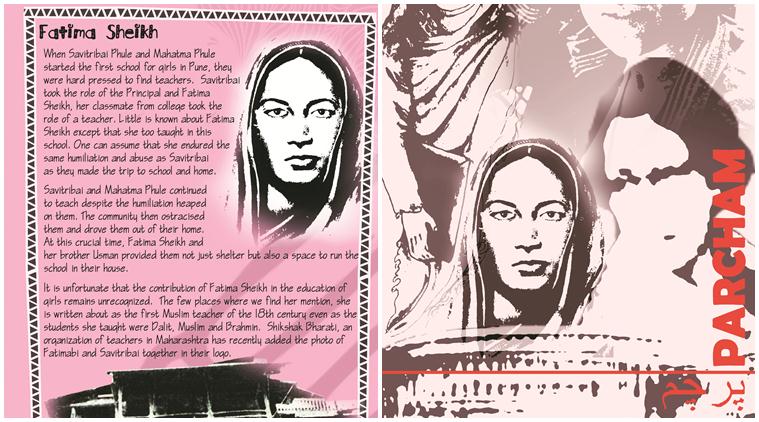
(From right) Book jacket of the diary; one of the inside pages that acts as a separator

Earlier this week, several Indian intellectuals and feminists paid homage to Savitribai Phule on her 185th birth anniversary. The contribution of the social reformist towards women’s rights, especially in the field of education, is now being recognised. However, Fatima Sheikh continues to be an elusive figure in Indian history. A diary introduced by Parcham Collective — a voluntary group in Mumbra in Thane district — celebrates Sheikh and several other pioneering Muslim women, who have contributed to society but have remained largely unacknowledged.

“In a political environment when the minorities in India, especially the Muslims, are having to prove their allegiance to the country, we hope this diary will reiterate that we aren’t the ‘other’,” says Sabah Khan, one of the co-founders of Parcham Collective, which attempts to break stereotypes based on religion, class, caste and gender. Active since 2012, they have been working with girls and have been successful in using football among adolescents to reclaim public space for the feminine gender and also bridge the gap between Hindus and the dominant Muslim population of Mumbra.

In the diary, Sheikh, a 2016 organiser, is the first Muslim woman, among six. Savitribai’s classmate from college, she not only taught at her school but also gave the Phule couple shelter when they were ostracised by the society for their work. The other women include Rokeya Sakhawat Hossain (1880-1932), Nazar Sajjad Hyder (1894-1967) and Rashid Jahan (1905-1952), among others. Their stories appear with illustrations and act as separators between the diary pages.

The idea of a diary, says Khan, came up earlier in 2015 during a discussion on Muslim women and their contribution to society. “At a time when education of the Muslim girl child is an issue and girls often drop out of school in Mumbra, we wanted to highlight women as role models who would inspire people,” says Khan.

The Parcham Collective team had been trying to unearth names and information of such women for a long time; the information had been tough to come by. It took them three months of research, tapping feminists such as Uma Chakravarti, and the names started to come up.

So there is Rashid Khan, a gynaecologist and writer, who was an inspiration to writers such as Premchand, Ismat Chughtai and Faiz Ahmed Faiz. A member of the Progressive Writers’ Movement, Rashid spoke about the oppression Muslim women faced everyday. As for Begum Qudsia Aizaz Rasul (1908-2001), few are aware that the Indian Women’s Hockey Cup is named after her. A politician from a privileged family, her key contributions include fighting for the abolition of the zamindari system and encouraging sports among women.

This is their first diary, but Parcham Collective wants to make it an annual project, using it to talk about subaltern women. They hope to dedicate the 2017 diary to Muslim women across the world in the arena of sports. “While the diary has been welcomed by feminists, we believe the real success of the project will be if common people purchase it and gain from it,” says Khan. Buyers can visit Parcham Collective’s Facebook page page and place an order for the diary.

source: http://www.indianexpress.com / The Indian Express / Home> Lifestyle> Book / by Dipti Nagpaul D’Souza / January 07th, 2017

Antique pieces are his only asset

Bidar, KARNATAKA :

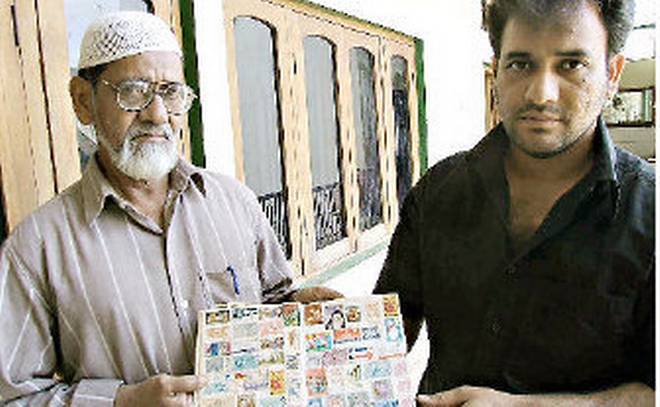
Rare: Liaquat Ali Khan and his son showing his collection of stamps in Bidar.

Liaquat Ali Khan’s house in Bidar is an informal museum

Bidar:

What would be the value of a Koran that has words written in liquid gold? Amateur antique collector Liaquat Ali Khan of Bidar has such a rare piece.

This is one of his prize possessions. He has many such invaluable things in his collection. His house is an informal museum of artefacts, coins, stamps, documents, rare cutlery, currency notes, paintings, books, matchbox covers, leaflets about stamp and coin collection, pens, historical tools, knives and many other things.

Mr. Khan’s early life was hard. He could not complete his studies and took up odd jobs. He started a petty shop and ran it for nearly 25 years. He had to close it down owing to some problems. He now lives with his son in a small rented house in Bidar. He keeps the valuables in trunks under the cot and spreads the collection on the bed whenever there are visitors.

“These antique pieces are my only asset. I have spent all my resources to collect them,” he says.

“Whenever I used to hear that somebody had a rare collectible, I would go and look at it. I would buy it if I liked it. I would request the owner to give it to me and bid for it,” Mr. Khan says.

His obsession with collecting rare things was such that his family grew weary of it.

“They would despise my hobby. My wife would complain that I gave more thought to collecting coins than bringing up my children,” he says.

His collection includes a “miracle coin” from the British mint. It is concealed in a cover that looks exactly like the coin inside. One can find out that there is a coin inside only by dropping it on the floor.

There is also a set of gold coins brought out by the Vijayanagara king Sri Krishnadevaraya.

He has a copy of a letter written in Urdu by Mahatma Gandhi to one of his friends.

Mr. Khan also has government orders signed by the Nizam of Hyderabad.

He has rare stamps such as the 3D stamp of Germany and a scented one of Saudi Arabia. Mr. Khan has currency notes of nearly 100 countries.

His son is helping him in preserving the collection.

Mr. Khan has requested the Government to provide him a room to set up a permanent museum. “I have repeatedly made this request. But it has not been considered,” he says.

“Many VIPs have seen my collection. All of them have appreciated it and promised help. But none of them have kept their promise,” he says.

source:  http://www.thehindu.com / The Hindu / Home> National> Karnataka / by Rishikesh Bahadur Desai / June 22nd, 2007

State Filmmakers make a mark

JAMMU & KASHMIR :

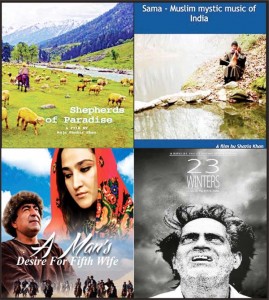
images: www. pinterest.com

Tariq A. Rather

Goa:
The 44th edition of International Film Festival of India (IFFI) at Goa has proved a wonderful platform for the Kashmiri filmmakers as the festival provided them opportunity to showcase their creative work not only to the domestic but also to the international audiences.
Three non-feature films by Kashmiri filmmakers were screened during the 11 day festival beginning on November 20. Another Kashmiri filmmaker having worked as an Associate Director for 90-Minute Afghan-Indo Film “A Man’s Desire For A Fifth Wife”—in Dari language, featured under ‘Cinema of the World’ section in the festival.
‘Shepherds of Paradise’ by Raja Shabir Khan, ‘23 Winters’ by Rajesh S Jala and ‘Sama: Muslim Mystic Music of India’ by Shazia Khan, are the three films which found place in the prestigious Indian Panorama-Non Feature (IP-NF) Section of IFFI-2013.
‘Shepherds of Paradise’
‘Shepherds of Paradise’, , in Gojri & Urdu is a 50 minute film which narrates the story of 75-year-old Gafoor, a shepherd (Gujjar–Bakerwal community), who travels on foot with his family and herd from the plains of Jammu to the mountains of Kashmir in summer, and reverses the trip in winter. The steep terrain, unpredictable weather and the onset of turbulent situation in Kashmir, makes it a hazardous journey. The film was screened twice during the festival.
The film has bagged the National Film Award Swarna Kamal (Golden Lotus Award), a certificate and a cash prize of Rs 1.50 Lakh at the 60th National Film Awards ceremony held on May 3, 2013. The film has shared the Best Cinematography award with another Marathi film ‘Kaatal’.
Director Raja Shabir says that it was a very challenging task to film because of the tough terrain, rough weather, long journey and the limited resources. The film was shot by without any crew and I followed the shepherds on foot all along their traditional hilly tracks of about 300 km., he added.
After completing his studies in political science and history from Kashmir University, Raja Shabir Khan joined the Satyajit Ray Film and Television Institute (SRFTII) in Kolkata in 2003 and later he relocated to Mumbai for a year. His first documentary film, ‘Angels of Troubled Paradise’, has won the special jury mention award at the 3rd Siliguri International Short and Documentary Film Festival.
‘23 Winters’:
‘23 Winters’, a 25 minute Kashmiri & Hindi film, screened twice at IFFI, is a fictional story of a schizophrenic Kashmiri Pandit’s journey to the Valley after living in Delhi for several years. A film set in reality, played by a real protagonist, Bota, who lives a surreal life. This film looks at his traumatic past which haunts his exiled present. Nonetheless, his hopes are unvanquished, the film explains.
Rajesh Jala says that he has been making films, primarily, documentaries, for 11 years and has been an enlightening journey through human emotions, social concerns and inner conflicts. He has directed and produced a number of documentary films and television series for leading international and Indian TV channels. His films have been selected at a number of international film festivals including Montreal, Puson, Amsterdam, IFFI, Warsaw, Leipzig, Munich, Rome, MIDD, Thessaloniki, MOMA, etc, he added.
‘Sama: Muslim Mystic Music of India’:
It is a 52 minute Hindi & English film screened once at IFFI explores the Muslim music tradition in India and portrays how the two have borrowed and taken inspiration from each other. The film attempts to discover that connection which allows the performer to become one with the Creator and experience the peace, calm, serenity and joy with the artist as he creates Sama. The film has cinematography by Salim Khan, Shazia Khan & Mohammad Yunus Zargar.
Neelofar Shama, from Baramulla, North Kashmir, has worked as an Associate Director for “A Man’s Desire For A Fifth Wife”, directed and written by its lead actor Mohammad Sediq Abedi who is having 19 years of professional experience in Afghanistan based Jihoon Film & Altin Film companies.
The story of the film reflects the thousand year old custom which occurs in a village at the North of Afghanistan and tells the story of violence against women. A man with old traditions wants to get married for the fifth time; despite of having 4 wives already and the story shows women weak and sufferer existing in a society. The story portrays all factors of the age old culture and traditional game Buzkashi or Oghlak with thousand horses.
During media interaction along with Tahmina Rajabova, Tajik actress playing role of 3rd wife in the film, at the IFFI, Neelofar Shama said that she has started her career as a freelance producer-director with Doordarshan and has directed more than 70 documentaries, 85 TV serials, 5 advertisement films, 5 telefilms and 5 short films & several talk shows. She says working on Afghan film was a mix of fear, enthusiasm & adventure.

source: http://www.dailyexcelsior.com / Daily Excelsior / Home / by Tariq A Rather / Decemeber 08th, 2013

Book Review: Being the Other—The Muslim in India

Lucknow, UTTAR PRADESH / NEW DELHI :

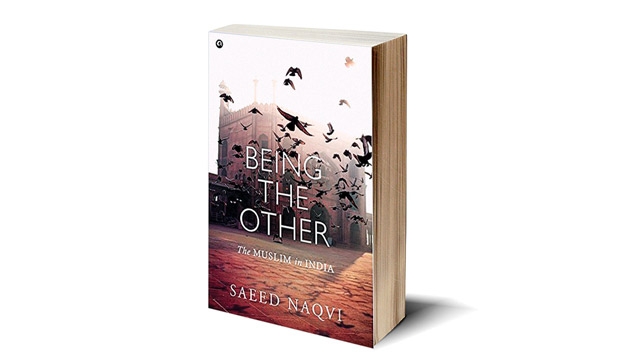
BookBeingTheOtherMPOs16jan2017


Saeed Naqvi’s book is vital in understanding forces that have shaped the Hindu-Muslim divide, says Iftikhar Gilani

Book: Being the Other—The Muslim in India

Author: Saeed Naqvi

Publisher: Aleph

239 pages

Rs 599

A decade ago, a Hindu friend booked a vacation in Kashmir. Before leaving, he hesitantly asked if his 14-year-old son could spend time with a Muslim family. “He isn’t familiar with a Muslim family,” he confided. I arranged their stay with a government official in Srinagar who had children of the same age. The interaction, my friend told me later, had helped clear cobwebs not only from his son’s mind, but from his as well.

In Being the other…, Saaed Naqvi recounts a similar experience. In Allahabad University, he asked the audience whether the Hindus among them had visited a Muslim home. No one had, even as a few murmured about their fathers knowing Urdu or Persian or that their mothers cooked chicken or mutton. The book is a memoir and exploration of various deliberate and inadvertent acts that have contributed to this ‘othering’ of the Muslims in India.

The author, a senior journalist, blames both the Congress and the BJP for this yawning gulf between the Hindu-Muslim communities. “Partition, in a way, was the gift the Congress gave to the Hindu right, which in the fullness of time, is today’s Hindutva,” Naqvi says. From then on, it has been a slow and steady decline for India’s 180 million Muslims.

Why has this happened?

Islam’s experience of Hindu civilisation dates back 14 centuries. But to understand Muslims and Islam, Indian scholars rely on Americans whose exposure doesn’t go beyond half a century.

And security agencies make it worse when they pick up innocent Muslims on dubious charges, forcing the community to retreat into a shell. “With every such arrest, more members of the community turn against the State and may even be persuaded to join militant groups or take to arms. If injustice becomes the law, resistance becomes duty,” the author says.

But in some places, Naqvi falls in with the ill-informed discourse of some scholars. He mentions, for instance, that Sir Syed Ahmed Khan set up the Mohammedan Anglo Oriental College (now Aligarh Muslim University), for ashraf (upper caste) Muslims alone, but fails to explain how a Hindu, Ishwari Prasad, was the first graduate of this college. He also joins the chorus to heap scorn on Wahhabism, but doesn’t mention that India’s first education minister, Maulana Abul Kalam Azad, whom he praises, belonged to this school of thought.

Though there is room for improvement, this book is an essential read for those interested in understanding the forces that have shaped the Hindu-Muslim divide and its consequences.

source:  http://www.dnaindia.com / DNA / Home> News> Lifestyle News / by Iftikhar Gilani / DNA, Mumbai – Sunday October 16th, 2016

Renowned freedom fighter and veteran journalist M Rasheed passes away

KERALA :

Kozhikode :

Renowned freedom fighter, writer and veteran journalist M Rasheed passed away in Salem on Friday. He had his last breath following a cardiac arrest at his daughter’s residence in Salem on Friday morning. An active participant in the Quit India Movement in 1942, he was also jailed during the freedom struggle.

Son of eminent freedom fighter E Moidu Moulavi, Rasheed was taken to the custody while he was high school student. He was one of the founding members of the Revolutionary Socialist Party and the editor of the party’s mouthpiece Sakhav.

The veteran journalist was a regular column writer in Malayalam dailies and was author of some books.

He will be laid to rest at Ponnani on Saturday morning.

source: http://www.newindianexpress.com / The New Indian Express / Home> Nation / by Express News Service / January 06th, 2017

Istafa Husain Ansari brought handloom industry to forefront

Gorakhpur, UTTAR PRADESH :

There is no denying to the fact that 1970-1980 was the best decade for a Bunkar (weaver) of Uttar Pradesh. This period can be identified as the golden era for the handloom industry and the person responsible for this was no other than late Istafa Husain Ansari of Gorakhpur. I am fortunate to be one of his grandsons.

Istafa Husain Ansari (1914-1987) was the third child of Sheikh Murtaza Husain- a Zamindar and a successful businessman, along with a prominent political leader of Gorakhpur. From the very beginning he had nationalist leaning. His initial education was in Gorakhpur and for the higher education he attended Lucknow University, from where he completed his M.Sc. and LLB. During those days the political environment in Lucknow was stirring, and there he worked along with stalwarts Dr. Shankar Dayal Sharma and K Raghurammaiyya, who were prominent student leaders of that time. At an early age he got married to Amina Khatoon, daughter of a prominent businessman of Gorakhpur, Mian Rahmatullah. One of his brothers-in-law, Niamatullah Ansari participated in the freedom struggle, and was later elected as a MLA from Gorakhpur.

IstafaHusainMPOsJan052017

After completing his education in Lucknow, he went back to Gorakhpur to practice law in Gorakhpur Civil Court. He was interested in the issues related to small farmers, peasants and the marginalized sections of the society. His contact with Professor Shibban Lal Saxena, who was an influential Congress leader of that time, brought him closer to Maharajganj and Pharenda, from where he started his formal political career by getting elected as the Gram Pradhan of Bhelumpur, which was also known as Karmaura. In 1952, for the first assembly election after independence, he won the Gorakhpur seat on a Congress ticket. He won by a big majority and then again by a bigger majority in 1957.

He was elevated to the position of Parliamentary Secretary for Education, Home and Information, when Sampoorna Nand became the Chief Minister of Uttar Pradesh. Then in 1966 and in 1972, he was elected as a Member of the Legislative Council in Uttar Pradesh Vidhan Parishad. In November 1973, when Chief Minister Hemvati Nandan Bahuguna, formed his eleven member’s cabinet, he was assigned as a Cabinet Minister in-charge of the small scale industries. He saw the deterioration in the politics climate and declined to be a part of that. His refusal to subscribe to the kind of politics brought in by Sanjay Gandhi curtailed his political career, because he could not do the Jee-Hazoori (sycophancy) that became the norm for success those days.

The success story of his life can be gauged by his contribution to the handloom as well as other cottage industries. He battled tirelessly for uplifting the weaker sections of the society. He fought relentlessly for the cause of the weavers and led an agitation against the ruling congress party, of which he was an active member, without fearing for the consequences and his own political future. As a result of the struggle, all his demands were met, and for the first time the woes of the handloom industry caught the attention of the policy makers. As a result, in 1970s when Prime Minister Indira Gandhi formulated her twenty point development program, challenges facing the handloom industry were also included in it. Then came the golden period of the handloom industry where infra-structure was developed to provide the raw material as well as avenues were opened to find markets for the finished product.

Apart from political appointments, he was also a member of the Aligarh Muslim University and Agra University courts. Locally in Gorakhpur, he was in the Executive Committee of Gorakhpur University, and was the founder member of Madan Mohan Malviya Engineering College. For life, he was the President of the school named after his father, Sheikh Murtaza Husain Memorial Higher Secondary School. During the time of his death in 1987, he was the member of Uttar Pradesh Minorities Commission.

It is not out of place to mention that in spite of being in public life for about five decades he maintained an unblemished record. His eldest son, Ashfaq Husain ventured into politics, and was elected to the Lok Sabha from Maharajganj. It is not out of place to mention that he was a great advocate for education and encouraged his descendants for quality education. As a result, today all twenty-two of his grandchildren are either engineers or have achieved post graduate degrees.

(The author is a Nuclear Engineer and was in the United States for long, but presently is in India. Can be contacted at www.tanvirsalim.com.)

source: http://www.twocircles.net / TwoCircles.net / Home / by Tanvir Salim / October 26th, 2013

Kiosk on wheels helps persons with disabilities turn entrepreneurs

Bengaluru, KARNATAKA :

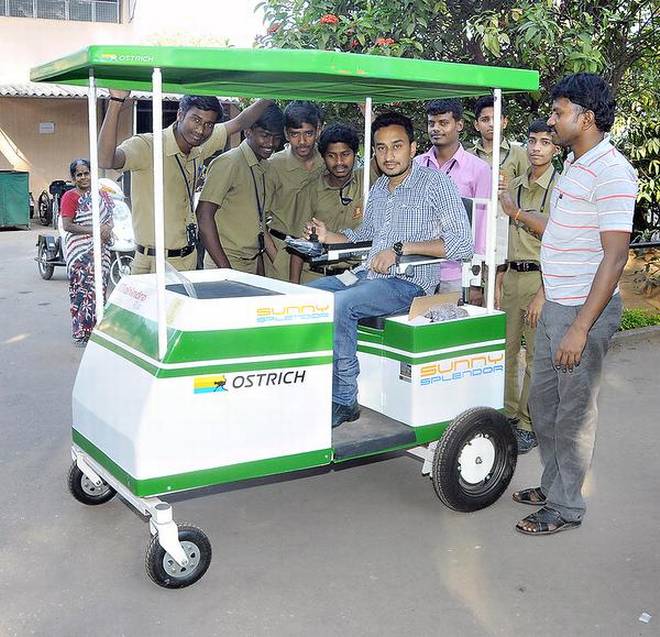
The battery-operated kiosk, Sunny Splendor, is a boon to persons with disabilities. —Photo: Sampath Kumar G.P. | Photo Credit: G_P_Sampath Kumar

Three years ago, Umesh, a lorry driver, lost his legs in a road accident. To make ends meet, he decided to sell tea on a two-wheeler, but the new venture threw up many challenges.

Dejected but not defeated, he approached an automobile firm for help. The firm, along with a wheelchair manufacturer, came up with a design for a disabled-friendly mobile kiosk to help people with disabilities earn a livelihood as part of a CSR initiative. The company approached the Association of People with Disabilities (APD), which funded the project. By 2015-end, Umesh had a prototype of the mobile kiosk.

APD rolled out three such mobile kiosks in the city in December last year to enable people with locomotive impairment and cerebral palsy start a business. The kiosk or electric vehicle named Sunny Splendor can also be charged on solar power.

Calling it ‘office on wheels’, C.N. Gopinath, executive board member of APD, said: “It plays a pivotal role in creating a perfect livelihood option for the physically challenged, who at times are constrained by financial circumstances and lack of qualification.”

Mansoor Ahmed, one of the fund raisers of the project, said the kiosk is environment and disabled-friendly. “We replaced the steering wheel with a joystick and the tires have increased brake efficiency”.

“I want to start a cosmetics and beverages business and my target audience comprises those working in tech parks. With this vehicle, I can commute to different tech parks,” said Basheer Ahmed, who is affected by polio. For Mahesh, who has been repairing mobile phones from home, the vehicle will help him broaden his customer base. “I want to run the business outside a government office. I am also planning to buy a typewriter, so I can help officials in their work”.

Four kiosks in Bengaluru

There are four such kiosks in Bengaluru. Beneficiaries can approach APD if they wish to become entrepreneurs, and have to go through a selection process before they can get their own mobile kiosk.

APD charges 10 per cent of the ₹1 lakh that costs to make a unit. “We believe they have the right to stake a claim in our ventures. This would not be possible if we operated on a charity model, which is is why we accept 10 per cent monetary contribution from them, though we do not insist this from those who cannot afford,” Mr. Mansoor Ahmed added.

source: http://www.thehindu.com / The Hindu / Home> News> States> Karnataka / by Shilpa Ramaswamy / Bengaluru – January 03rd, 2016