Category Archives: Arts, Culture & Entertainment

An intrinsic crafter of bidriware

Bidar, KARNATAKA :

bidriwarempos03jan2016

From a one-room house in Bidar old city to the Republic Day parade on Rajpath in New Delhi, it has been a long journey for bidri artisan Shah Rashid Ahmed Quadri.

The artisan, who was part of the bidriware tableau at the parade, was once advised by his father to quit the profession as there was no money in it. However, he did not quit because he liked hitting metals with chisels and a hammer.

Born on June 5, 1955, Shah Rashid Ahmed Quadri hails from a family of bidri artisans. As a result, Quadri got exposed to this craft from a young age and was trained under his father, Shah Mustafa Quadri. “I was forced to get involved in this craft to support my father, who was the only earning member in our family,” says Quadri. Initially, his father was not keen on him joining the shop as he felt the profession was not remunerative. He received a lot of encouragement when he began doing the craft and improved upon his father’s traditional designs. After a long period of training, he started working independently in 1970 and introduced various unique patterns.

Quadri has experimented with various bidriware techniques and patterns in his work. He introduced phooljhadi design and reintroduced sheet-work, an old technique that was used by court artists in the Bahmani Empire. Additionally, he is also an expert in wire and sheet-work inlaying.

Quadri has also trained several people in bidriware. Around 80 youngsters and many women have benefited by the training. Shaheda Begum, who has been working under him for the past two decades, is one such woman and has become an expert in sheet technique. He has also hosted various training programmes, where he taught bidri art. Some of the programmes he taught are organised as an apprenticeship training scheme.

Ample recognition
Quadri received several awards for his work including the Karnataka State award in 1984, a national award in 1988, district Rajyotsava award in 1996, Great Indian Achievers Award in 2004, and the Swarna Karnataka Rajyaotsava Award in 2006. Recently, he was honoured with Shilpa Guru award. The award is given in recognition of excellent craftsmanship, product excellence and for being instrumental in the continuance of crafts as a vital part of traditional heritage.

He exhibited his works in several countries and gave live demonstrations as well. These included the Science Festival of India that was held at The Museum of Science in Boston, USA in 1987 and a live demonstration in Holland in 1992. Bidri Art was selected to represent Karnataka at the Rajpath in New Delhi on Republic Day in 2011. Quadri, along with his team, took seat on the tableau with his work and gave a live demonstration. The Karnataka tableau was awarded second prize that year.

Apart from being a professional artisan and inspiring many others to continue the legacy, Quadri has also served as a member of Karnataka State Award selection committee in 1998.

He can be contacted on 9880690669 or at craft@gmail.com

source: http://www.deccanherald.com / Deccan Herald / Home> Supplements> Spectrum / by Rehaman Patel / January 03rd, 2017

‘Resistance is a form of justice’

NEW DELHI :

Drawn into the struggle and trauma of families in conflict-torn Sri Lanka and Kashmir, filmmaker Iffat Fatima says she became a part of it through a process of osmosis

Iffat Fatima an independent filmmaker from Delhi, went to Sri Lanka in 2000 to research a fellowship project on Education and Identity. In the years that followed, she worked at a television channel, Young Asian Television. In 2005, Iffat made a documentary film on conflict in Sri Lanka and what it had done to the lives of people – The Other Side of War and Peace. When she met Parveena Ahanger, the chairperson of the Association of the Parents of Disappeared Persons (APDP) in 2006, the urge to make a film on Kashmir’s disappeared was strong. After nine years of travel and research, Iffat made Khoon Diy Bharav, which has moved viewers in all its screenings.

hindulitforlifempos031dec2016


A guest at The Hindu’s festival of literature, Lit for Life, in Chennai in January 2017, Iffat answers a few questions:

Can you please tell us about the Association of Parents of Disappeared Persons (APDP)?

In 1994, with the support of legal professionals and human rights activists, the families of the victims of Enforced Involuntary Disappearances (EID) in Jammu and Kashmir organised themselves into a collective: The Association of Parents of Disappeared Persons (APDP). Over the years APDP has become a movement – an important space for a continuous engagement on issues of justice and accountability. Drawing attention to the trauma of the families engaged in a gruelling struggle against the Indian security establishment, APDP has succeeded not only in breaking the silence over the issue of enforced disappearances in Kashmir, but has also sustained and kept alive a public discourse on resistance and what it means to resist against all odds. APDP, in the very act of its being, poses a challenge to the official discourse of erasure that is being systematically imposed in the public domain in Kashmir.

Your film Khoon Diy Bharav was made over a period of nine years? Can you speak about the work that went into the film? It must have been extremely traumatic for you — living the horrific stories all over again. How did you manage to sail through it? Can you narrate some of these incidents?

I was, in a sense, introduced to the trauma and the grief of the families of the disappeared through the making of my film, Lanka – the other Side of War and Peace. In 2006, almost a year after I finished the film I began working on the issue of enforced disappearances in Kashmir. I had been in touch with Parveena Ahangar whose son became a victim of enforced disappearance in 1990. Parveena had been largely instrumental in bringing the families together under the banner of APDP. She became my constant companion and I travelled all over the valley with her, meeting the families. I was drawn into the struggle, the continuous trauma, the continuous torture the families were going through. Through a process of osmosis, I internalised their struggle and became part of it. I cried and laughed with them, carrying a camera and recording their struggle became an organic process. I was not thinking of the end product.

Through these many years, 2006 to 2010, the movement for azaadi in Kashmir was also going through a tumultuous period. People were coming out into the streets in thousands, young boys were being killed. Resistance was acquiring a new form and people were expressing their agency, reclaiming the movement, so to say ‘snatching it away from the gun’. The affected families kept using the term “Khoon Diy Baarav” which eventually became the title of the film. What they were implying is that blood has flown, it has congealed and sedimented into memory and transformed into resistance. So resistance is a form of justice, while there is no hope of justice from the Indian state. After 2010, I felt I had to come to grips with my material and give it a tangible form. I had more than a 100 hours of material. The editing process was long and agonizing, I made several cuts. Friends were very supportive and their suggestions and feedback was very valuable in shaping the final film.

Army, in Kashmir, is above law so to say. How did they react to your film? I have read of the demonstrations held in certain campuses during the screening of your film.

“If there is a rule of law, why are the armed forces exempt from it?” is a question that Parveena poses in the film several times. This is a challenge that many people find difficult to confront, especially in the current atmosphere of hyper-nationalism in India. They would rather not see it. But I must say that I have extensively screened the film in India and most audiences have been moved by the film and have responded in a very humane way. I get a sense that it reaches out to people rather than raising their hackles.

You have been arrested several times. Can you speak about it?

I haven’t been seriously arrested but have been apprehended several times. Majority of people in Kashmir have experienced that and most certainly anybody roaming around the streets with a camera has to be prepared for it. It is very disconcerting and rather scary, I must admit. But maybe part of being a filmmaker or a journalist is to learn to negotiate and work around these difficult situations. As a director there is also the added responsibility of the crew and the expensive equipment. I think being a woman might have some advantages as you are seen to be less of a threat. It is important to be cautious and to create a certain safety network.

Over 8000 men have disappeared in Kashmir. How are the women coping? Have they reshaped their lives?

The disappeared are all men and the women are left behind to cope. They don’t have a choice, many of them have children, they have to survive and carry on with their lives and are doing that very courageously. They have brought up their children, done their best for them. The women and the families are supportive of each other and APDP is there for them. However, it has taken a big toll, most of them have health problems — physical as well as psychological. There are some women who have remarried and moved on with their lives, but those with children largely have chosen to stay single. Keeping alive the memory of the disappeared is very important, in fact it keeps them going.

Your film about Sri Lanka also explores memory and violence. Do these two experiences – Sri Lanka and Kashmir — have any similarity?

In both cases- Sri Lanka and Kashmir- the conflict has been protracted and the state has used brute military power to repress people’s aspirations and political demands leading to a cycle of violence.

It is inevitable; brute military power can only lead to a shattered social fabric with deep wounds and scars. The state seems to be impervious to that. It doesn’t care.

source:  http://www.thehindu.com / The Hindu / Home> Entertainment> Movies / by Deepa Ganesh / December 29th, 2016
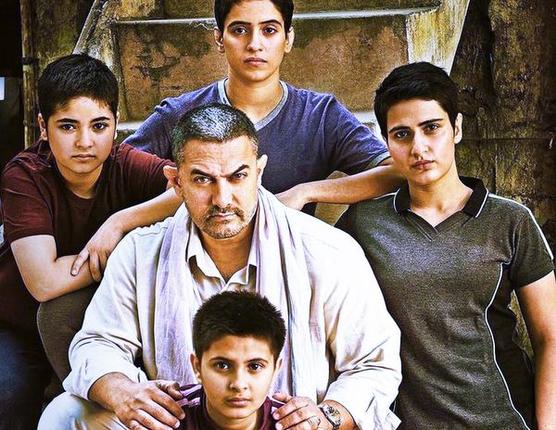
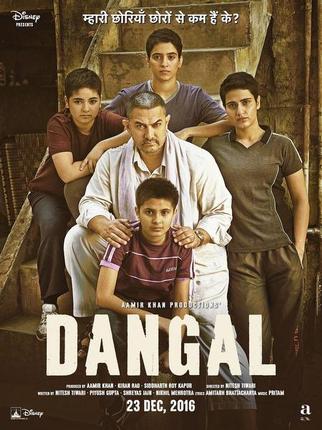
Aamir’s Dangal remonetises the box office

Analysts expect the movie to become one of the top grossers

dangalmpos28dec2016

Aamir Khan’s Dangal, which opened on Friday, has come as a boon for cinemas in the era of demonetisation. Analysts and multiplexes believe the movie could notch up ₹100 crore in the opening weekend itself and become one of the top grossers.

The movie, from the studios of Disney Pictures, UTV Motion Pictures and Aamir Khan Productions, has been released across 4,300 screens in India and about 1,000 screens internationally.

Trade analyst Komal Nahata said the movie will appeal to both the masses and the classes as well the urban and the rural consumers.

“It is expected to see historic box-office collections on the opening day. Going by early indications, the movie is also expected to see record lifetime collections,” he added.

According to some analysts, a reason could be that the film is based on a popular sport, wrestling. Besides, earlier this year, the audience had given a thumbs-up to Salman Khan’s Sultan, also based on the same sport. Known to set new records at the box office, the last Aamir Khan-starrer, PK, had raked in an estimated ₹331 crore, becoming the highest grossing bollywood film.

dangalpostermpos28dec2016

PV Sunil, CEO and Director, Carnival Cinemas, said, “Dangal is a boon to the film exhibition industry, especially in the current economic conditions. Our first-day occupancy of around 50 per cent in the matinee shows seems very promising and hints towards a big domestic weekend collection of the film.”

Ticketing platform BookMyShow said it has already hit its fastest one million ticket milestone for a movie with Dangal clocking sales of over ₹20 crore.

Devang Sampat, Director – Strategic Initiatives, Cinépolis India added, “The movie is expected to see a long run at the box office as it is benefiting from a strong word of mouth.”

Tinku Singh, Group President & Chief Strategy Officer SRS Group, said: “Since demonetisation, we have seen a drop in ticket sales at our cinemas, especially in tier-2 cities. But with Dangal, we are seeing average occupancies of 60-65 per cent on the first day.”

The film has brand association tie-ups with Bournvita, Vivel and Nissan Datsun.

source: http://www.thehindubusinessline.com / The Business Line / Home> Variety / by Meenakshi Verma Ambwani / December 23rd, 2016

Hindustani Sitar-Vocal Concert

Mysuru, KARNATAKA :

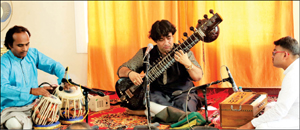
Ustad Hafiz Balekhan is seen presenting a Sitar recital in city recently accompanied by Ustad Nisar Ahmed on Tabla and Pandit Harikrishna Purohith on Harmonium.

Pandit Taranath Foundation is the brainchild of the famous Sarod Maestro Pandit Rajiv Taranath, who is its Managing Trustee – named after his father. Besides being a leading Sarod player himself, Rajiv Taranath has a penchant for organising music festivals in Hindustani style in Mysuru and Bengaluru.

He is presently stationed in Mysuru and organising three or four music programmes here every year, thus encouraging youngsters in the line and also with a sprinkle of stalwarts once in a way. He has pupils in America also and he visits that country every year. I have the privilege of offering a venue for small baitak kacheris in the first floor hall of my residence in Saraswathipuram (chairs and squatting capacity to about 80 connoisseurs). The sessions are usually in the mornings for two-and-a-half hours from 10 am onwards. I am beholden to Rajivji for this.

In the above series, the Foundation had organised a grand Hindustani Sitar-Vocal concert by the famous youngster Ustad Hafiz Balekhan on Sunday, the 25th instant, at the above venue. Ustad Hafiz is the younger brother of Ustad Rais Khan (settled in Pune) and the brothers give individual and duet concerts also. Ustad Nisar Ahmed from Dharwad gave Tabla support while Pandit Harikrishna Purohith was on the Harmonium.

Ustad Hafiz commenced his Sitar concert with a number in the beautiful ‘Ahir Bhairav’ Raga and delineated in detail all the beautiful strands of this number on the string instrument, over which he seems to have mastery. The next number was in raga ‘Pilu’ and came out very diligently. I do not know why it was that while he played Ahir Bhairav the only accompaniment was Tabla and Pandit Purohith joined him on Harmonium afterwards.

A ‘Thumri’ followed and was elegantly handled by the Ustad. A Ghazal “Chupke Chupke” followed in quick succession.

At this juncture, Pandit Taranath asked Hafiz Khan to turn to vocal keeping the string instrument on his lap for support and lo! a surprise sprang on the over seventy-five strong connoisseurs when the Ustad started to sing “Nara Janma Bandaga Naalige Iruvaga Krishna Enabarade,’ a Purandara Dasa number in Raga ‘Mishra Charu Keshi’. Wide applause greeted this number. This proves, if proof if necessary, that music knows no religion or language and we have ample evidence for this in our own Jesudas, American John Higgins Bhagavathar and Ustad Fayaz Khan, all of whom have enthralled the connoisseurs by their singing. The concert ended with the usual Bhairavi.

source: http://www.starofmysore.com / Star of Mysore / Home> Feature Articles / December 29th, 2016

Standup comic bags film role

KARNATAKA :

ahmedshariffmpos28dec2016

Comedian Ahmed Shariff  will soon be seen in the upcoming Kannada film, Humble Politician Nograj, which stars Danish Sait as a manipulative politician.

Telling us more about this, Ahmed says, “I went for the audition two weeks ago after seeing the ads, and thought that I fared badly because the lines were in Kannada, and I am not a native Kannada speaker. However, they liked how I acted and I got a call when I was in Hyderabad for a show. I still don’t know the role that I will be offered.”

He added that he will be going for a screen-test soon. Ask him if his being a comedian helped him get the role and he says, “Not at all. I stood in line with hundreds of people. There was no special privilege.”

source: http://www.timesofindia.indiatimes.com / The Times of India / News> Entertainment> Kannada> Movies> News / by Stuti Agarwal / TNN / December 28th, 2016

Majlis to remember city’s noted nawabs

Lucknow , UTTAR PRADESH :

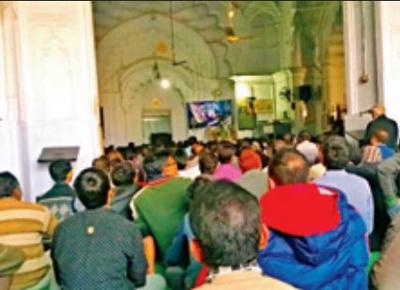
Friday's majlis in progress
Friday’s majlis in progress


Lucknow :

In a unique step, from now on Lucknow will pay obeisance to its nawabs who played an important role in starting and continuing with the Muharram rituals that took the city’s name to the world.

Paying tribute to their souls, every Friday after Jumah prayers, a majlis (religious sermon remembering the martyrdom of Imam Hussain  and the tragedy of Karbala) will be organised at the Bara Imambara.

 Earlier,majlis for a few nawabs were organised by their descendants or caretakers of the respective Imambaras set up by them. This is the first time that tribute will be paid in a systematic manner. A list with 25 names has already been drawn which will further be expanded to include descendants who, even in poverty, continued Muharram rituals, and clerics on whose advice the nawabs ruled Avadh.

On Friday, Maulana Kalbe Jawad presided over the majlis in memory of Nawab Ghasiud-din Haider while also talking about the latter’s and his role in Lucknow’s Muharram.

source: http://www.timesofindia.indiatimes.com / The Times of India / News> City News> Lucknow News / TNN / December 24th, 2016

Telugu writer brings out calendar of Indian Muslim freedom fighters

ANDHRA PRADESH :

Telugu writer Syed Naseer Ahamed, with the help of Mohammed Farookh Shubli, Founder President of Youth Welfare, Vijayawada, has brought out a calendar for 2017 bearing photos of India’s Muslim freedom fighters.

Syed Naseer Ahamed has been consistently writing about Muslim freedom fighters including his pictorial album The Immortals. The calendar consists of 6 pages. Each page of two months has four photos of Muslim freedom fighters who are less known to general public. A total of 24 freedom fighters have been accommodated in six pages. Role of Muslim freedom fighters in India’s Independence has been printed often in the print edition of The Milli Gazette.

calendarfreedomfightersmpos28dec2016


This calendar is in English. Syed Naseer Ahamed is trying to release the calendar in various centres across the country in order to inform people about the part played by Muslims in the freedom struggle of India.

For more information, please contact Syed Naseer Ahamed at syednaseerahamed2015$gmail.com.

source: http://www.milligazette.com / The Milli Gazette / Home> Online News> Community News / The Milli Gazette Online / December 23rd, 2016


The generous Sultan

NEW DELHI :

A GEOGRAPHICAL LANDMARK - A part of Delhi ridge along which Buddha Jayanti Park has come up | / Photo Credit: HINDU PHOTO ARCHIVES
A GEOGRAPHICAL LANDMARK – A part of Delhi ridge along which Buddha Jayanti Park has come up | / Photo Credit: HINDU PHOTO ARCHIVES

The news of a maulvi living in an alcove of the Ridge area makes one reflect on the legacy of Feroz Shah Tughlaq who respected men of divinity

Police accosting a maulvi in a forest bordering the Bodyguard Lines of the President’s Estate recently should cause little wonder. Ghazi Norool Hassan, say reports, was found living in an alcove of the Ridge area along with his son, claiming to be the caretaker of a mazar. This shrine is supposed to be very old and in keeping with the legacy of the reign of Feroz Shah Tughlaq. A large part of Delhi was forest area in the 14th Century and this helped the Emperor to indulge in his favourite past-time of hunting. Right from Mehrauli to North Delhi there is evidence of the Sultan’s hunting lodges where he sometimes rested at night too.

While in North Delhi he built an observatory, besides a hunting lodge, a Pir of his time also set up abode in the area and, after drawing a lot of devotees, disappeared one fine day, leaving his admirers shocked. The place has come to be known as Pir Ghaib. On the Ridge near Karol Bagh is the ruined gate of Bhuli Bhatiyari-ka-Mahal. Though Sir Syed Ahmad Khan thought it was a distortion of the name of a nobleman, Bhu Ali Bhatti, there are not many takers for this assertion.

If oral history is to be believed, Bhuli Bhatiyari was the comely daughter of a dhaba owner (Bhaitiyara) with whom the Sultan fell in love while passing that way. There is incidentally a Bhuri Bhatiyari-ki-Masjid (dedicated to a fair innkeeper) opposite the Khooni Darwaza. Another story says Feroz Shah actually fell in love with a gypsy girl for whom he built a palace as she had stolen his heart after offering him a drink of water on a hot summer day while the Sultan was out hunting.

Historian Ishwari Prasad says that Feroz Shah was a pious man, despite being an orthodox Sunni who ill-treated the Shias and non-Muslims. But at the same time he was generous and not fond of shedding blood, like his cousin and mentor Mohammed Bin Tughlaq, whom he had succeeded. Feroz was a great devotee of dervishes, many of whom flourished in his empire. One of them probably was the Pir Sahib of the place where the maulvi was found living secretly for 40 years. The forest area of which the shrine is a part, had many other dargahs which were demolished when New Delhi was built. Raisina Hill was also covered with a forest where wolves, leopards and hyenas were found. So a Forest Ranger’s bungalow was set up there. In later times, this bungalow became part of the Sacred Heart Cathedral and now after renovation, is known as Maria Bhawan.

Some old mosques still exist in nearby areas which may be dating back to Tughlaq times, for that matter the place where now stands Gurdwara Rakabganj was also a jungle once in which during Aurangzeb’s time lived a contractor, Lakhi Singh of the Mughal court. When Guru Tegh Bahadur was beheaded on the orders of Aurangzeb, there was a violent storm, taking advantage of which Lakhi Singh and his eight sons (who had come on horses and bullocks) took the body away, while the Guru’s head was taken away by a man named Jatha. Lakhi Singh drove all the way from Chandni Chowk to the forest where he lived and putting the body in his house set it on fire to avoid suspicion. Later Gurdwara Rakabganj came up there.

But to come back to Feroz Shah, the number of mosques and dargahs that were set up in his reign rivalled the inns, gardens and hospitals. He is said to have laid 1,200 gardens around Delhi and nearby areas in each of which a Sufi found refuge. The Sultan lived up to the age of 90, the longest living ruler of Delhi after Aurangzeb. He was so generous at heart that even while laying siege to a city he would often turn back on hearing the cries of women in distress and suffering from the pangs of hunger, along with their children. Even while on shikar, Feroz Shah would pay obeisance to saints who had set up abode in his empire. Many of them were helped by him to set up khankahs or hospices, and when they died the Sultan was always ready to build a mazar for them.

Once while visiting a dervish he was puzzled on seeing a goat and a tendua (panther) lying in the courtyard of the jungle abode. Seeing his amazement at the sight the dervish told him that in the royal darbar this may not be possible but in his khankah the goat and the panther could lie side by side, forgetting their enmity. When the British built what is now President’s Estate, they reclaimed a lot of forest land in which wild animals roamed. But still a lot of the area acquired by Lutyens and Baker was left as forest land. The mazar of which Noorol Hassan claims to be caretaker is only one among many hidden away from the public eye. Don’t be surprised if in course of time the mazar becomes a regular shrine with an annual Urs. But for this the history of the mazar and of the saint buried there would first have to be determined. Until then Ghazi Noorol Hassan can continue to be caretaker of the legacy bequeathed to him by Fakhruddin Ali Ahmed. The late President himself preferred to be buried outside the New Delhi Jama Masjid, opposite Parliament House, where once the heart-broken poet Hasrat Mohani of “Chupke, chupke aansoon bahana” fame had made his bachelor’s quarters.

source: http://www.thehindu.com / The Hindu / Home> Society> History & Culture / December 25th, 2016

Central Sahitya Akademi award for 2 Dakshina Kannada writers

KARNATAKA :

Mangaluru  :

TWO well-known authors — Edwin Joseph Francis D’Souza from Mangaluru and Bolwar Mohammed Kunhi from Puttur —  have been chosen for the prestigious Central Sahitya Akademi Award for 2016 in Konkani and Kannada languages, respectively.

This is the first time that two writers from Dakshina Kannada have been recognised for the prestigious national award in the same year.

Edwin J F D’Souza
Edwin J F D’Souza

Edwin D’Souza has won the award for his Konkani novel Kallem Bhangaar (Black Gold), while Bolwar Mohammed Kunhi won the award for his 1,110-page Kannada work Swatantryada Ota (Run of Independence). Kunhi is the only writer to have got the Central Sahitya Academy award twice. Earlier he got it for his children’s novel Gandhi Thata Bapu hege Aadaru.

BM Kunhi
BM Kunhi

Kunhi was born in 1951 in a village in Puttur called Bolwaru. He is a short story writer, novelist, playwright and scriptwriter, and one of the pioneers to have introduced Muslim culture in Kannada prose.
Won award at the right time, says D’Souza

D’Souza is elated after winning the Kendra Sahitya Akademi award for Konkani.
He  said, “There could not be a better award when given at the right time and without lobbying. What is more important is to get an award when you feel that you deserve it. In my case all these three factors played their role.”

He was born in Valencia, Mangaluru in June 1948 and studied in St Aloysius (Autonomous) College, Mangaluru. He holds a degree in commerce, a postgraduate diploma in Konkani and five online diplomas from the Bible School, US, in Christian Theology.

His first short story in Konkani was published in 1964. Since then he has penned 33 novels, over 100 short stories, columns and satires. Many of his short stories have been translated into English, Kannada, Hindi, Kashmiri, Malayalam and Tamil.

He has won 13 state, inter-state and international awards for literature. His acclaimed short story A Cup of Hot Coffee was published by Late Khushwant Singh in his anthology, Our Favorite Indian Short Stories.  Several of his short stories have been published by Kendra Sahitya Akademi, in its publications Prateechi and Indian Literature. The Goa Konkani Akademi published his 450-page novel Kallem Bhangaar in Devanagari script.

His spouse of 41 years Jane D’Souza was immensely happy. “I would consider it as the best-ever Christmas I ever had in my life so far. Sometime I wondered how he can write so much and so effortlessly without being distracted. Now I know he was born to write.”

Speaking to Express from his home in Koramangala in Bengaluru Kunhi said, “I could not have been better honoured. I had  no clue, I am also honoured that the Akadami has recognised my work not once but twice, earlier in 2009 for my children’s literature. Kannada is a beautiful language and can effectively express and portray literature in any culture, which is the strength and the beauty of the language”.

source: http://www.newindianexpress.com / The New Indian Express / Home> States> Karnataka / by Express News Service / December 22nd, 2016

Revisiting the life and times of Hayat Bakshi Begum

Hyderabad, TELANGANA :

A day after staging the internationally-feted heritage play, Quli: Dilon ka Shahzaada , actor-director-playwrighter Mohammad Ali Baig staged its sequel, Saavan-e-Hayat in Golconda Fort this Sunday celebrating the splendour of the Qutub Shahs.

A biographical play on the life of Golconda’s de facto empress, Hayat Bakshi, the only child of Mohammad Quli Qutb Shah and perhaps the most powerful lady of medieval Deccan.

A magnificent blend of great writing and commendable acting ensured the 65 minute play in Hindustani kept the audience glued to their seats.

The play featuring Mohammad Ali Baig in triple roles as Hayat’s father, husband and son, Rashmi Seth as old Hayat, Noor Baig as young Hayat and Ayushi Gupta as adolscent Hayat also featured Vijay Prasad, Kavita Golechha and SA Majeed in prominent roles.

It was well-attended and generously applauded by the theatre lovers and the locals alike who thronged the fort to watch the historic play.

source: http://www.timesofindia.indiatimes.com / The Times of India / News> City News> Hyderabad News / December 20th, 2016