Category Archives: Arts, Culture & Entertainment

The joys of reverse sweep

NEW DELHI / Mumbai, MAHARASHTRA :

HAVING A BALL Saqib Saleem at Hindu College in New Delhi | Photo Credit: Photo: Abhimanyu Sindhu

In a candid conversation, Delhi boy Saqib Saleem revisits his college days

My encounter with Saqib Saleem happens as he converses, overcome with nostalgia, with his college cricket coach Jai Pal Singh about the good old days. His eyes survey the familiar area of the Hindu College staff room as he leads me to the Sports Complex where he ‘lived, ate and slept’ during his stint as a cricketer. So, he used to play cricket? His coach corrects me and says he still does. “Once a sportsman, always a sportsman.”

“The college has changed a lot, yet the air is unchanged”, remarks the actor seeing the new administrative building cornering the famous Virgin tree. With searching eyes attempting to gather the familiar, he spots Manish pakodewaala where he used to come in the middle of practice to satisfy hunger pangs.

Entering the sports complex, he sits at the higher end of a staircase, good enough to give him a panoramic view of the landscape. Quite seemingly distracted by the urge to relive the experiences of the college, Saqib intently looks at the field reconstructing the space for us.

Composed, yet gushed, his manner is amiable as he talks to some college students in between. He wears aviators concealing his gaze lest I intervene in his reconstruction of a personal journey. Going back in time, Saqib talks about his experience as a college student, his journey to Bollywood and his upcoming film.

Excerpts:

Tell us about your time in college.

College was the best time there could be. I used to come at 7 a.m. and leave at 8 p.m. It had become my second home. Even today I tell my friends in Mumbai that if given a chance to go back in time, I would like to relive the three years of college.

I was the president of Nakshatra, the fashion society of the college. We did fashion shows across different colleges and participated in competitions. I didn’t want to be a model or actor in the beginning but walking the ramp gave me a temporary high. I used to get the best model trophy everywhere. I thought, maybe what I do, people like that, and as a result garnered confidence. It all started with Nakshatra!

You’ve also represented Delhi and Jammu and Kashmir in cricket. Didn’t you want to pursue a career in the sport?

My love for cricket started early. I wanted to be a professional. But as I got exposure, I got a reality check. I saw better talent around me. There is no harm in accepting there are better people. Appreciation for others and recognition gives me the boost to work harder in life. I wanted to figure out something I was best at and could prove my mettle in. I wanted to carve my own niche. Thus the detour happened, Mumbai happened.

Any particular interesting incidents that you’d like to recall from your college life.

There are many. You need to be there on Valentine’s Day in the college to see the spectacle. I was active in university politics as well. My support for candidates used to be agenda-based, irrespective of party affiliations. It is necessary to indulge in campus politics as it completes your college experience. It is a huge learning experience. You get to meet interesting people and learn public dealing.

Although I was a day-scholar, I rented a flat near campus with a few friends which acted as our ‘crash pad’ in case we didn’t want to go back home after a party. I also had plenty of friends in the hostel. The annual college festival Mecca was the best time of the year. You could feel the energy of the college in just three days.

How did you end up going to Mumbai? Did you have anything to fall back on there?

Well, you won’t believe me, but I went there for a girl. I was dating a senior who wanted to be an actress, so she went to Mumbai after college. At that time, I was working with my father managing the restaurants. She called me one night and said that a long distance relationship won’t work. I asked if I could move to Mumbai to be with her. She said yes and I eventually moved hoping to make a career in modelling. But, we broke up in three months. Yes, so that’s how I stayed in Mumbai and ended up being an actor.

How was your experience in the advertisement industry working with different directors and brands?

The experience was very interesting. As an actor, I don’t really enjoy doing ads. But there are some really brilliant ad makers who make your realise your true potential and help you throughout. They make you see things you never really thought you had. My whole education in acting was through advertisements. It taught me how to face the camera. I had no background in theatre or acting. Ads helped me better my craft. People who don’t have any professional background in acting can use the medium of ads to get recognition and move forward.

You’re in the city for the shoot of your upcoming movie, Koroli Loves Sumit. How has the experience been working with Aleya Sen?

Well, I worked with her in a music video called “Tum ho Toh”. Both Taapsee Pannu, my co-actor in the movie and I featured in the video. She offered us the movie after the video. It is exciting and interesting to work with her as she also comes from the advertisement industry, and has a unique style.

I was excited as I was asked to play a Lajpat Nagar gym trainer, a role quite close to my experiences in the city. The movie is a love story about two people who’re not meant to be. It will hopefully hit the screens in the first quarter of next year.

As a new age actor, what advice would you like to give to aspiring actors and people wanting to enter the industry?

You just got to believe in yourself. If you respect yourself, others will respect you as well. There is no rocket science to it. You have to enjoy what you do. If you don’t believe in yourself, no one will. You should always be ready to learn new things and acquire experiences.

source: http://www.thehindu.com / The Hindu / Home> Entertainment> Movies / by Sidharth Yadav / December 17th, 2016
Haunting notes from the Sitargalli of Miraj

Miraj (Sangli District) , MAHARASHTRA :

A peek into the lives of the luthiers of Maharashtra and their bygone glory

sitarmpos17dec2016

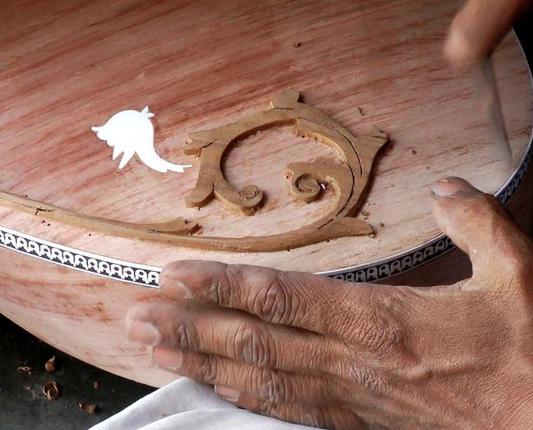
Around 40 km from the bustling city of sugar lords, Kolhapur, sits the small town of Miraj. We drive through crowded by-lanes, where you can relive age-old stories of a traditional craft that has its roots in this erstwhile royal city. The craftsmanship is something of a gharana in itself — with successive generations of families engaged in creating beautiful stringed instruments, such as the sitar, tanpura and the swarmandal over centuries.

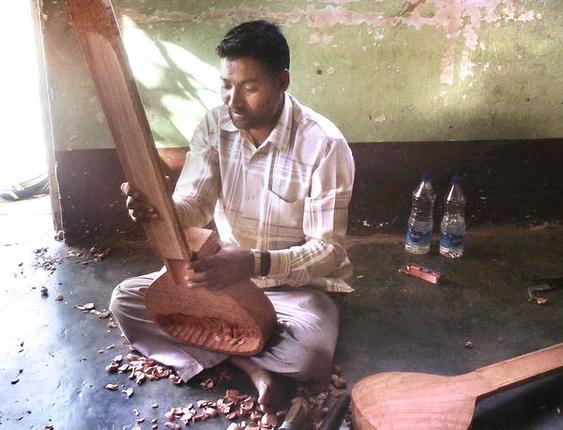
Fading melody A sitar-maker of Miraj

Entering one of the workshops of the sitar-makers in a bylane, we meet the gifted Naeem, Imtiaz and Zuber, strangely all with the last names ‘Sitarmaker’, a proud heritage which binds the close-knit community that can trace its family tree to a single ancestor. Their pride, however, seems to be diminishing by the day. These artisans, once the uncrowned kings of the music trade, are now struggling to survive. They say, half in jest, “We are good at two things — making sitars and living from hand to mouth”.

There was a time when these luthiers were paid handsomely and even commissioned by Mughal emperors down the ages to make their uniquely resonant instruments. Their flourishing trade had developed into an entire lane of luthiers, stretching from one part of the town to the other. It is called Sitargalli, meaning the lane where sitars are made.

Waning interest

Artisans at every shop we pass are trying to make a desperate pitch about their instruments. They even go to the extent of downplaying the quality of wares in the neighbouring shop. “Their art is not pure. They separated from the family for business and now want financial gratification from it,” they say. One such family member, Imtiaz, does not speak much. In his dingy shop lie incomplete wooden frames of sitars. Some completed but unsold sitars are visible under a dusty, mouldy cloth.

Imtiaz invites us to his home far away from the main town. On the border between Kolhapur and Miraj lies his house, an abode of legendary sitar-makers for over a century. Stretches of farmland in three directions behind his house lend it a false image of prosperity. Asked how much of the land he owns, Imtiaz politely replies, “ Hum toh rehte bhi border pe hai. Na ghar ke na ghaat ke .” (Even the house we live in is on the border between the two towns. We are neither here nor there).

The family greets us with piping hot cups of tea and biscuits. But the mood turns sombre when Imtiaz begins to speak, “Nowadays people want to play guitars and we don’t know how to make them. What they don’t realise is that the guitar is a foreign instrument. To make and buy foreign instruments in India is like sounding the death knell for our own instrument makers.”

Imtiaz recalls, “We used to live in a mansion. My father would tell me that his grandfather taught all of them how to make sitars. They would play together, eat together and live happily. But after a few years, when business slowed down, families were pitted against each other. Brothers competed to earn money; this killed the trade. Luthiers came to Miraj, learned the craft and left… started their businesses elsewhere. It is just here that they don’t want to keep the business within the family. This infighting only adds to the misery.”

Exacting riyaaz

His father, Abdul Majid, who has been making sitars for six generations, is hard at work finishing a sitar. He says, “Very few people want to put in the hard work and effort to learn the sitar. It is not easy. Your fingers bleed in the beginning. They get calloused. They hurt from the playing. It is not easy to sit with a straight spine for three hours, on the floor, for every riyaaz (practice) session. Very few have the determination to go on. If playing needs so much effort, can you imagine how much is needed to make the instrument?”

Zuber, their cousin, speaks of how he almost drove a chisel into his foot while hollowing a plank for a sitar. Gazing at the children of the family, Imtiaz wonders, “I don’t know whether these children will ever understand the power of the art that they hold in their hands. They will be the eighth generation in this lineage, should they choose to stay with the trade.”

The family has started farming because it cannot afford to wait for sitar orders. “For sustenance, we have leased some land and are growing vegetables. Most of them we sell and use the leftovers at home. We are lucky that we get to eat fresh from the farm.”

Solid guarantee

As we’re leaving, Imtiaz gives us one final sales pitch that is too hard to ignore. “We will make the best instruments you need and, if you don’t like them, I will personally carry them back to my workshop. My trade is not agriculture, it is these instruments.”

(To sustain their trade, Bajaao has offered the luthiers a fair trade deal. In an industry that is rife with duplicity and fraudulent dealings, the company offers a hundred per cent guarantee on the quality and longevity of an instrument made according to the flawless Miraj tradition.)

The writer is CEO of Bajaao and recently visited the famous town of luthiers.

source: http://www.thehindubusinessline.com / Business Line / Home / by Suman Singh / print edition December 17th, 2016

Story-Telling

Mysuru, KARNATAKA :
Kalasuruchi has organised a story-telling by Ayesha Karim, Retd. Bank Officer, Canara Bank, Mysuru, at Suruchi Rangamane, 476, Chitrabhanu Road, Kuvempunagar, on Dec. 17 from 4.30 pm to 5.30 pm

For details, contact Ph: 0821-2541795 or Mob: 92435-81097, according to a press release.

source: http://www.starofmysore.com / Star of Mysore / Home> In Brief / December 16th, 2016


Realtor Razack to open Bengaluru’s first Museum of Indian Paper Money

Bengaluru, KARNATAKA :

In 1913, Maharaja Krishna Raja Wadiyar IV appointed William Clarence Rose as the first chief manager of the Bank of Mysore. Whilst in office, Rose collected all British India banknotes of denominations five, ten, fifty and one hundred in a series. When he retired in 1925, he received a wax-paper scroll rolled into a carved silver sheath, mounted on a teak base. Everything was made from melted silver coinage issued by the Raj.

Rose passed all this onto his daughter Vera Katherine Maud Collins, who bequeathed it to her grandson Simon Collins.The latter remembers how the “gift was kept in a 1937 coronation stamp album“ and was passed on two months before his grandmother’s death in 1982. This legacy -along with other historical nuggets -is finding its way back to the city .

The collection will be housed in a museum of Indian currency, expected to come up in Bengaluru next year.

The project is the brainchild of realtor and currency collector Rezwan Razack, who has been collecting Indian paper money since 1971. Spread across 4,000 square feet and located off Brunton Road, the museum is expected to be open to the public in the latter half of 2017. “The intention of setting up the Museum of Indian Paper Money is to display all that there is in my collection. It is to create awareness about our history and our journey so far as a nation, through our currency ,“ says Razack,  who is the managing director of city-based Prestige Estates Projects and chairman of the International Banknotes Society’s India chapter.

Among the world’s most prolific collectors of rare currencies, Razack has preserved bills dating back to early 1770s.These include the uni-face (onesided) notes first launched by the government of India, portrait notes of King George V & VI, cash coupons of princely states, Indian notes issued in Pakistan and Burma, special issues made for the Persian Gulf and Haj Pilgrims and all variants of Indian notes -from the Independence era till the latest demonetisation exercise.

E a ch n o t e links us to the way of life in the past and unearths lesser-known stories of our city and country, believes Razack. For instance, on display will be 100-odd Prisoner of War coupons issued by the British. “There were eight camps across India, including Bengaluru, which issued bills from one anna to ten rupees,“ he says.

The museum will comprise of interactive displays, historic facts and trivia, along with stories and essays written by Razack from his own journey and experience as a collector.Architects are working on the blueprint of the museum and estimates should be drawn up by the end of the year, Razack informs.

source:  http://www.economictimes.indiatimes.com / The Economic Times / Home> ET Home> Magazines> Panache / by Divya Shekhar, ET Bureau / November 24th, 2016

Recognising a lifetime of devotion to music

Gwalior, MADHYA PRADESH / NEW DELHI :

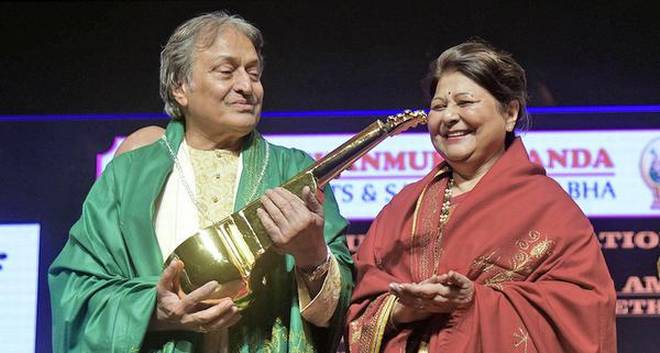
instrumental figure:Maestro Ustad Amjad Ali Khan and his wife Subbulaxmi during the felicitation.— Photo: Vijay Bate


Mumbai :

Sarod virtuoso Ustad Amjad Ali Khan was conferred with the Sri Shanmukhananda National Eminence Award on Saturday

The Sri Shanmukhananda Chandrasekara Saraswathi Auditorium played host to the city’s connoisseurs of music on Saturday, all in attendance to witness the felicitation of sarod maestro Ustad Amjad Ali Khan, where he was conferred the 17th Sri Shanmukhananda National Eminence Award.

The award was presented by V. Shankar, president of Sri Shanmukhananda Sabha, and the felicitation was followed by a sarod duet by Khan’s sons and disciples Amaan Ali Bangash and Ayaan Ali Bangash, accompanied by Satyajit Talwalkar on the tabla.

Rahul Deshpande (Hindustani vocal), K. Gayatri (Carnatic vocal) and Sandeep Narayan (Carnatic vocal) were also conferred the Shanmukha Sangeetha Shiromani award for significant contribution to music.

Speaking on the occasion, the maestro expressed his gratitude to his family for their support. “It has been a long journey as an artiste, and I was no child prodigy. It takes great sadhna (practice) to achieve goals in life,” he said before presenting a short tarana .

Life dedicated to music

Mr. Shankar said, “Ustad ji is the foremost ambassador of Indian music today, taking his art beyond the borders of the country.” He added that Ustad Amjad Ali Khan was chosen this year for his lifetime dedication to the cause of music. The award carries a cash prize of Rs 2.5 lakh and a citation.

The writer is an intern at The Hindu

source: http://www.thehindu.com / The Hindu / Home> National / by Malavika Balasubramaniam / Mumbai – December 11th, 2016

Mangaluru: Photojournalist Ahmed Anwar passes away at 55

Mangalore , KARNATAKA :

Mangaluru :

City’s acclaimed photojournalist Ahmed Anwar passed away on Sunday December 11 at his residence in Balmatta here. He was 55.

Besides being an excellent photojournalist, Anwar was also a poet and short story writer.

Anwar, who was in the garment industry, became a photojournalist due to his interest in photography. Over the years, he held several photography exhibitions to showcase his works. In February 2015, ‘Street Life’, an exhbition of his photographs in monochrome was held in the city.

Anwar, who was battling cancer, won several awards for his photographic and literary works, including Attimabbe Literary Award for his anthology ‘Bevu Bella’, Pejawar Sadashiv Rao Memorial Award conferred by Mumbai Karnataka Sangha, Muslim Literary Award by Muslim Writers’ Association, Mangaluru and Sneha Setu Award conferred by Sneha Setu Literary Organization. His other works include ‘Bharata Geeta’, ‘Gul Mohar’, and ‘Nanna Kanasina Bharata’.

‘Payanigala Padyagalu’, a book of his poems brought out by his friends, was scheduled for release on December 23.

source: http://www.daijiworld.com / DaijiWorld.com / Home> Top Stories / DaijiWorld Media Network / Sunday – December 11th, 2016

Nature-inspired

Silchar – ASSAM / PUDUCHERRY :

Healing works

akmalhussainmpos08dec2016

Interpreting nature can be tricky. So is painting it. As an artist, one can try to focus on its essence, but lose out on its detail and form. Otherwise, one can try to get a grip on the instantaneous, but miss out on its fluid dynamics. Rare is the work of art that manages to portray all of this together. Both Akmal Husain and Keiko Mima manage to do exactly this, in their own unique ways.

This hugely talented and successful artist-couple are enigmatic in more ways than one. Husain is from rural Assam, Mima from Japan, and they have now made Puducherry their home, where they live with their three young daughters. The works of both Husain, who had his art education at Shantiniketan, and Mima, who studied art at Kyoto Seika University, Japan, are much sought after.

Mima and Husain are both drawn to nature but interpret it in their own way. Husain’s visualisation of nature is unique and in a sense, simplistic. It radiates positivity, bliss and beauty. His paintings reflect an oasis of tranquility in this chaotic life, taking you into the beautiful village life that once existed everywhere. Mima’s paintings, on the other hand, radiate etherealness, fragility, transience and the timelessness of nature — in a sense, alluding to the spiritual concept of ‘Maya’.


Journey decoded

Mima has been painting since she was a child. “My mother is an artist too and teaches painting to children at our home in Japan. When I was young, I was her student too. She always made us paint flowers and fruits with watercolours, which I tried to render as realistically as I could,” she says.

We learn that she began studying painting more seriously in high school. It was there that she learnt charcoal drawing and oil painting. After that, she studied oil painting in an art college, where she tried experimenting with various new materials also. Then, she was using mixed mediums to make several abstract images. The mediums she now favours are pencil and watercolours. She has a fascination for traditional Indian mural art, which she hopes to learn some day.

“When I started painting with watercolours again in India in 1997, there had been a large gap of about 20 years since I had last painted flowers. When I started to observe and study flowers more deeply, I was fascinated. Their beauty is not limited to their form and colour, but they have feelings like human beings, or one might even say that they are more sensitive,” she explains.

Husain lets us in on his entry into the fascinating world of art. “I started painting with oil paints only in my third year at Kalabhavan. It took me a year to understand the medium. I discovered that it allowed me to erase and repaint portions unlike watercolours. I was fascinated by the rural settings around Kalabhavan, especially the atmosphere created by the light of the setting sun, or dawn. I sketched whatever I could, and the rest I absorbed. I was not very skilled at drawing, so when I returned to the studio, I painted, erased and painted again, trying to bring out what I had absorbed,” he shares.

It was during his fourth year at Shantiniketan, in the Kolkata Book Fair, that he discovered a book called Modern Primitive Painting, which gave him a lot of confidence to draw. “Over a period of six months, I made two large oil paintings. And one more by the end of my final year, which took me almost six months to complete with all the erasing and repainting. That painting won me the National Academy Award by Lalit Kala Academy in 1985. Eventually, erasing and reworking became my personal technique,” Husain beams.

In 2015, he started a series of experimental watercolours based on the theme of leaves. “An oil painting takes me two to three months to complete. While at it, I see around me the changing nature. Simply fallen leaves of various kinds, and their many colours, sometimes wet, at others dry, have inspired me. That is how I began my experiments with composing layers of semi-abstract watercolours.” Husain’s many awards include the Sovana Banik Memorial Scholarship and the National Academy Award of Lalit Kala Academy.

Since the medium of inspiration and the mode of work is the same, do Husain and Mima discuss their ideas with each other? Husain explains, “It is true that both of us paint from nature, but we see it with different eyes. Hence, our techniques are different. It is in my nature to discuss my work with her before, during and after creating it. She is the opposite; she likes to work but does not like to talk about it very much. Her discipline inspires me very much.” Mima adds, “There is an exchange, and his techniques are sometimes helpful in my work.”

In 2003, they moved to Puducherry for the education of their eldest daughter. Now, all their daughters are studying there. Talking about the transition of the town, Mima says, “The first time I visited Puducherry was in 2000. It wasn’t crowded then and the atmosphere was more peaceful, even spiritual, and the people were very good-natured.” But she hastens to add that they do enjoy the town’s coastal scenery and sea breeze, and find Puducherry’s ayurveda and homeopathy very useful.

Influenced by their lands

Nevertheless, the lands that spawned them rules large in their hearts. For instance, Husain shares that whenever he does oil paintings, he subconsciously draws inspiration from his early childhood and Shantiniketan days. Born in Silchar in Assam, Husain grew up surrounded by nature. “My home was at a little distance away from the main town and our home was surrounded by greenery. My father was very fond of gardens, and my mother had a passion for betel nut trees and vegetable plants. I used to accompany her to the garden to plant betel nut trees, vegetable seeds, etc. There was always a milch cow at home, which remains to be one of my favourite subjects,” he says. This trend continued even when he went to Shantiniketan to learn painting.

It’s the same case with Mima. She carries Japan in her soul. “I do not miss the nature or colours of Japan since they are within me,” she says. She mentions that while she is not directly inspired by traditional Japanese art, it has shaped her in a way because her sense of beauty was cultivated in Japan. She says, “I mostly draw flowers and landscapes in situ. But influences from my early experiences of nature in Japan are at work too, in the background. I continue to draw and paint from nature and I hope to heal people’s hearts through my work.

source: http://www.deccanherald.com / Deccan Herald / Home> Supplements> Sunday Herald – Arts & Culture / by Hema Vijay / November 27th, 2016

Baikal Utsahi , Poet, Writer and Politician, is no more

Balrampur – Lucknow, UTTAR PRADESH  / NEW DELHI  :


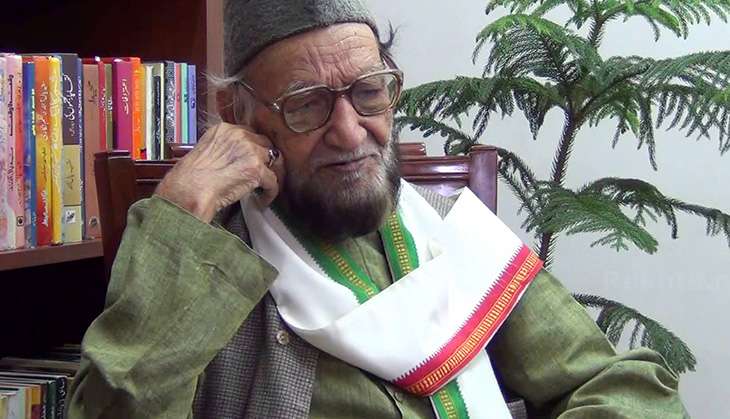
Photo: rekhta.org
Photo: rekhta.org

Well-known poet and former Rajya Sabha MP Bekal Utsahi passed away at New Delhi’s Ram Manohar Lohia Hospital on Saturday.

The 88-year-old poet was admitted to the hospital on 1 December after a fall in the bathroom at his South Avenue residence in Delhi.

According to Utsahi’s daughter Sophia, he suffered a brain haemorrhage following the accident.

Utsahi was nominated to the upper house of Parliament during Rajiv Gandhi’s tenure as Prime Minister.

An Enthusiastic Poet

Utsahi was born on 1 June 1928 in Uttar Pradesh’s Balrampur (formerly Gonda) district. His father was Lodhi Mohammad Zafar Khan.

Utsahi’s family named him Mohammad Shafi Khan. He changed his name to ‘Bekal Varsi’ in 1945 after a visit to the mazaar of Hazrat Vaaris Ali Shah of Devan Sharif, at which time Shah Hafiz Pyari Miyan said: “Bedam gaya, Bekal aaya (Bedam went, Bekal came).”

During an election meeting in 1952, Jawaharlal Nehru was impressed with Bekal’s poetry, and said: “Yeh humara utsahi shayar hai (He is our enthusiastic poet).”

This added the sobriquet ‘Utsahi’ to the poet’s name.

Utsahi was known for his poetry in Awadhi. He also hosted several programmes for Doordarshan, including ‘Bazm‘, a show dedicated to Urdu poetry.

Utsahi participated in several poetry symposiums across the globe. In 1976, he was awarded the Padma Shri for his contribution to the world of literature.

Edited by Shreyas Sharma

source: http://www.catchnews.com / Catch News / Home / by Catch Team / December 03rd, 2016

Double Delight

KARNATAKA :

shafiquekhanmpos03dec2016

by Dr. Padmavathi Narasimhan

All India Radio (AIR) has been playing a pivotal role in the preservation and propagation of the two streams of Indian Classical Music — Hindustani and Karnatak Music. AIR – Mysuru celebrated Karnataka Rajyotsava on Nov. 18 in collaboration with the Department of Kannada and Culture.

The programme included prize distribution to the winners of various events held at Akashavani for its staff, rendition of Kannada songs in and about Kannada and to crown it all, a grand sitar-violin jugalbandi concert.

Akashavani is always known for its timing. The programme began as per schedule at 6 pm on the dot. But the stage formalities were too prolonged, which reflected on the main attraction of the evening — the jugalbandi concert by Mysore Nagaraj and Ustad Shafique Khan.

Perhaps the distribution of the prizes and the felicitations could have been organised in a separate function exclusively for the staff, which would avoid monotony to the mute audience.

The rendition of Kannada songs by G. Pushpalata, her son Alap and Nitin Rajaram Shastri was impressive with clarity in lyrics and Nitin’s admirable harmonium playing. Thanks to AIR, there were no electronic instruments accompanying the artistes.

Tumkur Ravishankar and Nitin said (did) it all.

The first of the series was Anuradha P. Samaga’s ‘Modalige Eraguve Amma Ninnadige’ sung by Nitin. Alap has a soft, resonant voice and a natural instinct for singing with feeling. Nitin and he together sang H.S. Venkatesh Murty’s ‘Kannada Naadina Makkalu Naavu,’ for which Praveen Godkhindi has directed the music.

The other numbers were ‘Kannadiga Tanemba Satyavanu Aritavage’ by Siddiah Puranik (music composed by G. Pushpalata) and ‘Banagala Haradide Kannadada Garime’ sung with high patriotic spirit.

The main event of the evening was the concert much-looked-forward-to by Mysore Nagaraj and Shafique Khan. Working now as a top grade artiste at AIR, Dharwad, Shafique Kahan’s style blends both Gayaki style and the Instrumental style (Tantrakari ang). The pair treated the listeners to an evening of melody and expressive music.

Both are from established families of music. Charukeshi allows space for a variety of moods.

Shafique Khan’s alap of Charukeshi evoked inexplicable emotions. A composition followed. Here the duo alternated in taking a leading and supporting role. In Pantuvarali (Puriya Dhanashri), Nagaraj led with a meditative mood and in an amazing time span of 20 minutes, the two gave a commendable version of Pantuvarali.

Ravishankar and Uday Raj Karpoor chose to provide accompaniment by bringing the soft but lively touch to their instruments.

Nagaraj and Shafique Khan concluded the concert with the popular Bhajan of Sachchidananda Swamiji of Sri Ganapathy Ashrama, Mysuru — ‘Pahi Pahi gajanana’ in Sindhubhairavi.

source: http://www.starofmysore.com / Star of Mysore / Home> Feature Articles / November 27th, 2016

Anjuman-E-Hadeqathul Adab Hosts : 12th Eid Milan Programme

Mysuru, KARNATAKA :

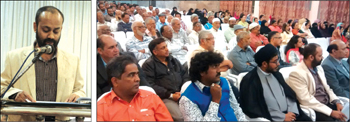
Viqar Ahmed Sayeed, Asst. Editor, Frontline Magazine, delivering the keynote address at Eid Milan prog. yesterday. Picture right shows a section of audience.

Mysuru :

Anjuman-e-Hadeqathul Adab, Mysuru, had organised its 12th Eid Milan programme at Abids Convention Hall in Bannimantap, here yesterday.

The programme started with the recitation of the verses of the Holy Quran by the Anjuman Treasurer M. Noor Ulla Shariff which were translated into English by Ajuman member Muazzam Ahmed Khan Tanveer.

Anjuman member Anees Ghori welcomed the guest and invitees.

Syed Shafi Ahmed, President of the Anjuman, presented a report on the activities and the aims and objectives of Anjuman and paid rich tributes to the founders who established this Anjuman to promote brotherhood and communal harmony in the city of Mysuru. He also lauded the work of the past office-bearers and members.

Speaking on the occasion, Dr. K. Javeed Nayeem, former President of the Anjuman, said that only when we are concerned about our neighbour’s pain and problems and embrace one another forgetting that we are from different religions that we become the true followers of our religion.

He cited the example of how in Chhattisgarh, a Muslim by name Razak Khan perform the last rites of Santosh Singh, his neighbour, according to the traditions and customs of Santosh Singh’s religion and one more instance of how in Colaba during Ganesh Chaturthi festival, on a Friday when Hindus saw their Muslim Brethren performing Juma Prayer in a open space outside the Masjid under the scorching sun, they invited them to offer their Namaz in a pendal erected in front of the Temple.

Anjuman member Dr. Irfan Ahmed Riazi presented some Urdu couplets on the present scenario in society.

Viqar Ahmed Sayeed, Assistant Editor, Frontline Magazine, in his keynote address, stressed on the need for establishing communal harmony in society and fostering good relations between members of different communities.

Hazrath Moulana S.M. Abbas Sajjadi, speaking on the occasion, requested Muslims to spread the message of love, brotherhood and communal harmony not just amongst themselves but also across other communities respecting all other religions.

The Moulana lauded the services of the Anjuman in spreading the message of communal harmony which is need of the hour.

Srihari, a member of the Alert Citizens Trust (ACT), speaking on the occasion, stressed on the need to not only protect communal harmony but also the need to make our environment greener by planting more trees. He urged each family to plant at least five saplings and nurture them.

Zee TV Kannada Comedy Khiladi-2008 winner and International Mimicry Artiste Ramesh Babu entertained the audience with his mimicry and jokes and greeted the members of the Anjuman for their efforts to spread the message of peace, brotherhood and harmony.

Anjuman Vice-President S. Moinuddin Pasha proposed a vote of thanks.

source: http://www.starofmysore.com / Star of Mysore / Home> General News / November 28th, 2016