The pallid, smudgy walls of Mahmudabad fort glistened in yellow lights as hundreds of followers of Imam Husain (Prophet Mohammad’s grandson and martyr of Karbala) walked barefoot on the rugged path from the outer gate to its interiors, beating drums and reciting ‘nauha’ (elegy) that filled the air with a tradition that has been part of the cross cultural commemoration of Muharram at the royal estate. For centuries, locals have been an important aspect of the Muharram legacy and on Saturday, Mahmudabad offered a special experience for many first-timers from Lucknow and other cities of India as well as foreign nationals from different religious backgrounds, who took part in the tradition, showcasing the synergistic nature of Awadh’s heritage.
A joint effort of Waqf-e-Maharaja and a citizen-driven initiative working for communal harmony- Shoulder to Shoulder (S2S), ‘Karbala: Beyond Religious Boundaries’ served opportune time for people from different cultures to gather and watch closely what Muharram signifies. An eye-opener to Awadh’s culture, the initiative served also as a platform for breaking several myths about Islam and Shia faith.
“I thought there would be a ‘tamasha’ of people striking their bodies with blades but instead I came to know about the sacrifice of Imam Husain and could feel the pain during the sermon,” said Amit Kumar, part of the entourage from Lucknow.
Visitors witnessed several traditional arts that are part of ‘azadaari’ (mourning) at this Sitapur town and the intangible heritage of Awadh, from melancholic classical Indian ragas on shehnai like Khamaj and Bhairavi , to the recitation of ‘sozkhwani’ and ‘marsiya’ in English and Urdu and experiencing the age old tradition of Nassari-a dying narrative art.
“In most part of the world, I had met only Sunnis from Asia but here is an example of how much more there is to India than just one culture,” said Philipp Jeun from Switzerland.
When the maulana (priest) began his speech on Karbala with: “Dar-e-Husain pe milte hain har khayal ke log/yeh ittehaad ka markaz hai aadmi ke liye (At Husain’s threshold meet people of all ideologies/this is the hub of unity of mankind),” all agreed in unison.
source: http://www.timesofindia.indiatimes.com / The Times of India / News Home> City News> Lucknow / by Yusra Hussain / TNN / October 11th, 2016
A team of Serve India, a Kozhikode-based cultural organisation, has been selected to perform Kolkali in Rashtriya Samvrithi Mahotsavam organised by the Union Department of Culture in Delhi from October 15 to 23.
According to a press release issued here, the team consisting of artistes from across the State will undergo a three-day training in Chennai before they set off to Delhi.
The traditional dressing style for Kolkali has been altered to be more colourful considering the importance of the festival as well as to suit the audience expectation.
The team is led by Yasin Kurikkal while Noushad Mankavu is the troupe manager, the release adds.
source: http://www.thehindu.com / The Hindu / Home> News> Cities> Kozhikode / by Staff Reporter / Kozhikode – October 12th, 2016
The music lovers at the Maharaja College Grounds yesterday were treated to soothing music with not much bang bang. Javed Ali, who is known for his sufi style of singing, took the audience on musical expedition with rendition of songs such as Kehne Ko Jasne Bahara Hari (Jodha Akbar), Tu Jo Mila (Bhajrangi Bhaijaan), Kun Faya Kun (Rockstar) Tu Meri Adhuri Pyas Pyas (Gajini) and Maula Maula (Delhi 6).
He also made sure to bring in some foot-tapping moments with songs such as Ishaqzaade (Ishaqzaade), Tum Tak (Raanjhanaa), Galat Baat Hain (Tu Mere Hero) and ended with some Amitabh Bachchan hits which included Apni To Jaise Taise (Laawaris), Pag Ghungroo (Namak Halal) and Kajra Re (Bunty Aur Babli).
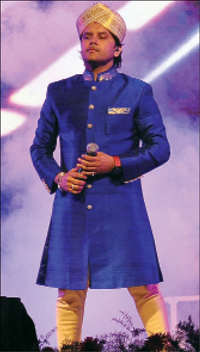
Dressed in sherwani and Mysuru Peta, Javed Ali said that he had come to Mysuru for the first time and loved the way people had received him. Javed was accompanied by Manisha Jambotkar, an upcoming singer, who rendered songs such as Zehnaseeb (Hasee Toh Pahsee), Jag Ghoomeya (female version – Sulthan), Deewani (Bajiro Mastani) and Jiya Jiya (Jab Tak Hai Jaan) which enthralled the audience.
Prior to Javed Ali’s concert, students of Government FGC, H.D. Kote; D. Banumaiah Independent PU College; Government FGC, T. Narasipur; Government FGC, Kuvempunagar and Maharani Commerce and Management College presented various colourful cultural programmes.
Later, members of Kamsale Ravi and Group presented Kamsale programme much to the delight of the audience. This was followed by a fusion dance performance by students of Nimishamba Dance School led by Vid. Sridhar Jain. The most attractive of cultural programmes, prior to Javed Ali concert, was Yoga Dance Ballet by the students of Vivekananda Yoga Shikshana and Samshodana Samsthe of Mysuru.
source: http://www.starofmysore.com / Star of Mysore / Home> General News / October 08th, 2016
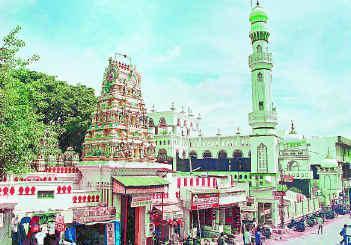
A cluster of shrines of all denominations dots the road that has not seen a single instance of communal violence.
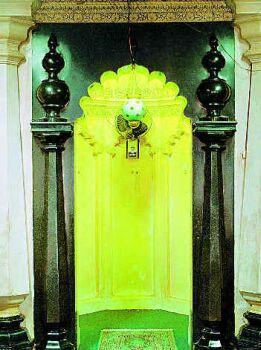
The meharab with the black granite frame at the Jumma Masjid.
IT IS every bit a spot Mahatma Gandhi dreamed of. A stretch on Old Poor House Road in the Cantonment area, behind Bowring Hospital, has a church, two temples, and four mosques. As the country enters its 57th year of Independence at a time of competitive communalism, the businessmen on O.P.H. Road have insulated this busy street from the influence of zealots.
“We live like brothers here. We sit across the table and sort out the differences, if there are any,” says Syed Masood, Chairman of the Jumma Masjid Trust, which owns 290 shops on O.P.H. Road. The mosque, which has a 90-foot minaret, was built in 1790 with materials supplied by Tipu Sultan from Srirangapatna. The magnificent granite structure can accommodate up to 5,000 people for namaz. The frame of its mehrab is carved out of a single block of black granite. The serene prayer hall has black stone pillars. The other four mosques are Masjid-e-Azam, Masjid-e-Bewarpawan (Merchant’s Mosque), Lal Masjid (1845), and Masjid-e-Lababeen.
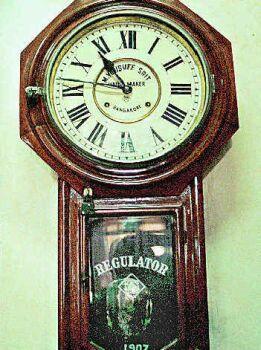
The Jumma Masjid also has a clock that has been ticking for 97 years now. Its late Imam, Abdul Hafeez Junaidi, had the distinction of being the only imam in India to have conducted prayers for 50 years in a row. Having played no mean role in promoting peace, he is still revered by the businessmen of the area.
To the left of the mosque stands the Lakshminarasimha Swamy Temple. The sanctum sanctorum was earlier a small mandapam with the beautiful deity carved out of granite, said to date back to early 19th Century. Doddanna Shetty (1840-1921), well-known philanthropist and founder of S.L.N. Charities, drawn to the modest shrine as a boy, developed it into a full-fledged temple in 1910.
A striking example of harmony.
Later, the late Mayor, C.P. Deenadayalu Naidu, took over management of the shrine. After his time, the mantle fell on his nephew, V.P. Chengalarayalu Naidu, in 1986. The latter says even on December 6, 1992, when the area was tense after the Babri Masjid was razed in Ayodhya, the area, on which a curfew was clamped, remained free of violence. “I rushed to the temple on hearing the news that day. The businessmen told us that nothing untoward would happen,” he says.
The temple attracts a large number of devotees from the surrounding villages on Holi, not to speak of hundreds of Christians who throng St. Mary’s Basilica during Mary’s Feast in September. Incidentally, a few feet away from the temple is St. Paul’s Church, which has its entrance at the Bowring Hospital end.
To the right of the Jumma Masjid is the 101-year-old Sri Venugopalaswamy Temple, run by the Reddy Bhoomi Kalyana Kula Brundam. The garba griha here has Rukmini, Venugopala Swamy, and Satyabhama as deities. Built in 1902, it used to have Sugreeva as the presiding deity earlier. When a shrine at Vannarpet (Viveknagar) was dismantled, the idols of Rukmini, Venugopala Swamy, and Satyabhama were shifted to this temple by members of the Reddy Bhoomi Kula community.
Says V. Krishnamurthy Shastri, an astrologer who has been working here for the past seven years: “Till recently, oil for the lamps and flowers for puja were supplied by Muslims. When they take out processions, they don’t trouble us. On special occasions, the traders go out of their way to help us.”
T.H. Yang, a Chinese trader, who makes special shoes for disabled persons, finds it hard to be unaffected by the friendly nature of the people in the area. He has been doing business here (his shop is called C.H. Yong and Company) for 51 years. His father opened the establishment in 1933 and he took over in 1952.
The clock that has been ticking for 97 years at the mosque.
Communal harmony had always existed in the 15-odd villages surrounding Cantonment, even before General Wellesley trooped in with his soldiers in 1809 after conquering Srirangapatnam. The burrah sahebs and memsabs, as the Europeans were called, did not attempt to alter this situation either.
“The Assigned Tract (Cantonment) had a charm of its own, which can hardly be described. The area is an agglomeration of people of different tongues — both Indian and European — welded into one community by the common economic interests. Here met East and West in a most dynamic focus. A warm handshake, a courteous salaam, and a kindlynamaste greeted the citizens. Its population, in 1891, was 1,00,81 as against 80,285 in the city,” says Fazlul Hassan, historian, in his bookBangalore Through The Centuries.
Although vivacious shoppers from Europe and savvy merchants dominated life here, lending its own character, the Cantonment area did catch the spirit of nationalist fervour. During the height of the Khilafat movement in 1921, it reverberated with slogans of Swaraj. Merchants and philanthropists supported the movement and a public meeting was held at the Idgah Maidan in Benson Town which was addressed by Mahatma Gandhi, Moulana Abul Kalam Azad, and Moulana Shoukat Ali. In a fiery speech, Moulana Mohammed Ali said: “The power behind the chakra gun is so effective that a single shot fired from Bangalore is sufficient to destroy Manchester.”
Traders from Commercial Street sent bales of foreign cloth to the sprawling maidans of Blackpalli (Shivajinagar) and the Muslim orphanage on Dickenson Road, which were set on fire. Osman Sait, a wealthy merchant, sold all his property to meet the expenses of Khilafat movement in the area and to start nationalist educational institutions and publications.
Today, not many remember the heady days and valorous deeds that eventually won us Independence. When our country now battles religious turmoil from within, communities like those on O.P.H. Road are an inspiring example.
V. RAMESH
source: http://www.thehindu.com / The Hindu / Home> Metroplus Bangalore / by V. Ramesh / Thursday – August 14th, 2003
Bollywood actor Nawazuddin Siddiqui may have backed out of his Ramlila act in riot-affected and divided Muzaffarnagar , but in adjoining Agra, Nizamuddin continues to rock the Ramlila stage.
He’s been doing key roles for over last five years and is Janak, the father of Sita, this time, no less. It wasn’t always that easy for Nizamuddin though.
During his early years in the Ramlila theater, he too faced protests and opposition like the way Nawazuddin did. But he stood his ground. In fact, another Muslim will do the part of Bharat along with him this year.
The 55-year-old Nizamuddin, who is the track man at Agra cantt station in north central railway zone, never had any acting classes but landed up for top notch role in 46th edition of Ramlila theater on dussehra.
Speaking to TOI, Nizamuddin said, “Back in 2010 when I gave my first audition for Ramlila play organized by railway, I was offered roles of Shantanu (father of Shravan) and Rishi Atari (mentor of Sabri). But soon, scores of people from my own community raised questioned on my faith in Islam. I was almost ousted.”
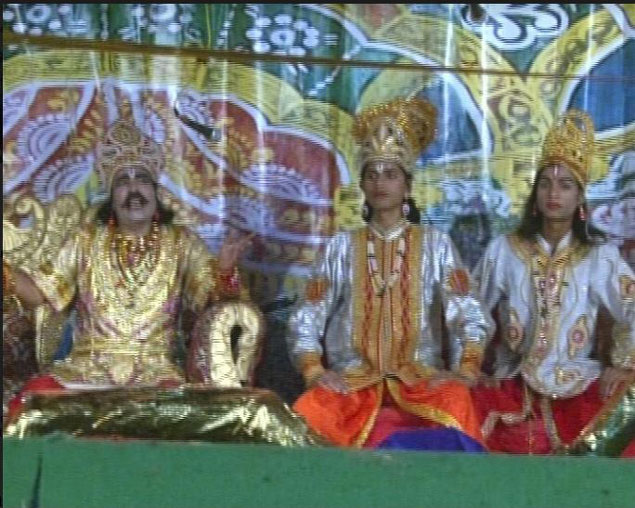
Nizamuddin playing Janak character, father of Sita, sits on the extreme left and delivers his dialogues.
“But as an artist I never changed my stance. There is no sin if a Muslim man acts in Hindu play. Ramlila talks about peace and triumph over evil. Getting a role in Ramlila is a matter of pride for me,” he said.
Expressing his dissent on Bollywood actor Nawazuddin Siddiqui backing out from play after opposition from right wing members, Nizamuddin said, “Nawazuddin is an artist, he should have continued with his act instead of giving up against bullies. I’m sure, the local residents and administration would had supported him if he would have stood up.”
Talking to TOI, director of Ramlila theater, Manoj Singh, who has been playing role of Ravan since 1998, said, “It is amazing to see the zeal of men like Nizamuddin, who outsmart other contestant for the roles. This is blunt and appropriate reply to those people, who want to create enmity and disturbance among different communities.”
“This year we had only two Muslim artists who have notched the top roles, while for the first time a woman has joined the play to act as Sita,” added Singh.
source: http://www.timesofindia.indiatimes.com / The Times of India / News Home> City News> Agra / by Arvind Chauhan / TNN / October 08th, 2016
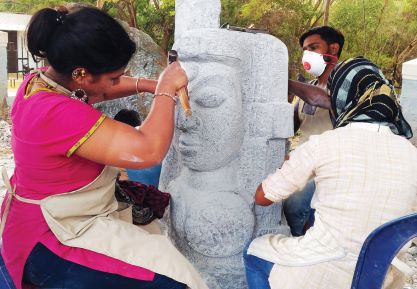
The ongoing 11-day Sculpture Workshop, jointly organised by Karnataka Shilpakala Academy and Lalitha Kala Akademi at Kalamandira on Hunsur Road in city, has provided vast experience to the sculptors.
Seven senior sculptors, assisted by an equal number of assistants, who have come from Raichur, Mysuru, Bengaluru, Mandya and Ballari districts, are busy giving final touches to their sculptures, with the camp drawing to a close on Oct. 5.
Tukaram of Sindhanur in Raichur district assisted by Manoj Kumar is sculpting ‘Kalikadevi’ idol, while Manjunath Acharya of Yelahanka assisted by Kumar of Bengaluru is giving final shape to ‘Shiva’ idol, Kalachari of Ballari assisted by Vivek M. Podar of Vijayapura is giving final touches to ‘Kambada Narasimha’ idol and our very own Shyamasundar Bhat of Roopa Nagar in Mysuru, assisted by Krishnappa is in the last leg of sculpting ‘Veerabhadra’ idol.
There are women sculptors too in the camp, exhibiting the skills they have learnt over the years. Gayatri A. Shipli of Chikkalasandra in Bengaluru assisted by Tabu Tabassum ofHospet, is sculpting a folk figure. The other sculptors, taking part include Deepak and Lokesh from Mandya.
The stones for sculpting were procured from Hampapura in H.D. Kote taluk.
The camp also features wood sculpture and carving. G.V. Shivakumar of Bengaluru has carved ‘Ardha Nareeshwara’ idol out of wooden piece, while on M. Chidananda of Girinagar in Bengaluru has carved ‘Shiva’ idol, Vasant Naikar ‘Madanike,’ Sashidhar Acharya ‘Krishna,’ Nagendra S. Kammar ‘Darpana Sundari,’ and Vijay and Shivakumar contemporary art works.
M. Ramamurthy of Bengaluru is the camp Director, while Karnataka Shilpakala Academy Member Dr. Geetanjali Achar of Mysuru is the convenor.
source: http://www.starofmysore.com / Star of Mysore / Home> Feature Articles / October 04th, 2016
Abortive takeover bids did not prevent the Muslim influences from impacting the Kashmir society. Long before Kashmir’s transition to Islam, the new faith existed and thrived even during the Hindu rule, says Sara Wani
(Manuscripts of the Holy Qur’an calligraphed in 1237 AD on a 25 feet long and 2.5 inch wide scroll paper. Belived to be gifted by Shiekh Hamza Makhdoom (RA) to Khawaja Miram Bazaz, great grand father of Majid and Ashraf Quazi, who displayed it in an exhibition in Srinagar.)
Mohammed bin Qasim packed home never to return and Ghaznavids’ left, as if vowing never to set foot on mountains guarding Kashmir like a wall. Kashmir kingdom was apparently insulated against the changes that swept proper India. Delhi Muslim kings and Turkish Sultans remained too preoccupied with power consolidation to make any advance toward Kashmir.
But for the ideas and influences, high Himalayas were no impregnable. Then, political boundaries did not stop trade, refugees and even fortune hunters. Kashmir knew of Islam much earlier than the two failed conquests.
In his Shah Hamdan of Kashmir, Kashmir’s former Director of Archives, Archeology, Research and Museums, Prof Fida Mohammad Khan Husnain has referred to a legend that then Kashmir ruler Veenditya’s emissaries had trekked through Bahrain and met the prophet of Islam. “This information is further collaborated in a Persian manuscript entitled Anwar-i-Kashmir, where it is informed that the Holy Prophet did depute Abu Hazifa Yamani in about 8 AH (after Hijra) with letters to the Chinese emperor but the above emissary got held up in Kashmir due to a heavy snowfall,” Husnain wrote. “Veenditya, the Raja of Kashmir treated them well.”
While the author offers no detail about the veracity of the manuscript and its writer, he claims that Caliph Umar ibn Khitab had deputed a delegation of five persons to Kashmir in about 21 AH. He offers no reference to substantiate the claim. Extensive research failed to trace the king in Rajatarangini. At that point of time when Islam was getting established in the deserts of Arabia, Kashmir was witnessing transfer of power from Baladitya, the last Gonanda king, to Karkotas whoso rule begun with Durlabhavardhana (627-649). Even the Thang dynasty records in China suggest that the first Muslim delegation comprising 15 Arabs was led by Said Ibn Abi Waqqas. Thabit ibn Qays accompanied him. Dispatched by Caliph Usman, it met Chinese Emperor Yung-Wei in 651.
But the existence of Muslims in Kashmir is well documented after the fall of Sindh. Chachnama author Alafi bin Hamıd al-Kufı, states that Muhammad Alaf, an Arab mercenary who had served Sindh ruler Dahır (712 A D), sought refuge in Kashmir. The then Kashmir ruler Candrapıda, received him well and bestowed on him the territory of Shakalbar. G M Sufi, the author of Kashir: Being A History of Kashmir has quoted Sir Alexander Cunningham locating Shakalbar somewhere around the slat range saying the territory was then under the control of Kashmir king.
After Alafı’s death, his estate was inherited by one Jahm, who, according to al-Kufı, “built many mosques there”.
Writing in the UNESCO publication History of Civilizations of Central Asia (IV), N A Baloch has quoted al-Bırunı recording that Muhammad bin al-Qasim bin Munabbih who took Multan “belonged to the house of Jahm bin Sama al-Shami, who had allegedly settled in Kashmir as far back as 712–14 and whose descendants had reportedly continued to flourish there.”
Baloch says though Kashmir was ruled, from the eighth century onwards, by the local, independent, originally non-Muslim dynasties, the region had “increasing political contacts with the Muslim rulers of Sind and Khurasan.” Kashmir and Kashgar, then, would be the two main trading states through Gilgit.
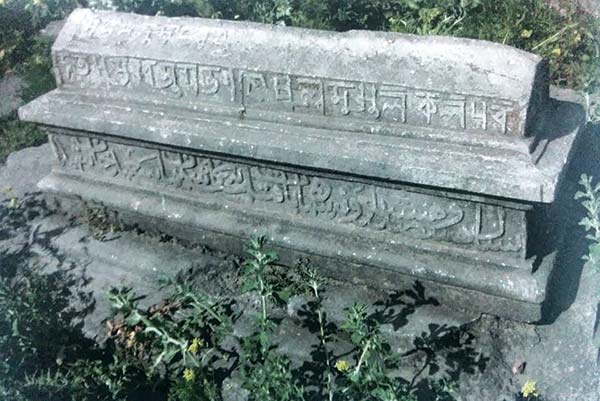
(Arabic and Sharda inscription on the grave of Seda Khan, next to Ziarat of Bahauddin Sahib, who died in a battle in the reign of Mummad Shah (1484-1537).)
Gaznavids’ returned home from Rajouri as winters set in and failed to wrest Kashmir from Sangramaraja in 1021. “It is, however, possible that some of Mahmud’s soldiers, finding it difficult to cross the mountains towards the plains of India, stayed behind and settled in Kashmir,” historian Abdul Qayoom Rafiqui writes in the UNESCO publication. “It is after these Turkish invasions that Kalhana refers, for the first time, to the presence of Turuskas (Muslim) in Kashmir when describing the reign of Harsa (1089–1111).”
Venetian adventurer Marco Polo is still a widely reliable traveler of that era. He visited Kashmir in 1260. His description of an “idolatrous” Kashmir, then ruled by Laksmanadeva (1273-86) – an “incompetent” ruler “consistently harassed by the Turks and his turbulent nobles”, is brief but interesting.
“They have an astonishing acquaintance with the devilries of enchantment; insomuch that they make their idols to speak,” Polo records in his Travels of Marco Polo. “They can also by their sorceries bring on changes of weather and produce darkness, and do a number of things so extraordinary that no one without seeing them would believe them.”
While terming Kashmir as the “very original source from which Idolatry has spread abroad”, Polo has made the predominant faith clear. But he has made two other observations.
“There are in this country Eremites (after the fashion of those parts), who dwell in seclusion and practise great abstinence in eating and drinking. They observe strict chastity, and keep from all sins forbidden in their law, so that they are regarded by their own folk as very holy persons. They live to a very great age,” goes the first one.
“The people of the province do not kill animals nor spill blood; so if they want to eat meat they get the Saracens who dwell among them to play the butcher,” is the other observation. Saracen is a generic term for Muslims that Christian writers widely used in Europe.
Evidences suggesting Muslim presence in thirteenth century were further corroborated in August 2012 by Qazi brothers – Ashraf and Majid, originally from Khawaja Bazaar. At an exhibition, they displayed full text of the Qur’an calligraphed in 1237 AD on a 25 ft x 2.5 inch scroll paper. “It is part of our heirloom and we had forgotten it on our attic in our old house under the shingled rooftop and nobody touched the two boxes for nearly 150 years,” Ashraf said. “Once we discovered and opened the box, we discovered the treasure.” The rare manuscript, calligraphed by Fatahullah Kashmiri was gifted by Sheikh Hamzah Makhdoom to Khawaja Miram Bazaz, the great grandfather of the Qazis. It carries a certificate of authenticity and transfer with 35 Ulema as witness. Historians did not expect Muslims to be living in Kashmir, then.
Focusing on the ‘court’, Rajatarangini, Kashmir’s oldest historical chronicle skips mentioning social changes in detail. But the first major mention of a social change is during the reign of Lohara dynasty king Harsa (1089-1101). The king says Kalhana, “introduced into the country more elaborate fashions in dress and ornaments and made his courtiers imitate his own taste for extravagance in personal attire.” The ‘new dress code’, an apparent ‘Western Disturbance’ was explained by M A Stein as the “Mohammedan influence”.
This observation is indicative of a social impact though not a religious transformation. But the Kashmir court was never immune to foreign influence. Even Lalitaditya’s had a Turk minister Cankuna. Stein says he was from Badakhshan or its immediately adjoining tracts on the upper Oxus. Besides, Lalitaditya, “as overlord of India”, according to Maharajas’ of India, by Annmorrow Shrishti was “already recruiting regiments from Central Asia.”
Vajraditiya-Bappiyaka, Lalitaditya’s son who ruled Kashmir for seven years, says Kalhana “sold many men to and introduced in the country many Mleccha practice”.
Apparently, Mlecchs were to Hindu scholarship what Saracens were to European writers. A Sanskrit word, Mleccha means “alien in language and manners, uncouth, inferior”. Their presence was felt throughout the reign of Korkotas’, the dynasty that reigned Kashmir between 663 – 855 AD, coinciding with the period when Arab armies were being dispatched to the length and breadth of the world. Even the Bhavaishya Purana, one of the 18 Puranas of ancient Vedic literature dealing with the future, anticipates the rise of prophet of Islam as “the Acharay of Mlecchas”, a desert resident who would be the embodiment of divine qualities. Some Kashmir historians see Ali Kadal as the Mleccha Mar that Rajatarangini refers to.
Husnain is correct in saying that Islam was brought to Kashmir by non-Muslim Rajas. While Karkota king Vajraditya (761– 767) introduced Mleccha practices, Lohara dynasty king Harsa not only employed Turuska commanders but made temple spoliation a state policy. He confiscated idols possessing the valuable metals, they were made of.
A Hindu iconoclast, Harsa was an interesting character. Initially prudent, courageous and lover of art and music, Sufi feels “his mind was rather demented”. Kalhana see him as “a jumble of contraries”, who was bankrupted by extravagances. To manage his kitty, Kalhana says he would loot the temple treasures, especially the metallic idols. An exploitative taxman, he would even levy night soil! Even though famines, bandits and plagues attacked Kashmir, Harsa never exempted his subjects from taxes. Eventually, his nephews led a rebellion, putting his palace afire, roasting his queens alive and slaying his successors. He was perhaps the only Kashmir king who head was sliced after being hunted down and left to be cremated by a wood-dealer “as a naked pauper”.
Stein has explained Harsa differently. “As Kalhana is particular to specify the new metal statues of gods throughout Kashmir which escaped Harsa’s clutches, we cannot doubt the extent and thoroughness of Harsa’s iconoclasm,” Stein writes. “Can the latter have been instigated or encouraged somehow by the steady advance of Mohammadanism in the territories? Kalhana when relating to these shameful confiscations, gives to Harsa the epithet Turuska i.e; Mohammadan, and later makes reference to Turuska captains being employed in his army and enjoying his favor”.
Having little faith in his people and his soldiery, Harsa had raised a new model for his army. Comprising mostly Ekangas, the royal bodyguards and the Tantrins, the reformed trouble-makers, each group of hundred soldiers was placed under a Muslim commander, thus making it impossible for soldiers to run away or hatch plots. This was the beginning of Muslim influence in Kashmiri politics. After Harsa, Bhiksacara (1120-21) is understood to have raised a Muslim cavalry for his personal guard, a task they eventually failed in.
Harsa, however, was one of the series of puppet kings who misruled Kashmir for nearly 500 years after Lalitaditya (724-60) when court rivalry would change kings in Kashmir like turbans. In between came Avantivarman (855-883) who tried to put the house in order. Putting foreign conquests at halt, he devoted his attention to his state focusing on development, welfare, and delivery of services. As his son succeeded him, things were back to square one with class-wars and internecine battles triggering the political instability and reducing the kingdom to its old territorial confines.
By the time Jayasimha (1128-1155) took over, Muslim mercenaries had gained so much popularity that the king and his army chief, according to Kalhana, would go “into the camp with Yavanas (Muslims).”
The gradual decay of the state and the society had led to such deterioration, according to Rajatarangini that when Sahadeva (1300-1 to 1319-20 AD) took over, Kashmir had reduced to a kingdom of “drunkards, gamblers and profligate women”. So when Mongol king Karmasena’s commander Dulcha (Zulchu) invaded Kashmir in 1320, the king fled to Kishtwar. Nobody resisted 70,000-strong invaders, who devastated Kashmir for eight months, selling men to Tartar traders, setting afire dwellings and standing crops. But the entire army perished over Devsar Mountains in south Kashmir while fleeing Kashmir winters with thousands of men and women slaves.
Dulcha destruction literally marked the end of a long chaotic Hindu rule. That changed Kashmir forever.
(This is the second in a four part series on advent of Islam in Kashmir. Read the first partIslam’s Kashmir Story.)
source: http://www.kashmirlife.net / Kashmir Life / Home> Faith History / Tuesday – February 16th, 2016
The Vice President will proceed to Kollam by helicopter to unveil the statue of renowned educationist Dr. M. Sreenivasan at the Sree Narayana College campus.
At a function to be held at the Kanakakkunnu Palace in the evening, the Vice President will formally open the digital library of the P N Panicker Foundation.
Vice President Dr. Hamid Ansari will embark on a three-day visit to Kerala on Monday, where he will attend various programmes in Kollam, Thiruvananthapuram and Ernakulam. Soon after his arrival in the State capital in the afternoon, the Vice President will proceed to Kollam by helicopter to unveil the statue of renowned educationist Dr. M. Sreenivasan at the Sree Narayana College campus.
Later, Ansari will return to the capital city for stay at the Raj Bhavan, where he has two engagements on Tuesday.
In the morning, he will inaugurate the Navathi celebrations of Navajyothi Karunakara Guru at the Santhigiri Ashram.
At a function to be held at the Kanakakkunnu Palace in the evening, the Vice President will formally open the digital library of the P N Panicker Foundation.
The digital library is launched as part of the Foundation’s drive for complete e-literacy. On Wednesday morning, the Vice President will inaugurate the Vidhyadhanam Scheme of the St. Teresa College in Ernakulam, following which he will then return to Delhi.
source: http://www.indianexpress.com / The Indian Express / Home> India> India News / by ANI, New Delhi / August 29th, 2016
Former MP Sebastian Paul presenting the first copy of SiGNS festival book to actor Sajitha Madathil during the inaugural function of SiGNS 2016 in Kochi on Wednesday.— PHOTO: by special arrangement
SiGNS short film and documentary festival opensin city
Kerala Chalachithra Academy Chairman Kamal has said the government was considering setting up, over a period of five years, nearly 200 new cinema halls across villages in the State for screening alternative, parallel, and art house films of note in Malayalam.
“This is something the Minister himself has mentioned, as a means to take good cinema to the interiors. Besides, film societies continue to be relevant in their mission to bring closer to cinema the section of people who are staying aloof,” he said while inaugurating the SiGNS short film and documentary festival organised by the Kerala chapter of the Federation of Film Societies of India (FFSI-K) and Kochi Biennale Foundation here on Wednesday. As part of measures to promote Malabar region, the International Documentary and Short Film Festival of Kerala (IDSFFK), routinely held in Thiruvananthapuram, will be shifted to Kozhikode next year.
Mr. Kamal outlined the course of the film societies movement in the State and said the movement had hit the doldrums in the early 1990s, and the social situation then had created a breed of apolitical, direction-less youth.
“But there was a revival of the movement in the mid-2000s. While the old generation still nurses the hardship they had undergone in the celluloid era, the digital film age averted the need for collectivity, as anyone with a mobile cam can make and watch films.”
source: http:/www.thehindu.com / The Hindu / Home> News> Cities> Kochi / by Special Correspondent / Kochi – September 29th, 2016
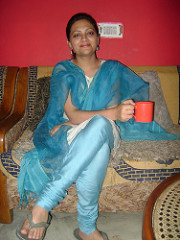
Television journalism is one of the most glamorous jobs of new India. Arfa Khanum Sherwani as principal correspondent and news anchor for NDTV India holds one of those glamorous jobs. Her home in New Delhi is an example of simplicity. She used to be in front of her camera, but this time she was the subject of the interview. I asked her about television journalism in India which is barely a decade old.
While Ms. Sherwani is very optimistic about the future of news channels in India, she is also brutally honest in accepting the mistakes made by electronic journalists.
Arfa, originally from UP, is a Chemistry graduate. She did a one year course in journalism from Aligarh Muslim University (AMU) and joined The Pioneer. From there she moved to The Asian Age. Realizing that she is more comfortable in a visual medium, she found herself as a TV reporter and news anchor.
Arfa has won accolades and criticism for her courageous and investigative reporting on Sachar Committee Report, Batla House encounter, and a special on the performance of the Ministry of Minority Affairs.
“News channels in India are in adolescent phase,” Arfa argues and that’s why they seem to be moving from one experiment to another, still trying to find a firm footing. She is critical of the abuse of the term ‘breaking news’ and over reliance on TRP, the rating system used by the Indian TV channels.
Arfa does not hesitate in calling the news dished out by TV channels as ‘infotainment.’ She calls for higher standard and believes that viewers are ready to watch quality journalism if given the opportunity.
She is passionate about the media and believes that she has so much to learn and excited about the opportunity to learn something new every day. She wants to be known as a serious journalist who is a face of authenticity who raises people’s issues and concerns and becomes their voice.
A sign of good journalist, she always keeps a notebook to record her thoughts and a book to keep herself informed of the issues.