Category Archives: Arts, Culture & Entertainment

Over a cup of evening tea : A brush with Royalty recollected

Mysuru, KARNATAKA :

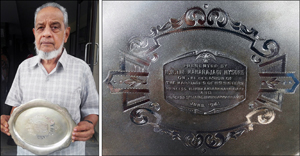
Prof M. J. Sadiq with the silver tray. Detailing on the silver tray

by Dr. K. Javeed Nayeem

Mysuru :

Today I’m writing this article about Royal weddings of long ago from a place that seems like it has been caught in a weird time warp. I say this because our Coffee Estate where I am on a holiday right now has been without a working telephone landline for the past three months. The best mobile phones too just become expensive paperweights, unable to serve their intended purpose. Although privileged to be located amid lush sylvan surroundings in the midst of the best that nature has to offer, most estates like ours are tucked in the nooks and crannies of the hills where mobile signals simply fail to trickle through. Electricity too is a commodity that cannot be had for the asking just because you have a meter and a line hooked to an electric pole.

Nobody who is entrusted with the responsibility of keeping these facilities working has been able to summon the will or the sense of commitment to do anything about it despite all the hue and cry raised by subscribers who are cut off from a civilisation that thrives on constant wireless connectivity and only keeps complaining constantly of insufficient speed! After I complete this article I’ll have to drive ten kilometres with my laptop to the nearest village where a sufficiently strong mobile signal becomes available for me to mail it to the SOM office.

This business too is not as simple as it seems. I’ll have to wait patiently in my car and keep a watch on the signal strength before pressing the send button precisely at the right moment. It’s a little like skeet shooting, thankfully a sport at which I happen to be pretty good! Well, going back just a little bit from the time zone where I am now standing I would like to draw your attention to how things were in the forties in Royal Mysore.

Girija Madhavan, a multi-talented lady who sometimes takes readers down the memory lane with her nostalgic writings and paintings, recently talked of the way Royal weddings used to be held (SOM dated 20th June, 2016). She recalled how her late father M. Venkatesh used to attend the Durbars of the Maharaja and she has also sent a picture of the silver salver on which the wedding invitations used to be placed before being handed over to the VIP invitees. My late maternal grandfather Alhaj M. Khaleelur Rahman, then a prosperous merchant on Ashoka Road, was a person who was very close to the Royal family and who used to be invited to Dasara Durbars and all the Royal weddings and other functions that used to take place during his time. His son, Prof. M.J. Sadiq, my maternal uncle, who used to teach Zoology at St. Philomena’s College, still has in his possession the salver on which his father received the invitation to the weddings of the two sisters of the Maharaja held in the year 1941.

Weighing exactly 350gms and made of 97% pure silver by C. Krishnaiah Chetty and Sons of Bangalore, its purity and paternity are stamped on the reverse. It is very similar to the one in possession of Girija Madhavan although slightly different in shape. Incidentally, my uncle, Prof. Sadiq is a very meticulous person who is a sort of chronicler of all events in our family besides being the curator and caretaker of the family heirlooms. If you want to know what the cost of onions or sugar or rice used to be in any given year ever since he started wielding a pen probably in the mid-forties, he will turn the pages of his record books and give you the exact figures in less time than it takes for the Google search engine to do the job!

He has also preserved all the invitation cards of all the weddings that have taken place in the family ever since he was a little boy. Incidentally, he found a mention in Star of Mysore last week for being the first person to suggest in a letter to the editor three and a half decades ago that the Hardinge Circle would be a good place to install the statue of H. H. Sri. Jayachamaraja Wadiyar.

R. Kasturi Raj Chetty, who became the eighth Vice-Chancellor of the Mysore University (1948-50), used to be very close friend of my grandfather and the two would attend most public functions together including the ones at the Palace. The wife of the VC for whom my late grandmother, Zaibunnissa was a favourite friend, would come in a separate chauffeur driven car to pick up my grandmother on her way to attend such events. It appears the two ladies even used to do their shopping for silk saris together. It certainly must have seemed very unusual at that time for a lady from a tradition bound Muslim household to be seen socialising as she did when most of her counterparts led a home-bound existence. ‘Good old Days’ indeed!

e-mail: kjnmysore@rediffmail.com

source: http://www.starofmysore.com / Star of Mysore /  Home> Feature Articles / July 08th, 2016
Keeping alive a tradition that’s on the wane

Hyderabad, TELANGANA :

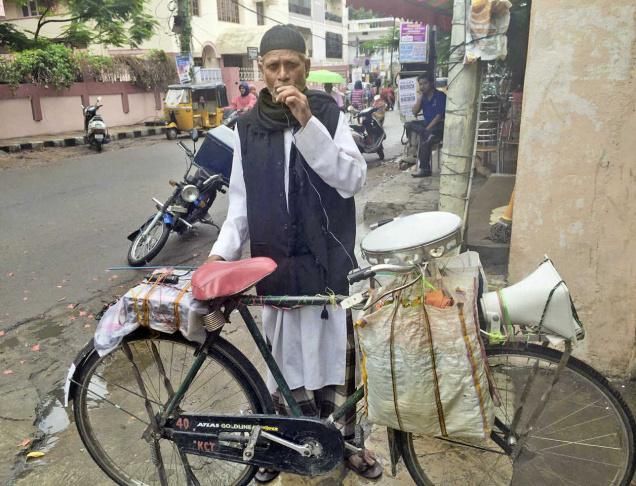
Without a miss:Muhammad Jaffer has been announcing Ramzan fasting time for the past 31 years.— Photo: Serish Nanisetti

Muhammad Jaffer cycles through the streets of Santoshnagar beating his drum announcing the beginning of Ramzan fast

He is a town crier with a difference. Under the halogen streetlight glow at 3.30 a.m., Muhammad Jaffer’s voice booms over the hailer in Santoshnagar, Mehdipatnam followed by banging of drum announcing the beginning of Ramzan fast for the day. The whirring fan, the noisy AC and closed doors are no impediment, as folks scramble to prepare lunch before the 16-hour fast. Some have the food ready and just have to brush and eat sehri.

“This is a tradition from the beginning of Islam. Now people have alarm clocks, but I like to hear his sing-song voice asking people to wake up for food and prayer,” says Aziz Ahmed, a businessman. “Earlier, there were sehri-walahs doing this, but now the numbers have declined,” says Mr. Aziz, recalling the time when the family used to live in Hussainialam in the old city, 40 years ago.

It is difficult to catch Mr. Jaffer in the morning as he briskly cycles through the streets of Santoshnagar to Rethibowli in Mehdipatnam between 2 a.m. and 3.30 a.m. banging the drum mounted on the handlebar of the cycle and singing the words that are difficult to grasp. “I have been doing this for the past 31 years. I began in 1983 or 1984 when I was 14 and my father Muhammad Qureshi passed away. I am continuing his legacy. Then I used a tin drum which I used to bang, shout and walk through these same streets,” says Mr. Jaffer, on a day when he has come to collect money from grateful people whom he has rendered this service to.

“Earlier, people used to give foodgrains. Now they give clothes, grains as well as money,” informs Mr. Aziz.

“There was a time when we used to meet at 1 a.m. to drink tea and have pan before heading out to make these calls. We were more than a few dozen. But now, there are about 10 in this part of the city and I think the whole of Hyderabad may have about 50,” he guesses.

“No. My children will not follow this profession. They are all young and they want to study and work,” says Mr. Jaffer, who supplies lime to restaurants and function halls during the rest of the year.

In these days of niche apps that show the direction of qibla, exact time of prayer, and cell phone alarms, Muhammad Jaffer is a happy anachronism which Hyderabad can be proud of.

source: http://www.thehindu.com / The Hindu / Home> News> Cities> Hyderabad / by Serish Nanisetti / Hyderabad – July 06th, 2016

Ishaq Madina: A place of Hindu-Muslim amity

Visakhapatnam, ANDHRA PRADESH :

Visakhapatnam:

A seat of secularism, Ishaq Madina Dargah is known to celebrate Ramzan and Ram Navami in the same premises.

Also referred to as the Sheikh Ali Ishaq Madina Rehmatullah Dargah, this place of worship is named after a Muslim sufi saint who arrived in Visakhapatnam from Madina in Arabia along with his followers. Though the exact date of the dargah is not known, it gained prominence during the Mughul rule and was granted the Inam (land) of Yerrada and Devada villages and other properties in Vizag in 1706. Locals, however, claim that the Dargah is much older and has been observing the holy month of Ramzan for more than four centuries.

According to Mohiddin Basha, a dargah trustee, “Ramzan has been observed for at least four hundred years now. Recently, archaeological experts declared that the dargah could actually date back further to another two centuries at least”

“Hindus and Muslims alike come to pay their respects to the sufi saint Sheikh Ali Rehmatullah. In fact, the first Sepoy Mutiny to take place in India in 1780s was launched after the sepoys took their blessings from the dargah before going to battle against the British,” Basha said. During Ramzan, the dargah keeps the kitchen open to people from all faiths.

Hindu festivals such as Sri Ram Navami and Janmashtami are also celebrated at the dargah with great pomp. K Ramana Murthy, a resident of Sivalayam Stree, said, “The dargah symbolises the unity in the concept of God and because of it’s presence, there has never been a case of Hindu-Muslim rivalry in this city. We live as brothers and respect each others traditions.”

History buff BS Mahesh said, “The reason why Hindus and Muslims had no conflict of interests in Visakhapatnam is partly because most of the Muslims here were traders and sea farers, while the Hindus were ship builders and metal smiths. The give and take relationship between the two communities was harmosnised by the presence of the dargah. Many trustees of the dargah and some of the famous 19th century Muslim scholars from Vizag such as Chisti Saheb were scholars in Sanskrit and Telugu as well.”

In a bid to bring the dargah to the notice of the people, the trustees intend to request the state government to release some of its properties that were forcible occupied and be recognised as one of the oldest places in AP where Ramzan has been celebrated by both Muslims and Hindus.

source: http://www.timesofindia.indiatimes.com / The Times of India / News Home> City> Visakhapatnam / TNN / July 06th, 2016

Eid Dawoodi Bohra style is to promote zero wastage of food

Visakhapatnam, ANDHRA PRADESH :

Visakhapatnam:

While the Muslim community across the country will celebrate Eid-ul-Fitr on Thursday, the Dawoodi Bohra community residing in upscale Mubarak Colony of Port City observed the festival on Tuesday after 30 days of fasting by offering prayers and namaaz at the Mohammadi Masjid in Yendada.

Around 650 people took part in a community breakfast after the prayers. A unique feature of their meal is everyone, irrespective of social status, eats from huge thalis as it fosters the spirit of harmony and promotes economic justice. Another reason for such a practice is to avoid wastage of food.

“Today’s Eid-special breakfast consisted of sheer khorma (a sweet dish made of dry fruits, milk and sewaiyya), bread, kheema, vadas and chutney. Eight people at a time can sit together to eat from a thali. For lunch and dinner too, the same system would be followed. Special items like biryani and karri chawal was prepared in our community kitchen today,” said Adnan Sabuwala, a member of the Dawoodi Bohra community.

A good initiative of the community is preventing wastage of food. “Whatever food remains after consumption by our members would be distributed among the poor villagers in the surrounding areas. If there’s some food or vegetables that’s not in a state good enough for consumption by people, we go to some cattle or animal shed and with permission of the owners, offer them to the animals,” said Mulla Abhizer Madraswala, secretary of Anjuman-e-badri, a committee organisation that looks into the accounts and logistics.”

source: http://www.timesofindia.indiatimes.com / The Times of India / News Home> City> Visakhapatnam / TNN / July 06th, 2016

Where the streets never sleep

Chennai, TAMIL NADU :

Triplicane comes alive during the holy month of Ramzan. AKILA KANNADASAN strolls through its many lanes, taking in its sights, sounds and flavours

Mohammad Fazluddin looks at the net of silver beads he’s woven with satisfaction. It is suspended on a nail at Meraj Gul Mahal, a craft shop the size of a telephone booth, located in a by-lane opposite the Big Mosque on Triplicane High Road. The beads will form the base for a sultani sehra, an accessory that will drop like a curtain over a groom’s face. The 80-year-old has been making such essentials for Muslim weddings for decades. Despite his age, he opens the shutters of his little shop every day. For, orders flow during the month of Ramzan, at the end of which the wedding season begins.

Triplicane reflects Fazluddin’s spirit — hope and the prospect of a new beginning. Shoppers with their purses full, thanks to generous friends and family; shop-keepers whose cash counters are filling by the hour; restaurateurs whose evening specials sell like hot cakes… everyone is happy. “Ramzan is when women buy new burqas,” says Shanaz Akthar of Sana Burqa House. “Even those who cannot afford them save up for new ones.” The new arrivals this year are double-coloured and umbrella-cut burqas.

At Triplicane high road / Photo: Shaju John

The shops that sell wedding merchandise are filled with laughter and friendly chatter. At Chand Basha, Kairoon shops for stone-studded bangles for her daughter, who is to be married. The shop has been around for over 80 years, and is among the more popular in the area. Bottles of beads and sequins and racks of red-and-gold dupattas and hand fans line the shop. How has business been, we ask Basha, when Kairoon cuts in: “Of course it’s good. Just look at the man. He’s getting plumper every year,” and laughs. As we step out, Zakira Begum waves at us with a grin from across the road. It’s a shame if you take pride in knowing Triplicane well but don’t know Zakira. The smiling lady sits at the same spot a few blocks from the Big Mosque with tubs bearing pale-white circles of rumani semiya every year during Ramzan. She makes the semiya at her house in Royapettah and has been selling it for 40 years. Several other men and women are also seated on the pavement selling semiya.

The Big Mosque nearby bustles with men who walk in prayerfully to break their fast with the nombu kanji served inside. If there’s one thing that’s as important as the fragrant kanji, it’s the vadai. For many, it’s a tradition to have the kanji with a vadai or two. Waheeda Begum and her mother have been making vadais for the hundreds of people who come to the mosque.

Seated at the gate, Waheeda slides in circles of batter into a vat of hot oil, while her mother extracts them once they are cooked a crispy brown. Her medhu vadais are legendary; so are the muttai bondas.

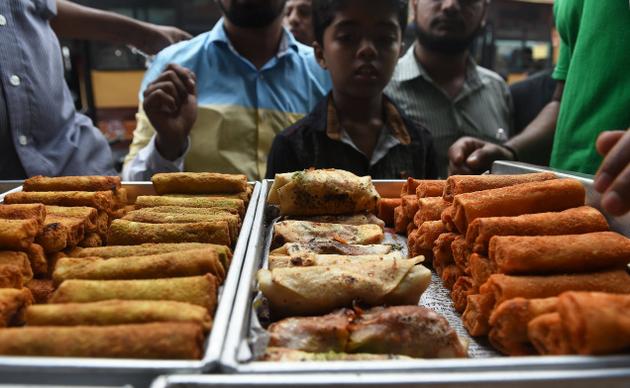
Triplicane High Road and Dr. Besant Road play host to several vadai sellers during this season. With women at the helm, these pushcarts do brisk business. Then, there are the many biryani restaurants that whip up evening specialties. SHB Biryani, famous for its mutton biryani, sells a range of deep-fried delicacies, such as mutton and chicken cutlets, chicken roti, a dish made of spicy minced chicken masala wrapped in a thin maida roti, chicken samosas, chicken rolls… all of which disappear the moment they reach the counter. Men stop by to buy them for their fasting families.

Ramzan special snacks displayed at SHB Biryani on Triplicane high road,/ Photo: Shaju John

But, what’s Ramzan without Afreen Juice and Tea Shop’s chicken samosa? It’s almost a sin to miss the crumbly, greasy samosa with a chunky chicken filling. Haleem, a Hyderabad specialty, is not as common as vadai and biryani in Triplicane. Afreen stocks Pista House’s haleem. Abdul Rahman, who works in the IT sector, has brought Sheik Hafiz, a haleem specialist from Hyderabad, to make the delicacy and sell it at a makeshift stall opposite the Ameerunnisa Begum Sahiba Mosque near Zam Bazaar. “We supply to several restaurants in the city,” says Abdul.

As dusk falls and the muezzin calls for prayer, the streets of Triplicane grind to a halt. But it lasts just a moment. The rhythm picks up again, and goes on and on.

Triplicane never sleeps.

source: http://www.thehindu.com / The Hindu / Home> Features> Metroplus> Society / by Akila Kannadasan / Chennai  – July 04th, 2016

These Adil Shahi era cannons cry for attention

Vijayapura(Bijapur), KARNATAKA :

VijayapuraCanon02MPOs04jul2016

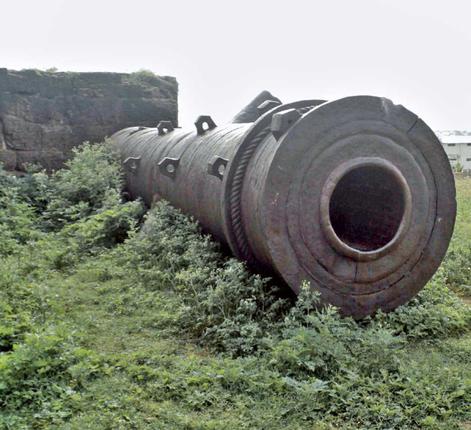
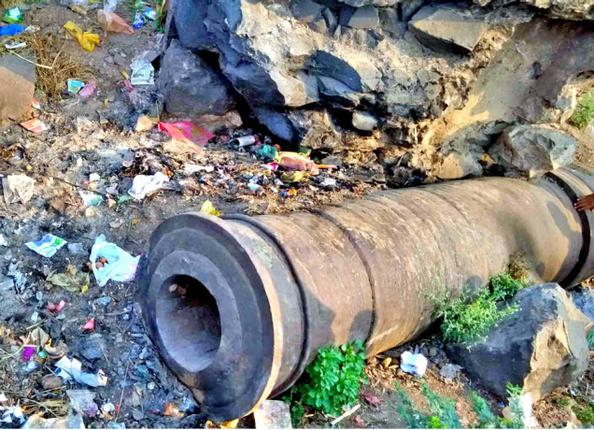
The Mustafabad cannon at Allapur Gate and Landa Qasab cannon, in Vijayapura, are facing neglect.

Some of the massive and marvellous cannons belonging to the Adil Shahi era here are decaying because of lack of efforts to preserve them.

While only a few giant cannons have been preserved at Nakkar Khana, the main pavilion of the Gol Gumbaz, at Malik-e-Maidan, some others are left there in the open.

The cannons at Mustafabad near Allapur Gate, a few hundred metres from the Gol Gumbaz, are in the worst shape.

The cannon was earlier placed on the fort wall. Over a period of time, the wall collapsed owing to lack of maintenance and the giant cannon fell on the ground.

The authorities have not made any efforts to locate it to a better place where it could be preserved. They are now getting gradually buried under a heap of garbage and human waste.

Similar is the condition of the Landa Qasab cannon near Kirti Nagar and Ali Burj.

While a signboard has been placed by the Archaeological Survey of India near the Landa Qasab cannon, the one at Mustafabad does not have one.

According to historians, these cannons played a significant role in protecting the boundaries of the Adil Shahi empire from enemies.

They were strategically placed on towers where security men could keep a watch on the entry of enemies.

source: http://www.thehindu.com / The Hindu / Home> National> Karnataka / Firoz Rozindar / Vijayapura – June 30th, 2016

Naseer Taj and his passion for qawwali

Hyderabad, TELANGANA :

Naseer Taj. / Photo: G. Ramakrishna

Qawwal Naseer Taj talks about the power of qawwali, its spiritual approach and why connoisseurs enjoy it

For 30-plus years, Naseer Taj has been enthralling music aficionados with his qawwalis in Hyderabad. “Music is a way of devotion and life,” he smiles as he gets ready for a qawwali rendition at Goethe Zentrum. As part of the World Music Day celebrations, he along with his team including his son gave a soulful performance at the German centre. The packed crowd of 100 members sat mesmerised as his robust voice croonedSabka Malik ek hai. It was followed by the all-time favourite Damadam mast kalandar. The six accompanying artistes added to the lively effect and turned the cool Sunday evening into a memorable onefor the audience.

A few hours before the performance, Naseer is in a buoyant mood. He recalls his early days as an auto driver before his passion created a path for him. “I was passionate about qawwalis. There was something magical about the chorus voice and claps,” he recalls. While his family was concerned about the youngster listening to qawwalis in his spare time, Naseer was unperturbed. “I would drive auto in the mornings and attend qawwali programmes in the night. The family would search for me and I would be listening to a qawwali at a concert,” he laughs and adds, “I was busy pursuing my passion that I never knew when it became my profession.”

The energetic powerhouse pieces of qawwali were traditionally sung at the shrines of saints; they would take many on the path of spirituality. Qawwalis depicted in movies and reality shows seem different from the traditional form, and Naseer says the highpoint of qawwalis is its underlying spiritual approach. “Qawwalis draws their essence from classical music but it is a unique genre. Here music and text blend together and the lyrics are important. While one sings softly in a ghazal, qawwals like to sing loudly. This has a deep effect on the audience’s memory.”

Speaking about qawwali’s roots, he says, “Qawwalis have a unique place in Hindustan and music lovers hold it on a high pedestal. People of all sects enjoy the performances,” he states, giving examples of ,Sabka maalik ek hai. He sums up the essence by saying: “Badan ka rang kuch bhi sahi, sabka lahoo ka rang ek hai. Qawwali is part of our culture and we should be proud of our legacy,” he says.

Naseer has given numerous performances across India and abroad. “One cannot put into words the feeling of singing qawwali,” he says and explains, “The music, rhythmic claps and the loud voice of the qawwal creates a positive energy. The qawwals experience ecstasy and the divine presence. Those moments are magical when the audience also experiences joy.”

He recently sang for the Independence Day celebrations at Golconda Fort and affirms the genre has seen changes according to the changing tastes. He feels connoisseurs enjoy a qawwali with clean words. “There were some songs with cheap lyrics but when there are meaningful words, qawwalis create a connect. Log ache cheez ko sunte hain, chillar cheez ko nahin

Naseer looks back at his life with satisfaction. “My qawaalis have given my soul joy and peace. I have got my daughters married. I live in a rented accommodation. My only dream is to see my son shape up as a good qawwal. When he sings, people will remember me,” he signs off.

source: http://www.thehindu.com / The Hindu / Home> Features> Friday Review > Music / by Neeraja Murthy / Hyderabad – June 30th, 2016

Dewa Shareef, Ramdevra, Powa Mecca: Portals of harmony

NEW DELHI :

It is said that Shah never asked his followers to shun their own religion and this is the reason why he had a great number of Hindu followers.

What is common among Dewa Shareef in Uttar Pradesh, Ramdevra in Rajasthan and Powa Mecca in Assam?

These are some of the lesser-known shrines revered and frequented by people of all faiths and since ages have been portals of peace, tolerance and harmony.

The Dewa Shareef shrine of Haji Waris Ali Shah in Barabanki, hardly an hour’s drive from Lucknow, draws the faithful from across many strands of religion.

“The air around the place is liberal and the word intolerance an abomination. Why else would people leave their religious preferences behind and with baskets full of flowers, sweets and colourful shiny chaddars in their hands and wish in their hearts, make a beeline for the shrine of the Sufi saint,” says an article ‘The Sufi of Dewa’ in the latest issue of Equator Line magazine titled ‘Liminality of Faith’

It is said that Shah never asked his followers to shun their own religion and this is the reason why he had a great number of Hindu followers.

The very first foundation of the shrine was laid by Kanhaiya Lal and many more Hindus came forward after that.

Both Hindu and Muslim devotees contributed equally to the monument that it is today.

The Ramdevra shrine, about 12 km from Pokhran, is holy to both Hindus and Muslims.

“Ramdevra, the final resting place of Baba Ramdev, or Ramsha Pir as he is called by Muslims, is probably the only temple in the country with an intriguing assortment of devotees,” says another article ‘A Syncretic Oasis in Pokhran’

“One of the most puzzling features of the temple is the number of mazars inside. There are tiny gravestones representing the graves of children and large ones signifying the graves of adults… These are graves of people who had been close to Baba Ramdev. Among these graves, in the sanctum sanctorum, is the samadhi of the saint himself.”

Powa Mecca in Hajo near Assam’s main city Guwahati is the seat of Sufi saint Peer Ghiyasuddin Auliya.

“Earth was brought from Mecca to lay the foundation of the masjid. The locals believe that a pilgrim to this shrine earns a quarter of the blessings bestowed on someone performing Haj at Mecca. The place — Powa (quarter) Mecca — has derived its name from this belief. It is indeed significant that Hindus, Muslims and Buddhists all find this place holy and come here for pilgrimage,” writes noted Bangladeshi author Selina Hossain in ‘Faith Synthesis’

“More so, they say that the mythical bird Garuda, the carrier of Lord Vishnu, flew off the hill. After flying some distance, it stretched its wings and hovered over the place; it is now called Pakhimela market. A saint named Ourjo also sat in prayer there. The place is said to have been inhabited by the asuras. The most devious among them was Hayasur; his face resembled that of a horse.

“The saint had prayed to Vishnu that the asura be slain so he could pray in peace. Vishnu rode Garuda to defeat the asura in Hajo. This form of Vishnu is now called Haigrib. In a gesture of gratitude, Ourjo established the Haigrib temple here, bonding the two religions forever in an uninterrupted harmony,” she writes.

“Faith, unspoiled by outside interventions, has an openness that its seekers find reassuring,” says the magazine’s editor-in-chief Bhaskar Roy.

The issue also profiles Ajmer and Nizamuddin dargahs, Banke Bihari temple and Bavar Swamy’s empty shrine at Sabarimala among other shrines.

source: http://www.thehindu.com  / The Hindu / Home> National / PTI / New Delhi – June 28th, 2016

Reaching out in faith

Tiruchi, TAMIL NADU :

'Taraweeh' prayers are exclusive to the month of Ramadan. Photo: PTI
‘Taraweeh’ prayers are exclusive to the month of Ramadan. Photo: PTI

Qualified reciters of the Quran from North India are in great demand in to lead the Taraweeh prayers in South Indian mosques during Ramadan

Of all the months in the lunar Islamic calendar, Ramadan stands out for its focus on spirituality. Through dawn-to-dusk periods of voluntary abstinence and prayer, the Muslim is expected to feel closer to God.

Ramadan is also believed to be the month when the Quran began to be revealed. So the recitation of verses from the holy book in Arabic assumes greater importance during this month. It is a common practice for observant Muslims to try and finish at least one complete reading of the Quran at home. This is also carried out by imams (prayer leaders) who conduct the late-night Taraweeh prayers in mosques during the month.

With the emphasis on the most sonorous rendition of the Quran, management committees and clerics attached to mosques and other places of congregational prayers in Ramadan take an extra effort to find Aalims (scholars) who have memorised the 6,666 verses of the holy book and are skilled in reciting it in a semi-musical style. A person who has perfected memorising the book is known as Hafez, and one who has mastered the art of recitation, as Qari.

In South India, Islamic institutions often invite qualified reciters of the Quran from the North specifically to conduct the Taraweeh prayers during Ramadan.

North Indians are considered to be better in Arabic pronunciation because of the semantic and phonetic affinity that their regional languages – Hindi, Urdu and Hindustani – have with the language of the Quran.

In Tamil Nadu, cities like Chennai, Tiruchi, Madurai and Salem have been hosting imams from Uttar Pradesh, Bhopal and Bihar to lead Taraweeh prayers for several decades.

“The imam’s talent is important in holding the congregation’s interest,” says Mohamed Meeran Misbahi, Secretary, Tamil Nadu Jama’at-ul-Ulema Sabai, a state grouping of Islamic scholars. The Tenkasi native has been officiating as imam at the Kader Mosque in Tiruchi’s Gandhi Market area for the past 20 years. “Many worshippers visit mosques just to sample the different styles of sermons and Quran recitation during Ramadan, so the clerics have to make an extra effort to keep the people engaged,” he adds.

On average, depending on his professional expertise, a prayer leader can earn from Rs. 8,000 to 15,000 per month. During Ramadan, the income is boosted by donations from the congregation.

Historic link

The erstwhile princely kingdom of Rampur (now a part of Uttar Pradesh) has been maintaining a link with Tiruchi that started in 1952, when Saudi Arabian national of Indian origin, Moulana Qari Hafez Mohamed Ismail Sahib Mujaddidi Madani, was invited to conduct Taraweeh prayers at the Mohammadi Jama Masjid in Tiruchi by the then-Nawab of Arcot.

“My father led the Taraweeh prayers from 1952 to 1974. He died during a prayer service in 1974, and was buried in Tiruchi,” says his son Qari Moulvi Rashid Mujaddidi. The cleric, an Indian citizen, had conducted Taraweeh prayers at the Chowk Mosque from 1960 to 2006. Though he has cut down his engagements due to his advancing years and health problems, the cleric still visits the city during Ramadan, and this year, is officiating as a Taraweeh imam at a private mosque in Singarathope.

His son Salman, who is also an imam, reached Tiruchi a day before the month’s commencement (by the sighting of the crescent moon) was announced, in early June.

“I don’t speak much Tamil, but I have got only love and affection from the people of Tiruchi,” says Moulvi Rashid, who has also worked as an Arabic lecturer in Rampur. “I always tell people to come and visit Tiruchi and learn how different communities can live in harmony. ”

South-side sojourn

For Moulana Hafez Abdul Rab Qassimi, a suggestion by his friend brought him from his village Mansoorpur, Uttar Pradesh to the Bangali Street Mosque in Woraiyur in 1972. “I was a young man when I started leading the Taraweeh prayers here; now I am almost 68. I will continue to come as long as I am physically able to,” says Moulana Abdul Rab, who makes a three-day rail journey via Moradabad, Delhi and Chennai to reach Tiruchi every Ramadan.

Accommodation for the visiting imams is usually provided within the mosque premises. Congregants provide the food for breaking the fast (iftar) and pre-dawn meal (suhour).

It is Moulana Zia-ur-Rahman’s first year as the Taraweeh imam at the Tennur mosque. A graduate of Qurannic studies from Hyderabad, the 27-year-old will return to his native Leela Baran village in Bihar shortly before Eid-al-Fitr, the festival that denotes the end of Ramadan. “The atmosphere in Tiruchi is very peaceful and conducive to prayer,” says the imam.

Quest for authenticity

Despite the continuing patronage of North Indian imams, many South Indian institutions have come up in the interim to create a new talent pool of young Muslim clerics with a comparable expertise in Quran recitation.

“International qirat (recitation) competitions and a wider exposure to different styles have led to more Muslims opting to study this discipline more seriously,” says Moulana Hafiz Mufti Ruhul Haq, principal, Jamia Anvar-ul-Uloom Arabic College, Khaja Nagar.

The college offers Arabic-medium courses in Quran recitation, Islamic jurisprudence and the study of the Traditions (Hadith) of Prophet Muhammad.

“Besides mosque duties, we also train our students in computer skills in English, Arabic and Tamil, so that they can have a wider range of employment opportunities,” says Moulana Ruhul Haq. Taraweeh

The emphasis on certification has increased the number of younger clerics, with institutions attracting students not just from the South, but also the North.

Like any profession, individual talent is ultimately the deciding factor in religious orders too.

***

Fact file

In Arabic, Taraweeh is the plural of tarweeha, which means to rest. In the context of Ramadan prayers, it means to take rest between every four rak’at (units) of praying. Services need to have more than two periods of rest in order to qualify as Taraweeh.

Taraweeh prayer units across the Muslim world range from 8 rak’ats to 20 rak’ats.

Taraweeh is exclusive to the month of Ramadan. However, unlike the compulsory (fardh) five prayers of the day, participating in Taraweeh daily is not obligatory. In fact, Ramadan-specific prayers are meant to be conducted only after the compulsory night prayer (Isha).

source: http://www.thehindu.com / The Hindu / Home> Features> Metroplus / by Nahla Nainar / Tiruchi – June 24th, 2016

Resul Pookutty becomes first Asian to win Golden Reel Award

 KERALA  / Mumbai , MAHARASHTRA  :
Resul Pookutty has made the country proud by becoming the first Asian to win the award for best sound for documentary “India’s Daughter” at the coveted Motion Picture Sound Editors’ 63rd annual Golden Reel Awards.

Resul Pookutty has made the country proud by becoming the first Asian to win the award for best sound for documentary “India’s Daughter” at the coveted Motion Picture Sound Editors’ 63rd annual Golden Reel Awards.

Oscar-winning sound designer Resul Pookutty has made the country proud by becoming the first Asian to win the award for best sound for documentary “India’s Daughter” at the coveted Motion Picture Sound Editors’ 63rd annual Golden Reel Awards.

Pookutty, 44, who attended the awards ceremony here, took to Twitter to share his excitement about winning the honour for British documentary maker Leslee Udwin-directed “India’s Daughter”, made on the Delhi gangrape incident of December 2012, which is banned in India.

“I am honoured with the Golden Reel Award for ‘India’s Daughter’. This is an incredible recognition for me as well as for all those worked in the banned film apart from all those who protested against the brutal killing of Nirbhaya,” Pookutty told PTI from Los Angeles this afternoon.

The Oscar-winning sound engineer said he is the first Asian to win the coveted award at the 63rd Golden Reel Award from the Motion Picture Sound Editors’ (MPSE) of US for best sound.

The government had banned the film from public screening/ airing in the country.

Dedicating the award to the 23-year-old paramedic student who was brutally gangraped on December, 16 2012 following which she died, Pookutty said the film “India’s Daughter” is the true spirit of the youth of the nation.

He said the film recognises the entire spirit of the youth who protested against the inhuman treatment being meted out to girls and women.

“I dedicate this award to Nirbhaya’s soul… And her indomitable spirit,” Pookutty said.

The competing films/ television documentaries in the list included “Beware Baltimore”, “Chef’s Table”, “Deadliest Catch”, and “The Undrafted” “Mad Max: Fury Road”, “The Martian”, “Star Wars: The Force Awakens” and “The Revenant” among others.

Pookutty said a double nomination was rarity in the industry and the beauty is that both these are Indian works.

Late last month, in a rare achievement, Pookutty had won two nominations for two films, both banned in the country, from the prestigious American Motion Picture Sound Editors’ (MPSE) Golden Reel Awards.

The 44-year-old artist of “Slumdog Millionaire” fame has won nominations for his sound engineering work in “Unfreedom”, a US production, and “India’s Daughter”.

He noted that all his international recognitions came for the work he has done in India, but expressed anguish over the ban imposed on both the films in the country.

“I don’t understand why a progressive society like ours should react the way we do now. I am pained at the suppression of artistic freedom,” he had said earlier, adding these two works are analysis of extreme violence, which any progressive society should welcome.

“By banning such films we are nullifying the will of the people,” Pookutty said.

The MPSE recognises excellence in an array of sound editing achievement, from sound effects and foley to dialogue and ADR to music and score integration.

The MPSE is the final industry group to announce nominees this year and remains the only group to do so after annual Academy Award nominations.

“India’s Daughter” was directed, written and produced by British director Leslee Udwin. Though the documentary was banned in India, it was globally beamed on March 4 last year.

“Unfreedom”, which espouses homosexuality, is the debut film of Florida, US-based director Raj Amit Kumar. The film, starring Adil Hussain and Victor Banerjee, is also banned in the country by the Censor Board.

The thriller chronicles a lesbian love story set in New York and New Delhi and is said to be inspired by Faiz Ahmad Faiz’s poem – “Ye Dagh Dagh Ujala”. The film is expected to hit North American halls on May 29.

Pookutty is a film sound designer, sound editor and mixer, and lives in Mumbai with his family. He is a graduate of the Film and Television Institute of India, Pune.

He, along with Richard Pryke and Ian Tapp, had won the Academy Awards for best sound mixing for the Britsh production “Slumdog Millionaire”.

source: http://www.indianexpress.com / The Indian Express / Home> Entetainment> Music / PTI, Mumbai / February 28th, 2016