Category Archives: Arts, Culture & Entertainment

Resul Pookutty gets another honour

KERALA / Mumbai , MAHARASHTRA  :

ResulPookuttyMPOs27jun2016

It looks like Resul Pookutty is on an award-winning spree. The Academy Award-winning Slumdog Millionaire sound designer was recently honoured with yet another award.The Rocheston Accreditation Institute has honoured the sound designer with Rocheston’s Distinguished Engineer award, for his contribution to the field of sound and music in cinema.

Academy Award-winning musician AR Rahman, took to his micro-blogging page to congratulate Resul. He posted, “Congrats Resul for getting the most distinguished engineer award from Rocheston”. Rahman and Resul share a cordial working relationship.

source: http://www.timesofindia.indiatimes.com / The Times of India / News Home> Entertainment> Tamil / TNN / June 26th, 2016

Athala Kotti, a vanishing tribe

Udupi, KARNATAKA / Anantapur, ANDHRA PRADESH :

Udupi:

Around 3am during the month of Ramzan, a group of people from Andhra Pradesh carrying drums and sticks shout in Urdu: “Those who are asleep, wake up, declare your loyalty to God and get up to eat the dawn meal”.

This is like an alarm for Muslims in Udupi to have their ‘Sehari’ and start the fast. These people, called ‘Athala Kotti'(fakir), have been following the tradition for the last four decades. They will do this for 30 days and on Eid-ul-Fitr, Muslims offer them money, food and clothes. The offering is considered as their monthly earning.

These folks are not invited to one place and keep changing places every year. A few of them prefer to visit the coastal district every year.

However, the importance of ‘Athala Kotti’ is decreasing year by year as people are now more depending on alarm clocks and mobile phones to wake up. Earlier, there was no such facilities and these people used to go to each Muslim family and wake them up. Keeping the ancient tradition, some Muslims still prefer to wake up by listening to their voice.

Nazeerulla Shah Khalifa Raphayi from Anantapur district, a member of the group, said, “I have been coming to Udupi for years. We use drums made from animal skin. We sing songs and hold the lamp while moving from one house to another. We start the journey at 2.30am every day and continue till 4am. After the duty, we choose a Muslim house, and in that house we have our Iftar (evening food). The Muslims in the coastal district are used to our visit.”

“We never demand anything from people. This is considered as a service to God. During the month, some of us go to dargas across the country and dedicate their service there,” he said.

Munavvar Alifa, a member of the group, said: “Earlier, there were only few houses here; now, the number of houses has increased, so responsibility is more as we have limited time to wake them up. Even Hindu families give us offerings here.”

According to tradition, the first fakir in Islam was Bilal bin Rabah, who lived between the sixth and seventh centuries, used to wake up believers with his clear voice. Since then, the role passed down from generation to generation, until it became formalized at the beginning of the ninth century.

A person was appointed to carry out the role in every neighbourhood during the month of Ramzan.

source: http://www.timesofindia.indiatimes.com / The Times of India / News Home> City> Mangalore / TNN / June 24th, 2016

Yemeni Lungis fly off the shelves in Pearl City

Hyderabad, TELANGANA :

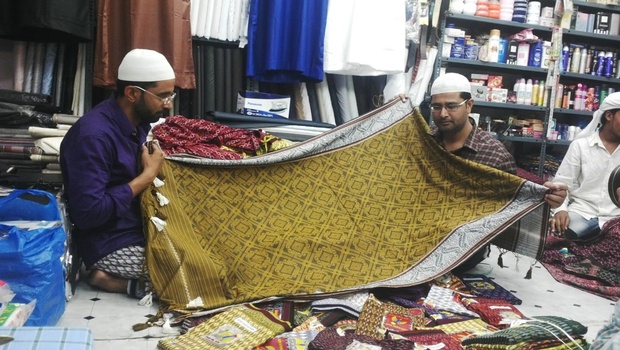
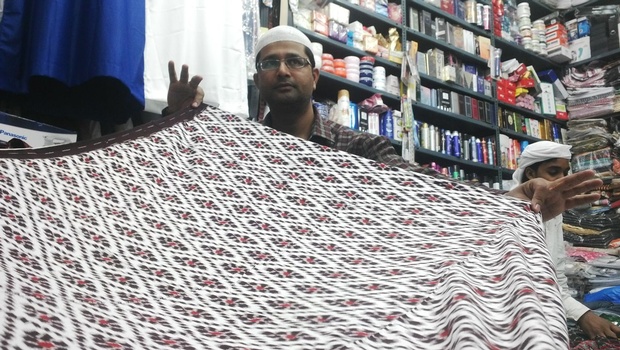
A shopkeeper displaying a Yemeni lungi | (Vinay Madapu/EPS)

Hyderabad :

While the colourful lungi is fast disappearing giving way to the trendy Bermudas, the casual wear is making a comeback among certain communities in the Pearl City.

Sale of imported Yemeni lungis or Futah (also called Izaar in Saudi Arabia) has more than doubled during the holy month of Ramzan in Barkas, the area where Arab-origin Hy derabadis reside in Old City.

While big shops in the area have recorded a whopping 60-70 per cent rise in the sale of lungis, small-scale textile dealers say that there is a 50 per cent rise in demand for lungis.


A shopkeeper displaying a Yemeni lungi | (Vinay Madapu/EPS)

“The lungis form part of our identity,” said 23-year-old Khaled Umar, who doesn’t mind shelling out some extra bucks for it.

Young or old, every male in Barkas prefers the Arab lungis along with full or half-sleeved shirts over any other dress. This is said to be the reason for the spurt in sale of the simple casual wear during Ramzan.

“People gift lungis to their relatives in Barkas and elsewhere during Ramzan and Eid, and a customer will order for multiple number of lungis,” said Md Sarfaraz Khan, a dealer.

Though the price range of lungis starts from Rs 350, high-quality Futahs cost up to Rs 7,000.But, one needs to be extremely careful in handling the lungis. “They are not for rough use. They should be cleaned with care and not squeezed too hard, or else small holes may appear,” said the shop-owner, whose great grandfather, like many other residents of Barkas was brought to Hyderabad as soldiers in the Nizam’s Army.

source: http://www.newindianexpress.com / The New Indian Express / Home> Cities> Hyderabad / by Aishik Chanda / June 20th, 2016

Beacon of change

Hyderabad, TELANGANA :

Members smile during a rehearsal break The group is performing qawwali at Goethe Zentrum for World Music Day Celebrations. Photo: G. Ramakrishna

A group of women qawwals share their experiences and the issues they highlight in their qawwalis

Hyderabad :

Away from the hustle and bustle of the bazaars in Charminar, a quiet lane in Sultanshahi resonates with qawwal claps and inside Shaheen Resource Centre, the chatter and laughter of young girls fills the air.

Amidst the harmonium preludes, the group wearing cheery yellow duppattas and feather caps sing a qawwali — Kab tak mera maula, dil mera pukara hai, shaadi meri marzi se kabhi hoti nahin hai, mujh ko kya pasand hai koi poochta nahin hai... Clearly this is not a regular qawwali where singers confine their performances to a spiritual context. The lyrics here carry a message that’s contemporary and temporal though it’s packaged in familiar qawwali tunes.

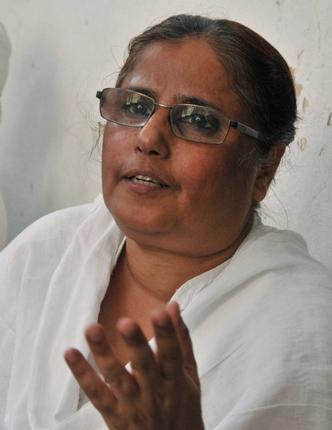
Jameela Nishat of Shaheen Resource Centre Photo: G. Ramakrishna

Jameela Nishat, the founder of Shaheen talks about using qawwali as a beacon of change. “Women are not given space in public; they are allowed to write poetry but not allowed to perform in public. This is our effort to bring a change in that mindset,” she shares.

A feminist Urdu poet who writes the songs which depicts reality, Jameela encourages women to take a step towards this change. As a result, the group from Shaheen has performed qawwalis at schools, colleges and other events for three years now.

Sania Fatima, a staff teacher and volunteer, shares the impact of qawwalis. “When we perform for special days like a Mother’s Day or Women’s Day, we intersperse the songs with messages like ‘beti bachao beti padao’ and highlight the abuse women face daily in their lives. The response is amazing as qawwalis are enjoyed by all,” she points out. Some popular tunes of classics like Tere mehfil mein kismet, aajmaake hum bhi dekhenge from Mughal-E-Azam have been used with lyrics changed to highlight contemporary social issues.

Tackling themes like dowry, education, taking care of one’s health, being independent and making life’s choices; lyrics in the songs asks tough questions. Sultana, who is a graduate, believes qawwalis can be used as instruments of change.

Zehra Jabeen recalls the experience of performing qawwali recently during the ‘Salaam Telangana’ event at Ravindra Bharati. “The crowd was restive and making lots of noise; it did not stop even when we started the qawwali. But within a few seconds, there was pin drop silence and they heard us with full attention.” .

It is a mixed group, comprising members of various ages and stages in life. A first year student Swati Kulkarni is also part of the group. “I have knowledge of music but singing a qawwali was new. Everything, from the costume, changing one’s voice, to singing in rhythm to the claps was different,” she smiles. The cheerful group looks forward to the qawwali performances.

“It is a big challenge to come out and stand courageously on a platform to sing. We hope our songs inspire many others too,” chips in Sania, the lead singer, and adds, “We brush aside minor issues of high notes and low notes. We make our voices heard as a group.”

The rehearsals for a forthcoming performance over, the girls break into a smile. “When we wear the costume and sing in rhythm, we feel so excited that we forget the world.”

(The group is performing as part of World Music Day celebrations at Goethe Zentrum on June 26; Entry: Free)

source: http://www.thehindu.com / The Hindu / Home> Features> Metroplus / by Neerja Murthy / Hyderabad – June 24th, 2016

Food delivery service for the devout

Hyderabad, TELANGANA :

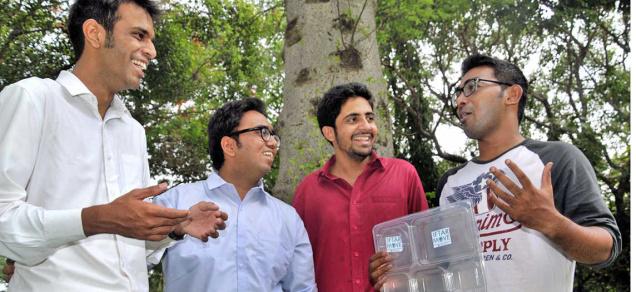
Young entrepreneurs:Kareem, Umair Abdullah, Sharjeel Siddiqui and Syed Adil the team behind the startup ‘Iftar Move’, a food delivery service that caters to people fasting during the Ramzan season in Hyderabad.- Photo: G. Ramakrishna

For the devout observing fast during Ramzan but unable to enter the kitchen for Iftar, the service floated by four youngsters is the perfect solution.

Keeping in mind the limitations of techies, bachelors and also the unwell, Ahmed Kareem, Umair Abdullah, Sharjeel Siddiqui and Syed Adil started ‘Iftar Move’.

The team behind the startup say that the need for hygienic and economical food coupled with a reliable service made them give wings to their idea.

“I have come across people who live alone or are working professionals, who want to break the day’s fast with home-cooked food but cannot. This service is for them,” said Ahmed Kareem Uddin Naseer, Digital marketing Head of ‘Iftar Move’. “This is the first time we are venturing into the food space and it is for a noble cause. We have taken utmost care to prepare food in hygienic conditions.”

The meals can be ordered through whatsapp, website, call or even by posting on the Facebook page. A set of seven items will be delivered which include Haleem, paneer samosas, chicken rolls, bhajiye, dates, fruit chat and Frooti.

Two kitchens, one in Jubilee Hills and the other in Malakpet, have been set up for the service.

With increasing number of orders coming from IT parks, the main focus of the service is also the Hi-tec city and surrounding areas. “We started with 20 or 30 orders but within a week we started getting lot of enquiries. Last weekend we accepted 200 orders,” said Ahmed Kareem who says they might plan to make this a yearly affair every Ramzan season.

source: http://www.thehindu.com / The Hindu / Home> News> Cities> Hyderabad / by Staff Reporter / Hyderabad – June 15th, 2016

Release of Sania’s book on July 13

India’s most successful tennis player, Sania Mirza, has kept her date with the city by deciding to launch her eagerly-awaited book ‘Ace Against Odds’ in Hyderabad on July 13.

In attendance will be family members and close relatives who have been part of her journey in the world of tennis in Hyderabad and Mumbai (where the launch is on July 16).

The book has already created interest in the world of sports as the big achiever is most likely to give an insight of what she felt on various subjects relating to her growth from a teenager into a World No. 1 women’s doubles player on the tennis court and how she felt during those turbulent times – both on and off the court.

Clearly, Sania quote in the book – “My legs felt heavy. My arms were numb. I could see the blurry tennis ball as it crossed the net and hit the surface on the court. Fault. Just missed the line” – should be an apt reminder of her intense desire to put the record straight on many subjects including one of the most critical phases of her life when she was forced to take a six-month lay-off due to a career-threatening wrist injury when she could not even hold a tennis racket.

“Essentially, I sincerely hope that it will be some sort of a guide and inspiration too for the modern day generation.

“Well, the kind of struggle the Mirzas (father Imran and mother Nasima) had gone through in shaping my career will also be a key subject in it,” was Sania’s quote on the book.

source: http://www.thehindu.com / The Hindu / Home> News> Cities> Hyderabad / by V.V. Subrahmanyam / Hyderabad – June 23rd, 2016

We thank thee, O father: Four generations of happiness

Thiruvananthapuram, KERALA :

KakkatMPOs19jun2016

Thiruvananthapuram :

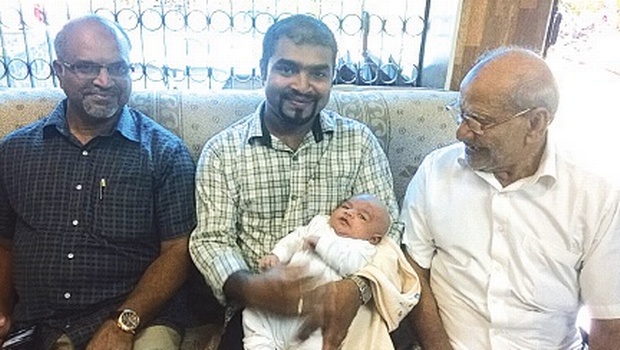
The Kakkat family has always been a big one. During marriages and other functions the ancestral house fills up with relatives. It is these past few years that the sons and daughters of the family have started living separately.

This family has always stressed on  the importance of living in harmony and with  generations together. In the Kakkat house it is a normal thing to see grandchildren and great grandchildren of the same age playing together. Four generations sit together and reminisce about their childhood and their fathers.

The great grandfather

Leaning heavily on a walking stick is eighty-year-old Moideenkutty Haji who loves spinning tales of the past. Stories mostly about his father Alippu Haji, and his grandfather, who was killed in the wagon tragedy. His favourite pastime include gathering all the young ones and regaling them with all kinds of anecdotes.

“There are so many stories that I can tell you,” he says with a twinkle in his eyes. “My father was a good man, very brave. He used to have this business (malancharakku), where he would take the goods from home (Kattuppara in Malappuram) to Ponnani Sea port. I was the eldest and he would often take me with him.”

The grandfather

Like his father before him, Ashraf Ali, now at 56, began dabbling in business at a very early age. “By the time we were 15, we started accompanying vappa (father) to different places as he went about with his business. He used to travel a lot, but when he came home he used to make sure that we knew about his experiences and such.” Though he had a job in the Gulf as a marketing manager in a watch company, he was keen on starting his own business. “Vappa is not a very educated man. He learned what he did during his travels. He taught us that. To seek knowledge from the world around us,” says Ashraf.

The Father

“Uppa (father) never told me outright what to do. Sometimes he would not answer all of my queries but made me find the answers myself,” Mohammed Thabith talks about his father. “This used to frustrate me a lot. But his discipline and his penchant of pushing me to find solutions myself helped me find my independence later in life.”

Great onus was put on the need for education. Thabith recalls how his father used to be adamant that all of his children be highly educated.

“We were all pushed to do the best we could. And that didn’t stop with education. I’m thirty-year-old. Even now he gives us practical pieces of advises from time to time. Now that I have a son, I will definitely ape my father and teach him how to question things and learn the truth by himself, while being a strong person for him.”

source:  http://www.newindianexpress.com / The New Indian Express / Home> Cities> Thiruvananthapuram / by Hana Ashraf / June 16th, 2016

Begum Hazrat Mahal: The Pari Who Became a Revolutionary


BegumHazratMPOs01jun2016

Awadh(Lucknow), UTTAR PRADESH :

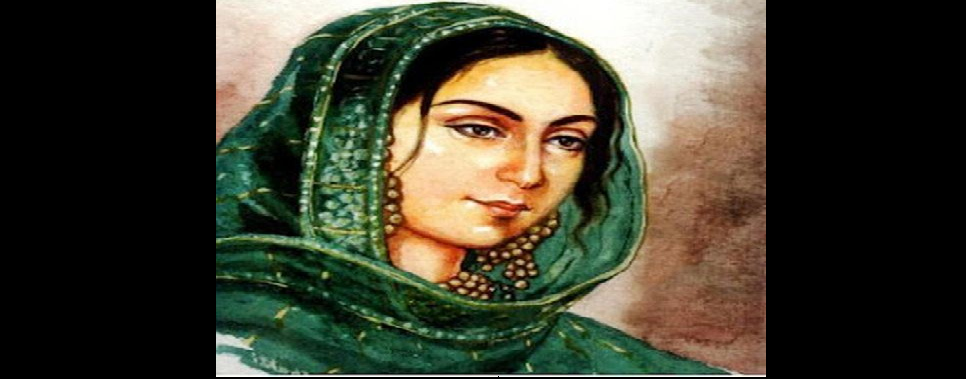
June, in particular is a good month to remember Begum Hazrat Mahal who led the first war of independence against the British in Lucknow. This Begum of Avadh had defied British forces of the East India Company in the great uprising of 1857.

She was one of the nine divorced women of Wajid Ali Shah, Lucknow’s last ruler.

“When the king left Lucknow on 13 March 1856 he took with him as well as his mother, three of his wives including Khas Mahal and Akhtar Mahal. An unknown number of wives were left behind in Lucknow as well as nine divorced women including Hazrat Mahal and her young son,” writes Rosie Llewellyn-Jones in The Last King in India.

Begum Hazrat Mahal took charge of the city despite her divorce from the king and her supporters included Raja Jailal Singh, a former Nizam of Azamgarh. It was Raja Jailal who fed support to the rebellion from the suburbs around Lucknow.

The other supporter defending Lucknow was Nana Sahib, a Maratha soldier and childhood friend of Rani Lakshmibai. Nana Sahib led the revolt against the British in Kanpur. Like Begum Hazrat Mahal he too retreated to Nepal after the British regained Lucknow in 1858.

Wajid Ali Shah was forced to leave Lucknow for exile in Calcutta, by the British. Lucknow was one of the most bitterly contested cities during this first war of independence against the British.

Between the exile of Wajid Ali Shah in March 1856 and the first war of independence in June 1857, Lucknow was defended by Begum Hazrat Mahal and she ruled as regent for 10 months. Her 12 year old son Birjis Qadr was crowned in the Baradari at Qaiserbagh, the palace built by his father.

After the British overpowered the freedom fighters, Begum Hazrat Mahal refused a pension and continued gorilla attacks on British military centers till November 1859. She spent the rest of her life in Kathmandu, Nepal and was buried there in 1879.

It may be recalled that fighting broke out at the end of June in 1857 against the British after soldiers mostly from the Avadh region heard that their mild mannered ruler was unceremoniously stripped of his throne and his kingdom by the British on grounds of mismanagement. Their first reaction was one of disbelief. Their second reaction was of anger. soldiers in different parts of north India took up arms and in Lucknow laid siege to the city’s British Residency where English and Anglo Indian inhabitants were hiding for four and a half months between July and November 1857.

But before Begum Hazrat Mahal transformed into a revolutionary she was a fairy. It may be recalled that apart from official wives and temporary wives there was yet another category of women, the pari or fairy who was often taken on as a temporary wife if the king found her pleasing and talented. The fairies were certainly an innovation of Wajid Ali Shah, poet prince and were recruited from the lower classes, including courtesans who lived mainly in Chowk, in the old city.

These women were not educated but after tuitions some of them acquired sophistication. Some fairies went on to become expert singers or dancers while others proved to be good for nothing.

Begum Hazrat Mahal’s maiden name was Muhammadi Khanum, and she was born in Faizabad. Her father was a slave called Umber owned by a Ghulam Hossein Ali Khan. Her mother was a Muslim mistress of Umber. A courtesan by profession, Muhammadi was taken into the royal harem after being sold by her parents.

She was later promoted to a fairy and was called Mahak Pari by the king. She became a begum after being accepted as a royal concubine of Wajid Ali Shah and the title Hazrat Mahal was given to her after the birth of their son, Birjis Qadr.

For some time Wajid Ali Shah was completely smitten by Hazrat Mahal. writing many poems for the dusky beauty.

Soon the king moved on to other women but in 1845 when he learned that Mahak Pari was pregnant, he immediately put her into purdah and gave her the title of Iftikhar-un-nisa or pride of all women.

Now this beautiful fairy, brave freedom fighter and pride of all women is immortalised in a documentary film directed by Mohiuddin Mirza and produced by the Films Division that was screened in the city by Lucknow Expressions Society in the presence of Kaukab Qadr Meerza, great grandson of Begum Hazrat Mahal and Manzilat Fatima, the warrior queen’s great great grand daughter.

“The aim is to never forget how the entire city had united under the leadership of Begum Hazrat Mahal to stand up against the British irrespective of religious and gender differences,” said an organiser of the event.

source: http://www.thecitizen.in / The Citizen / Home / by Mehru Jaffer / Monday – May 30th, 2016

Film on Begum brings Avadh’s queen to life

Lucknow:

It will be a royal evening for Lucknow coming Monday when in the company of the last Queen of Awadh, Begum Hazrat Mahal, the city will come face to face with its past. In the 137th death anniversary year of the Queen, an unsung hero of the first war of Independence of 1857, a documentary on her will be screened on May 30.

Claimed to be the first ever film on the Queen, the 26-minute documentary has been directed by national award-winning director Mohi-ud-Din Mirza. Commissioned by the Films Division, the film will be screened by the Lucknow Expressions Society along with the UP Tourism department. Prince Kaukab Qader Meerza, great grandson of the Queen, will also be coming to Lucknow from Kolkata for the day.

The screening comes with an aim to enlighten people about the sacrifices of the freedom fighter for the motherland. Documenting the history of Begum Hazrat Mahal as also including her direct descendants, it shows the Queen in her role as one of the first women revolutionaries in India’s independence struggle.

“It is for the first time that a film has been made on my great great grandmother who is someone that we have grown looking up to,” said Manzilat Khan, a direct descendant of King Wajid Ali Shah and Begum Hazrat Mahal. Khan will also be in the city on the day. It was after King Wajid Ali Shah was exiled to Matiaburj in Kolkata that the Queen fought valiantly against the British troops annexing Awadh, defeating them in Alambagh. She later took refuge in Nepal where she died on April 7, 1879.

“At the time when the independence of women was just a notion, she had a vision for the country’s freedom from the British. She chose to fight and take it on herself. Not many know about her struggle and the film will rightfully do that,” added Khan.

source: http://www.timesofindia.indiatimes.com / The Times of India / News Home> City> Lucknow / TNN / May 26th, 2016

SNACK TRACK – Meaty bites of goodness

Bengaluru, KARNATAKA :

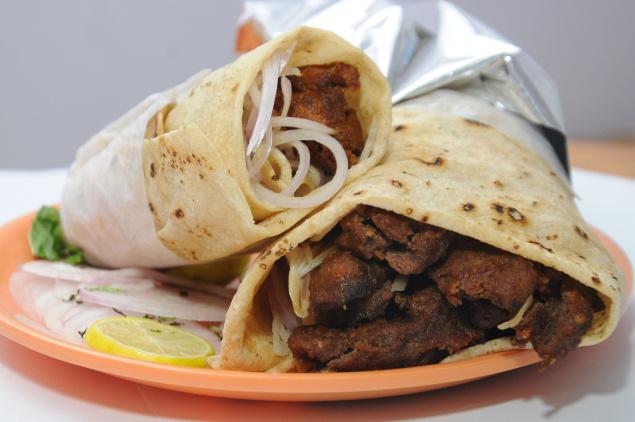
Fanoos' beef roll PHOTO: SUDHAKARA JAIN
Fanoos’ beef roll PHOTO: SUDHAKARA JAIN

The legendary beef sheekh kabab rolls of Fanoos is one of Bengaluru’s most sought-after rolls

The air sizzles with the smell of grilled meat, the heat from the tandoors is warm, yet not suffocating, and the crowd that has gathered remained calm, yet excited and hungry as they wait patiently to bite into goodness.

The roomali rotis are spread on clean, slick steel counters, the steaming hot meat piled onto them, the chopped onions and lime juice thrown in and the rolls are deftly wrapped in tissue paper and handed over to eager customers. Welcome to Fanoos – the destination for the one of Bengaluru’s tastiest rolls.

The bustling Johnson Market area in Richmond Town is the abode of one the city’s most spectacular roll joints.

The heavy traffic on the Hosur Road, the melee of people in the market area and the jostling crowds pouring in to buy their choicest rolls from the counters does not deter Bengaluru’s foodies from making sure they get what they come for – the legendary beef kabab rolls of Fanoos.

While the joint also serves chicken and mutton variants, it’s the beef rolls that are to die for. Coming in a range of sizes from the humble single roll to the enormous mogambo roll, Fanoos is the place meat lovers swear by.

What started in 1975 as a small footpath kabab joint by the late Ajaz Hussain is now a booming empire in Bengaluru. Taken over by his three sons after his death, Ajaz’s motto of serving only the finest for his extended family of customers is still kept strongly alive. Shakir Hussain and his two elder brothers firmly believe in keeping their father’s legacy alive and left their studies to keep the establishment running. “It was our dad who introduced the concept of sheek kababs from a recipe he modified from his mother. Even the terms like jumbo, mumbo, Rambo and sambo for the size of the rolls were coined by him. As the next generation, we brothers came up with the next size of rolls called mogambo,” says Shakir.

He adds: “It’s not just about food in Fanoos. We have many stories here. We have friends who come here to meet up after several years. It is also a place for lovers to meet. This is the perfect combination of food, friendship and fun with our extended family of customers.”

Musician James Prabhakar says he and his band spend their Sundays every week after practice at Fanoos. “It’s almost a tradition for us and our default buys here are the sheek kabab rolls. The green apple sodas from the Madeena Stores opposite to Fanoos are an added bonus that makes it a complete meal. Fanoos also serves as a place for us to catch up with friends and chill out amid the smell of sizzling, mouth-watering meat.”

The Iranian cuisine joint customised for Bengaluru also serves shawarmas, veg rolls and a variety of other flavours and even the popular Haleem during Ramzan, but nothing comes close to their beef sheek kabab rolls priced between Rs. 45 to Rs. 185 depending on size.

So what are you waiting for? Head over and dig in.

source: http://www.thehindu.com / The Hindu / Home> News> Cities> Bengaluru / by Allan Moses Rodricks / Bengaluru – May 30th, 2016