The Mustafabad cannon at Allapur Gate and Landa Qasab cannon, in Vijayapura, are facing neglect.
Some of the massive and marvellous cannons belonging to the Adil Shahi era here are decaying because of lack of efforts to preserve them.
While only a few giant cannons have been preserved at Nakkar Khana, the main pavilion of the Gol Gumbaz, at Malik-e-Maidan, some others are left there in the open.
The cannons at Mustafabad near Allapur Gate, a few hundred metres from the Gol Gumbaz, are in the worst shape.
The cannon was earlier placed on the fort wall. Over a period of time, the wall collapsed owing to lack of maintenance and the giant cannon fell on the ground.
The authorities have not made any efforts to locate it to a better place where it could be preserved. They are now getting gradually buried under a heap of garbage and human waste.
Similar is the condition of the Landa Qasab cannon near Kirti Nagar and Ali Burj.
While a signboard has been placed by the Archaeological Survey of India near the Landa Qasab cannon, the one at Mustafabad does not have one.
According to historians, these cannons played a significant role in protecting the boundaries of the Adil Shahi empire from enemies.
They were strategically placed on towers where security men could keep a watch on the entry of enemies.
source: http://www.thehindu.com / The Hindu / Home> National> Karnataka / Firoz Rozindar / Vijayapura – June 30th, 2016
Qawwal Naseer Taj talks about the power of qawwali, its spiritual approach and why connoisseurs enjoy it
For 30-plus years, Naseer Taj has been enthralling music aficionados with his qawwalis in Hyderabad. “Music is a way of devotion and life,” he smiles as he gets ready for a qawwali rendition at Goethe Zentrum. As part of the World Music Day celebrations, he along with his team including his son gave a soulful performance at the German centre. The packed crowd of 100 members sat mesmerised as his robust voice croonedSabka Malik ek hai. It was followed by the all-time favourite Damadam mast kalandar. The six accompanying artistes added to the lively effect and turned the cool Sunday evening into a memorable onefor the audience.
A few hours before the performance, Naseer is in a buoyant mood. He recalls his early days as an auto driver before his passion created a path for him. “I was passionate about qawwalis. There was something magical about the chorus voice and claps,” he recalls. While his family was concerned about the youngster listening to qawwalis in his spare time, Naseer was unperturbed. “I would drive auto in the mornings and attend qawwali programmes in the night. The family would search for me and I would be listening to a qawwali at a concert,” he laughs and adds, “I was busy pursuing my passion that I never knew when it became my profession.”
The energetic powerhouse pieces of qawwali were traditionally sung at the shrines of saints; they would take many on the path of spirituality. Qawwalis depicted in movies and reality shows seem different from the traditional form, and Naseer says the highpoint of qawwalis is its underlying spiritual approach. “Qawwalis draws their essence from classical music but it is a unique genre. Here music and text blend together and the lyrics are important. While one sings softly in a ghazal, qawwals like to sing loudly. This has a deep effect on the audience’s memory.”
Speaking about qawwali’s roots, he says, “Qawwalis have a unique place in Hindustan and music lovers hold it on a high pedestal. People of all sects enjoy the performances,” he states, giving examples of ,Sabka maalik ek hai. He sums up the essence by saying: “Badan ka rang kuch bhi sahi, sabka lahoo ka rang ek hai. Qawwali is part of our culture and we should be proud of our legacy,” he says.
Naseer has given numerous performances across India and abroad. “One cannot put into words the feeling of singing qawwali,” he says and explains, “The music, rhythmic claps and the loud voice of the qawwal creates a positive energy. The qawwals experience ecstasy and the divine presence. Those moments are magical when the audience also experiences joy.”
He recently sang for the Independence Day celebrations at Golconda Fort and affirms the genre has seen changes according to the changing tastes. He feels connoisseurs enjoy a qawwali with clean words. “There were some songs with cheap lyrics but when there are meaningful words, qawwalis create a connect. Log ache cheez ko sunte hain, chillar cheez ko nahin”
Naseer looks back at his life with satisfaction. “My qawaalis have given my soul joy and peace. I have got my daughters married. I live in a rented accommodation. My only dream is to see my son shape up as a good qawwal. When he sings, people will remember me,” he signs off.
source: http://www.thehindu.com / The Hindu / Home> Features> Friday Review > Music / by Neeraja Murthy / Hyderabad – June 30th, 2016
It is said that Shah never asked his followers to shun their own religion and this is the reason why he had a great number of Hindu followers.
What is common among Dewa Shareef in Uttar Pradesh, Ramdevra in Rajasthan and Powa Mecca in Assam?
These are some of the lesser-known shrines revered and frequented by people of all faiths and since ages have been portals of peace, tolerance and harmony.
The Dewa Shareef shrine of Haji Waris Ali Shah in Barabanki, hardly an hour’s drive from Lucknow, draws the faithful from across many strands of religion.
“The air around the place is liberal and the word intolerance an abomination. Why else would people leave their religious preferences behind and with baskets full of flowers, sweets and colourful shiny chaddars in their hands and wish in their hearts, make a beeline for the shrine of the Sufi saint,” says an article ‘The Sufi of Dewa’ in the latest issue of Equator Line magazine titled ‘Liminality of Faith’
It is said that Shah never asked his followers to shun their own religion and this is the reason why he had a great number of Hindu followers.
The very first foundation of the shrine was laid by Kanhaiya Lal and many more Hindus came forward after that.
Both Hindu and Muslim devotees contributed equally to the monument that it is today.
The Ramdevra shrine, about 12 km from Pokhran, is holy to both Hindus and Muslims.
“Ramdevra, the final resting place of Baba Ramdev, or Ramsha Pir as he is called by Muslims, is probably the only temple in the country with an intriguing assortment of devotees,” says another article ‘A Syncretic Oasis in Pokhran’
“One of the most puzzling features of the temple is the number of mazars inside. There are tiny gravestones representing the graves of children and large ones signifying the graves of adults… These are graves of people who had been close to Baba Ramdev. Among these graves, in the sanctum sanctorum, is the samadhi of the saint himself.”
Powa Mecca in Hajo near Assam’s main city Guwahati is the seat of Sufi saint Peer Ghiyasuddin Auliya.
“Earth was brought from Mecca to lay the foundation of the masjid. The locals believe that a pilgrim to this shrine earns a quarter of the blessings bestowed on someone performing Haj at Mecca. The place — Powa (quarter) Mecca — has derived its name from this belief. It is indeed significant that Hindus, Muslims and Buddhists all find this place holy and come here for pilgrimage,” writes noted Bangladeshi author Selina Hossain in ‘Faith Synthesis’
“More so, they say that the mythical bird Garuda, the carrier of Lord Vishnu, flew off the hill. After flying some distance, it stretched its wings and hovered over the place; it is now called Pakhimela market. A saint named Ourjo also sat in prayer there. The place is said to have been inhabited by the asuras. The most devious among them was Hayasur; his face resembled that of a horse.
“The saint had prayed to Vishnu that the asura be slain so he could pray in peace. Vishnu rode Garuda to defeat the asura in Hajo. This form of Vishnu is now called Haigrib. In a gesture of gratitude, Ourjo established the Haigrib temple here, bonding the two religions forever in an uninterrupted harmony,” she writes.
“Faith, unspoiled by outside interventions, has an openness that its seekers find reassuring,” says the magazine’s editor-in-chief Bhaskar Roy.
The issue also profiles Ajmer and Nizamuddin dargahs, Banke Bihari temple and Bavar Swamy’s empty shrine at Sabarimala among other shrines.
source: http://www.thehindu.com / The Hindu / Home> National / PTI / New Delhi – June 28th, 2016
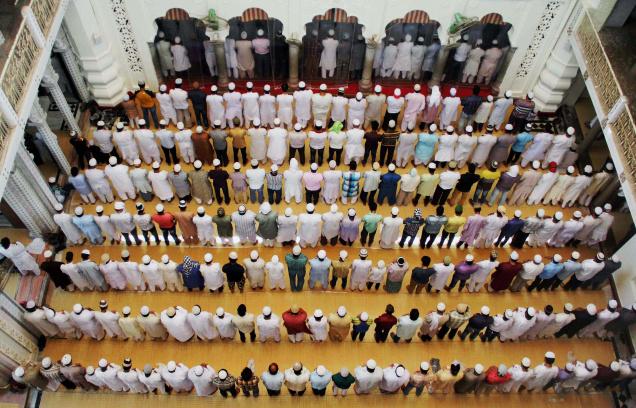
‘Taraweeh’ prayers are exclusive to the month of Ramadan. Photo: PTI
Qualified reciters of the Quran from North India are in great demand in to lead the Taraweeh prayers in South Indian mosques during Ramadan
Of all the months in the lunar Islamic calendar, Ramadan stands out for its focus on spirituality. Through dawn-to-dusk periods of voluntary abstinence and prayer, the Muslim is expected to feel closer to God.
Ramadan is also believed to be the month when the Quran began to be revealed. So the recitation of verses from the holy book in Arabic assumes greater importance during this month. It is a common practice for observant Muslims to try and finish at least one complete reading of the Quran at home. This is also carried out by imams (prayer leaders) who conduct the late-night Taraweeh prayers in mosques during the month.
With the emphasis on the most sonorous rendition of the Quran, management committees and clerics attached to mosques and other places of congregational prayers in Ramadan take an extra effort to find Aalims (scholars) who have memorised the 6,666 verses of the holy book and are skilled in reciting it in a semi-musical style. A person who has perfected memorising the book is known as Hafez, and one who has mastered the art of recitation, as Qari.
In South India, Islamic institutions often invite qualified reciters of the Quran from the North specifically to conduct the Taraweeh prayers during Ramadan.
North Indians are considered to be better in Arabic pronunciation because of the semantic and phonetic affinity that their regional languages – Hindi, Urdu and Hindustani – have with the language of the Quran.
In Tamil Nadu, cities like Chennai, Tiruchi, Madurai and Salem have been hosting imams from Uttar Pradesh, Bhopal and Bihar to lead Taraweeh prayers for several decades.
“The imam’s talent is important in holding the congregation’s interest,” says Mohamed Meeran Misbahi, Secretary, Tamil Nadu Jama’at-ul-Ulema Sabai, a state grouping of Islamic scholars. The Tenkasi native has been officiating as imam at the Kader Mosque in Tiruchi’s Gandhi Market area for the past 20 years. “Many worshippers visit mosques just to sample the different styles of sermons and Quran recitation during Ramadan, so the clerics have to make an extra effort to keep the people engaged,” he adds.
On average, depending on his professional expertise, a prayer leader can earn from Rs. 8,000 to 15,000 per month. During Ramadan, the income is boosted by donations from the congregation.
Historic link
The erstwhile princely kingdom of Rampur (now a part of Uttar Pradesh) has been maintaining a link with Tiruchi that started in 1952, when Saudi Arabian national of Indian origin, Moulana Qari Hafez Mohamed Ismail Sahib Mujaddidi Madani, was invited to conduct Taraweeh prayers at the Mohammadi Jama Masjid in Tiruchi by the then-Nawab of Arcot.
“My father led the Taraweeh prayers from 1952 to 1974. He died during a prayer service in 1974, and was buried in Tiruchi,” says his son Qari Moulvi Rashid Mujaddidi. The cleric, an Indian citizen, had conducted Taraweeh prayers at the Chowk Mosque from 1960 to 2006. Though he has cut down his engagements due to his advancing years and health problems, the cleric still visits the city during Ramadan, and this year, is officiating as a Taraweeh imam at a private mosque in Singarathope.
His son Salman, who is also an imam, reached Tiruchi a day before the month’s commencement (by the sighting of the crescent moon) was announced, in early June.
“I don’t speak much Tamil, but I have got only love and affection from the people of Tiruchi,” says Moulvi Rashid, who has also worked as an Arabic lecturer in Rampur. “I always tell people to come and visit Tiruchi and learn how different communities can live in harmony. ”
South-side sojourn
For Moulana Hafez Abdul Rab Qassimi, a suggestion by his friend brought him from his village Mansoorpur, Uttar Pradesh to the Bangali Street Mosque in Woraiyur in 1972. “I was a young man when I started leading the Taraweeh prayers here; now I am almost 68. I will continue to come as long as I am physically able to,” says Moulana Abdul Rab, who makes a three-day rail journey via Moradabad, Delhi and Chennai to reach Tiruchi every Ramadan.
Accommodation for the visiting imams is usually provided within the mosque premises. Congregants provide the food for breaking the fast (iftar) and pre-dawn meal (suhour).
It is Moulana Zia-ur-Rahman’s first year as the Taraweeh imam at the Tennur mosque. A graduate of Qurannic studies from Hyderabad, the 27-year-old will return to his native Leela Baran village in Bihar shortly before Eid-al-Fitr, the festival that denotes the end of Ramadan. “The atmosphere in Tiruchi is very peaceful and conducive to prayer,” says the imam.
Quest for authenticity
Despite the continuing patronage of North Indian imams, many South Indian institutions have come up in the interim to create a new talent pool of young Muslim clerics with a comparable expertise in Quran recitation.
“International qirat (recitation) competitions and a wider exposure to different styles have led to more Muslims opting to study this discipline more seriously,” says Moulana Hafiz Mufti Ruhul Haq, principal, Jamia Anvar-ul-Uloom Arabic College, Khaja Nagar.
The college offers Arabic-medium courses in Quran recitation, Islamic jurisprudence and the study of the Traditions (Hadith) of Prophet Muhammad.
“Besides mosque duties, we also train our students in computer skills in English, Arabic and Tamil, so that they can have a wider range of employment opportunities,” says Moulana Ruhul Haq. Taraweeh
The emphasis on certification has increased the number of younger clerics, with institutions attracting students not just from the South, but also the North.
Like any profession, individual talent is ultimately the deciding factor in religious orders too.
***
Fact file
In Arabic, Taraweeh is the plural of tarweeha, which means to rest. In the context of Ramadan prayers, it means to take rest between every four rak’at (units) of praying. Services need to have more than two periods of rest in order to qualify as Taraweeh.
Taraweeh prayer units across the Muslim world range from 8 rak’ats to 20 rak’ats.
Taraweeh is exclusive to the month of Ramadan. However, unlike the compulsory (fardh) five prayers of the day, participating in Taraweeh daily is not obligatory. In fact, Ramadan-specific prayers are meant to be conducted only after the compulsory night prayer (Isha).
source: http://www.thehindu.com / The Hindu / Home> Features> Metroplus / by Nahla Nainar / Tiruchi – June 24th, 2016
Resul Pookutty has made the country proud by becoming the first Asian to win the award for best sound for documentary “India’s Daughter” at the coveted Motion Picture Sound Editors’ 63rd annual Golden Reel Awards.
Resul Pookutty has made the country proud by becoming the first Asian to win the award for best sound for documentary “India’s Daughter” at the coveted Motion Picture Sound Editors’ 63rd annual Golden Reel Awards.
Oscar-winning sound designer Resul Pookutty has made the country proud by becoming the first Asian to win the award for best sound for documentary “India’s Daughter” at the coveted Motion Picture Sound Editors’ 63rd annual Golden Reel Awards.
Pookutty, 44, who attended the awards ceremony here, took to Twitter to share his excitement about winning the honour for British documentary maker Leslee Udwin-directed “India’s Daughter”, made on the Delhi gangrape incident of December 2012, which is banned in India.
“I am honoured with the Golden Reel Award for ‘India’s Daughter’. This is an incredible recognition for me as well as for all those worked in the banned film apart from all those who protested against the brutal killing of Nirbhaya,” Pookutty told PTI from Los Angeles this afternoon.
The Oscar-winning sound engineer said he is the first Asian to win the coveted award at the 63rd Golden Reel Award from the Motion Picture Sound Editors’ (MPSE) of US for best sound.
The government had banned the film from public screening/ airing in the country.
Dedicating the award to the 23-year-old paramedic student who was brutally gangraped on December, 16 2012 following which she died, Pookutty said the film “India’s Daughter” is the true spirit of the youth of the nation.
He said the film recognises the entire spirit of the youth who protested against the inhuman treatment being meted out to girls and women.
“I dedicate this award to Nirbhaya’s soul… And her indomitable spirit,” Pookutty said.
The competing films/ television documentaries in the list included “Beware Baltimore”, “Chef’s Table”, “Deadliest Catch”, and “The Undrafted” “Mad Max: Fury Road”, “The Martian”, “Star Wars: The Force Awakens” and “The Revenant” among others.
Pookutty said a double nomination was rarity in the industry and the beauty is that both these are Indian works.
Late last month, in a rare achievement, Pookutty had won two nominations for two films, both banned in the country, from the prestigious American Motion Picture Sound Editors’ (MPSE) Golden Reel Awards.
The 44-year-old artist of “Slumdog Millionaire” fame has won nominations for his sound engineering work in “Unfreedom”, a US production, and “India’s Daughter”.
He noted that all his international recognitions came for the work he has done in India, but expressed anguish over the ban imposed on both the films in the country.
“I don’t understand why a progressive society like ours should react the way we do now. I am pained at the suppression of artistic freedom,” he had said earlier, adding these two works are analysis of extreme violence, which any progressive society should welcome.
“By banning such films we are nullifying the will of the people,” Pookutty said.
The MPSE recognises excellence in an array of sound editing achievement, from sound effects and foley to dialogue and ADR to music and score integration.
The MPSE is the final industry group to announce nominees this year and remains the only group to do so after annual Academy Award nominations.
“India’s Daughter” was directed, written and produced by British director Leslee Udwin. Though the documentary was banned in India, it was globally beamed on March 4 last year.
“Unfreedom”, which espouses homosexuality, is the debut film of Florida, US-based director Raj Amit Kumar. The film, starring Adil Hussain and Victor Banerjee, is also banned in the country by the Censor Board.
The thriller chronicles a lesbian love story set in New York and New Delhi and is said to be inspired by Faiz Ahmad Faiz’s poem – “Ye Dagh Dagh Ujala”. The film is expected to hit North American halls on May 29.
Pookutty is a film sound designer, sound editor and mixer, and lives in Mumbai with his family. He is a graduate of the Film and Television Institute of India, Pune.
He, along with Richard Pryke and Ian Tapp, had won the Academy Awards for best sound mixing for the Britsh production “Slumdog Millionaire”.
source: http://www.indianexpress.com / The Indian Express / Home> Entetainment> Music / PTI, Mumbai / February 28th, 2016
It looks like Resul Pookutty is on an award-winning spree. The Academy Award-winning Slumdog Millionaire sound designer was recently honoured with yet another award.The Rocheston Accreditation Institute has honoured the sound designer with Rocheston’s Distinguished Engineer award, for his contribution to the field of sound and music in cinema.
Academy Award-winning musician AR Rahman, took to his micro-blogging page to congratulate Resul. He posted, “Congrats Resul for getting the most distinguished engineer award from Rocheston”. Rahman and Resul share a cordial working relationship.
source: http://www.timesofindia.indiatimes.com / The Times of India / News Home> Entertainment> Tamil / TNN / June 26th, 2016
Around 3am during the month of Ramzan, a group of people from Andhra Pradesh carrying drums and sticks shout in Urdu: “Those who are asleep, wake up, declare your loyalty to God and get up to eat the dawn meal”.
This is like an alarm for Muslims in Udupi to have their ‘Sehari’ and start the fast. These people, called ‘Athala Kotti'(fakir), have been following the tradition for the last four decades. They will do this for 30 days and on Eid-ul-Fitr, Muslims offer them money, food and clothes. The offering is considered as their monthly earning.
These folks are not invited to one place and keep changing places every year. A few of them prefer to visit the coastal district every year.
However, the importance of ‘Athala Kotti’ is decreasing year by year as people are now more depending on alarm clocks and mobile phones to wake up. Earlier, there was no such facilities and these people used to go to each Muslim family and wake them up. Keeping the ancient tradition, some Muslims still prefer to wake up by listening to their voice.
Nazeerulla Shah Khalifa Raphayi from Anantapur district, a member of the group, said, “I have been coming to Udupi for years. We use drums made from animal skin. We sing songs and hold the lamp while moving from one house to another. We start the journey at 2.30am every day and continue till 4am. After the duty, we choose a Muslim house, and in that house we have our Iftar (evening food). The Muslims in the coastal district are used to our visit.”
“We never demand anything from people. This is considered as a service to God. During the month, some of us go to dargas across the country and dedicate their service there,” he said.
Munavvar Alifa, a member of the group, said: “Earlier, there were only few houses here; now, the number of houses has increased, so responsibility is more as we have limited time to wake them up. Even Hindu families give us offerings here.”
According to tradition, the first fakir in Islam was Bilal bin Rabah, who lived between the sixth and seventh centuries, used to wake up believers with his clear voice. Since then, the role passed down from generation to generation, until it became formalized at the beginning of the ninth century.
A person was appointed to carry out the role in every neighbourhood during the month of Ramzan.
source: http://www.timesofindia.indiatimes.com / The Times of India / News Home> City> Mangalore / TNN / June 24th, 2016
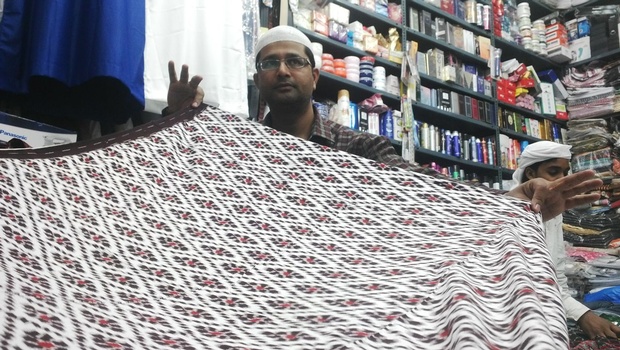
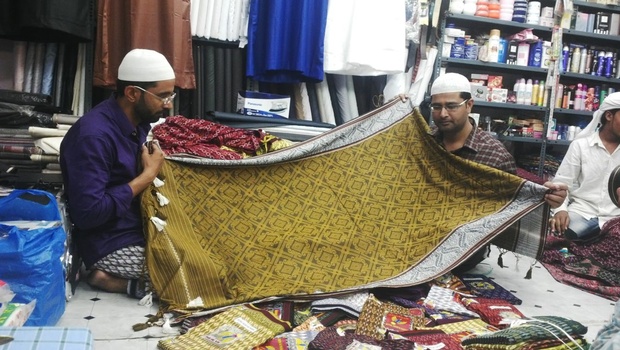
A shopkeeper displaying a Yemeni lungi | (Vinay Madapu/EPS)
Hyderabad :
While the colourful lungi is fast disappearing giving way to the trendy Bermudas, the casual wear is making a comeback among certain communities in the Pearl City.
Sale of imported Yemeni lungis or Futah (also called Izaar in Saudi Arabia) has more than doubled during the holy month of Ramzan in Barkas, the area where Arab-origin Hy derabadis reside in Old City.
While big shops in the area have recorded a whopping 60-70 per cent rise in the sale of lungis, small-scale textile dealers say that there is a 50 per cent rise in demand for lungis.
A shopkeeper displaying a Yemeni lungi | (Vinay Madapu/EPS)
“The lungis form part of our identity,” said 23-year-old Khaled Umar, who doesn’t mind shelling out some extra bucks for it.
Young or old, every male in Barkas prefers the Arab lungis along with full or half-sleeved shirts over any other dress. This is said to be the reason for the spurt in sale of the simple casual wear during Ramzan.
“People gift lungis to their relatives in Barkas and elsewhere during Ramzan and Eid, and a customer will order for multiple number of lungis,” said Md Sarfaraz Khan, a dealer.
Though the price range of lungis starts from Rs 350, high-quality Futahs cost up to Rs 7,000.But, one needs to be extremely careful in handling the lungis. “They are not for rough use. They should be cleaned with care and not squeezed too hard, or else small holes may appear,” said the shop-owner, whose great grandfather, like many other residents of Barkas was brought to Hyderabad as soldiers in the Nizam’s Army.
source: http://www.newindianexpress.com / The New Indian Express / Home> Cities> Hyderabad / by Aishik Chanda / June 20th, 2016
Members smile during a rehearsal break The group is performing qawwali at Goethe Zentrum for World Music Day Celebrations. Photo: G. Ramakrishna
A group of women qawwals share their experiences and the issues they highlight in their qawwalis
Hyderabad :
Away from the hustle and bustle of the bazaars in Charminar, a quiet lane in Sultanshahi resonates with qawwal claps and inside Shaheen Resource Centre, the chatter and laughter of young girls fills the air.
Amidst the harmonium preludes, the group wearing cheery yellow duppattas and feather caps sing a qawwali — Kab tak mera maula, dil mera pukara hai, shaadi meri marzi se kabhi hoti nahin hai, mujh ko kya pasand hai koi poochta nahin hai... Clearly this is not a regular qawwali where singers confine their performances to a spiritual context. The lyrics here carry a message that’s contemporary and temporal though it’s packaged in familiar qawwali tunes.
Jameela Nishat of Shaheen Resource Centre Photo: G. Ramakrishna
Jameela Nishat, the founder of Shaheen talks about using qawwali as a beacon of change. “Women are not given space in public; they are allowed to write poetry but not allowed to perform in public. This is our effort to bring a change in that mindset,” she shares.
A feminist Urdu poet who writes the songs which depicts reality, Jameela encourages women to take a step towards this change. As a result, the group from Shaheen has performed qawwalis at schools, colleges and other events for three years now.
Sania Fatima, a staff teacher and volunteer, shares the impact of qawwalis. “When we perform for special days like a Mother’s Day or Women’s Day, we intersperse the songs with messages like ‘beti bachao beti padao’ and highlight the abuse women face daily in their lives. The response is amazing as qawwalis are enjoyed by all,” she points out. Some popular tunes of classics like Tere mehfil mein kismet, aajmaake hum bhi dekhenge from Mughal-E-Azam have been used with lyrics changed to highlight contemporary social issues.
Tackling themes like dowry, education, taking care of one’s health, being independent and making life’s choices; lyrics in the songs asks tough questions. Sultana, who is a graduate, believes qawwalis can be used as instruments of change.
Zehra Jabeen recalls the experience of performing qawwali recently during the ‘Salaam Telangana’ event at Ravindra Bharati. “The crowd was restive and making lots of noise; it did not stop even when we started the qawwali. But within a few seconds, there was pin drop silence and they heard us with full attention.” .
It is a mixed group, comprising members of various ages and stages in life. A first year student Swati Kulkarni is also part of the group. “I have knowledge of music but singing a qawwali was new. Everything, from the costume, changing one’s voice, to singing in rhythm to the claps was different,” she smiles. The cheerful group looks forward to the qawwali performances.
“It is a big challenge to come out and stand courageously on a platform to sing. We hope our songs inspire many others too,” chips in Sania, the lead singer, and adds, “We brush aside minor issues of high notes and low notes. We make our voices heard as a group.”
The rehearsals for a forthcoming performance over, the girls break into a smile. “When we wear the costume and sing in rhythm, we feel so excited that we forget the world.”
(The group is performing as part of World Music Day celebrations at Goethe Zentrum on June 26; Entry: Free)
source: http://www.thehindu.com / The Hindu / Home> Features> Metroplus / by Neerja Murthy / Hyderabad – June 24th, 2016
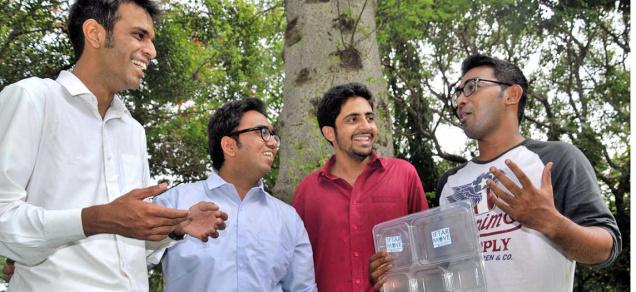
Young entrepreneurs:Kareem, Umair Abdullah, Sharjeel Siddiqui and Syed Adil the team behind the startup ‘Iftar Move’, a food delivery service that caters to people fasting during the Ramzan season in Hyderabad.- Photo: G. Ramakrishna
For the devout observing fast during Ramzan but unable to enter the kitchen for Iftar, the service floated by four youngsters is the perfect solution.
Keeping in mind the limitations of techies, bachelors and also the unwell, Ahmed Kareem, Umair Abdullah, Sharjeel Siddiqui and Syed Adil started ‘Iftar Move’.
The team behind the startup say that the need for hygienic and economical food coupled with a reliable service made them give wings to their idea.
“I have come across people who live alone or are working professionals, who want to break the day’s fast with home-cooked food but cannot. This service is for them,” said Ahmed Kareem Uddin Naseer, Digital marketing Head of ‘Iftar Move’. “This is the first time we are venturing into the food space and it is for a noble cause. We have taken utmost care to prepare food in hygienic conditions.”
The meals can be ordered through whatsapp, website, call or even by posting on the Facebook page. A set of seven items will be delivered which include Haleem, paneer samosas, chicken rolls, bhajiye, dates, fruit chat and Frooti.
Two kitchens, one in Jubilee Hills and the other in Malakpet, have been set up for the service.
With increasing number of orders coming from IT parks, the main focus of the service is also the Hi-tec city and surrounding areas. “We started with 20 or 30 orders but within a week we started getting lot of enquiries. Last weekend we accepted 200 orders,” said Ahmed Kareem who says they might plan to make this a yearly affair every Ramzan season.
source: http://www.thehindu.com / The Hindu / Home> News> Cities> Hyderabad / by Staff Reporter / Hyderabad – June 15th, 2016