Category Archives: Arts, Culture & Entertainment

While my veena gently weeps

Alwar, RAJASTHAN / NEW DELHI :

First impression: a small, wiry man with a gigantic string instrument.

Second impression: Once the frail man starts plucking the strings of the gigantic instrument and the melodious notes start flowing, you understand why Ustad Asad Ali Khan stands tall among today’s music maestros.

The only known living exponent of the rudra veena, Khansaab is probably one of the last of the musicians who combine traditional been techniques with an in-depth knowledge of the raagas.

“The rudra veena can execute all the subtleties of the human voice. Unlike the sitar and the sarod, it does not have tarap or resonance strings. Their absence allows the musicians to play shrutis or microtones, which are considered the ultimate in classical music. Iska awaz sabse buland hai.”

The Ustad should know. Trained by his father Ustad Sadiq Ali Khan, court musician of Alwar, Khansaab represents the legendary Jaipur beenkar gharana and traces his genius to his great grandfather Ustad Rajab Ali Khan. Being from the seventh generation of rudra veena players in the family, Ustad Asad Ali Khan’s relationship with this instrument of the gods is a passionate one. He challenges those who term the rudra veena as inflexible and a museum piece.

“These are excuses that people use to cover up their own inadequacies. Yes, it is a difficult instrument to play. But that is true of all classical music. It is not filmi music which you can learn in a few days,” he says emphatically.

Defending the rudra veena, Khan says, “The veena stands at the pinnacle of all stringed instruments. It is believed that the rudra veena was created by Lord Shiva who was inspired by Goddess Parvati. It was born out of his urge to create something that he could use to measure swaras and shrutis.”

But it is the man on this earth who has labelled this instrument “difficult”. “Isn’t the sitar difficult to play? Does not the sarod require years to master? Today’s musicians want the accolades easily without the hard work. It is they who have badmouthed the rudra veena,” he fumes.

For mastering the rudra veena you have to play by the rules, and Khan is unwilling to bend the rules. “The first requirement is to sit in the yogic vajrasana position. Unless you sit in that position, place the veena on the shoulder and use your breath as a modulator for notes, you cannot have the desired impact. The nuances of the notes will be lost if you change your posture. How many young people today can sit in that position for hours together?” he asks.

Raagas Mian ki malhar and Darbari Kanhada bring out the best from the rudra veena, feels the Ustad, who plays dhrupad in the Kandarbani style, which is one of the four ancient styles of Indian music.

Ustad Asad Ali is also against fusion music, which is seen as a way out to revive flagging interest in classical music. “Yeh hamaare shaan ki khilaaf hai. Fusion is not our job. We are not meant to compete with filmstars. In the drive to become commercially successful, we should not lose sight of our tradition and culture. Classical music and film/popular music have different positions in the world of music and that is the way to be,” he says.

Of course step-motherly treatment by the powers-that-be has also contributed to the decline of the rudra veena. “None of the five universities of music in the country teaches the rudra veena. Sadly, even I have taught the sitar in the Faculty of Music and Fine Arts in Delhi University for 17 years. The rudra veena is not taught there. Ultimately, the musician has to survive, and without a certificate, a rudra veena exponent will not get a job in any university,” he points out and laments, “Soon, we will have only foreigners playing the veena.” Currently, apart from a couple of Indian students, most of Khan’s disciples are from the West. His nephew Zaki Haider is also training under him, hoping to carry on the legacy.

“The government has to do more to preserve the fading tradition of the rudra veena. I have suggested that the recordings of Ustad Sadiq Ali Khan and other stalwarts lying with the Sangeet Natak Akademi should be marketed. I do not want any royalty, just make those recordings available before those tapes get destroyed. It may not mint millions, but millions of Indians will get to know their heritage,” he says. Carrying forward the task of telling the world about the instrument, the ustad is currently working on a book on the rudra veena, under a two-year fellowship given by the Ministry of Culture.

Unfortunately, it’s not just the rudra veena, but also the ustad who seems to have been forgotten by many. Despite being acclaimed for his musical virtuosity and for probably being the most well-known rudra veena player in the world, the country’s civilian honours have passed him by. “I do not want to lobby for such awards,” he says, but it can’t stop himself from adding that even harmonium players are feted by the public today while the rudra veena and rudra veena players are forgotten.

Gourds, frets and strings attached

SO we know that the rudra veena is rarely heard on the concert stage these days. That’s sad. But let’s get the vital statistics of this ornate instrument before it is forgotten. Musicians believe that the rudra veena is the ideal instrument for a dhrupad rendition because its sound has the same richness of overtones that the voice acquires with the practice of Nada Yoga.

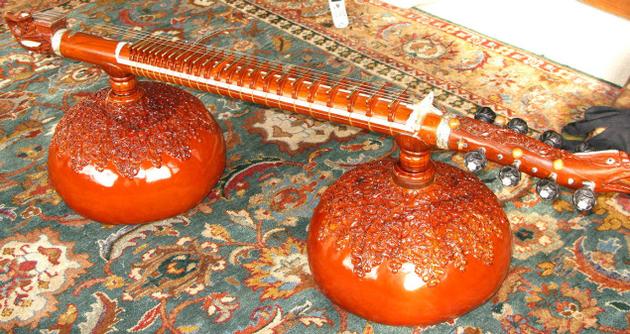
This string instrument is different from the Saraswati veena in the way it is placed. The former rests against the shoulder while the latter is placed on the lap of the performer. Its basic structure is a bamboo mounted on two gourds with 19-24 frets fixed with bee’s wax. Additionally, there are four main and three side strings having a range of four to four and a half octaves. The gigantic dimensions also make it one of the heaviest instruments. At 10 kg, you can at best hope to balance the weight while sitting in the yogic vajrasana position.

If you want to be the proud owner of a rudra veena, you are going to be lighter by at least Rs 75,000. And you’ll also have to be patient. It takes at least a year to make a good rudra veena.

source: http://www.archive.financialexpress.com / The Financial Express / Home> Art & Enterainment / October 01st, 2006
Celebrating Urdu

Hyderabad, TELANGANA :
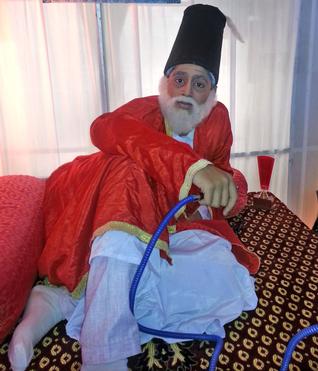
A student posing as Mirza Ghalib

It was an expo with a difference. No, it was not an art, fashion or product fair. It was all about language, something unheard of till then. The city of domes and minarets was witness to a unique celebration of Urdu. And it took school children to bring out the sweetness and magical lyricism of the Urdu language.

Titled after Daagh Dehlvi’s famous couplet ‘Urdu hai jiska naam …’, the exhibition hosted by students and teachers of Central Public High School, Khilwath, recently at the Mehboob Husain Jigar hall in Siasat daily was a runaway success. Students of different schools in the city and lovers of Urdu flocked the show necessitating extension of the expo.

Language is the road map of a culture. It tells you where its people come from and where they are headed. The expo did just that.

It not only traced the history of Urdu but gave visitors something to remember long after they left the premises. Some of the finest Urdu couplets and ‘nazms’ were on display.

What added to the appeal was the way students donned the attire and looks of the famous poets of yore. One could see the poet of East, Allama Iqbal, reclining in his trademark black suit and Mirza Ghalib with his typical cone cap and snowy beard, holding a hookah. There was also Wali Deccani, Mohd Quli Qutb Shah, Mir Taqi Mir, Hazrath Amir Khusro besides writers like Ibne Safi, Premchander.

Students waxed eloquent about the works of the poets apart from reciting their verses. Presentation of ‘Shikwa’ and ‘Jawab-e-Shikwa’, the epic poems of Allama Iqbal by students was the high point of the expo.

“We decided to present the language in all its glory as these days everyone is talking about the decline of Urdu,” said Mohd Zafarullah Faheem, Director, Central Public High School.

The limits of one’s language are the limits of one’s world. But there was no limit to the poetical appeal of the expo. Wherever one glanced one was greeted by ‘shayeri’.

Talk to a man in a language he understands, that goes to this head. And if you talk to him in his language, that goes to his heart. That’s what the Urdu expo did — it went straight to the heart.

source: http://ww.thehindu.com / The Hindu / Home> Features> MetroPlus / by J.S.Ifthekhar / Hyderabad – November 26th, 2015

Ustad Asad Ali Khan – Raga Multani – Rudra Veena – Rudra Vina – Dhrupad

Alwar, RAJASTHAN / NEW DELHI :

Ustad Asad Ali Khan – Raga Multani – Rudra Veena – Rudra Vina – Dhrupad, Amsterdam 27th April 2003

Published on Apr 3, 2013 /  by Carsten Wicke 

Dear Friends, Music Lovers & Musicians,
we continue with an afternoon concert – played just two days after the Marwa in Utrecht at the Royal Tropical Institute (KIT) in Amsterdam o

source://www.youtube.com

Mastering the king of instruments


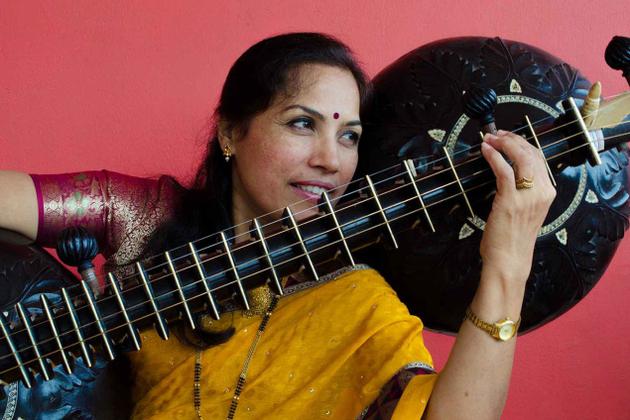
Jyoti Hegde. Photo Special Arrangement

Jyoti Hegde, India’s only woman rudraveena artist, talks to Sowjanya Peddi about conquering the unconventional rudraveena and storming a male bastion

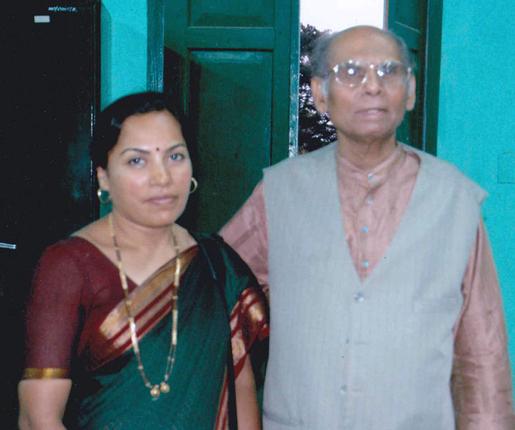
On a quiet farm away from the glitz of the urban art world, in a village near Sirsi about 125 km from Dharwad in Northern Karnataka, lives a young woman with her husband. Her name is Jyoti Hegde and she might not be splashed on newspapers but she is the first woman performing artist of the rudraveena in India. Rudraveena is a world heritage instrument, protected and promoted by the UNESCO. Jyoti follows the Khandarbani school of Dhrupad and her guru is the illustrious Ustad Asad Ali Khan.

Jyoti Hegde with Ustad Asad Ali Khan. Photo: Special Arrangement

In the rustic peace and unpretentious but generous hospitality of her home, she talks about her life and her views on Dhrupad and the rudraveena with Sowjanya Peddi. Here are the translated excerpts.

I was born in Dharwad, Karnataka, where my father was a range forest officer. I grew up in Belgaum and Sirsi. I liked dance and was particularly talented in drawing. I might have become a painter if a chance encounter with the rudraveena had not transformed my life. I was learning the sitar from my first guru Dr. Bindu Madhav Pathak and in a lec-dem one day, he played the rudraveena. The sound of the instrument haunted me. The gambhirta (sonorous resonant sound) of its tones was very different from the chanchalata (playfulness) of the sitar. I requested Pathakji to teach me, but he refused, saying it is not a woman’s domain. I persisted. I told my father about my wish. Initially, Pathakji refused my father too, but later he relented and said that “playing the rudraveena is not a woman’s forte but since she is so insistent, let us give her an old rudraveena that is lying at my house. Once she plays it for a while, she will give up the idea of her own accord”. This was like a secret pact between my father and him, unknown to me. But when Pathakji saw my commitment and determination, he eventually advised my father to get me a new rudraveena, at the age of 16, which I continue to play even today. I would go to Pathakji’s house by 7 a.m so that he could set me an exercise for the day.

He would return at 5.30 p.m. The entire day I would practise the single phrase he had taught me that morningI was so focussed that he once said I had gained the expertise of 10 years within a year. Within a year I won the first prize for rudraveena in the Akhil Bharatiya Akashvani Sangeeth Spardha in 1981-82. I was also enrolled as a regular artist at All India Radio. I also won the first prize in the Karnataka Youth Festival for three consecutive years from 1981 to 1983.

My gurus chronicle my journey from Khayal to Dhrupad. I learnt from Pathakji in the Khayal tradition. He used to compliment me, saying “she knows how to get knowledge from me”. Now after many years of teaching, I understand this was the biggest compliment. An early review commented that “the artist did not spare enough time for bandish rendition with sat sangat (jointly) on pakhawaj”. I felt the most prominent attribute of the rudraveena is its capability for nadopasana through alap. Playing with the accompanist is less important. I understood then that this instrument is not best supported by the Khayal. I discovered a book on Dhrupad by Thomas Marcotti titled The Way-Music: How to conjure with sounds? The book had a 90-minute music cassette attached to it. I was transfixed by the depth and richness of the notes and its emphasis on slow measured movement. I was drawn to Dhrupad from then on. Whenever an artist performs in the Dhrupad ang, whether sitar, surbahar or rudraveena, it will entail more emphasis on alap than on bandish.

I studied with Pt. Indudhar Nirodi for three years, who gave me a deeper understanding of Dhrupad through vocal training and taught me the subtleties of Dhrupad. After he left Dharwad, I approached Ustad Asad Ali Khan where I learnt for five years.

RurdraveenaBF26nov2015

Rudraveena is known as the king of instruments. All string instruments are shaped after it. According to Hindu mythology, Shiva is said to have taken inspiration from Parvati’s form and created this instrument. Shiva was the first to play this instrument and he taught it to Parvati who in turn taught it to Saraswati. It was restricted initially to the dev loka and was used for aradhana (devotion) alone. Later, Narad learnt it from Saraswati and brought it down to earth. In earlier times, it was used as accompaniment for veda mantra pathan (vedic recital) and with the yaga yagna (vedic rituals) of the rishi munis (sages). It held a place of reverence equivalent to that of the shank (conch) or jagate (circular plate/gong used in temples) that produce sounds during worship rituals but are not specifically used for producing music. It was treated with the same sanctity accorded to the sacred idol. Only select people were allowed to touch it and that only after purifying themselves.

Rudraveena is considered a measure to weigh the principles and grammar of the Dhrupad style of music. As Dhrupad evolved out of Sama veda chanting, the rudraveena also came to be considered the instrument to accompany Dhrupad. The shift must have been sharp and swift, as the music left temples and entered the Mughal courts. This brought a change in lyrics, tempo and style of playing. Dhrupad lyrics were chiefly based on the varnanas (description) of deities following the earlier devotional context. In the new context, more preference was given to prakriti varnana (nature description), shringar ras (romantic feelings) and songs praising the emperor/royalty. Both the rudraveena and Dhrupad rose to popularity from the 8th to the 15th and 16th centuries. This is the golden period for rudraveena, which produced artists such as Swami Haridas, Miya Tansen, Baiju Bawra, Gopal Nayak, Nayak Bakshu and Nayak Charju among others.

In Akbar’s times the instrument was very popular and prevalent. The rise of Khayal can be seen as a development of the above context. With Khayal, the sitar emerged as a more apt accompanying instrument its playful and rapid explorations. The rudraveena receded from the scene.

The rudraveena is a large and heavy instrument. Its strings are thick and plucking them requires strength. In addition, the original posture requires keeping the instrument on the body, which means carrying 3.5 kg to 5 kg for two or three hours in one sitting. Also, the sacred context of the instrument conventionally permitted only select classes of men to play or even touch it. It was a superstition that if women played it they will not be able to conceive children. One reason could be that the Vajrasan posture might have been considered harmful for the uterus. When my mother heard this she asked me to stop playing, but I was already so much in love with it that I could not think of leaving it. Eventually I got married and conceived a son. But some controversies persist. I could not play in the Vajrasan posture during my pregnancy and adopted the Sukhasan posture. After delivery, I continue to play in Sukhasan. I don’t believe earlier restrictions on women are valid in present times. The measure of what is sacred and pure is redefined in every era. We should interpret cultural norms and injunctions as indicative of demanding inner purity from the artist.

We live a quiet life on our farm. I get much support from my husband, son and daughter- in-law who help me with modern technology to take my art forward. I relish the peace and rhythm of farm life; it brings depth and anubhav (experience) to my music.

Dhrupad is the foundation for Hindustani classical music. Unless young people take it up, it will be lost to us. The rudraveena is also disappearing because no new generation is passionate enough to learn this demanding skill. They find it difficult to support themselves [financially]…. they look for quick fame. But the foundation of our newness should be based on our own culture. If we just rush into modernity that is not our own, it will be meaningless.

The instrument

The rudraveena cannot be bought off the shelf. Its making is unique, as it is connected to the player’s body. For instance, its length should be 11 times the hand span of the player. The tuning can be completed only after it is placed on the body. The playing is connected to the player’s breathing rhythm. Traditionally, it was played only in the vajrasan pose.

One tumba (gourd) is kept on the right thigh and one on the shoulder, the right hand plucks the strings going over the right tumba and the left holds the strings with the left ear touching the left tumba. Khanji used to associate this posture with the sacred Swastika.

The instrument’s centre falls between the navel and the heart. The vibrations circulate in our inner body with the sound of ‘om’ entering the left ear from the left tumba. The right tumba’s vibrations go through the lower body through the right thigh. These vibrations produce inner well-being and tune us to the universal nada (sound). The instrument is itself a tool of pranayam and yoga. For those who have not mastered breathing, it is a difficult instrument to learn.

source: http://www.thehindu.com / The Hindu / Home> Features> Friday Review> Music / Sowjanya Peddi / November 26th, 2015

Six historical buildings awarded

Hyderabad, TELANGANA :

IntachHydMPOs22apr2016

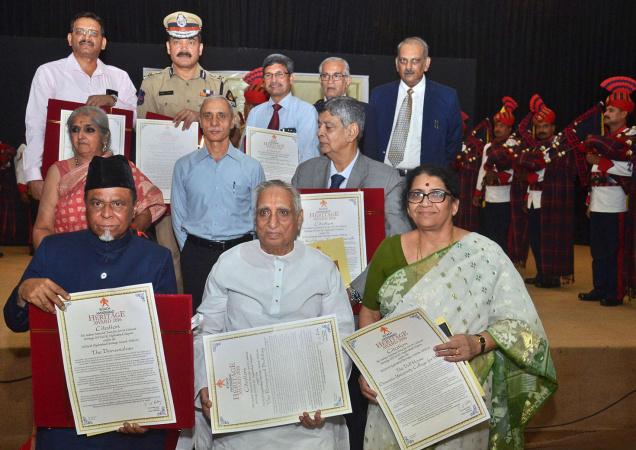
The Indian National Trust for Art and Cultural Heritage (INTACH) on Monday awarded six historic buildings and their managements for efforts to conserve them.

“For its associational value as the birthplace of Hyderabad’s very own magic potion and as memorial to the legacy of Hakeem Farooqui, the Karkhana Zinda Tilismath is acknowledged,” reads the citation of the award given to the historic structure in Amberpet. Five other structures – the St. Francis Xavier church in Yapral, Ramgopal building on M.G. Road, Heritage Artillery Collection and Ranbir Hall at Artillery Centre in Golconda, Equestrian Centre Hyderabad Mounted Police in Saifabad, and the headquarters of AIMIM in Darussalam – were given awards.

A special citation was made for Doll House, a replica of the Residency Building that is now the Koti’s Women College.

The award to Equestrian Centre was in consonance with this year’s World Heritage Day celebrations themed by UNESCO to recognise sports heritage. In this context, the INTACH’s representatives recounted the contributions of noted sports personalities S.A. Rahim, the coach of India’s football team who led the country in Melbourne Olympics in 1956, and tennis player Ghouse Mohammed Khan.

Arjuna awardee Mir Khasim Ali was the event’s chief guest.

INTACH recognised the structures for their restoration and re-use while keeping intact their historic value. Reciting couplets of legendry poet Amir Khusro and Mirza Ghalib to describe importance of history and heritage structures, Air Commodore Suresh Badyal, the guest of honor at the event, said the armed forces have contributed to conservation of heritage structures and that organisations like INTACH should continue to conserve more structures.

INTACH convenor Sajjad Shahid recounted threats perceived to heritage, including the development of Metro Rail opposite the State Assembly and through Sultan Bazaar, while decrying G.O. 183 that allegedly robbed 160 heritage structures, rock formations and other historic precincts of legal protection that was accorded to them. Mr. Shahid informed the gathering that the High Court has stayed the order.

source: http://www.thehindu.com / The Hindu / Home> News> Cities> Hyderabad / by Staff Reporter / Hyderabad – April 19th, 2016

Sri Mahaveera Ahimsa Award Conferred on Dr. Khader

Mysuru, KARNATAKA :

Sri 108 Munishree Pavanakeerthi Bhattaraka Muni Maharaj is seen conferring ‘Sri Mahaveera Ahimsa Award’ on noted Homoeopath Dr. Khader during the 2615th Janma Jayanti celebrations of 1008 Bhagawan Sri Mahaveera Theerthankara organised under the aegis of Sri Mahaveera Seva Samsthan at Sri M.L.Vardhamanaiah Smaraka Bhavan on Chadragupta Road last evening as Padmashree Jaina Mahila Samaja President Sheela Anantharaj, Sri Mahaveera Bhavan Construction Committee President M.A. Sudhirkumar, Sri Digambara Jain Samaj President S.N. Prakash Babu, M.L. Jain Boarding Home Secretary Madan Kumar, Sri Mahaveera Seva Samsthan Vice-President M.R. Sunil Kumar, Ajit and others look on.

Mysuru :

“Born as a human being, one should practice the habit of letting other living beings also live in peace,” said city’s noted Homoeopath Dr. Khader, who has been touring rural areas propagating the message of non-violence for the past 10 years after turning a vegetarian at the age of 15.

He was speaking after being conferred with ‘Sri Mahaveera Ahimsa Award by Sri 108 Munishree Pavanakeerthi Bhattaraka Muni Maharaj at a function organised by Sri Mahaveera Seva Samsthan as part of 2615th Jayanti Mahotsava of 1008 Bhagawan Sri Mahaveera Theerthankara at Sri M.L.Vardhamanaiah Smaraka Bhavan on Chadragupta Road in city last evening.

Regretting that 30 to 40 percent of those manufacturing biscuits and chocolates use fat extracted from animals, he added that consumption of bakery items also lead to sugar-related and respiratory ailments, which need to be curbed at once by using vegetarian products.

Former Mayor and Ekalavya Awardee (for Kho-Kho) N.Prakash was also felicitated on the occasion by the Seva Samsthan.

source:  http://www.starofmysore.com / Star of Mysore / Home> General News / April 20th, 2016

Juma Masjid to be opened for women

Kottayam, KERALA :

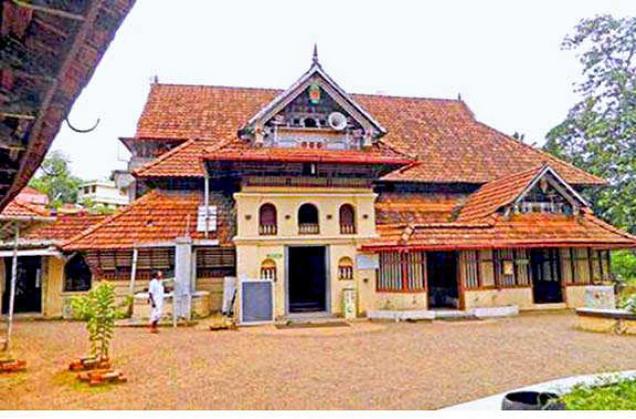
UNIQUE CONSTRUCTION:The age-old Juma Masjid at Thazhathangadi.

Mosque built by preacher from Arabia

The age-old Juma Masjid at Thazhathangadi, believed to be among the 11 mosques constructed by Malik bin Dinar, the eighth century religious preacher from Arabia, will, for the first time, be opened for women.

Timings

Women believers can enter the mosque on April 24 and May 8 from 8 a.m. till 12 noon and then from 1 p.m. till 3.30 p.m. and later from 4.30 p.m. till 6 p.m. The timings have been regulated so as not to interfere with the religious rites, a press note said on Tuesday.

The unique construction attracts tourists from far and wide, but women have not been allowed to have a peek into the richly carved interiors, made primarily of wood, so far, said C.M. Yousuf, secretary of the Thazhathangadi Muslim Jamaath, in the press note.

The Juma Masjid, considered one of the most beautiful places of religious worship, reflects the heritage of Kerala temple architectural styles and showcases the rich sculptural styles of Arabic architecture.

The mosque also houses the centuries-old sundial, sacred writings from the Quran embossed in wood, the stunning Maalikappuram and the richly carved facades and many more objects of interests.

According to Mr. Yousuf, researchers and tourists used to arrive to have a look at the unique structure, but so far women have been denied permission.

There have been appeals from the local people for such a permission. It was against this background that the Juma Masjid committee decided to allow women to enter the mosque, he said.

source: http://www.thehindu.com / The Hindu / Home> National> Kerala / by Special Correspondent / Kottayam – April 20th, 2016

Bonhams – Auctions

BonhamsQuranMPOs21apr2016
Lot 2
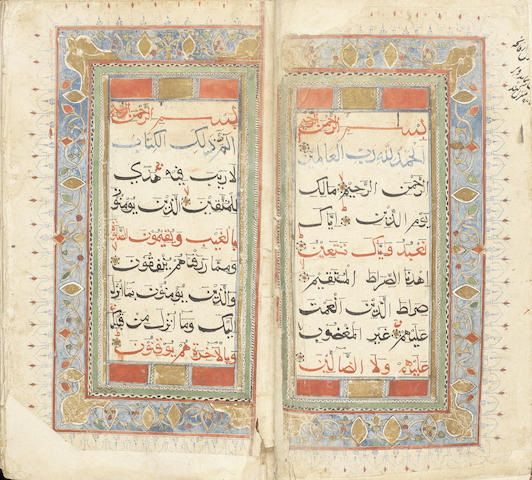
A LARGE ILLUMINATED QUR’AN, BY REPUTE TAKEN FROM THE BAGGAGE OF NANA SAHIB AFTER HIS DEFEAT IN THE MUTINY OF 1857
Sultanate India, late 15th/early 16th Century
Sold for £8,125 (INR 773,744) inc. premium
_______________________________________________________________________
A large illuminated Qur’an, by repute taken from the baggage of Nana Sahib after his defeat in the Mutiny of 1857, Sultanate India, late 15th/early 16th Century
 
Arabic manuscript on cream-coloured thin paper, 632 leaves, 11 lines to the page written in large and dispersed bihari script, first, sixth and eleventh lines on each page written in red ink, remaining lines written in black ink with diacritics and vowel points in black, the work Allah and some other significant words picked out in red, gold rosettes decorated with blue and red dots between verses, inner margins ruled in blue and red, catchwords, circular and pear-shaped devices in predominantly red, yellow and white coloured panels between suras left blank, two double pages of illumination at beginning and end with outer borders decorated with intertwining stylised floral and vegetal motifs interspersed with gold lozenges, edges frayed, some tears, corners rather thumbed, some waterstaining mostly restricted to outer borders, discoloration, later brown morocco with stamped central medallions and cornerpieces of paper onlay, with flap, edges torn, covers stained, rebacked
325 x 200 mm.

FOOTNOTES

  • Provenance:
    Probably Dhondu Pant, known as Nana Sahib (1824-57).
    Lieutenant-General Harward, Royal Artillery.
    Portsmouth Libraries.

Exhibited:
Portsmouth High Street Museum (unknown date, but probably first half of the 20th Century).

A typewritten label affixed to the flyleaf reproduces the exhibition note: Copy of the Koran from the baggage of the arch fiend of Bittoor, “Dundoo Punt”, Nana Sahib – the monster of Cawnpore. The Nana was a Hindoo, and this Koran was used to swear in his Mahomedan followers. Presented by Lieut. Gen. Harward, RA.

Nana Sahib, whose original name was Dhondu Pant, was a Maratha aristocrat, born in Bithoor, adopted son of the last exiled Maratha ruler, Peshwa Baji Rao II.

In the 1850s he became disenchanted with what he regarded as the East India Company’s high-handed policies, as well as, more immediately, its revoking the pension he felt he was due following the defeat and extinction of the Maratha kingdom.

In 1857 at Cawnpore (Kanpur) he switched sides, captured the Company’s treasury and declared loyalty to the Mughal Emperor Bahadur Shah II and that he intended to restore the Maratha kingdom.
It is disputed whether Nana Sahib himself, or his subordinates, gave the order to murder 120 women and children (survivors of an earlier massacre) on 15th July 1857 at Bibighar.

But they were undoubtedly murdered, hacked to death by sepoys and others, and the bodies thrown down a choked well. Whatever the exact details, the incident, alongside others of 1857, became part of the mythology of the British Empire, and the cry of ‘Remember Cawnpore!’ passed into common parlance – seen even in the label in this manuscript – as a reflection of British views of Indian perfidy during the Mutiny (or Rebellion).

Nana Sahib disappeared after the Company retook Cawnpore. There were rumours that he lived on in Nepal, and became an ascetic; others that he died of fever.

Post-Independence he was lauded as a freedom fighter and there is a park in Kanpur in his honour.

According to David James (After Timur: Qur’ans of the 14th and 15th Centuries, The Nasser D. Khalili Collection of Islamic Art, Oxford 1992, pp. 102-107), ‘most of the Indian Qur’ans that have survived from the pre-Mughal period were written in bihari, a peculiarly Indian form of naskh whose origins are still obscure and which virtually disappeared with the advent of the Mughals.

In bihari script, the emphasis is on the sublinear elements of the Arabic letter forms, which are greatly thickened and end in sharp points. It is usually assumed the name of this script was derived from the province of Bihar in eastern India, but Bihar was not particularly important as a centre of Islam.

There is an alternative spelling, bahari, and it has been suggested that this is the correct form and that it is derived from the size (bahar) that was used to prepare paper for writing’.

James observes that the most frequently used colours in the illumination are a strong orange, a milky blue and yellow and motifs such as floral sprays, quatrefoils and chains painted in gold directly onto a blue ground.

source: http://www.bonhams.com / Bonhams / Bonhams.com> Auctions / London, Bond Street

Gujarat built mosques to draw Arab ships

Ahmedabad, GUJARAT :

Ahmedabad :

Can you imagine a non-Muslim building a mosque in 21st century India? May sound impossible today. But, two far-sighted Jains built one of the earliest mosques in Gujarat, a state that has seen some of the worst post-independence communal riots.

And, all this for the sake of business. Between 1178 and 1242, Vastupal and Sheth Jagdusha built mosques in Cambay and Bhadreshwar in Kutch to attract Arab and Turkish traders, who would bring in foreign exchange. While Vastupal was the commissioner of Cambay port, Jagdusha was a merchant of Bhadreshwar port in Kutch. Jains have been an important business community from the earliest time till today.

‘History of International Trade And Customs Duties In Gujarat’, a book by historian Makrand Mehta, says Vastupal encouraged Muslims to settle down in Cambay and Anhilwad Patan, the capital of the Solanki-Vaghela rulers of Gujarat.

The accounts of Arab travellers like Masudi Istakhari Ibn Hauqal and others, who visited Gujarat between the 9th and 12th centuries, amply testify to the settlements of Muslims in Cambay and other cities of Gujarat.

“But the Muslims settlements could hardly have developed without the support of the Solanki rulers. In fact, they attracted the Arabs and Persians to Cambay and Vastupal did it by constructing mosques for them,” says Mehta.

Jagdusha was not officially designated as a customs collector but he had cultivated excellent relations with ship captains and customs staff. Although a devout Jain, as a staunch businessman he understood the value of foreign exchange. “For this reason he also constructed a mosque in Bhadreshwar, his hometown,” according to the book.

source: http://www.timesofindia.indiatimes.com / The Times of India / News Home> City> Ahmedabad / by Ashish Vashi & Harit Mehta / TNN / February 10th, 2010

Temple tragedy: Mamootty’s act of compassion

Kollam, KERALA :

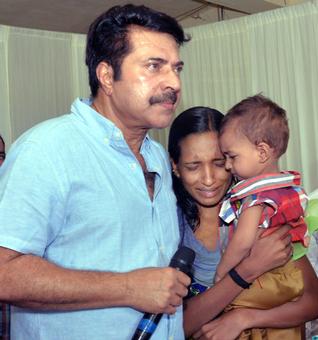
REACHING OUT:Actor Mammootty consoles Surumi who lost her husband in the Puttingal fireworks tragedy.— Photo: C. Suresh Kumar

Heartrending scenes were witnessed when the actor hugged siblings Krishna and Kishore who lost their parents in the disaster.

Film actor Mammootty undertook one of his most poignant roles in real life when he arrived at Paravur on Tuesday to comfort the traumatised victims of the Puttingal fireworks tragedy.

As he addressed the victims at the Kottapuram LP School hall in the township, Mammootty even whimpered and that had a relay effect on the audience, especially the victims.

The actor, who arrived there shortly after noon, spent more than an hour with the victims.

The gathering was jointly organised by the Puttingal Nagar Residents Association, the Mammootty Fans Association and the Patanjali Herbal Exports Private Limited.

Heartrending scenes were witnessed at the venue when the actor hugged the siblings Krishna and Kishore who had lost their parents in the tragedy.

He was seen comforting 21-year-old Surumi who had lost her husband Vishnu in the tragedy. Carrying her one-and-a-half-year-old son, she burst into tears as the cine star approached her.

The actor said comforting the victims was a herculean task. Still, if his presence there could make a little contribution, it would be precious to him, he said.

“The tragedy at Puttingal has no comparison.”

The thrust now should be the rehabilitation of the victims, especially helping them overcome their mental shock. “This is one tragedy in which the living victims cannot be comforted by mere words alone,” he said

Fireworks are a dangerous entertainment which should always be enjoyed from a safe distance, he added.

source: http://www.thehindu.com / The Hindu / Home> National> Kerala / by Special Correspondent / Kollam – April 20th, 2016