Category Archives: Arts, Culture & Entertainment

K.K. Muhammed – Digger of truth

kkMuhammedMPOs27feb2016

KERALA :

LAST year, a young journalist friend, Rajeev Mangottil, invited me to speak at the Onam Day celebrations at Jamia Millia Islamia. The name of this venerable institution is derived from the Urdu language in which Jamia means ‘university’ and Millia means ‘national’. That is where I first met the youthful-looking K.K. Muhammed, Director of the Archaeological Survey of India (ASI).

Rajeev whispered into my ears that Muhammed would soon be retiring and his story on him was scheduled to appear in the Malayala Manorama supplement. Since the Malayalam daily is fond of showcasing every Malayali as an achiever of sorts, I was not greatly impressed.

One reason why I underestimated him was that I have a poor opinion of the ASI. Just last fortnight a friend from Punjab SMSed to say that he had visited Nangal and seen the glass case which commemorates Chinese leader Chou en Lai’s visit and the discussions he had with Prime Minister Jawaharlal Nehru while formulating Panchsheel or the five principles of peaceful co-existence. I had visited the place a couple of times and was shocked by the fashionable sofa in the glass case. I checked and found that the two leaders had used caned, wooden chairs, which the officials concerned did not find impressive enough to be showcased.

In contrast, I saw at Potsdam, near Berlin, the large table and the chairs used by Stalin, Churchill and other victors of the Second World War, while deciding to divide Berlin into four zones and to constitute the United Nations, preserved in the same manner in which they were used, attracting thousands of tourists every year. But the first time I visited Shimla, I was unable to see the table and the chairs used by Indira Gandhi and Z.A. Bhutto for finalizing what is known as the Simla Agreement because no official had any clue about their existence.

Muhammed preferred to speak after J. Gopikrishnan, the ‘Pioneer’ reporter who unearthed the Spectrum scam, and I had our say. He spoke extempore and quoting the Vedas and the Upanishads, he took the listeners on a conducted tour of ancient Kerala, where the persecuted Jews found asylum and Semitic religious ideas flourished and enriched the native cultural practices and traditions. It was apparent that he had an excellent command of Sanskrit, the language of the gods. No, he did not say anything about the ASI or the work he had been doing.

He gave me his visiting card, which said that he lived in the Red Fort. He certainly could not have found a better place to live in than the fort the Mughals had built and from which they ruled the country. No other monument has witnessed history as the Red Fort from the ramparts of which the Prime Minister addresses the nation on Independence Day. It would not be an exaggeration to say that Muhammed breathes history and archaeology, rather than air.

So when I received an invitation for his lecture on the ancient churches of Goa at the Kerala Club, I could not resist the temptation to attend. What makes Muhammed stand out as an archaeologist is the passion he has for archaeology. We have all studied about Akbar the Great and Din-i Ilahi, the divine faith, he propounded by incorporating the best from Islam, Hinduism, Christianity, Buddhism, Jainism and Zoroastrianism.

It was at Ibadat Khana, the House of Worship, that the Emperor used to hold discussions with religious scholars. Miniature paintings that depict Akbar meeting Christian theologians exist. But where exactly was Ibadat Khana?

Mohammed studied the painting thoroughly and believed that it could be excavated at a particular spot in Fatehpur Sikri. He was in his late twenties and could not, therefore, convince his seniors, who all had a different belief. But he started excavating on the spot and found that the dome, the antechamber, the different layers and the gate depicted in the painting matched his excavation. It was a great archaeological discovery for which then Prime Minister Indira Gandhi congratulated him. What’s more, he also discovered a Christian chapel and a bazar in the same area.

Ask Muhammed and he will tell you that restoration of the 1300-year-old Bateshwar temple in Madhya Pradesh as the high-water mark of his career. He found hundreds of temples in a state of ruin, devastated as they were by an earthquake. Restoring them was a challenging task. Nobody seemed to be bothered. He had heard that dacoits would occasionally drop in to worship at the Hanuman temple there.

One day while returning to his workplace, he found a person smoking beedi in the temple. Muhammed rebuked him for smoking in a sacred place, little knowing that he was none else but dacoit Nirbhay Singh Gujjar! Fortunately, the dacoit did not pull his trigger and he left only after he was told by Muhammed that he belonged to the Gujjar-Pratihara dynasty that had once ruled the region.

He found that he could not carry on his work without the cooperation of the MP government, which was disinterested. Then he hit upon the idea of writing a letter to the then Rashtriya Swayamsevak Sangh (National Volunteer Corps) Sarsanghachalak, V.S. Sudarshan, telling him that though the BJP ruled the state, its government was not at all interested in restoring the ancient temples.

The RSS chief took up the matter with the Chief Minister, who ensured that he received the full support of the state government. He also had to contend with the mining mafia, which took a dim view of the restoration work. Finally, he was able to restore about 80 temples while the work is still going on.

I recently saw a documentary telecast by Asianet on the Bateshwar temple complex, which has started attracting tourists. Restoring a temple from the ruins is not an easy job. One should have a great knowledge of the art of temple construction. On TV, I heard Muhammed explain to the viewers how he came to the conclusion that a statue of Nandi could only have been at that particular spot. Rome was not built in a day. Nor had he learnt archaeology in a day.

Muhammed is modest when he says, “I have always been inspired by the Upanishads”. He knows important texts like Manasara Shilpa Shastra and Mayamata Vastu Shastra by heart. He is unabashed when he says: “I must have been a Namboodiri Brahmin in my previous birth”. I would have certainly believed him, if I had not heard his lecture on the ancient churches of Goa, where he was posted for about six years. He showed slides of various churches before and after restoration. That any ASI official could have done.

What no non-Christian could have done with such finesse was give a graphic account of the religious traditions and practices of Christians. He showed the picture of a temple, which gave Vasco da Gama the impression of a church. He went on to explain how the builders of churches in Goa liberally followed the motifs and styles used in Hindu temples and architecture.

For instance, lotus enjoys a pride of place in Hinduism. Vishnu’s feet are always qualified as the “lotus feet”. But in Christianity, no such importance is given to the lotus, which is like any other flower. Yet, he found that many of the churches in Goa sported lotus paintings and motifs.

There were many other features from Hindu temple architecture that were freely adopted by church builders. In temples, leftover water was always allowed to flow through a pipe the mouth of which resembled a crocodile’s. He showed with slides how the idea had been freely incorporated in church construction also. Of course, Muhammed had an explanation for it. The artisans who built churches came from the same class, which built temples in the area.

I was not surprised by Muhammed’s statement because a Malayalam journal had recently published a photo feature on one Govindan Gopalakrishnan, who specializes in mosque construction despite never having studied at a school of architecture, and never having seen the Taj Mahal, let alone the Jama Masjid in Delhi. He has so far built 88 mosques, including the magnificent Palayam mosque in Thiruvananthapuram and the strikingly beautiful ones along the highways in the state. Gopalakrishnan, who is a practicing Hindu, considers mosque construction as his “karma”.

Mohammed’s knowledge of church architecture was as splendid as his knowledge of the life and work of St. Francis Xavier, whose mortal remains are preserved in a church in Goa. When he spoke about him, I felt there was a devout Catholic in him.

And when he explained the various Stations of the Cross that he helped preserve in a church, and recited a line from the Bible “Elahi Elahi Lama Sabachthani” (My God, my God, why have you forsaken me?), I could see that he was overwhelmed by the enormity of emotions. I would not be surprised if he claimed that he was a bishop in his previous birth.

You and I may brand him as a Muslim or a Hindu or a Christian but Muhammed is a professional archaeologist, who ensures that wherever excavation is carried out, the local children and youth are involved in it so that when they grow up they will not leave vandal-like imprints of “Pappu loves Pappy” on the monuments they visit. In his case, wrong perceptions turned out to be far too costly.

When the post of Vice-Chancellor of Calicut University fell vacant, many knowledgeable people suggested Muhammed’s name but some thought that he was too close to the Sangh Parivar to be trusted with such a job. Instead, a person of lesser merit was chosen. Muhammed would not, however, be bothered for he knew that “an archaeologist is one whose career lies in the ruins”.

It was just the other day that historian M.G.S. Narayanan lamented that in Kerala, the Archaeology Department was headed by people who could not spell the word “archaeology” and would ask whether Alexander Fleming and Alexander Cunningham were the same.

For Muhammed, work is worship and it does not matter that he has not been adequately recognized for his contributions. However, he has many anecdotes to recount. Like the one of the time when he took President Barack Obama and his wife Michelle round the Humayun tomb and answered their questions.

Muhammed has in a recent interview expressed his distress over the low priority archaeology enjoys in the country. When he was in charge of the ASI’s work in Northern India, his budget was a puny Rs 6 crore. How many people know that it took 20,000 workers and artisans 16 years to construct the Taj in 1647-48 at a cost of Rs 50 lakh? This, when it is India’s tourism showpiece and the foremost Indian monument that spurs the international visitor to visit the country!

Do they know that parts of the Taj had fallen into disrepair? It was Lord Curzon, who ordered a comprehensive restoration project, which was completed in 1908. If anything, it shows how restoration is important for any historical site. Instead, we are good at spreading myths. One such myth is that Shah Jahan ordered the amputation of the hands of the architect of Taj Mahal in order to ensure that nobody made such a magnificent monument again. Another such myth is that the Emperor started building his own tomb on the other side of the Yamuna in black marble. Excavations across the river revealed no foundations.

Thus archaeology has its use in not only proving historical facts but also in exposing falsehoods. Muhammed showed how he transplanted a temple brick by brick using a numbering process. At the end of the project, not a single brick had become surplus. In retrospect, the most enduring image from the lecture was a gate, which he restored without spending a single penny from the state exchequer. Instead, he involved the local youth in the preservation work. They were only too happy to join him in his noble endeavor.

In all his pursuits, one thought that has guided Muhammed is “Om Lokah Samastah Sukhino Bhavantu”! (May all the people be happy!). What a pity that in a country where all and sundry are given Padma awards, a person like K.K. Muhammed has not been given such a recognition because to some, he is a Muslim and to some others, a Hindu. Rather like the poet Kabir over whose body the two communities fought only to find that he had transported himself to the realm of the sacred and the holy. K.K. Muhammed’s scholarship belongs to none, because it belongs to all.

The writer can be reached at ajphilip@gmail.com
Courtesy: Indian Currents

source: http://www.heraldofindia.com / The Herald of India / Home> Article / by A.J. Pinto / 2012
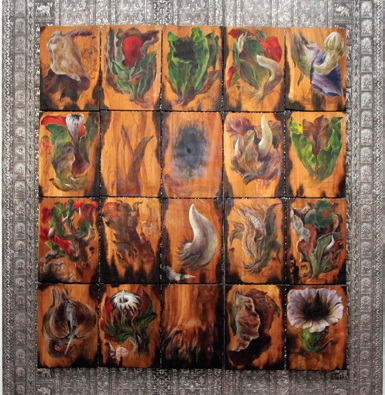
Stroke of the Healing Tree

Vadodara, GUJARAT :

K K Muhammed | photographs by Albin Mathew

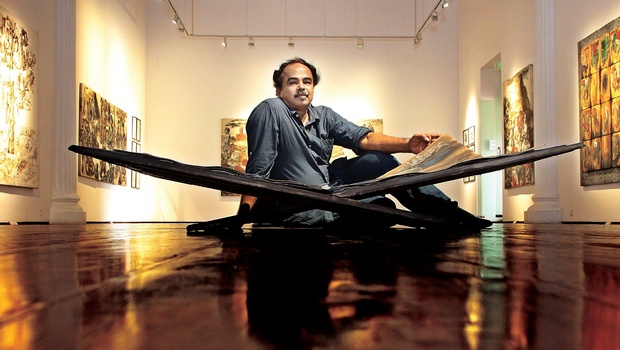
Trees are essential for life and have always occupied an important place in myths, folklores and religions. K K Muhammed, a Vadodara-based artist, has used this aspect as the base for a series of works during his first-ever exhibition which was held recently in Kochi.

His paintings depict the malignancy of various maladies prevalent in our society, and the way they have crippled us. Be it discrimination against women, domestic violence, male domination or the exploitation of environment for human need, the artist has used trees as a spokesperson to highlight the issue.

“Every person has a close contact with trees,” says Muhammed. “Many of us have been influenced by the positive aura of trees, even without being aware of it. Hence, those who see these paintings will be able to identify the inner truth that I am trying to convey,” he says.

In two paintings, a log of wood occupies prime position. While the log represents consumerism in one work, it represents opulence of the rulers of the past and the present in another. “Consumerism has become a bane,” says Muhammed. “People today try to find out ways to get things done without effort. The ‘lesser the hard work the better it is’ has become the motto of this generation.”

Nothing has changed much, believes Muhammed. “The rulers of yore and the present are the same lot. Opulence binds them together. The log of wood in the picture cries out against the greed of the rulers which should be satisfied at any cost,” says the artist. These paintings also highlight male dominance and try to depict how men have hold the reins of the society while relegating women to do menial tasks.

Paintings by Muhammed put on display at the exhibition
 

A tree stands alone in one of the paintings in sepia. At one glance, a person cannot notice, but when one looks closely, various images peek out of the stem and branches. Hidden among the leaves and bark are the images of men and women along with various implements that we use in daily life. A thorn can be seen piercing a leaf, which again, highlights the brutal nature of man. Mainly, how he doesn’t flinch from trampling and back-stabbing others to reach his goal. Muhammed has also done a set of paintings on burnt wood. “I wanted to show that the nature is both the creator and destroyer,” he says. “The tender buds and flowers sprouting from the dead wood show the continuity of life. It also shows that nature is forgiving.”A painting, which highlights the hardships of women, catches the eye. The picture depicts how a woman looks after every single need of her family. The tender nature of the gender has been brought up to light through the image of a pregnant woman sitting with a rabbit on her lap.

“Men are self-oriented by nature and they do not hesitate to slander even their mothers for their own gain. They are afflicted by a grave malady called narcissism,” says Muhammed. The artist has depicted his belief in one of his paintings which is based on the story of young Narcissus, a Greek mythological character.

The artist is critical to the great importance that society gives to men. He points out this aspect in another painting which portrays various day-to-day affairs that we come across, things like the railings of a fence, the various objects that are used in the household and also symbols of religious importance.

Muhammed has received many awards, including the Bombay Arts Award and Kerala Lalithakala Akademi award, among others. He has done nine solo shows so far and been a part of more than 45 group shows. A postgraduate from Kala Bhavan, Visva Bharati at Santiniketan, the artist is planning to indulge in his other love, sculpting. “I will be exhibiting my works in a year or so,” says Muhammed.

source: http://www.newindianexpress.com / The New Indian Express / Home> Magazine / by Anu C.Kuruvilla / February 20th, 2016

Rare books, methodically sorted

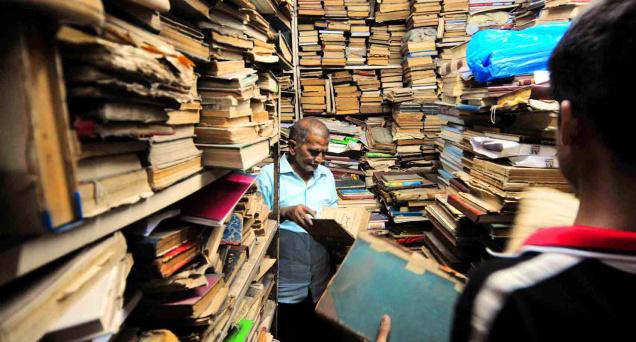
Haziq and Mohi Rare Book Suppliers at Mubarak Chowk near Charminar is all set for a massive overhaul.-Photo: Mohammed Yousuf

After his death, siblings of Ahmed Bin Mohammed Bafanna, owner of Haziq and Mohi Rare Book Suppliers, start digitising and categorising the inventory.

Hyderabad, TELANGANA :

our months after 67-year-old Ahmed Bin Mohammed Bafanna breathed his last leaving behind a treasure trove in terms of literature, his four-decade-old shop which sells rare books is all set to be brought back to life. While it will take time to return things to full functionality, it is nevertheless something that book lovers have been waiting for.

And if you were one of those people wondering about the future of Haziq and Mohi Rare Book Suppliers, then there is good news. Mr. Ahmed’s five siblings have now begun sorting and rearranging the range of books in the shop subject wise, and they also plan to digitise the entire collection. “We started work in December, and have categorised more than 10,000 books so far,” said Khaled Bafanna, the youngest of the siblings.

The work to categorise all the books in Haziq and Mohi will take at least six months more, given that nobody in the family except Mr. Ahmed had any idea of which book is where.

“He had everything on his mind. We have started separating them under categories like Islamic literature and history. It will make things easier, as we would know how to find things. And we don’t even know the total number of books that are here,” explained Khaled. After Mr. Ahmed’s sudden demise, there was fear among his customers that his store would be shut down. Perhaps the fact that the store was closed for about 40 days after his death may have prompted that idea. For instance, a researcher from the US who was in Hyderabad last December went back disappointed, as the store was closed. The shop is a place where any literature lover could get lost in. Filled with books everywhere, there is just enough space for one person to walk through it, literally. A second person would have to either go outside to give way, or turn sideways to let another person pass. And the books also perhaps live up to the store’s name, as all of them inside are titles that would pique anyone’s curiosity.

For example, some of the books on display there are Aazadi (in Urdu), Women in Delhi Sultanate by Lokesh Chandra Nand, Timardaari (in Urdu) and another one titled Hyderabad Gazetteer by A. Khan. “Once my son’s exams are over, I will also create an email ID for the shop, so that our customers can reach us easily,” said Khaled, who is helped by his brothers to run the shop. And without Mr. Ahmed, how do they fix the cost of the books they sell? “We fix the price based on the date of the books, i.e. how old they are. And also, in case we cannot get another print of a particular book, we will only make Photostat copies of the original and give it, to preserve the copy we have,” he said, sitting where his eldest brother once sat in front of the shop on a small stool. Khaled and his brothers will also be relying on the same book sellers who would inform whenever a rare book would be available in the market for them to purchase. Mr. Ahmed is survived by his five brothers Ali, Abdallah, Salem, Osman and Khaled, all of whom maintain the store together. The shop is open from 12 noon to 7 p.m., and customers can contact Mr. Khaled on 93940 21930.

Some of the books are Aazadi, and Women in Delhi Sultanate by Lokesh Chandra Nand

 source: http://www.thehindu.com / The Hindu / Home> News> Cities> Hyderabad / by Yunus Y. Lasania / February 22nd, 2016

The Three Musketeers of Swachh Bharat Abhiyan in city

AutoSwachMPOs26feb2016

by M.L. Krishnaswami

Mysuru, KARNATAKA :

Prime Minister Narendra Modi has exhorted citizens to give a boost to promoting physical cleanliness of the towns and villages of the country and has directed his Ministries concerned to declare a few cities of the land as clean cities and giving them appropriate rankings. Thus our own city ‘Mysuru’ has been adjudged the Cleanest City in the tier-2 category. This has generated a high level of civic consciousness among the City Corporation and the Citizens.

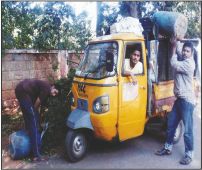
The successive Mayors, Corporators and the Commissioners of MCC have to be complimented for this award. But the ultimate responsibility for the success of this hazardous task greatly rests on the shoulders of the grassroot workers in the lowest rung of the whole set-up. In this article, with due apologies to the higher ones in the hierarchy, I am inclined to highlight this important segment. Where I live, this job is meticulously done by three youngsters, the garbage collectors, who come early every morning shouting ‘Kasa, Kasa’ on the streets to awaken the householders to bring the garbage bin or tub to their doorsteps to be collected by the above youngsters and dumped into the carting autos. I have somehow befriended these boys in my own way and my wife even gives them a cup of hot-tea, a welcome drink in the early winter morning. Now, a brief about the boys:

1) The auto driver is named Farhan, obviously a Muslim boy of a score of years in age, who says he has studied upto PUC and due to family problems has taken up this part-time job (from 5 am to 2 pm) to save a portion of his earnings to enable him take up and study for B.Com next year. He has plans to pursue higher education upto M.Com or MBA. What a brilliant idea for future plans to this very handsome and affable young boy.

2) Rangaswamy is the important member of this trio and has studied upto High School. He is married and has two kids pursuing school education. He has carved out higher education for his kids more so because he was denied an opportunity to pursue his studies further.

3) Varadaraju is the third boy who collects the street and household garbage and carries them upto the auto and hands it over to Rangaswamy to put them into the inner auto space. He also has some formal education.

The job of the above three youngsters is to assiduously scan the about one-and-a-half to two-square-kilometres of the area allotted to them for garbage collection and transport it to the nearest lorry assigned to the area for carrying it forward to the dumping yard for treatment and final disposal.

In this hazardous task, I guess Mysuru City must be collecting and disposing off hundreds of tonnes of dry street and household garbage every day. Proper planning for final disposal of the garbage thus collected on a daily basis must be a challenging task for the City Corporation authorities who should be complimented for the same. The next higher-ups like Health Inspectors and others involved in these monotonous and highly necessary daily activities should be complimented for a good job done for the ultimate well-being of the city. Proper planning and execution are the hallmarks of this stupendous task in continuing to maintain the health of the citizens.

In the above context, I would prefer to call the three youngsters as the “Foot Soldiers of the Swachh Bharat Abhiyan.”

Decades ago many extensions of the then Mysore did not have Underground Drainage (UGD) networks and my memory goes back to the Vontikoppal area which was one of them. My father’s uncle lived there. It was an area inhabited by college professors including Kuvempu. Hand collection and hand carting of domestic sewage was in vogue and thus came the idea of a conservancy lane in between the parallel rows of houses facing the main road. The collection and carting of this ignominious domestic garbage was done by members of a particular community, nicknamed scavengers. What a shame and black mark on the society? It is good for the society that this system has been abolished in most of the cities and towns. It is an improvement in social conduct that people belonging to all communities have joined the brigade of the ‘Swachh Bharat Abhiyan.’ The doors of this Abhiyan should open up and welcome youngsters from all communities in the country into its fold. Time is not far off for this to happen.

In olden days, when I was a boy, fairly big houses in the city would be having a reserved space in the compound corner called ‘Thippe’ and all dry and kitchen garbage would be dumped into it and cleaned almost every week, by municipal workers. This was a very good and welcome step in maintaining the health of the household members. This, however, is absent these days.

Now, in a lighter vein this ‘Thippe’ was also used to make fun of a lady member of the household who begets twenty- one children by a single husband. A small function would be arranged to commemorate this great event by asking her to sit on a carpet spread on this ‘Thippe’ and perform a small ‘Arathi,’ a mark of a mini-religious function to celebrate the event by inviting relatives and neighbours!! My father’s maternal uncle’s wife had this distinction (!) and she was nick-named ‘Papachi’ and whatever it meant I do not know. She bore twenty-one children to her husband !

Old order changeth yielding

Place to new

And God fulfils Himself

In many ways

The present generation of husband and wife normally have one child, if at all, and many forego the joy of parenthood and the reason they offer is “we want to enjoy life fully without obligations or hindrances.” Nobody will remain young for ever and when they get old, they regret their earlier decision, but it would be too late in the day.

e-mail: mlkswami@yahoo.in

source: http://www.starofmysore.com / Star of Mysore / Home> Feature Articles / Thursday – February 25th, 2016

Karnataka Urdu Academy Chairperson passes away

Bengaluru , KARNATAKA :

Dr. Fauzia Choudhry collapsed while speaking at a programme in Kannada Bhavan, Bengaluru

DrFauziaMPOs26feb2016

Mysuru :

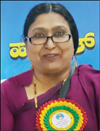
Dr. Fauzia Choudhry (52), Chairperson of Karnataka Urdu Academy, passed away yesterday in Bengaluru following a heart attack.

She leaves behind her husband, three daughters and a host of relatives and friends.

Dr. Fauzia Choudhry, who collapsed while delivering the presidential address at a programme held at the Urdu Library in Kannada Bhavan, was rushed to St. Martha’s Heart Centre, where she was declared brought dead.

Namaz-e-Janaza will be held today after Zohar at Masjid-e-Khadria, followed by the burial at Khudus Saheb Makhan in Bengaluru.

Condoled: MLA Tanveer Sait, Secretary of Mysore District Relief Committee Mohammed Mumtaz Ahmed and others have condoled her death.

source: http://www.starofmysore.com / Star of Mysore / Home> General News / Thursday  – February 25th, 2016

Cervical Cancer Less Among Muslim Women: Dr V Shanta

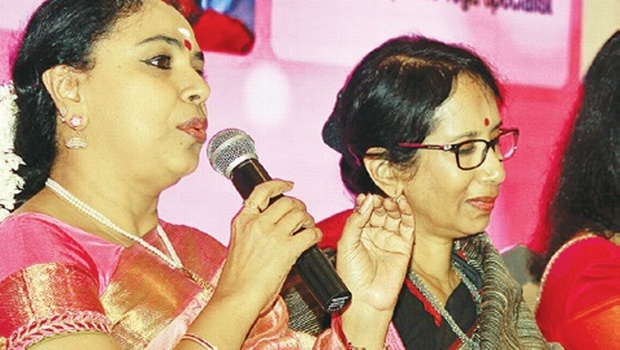
Sudha Raghunathan at Oncology meet  Martin Louis

Chennai :

Pointing out that cervical cancer is less among Muslim women, Dr V Shanta, chairperson, Cancer Institute WIA, attributes this to the religious ritual of circumcision practised by them.

Addressing the gathering at a symposium on women’s oncology organised by Apollo Hospitals and National Cancer Institute of the  United States (USA NCI) on Monday, Dr Shanta says only 8.9% of the Muslim women have cervical cancer compared to 15.4% among the Christian women and 22.1% among the Hindu women against a total ratio of 1 lakh.

“The main reason for such a drastic change is the practice of circumcision and penile hygiene,” she adds. “Circumcision has a protective effect against sexual transmission of human papilloma virus (HPV), which is a causative agent in cervical cancer,” said a doctor at the symposium.

The country has seen an uneven literacy pattern which has affected cancer detection and curing, according to Dr Shanta. Various research have proved that uneducated adults are more likely to die from cancer than the educated as awareness is a big problem for illiterate people, she said.

Further, she says that there has been a decrease in cervical cancer among women in the urban centres when compared to rural areas. But city women have recorded an increase in breast cancer. Dr Shanta cited the figures of 2009-12 to show that cervical cancer reported in Chennai is only 16.5% when compared to 22.8% in rural areas. Likewise, breast cancer reported in the Chennai is 38.6% when compared to 15.1% in rural areas.

“This is because of education and socio-economic status of the people. The attitude among the urban populace is more towards the cure than prevention. Only when they realise that prevention is better than cure can the rates of cancer death be brought down,” she explained.

State health secretary J Radhakrishnan said that private and government hospitals along with NGOs are working together to fight oncology among women. He pointed out that around 1.09 crore women were screened for cervical cancer in Tamil Nadu out of which 3.7 lakh were found to have the the disease. Similarly, around 1.33 crore women were screened for breast cancer out of which which 1.64 lakh were found to have the disease.

A symposium titled ‘Marga’ focused on a road map towards women’s oncology care in India was held. It was pointed out that 35 million deaths occurred due to NCDs (non-communicable diseases) each year which is due to sedentary lifestyle, poor diet regime and high stress levels. While many schools had banned fast foods in their canteens, parents must avoid giving kids such items, they said.

source: http://www.newindianexpress.com / The New Indian Express / Home> Cities> Chennai / by Express News Service / February 23rd, 2016

In Kerala’s Kozhikode, hunt for a Chinese legend

In Kerala’s Kozhikode, hunt for a Chinese legend

Kozhikode, KERALA :

More than 600 years after a seven-foot tall Chinese naval explorer touched the shores of Calicut (now Kozhikode), a bustling international port city in northern Kerala, an attempt to find his relics and perhaps his final burial place is in order in the state.

Last month, two professors, working in different countries, arrived in Kerala with the aim of finding more information about Zheng He, a fleet admiral of China’s early Ming dynasty and one of the world’s earliest navigators, much ahead of the likes of Christopher Columbus and Vasco da Gama. According to credible historical accounts, Zheng He, who had led seven naval expeditions in the Indian Ocean, was buried at sea off the coast of Calicut after he died of illness in the course of a voyage.

“We came to Kerala on January 7-9 to find information about relics and stories of Zheng He and his crew in Calicut. It was an official trip of Zhenghe International Peace Foundation,” said Shaojin Chai, a senior research fellow at the Ministry of Culture in UAE.

While history books are replete with the exploits of Columbus and Gama, not much is known about Zheng He, whose fleet was considered to be ten times bigger than his contemporaries. In fact, National Geographic magazine described  the naval armada of Zheng He off the coast of Sri Lanka as a ‘massive shadow on the horizon’, that moved like a ‘floating city’ and stretched across miles and miles of the ocean.

Zheng He, who is venerated almost like a God in several parts of China and has temples dedicated to him in Malaysia and Indonesia, was born in China’s Yunnan province in 1371. Born into a Muslim family, Zheng He was ritually castrated at the age of ten at the hands of an invading Ming army. But his life as a eunuch turned out for the better after he was sent to serve in the household of Zhu Di, who would later go on to become the Yongle Emperor. History says Zheng He was able to gain the trust of the emperor in a short period of time and convinced him to let him embark on naval trips that would extend China’s trade potential to Southeast Asia, the Indian subcontinent and the far-away Middle East.

Watch video

Zheng He’s first voyage, according to several accounts, began in the year 1405, sailing from China through Indonesia and Malaysia to finally end at Calicut via Cochin. His fleet was estimated to be more than 20,000 men travelling in more than 60 treasure ships – numbers described astonishing in most accounts. His subsequent trips took him as far as Iran and eastern Africa to the shores of Mogadishu.

For the Chinese explorer, Calicut, then a prosperous trading port that dealt extensively in eastern spices under the rule of the Zamorin, was an ideal base to conduct trade across the Indian Ocean and the Middle East.

“Chinese historian Ma Huan, Zheng He’s translator, described Calicut as very friendly, harmonious and a dynamic place where trading was fair and the Hindu king consulted with Muslim ministers to conduct state affairs,” said Professor Chai, who was accompanied to Kerala by Haiyun Ma, a professor at Frostburg State University, Maryland, US.

During their short visit, both professors visited a few mosques which had Chinese connections and inspected tombstones, but could not unearth any reliable clues that could point to Zheng He’s period.

However, CK Ramachandran, convenor of the Calicut Heritage Forum, dismissed claims that the Chinese naval commander had been buried under land.

“According to early Chinese traditions, a eunuch, after death, cannot go to heaven with a deformed body. That’s why he was ceremonially buried at sea,” said Ramachandran, who has meticulously collated several historian accounts of the Chinese in Kerala.

“I did visit Nanjing in China where a tomb has been erected in Zheng He’s memory. But it is more of a memorial. It is empty,” he added.

Nevertheless, undeterred, Professors Chai and Ma are planning to organise a conference next year in Kerala which would throw light on Zheng He’s exploits for which they have spoken to state government officials as well.

“Zheng He was considered one of the greatest statesmen and explorers in Chinese history and was our national pride for promoting peace and trade with other countries (sic),” said Prof Chai.

source: http://www.in.news.yahoo.com / by Vishnu Varma, The Indian Express / February 20th, 2016

Poet Dr. Akbar Ali passes away

Belagavi – Mysuru, KARNATAKA :

DrAkbarAliMPOs21feb2016

Mysuru :

Chutuku Kavi was also a former MLC

Renowned poet and former MLC Dr. M. Akbar Ali, passed away at a private hospital in city this morning following illness. He was 91.

He is survived by three sons, three daughters and a host of relatives and friends. His wife Banubi had predeceased him.

Dr. Akbar Ali, was said to be suffering from cancer, was admitted to the hospital about 15 days ago, where he breathed his last at 6 am this morning.

Deputy Commissioner C. Shikha, other eminent personalities and dignitaries from all walks of life paid their last respects to the departed poet at his residence in T.K. Layout.

His last rites will be performed at the Muslim Burial Ground behind city’s Central Prison this evening, according to family sources.

Profile: Dr. M. Akbar Ali, who gained popularity as a ‘Chutuku poet,’ was born at Ullegaddi Khanapur village in Hukkeri taluk of Belagavi district on Mar. 3, 1925.

After getting his early education at his village, Dr. Akbar Ali did his higher education at Belagavi and Pune and got his Ph.D Degree from the University of Mysore.

Beginning his career as a teacher at Belagavi in 1953, Dr. Akbar Ali retired from Mysore University as a Professor (Distance Eduction Wing) in 1985 on superannuation, before serving in different colleges at many places.

He has written many ‘Chutuku’ poems including Akbar Ali Chutukugalu, Belakina Aradhane, Kasi Gulabi, Kathana, Kannada Kavyadhyana and Akbar Ali Samagra Kavya.

Among the many awards and prizes he has won, includes Rajya Sahitya Academy Award (1967), National Integration Award (1974), Kannada Rajyotsava Award (1985), Honorary Award of Karnataka Sahitya Academy (1985) and DVG Muktaka Sahitya Award in 2009.

Dr. Akbar Ali was a nominated Member of the Legislative Council (MLC) from 1986 to 1992.

He had chaired the 9th Mysuru District Kannada Sahitya Sammelana in 2008 and the All India Poets meet held at Mandya in 1994.

source: http://www.starofmysore.com / Star of Mysore / Home> General News / February 21st, 2016

Pages from History : South Indian Coinage

Mysuru, KARNATAKA :

by Prof. A.V. Narasimha Murthy, former Head, Department of Ancient History & Archaeology, University of Mysore

I had the good fortune of serving the Numismatic Society of India, Varanasi, as its President, Secretary and Editor. I used to attend the annual conferences of this Society regularly. I once noticed that scholars attending the Varanasi Conference from South India could be counted on finger tips. The reason, I learnt, was that North India was very far and travel would be difficult and many scholars suggested ‘Why not a South Indian Coin (Numismatic) Society be started?’ It was a good suggestion and I contacted Dr. R. Krishnamurthy, Editor of Dinamalar (Tamil Daily) from Chennai and he welcomed the idea but told me that his business as the Editor of a Daily would not allow him to devote full time and energy for this. But he hastened to add, ‘If you can take that responsibility, my full support to you is there.’

Prof. K.V. Raman of Chennai gave me his support. The Head of the publication of New Era, Dr. Srinivasan Srinivasan agreed to print and publish the Journal of the Society on the condition ‘I should be its Editor.’ I agreed and South Indian Numismatic Society came into existence in 1990. So far it has conducted 26 conferences at different centres in Karnataka, Andhra, Tamil Nadu, Kerala. This time it met at Thiruvananthapuram in Jan. 2016. About 150 Numismatists attended.

It was our good fortune that it was hosted by the Centre for Heritage Studies under the Cultural Affairs Department of Kerala. K.C. Joseph, Minister for Rural Development, Culture and Planning, who inaugurated the conference, extended full cooperation to this conference which was a success.

There was a time when barter was the system of trade. People realised its limitation and began using coins. Coins as such have not been noticed in the Indus Valley Culture. However, Rig Veda mentions coins like Nishka, Rukma, Khadi, in the sense of coins. But actually Nishka means a necklace and hence, it has been taken as a necklace made of gold coins (kasinasara). Anyway, that is the earliest coin of our country.

South India had a period which is generally referred to as Sangam age and it was considered as a literary imagination or even bunkum. Suddenly, Dinamalar Krishnamurthy discovered a coin belonging to a Sangam King called Peruvalathi. For the present, this is considered to be the earliest coin of South India. Barring this, the Satavahana (Andhra) coins are the earliest coins of Deccan and South India.

However, we have had uninscribed punch marked coins all over the country including South India and Karnataka. These silver coins had 5 symbols punched on them and one of them represented the government or the king. At this time, Roman merchants came to South India and gave their gold and silver coins and purchased our spices, especially black pepper, which was considered as an antidote for malaria. Thus the large number of Roman coins gave an impetus for the minting of coins in South India.

Kadambas of Banavasi are considered to the actual inaugurators of coinage in Karnataka. They issued what are called Padmatanka coins. A Padmatanka is a gold piece which has a central punch of a lotus or Padma with some symbols and letters like ‘Sri’ with or without the name of the issuer. The Pallavas of Kanchi issued their own coins in gold and copper. This system was continued by the Cholas of Thanjavur. They minted the portrayal of the king with Nagari or Tamil legends. Chola coins have been discovered in plenty as to fill up them, in gunny bags. In Andhra area, Vishnukundins minted coins. In Karnataka, the Chalukyas minted coins and their most popular coin is called Varaha. This word survives even today in traditional parlance. In fact, the coin name Varaha is a contribution of Karnataka in general and that of the Chalukyas in particular.

The Western Gangas of Talakad minted gold and copper coins with elephant as the important symbol. Unfortunately, Rashtrakuta coins have not been discovered in plenty. Later, Chalukya coins have been found in plenty. The Hoysalas minted coins in gold and copper. Vishnuvardhana minted coins with lion and the legend Talakadugonda symbolising the defeat of the Cholas. One interesting coin is the one which has a portrait of Saint Ramanujacharya. The Sevunas or the Yadava coins include those of Bhillama, Singhana and Ramachandra.

Kings of Vijayanagara introduced innovation in coinage. It is not only a golden age but a golden period for Karnataka coinage. Their coinage has been praised by foreign travellers also. They introduced legends in Kannada and Nagari. The most important coin of Krishnadevaraya are the coins representing Lord Venkateswara of Tirumala and Sri Krishna holding a lump of butter in his hands. Krishnadevaraya performed Kanakabhisheka to Balaji of Tirupati by minting gold coins which had the representation of Venkateswara with Sridevi and Bhudevi and his name in Kannada or Nagari. Nayakas of Madura imitated the coinage of Vijayanagara. Their coins contain legends in Kannada and Tamil.

We may turn our attention to the coinage of Muslim kings — the Bahamani dynasty, Adil Shahi dynasty and Barid Shahi Sultans. They minted coins with legends in Arabic and Persian on both sides. Hyder Ali and Tipu Sultan occupy an important place in Karnataka history. Tipu’s innovation in coinage is amazing. He established seventeen mints in different parts of South India and minted coins in gold, silver and copper. He gave each coin a name after the Islamic Saints. His gold coins contain the Persian legend ‘The religion of Ahmad is illumined in the world by the victory of Hyder.’ The reverse has the legend ‘He is the Sultan, the unique, the just, the third of Bahari, cyclic year Azal 2.’

The Wadiyars of Mysore (now Mysuru) began issuing coins with legends. The representation of Hindu Gods by Krishnaraja Wadiyar is unique. They also minted coins with portrayals of lion and elephant with legends in Roman, Kannada and Persian. Once the British took over, they began to follow the British coinage. After independence, the entire country, including South India, is following the system which we are now seeing. Thus, South India followed a unique system of coinage which has a history of over 2,000 years.

source: http://www.starofmysore.com / Star of Mysore / Home> Feature Articles / February 21st, 2016

It’s a Jawa Day everyday with Motorcycles & Memorabilia

Mysuru, KARNATAKA :

People across the globe celebrate Jawa Day on the second Sunday of July every year, but for H. Ajay Kumar of Mahadevapura in Mysuru, who owns four Yezdi and a Jawa bike, everyday is a Jawa Day! One may wonder as to what makes him so unique when there are so many other people who own more Jawa bikes. What makes Ajay stand out is not just the motorcycles but the memorabilia of Ideal Jawa, the collectibles of Jawa factory and the info about the factory he has right on the tip of his tongue that shows his passion for the legacy that Ideal Jawa left behind. This Weekend’s Pictorial Star Supplement will take our readers on a nostalgic ride of the good-old Ideal Jawa days.

by B.N. Ramya

AjayKumarMPOs21feb2016

The Motorcycles…

Anyone studying physics in eighth standard would think of scoring high marks in exams or at the most of learning physics for the sake of good marks which counts a lot in CET to get an engineering or medical seat. But Ajay Kumar has a different story to tell.

Speaking about how his love grew for automobiles, he says, “It was when I was in eighth standard that I learnt about steam engine, internal combustion and then my curiosity to know about two-stroke and four-stroke engine arose. My dad had a Hero Puch then and with that I was introduced to Prasad uncle of Gururaja Automobiles on Ramanuja Road, the authorised dealers of Hero Puch. So anything I wanted to know about engines and machines, I was there at his shop satiating my hunger to know more about automobiles.”

It is a known fact that the words ‘automobiles’ and ‘Mysuru’ will no doubt make one think of Ideal Jawa, the second biggest Jawa motorcycle manufacturing factory in the world, next only to the original factory in Czechoslovakia. Ajay too was fascinated towards Jawa bikes like any other bike enthusiasts for its reliability and ruggedness.

About his first bike Ajay says: “As I told you my dad had a Hero Puch which I did not actually like much. I so very much wanted a bigger vehicle. When I once visited my grandma’s house on vacation, I saw a X standard boy riding bullet and I wanted to have one such bike. My father bought me Yezdi 175 CC when I was in X std. in 1999; that was my first BIG bike.”

“After that somewhere in 2002-03, I got to know about a Yezdi 60CC lying idol at a house of one of the Jawa employees, who had stopped using that vehicle after the factory had stopped production. I purchased that bike, which is now in a good condition after being given the required attention,” says Ajay adding: “then followed the purchase of Roadking from Vijayanagar; Joining some like-minded bike enthusiasts like Gavin and Azam, a Jawa Group was formed in 2007, which made way for the purchase of Jawa and then again Yezdi D250 Classic.”

“Initially I used to be an active member of the Jawa group, biking around and popularising the bikes. With passage of time and getting busy with family, though I fail to make more Jawa rides, I make sure that come what may, I attend the Jawa Day celebrations and go on rides,” says the bike enthusiast who added, his longest trip on bike was to Kodaikanal with friends and he keeps visiting Sakleshpura, where his in-laws reside, on bike enjoying the greenery en-route.

When asked where does he get his bikes repaired if they break down, Ajay says: “I alone can make repairs most of the time and if I need any major repair works, I approach Jawa mechanics Mohammed Dastagir and his son Shamshir Ahmed, who have a garage behind Dalvoy School. They are quite well-known among Jawa enthusiasts. People from Bengaluru, Chennai and Kerala too come there to get their bikes repaired.”

A native of Anantapur in Andhra Pradesh, Ajay is the son of H.V.G. Raju, a retired employee of Coffee Board and Yashoda and is married to Ashritha. Ajay, an alumnus of Sarada Vilas Educational Institutions in city, who has worked for various automobile showrooms, now runs a car driving school (The Search) in Vishweshwaranagar.

The Memorabilia…

Power bikes do not have speed and speed bikes do not have power. Jawa bikes are terrain bikes, says Ajay who is so much in love with the thundering sound of these yesteryear bikes.

Ajay, who can tell the exact date and year of the different models released by Ideal Jawa, laments about the decline of the Ideal Jawa, saying: “To demolish the factory completely, it took almost 5-6 months and I was there for almost five months everyday seeing the producer of the legendary bikes coming down. There I found some spare parts, bouchers, photographs and bulletins of Jawa factory, which speaks a lot of this giant bike producer.”

source: http://www.starofmysore.com / Star of Mysore / Home> Feature Articles / February 20th, 2016