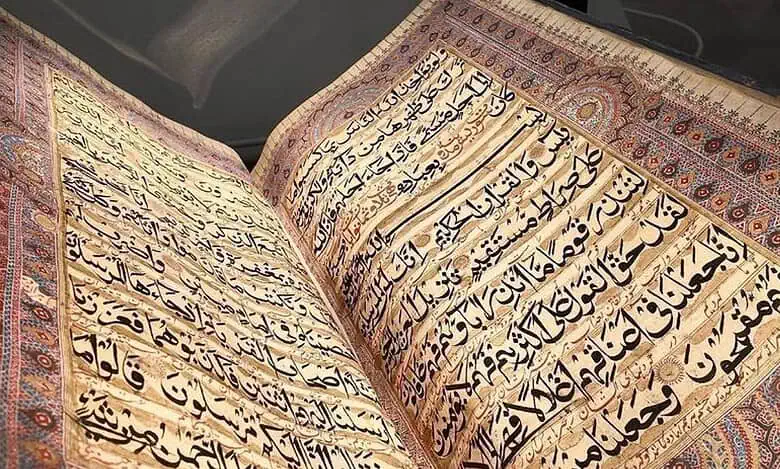
Indian calligrapher Ghulam Mohiuddin transcribed this manuscript.
pix: SPA
Jeddah:
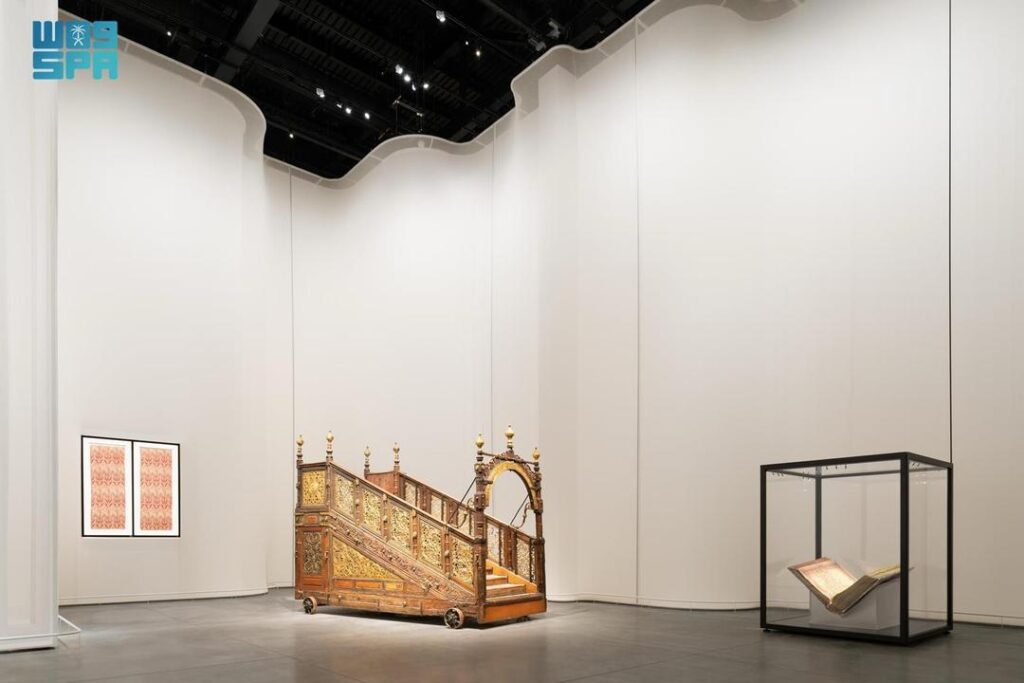
A two-century-old Quran manuscript, transcribed in India, is now on display at the Islamic Arts Biennale at the Western Hajj Terminal of King Abdulaziz International Airport in Jeddah, Saudi Arabia.
Indian calligrapher Ghulam Mohiuddin transcribed this monumental Quran manuscript on the 6th of Muharram, 1240 AH (August 31, 1824 AD) in northern India. It was designated as a waqf (endowment) for the Prophet’s Mosque in Madinah, reflecting India’s deep historical ties to Islamic art and heritage.
Measuring an extraordinary 139.7 × 77.5 cm, the manuscript is embellished with gold, deep-colored pigments, and a cover originally encrusted with rubies, emeralds, turquoise, and peridot, making it one of the rarest Quran copies on display, the Saudi Press Agency (SPA) reported.
The text is written in black Naskh script, with a Persian translation in red Nastaliq, showcasing the Indo-Persian calligraphic style of the era.
Historical records indicate that the manuscript arrived in Madinah in the mid-13th century AH and was initially placed near Bab As-Salam before being moved to the mosque’s treasury during restoration in 1273 AH (1857 AD).
In 1302 AH (1884 AD), it was rebound by Hajj Yusuf bin Hajj Masoom Nemankani, a scholar and manuscript expert from Uzbekistan who later settled in Madinah.
Now preserved at the King Abdulaziz Complex for Endowment Libraries in Madinah, this rare Indian-transcribed Quran is a key attraction at the Biennale, celebrating India’s historical ties with the Islamic world and its legacy of artistic excellence.
source: http://www.siasat.com / The Siasat Daily / Home> News> Middle East / by Sakina Fatima, X / March 12th, 2025
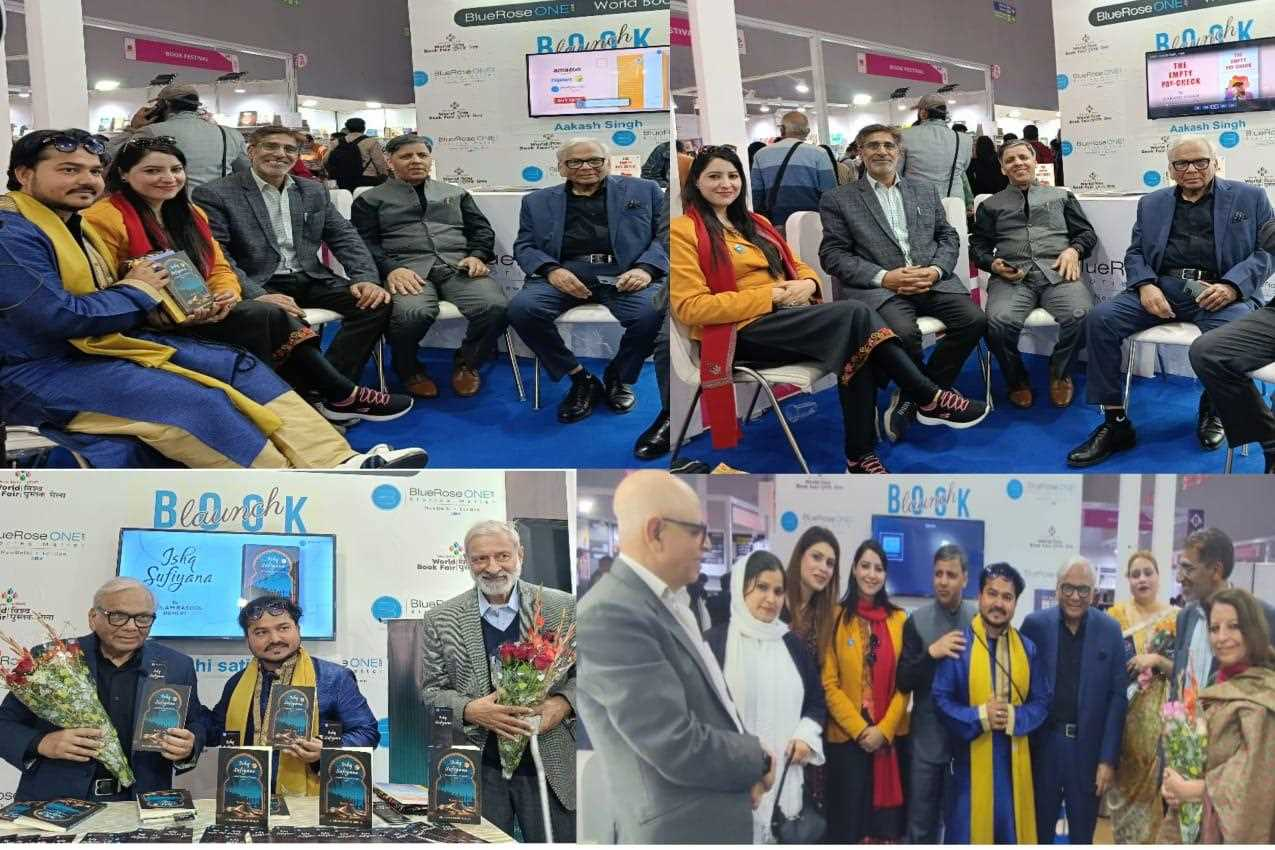
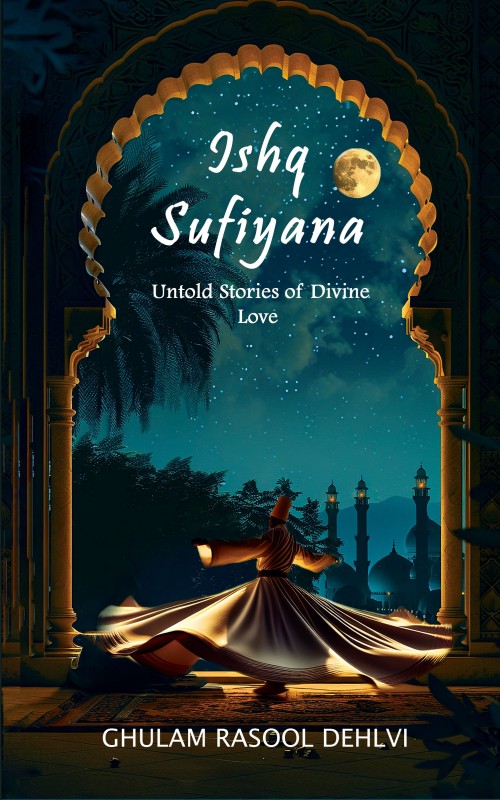
On the concluding day of the World Book Fair 2025, held in at Bharat Mandapam / Pragati Maidan New Delhi from February 1 to February 9, the book “Ishq Sufiyana: untold stories of divine love” by young writer and intellectual Ghulam Rasool Dehlvi was officially launched.
Ishq Sufiyana: Untold Stories of Divine Love / by Ghulam Rasool Dehlvi / image: blueroseone.com
The book launch ceremony took place at Stall No. 12 in Hall No. 6, with several distinguished personalities in attendance.
Notable figures present at the event included Kamlesh Sharma, former Secretary General of the Commonwealth and former Indian Ambassador to the United Nations (New York and Geneva), Padma Shri Professor Iqbal Hasnain, former Vice-Chancellor of Calicut University, Professor Madhu Khanna, former Director of the Department of Comparative Religions and Spirituality, Jamia Millia Islamia, Dr. Shahid Rasool, Dean of Academics at the Central University of Kashmir, Dr. Anita Benjamin, Founding Director of the Rashtriya Christian Mahasangh, Farooq Wani, Chief Editor of the daily Brighter Kashmir, Syed Abid Gowhar, renowned broadcaster and journalist from Jammu & Kashmir, Tasleema Akhtar, human rights activist, Tahmeena Rizvi, researcher, Dr. Rachika Arora, Syed Affan Yasawi, among others.
During this vibrant event, all the distinguished guests shared their thoughts about the book and its author. Ishq Sufiyana is a unique blend of reality and imagination. It creatively presents the real-life stories of thirty renowned Sufi saints of India.
The book among other Sufi intellects also highlights four revered saints and spiritual figures from the Kashmir Valley, Mir Syed Ali Hamdani (RA), Sheikh Noor-ud-Din Noorani (Nund Rishi) (RA), Sheikh Hamza Makhdum (RA) and Lal Ded (Lalla Arifa)
Additionally, Ishq Sufiyana includes a collection of narratives based on Sufism, ethics, and spirituality, many of which have been previously published in various newspapers and journals. The book aims to inspire seekers of all religions and spiritual traditions to dive into the ocean of divine love. The values and teachings of the personalities featured in the book remain relevant today, helping individuals grasp the depths of divine love that transcend worldly boundaries.
Ghulam Rasool Dehlvi is a well-known Sufi scholar, researcher, critic, speaker, and author based in Delhi. He is fluent in Urdu, Arabic, and Persian and is a trained scholar in Indo-Islamic traditions. He has received in-depth education and training in various spiritual orders, particularly the Naqshbandi, Qadiri, and Chishti Sufi traditions.
He has also undergone spiritual training and initiation under Turkish-origin Naqshbandi Sufi Sheikh Ashraf Effendi (Founder of Sufi Land, Germany). Pir Zia Inayat Khan (Global Head of the Inayati Chishti Sufi Order), American Sufi guide Pir Shabda Khan (Director, Sufism International, USA). He has studied under several esteemed Sufi scholars and spiritual elders in India. Recently, he was invited as a scholar-in-residence at the Bawa Muhaiyaddeen Fellowship (Philadelphia) and the Awliya Council of North America (New York, USA).
He has also served as an advisor on Islamic affairs for the National Security Council Secretariat, New Delhi.
Moreover, he has participated as a permanent representative of UN-affiliated NGOs at the United Nations Human Rights Council in Geneva, Switzerland.
The author is also an independent writer, poet, translator, and commentator.
source: http://www.brighterkashmir.com / Brighter Kashmir / Home> Breaking News / by Abid Gowhar / image of publication edited by blueroseone.com / February 12th, 2025
An online database, it is a collection of qawwalis in cinema, from talkie days to the present.
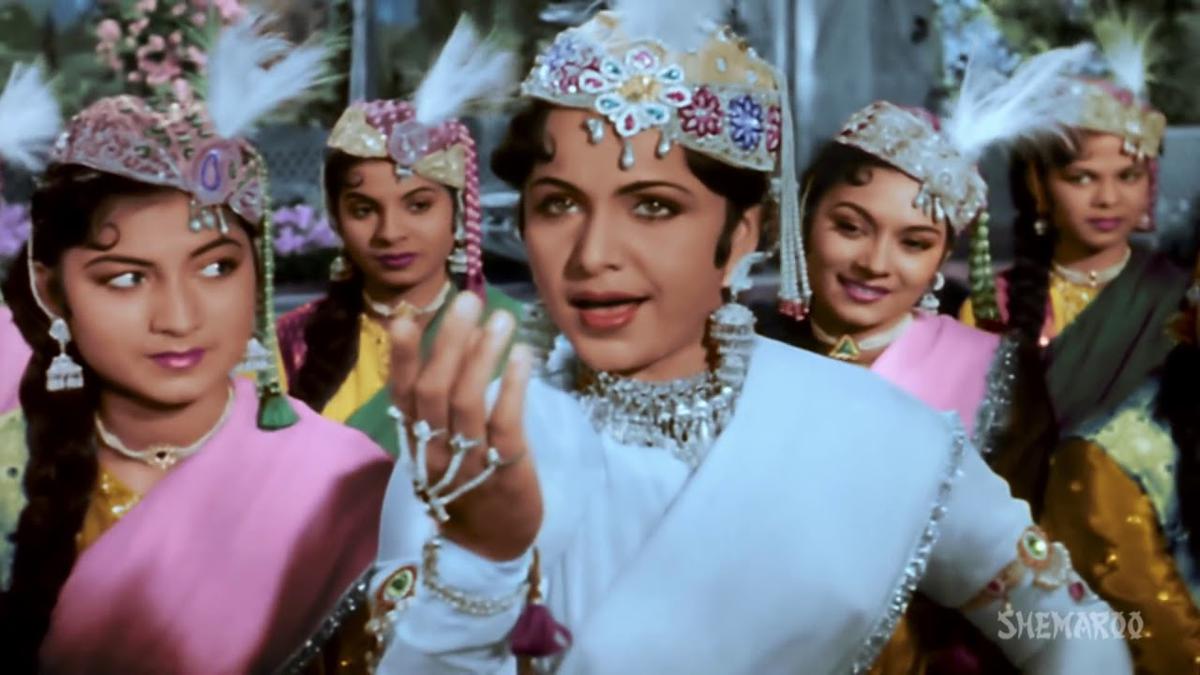
The popular qawwali, ‘Teri mehfil mein kismat azamakar’, from Mughal-e-Azam | Photo Credit: Special Arrangement
The qawwali, a musical genre closely associated with Islamic Sufi tradition, has evolved over the generations to include not just devotion, but romance, comedy and even social commentary in its fold.
Its journey from the courtly environs of erstwhile princely salons, to the dargahs, and then into the Hindi film industry, has largely gone undocumented, though the transition is still in progress. However in recent weeks, the Cinema Qawwali Archive, an online database curated by Delhi-based independent filmmaker and researcher Yousuf Saeed, has been reviving interest in this pop culture import.
“Qaul means a saying or spoken phrase [in Arabic and Urdu]. Those who sang a qaul were called qawwals. All qawwali lyrics may not necessarily send you into a trance, some can also be subtle. But the singing style is surely bold. Off-hand, most people can recall only around 10-20 qawwalis in Hindi cinema, but the actual number is much bigger,” says Saeed in a phone interview.
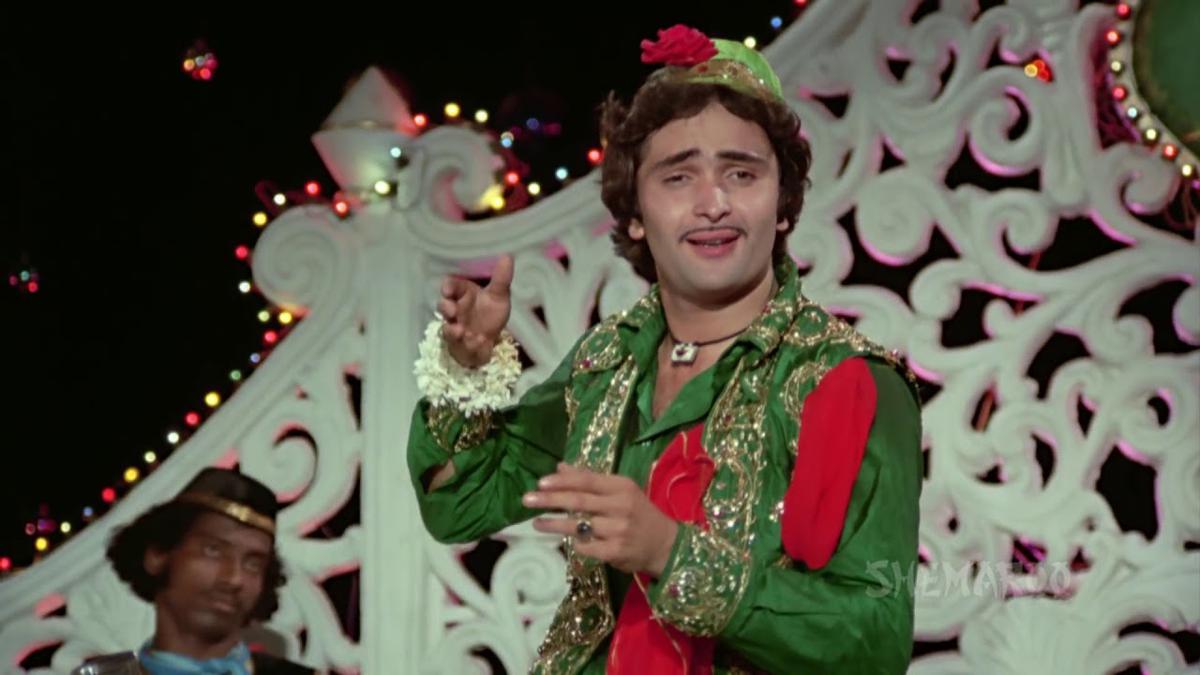
‘Parda hain parda’ from Amar Akbar Anthony
Working on the database for a decade, Saeed has compiled 800 qawwalis so far, with the earliest going back to the 1930s, and latest, until 2022. “The ‘talkie’ pictures came to India in 1931; though the original movies from the early 1930s are lost forever, I did manage to find some from 1936, with unusual names like Miss Frontier Mail (starring ‘Fearless’ Nadia), and the 1939 film Brandy Ki Botal,” says Saeed.
Poetry of the past
Saeed began noticing the qawwali’s ubiquity in Hindi films while working on a series of documentaries on Sufi poet and musician Abul Hasan Yamin-ud-din Khusrau, also known as Amir Khusro (1253–1325 AD). “I realised that quite a few of his qawwalis had been lifted and modified for Hindi films, so I started noting them down, and soon, the list grew to 400 songs. I wanted to make them available on a common database in chronological order,” he says. Among these is the qawwali ‘Zihale Miskin’ sung by Lata Mangeshkar in Ghulami (1985). A simplified version of Khusro’s original, the lilting composition retains the poet’s penchant for multi-lingual lyric arrangements.
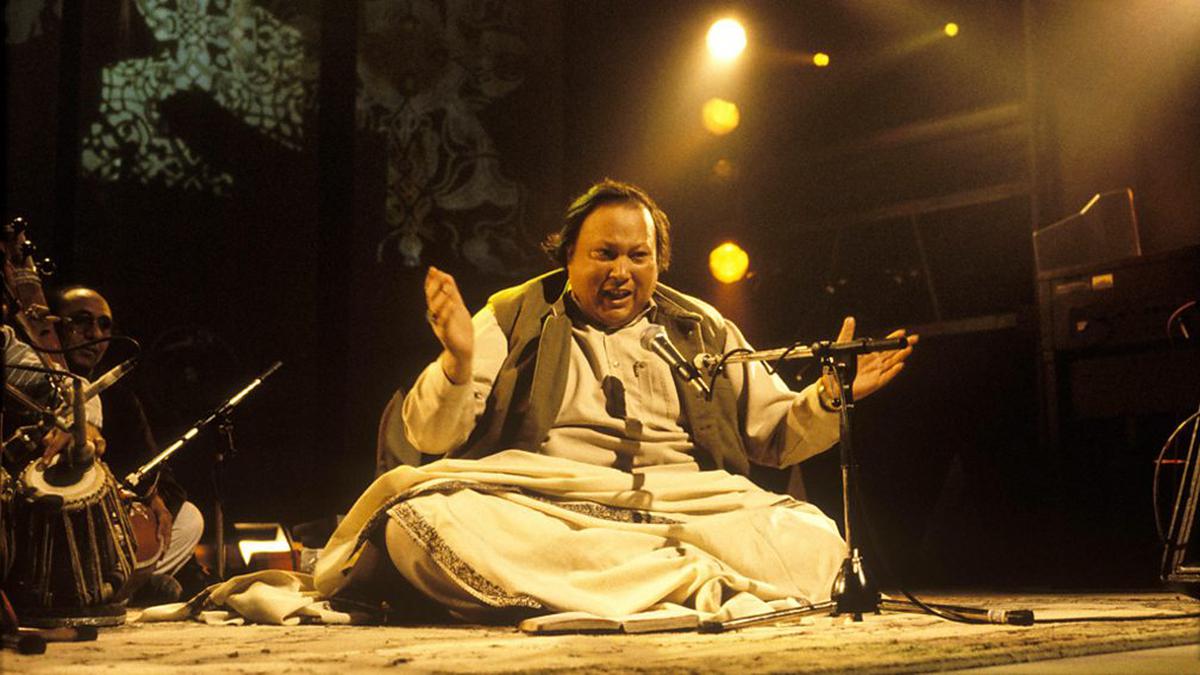
The inimitable Nusrat Fateh Ali Khan | Photo Credit: Getty Images
“’Zihale Miskin’ is very popular, and unusual, because it has one line in Persian and one in Brij Bhasha. Then there are many of Khusro’s Dohas (couplets) that are used in qawwali songs quite often,” says Saeed.
Qawwali, says the filmmaker, is a free-floating art that allows singers and lyricists to combine several genres and poetic forms in a seamless composition. Besides YouTube, Saeed has picked out his selections from DVDs and VCDs (remember those?). “I haven’t had a problem with copyright so far, since quite a few of the songs are already in the public domain. But it’s amazing how I keep discovering new qawwalis everyday. My latest is ‘Shikayat’ from last year’s Gangubai Kathiawadi,” he laughs.
Qawwali down the ages
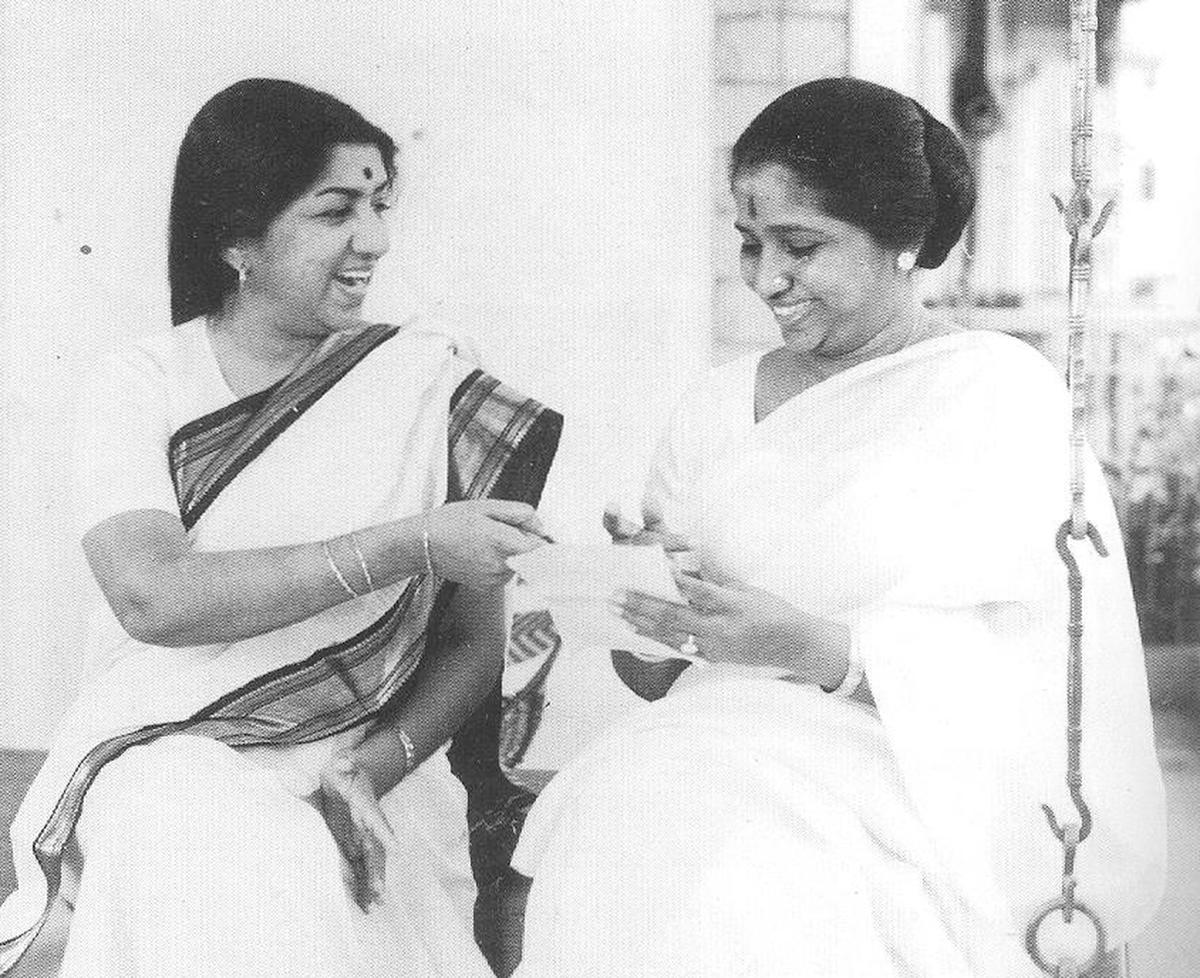
Lata Mangeshkar and Asha Bhosle have sung some popular qawwalis | Photo Credit: The Hindu Archives
Saeed categorises the film qawwali of the 20th century into three periods. The first starts with the black-and-white films of the 1940s until the 1950s, when the lyrics showcased a literary flair for Urdu, by adding ‘ghazals’ into qawwalis. The second stage starts with the coming of colour films, when the qawwali too literally added some hues to its own repertoire. “A lot of things were happening in the 1960s, ‘70s and ‘80s, when qawwalis became more of a device to move the plot ahead. In some films, for example, a qawwali would be staged to highlight comedy, in the backdrop of a fight sequence, or to convey romance between characters,” he says.
The mass entertainer Amar Akbar Anthony (1977), for instance, uses the qawwali both for fun (‘Parda hai parda’) and spirituality (‘Shirdi wale Sai Baba’), to good effect.
The third phase started in the 1990s, when Pakistani singer/songwriter Nusrat Fateh Ali Khan and India’s A.R. Rahman brought in sea-change by modernising the qawwali with electronica and smooth singing.
Teri Mehfil Mein | Lata Mangeshkar, Shamshad Begum | Classic Duet | Mughal-E-Azam | Bollywood Song
Comment on society
Yousuf Saeed | Photo Credit: Sandeep Sharma
The qawwali has become a social marker of sorts in films, says Saeed, creating a Muslim stereotype where the singers wear slanted fur caps, a kerchief around their neck and clap in a certain style. The Bollywood ‘Muslim social’ film that featured stories with veiled damsels courted by sherwani-clad gentlemen (Mere Mehboob, 1963) was born out of this need to appeal to family audiences from this community.
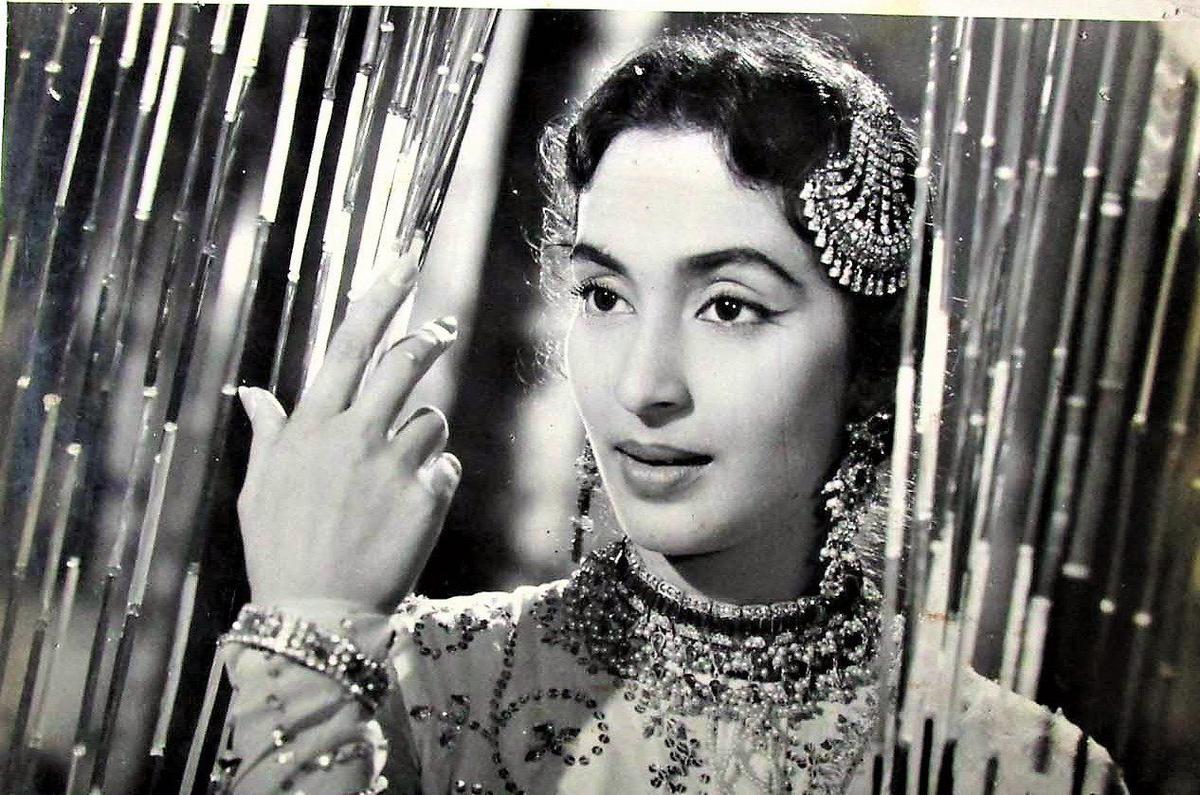
Nutan in the famous qawwali, ‘Nigahen milane ko ji chahta hai’ from the film Dil hi to hai | Photo Credit: Special Arrangement
Female singers have also had strong showing in this genre, from ‘Aahen na bharin shikve na kiye’ (Zeenat, 1945), and ‘Aaj teri mehfil mein’ (Mughal-e-Azam, 1960) to Shikayat’ (Gangubhai Kathiawadi, 2022), all showcasing the skills of chanteuses Sudha Malhotra, Lata Mangeshkar, Asha Bhonsle, Shamshad Begum, and Archana Gore.
Linguistic gymnastics
The Cinema Qawwali Archive also helps visitors to understand the literary changes over the years. “It’s inevitable that the linguistic purity of the early qawwalis is no longer there. But new words like ‘Maula’ and ‘Allahu’ and Arabicised Urdu have become more common in film qawwalis, especially as a choral element. Off the screen, in private qawwali mehfils, singers are often known to sing certain words or phrases again and again on the patron’s farmaish (request) for him or her to attain ecstasy,” he says.
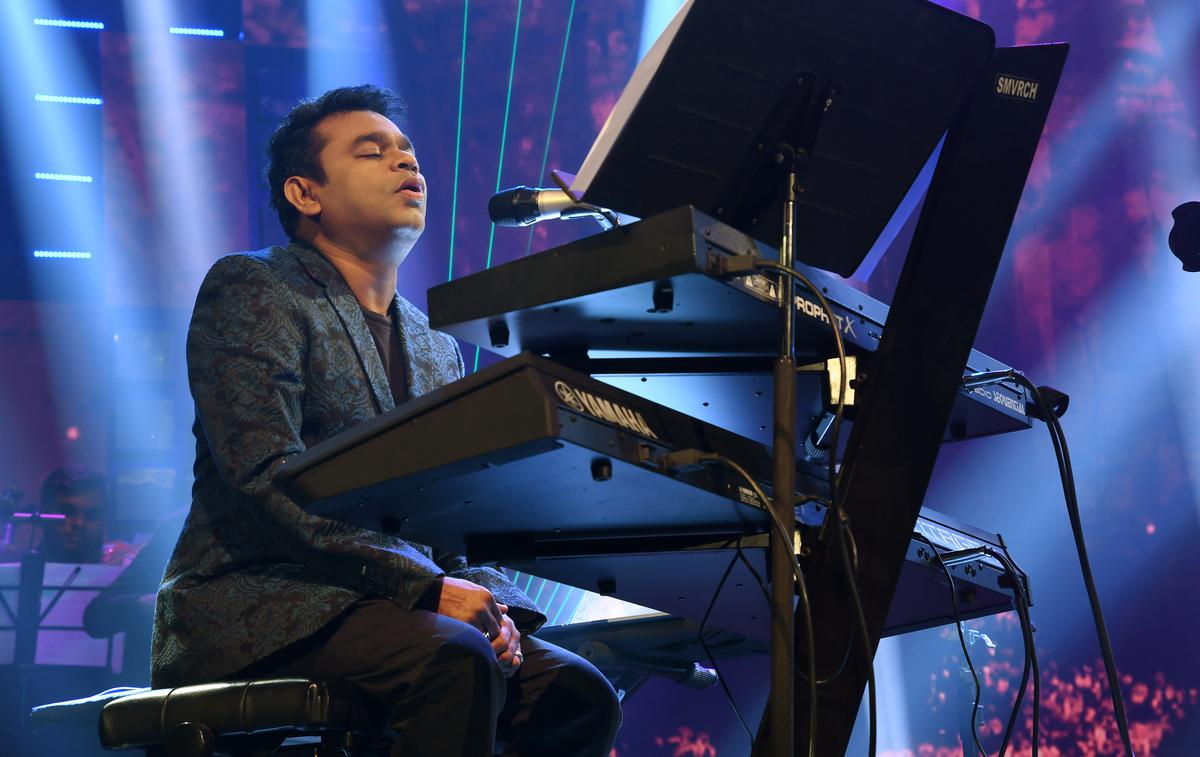
Music director A.R. Rahman gave qawwali a distinct twist with Turkish, Moroccan and Syrian Sufi rhythms. | Photo Credit: RAVINDRAN R
Rahman’s infusion of Turkish, Moroccan and Syrian Sufi rhythms into his songs has helped the qawwali reach out to both the South Asian diaspora and Westerners, says Saeed. “The film Rockstar (2011) made qawwali singers at Nizamuddin Dargah famous, with tourism developing around the shrine. But interestingly, cinema has also used qawwali for its own purpose, by taking it into a secular space,” says Saeed.
Hoping to publish a companion volume on the Cinema Qawwali Archive soon, Saeed says, “People think that the qawwali is dying out, but this isn’t true. They will continue to be written and performed because film directors find it a very fascinating and unique form. Qawwali weaves the story together and keeps it going.”
ROCKSTAR: Kun Faya Kun (Full Video Song) | Ranbir Kapoor | A.R. Rahman, Javed Ali, Mohit Chauhan
source: http://www.thehindu.com / The Hindu / Home> Entertainment> Music / by Nahla Nainar / July 10th, 2023
On his birth centenary, Nagore Hanifa continues to be celebrated and his timeless devotional and political numbers continue to draw in listeners.
The Hanifa fan base continues to grow, as seen by the number of cover versions of his ‘Iraivanidam Kaiyenthungal’ | Photo Credit: Special Arrangement
Of the many singers in South India with a universal appeal, ‘Isai Murasu’ Esmail Mohamed Hanifa stands tall on the pantheon of greats with origins in Tamil Nadu’s Cauvery delta region.
Hanifa, an iconic minstrel of Islamic devotional songs in Tamil had strong links with Nagore, the town in Nagapattinam that hosts the 16th century shrine to Sufi saint Syed Abdul Qadir. It eventually became the prefix to his name too.
Recently, the Tamil Nadu government kickstarted the celebration of Hanifa’s centenary year by naming a street and public children’s park in Nagore after him.
It is a fitting tribute to a man who captured the hearts of fans with his distinctive baritone from the early 1930s.
Even posthumously, the Hanifa fan base continues to grow, as seen by the number of cover versions of his ‘Iraivanidam Kaiyenthungal’ and his other songs that are available online.
Hanifa’s devotional and wedding songs continue to hold sway in Tamil Muslim social functions | Photo Credit: Special Arrangement
The youngest of three children of Mohamed Ismail, a railway worker in Malaysia, and Mariam Biwi of Ramanathapuram, Hanifa began singing mainly to support his family.
The singer spent his early childhood in Ramanathapuram, and later went to work for his paternal uncle Abu Bakr Rowther in Tiruvarur. It was here that Hanifa’s musical talent was noticed. His first professional concert at the age of 13 set him off on a trajectory no one imagined.
“My father’s rousing voice owes much to the Ghousia Bait-us-Sabha at Nagore, for whom he used to sing,” says his son Naushad Ali, based out of Chennai.
“At the time, there was a practice of taking out a pre-wedding procession to introduce the bridegroom to the families in the neighbourhood. A team of young drummers beating ‘thabs’ would head the procession, followed by the groom in a car or on horseback.
My father and his accompanists would be in the middle, with the hosts and guests making up the back of the crowd. He learned early on to beat the competition from the ‘thabs’ boys by singing loudly and in tune, without the help of a microphone. It was a skill that he developed out of necessity,” he adds.
Hanifa was a mainstay at most of the ‘Urs’ festivals held by the Sufi dargahs in the State | Photo Credit: Special Arrangement
Naushad, now in his sixties, was his father’s caregiver in his later years, and also renders vocal concerts in the Nagore Hanifa style.
Hanifa’s devotional and wedding songs continue to hold sway in Tamil Muslim social functions. His devotional songs were often based on ‘nasheed’ (Islamic chants sung a cappella or with instruments) and ‘naat’ (poetry in praise of Prophet Muhammad), referencing the Muslim faith, history, and current events. Quite a few of them were modified to suit Tamil listeners.
‘Hasbi rabbi jallalah’, for instance, has just the first stanza in Arabic; the rest of the song in Tamil adds elements from Ramanathapuram’s history. “It was first recorded in the 1970s for a school function, and I was among the children who sang the chorus,” recalls Naushad.
‘Maalai soodum manamakkale’, ‘Vazhga, vazhga, vaazhgave’ and ‘Deen kula kanne’, were among the songs that he presented at marriage concerts, usually held a day before the nuptials or after the wedding reception.
He was a mainstay at most of the ‘Urs’ festivals held by the Sufi dargahs in the State.
Nagore Hanifa married past the age of 30, and his wife A.R. Roshan Begum looked after the couple’s six children in Nagore while Hanifa built his career.
“We did not get to see our father much while growing up, because he would always be on tour. At the peak of his career, he would have at least 45 engagements in a month. He rarely declined any offer. Those were different times, with no marketing, public relations or copyright. Many songs were set to popular film tunes re-arranged by his small orchestra. I wonder how he managed his career all alone,” wonders Naushad.
Hanifa’s songs were known for their profound lyrics. He was helped in this by poets Abidin and Nagore Saleem, among others.
The self-taught maestro picked up tips on Carnatic music from S.M.A. Qadir at the Nagore dargah.
Naushad was tasked with the job of copying out the lyrics and taking care of his father’s correspondence. “Much of what I know about Tamil literary expression and pronunciation is due to my father. He would rap me on my head if I got the spelling or grammar wrong,” he laughs.
Though he had a prodigious memory for lyrics, Hanifa would always take his notebooks with him on stage. “If he noticed mistakes in the rendition, he would skillfully re-sing the portion in a way that the audience would not notice,” shares Naushad.
Nagore Hanifa performed in all kinds of venues — from five star hotels and modest homes — with the same flair, and never let his celebrity status get in the way. He would also do any number of encores — he had no ego, says his son.
Hanifa occasionally lent his voice to Tamil films — in movies such as Gulebakavali (1955), Paava mannippu (1965) and Chembaruthi (1992) — but consciously kept away from cinema because he was not open to adopting a ubiquitous name such as ‘Kumar’, which was what some composers demanded.
“My father used to say that it is more satisfying to sing four songs as Hanifa than a crore songs as Kumar. Having held the stage in live concerts that ran into hours, he did not appreciate his craft being adapted for light music,” says Naushad.
When Hanifa passed away on April 8, 2015, at the age of 96, a veil fell forever on an era of homespun superstars produced in Tamil Nadu.
Political anthem
In his heyday, Hanifa used to be known as the ‘voice’ of the Dravida Munnetra Kazhagam (DMK), because of his political anthems for the party. His warm friendship with DMK leader and former Chief Minister M. Karunanidhi began in their adolescence and stayed strong through their lifetime. Some of the songs he sang for the party are still used by the DMK to raise the morale of party cadres.
source: http://www.thehindu.com / The Hindu / Home> Entertainment> Music / by Nahla Nainar / February 06th, 2025
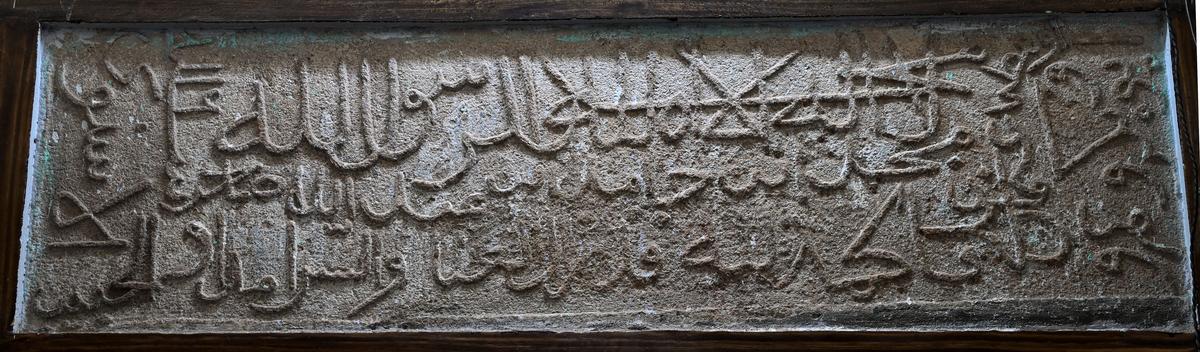
Makkah Masjid is among the oldest Islamic shrines in Tamil Nadu. An inscribed tablet dates the mosque back to the year 116 of the Al-Hijri calendar, corresponding to 734 A.D.
An inscription on the stone structure’s wall (background), dates the building to the Islamic (Hijri) year of 116, corresponding to 734 A.D. | Photo Credit: M. MOORTHY
The family of a cloth merchant has been taking care of the mosque for generations.
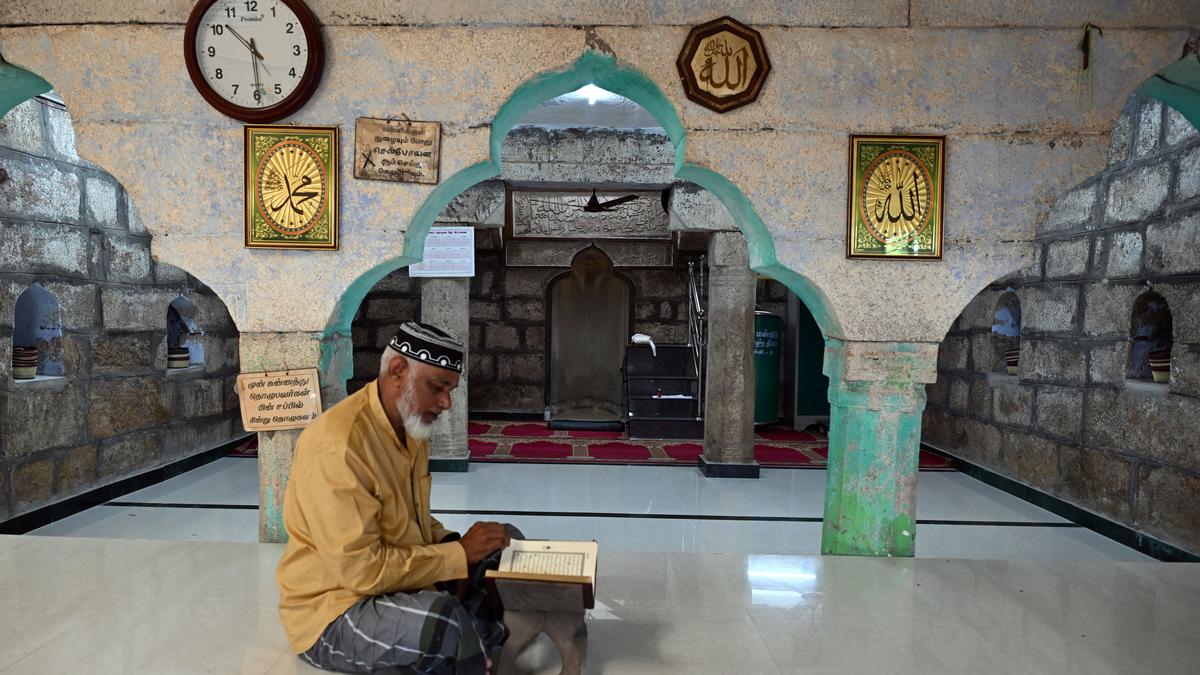
Tucked away next to a carpentry workshop on Tiruchi’s Fort Station Road is what is considered to be one of the oldest Islamic places of worship in Tamil Nadu: the Makkah Masjid that dates back to the year 116 of the Al-Hijri calendar, corresponding to 734 A.D.
A view of the prayer hall of Makkah Masjid in Fort Station Road, Tiruchi. It is considered to be among the oldest Islamic shrines in the country. | Photo Credit: M. MOORTHY
The family of M.G.A.R. Abdul Rahman, a cloth merchant in Tiruchi, has been taking care of the property for several generations.
The mosque’s age is validated by an inscribed stone tablet in Arabic above the ‘mihrab’ (the niche that indicates the ‘qibla’ or direction of prayer). The graves of Mohamed Ibrahim, Hazrat Haji Abdullah, Hazrat Haji Mohamed Anwar, Ahmed Kabir, and Tahira Biwi, thought to be pious Muslims of yore, are also to be found here. Two recently added minarets indicate the mosque’s presence in this quiet part of town.
Surrounded by thorny bushes
“Until the 1980s, the mosque was very different from what you see today,” A.R. Mohamed Ghouse, hereditary trustee, and one of Mr. Rahman’s 12 children, told The Hindu. “When my father was bequeathed this shrine, it was surrounded by thorny bushes and palm trees. There was no road access; people would walk single-file on a narrow pathway to reach the premises. Since this is a low-lying area, the building would be flooded during the rainy season. Before we got electricity connection in the 1980s, the place used to be lit up with oil lamps and hurricane lanterns. We have been maintaining the buildings with the help of generous donors from all faiths,” he said.
The Muslim community has had a long and harmonious presence in Tiruchi since ancient times. The Makkah Masjid is a stone’s throw away from Hazrat Thable Alam Badhusa Nathervali Dargah, the mausoleum dedicated to a nobleman of Turkish-Syrian lineage born as Sultan Mutahirruddin in 927 A.D., in Suharwardy, near Samarkand, who gave up his privileged life to spread the message of Islam in southern Asia. It is said the saint stayed on the Makkah Masjid premises before he settled in the present site.
Mosques endowed by the erstwhile Nawabs of Arcot are also an indelible part of Tiruchi’s landscape. Woraiyur, the capital of the Chola dynasty from the 2nd Century (now a suburb of Tiruchi), was already known to Arab traders. After the birth of Islam, Arab-Muslim missionaries began travelling to the region. Biographies of Muslim saints and the local traditions of the period reveal that Islam spread in the southern part of India in a largely peaceful and voluntary manner.
According to J. Raja Mohamad, historian and former curator of Pudukottai Government Museum, the Makkah Masjid could have been built for the Muslim settlement that emerged in the Tamil hinterland during the Pallava rule. “When I visited the mosque in the 1970s, it was hard to spot because of the overgrown bushes. It resembled a small ‘mandapam’ (hall), built in granite, with six Dravidian style pillars that are square at the base, octagonal in the middle, and square again. The ceiling was also made of granite slabs. Though it has become more modernised now, the trustees have retained most of the old building,” he said.
While Dravidian-style granite mosques are present elsewhere in Tamil Nadu, the Makkah Masjid may be the only shrine with a contemporary dated inscription in the State as well as in southern peninsular India, he added.
Caliphs named in inscription
In his 2004 book, Islamic Architecture in Tamil Nadu, supported by the Nehru Trust for Indian Collections at Victoria and Albert Museum, London, Mr. Mohamad writes, “According to the Arabic inscription in the rectangular granite slab above the ‘mihrab’, this mosque was built by one Mohamed Ibn Hameed Ibn Abdullah in Hijri 116 corresponding to 734 AD. The names of the four Caliphs (successors to Prophet Muhammad) — Abu Bakr, Umar, Uthman, and Ali — are also mentioned in the inscription, which has been accepted by scholars as belonging to the 8th Century AD.”
Maintaining the mosque has been a labour of love for the family trustees. “The prayers have never stopped in the Makkah Masjid even though we do not have a ‘mohalla’ (a neighbourhood congregation).
Approximately, 200 people attend the Friday prayers,” said A.R. Abdul Razak, 74, the eldest son of Rahman and the imam (who leads prayers) for the past 39 years.
The annual ‘Urs’ (festival) commemorating Mohamed Ibrahim and Tahira Bibi on the 28th day of the Islamic month of Rajab (now in its 1,329th year) at the dargah on the mosque’s campus is supported by people of many faiths, who donate generously towards the public feast.
Mr. Razak gave up his job as a ship cook in Switzerland in deference to his ailing father’s wish to officiate as the chief cleric of the mosque. “I underwent training in Quranic recitation and Islamic theology from scholars in Tiruchi before taking up this position,” he said.
An antique copy of The Holy Quran is among the oldest artefacts in the mosque.
To prevent flooding, the ground level was raised with truckloads of mud after road access was granted by Southern Railway in the 1980s. As a result, five of the eight steps of the prayer hall are now permanently below the ground. Several coats of whitewash were scrubbed away to reveal the original granite walls and inscriptions. Some of the stonework also contains fragments of Tamil writing from the 10th Century. “We have tried to maintain the premises to the best of our ability. We hope succeeding generations of our family will continue to take care of the Makkah Masjid,” said Mr. Ghouse.
source: http://www.thehindu.com / The Hindu / Home> News> India> Tamil Nadu / by Nahla Nainar / June 28th, 2024
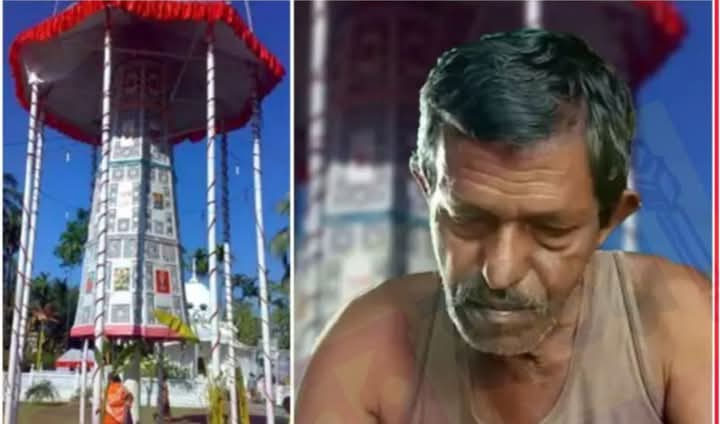
Altaf Hussain, Artisan and chief decorator of Ram Leela Utsav
The death of Altaf Hussain, one of the well-known artisans whose family had been involved in decorating the venue of Raas Mela Utsav, a famous cultural event of the city of Cooch Behar of West Bengal is being widely mourned across the state.
Altaf Mian, 70, passed away on Saturday. He was buried in Cooch Bihar, located about 7.5 hours drive from Kolkata.
His family, popularly known as ‘Altaf Mian’, had been organizing the famous ‘Raas Mela Utsav’ of Cooch Behar for a long time.
For forty years, Altaf Hussain was involved in decorating the venue of the Raas Leela Utsav – a play based on the life of Lord Krishna, particularly romantic and naughty interactions with Gopis the local young women, at the Madan Mohan temple every year in November.
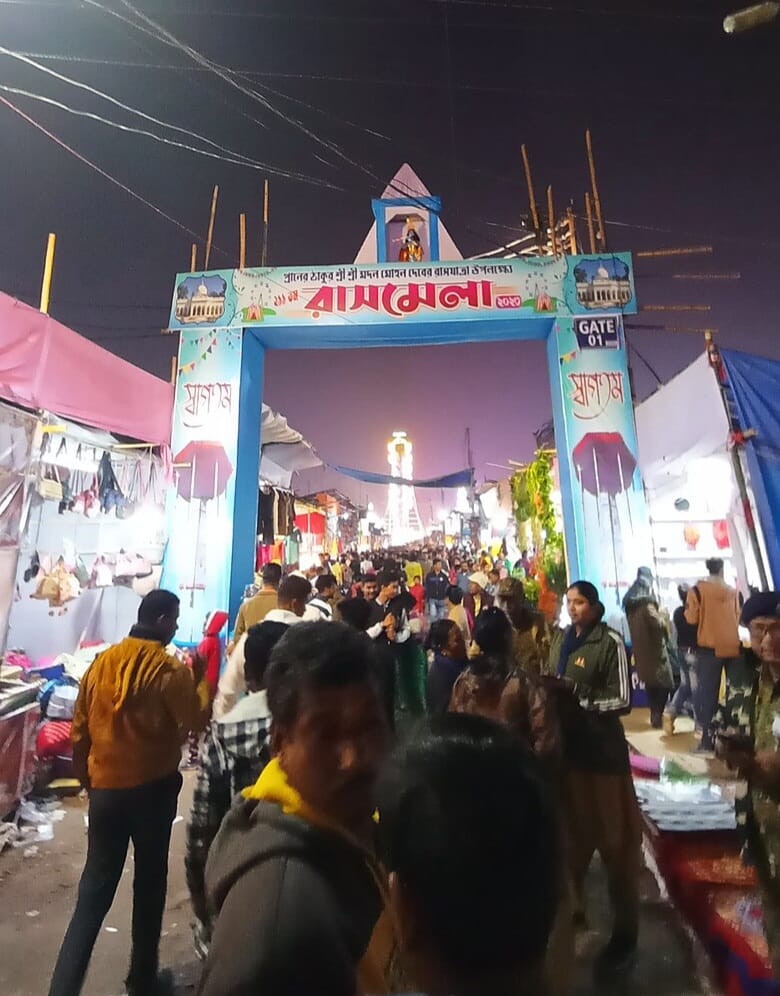
Altaf Hussain was famous for designing the archway of the Raas Mela festival.
Even Bengal Chief Minister Mamata Banerjee has expressed deep grief over his death.
Altaf Hussain had not been well for two years. For this reason, his son Aminur Hussain take charge of decorating the ‘Ras Leela Utsav’
Work
Altaf Hussain was being treated at MGN Medical College Hospital in Cooch Behar.
As soon as the news of his death came in, a big crowd of his admirers gathered at his house in the Harin Chaura area. Hindus and Muslims, children, old and young alike came to pay their respects. Women were seen weeping.
A pall of gloom fell on the city. Chief Minister Mamata Banerjee, joined his admirers in expressing grief and offering condolences to his family.
She also directed the Cooch Behar district administration to bury Altaf Hussain with state dignity.
What is Raas Mela festival?
‘Raas Mela festival’ is an artistic presentation of Lord Krishna’s dance with his consort Radha and gopis of Braj. This dance festival of Radha-Krishna is also mentioned in Bhagwat Purana and Geet Govinda.
The ‘Raas festival’ of Cooch Behar district is quite famous. It lasts a fortnight This ‘Raas Mela Utsav’, which lasts for fifteen to twenty days, starts on 15 November and continues till the first week of December. This ‘Raas Utsav’ is also called ‘Winter Carnival’ in Cooch Behar.
This ‘Raas Mela Utsav’ has been going on in Cooch Behar district for two hundred years. It is said that this happened for the first time during the time of the 17th king of Cooch Behar Harendra Narayan. His descendants celebrated it with pomp and show.
During the time of Raja Madan Mohan, the format of this festival changed. It was during this time that Altaf Hussain’s ancestors were given the responsibility of decorating this festival. For the first time, big arches were erected and this tradition continues.
The attraction of this ‘Raas Mela Utsav’ spread far and wide and people were drawn to see this festival.
So far the Raas Mela Utsav of Cooch Behar was only disrupted twice – in 1912 when cholera disease spread and the second time in 2020 during the Corona pandemic.
source: http://www.awazthevoice.in / Awaz, The Voice / Home> Story / by Jaynarayan Prasad, Kolkata / March 04th, 2025
A ‘family get-together’ will be organized at Al Qusais Amity School in Dubai on Saturday, February 15, under the auspices of the UAE ‘Sahebaan’ community.
‘Sahebaan’ is an Urdu-speaking Muslim community from Dakshina Kannada and Udupi.
This ‘Family Get-Together’ will be held from 4 PM to 11 PM, and several programs will take place during this time, said program organizer and patron H.M. Afroz Assadi.
He stated that a felicitation program will be held to recognize children studying in the UAE who have scored more than 90% marks, as well as those who have achieved success in sports.
The chief guests of the event will be ‘Sahebaan’ community leaders, businessman and Hidayat Group President Hidayatullah Abbas, non-resident businessman, Philanthropist and owner of Nash Engineering Company in Dubai K.S. Nisar Ahmed, along with several other dignitaries.
source: http://www.english.varthabharati.in / Vartha Bharati / Home> Gulf / by Vartha Bharati / February 12th, 2025
Mr. Tanmaya Tyagi being honoured by Prof. Mohammed Naved Khan and Prof Badar jahan during the Art Utopia 2025
“Art is not just about skill but also about passion, perseverance, and discipline.”
Aligarh:
The University Fine Arts Club of the Cultural Education Centre, AMU, organised Art Utopia 2025, bringing together students for a celebration of creativity, learning, and artistic expression.
The event opened with Safar-e-Rooh, an impactful live performance by Mr. Haris Raza Ashraf, portraying the global scenario and its impact on individuals, captivating the audience.
The event featured two skill-building workshops – one on Resin Art by Dr. Atiya Parveen and another on the Art of Caricature by Mr. Tanmaya Tyagi. These sessions enriched participants with artistic techniques and perspectives.
Adding to the creative atmosphere, three unique art installations were displayed. A group of students presented Chai, symbolising its significance in campus life. Mr. Salik Tariq, the club’s secretary, crafted a striking 3D image of Sir Syed Ahmad Khan, while another group depicted the societal limitations faced by girls in pursuing their dreams through an artistic portrayal using natural elements.
The second day featured competitions in Canvas Painting, Face Painting, and Painting on Decorative Items, drawing enthusiastic student participation. A panel of faculty members judged the competitions, recognising exceptional talent.
The event concluded with a felicitation ceremony honouring the resource persons and awarding winners. First prizes were secured by Mr. Aaryan Pratap Singh (Canvas Painting), Ms. Falak Javed (Face Painting), and Ms. Uzma Ansari (Painting on Decorative Items).
During the closing ceremony, Prof. Mohammed Naved Khan, Coordinator CEC, emphasised that “Art is not just about skill but also about passion, perseverance, and discipline.” Prof. Badar Jahan, President of the Fine Arts Club, praised participants for their creativity and urged them to stay focused on their artistic journey.
Art Utopia 2025 successfully promotes a culture of artistic excellence and innovation on campus.
source: http://www.radiancenews.com / Radiance News / Home> Latest News> Report / by Radiance News Bureau / March 03rd, 2025
Renowned Urdu scholar, poet, and educator Dr. Haneef Shabab from Bhatkal has been selected for the prestigious Karnataka Urdu Academy Award 2024 in recognition of his outstanding contributions to Urdu literature. The award will be presented to him on February 27 at a special ceremony in Bengaluru.
Dr. Shabab, a veteran in the field of Urdu literature, has dedicated his life to teaching, research, and literary enrichment. As a poet, mentor, and academic, he has made significant efforts to preserve and promote Urdu through scholarly writings and literary works. His research and critical analyses have played a vital role in nurturing a new generation of Urdu scholars. With over 25 years of experience as an Urdu teacher at Shams English Medium School in Bhatkal, he has influenced countless students.
Throughout his career, Dr. Shabab has actively participated in seminars, workshops, and literary festivals, fostering a deeper appreciation for Urdu poetry and prose. His writings are not just academic but also deeply reflective of cultural values, emotions, and social issues.
One of his most celebrated works is the poem “Aur Line Cut Gayi,” which poignantly addresses the issue of female foeticide. Written as an emotional dialogue between a deceased child and her mother, the poem has received international acclaim for its profound social message.
Apart from poetry, Dr. Shabab has significantly contributed to Urdu journalism, writing insightful articles and critiques on various cultural and societal matters. He has also authored two books: “Sulagte Khwaab” (1997) and “Lahu Lahu Mausam” (2009), both collections of his poetry.
The recognition by the Karnataka Urdu Academy is a testament to Dr. Shabab’s lifelong dedication to Urdu literature and his impact on the literary world.
source: http://www.radiancenews.com / Radiance News / Home> Pride of the Nation> Award / by Radiance News Bureau / February 26th, 2025
Heart Lamp is one among the 13 books chosen by the 2025 International Booker Prize judging panel, headed by Max Porter.
Banu Mushtaq. File | Photo Credit: The Hindu
“It is an honour for Kannada that a work written in our language is getting this recognition,” said Hassan-based Kannada writer, advocate and activist Banu Mushtaq, whose collection of stories Heart Lamp, translated by Deepa Bhasthi, has found a place in the long list for the International Booker Prize 2025.
Heart Lamp is one among the 13 books chosen by the 2025 judging panel, headed by Max Porter. The judges made their selection from 154 books submitted by publishers. The shortlist of books will be announced on April 8 and the winner will be announced on May 20.
Heart Lamp, is a collection of 11 short stories written by Banu Mushtaq between 1990 and 2023. “So far I have brought out six collections of short stories in Kannada. Among them, 11 were chosen for the collection Heart Lamp,” said Ms. Mushtaq.
What judges said
The judge panel, in its comment on the collection, stated, “Written in a style at once witty, vivid, colloquial, moving and excoriating, it’s in her characters – the sparky children, the audacious grandmothers, the buffoonish maulvis and thug brothers, the off-hapless husbands, and the mothers above all, surviving their feelings at great cost – that Musthaq emerges as an astonishing writer and observer of human nature, building disconcerting emotional heights out of a rich spoken style.”
Earlier, an English translation of a collection of her short stories Haseena and Other Stories won English PEN translation award for the year 2024. That was also translated by Deepa Bhasthi.
Early years
Ms. Mushtaq began writing in the progressive literary movement in Karnataka in the 1970s and 1980s, which gave voice to several people from dalit and minority communities, including strong women’s voices in Ms. Mushtaq.
Some of her early writings were published in Lankesh Patrike, for whom she also worked as a correspondent for some years. The writer remains a committed voice in the progressive circles, and remained critical of forces that divide people among lines of caste, class, gender and religion.
Among her important works are Hejje Moodida Haadi, Benki-Male, Edeya Hanate, Badavara Magalu Hennalla (short stories), Kubra (novel) Odde Kannina Baagina (poetry), Ibbaniya Kaavu (essays) and Kautumbika Daurjanya Kayide (on Domestic Violence Act). Haseena has also been made into a film, directed by Girish Kasaravalli.
The late Kannada writer and Jnanpith awardee U.R. Ananthamurthy was also nominated for Man Booker International Prize in 2013, but did not win it.
source: http://www.thehindu.com / The Hindu / Home> Books> Author / by The Hindu Bureau / February 26th, 2025