Category Archives: Arts, Culture & Entertainment

Shah Rukh Khan donates Rs. 1 crore for Chennai flood victims

Bollywood superstar and Kolkata Knight Riders co-owner Shah Rukh Khan has donated Rs. one crore for the victims of Chennai flood.

According to sources, Shah Rukh, who will be seen with Kajol in his upcoming filmDilwale, has contributed the sum to the Chief Minister’s Public Relief Fund.

The 50-year-old “Chennai Express” star has written a letter to Jayalalithaa, Chief Minister of Tamil Nadu, according to sources.

In the wake of Chennai floods, many Indian actors such as Rana Daggubati ofBahubali fame, and sports persons such as Saina Nehwal and Dipika Pallikal, have come forward to help the flood victims.

About 280 people have died so far across Tamil Nadu since torrential rains on December 1 submerged tracts of Chennai and caused havoc and devastation.

source:  http://www.thehindu.com / The Hindu / Home> National> Tamil Nadu / PTI / New Delhi – December 07th, 2015

Prof. Sheikh Ali’s Book

Marking the centenary celebrations of the University of Mysore, former Vice-Chancellor of Mangalore and Goa Universities Prof. B. Sheikh Ali has scripted a book titled ‘An era of enlightenment,’ which was released by President Pranab Mukherjee during his visit to the city in July.

The book explains the history and the challenges faced by the University in its 100 years of existence.

The book priced at Rs. 600 is being sold at Prasaranga in Manasagangotri and at the Prasaranga outlet at Ramaswamy Circle, at a discount of 20%.

For details, contact Ph: 0821-2419387 or 2419488.

source: http://www.starofmysore.com / Star of Mysore / Home> In Brief / Tuesday – December 08th, 2015

Urdu Academy Chief Visits MEWA

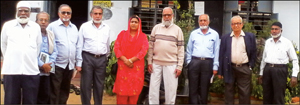
Seen in the picture are (from left) Syed Rafiulla Hussaini, Gowher Tarikervi, Viqar Ahmed Siddiqi, Baqar Umar Khan, Dr. Fouzia Choudhry, Shamim Ahmed, Nyamathulla Khan, Capt. Mir Afzal Hussain and Anwer Pasha.

Mysuru :

Dr. Fouzia Choudhry, Chairperson, Karnataka Urdu Academy, Bengaluru, visited MEWA Educational and Vocational Training Centre at Shantinagar on Nov. 30 and interacted with the trainees of tailoring, fashion designing, computer, Urdu course and students who have taken SSLC Exam as private candidates.

She advised them to work hard and achieve their goals ignoring the hurdles which come across.

She was received by the organisation President Viqar Ahmed Siddiqi,  Secretary Shamim Ahmed,  Vice-President Capt. Mir Afzal Hussain,  Anwer Pasha,  Baqar Umar Khan,  Syed Rafiulla Hussaini,  Gowher Tariikervi, and  Nyamathulla Khan.

source: http://www.starofmysore.com / Star of Mysore / Home> General News / Monday – November 07th, 2015

Lucknow boy makes mark in Hollywood, NY stage

LucknowboyMPOs07dec2015

Lucknow :

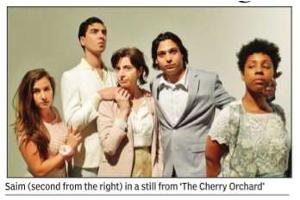
He wanted to join the media industry but landed up in Hollywood. Meet 29-year old Saim Hyder who is doing theatre and also acting in short films in the United States of America. He has recently completed playing the leading role in the classic Anton Chekov play `The Cherry Orchard’ for Falcon Productions, a wellknown theater group in New York City .

Hyder’s talent landed him meaty roles in the plays ‘Bonafide Women’ directed by Stephanie Ogeleza. He played the lead in short film `Larry Bought Lemon’, screened at the prestigious Indian Film Festival of Tampa, Florida in 2013) and another film, `Patrons’, directed by Polish director Rita Haider was screened at the International Palm Springs Film Festival last year.

Hyder’s performance received favorable criticism in US media. Broadway World, authority on all Broadway shows called his performance in the part-comedy-part-drama `The Rajah’s son & Princess Labam’ “dramatic and riveting”, while NRI Tribune, one of the largest Indian-American newspaper described his role in the same play as “one of the most loved performances”.

In Lucknow, Hyder went to La Martiniere College where his acting talent was nurtured under his teachers. In school, I acted in school plays and inter school competitions where I stood out and was praised,” said Saim. It was only when he moved to US in 2008 to pursue Mass Communication from the University of Arkansas, he realised performing on stage could mean more than journalism. ” was so passionate about the film industry that at UOA, took up research on the influence of Indian cinema he roes on the youth,” said Hyder, who later trained at the renowned New York Film Academy and Maggie Flanigan Acting Studio in New York City.

While at NY Film Academy, he was trained in the basics of film genre. It was a MF studio where he received intensive training under the best in the industry in the exclusive `Meisner Technique of acting which legendary actors such as Marlon Bran do, Robert Duvall and Tom Cruise learnt as students Meisner technique is an approach to acting which develops from an interna source such as emotional re call, memory, etc. Back home, Hyder is famous for entertaining family and friends, acting out famous dialogues of Indian and Hollywood actors. “In all our family get-togethers, he is made to enact scenes from his plays or films, his favourite, which he repeats most of the time, being from The Cherry Orchard, saying the lines, `I have done it, I have done it all. The Cherry Orchard is mine…’, to an applause from all of us,” said Aaqil, Hyder’s cousin, who is more a friend.

Hyder hasn’t restricted himself to theatre, he has also dabbled with radio. “I have anchored more than 100 minutes of live shows, called Bindaas Bol on Jus Radio, an online channel popular with the Indian American diaspora,” he said.

His upcoming work includes a Hindi sitcom for a South Asian TV channel which is even being produced by him. “With his focus and talent, we are hopeful that Saim will make a mark in the highly competitive entertainment industry in Hollywood. The talent of this Lucknow boy will shine around the world,” said his father Nafees Haider Naqvi.

source: http://www.timesofindia.indiatimes.com / The Times of India / News Home> City> Lucknow / by Isha Jain, TNN / December 07th, 2015

5 Agra monuments in India’s top 10 frequented by foreigners

Agra:

Just the city of Agra and its close neighbour Fatehpur Sikri have five of the top 10 monuments in the country that are most visited by foreign tourists.

Replying to a query in the Rajya Sabha on Wednesday, Union culture minister Mahesh Sharma said Taj Mahal alone has 23% share of foreign tourists travelling to India. Agra Fort got 12% in 2014. He added that foreign exchange earnings through tourism in India during 2012, 2013 and 2014 stood at Rs 94,487 crore, Rs 1,07,671 crore and Rs 1,23,320 crore respectively.

The minister dismissed claims that the tourism industry had witnessed a decline compared to the last few years. “On the contrary”, he said, “foreign tourists’ arrival growth rate in India has more than doubled between 2012 (4.3%) and 2014 (10.2%). In 2013, it was a mere 5.9%.

In terms of exact numbers, a total of 6.58 million tourists visited India in 2012, which increased to 6.97 million in 2013 and 7.68 million in 2014.

Citing Archaeological Survey of India’s data on foreign tourist arrival at centrally-protected monuments in 2014, Sharma said Taj Mahal with 6.4 lakh visitors, Agra Fort with 3.43 lakh and Qutub Minar with 2.76 lakh were the top three tourist destinations in the country.

The other three monuments of Agra which featured in the top 10 list are Fatehpur Sikri (5th position), Akbar’s tomb (8th) and Itimad-ud daula (10th).

To another query on carbon pollution around the Taj Mahal, the minister said that the Taj Trapezium Zone (TTZ) Authority has banned entry of Euro-I model, petrol/diesel-operated auto loader vehicles from July 31 to reduce vehicular pollution in the vicinity of the Taj. He added that TTZ Authority has also decided to convert petrol/diesel-operated commercial vehicles to CNG. So far, 34,302 vehicles have been converted to CNG in Agra, he said.

However, though the Taj Mahal still remains at the top of the most-visited monuments in the country, there has been a constant fall in the number of foreign visitors to the 17th century monument in the last three years. There were 7.9 lakh visitors from abroad to the Taj in 2012. But the number came down to 7.4 lakh in 2013, further dipping to 6.4 lakh in 2014.

Prior to 2012, the average foreign tourist footfall at the world heritage building had been increasing at a rate of 10-15% per annum. In 2010, 6.1 lakh foreigners had visited the Taj. The number went up to 6.7 lakh in 2011 and further to 7.9 lakh in 2012.

source: http://www.timesofindia.indiatimes.com / The Times of India / News Home> City> Agra / Aditya Dev, TNN / December 02nd, 2015

Qawali and Sarige Utsav

Mysuru, Karnataka :

Qawali (Zahidulla Khan Mastana & party and Zaiba Tarranum & party) has been organised at the Exhibition Grounds today from 6 pm to 7.30 pm, under the aegis of the Cultural Committee of Karnataka Urdu Academy and Karnataka Exhibition Authority (KEA).

Qawali will be followed by ‘Sarige Utsav,’ a cultural programme by KSRTC employees, organised by Dasara Exhibition Cultural Sub-Committee, at P. Kalinga Rao auditorium in the Exhibition Grounds.

source: http://www.starofmysore.com / Star of Mysore / Home> In Brief / Saturday – December 05th, 2015

Understanding our roots

I got attracted to history only after I entered the museum

HISTORY BUFFDr. J. Raja Mohamed has made his career showcasingTamil Nadu’s rich heritage for the public.— Photo: B. Velankanni Raj

Former curator of Pudukottai Government Museum Dr. J. Raja Mohamedcomments on how we allow our awareness of our past to shape our present

“If we want communal harmony, we must have a proper history to be taught to the people, and the younger generation in particular,” says J. Raja Mohamed.

Having spent over three decades in Tamil Nadu State Department of Museums – first as the Curator of the Pudukottai Government Museum from 1968 to 2003 and retiring as Assistant Director of Museums, Chennai in 2004 – Dr. Mohamed is amply qualified to comment on how we allow our awareness of our past to shape our present.

In a way, Dr. Raja Mohamed’s home in Pudukottai’s Jeeva Nagar neighbourhood is like a museum too, a repository of books from all over the world and his own writings (he is the author of around 10 books in Tamil and English on local history and has published over 100 research papers in art, architecture and history).

Like any good historian, all his statements are backed up with meticulous research. “Many facts in history have been distorted over the years, and we do not know at which stage it was done. Similarly, so many things have not been brought to light,” says Dr. Mohamed, who has specialised in the history of Pudukottai and has also written a seminal reference work on the maritime history of Tamil Muslims (see related story on Page 2 ).

So how did this zoology graduate get so interested in history?

New passion

Born in 1946 in Udayarpalayam (in present-day Ariyalur district) to a middle class family trading in animal hides, the young Raja Mohamed was entering high school when his father suffered a heavy financial loss.

“Paying the Rs. 3 fees for school was a huge problem, and most of my siblings had to stop studying due to this,” he recalls today.

“But I was determined to continue my studies, and so I started working in my free time at bakeries, cool drinks shops and factories, to meet my expenses. Saving those three rupees was very tough because a day’s work would only pay one or two annas (16 annas made a rupee),” he says.

After 2 years of hardship, he was one of 6 students from the Composite District of Tiruchi who won a government scholarship of Rs. 12 which took care of his fees from 9th Standard till the end of school.

He stood first in his B.Sc Zoology course, which made it easier for him to apply for Government service. “I decided to work in the Pudukottai Museum because Zoology graduates didn’t really have a choice in those days,” says Dr. Mohamed. “But I got attracted to history only after I entered the museum.” As proof of that new passion, he went on to earn post-graduate degrees in History, Archaeology, Anthropology, and for good measure, a degree in Law besides a certification in Museum Studies. For his doctoral thesis, Dr. Mohamed researched the maritime history of the Muslims of the Coromandel Coast.

Extensive research

Contradictory interpretation of history has remained a concern for Dr. Mohamed.

“When we read Indian history, the biggest accusation made by big and small scholars alike is that Muslim rulers destroyed temples. Some people may simply be repeating what someone else has said. Nobody has gone into researching the merit of these statements for themselves,” says Dr. Mohamed.

With a grant from the Nehru Trust for Indian Collections at the Victoria and Albert Museum (NTICVA), London in 1994-95, Dr. Mohamed set out to research Islamic buildings in Tamil Nadu.

The result of his work was published by the Department of Museums in 2004 as Islamic Architecture in Tamil Nadu , a book that contains photographs and descriptions of buildings throughout the State, some of which date back to the 8th Century.

The research showed him many new truths, he says. “As inscriptions on the sites prove, each and everyminbar (pulpit) of the old mosques that we find in the seashore areas to this day was made for mosques. Temples were never demolished or converted into mosques,” says Dr. Mohamed.

The main point, he says, is that around a thousand years ago, “The sthapathi or mason who was building the temple, was also the person to build the mosque. So when he built the mosques, he used Dravidian architecture, but avoided portraiture of figures and icons as per the tenets of Islam. Many structures look like temples, but they are mosques. And they have inscriptions from the 9th Century and 10th Century that state that they were endowed by Hindu rulers. These facts have got obscured over the years.”

Dr. Mohamed’s research also concludes that the earliest mosque in the State was built in Tiruchi.

“It is a small structure built during the Pallava era and is shaped like a temple mandapam, but with an Arabic inscription of old character, of 8th Century. We discovered that it was built in AD 734,” says Dr. Mohamed of the mosque that may be found in the city’s modern-day Fort Station area.

He also deciphered 200 temple inscriptions, and helped to unearth the ancient villages of Ollaiyur (now in Thirumayam district) and Senikulamanickapuram, which has now become a part of Pudukottai.

Some of his ongoing projects include a book on the ancient history of Pudukottai (till 6th Century) for the Central Institute of Classical Tamil. During the fieldwork for this book, he found a rock painting at Kudmiyanmalai, which takes the history of Pudukottai to 2000 BC.

A book on the village deities and folk arts of Pudukottai is also nearing completion. “People have been willing to accept new ideas in religion and live in peace, even though this has not been made obvious in our printed historical records,” says Dr. Mohamed, who received the State award for communal harmony in 2012.

A father of two sons and a daughter, Dr. Mohamed credits his wife Abida Begum for her unstinting support that helped him to spend time “at home and in the forest”, for his research. Not having his parents around to see him achieve his career milestones is a recurring regret.

“But my early struggles taught me to trust hard work, and not luck. I loved my job, and I still love it even though I retired long ago,” he smiles.

source: http://www.thehindu.com / The Hindu / Home> News> Cities> Tiruchirapalli / by Nahla Nainar / Tiruchi – November 30th, 2015

Jashn-e-Urdu and Mushaira at Farooqia PU College

Renowned Urdu poet N.M. Ghouse Khateeb feted

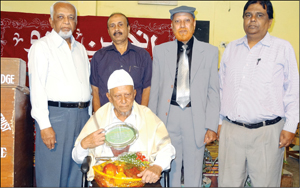
N. M. Ghouse Khateeb Nagmangali, renowned Urdu poet, who was felicitated by Anjuman-e-Urdu of Farooqia PU college in city yesterday, is seen with (standing from left) Prof.Riyaz Ahmed (President), Prof. Mohammed Ziaulla (chief guest), Prof. M. Sayeed Ahmed (Hon. Secretary) and Abdul Jabbar (Principal).

Mysuru :

Anjuman-e-Urdu of Farooqia P.U. College, Tilaknagar, celebrated “Jashn-e-Urdu” at its premises yesterday.

Prof. Mohamed Ziaulla, who was the chief guest, spoke on the contribution of Moulana Abul Kalam Azad to Urdu literature. On the occasion, N.M Ghouse Khateeb Nagmangali, retired lecturer and renowned Urdu poet, was felicitated by the Anjuman-e-Urdu of the college for his contribution to Urdu literature.

Khateeb is a recipient of State- level Adarsh Guru Award (1992), Best Teacher award for Mandya District (1995), Karnataka State Best Teacher Award (1997) and Rajyotsava Award in 2014.

Prof. M.Sayeed Ahmed, Hon. Secretary of the college, read the citation while Prof. Riyaz Ahmed, President of Rifahul Muslimeen Educational Trust (RMET) felicitated Khateeb.

On the occasion, Syed Yaseen, II PU Commerce student received rolling shield for securing first place in Syed Mohammed Memorial Inter-collegiate Essay competition in Urdu. Roshan Banu of Arts received a special prize for scoring highest marks in II PUC Urdu exam.

Prof. Riyaz Ahmed presided over the function which commenced with Qirath by Abdul Hameed of I PU commerce. M.K. Zakir, lecturer in Hindi, recited Nath. Abdul Jabbar, Principal, welcomed. Shahwar Jahan, lecturer in Urdu, presented a report on the activities of Anjuma-e-Urdu. Samreen Banu of II PU Arts, recited Taran-e -Urdu. Shabreen Taj of II PU Science compered. Mohammed Habeebulla of II PU Science proposed a vote of thanks.

Jashn-e-Urdu was followed by a Mushaira. Abdul Rahman Gowher Tarikervi presided over the Mushaira dedicated to elderly poet late Razaq Afsar.

Syed Yaseen, who compered the programme, gave a brief introduction about the rich contributions made by the late poet. He said the late poet’s creative work was published in the form of six books titled ‘Aabshar,’ ‘Aetaraf,’ ‘Shab Chirag,’ ‘Harfe-Abdeda,’ ‘Zaber Jad’ and ‘Ujli Khusbo.’

The poets, who recited their poetic tribute to the late poet are: Dr. Irfan Ahmed Riyazi, Hakeem Sayeed, Mushtaq Sayeed, Khateeb Nagmangali, Gowher Tarikervi and Naveed Ahmed Siddiqi.

Earlier, Samreen and Party rendered Tarane Farooqia composed by late poet Razak Afsar.

source: http://www.starofmysore.com / Star of Mysore / Home> General News / Monday – November 30th, 2015

NATION – On the Sultan’s Trail


TipuKodaguMPOs30nov2015

In the green, hilly tracts of Kodagu, a small district in Karnataka bordering Kerala, the past is urgent, pressing. A king’s ghost has been summoned again, so his story can be rewritten to suit the age. Tipu Sultan. Perhaps no other Indian king has been mummified by as much subjective judgement. Invariably, he is either a justified villain or an unjustified hero, a tele-serial star or a wanton killer of Hindus. In Kodagu, where Tipu is believed to have put thousands to the sword, a destabilising interrogation of his legacy recently claimed two more lives, over 200 years after the king perished in the British siege of Srirangapatna in 1799. Even as the Karnataka government’s plans to celebrate Tipu Jayanti on Deepavali day—10 days ahead of his date of birth, 20 November—predictably met with opposition from Hindu organisations, the Muslims of Kodagu, many of them descendants of migrants from Kerala, appropriated him as their hero overnight. On the appointed day, the communities clashed violently in the tourist town of Madikeri, the headquarters of the district, resulting in two unfortunate deaths: 65-year-old DS Kuttappa, the district organising secretary of the Vishva Hindu Parishad, was killed when he fell or was pushed from, depending on who you believe, a height during the riot; and 22-year-old Shahul Hamid from Siddapur was shot while returning in a truck from Madikeri. Observers blame the deaths on police and administrative negligence, but the reality of the unrest in Kodagu runs deeper.

From his perch in Srirangapatna near Mysore, Tipu Sultan—and before him, his father Haider Ali—had repeatedly attacked Kodagu in the 1780s in order to secure free passage to Malabar. His incursions into Coorg, replete with the plunder and destruction of temples—a common practice in medieval times even among Hindu rulers—were time and again thwarted by native Kodava warriors, but the region eventually succumbed to the assaults. According to historical accounts, Tipu then ordered ‘both the slain and the prisoners, with the women and children, to be made Musalmans.’ “Kodavas were deeply scarred by Tipu’s excesses but they did not give up. They had their tiri-toks—country guns—and they were skilled at guerrilla warfare. For Tipu’s army, the leeches alone proved a deterrent,” says Addanda C Cariappa, a writer, actor, theatre person and former president of the Karnataka Kodava Sahitya Academy, who is working on a book in Kannada on Tipu Sultan. His pride in the community’s martial heritage and its achievements in the military soon dissolve into alarmism as he talks about the shrinking Kodava population. “We are a dwindling race with a population of just 1.25 lakh. Soon, we will be the Kashmiri Pandits of south India. The religious turbulence of Tipu’s reign is partly to blame,” Cariappa says.

There is no love lost between Kodavas and the erstwhile ruler of Mysore: they will tell you that Tipu was no son of the soil; that he preferred Persian to Kannada and wanted to propagate Islam across south India; and that his epitaph in Srirangapatna and the inscription on his sword commemorate him as a sultan who lived and died for the faith. This, then, was the majoritarian cultural sentiment that formed the backdrop of the Tipu Jayanti celebrations in Kodagu. The Siddaramaiah government has been accused of inciting riots for political gain in a district where all the legislators—two MLAs, KG Bopaiah and Appachu Ranjan, and Prathap Simha, the lone MP from Kodagu—belong to the BJP. Conspiracy theorists go to the extent of alleging that a law-and-order crisis was precipitated by the Siddaramaiah camp to show the new home minister of the state, G Parameshwara, in poor light. Whatever the provocation, the celebrations marked a dark day for communal harmony in the state.

It is dark when we halt at Kuttappa’s house near Madhapur, about 20 km north-east of Madikeri, at the end of a long, snaking drive through banana and paddy fields. The sitting room is bustling with local reporters, Sangh Parivar activists and Kuttappa’s scampering grandchildren. His son Dani wears a dhoti and an unreadable expression. His mother sits unmoving in a corner, her long hair undone,face buried between her knees. “Father knew his life was in danger. But anything could have happened in Madikeri that day and he could not stay away,” says Dani, who works at a factory in Madikeri and is an RSS activist. “They beat him and stoned him, then pushed him to his death. There are eyewitnesses who saw what happened near General Thimmaiah Circle.” The police are awaiting the autopsy report that may throw light on the cause of his death.

On that Tuesday morning, a few thousand people carrying Tipu flags marched towards Town Hall, where his birthday was to be celebrated. The 2,000 policemen who were later deployed to keep vigil over the small district—4,100 sq km of it—had not yet been called in; the district administration was wholly unprepared for trouble. As supporters of the Social Democratic Party of India (SDPI) and Sangh Parivar activists hurled stones at one another, the situation quickly spiralled out of control and the police resorted to a lathi charge. “The Muslims came armed with stones and swords,” alleges Dani. Soon, he is no longer talking about the death of his father, but building a case against “radical Muslims” who, he alleges, have destroyed the peace of the region.

Kodagu is a peaceable place where enmities that lay buried in the dim mists of the past are not easily kindled. Before the flare-up around Tipu Jayanti, the Sultan’s exploits here were largely forgotten—although, if you visit enough Kodava homes, you will have occasion to pet dogs named Tipu. The last time there was a Hindu- Muslim clash in Kogadu was in December 2001, when miscreants vandalised the Harishchandra temple at Palur, about 20 km from Madikeri. Angry Hindu mobs gathered in town, blocking roads and attacking Muslim worshippers; Section 144 was eventually imposed. Like most riots, the 2001 incident reeked of political opportunism and widened the space between Kodagu’s communities. This is happening again now, thanks to a king who has captured the fancy of a nation in search of heroes. Tipu introduced land reforms and modern banking. He abolished alcohol and donated to temples. He was the last Indian ruler to consistently rebel against the British. Yet, large sections of Kodavas do not hesitate to judge an 18th-century ruler by 21st-century morals. “He killed Hindus and converted them. These people who want to celebrate him—what are they celebrating exactly?” Dani asks.

“The problem is that people think in terms of religion in this country,” says actor and playwright Girish Karnad, who received a death threat on social media after remarking that Bengaluru International Airport would have been named after Tipu Sultan, and not after city founder Kempegowda, had the king been Hindu. “It is not as though our politics has changed in 200 years. We still see leaders using atrocities to build their careers. At least Tipu Sultan did not commit these atrocities against his people. I can’t see how what he did was more condemnable. The people of Mysore were happy with him,” he says.


+++


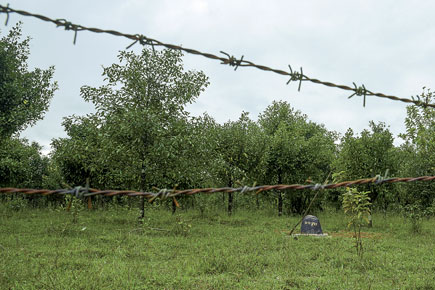
On the banks of the Cauvery at Ayyankeri, a village 6 km from the temple town of Bhagamandala on the road to Madikeri, is a patch of flat forest land planted with kodampuli (Malabar tamarind) trees. A barbed wire fence separates it from private land where rising water levels have made cultivation difficult; consequently, a lush pastoral meadow stretches all the way down to the river, its waters screened from sight by a thin line of trees. Inside the fence stands a small, rounded black stone with the date ‘13.12.1785’ painted on it, next to the words ‘Holocaust of the Humans’. Visiting what is described to me as the Auschwitz and Jallianwala Bagh of Kodagu, I am struck by the absence of history around it. No one in the neighbourhood has heard of Devattiparambu, the grounds where Tipu Sultan is said to have massacred over 30,000 Kodavas on a single day after inviting them to a feast. Yet, Kodavas like Addanda Cariappa are convinced that this is where the king all but wiped out a thriving, fearless people. Cariappa’s book is to be released on 13 December to commemorate the incident. “We used to call this area periya parambu (big ground). The NCC camped here in the 1950s to build a bridge,” says Abdul Rahman, a villager who owns some land next to the river, speaking in Malayalam. “A couple of months ago, some people from the Codava National Council [which has been campaigning for ethno-linguistic tribal minority status for Kodavas] came and looked around for a place to install the memorial. Since this is forest land, they thought it would be safe here,” he says. Rahman and his neighbours attended the Tipu Jayanti celebrations in Madikeri because they were puzzled at the calumny suddenly hurled at their village. Tipu allegedly converted thousands of Kodavas, whose descendants are now known as Kodava Mappilas. Muslims living in Ayyankeri, however, say their ancestors migrated from Kerala. “We have a mosque here that is said to date back 300 years and there are no records of conversion by Tipu Sultan in these parts,” says Rahman. “Nor is there any proof that this was Tipu’s killing field.”

Was Tipu really a monster of ego and a jihadist? Or could he have liberated India from the imperialists? “How does it matter? Lives have been lost,” says Abdul Naseer, the father of Shahul Hamid. “We have lost our only son.” In a small house with green walls, Naseer and his wife Kulusu contemplate their misfortune. “Shahul worked at a Toyota showroom in Bengaluru. He had come to Siddapur to apply for a BPL card so that we could get a discount on his sister’s kidney stone surgery in Mangalore,” says Kulusu. “He did not know a thing about Tipu. He just hitched a ride back home from Madikeri.” About 300 Muslim youth from Siddapur, Kodagu, attended the event, and most of them have since fled the area fearing arrest. “There are no youth in town today. There is fear. The police keep coming back with inquiries,” says Naseer. Police have made over 60 arrests so far and filed 35 cases. A magisterial probe has been ordered. “The people who killed my son go scot free even now,” Naseer says. He flew in from Dubai, where he works as a driver, when he heard his son had been shot. “I remember thinking, ‘It is a bullet to the head, he won’t make it’,” says Naseer, who has no plans to return to the Middle East. “There is no one to earn for,” he says.

While the Madikeri incident may have been precipitated by an unmindful government decision, there is a discernible trend of Muslim radicalisation in Kodagu, says KB Ganapathy, editor-in-chief of Star of Mysore, a widely- read evening newspaper. “I grew up in Kodagu. Muslim women never wore burkhas until a few years ago. Just two years ago, a women’s college in Virajpet took issue with students suddenly appearing in burkhas. The women in turn asserted their fundamental right to wear them, and eventually the parties came to the compromise that they could wear the burkha till the college gate but no further,” he says. “In this situation, the Congress may well be trying to capture the Muslim vote.”

In Srirangapatna, the anniversary of Tipu Sultan’s death is celebrated with much gusto. Followers waving banners with his emblem—a blazing sun amidst tiger stripes— participate in a procession from his mosque to his grave, where they smear sandal paste on the tomb. “I have attended many of these processions—called urs—and they have been peaceful. It is when you politicise the celebration that problems occur,” Ganapathy says. He has argued against idolising Tipu over other kings who fought the British. “Why doesn’t Mamata Banerjee celebrate the birthday of Siraj-ud-Daulah, the last independent Nawab of Bengal? He lived before Tipu’s time,” the editor says.

Tipu was a multicultural icon, a proto-nationalist who understood the future and respected other religions, says leftist historian KN Panikkar, who wants the country to remember him “not as a Muslim ruler but as a ruler of Mysore who gave us an anti-imperialist legacy”. Must we celebrate kings in democratic India? A king is not a perfection of noble qualities. He may fight an intercontinental cast of foes, but he is first and foremost fighting for his territory. “Freedom as we know it today was not part of Tipu Sultan’s imagination,” says Addanda Cariappa. “Just as it was not part of the imagination of the Peshwas or the Rani of Jhansi. They all fought for themselves.”

‘Happy is the country that needs no heroes,’ wrote Bertolt Brecht. Let us live up to the perils of the era and not drag a long-dead ruler to court with us.

source: http://www.m.openthemagazine.com /  Open / Home> Nation  / by V. Shoba  / November 26th, 2015
Four faiths thrive in Falaknuma

FalaknumaMPOs30nov2015

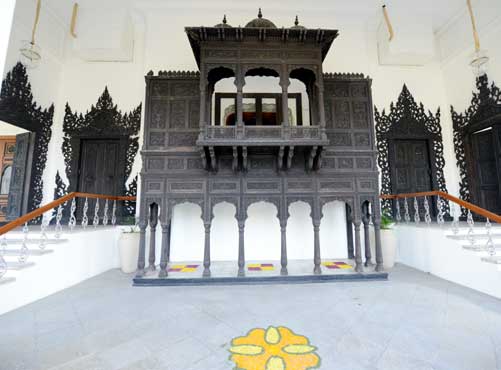
The Coronation Hall at Taj Falaknuma, which has been thrown open for public viewing after months of cleaning and refurbishing, is all set to give visitors a great experience of witnessing four different faiths under one roof. The restoration of the hall was done under the guidance of Princess Esra Birgin and experts from UK. It was in a decrepit condition with the roof falling apart and the carving turning black due to pigeon poop.

It is after several months of cleaning and polishing that fragrance of sandalwood filled the room, allowing one to cross the corridors admiring its art, sculpture and wood carvings. Sharing his views, raconteur Prabhakar Mahindrakar said, “In 1903, when the sixth Nizam Mir Mahboob Ali Khan attended the coronation of King Edward at Dilli Darbar, a lot of artists and craftsmen came to showcase their work at the mela expecting huge sales.

Unfortunately, no ruler took interest in purchasing the works and the artisans were left disappointed, except for the Nizam of Hyderabad who bought this ‘four-religion art’, which was immediately shipped to the city.” The Coronation Hall, which was used by royal women members and the Nizam, has many interesting facts to entice visitors. It took nearly three years for the Nizam to get the single unit art work to be put on proper display at the hall.

The intricate wood carvings are made in sandalwood and rosewood, which have certain unique features that pinpoint to the secular rule which prevailed during the Nizamera. Palace historian PrabhakarMahindrakar said, “The hall is divided into five sections, each dedicated to a distinct faith. The room begins with the Mughal art and is followed by Thai, Buddhism and comes to an end with Hinduism.

The first section of the room has intricate carving of ‘Tree of life’ in sandalwood on both sides of the hall, and on to the right one can also see the replica of ‘Emperor Jahangir darbar’ which was used by the Nizam to look at the city.” Walking down further, one would be welcomed with huge sandalwood arches which depict the temples of Thai monks and other carvings include Yali and peacocks which play a prominent role in Thai culture.

The next is Buddhism arch which depicts the royal life of ‘Gautam Buddha’ on one side and enlightenment and penance on the other side. The last depicts, Hinduism, where there is a replica of Panchavati, the abode of Ram-Sita while in exile along with many other mythological figures related to Lord Krishna, Goddess Lakshmi, Lord Vinayaka and many more.

source: http://www.metroindia.com / Metro India / Home> LifeStyle> Places / by Metro India News / November 28th, 2015