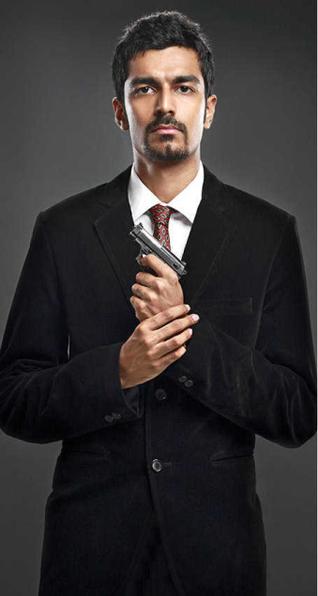
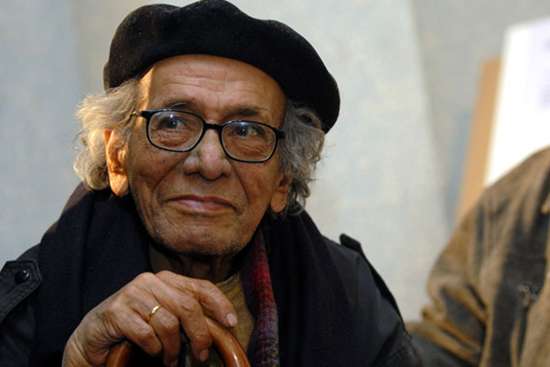
Comedian Azeem Banatwalla talks about the changing scene of stand-up in the country and his need to constantly reinvent himself
He’s been described as an ‘effortlessly likeable’ comedian, someone whose speciality is ‘merciless humour’. But at Azeem Banatwalla’s recent performance in Chennai, he struggled to find his footing. “It took me a while to get the audience warmed up. As a performer, I take some time to set up my jokes; that could be a reason. However, we settled in soon enough, and things were smooth from there,” he says.
He insists that his brand of humour is different from that of other Indian stand-up artistes. “My acts are all about things that appeal to me. I analyse religion without being offensive, and I absolutely don’t do political humour or over-the-top adult humour. I am more quirky in my approach with these topics; even when I touch upon religion, it is with tact. At the risk of sounding pompous, I’d say I’m into intelligent humour,” he laughs.
With the audience across the country evolving, keeping content fresh is a challenge for stand-up artistes, says Azeem. “The audience in places like Mumbai, Bangalore and Kolkata are good at picking up subtle humour, and they no longer shy away from calling out an artiste, if he or she is off the mark. If your material is stereotypical, you can expect to be booed,” he says, adding, “People are more well-read today. So we don’t just pander to the crowd anymore; we talk about things that we want. And I like this challenge of having to constantly reinvent my humour because, after a point, I get bored telling the same jokes over and over again.”
The 6-footer, who spent the initial part of his career writing for various publications, confesses that his acts were written like staid scripts. “I realised I was delivering the same lines in the same way, over and over again. That is no longer the case. I now just prepare a rough draft of points I want to touch upon during an act, and then go on to improvise my jokes based on how the audience receives them,” he says.
His stories stemming from frequent travels and his observation about life in general usually translate to humour on-stage. “It could be my take on the air hostesses or the crying babies around me,” says Azeem, who himself enjoys watching comedians like Bill Burr, Sundeep Rao and Anuvab Pal.
But the man, who manages to rack up laughs and guffaws throughout his acts, is quite reticent when he’s away from the spotlight. “I think I’m the most confident when I’m on stage. When I’m off it, I’d much rather sit in a corner, finish my drink and go home,” he laughs.
source: http://www.thehindu.com / The Hindu / Home> MetroPlus / by Ranjani Rajendra / September 05th, 2015
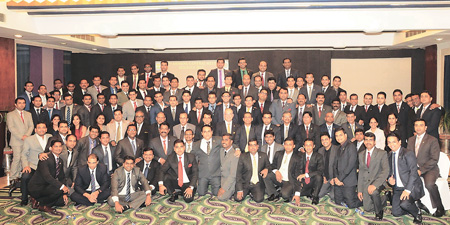
Les Clefs d’Or India Concierge recently held its ninth Annual General Meeting (AGM) in Kolkata recently.
The AGM was inaugurated by Zaid Farooqi, resident manager, Taj Bengal, Kolkata; James Ridenour chief concierge, InterContinental, Sydney and general secretary, Les Clefs d’Or International; Stephen Fernandes, past president, Les Clefs d’Or India; and Edwin Saldanha, president, Les Clefs d’Or India and Asian zone director, Les Clefs d’Or International.
Regional presentations were made by Rajesh Kumar Yadav from northern region, Sachin Singh and Apeksha Boricha from western region, David Aaron from eastern region, and Sri Kishen from southern region.
The treasurer and PRO reports were shared by Arun Baidya and Shaunak Vengurlekar respectively, and a speech on current trends was given by George Kuruvilla, general manager, The Oberoi Grand, Kolkata.
A brand presentation on social media was conducted by James Ridenour who urged for maximum participation in the communications committee.
The new executive committee for the period 2015-2017 was also announced during the AGM.
The AGM continued with the opening of networking eve by Samrat Dutta, general manager, Taj Bengal Kolkata.
During the pinning ceremony 32 new members received adherent membership to Les Clefs d’Or India and 36 adherent members were upgraded to full membership status.
The UICH Honorary Member was awarded to Biswajit Chakraborty, general manager, Sofitel BKC, Mumbai for his contribution and support extended to the concierge society in India.
This was followed by the Concierge of the Year 2015 award which was given to Debayan Ghosh from Shangri-La, Bengaluru.
source: http://www.financialexpress.com / Home> Food & Hospitality World / by FWH Staff – Mumbai / August 18th, 2015
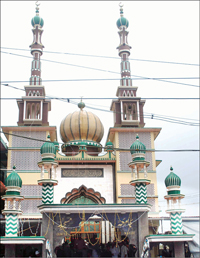
When late President APJ Abdul Kalam prayed at Jamiah Mosque in Madikeri, Kodagu
by Prof. M.I.K. Durrani
Jainulabadeen always felt that his son was destined to be exceptional and in his heart of hearts he hoped that his promising young son would one day make the family proud by becoming a Collector (Deputy Commissioner), not having the slightest inkling of what the future had in store for this darling of the family. His wife Ashiamma joined her husband in wishing Godspeed to their son as he left Rameswaram.
And thus commenced a long scientific odyssey leading to one achievement after another, followed by one glory succeeding another and finally one accolade upon another accolade in the form of Padma Bhushan, Padma Vibhushan and Bharat Ratna and then the acme as the first citizen of this country — President of India.
[Continued from yesterday]
But in spite of all the innate greatness of the genius that the country can boast of, this very personification of humility has got this to say:
“Each individual creature on this beautiful planet is created by God to fulfil a particular role. Whatever I have achieved in life is through His help and an expression of His will. He showered His grace on me through some outstanding teachers and colleagues and when I pay tribute to these people, I am merely praising His glory. All these rockets and missiles are His work through a small person called Kalam, in order to tell the several million mass of India to never feel small or helpless. We are all born with a divine fire in us. Our efforts should be to give wings to this fire and fill the world with the glory of its goodness.”
And I wondered how the young dreamer, who once watched cranes and sea-gulls soar into flight, longed to fly and did realise his dreams. And that unique person was going to visit the Jamiah Mosque at Madikeri and I too would be one of the fortunate few to behold the nonpareil in flesh and blood.
By the time I reached Balayatrie Estate on Thursday, the 6th April, 2006, it was nearly 10 pm. I was welcomed with all the usual warmth and affection that my brothers-in-law could muster up. There was the eldest of them, F.M. Khan, former MP and his third brother, Noor Mohammed and the youngest of the five brothers, Afroz Mohammed Khan. F.M. Khan was virtually a recluse after his cardiac surgery and whenever any relatives came to stay with him, he would be immensely pleased to enjoy their company. Noor Mohammed had arrived from Mysuru along with his family comprising his wife, son, daughter in-law and his two grand-children. Since Dr. Kalam was by nature very fond of children, Afroz suggested that the President should be welcomed to the mosque with a special bouquet of flowers from carnivorous plants as a mark of respect and the honour of presenting it should be given to Noor Mohammed’s exceptionally cute four-year-old grandson, Mohammed Khan. Everybody endorsed Afroz’s suggestion. F.M. Khan was feeling drowsy so he retired to bed and Noor also followed suit.
Afroz and I were by ourselves, not feeling sleepy at all, I, because of my curiosity pertaining to the President’s impending visit to the Mosque and Afroz due to his bubbling excitement. He got up and said he would fetch some tea for me and went straight to the kitchen. Of all the five Khan brothers, Afroz is the youngest but the tallest. He happens to be chip off the old block since his philanthropic nature, charitable generosity and compassion for all his paternal and maternal relations have been inherited by him to a large extent from his father late Yusuf Ali Khan.
F.M. Khan, his eldest brother, as the dejure muthavalli (manager) of the Mosque wasn’t able to discharge his duties owing to his ill health. Afroz, the youngest volunteered to shoulder the responsibility and thus he was the defacto muthavalli at that time and simultaneously he had been elected as the President of the Managing Committee of the Jamiah Mosque. As a dedicated and zealous servant of God Almighty, he had just then completed the renovation of the Mosque and had changed it into a well-known mosque of Madikeri.
As we started sipping our respective beverages, I asked Afroz how he had manoeuvred to get the President participate in the Friday prayers. Synopsised, it amounted to this:
It was during the first week of April 2006 that the news was flashed in the newspapers that the President of India was to visit Madikeri to participate in the centenary celebrations of General K.S. Thimayya and the day selected happened to be a Friday which all devout Muslims consider as a day of festival for the followers of the faith and every Muslim is expected to attend the congregational prayer on that day. So assuming that since Dr. Abdul Kalam had descended from a very pious family, he might in all probability would not miss the obligatory Jummah prayers.
So Afroz wanted to find out whether there was any scheduled programme of the President to attend the prayers. The first thing he did on 5.4.2006 was to ring up the office of the Deputy Commissioner, the Superintendent of Police and the Wakf Board, Mercara, to ascertain whether a visit to the Mosque was envisaged but from all the three places, the curt answer was an emphatic “No.” And thirty minutes later at 11.30 am, he called the Offices of the Deputy Commissioner and the Superintendent of Police again to find out the latest position but once again he was told that there was no such programme.
Afroz, as the President of the Mosque, was in a dilemma. Then suddenly he had an inspiration. He got an e-mail sent to the Rashtrapathi’s Office stating that the Friday prayers at the Jamiah Masjid in Mercara will commence at 1 pm. The very next day, on Thursday, the 6th April 2006 at 11.30 am, there was a call to the Jamiah Masjid from P.M. Nair, Secretary to the President, desiring Afroz Mohammed Khan to contact P.M. Nair and Afroz did so at noon. Nair said that his e-mail was received and the President thanked him for the information. He added that the President would be joining the Jummah prayers. Nair further said that it would be a purely private visit, therefore there was no need to inform either the Deputy Commissioner or the Police about it.
Afroz informed his brother F.M. Khan about the talk he had with the President’s Secretary and the ex-MP wanted to get it confirmed so he contacted the Deputy Commissioner, the Superintendent of Police and the Office of the Wakf Board but none among them had any information about it. F.M. Khan was rather sceptic about the visit to the Mosque and expressed his fears.
However, Afroz went to the Deputy Commissioner’s office at 5 pm to discuss about the President’s visit. He sent his card in but the officer was otherwise busy, as usually people in such position are, and then there was no urgent need to attend to a visitor who was only a President of a Mosque.
Afroz waited patiently for about half-an-hour but since there seemed to be no end to his travail, he left the place and went back to the Mosque.
[To be continued]
source: http://www.starofmysore.com / Star of Mysore / Home> Feature Articles / Saturday -September 05th, 2015
———————————————————————————————————————–
Recollections …: Prayer with People’s President – 3
By Prof. M.I.K. Durrani
The Mosque was as usual spic-and-span and there wasn’t any room for further improvement. At about 8.30 pm that evening, Additional Superintendent of Police Bhagwan Das arrived at the Mosque just to inspect the place with regard to cleanliness and security. He was completely satisfied with the upkeep of the place and desired to know how the President would be received and by whom. Afroz informed him that he himself, as the President of the Mosque, would receive President Dr. Abdul Kalam. The officer wanted to know how many garlands would be used since they had to be subjected to a thorough scrutiny. He was told that garlanding a person in the Mosque as a gesture of welcoming him isn’t customary and, therefore, there would be no garlanding. However, as a token of high regard, it was decided to offer the President a special bouquet of flowers from carnivorous plants and the same would be presented by a four-year-old boy at the entrance of the Mosque. The Additional Superintendent of Police was completely satisfied with the arrangements and bid goodbye to the staff of the Mosque.
[Continued from yesterday]
The next day was Friday, the day named after Frigga (or Freya), wife of Odin (the God), who is immortalised in the name Wednesday (Odin’s Day) but in Arabic it is called Jummah, meaning Congregation — an assembly of a large number of people for prayer. Jummah is considered by Muslims all over the world as a Holy Day, a sacred and blessed one.
A great deal of sanctity is associated with it since it is believed that Adam, the first man, was created on that day and that was the day he was admitted into the Garden of Eden from where he was much later expelled and that day also happened to be another Jummah and when he passed away, it was a Jummah too. The Day of Judgement is also expected to be on the same day. Furthermore, it is also believed that Allah forgives all sinners on this day when they are truly contrite, so it may as well be described as a day of deliverance from sin.
And on the D-day, we, all the menfolk, got ready well- in-time. After our bath, every one put on his Friday’s best comprising a white jhubba and white pyjamas, both soaked in light perfume. We reached the Mosque at about 12 noon. Already there were quite a few Policemen in the vicinity and the devotees had started trickling in. Afroz told the Mouzzan (Mosque official) to keep sufficient stock of water in case it was required by the President for performing Wazoo (the mandatory ritualistic washing of the face and limbs) before joining the congregation.
Exactly at 1 pm, the Imam started his bayan (speech) in Urdu which usually precedes the mandatory Arabic Khutbah (sermon or talk) in two parts. The first part of the Khutbah was over but there wasn’t any sign of the VVIP. The second part was also started, still the suspense continued. Exactly at 1.55 pm, there was a phone call from S.M. Khan, the Press Secretary, informing Afroz that the President would be arriving in another five minutes.
The Mosque clock chimed two O’ clock, the Khutbah came to an end and at that very moment, the President’s car arrived at the entrance of the Mosque and out emerged the smiling President wearing a closed collared coat and trousers with a white skull cap in his hand, which he put on to his head as he entered the odoriferous prayer hall. His feet were covered with white socks as he had left his shoes inside the car. He was received by Afroz in his capacity as the President of Mosque and Dr. Kalam shook his hand warmly and regretted his late arrival.
Then Noor Mohammed’s grandson, Mohammed Khan, the cute little laddie presented the bouquet to the President. After receiving the bouquet, the President, good humouredly snatched the cap from the boy’s head as though he was taking it away, but the very next moment he put it back on the child’s head and blessed him by placing the palm on his head and the boy bent his head and simpered. In the meanwhile, Afroz approached S.M. Khan and enquired sotto voce whether the President would perform the Wazoo. Khan replied that the President never went out with Wazoo. Even then he was Bawazoo (with the Wazoo).
Dr. Kalam, followed by his Secretary, joined the congregation. He found a vacant place on the carpeted floor in the third row and there he sat down. Though he had been offered a place in the first row, he had declined it as he must have felt that he was just a devotee like any other person and he didn’t like any kind of discrimination on the basis of a person’s status. Just then all the people stood up and formed lines. The Imam said ‘Allah-o-Akbar’ and the entire flock joined the rituals.
One thing which had at that time moved me almost to tears was when I saw the first citizen of this great land of ours, like any other commoner, joining the congregation wherever he found a vacant place, not expecting any kind of special consideration. What a contrast it is with the attitude of upstarts among the self-styled VIPs, who always consider it their birth right to enjoy preferential treatment wherever they go. Dr. Kalam, a man of remarkable humility, must have remembered one stanza from Dr. Mohammed Iqbal’s Urdu poem, Shikwa (complaint) in which there is this touching narration:
1. Aagaya aine lada ee may jab waqt-e-namaz,
Qibla roo ho ke khadi ho gayi qaum-e-hijaz,
2. Ek hi saf may khade ho gaye Mahmood-o-Ayaz,
Na koyee banda raha na koyee banda nawaz,
3. Banda-o-saheb-o-mohtaj-o-ghani ek huye,
Teri sirkar may pahunche toh so bhi ek huye.
And the above lines have been excellently rendered into English by no less a person than late Khushwant Singh, thus:
1. In the midst of raging battle, if the time came to pray,
Hijazis (Arabs) turned to Mecca, kissed the earth and ceased to fray;
2. Sultan and slave (Mehmood and Ayaz) in single file stood side by side,
Then no servant was nor master, nothing did them divide;
3. Between serf and Lord, needy and rich, difference there was none,
When they appeared in your court, they came as equals and one.
And that one act of self-effacement speaks volumes about the greatness of the humble, God-fearing scientist.
[To be continued]
source: http://www.starofmysore.com / Star of Mysore / Home> Feature Articles / Sunday -September 06th, 2015
Recollections …: Prayer with People’s President – 4
By Prof. M.I.K. Durrani
[Continued from yesterday]
Jamiah Mosque in Madikeri, Kodagu.
After the prayers were over, the courteous President told Afroz to seek, on his behalf, permission from the Imam to address the gathering.
While all the members of the congregation were seated, he stood up and spoke to them in English. He expressed his happiness at witnessing such a large gathering. He said that his father and grandfather were all orthodox Muslims and never missed a single prayer.
His father used to take him to Mosque every evening and whenever he achieved anything, his father used to make him offer thanksgiving prayers in the Mosque. He hoped that the audience would continue to keep up the practice of their ancestors and lead virtuous lives. At the same time, he advised them to live in greater harmony with the people of other religions and to be proud of being Indians.
Sensing that what he was saying might be misunderstood by a majority of the audience due to their ignorance of the English language, he concluded his speech by asking the people to join him by repeating the Arabic Ayats (lines) from Surah Al Fatihah which all Muslims recite during prayers and which implore Allah to guide them to the path of those who were favoured by Him and not the path of those who earned His wrath by going astray.
The audience felt maximum spiritual intensity by repeating each ayat with fervour as the President recited them like a teacher.
Afroz proposed a vote of thanks and the President started moving through the throng of the much impressed audience, shaking hands with several persons who were standing on either side of his path.
Noticing a group of children, he went straight to them and spoke to them in English and was much pleased to find them responding in that language. Then he got into his car, waved towards one and all, who were standing on both sides of the route and departed leaving behind the admiring people of Madikeri, who would always cherish the memory of a People’s President’s visit to their beautiful hill station.
And today, when I look back and recollect what a great day it was in my life when I had the honour of shaking hands with that gem of a man, I just wonder whether it was really so or it was just a dream. Today he is no more with us but he has left such an indelible impression on our mind that the Bard whispers from nowhere:
“His life was gentle and the elements
So mixed in him, that nature might stand up,
And say to all the world, This was a man.”
[Concluded]
source: http://www.starofmysore.com / Star of Mysore / Home> Feature Articles / Monday -September 07th, 2015
The Cosmopolitans | Anjum Hasan | Hamish Hamilton | Pages 275 | Rs 499
Anjum Hasan
The title of Anjum Hasan’s newest book sets the tone for a novel chock-full of irony. In fact, the first word of the book is also a title and an exercise in irony. ‘Nostalgia was big,’ the book begins. Nostalgia is the art installation that appears in the very first chapter of the book. A living room with a vintage TV playing black-and-white news about death in jungles and government scams, the installation has travelled from Venice to Bangalore. Which is where Qayenaat, the protagonist of this tantalising novel about art and artists, encounters its strange, retro glamour.
The tension between provincials and cosmopolitans is a well-examined theme in Hasan’s work. Her first novel, Lunatic in My Head (2007), was set in Shillong and traced the lives of three characters waiting for their life to begin. Hasan has also published a collection of poems, a second novel,Neti, Neti: Not This, Not This (2009) as well as a collection of short stories, titled Difficult Pleasures (2012), a title that could very well apply to all her writing. In her current novel, the title is like a lightbulb in a living room, invisible in itself, but illuminating everything under it.
What’s in a title? Qayenaat is, after all, a woman who has bought a painting by the mysterious artist called NJ because of its ‘poignant, Shakespearean name’. As for her own name: ‘At twenty she had dropped her last name simply because it was Gupta and there was no way to reconcile the ordinariness of Gupta with the sublimity of Qayenaat. So, braving passport officials and census takers, strangers on trains who insisted she reveal her religion, caste and clan, and boyfriends who wanted to know her second name before they kissed her, she stuck to Qayenaat…’
And thus we have our unusual protagonist. A 53-year-old single woman and a failed artist, prone to wearing ‘corduroys the colour of horse shit and khadi the colour of dishwater’, assertive enough to shake off her surname, but willing to be perplexed about art, about whether galleries matter, about artists and their public responsibilities. But while Qayenaat has been busy preserving the dignity of a genteel, reflective life, ‘Something had been happening since the turn of the century to render everyone well-off except Qayenaat.’
Hassan’s precise, poetic voice soars when she describes the new wealth of Bangalore: ‘It was as if they’d all just been waiting for Pears soap and Italian pasta to hit the shelves before they disowned their alleged poverty, grinning sheepishly as they abandoned the swadeshi delights of their youth—the polka-dotted nylon saris, the low-roofed Fiat cars, the striped yellow packs of glucose biscuits, the synthetic orange juices, the bottles of royal blue Chelpark ink with which one filled fountain pens to write letters to faraway friends and which friends filled their pens with to write back.’
Hasan’s observation of the city is always scrupulous and affectionate, and a joy to read. With detail that is both deft and luxuriant, she describes the busy hunger on the streets of Shivajinagar during the Iftar hour, the women inburkhas and running shoes doing their rounds in Coles Park, how MG Road’s dream of being the modern centre of the city was interrupted by the malls and lifestyle enclaves and bistros of more nouveau riche neighbourhoods. Bangalore and the various ideals of cosmopolitanism it stands for are transmuted into a particularly suitable setting in this book about various species of cosmopolitans.
At first glance, Baban, the jet-setting artist, and Sara, the wealthy art collector, are the cosmopolitans of the novel, with their casual, easy relationship to money and art. Qayenaat, like MG Road, has been out-cosmoplitaned over the years. Then there is her former lover Sathi, a journalist from the boondocks of Uttar Pradesh. Sathi lives by Mahatma Gandhi’s dictum about asking yourself how one’s actions will affect the poorest. This makes him both pragmatic and idealistic. When Sara and Baban are discussing Baban’s newest idea for an installation: a mansion of water, ‘a liquid monument,’ it is Sathi who brings up the pathetic condition of municipal waterworks. Water, like money, is an object of abstraction for Baban and Sara, whereas for Sathi, and Qayenaat, living in Sir MV Nagar, an industrial township beyond the northern edge of the city, water and money are in short supply.
It is refreshing to read a book about a woman who needs money. When we first meet Qayenaat in the gallery, she is there because she is, she realises belatedly, in love with the artist Baban, the old friend who has reinvented himself as a world-famous artist, newly returned to the city of his youth. But before the story can settle into the expected romantic momentum, money or the lack of it becomes a central element in the narrative. Qayenaat needs money, and with Sathi’s help, briefly considers staging an art theft to con the insurance people. After she becomes responsible for the tragic death of a beloved art critic, Qayenaat abandons Bangalore. To do this, she has to raise money and she does so by selling her beloved The Painting of a Sorrow. But where can she go to make amends? The answer is provided by an old cutting from The Illustrated Weekly about a dying dance form, saved amongst her father’s memorabilia. ‘I’ll go into India,’ Qayenaat decides.
However, this external world of art openings and conversations and thought crimes and tragic deaths only exist as a backdrop, however, for Hasan’s meticulous exploration of her character’s inner life. Right from the beginning, the reader is stationed inside Qayenaat’s head. The story alternates between the languid pace of her rambling thoughts and the occasional spurt of action. Even the dance she is passionate about exploring is a means to an end in this philosophical novel; in terms of popular appeal and glamour, this art form created by the rulers of an erstwhile kingdom in central India is at the opposite end of the spectrum from Baban’s Nostalgia. Determined to study the dance, Qayenaat arrives in Simhal, a tiny town in the middle of the country whose tribals are at war with the Indian state—the kind of place that produces the bad news which the TV newscaster in Baban’s living room installation is mouthing.
Legend (or excellent public relations) has it that Orhan Pamuk was inspired to start collecting objects for his Museum of Innocence after meeting a former Ottoman royal who made a living as a ticket collector in an Egyptian palace. Apparently, the Crown Prince even considered taking up a tour guide position at the Ihlamur Palace, in Istanbul where he had grown up. In Simhal, Qayenaat, too, meets a monarch whose vocation has devolved into an all-consuming nostalgia, in a ruined palace whose red paint has faded to the colour of mud, stuffed with ‘racks of mouldy dance costumes and chests of rusty swords’.
+++
The king of this palace dreams of ‘a museum and a library dedicated to the dance; a five-star hotel that could house at least two hundred guests; and, finally, a university to teach performance arts to students from every corner of the world’. But there is already a museum of innocence in Simhal: a dusty, forgotten archive of legless statues, complete with a library where a young woman sits reading in the newspaper about landmines blowing up buses in the countryside near them. Here, Qayenaat makes a friend.
In another ruined building, she falls in love. Watching this, far away from the chaos and discontents of Bangalore, is one of the pleasures of this novel. The hope and lightness of love are weighed, again and again, against the larger world, full of violence and instability; Hasan is especially adept at this eternal conflict. What eventually saves Qayenaat, however, is not love, but friendship. The loyalty of Sathi, the generosity of Sara, the shy sisterhood that springs up between Qayenaat and the young librarian— eventually, it is friendship that saves Qayenaat and redeems her journey when the king betrays her ideals and his tiny sphere of influence turns into a gilded cage.
The Cosmopolitans begins with an art exhibition and ends in an art exhibition. NJ has been killed by those who are offended by the nudity in her paintings, and in honour of her, Baban is curating an exhibition of paintings by Bangalore artists. As the novel ends, Qayenaat walks through the gallery wondering:
‘Do they display resistance, these works that mourn and celebrate NJ, or have they just been produced to be consumed by the always open maw of that monster, the market? She did not know but felt at home as she walked among them. Here again was déjà vu all over again. Art, which was long in contrast to life’s shortness. Art, which she had been a student of all her adult life, burnt down one evening, left Bangalore to get away from, found in another form in Simhal, and then escaped yet again to return to where she’d started. Art, which had killed NJ and was perhaps the only thing that could avenge her death, bring her back to life in some small way.’
A book that began with nostalgia ends with déjà vu. Perhaps this is the difference between the cosmopolitans and the provincials. One is destined to long for the thing that is gone, and the other is sentenced to the banality of repetition. The Cosmopolitans is a lyrical study in how one feeds off of the other.
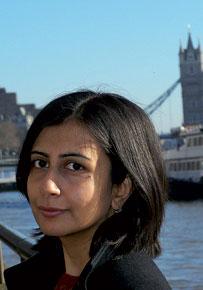
(Shahnaz Habib is a writer and editor)
source: http://www.openthemagazine.com / Open / Home> Books / by Shahnaz Habib / August 07th, 2015
For someone who works seven days a week, the concept of a ‘weekend’ does not exist. I’m usually hosting events, working at the radio station, shooting or travelling around the world for various occasions, so I don’t get much free time to myself.
However, I do get cosy once in a while — it’s mostly the times between my travels — but there are moments. Whether I’m travelling or at home, my idea of ‘chilling’ involves hanging around in my room, going for a swim, playing some video games, or working out at the gym. I’m not someone who takes a break and calls my friends to go have a good time. I enjoy working during my free time. I don’t believe in wasting time and I’m always looking out for new things to try and do. Looking at nature and doing absolutely nothing is just not my style!
I have two very close friends that I love hanging out with, but unfortunately they moved to Mumbai. But even when they were in the City, we would just hang out and do productive things like brainstorm for new ideas and create new content. And when I really want a break, I shut everything down and go on a long vacation. This happens only once in six months or more — that’s when I know that I need to reboot.
Recently, after working six months like a mad man, my sister and mother planned a Europe trip. I was already there for a shoot and they joined me after. It was a great time; we did regular tourist stuff — a visit to Milan, hung out at Amsterdam, went up to the Eiffel Tower, took a city tour around Paris and more. We made a lot of new friends there and it was quite refreshing. But, as usual, I missed work, so coming back was such a relief!
Generally, when you ask someone what they like to do, they immediately tell you that it’s either reading a book, painting, or something they are good at. But I haven’t found my ‘favourite thing’ to do yet. I did experiment with what I thought I might like — tried my hand at painting and realised that I am a terrible artist. I even tried to read a book, a motivational one, but I couldn’t go past the third page. I didn’t think a person who is always fuelled up needed anymore ‘gyaan’!
But I do enjoy spending time with my three-year-old cat, Red. Being around him makes me feel calm and gives me the peace of mind I need. We usually hang out in the garden, where he drinks water from his little bowl and enjoys his food. That moment, that experience, makes me feel like nothing else in the world matters. So it turns out that’s the detoxing I needed, not reading or painting.
I guess one can say that I make up my weekends and vacations as and when they happen. If it’s a place I’ve never been to before, I make sure that I allot some time to explore it. Since I’m a city-person, I enjoy nightclubs, the architecture, monuments and landscapes. Going to a coffee shop in a city is more important to me than going to a lake or river. It’s also a good thing that I’m an extrovert; I love meeting new people in the places I visit and I generally hang out with them during my trips. After all, the best things in life are not planned or reserved, so I take it as it comes and go with the flow.
The idea of a weekend is to relax and free your mind, and I do that on a daily basis. The drive I have from home to the radio station, that fifteen minutes of music and zoning out, is my weekend and my free time. I couldn’t have asked for a better life!
A few of my favourite things
Watching ‘Family Guy’
Playstation
Practising and rehearsing weird voices
The colours black and blue
Chinese food
source: http://www.deccanherald.com / Deccan Herald / Home> Supplements> MetroLife / by Anila Kurian / Saturday – September 05th, 2015
His book, My Name Is Gauhar Jaan, is being scripted into a play by none other than Mahesh Dattani.
And it will be directed by Lillete Dubey.
Currently, the two men have been discussing the period drama and the classical background score to go with it.
The play, Gauhar, is likely to be staged at the end of the year and will have a worldwide premier. Although the play is inspired by the book, Sampath is happy to allow “dramatic liberties”.
But knowing Dattani, a stickler for details and accuracy, there ain’t going to be any heartburn. As of now, if wishes were horses, Sampath would love to showcase the play at the Bangalore Lit Fest. The diarist would like that too.
source : http://www.bangaloremirror.com / Bangalore Mirror / Home> Columns> Code 560 / Bangalore Mirror Bureau / September 02nd, 2015
“The Hardayal library is an important signpost of our city’s history. We need to ensure that it is restored to its erstwhile glory,” said Jung.
In a meeting on Friday, Lieutenant Governor Najeeb Jung approved a Rs 3-crore grant for the restoration of the ailing Hardayal municipal public library in Chandni Chowk.
The meeting was attended by Commissioner (North corporation) representatives from the South and East corporations, the secretary and librarian and senior government officers.
“The Delhi Urban Heritage Foundation (DUHF) will look into the restoring the library’s outer and inner structure. A joint inspection shall be undertaken immediately to chart out the course to be taken and for removal of encroachments. Work shall also be undertaken to help digitise rare and old books in the library’s collection,” stated the Lt-Governor.
“The Hardayal library is an important signpost of our city’s history. We need to ensure that it is restored to its erstwhile glory,” said Jung.
Established in 1862, the library is more than 150 years old and is presumably the oldest one in Delhi. It has a collection of extremely rare and precious books, including books dating back to the 16th century.
It has a collection of more than 1,70,000 books in different languages, with 8,000 of these in the rare category section. It has 28 branches which are spread all across the three municipalities of Delhi.
source: http://www.indianexpress.com / The Indian Express / Home> Cities> Delhi / by Express News Service / New Delhi – August 29th, 2015
On the 92nd birth anniversary of the man the likes of whom are hardly around in Indian theatre any more. by Danish Husain
I have a habit of reaching places late. I got to work with Habib Tanvir only in the last 5 years of his life. And this has been one of my big regrets; I often wish my association with him had started earlier. I would have learnt more—about theatre, arts, culture and even life. His death deprived me of all this.
He was perpetually on the lookout for new faces. I was working with M.S. Sathyu in Dara Shikoh when a fellow actor Humayun Abbasi, a family acquaintance of Habib Saab, introduced me to him. I eventually got to work with him in Agra Bazaar. But my first meeting with him was much earlier as a manager in the Standard Chartered Bank. He was standing in the queue at the counter one day when I spotted him. Of course I recognised him, immediately pulled him out of the queue, escorted him to my desk, and sorted out his queries. Later when I narrated the incident to him, he remembered it. Since 2004-05, I became a regular member of the Agra Bazaar troupe.
The most amazing thing about Habib Saab was that he had multiple backup plans for any situation. He would never be perturbed by any news, however problematic. Even 10 minutes before a show, if there were last minute changes to be made, he would calmly go about making them. He could chop and edit a play at a minute’s notice and yet it would come together as a whole, complete in itself. The show wouldn’t stop ever. He would improvise as and when required.
At times his plays had 45-50 actors on stage, a pan-India cast with actors travelling from all over the country. They could be a logistical nightmare, but not for him. He would have multiple actors work on multiple roles so anybody could take over from anyone else in case of an emergency. He would call me “stepney”. “Jahan chaahe laga do” he would say. So I played many big and small roles—shayar, shohda, patangwala, even a crowd member in Agra Bazaar.
He had an eye on everything, every aspect of the play, from lighting to music to costumes, props, sets, you name it. He had an eye for detail. There was a sense of rootedness in his works. The texts were anchored in a defined sensibility, culture, ethos and zubaan. His understanding of his material was immaculate. The enormity and nuance of it would sink only after multiple performances. Bahut badaa mayajaal tha unka but you would understand the big picture when you figured out how the smallest of the components operated.
Each of his plays had this layering and subtlety which hit you and stayed with you much after you had watched the play. The play demanded to be seen again and again. One had to revisit it to absorb and savour it. Each time you viewed a specific play a new window of meaning opened on you.
He had once referred to himself as a “benign dictator”. I remember hearing that in one of the documentaries made on him. He never wielded a hammer during rehearsals. He would sit with a pipe in a corner and intervene only when someone went off tune. He had this ambivalent relationship with the Chattisgarhi actors. They were idiosyncratic and difficult to handle. In fact, the character of policewala in Charandas Chor was Habib Saab himself, metaphorically, constantly chasing and steering his actors. It was about his own struggles as a director. The actors, on the other hand, would have problems with him yet could not live without him. He could steer and keep the herd together because he had a fine understanding of human nature. The actors would often get drunk and riled up post performance and would misbehave with him but he would just sit calmly and hear them out. Next day, when the hullabaloo would be over, the actors would tremble, wait for a reaction from him. But he wouldn’t react, he’d be silent and use it effectively. It intrigued and worried them and they would come around. He managed to take them all along. They would fight, leave and come back. But things kept moving. They wouldn’t halt. No wonder then why there were instances of three generations of actors working with Naya Theatre.
His grounding, thoughts and understanding are missing now. Naya Theatre was self funded through invited shows. The grants were not very huge. One hears that the land allotted to him for the repertory also got usurped. Yet he kept Naya Theatre going for 50 years, it has survived six years after he is gone. If things are not seeming bright it’s also because of the government’s failure to recognise true artistes and what fosters a culture. He was a true visionary, a one in a century kind of man, the likes of whom are hardly around in Indian theatre any more.
source : http://www.outlookindia.com / Outook / Home> Arts & Entertainment – Opinion / by Danish Husain / September 01st, 2015
Former minister Nafees Fazal has launched her own jewellery studio
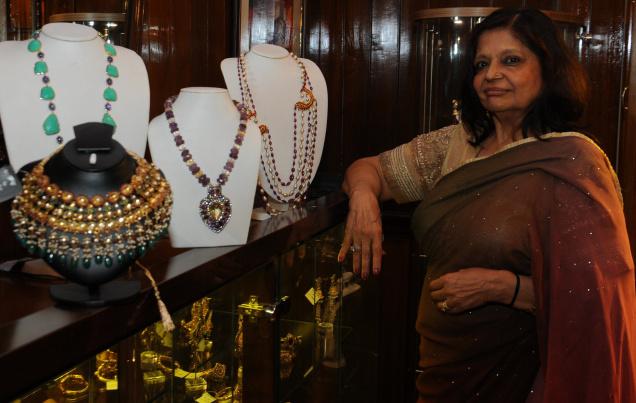
Nafees Fazal, a former minister for Medical Education and Science and Technology, in Karnataka “loves politics and jewellery. I have a passion for beautiful things,” explains the lady herself. Dressed in an elegant sari, she is not wearing any jewellery herself. “I don’t like to look like a Christmas tree all the time. A lovely sari, draped well, is enough to get me through the day,” she beams.
Nafees is now in the news as she launched her own jewellery studio called The Private Collection by Nafees Fazal. She has converted a room in her bungalow into the studio. “Having a studio at home helps me cut the overheads,” she explains.
As of now she has a limited range of jewellery called the “Naf Collection”. “Naf is short for my name,” she says, and dons the role of a model as she stylishly demonstrates how a particular piece of jewellery must be worn or carried in style.
“I am itching to get back into politics. But what do I do in the meantime? I can’t play housewife all the time. I decided to travel, and curate this collection for women. Who doesn’t love jewellery?” asks Nafees. The collection, currently on display, starts at Rs. 4,000. It is collected from Tanjavur, Rajasthan, and Delhi over the “last four months”. It offers designs in precious and semi-precious stones, antique pieces from Trivandrum, “which are bought at the princely sales”. Then there are jhumkis, large earrings, kangans, neck pieces and so on.
From bridal wear, to party wear or just making a style statment, the collection has something for every occasion. “They are created in silver, plated with gold, and come with kundan in polki and other hand works. Hence, it brings the cost down drastically. The aim is to offer the traditional with a touch of modernity. Part of the proceeds will go towards my Kare Foundation, which was started to help poor patients in 2009,” states the former minister.
She adds that she is “passionate to help the poor”. “I do not have crores but am all game to help those in need.”
Will she get into designing as well? Pat comes the reply, “No! I am not into manufacturing but only curating. I need to get back into politics. This is just a hobby. The studio will continue. I assure you that there is something stylish for everybody here.”
source: http://www.thehindu.com / The Hindu / Home> Features> MetroPlus> Fashion / by Shilpa Sebastian R / Bengaluru – August 31st, 2015
For international rock and metal bands, India is on the top of their bucket list. Members of the music fraternity share their opinion.
‘Metallica’ a Heavy Metal Band performing a live concert at Palace Grounds, in Bangalore on October 30, 2011. Photo: K. Bhagya Prakash
Most of us spent our growing up years listening to iconic bands such as Iron Maiden, Metallica, Megadeth, Lamb of God, Mr. Big, Michael Learns To Rock and Cannibal Corpse among other legends on our walkmans and CD players. Much of our time went into memorising the lyrics and for the aspiring musician in us, learning and practising the riffs and beats. But none of us would have ever imagined getting to watch these childhood heroes perform live in our own country.
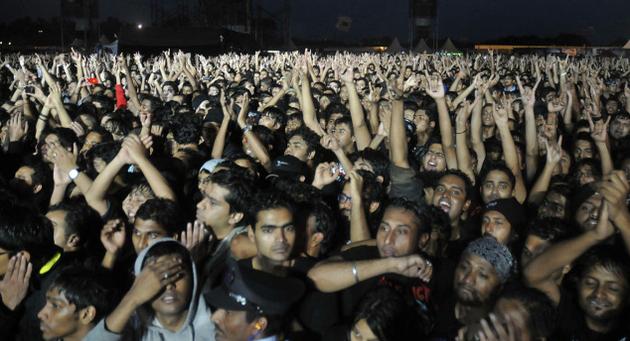
Fans during ‘Metallica’, the heavy Metal band’s live concert at Palace Grounds in Bangalore on October 30, 2011. Photo: K. Bhagya Prakash
Today, international bands are not only pulling in massive crowds to their gigs but also opening doors to discovering new audiences. India, particularly Bengaluru, has turned into a must-visit destination for international bands and in the last decade alone, a plethora of international acts have ticked India on their bucket list, some more than once. Here is what some of the country’s musicians have to say about the trend.
What set it off
Tony Das from ‘Peepal Tree’ says one thing that played a pivotal role in this rush of bands is that we were starved of them for quite a while.
“So when the time came, the fans of the slightly older bands that were around for a long time, jumped at the opportunity. Until recently, shows by international acts were random, erratic and rare. I guess they found a way to make it profitable especially with fans waiting for so long. Also, over time, people have developed a slightly more serious taste for music. People really love their music here and are willing to pay any amount to attend shows. My dream band to perform in India is American rock band Extreme since I’m a huge fan of frontman and lead guitarist Nuno Bettencourt.” Rajeev Rajagopal from ‘Thermal And A Quarter’ agrees that it is no surprise international bands head to India, and specially metro cities.
Role of language
“Among most metros, English is quite widely used. Also, the people in the country have developed a taste for international music from the Brit hangover here. It’s an international language and the audiences here listened to a lot of music. Hence, the reputation of a place really picks up. International bands know they will get an audience here. My dream band is American jazz band Steely Dan.”
Freelance musician and principal of Wings School of Music Ashley Joseph admits that India has always been a potential market for big bands with its big festivals. “The festivals are not only specific to one genre and there are a lot of blues and jazz artistes who also come down. There is an audience for everything here. India, in general, caters a wide range of audiences across genres. Artistes from here also have a significant audience abroad. My favourite band that must visit India is Rage Against The Machine/Audioslave.
Salman U. Syed, the promoter of the Bangalore Open Air metal festival, says India is also a new market since bands have been touring the States and Europe from the 80s itself. “Asia and India have always been a new market for these bands since they are a newer audience. My dream band that definitely needs to make a pit-stop iin India is British heavy metal band Judas Priest.”
Nathan Lee Harris from ‘Galeej Gurus’ points out that a lot of bands are now aware that there is an audience for their music. “These are mainly the newer bands, exploring third world countries before their music fizzles out. But I don’t have the same opinion for older bands. I believe that when they come to the Indian market, which they avoided 20-30 years ago, it is only to make a quick buck and go back. It’s quite obvious. Also on the flip side, these bands are now slightly more affordable. At the peak of their careers, we could not have afforded to bring them down. Now, since they are not at the peak of their careers, it’s easier to raise a sponsorship without feeling the pinch. My dream band, and most other musicians will also approve, is legendary Irish rock band U2.”
Jagadeesh M.R from ‘Moonarra’ says: “For bands from Europe and the States, India is affordable and has rapidly turned into a hotspot. The audience are quite varied and awareness of international music happens all the time through social media and the Internet. Musically, we are much more eclectic and even though Bollywood has a strong presence, other forms of music also survive and thrive, especially with alternate music culture. My dream artist will be Stevie Wonder.”
source: http://www.thehindu.com / The Hindu / Home> News> Cities. Bengaluru / by Allan Moses Rodricks / August 31st, 2015