Category Archives: Arts, Culture & Entertainment

Quran dating back to Akbar’s period recovered by Dist. Cops

Ten-member gang trying to sell it for Rs.5 crore arrested
AkbarQuranMPOs12aug2015

Mysuru :

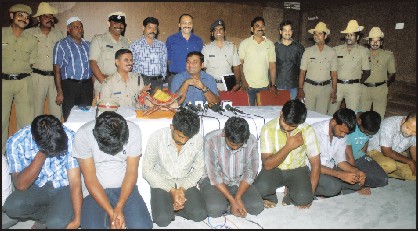
In a meticulously planned and precisely executed operation, sleuths attached to the District Police, seized a 410 year-old Quran, written during Mughal ruler Akbar’s period in the district and also arrested a gang of 10 members who were allegedly trying to sell it for Rs.5crore.

Police have also seized a Ford Ikon car (MH02 AK-4967) from the gang

The nabbed have been identified as S. Nagaraju of Sindhanur, A. Muralikrishna of Sasalamai Camp, Kanakappa Kambli of Yerebeleri village in Gadag district, Kallappa Kambali o Kalaburgi and Sanath of Kollur in Udupi taluk, Ravindra, Vijayendra of Hosanagar in Shivamogga district, Prasad of Heggodu in Sagar taluk, Bhaskar of Sindhanur and Raghu of Karwar.

Addressing a press conference at his office in city yesterday, SP Abhinav Khare said that Police, who came across a video on the antique Quran that the gang was sharing with prospective buyers formed a team to trap the gang.

The Police team, posing as prospective buyers approached five members of the gang near the Railway Station in Hosa Agrahara in K.R.Nagar taluk in the district and nabbed them before nabbing the remaining members in Mysuru city, he said and added that the accused had confessed to have got the antique from some persons in Hyderabad promising to share the proceeds of the sale with them.

Additional SP Kala Krishnaswamy, Rural Dy.SP Vikram Amte led K.R.Nagar Inspector H.N.Siddaiah, DCIB Inspector Gopalakrishna, Saligrama SI Poonacha in the nabbing and seizing operations.

Meanwhile, noted historian and former Vice-Chancellor of Mangalore and Goa Universities Prof. B. Sheikh Ali, who was present at the press conference described the calligraphy as a 604-page book, each separated by a butter paper for better preservation as a piece of Exquisite Art adding that writing in the Quran is legible.

Continuing, Prof. Sheikh Ali said ‘It was written in 1959 of the Hijri calendar, which works out to 1605 A.D. This was around the period when Mughal rule was at its peak in India and the time when Akbar was succeeded by Jahangir.”

He further said that though there is no other information on the last page other than the year in which it is written, there is a sentence that says that the calligraphy is dedicated to the saints.

Interestingly, SP Khare removed his footwear while holding the Quran to pose for photograph before the Quran was carefully placed in a carved wooden stand and covered with a cloth.

source: http://www.starofmysore.com / Star of Mysore / Home> General News / Wednesday – August 12th, 2015
Blind youth develops mobile app for eye donation

Kochi :

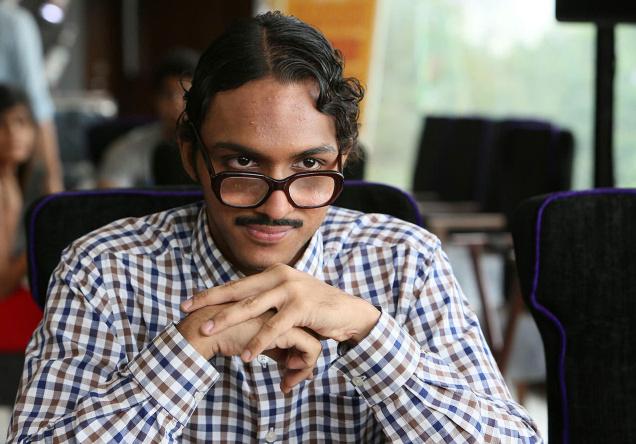
A new app called Netradaan enables users to sign up for eye donation through their mobile phones. What makes the app all the more special is the contributions by a visually challenged person in its making.

Muhammed Ramees was born with partial eyesight. When Sunil Mathew, founder of Sightica Solutions spotted him during an interview to train visually challenged persons in using computers, he realized that Ramees was too good to be just trained in basics. That was the beginning. Together the duo went on to develop a series of Android apps.

“One of the unique features of the app is t the recipient request through which a request for cornea can be made. This will go into the database of the association. The app has English and Hindi versions, Ramees said. The app encourages users to donate their eyes through an easy to fill-and-submit donor form. “We have partnered with the Eye Bank Association of India. The donor receives an eye donation card from the association,” said Sunil, who also runs Society for Rehabilitation of the Visually Challenged (SRVC), an NGO in Kochi.

Another app called Kuluk created by them enables the blind to call for help by shaking or tapping their phone “A visually challenged person can call for help by shaking the phone or tapping it just once keeping the app on. The users can customize the number of shakes upto three. A shake or a tap prompts a call or message to emergency numbers saved on their phones,” said Sunil. Another app called Mapseeker helps the elderly or visually challenged to find important places using google maps. “This is just like the GPS but with more user-friendly features for the blind,” Ramees added. ”

Netradaan app has won the m-inclusion Awards at the mBillionth Awards held in New Delhi last week. The award honours outstanding mobile content and apps from South Asia.

“We should spread awareness regarding eye donation. What pushed us to develop this app was the long waiting list for corneas. About 45,000 corneas are imported from Sri Lanka alone every year,” said Sunil. All the apps can be downloaded from Google Playstore.

source: http://www.timesofindia.indiatimes.com / The Times of India / News Home> City> Kochi / by Sudha Nambudiri, TNN / August 04th, 2015

Over a cup of evening tea : A monumental miscalculation ?


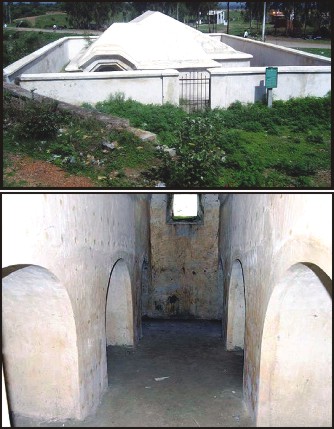
Top - 1) The centuries-old armoury of Tipu Sultan. Below -  2) An interior view of the armoury.
Top – 1) The centuries-old armoury of Tipu Sultan.
Below – 2) An interior view of the armoury.

by Dr. K. Javeed Nayeem, MD

No, I’m not talking about the hanging of Yakub Memon as you may be inclined to think from the title. It is pointless to dig up the graves of those who are very dead. But nevertheless, many will be doing it for some time to come. I’m talking of something much closer home although this is also about digging up something from the past. It has now been announced that the more than two-centuries old Armoury of Tipu Sultan, which has become an impediment to the Mysuru-Bengaluru Railway line doubling project, will finally be shifted to a different site about 500 meters away from where it stands now, although its new location is as yet unannounced.

This matter has been under consideration for quite some time now and different ways and means of circumventing the ancient obstruction to upgrade a much-needed modern means of transport have been aired from time to time by the Railway authorities and the Government. For a brief while it was even suggested that to avoid disturbing the monument we would even make do with a single track between the Naganahalli and Pandavapura stations. But this move, seemingly very kind to our heritage and hoary past, would have completely defeated the whole purpose of doubling the track thus making a mockery of the entire expensive project.

What I would like to highlight here is the very lackadaisical attitude of our government agencies to proper planning before jumping into the very profitable business of execution. It looks like a very apt case of utter disregard to the axiom of looking before leaping and doing just the opposite instead. Many engineers working for the Railways and many other very knowledgeable and qualified people tell me that with a little proper planning the track doubling work could have been accomplished without the need to re-locate the monument.

This point of view seemed right even to me when I visited the place just yesterday with my son, Adnan to have a first-hand look. It is common knowledge that to a common man with a little common sense, alternative options come easily while to experts with intelligence they often remain elusive. The new bridge across the south branch of the river Cauvery built to carry the second line is almost ready and until now the authorities were unsure of how they would align the track while taking it past the station and across the not-to-wide island with very limited space for the rakes of trains which are getting longer day by day. With no other viable alternative in sight, since the seemingly very wrongly positioned bridge is already in place, they now seem to be all set for another round of grossly unjustified expenditure.

Initially it was announced that the armoury would be dismantled brick-by-brick and rebuilt. Then someone rightly discovered that this was the wrong way of handling a very fragile brick and lime mortar structure and said that they would cut it up like a cake into meter wide cubes and cart them away to the new location. This too did not seem very practicable while being very obviously very unkind to the structure itself.

Now they have reportedly tendered the process to a US firm and its Indian partners who will shift it without dismantling it for a whopping sum of Rs. 11.6 crore. The process is bound to be interesting to watch. These armouries built by Tipu are semi-underground rooms with very thick walls and sloping masonry roofs supported by pillars where gun powder and small arms used to be stored. It is on record that he had built eleven almost identical armouries at Srirangapatna and seven of them are still standing in identical states of neglect.

I have been able to locate and count five of them ever since the time of my childhood. There are five others outside Srirangapatna located at the Manzarabad fort near Sakleshpur, Pavagada, Madhugiri, Sultan Battery in Kerala and Bengaluru. The last mentioned is deep inside Kalasipalyam behind the Bangalore Medical College and although located in the heart of the capital, it is completely dilapidated and has very conveniently become notorious for all kinds of illicit activities. No one either in the Government or the BBMP under whose jurisdiction it falls seems to have thought of preserving it, let alone restoring it to its former state as a keepsake from the past.

None of the seven existing armouries in Srirangapatna too including the one that is very accessibly located at the western corner of the fort near the British martyrs’ memorial obelisk, built in 1907 has been maintained in a state that can attract tourist attention. When that is the case I am left wondering whose sentiments the authorities are trying to avoid hurting by spending such a huge sum of money on relocating and restoring a small hitherto completely neglected piece of history in a very inaccessible location while having allowed the rest of the magnificent fort at Srirangapatna to gradually crumble brick-by-brick due to the abject lack of protection and basic maintenance?

Now, eleven crore rupees is a very large sum of money and if it is spent wisely and honestly it can do immense good to the entire fort that surrounds Srirangapatna thus preserving the beauty and grandeur of the historic town. Spending it just to relocate the armoury that now obstructs an albeit wrongly planned Railway track just as a face-saving measure is a sheer waste of public money most of which will undoubtedly go only to line the pockets of unscrupulous politicians, bureaucrats and contractors who thrive on such needless projects. People should therefore oppose this move. No one is going to mourn the loss of a structure the existence and significance of which they never knew.

There are many other monuments with much greater significance than the armoury under consideration of this present rather wasteful effort which can benefit from some much needed attention. For instance, the fading and flaking paintings at the Daria Daulat Bagh, the many historically important ‘Water Gates’ with narrow passages and steps leading to the river and the once very tranquil Sangam, the point where the two branches of the river meet once again after embracing the island.

Not very long ago before the advent of the now omnipresent and omnipotent parking fee mafia, which enjoys the patronage and participation of some vested interests, this place was a favourite picnic spot for families. It has now become the favourite haunt of thieves, extortionists, drunkards and drug addicts while the authorities conveniently look the other way.

e-mail: kjnmysore@rediffmail.com

source: http://www.starofmysore.com / Star of Mysore / Home> Feature Articles / Friday – July 31st, 2015

Interview of Nasser’s son: Baasha is back

LuthfudeenMPOs05aug2015

Nasser’s son Luthfudeen Baasha,currently featuring in Idhu Enna Maayam, tells sudhir srinivasan that he’s grown as an actor

Luthfudeen Baasha tells me that since his debut in director A. L. Vijay’s Saivam, he has taken the time to study acting. He spent two weeks at an acting workshop in Pondicherry conducted by a performance company called Adishakti. He also spent time with N. K. Sharma of Act 1, a Delhi-based theatre group. All this information surprises me. He has Nasser for a father. Can acting training come from a better qualified person? “You should probably ask him about it,” he says, and throws me off guard by passing the phone to Nasser. “You see, the problem with trying to teach your child is that you never know when they will start arguing or when they will suddenly want a break. The connection is too personal, and it’s difficult to create a teacher-student relationship,” says Nasser. He also points out, in all modesty, that thanks to the workshops that his son has attended, he has learnt a couple of acting tips himself.

Luthfudeen has now done a role in Idhu Enna Maayam, another A. L. Vijay film. He hasn’t done any other films since Saivam owing to “personal commitments”. He explains his role in the just-released film with an Anniyan reference. “Remember how Ambi turns into Remo in that film? I undergo a similar transformation in this film.” Interestingly, Vijay’s original choice for the role wasn’t Luthfudeen. “He was visiting us once, and I told him about the acting workshops I had attended. He sensed that I was very keen to do films again, and offered me this role.” He remembers how he had to hide signing Saivamfrom Nasser. “He was shouting from the rooftops that actors must be trained, and right under his nose, his son, utterly untrained, had just signed a film. Thankfully though, he wasn’t livid as I expected him to be. But I’ve fulfilled my promise that I’d go through formal training in acting after I completed that film.”

However, his long-term plan is to turn filmmaker, and to that end, he views these roles as a kind of paid internship. “Let’s say I’m creatively building myself until I’m ready to make films.” So, for now, he’s happy to try and become more proficient as an actor. And yes, those training sessions came in handy, thank you very much. “I remember taking as many as 10 takes for many scenes in Saivam. This time, it was just three or four.”

source:  http://www.thehindu.com / The Hindu / Home> Features> Cinema Plus / by Sudhir Srinivasan / August 01st, 2015

Mandapam tailor made the decorative cloth for cortege

Rare chance: This humble tailor in Mandapam made the decorative cloth for the cortege of former President  A.P.J. Abdul Kalam.— Photo: L. BALACHANDAR / The Hindu
Rare chance: This humble tailor in Mandapam made the decorative cloth for the cortege of former President A.P.J. Abdul Kalam.— Photo: L. BALACHANDAR / The Hindu

“I was much privileged to do the work and I am painfully happy. I will cherish the moment all my life”

A differently abled tailor in this coastal town had the privilege of making the decorative cloth for the army vehicle which carried the mortal remains of former President A.P.J. Abdul Kalam on the final journey on July 30.

R. Rabi Khan (51) had just returned from the Mandapam helipad after witnessing the arrival of Kalam’s body on July 29 when an army man brought a 10.5-metre-long cloth for making frills. He was in no mood to work and refused to take up the job.

But the moment the army man said it was for Kalam’s cortege, he sprang up and completed the work in two hours.

“I am in the profession for close to three decades and this was the profound moment in my life. Making the decorative cloth for Kalam was the most satisfying job in my career,” Mr. Khan told The Hindu on Monday.

The frill cloth he made was tied around the base of four sides of the army vehicle, on which the coffin was placed for the final journey. The army man had offered some good money for the work, but Mr. Khan refused to take it. “I was much privileged to do the work and I am painfully happy. I will cherish the moment all my life,” said Mr. Khan who was moved to tears.

Though he had briefly worked in a tailoring shop run by Kalam’s nephew in Pamban, he never had the opportunity to meet the People’s President. He saw Kalam only once when he came to Mandapam railway station last year to board a special train to travel across the Pamban rail bridge on the occasion of its centenary celebrations, he said.

A school dropout, this gents’ tailor owns a single 1989-make Rama sewing machine and works independently. His wife works in a marine export company to supplement family income.

source: http://www.thehindu.com / The Hindu / Home> National> Tamil Nadu / by D.J. Walter Scott /Mandapam – August 04th,  2015

Chef Izzat Cooks Mouth-watering Dishes Without Water!

Non veg starters by chef Hussain. | IANS

New Delhi  : 

For celebrity chef Izzat Hussain, who started out life as a Unani practioner, creating food that is easy to digest and beneficial to the health of countless patrons is de rigueur. Thus, his USP is preparing mouth-watering dishes without water! Yes, you read it right, without water.

“To maintain consistency in the taste of my food, I don’t use water as its taste varies from region to region,” the chef told IANS at an ongoing Awadhi food festival here.

So, what does he substitute water with? A variety of liquids but principally milk.

“There is a certain consistency I find in milk and that’s why it’s my preferred choice. It definitely enhances the overall taste. I use milk for my dishes, milk for kneading dough, cream for pickles and so on,” Izzat explained.

chef Izzat Hussain. | IANS

 With an enviable lineage tracing back to Nawab Wajid Ali Shah, the last nawab of Oudh, Hussain is known the world over for his Awadhi cuisine.

“There is a strong need to keep the trust and taste of the people who come to savour authentic and healthy food,” he said at the Radisson Blu hotel here.

Having practised Unani, Hussain said he gives a lot of importance to the health of his patrons. “I take great pride in creating food that is easy to digest and beneficial to one’s health,” he emphasised.

Asked about the idea behind the food festival, the celebrity chef said: “The concept of good food and genuine ‘nawabi’ cuisine is changing with every passing day. With these food festivals, I intend to keep alive the originality and heritage of these delicacies and present authentic food on the platter.”

Hussain also debunked the popular belief that Mughlai food needs a lot of oil to prepare and is difficult to digest.

“People think that Mughlai food contains a lot of oil and ghee, but the fact is that these foods take much less oil to prepare compared with other dishes. In fact, it gives us an option to drain out most of the oil once the food is cooked,” Hussain said.

Hussain has a unique distinction of giving to the culinary world a loaf named after him. The flat bread or chapati – named Izzat ki Roti – is made by mixing mixed-grain flour with secret Unani herbs.

Now he plans to develop a concoction of green tea and mulethi (medicinal spice liquorice) which, he said, could be a healthy alternative to normal tea and coffee.

Talking about the food festival, he said it is “one of the best” Delhi has seen in the recent past.

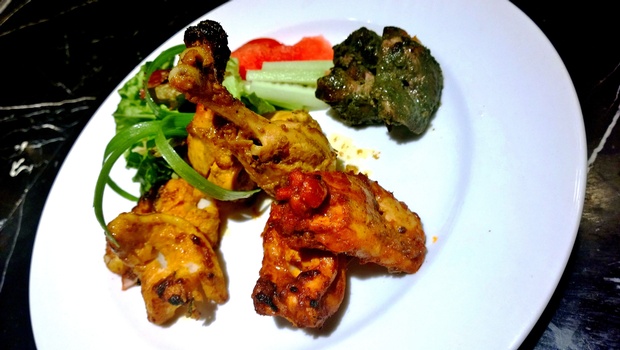
The lavish fare on offer at the festival includes mouth-watering reshmi galouti kebab, malai boti kebab, mutton nehari, murgh begum pasand, mutton dum biryani and murgh tursh pulao, among others for the non-vegetarians.

For vegetarians, paneer kebab, Izzati kebab, Shahi Korma, Chakundari Paneer, Kathal Stew, Kathal Biryani, and Kaju Biryani are on offer.

So, whether you are a vegetarian or a non-vegetarian, you can certainly dig in the platter on offer at the food festival and lick your fingers amid the lush ambience and strains of ‘qawwali’ singing in the background at the Radisson Blu hotel.

source: http://www.newindianexpress.com / The New Indian Express / Home> LifeStyle> Food / by IANS / July 29th, 2015

At last, Tipu armoury in ASI care

At this non-descript place hidden in the chaotic Kalasipalyam, Mysore ruler Tipu Sultan had stacked his ammunition cache. The 200-year-old armoury of Tipu Sultan behind Bangalore Medical College, which till now was treated like nobody’s baby, will soon be taken over by the Archaeological Survey of India (ASI) and declared a protected monument.

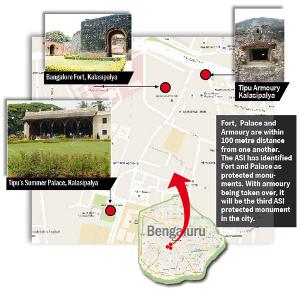
Fort,  Palace and Armoury are within 100 metre distance from one another.  The ASI has identified Fort and Palace as protected monuments. With armoury being taken over, it will be the third ASI protected monument in the city
Fort, Palace and Armoury are within 100 metre distance from one another. The ASI has identified Fort and Palace as protected monuments. With armoury being taken over, it will be the third ASI protected monument in the city

It will be the third ASI-listed protected monument in the city after Tipu’s Palace and Tipu’s Fort, all situated near KR Market.

The three monuments – armoury, palace and fort – are situated within a 100 metres of each other. Commissioner, state department of archaeology, museums and heritage, C G Betsurmath wrote to ASI approving the takeover about three weeks ago.

For several years now, the armoury has been in news, albeit for wrong reasons. Lack of upkeep resulting in condition of the structure deteriorating; the unkempt place turning into a gamblers’ den; the state archaeology department and BBMP passing on the buck of responsibility to each other, and so on. Only in 2002, it was, that the 18th century armoury saw some conservation by Indian National Trust for Art and Cultural Heritage (Intach), Bangalore Chapter. The not-for-profit non-governmental organisation shifted a retaining wall and exposed the original steps leading to the monument after removing the compound wall. A toilet illegally built on the southern wall of the structure was also removed.

Of the recent development, Arun Raj T, superintending archaeologist, ASI, Bengaluru circle told Bangalore Mirror: “The state government wrote to us saying they have no objections in ASI taking over Tipu’s Armoury. It is good news and a result of continuous effort of Intach. This is the first step and we have a process to follow. We will have to write to our Delhi office and complete some formalities with the Bruhut Bengaluru Mahanagara Palike. Given the historical importance, it is necessary to protect the armoury and connect the three monuments (fort, palace and armoury) as these three are remnants in the city that date back to Tipu’s period.”

However, there is a small hitch – a school building adjacent to the armoury. ASI and BBMP will have to conduct a joint survey of the place and find a solution. “The school almost abuts the armoury and once the armoury is declared a protected area, the school will have to be vacated considering that a buffer has to be maintained around our monuments. In that case, we would need BBMP’s help in relocating the school,” added Arun Raj.

Intach, Bangalore Chapter, which has campaigned for the armoury is overjoyed. In fact, a month ago, Intach had written to BBMP suggesting that they hand over the armoury to ASI. “ Once it is declared a protected monument, there will be no threat to the armoury in terms of encroachment and will be well maintained. We have been pushing for this for a long time and finally, the move has come through,” said Meera Iyer, co-convener of Intach.

History has it that this armoury was built below the ground level to store ammunition and the structure style is so relevant that it still being followed by the army. Armoury also called magazine is always built below the ground level, has just one entrance and is not exposed to the outside world by growing grass on the exteriors.

According to historian Suresh Moona who has chronicled the city’s history, this armoury in Kalasipalyam housed missiles and ammunitions and in a nearby area, Taramandalpet, rockets were experimented. Taramandalpet is close to Jumma Masjid Road near Raja Market where Tipu’s missile manufacturing unit functioned. Every night, rockets would be fired, which looked like a cluster of stars in the sky – hence the name Taramandalpet.

Pride of the city

» Under ASI Bangalore Circle of ASI, there are 207 monuments.

» In Bengaluru, there are two ASI-listed monuments – Tipu Fort and Tipu Palace; Bengaluru district houses six monuments including the fort at Devanahalli and Hunting Lodge on Nandi Hills.

» Monuments in Hampi are the most well-known; Tipu’s properties in Srirangapatna have also become popular tourist attractions.

source:  http://www.bangaloremirror.com / Bangalore Mirror / Home> Bangalore> Others / by Kushala S, Bangalore Mirror Bureau / July 30th, 2015

Rabia will not serve tea any more

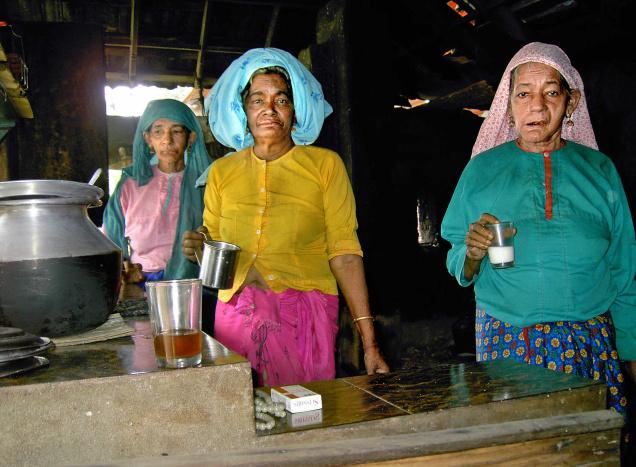
Rabia (middle) at her Makani at Panangangara along with her sisters.

The rustic hands which served thousands of people with tasty ethnic tea at a village makani at Panangangara near Perinthalmanna have stopped moving. Rabia, 70, will not serve any moretea either for the local people or the passersby.

Rabia passed away on Saturday, leaving behind a legacy of serving people with tea for over half a century. In fact, she served tea for generations.

The tea shop she managed on the veranda of her house on the Palakkad-Kozhikode highway at Panangangara had long become a talk of the village largely because of the unique taste of the tea she mixedand her simple behaviour. She was helped by her sisters Fatimakutty and Sulaikha.

Many a traveller, including foreigners, has had the taste of Rabia’s tea. Started 60 years ago by her late father T.K. Saithali, Rabia and her sisters insisted on carrying forward the Makani tradition that existed in Malabar. Although Makani does not mean anything more than a shop, the very mention of it in the villages of Malappuram brings memories of ethnic culture, language and food.

source: http://www.thehindu.com / The Hindu / Home> National> Kerala / by Abdul Latheef Naha / Malappuram – July 26th, 2015

To see notes from Mughal era, head to Rampur Raza Library

Rampur :

The Rampur Raza Library is renowned globally for its collection of ancient manuscripts from South Asia. The library has now organised an exhibition of Qurans, inviting scholars to view ancient manuscripts of the holy Quran in the month of Ramzan.

Some of the manuscripts on display are among the oldest pieces of Arabic calligraphy. A 7th century Quran written on parchment in the early Kufic script, attributed to Hazrat Ali (d. AD 661) is on display. Viewers are lining up to see this rare manuscript.

An 8th century manuscript of the Quran is attributed to Imam Jafar Sadiq, whose unique penmanship is widely appreciated.

A 9th century script is attributed to Imam Abul Hasan Musa, who served as prime minister to three caliphs of Baghdad. He died on July 20, 941 AD. His Quran is in the early Naskh style, popular in the 10th century. This form of calligraphy continues to be in vogue, with some changes.

Maulana Mohammad Irshad Nadvi, who is coordinating the exhibition, said, “The library also has a copy of a Quran written by master calligrapher of the 13th century Baghdad, Yaqut-al Musta Simi. It is decorated in gold and precious lapis lazuli.”

Nadvi said another masterpiece of Arabic manuscript by this calligrapher, titled Diwan-al-Hadira and dating to 1221 AD is part of the royal library of Sultan Ibrahim Adil Shah of Bijapur.

The exhibition also displays calligraphy in Arabic that created its own pseudo-geography, with exquisite and richly illustrated figures of human beings, animals and birds. Some of this came from the pen of 13th century calligrapher Zakaria bin Mahmud al-Qazvini.

Among the assets of the library on display is the Arabic manuscript Sharhal-Kafia of Razi. It bears marginal notes by Nawab Sadullah Khan, prime minister of Mughal emperor Shah Jahan. Among the many seals on this manuscript is one of emperor Aurangzeb.

Jacob Thorek Jensen, who is visiting the exhibition from Denmark and serves as advisor to a Danish culture agency, said, “This is a brilliant show of the elaborate calligraphy of writers of the Quran.”

Library spokesman Himanshu Singh said visitors to the library and the exhibition come from different faiths.

source: http://www.timesofindia.indiatimes.com / The Times of India / Home> City> Bareilly / by Nazar Abbas, TNN / July 16th, 2015

All India Milli Council President call for peaceful celebration of Ramzan

Moon Committee to meet today evening

MilliCouncilMPOs23jul2015

Mysuru :

The President of All India Milli Council Mysuru, Hazarath Moulana Mohammed Zakaulla Siddiqi has urged the Muslim brethren to celebrate Ramzan peacefully.

Hazarath Moulana Mohammed Zakaulla Siddiqi speaking to SOM said that during the holy month, Muslim brethren fast and offer prayers for peace and well being of everyone and added that donation of 2.5 percent of the total earnings in a year is given to the poor and urged the Muslim brethren to donate 2 kg wheat or its cost to the poor before offering prayers at the Eidgha Maidan on the day of Ramzan.

In his message, Hazarath Moulana Mohammed Zakaulla Siddiqi urged the Muslim brethren to live as per the Shariath of the Prophet, live peacefully, spread the message of peace and harmony and walk in the way which the Holy Quran has showed.

Moon Committee to meet today : Meanwhile, a meeting of the Mysore District Hilal (Moon) Committee, has been convened at the office of the District Waqf Advisory Committee, Muslim Boys’ Orphanage Campus, New Sayyaji Rao Road, Mysuru, today, after Namaz-E-Maghrib at 7pm to sight the Eidul Fitar (Ramzan Festival) Moon and to declare the celebration of Eid. The Public is requested to contact the Hilal Committee personally or the telephone numbers mentioned below to inform the sighting of moon to the Committee with sufficient witnesses or to get the information regarding sighting of Moon according to the press release from Ariff A. Mehkri, Chairman, Mysore District Wakf Advisory Committee who is also the Convenor of the Mysore District Hilal (Moon) Committee.

For details contact Ph: 0821-2423520, Mob: 94498-18786, 98869-69882.

source: http://www.starofmysore.com / Star of Mysore / Home> General News /  Friday – July 17th, 2015