Category Archives: Arts, Culture & Entertainment

Book explores the history of Nagore dargah

Chennai :

When the Tanjore king Achuthappa Naik (1560-1614) was bedridden after he suffered a paralytic stroke, many believed it was due to some black magic. The matter was informed to a visiting saint who eventually restored the king to health. Whether one believes in miracles or not, Nagore still thrives on it.

“Nagore is known for its religious harmony for more than 500 years. It is all because of the saint Qadir Wali who is enshrined there in a place widely known as Nagore dargah to which people of all religions throng with faith and problems. The miracle has been happening since 16th century and it still continues,” said A S Mohamed Rafee, author of the recently released book, “The Ocean of Miracles: Life of Qadir Wali”.

Qadir Wali travelled to many parts of the world and stayed in Mecca, Medina, Turkey and Palestine for many years before he came to Nagore where he lived for 28 years. “At a time when the world is facing serious threats in the name of religion, it’s remarkable that Nagore still survives on harmony, a reason why more sandal smeared heads are seen in the Sufi dargah. Wali served the people of all religions with his miraculous powers,” said Rafee, who is associate professor at the Mazharul Uloom College, Ambur.

Qadir Wali was born in 1504 in Manikkappur, a town established by Firoz Sha Tughluq in Uttar Pradesh, some 60 km from today’s Ayodhya. His parents, Hasan Guddus and Fatima, were descendants in the lineage of Prophet Muhammad and Abdul Qadir of Jilan, a great saint of the 12th century in Iraq.

Nagore dargah was built on land donated by king Achuthappa Naik. Many important parts of the dargah were built by the generous donation of non-Muslims, a reason cited why it’s a symbol of religious harmony. “The dargah has five minarets and the tallest one is called Periya Minar. It is 131 feet high with ten storeys. It was built by king Pratap Sing of Tanjore (1739-17633) after his wish for a son was fulfilled by praying to Wali 200 years after his passing away. The Peer Mandapam was built by the Dutch.

source: http://www.timesofindia.indiatimes.com / The Times of Ibdia / Home> City> Chennai / by M T Saju, TNN / February 09th, 2015
Nawazuddin Siddiqui, Kailash Kher Get Yash Bharti Award

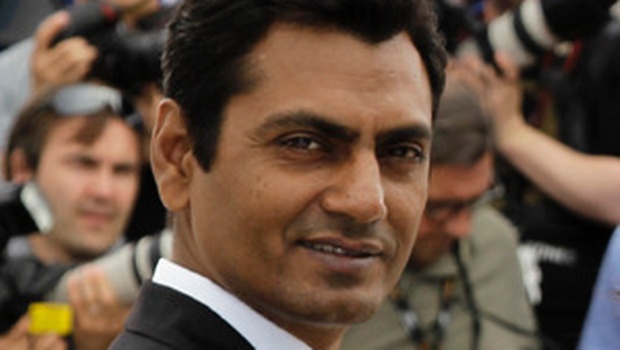
Nawazuddin Siddiqui | AP photo

Lucknow :

Actor Nawazuddin Siddiqui and singer Kailash Kher received the Yash Bharti Award by Uttar Pradesh Chief Minister Akhilesh Yadav here Monday.

Kher, whose musical notes echo originality and calmness, took to micro-blogging site Twitter to share the news and thanked the state government for the recognition.

“@achlendra: CM @yadavakhilesh honours singer @Kailashkher #YashBhartiAward function in Lucknow on Monday. Thank u,” he wrote.

Nawazuddin, who has garnered appreciation from all quarters with his critical performances in “The Lunchbox”, “Miss Lovely”, “Kahaani” and “Gangs of Wasseypur”, was also lauded for his contribution to Indian cinema.

“Today we received #YashBharti Award by UP CM @yadavakhilesh. My old friend @Nawazuddin_S also got one. Thank u all,” Kher tweeted.

The “Teri deewani” hitmaker also shared photographs of the ceremony.

The Yash Bharti Award is conferred by the Uttar Pradesh government for excellence in literature, fine arts, folk music, classical music, cinema and sports.

source: http://www.newindianexpress.com / The New Indian Express / Home> Entertainment> Hindi / by IANS / February 09th, 2015

Flavours of the Lesser Known

Shaad Hassan Damudi
Shaad Hassan Damudi

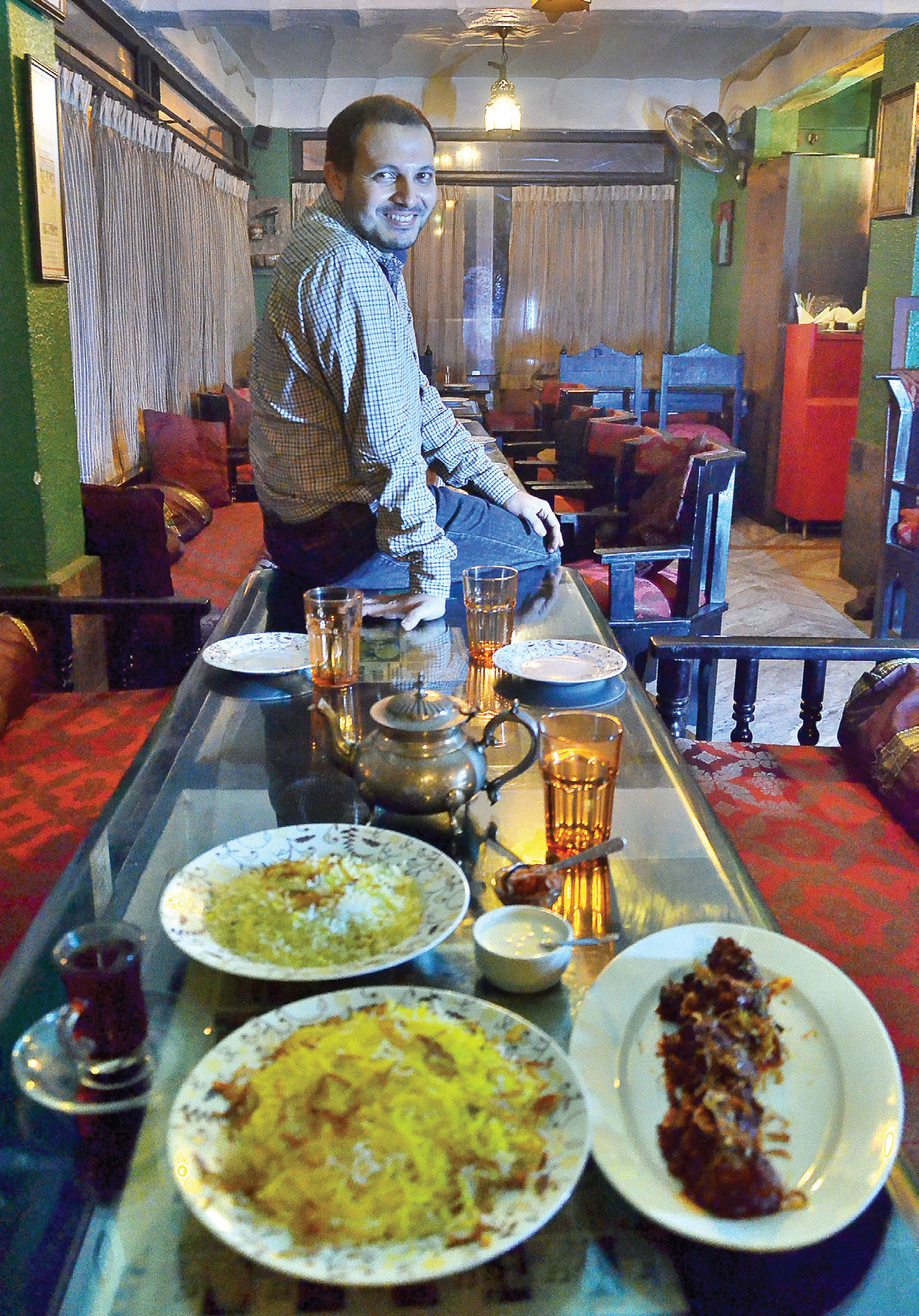
Ali Baba, a small cosy eating place in Frazer Town, Bengaluru, is where you get some Persian and Arabian food at reasonable prices. But what its USP is that its young and handsome owner, Shaad Hassan Damudi, is a Bhatkali Muslim and serves up some authentic Bhatkali food. Bhatkal is a small town in Southern Karwar district of Karnataka and has a rich and relatively unknown cultural and culinary history. The Muslims there are called Navayaths or new people. The Navayaths speak a dialect called Navayathi which is a fusion of Sanskrit, Persian, Arabic, Marathi, Hindustani with Konkani as its base.

Traders from the Persian Gulf—namely Yemen, Iran and Iraq—who traded mainly in horses, textiles, timber, gemstones and spices, eventually settled on the Konkan coast and contributed to the cuisine that is a ménage of Indian, Persian and Arabic cultures.

The most famous dish has got to be the delightful Bhatkali Biryani, half-cooked in steam. Damudi uses Sella basmati rice which is an aged rice and is exported to the Middle East and hence not available in India. “We use a lot of browned onions and tomatoes, and a red chilli paste which add colour. Our food is moderately spicy and whole garam masala is added to biryani which is layered with rice and then the onion, tomato, ginger garlic and garam masala mixture,” says Damudi.

Popular TV foodies—Rocky and Mayur of Highway on my Plate fame—recently visited Ali Baba and gorged on the Bhatkali food and featured it on one of their shows.

The kadang fry is a must-try for vegetarians, its sweet potatoes with the ubiquitous red chilli paste, an interesting blend of sweet and spicy flavours. The boneless chicken tikka cooked on a barbeque does remind me of tandoori chicken but the red chilli paste gives it that distinctly Bhatkali flavour. The people here use vinegar made from sugarcane which is used in salads as well as in finely cut onions as an accompaniment. The predominant flavour of the Chicken Khurma at Ali Baba is sweet.

True to its Indo-Persian origins, this dish is creamy and smooth, thickened and enriched with cashew nut paste. However, the addition of one quintessentially coastal south Indian ingredient—coconut milk—not only sweetens it, but also stamps it as a Navayathi.

Gawa Shaiyo was a pleasant surprise. It is wheat vermicelli with mutton in it. The mutton is amazingly tender, delicately spiced, and enhanced by the nutty flavour of fried wheat vermicelli. For those who thought vermicelli was used only in vegetarian dishes and to make kheer, this should come as a delicious revelation.

The piece de resistance is the vermicelli chicken biryani which is simply mouth-watering, surprisingly light and does not need any accompanying gravy or burhani or raita. “This biryani is best when made with chicken and not mutton,” says Damudi. The prawn fry is pretty crunchy being deep fried with a bit of cornflour added, along with the red chilli paste. Surprisingly, hardly any coconut is used in Bhatkali cuisine.

Tausha sherbat is made with grated cucumbers to which a wee bit of sugar is added. The cucumber releases its own water and this delightfully and refreshing simple drink is ideal on a hot summer’s day. All you need is a spoon to dig into it.

The desserts are pretty exotic. One made from, hold your breath, dill leaves with condensed milk and eggs reminds one of good old caramel custard. It is steamed and very tasty, except for its light green colour!

The ambience is exotic with doors and other accessories from old homes in Bhatkal innovatively used as table tops and decorative pieces. Pricing is reasonable and portions pretty generous.

source: http://www.newindianexpress.com / The New Indian Express / Home> LifeStyle> Food / by Sangeeta Cavale Radhakrishna / February 07th, 2015

Evergreen at 80

Noted Kannada poet Prof. KS Nissar Ahmed. / The Hindu

Bhagavatharu has organised ‘Nityotsava Kavige’ on February 8 to mark the 80 birthday of Prof. K.S. Nissar Ahmed. The event will begin with ‘Nissar Ahmadara geethegalu’ at 10 a.m. and go on till 8 p.m at Nayana auditorium, Bangalore. Dr. Prabhushankar, writer, will preside over the inauguration ceremony.

The event will feature seminars on Nissar Ahmed’s writings, a book release, a musical performance and poetry reading. Nissar Ahmed will be felicitated at 6 p.m. ‘Bhavanubhava Samyoga’, authored by P.V.Narayana, will be released by Prof. Baragooru Ramachandrappa, culture critic.

source: http: //www.thehindu.com / The Hindu / Home> Features> Friday Review / February 05th, 2015

Coorg girl and Kashmiri Boy win Clean & Clear Times Fresh Face 2014 in Mumbai

In a nail-biting national finale, MM Rashmika from MS Ramaiah College of Arts, Science and Commerce, and Zaid Shaikh from Ness Wadia College of Commerce were chosen the winners. 

Akshay Kumar with winners

With the handsome Akshay and Rana in their midst and Ankit Tiwari closing the evening with a soulful show, the audience were in for a memorable evening. For the contest, the girls were dressed in creations by designer Masaba Gupta and Nisha Sainani, while the boys sported designer Kunal Rawal’s dapper outfits.

source: http://www.timesofindia.indiatimes.com / The Times of India / Home> Entertainment> Events / by Garima Sharma, TNN / January 28th, 2015

Time to bring back Nizams’ jewellery

Unlike the Congress functionaries who did not fail to spew venom against the last Nizam Mir Osman Ali Khan whenever they got an opportunity, Telangana CM, K Chandrasekhar Rao, has been underscoring the developmental work done by the late Nizam. At the inauguration of Numaish on January 1, the CM once again highlighted the ways in which the Nizam tried to make Hyderabad a modern city. Among other things, he also spoke about the farsightedness of the Nizam in leasing out land for the Exhibition Society some 75 years ago. One of the things that KCR can do on a priority basis to restore the glorious heritage of the formerly Hyderabad state is to bring back the marvellous jewellery of the Nizams that is locked up in the RBI vaults for several years. This can be done amicably with little bit of cooperation between the Centre and Telangana governments.

Australian writer John Zubrzycki who has written two books on the Nizams, said sometime ago that Hyderabad was the natural choice for keeping the jewellery, and not the vaults of RBI.

Mir Osman Ali Khan after merging his state with the Indian Union in 1948, created over 50 trusts in 1951 to safeguard his own interest and that of his progeny. One of the most reputed among these trusts was the one that dealt with the jewellery. HEH the Nizam’s Jewellery Trust became the proud owner of 173 pieces of jewellery, 22 pieces of unset emeralds and the famous 184.5 carat Jacob diamond. According to observers of the Royal dealings, what became part of the trust was only a fraction of the wealth of the Nizam who was declared the richest man in the world in 1937. At the time of the formation of the trust there were 42 beneficiaries with Nawab Mukarram Jah holding the largest share. After the Nizam’s death in 1967 the trustees wanted to sell the jewellery as they felt that the family of the Nizam had fallen on bad times. Following enquiries, the trustees felt that the jewellery would fetch about Rs 10,000 crore if it was sold in the international market. But the Government of India (GoI) did not like the ideas as it felt that the jewellery was part of the national heritage. A long legal battle ensued between the government and the trustees. Finally, accepting the arbitration of A K Sen the trustees agreed to sell the jewellery to the government for Rs 206.49 crore. After tax deduction, the trustees were given Rs 165.5 crore in 1995.

The GoI organised a successful exhibition of the fabulous jewellery in Delhi followed by one at Salar Jung Museum in Hyderabad in 2001-2002 which drew about 2 lakh visitors including a large number of foreigners. The show was put up again in 2005 and 2007 when the number of visitors touched nearly 3 lakh. The government of united AP during the times of N Chandrababu Naidu as well as Y S Rajasekhara Reddy wrote many letters to the Centre to shift the jewellery to Hyderabad. They said that the GoI could retain the ownership but should allow the state government to put the jewels on display, since they formed part of the heritage of Hyderabad. A list of possible locations was drawn up subsequently that included Chowmahalla Palace, State Museum in Public Gardens, Jawahar Bal Bhavan in Public Gardens, Kela Bazaar land adjacent to SJM and the SJM itself. None of these locations were acceptable for some reason or the other.

Finally in 2009 the state government agreed to hand over the old municipal corporation headquarters where the Quli Qutb Shah Urban Development Authority is located to the tourism department for the construction of a new building to host the Nizams’ Jewellery gallery. The state government also agreed to bear the cost of construction as well as the recurring cost of maintaining security at the jewellery exhibition. Though all disagreements between the two governments were resolved the project did not move forward. No explanation has ever been offered on why it was stalled though.

This matter should be raked up by KCR now, given that he already has a well prepared plan (drawn up in the past). All he has to do is exercise his authority to ask the tourism department to begin construction of the gallery and ask the Centre to fulfil its promise of shifting the jewellery.

The Hyderabadis hope that KCR will prove his sincerity towards the city he always praises by expediting the return of the Nizams’ jewellery.

source:  http://www.thehindu.com / The Hindu / Home>  City> Hyderabad / by Mir Ayoob Ali Khan / January 25th, 2015

The tale of the idli

If I say the idli was brought to southern India by Arab settlers, it could raise hackles, especially among South Indians. But the truth cannot be suppressed. References to the modern way of making the idli appear in Indian works only after 1250 CE.

K.T. Acharya, the food historian, speculates that the modern idli might have originated in the region that is now Indonesia, which has had a long tradition of fermented food. According to him, cooks employed by the Hindu kings of the local kingdom may have invented the steamed idli there, and brought the recipe to India during the period 800-1200 CE. But this theory is being questioned by modern food historians such as Lizzie Collingham, Kristen Gremillion, Raymond Grew, Makhdoom Al-Salaqi (Syria), Zahiruddin Afiyaab (Lebanon). References available at the Al-Azhar University Library in Cairo also suggest that Arab traders in the southern belt brought in the idli when they married and settled down in those parts. Now the question is: how did that happen? It is known that Arab traders used to come to the southern coast for trade, and that pre-dated even the advent of Islam. The first mosque outside the Arab peninsula was erected by Arab settlers who came here as traders.

The Arab settlers were strict in their dietary preferences; many of them came here when Mohammed was still alive and they were neo-converts to Islam from Paganism. They insisted on halaal food, and Indian food was quite alien to their palate. To avoid all such confusion regarding what is halaal orharaam in food, they began to make rice balls as it was easy to make and was the safest option available. After making the rice balls, they would slightly flatten them and eat with bland coconut paste (Encyclopaedia of Food History, edited by Collingham and Gordon Ramsay of Britain, Oxford University Press, and Seed to Civilisation, The Story of Food, by Heiser Charles B, Harvard University Press, 1990). Later it was improved upon, and from the 8th century onwards, the idli in its modernavatar came into existence.

sumitmaclean@hotmail.com

source: http://www.thehindu.com  / The Hindu / Home> Opinion> Open Page / by Sumit Paul / February 01st, 2015

A spelling bee with a difference

Winners of the spelling bee contest: (from left) Bindu Shree (3rd place), Sandhya (2nd place), Archana N.S. (1st place), Syed Arbaz (4th place), and Vishwanath R. (5th place). / The Hindu

The air is thick with tension as students from 23 schools across the city struggle to get their words right.

“How do you spell Gemini?” a judge asks Preethy of Madivala Government High School. She hesitates and asks for a Kannada translation, then proceeds to answer correctly, amid loud claps and cheers.

It was the sixth year that Sahasra Deepika International for Education (SDIE) was holding a spelling bee competition for Class 9 students of Kannada-medium government high schools across the city.

It is unique in many ways: the students do not come from top private schools and many cannot speak English beyond constructing basic sentences. As many as 92 students were drawn from 23 schools as part of a programme to impart English grammar and vocabulary skills among Kannada-medium students. They performed admirably, tackling words from ‘celebration’ and ‘vague’ to ‘heliocentric’ and ‘echinodermata’. The winning word was ‘chorus’.

“We want to give these children an opportunity to be on stage, and to gain confidence through such competitions,” says Vijayalakshmi Ramakrishnan, founder and treasurer of the SDIE. “Some of these kids have never celebrated a birthday. Some do not get English textbooks until the end of the school year.”

The goal is to try to ensure that these children do not feel left out, she says, pointing out that without a working knowledge of English, the children have little chance of getting jobs in the future.

The winners of the event are: Archana, Krishna Iyer School; Sandhya, Honnagonahatti Government High School; Bindu Shree, Honnagonahatti High School; Syed Arbaz, Fort High School, and Vishwanath Doddagolarahatti Government High School.

source: http://www.thehindu.com / The Hindu / Home> News> National> Karnataka / by Cinthya Anand /Bengaluru – February 01st, 2015

If you missed Tansen, listen to his descendant

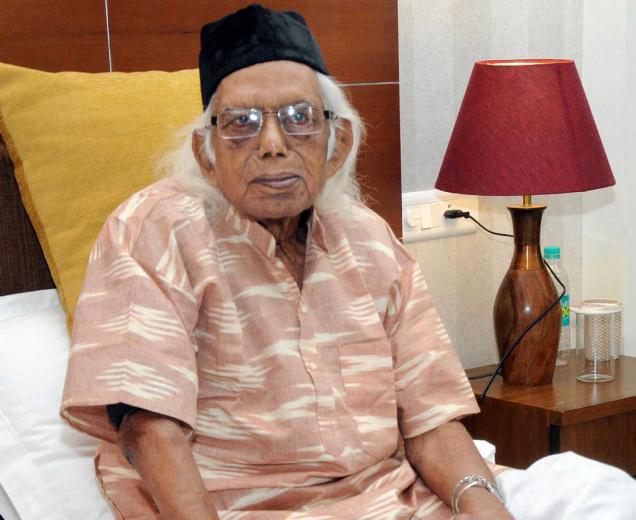
Abdul Rashid Khan will perform at Sursagar’s ‘Living Legends and Budding Masters’ series at Alliance Francaise on January 30 at 6.30 p.m. — Photo: Sampath Kumar G.P.

Ustad Abdul Rashid Khan (107), based in Kolkata, was the oldest living legend to be bestowed Padma Bhushan

He is the direct descendant of Tansen and has been performing for 75 years. He has performed nearly 3,000 concerts and composed 2,000 bandish , which are being sung by leading Hindustani musicians. In 2013, when he was conferred the Padma Bhushan, he was the oldest living legend to be bestowed the honour.

“I am Ustad Abdul Rashid Khan, 107 years young,” declares the maestro jokingly. “Some members of my family have lived up to the age of 110 and beyond,” he says.

Born in 1908 at Salon near Rai Bareli in Uttar Pradesh, Rashid Khan is the son of Chote Usuf Khan of the Gwalior Gharana. He is the 23{+r}{+d}generation of Tansen’s family and traces his ancestry to Surat Sen, one of the maestro’s four sons.

“My father, and uncle Bade Usuf Khan, trained me in a 10-hour schedule that was followed by a four-hour riyaaz (practice) every day for 22 years.

“Only when I touched 30 did my gurus allow me to step on a stage. That was the kind of integrity we followed,” says the Ustad, who once had Zakir Hussain, then 16, playing the tabla.

After obtaining a degree from Allahabad University, Rashid Khan went to Rae Bareli. He performed a slew of concerts in every nook and corner of India. “I have performed at every maharaja’s court in pre-Independent India. Rae Bareli alone had 22 maharajas and each would demand a particular raag ,” he says recollecting the traditional four to five hour concerts that were in vogue then.

In 1991, he was specially invited by the ITC Sangeeth Research Academy in Kolkata to take over as the senior guru. He has been teaching there for the last 25 years. His traditional compositions have been recorded by the BBC and Iraq Radio.

The UP Sangeet Natak Academi and the ITC Sangeet Research Academy have more than 1500 compositions of the ustad in their collection.

And the secret of his longevity?

“All we know is that he prays five times a day,” says grandson Bilal Khan, who accompanies the ustad on the tabla.

source: http://www.thehindu.com / The Hindu / Home> News> Cities> Bengaluru / by Ranjani Govind / Bengaluru – January 29th, 2015

Is Mumtaz Mahal’s body mummified in Taj Mahal?

TajMahalMPOs30jan2015

The mystery surrounding Mumtaz Mahal’s burial at the Taj Mahal has deepened with a book claiming that her body was mummified.

Mughal emperor Shah Jahan built the 17th century Taj Mahal here in memory of his beloved wife Mumtaz who died while giving birth to their 14th child in Burhanpur, a town in what is now Maharashtra.

“The real truth about Taj Mahal was suppressed. If the truth had been revealed when Taj Mahal was being built, it would have become almost impossible to construct the monument,” Afsar Ahmad, author of the controversial e-book “Taj Mahal or Mummy Mahal” (Self-published, 200 pp, Rs.150), told IANS.

The journalist-turned-writer has also disclosed in the book what he claims are several unknown facts related to Mumtaz’s death.

The book has details about Mumtaz’s death and her last few days – and details the mummification of her body. Mumtaz was buried thrice – twice in a depository and then the final one.

But how was her body preserved during the period? Did the Mughals use the method of the ancient Egypt or was it some other procedure? Did the Mughal have a ritual of preserving dead bodies? But the biggest question the book tries to answer is if Mumtaz’s body is still preserved.

Ahmed said he wants to lift the veil and mystery surrounding the death and subsequent burial of Mumtaz.

Shah Jahan’s court writers could have shed light on the entire incident, but they could not do so as they were under instructions not to reveal anything which showed the emperor in poor light.

The author said the reader has the right to know the truth behind Mumtaz’s death and burial.

The e-book also tries to find answers if the Mughal only followed Islamic rituals and the different methods of burial. The book is available on Amazon in the Kindle format.

source: http://www.deccanherald.com / Deccan Herald / Home> National / IANS / Agra – January 28th, 2015