Nature enthusiasts and students gathered at a barrage on the river Kosi in north India, observing migratory birds on the occasion of National Bird Watching Day, celebrated to mark the 116th birth anniversary of renowned biologist Salim Ali.
Armed with binoculars, notebooks, field guides and cameras, they stood at the edge of the reservoir, making a note of the resident and migratory species present at the site.
The bird watchers said that it was important to educate people about the importance of conserving the country’s diverse fauna.
“We brought a few children who study in a local school, so that they can make themselves aware of bird life. The message for the people of the country and people in the world is that we must keep (these birds) alive, so that we learn about them and protect them,” said a birder, Rohit Sati.
The waters of the reservoir had large numbers of Ruddy Shelducks and cormorants swimming, feeding and sunning themselves.
The reservoir at Ramnagar is close to India’s iconic Jim Corbett National Park, which is home to over 500 species of birds, a sizeable chunk of more than 1200 species found all over the country.
Winter sees many species of birds migrate from north and central Asia and other, colder parts of the world, as the birds breed and live in the more temperate climate of the Indian subcontinent.
The Director of the Rainbow Wildlife Awareness organisation, Rajesh Bhatt said that the reservoir itself played host to over 200 species of resident and migratory birds.
“The important birds here are the Ruddy Shelduck, the Ibisbill, wallcreeper, cormorant, garganey, pintail, Bar-headed Goose, which can be seen easily,” Bhatt said.
Born in 1896, Salim Ali, known as ‘the Bird Man of India’, made his name as one of the first Indian naturalists to conduct systematic surveys on birds. His field guides are used by many birdwatchers when they set out in pursuit of the hobby.
Ali, who died in 1987, is also credited with the creation and recognition of such biodiversity hubs as the Keoladeo National park in Rajasthan and the Silent Valley National park in Kerala. (ANI)
source: http://www.aninews.in / ANI News / Home> National / November 12th, 2014
Diverse events are on the cards to celebrate the birth anniversary of renowned ornithologist Salim Ali, often observed as the National Bird Watching Day, on November 12.
The events are being organised by the Social Forestry wing of the Dept of Forests and Wildlife and World Wildlife Fund-India.
source: http://www.newindianexpress.com / The New Indian Express / Home> States> Kerala / by Express News Service / November 11th, 2014
Aeliya always had a passion for making things from scratch. “My romance with clay started when I was in college. I used to make jewellery with potter’s clay or terracotta and my creations were very popular on campus,” she recalls.
Slowly, Aeliya moved on to make things out of coal porcelain. “By then, I started using candle as a medium and would make flowers and insects like ladybirds and beetles on it,” she adds.
But once she graduated and started working in an MNC, she was left with little time to pursue her hobby. “But my hands would twitch even at work,” she laughs. So she would create things whenever she got some time off. “I also started making customised clay magnets and using my artwork on gel candles and started experimenting with different clays,” she says.
She then realised that she could do the same with edible ingredients. “I realised that there are certain food items that have the same quality and could be used for cake decoration. Slowly, I came across sugar or gum paste which is also known as fondant and thought why not make edible shapes with my passion. Also innovative cakes are a trend in the market nowadays and unique cake toppers add to their beauty,” she notes.
Soon after she had her second child, Aeliya left her corporate job and started pursuing her passion full-time. She used this period to sharpen her skills. “I didn’t go to any institute and learnt everything on my own,” she adds.
“My friends then told me that I might as well learn the art of baking. Though baking sounds like an easy process, it’s far from that. It requires a lot of scientific techniques which I learnt by reading. My brother-in-law, who is in London, sent me a book to learn more. He also started sending me cutters of different sizes,” she notes.
Today, Aeliya bakes amazing cakes and cupcakes with toppers that are equally stunning.
“Since cupcakes are in trend and a lot of people bake them, I like making unique cupcakes with floral toppings. I even make bouquets on them,” she explains. She even makes ‘Angry Birds’ and superhero-themed toppers like ‘Batman’. Name any theme and she can make a topper and cake as per that.
One her most beautiful works is the sandal topper. The delicate piece takes around two days to make. Explaining the process of creating the topper, she says, “I first cut the basic shape out on the paste with a knife and then fine tune it. I don’t use any mould to create the shapes. So on an average, each topper takes around two or three days. A shape like sandal takes a day to be created and then the finer details like fixing the buckle take another day.”
Aeliya’s toppers are so popular that she gets a number of orders. “If a person has something in mind, I tell him or her to send me a photograph. So I can make it according to their wish. My speciality is half-kg theme cakes,” she explains. She also enjoys experimenting with as many shapes as possible. “So far except one or two designs, I have never repeated myself,” she notes.
Another favourite design of hers, which is unique, is the handbag cake. “It’s something that college girls really like.” She gets a number of requests on her Facebook page — ‘Cake Toppers Shoppe Bangalore’ too. She perfectly sums up her love for making cake toppers as she says, “I have finally found my nirvana.”
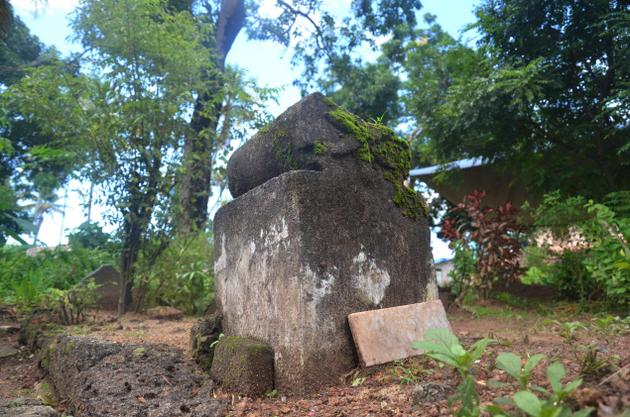
A view of the burial place of Makthi Thangal at Calvethy, Fort Kochi. Photo: Thulasi Kakkat / The Hindu
Syed Sanaullah Makthi Thangal, one of the earliest progressive Islamic scholars of Kerala, lies buried in the ancient Juma Masjid at Calvathy
In the middle of the khabaristan or burial ground adjoining the historic Juma Masjid at Calvathy, among the many grave markers, weeds and grass is one ancient grave. The tombstone is worn out and cracked, a row of laterite bricks mark out the grave, and a small neem plant has grown right in the middle. This is perhaps the only surviving memory of Syed Sanaullah Makthi Thangal (1847-1912), the famous Islamist reformer and author.
Historical documents reveal that Makthi Thangal was born at Veliyankodu, Malappuram district. But most of his creative pursuits and death happened in Kochi. He studied Arabic from his father Syed Ahmed Thangal and then enrolled at the Chavakkad Higher Elementary School. He went on to become an expert in Islamic studies and an expert in Malayalam, Arabic, Hindustani, Persian and Tamil languages.
He began his career as an excise inspector in the British government. This was a period when the Muslims in Kerala had not opened up to public education, were bound by superstitions, were gullible to accept anyone as their spiritual leader. Added to this was the government supported conversion threats. Thangal quit his job and plunged into public life. His mission was to help his community rise from the social and cultural depths into which it had fallen.
Thangal began writing, speaking and propagating his views that were bold, poetic, reformist and directed to benefit the Muslim community. Thangal wrote in the newspapers that were in circulation at that time, those that were ready to publish his articles and also published books on matters relevant to the community in British India. His speeches and all what he wrote turned out to be a clarion call to many who towed his line of thought. Thangal is considered to be the first Muslim to write, publish books and launch a daily newsletter.
Dr. C.K. Kareem, in his Kerala Muslim History, Statistics and Directory, Volume 1 (History of Kerala and of her Muslims), records that Thangal had to suffer a lot for his work. He quotes from Thangal’s concise autobiography, Makthi Manaklesham that gives a graphic account of his travails. The fierce attacks came from the conservatives within his community and from the British. But Thangal was not one to be cowed down by all this.
For nearly 30 years Thangal is said to have travelled the length and breadth of the State spreading awareness about the need for education, women’s empowerment, calling for a fight against superstition, conversion and non-Islamic beliefs.
Book cover of Makthi Thangal’s complete works / The Hindu
E. Moidu Moulavi, in his preface to the collected edition of Makthi Thangal’s works (Makthi Thangalude Sampoorna Krithikal) published by Kerala Islamic Mission, Tirur, states that Thangal must have written 40 books. Though he did not have the means, found no publishers, did all that on his own. Moidu Moulavi considers Thangal’s works as a value addition to the ancient Malayalam literary style and an invaluable historical document. What makes these works more important is when one considers the time during which they were written. The language may not have the finesse but certainly did not lack the power.
“Some of Thangal’s works like Kadora Kudaram, which was a resistance against the British supported religious conversions, Muslimugalum Vidyabyasavum that exhorted Muslims to embrace Malayalam and English education and Naari Narabhichari on the need for women’s education are all revolutionary, progressive works of a genius. As Dr. C. K. Karim observes and from what I have read they were brave views that shook the conformist mindset of the community. Thangal had to suffer a lot for his writings with many slapping court cases against him,” says M.A. Aboobacker, cultural activist.
What made Thangal unique was that he was the first reformist who studied the religious aspects of various religions before formulating his views. As historian M. Gangadaran notes Makthi Thangal as a reformist who used his vast knowledge to find a way out for the Muslim community from the darkness. He understood the significance of language and insisted that it should not be a barrier for Islam.
Failing health forced Thangal to settle down permanently in Kochi. He died on September 18, 1912. Among his many disciples and followers was C.V. Abdurahman Hydrose, editor of Malabar Islam. “Hydrose Sahib stayed at Darussalam Road. His father was also known to Makthi Thangal. It is said that Thangal presented his pen to Hydrose Sahib telling him that he has nothing else to give him and prayed that this pen would be helpful to him.
As Moidu Moulavi writes, Hydrose Sahib, true to the legacy he inherited, went on to publish many of Thangal’s works including Makthi Vijayam,” says Aboobacker.
Once in a while people visit Thangal’s grave, people who have read about him, who have read his works. “It was my friend Gaffoor who first told me about Thangal’s grave. I had read a lot about him and also some of his writings. In January 2013, when Gaffoor came down from Muscat, we went for the Biennale. We then decided to find out where Thangal’s grave was. It took us a lot of wandering, asking many people to finally find it. I feel Thangal who has contributed so much for nourishing and reforming the Muslim community deserves more”, feels R.P. Sivan, a Malayalam teacher at SRV High School.
Apart from a literary award instituted by an organisation in Makthi Thangal’s name there is nothing else to perpetuate the memory of this visionary reformer.
Perhaps, adapting Emily Dickinson’s lines, after a hundred years nobody would know this place. Weeds will rage triumphant, strangers will stroll past this lone tombstone, no one to tell them of the man buried there; lost to memory.
source: http://www.thehindu.com / The Hindu / Home> Features> MetroPlus> Hidden Histories / by K. Pradeep / Kochi – October 31st, 2014
Kashmir Book Trust Pvt Ltd today inaugurated its first online book store by the name “Online Book Store”.
The book store was inaugurated by Kashmir University Chief librarian AM Baba, Deputy Director, DIQA Showket Shafi and Director, Centre for Career Planning and Councelling Farooq Ahmad Khan at second floor Auqaf complex opposite Sir Syed Gate, Kashmir University.
During the inaugural function AM Baba while applauding the initiative said, “To have online book stores is the need of the hour. During the recent devastating floods many rare books were washed away, they would have been saved, had we made online editions of these books”.
“We started this endeavour in order to give an extra edge in education system in Kashmir keeping in view the various problems the Valley students face, who don’t have easy asses to subscribe e books. The students, who hail from far flung areas can also avail benefit from our free door to door delivery system”, said Sameer Nazeer and Mudasir Ahmad, Managing partners of Online Book Store.
source: http://www.dailyexcelsior.com / Daily Excelsior.com / Home / by Excelsior Correspondent / Srinagar – November 03rd, 2014
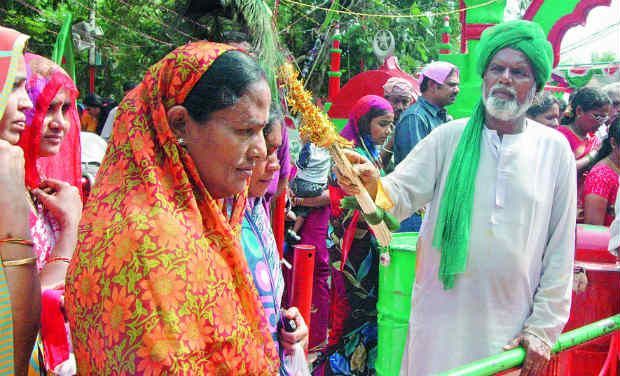
Thousands of devotees of all faiths from all corners of the state and neighboring states offered prayers at Bara Shaheed Dargah and exchanged rotis at Nellore Tank on the first day of Rottela Panduga
Nellore:
Thousands of devotees of all faiths from all corners of the state and neighboring states offered prayers at Bara Shaheed Dargah and exchanged rotis at Nellore Tank on the first day of Rottela Panduga on Tuesday.Water level in the Nellore tank has been increased from 10 feet to 12.5 feet by releasing water from Somasila for the benefit of the devotees. Police and expert swimmers mounted on special boats kept a tab on the devotees entering the tank to exchange rotis.
For the first time mobile E-Toilets have been arranged besides bathrooms exclusively for women. Officials have arranged temporary facilities and illumination at parking lots since hundreds of devotees have been sleeping at the parking lots itself during nights. Authorities have instructed the managements of colleges and educational institutions in the city to be ready to accommodate the pilgrims in case of heavy downpour.
source: http://www.deccanchronicle.com / Deccan Chronicle / Home> Nation> Current Affairs / DC Correspondent / November 05th, 2014
Megastar of M’Town, Mammootty has won the Lifetime Achievement Award in Kashmir Film Festival, 2014 for his contribution to Indian Cinema. Also his movie Balyakalasakhi, won its director Pramod Payyannur the award for the best director and script.
Meanwhile, Jordan movie ‘When Monalisa Smiled’ has been adjudged the best film and the Turkish movie Spring is Rebellious, won the award for the second best film in the feature.
source: http://www.timesofindia.indiatimes.com / The Times of India / Home> Entertainment> Malayalam> Movies / by Radhika C. Pillai, TNN / August 26th, 2014
Organised during Muharram, the Majlis or religious gathering serves as a reminder of the martyrdom of Imam Hussain and his 72 followers at the battlefield of Karbala. For women orators or zakiras addressing these gatherings, however, the majlis is increasingly evolving as a platform to espouse the cause of women’s rights and empowerment.
Taaj Bano, a zakira, considers her responsibility to educate azaadars (those who lament the death of Imam Hussain) that there is much more to a majlis than just the narration of atrocities faced by Imam Hussain.
“The ruthless battle of Karbala gives a strong message to the women of today teaching them how to live a life of dignity, understand their rights and duties by following the footsteps of Bibi Zainab, who despite all odds stood up against the tyrant ruler Yazeed,” said Bano, who has been addressing majlis since she was four.
In the bylanes of Raqabganj, zakira Massarat Fatima is deeply concerned over the increasing number of divorce cases. This year, she addressed azaadars on what should be the ideal the character of a mother and wife.
“The pious character of Bibi Fatima Zehra who never made any demand from her husband Hazrat Imam Ali initiated the nuances of Islamic studies in me,” she added.
Being a zakira is a matter of pride for Dr Naseem Subhi Rizvi who feels that a woman must receive the highest degree of worldly knowledge by seeking education in top most universities but remain close to her religion.
“Hadees (sayings of Prophet Mohammad) recited during majlis teaches working women to strike a balance between office and household chores,” she said.
source: http://www.timesofindia.indiatimes.com / The Times of India / Home> City> Lucknow / by Uzma Talha, TNN / November 03rd, 2014
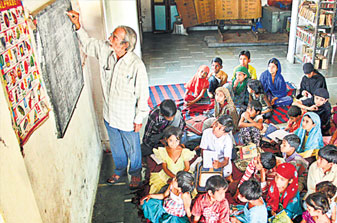
Dr Aziz Indori’s school is not affiliated to any board, but the curriculum is well thought through. Amit Jaiswal/HT Photo
It is 10 am sharp when Kavita, 13, reaches the school in Khajrana. The teacher may have been impressed with her punctuality, but quickly draws attention to her unkempt hair.
Tidiness is among the many lessons this sprightly teenager from the slums of Khajrana and 84 of her schoolmates are being taught at Indori’s Paathshala.
The school takes its name from Aziz Indori, 80, who scripted an education revolution in the heart of Madhya Pradesh’s commercial capital.
After retiring from the city’s Islamia Karimia Degree College in 1995, Indori took up the task of educating poor Muslim children. The doors of his school are, however, open to children from other communities also.
The retired Urdu teacher is a bundle of energy despite his age. His experiment with 10 children has blossomed in the last two decades. The two-storey school now accommodates eight times its original number of students going right up to Class 8. The school is not affiliated to any board, but the curriculum has been well thought through and gives the children of the local daily wage earners a shot at a better life.
Kavita recites multiplication tables up to 4, while her junior Anamika (another Hindu student) writes the English alphabet with a flourish. Daily wage earner Ghulam Mohammed, father of Firoz, 11, who studies in the school says, “I could not study much, but did not want my child to loiter on the roads. Given my means, I could not afford to educate him… then one day I came across Indori sahib’s school.”
Indori, a doctorate in Urdu, derives immense satisfaction from his work. “I have always stood for the education of the poor. Rich have the means and resources. Who cares for the poor?”
Indori chacha, as he is known to his students, says, “I want to break this tradition in the Muslim community that the child of a cart-puller will be a cart-puller.”
MP’s slide in the Annual Status of Education Report (ASER) 2011-12 — the largest survey of what children across the country are learning — makes Indori’s effort more praiseworthy. According to the report released in January, attendance in primary schools (Classes 1 to 5) of MP has dipped to 54.5% in ’11 from 67% in ’07.
Till date, Indori has not involved any politician or religious leader in his project. “It is with the help of 4-5 friends that I’m running this project.” His Muscat-based brother-in-law, Dr Abdul Rashid, donated the building that houses the school.
With age catching up, Indori has roped in two persons to care for the students. “One is paid Rs. 800 and the other R1,200 per month by my friends.”
The students, who make do with well-worn clothes, are provided stationery and winter clothing — all for a nominal fee of R20 per month. With no examination system, students are judged according to their daily progress. The system has worked. Nearly 20 of the school’s students have gone on to complete their matriculation, some of them from a state-run school in the locality.
An alumnus of the school, Parveen, who studied up to Class 10, says, “I am thankful to Indori chacha.” Parveen, who is getting married today, also got the opportunity to learn tailoring, and contribute to her family’s earnings, at another Indori initiative — the Jan Shikshan Sansthan. This is Indori’s effort to provide vocational training to girls in the slum. The programme already has more than 75 trainees.
Indori says, “I feel satisfied. I wanted to educate and make poor Muslim girls self-reliant. I didn’t want them to get just a degree, but also knowledge.”
source: http://www.hindustantimes.com / Hindustan Times / Home> / by Vijay Swaroop, Hindustan Times / Indore – May 03rd, 2012