Category Archives: Arts, Culture & Entertainment

Jammu and Kashmir: What an artist in Srinagar managed to save from the floods

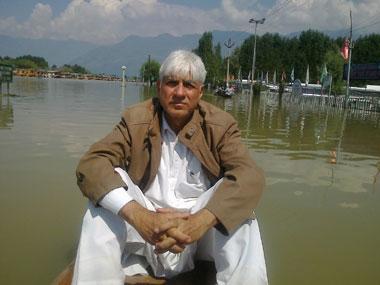
MasoodHussainMPos22sept2014

by Chitra Padmanabhan

Conversations carried out in fleeting moments of phone connectivity have a timbre their very own. More so if they take place against a backdrop such as the recent inundation of Srinagar by a swollen Jhelum River. But if the person conversing from the other end happens to be the Srinagar-based artist Masood Hussain, renowned for the luminosity of his culturally rooted works, then the conversation is moulded by unfailing grace under pressure so typical of the gentle 61 year old and so familiar to anyone acquainted with him.

So, what starts as a flurry of phone calls to ascertain the whereabouts of Masood saheb and his family in flood-ravaged Srinagar eventually turns into a ‘serialised’ conversation. Always shy of drawing attention to himself, the artist initially speaks of the year-long work of seven paintings that he had completed barely two weeks before the flood. The paintings are based on seven unpublished couplets that were given to him by the iconic poet Agha Shahid Ali during his Srinagar visit 15 years ago.

Shortly after, Shahid returned to the US where he later succumbed to cancer. Masood vividly remembers the day Shahid handed him a couple of pages saying, “I want you to paint on the theme of these couplets whenever you have the time.” The couplets, on the seasons of Kashmir, resonate with layered meanings, says Masood who quotes their titles: ‘When It is Early Spring,’ ‘The Elements Conspire,’ ‘Autumn Refrain in Kashmir,’ ‘Early Winter,’ ‘Deep January,’ ‘At the Gates of Paradise,’ and ‘The Blossoms Return.’ He mentions Shahid’s couplet, ‘The Elements Conspire,’ in particular: They conspire so that someone, on the shores, awaits the vendor of flowers/And the other side of the earth awaits Kashmir’s sun, its message that water and fire are at peace.

The artist, whose tactile works evoke Kashmir with an intensity that matches the poet’s oeuvre, regards these large-format acrylic and oil paintings among his finest works. “So, on August 29, when I left for Tanmarg, 40 km from Srinagar, to attend a national camp for artists, I was in a lighter frame of mind than I had been for several months.”

However, he returned from the artist’s camp a day earlier, on September 3: “It just did not stop raining and I was anxious because Jawahar Nagar, where I stay, is situated between a flood channel and the Jhelum,” he explains. “In the next few days every time my wife and I looked out of the window, the Jhelum’s water level seemed to have risen, but no one knew what was happening or what to do. Nothing in our past experience had prepared us for what was coming,” says Masood.

The next thing that Masood remembers is the Jhelum River, a familiar enough presence in his canvases, turning unfamiliar, reducing lives and homes to flotsam, erasing a lifetime of landmarks and all vestiges of administration; moreover, reducing a 21st- century existence of connectivity to an enervating isolation in a state already marked by constantly high levels of anxiety.

By 1 am on September 7, nearby areas such as Lal Mandi were surrounded by water. Fearing that Jawahar Nagar would be next, at 2 am Masood and his wife drove their daughters to his sister’s house in Shalimar “which is on somewhat higher ground.” They returned another way to avoid flooded areas but when they got off at Zero Bridge to walk the distance to Jawahar Nagar they found a familiar landmark, the popular restaurant Hat Trick, standing like a forlorn island in a watery expanse. After wading through knee-deep water for 100 metres, Masood and his wife reached their house where his younger brother, Nasir, and sister-in-law were waiting for them.

The first thing that Masood did was to rush to his first floor studio, hoist the new paintings on his shoulder, each a seven-foot- long roll of canvas, and trudge to the attic on the second floor. “I wondered if they would remain safe,” he admits.

The pictures Masood took on his phone gave him a precise timeline of events. “On Sept 7, 11.34 am our ground floor was submerged and the compound wall of our neighbour Mr. AK Kaul, a famous dentist, came crashing down,” he recalls. Between 1 pm and 1.15 pm, two neighbouring houses sank to the ground. Since Masood’s house, too, was an old construction like those buildings and the water had reached the first floor, at about 1.30 pm he decided to move out. The floodwater was 18 to 20 feet high. “Luckily my brother had two inflatable boats he keeps for fishing purposes with a seating capacity of one and two people.”

They rowed their wives over to a four-storeyed house of recent vintage about 200 metres away that was owned by businessman Haji Bashir Ahmed, “a stranger who put his home at our disposal with rare generosity,” remembers Masood. Then the brothers made rounds of the neighbourhood. They first rescued the Kauls whose heads were barely above water, then an aged Sikh couple and an ex-DG Police, Peer Hassan Shah in his 80s. In an even tone Masood recounts a moment of panic when one of the air chambers in the boat developed a puncture as he was ferrying the old and ailing Mrs. Qureishi but “somehow I managed.”

Those who could wade through the water and climb the staircase to Haji Bashir’s house did so. Masood ferried the others to another terrace with an external staircase 45 metres away, also belonging to the businessman. “Old Mrs. Qureishi was in a bad way, but it was the ex-DG’s guards who were whimpering because they could not swim,” recalls Masood.

It took them four hours to shepherd about 40 people to the two terraces by which time the light had started fading, says Masood. One boat was completely punctured; the other one had only one functioning air chamber. While Haji Bashir’s terrace, including Masood’s family, had access to the amenities of a running establishment such as food, water and blankets, Masood and 16 others on the smaller terrace had nothing whatsoever. A sense of shock, the clammy air and lack of blankets made the night of September 7 seem unduly long to them. “We gathered some wood lying around. Mr. Kaul’s daughter- in-law had a matchbox with which we lit a fire. There was no one to see that Pandits, Sikhs and Muslims faced the creeping cold together in a huddle of humanity.”

Next day, the artist fashioned a ropeway with steel wire between the two terraces. Soon baskets bearing food items, blankets and water were sent from the main terrace to the smaller terrace. Later, Masood risked going in the big boat to the main house. On September 9, after two nights and two days on the terrace, the artist and others were airlifted by an Indian Air Force helicopter to a camp near the airport where they stayed overnight. Masood proudly relates that his brother stayed back to rescue more people, “rowing as far as 300 metres to find people. He is 10 years younger than me and has more energy, hai na!”
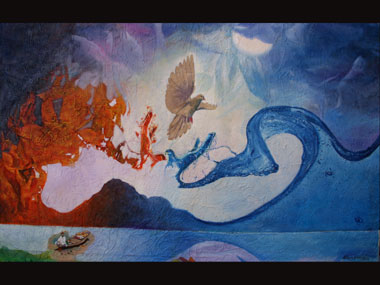
A painting by Masood Hussain.

Since September 10 Masood and his wife have shuttled between the homes of friends and relatives. Over fractured conversations, he patiently sketches an unnerving topography of displacement: “Two days in Wanbal, 12 kilometres from Jawahar Nagar, then in Nawpora, which is closer to Jawahar Nagar… His itinerant phase is inked in my diary as a series of numbers: ‘Masood Hussain, Masood relative one, two, Masood new…. Every conversation is about a ceaseless exploration of new routes — by car, motorcycle, boat or raft — to reach loved ones or make at least one trip to the submerged home that had been left wide open in the rush to safety. “There are roving bands of thieves,” explains Masood saheb.

September 15, 11 am: Masood mentions that there has been no contact with his daughters for a week. Moreover, he does not know if his precious series of seven is intact. “I gave my word to Shahid 15 years ago; we were co-travellers,” he says. The artist, however, is struck by a curious coincidence. “Shahid’s couplet, ‘The Elements Conspire,’ is about the earth awaiting the message that water and fire are at peace. These elements have marked my life too: once I lost everything when my studio was gutted in a fire during the militancy period; this time I wonder whether the floodwater will spare me.”

September 15, 10 pm: There is a call from Masood: “I made it to Jawahar Nagar today. From Nawpora I reached Lal Mandi where it took me four hours to design a raft that would not sink; there is still no administration in sight. We made a raft out of stray wooden planks. Underneath it we added a layer of thermocol taken from empty LCD TV cartons, and empty water bottles, tying everything up with a ragged cloth banner. It worked and I reached home. The seven paintings are safe. Tomorrow I shall go to meet my daughters.” The phone connection breaks but for once there is no irritation, only a feeling of exultation.

At 8.30 am on September 16, there is a brief text message from Masood completing the broken thread of previous night’s call: Lost everything except the seven paintings.

source: http://www.m.firstpost.com / FirstPost. / Home / by Chitra Padmanabhan / September 21st, 2014
The Husain on the wall

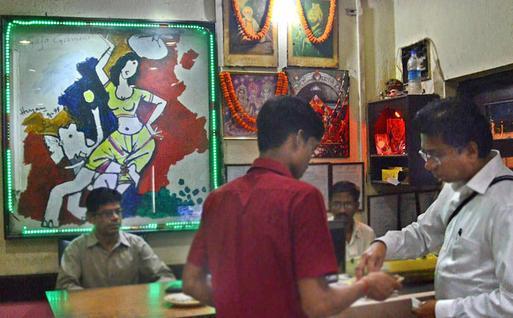
The wall of the Azad Hind Dhaba in Kolkata adorned with M.F. Husain’s Gaja Gamini. Photo: SUSHANTA PATRONOBISH

The now-famous painting, titled Gaja Gamini (one with a walk like an elephant), depicts a dancing woman, in a bright red background, while a white elephant looks on with its trunk held aloft

The memory of seeing M.F. Husain colouring one of his sketches back in 1999 is still fresh in the mind of Madan Sharma, one of the owners of Azad Hind Dhaba, a popular eatery in south Kolkata.

One fine afternoon years back, Mr. Husain walked into the dhaba, which he frequented during his visits here, and all of a sudden started adding colour to the black and white sketch on the wall that he had drawn three years before.

“The experience made me speechless,” Mr. Sharma said, on the eve of the 99th birth anniversary of the iconic painter.

The now-famous painting, titled Gaja Gamini (one with a walk like an elephant), depicts a dancing woman, in a bright red background, while a white elephant looks on with its trunk held aloft. Mr. Husain arranged a private show of his film Gaja Gamini at Azad Hind in 1999.

Sitting at the cash counter with the painting behind him, Mr. Sharma fondly recalled his memories of the famous artist. He remembers Mr. Husain as a “moody and humble person” who would come to the restaurant and sit quietly in one corner sipping his favourite “kadak chai [strong tea].”

“He did not talk much. But sometimes told me what kind of food he wants,” Mr. Sharma said. He was initially apprehensive of talking to an artist of Mr. Husain’s calibre, but eventually they became friends. “Mr. Husain could mingle with adults and children with equal ease. He was totally devoid of arrogance.” Whenever schoolchildren spotted him at the eatery, they flocked to him and asked for autographs. The world-famous painter complied with their demands with a smile and even drew them impromptu sketches.

When asked about the controversy that erupted in 2006 over Mr. Husain’s depiction of Hindu gods and goddesses, Mr. Sharma said the thought of removing the painting never entered his mind. “Nobody asked me to remove the painting even when the controversy erupted.”

Mr. Husain eventually had to leave the country under pressure from Hindu nationalist forces. He passed away in London in August 2011.

Meanwhile, the dancing woman with an elephant walk lives on happily on the central wall of Azad Hind Dhaba, in the company of numerous Hindu gods and goddesses.

source: http://www.thehindu.com / The Hindu / Home> Features> Friday Review> Art / by Soumya Das / Kolkata – September 17th, 2014

Urs-e-Sherieff of Tipu Sultan

Mysore, Karnataka :

The 222nd Urs-e-Sherieff of Hazrath Tipu Sultan Shaheed (RA) will be celebrated at Gumbad-e-Shahi, Ganjam, Srirangapatna, on Sept. 24 and 25.

The Sandal procession will start at Masjid-e-Ala, Srirangapatna at 3 pm on Sept. 24 and reaches Gumbad-e-Shahi, Ganjam, at 6 pm.

A special programme on Urs will start at 7 pm on Sept. 24 and will continue till next day morning (Sept. 25).

source: http://www.starofmysore.com / Star of Mysore / Home> In Brief  / September 15th,  2014

Dilip Kumar’s autobiography reveals his journey from Peshawar to Bombay

Book: The Substance and the Shadow: An Autobiography
Author: Dilip Kumar
Publisher: Hay House
Pages: 450
Price: Rs 699

In 1998, soon after he had received the Nishan-e-Imtiaz award from Pakistan, I managed to see Dilip Kumar in person for the first time.

There were demonstrations outside his house by the Shiv Sena, which was protesting the award. He was the soul of charm. I had gone to propose a book about his films. He was not ready to commit but he did talk about his early life in Peshawar, coming to Bombay, his sojourn away from his family to make a living in Pune, where he succeeded in amassing a small fortune of Rs 5,000 by saving his profits.

All that is recorded in this book, besides much more.

At the time, no one could imagine that the man, so open in private conversation about himself  but so reticent in public, would ever write his autobiography. But now we have the authentic thing, and it is a treasure trove. It is Dilip Kumar’s voice, faithfully recorded by Udayatara Nayar, who has done a great job.

The first few chapters tell us of his childhood in Peshawar. He was a lonely child and fell back then, as ever since, on his inner resources. The large joint family with his grandmother, parents and uncles is depicted well in the book as is Peshawar of the 1920s and 1930s. Soon after, the family moved to Bombay.

Dilip Kumar tells us about his school and college days, his fondness for football and how his friend Raj Kapoor told him he could make it in films, as he (Kapoor) was going to. But Dilip Kumar showed no aptitude for acting. Chance took him to Bombay Talkies and Devika Rani. The rest is history. He was helped along by Ashok Kumar and Shashadhar Mukherjee, who were pillars of Bombay Talkies.

There is a lot here about how Dilip Kumar learnt to act. Nitin Bose tells him early on in his career that acting in films is about emoting, often without dialogue. He tells us he never followed “method” acting. But for each part, he went deep into the persona of the character he was playing, and tried to become that person.

Dilip Kumar has played urban and rural roles, tragedies and comedies. He also grew as an actor from role to role. Take three films in which he plays a villager :  Mela (1948), Naya Daur (1957) and Ganga Jamuna (1961) and you see the depth and range of emotions growing, until the death scene in Ganga Jamuna, one of the best in Hindi cinema.

The tragic roles  in his early career drove him to depression. He decided to consult a Harley Street specialist and was advised to switch to  sunnier roles. So he took on positive roles such as Azaad (1955).  He still had to do Devdas (1955) for Bimal Roy which has the classic tragic hero.

The autobiography also tells us about Saira Banu, a determined young woman, who wanted to marry him and succeeded. Saira Banu has been a key to his longevity. If he is still with us (and long may he be so)  while his contemporaries  have gone, it is thanks to the care and attention he has received from Saira Banu. There are many stars, but there is only one actor — Dilip Kumar.

Meghnad Desai is an MP, House of Lords

source: http://www.indianexpress.com / The Indian Express / Home> LifeStyle> Books> Book Review / by Meghnad Desai / August 23rd, 2014

Financial needs led Muslim family to deposit diamond studded Mughal era dupatta

DiamondMPOs20sept2014
Hyderabad :

Khaji Abdul Vali and Rafiya Bibi, were used to work as teachers in Mudduru for more than 60 years ago, hailed from Cheriyal mandal in Warangal district is now in destitution.

But, they are the owner of a diamond-studded chunni (dupatta), dating back to the Mughal era which was a gift to them. The diamond-studded dupatta was given to their only daughter Fathimunnisa Begum as gift from their parents on her D- day.

In search of livelihood, they sold their house in Cheriyal and shifted to Hyderabad.The family with the valuable chunni approached a gemologist in Hyderabad recently to get some financial assistance, but was told that it is precious and need to be preserved.

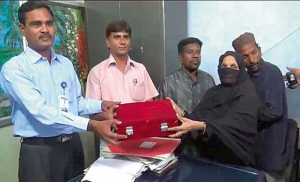
Therefore, the family decided to hand-over the dupatta to the government and also asked for financial help. Warangal district SP directed the Cheriyal police officials to preserve the valuable dupatta and it was kept it in the safe deposit locker of 5131, Cheriyal branch, to protect it from theft.

Locals have urged the officials to put chunni on view for public and provide financial aid to family members of Ms Fathimunnisa Begum.

source: http://www.siasat.com / The Siasat Daily / Home>  Top Stories / Hyderabad – Thursday, September 18th, 2014

MADRAS 375 – A gastronomic journey with biryani

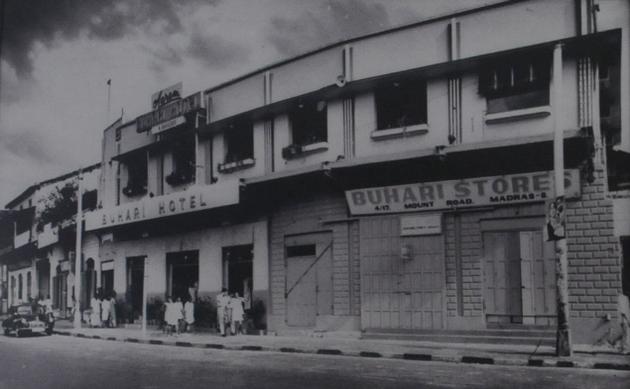
The Anna Salai branch of Buhari Hotel is its most famous -- Photo: Special Arrangement / The Hindu
The Anna Salai branch of Buhari Hotel is its most famous — Photo: Special Arrangement / The Hindu

When Buhari hotel on Anna Salai threw its gates open to the public in 1951, it ushered in a number of firsts: espresso machines making cup after cup of steaming coffee, a jukebox playing tunes of the times, and cutlery and crockery brought from London to give a “fine-dining experience to Madras’ foodies.”

A.M. Buhari, who brought the mildly spiced, fragrant biryani from Colombo, was a pioneer of sorts. Whether it was a boiled egg nestled in a bed of saffron-infused rice or Chicken 65 fried to perfection —called thus after the year it was created in, he set himself apart in the restaurant business early on.

Buhari Hotel's Anna Salai branch is its most famous -- Photo: R. Ragu / The Hindu
Buhari Hotel’s Anna Salai branch is its most famous — Photo: R. Ragu / The Hindu

The brand Buhari that has now become synonymous with biryani in the city emerged out of 200 different blends Mr. Buhari experimented with.

As a ten-year-old, Mr. Buhari had to leave his village in Tirunelveli district and go to Sri Lanka. After a self-sponsored education, it just took a few years to figure out his calling. Starting with trading in food and groceries, he finally set up Hotel De Buhari in Colombo and introduced the brand’s eponymous dish.

“My grandfather then wanted to return to India and came to Madras to set up Buhari,” says Nawaz Buhari, who currently heads the original branch. Today, the brand has proliferated with nine branches in the city and is looking to set up four more in the near future.

______________________________________________________________________

Dates in History
1956
A.M. Buhari introduced a jukebox and a espresso coffee machine at the Anna Salai branch

1965
Chicken 65, a deep fired chicken dish with telltale red colouring, was introduced at the hotel

1996
The one-man show by A.M. Buhari ended, after a 45 year period with his death
Did you know !

Actor M.G. Ramachandran loved the special almond chicken soup and the cassata icecream from buhari so much that a parcel of both was frequently requested to be delivered to his house

______________________________________________________________________ 

While the Anna Salai branch is its most famous, the one at Marina, set up in 1956, became the popular hangout of the 60s and 70s.

Seventy-year-old A.H. Lathif, as famous as the restaurant, has worked in the restaurant for 54 years. “I have served actors Raj Kapoor, Sivaji Ganesan and Sridevi,” he says.

Having lost the branch at Marina beach in the 80s, and the one opposite Central station very recently, the brand, headed by the patriarch till the time of his death in 1996, is now run by the family’s third generation.

With the increase in the number of branches, there are, predictably, differences in the quality and taste of the biryani. “The family has taken a decision to never go for the franchise model of business, because we cannot compromise on the brand image my grandfather worked so hard to build,” says Mr. Nawaz Buhari.

source: http://www.thehindu.com / The Hindu / Home> News> Cities> Chennai> Madras 375 / by Evelyn Ratnakumar / Chennai – August 13th, 2014

The sultana of music

Photo: Bhagya Prakash K.

Begum Parveen Sultana continues to be the diva she was. Her voice and passion remain undiminished, finds DEEPA GANESH

The huge auditorium was packed and overflowing. Old, middle-aged and the young had thronged the hall. When the diva of Hindustani classical music, the stunning Parveen Sultana occupied the stage, there was a thunderous clap. For the older crowd, they went a long way back with this musician who, with her remarkable voice and rendition, had etched a permanent place in their hearts. The young had heard many a story about how she drew thousands to her concert – she was not merely a breathtaking beauty but a musician who could make four octaves submit to her. After the first few minutes of rag Madhuvanti, the audience exchanged reassured looks, but after a few more minutes they just looked at each other, amazed. Into her sixties, the power of Parveen Sultana’s voice remains the same and her musical exuberance intact. That evening, as she sang Rageshri, Bhavani Dayani (supported by dazzling artistry of Vyasamurti Katti and Vishwanath Nakod) and others for the 60th anniversary of Shri Rama Lalitha Kala Mandira, she took the listeners into the world of nada .

A picture of simplicity, poise and grace, Parveen Sultana spoke at length about her childhood and musical journey from a remote village in Assam to centrestage in Bombay. Excerpts from the interview:

You had very unusual parents who not only recognized your talent, but also wanted you to pursue it. In the later years, when they learnt that music was going to be your life, how did they react, coming from an orthodox Muslim background?

My father Ikramul Mazid was a musician himself. Our house was filled with music 24 hours in a day – my father’s riyaz, fellow musicians coming to our house, so on and so forth. So in that sense, it was difficult to ignore music in our household.

I think being born in Assam also made a difference. The atmosphere in our village Nagaon was syncretic. There were no caste barriers, and people of all the religions stayed together. I remember my aunts used to wear the bindi and never found it interfering with the religion they practiced. They were sure about its aesthetic value and the same passed on to me as well.

When I was a little girl, my father used to take great pains to inculcate seriousness in me. He would wake me up at 5 a.m., carry me and give me a wash, make ovaltin for me and would sit down for riyaz with me. But as the years went by, I began to love music so much that I needed no one to tell me to dedicate time to it. When I was 11 years old, I started giving small concerts, won several prizes, and step by step, with my parents standing firmly beside me, I moved on. In fact, when I decided to pursue music seriously, my mother Maroofa told my father, “I will take care of the household, you take care of her.” They started looking for a guru, and finally it was decided that I was going to learn from the scholar Chinmoy Lahiri in Kolkata who was known to my father. Every Friday I used to go from Nagaon to Kolkata for my lessons. The only advice my parents gave me was this, ‘Dress well, speak well. Mistakes are human, be brave to admit it and don’t lie to us. We are here to help you in everything.’ I was fortunate to have such parents, they were wonderful. Their engagement with me was complete.

In those days, Kolkata had many an Ustad. Why did you choose to go to Chinmoy Lahiriji?

I was too young to decide who my guru had to be. My father was of the opinion that I should learn from a scholar, and not a professional, performing musician. ‘He is a man who has made many musicians. You learn from him,’ my father said. However, my father had to deal with Muslim orthodoxy. ‘Why are you teaching her music?’, ‘ Don’t give daughters so much importance. Just get her married’, ‘Why are you taking her to a Pandit being a Muslim?’ and more. But my father was a very progressive person. He brushed everything aside firmly and left me in my guru’s care.

My guru took me into his fold like I were his daughter. I used to stay at his house, eat and rest there. He had immense patience and explained everything in great detail. This would not have been possible if I went to an Ustad. I could speak only Assamese and knew no Hindi. I studied in a missionary school so I knew English. How would I communicate with an Ustad? And I was someone who asked a thousand questions. I was fortunate to learn from my guru.

Your first full-fledged performance was at the age of 12 in Kolkata…

That concert was organized by my Guruji at the Sadarang Sangeet Sammelan. Kolkata, as you said, was full of top class musicians in those days. My guruji was a revered scholar in the music circles, and on his word Pandit Ravi Shankar, Salamat Ali Khan saab, Bade Ghulam Ali Khan saab, Samta Prasad and a whole lot of luminaries had turned up. I hadn’t the slightest clue about their greatness. Before I went on to the stage, my father said, ‘Sing like you are the Maharani of music. Nothing but your music should matter to you.’ I was a daredevil and knew no fear. After the concert, each of them came and blessed me, and my concert became the talk of the town. The happiness of my guru and my parents knew no bounds. But today, when I think of that concert my feet go cold and I feel nervous. Even Bharat Ratna cannot match what I got from all those greats of music that day.

ParveenMPos19sept2014

What I miss immensely now is that atmosphere. Young or veteran, every musician and organizer deemed it as his duty to be present, listen and encourage them. But today, everyone is after stars. You have to encourage youngsters. I too was young and inexperienced at one point. But my gurus, parents, fellow musicians, and listeners have made me what I am. They say that you have to take a thousand births before you are born as a musician. I am very fortunate. God has showed me this path. Every day I pray to him, ‘Don’t take music away from me…’

(This is the first part of a two-part interview with Begum Parveen Sultana.)

source: http://www.thehindu.com / The Hindu / Home> Features> Friday Review / by Deepa Ganesh / September 19th, 2014

`We don’t teach just music’

The grand couple of Hindustani music Begum Parween Sultana and Ustad Dilshad Khan get into a jugalbandi of words

MUTUAL ADMIRATION Ustad Dilshad Khan calls Parween Sultana his perfect student and she considers him her perfect guru Photo: V. Sreenivasa Murthy

When Begum Parween Sultana and Ustad Dilshad Khan pose for our camera, they’re completely at ease. She tells us how beautiful his compositions are, including the one he has composed in Maluhamand. He says he calls her Yaman (the raga), because no one sings it like her. Getting them to talk to each other, but not about each other, was quite a challenge, says MALA KUMAR, who caught the exuberant couple just before they performed yet another enthralling jugalbandi.

Both have been child prodigies. Begum Parween Sultana received her early training from father Ikramul Majid, then from Acharya Chinmoy Lahiri in Kolkata, and finally from husband-to-be Ustad Dilshad Khan in Mumbai.

Ustad Dilshad Khan started learning the tabla at the age of four from his father and later took up singing under the guidance of N.C. Chakravorty, Hidan Banarjee and Gyan Prakash Ghosh. Influenced greatly by the gayaki of Ustad Bade Ghulam Ali Khan of the Patiala gharana, he later became the disciple of Fayyaz Ahmed Khan and his brother Ustad Hiaz Ahmed Khan of Kirana gharana. Having been exposed to the best in the Seni, Patiala and finally the Kirana styles, Dilshad became so obsessed with classical music that he gave up a lucrative career as a marine engineer to dedicate his life to the cause of Indian classical music.

In an intimate conversation, the musical couple speak of the tehzeeb or culture of old world music and the politics of today’s “music talent” world. Excerpts:

Begum Parween Sultana (BPS): Let’s talk about our music.

Ustad Dilshad Khan (UDK): What? And displease the best cook in the world! No, no… (To the writer) Parween is an excellent cook, and I love to eat. You know, we’re almost South Indian in our tastes.

BPS: (Getting right back to their favourite topic, musicAchcha Khansaab, do you remember? We first came to Bangalore as musicians in 1978, invited by the Rama Seva Mandali, and today again we are here to perform for them.

UDK: Yes, the Bangalore audience has always been excellent, isn’t it? Those were great days… people used to take so much trouble to listen to great artistes. The singers were great because they used to be so experienced and they used to do so much riyaaz. Everyone seemed to have time to sit through long recitals… (He then gets into a two-minute conversation with the writer.)

BPS: (Bringing him back to the conversation) Khan saabzara idhar dekhiye

UDK: Battees saal se dekh raha hoon… two years as my student and for 30 years after our marriage!

BPS: In the music room you are my guru…

UDK: And you are an excellent student. We do have very good students all over the world. But isn’t the world itself changing? People want to learn music, learn karate, painting… everything in quick workshops.

BPS: True. But we are different. We have been teaching only those who want to become professional singers. And we teach not just music but the tehzeeb — the culture, the etiquette, that an artiste should have.

UDK: We don’t want to teach students for whom it means hobby… or hubby!

(But Parween got both, didn’t she?!)

UDK: That is true, but even today she is a true student. But haven’t we seen people who want to become singing sensations within 48 hours? They want to become Indian Idols. See that Ravind…

BPS: Now don’t bring him up Khan Saab.

UDK: But how did people vote for that besura man?

BPS: Why do you want to talk about him? We are not bothered. You know, you must be careful about what you say. We have to realise that to be successful, it is not enough just to be talented. One needs to be blessed, one needs to know the nerve of the audiences and you also need a cool temperament. Success comes and knocks on the door, but you have to open the door. And to maintain success you have to work very hard. You have to be diplomatic.

UDK: Yes, I agree, you are my guru in this department. There is a small difference between being simple and being a simpleton. And I’m often thought of as the latter!

BPS: No, no, you are just too sentimental. And too nice. We all need to be disciplined, but you are too much! So many times I have had to drag you away from riyaaz because people are waiting for us, or we have a flight to catch….

UDK: See, my guruji died on my lap. And he told me never to let go of two things — namaaz and riyaaz. So it’s very difficult for me to change.

BPS: I am a singer and a performer.

UDK: So you need to add garam masala!

BPS: Yes, we need to be very practical. Knowing your audience and catering to them is not just important, it is the most important thing.

(Is that why Lata Mangeshkar continues to sing, even when her voice shakes?)

UDK: Why not, when she sings so well? And when… (turning to his wife) ok, I won’t take his name.

BPS: Why are you comparing Amma with that man? She still doesriyaaz before coming for a recording!

(Changing the topic to talk about their other interests)

BPS: You are an excellent artist and paint so well. You have a great sense of colour and style. You even chooses my saris, my lipstick.(laughs) But you don’t like to come shopping with me.

UDK: But don’t you have the best companion, the love of our life, our daughter.

BPS: At 17, she has a voice that has an excellent range. She is a kind, sensitive, loving child, and she and you are very close.

UDK: I object! You are her favourite!

BPS: Bakwaas!

UDK: (Turning to the writer) Let me take two minutes to tell you….

BPS: Bas, bas, Dilshad, these two-minutes will be endless and we have to leave…

UDK: We have to meet Sai Baba to take his blessings, let’s go.

source: http://www.thehindu.com / The Hindu / Home> MetroPlus Mangalore / by Mala Kumar / Saturday – May 28th, 2005

A rare mehfil in troubled times

Zila comes calling

Zila Khan is the daughter of Ustad Vilayat Khan. In his time he was the most famous Sitar player in the country. Today, she is as her father, grand-father Ustad Inayat Khan and great grand-father Ustad Imdad Khan were in the times they lived. 42-year old Zila Khan is currently amongst the best of our country’s singers of classical and light classical Hindustani music specialising in Sufiana and rendering ghazals of great poets of Urdu and Hindi. She was put through a rigorous mill of singing eight hours a day while still a child in school in Calcutta. She was not allowed to study beyond the 10th standard in order to devote all her time to music . She was the first girl in seven generations to become a professional singer. She did me the honour of singing at one of my mehfils. It was a memorable evening.

There were a few surprises in store for me. I was expecting her to come alone. She came bustling in, followed by her harmonium and tabla players, a photographer and a lackey. I expected her to be a demure and reserved young lady; she kissed my beard or both sides as I sat wrapped up in my shawl by the fire-side. I offered them sharaab (Scotch): they declined and asked for tea. The first thing she did was to keep her mobile with her while sipping tea. I am allergic towards mobiles in mehfils.

The session started with the harmonium and tabla players warming up. Zila sang a few notes to get the harmonium to the right notes and slapped her thighs to indicate the beat for the table. In between she answered my questions in fluent English and Urdu: Her mobile rang. Call from New York. She confirmed her date with the caller. Then back to singing a note or two for the harmonium, thigh slaps for the tabla, answering my questions and pressing buttons on her mobile. She was on line to Kochi telling the fellow at the other end to change the date of her performances in Kerala till after she had fulfilled her engagements in the States. She was like a six-armed goddess doing six things at a time. I lost patience and pleaded with her “Switch off that damned mobile before you start. “She did not take offence. ‘I’ve finished with it,” she replied as she put it in her hand bag. She turned to me with a bow, for permission to begin “Ijaazat?” I nodded my head: “What would like to hear first?” she asked. I was not prepared for the fermaish, so came out with the first ghazal that came to my mind : Muddat hoee hai yaar to mehmaan kiye hooey (it has been a long time since I entertained my beloved in my house).Then she broke into full throated song — arms and hands emphasising meanings. At the end of every couplet she turned to me rather than her note book for the next — whether to test me or flatter me. Fortunately, I did not let myself down. I was able to show off my memory and was mighty pleased with myself.

So it went on from Ghalib to Hafeez Jalandhari, and others she interwove lines of poets to give her songs a theme, which ghazals rarely have. I was transported into another world — as was everyone else in the mehfil. Long after I had retired for a night her voice kept ringing in my ears and her animated gestures dancing in my eyes.

source:  http://www.hindustantimes.com / Hindustan Times / Home / by Khushwant Singh / January 02nd, 2009

Moment of musical humanism

Sufi-based renditions by Zila Khan in New Delhi commemorated World Hospice and Palliative Care Day.

SINGING FOR A CAUSE: Zila Khan. / Photo: Shiv Kumar Pushpakar / The Hindu .

Linking the world with the ring of music is invariably dismissed as a metaphorical thought except on World Hospice and Palliative Care Day, when musicians and vocalists hold a global concert in their respective regions, on that day. This week, the organisers of this event in India, CanSupport, who work for quality care and palliative support for cancer victims and their families, hosted the fourth concert of this world-series.

The decisive moment of this musical humanism began at 7.30 p.m. local time, with an inaugural concert in New Zealand. Thereon, the baton was passed from country to country and was slated to end in Hawai.

In India, the precise moment was commemorated with a recital of Sufi-based renditions by the much acclaimed artiste Zila Khan. In consonance with the prevalent mood of the occasion, Zila Khan rendered a vocal recital of Iqbal’s poem, `Zindagi,’ regaling her listeners into a mesmerising warp by touching upon the emotive pull of the notes ga, ma, pacham, nishad and swara. This high touch start by Zila Khan also brought into focus the highlights of Zila’s personal oeuvre. Her sound vocal training enabled her to delight her listeners with soul stirring content that did justice to the phraseology of the immortal verse.

Structured

The choice of classical insets into an overall ghazal format was a sanguine compositional choice by the artiste. Her penchant for singing medium paced, poised and well-accented literary verse came to the fore, in her rendering. The highly structured methodology of the geet-numa ghazal that Zila chose, recounted the universal appeal of tradition in the midst of thoughtless innovation. The audience was left satiated with her compositional flair, her intrinsic musical command and her easy mannerisms even through the trickiest passages of the verse. The next rendering of the verse of Hasrate Mohani gave listeners a chance to savour her musical talents a notch further. The singer in her remained in full control as she accented the phraseology with deliberation and combining it into an inviting musical weave. The tenets of the gayaki gharana that Zila Khan hails from, as part of the Imdadkhani tradition of her late guru and father Ustad Vilayat Khan, remained in the forefront without taking on a dominating role. Her concert thus immersed audiences in its strong content and serious listeners were able to decipher the guiding presence of the gayaki tradition just beneath the ringing tones of the artistic appeal.

source: http://www.thehindu.com / The Hindu / Home> Features> Entertainment Chennai and Tamil Nadu / by Prakash Wadhera / Friday, October 21st, 2005