Category Archives: Arts, Culture & Entertainment

Music in the genes

Zila Khan was in Delhi the other day to launch her new album of classical and semi-classical musical forms. Music is her passion, and music is in her blood, but over a cup of tea, the delights of a good lemon tart cannot be surpassed, she tells ANJANA RAJAN… .
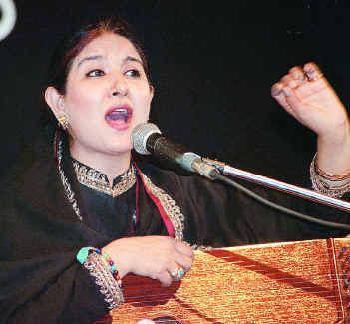
Zila Khan performing rare musical forms in Delhi at the release of her new album./  Photo: Shiv Kumar Pushpakar / The Hindu.
Zila Khan performing rare musical forms in Delhi at the release of her new album./ Photo: Shiv Kumar Pushpakar / The Hindu.

THE CHILDREN of eminent artistes often struggle to maintain their individual identity before a public that insists on regarding them as appendages of their more illustrious parents. Zila Khan, daughter of pre-eminent sitar maestro Vilayat Khan might be considered among this number. But while she is carving out a niche for herself by performing across the world as a solo vocalist known for her mastery over rare forms, she is also fiercely proud of her lineage.

“Yeh khoon hai naa,” she reiterates more than once, referring to her solid background. Even the recorded music in her family goes back four generations. But it is not merely a blood relationship with her father, it is the bond of a guru and disciple too.

Zila, who divides her time between Oman and London and was in Delhi recently for the release of her music album by Art Karat Entertainment, has as much encouragement for the aspiring `first generation’ artistes who don’t come from traditional music families, as she has praise for the offspring of famous performers, who like herself have decided to carry on the tradition despite the temptations of living a life of indolent luxury fuelled by the parent’s music royalties.

From the time of her grandfather Inayat Khan, the family has been known as generous in sharing and teaching, and, stressing her grandfather’s progressive outlook in teaching women, she declares we would not find a woman from a well-off family in West Bengal who has not had the opportunity of learning from him. And yet, in her own family, she is the first woman to learn and perform music! Paradox or no, Zila has no qualms about admitting it.

“I am absolutely honest,” she affirms, and her eyes have a fiery glint. It was her father who was the radical in her family, but though he taught her “like a son” he asked her to refrain from performing till she got married, and blessed her that she may get a husband in conformance with her aspirations.

Zila is sure his blessings have found their mark, and in Khalid Anwar Shaikh, she has found the perfect match who understands her passion for music and supports her in her globe trotting career.

Thankful that she is able to pursue “my greatest love and passion,” Zila, with her vast range of musical forms, like qaul, qalbana, gul, and others – each with its own special method of singing, its own theka – and her 10-year-old son Faizan who roams the world with her while simultaneously pursuing his studies, in the process keeping up the khaandani tradition, still finds delight in the little pleasures of life, like India International Centre’s irresistible lemon tarts. You have to agree with her when she calls herself “magan.”

source: http://www.thehindu.com / The Hindu / Home> Features> MetroPlus Delhi / Thursday – December 19th, 2002

Looking for Shahid

Kashmiri poet Agha Shahid Ali. / Photo: Special Arrangement / The Hindu

A tribute to Kashmiri poet Agha Shahid Ali on his 10th death anniversary.

Missing me one place search another/I stop somewhere waiting for you. Walt Whitman

The 10th death anniversary of the extremely talented Kashmiri poet Agha Shahid Ali (February 4, 1949 – December 8, 2001) again draws us to his poetry. Shahid’s name – the Persian “beloved” and the Arabic “witness” – is a signature of what adorned both, his life and craft. It is incredible to know how much Shahid was loved and how much he loved in return.

His poems exude the saffron of feelings, like the shaded yellow leaves of dusk. Friends, lovers, martyrs and a suffering mother overwhelm his poetry. Their voices add to his voice. Shahid is an embroiderer of language. It isn’t easy to catch him or let go as he invites you to unravel his deepest and most intricate feelings and concerns.

Need to be heard

Shahid evokes a mythical language of history, where he creates an urgent need to be heard against eras of loss. Like in the beginning of this beautiful poem, ‘A History of Paisley’: You who will find the dark fossils of paisleys/one afternoon on the peaks of Zabarvan –/Trader from an ancient market of the future,/. . . won’t know that these/are her footprints from the day the world began/when land rushed from the ocean, toward Kashmir.

Shahid’s Kashmir is a place looking for its future in the reclamation of its many pasts. In a poem dedicated to his friend Suvir Kaul, Shahid writes: We’ll go past our ancestors, up the staircase,/Holding their wills against our hearts. Their wish/Was we return – forever – and inherit…

Inherit what? The glass map of our country, says Shahid. But this country cannot be inherited without hands blossoming into fists/till the soldiers return the keys/and disappear. The soldiers must leave first, before the country can be painfully stitched back to recognition and the birds of childhood will find voice and the nameless graves will stir with names.

Shahid’s Kashmir, which he calls an imaginary homeland, echoing Salman Rushdie’s India, is nevertheless not a name attached to the idea of a nation. The word nation goes interestingly unmentioned in Nehru’s The Discovery of India, where he called India “a myth and an idea, a dream and a vision”. This appears significant today as the nation has not allowed India to dream generously and the idea of India has degenerated. The line of control has controlled India’s vision since Independence. We have to go back in time and hear how Kashmir and India spoke to each other. India should abandon the West’s language of nationalism. India should refuse to be among the “Rest” of the West’s imagination.

As Shahid asks in a poem: Will the middle class give up its white devotion? Just as Shahid learnt of Kashmir through the poetry of Lal Ded and the rishi Sheikh Noor-ud-Din, the idea of India needs to be revisited through Arab and Chinese travellers of the past, through Buddhist, Hindu and Muslim mystics, through Kabir, Bulleh Shah, Khusrau and Dara Shikoh. On lines drawn over a map of glass, looking for his other in the darkness of history, Shahid discovers the emblem of clarity: I must force silence to be a mirrorto see his voice, ask it again for directions.

Shahid, blind from the start, waits to ask his beloved adversary for directions. In his endearing letter of complaint to his other, the Hindus, Shahid mourns the severing event of their exodus. He is pessimistic about the possibilities of rapprochement:  There is everything to forgive. You can’t forgive me. Shahid seems to suggest, if the other, driven by fondness (philia) and not reason, is willing to forgive, then there lies a long, shared history worth forgiving for.

Fate of Kashmir

As a poet of Kashmir’s struggle for dignity, Shahid paid his tributes and condolences to its martyrs and upheld their innocence. He attested fortune’s shame on the death of 18-year-old Rizwan. But even as Shahid was tormented by the fate of Kashmiri boys whose bodies were broken till they could sing no more, he asserted a lyrical, Brechtian resilience: Freedom’s terrible thirst, flooding Kashmir,/is bringing love to its tormented glass./Strangers who will inherit this last night/of the past? Of what shall I not sing, and sing?

Looking for Shahid you find yourself hearing a “witness” who dreams against the paranoia of borders. Looking for Shahid you find yourself marooned in the wailing of Paradise. Looking for Shahid you find a “beloved” hiding and seeking, veiling and unveiling, telling his lover amidst the fog: when you divide what remains of this night/it will be like a prophet once parted the sea.

Shahid, the playfully deceptive non-believer like Ghalib, once wrote in a ghazal: I (who) believe in prayer but could never in God. Elsewhere he countered Nietzsche, asking: When even god is dead, what is left but prayer?

Shahid seems to suggest, even an atheist is bound to a relationship of affect with this world. This relation can make an ethical demand on him in the heart of a despairing, Kafkan moment – to pray in god’s absence, to pray without hope, but pray nevertheless, as an unfathomable, mad duty towards the other. Shahid waits for us at the other end of that prayer.

Manash Bhattacharjee is a poet and scholar living in Delhi.

source: http://www.thehindu.com / The Hindu / Home> Features> Sunday Magazine / by Manash Bhattacharjee /  December 03rd, 2011

Haj pilgrims opt for Bareilly’s surma

Bareilly :

Scores of Haj pilgrims across the world traveling to Mecca prefer to apply ‘Bareilly-wala surma’ (kohl manufactured in Bareilly) rather than the kohl prepared in other Asian and Arab countries.

A city-based manufacturer claimed that the demand for Bareilly’s surma increases by over 30% during Haj time as compared to other seasons.

The USP of Bareilly’s surma is that it is finely grinded and instantly provides cool comfort to the eyes, he says.

“While preparing surma, other manufacturers based in India and other countries use a grinder and other modern appliances for crushing the semi and precious stones. However, we still stick to our traditional method of using baton stone (sil batta) which helps us finely crush the metal or stone,” said M Haseen Hashmi (67), the manufacturer of Bareilly’s surma.

He claimed that it was his ancestors who made surma popular in the country after setting up their firm in 1794. Since then, generation after generation of Hashmi’s family has been producing surma. At present, hundreds of people in Bareilly work under him.

Even the baton stone used in the preparation of surma is unique. “The stone is black and it is available in Jaipur. The black stone crushes the metal into fine pieces but metal is unable to grind the black stone,” said Hashmi, as he recalled that it was the same black stone with which Shahjahan wanted to build a black Taj Mahal.

He added, “The main ingredient of Bareilly’s surma is the stone of Kohetoor mountain which is located in Egypt. From there, it is exported to India and we purchase it from traders.”

Shabbu Miyan, who is the manager of Khanquah-e-Niyaziya and younger brother of Sajjadanasheen, said, “It is mentioned in the holy Quran that applying surma extracted from the Kohetoor mountain is pious and good for eye-sight. Even Prophet Mohammed used to apply surma made from Kohetoor stone before going for prayers and sleeping.”

Though surma prepared in Bareilly is available in more than 80 varieties, a majority of Haj pilgrims from all over the world opt for surma gulab. “It is a general surma and can be applied by anyone,” said Hashmi. Apart from this, pilgrims prefer to apply ‘surma mamira 777’ and ‘sadi kajal’. ‘Surma mamira 777’ actually causes irritation in the eyes, but cleans all impurities, he claimed.

Sadi Kajal is for women and enhances the beauty of their eyes. The other popular variants help in curing diseases related to eye-sight like red spot in sclera (white area of eyes), eyes pain and also help in improving eye-sight, Hashmi claimed.

The manufacturer provides Bareilly’s surma to agents in Mumbai and Delhi who later export it to Arab countries. As pilgrims offer prayers at Mecca on Eid-ul-Adha or Bakri-Eid, the demand for the city-based surma soars by 30% three months before the festival.

Masqood Hasan, a timber businessman who will be leaving for Haj soon, said, “Applying surma is following Prophet Mohammed. As people across the country are attracted to Bareilly’s surma, I always get surma packed to gift it to my relatives and friends whom we meet during Haj.” Another Haj pilgrim, Shahida Mahmood (42) said, “Bareilly’s surma not only provides comfort but also protects the eyes from all diseases.”

source: http://www.timesofindia.indiatimes.com / The Times of India / Home> City> Bareilly / by Priyangi Agarwal, TNN / September 08th, 2014

Eminent Urdu scholars, poets honoured

It was Urdu that astronaut Rakesh Sharma used when he was asked by Prime Minister Indira Gandhi to describe how India looked from space. “He said, ‘Saare jahaan se achcha Hindustan hamara’ using poet Muhammad Iqbal’s poetry,” said Fathima Muzaffar of the Indian Union Muslim League. That is enough reason to take pride in the language and promote it, she told a gathering of Urdu scholars and poets at a function here on Tuesday.

She said non-speakers tend to dismiss it as a language used for mushairas, qawwalis and ghazals. But it is a rich language with a literature of its own. “There is a mistaken belief that learning Urdu may hinder one’s economic prospects. But everywhere in the world mother tongue is respected. In European countries, children learn in their native language,” she said. She urged R. Thandavan, Vice-Chancellor of the University of Madras, who inaugurated a seminar on Sardar Jaffri – life and contributions’, to create more job opportunities for Urdu speakers.

University of Madras Vice Chancellor R Thandavan (right) presents an award to Md. Ubaidur Rehman (left), head, Department of Urdu, The New College. —PHOTO: K.V. SRINIVASAN / The Hindu

Dr. Thandavan said he had high regard for the language though he did not understand it as well as Hindi. He launched five books and distributed awards to Urdu scholars and personalities who had contributed to the language and the community.

Syed Sajjad Husain, head of the Department of Arabic, Persian and Urdu, which organised the seminar, said 25 eminent scholars, poets and personalities were honoured for their contributions.

source: http://www.thehindu.com / The Hindu / Home> National> Tamil Nadu / by Special Correspondent / Chennai – January 01st, 2014

Remembering ‘nana’

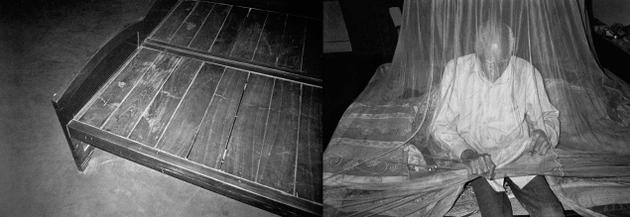
Zishan’s photographs documenting his grandfather  / The Hindu
Zishan’s photographs documenting his grandfather / The Hindu

PHOTOGRAPHY Watching Zishan Akbar Latif’s exhibition was an experience in itself leaving many feeling cathartic

In this deluge of exhibitions, there are a few which can’t escape attention. Mumbai-based photographer Zishan Akbar Latif’s first ever show “95 Mani Villa” was one of those. First, I wanted to see it because of professional requirements. Importantly, I wanted to see it for myself.

For last couple of years, I have been toying with the idea of recording my grandmother with the intention of documenting the beautiful traditional songs that have been passed on from one generation to another in this family of Madhya Pradesh. The region’s cuisine, its peculiar customs, that I have got a glimpse of while growing up were other aspects I sought to record through my nani who is in her 70s, now.

The project in my mind was merely anthropological until I saw Zishan’s just concluded exhibition, which inspired me to give it a spin and explore the personal world of both my grandparents. Not just my nani’s songs, the sole picture of my grandparents together after they got married in 1951, my grandmother’s colourful hairclips, her bright glass bangles, the paan box they open after every meal, the memories of their dead son and daughter the old couple have clung to, the letters my grandfather writes every single day to the Prime Minister, the President, various political parties and ministries, his poetry and the stories of the various wars he fought in as an army person. I also wish to make my 85-year-old grandfather relive the life in D-20, Delhi Cantt, where I would return to post school every day to play with his hand-made toys in an unimaginably huge garden that he single-handedly maintained…his handcrafted tables, chairs…

Zishan2MPOs16sept2014

95 Mani Villa, brilliantly curated by Amit Mehra, is a similar navigation of memories although with a different approach. It starts with a young photographer setting out to document the last few years of his grandfather Dhanji Anklesaria in 95 Mani Villa in Jhansi. In a pitch dark room, Zishan lets the viewer into his intimate world through the backlit black and white images of his late grandfather.

Shot on film, Zishan captured the last two years of Dhanji’s life trying to understand him better. “It was because of him that my mom had eloped with my father. He reconciled to the fact late. Then he had an estranged relationship with his son, who married a divorcee, a non-parsi, having kids at the age of 53. While he had reconciled with my mother marrying a Muslim, he couldn’t accept his son…I wanted to know him better,” says Zishan.

Frequenting 95 Mani Villa to spend time with his ailing grandfather, Zishan captured his last birthday, his routine, his phone – his only connect to the outside world, his harmonium, his dog, a constant companion and his loneliness. “I wanted to create a surreal space which would enable people to experience and identify with it. It wouldn’t have had the same effect if I had shown just simply displayed prints. And I always wanted to have an AV in the show. The darkness was also intended to prevent the viewer from getting distracted.”

While such personal work could have gone into cliches, Zishan’s work eschews all of them. The subtle, aesthetic shots weave a poignant narrative of inter-personal relationships, memory and familial bonds. “When I started shooting him in 2010, I was shooting to document him, not for a show. But everyone who saw the pictures asked, ‘Where is the grandson?’ There was a distance. By the end of it, everything came together, I as a photographer and I as a grandson.”

SHAILAJA TRIPATHI

source: http://www.thehindu.com / The Hindu / Home> Features> MetroPlus / by Shailaja Tripathi / December 14th, 2013

Sandal and Urs at Chittoor dargah begin

Fervour marks annual sandal and Urs of Hazarath Gulam Rasool Baba Dargah

The 72nd annual sandal and Urs of Hazarath Gulam Rasool Baba Dargah of Chittoor commenced on Saturday amidst religious fervour, with the performing of sandal in the evening, followed by Urus.

The annual event draws huge crowds from all sections of people in Chittoor division, while the Dargah is seen as an epitome of Hindu-Muslim unity since seven decades. Local belief is that the Hazarath while wayfaring down South had settled in Chittoor a century ago. His presence was said to have brought copious rains in the region, driving away the perennial drought conditions. As a mark of respect for the Hazarath, the people of Chittoor built a Dargah. Earlier, the traditional ritual of carrying sandal commenced in the afternoon through the arterial junctions. After performing Fathiha ritual, the Dargah heads distributed the sandal to the gathering. Poor feeding was performed from evening till late night.

source: http://www.thehindu.com / The Hindu / Home> National> Andhra Pradesh / by Staff Reporter / Chittoor – December 15th, 2013

Poets from five States participate in Mushayira

Poets from five States participated in a poetry fest organised in Bidar on Monday night by several literary organisations.

Poets used Shayari couplets, Ghazals and Tarannums to send a message to society. The issues they chose ranged from love, heartbreak, mother’s love, the life of the Prophet Mohammad to the recent carnage in Muzaffarnagar.

B. Narayan Rao, former Zilla Panchayat member, who inaugurated the Mushayira, lamented that Urdu was being limited to Muslims. Urdu is the language that binds India together. “While millions of non-Muslims speak Urdu, millions of Muslims in several States don’t understand the language,” he said.

Tanveer Ahmed Salman, who anchored the Mushayira, said Bidar was the city where the first Urdu book “Masnabi Padamrao Kadamrao” was published in the 14th century. This remains a matter of pride for us, he said.  It has produced poets of global repute like Hazrath Ishqui in the 18th century and modern day favourites like Rashid Ahmed Rashid and Suleiman Khatib.

Deputy Commissioner P.C. Jaffer released six books. He said though the number of people who spoke Urdu was increasing, the number of those who could read and write the language was decreasing. “This is the problem with most Indian languages. We should make concerted efforts to preserve Urdu and other Indian languages,” Mr. Jaffer said.

The books that were released included Bidar Ke Asare Kadima, a note on the monuments of Bidar, by Abdul Samad Bharati; Tazkara Mahamud Gawan and Jahan-e-Kaleem by Nissar Ahmed Kaleem; Nashrah and Saad by Ameeroddin Amir and Ghanti by Hameed Saleem.

Poets from Karnataka, Andhra, Maharashtra, Uttar Pradesh and Orissa participated. They included Misbaq Azmi, Akram Nakkash, Saifuddin Saif Ghori, Naveed Abdul Jaleel and Nooruddin Noor.

Poets from Bidar like Mohammad Yousuf Raheem Bidri, Mukhtadir Taj, Nissar Ahmed Kaleem, Basit Khan Sufi, Ameeroddin Amir and Rehana Begum participated.

The surprise package was the singing of two ghazals by Deputy Conservator Forests Sunil Panwar. “A native of Uttarakhand, he learnt to read and write Urdu after being posted to Bidar,” Mr. Bidri, who was a member of the organising committee, said.


  • ‘Bidar has produced poets of global repute like Hazrath Ishqui, Rashid Ahmed Rashid and Suleiman Khatib’
  • We should make concerted efforts to preserve Urdu and other Indian languages: P.C. Jaffer

source: http://www.thehindu.com / The Hindu / Home> National> Karnataka / by Special Correspondent / Bidar – December 10th, 2013

Identity proof compulsory to enter Taj Mahal mosque on Fridays

People entering Taj Mahal complex for prayers on Fridays will now have to carry identity documents, according to a directive issued by Archaeological Survey of India (ASI) following a complaint that non-Indians were also entering the mosque despite it being closed for visitors.

The directive, issued by ASI’s Agra unit superintending archaeologist N.K. Pathak on Thursday, has, however, received criticism from Taj Mahal’s Mosque Committee which has said that no Muslim, irrespective of nationality, can be stopped from offering prayers at the mosque.

The local ASI unit had received a complaint that an Indian Muslim had allegedly brought five Bangladeshi nationals along with him to Taj Mahal’s mosque last Friday, leading to a row over as to who all should be allowed inside the mosque.

The ASI authorities claim that the body’s Director General has ruled that only Indians should be allowed to enter the mosque to offer prayers on Fridays, when the monument is closed for visitors.

The Taj Mahal Mosque Committee President Ibrahim Hussain Zaidi, however, criticised the directive and said Muslims should not be discriminated on the basis of nationality.

“The Gazette notification of January 1, 2001 issued by Government of India states that Muslims will be allowed to offer prayers at the Taj mosque on Fridays even though it is closed for visitors. Nowhere does it say that Muslims of other nationality should not be allowed,” he said.

Reacting to Zaidi’s criticism, ASI caretaker at Taj Mahal Syed Muazzar Ali said that the mosque committee has no locus standi on the matter.

source: http://www.thehindu.com / The Hindu / Home> News> National> Other States / PTI / Agra – December 27th, 2014

Vestiges of the past

KhalidSabirMPOs16sept2014

COMMUNITY CHRONICLE The wedding invitation of Wajid Ali Shah’s son, a fatwa by a pundit, nikahnamas embossed in gold, a judgement by Akbar Allahabadi…Khalid Sabir’s house in New Delhi’s Shaheen Bagh preserves remnants of yesteryear Awadh

With age, nostalgia becomes a hobby for many. One of its probable side effects is the fascination for most things old — they become a token of the times that were, appealing for the stories they hold, don’t they?

But with New Delhi’s Shaheen Bagh resident Khalid Sabir, young age never became a deterrent in evoking nostalgia for an age his forefathers belonged to, and he began collecting — and collecting — so many things from the past that most of his two-storey house is now packed with an assortment of things that are clearly rare, precious and deserve space in a museum.

The transformation of Sabir, now 62, into being a hardcore collector rather sprang from a strong sense of documenting history that caught his imagination in his school days in Allahabad. Sipping tea, surrounded by things from his valuable collection spread over a bed, an effervescent Sabir reels back to his first venture at collecting things. “My uncle Ahmad Sabir was the still photographer for Mughal-e-Azam . When the film got released, he came to Allahabad and took the entire family to watch it. It was he who gave me a couple of posters of the film. That triggered in me the urge to collect film posters. Over the years, I had an amazing collection but all got burnt during a fire in the house some years ago.”

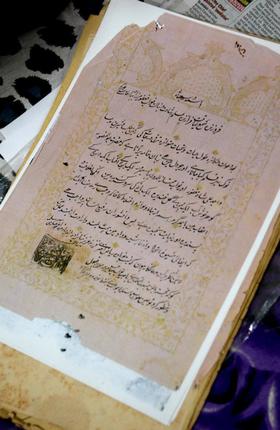
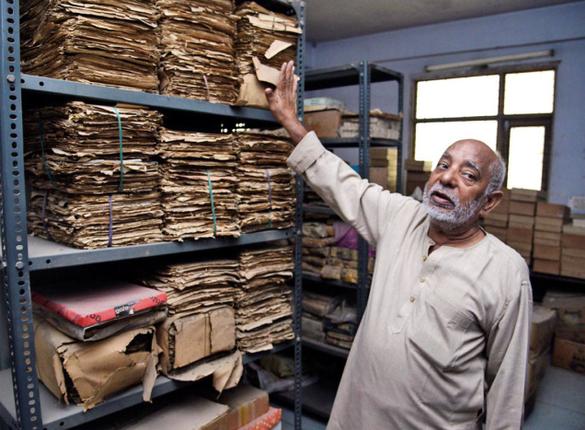
Collector’s items(From left) Khalid reading out from a royal nikahnama; in a room with old documents; an issue of Urdu daily Nawal Kishore Photos: S. Subramanium

Much later, in the early ’80s, work took Sabir to the U.K. but the urge remained. During visits to his home State Uttar Pradesh — to towns like Allahabad, Lucknow, Rampur, etc. — he would check out on the local scrap collectors, the kabari-wallahs. Each time, he would hit upon a treasure from the past. “I have collected most of my things from kabari-wallahs,” says Sabir, displaying for this reporter a judgement given by the famed Akbar Allahabadi, a silk map of Lucknow dated 1884, an invitation sent out by Nawab Wajid Ali Shah for one of his son’s weddings, a judgement by Sir Lawrence Peel dated 1865 in a case involving Bahu Begum of Faizabad; a fatwa proclaimed by a Hindu pandit in 1800, a pre-1857 nikahnama of a princess written in gold with mehr worth 12 lakhs, among other prized catches culled out from the dump yards. Holding the copy of the fatwa, he points out, “Like the maulanas, Hindu pundits also used to declare fatwa. Urdu was the language of the times, so it was used in them. Every fatwa refers to a hadith, so this one also begins with one written in Urdu by a maulana. It is followed by a pandit answering the maulana by referring to a shloka from the Ramayana in Devnagiri before pronouncing the judgement.” Indicating the date written on top of the fatwa, he says laughing, “This one is before Ghalib.”

Sabir reads out from the wedding invitation of Wajid Ali Shah — known for his love for poetry — prodding you to listen carefully to the language. “It was a time when Urdu was emerging from Persian. You can see the mix here,” he says with relish. That marriage went into trouble, leading to the return of the bride’s dowry. Interestingly, Sabir has letters of the fight between the bride and the groom, also the list of her dowry.

Carefully taking out from a plastic envelope a clasp of yellowed papers a judgement given by the famed poet and judge Akbar Allahabadi in 1862, Sabir says, “Read this, not for nothing there is an old saying in U.P. that what is left in Allahabad apart from Akbar and amrud trees.”

AlmirahsMPos16sept2014

In rows of steel almirahs and shelves covering five rooms of his house, there are stacks of old land deeds of thousands of families across U.P., receipts of property tax issued during the British rule, nikahnamas of Hindu nawabs, initial editions of Urdu dailies like Nawal Kishore , Haqiqat , Awadh Akhbar , personal letters of English couples living in that region among other things. “I have the third issue of the Lucknow newspaper The Pioneer too, which I don’t think the company itself has,” he adds.

A compulsive collector that Sabir is, he also has a roomful of postage stamps from across the world collected since his school days. And another room where stacked to its ceiling are old editions of Indian magazines and press clippings on 400 topics. “I have published 13 books after compiling these press clippings on different subjects,” he informs. Till a while ago, Sabir says, he used to subscribe to 30 newspapers across different languages. “I had employed four people to help me out in preserving my collection. But I have slowed down after a heart attack sometime ago,” he says.

So what does he plan to do with this priceless collection? “I had approached Jamia Millia Islamia, Aligarh Muslim University, Rampur Raza Library, all the important places that you might think would be interested in keeping this Awadhi treasure. But none seem to be really so. I have spent a lot of money and time on this collection, don’t want it to go waste. So I am saving money, planning to start a museum on my own,” he says. Meanwhile, he has just returned from Dubai “after giving photocopies of some old newspaper papers for digitisation to a Dubai-based organisation. It digitises for free old Arabic, Persian and Urdu documents.”

I had approached Jamia Millia Islamia, AMU, Rampur Raza Library to preserve this Awadhi treasure. But none seem to be really interested

source: http;//www.thehindu.com / The Hindu / Home> Features> MetroPlus / by Sangeeta Barooah Pisharoty / September 08th, 2014

Qalai work losing its sheen

QaliMPOs16sept2014

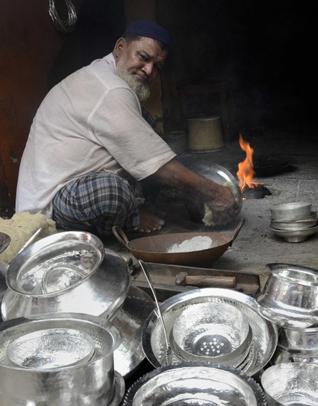
In a sharp contrast to the sweltering heat, a smiling Mohammad Faisal picks up a huge cooking vessel called degh with his right hand, and applies hair-thin Malaysian tin foil on it. Then, with a thick pad of old cotton soaked innausadar (ammonium chloride) ash, he moves the foil within the vessel, while rotating a fixed iron fan on the floor with his left hand. The result: within minutes an ultra shining degh is ready. This polishing technique is called qalai – a tin polish done only on copper and brass utensil.

Faisal is perhaps the last of this generation who inherited this craft from his grandfather Mohammad Sharfuddin, now 82. His uncle Irfan is managing shop No. 1132 at Matiya Mahal Bazar called Qalai Ghar. It is a nondescript shop in a row of attractive ones, except that it draws attention with its shining vessels – from a small bowl to a degh with 80 kg capacity.

The shop has three naand or pits full of water, as big as the bottom of an 80 kg degh , in which it is immersed slowly, soon after the hot tin foil is rubbed on it. After the wash the shine is exemplary.

Says the 52-year-old Irfan: “This shop is 150 years old but we have been in the business of qalai for about 80 years. We learnt it from our father. For now we have quite a lot of work, especially because in Old Delhi, people still keep brass and copper utensils in their homes and also gift them at weddings. Moreover, Karim Hotel gives us its qalai work every two months – we polish their 70 to 80 big and small utensils and this work remains our main source of income.”

Mohammad Irfan charges as little as Rs.20 for a small bowl measuring three inches in diameter to Rs.800 for an 80 kg degh .

Earlier, Delhi’s Bhogal and Sundar Nagar used to be the hubs for qalaiwalas; some of them can still be located in small corners. Muslim Punjabis or sadagars from Pakistan are the main users of copper and brass utensils and most of them live in Old Delhi.

The Walled City used to have as many as 10-15 qalai shops earlier. Three of the big ones were located at Turkman Gate. One of these closed during the Emergency, another one some 25 years ago, and the third one vanished without a trace, say the area residents.

Qalai Ghar too may close down in a few years from now. Sharing the reason, Irfan says: “I have not taught this skill to my three sons. They sell ready-made garments. This business may not grow in future.” He had also stopped getting ‘boys’ as trainees nearly “40 years ago”. Then inflation has also affected the skill adversely. “Earlier wood coal used to cost me Rs.3 per kg, now it is Rs.35. Earlier, a tin foil used to cost Rs.7, now it comes for Rs.1,800. Moreover, the work needs high energy levels, as we are constantly exposed to heat, fumes and our hands do not stop working for almost eight to 10 hours every day.”

There has been no technology invented to keep this skill alive either. Technology, says Irfan, is a far cry because utensil sizes vary. “How many machines can be invented to polish the vessels of all sizes and thickness,” he asks.

Though now almost all five star hotels, especially in the Capital, have again started using copper and brass utensils for health reasons and for showing a ‘connect’ with the Indian roots, yet that hasn’t got people like Irfan going.

Notably, the food cooked in an unpolished brass or copper utensil becomes poisonous, and so is the water kept in one. But some families with diabetic patients still use copper vessels for health benefits. But this is not enough to sustain the waning skill either.

The Walled City however, still has a few qalai walas . A couple of them are pheriwalas who go from door to door; a few have fixed shops at Uncha Charagh, Tazana House and Kala Mahal; while one sits on the footpath at Chandni Mahal.

Veteran Sharfuddin warns: “One should not go for pheriwalas as they do ‘duplicate’ work. They use solder rod foil (used for stitching in electronic goods), while the genuine polish can be achieved only through Malaysian tin foil which is expensive. If you rub your finger on fake-polish utensils, they will turn black, while rubbing finger on genuine polish won’t.”

source: http://www.thehindu.com / The Hindu / Home> National> Other States / by Rana Siddiqui Zaman / New Delhi – September 09th, 2014